
A complete issue · 16 pages · 1906
Judge — April 28, 1906
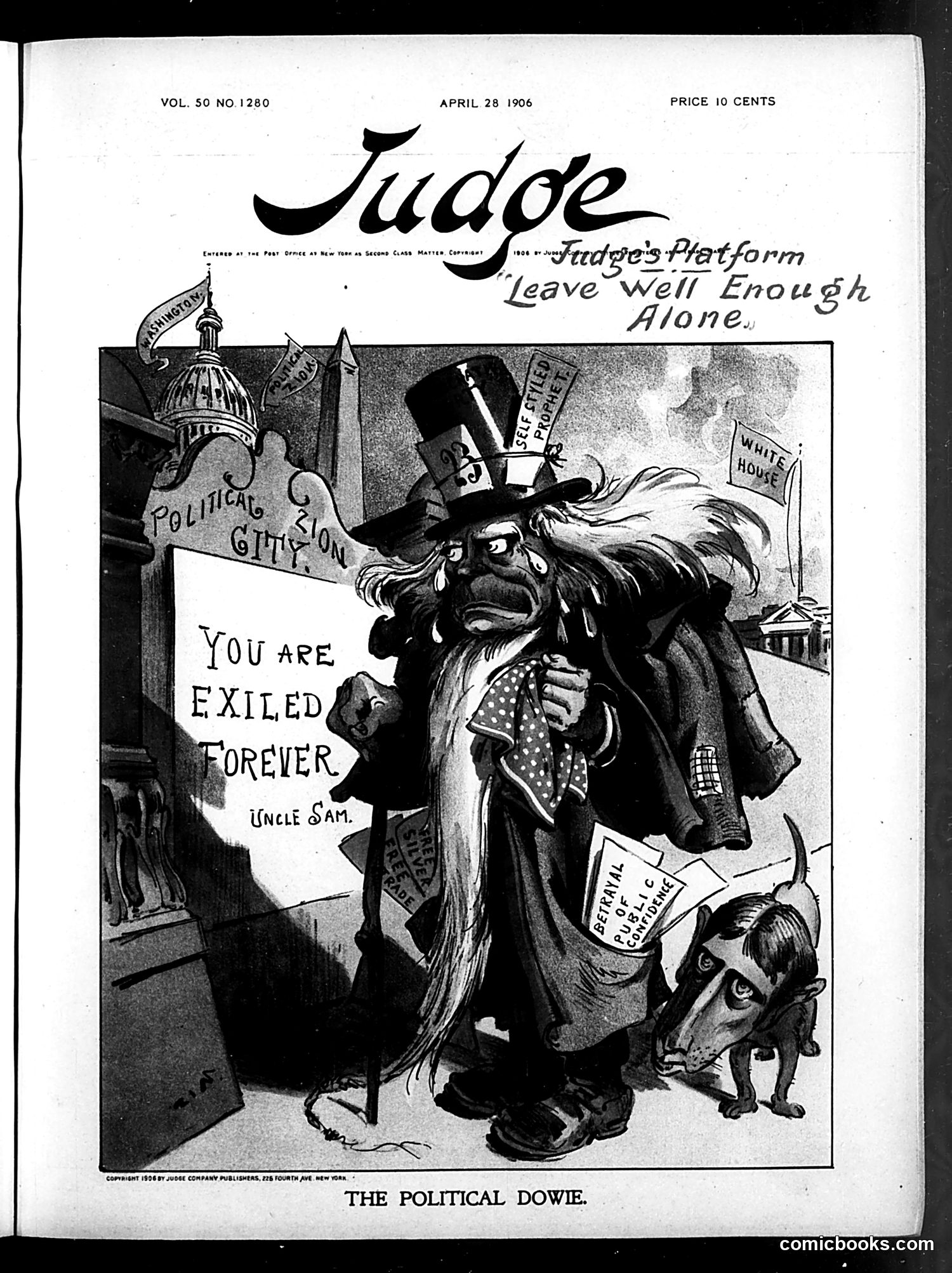
This cartoon depicts Uncle Sam (identifiable by his top hat and star-spangled vest) being forcibly exiled from the White House by a caricatured figure labeled "The Political Dowie." The exiled figure carries signs reading "Self Appointed Prophet" and "Bertha All of Dowie" (likely referencing John Alexander Dowie, a controversial religious figure and faith healer). The cartoon satirizes what appears to be Dowie's political interference or influence—suggesting he's inappropriately controlling American politics and banishing legitimate democratic governance. Uncle Sam holds a sign reading "You are exiled forever," indicating the threat Dowie's movement posed to traditional American political authority. A small dog accompanies the scene, possibly suggesting marginalization or ridicule of the movement.
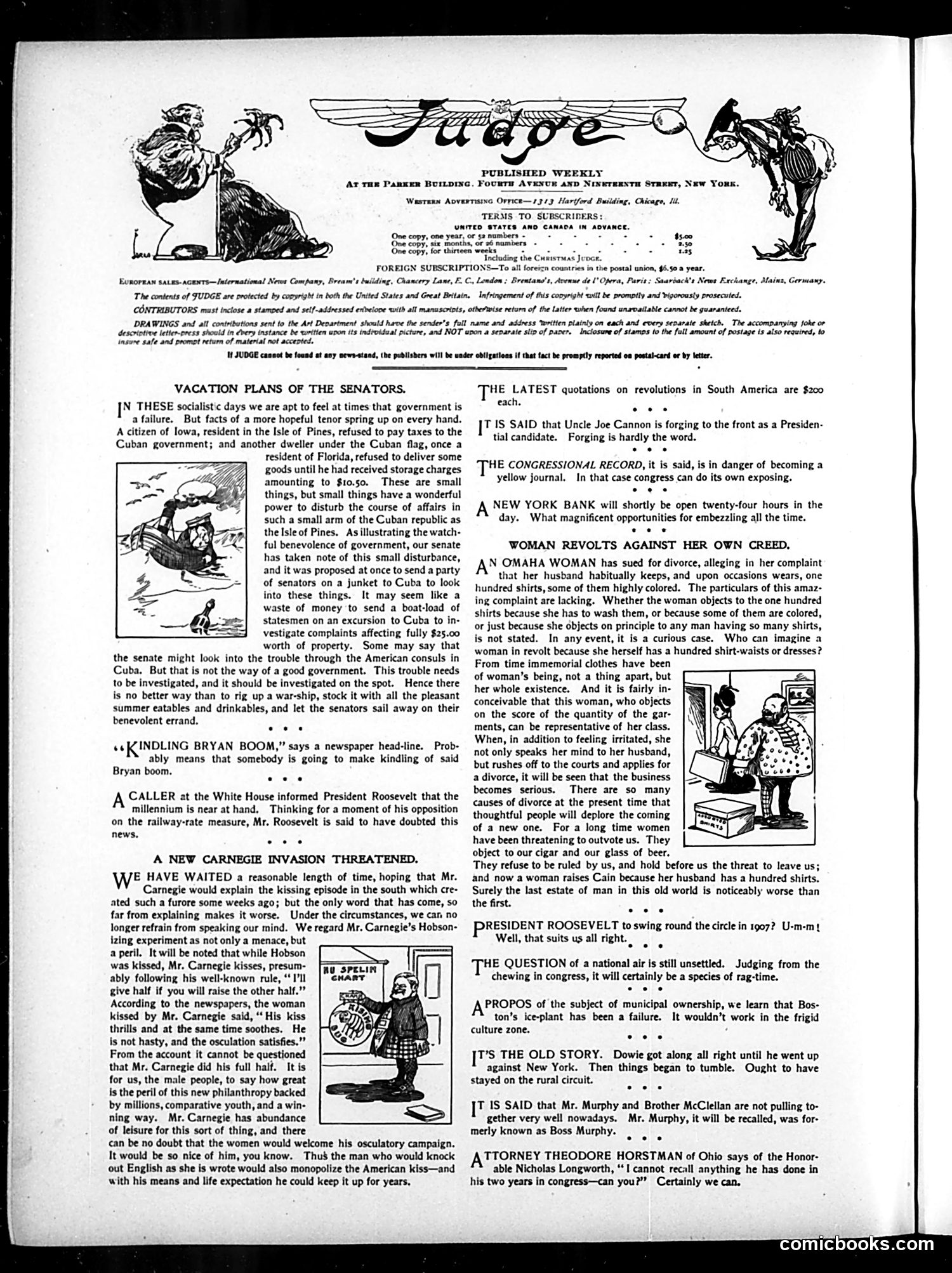
This page from Judge (a satirical weekly) contains several brief political commentaries rather than a single cartoon. The main satire targets **Senator vacation plans**, mocking senators' proposed trip to Cuba to investigate property complaints. Judge ridicules this as wasteful—using taxpayer money to send politicians on junkets disguised as fact-finding missions. Other items mock: - **President Roosevelt's potential 1908 run** ("swing round the circle") - **Andrew Carnegie's recent kiss scandal**, sarcastically defending him against criticism - **Divorce trends**, particularly a woman suing because her husband owns too many colored shirts—satirizing trivial marital disputes The cartoons (crude pen sketches) illustrate these brief items with exaggerated figures. The overall tone is cynical about politicians' self-serving behavior and contemporary social absurdities.
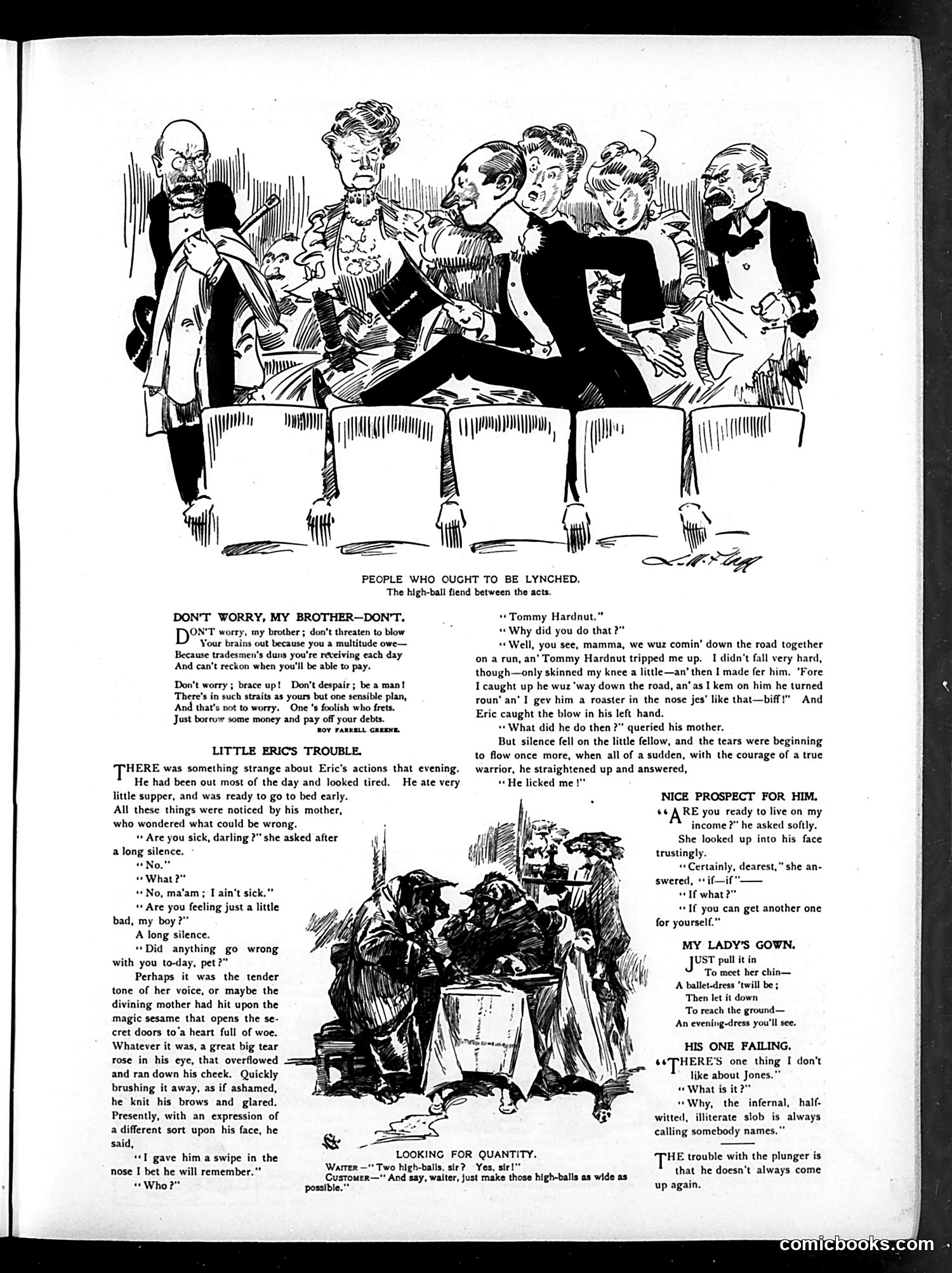
The top cartoon titled "PEOPLE WHO OUGHT TO BE LYNCHED" depicts well-dressed men at a dining table, likely representing wealthy or powerful figures of the era. The caption references "high-ball fiend between the acts," suggesting criticism of wealthy elites' drinking habits during what was likely Prohibition-era America. The lower sections contain humorous short stories and jokes, including "Little Eric's Trouble," "Nice Prospect for Him," "My Lady's Gown," "His One Failing," and "Looking for Quantity." These appear to be domestic comedies and satirical anecdotes typical of Judge magazine's social humor. Without additional context about the specific date and historical moment, the exact identities of the figures remain unclear, though the overall tone mocks upper-class pretension and behavior during this period of American social commentary.
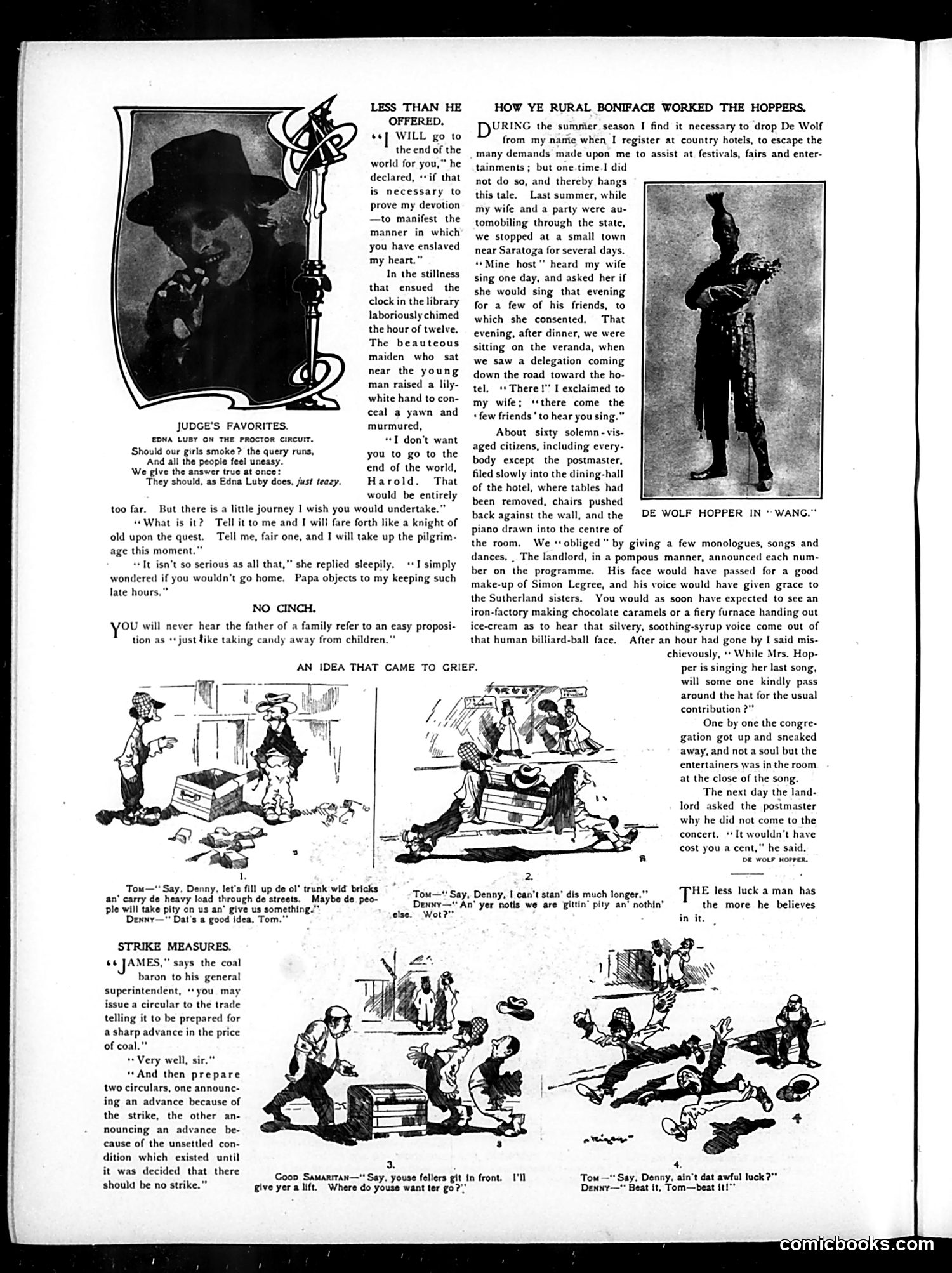
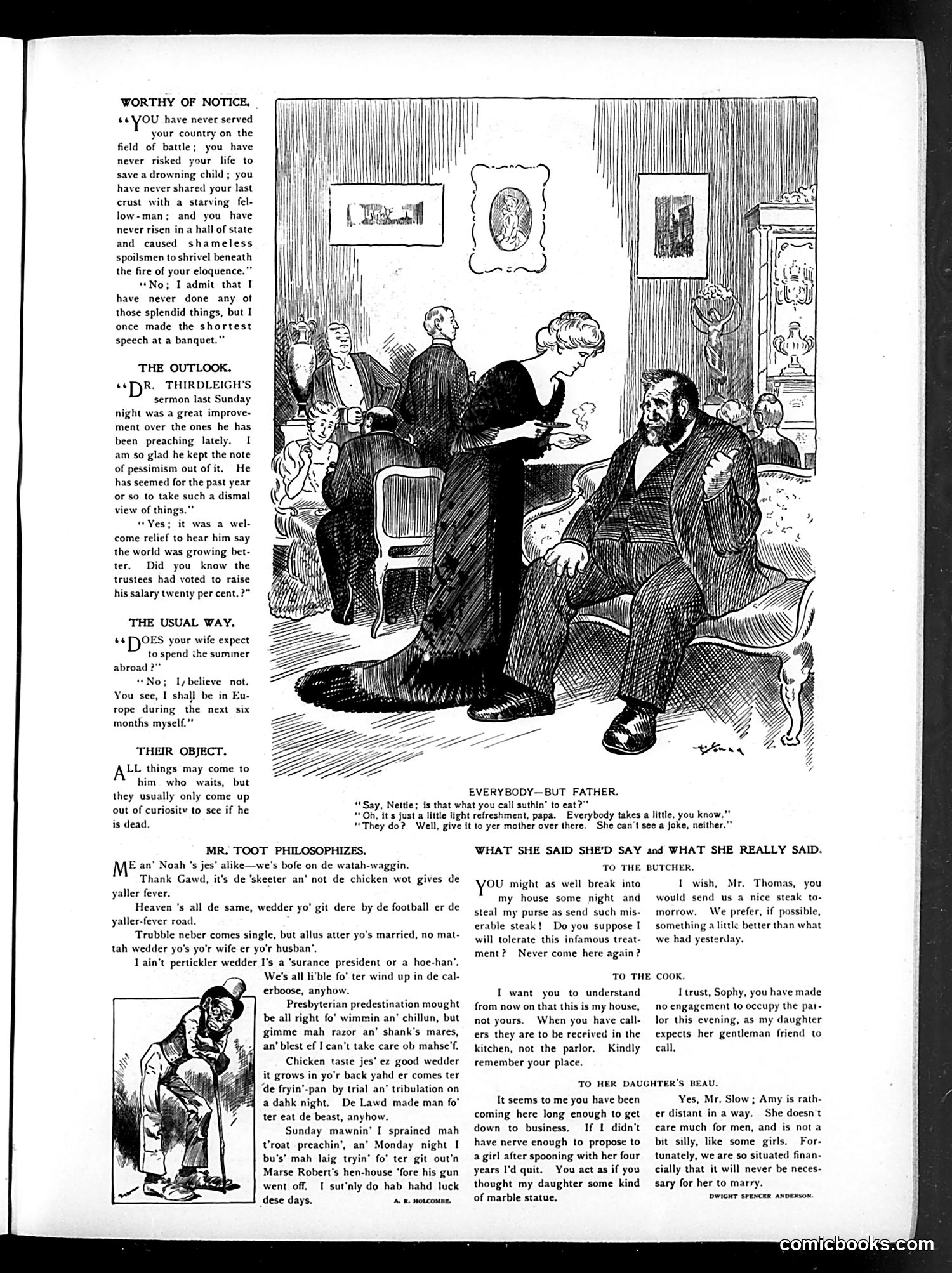
This page contains multiple satirical sketches mocking various social conventions of what appears to be the Gilded Age or early 20th century. The main cartoon depicts a social gathering where a woman serves light refreshment ("stiffer") to guests. The caption "EVERYBODY—BUT FATHER" suggests satirizing gender double standards regarding alcohol consumption—the father is excluded while others indulge. Below are dialogue-based satirical pieces lampooning: - **"Mr. Toot Philosophizes"**: A working-class character offering cynical observations about marriage and social pretension - **Butcher/Cook exchange**: Satirizing servant relations and class hierarchy, where a butcher complains about being excluded from parlors - **Daughter's suitor rejection**: Mocking upper-class attitudes toward courtship and financial suitability The humor targets class divisions, marital discord, servant treatment, and social hypocrisy—common Judge magazine targets.
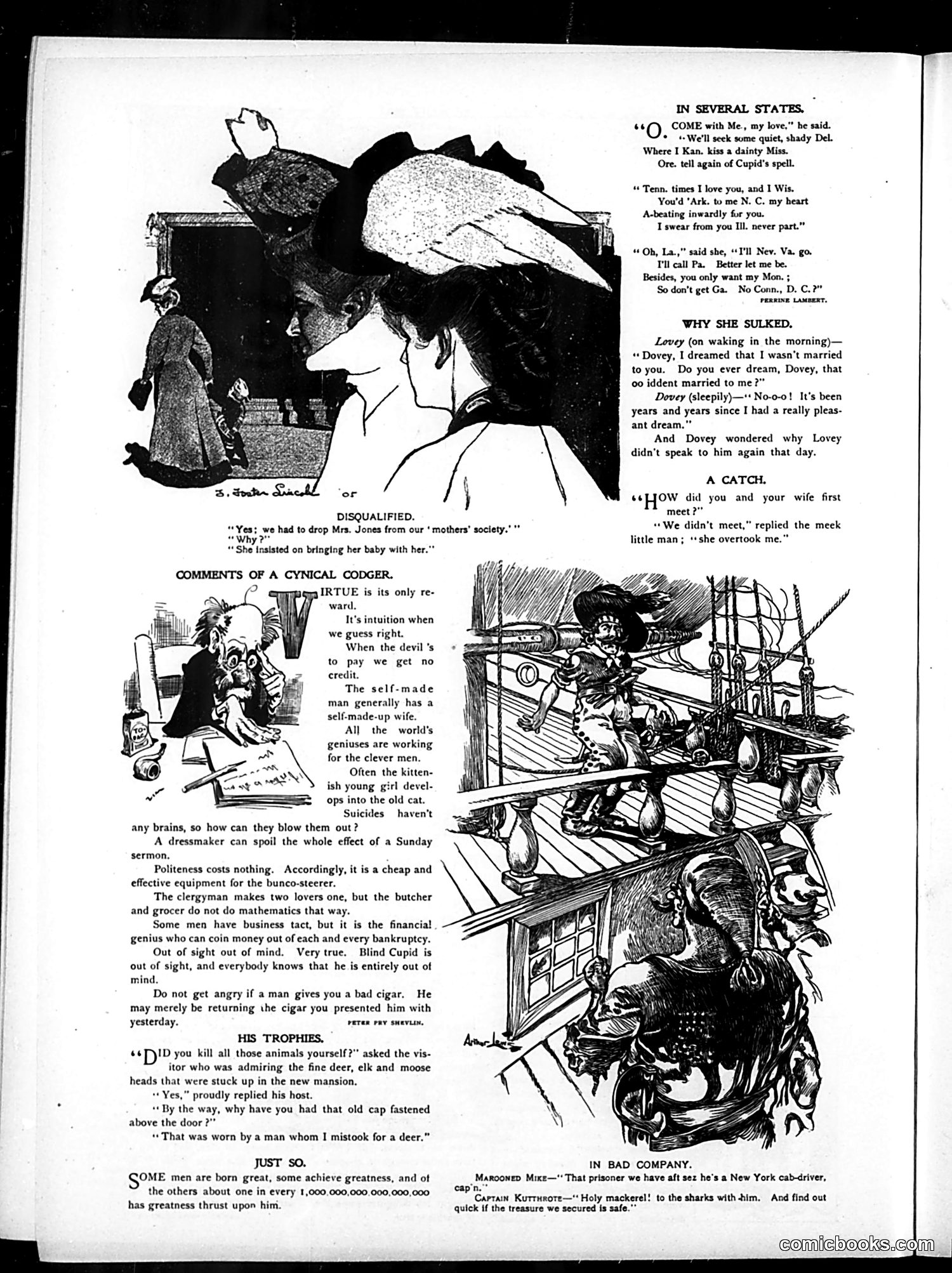
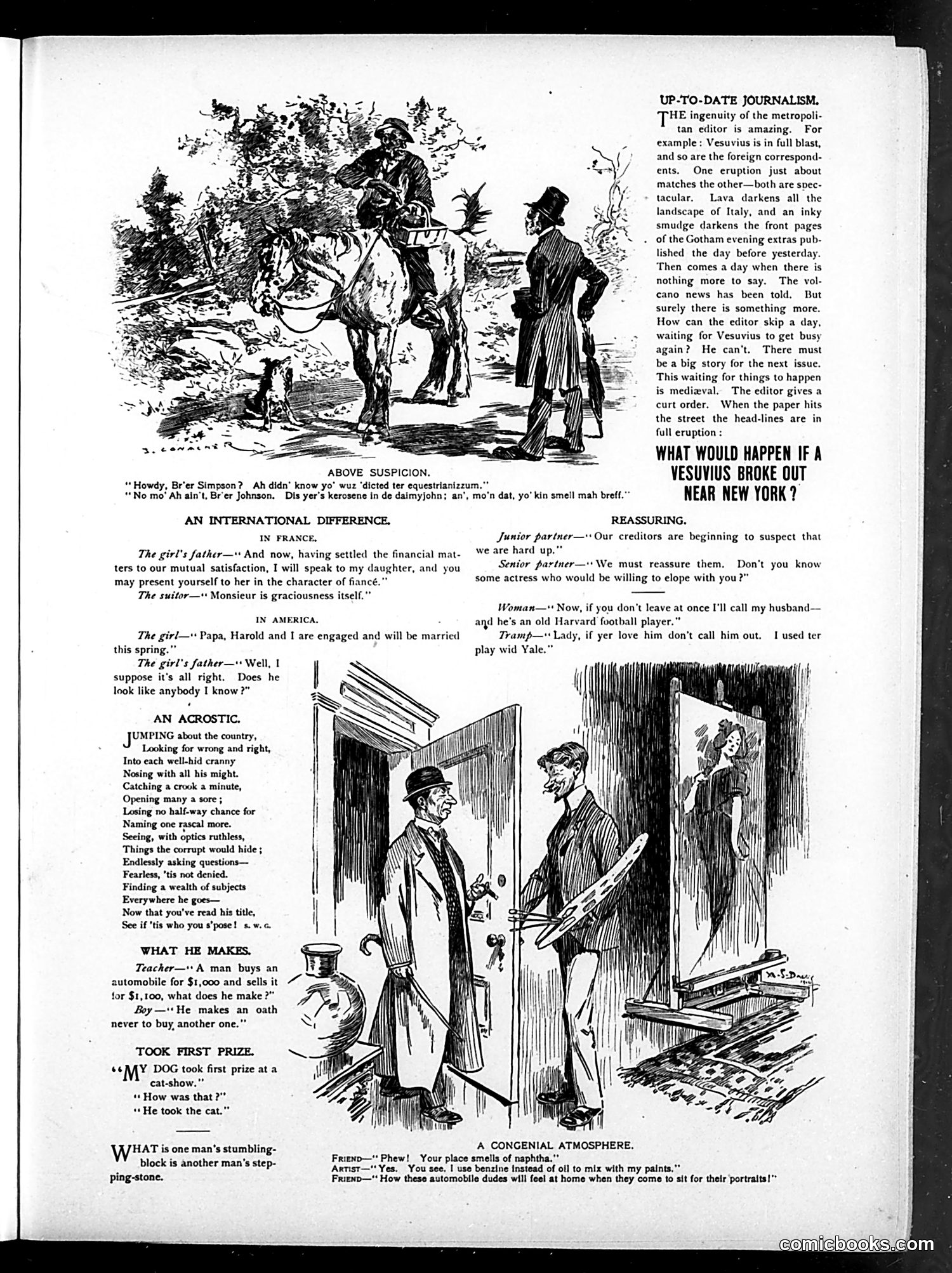
This page from Judge satirizes contemporary American life through several brief comedic pieces: **"Above Suspicion"** depicts a dialectal exchange between two Black men, with one accused of "equestrianizzum" (horse theft)—a racist stereotype joke typical of era humor. **"An International Difference"** contrasts European formality with American casualness: a French suitor respectfully meets the father after securing financial terms, while an American girl casually announces her engagement to her indifferent father. **"Up-to-Date Journalism"** criticizes sensationalist newspaper editors who fabricate catastrophic headlines when real news (like Mount Vesuvius eruptions) runs dry—mocking how metropolitan papers manufacture urgency through hyperbolic speculation rather than actual events. **"Reassuring" and "A Congenial Atmosphere"** offer brief gags about business deception and artistic eccentricity. The acrostic poem about "JOLSON" appears to reference a investigative figure, though the specific identity remains unclear without additional context. These pieces reflect Judge's satirical focus on modern American journalism, class pretension, and social manners.
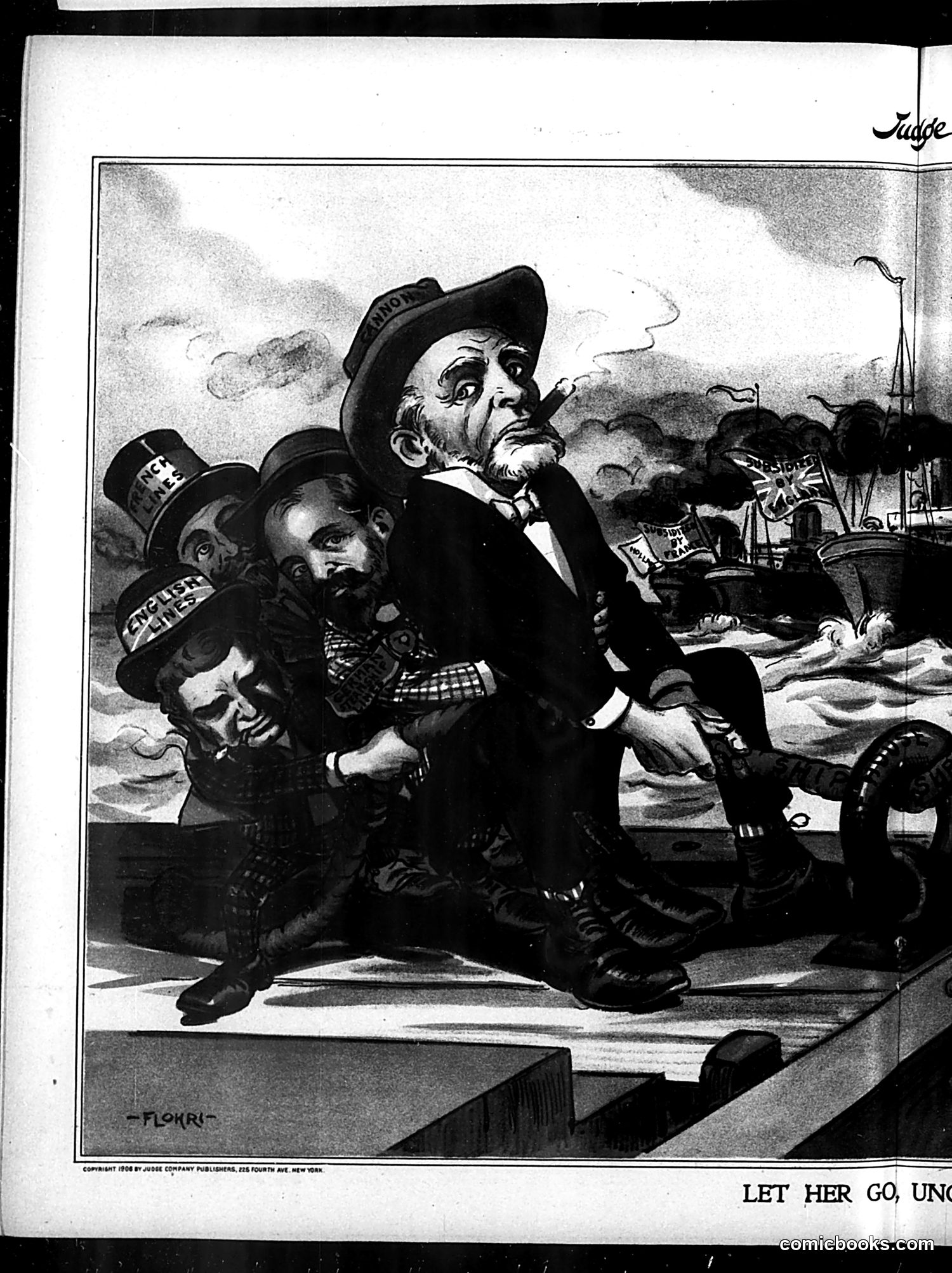
This 1906 Judge cartoon appears to satirize imperialism and colonial exploitation. The central figure—a tall, thin man in formal dress with a top hat labeled "MONROE"—likely represents American interests or policy. He's being embraced or constrained by three caricatured figures wearing hats labeled with what appear to be colonial or foreign designations, suggesting competing imperial powers. The background shows industrial/military infrastructure (smokestacks, fortifications), emphasizing the commercial and military dimensions of empire-building. The partial caption "LET HER GO, UNC[LE]" suggests this depicts an internal American political debate about releasing control of colonial territories or interests. The artist (signed "FLORI") uses exaggerated facial features typical of early 1900s satirical cartooning. Without seeing the complete caption and article, the exact political target remains somewhat unclear, but it likely critiques American foreign policy tensions during the Theodore Roosevelt era.
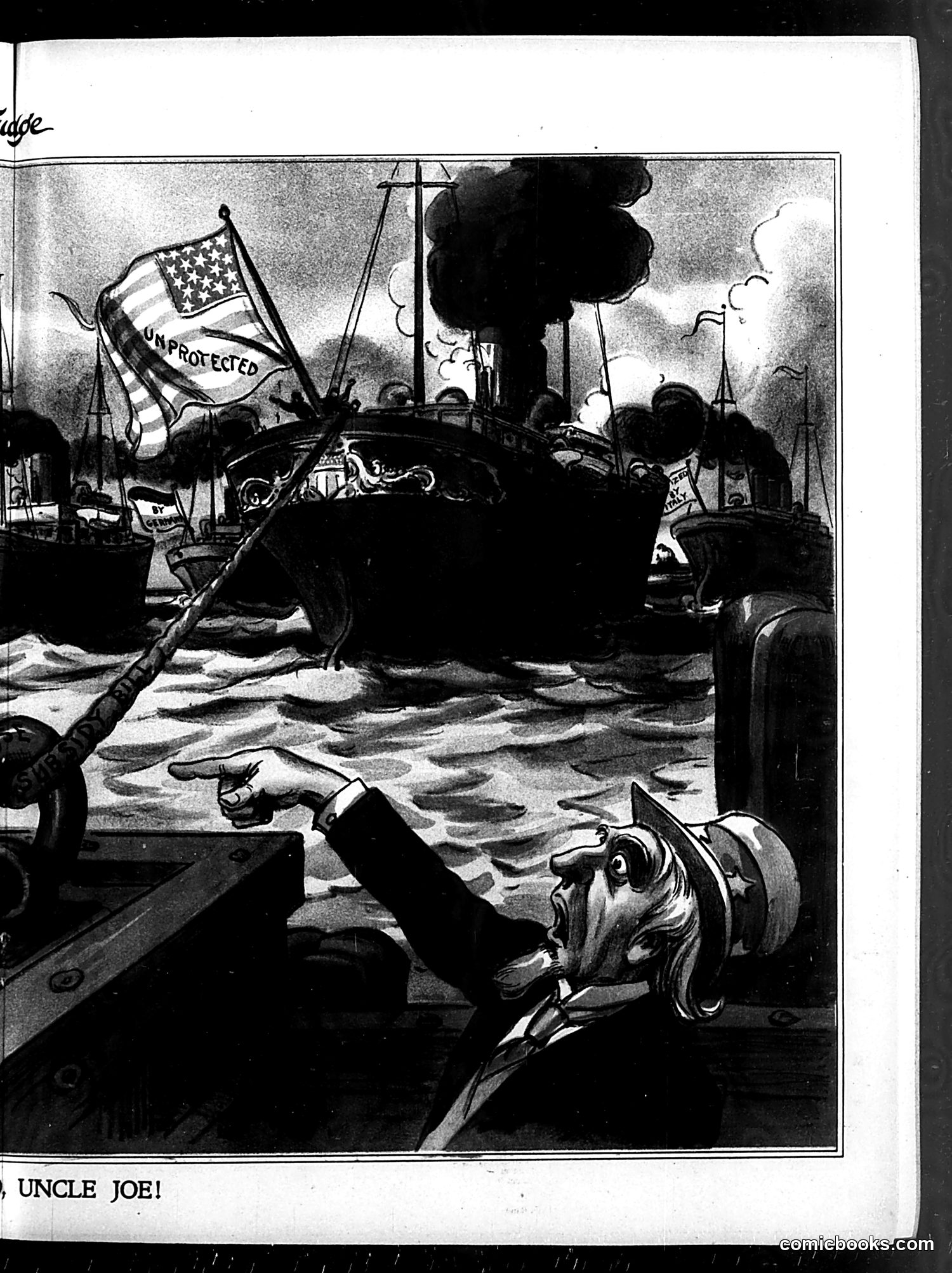
This appears to be a WWI-era satirical cartoon from *Judge* magazine titled "Uncle Joe!" The image depicts a dramatically sinking or damaged American ship labeled "UNPROTECTED" flying the American flag. The vessel is engulfed in smoke and chaos, with silhouetted figures aboard and surrounding ships visible in the background. The cartoon likely critiques American naval unpreparedness or vulnerability—possibly referencing shipping losses to German submarines. "Uncle Joe" presumably refers to Uncle Sam (the United States personified), though the specific reference remains unclear without additional context. The "UNPROTECTED" label is the cartoon's central point: it satirizes America's failure to adequately defend its merchant fleet or naval interests during this period.
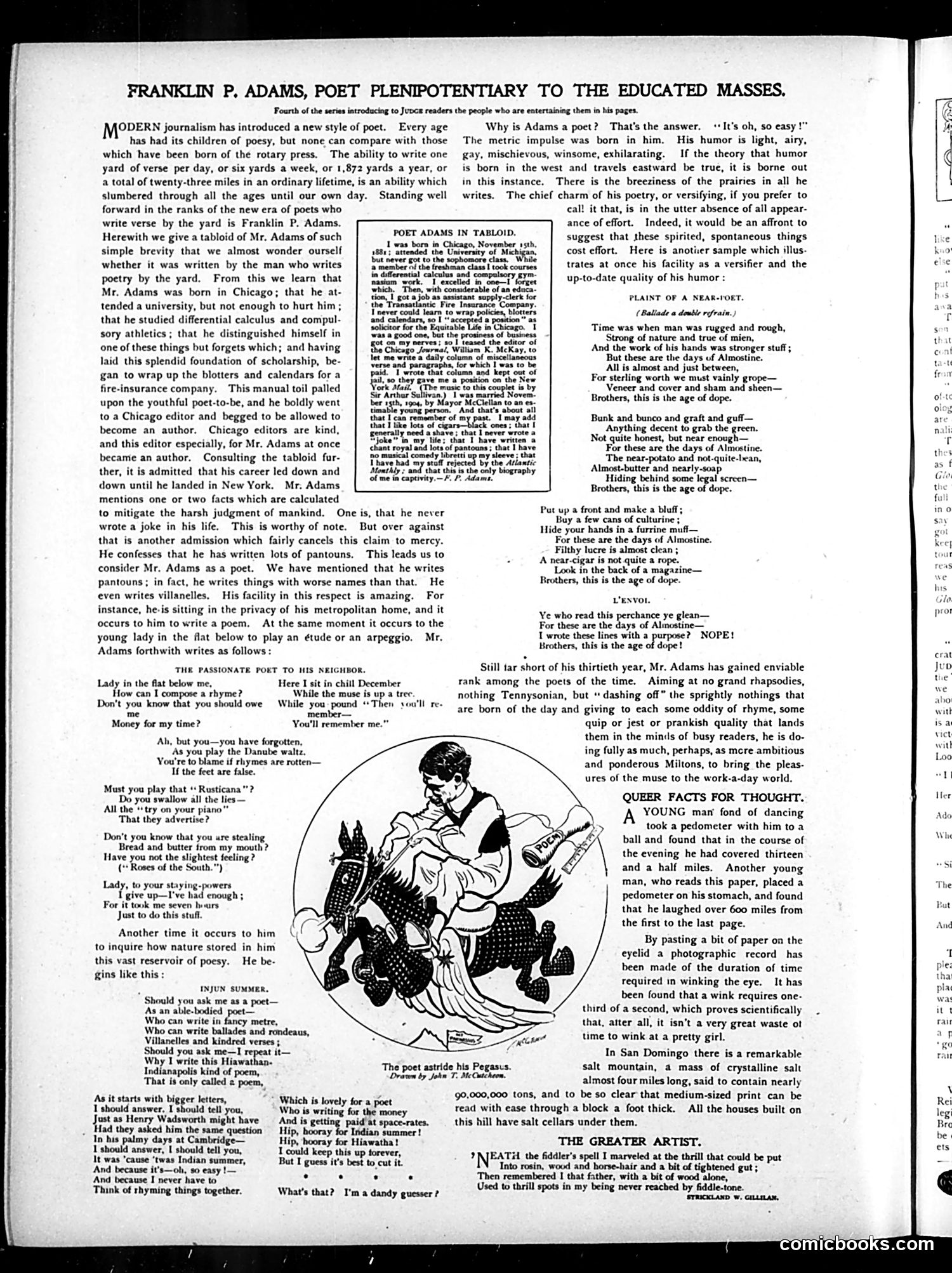
This page satirizes **Franklin P. Adams**, a prolific newspaper poet of the early 20th century who wrote verse "by the yard"—producing enormous quantities of poetry for publication. The satire targets the new breed of mass-produced poets enabled by modern journalism and the rotary press. The cartoon depicts Adams as frantically writing while a woman plays piano below, illustrating his compulsive productivity. The accompanying poem mockingly shows him complaining that his neighbor's music interrupts his verse-writing, treating poetry as mere commercial output rather than inspired art. The satire's point: Adams represents the degradation of poetry into industrial-scale product. Judge ridicules both his mechanical facility with technical forms (villanelles, pantouns) and his complaint that *others* disturb his "creative process"—implying his work requires no real inspiration, merely uninterrupted scribbling time. This reflects early-20th-century anxiety about mass culture and commercialization eroding artistic authenticity.
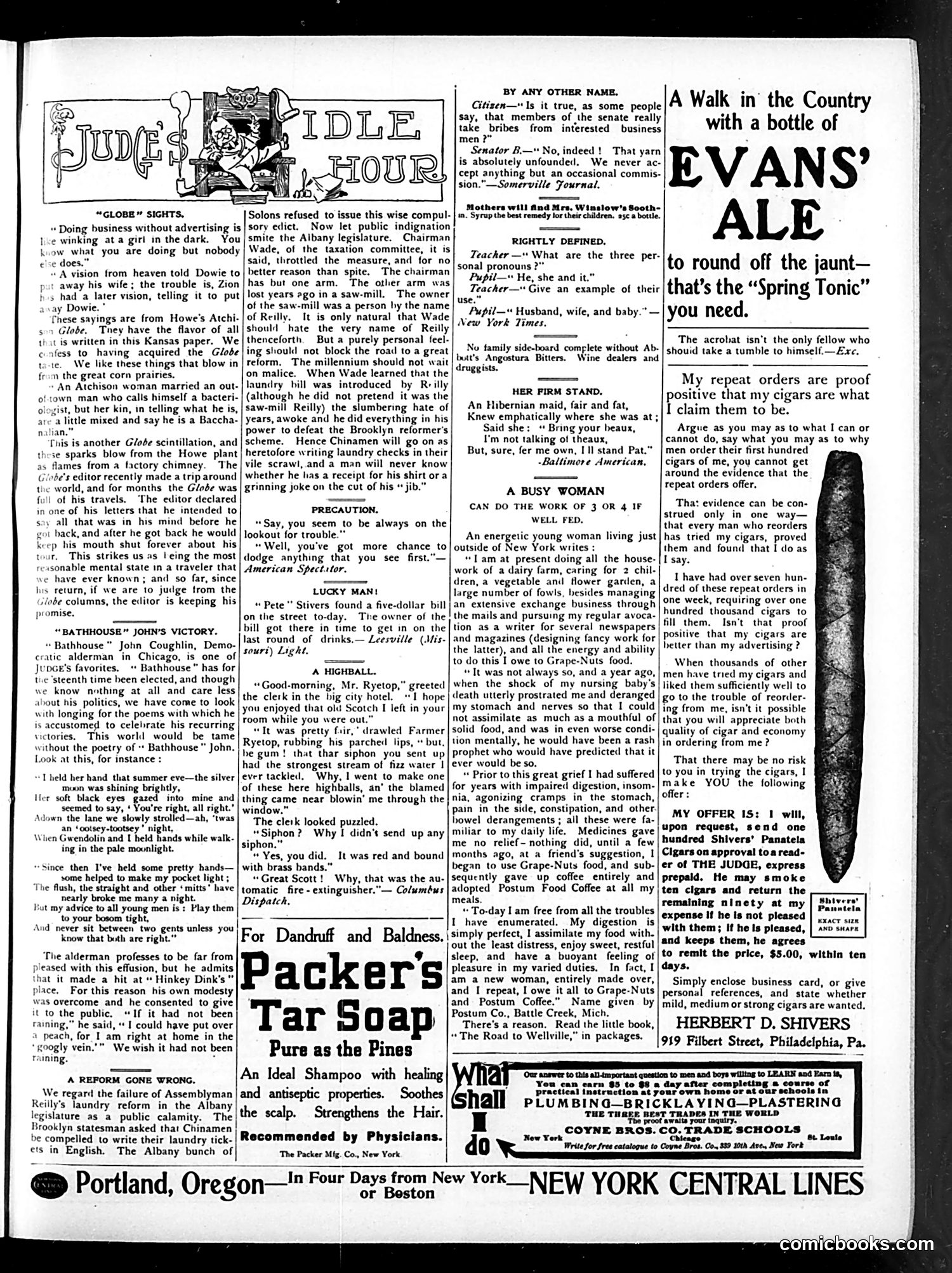
This page contains several satirical pieces targeting contemporary figures and issues: **"Globe" Sights** mocks the Atchison, Kansas newspaper for publishing absurd statements, including references to "Dowie" (likely John Alexander Dowie, a controversial religious figure of the era) and his marital troubles—presented as examples of the Globe's sensationalism. **"Bathhouse John's Victory"** celebrates the reelection of Chicago alderman John Coughlin with mockery, reprinting his self-congratulatory poetry about romance and card games. The satire suggests his "poetry" is laughably bad while noting his political influence. **"A Reform Gone Wrong"** criticizes the Albany legislature for blocking a bill requiring Chinese laundrymen to write tickets in English. The joke: legislator Wade killed the reform solely because it was sponsored by Reilly, a man whose father lost an arm in Wade's saw mill years earlier—personal grudge blocking progressive policy. The satire targets political pettiness, ethnic prejudice, and the absurdity of governance prioritizing personal vendettas over reform.
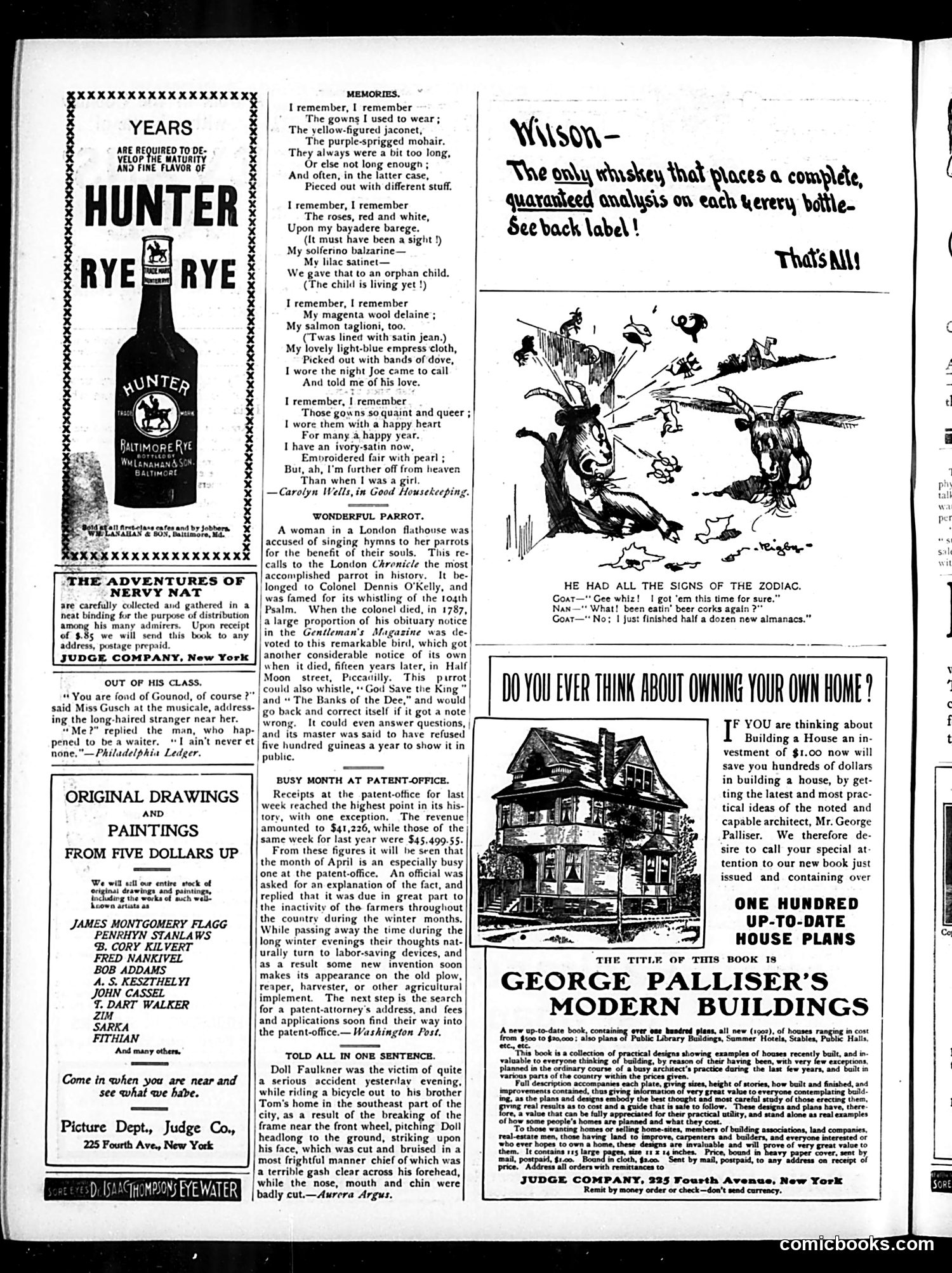
This page is primarily **advertisements and miscellaneous content** rather than political satire. The main elements are: **"Memories" poem**: A nostalgic verse about outdated women's fashions (jaconets, bayaderes, magenta delaines—all 19th-century fabrics). The melancholy ending suggests aging and lost youth, a common sentimental theme of the era. **"Wonderful Parrot" anecdote**: A humorous historical note about Colonel Dennis O'Kelly's trained parrot (died 1787) that whistled hymns and patriotic songs. It mocks both the owner's vanity and the Victorians' tendency to anthropomorphize animals. **The cartoon** (right side) depicts two goats arguing about whiskey—appears to be advertising Wilson whiskey with a joke about product analysis. **The remainder**: Patent office statistics, advertisements for art supplies, home building plans, and magazine promotions. There is **no discernible political satire** on this page—it's typical Judge filler content mixing nostalgia, animal anecdotes, and commercial advertising.
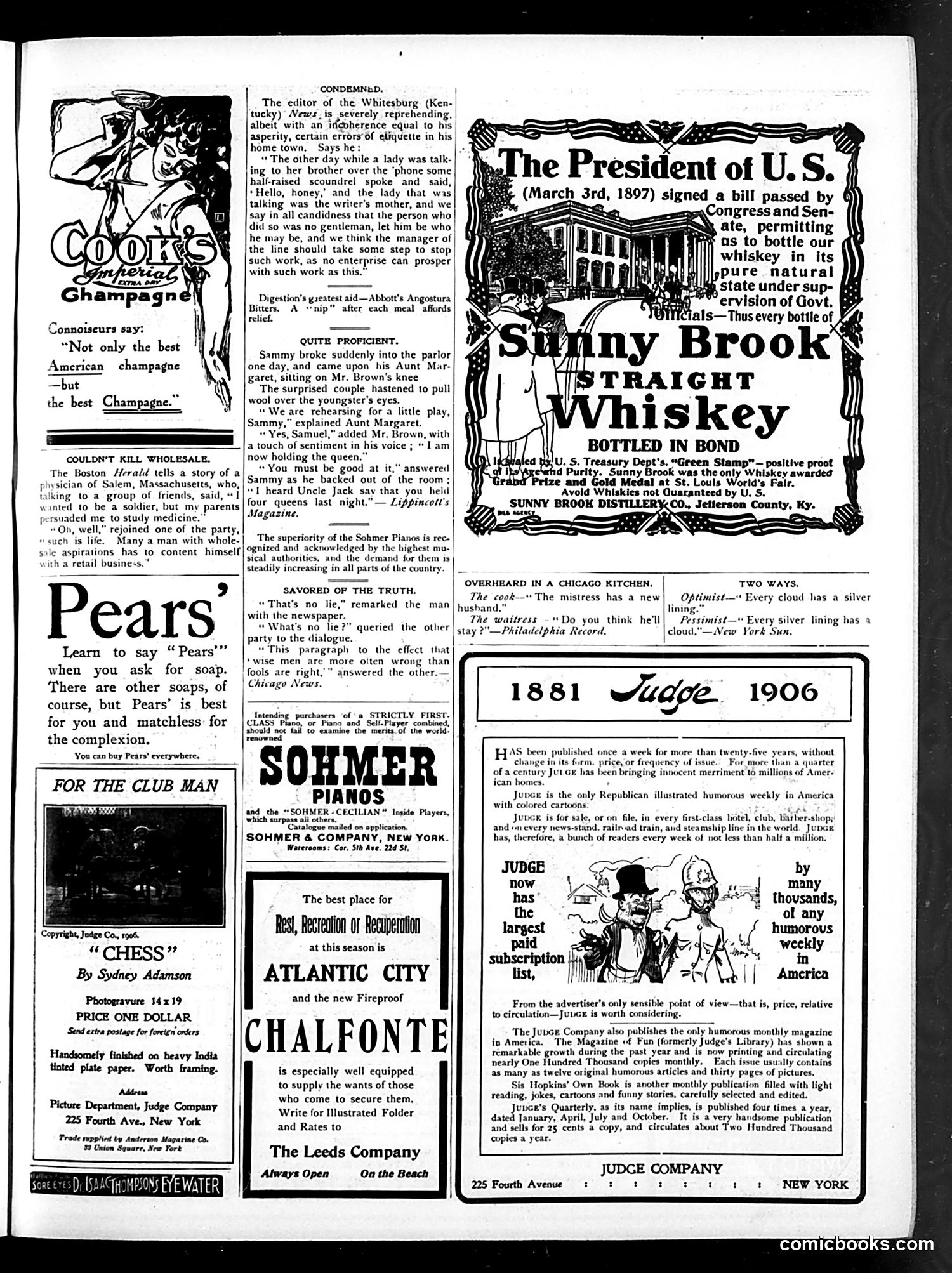
This page is primarily **advertising with brief humorous anecdotes**, rather than political satire. The main cartoons/jokes are: 1. **"Couldn't Kill Wholesale"** — A dark joke about a Salem physician who wanted to be a soldier but became a doctor instead. The punchline plays on "wholesale" vs. "retail" killing, contrasting soldiers' mass casualties with doctors' individual patient deaths. 2. **"Quite Proficient"** — A domestic comedy where a young boy catches his Aunt Margaret and Mr. Brown in a compromising position. They claim to be rehearsing a play where Brown "holds the queen." The boy's innocent reply—that he heard Uncle Jack say Brown "held four queens last night"—implies Brown is a card cheater, suggesting the adults' story is obviously false. The page is otherwise dominated by **product advertisements** for champagne, soap, pianos, whiskey, and Atlantic City hotels—typical of Judge's commercial model.
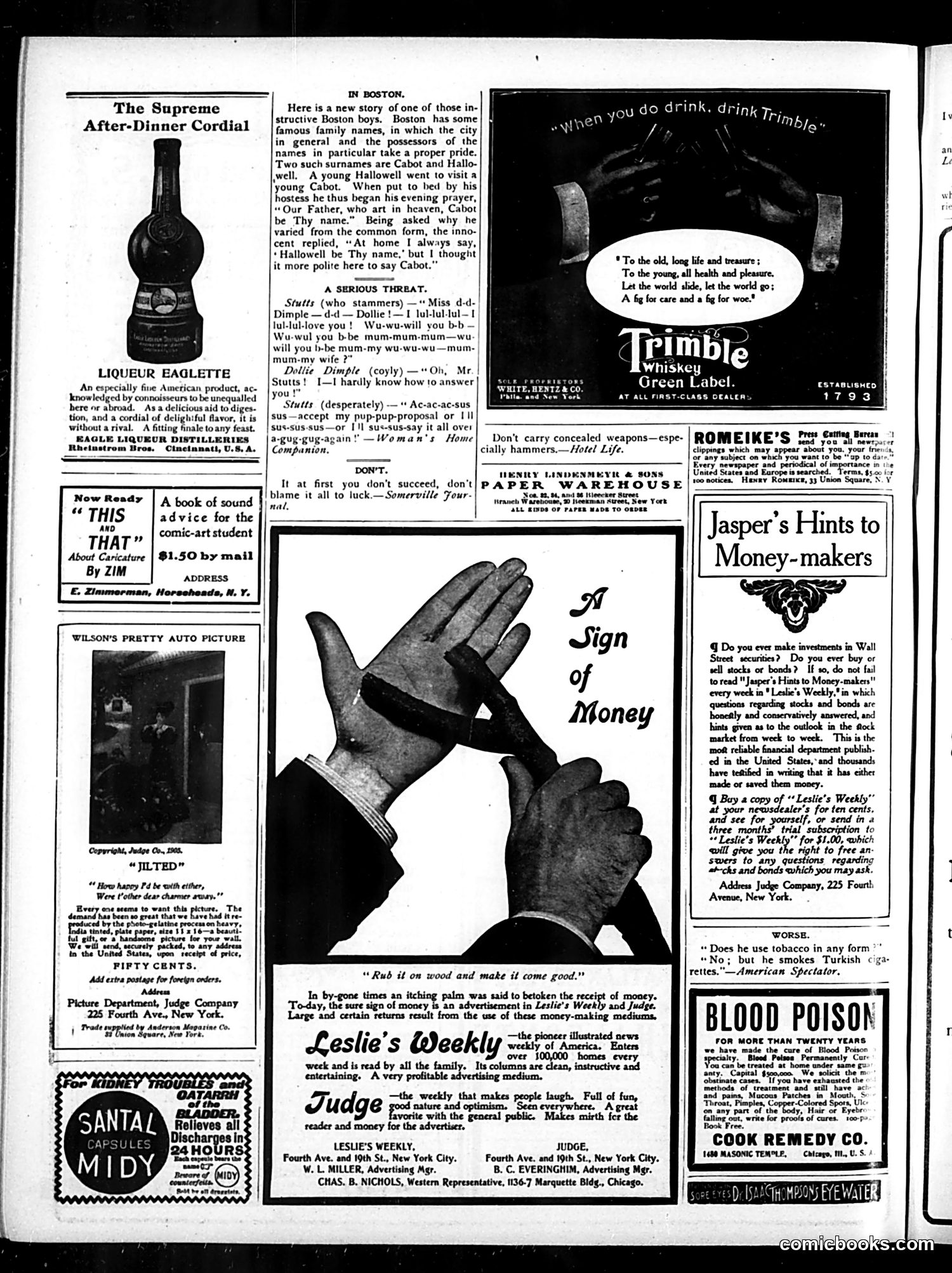
This page is primarily **advertising**, with a few short humorous pieces interspersed. The main cartoon ("A Sign of Money") depicts a hand inserting money into a slot—a visual pun about financial transactions and investment, accompanying ads for "Jasper's Hints to Money-makers" and Leslie's Weekly. The text includes two brief jokes: 1. **"In Boston"**: A satirical anecdote mocking Boston's pride in distinguished family names (Cabot, Hallowell, Hales). A young visitor from the Hallowell family, when praying before bed at a Cabot's home, changes "Hallowell be Thy name" to "Cabot be Thy name" out of politeness—the joke being the absurd substitution of family names into the Lord's Prayer. 2. **"A Serious Threat"**: A man with a stammer attempts proposing to a woman, stammering so badly he threatens to repeat his entire proposal if she doesn't accept immediately. The page otherwise contains advertisements for liqueurs, books on caricature, and financial publications typical of early 1900s Judge magazine content.
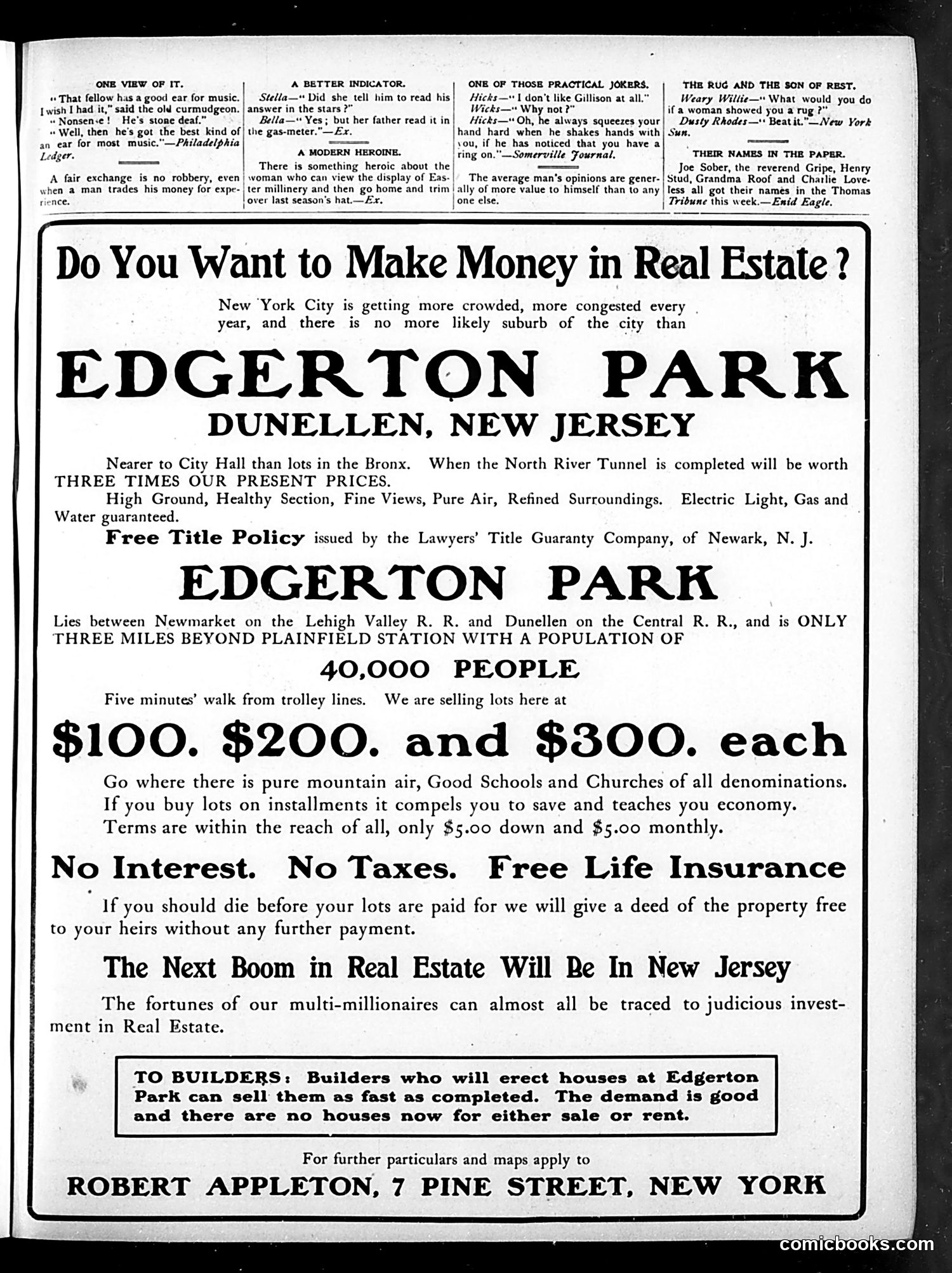
This page contains several brief satirical comic snippets at the top, followed by a large real-estate advertisement for Edgerton Park in New Jersey. The comics mock everyday absurdities: a deaf man appreciating music ironically; a woman's heroism in resisting Easter hat purchases; practical jokers testing acquaintances' manners; and vagrants' pragmatic advice about displaying rugs. The dominant content is a speculative real-estate advertisement promising enormous returns—lots will be "worth THREE TIMES OUR PRESENT PRICES" once the North River Tunnel completes. It targets small investors with minimal down payments ($5 down, $5 monthly) and free life insurance. The ad emphasizes proximity to New York City, pure air, good schools, and appeals to working-class aspiration through language about "compels you to save and teaches you economy." This likely reflects the early-20th-century suburban land boom and speculative fever that preceded the 1920s real-estate crash. Judge magazine's juxtaposition of brief satirical cynicism above this earnest advertisement may itself be ironic commentary on contemporary speculation.
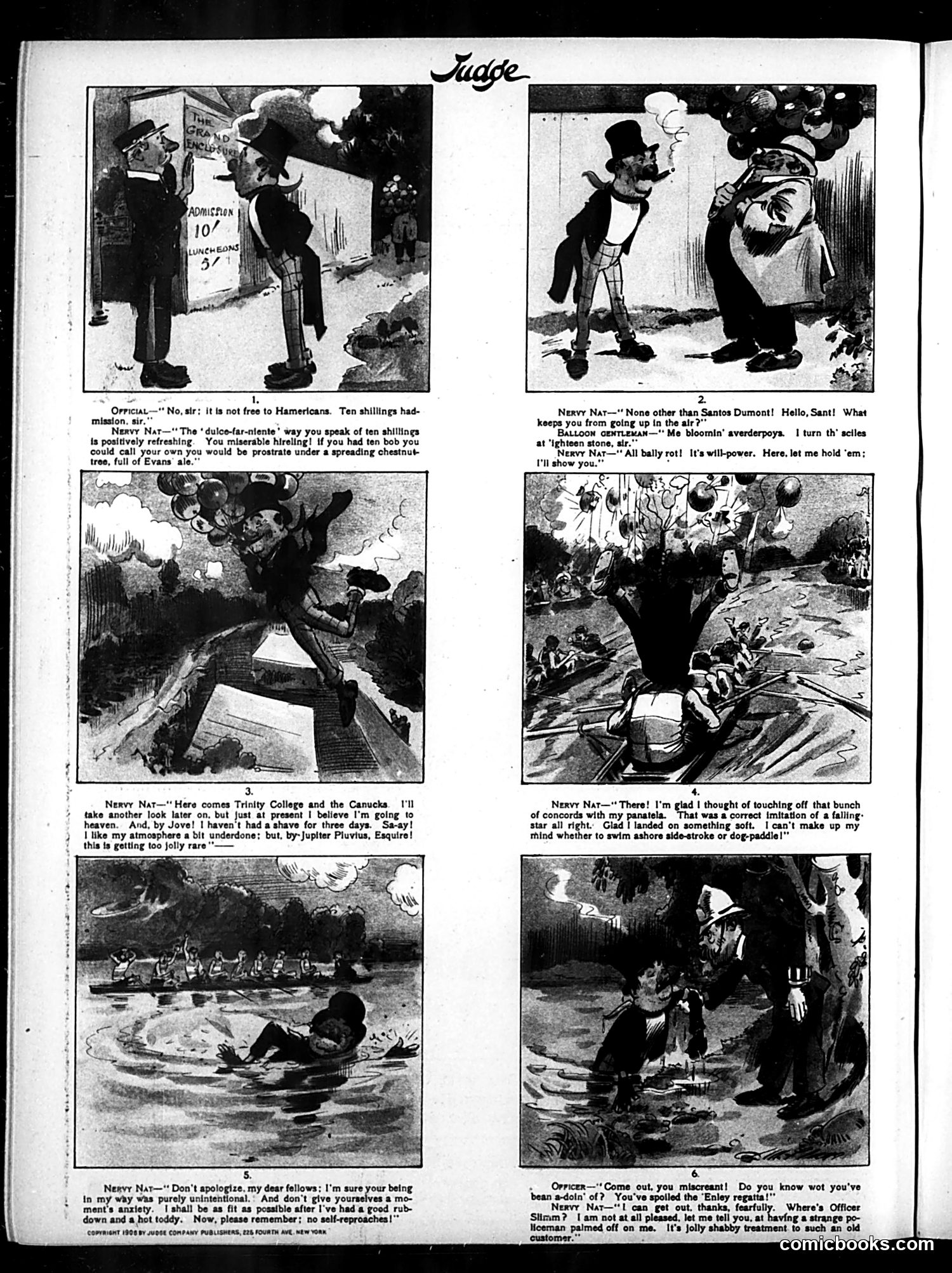
This is a comic strip following "Nervy Nat," a reckless character who repeatedly causes chaos while maintaining oblivious cheerfulness. The narrative shows Nat refusing ten shillings from an Official, then encountering Trinity College rowers and Canadian athletes ("Canucks"), before launching fireworks that he claims imitate falling stars—actually causing him to fall into water. He lands on a boat during the Henley Regatta (a prestigious British rowing event), disrupting the race. Finally, a policeman confronts him about the damage. The satire targets upper-class British entitlement and carelessness: Nat destroys public events and property while expecting sympathy and special treatment, complaining when a "strange policeman" (implying he expects preferential law enforcement) intervenes. The humor relies on his oblivious, self-centered responses to legitimate complaints about his destructive behavior. References to Santos Dumont (Brazilian aviation pioneer) and Evans' ale ground this in early 1900s culture.