
Judge, 1906-04-28 · page 10 of 16
Judge — April 28, 1906 — page 10: what you’re looking at
What you’re looking at
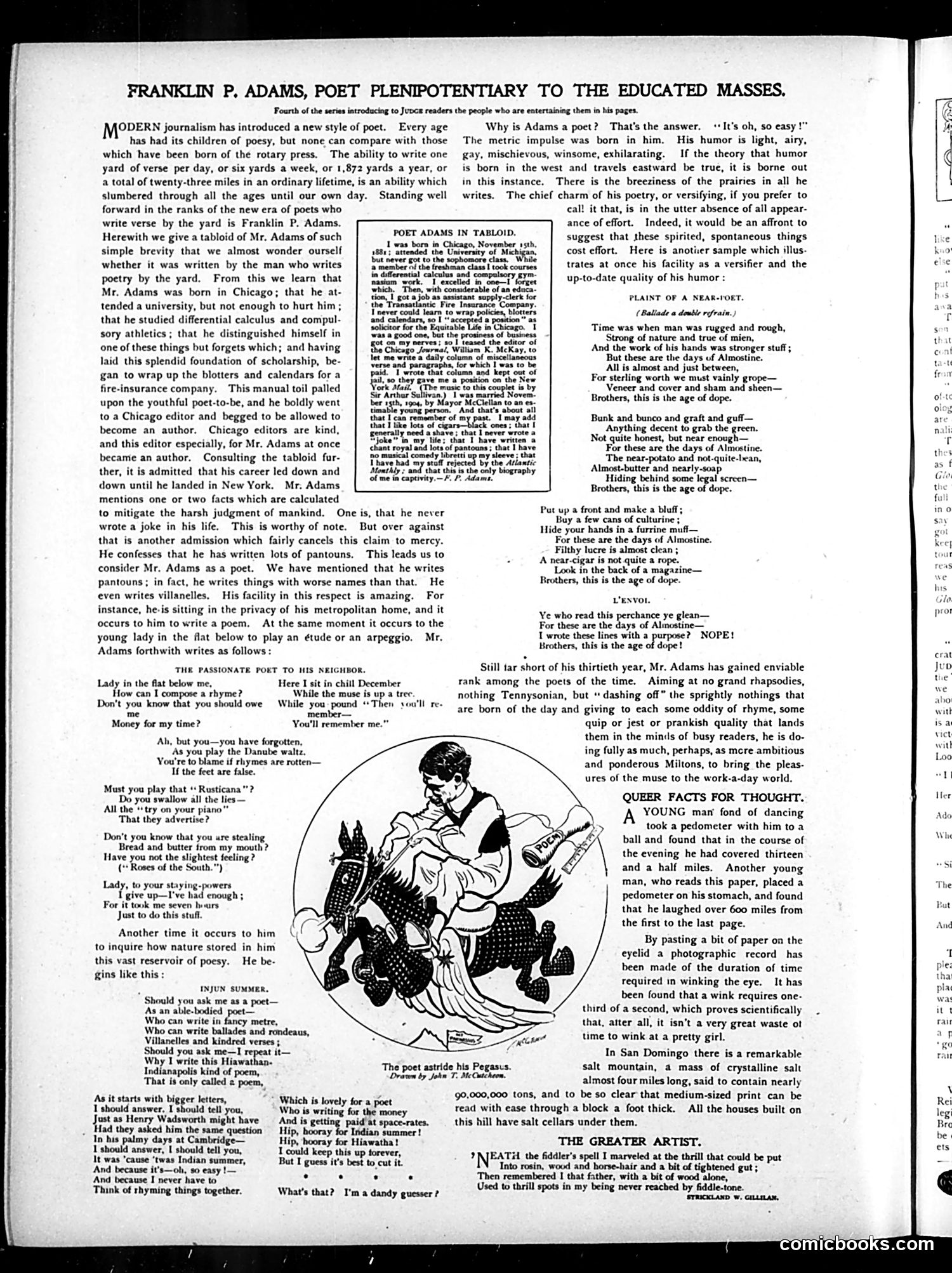
This page satirizes **Franklin P. Adams**, a prolific newspaper poet of the early 20th century who wrote verse "by the yard"—producing enormous quantities of poetry for publication. The satire targets the new breed of mass-produced poets enabled by modern journalism and the rotary press. The cartoon depicts Adams as frantically writing while a woman plays piano below, illustrating his compulsive productivity. The accompanying poem mockingly shows him complaining that his neighbor's music interrupts his verse-writing, treating poetry as mere commercial output rather than inspired art. The satire's point: Adams represents the degradation of poetry into industrial-scale product. Judge ridicules both his mechanical facility with technical forms (villanelles, pantouns) and his complaint that *others* disturb his "creative process"—implying his work requires no real inspiration, merely uninterrupted scribbling time. This reflects early-20th-century anxiety about mass culture and commercialization eroding artistic authenticity.
📄 Transcribed text from this page (OCR, searchable)
Machine-transcribed from the original scan — historical spelling and the odd misread are preserved.
FRANKLIN P, ADAMS, POET PLENIPOTENTIARY TO THE EDUCATED MASSES. Fourth of the series introducing to Jupce readers the people who are entertaining them in his pages. MODERN journalism has introduced a new style of poet. Every age has had its children of poesy, but none can compare with those which have been born of the rotary press. The ability to write one yard of verse per day, or six yards a week, or 1,872 yards a year, or a total of twenty-three miles in an ordinary lifetime, is an ability which slumbered through all the ages until our own day. Standing well forward in the ranks of the new era of poets who write verse by the yard is Franklin P. Adams. Herewith we give a tabloid of Mr. Adams of such simple brevity that we almost wonder ourself whether it was written by the man who writes poetry by the yard. From this we learn that Mr. Adams was born in Chicago; that he at- tended a university, but not enough to hurt him ; that he studied differential calculus and compul- sory athletics; that he distinguished himself in one of these things but forgets which; and having laid this splendid foundation of scholarship, be- gan to wrap up the blotters and calendars for a fire-insurance company. This manual toil palled upon the youthful poet-to-be, and he boldly went to a Chicago editor and begged to be allowed to become an author. Chicago editors are kind, and this editor especially, for Mr. Adams at once became an author. Consulting the tabloid fur- ther, it is admitted that his career led down and down until he landed in New York. Mr. Adams mentions one or two facts which are calculated to mitigate the harsh judgment of mankind. One is, that he never wrote a joke in his life. This is worthy of note. But over against that is another admission which fairly cancels this claim to mercy. He confesses that he has written lots of pantouns. This leads us to consider Mr. Adams as a poet. We have mentioned that he writes pantouns; in fact, he writes things with worse names than that. He even writes villanelles. His facility in this respect is amazing. For instance, he-is sitting in the privacy of his metropolitan home, and it occurs to him to write a poem, At the same moment it occurs to the young lady in the flat below to play an étude or an arpeggio. Mr. Adams forthwith writes as follows: was a good one, but verse a |. 1 wrote that Vork Mail, ‘no musical Thave had my staff Monthly: THE PASSIONATE POET TO IIS NEIGHBOR. Lady in the flat below me, Here I sit in chill December How can I compose a rhyme? While the muse is up a tree. Don't you know that you should owe While you-pound “Then you'll re- me member— Money for my time? You'll remember me.” Ah, but you—you have forgotten, ‘As you play the Danube waltz. You're to blame if rhymes are rotten— If the feet are false. Must you play that ‘+ Rusticana"? Do you swallow all the li All the “try on your piano” That they advertise? Don't you know that you ure stealing Bread and butter from my mouth? Have you not the slightest feeling ? (Roses of the South.") Lady, to your staying-powers ive up—I've had enough ; For it took me seven hiurs Just to do this stuff. Another time it occurs to him to inquire how nature stored in him this vast reservoir of poesy. He be- gins like this : j INJUN SUMMER. Should you ask me as a poet— As an able-bodied poet— Who can write in fancy metre, Who can write ballades and rondeai Villanelles and kindred verses ; Should you ask me—I repeat it— Why I write this Hiawathan- Indianapolis kind of poem, That is only called s poem, POET ADAMS IN TABLOID. ‘prosiness Sot an.my nerves: 20 teased Chicago Journal, Willium K. MeKay. to let me write a daily column of miscellaneous nd pis, for which I was to be aid Ts column and kept out of jail, so they gave me a position on y ibe masic to this cou ‘Arthur Sullivan.) Twas 4 fayor McClellan to an es- that this i the only biography of me in captivity.—/. P. Adams, The poet astride his Pegasus. Draven by Johm T. McCutcheon. As it starts with bigger letters, I should answer. Just as Henry Wadsworth might have Had they asked him the same question In his palmy days at Cambridge— I should answer, I should tell you, It was ‘cause ‘twas Indian summer, And because it's—oh, so easy !— And because I never have to Think of rhyming things together. Which is lovely for a poet Who is writing for the money is getting paid’ at space-rates. Hip, hooray fo Indian summer! Hip, hooray for Hiawatha ! L could keep this up forever, But I guess it’s best to cut it What's that? I'm a dandy guesser ? Why is Adams a poet? That's the answer. «It’s oh, so easy!” The metric impulse was born in him. His humor is light, airy, gay, mischievous, winsome, exhilarating. If the theory that humor is born in the west and travels eastward be true, it is borne out in this instance, There is the breeziness of the prairies in all he writes. The chief charm of his poetry, or versifying, if you prefer to cal! it that, is in the utter absence of all appear- ance of effort. Indeed, it would be an affront to suggest that these spirited, spontaneous things cost effort. Here is anotier sample which illus- trates at once his facility as a versifier and the up-to-date quality of his humor : 10, November 15th, rit PLAINT OF A NEAR-FORT. (Ballade a double refrain.) Time was when man was rugged and rough, Strong of nature and true of mien, And the work of his hands was stronger stuff ; But these are the days uf Almostine. Alll is almost and just between, New For sterling worth we must vainly grope— is by Veneer and cover and sham and sheen— aevems Brothers, this is the age of dope. Dusiness the editor of Bunk and bunco and graft and guff— Anything decent to grab the green. Not quite honest, but near enough— For these are the days of Almostine. The near-potato and not-quite-lean, Almost-butter and nearly-soap Hiding behind some legal screen— Brothers, this is the age of dope. Put up a front and make a bluff; Buy a few cans of culturine ; Hide your hands in a furrine mufl— For these are the days af Almostine. Filthy lucre is almost clean ; A near.cigar is not quite a rope. Look in the back of a magazine— Brothers, this is the age of dope. L'ENVoL. Ye who read this perchance ye glean— For these are the days of Alimostine— I wrote these lines with 2 purpose? NOPE! Brothers, this is the age of dope! Still tar short of his thirtieth year, Mr. Adams has gained enviable rank among the poets of the time. Aiming at no grand rhapsodies, nothing Tennysonian, but “dashing off” the sprightly nothings that are born of the day and giving to each some oddity of rhyme, some quip or jest or prankish quality that lands them in the minds of busy readers, he is do- ing fully as much, perhaps, as mere ambitious and ponderous Miltons, to bring the pleas- ures of the muse to the work-a-day world. QUEER FACTS FOR THOUGHT. A YOUNG man fond of dancing took a pedometer with him to a ball and found that in the course of the evening he had covered thirteen and a half miles. Another young man, who reads this paper, placed a pedometer on his stomach, and found that he laughed over 600 miles from the first to the last page. By pasting a bit of paper on the eyelid a photographic record has been made of the duration of time required in winking the eye. It has been found that a wink requires one- third of a second, which proves scientifically that, alter all, it isn’t a very great waste ot time to wink at a pretty girl. In San Domingo there is a remarkable salt mountain, a mass of crystalline salt almost four miles long, said to contain nearly 99,000,000 tons, and to be so clear that medium-sized print can be read with ease through a block a foot thick. All the houses built on this hill have salt cellars under them. THE GREATER ARTIST. ? NEATH the fiddler’ spell I marveled at the thrill that could be put Into rosin, wood and horse-hair and a bit of tightened gut ; Then remembered I that father, with a bit of wood alone, Used to thrill spots in my being never reached by fiddle-tone. STRICKLAND W. CILLILAX,