
A complete issue · 18 pages · 1906
Judge — January 27, 1906
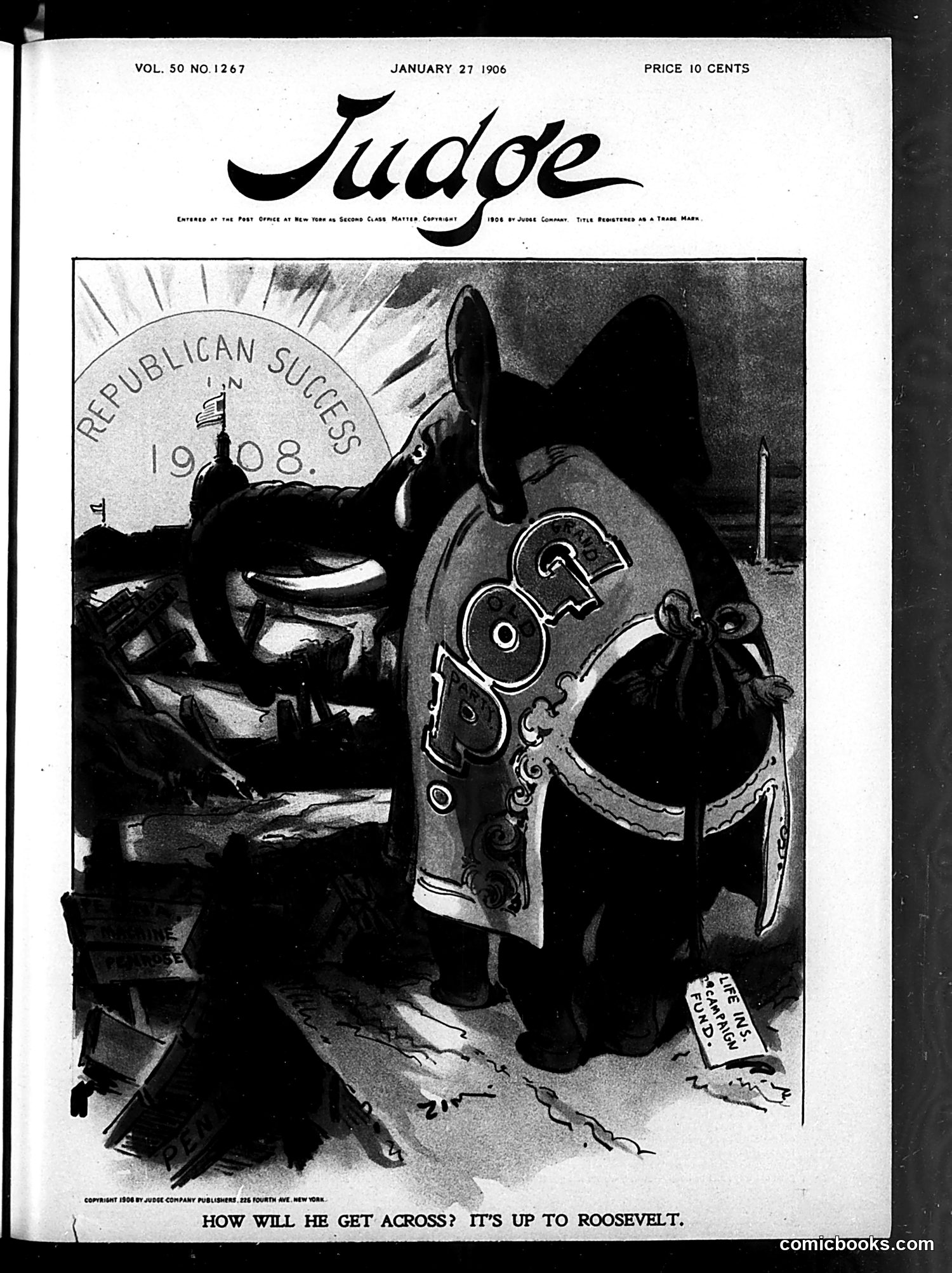
**Publication Details:** January 27, 1906 issue; price 10 cents. **Main Cartoon:** The image shows an elephant (Republican Party symbol) wearing ornate military/parade dress, positioned between two obstacles. A circular seal reading "REPUBLICAN SUCCESS 1908" appears in the background. **The Satire:** The caption reads "HOW WILL HE GET ACROSS? IT'S UP TO ROOSEVELT." This references the 1908 presidential succession question—Theodore Roosevelt had pledged not to seek another term, creating uncertainty about Republican continuity. The cartoon suggests Roosevelt must guide the party through the challenge of finding a viable successor while maintaining Republican dominance. The elephant's formal dress implies the party's pride, but the unclear path forward suggests political difficulty ahead.
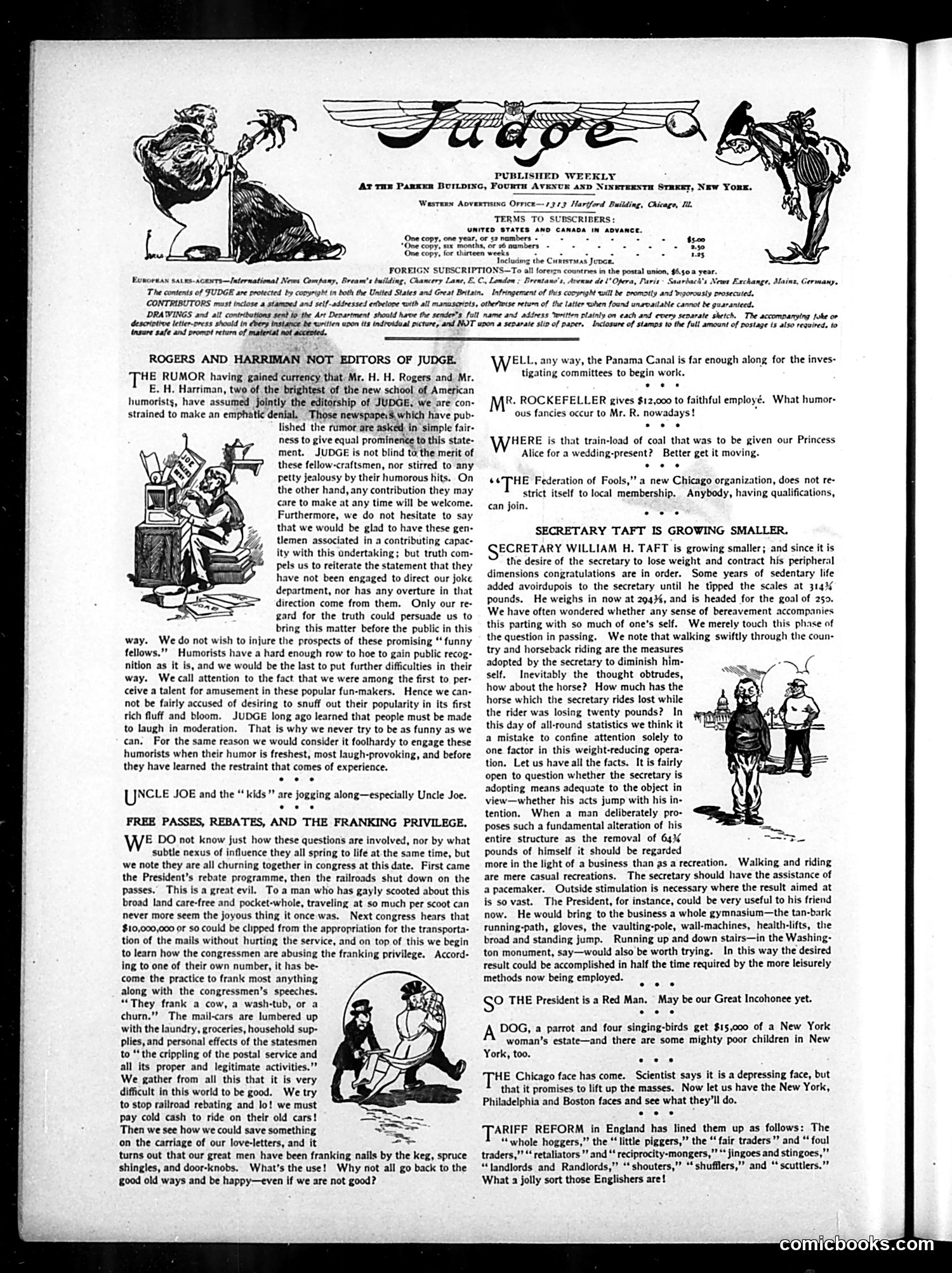
This page from Judge satirizes political and social issues of its era. The main article "Rogers and Harriman Not Editors of Judge" addresses rumors that humorists H.H. Rogers and E.C. Harriman had taken over the magazine's editorship. The piece defends Judge's independence while acknowledging these figures' contributions to humor. Other sections mock Secretary Taft's weight gain (noting he's contracted from 292½ to 254½ pounds), ridicule Congressional abuse of franking privileges for mail, and joke about President Theodore Roosevelt as a "Red Man." The cartoons feature satirical illustrations addressing governmental inefficiency and privilege abuse. Without clearer caption identification in the image, specific figures remain unclear, but the overall tone critiques both political corruption and personal eccentricities of public figures.
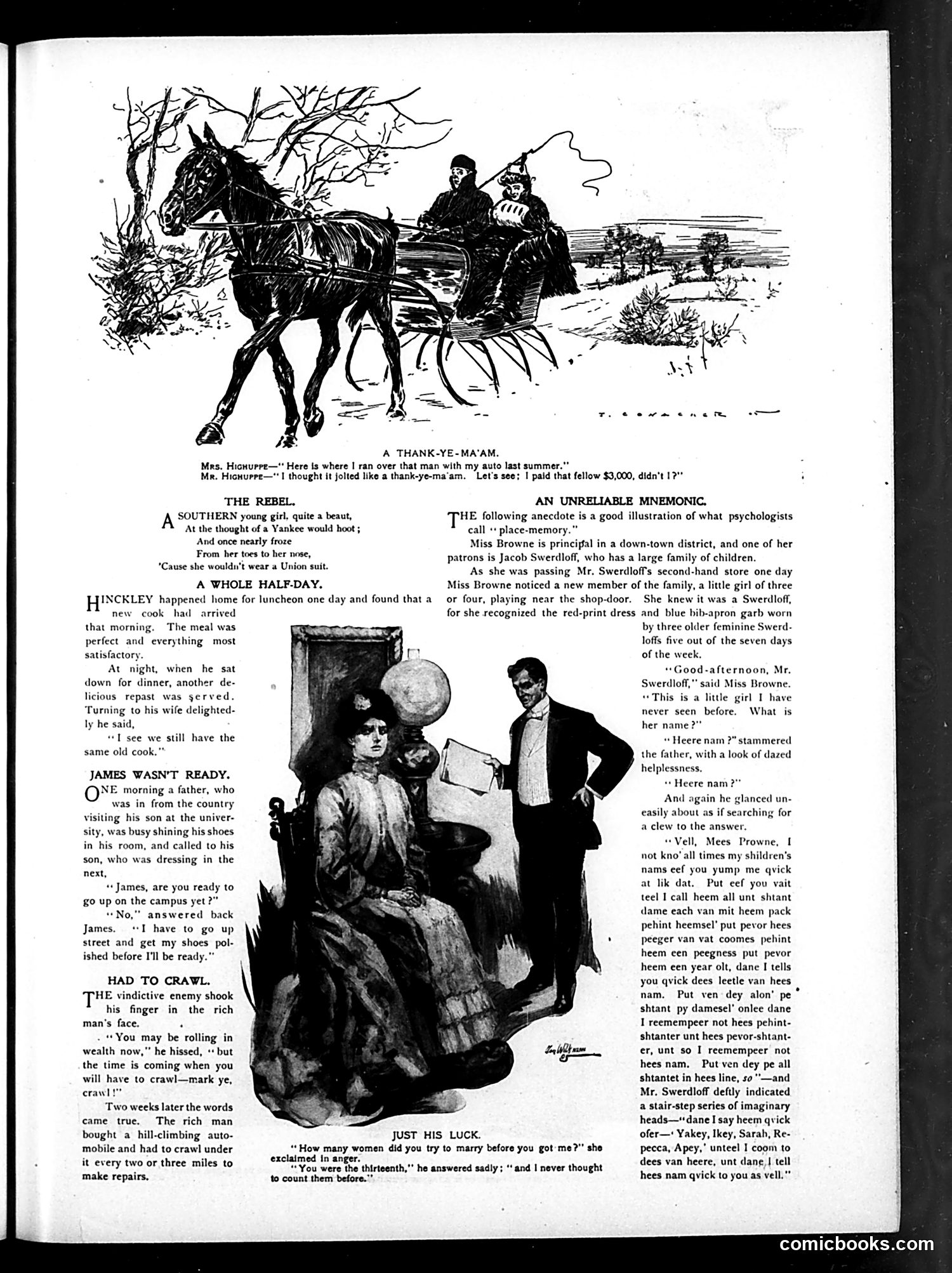
This page contains multiple unrelated short stories and anecdotes rather than political satire. **Top illustration**: Shows a horse-drawn carriage with two figures. The caption references a "thank-ye-ma'am" (a bump in the road) and a $3,000 auto repair bill—apparently satirizing the newfangled unreliability of early automobiles compared to horse transport. **Lower illustration**: Titled "Just His Luck," depicts a man with a woman, with text about marriage prospects. The anecdote concerns a wealthy father warning his son that hard times are coming and he'll need to "crawl"—later vindicated when the son must literally crawl under a broken-down automobile for repairs. The humor stems from class anxiety and the complications of new automotive technology in this early motorcar era.
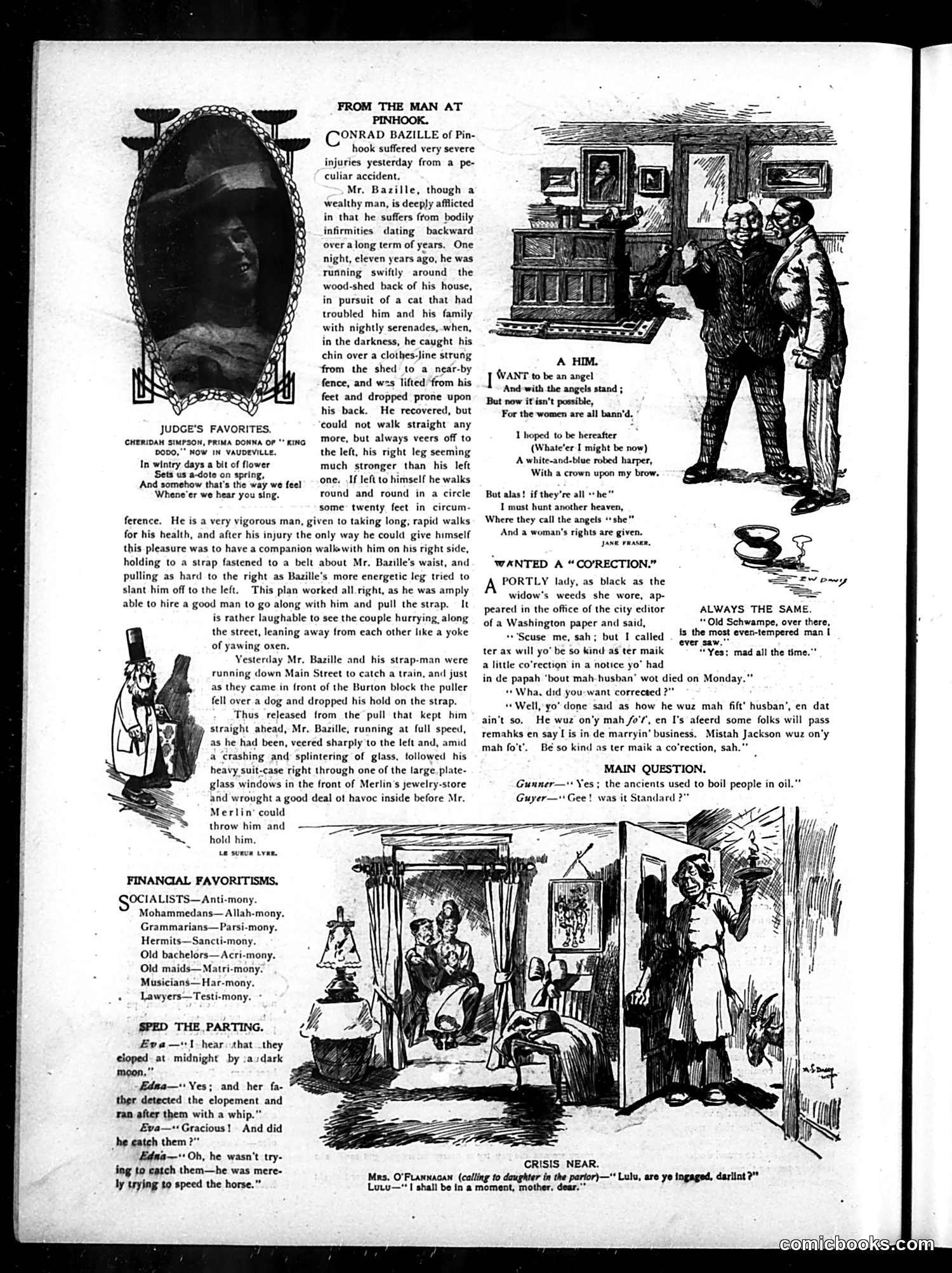
This page contains several satirical pieces typical of early 20th-century American humor: **"Judge's Favorites"** features a portrait of Conrad Bazille of Pinhook, a wealthy man afflicted with "bodily infirmities dating backward over a long term of years." The accompanying story describes his comic misadventure when he caught his chin on a clothesline while chasing a cat at night, resulting in injury. This appears to mock either a real local figure or exemplify comic physical misfortune. **Other sections** include humorous anecdotes like "Wanted a Correction" (a widow's comic complaint about her husband's death notice) and "Always the Same" (dialogue mocking predictable masculine behavior). The cartoons satirize domestic life and social awkwardness. Without identified public figures, these pieces represent Judge's general approach: mocking ordinary people's follies, marital discord, and social pretension rather than specific political targets.
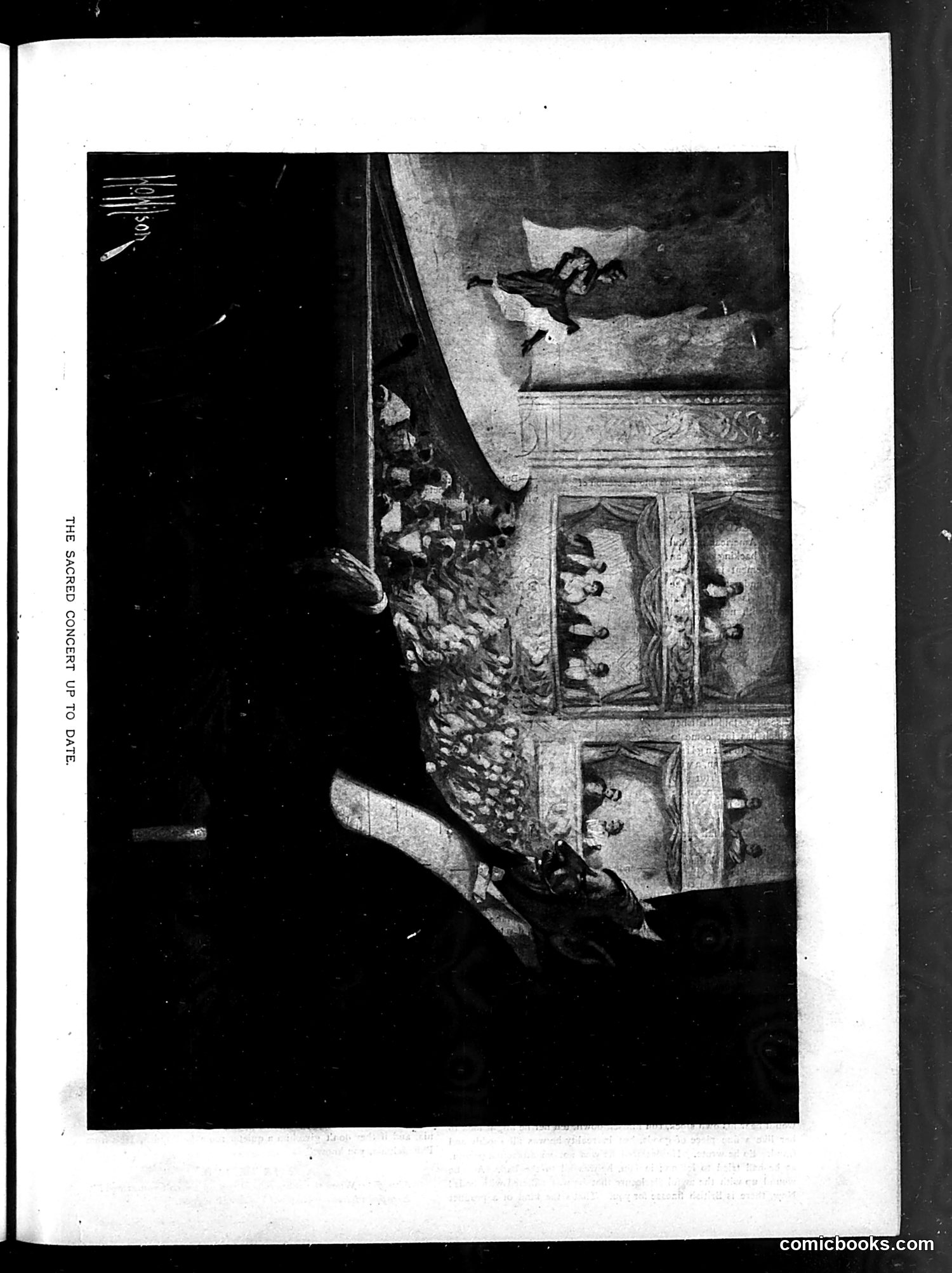
This cartoon satirizes a religious concert or church musical performance. The image shows an ornate theater or concert hall interior, viewed from an unconventional angle (rotated 90 degrees), with a performer on stage and audience members visible in windows or boxes. The title "The Sacred Concert Up to Date" suggests the satire targets modern performances of sacred/religious music, likely critiquing how contemporary entertainment culture has infiltrated church spaces. The theatrical setting, elaborate architectural details, and audience arrangement imply commercialization or secularization of religious music—transforming what should be spiritual into mere spectacle or "show business." Without clearer text, the specific cultural moment or figures remain unclear, but the satire seems to mock the incongruity between sacred tradition and modern theatrical presentation.
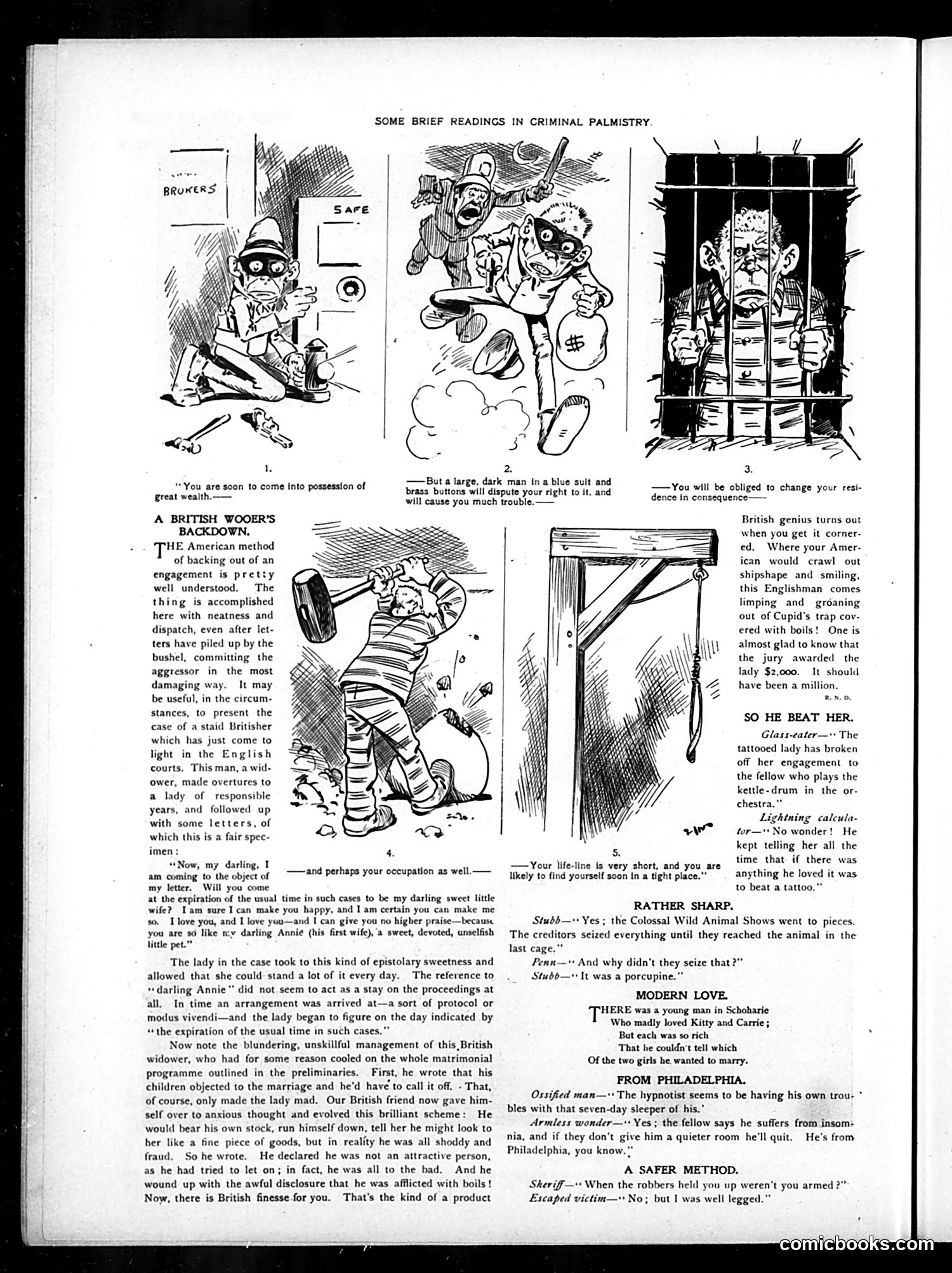
This page satirizes British courtship customs through palm-reading "predictions" that humorously foreshadow romantic misfortune. The main feature, "A British Wooer's Backdown," mocks an English widower who, after proposing marriage with flowery letters comparing his fiancée to his deceased wife "Annie," attempts to escape the engagement by claiming he's unattractive and afflicted with boils—a cowardly contrast to how Americans "crawl out shipshape and smiling." The satire suggests British men lack the directness of Americans, instead employing elaborate deception. The jury awarded the jilted woman $2,000, which Judge ironically deems insufficient compensation for such humiliation. Secondary jokes address tattooed ladies, animal shows, and love triangles—typical turn-of-century humor mocking both British pretension and contemporary American follies.
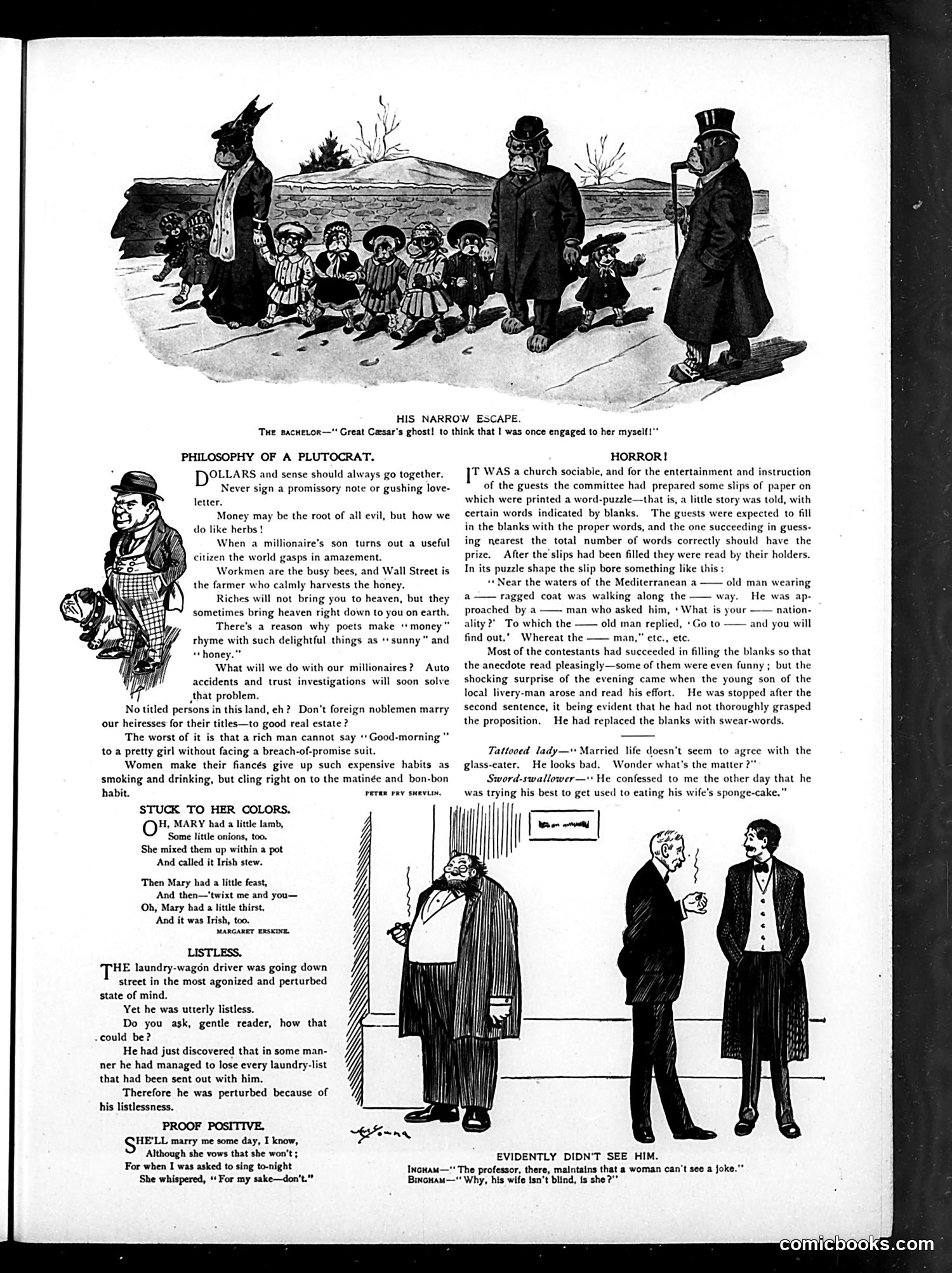
This page contains several humor pieces from the Gilded Age satirizing wealth and social pretension. **"His Narrow Escape"** depicts a bachelor relieved he didn't marry a woman now being courted by wealthy, eccentric suitors—mocking both fortune-hunters and wealthy eccentrics. **"Philosophy of a Plutocrat"** is social commentary on American capitalism: the wealthy exploit workers ("Wall Street harvests honey"), money corrupts morality, and rich heirs are celebrated merely for being useful. It satirizes the contradiction that riches won't get you to heaven yet somehow bring "heaven to earth"—cynically suggesting material excess substitutes for virtue. The remaining pieces are light humor: puns about laundry ("listless"), an Irish stew joke, wordplay about a young man's failed attempt at a word-puzzle game (he fills blanks with profanities), and jokes about sideshow performers. The overall thrust: Judge ridicules plutocratic hypocrisy while poking fun at ordinary people's foolishness and social climbing.
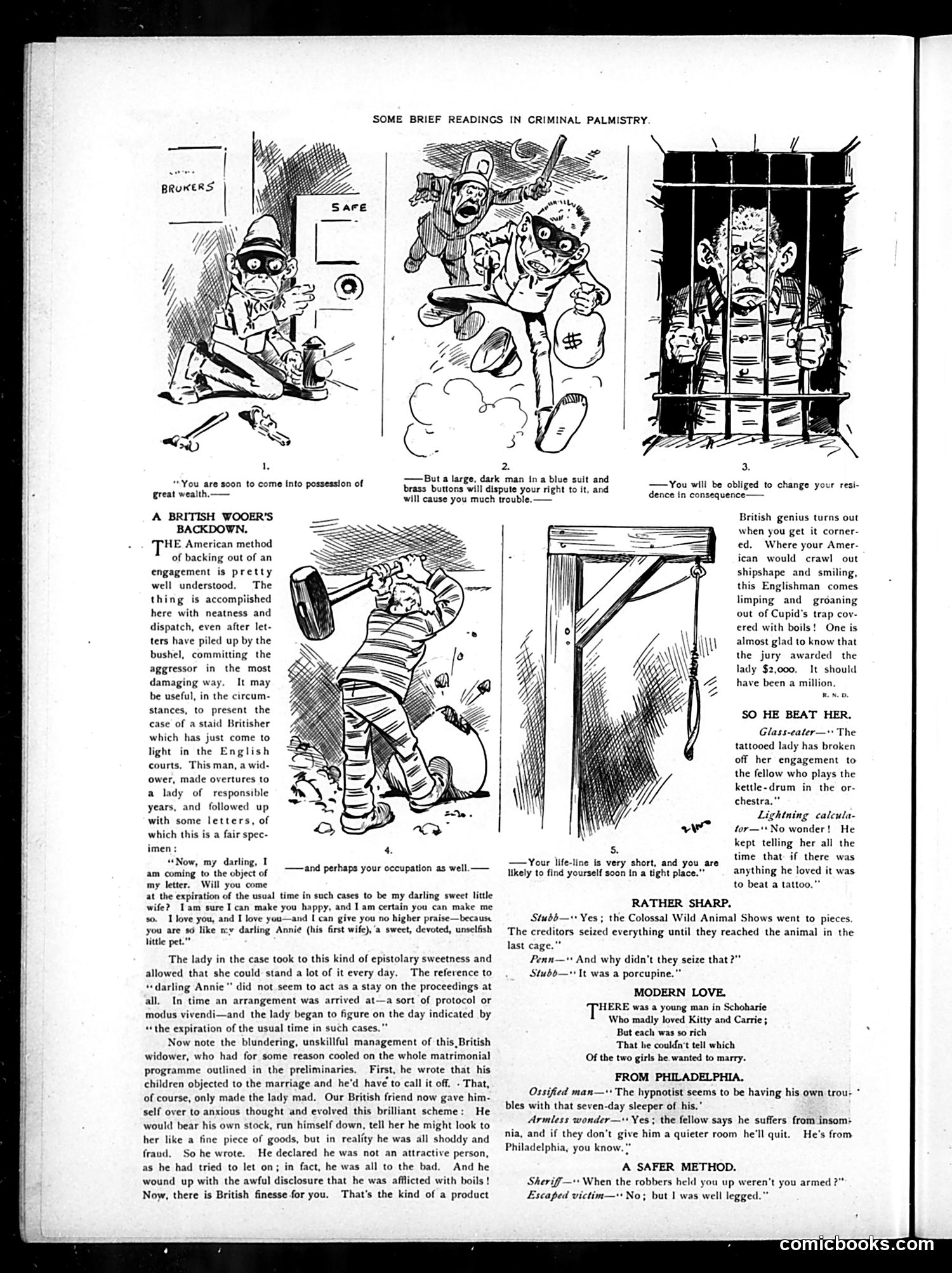
This page contains satirical cartoons and anecdotes mocking criminal behavior and romantic mishaps. The main feature, "A British Wooer's Backdown," ridicules a British widower who courted a woman with passionate letters comparing her to his deceased first wife "darling Annie," then abruptly attempted to end the engagement by claiming he was unattractive, fraudulent, and afflicted with boils. The satire contrasts American and British approaches to breaking engagements—Americans supposedly handle it smoothly, while this Britisher bungled it badly. A jury awarded the woman £2,000 compensation. The "Criminal Palmistry" cartoons use palm-reading to humorously predict criminals' fates: safe-cracking will lead to possession of wealth and imprisonment; robbery will result in residence changes. Additional brief jokes include wordplay about "beating" a tattoo (drumming) and a porcupine evading creditors. The overall tone mocks British social pretension and relationship failures.
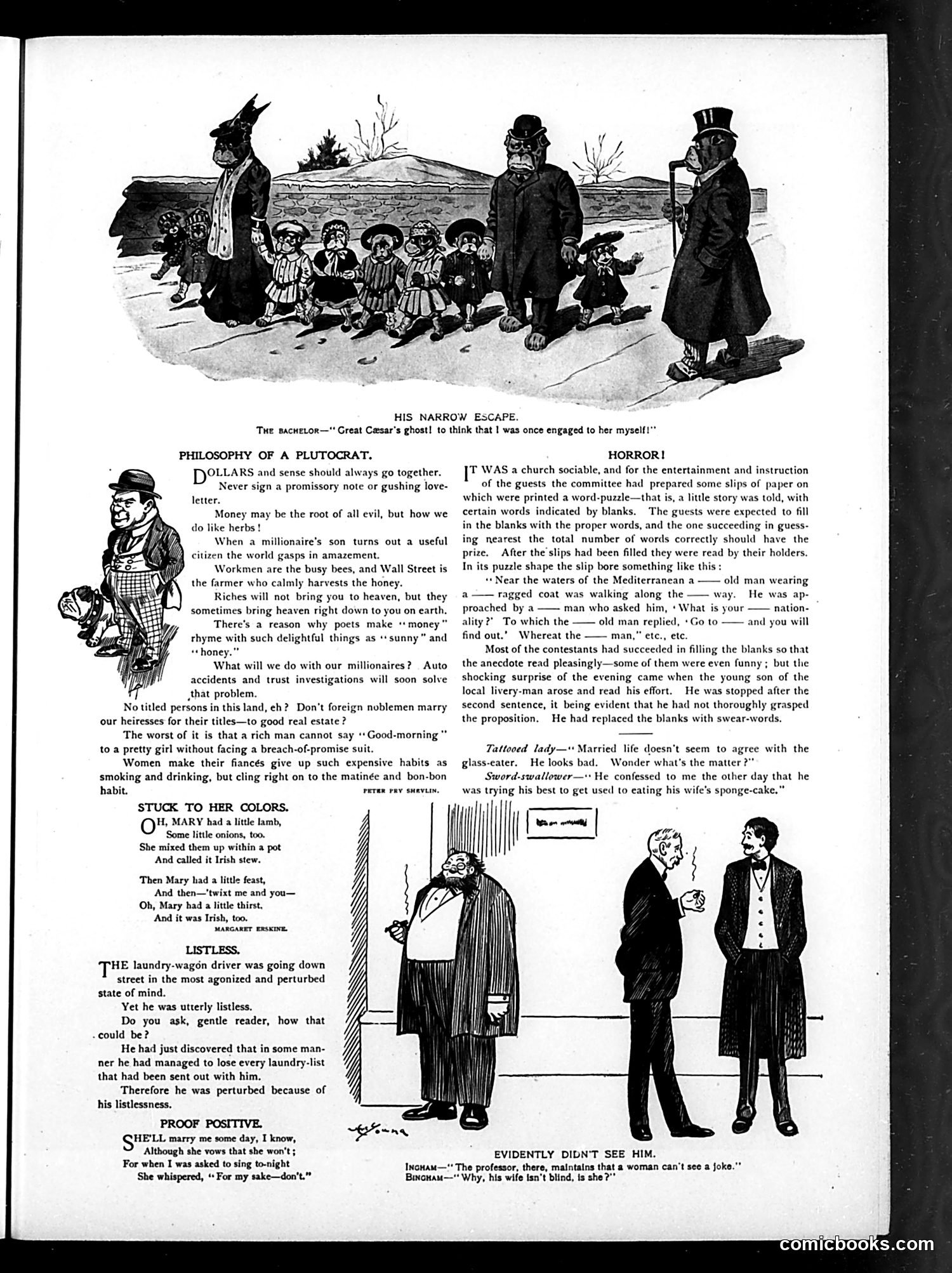
This page from the satirical magazine *Judge* contains multiple short humorous pieces targeting wealthy Americans and social pretensions of the Gilded Age era. The top cartoon shows a bachelor escaping an unwanted marriage, satirizing both matrimonial entanglements and the wealthy's anxieties about commitment. "Philosophy of a Plutocrat" mocks wealthy industrialists' contradictory values—their pursuit of money despite claiming it's "the root of all evil," their shock when rich men's sons become productive citizens, and their hypocrisy about class hierarchy. The quips about millionaires and "trust investigations" reference contemporary concerns about monopolies and corporate wrongdoing. The remaining pieces are light humor: puns about Irish stew and a laundry driver's "listlessness" (lost laundry lists), a woman's subtle acceptance of a suitor, and a church social's scandal when a livery man's son fills a word-puzzle with profanity instead of proper words—humor based on class-based assumptions about working-class crudeness. The page reflects period anxieties about wealth inequality, corporate power, and class distinctions in American society.
This appears to be a political cartoon from *Judge* magazine, though the OCR text provided contains no legible content to work from. From the image alone, I can see: A figure in formal dark clothing stands centrally, appearing to be ejected or propelled upward by what looks like a large cylindrical object (possibly a cannon or tube) on the right side. Multiple round objects float in the sky above. The style and composition suggest this is satirizing someone being "launched" or removed from a position, likely a political figure. However, **without readable text or a visible caption, I cannot identify the specific figure, the historical event referenced, or the satirical point intended.** The signature appears to read "Judge" but the date and additional context necessary for accurate interpretation are not legible in this reproduction. To properly explain this cartoon's meaning, I would need clearer OCR text or caption information.
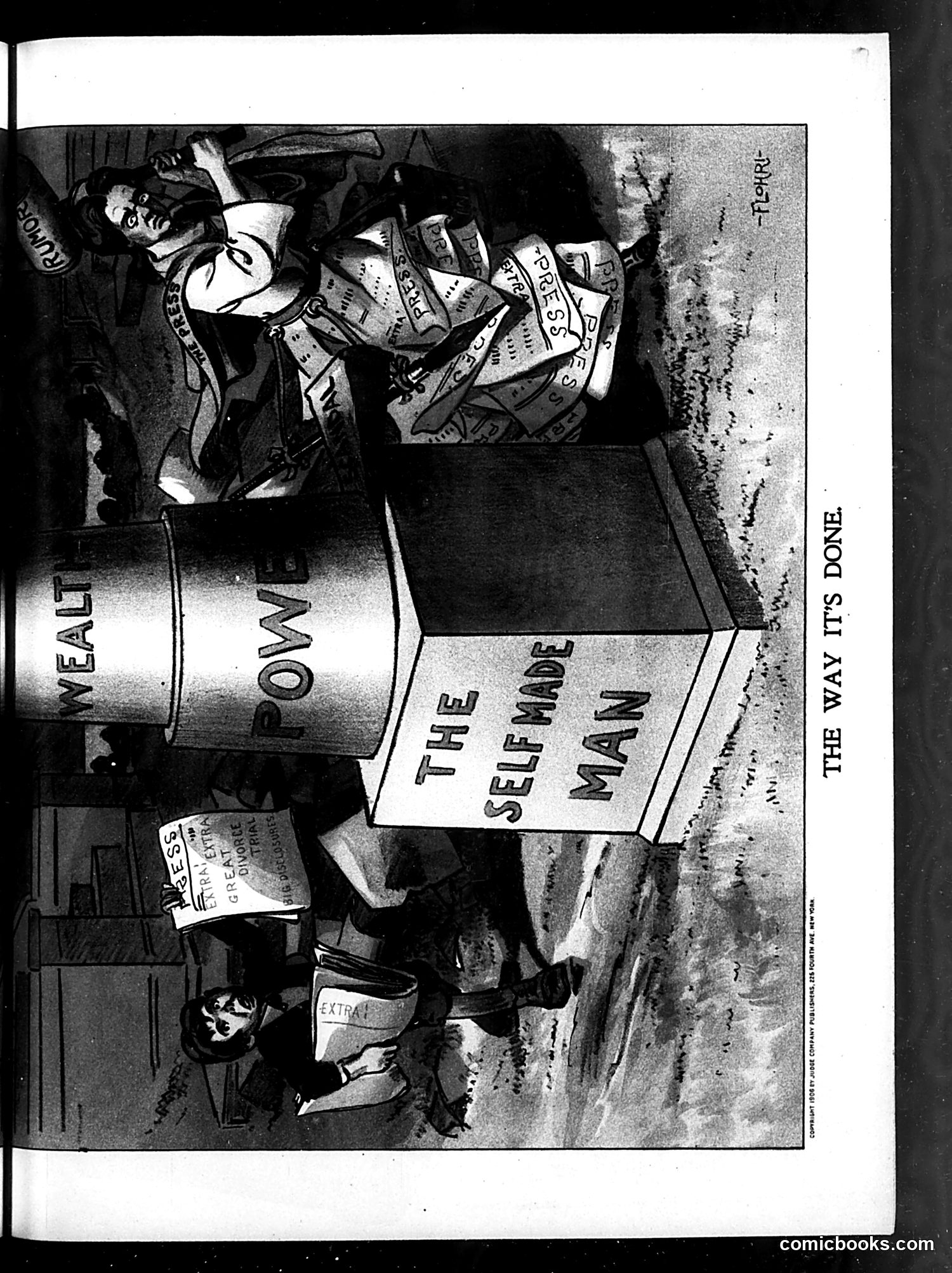
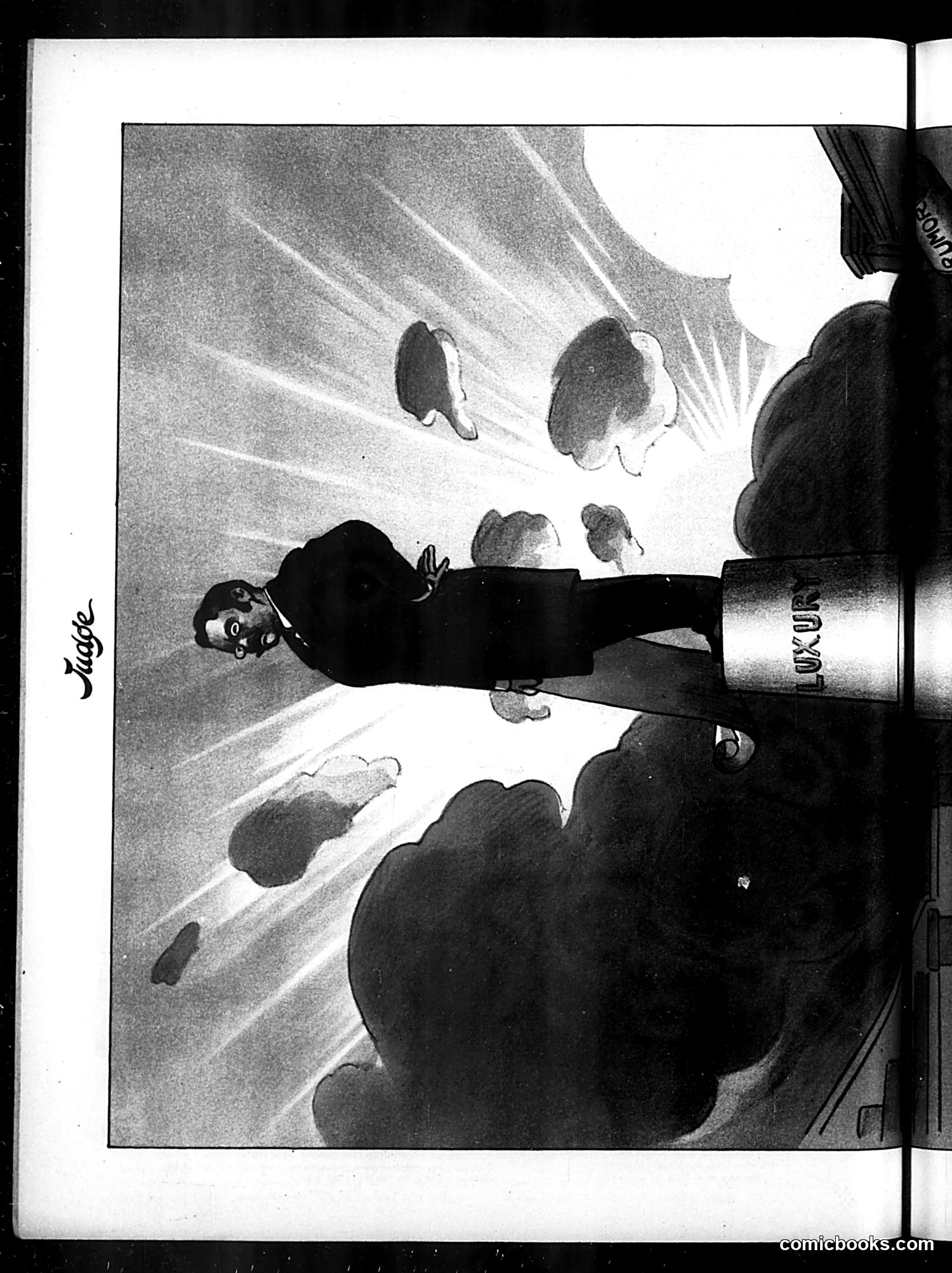
This cartoon depicts a figure emerging from a barrel labeled "THE SELF MADE MAN" while surrounded by containers marked "WEALTH" and "POWER." Additional labels visible on the figure's clothing appear to list various advantages or assistance received. The satire challenges the American myth of the "self-made man"—the notion that success comes purely from individual effort and merit. By showing the supposedly "self-made" figure literally packed with external advantages (wealth, power, and other labeled benefits), the cartoonist exposes this as a lie. The figure isn't actually self-made at all, but rather constructed from inherited privilege and systemic advantages. This likely critiques Gilded Age wealth inequality and the false meritocratic narratives wealthy industrialists used to justify their fortunes.
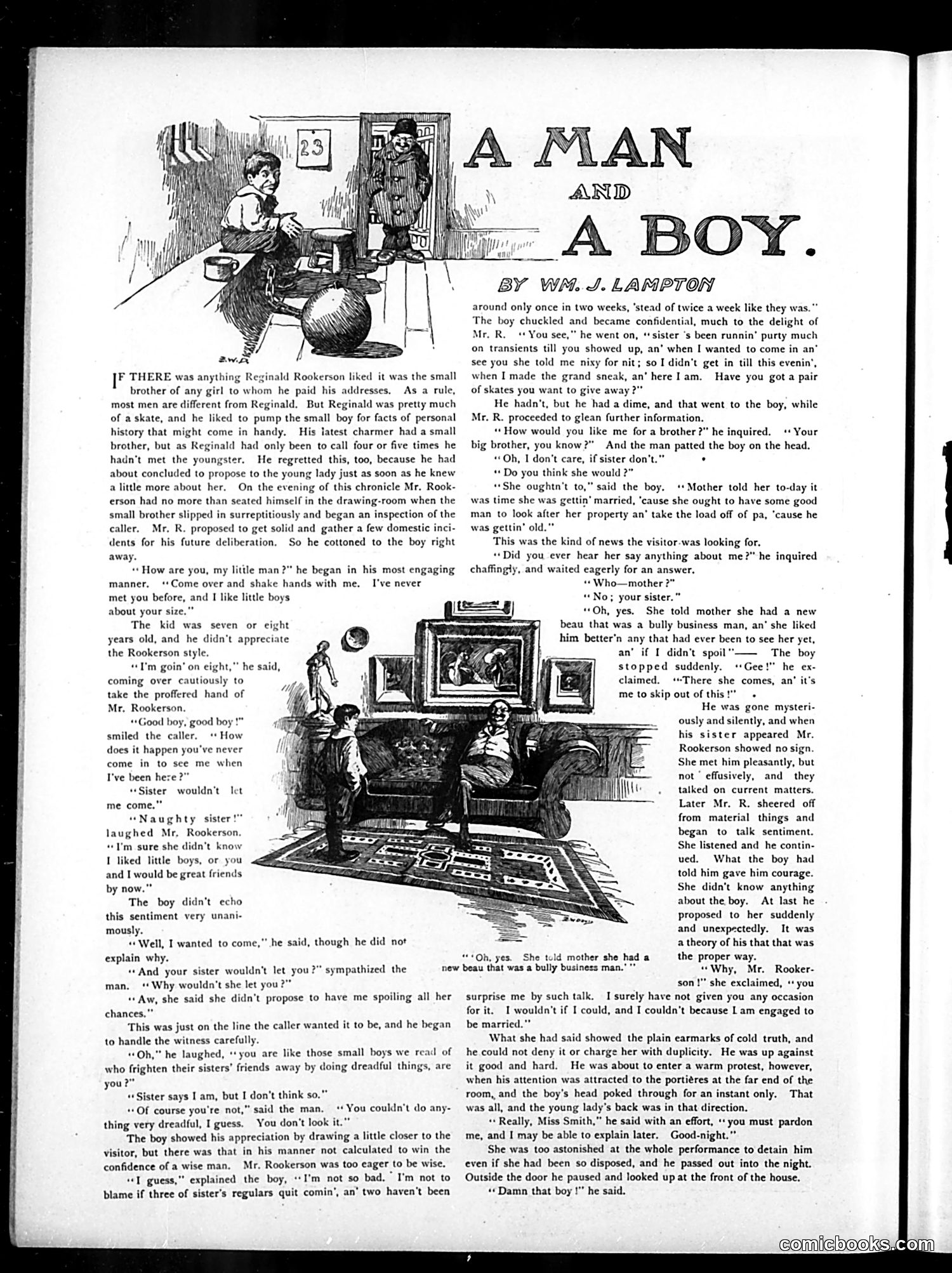
This is a satirical story about Reginald Rookerson, a scheming suitor who attempts to manipulate a young woman by befriending her younger brother to extract information about her family. The humor relies on exposing Rookerson's transparent, cynical approach to courtship: he's calculating, insincere, and willing to bribe a child with a dime for gossip. The boy, however, proves cleverer than the would-be Romeo. He uses Rookerson's transparent flattery against him, revealing damaging information: the suitor has driven away other potential matches through the boy's mischief, and the girl's family is actually interested in her marrying for financial security rather than love. The satire targets both manipulative male suitors and the era's transactional approach to marriage among the middle class. The illustrations show domestic interior scenes emphasizing the artificiality of Rookerson's performance.
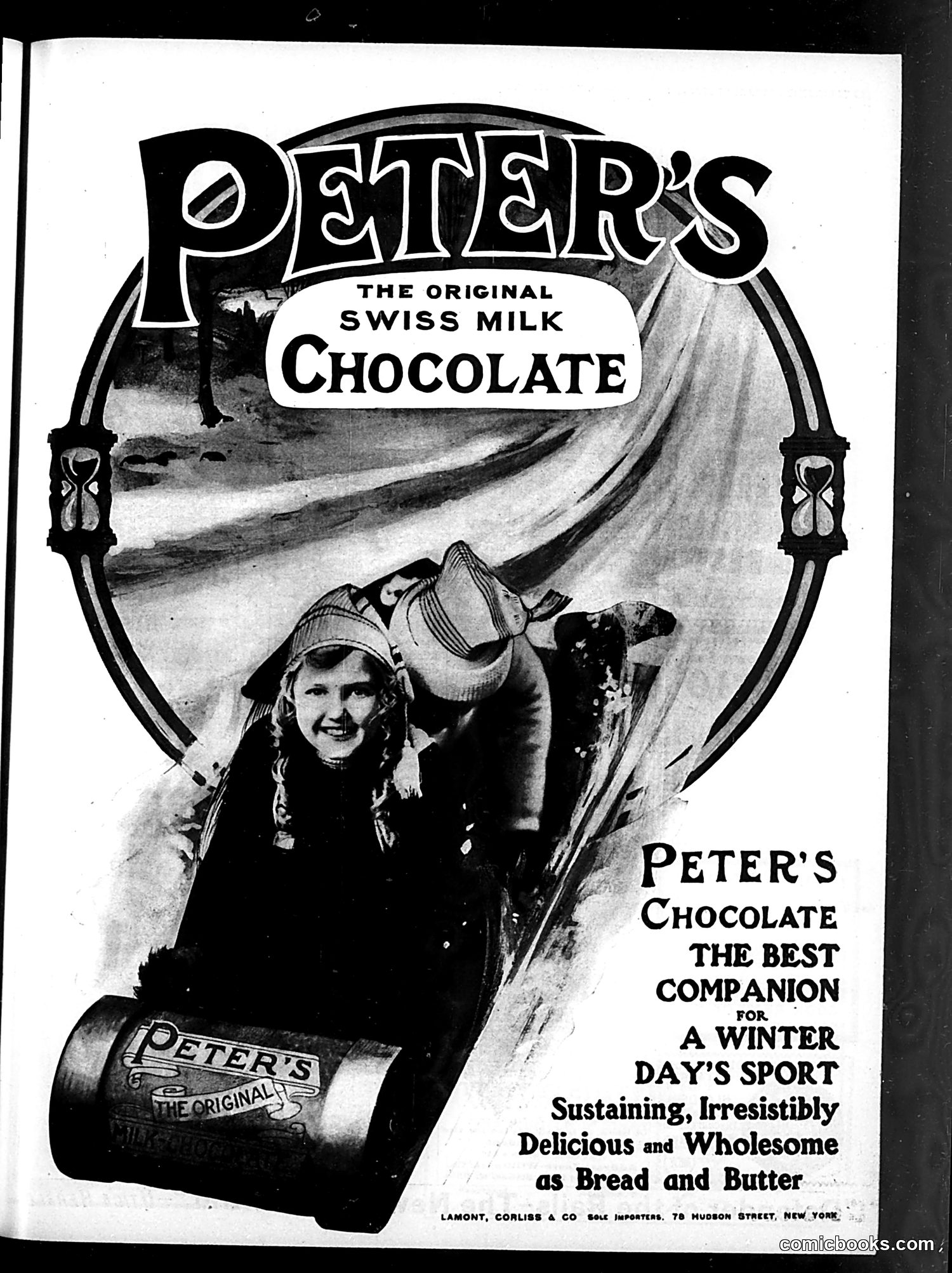
This is a **Peter's Chocolate advertisement**, not satire or political commentary. It promotes "The Original Swiss Milk Chocolate" as an ideal companion for winter sports activities. The image shows a person in winter clothing sledding down a snowy slope, suggesting the product provides energy and sustenance for outdoor recreation. The ad claims the chocolate is "Sustaining, Irresistibly Delicious and Wholesome as Bread and Butter." The advertiser is Lamont, Corliss & Co., importers based on Hudson Street in New York. This appears to be a straightforward early 20th-century commercial advertisement rather than satirical editorial content, though it ran in *Judge*, a magazine known for humor and commentary.
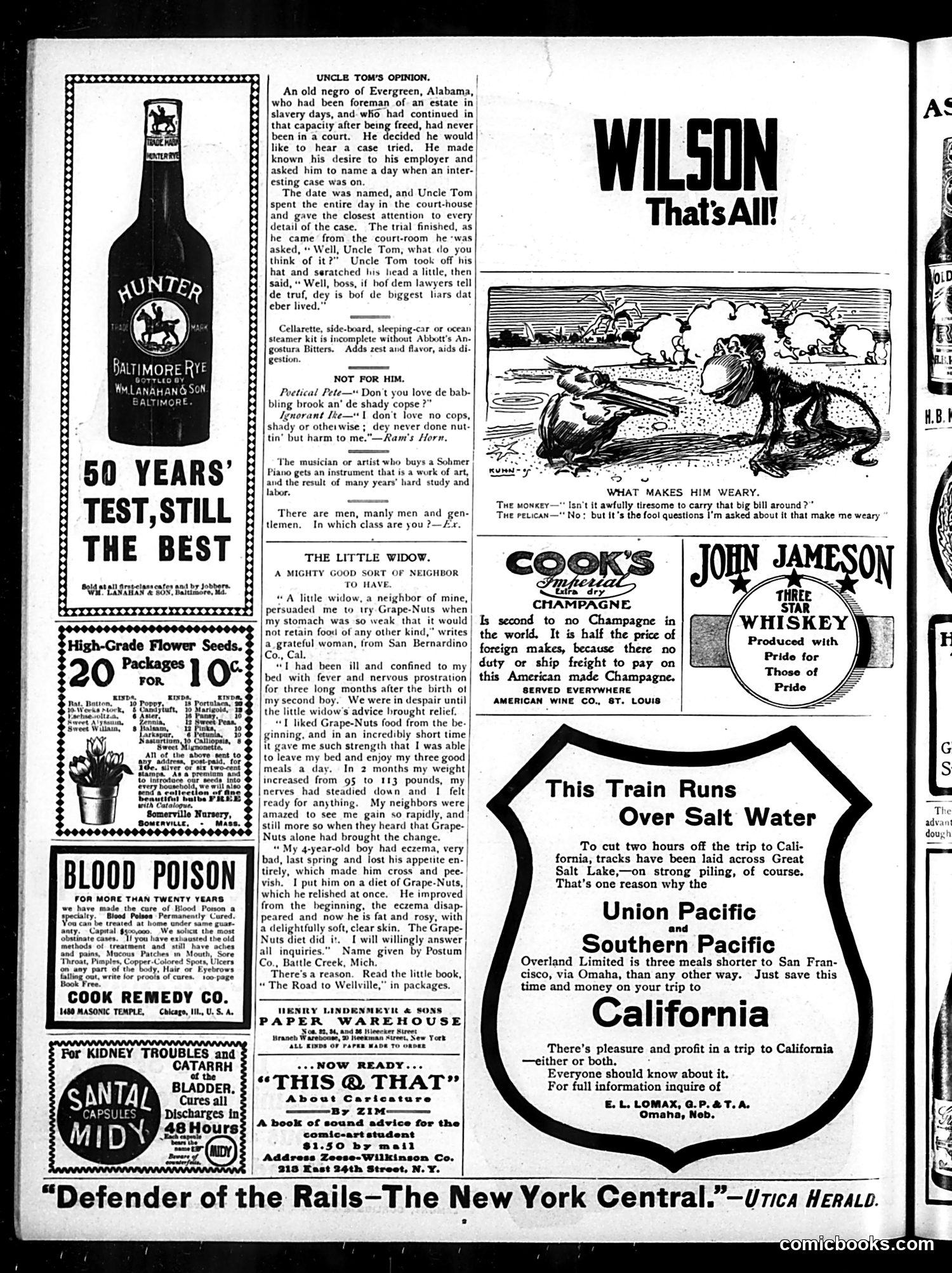
This page is primarily **advertisements and filler content** from Judge magazine, with one brief satirical piece: "Uncle Tom's Opinion." The main cartoon/story presents an elderly Black man (identified as "Uncle Tom," referencing the character from Harriet Beecher Stowe's novel) who attends his first court trial. After witnessing the lawyers' arguments, he concludes that both must be lying—a commentary on courtroom dishonesty and legal theatrics that was apparently meant as humor. The satire works by portraying the Black character as having common-sense skepticism about the legal system, though the racial caricature (dialect, naming) reflects the period's deeply offensive conventions. The rest of the page contains period advertisements for whiskey, seed packets, blood poison treatments, and railroad travel—typical early-20th-century magazine filler with no political content.
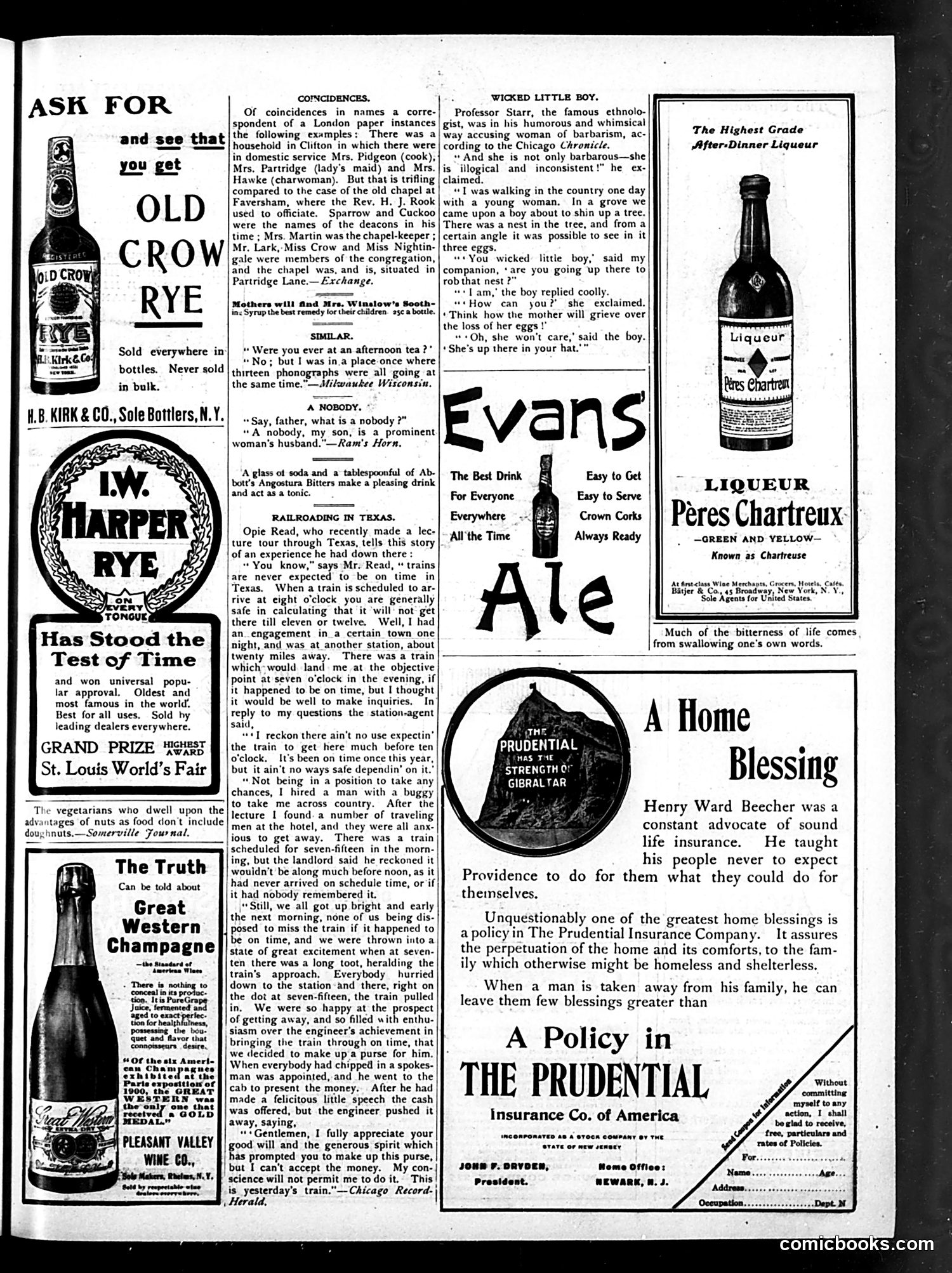
This page is primarily **advertising with humor pieces**, not political cartoons requiring historical explanation. The content consists of: 1. **Liquor and beverage advertisements** (Old Crow Rye, I.W. Harper Rye, Evans Ale, Peres Chartreux Liqueur, Western Champagne) — typical of early-20th-century publications before Prohibition 2. **Brief humorous anecdotes** with names as jokes ("Sparrow and Cuckoo" as church deacons; "Mrs. Martin," "Mr. Lark," "Miss Crow" as congregation members). These are simple wordplay pieces, not satire requiring historical context. 3. **An insurance advertisement** for The Prudential Insurance Company featuring Henry Ward Beecher's advocacy for life insurance 4. **A railroad story** about unreliable Texas trains — a straightforward tall tale with no political dimension The page lacks identifiable political figures, caricatures, or satirical commentary on contemporary events. It's a typical Judge magazine page mixing light humor, practical advice, and commercial advertising rather than substantive satire.
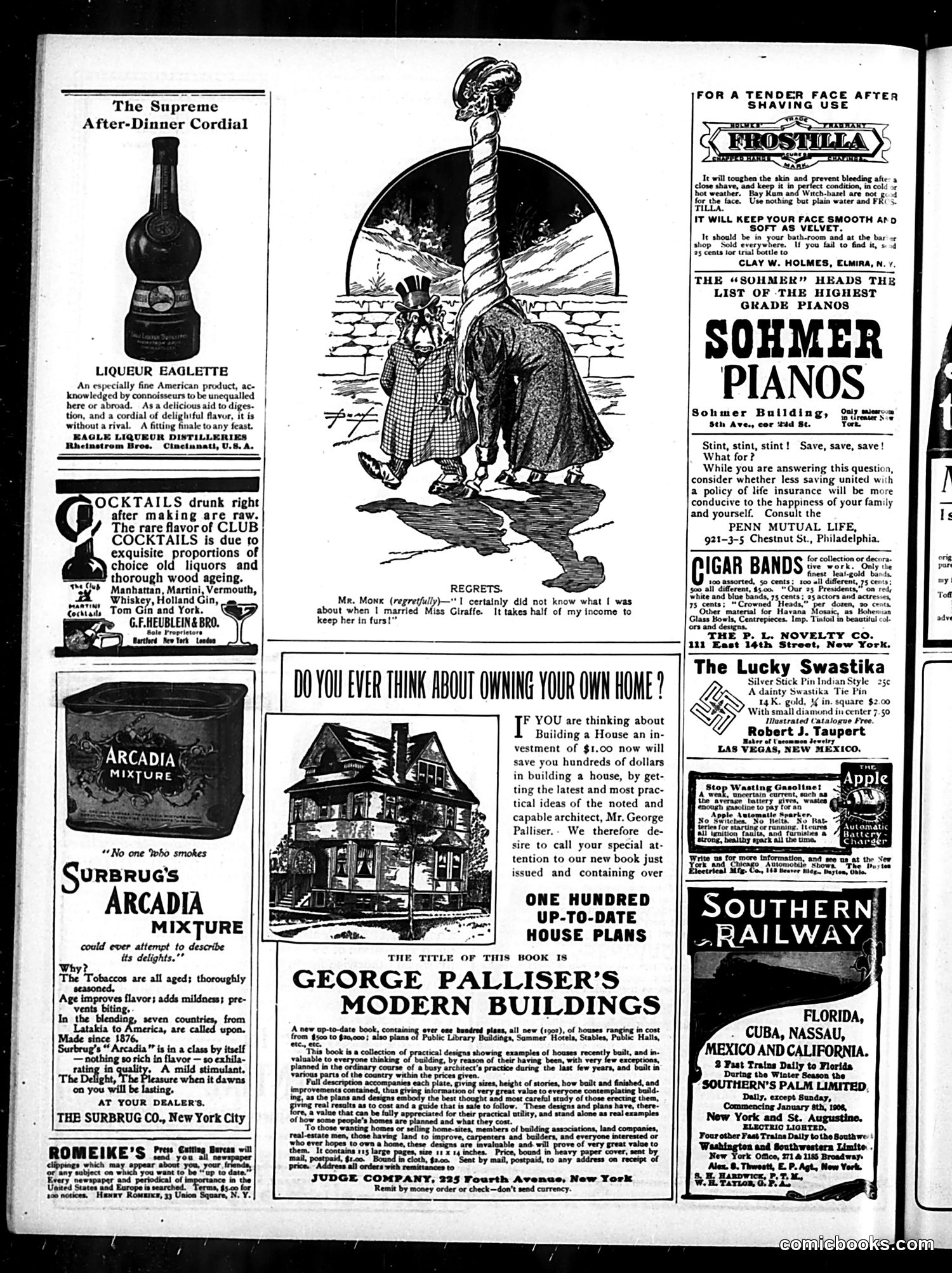
This page is primarily **advertisements and commercial content** rather than editorial cartoons. The dominant image is a single cartoon captioned "REGRETS," depicting Mr. Monk—a tall, thin man—standing beside his wife Miss Giraffe, a woman whose proportions humorously suggest an actual giraffe. The joke is a pun on marriage buyer's remorse: Monk regrets marrying her because she costs him half his income "to keep her in furs." The humor relies on the visual gag that she literally *is* a giraffe, thus requiring animal furs—a wordplay critique of expensive wives and the materialism of fashionable women's fashion spending in the early 1900s. The rest of the page contains period advertisements: liqueurs, cigars, tobacco, house-building plans, piano manufacturers, life insurance, and railroad travel—typical Judge magazine commercial content from this era (circa 1902-1905).
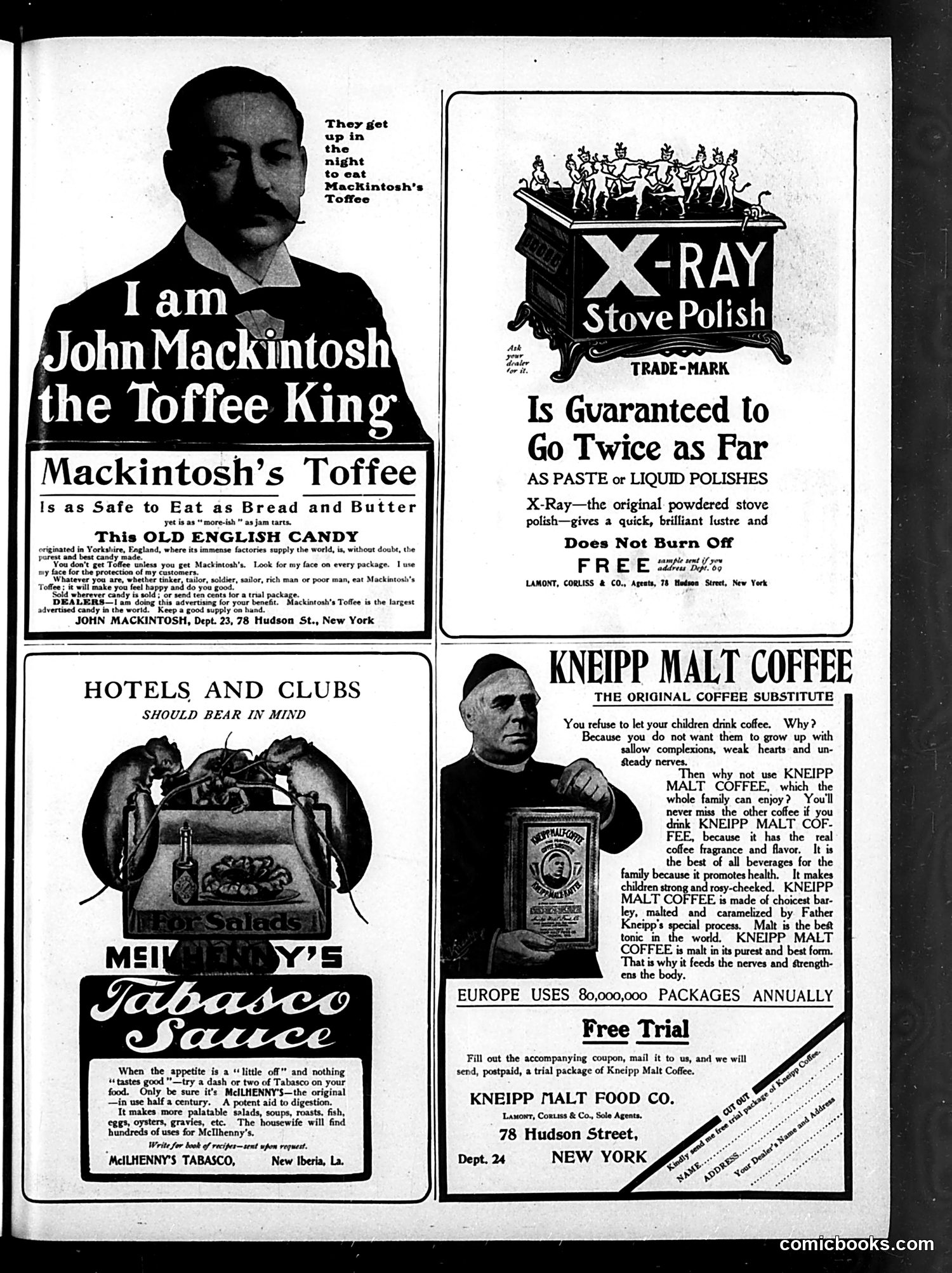
This page consists entirely of **product advertisements**, not political satire or cartoons. It contains four distinct ads from circa early 1900s: 1. **Mackintosh's Toffee** — Features the company founder/mascot John Mackintosh promoting English candy as wholesome enough to eat at night. 2. **X-Ray Stove Polish** — Advertises powdered polish superior to paste or liquid alternatives. 3. **McIlhenny's Tabasco** — Targets hotels and clubs, promoting the hot sauce (established 1868) as a digestive aid and flavor enhancer. 4. **Kneipp Malt Coffee** — A coffee substitute marketed to health-conscious parents concerned about caffeine's effects on children's development. References Father Kneipp's health philosophy (popular in early 1900s). All ads employ period conventions: testimonials from named figures, appeals to safety/health/quality, and offers of free trial packages. The page demonstrates how Judge magazine monetized through advertising rather than exclusively through editorial satire.
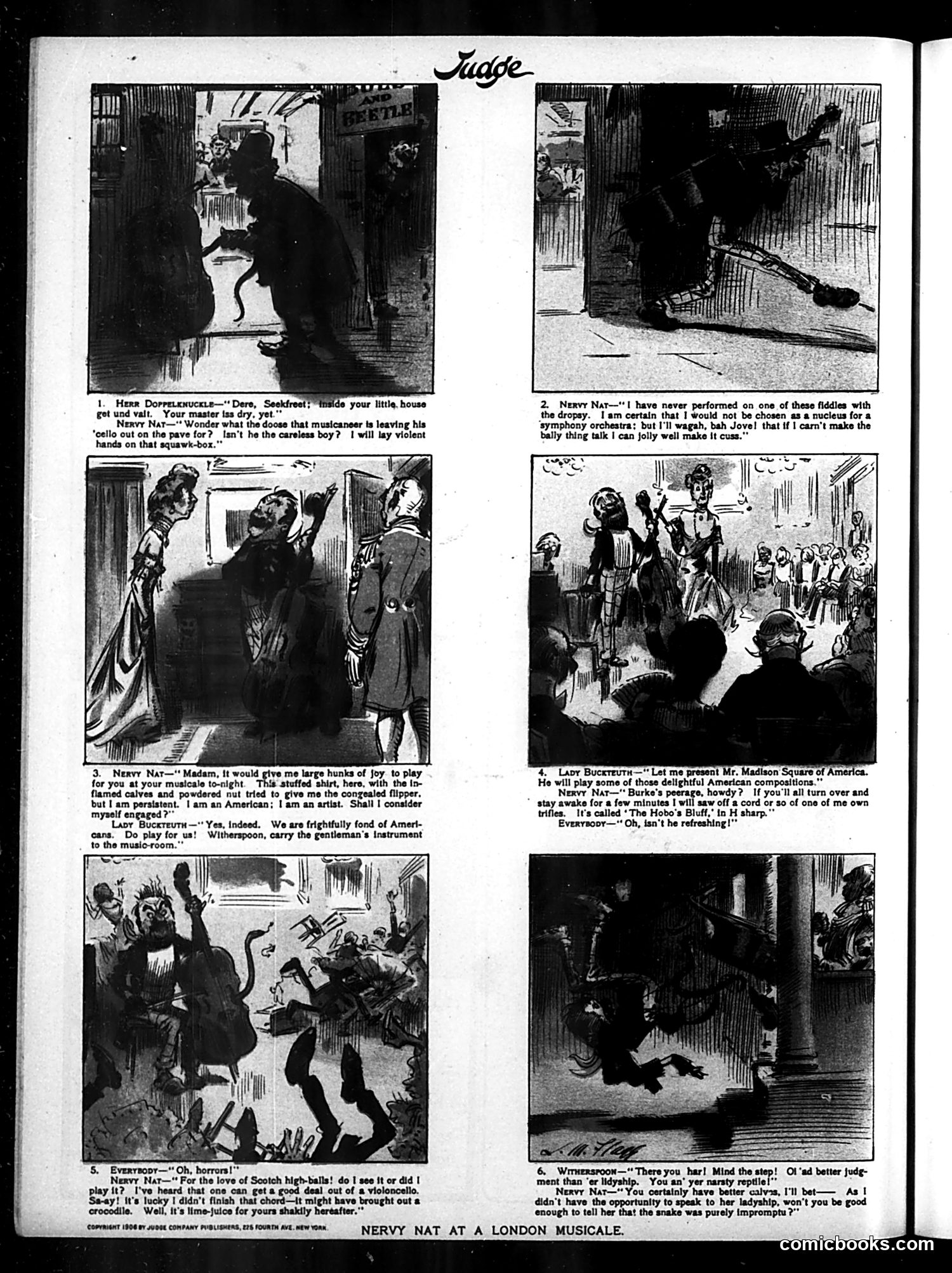
This six-panel comic satirizes an American musician's brash behavior at a London high-society event. "Nervy Nat" (an American character type) crashes a refined English musicale, aggressively pursuing performance opportunities despite being snubbed. The satire targets American cultural presumption: Nat insists he's "an artist" and "an American" as justification for forcing himself upon aristocratic hosts. The humor centers on class collision—Nat's crude directness ("violoncello with the dropsy," references to "Scotch high-balls") clashes with English formality. He performs with a live snake, creating chaos among the refined guests. The final panel's apology ("the snake was purely impromptu") captures the joke: Nat blames accident rather than admit intentional disruption. The piece stereotypes Americans as loud, pushy outsiders unaware of social boundaries, while mocking English pretension toward American visitors.