
Judge, 1906-01-27 · page 9 of 18
Judge — January 27, 1906 — page 9: what you’re looking at
What you’re looking at
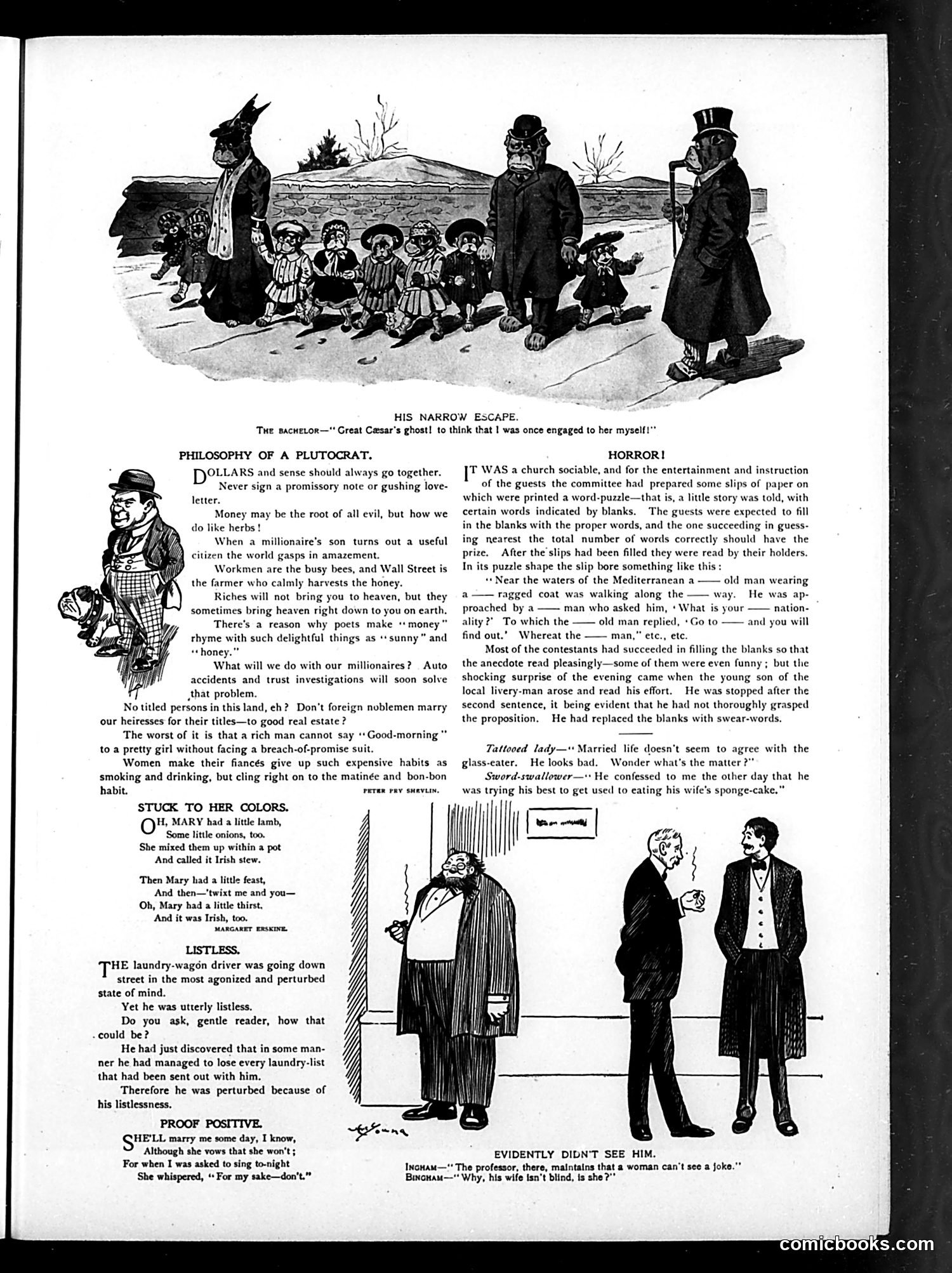
This page from the satirical magazine *Judge* contains multiple short humorous pieces targeting wealthy Americans and social pretensions of the Gilded Age era. The top cartoon shows a bachelor escaping an unwanted marriage, satirizing both matrimonial entanglements and the wealthy's anxieties about commitment. "Philosophy of a Plutocrat" mocks wealthy industrialists' contradictory values—their pursuit of money despite claiming it's "the root of all evil," their shock when rich men's sons become productive citizens, and their hypocrisy about class hierarchy. The quips about millionaires and "trust investigations" reference contemporary concerns about monopolies and corporate wrongdoing. The remaining pieces are light humor: puns about Irish stew and a laundry driver's "listlessness" (lost laundry lists), a woman's subtle acceptance of a suitor, and a church social's scandal when a livery man's son fills a word-puzzle with profanity instead of proper words—humor based on class-based assumptions about working-class crudeness. The page reflects period anxieties about wealth inequality, corporate power, and class distinctions in American society.
📄 Transcribed text from this page (OCR, searchable)
Machine-transcribed from the original scan — historical spelling and the odd misread are preserved.
HIS NARROW ESCAPE. Tue sachetor—"' Great Caesar's ghost! to think that I was once engaged to her myself!" PHILOSOPHY OF A PLUTOCRAT. OLLARS and sense should always go together. Never sign a promissory note or gushing love- letter. Money may be the root of all evil, but how we do like herbs! When a millionaire’s son turns out a useful citizen the world gasps in amazement. Workmen are the busy bees, and Wall Street is the farmer who calmly harvests the honey. Riches will not bring you to heaven, but they sometimes bring heaven right down to you on earth. There's a reason why poets make + money” rhyme with such delightful things as «sunny ” and “honey. What will we do with our millionaires? Auto accidents and trust investigations will soon solve that problem. No titled persons in this land, eh? Don’t foreign noblemen marry our heiresses for their titles—to good real estate? The worst of it is that a rich man cannot say ‘*Good-morning ” toa pretty girl without facing a breach-of-promise suit. Women make their fiancés give up such expensive habits as smoking and drinking, but cling right on to the matinée and bon-bon habit. PETER PRY SHRVLIN. STUCK TO HER COLORS. QT: MARY had a litte lamb, Some little onions, too. She mixed them up within a pot And called it Irish stew. ‘Then Mary had a little feast, And then—'twixt me and you— Oh, Mary had a little thirst, And it was Irish, too. MARGARET ERSKINE. LISTLESS. HE laundry-wagon driver was going down street in the most agonized and perturbed state of mind. Yet he was utterly listless. Do you ask, gentle reader, how that could be? He had just discovered that in some man- ner he had managed to lose every laundry-list that had been sent out with him, Therefore he was perturbed because of his listlessness. PROOF POSITIVE. HELL marry me some day, I know, Although she vows that she won't For when I was asked to sing to-night She whispered, ‘+ For my sake—don't.”” HORROR! [T WAS a church sociable, and for the entertainment and instruction of the guests the committee had prepared some slips of paper on which were printed a word-puzzle—that is, a little story was told, with certain words indicated by blanks. The guests were expected to fill in the blanks with the proper words, and the one succeeding in guess- ing nearest the total number of words correctly should have the prize. After the’slips had been filled they were read by their holders. In its puzzle shape the slip bore something like this : Near the waters of the Mediterranean a —— old man wearing a —— ragged coat was walking along the — He was ap- proached by a —— man who asked him, ‘What is your nation- ality?” To which the — old man replied, «Go to and you will find out.’ Whereat the —— man," ete., ete. Most of the contestants had succeeded in filling the blanks so that the anecdote read pleasingly—some of them were even funny ; but the shocking surprise of the evening came when the young son of the local livery-man arose and read his effort. He was stopped after the second sentence, it being evident that he had not thoroughly grasped the proposition, He had replaced the blanks with swear-words. Tattooed lady—* Married life doesn’t seem to agree with the glass-eater. He looks bad. Wonder what's the matter ?” Sword-swallower—* He confessed to me the other day that he was trying his best to get used to eating his wife’s sponge-cake.” EVIDENTLY DIDN'T SEE HIM. IncHam—‘' The professor, there, maintains that a woman can't see a joke."” Bixcnau—" Why, his wife isn’t blind, is she ?"*