
Judge, 1906-01-27 · page 12 of 18
Judge — January 27, 1906 — page 12: what you’re looking at
What you’re looking at
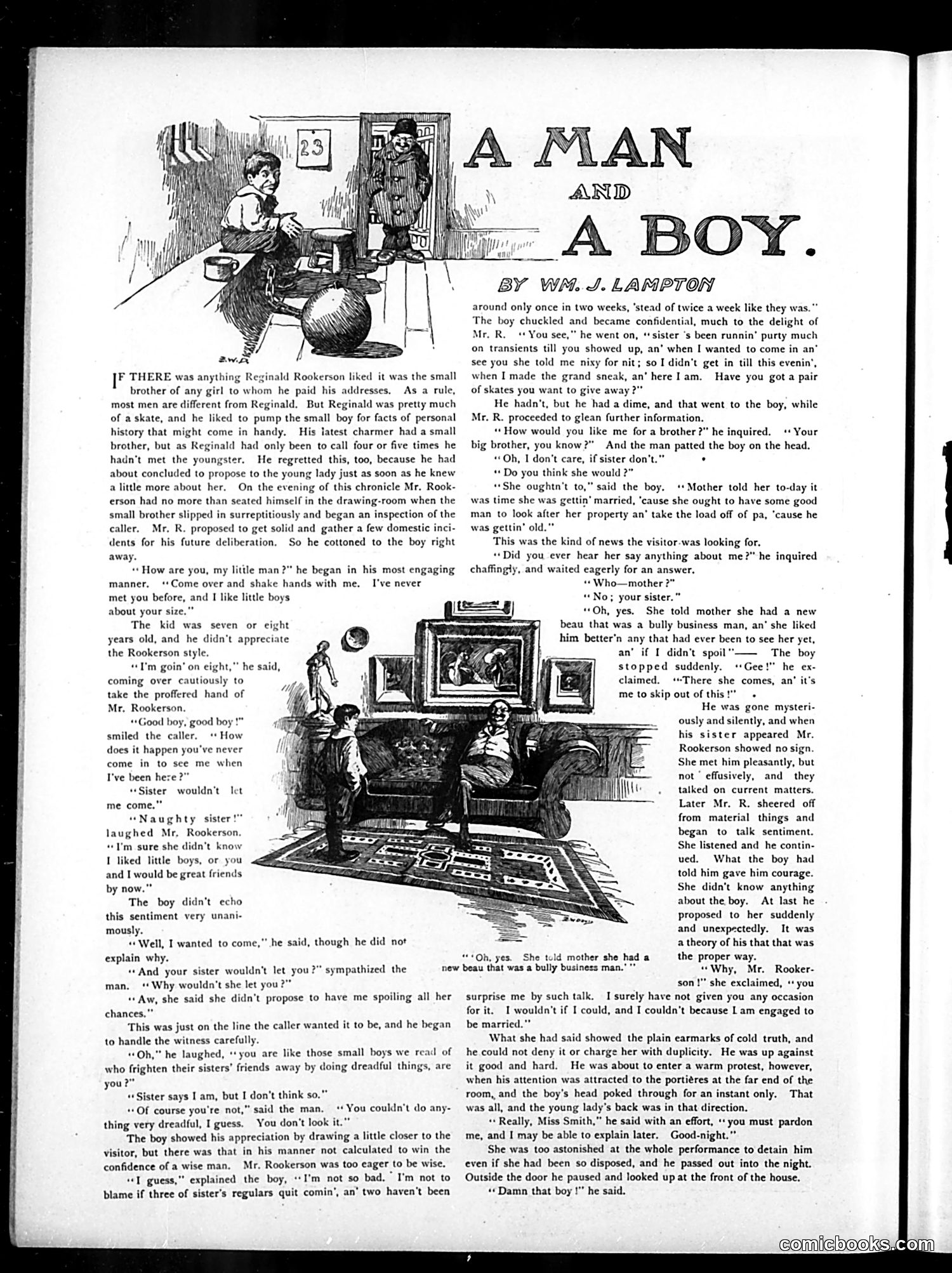
This is a satirical story about Reginald Rookerson, a scheming suitor who attempts to manipulate a young woman by befriending her younger brother to extract information about her family. The humor relies on exposing Rookerson's transparent, cynical approach to courtship: he's calculating, insincere, and willing to bribe a child with a dime for gossip. The boy, however, proves cleverer than the would-be Romeo. He uses Rookerson's transparent flattery against him, revealing damaging information: the suitor has driven away other potential matches through the boy's mischief, and the girl's family is actually interested in her marrying for financial security rather than love. The satire targets both manipulative male suitors and the era's transactional approach to marriage among the middle class. The illustrations show domestic interior scenes emphasizing the artificiality of Rookerson's performance.
📄 Transcribed text from this page (OCR, searchable)
Machine-transcribed from the original scan — historical spelling and the odd misread are preserved.
F THERE was anything Reginald Rookerson liked it was the small brother of any girl to whom he paid his addresses, As a rule, most men are different from Reginald. But Reginald was pretty much of a skate, and he liked to pump the small boy for facts of personal history that might come in handy. His latest charmer had a small brother, but as Reginald had only been to call four or five times he hadn‘t met the youngster. He regretted this, too, because he had about concluded to propose to the young lady just as soon as he knew a little more about her. On the evening of this chronicle Mr. Rook- erson had no more than seated himself in the drawing-room when the small brother slipped in surreptitiously and began an inspection of the caller. Mr. R. proposed to get solid and gather a few domestic inci- dents for his future deliberation, So he cottoned to the boy right away. + How are you, my little man?" he began in his most engaging manner. ‘Come over and shake hands with me. I've never met you before, and I like little boys about your size.” The kid was seven or eight years old, and he didn’t appreciate the Rookerson style. «I'm goin’ on eight," he said, coming over cautiously to take the proffered hand of Mr. Rookerson. “Good boy, good boy !* smiled the caller, + How does it happen you've never come in to see me when I've been here?” “Sister wouldn't me come.” “Naughty sister!” laughed Mr, Rookerson. «I'm sure she didn’t know I liked little boys, or you and I would be great friends by now.” The boy didn’t echo this sentiment very unani- mously. + Well, I wanted to come, explain why. + And your sister wouldn't let you?” sympathized the man. ‘Why wouldn't she let you?” ++ Aw, she said she didn’t propose to have me spoiling all her chances.”” ‘This was just on the line the caller wanted it to be, and he began let eC - —gy Syren he said, though he did not new to handle the witness carefully. “Oh,” he laughed, ‘you are like those small boys we read of who frighten their sisters’ friends away by doing dreadful things, are you?" #«Sister says I am, but I don’t think so.” Of course you're not,” said the man. thing very dreadful, I guess. You don’t look it."" ‘The boy showed his appreciation by drawing a little closer to the visitor, but there was that in his manner not calculated to win the confidence of a wise man. Mr. Rookerson was too eager to be wise. ‘1 guess,"" explained the boy, **I'm not so bad. I'm not to blame if three of sister's regulars quit comin’, an’ two haven't been +You couldn't do any- BY WH. JI. LAMPTON around only once in two weeks, ‘stead of twice a week like they was.” The boy chuckled and became confidential, much to the delight of Mr. R. «You see," he went on, ‘sister ‘s been runnin’ purty much on transients till you showed up, an’ when I wanted to come in an’ see you she told me nixy for nit; so I didn’t get in till this eveni when I made the grand sneak, an’ here 1am. Have you got a pair of skates you want to give away ?” He hadn't, but he had a dime, and that went to the boy, while Mr. R. proceeded to glean further information. «How would you like me for a brother?” he inquired. ++ Your big brother, you know?” And the man patted the boy on the head. *Oh, I don’t care, if sister don’t.” “Do you think she would ?” «She oughtn’t to,” said the boy. ‘Mother told her to-day it was time she was gettin’ married, ‘cause she ought to have some good man to look after her property an’ take the load off of pa, ‘cause he was gettin’ old." This was the kind of news the visitor-was looking for. ‘Did you ever hear her say anything about me?” he inquired chaffingly, and waited eagerly for an answer. ** Who—mother 2?” “No; your sister.” “Oh, yes. She told mother she had a new beau that was a bully business man, an‘ she liked him better'n any that had ever been to see her yet, an’ if I didn’t spoil"—— The boy stopped suddenly. «Gee! he ex- claimed. ‘There she comes, an’ it's me to skip out of this!" He was gone mysteri- ously and silently, and when his sister appeared Mr. Rookerson showed no sign. She met him pleasantly, but not ‘ effusively, and they talked on current matters. Later Mr. R. sheered off from material things and began to talk sentiment. She listened and he contin- ued. What the boy had told him gave him courage. She didn’t know anything about the boy. At last he proposed to her suddenly and unexpectedly. It was a theory of his that that was the proper way. “Why, Mr. Rooker- son!” she exclaimed, + you surprise me by such talk. I'surely have not given you any occasion for it. I wouldn't if I could, and I couldn't because L am engaged to be married." What she had said showed the plain earmarks of cold truth, and he could not deny it or charge her with duplicity. He was up against it good and hard. He was about to enter a warm protest, however, when his attention was attracted to the porti¢res at the far end of the room, and the boy’s head poked through for an instant only. That was all, and the young lady’s back was in that direction. Really, Miss Smith,” he said with an effort, «you must pardon me, and I may be able to explain later. Good-night."” She was too astonished at the whole performance to detain him even if she had been so disposed, and he passed out into the night. Outside the door he paused and looked up at the front of the house. «Damn that boy !”’ he said. | — “Oh, yes. She told mother she had a beau that was a bully business man.’ ”* Comichooks. to