
A complete issue · 16 pages · 1906
Judge — January 20, 1906
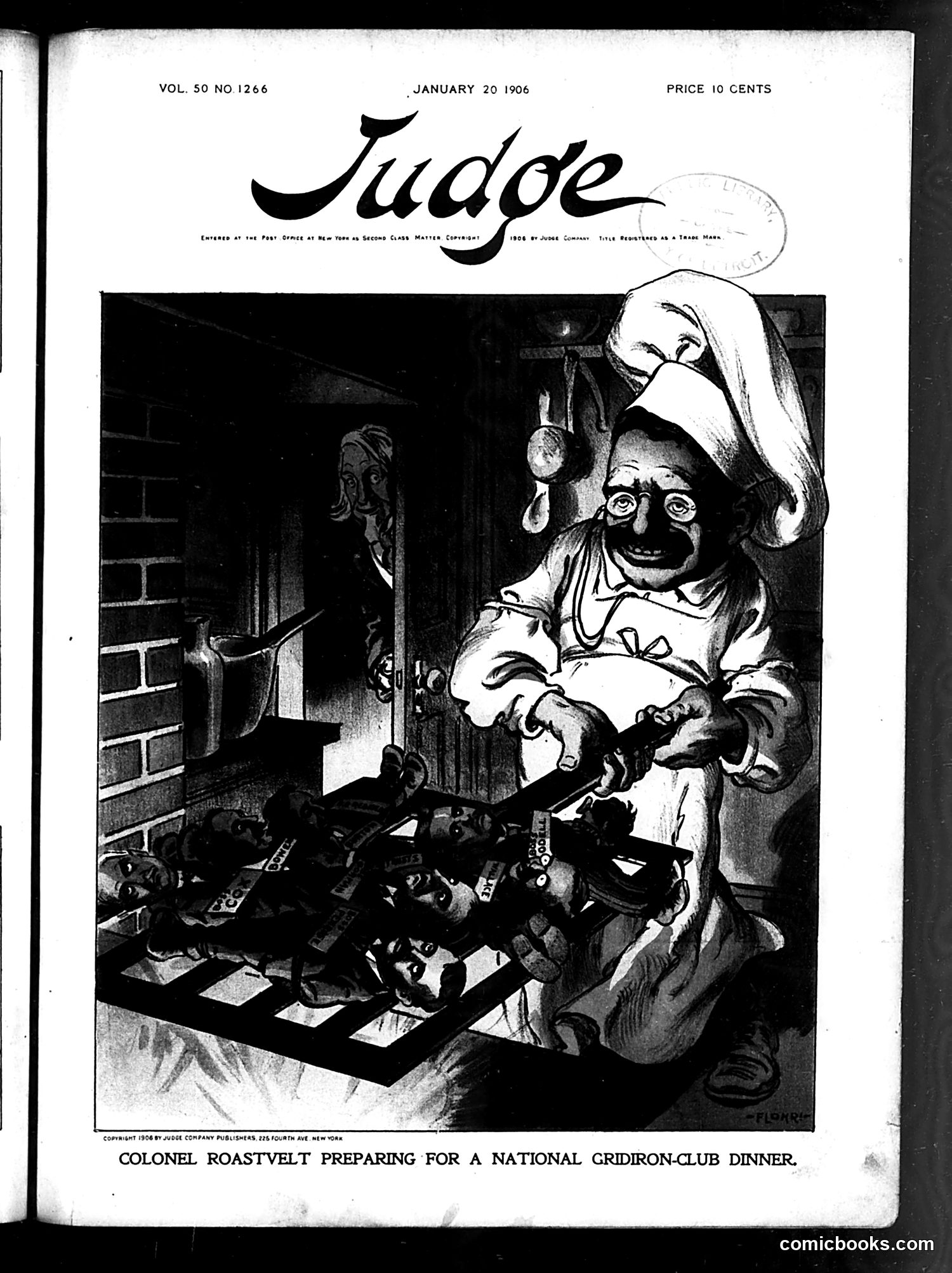
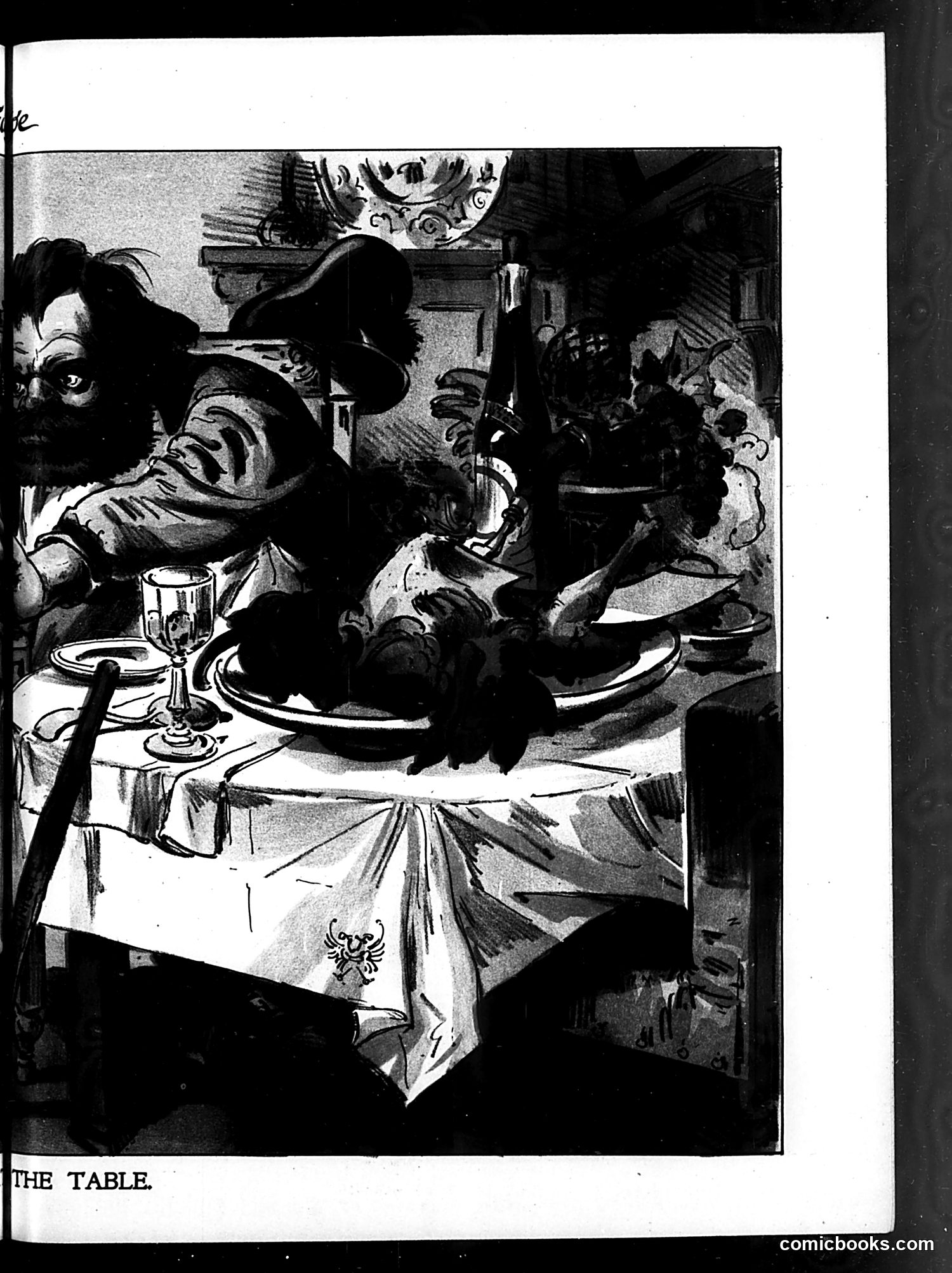
This political cartoon depicts **Colonel Theodore Roosevelt** (identifiable by the caption) as a chef preparing for a "National Gridiron Club Dinner." The satire plays on Roosevelt's public persona as a vigorous, forceful leader—here exaggerated as a caricatured cook brandishing cooking implements over a pot of roasting meat. The "Gridiron Club" was a real Washington, D.C. press organization known for satirical dinners mocking politicians. The cartoon likely mocks Roosevelt's aggressive policies or combative style, portraying him as someone who "prepares" or manipulates events forcefully, much as a cook dominates ingredients. The grotesque caricature reflects early 20th-century satirical illustration conventions that appear crude by modern standards.
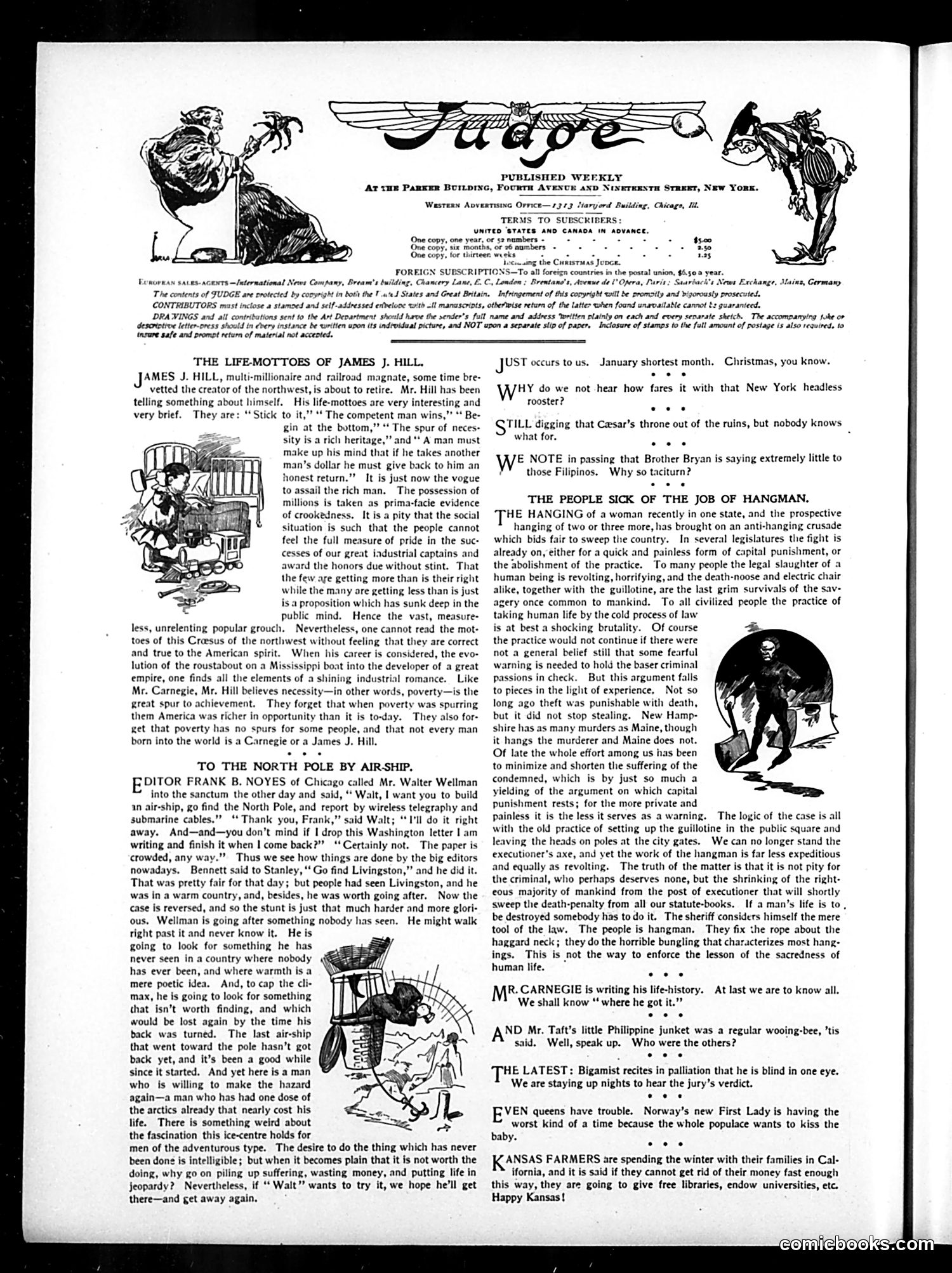
This page contains satirical commentary and illustrations typical of early 20th-century American humor. The main sections include: **"Life-Mottos of James J. Hill"** - A satirical piece mocking railroad magnate James J. Hill, depicted in illustrations as self-serving and morally questionable. The cartoon critiques wealthy industrialists' exploitation and lack of genuine social responsibility. **"The People Sick of the Job of Hangman"** - Editorial commentary opposing capital punishment, arguing execution doesn't deter crime and represents cruel government excess. It advocates for abolishing the death penalty. **"To the North Pole by Air-Ship"** - A humorous anecdote about an inventor seeking newspaper backing for an Arctic aviation expedition, satirizing both technological optimism and journalistic sensationalism. The page reflects Progressive Era concerns: industrial monopoly power, criminal justice reform, and skepticism toward technological promises.
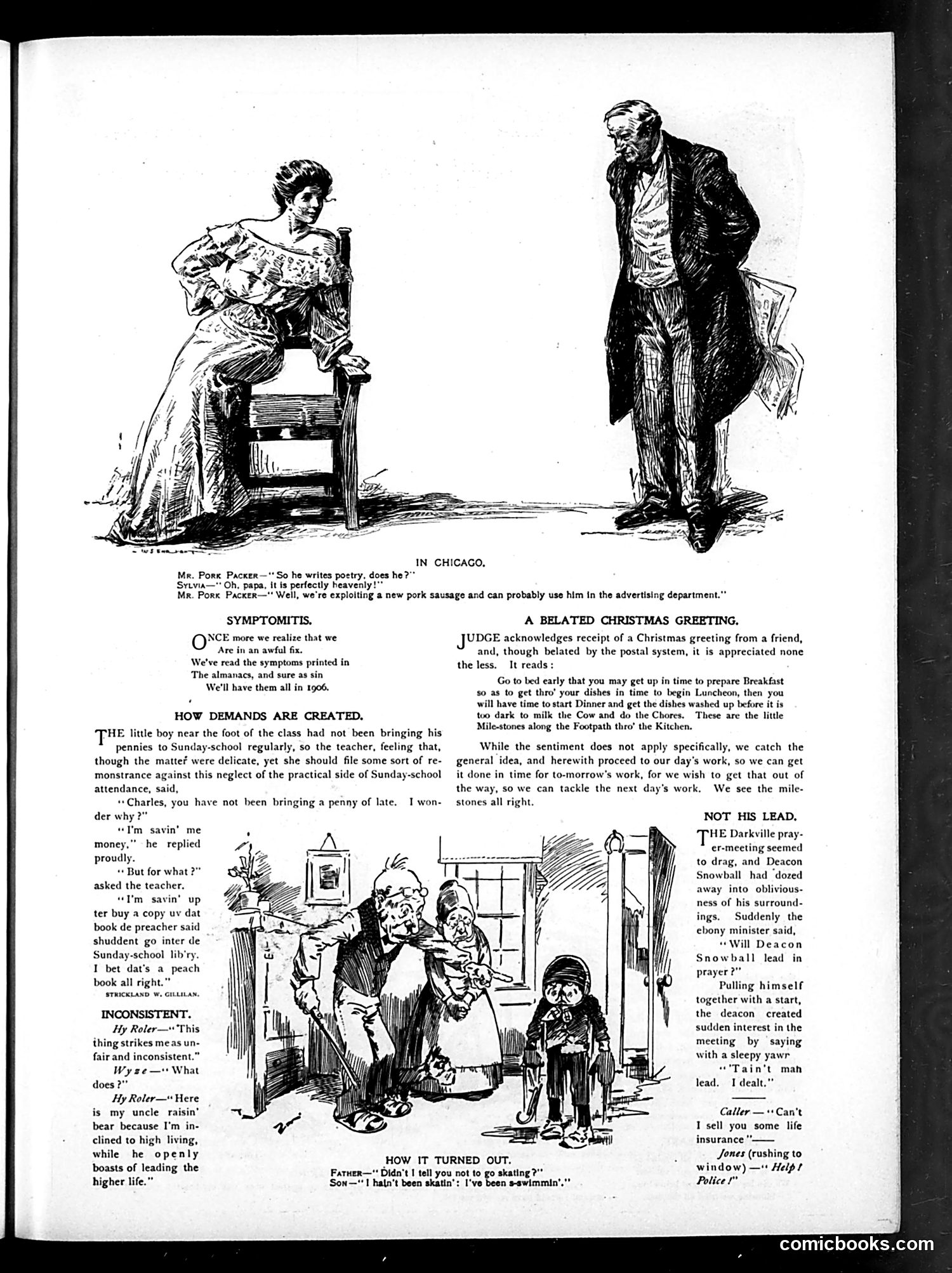
This page contains several unrelated satirical pieces typical of Judge magazine's format: **"In Chicago"** depicts a conversation between a woman and a man (labeled "Mr. Pork Packer") about a poet. The joke plays on Chicago's reputation as a meatpacking center—suggesting the city's businessmen prioritize practical advertising uses over literary merit. **"Symptomitis," "How Demands Are Created,"** and other titled sections are brief humorous anecdotes about everyday social situations—a teacher questioning a boy about missing Sunday school, an inconsistent father, and similar domestic comedy. **"How It Turned Out"** shows a domestic scene with children and appears to be a punchline about parental threats. The illustrations are typical Judge-style satirical line drawings. Without dates or clearer context, the specific events referenced remain unclear, though the humor targets middle-class social pretension and hypocrisy.
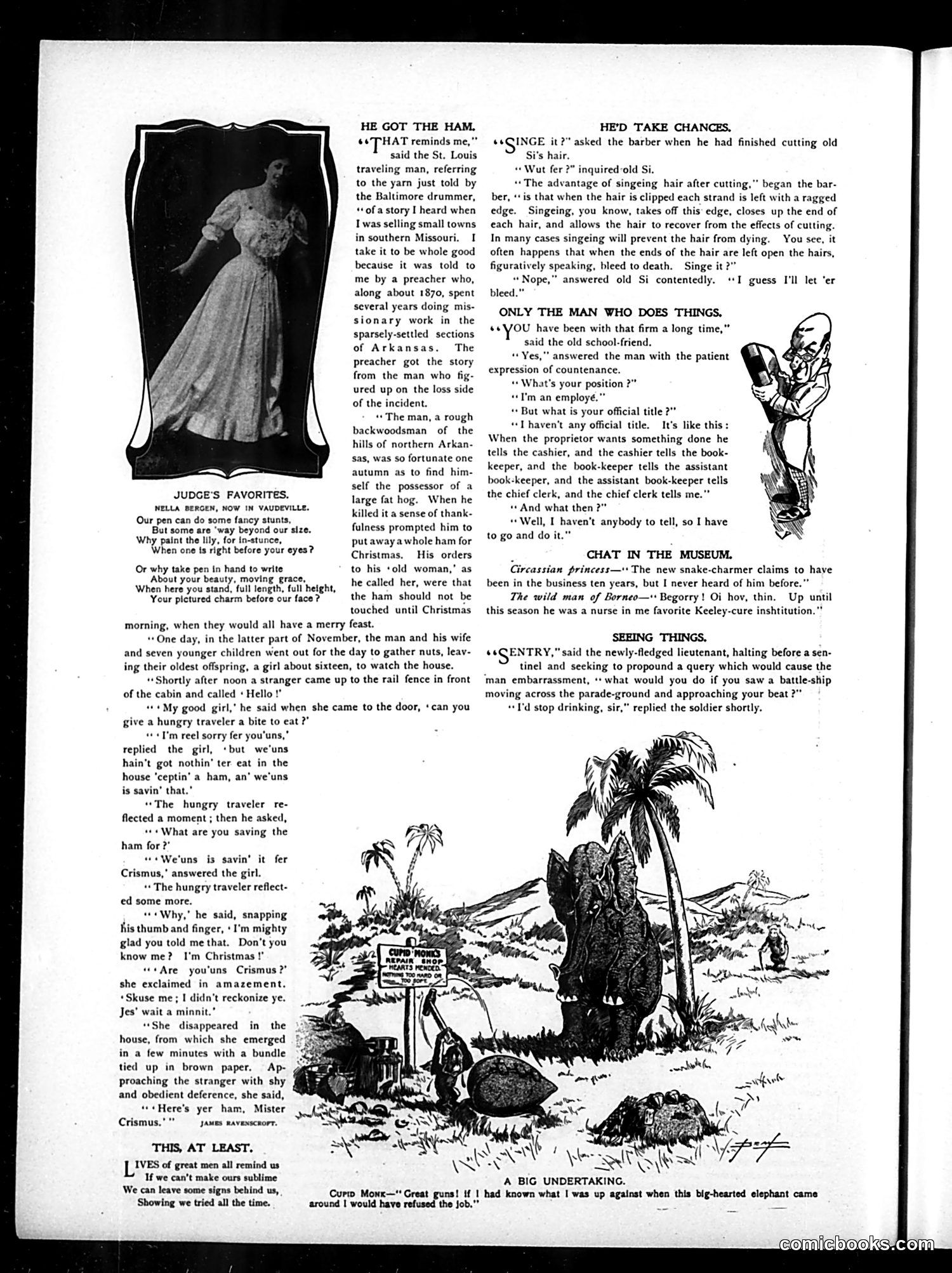
This page contains several short humorous stories rather than political cartoons. The main pieces include: **"He Got the Ham"** – A rural anecdote about a traveling man who receives a ham as a Christmas gift from a preacher, reflecting late 19th/early 20th-century frontier humor. **"Only the Man Who Does Things"** – A workplace satire about bureaucratic hierarchy, where employees pass tasks up and down a chain of command without clear authority or responsibility. **"Chat in the Museum"** and **"Seeing Things"** – Brief sketches about military/colonial encounters. The illustrations are decorative rather than satirical political commentary. This appears to be entertainment-focused content typical of Judge's lighter editorial material, emphasizing character humor and workplace absurdities rather than partisan critique.
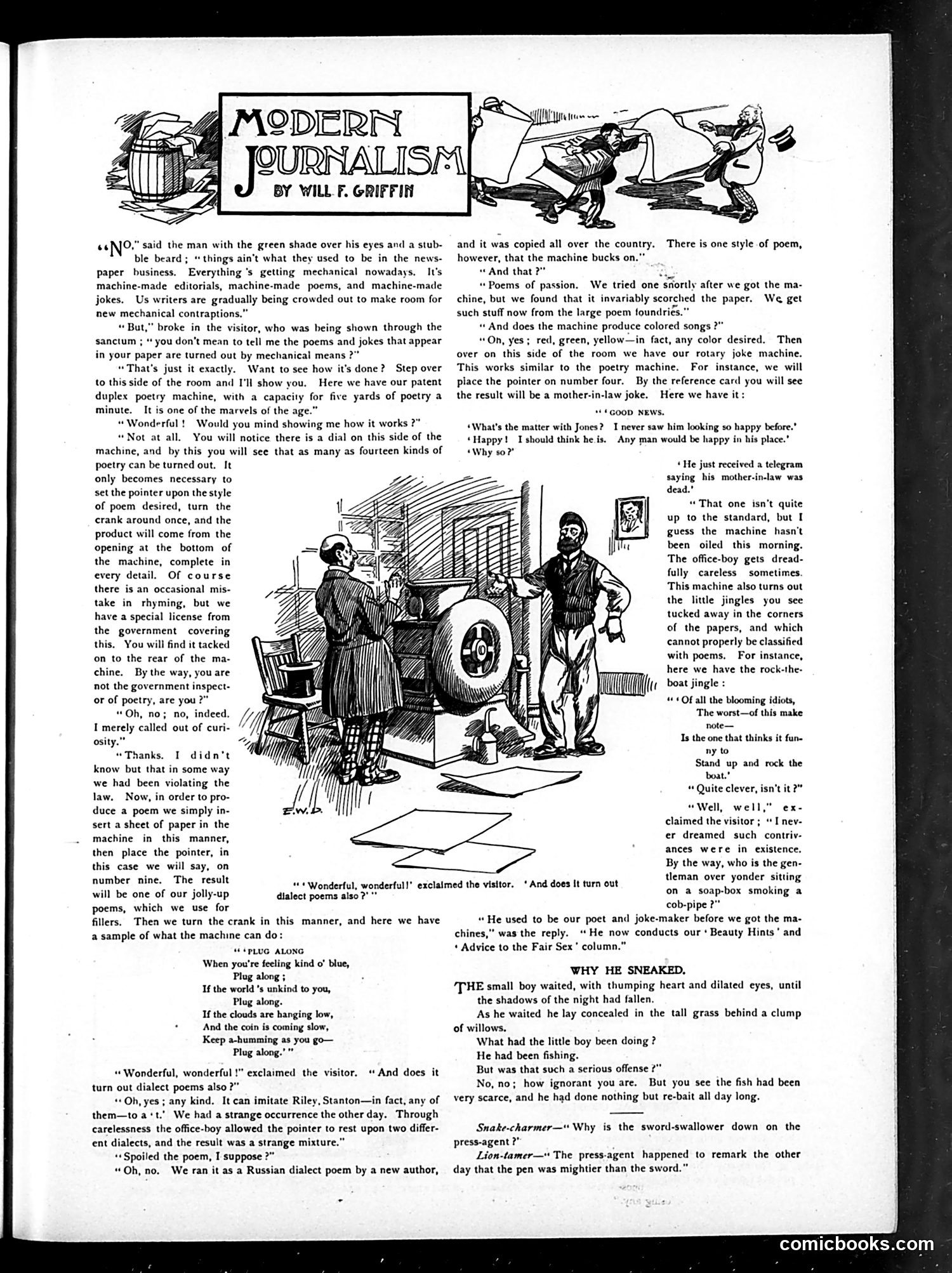
This satirical article mocks the mechanization of newspaper publishing. A man with a green eye-shade (representing an editor) demonstrates a "poetry machine"—a device that produces automated verse by turning a crank. The machine purportedly creates multiple styles of poems: passionate ones, colored "jingles," and even dialect poetry. The satire targets the industrialization of journalism and creative writing, suggesting that newspapers prioritize quantity and mechanical efficiency over genuine artistry. The poetry machine symbolizes how modern journalism treats literary content as mere product output rather than meaningful work. The accompanying story "Why He Sneaked" appears unrelated to the main cartoon's critique of mass-produced newspaper verse.
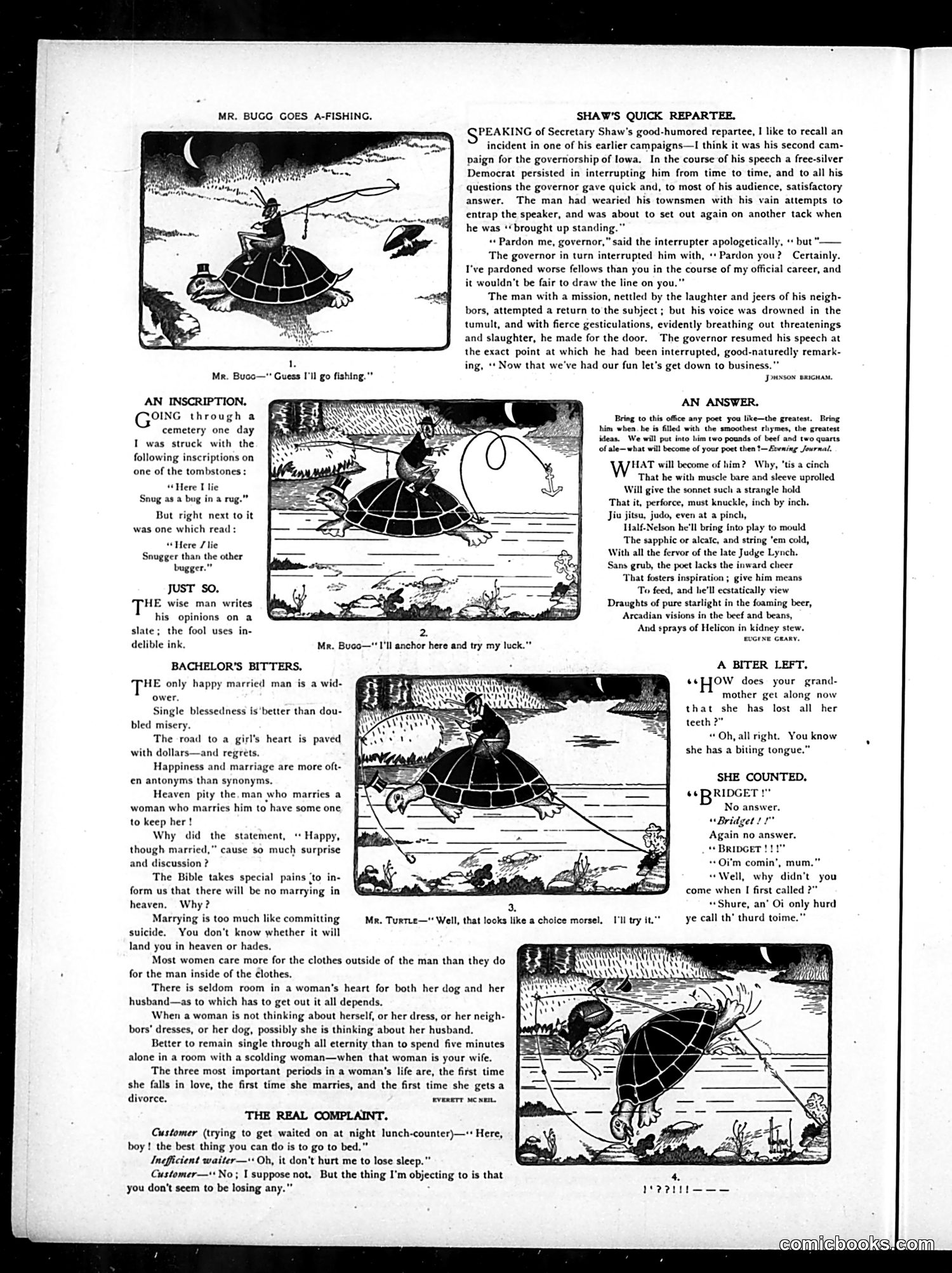
This page contains satirical commentary and humorous short pieces typical of early 20th-century Judge magazine. **"Mr. Bugg Goes A-Fishing"**: A visual gag about a character named Bugg attempting to fish, with the humor deriving from the pun on "snug as a bug in a rug." **"Shaw's Quick Repartee"**: A prose anecdote praising Secretary Shaw (likely Leslie Mortier Shaw, Secretary of the Treasury under Theodore Roosevelt) for his witty political comebacks during an Iowa gubernatorial campaign. The piece illustrates Shaw's ability to silence a heckler with clever rejoinders. **"An Answer"**: A poem humorously describing what happens when a poet is given beef and ale—he becomes physically aggressive, using wrestling moves on his own verse. **Remaining pieces**: Brief humorous observations about marriage, bachelors, and domestic life, plus a dialect-humor sketch about an Irish servant named Bridget who doesn't respond promptly to being called. The page reflects the magazine's mix of political satire, wordplay, and genteel humor aimed at educated readers.
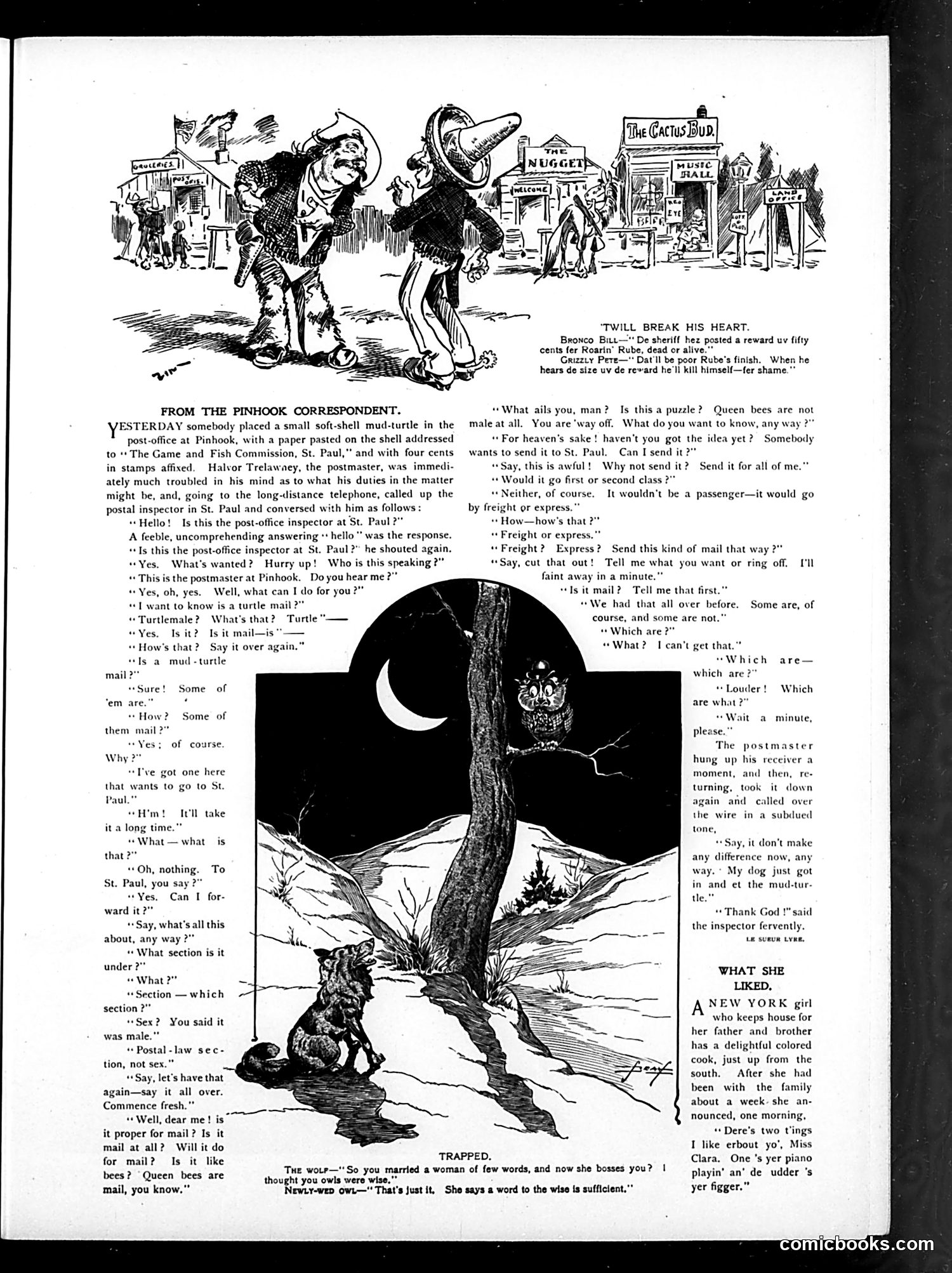
This page from *Judge* contains three satirical pieces: **"From the Pinhook Correspondent"** (main story): A humorous sketch about a rural Minnesota postmaster who calls a St. Paul postal inspector in confusion over whether a mud-turtle can be mailed. The comedy derives from the postmaster's thick accent and the inspector's mounting frustration during a long-distance phone conversation—a then-novel technology. The satire gently mocks rural bewilderment with modern systems. **"Trapped"** (owl cartoon): A visual pun about marriage. A newlywed owl claims his talkative wife is actually taciturn, then realizes "a word to the wise is sufficient"—meaning her silence conveys complete domination. **"What She Liked"** (brief anecdote): A Southern Black cook compliments her white employer on two things: piano playing and her figure. The humor relies on period racial stereotypes and dialect humor common to early-1900s publications. All three pieces reflect *Judge*'s satirical approach: gentle mockery of rural life, marriage dynamics, and racial caricature typical of the era.
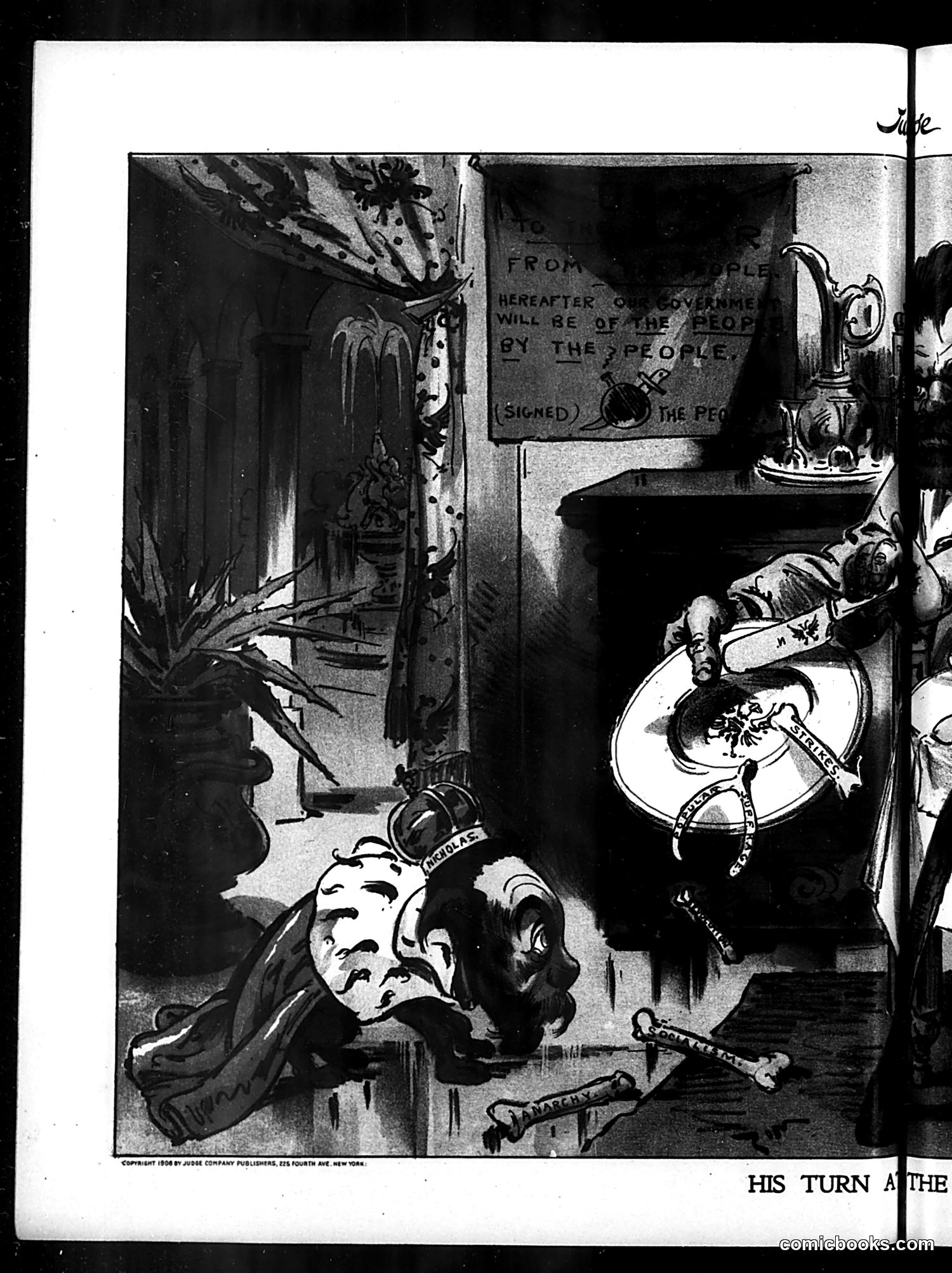
This satirical cartoon from *Judge* magazine depicts a theatrical or political scene. A figure wearing a mask lies on the floor in the foreground, appearing defeated or unconscious. Another masked figure sits elevated on the right, wearing what appears to be formal or ceremonial dress with a circular emblem. A placard on the wall reads partially: "FROM...HEREAFTER...WILL BE OF THE PEOPLE...BY THE PEOPLE...(SIGNED)...THE PEOPLE"—echoing Lincoln's Gettysburg Address language about government. The masks and theatrical setting suggest this is political allegory, likely commenting on hypocrisy or the gap between democratic ideals and political reality. However, without a visible date or clearer identification of the specific figures, I cannot definitively identify which historical moment or political figures this targets. The overall theme appears to critique insincerity in politics.
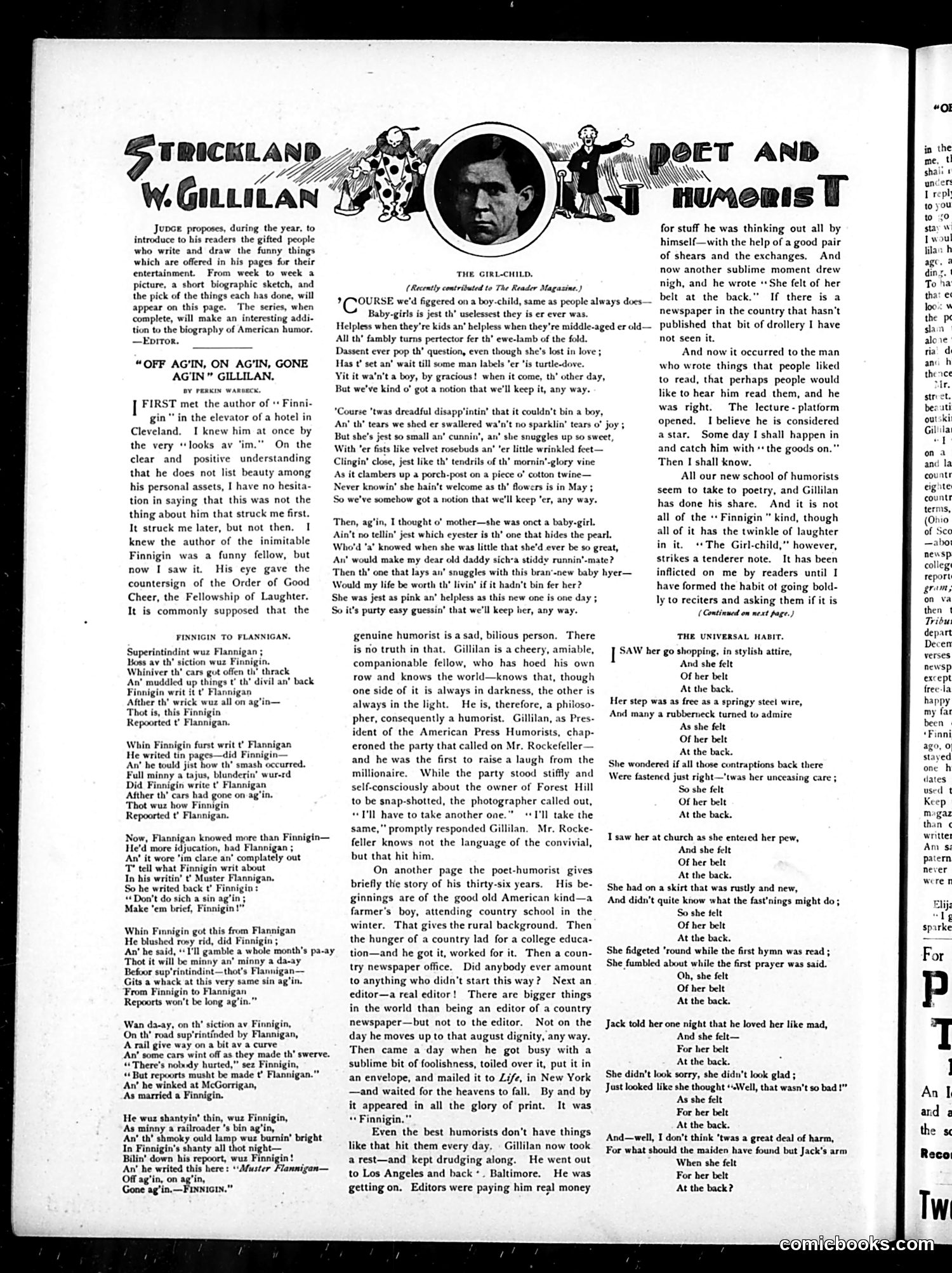
This is a **feature article introducing W. Gillillan**, a humor writer and poet, to Judge's readers. The page includes biographical text and samples of his work. The main content showcases Gillillan's signature style: **Irish-dialect comic verse** using phonetic spelling ("ag'in," "writ," "th'"). Two poems appear: "Finnigin to Flannigan" depicts railroad workers' miscommunications in exaggerated Irish brogue, while "The Girl-Child" humorously describes a rural family's disappointment at having a daughter rather than a son, then softening to acceptance. The satire targets **working-class Irish-American speech patterns** and rural sentimentality—common subject matter for American humor magazines of this era. Gillillan was apparently known for this particular comic voice. The portrait suggests he was a recognized literary figure Judge felt worth featuring to its readers as part of their ongoing series on American humorists.
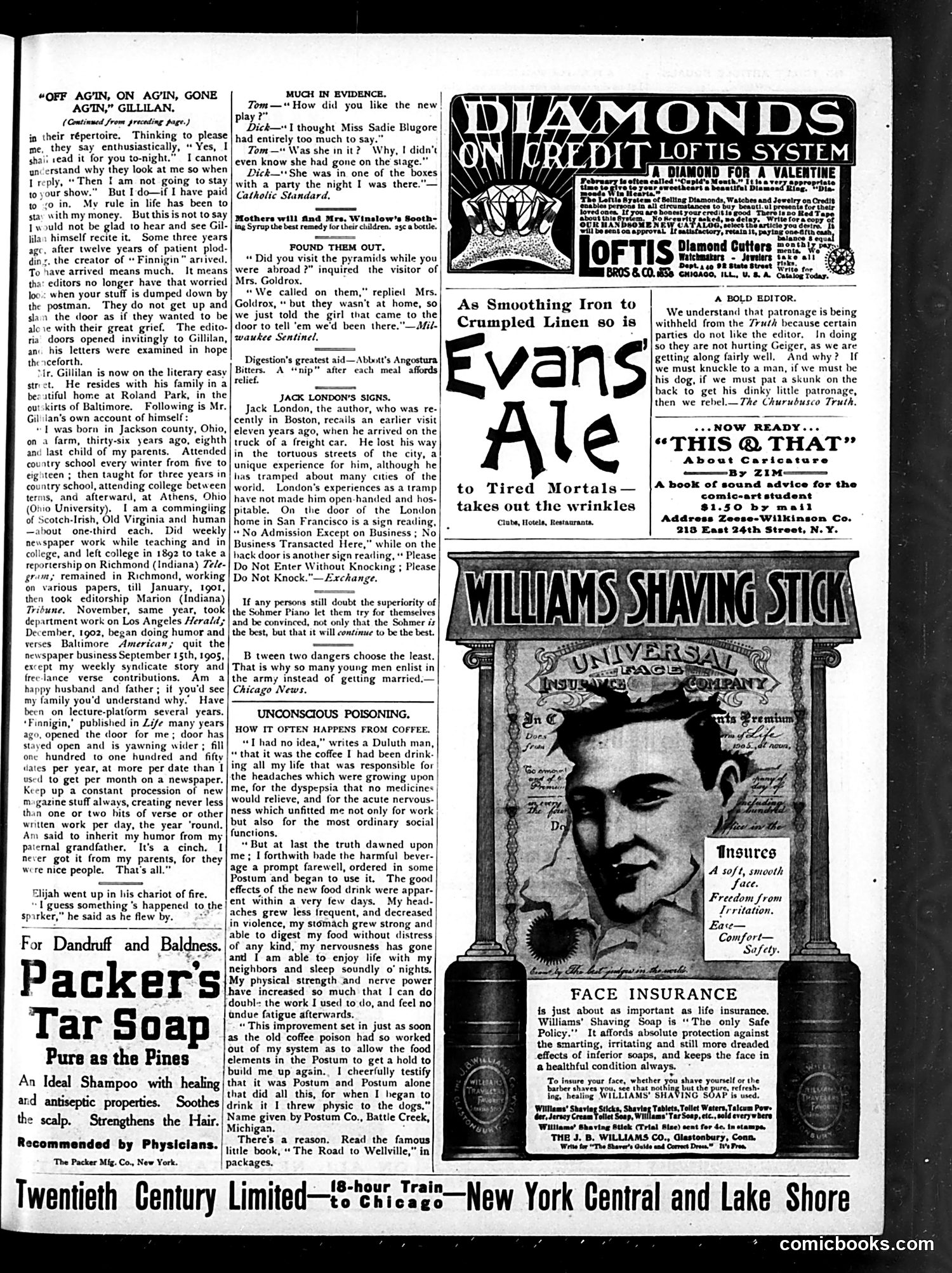
This page consists primarily of **advertisements and filler content**, not political satire or editorial cartoons requiring historical context. The main text is a biographical profile of **Strickland Gillilan**, a humor writer and poet whose work "Finnigin" helped launch his literary career. The piece is largely autobiographical—Gillilan describes his Ohio farm origins, newspaper work in Richmond and Marion, Indiana, and his eventual success as a lecturer and humorist writing for *Life* magazine and newspapers. The scattered jokes and anecdotes (about coffee poisoning, pyramid tourism, theater-going) appear to be filler material typical of the era's magazines. The page is dominated by **period advertisements** for products like Packer's Tar Soap, Evans Ale, Williams Shaving Soap, and diamond jewelry—representative of early 20th-century consumer marketing. There are no significant political references or satirical cartoons requiring specialized historical knowledge to interpret.
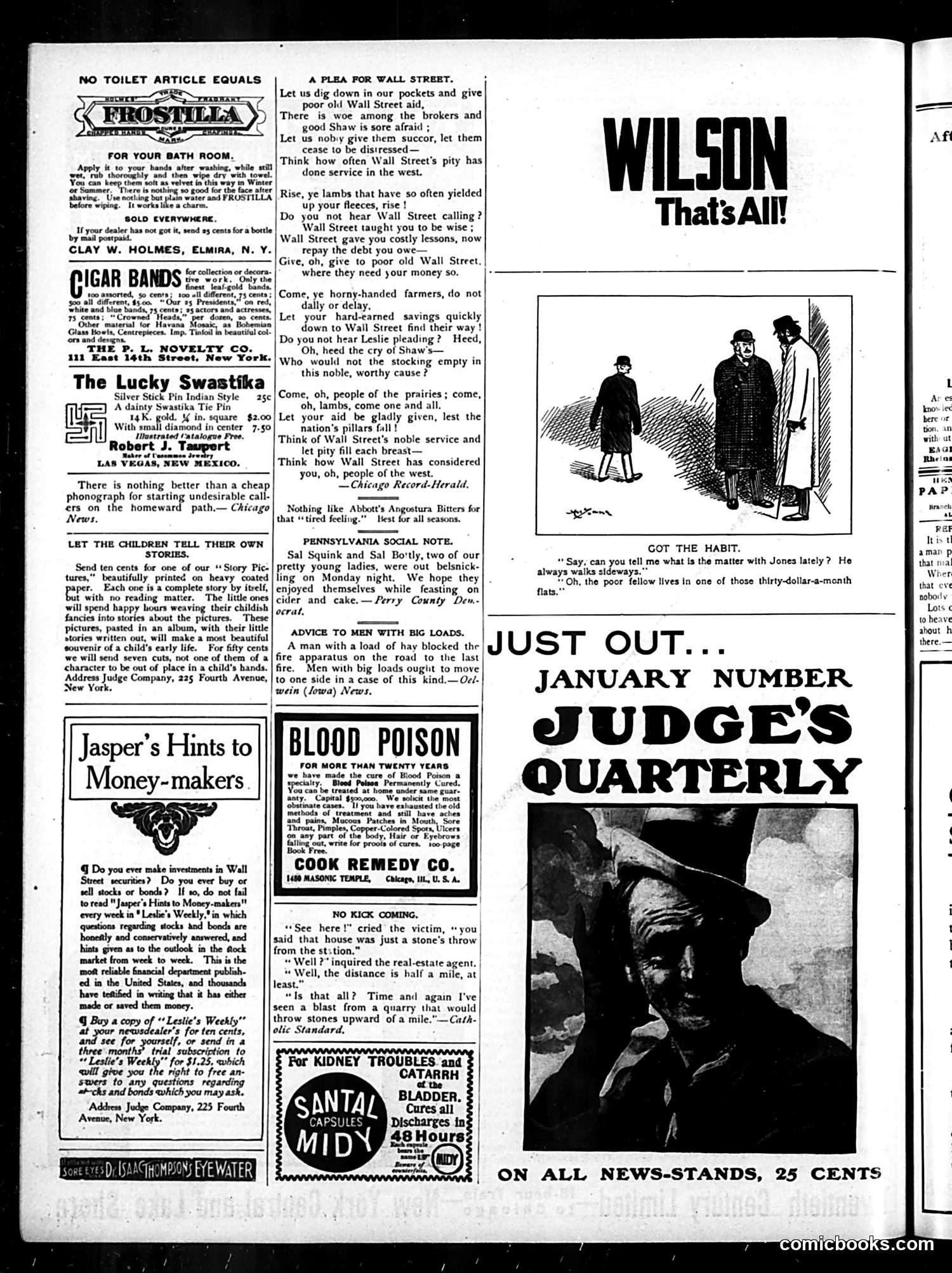
This page is primarily **advertisements and filler content** rather than political satire. However, it contains one notable satirical poem titled "A Plea for Wall Street." ## The Main Satire The poem mocks **wealthy Wall Street financiers** soliciting aid from farmers and rural Americans during what appears to be an economic crisis. The satire is **ironic and biting**: it sarcastically suggests that since Wall Street has supposedly helped the West prosper, farmers should now repay by sending their savings to rescue struggling brokers and speculators. The poem references figures named **Shaw and Leslie** (likely financial commentators or brokers of the era), portraying them as desperate and pleading. The repeated refrain urges rural Americans—"lambs," "horny-handed farmers," "people of the prairies"—to sacrifice their earnings to save Wall Street's "noble service." ## The Point The satire critiques **economic hypocrisy**: Wall Street profits from agricultural regions but shows no reciprocal concern. When Wall Street faces trouble, it expects farmers to bail them out. The poem exposes how financial elites frame self-interest as mutual obligation. The remainder of the page consists of product advertisements and miscellaneous humor.
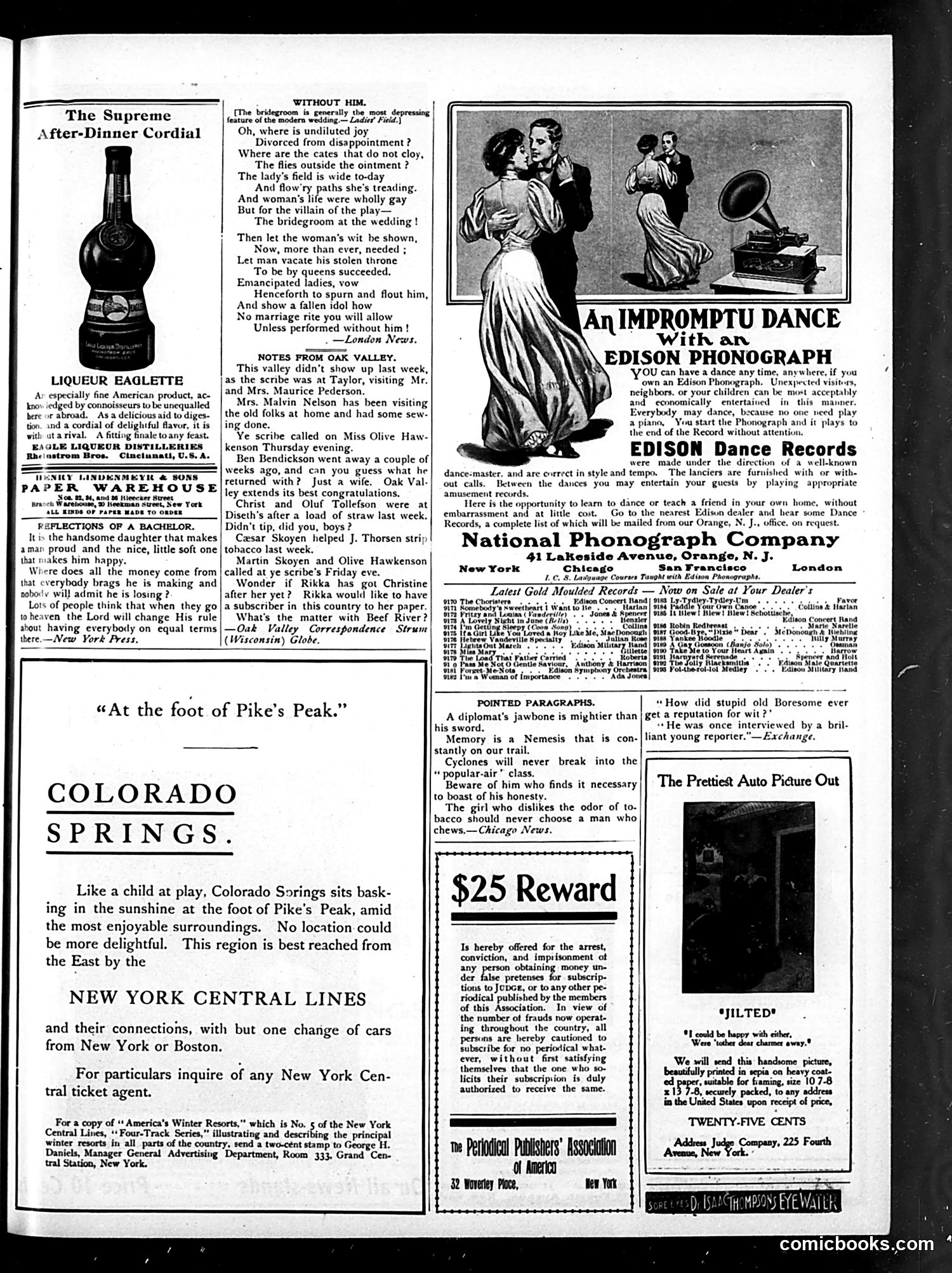
This page is primarily **advertising and filler content** rather than political satire. The main items are: 1. **"Without Him" poem** (top right): A satirical piece mocking marriage by suggesting women should reject wedlock entirely because husbands spoil otherwise perfect married life. It's light domestic satire typical of the era. 2. **Advertisements**: The bulk of the page features ads for liqueur, paper warehouses, Colorado Springs tourism, and Edison phonographs—standard commercial content. 3. **"Reflections of a Bachelor"**: Brief cynical observations about human nature and money. 4. **Oak Valley correspondence**: Rural gossip column with local news. There are no identifiable political figures or significant social commentary. The "Without Him" satire is generic marital humor reflecting early 20th-century attitudes about women's roles. This appears to be a routine issue page filled with ads and light entertainment rather than Judge's typical sharp political cartooning.
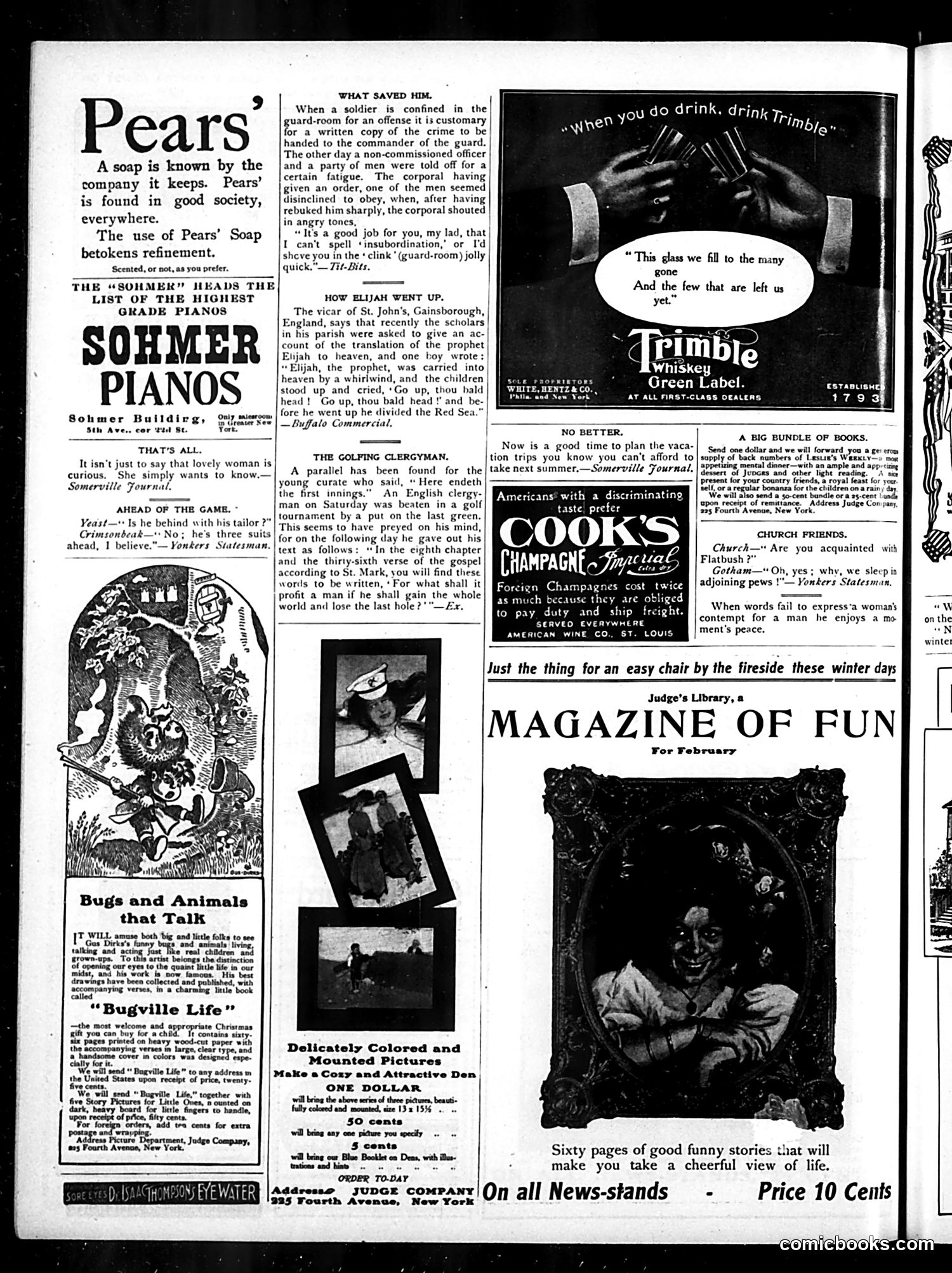
This is primarily an **advertising page** from Judge magazine, with several small satirical anecdotes interspersed. The notable humor pieces include: **"What Saved Him"** — A military joke about a soldier confined to the guard-room. The humor relies on the corporal's *illiteracy*: he cannot spell "insubordination," so cannot formally charge the soldier, thus saving him from punishment. The joke mocks working-class soldiers' lack of education. **"How Elijah Went Up"** — A children's bible lesson gone wrong. A schoolboy conflates the prophet Elijah's ascension to heaven with the children of Bethel (who mocked him) and adds the "Red Sea" — mixing biblical stories. The humor is in innocent childish confusion. **"The Golfing Clergyman"** — A clergyman, upset about losing at golf on the last hole, absurdly quotes scripture the next day as if it condemns losing games. The satire mocks the clergy's pompousness. The page otherwise contains advertisements for Pears' soap, Sohmer pianos, "Bugville Life" (an illustrated children's book), Trimble whiskey, and Cook's champagne.
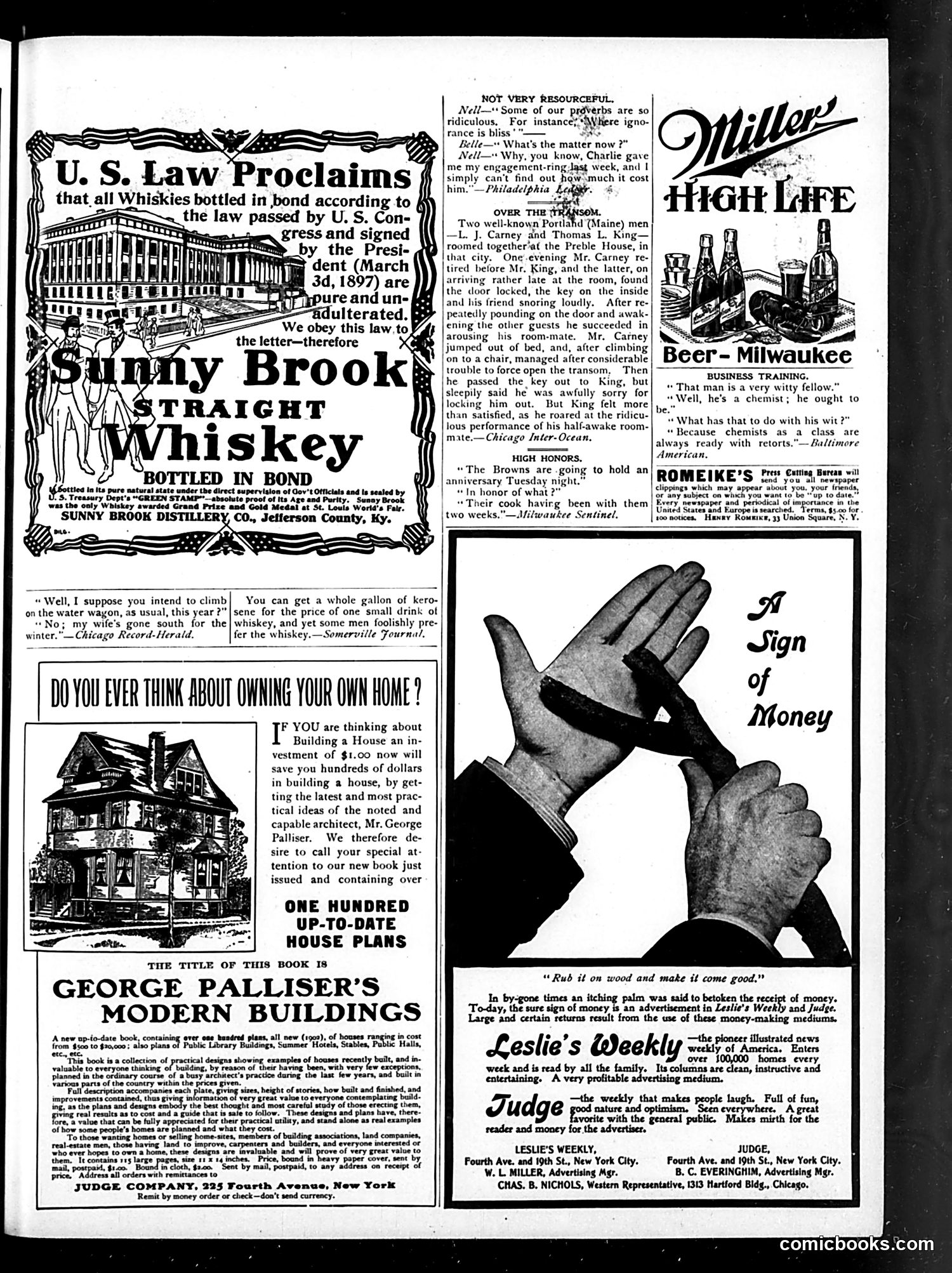
This page is primarily **advertising and humor pieces**, not political satire. The main content includes: 1. **Sunny Brook Whiskey ad**: Emphasizes federal government oversight ("GREEN STAMP") as proof of purity—reflecting early 1900s concerns about adulterated alcohol before modern food safety regulations. 2. **Humorous anecdotes**: Short jokes about marriage, kerosene prices, and workplace situations typical of period humor magazines. 3. **House-building book ad**: George Palliser's architectural plans, marketed as investment-saving guidance for homeowners. 4. **Trade publications ads**: Leslie's Weekly and Judge magazine self-promotion; Romeike's newspaper clipping service. The page reflects **Progressive Era concerns**: food/product safety (whiskey purity), homeownership as economic aspiration, and the emerging consumer information industry. The hand image advertising "A Sign of Money" promotes financial literacy publications. Overall, this is a commercial page showcasing period middle-class aspirations and consumer anxieties rather than political commentary.
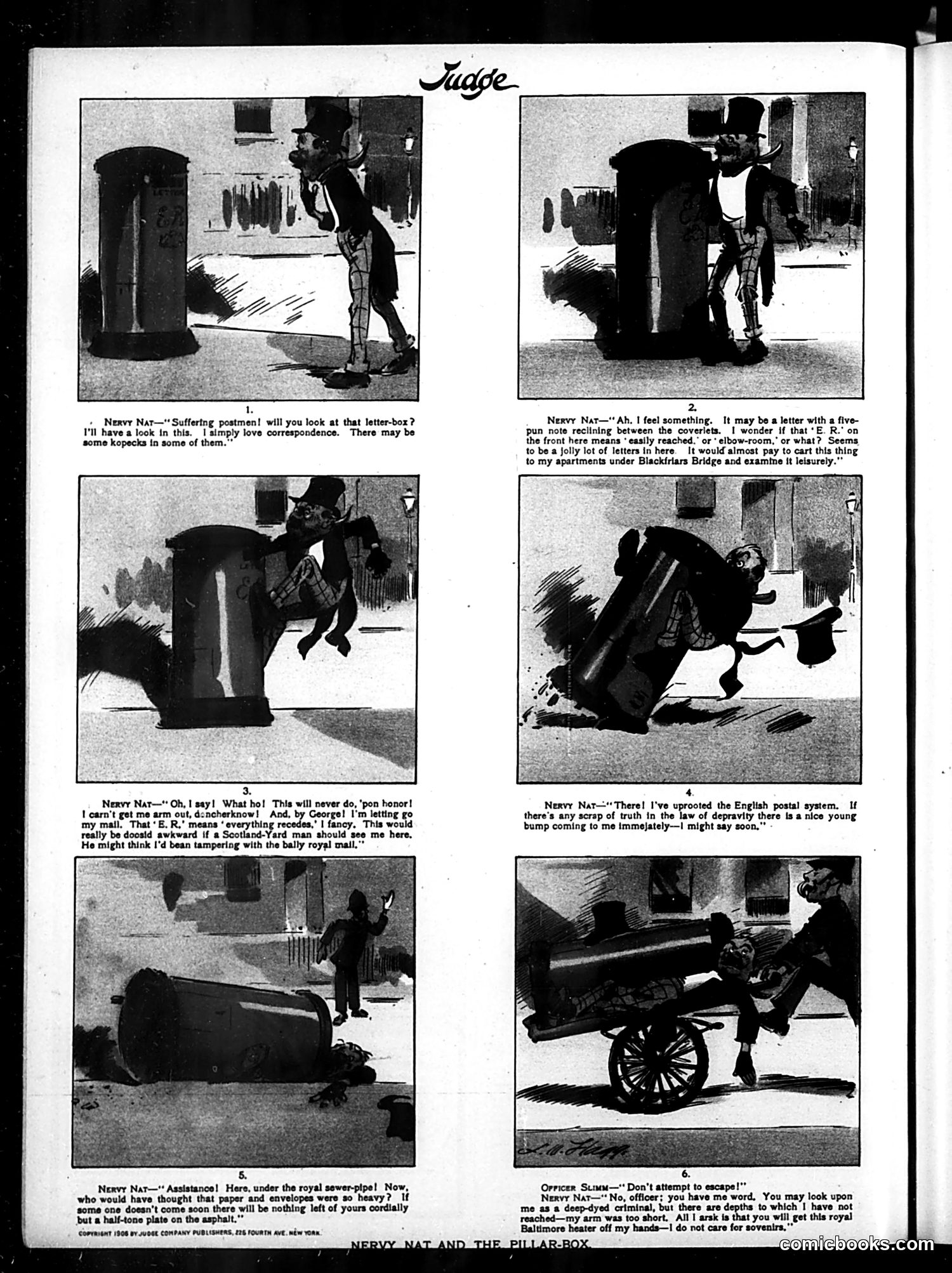
This is a six-panel comic strip satirizing a character called "Nervy Nat," a petty criminal attempting to steal mail from a British royal postbox (letter-box). The humor centers on his escalating misadventures: he reaches into the pillar-box searching for money, gets his arm stuck, recruits help to extract the heavy mailbag, and ultimately tips the entire postal structure over while attempting to haul it away. The satire targets both the criminal's bumbling incompetence and British class pretensions—his affected speech ("'pon honor," "doosid awkward") contrasts comically with his desperation. The final panel shows him arrested, having failed spectacularly at theft while claiming he couldn't stoop to *certain* criminal depths. The comic satirizes the "criminal underworld" as portrayed in popular British fiction of the era.