
Judge, 1906-01-20 · page 5 of 16
Judge — January 20, 1906 — page 5: what you’re looking at
What you’re looking at
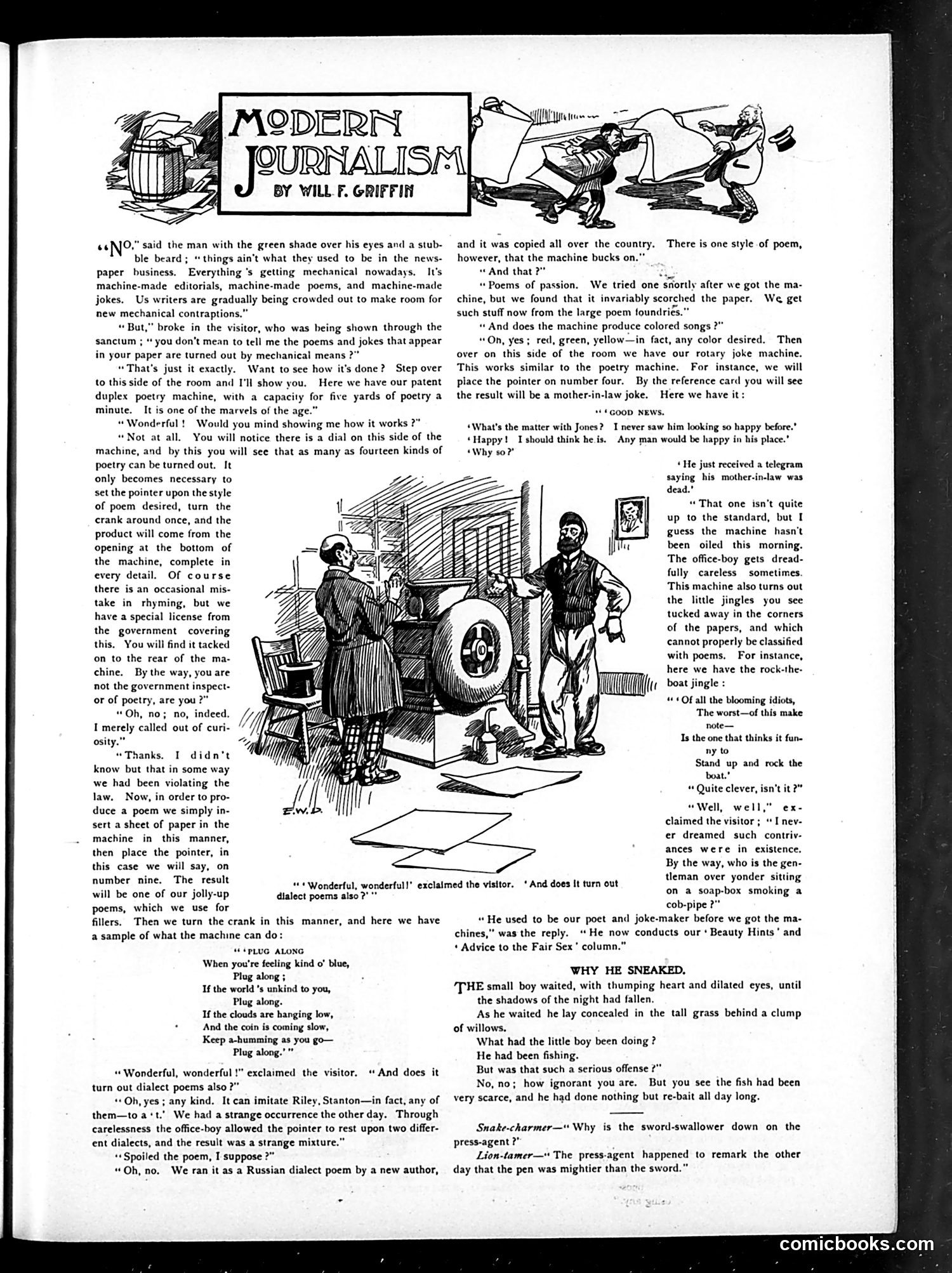
This satirical article mocks the mechanization of newspaper publishing. A man with a green eye-shade (representing an editor) demonstrates a "poetry machine"—a device that produces automated verse by turning a crank. The machine purportedly creates multiple styles of poems: passionate ones, colored "jingles," and even dialect poetry. The satire targets the industrialization of journalism and creative writing, suggesting that newspapers prioritize quantity and mechanical efficiency over genuine artistry. The poetry machine symbolizes how modern journalism treats literary content as mere product output rather than meaningful work. The accompanying story "Why He Sneaked" appears unrelated to the main cartoon's critique of mass-produced newspaper verse.
📄 Transcribed text from this page (OCR, searchable)
Machine-transcribed from the original scan — historical spelling and the odd misread are preserved.
660." said the man with the green shade over his eyes and a stub- ble beard; “things ain't what they used to be in the news- paper business. Everything ’s getting mechanical nowadays. It's machine-made editorials, machine-made poems, and machine-made jokes. Us writers are gradually being crowded out to make room for new mechanical contraptions.” “But,” broke in the visitor, who was being shown through the sanctum ; “you don’t mean to tell me the poems and jokes that appear in your paper are turned out by mechanical means ?” “That's just it exactly. Want to see how it's done? Step over to this side of the room and I'll show you. Here we have our patent duplex poetry machine, with a capacity for five yards of poetry a minute. It is one of the marvels of the age.” “Wonderful! Would you mind showing me how it works ?” “Not at all. ‘ou will notice there is a dial on this side of the machine, and by this you will see that as many as fourteen kinds of poetry can be turned out. It only becomes necessary to set the pointer upon the style of poem desired, turn the crank around once, and the product will come from the opening at the bottom of the machine, complete in every detail. Of course there is an occasional mis- take in rhyming, but we have a special license from the government covering this. You will find it tacked on to the rear of the ma- chine. By the way, you are not the government inspect or of poetry, are you 2” “Oh, no; no, indeed. I merely called out of curi- osity.”” “Thanks. I didn't know but that in some way we had been violating the law. Now, in order to pro- duce a poem we simply in- sert a sheet of paper in the machine in this manner, then place the pointer, in this case we will say, on number nine. The result ‘ will be one of our jolly-up poems, which we use for fillers, Then we turn the crank in this manner, and here we have a sample of what the machine can do: “PLUG ALONG ‘When you're feeling kind o° blue, Plug along ; If the world 's unkind to you, Plug along. If the clouds are hanging low, And the coin is coming slow, Keep a-humming as you go— Plug along.’ dialect poems also?" “Wonderful, wonderful !" exclaimed the visitor. “And does it turn out dialect poems also ?" “Oh, yes ; any kind. It can imitate Riley, Stanton—in fact, any of them—to a‘t.’ We had a strange occurrence the other day. Through carelessness the office-boy allowed the pointer to rest upon two differ- ent dialects, and the result was a strange mixture.” “«Spoiled the poem, I suppose ?” “Oh, no, We ran it as a Russian dialect poem by a new author, Wonderful, wonderful!’ exclaimed the visitor. and it was copied all over the country. There is one style of poem, however, that the machine bucks on.” “And that ?” 3 Poems of passion. We tried one snortly after we got the ma- chine, but we found that it invariably scorched the paper. We get such stuff now from the large poem foundries.” “ And does the machine produce colored songs ?" “On, yes; red, green, yellow—in fact, any color desired. Then over on this side of the room we have our rotary joke machine. This works similar to the poetry machine. For instance, we will place the pointer on number four. By the reference card you will see the result will be a mother-in-law joke. Here we have it: + ¢Goop NEWS. «What's the matter with Jones? I never saw him looking so happy before.’ “Happy! I should think he is. Any man would be happy in his place.’ «Why so?" “He just received a telegram saying his mother-in-law was dead.’ “That one isn’t quite up to the standard, but I guess the machine hasn't been oiled this morning. The office-boy gets dread- fully careless sometimes. This machine also turns out the little jingles you see tucked away in the corners of the papers, and which cannot properly be classified with poems. For instance, here we have the rock-the- boat jingle : «Of all the blooming idiots, The worst—of this make note— Is the one that thinks it fun- ny to Stand up and rock the boat.’ “ Quite clever, isn’t it 2” “Well, well,” claimed the visitor ; “I nev- er dreamed such contriv- ances were in existence. By the way, who is the gen- tleman over yonder sitting on a soap-box smoking a cob-pipe ?” «He used to be our poet and joke-maker before we got the ma- chines,” was the reply. “He now conducts our * Beauty Hints’ and * Advice to the Fair Sex * column. ex- * And does It turn out WHY HE SNEAKED, ‘THE small boy waited, with thumping heart and dilated eyes, until the shadows of the night had fallen. As he waited he lay concealed in the tall grass behind a clump of willows. What had the little boy been doing ? He had been fishing. But was that such a serious offense ?” No, no; how ignorant you are. But you see the fish had been very scarce, and he had done nothing but re-bait all day long. Snake-charmer— Why is the sword-swallower down on the press-agent ?” Lion-tamer—“ The press-agent happened to remark the other day that the pen was mightier than the sword.” comicbooks.com