
Judge, 1906-01-20 · page 2 of 16
Judge — January 20, 1906 — page 2: what you’re looking at
What you’re looking at
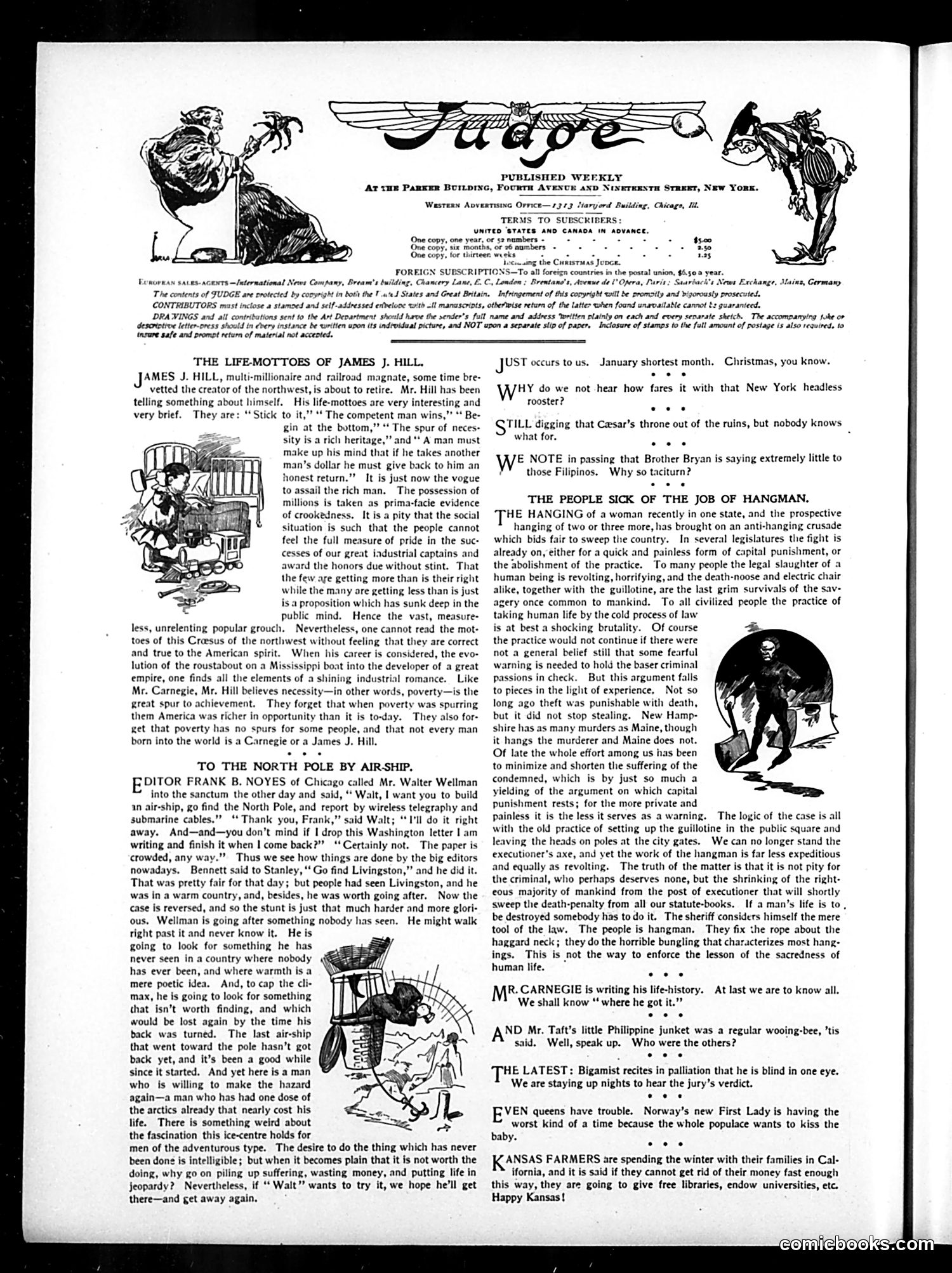
This page contains satirical commentary and illustrations typical of early 20th-century American humor. The main sections include: **"Life-Mottos of James J. Hill"** - A satirical piece mocking railroad magnate James J. Hill, depicted in illustrations as self-serving and morally questionable. The cartoon critiques wealthy industrialists' exploitation and lack of genuine social responsibility. **"The People Sick of the Job of Hangman"** - Editorial commentary opposing capital punishment, arguing execution doesn't deter crime and represents cruel government excess. It advocates for abolishing the death penalty. **"To the North Pole by Air-Ship"** - A humorous anecdote about an inventor seeking newspaper backing for an Arctic aviation expedition, satirizing both technological optimism and journalistic sensationalism. The page reflects Progressive Era concerns: industrial monopoly power, criminal justice reform, and skepticism toward technological promises.
📄 Transcribed text from this page (OCR, searchable)
Machine-transcribed from the original scan — historical spelling and the odd misread are preserved.
a — =F Ca / PUBLISHED WE: Av tae Paneer Bortpryc, Fourtm AveNce a: TERMS TO SUBSCRIBERS: UNITED STATES AND CANADA IN ADVANCE. One copy, one year,orsznumbers= = == ix months, or somumbers = = se irteer, weeks 7 Teena aing the Cunsratas Jonce. CRIPTIONS—To all foreign countries in the postal union, $4.50 year. The contents of FUDGE are erotected by conyrigh in bot the T.u'eJ States and Great Brita CONTRIBUTORS mast inciose a stamoed and self-addressed entvelove with all manuscripts, otherwise return of the Latter when found unavailaNe cannot t CC, London ; Brentano's, Avenue de!" Opera, "sNews Exchange, Infringement of this conyright will be promoily and digorousty prosecuted. sarantecd. DRAWINGS and alt contributions sent to the Art Devartment should have the sender's full name and address ‘written plainly on each and every senarate sketch. The accompanying juke or descriptive letter-press should tn every instance be written apon its indroidaal picture, and NOT upon a separate slip of paper, Inclosure of stamps to the full amount of postage (s also reauired. 10 insure safe and prompt return of material not accepted. ‘THE LIFE-MOTTOES OF JAMES J. HILL. JAMES J. HILL, multi-millionaire and railroad magnate, some time bre- vetted the creator of the northwest, is about to retire. Mr. Hill has been telling something about himself. His life-mottoes are very interesting and very brief. They are: ‘Stick to it,’ ‘* The competent man wins,” ** Be- gin at the bottom,” ** The spur of neces- sity is a rich heritage,” and ** A man must make up his mind that if he takes another man’s dollar he must give back to him an nest return.” It is just now the vogue to assail the rich man. The possession of millions is taken as prima-facie evidence of crookedness. It is a pity that the social situation is such that the people cannot feel the full measure of pride in the suc- cesses of our great industrial captains and award the honors due without stint. That the few age getting more than is their right while the many are getting less than is just is a proposition which has sunk deep in the public mind. Hence the vast, measure- less, unrelenting popular grouch. Nevertheless, one cannot read the mot- toes of this Croesus of the northwest without feeling that they are correct and true to the American spirit. When his career is considered, the evo- lution of the roustabout on a Mississippi boat into the developer of a great empire, one finds all the elements of a shining industrial romance. Like Mr. Carnegie, Mr. Hill believes necessity—in other words, poverty—is the great spur to achievement. They forget that when poverty was spurring them America was richer in opportunity than it is to-day. They also for- get that poverty has no spurs for some people, and that not every man born into the world is a Carnegie or a James J. Hill. TO THE NORTH POLE BY AIR-SHIP. Eo!ToR FRANK B. NOYES of Chicago called Mr. Walter Wellman into the sanctum the other day and said, “ Walt, | want you to build 1n air-ship, go find the North Pole, and report by wireless telegraphy and submarine cables.” “ Thank you, Frank,” said Walt; ‘I'll do it right away. And—and—you don’t mind if I drop this Washington letter | am writing and finish it when I come back?” ‘Certainly not. The paper is crowded, any way.” Thus we see how things are done by the big editors nowadays. Bennett said to Stanley, “ Go find Livingston,” and he did it. That was pretty fair for that day; but people had seen Livingston, and he was in a warm country, and, besides, he was worth going after. Now the case is reversed, and so the stunt is just that much harder and more glori- ous. Wellman is going after something nobody has seen. He might walk right past it and never know it. He is going to look for something he has never seen in a country where nobody has ever been, and where warmth is a mere poetic idea. And, to cap the cli- max, he Is going to look for something that isn’t worth finding, and which would be lost again by the time his back was turned. The last air-ship that went toward the pole hasn’t got back yet, and it’s been a good while since it started. And yet here is a man who is willing to make the hazard again—a man who has had one dose of the arctics already that nearly cost his life. There is something weird about the fascination this ice-centre holds for men of the adventurous type. The desire to do the thing which has never been done is intelligible; but when it becomes plain that it is not worth the doing, why go on piling up suffering, wasting money, and putting life in jeopardy? Nevertheless, if Walt’ wants to try it, we hope he'll get there—and get away again. JUST eccurs to us. January shortest month, Chiristmas, you know. wy do we not hear how fares it with that New York headless rooster? eee STILL digging that Caesar's throne out of the ruins, but nobody knows what for. . WE ? those Filipinos. NOTE in passing that Brother Bryan is saying extremely little to Why so taciturn? THE PEOPLE SICK OF THE JOB OF HANGMAN. HE HANGING of a woman recently in one state, and the prospective hanging of two or three more, has brought on an anti-hanging crusade which bids fair to sweep the country. In several legislatures the fight is already on, either for a quick and painless form of capital punishment, or the abolishment of the practice. To many people the legal slaughter of a human being is revolting, horrifying, and the death-noose and electric chair alike, together with the guillotine, are the last grim survivals of the sav- agery once common to mankind. To all civilized people the practice of taking human life by the cold process of law is at best a shocking brutality. Of course the practice would not continue if there were not a general belief still that some fearful warning is needed to hold the baser criminal passions in check. But this argument falls to pieces in the light of experience, Not so long ago theft was punishable with death, but it did not stop stealing. New Hamp- shire has as many murders as Maine, though it hangs the murderer and Maine does not. Of late the whole effort among us has been to minimize and shorten the suffering of the condemned, which is by just so much a yielding of the argument on which capital punishment rests; for the more private and painless it is the less it serves as a warning. The logic of the case is all with the old practice of setting up the guillotine in the public square and leaving the heads on poles at the city gates. We can no longer stand the executioner’s axe, and yet the work of the hangman is far less expeditious and equally as revolting. The truth of the matter is that it is not pity for the criminal, who perhaps deserves none, but the shrinking of the right- ous majority of mankind from the post of executioner that will shortly sweep the death-penalty from all our statute-books. If a man’s life is to, be destroyed somebody has todo it. The sheriff considers himself the mere tool of the law. The people is hangman. They fix the rope about the haggard neck; they do the horrible bungling that characterizes most hang- ings. This is not the way to enforce the lesson of the sacredness of human life. rok R. CARNEGIE is writing his life-history. We shall know “ where he got it.” sitees AND Mr. Taft’s litte Philippine junket was a regular wooing-bee, 'tis said, Well, speak up. Who were the others? ‘THE LATEST: Bigamist recites in palliation that he is blind in one eye. We are staying up nights to hear the jury’s verdict. eiots EVEN queens have trouble. Norway's new First Lady is having the worst kind of a time because the whole populace wants to kiss the baby. At last we are to know all. KANSAS FARMERS are spending the winter with their families in Cal- ifornia, and it is said if they cannot get rid of their money fast enough this way, they are going to give free libraries, endow universities, etc. Happy Kansas!