
Judge, 1906-01-20 · page 6 of 16
Judge — January 20, 1906 — page 6: what you’re looking at
What you’re looking at
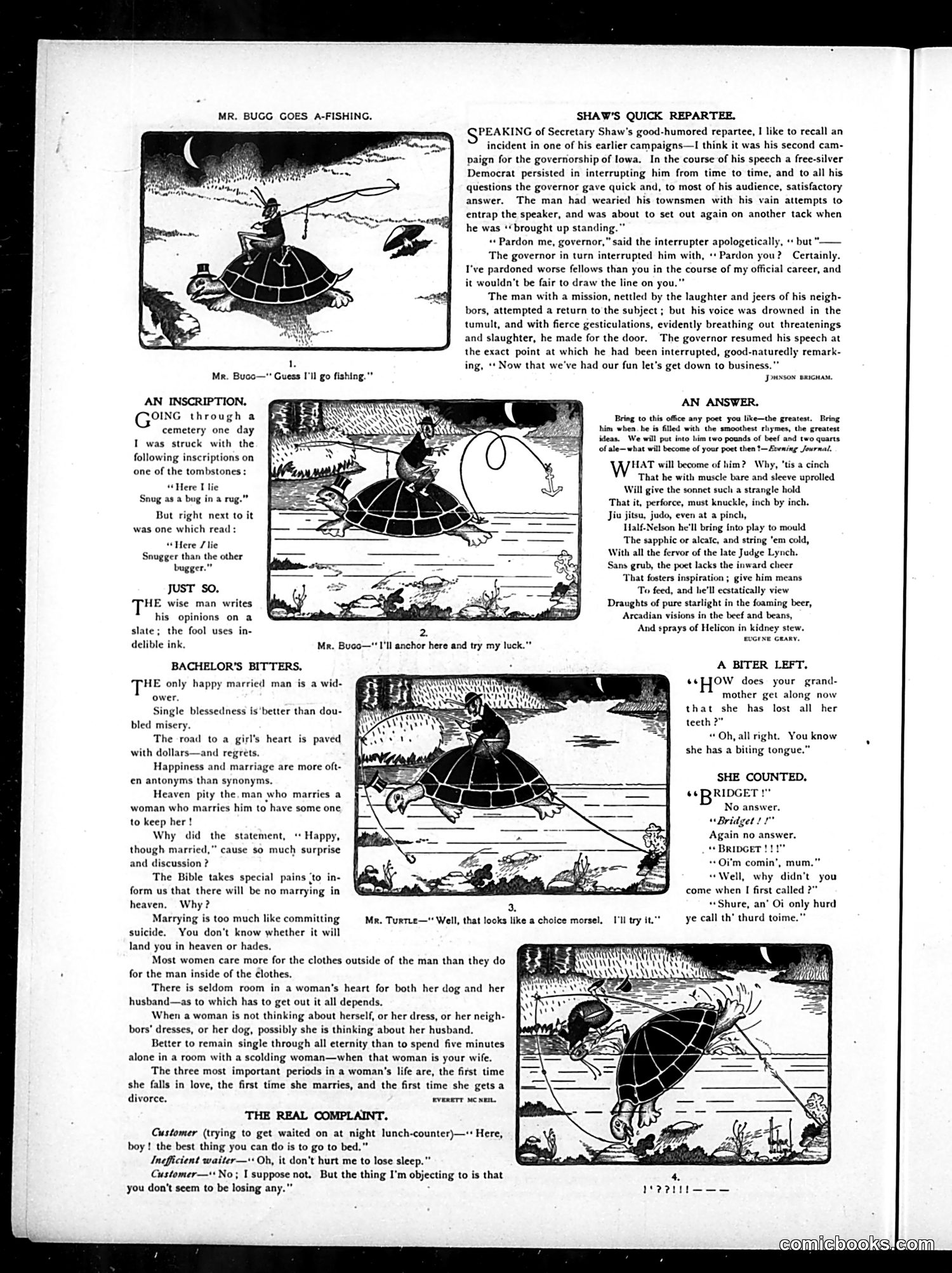
This page contains satirical commentary and humorous short pieces typical of early 20th-century Judge magazine. **"Mr. Bugg Goes A-Fishing"**: A visual gag about a character named Bugg attempting to fish, with the humor deriving from the pun on "snug as a bug in a rug." **"Shaw's Quick Repartee"**: A prose anecdote praising Secretary Shaw (likely Leslie Mortier Shaw, Secretary of the Treasury under Theodore Roosevelt) for his witty political comebacks during an Iowa gubernatorial campaign. The piece illustrates Shaw's ability to silence a heckler with clever rejoinders. **"An Answer"**: A poem humorously describing what happens when a poet is given beef and ale—he becomes physically aggressive, using wrestling moves on his own verse. **Remaining pieces**: Brief humorous observations about marriage, bachelors, and domestic life, plus a dialect-humor sketch about an Irish servant named Bridget who doesn't respond promptly to being called. The page reflects the magazine's mix of political satire, wordplay, and genteel humor aimed at educated readers.
📄 Transcribed text from this page (OCR, searchable)
Machine-transcribed from the original scan — historical spelling and the odd misread are preserved.
MR. BUGG GOES A-FISHING. 1 Mr. Buoo—"* Guess I'll go fishing.” AN INSCRIPTION. OING through a cemetery one day I was struck with the following inscriptions on one of the tombstones: “Here Tlie Snug as a bug in a rug.” But right next to it was one which read: “Here /lie SHAW’S QUICK REPARTEE. SPEAKING of Secretary Shaw's good-humored repartee, I like to recall an incident in one of his earlier campaigns—I think it was his second cam- paign for the governorship of lowa. In the course of his speech a free-silver Democrat persisted in interrupting him from time to time, and to all his questions the governor gave quick and, to most of his audience, satisfactory answer. The man had wearied his townsmen with his vain attempts to entrap the speaker, and was about to set out again on another tack when he was ‘brought up standing.” «Pardon me, governor,” said the interrupter apologetically, « but "—— ‘The governor in turn interrupted him with, «Pardon you? Certainly. I've pardoned worse fellows than you in the course of my official career, and it wouldn’t be fair to draw the line on you.” The man with a mission, nettled by the laughter and jeers of his neigh- bors, attempted a return to the subject ; but his voice was drowned in the tumult, and with fierce gesticulations, evidently breathing out threatenings and slaughter, he made for the door. The governor resumed his speech at the exact point at which he had been interrupted, good-naturedly remark- ing, ‘* Now that we've had our fun let’s get down to business."” JDMNSON BRIGHAM. AN ANSWER. Bring to this office any poet you like—the greatest. ring him whea.he is filled with the smoothest rhymes, the greatest teas. We will put into him two pounds of beef and two quarts of ale—what will become of your poet then t— Evening Journal. HAT will become of him? Why, ‘tis a cinch That he with muscle bare and sleeve uprolled Will give the sonnet such a strangle hold That it, perforce, must knuckle, inch by inch. Jiu jitsu, judo, even at a pinch, Half-Nelson he'll bring into play to mould The sapphic or alcatc, and string "em cold, With all the fervor of the late Judge Lynch. Snugger than the other bugger.” Sans grub, the poet lacks the inward cheer JUST So. THE wise man writes his opinions on a slate; the fool uses in- ‘That fosters inspiration ; give him means To feed, and he'll ecstatically view Draughts of pure starlight in the foaming beer, Arcadian visions in the beef and beans, And sprays of Helicon in kidney stew. EUGENE GEARY. delible ink. Mr. Buco—‘'I'll anchor here and try my luck."* BACHELOR'S BITTERS. THE only happy married man is a wid- ower. Single blessedness is'better than dou- bled misery. The road to a girl’s heart is paved with dollars—and regrets. Happiness and marriage are more oft- en antonyms than synonyms. Heaven pity the.man who marries a woman who marries him to have some one A BITER LEFT. ¢6LJOW does your grand- mother get along now that she has lost all her teeth 2” “Oh, all right. You know she has a biting tongue.” SHE COUNTED. 66 RRIDGET !" B No answer. to keep her! Why did the statement, « Happy, though married,” cause so much surprise and discussion ? The Bible takes special pains ‘to in- form us that there will be no marrying in heaven. Why? Marrying is too much like committing suicide. You don't know whether it will land you in heaven or hades. “Bridget 1!" Again no answi «+ BRIDGET! + Oi'm comin’, mum.” “Well, why didn’t. you come when I first called ? “Shure, an’ Oi only hurd ye call th’ thurd toime.” Most women care more for the clothes outside of the man than they do for the man inside of the clothes. There is seldom room in a woman's heart for both her dog and her husband—as to which has to get out it all depends. When a woman is not thinking about herself, or her dress, or her neigh- bors’ dresses, or her dog, possibly she is thinking about her husband. Better to remain single through all eternity than to spend five minutes alone in a room with a scolding woman—when that woman is your wife. The three most important periods in a woman's life are, the first time she falls in love, the first time she marries, and the first time she gets a divorce, EVERETT MC NEIL. THE REAL COMPLAINT. Customer (trying to get waited on at night lunch-counter)—* Here, boy! the best thing you can to is to go to bed.” Inefficient waiter—* Ob, it don't hurt me to lose sleep.” Customer—' No; I suppose not. But the thing I'm objecting to is that you don't seem to be losing any.”