
Judge, 1906-01-20 · page 4 of 16
Judge — January 20, 1906 — page 4: what you’re looking at
What you’re looking at
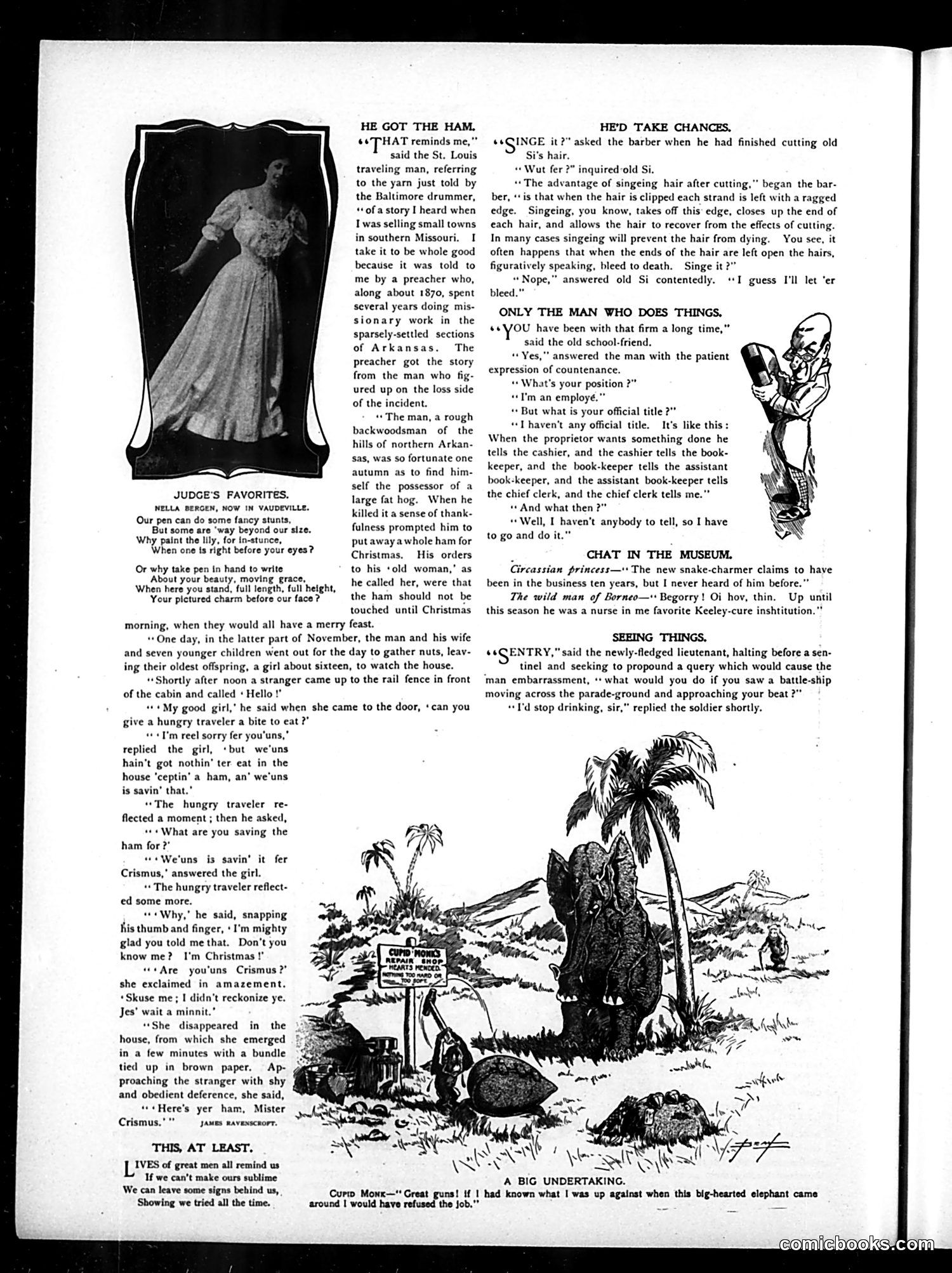
This page contains several short humorous stories rather than political cartoons. The main pieces include: **"He Got the Ham"** – A rural anecdote about a traveling man who receives a ham as a Christmas gift from a preacher, reflecting late 19th/early 20th-century frontier humor. **"Only the Man Who Does Things"** – A workplace satire about bureaucratic hierarchy, where employees pass tasks up and down a chain of command without clear authority or responsibility. **"Chat in the Museum"** and **"Seeing Things"** – Brief sketches about military/colonial encounters. The illustrations are decorative rather than satirical political commentary. This appears to be entertainment-focused content typical of Judge's lighter editorial material, emphasizing character humor and workplace absurdities rather than partisan critique.
📄 Transcribed text from this page (OCR, searchable)
Machine-transcribed from the original scan — historical spelling and the odd misread are preserved.
HE GOT THE HAM. 66"THAT reminds me," said the St. Louis traveling man, referring to the yarn just told by the Baltimore drummer, “ofa story I heard when Iwas selling small towns in southern Missouri. I take it to be whole good because it was told to me by a preacher who, along about 1870, spent several years doing mis- sionary work in the sparsely-settled sections of Arkansas. The preacher got the story from the man who fig- ured up on the loss side of the incident. «The man, a rough backwoodsman of the hills of northern Arkan- sas, was so fortunate one autumn as to find him- self the possessor of a large fat hog. When he killed it a sense of thank- fulness prompted him to put away a whole ham for Christmas. His orders to his ‘old woman," as he called her, were that the ham should not be touched until Christmas morning, when they would all have a merry feast. + One day, in the latter part of November, the man and his wife and seven younger children went out for the day to gather nuts, leav- ing their oldest offspring, a girl about sixteen, to watch the house. “Shortly after noon a stranger came up to the rail fence in front of the cabin and called + Hello!" “+My good girl,’ he said when she came to the door, ‘can you give a hungry traveler a bite to eat?" «I'm reel sorry fer you'uns,” replied the girl, «but we'uns hain‘t got nothin’ ter eat in the house ‘ceptin’ a ham, an’ we'uns is savin’ that.’ “The hungry traveler re- flected a moment ; then he asked, «+ “What are you saving the ham for ?* “We'uns is savin’ it Crismus,’ answered the girl. «The hungry traveler reflect- ed some more. “Why,” he said, snapping his thumb and finger, « I'm mighty glad you told me that. Don't you know me? I'm Christmas !" “Are you'uns Crismus ?* she exclaimed in amazement. *Skuse me ; I didn’t reckonize ye. Jes’ wait a minnit." She disappeared in the house, from which she emerged in a few minutes with a bundle tied up in brown paper. Ap- proaching the stranger with shy and obedient deference, she said, ‘+Here's yer ham, Mister Crismus.’ THIS, AT LEAST. ys. of great men all remind us If we can’t make ours sublime We can leave some signs behind us, Showing we tried all the time. JUDGE'S FAVORITES. NELLA BERGEN, NOW IN VAUDEVILLE. Our pen can do some fancy stunts, But some are ‘way beyond our size. Why paint the lily, for in-stunce, When one Is right before your eyes? Or why take pen in hand to write About your beauty, moving grace, When here you stand, full length, full height, Your pictured charm before our face ? fer JAMES RAVENSCROFT. Curt Monx—"' Great gui > Nee we oN HE'D TAKE CHANCES, ‘*GINGE it?” asked the barber when he had finished cutting old Si’s hair. + Wut fer 2” inquired-old Si. “The advantage of singeing hair after cutting,” began the bar- ber, ++is that when the hair is clipped each strand is left with a ragged edge. Singeing, you know, takes off this edge, closes up the end of each hair, and allows the hair to recover from the effects of cutting. In many cases singeing will prevent the hair from dying. You see, it often happens that when the ends of the hair are left open the hairs, figuratively speaking, bleed to death. Singe it?” “Nope,” answered old Si contentedly. “I guess I'll let ‘er bleed.” ONLY THE MAN WHO DOES THINGS, seyou have been with that firm a long time," said the old school-friend. “Yes,” answered the man with the patient expression of countenance. «What's your position 2” 'm an employé.”” ** But what is your official title 2” «Thaven't any official title. It’s like this: When the proprietor wants something done he tells the cashier, and the cashier tells the book- keeper, and the book-keeper tells the assistant book-keeper, and the assistant book-keeper tells the chief clerk, and the chief clerk tells me.” «And what then 2?” ‘Well, I haven't anybody to tell, so I have to go and do it." . CHAT IN THE MUSEUM. Circassian princess— The new snake-charmer claims to have been in the business ten years, but I never heard of him before.” The wild man of Borneo—* Begorry! Oi hov, thin. Up until this season he was a nurse in me favorite Keeley-cure inshtitution.” SEEING THINGS. S+GENTRY," said the newly-fledged lieutenant, halting before a sen- tinel and seeking to propound a query which would cause the ‘man embarrassment, “what would you do if you saw a battle-ship moving across the parade-ground and approaching your beat ?" “«I'd stop drinking, sir,” replied the soldier shortly. iene A BIG UNDERTAKING. ns! if | had known what I was up against when this big-hearted elephant came around I would have refused the job."* =