
Judge, 1906-01-20 · page 10 of 16
Judge — January 20, 1906 — page 10: what you’re looking at
What you’re looking at
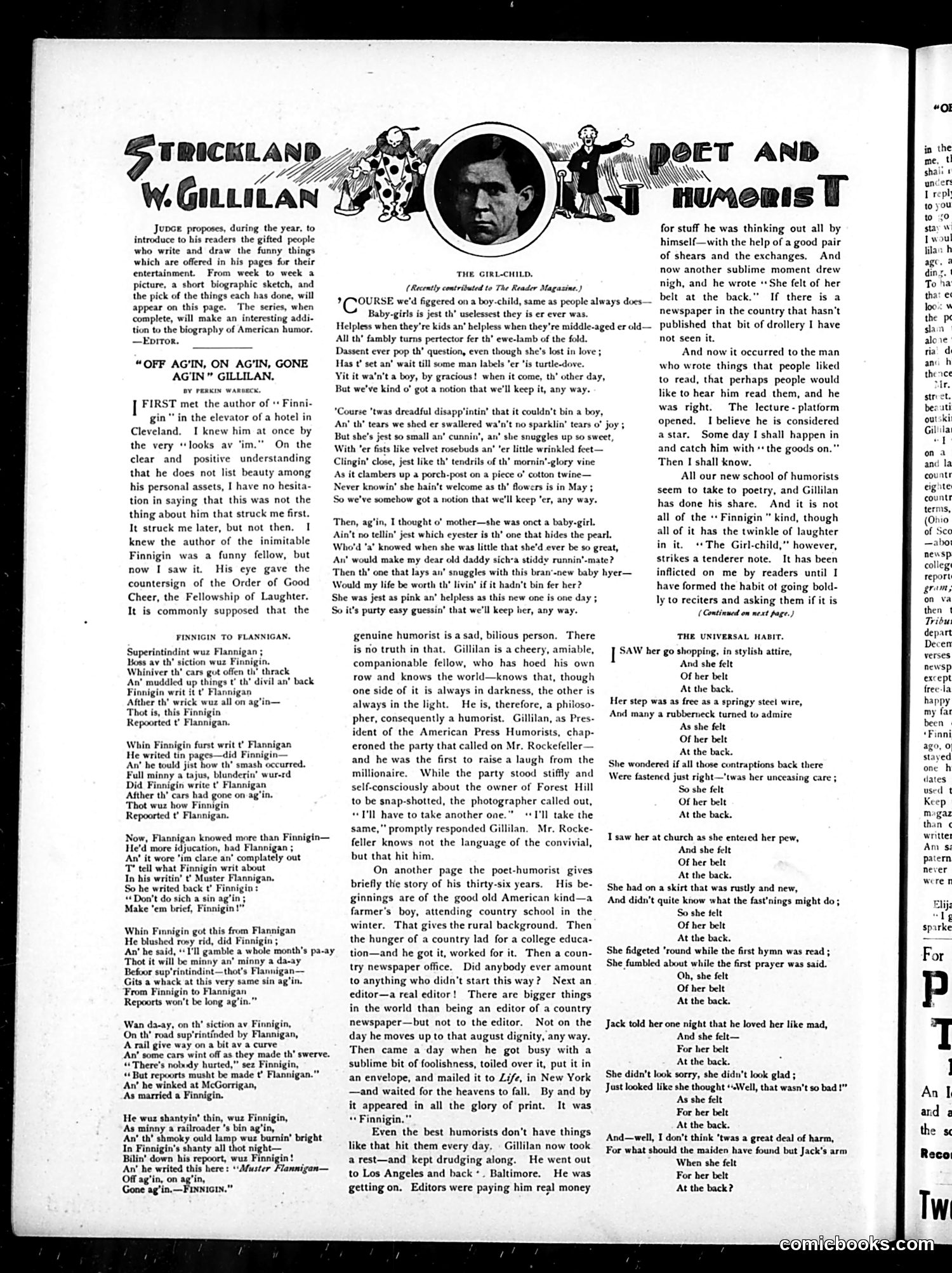
This is a **feature article introducing W. Gillillan**, a humor writer and poet, to Judge's readers. The page includes biographical text and samples of his work. The main content showcases Gillillan's signature style: **Irish-dialect comic verse** using phonetic spelling ("ag'in," "writ," "th'"). Two poems appear: "Finnigin to Flannigan" depicts railroad workers' miscommunications in exaggerated Irish brogue, while "The Girl-Child" humorously describes a rural family's disappointment at having a daughter rather than a son, then softening to acceptance. The satire targets **working-class Irish-American speech patterns** and rural sentimentality—common subject matter for American humor magazines of this era. Gillillan was apparently known for this particular comic voice. The portrait suggests he was a recognized literary figure Judge felt worth featuring to its readers as part of their ongoing series on American humorists.
📄 Transcribed text from this page (OCR, searchable)
Machine-transcribed from the original scan — historical spelling and the odd misread are preserved.
pate 2 W. Guutian’ Juvce proposes, during the year, to introduce to his readers the gifted people who write and draw the funny things which are offered in his pages for their entertainment. From week to week a picture, a short biographic sketch, and the pick of the things each has done, will appear on this page. ‘The series, when complete, will make an interesting addi- tion to the biography of American humor. —Eprror. “OFF AG'IN, ON AG'IN, GONE AG'IN” GILLILAN. BY PERKIN WARUECK. FIRST met the author of + Finni- gin" in the elevator of a hotel in Cleveland. I knew him at once by the very “looks av ‘im. On the clear and positive understanding that he does not list beauty among his personal assets, I have no hesita- tion in saying that this was not the thing about him that struck me first. It struck me later, but not then, I knew the author of the inimitable Finnigin was a funny fellow, but now I saw it. His eye gave the countersign of the Order of Good Cheer, the Fellowship of Laughter. It is commonly supposed that the FINNIGIN TO FLANNIGAN. Superintindint wuz Flannigan ; Voss av th’ siction wuz Finnigin. Whiniver th’ cars got offen th’ thrack An’ muddled up things t' th’ divil an’ back Finnigin writ itt’ Flannigan Afther th’ wrick wuz all on ag'in— Thot is, this Finnigin Repoorted t’ Flannigan. Whin Finnigin furst writ t' Flannigan He writed tin pages—did Finnigin— An’ he tould jist how th’ smash occurred. Full minny a tajus, blunderin’ wurerd Did Finnigin write Flannig: Afther th’ cars had gone on ag'in. Thot wuz how Finnigin Repoorted t’ Flannigan. Now, Flannigan knowed more than Finnigin— He'd more idjucation, had Flanigan ; ‘An’ it wore ‘im clare an’ complately out T’ tell what Finnigin writ about In his writin’ t Muster Flannigan, So he writed back t” Finnigi: “Don't do sich a sin ag’ Make ‘em brief, Finnigin Whin Finigin got this from Flanigan He blushed rosy rid, did Finnigin ; THE GIRL-CHILD. (Recently contributed to The Reader Magazine.) 9 COURSE we'd figgered on a boy-child, same as people always does— Baby-girls is jest th’ uselessest they is er ever was. Helpless when they're kids an’ helpless when they're middle-aged er old— All th’ fambly turns pertector fer th’ ewe-lamb of the fold. Dassent ever pop th’ question, even though she’s lost in love ; Has t’ set an’ wait till some man labels ‘er ‘is turtle-dove. Vit it wa'n't a boy, by gracious! when it come, th’ other day, But we've kind o° got a notion that we'll keep it, any way. "Course ‘twas dreadful disapp'intin’ that it couldn't bin a boy, An’ th’ tears we shed er swallered wa'n't no sparklin’ tears o° joy; n', an’ she snuggles up so sweet, astar. Some day I shall happen in But she’s jest so small an’ cunt With ‘er fists like velvet rosebuds an’ ‘er little wrinkled feet— Clingin’ close, jest like th’ tendrils of th’ mornin’-glory vine As it clambers up a porch-post on a piece 0” cotton twine— Never knowin’ she hain't welcome as th’ flowers is in May ; So we've somehow got a notion that we'll keep "er, any way. Then, ag'in, I thought o' mother—she was onct a baby-girl. Ain't no tellin’ jest which eyester is th’ one that hides the pearl. Who'd ‘a’ knowed when she was little that she'd ever be so great, An’ would make my dear old daddy sich-a stiddy runnin’-mate? ‘Then th’ one that lays an’ snuggles with this bran’-new baby hyer— Would my life be worth th’ livin’ if it hadn't bin fer her? She was jest as pink an’ helpless as this new one is one day ; So it's purty easy guessin’ that we'll keep her, any way. genuine humorist is a sad, bilious person. There is no truth in that. Gillilan is a cheery, amiable, companionable fellow, who has hoed his own row and knows the world—knows that, though one side of it is always in darkness, the other is always in the light. He is, therefore, a philoso- pher, consequently a humorist. Gillilan, as Pres- ident of the American Press Humorists, chap- eroned the party that called on Mr. Rockefeller— and he was the first to raise a laugh from the millionaire. While the party stood stiffly and self-consciously about the owner of Forest Hill to be snap-shotted, the photographer called out, I'll have to take another one.” **I'll take the same,” promptly responded Gillilan. Mr. Rocke- feller knows not the language of the convivial, but that hit him. On another page the poet-humorist gives briefly the story of his thirty-six years. His be- ginnings are of the good old American kind—a farmer's boy, attending country school in the winter. That gives the rural background. Then the hunger of a country lad for a college educa- An’ he “T'll gamble a whole month's pa-ay — tion—and he got it, worked for it. Then a coun- Thot it will be minny an’ minny a da-ay Befoor sup'rintindint—thot’s Flanigan Gits a whack at this very same sin ag’in. From Finnigin to Flanniga’ Repoorts won't be long ag’ Wan da-ay, on th’ siction av Finnigin, On th’ road sup'rintinded by Flannigan, A rail give way on a bit av a curve ‘An’ some cars wint off as they made th’ swerve. “There's nobody hurted,” sez Finnigin, “But reports musht be made t’ Flanigan.” An’ he winked at McGorrigan, ‘As married a Finnigin. He wuz shantyin’ thin, wuz As minny a railroader’s bin ag’in, An’ th’ shmoky ould lamp wuz burnin’ bright In Finnigin’s shanty all thot night Bilin’ down his repoort, wuz Finnigin! An’ he writed this here: ‘‘Afuster Flannigan— Off ag’in, on ag’i Gone ag’in.—FiniciN.” try newspaper office. Did anybody ever amount to anything who didn’t start this way? Next an editor—a real editor! There are bigger things in the world than being an editor of a country newspaper—but not to the editor. Not on the day he moves up to that august dignity, any way. Then came a day when he got busy with a sublime bit of foolishness, toiled over it, put it in an envelope, and mailed it to Life, in New York —and waited for the heavens to fall. By and by it appeared in all the glory of print. It was « Finnigin.”” Even the best humorists don’t have things like that hit them every day. | Gillilan now took arest—and kept drudging along. He went out to Los Angeles and back *. Baltimore. He was getting on. Editors were paying him real money @ET AND NON “Homers for stuff he was thinking out all by himself—with the help of a good pair of shears and the exchanges. And now another sublime moment drew nigh, and he wrote **She felt of her belt at the back.” If there is a newspaper in the country that hasn't published that bit of drollery I have not seen it. And now it occurred to the man who wrote things that people liked to read, that perhaps people would like to hear him read them, and he was right. The lecture - platform opened. I believe he is considered and catch him with «the goods on."” Then I shall know. All our new school of humorists seem to take to poetry, and Gillilan has done his share. And it is not all of the ++ Finnigin ” kind, though all of it has the twinkle of laughter in it. «The Girl-child,” however, strikes a tenderer note. It has been inflicted on me by readers until I have formed the habit ot going bold- ly to reciters and asking them if it is (Continued om next page.) THE UNIVERSAL HABIT. [ SAW ber go shopping, in stylish attire, And she felt Of her belt At the back. Her step was as free as a springy steel! wire, And many a rubberneck turned to admire As she felt Of her belt At the back. She wondered if all those contraptions back there Were fastened just right—'twas her unceasing care; So she felt Of her belt At the back. I saw her at church as she entered her pew, And she felt Of her belt At the back. She had on a skirt that was rustly and new, And didn’t quite know what the fast’nings might do ; So she felt Of her belt At the back. She fidgeted "round while the first hymn was read ; She fumbled about while the first prayer was said. Oh, she felt Of her belt At the back. Jack told her one night that he loved her like mad, And she felt— For her belt At the back. She didn’t look sorry, she didn't look glad; Just looked like she thought “Well, that wasn’t so bad !”” As she felt For her belt At the back. And—well, I don’t think ‘twas a great deal of harm, For what should the maiden have found but Jack's arm When she felt For her belt At the back? eighte countr terms, (Ohio of Sco —abo newsp colleg report gram, on va then 1 Tribu depart Decen verses newsp except free-la happy my far been *Finni ago, 0 stayed one h dates used 1 Keep mogaz than « writte Am s: patern never were n