
A complete issue · 16 pages · 1905
Judge — August 12, 1905
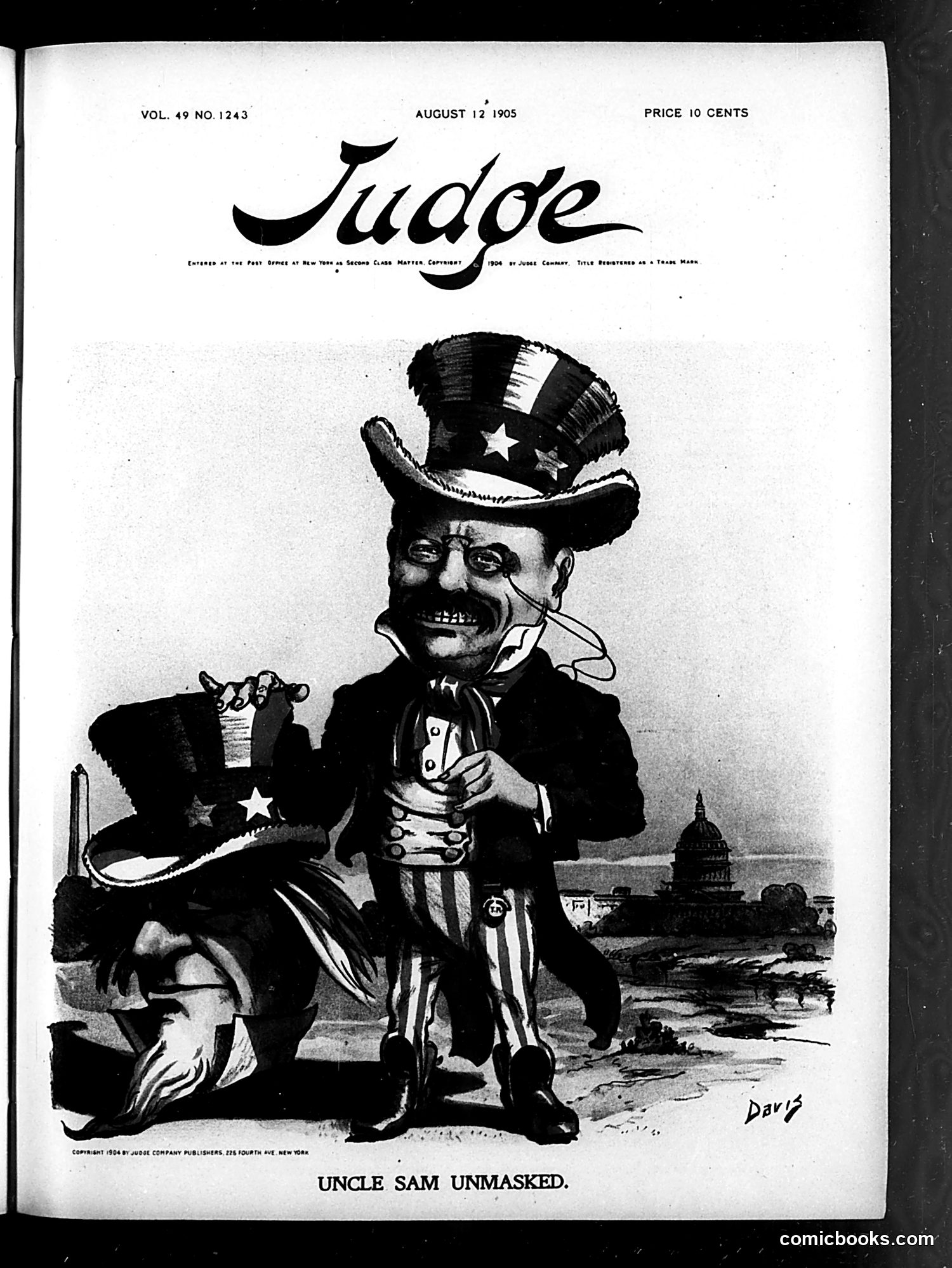
This political cartoon depicts Uncle Sam—the personification of the United States—with his mask removed to reveal a demonic or grotesque face beneath. The figure wears patriotic symbols (top hat with star, striped pants) while holding what appears to be a bloody hand or weapon. The Capitol building is visible in the background, suggesting federal government critique. The "unmasked" concept implies the cartoon is exposing alleged hypocrisy or hidden cruelty behind America's patriotic facade—likely referencing U.S. imperialism, foreign interventions, or domestic injustices of the early 1900s. The artist Davis uses caricature to argue that American values and actual American conduct diverge sharply. Without additional context from Judge's 1905 editorial stance, the specific target remains unclear—possibly Philippine-American War aftermath or domestic labor issues.
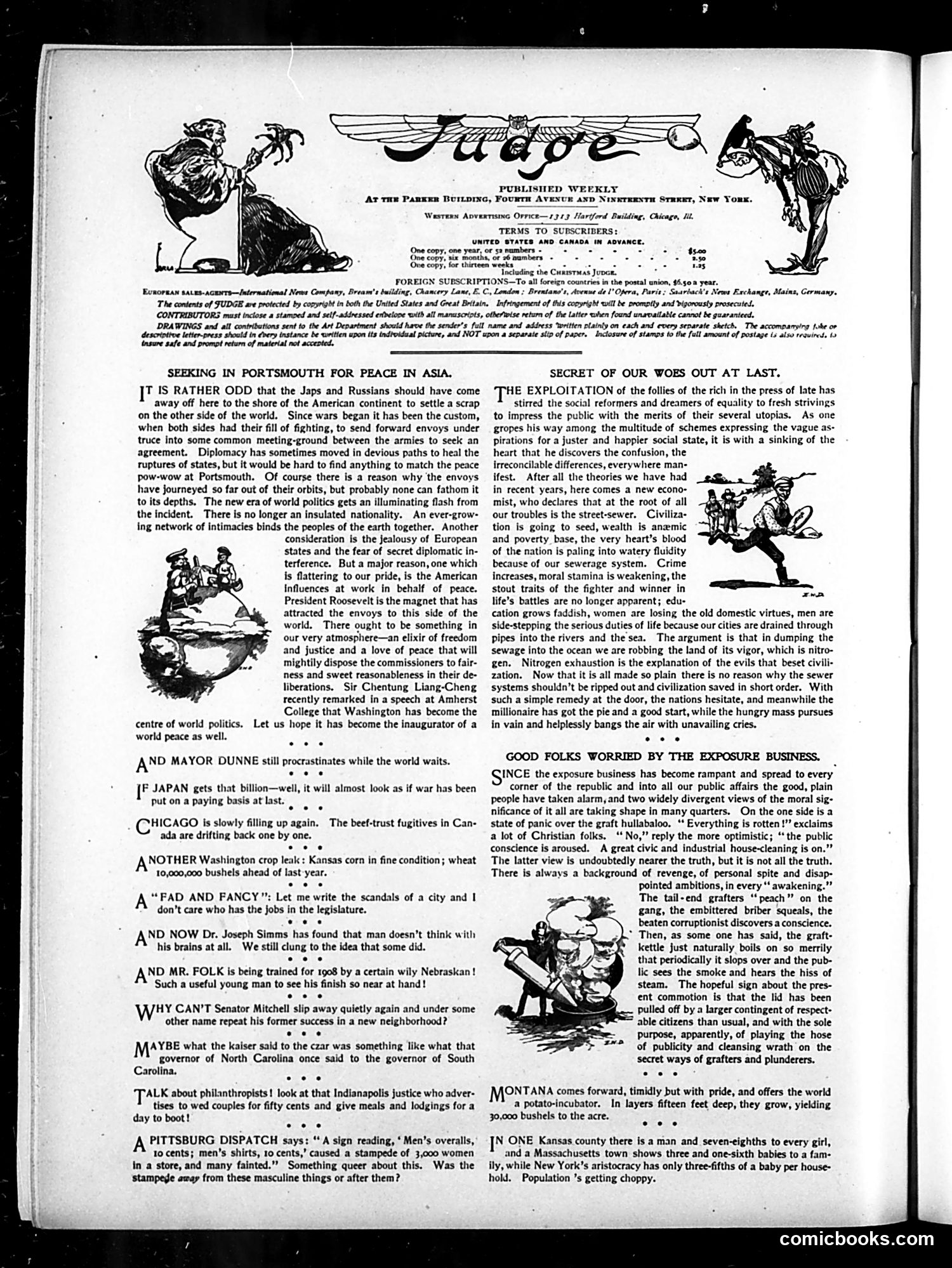
This page combines editorial commentary with satirical illustrations. The left column discusses peace negotiations in Portsmouth (likely the 1905 Russo-Japanese War settlement), criticizing American diplomatic interference and European nations' jealousy. The right column, "Secret of Our Woes Out At Last," satirizes urban problems—crime, moral decline, poverty—blaming sewage systems quite literally: filthy water flowing into rivers represents how "nitrogen exhaustion" and poor sanitation corrupt society. The accompanying cartoon depicts this visually. Lower sections use short, punchy satirical items mocking politicians (Mayor Dunne, Senator Mitchell, Kansas corn production) and social absurdities (a store sign reading men's overalls caused confusion). The overall tone is progressive-era muckraking, exposing infrastructure failures and political hypocrisy through sardonic commentary and grotesque caricature.
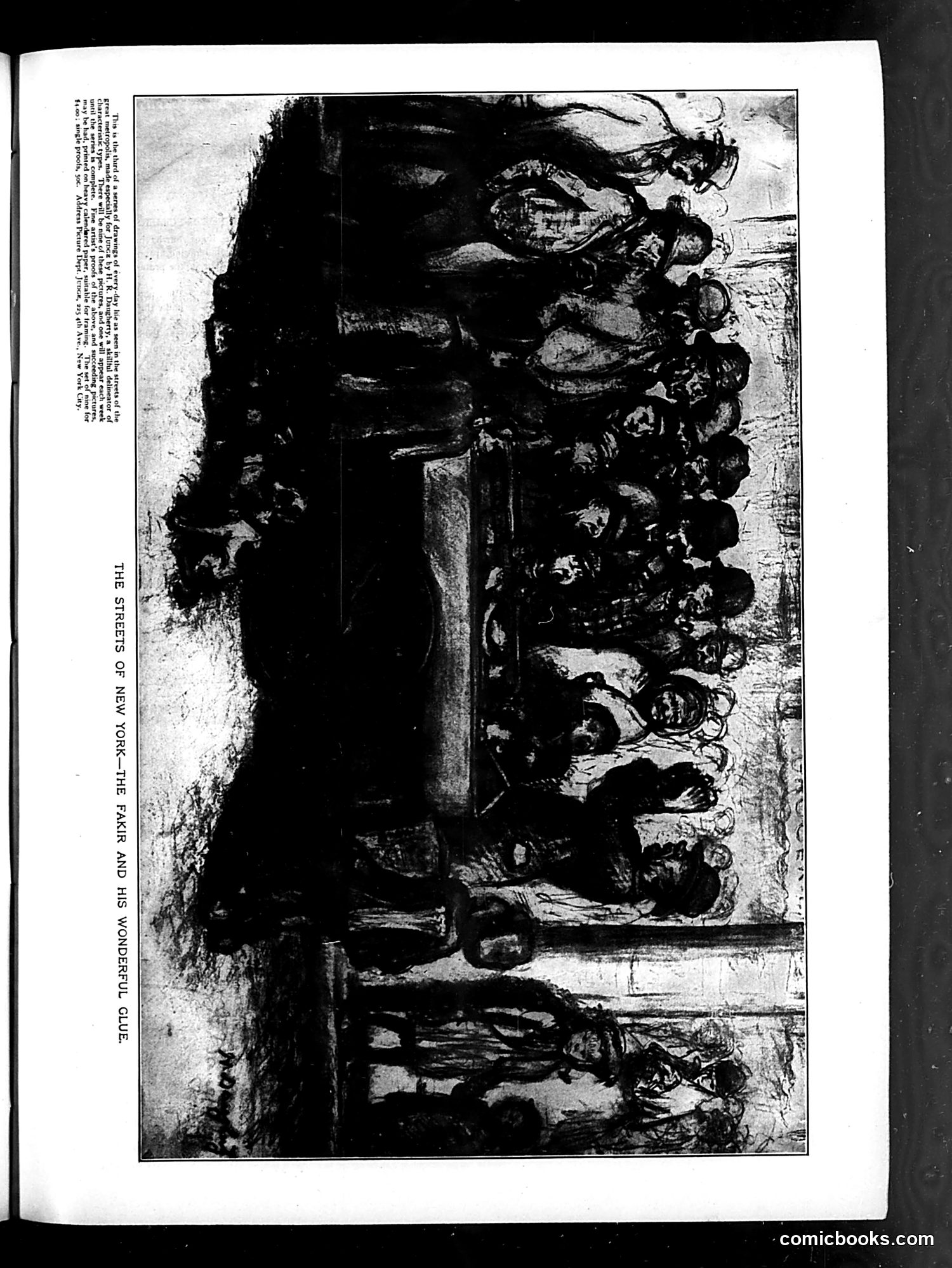
I can see this is a Judge magazine page with what appears to be a historical engraving or artwork depicting multiple figures in what looks like a crowded indoor scene. However, the image quality is quite poor—heavily darkened and difficult to read clearly—which makes it challenging to identify specific figures or caricatures with confidence. The OCR text provided appears incomplete or unclear in the original source material. Without being able to reliably read the caption, title, or accompanying text that would explain the cartoon's context, I cannot accurately identify the political or social references, the figures depicted, or the intended satirical message. To provide accurate historical analysis as requested, I would need either a clearer image or more legible text from the original page.
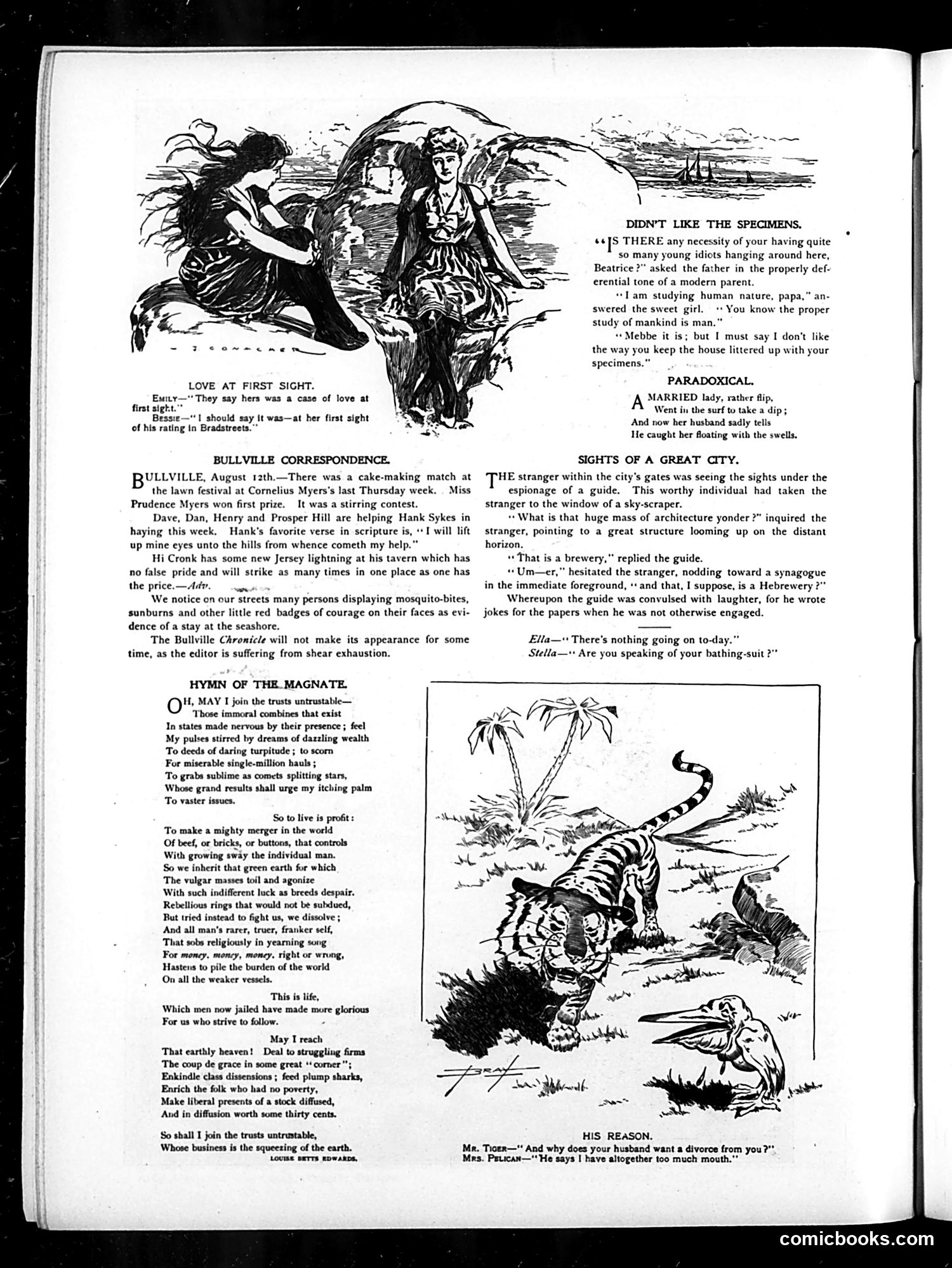
This page contains multiple unrelated satirical pieces typical of Judge magazine's format: 1. **"Love at First Sight"** - A humorous illustration about young romance, with accompanying narrative text. 2. **"Bullville Correspondence"** - A brief rural/small-town satire mentioning local characters and events (cake-making match, lightning strikes). 3. **"Hymn of the Magnate"** - A longer poem satirizing wealthy industrialists ("magnates"), criticizing their pursuit of profit, exploitation of workers, and moral hypocrisy. It appears to advocate for labor rights and wealth redistribution. 4. **"Sights of a Great City"** - Urban satire featuring a tourist and guide discussing city architecture and a brewery. 5. **"His Reason"** - A brief joke about divorce. The page reflects Judge's typical blend of social and economic satire aimed at Gilded Age excess and labor issues.
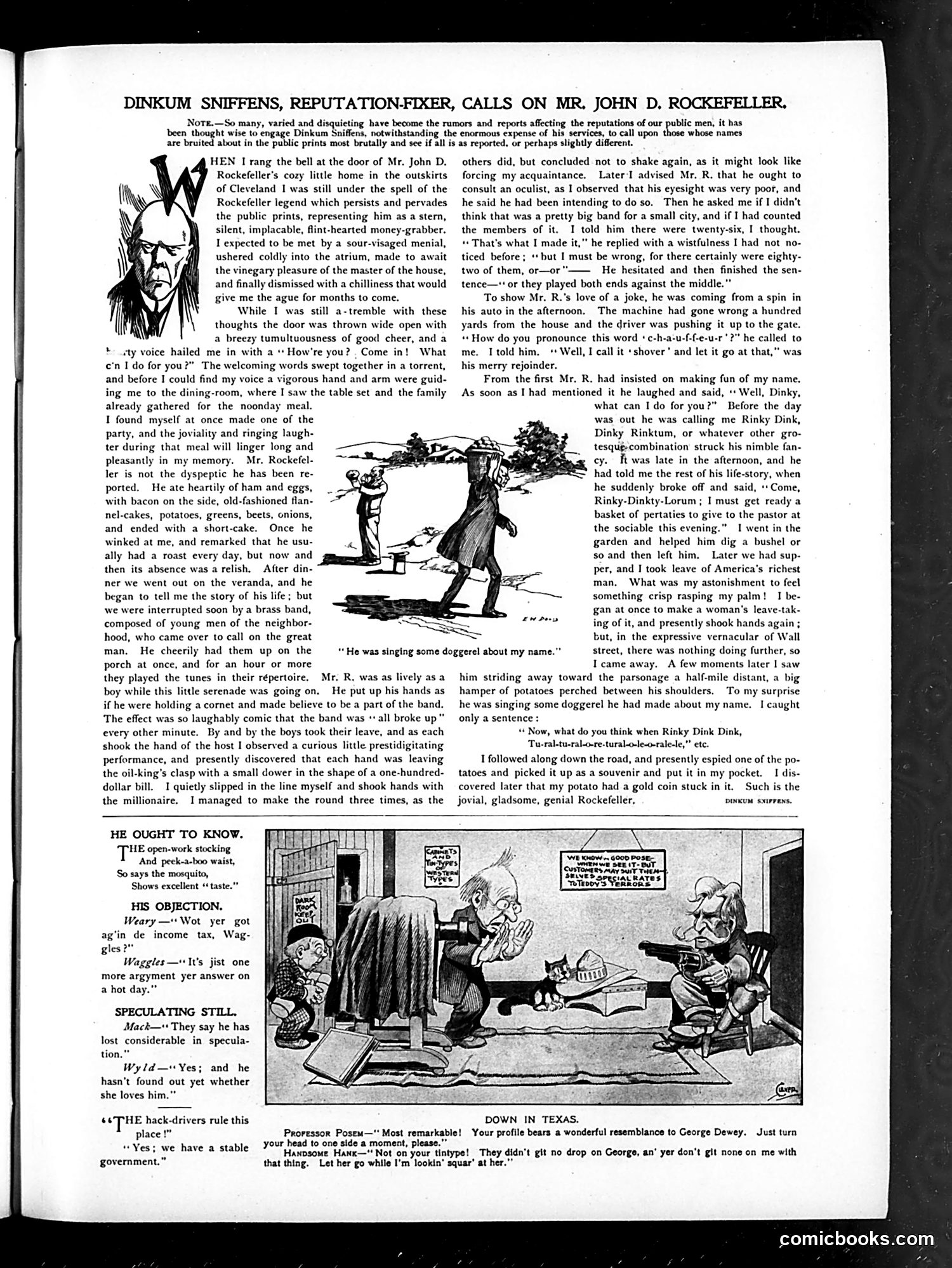
This Judge magazine piece satirizes the "reputation-fixer" industry—publicists hired to improve wealthy figures' public images. The narrator, "Dinkum Sniffens," visits John D. Rockefeller to debunk harsh rumors portraying him as a cold, miserly "money-grabber." The satire's point: Sniffens discovers Rockefeller is actually warm, jovial, and hospitable—but then reveals the deception. Rockefeller subtly bribes the visiting brass band with hundred-dollar bills (slipped into handshakes), and later lies about the band's size, correcting himself unconvincingly. The implication is clear: Rockefeller's friendliness is calculated performance, not genuine character. The cartoon mocks both Rockefeller's attempts at image rehabilitation and the entire reputation-fixing industry itself—suggesting wealthy industrialists' "reformed" public personas are merely staged theater hiding their true nature.
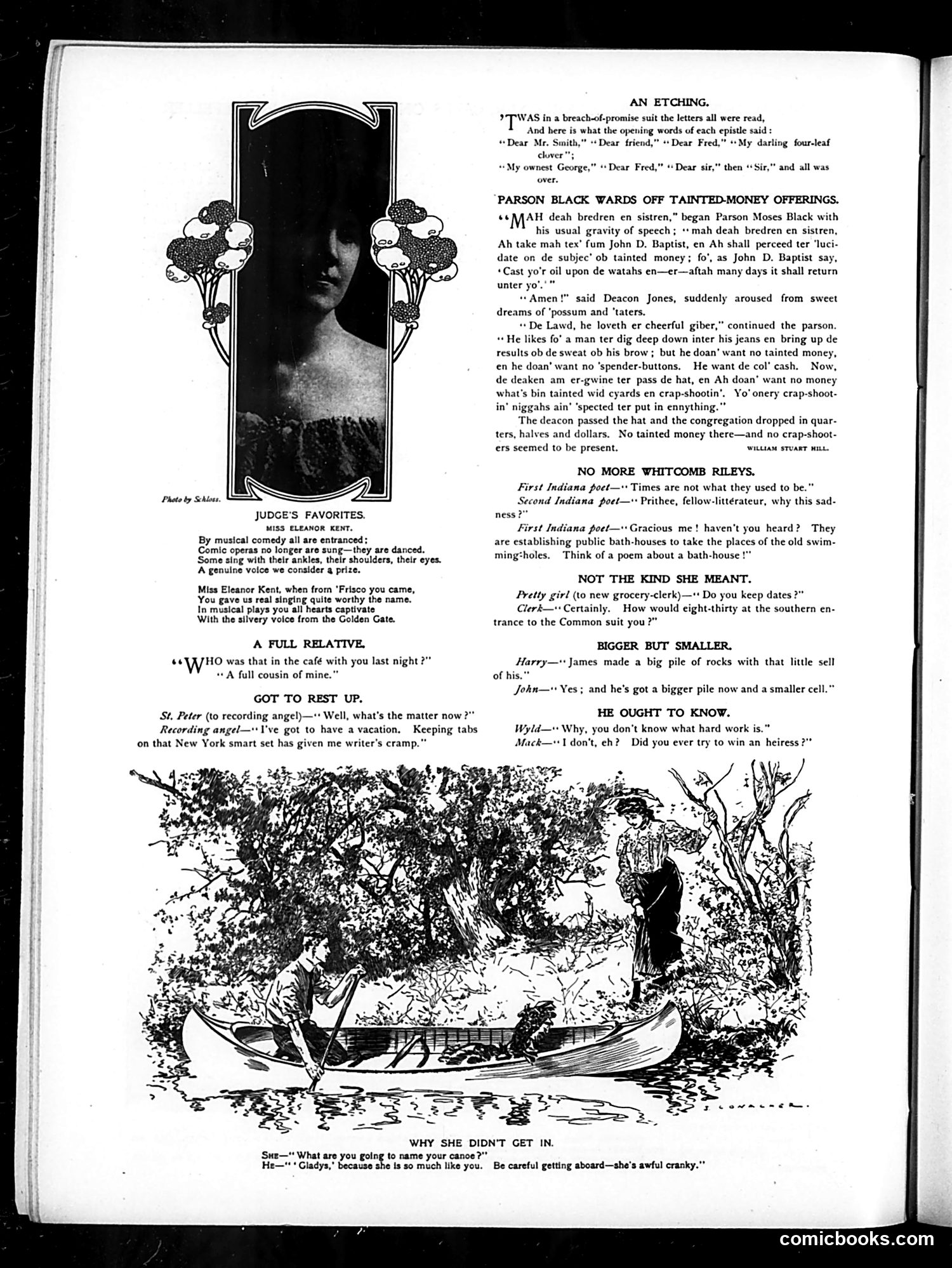
This page from *Judge* magazine contains several satirical pieces reflecting early 20th-century American humor: **"Parson Black Wards Off Tainted-Money Offerings"** mocks both wealthy industrialists' "tainted money" (likely John D. Rockefeller's oil fortune, seen as ill-gotten) and African American dialects. The parson hypocritically rejects "tainted" donations while happily accepting clean cash—satirizing selective morality around "dirty" money. **"No More Whitcomb Rileys"** laments that public bath-houses replace swimming holes, eliminating romantic pastoral imagery. James Whitcomb Riley was a popular Indiana poet; the joke suggests modern convenience destroys poetic inspiration. **Minor jokes** include puns about "dates" (romantic vs. calendar), a canoe named "Gladys" (unflattering comparison), and wordplay on a "cell" (prison vs. business venture). The page also features a portrait of musical performer Eleanor Kent and a scenic etching illustration. The content reflects turn-of-century preoccupations: industrial wealth, urban modernization, and sentimentality for rural America.
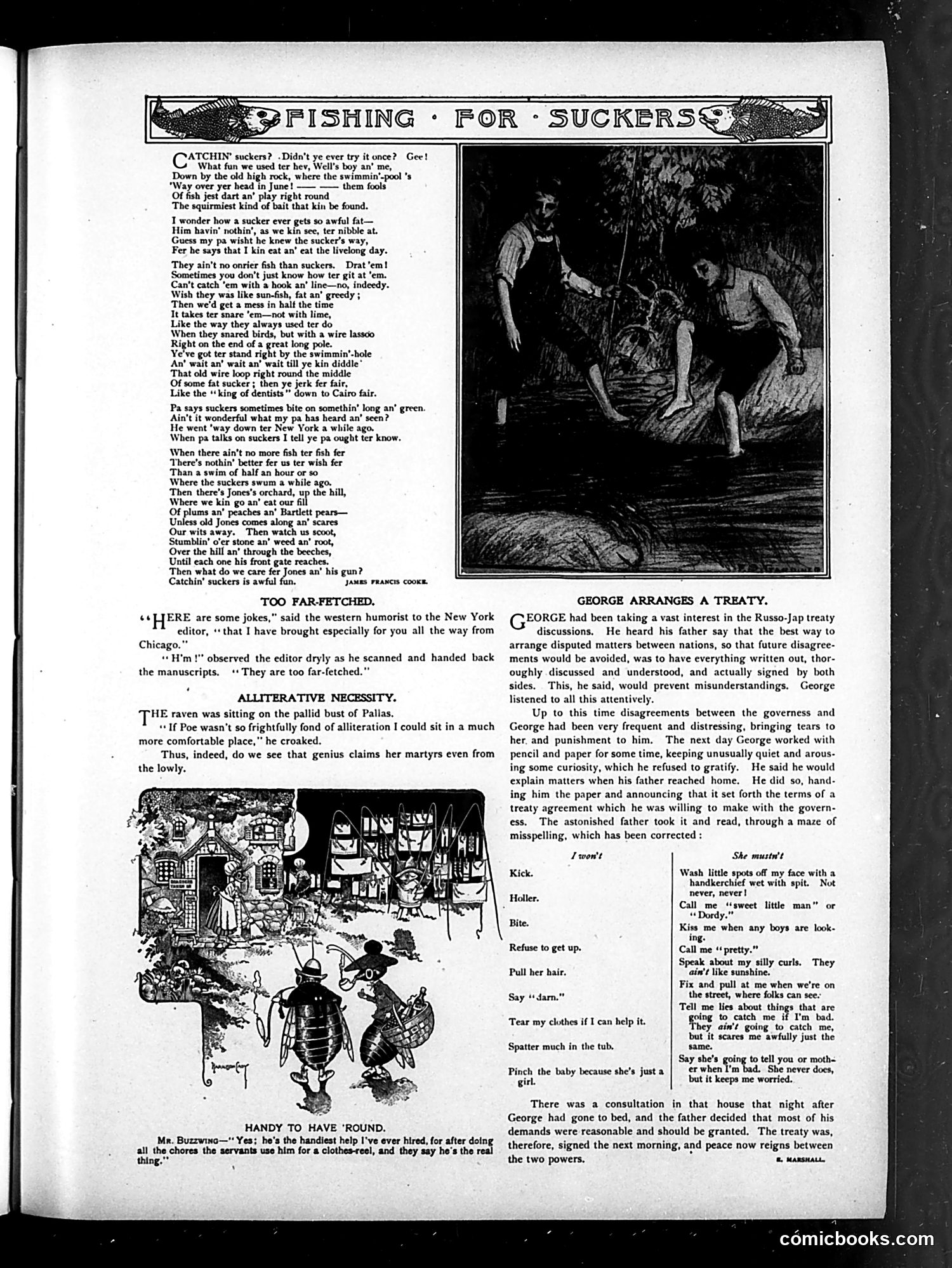
This page contains three distinct humor pieces typical of Judge's satirical content: **"Fishing for Suckers"** (main poem): A nostalgic rural dialect poem about boys catching fish, with extended metaphors about foolish people. The "sucker" fish serves as the stand-in for gullible individuals—a common satirical device. **"Too Far-Fetched"**: A meta-joke about a western humorist pitching jokes to a New York editor that are rejected as implausible. It satirizes the gap between regional humor sensibilities. **"George Arranges a Treaty"**: A children's anecdote where a boy, inspired by discussions of the Russo-Japanese Treaty (likely 1905), attempts to formalize disputes with his governess through a written agreement. The satire gently mocks both the formal diplomatic process and childhood earnestness. These pieces represent Judge's blend of social commentary, literary parody, and gentle domestic humor—common for American satirical magazines of the early 1900s.
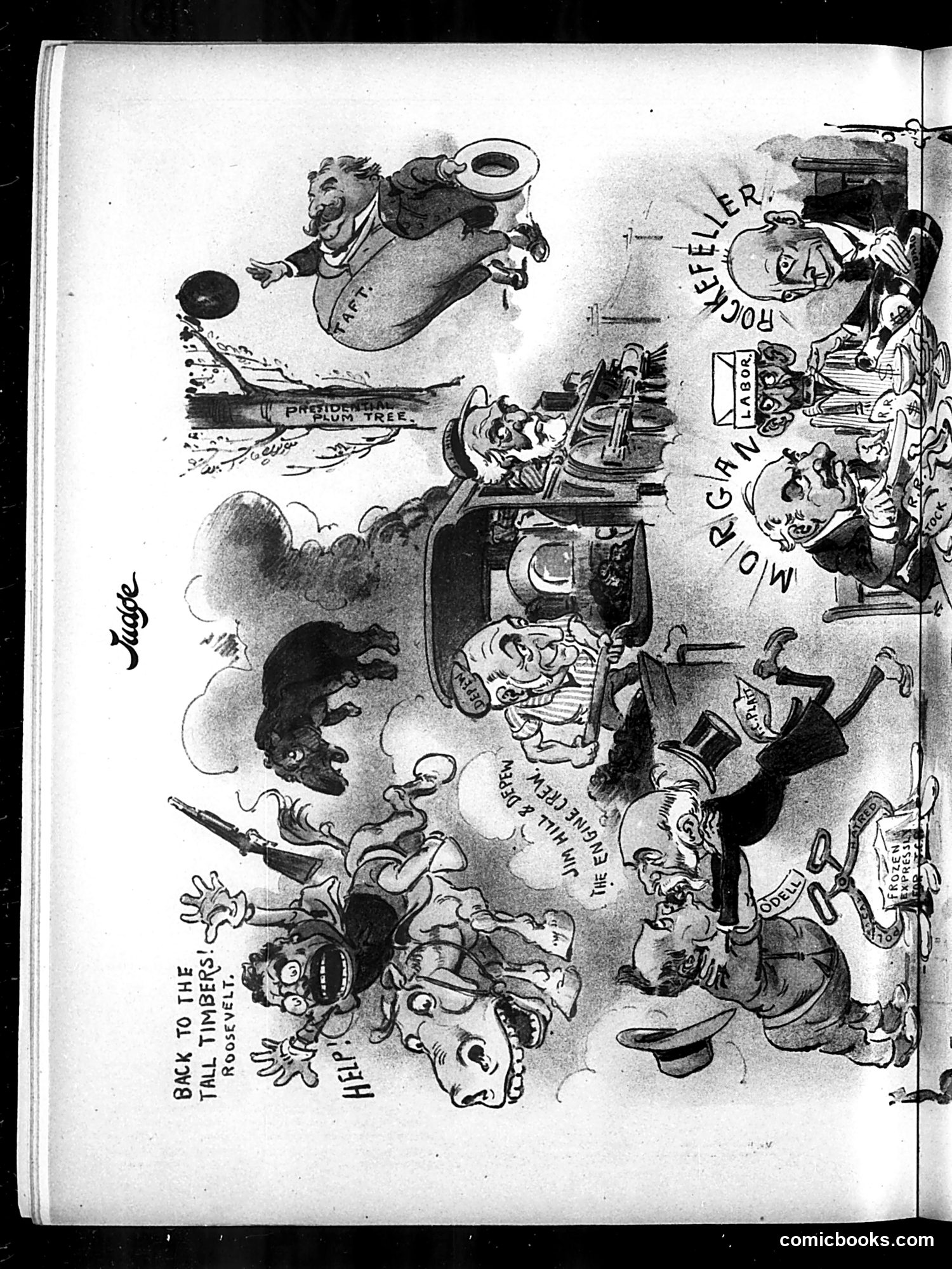
This page appears to be rotated and contains a satirical cartoon titled "Back to the Tigers' Roost" (visible on the left side). The OCR text is heavily corrupted and largely illegible, making it impossible to identify specific political figures or references with confidence. The illustration shows caricatured figures in exaggerated style typical of Judge magazine's political satire. There are references to what appears to be "Judge" and "Morgan Class" visible in text fragments, suggesting commentary on wealth, class, or specific public figures of the era. Without legible text or clearer image orientation, I cannot reliably identify which specific political figures, events, or social commentary this cartoon targets. The artistic style and presence of caricature suggests it's mocking prominent individuals or institutions, but specific identification would require additional context or a clearer source image.
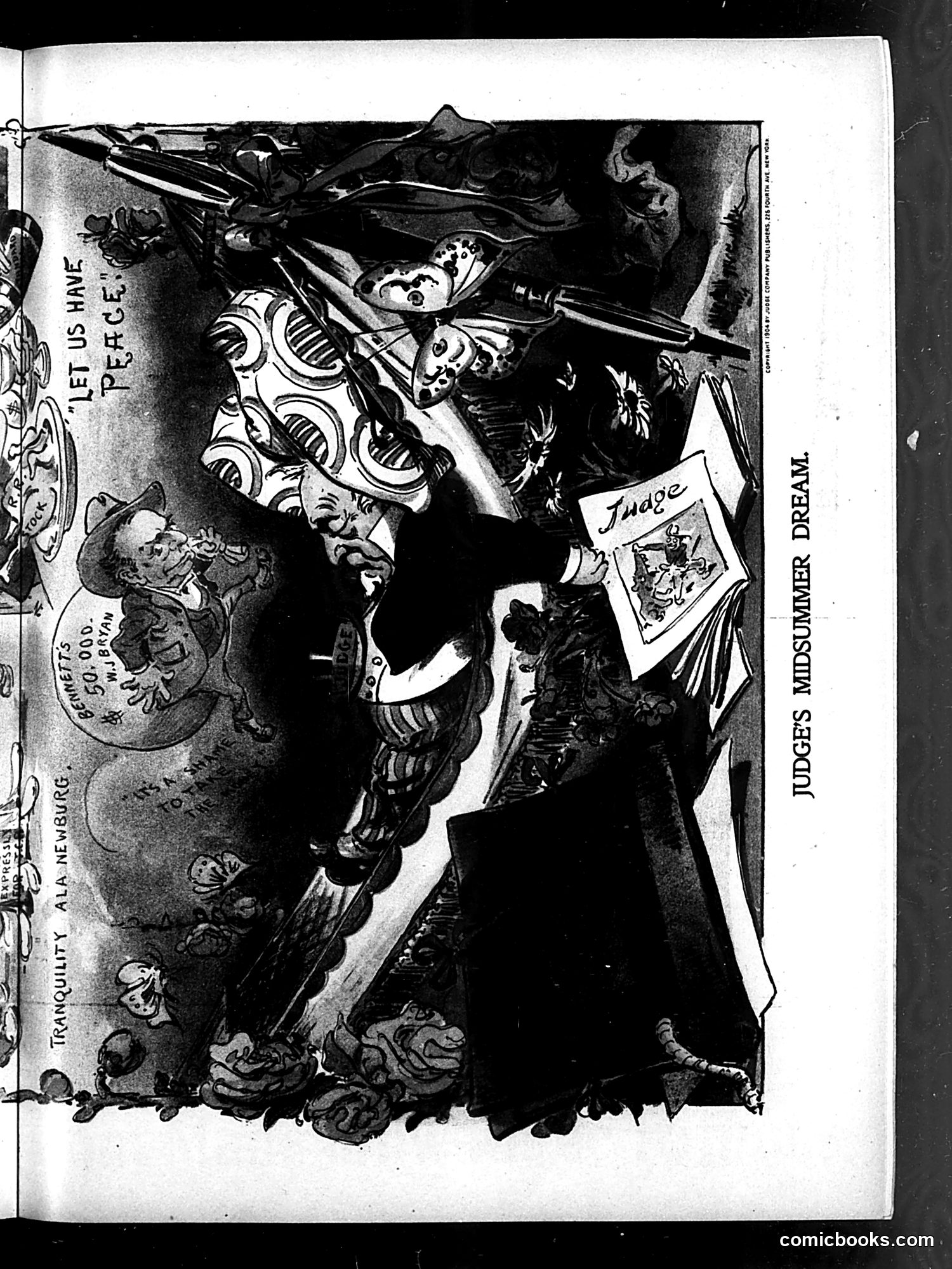
This page presents a theatrical cartoon titled "Judge's Midsummer Dream," a reference to Shakespeare's "A Midsummer Night's Dream." The composition depicts various figures in elaborate costumes and masks in a chaotic, dreamlike scene. On the left, text reads "Tranquility a Nightmare" with what appears to be a caricatured political figure. The central image shows fantastical characters and theatrical elements, including figures labeled "Judge" (visible on a banner/placard), suggesting this is self-referential satire about the Judge magazine itself. The overall composition satirizes American political turmoil of an unspecified period through theatrical metaphor—portraying current events as a confused theatrical production where reality has become absurd. Without a clear date, the specific political targets remain unclear, though the nightmarish tone suggests commentary on contemporary instability.
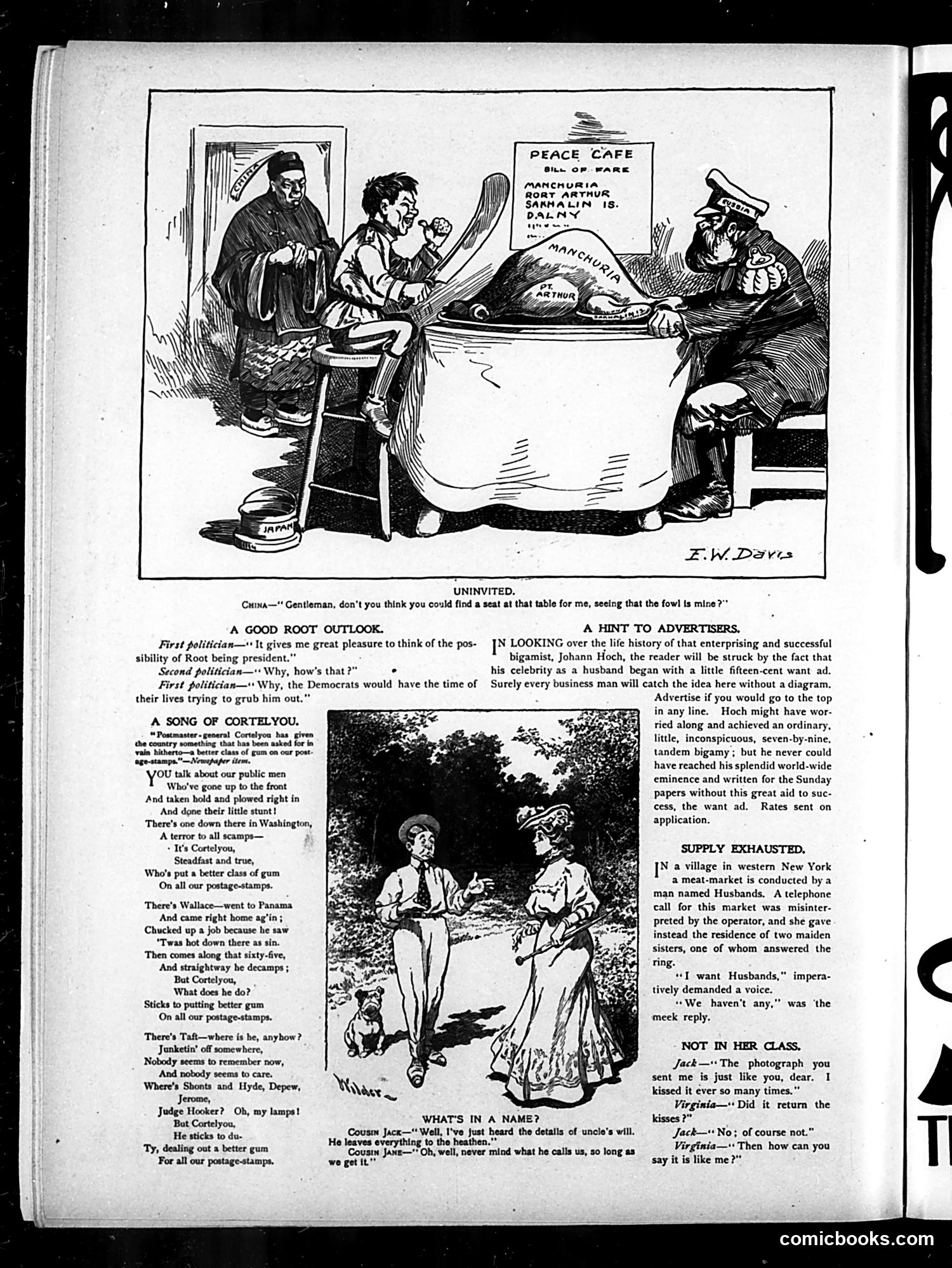
**Top Cartoon ("Uninvited"):** Depicts China at a table labeled "Peace Cafe" with a menu listing territories (Manchuria, Port Arthur, Sakhalin Island). China protests to a gentleman (likely representing a Western power or Japan) that he should have a seat since "the fowl is mine"—a bitter satire on the partition of Chinese territory among foreign powers following the Russo-Japanese War (1904-1905). **Political Commentary Sections:** Three brief jokes mock various U.S. political figures of the era. "A Good Root Outlook" jokes about Elihu Root's presidential prospects. "A Song of Cortelyou" praises Postmaster General George Cortelyou's minor achievement of improving postage-stamp adhesive, satirizing how politicians celebrate trivial accomplishments. **Johann Hoch Reference:** A dark humor section mocking a real bigamist whose crimes were publicized through want ads—dark satire about how advertising enables criminal notoriety. **Bottom Sections:** Light domestic humor about names and mistaken identity, unrelated to the political content above.
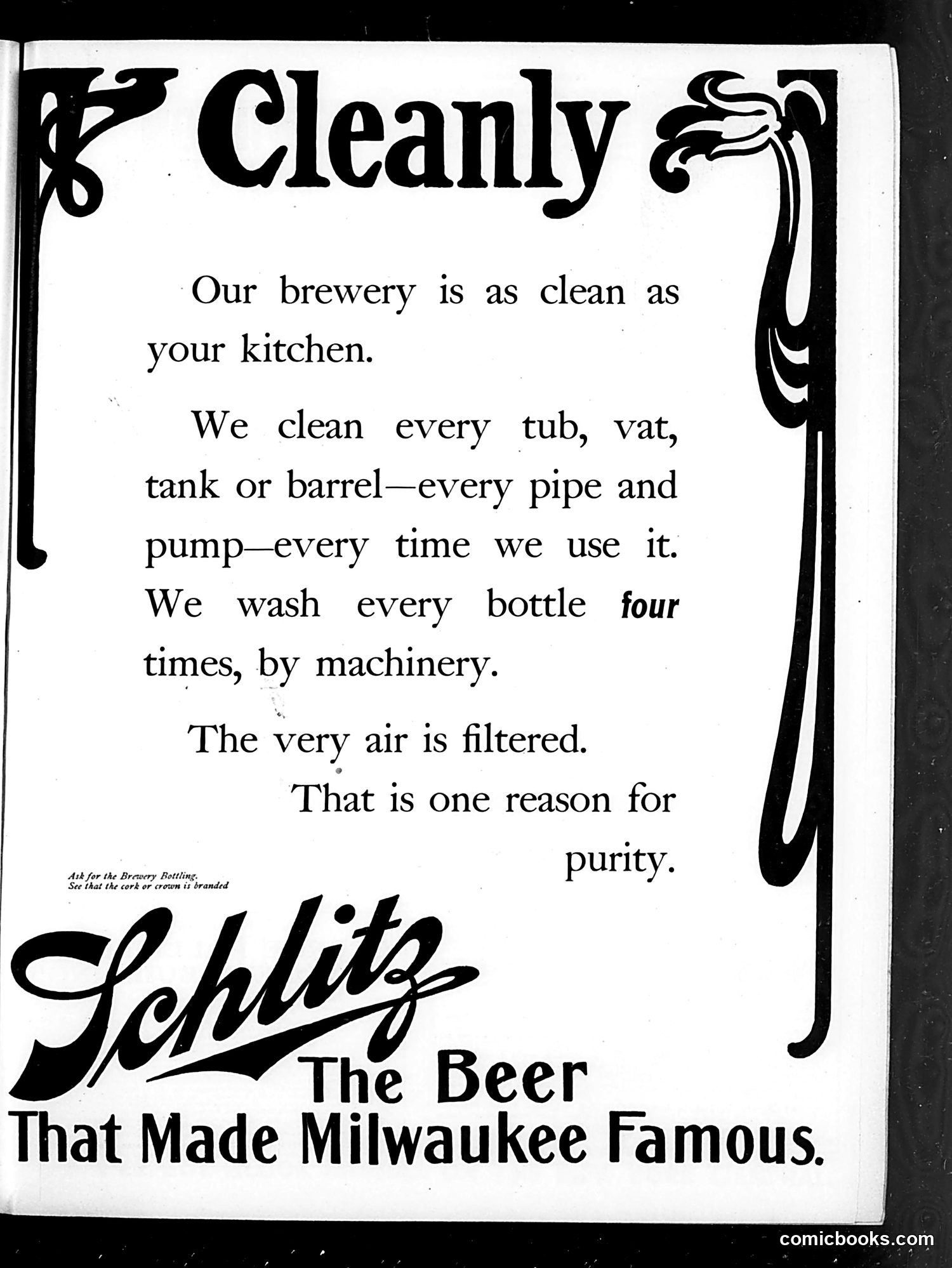
This is a **Schlitz beer advertisement**, not a cartoon. The page promotes Schlitz's brewing practices to assure consumers of product purity and safety. The ad emphasizes cleanliness as a selling point—claiming the brewery matches household hygiene standards. It details specific sanitation practices: cleaning equipment after each use, washing bottles four times by machinery, and filtering the air itself. This messaging likely responds to **early 20th-century food safety concerns**, when contaminated beverages caused serious illness. The tagline "The Beer That Made Milwaukee Famous" establishes Milwaukee's identity as a brewing hub. The instruction to check for branded corks/crowns suggests concerns about counterfeit products or tampering. This represents how breweries marketed quality and safety during a period when such assurances were novel competitive advantages.
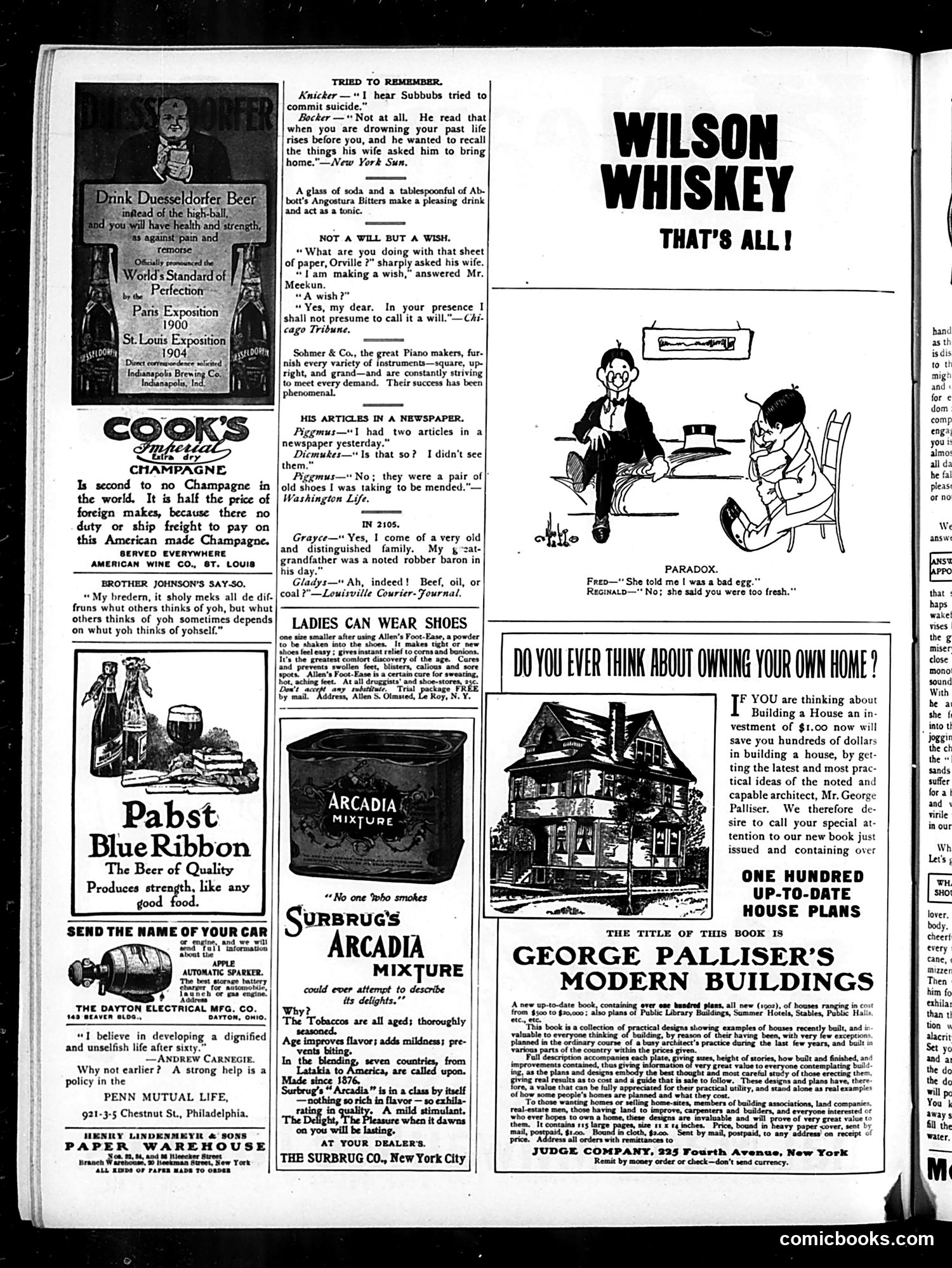
This page is primarily **advertising** interspersed with brief comic anecdotes typical of early 1900s Judge magazine humor. The cartoons and jokes are simple, lighthearted pieces: - **"Tried to Remember"**: A husband contemplates suicide to relive his past, but wants to recall errands his wife asked him to perform—gentle marital humor about forgetful spouses. - **"Not a Will but a Wish"**: A husband frames his desires as a "wish" rather than a "will" in his wife's presence, implying wives control domestic decisions. - **"In 2105"**: Mock snobbery about aristocratic ancestry, where a woman brags her great-grandfather was a "robber baron," leading to a crude joke about whether he stole beef, oil, or coal. - **"Paradox"**: Simple wordplay—calling someone a "bad egg" versus "too fresh" (impertinent). The page reflects period attitudes toward marriage dynamics, class pretension, and commercial humor. Most space advertises beer, whiskey, pianos, and home-building guides—the magazine's revenue source.
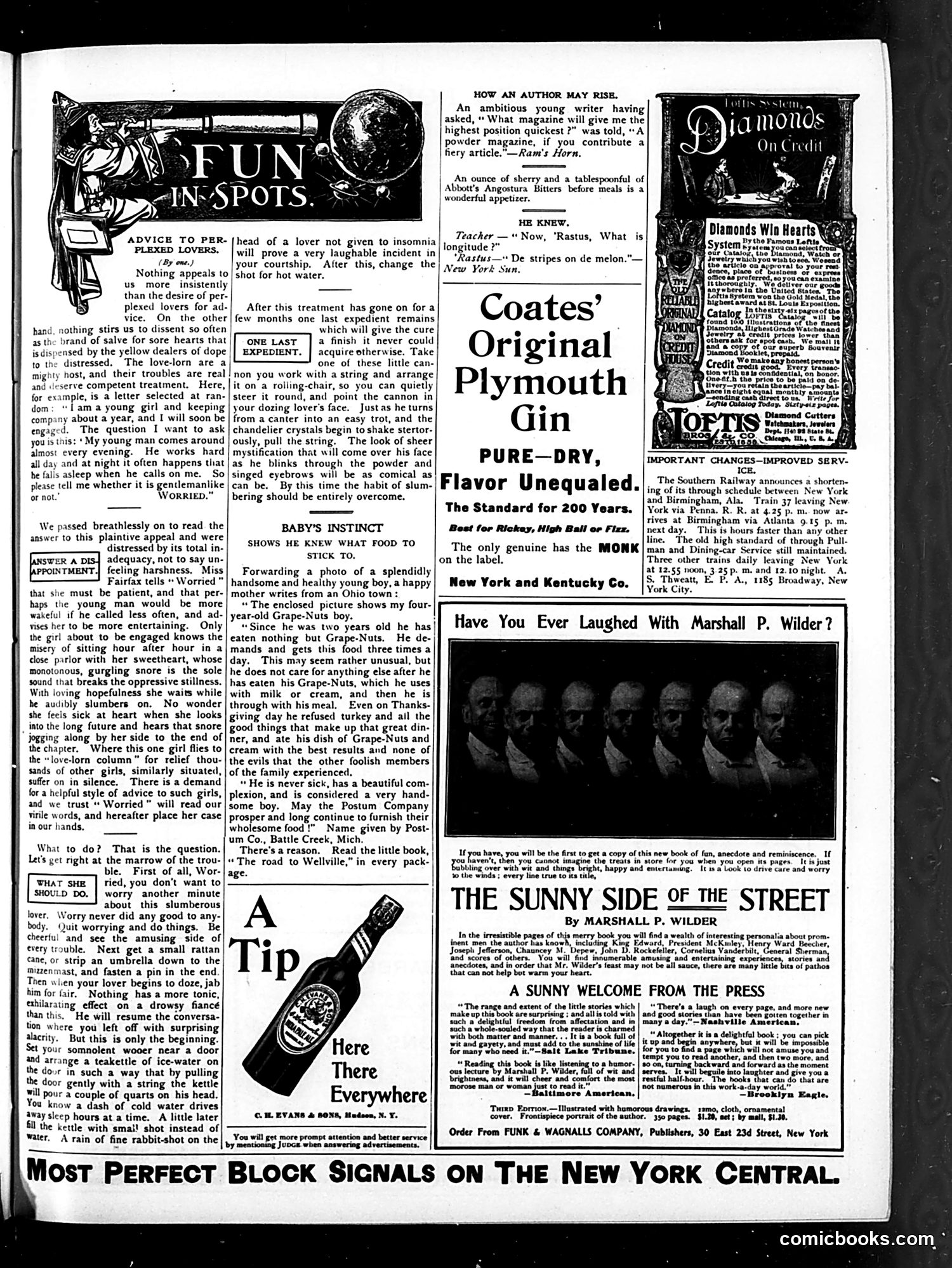
This page is primarily **advertising and advice columns** rather than political satire. The main content is "Advice to Perplexed Lovers"—a humorous advice column that satirizes both lovelorn advice-givers and their readers. A woman writes seeking guidance about her fiancé who falls asleep during their visits. The column's tongue-in-cheek "answer" hilariously escalates from jabbing him with a cane to rigging ice water traps to ultimately firing a cannon at his face—absurd suggestions meant to mock both the earnestness of advice-seeking and the patronizing tone of actual advice columnists of the era. The satire targets the sentimentality of "love-lorn columns" popular in early 20th-century newspapers, presenting wildly impractical "solutions" to highlight how unhelpful conventional advice often was. The page also features advertisements for Coates' Plymouth Gin, a diamond credit system, and Marshall P. Wilder entertainment—typical commercial content for Judge magazine.
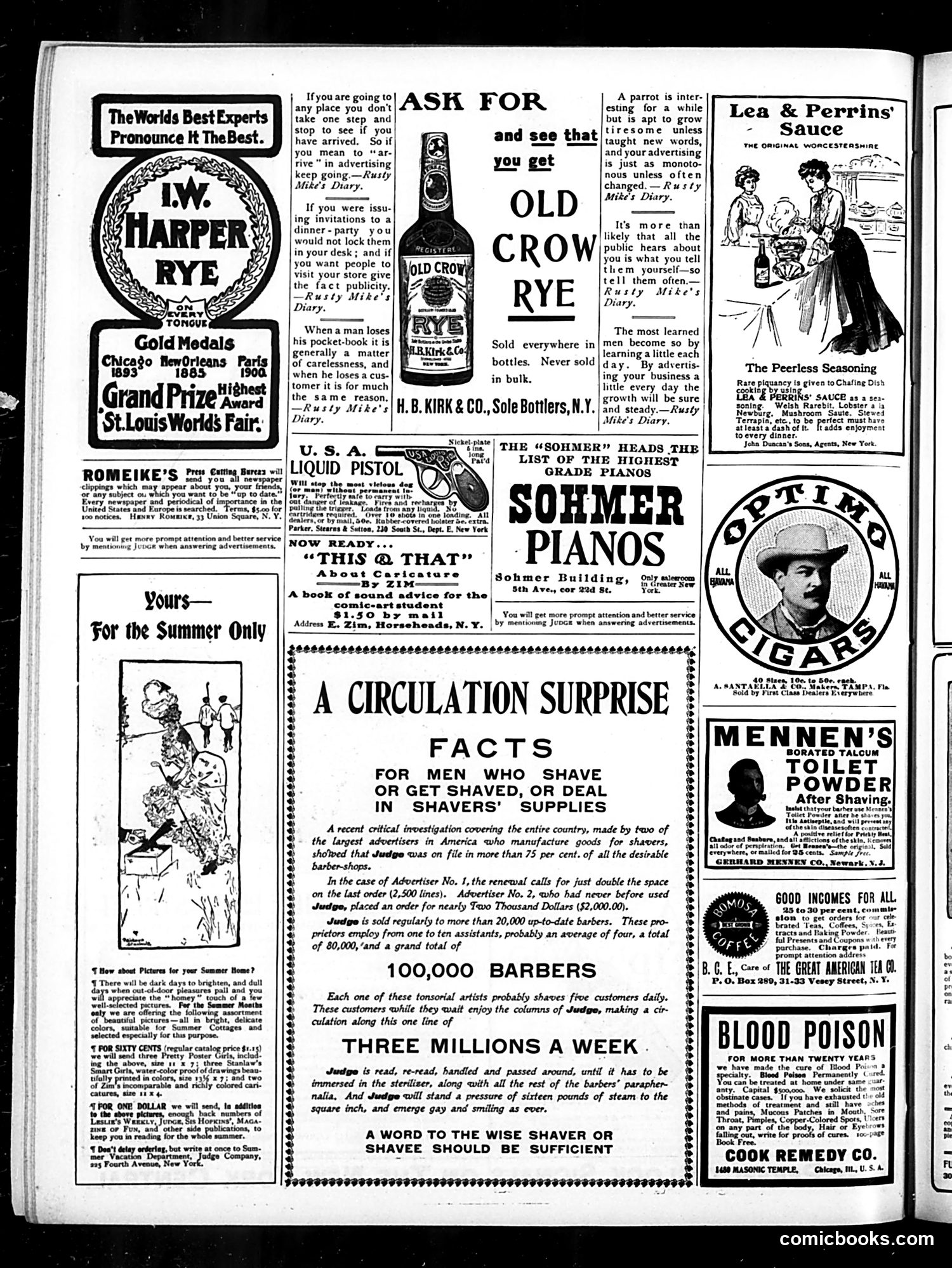
This page is primarily **advertising**, not political satire. It features vintage product ads (Old Crow Rye, Lea & Perrins sauce, Sohmer pianos, cigars, toiletries) interspersed with motivational business aphorisms attributed to "Rusty Mike's Diary." The only notable content is a large boxed section titled "A CIRCULATION SURPRISE" promoting Judge magazine itself. It claims an investigation found Judge displayed in 75% of American barber shops, targeting the shaving-supply industry. The text emphasizes Judge reaches 100,000 barbers daily and "three millions a week," presenting circulation statistics as evidence of the magazine's value to advertisers. The page essentially serves as a self-promotional advertisement, using barber-shop penetration data to convince manufacturers and retailers to advertise in Judge. There are no identifiable caricatures or political references visible.
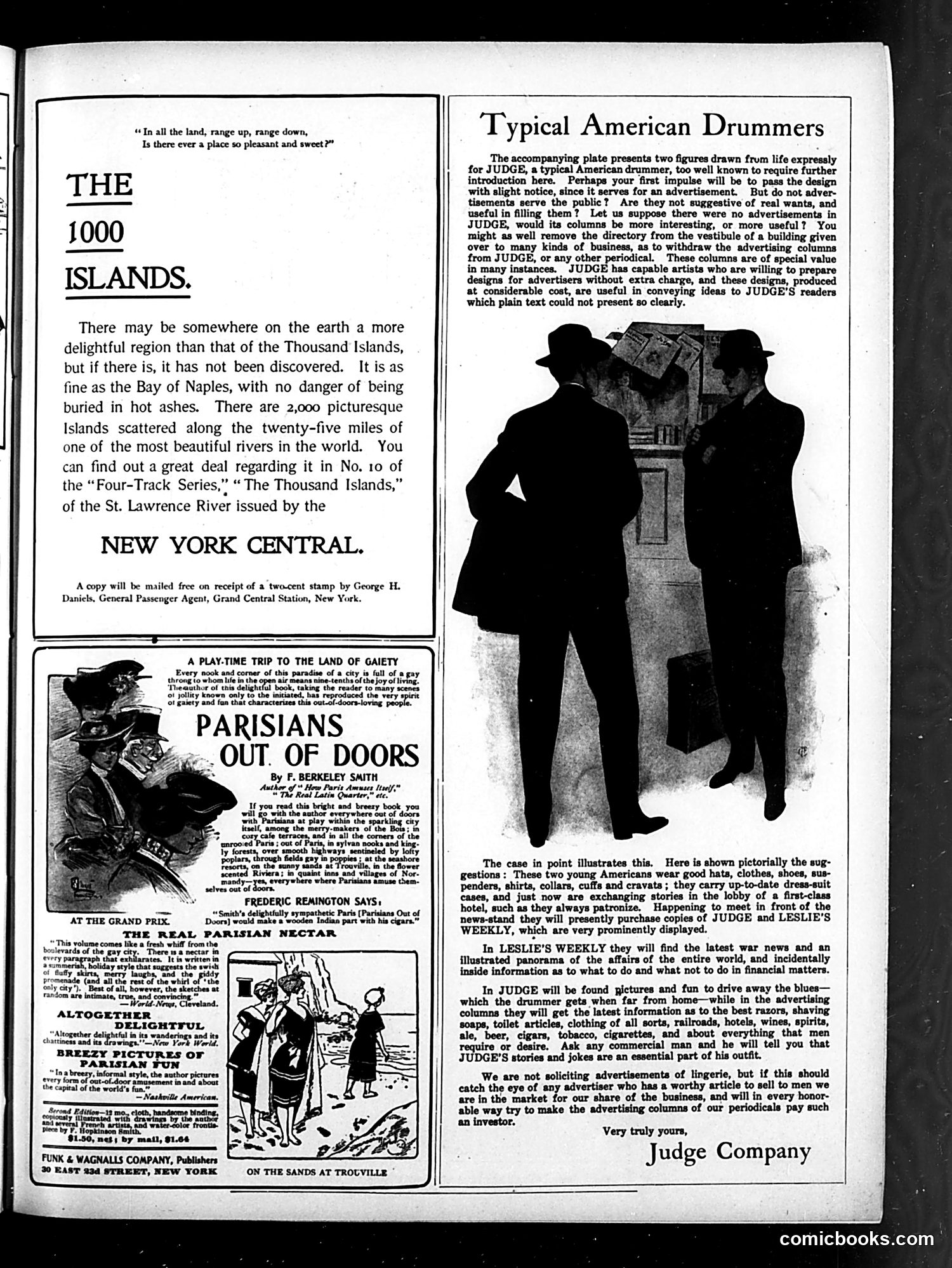
This page contains mostly advertisements and promotional content rather than political satire. **The Thousand Islands section** advertises the New York Central Railroad's tourist destination in upstate New York, using romantic language about the St. Lawrence River's beauty. **"Parisians Out of Doors"** promotes a travel book by F. Berkeley Smith with an illustrated cover showing Parisian leisure activities. It includes endorsements from author Frederic Remington. **"Typical American Drummers"** is the sole editorial content—a silhouette illustration of two traveling salesmen (drummers) in professional dress. The accompanying text argues that magazine advertisements serve the public by illustrating real consumer needs and goods (hats, clothes, shoes, cravats, dress-suit cases). It defends advertising as essential editorial content, not mere filler. The piece illustrates the period's growing commercialization of magazines and normalization of advertising as legitimate journalism.
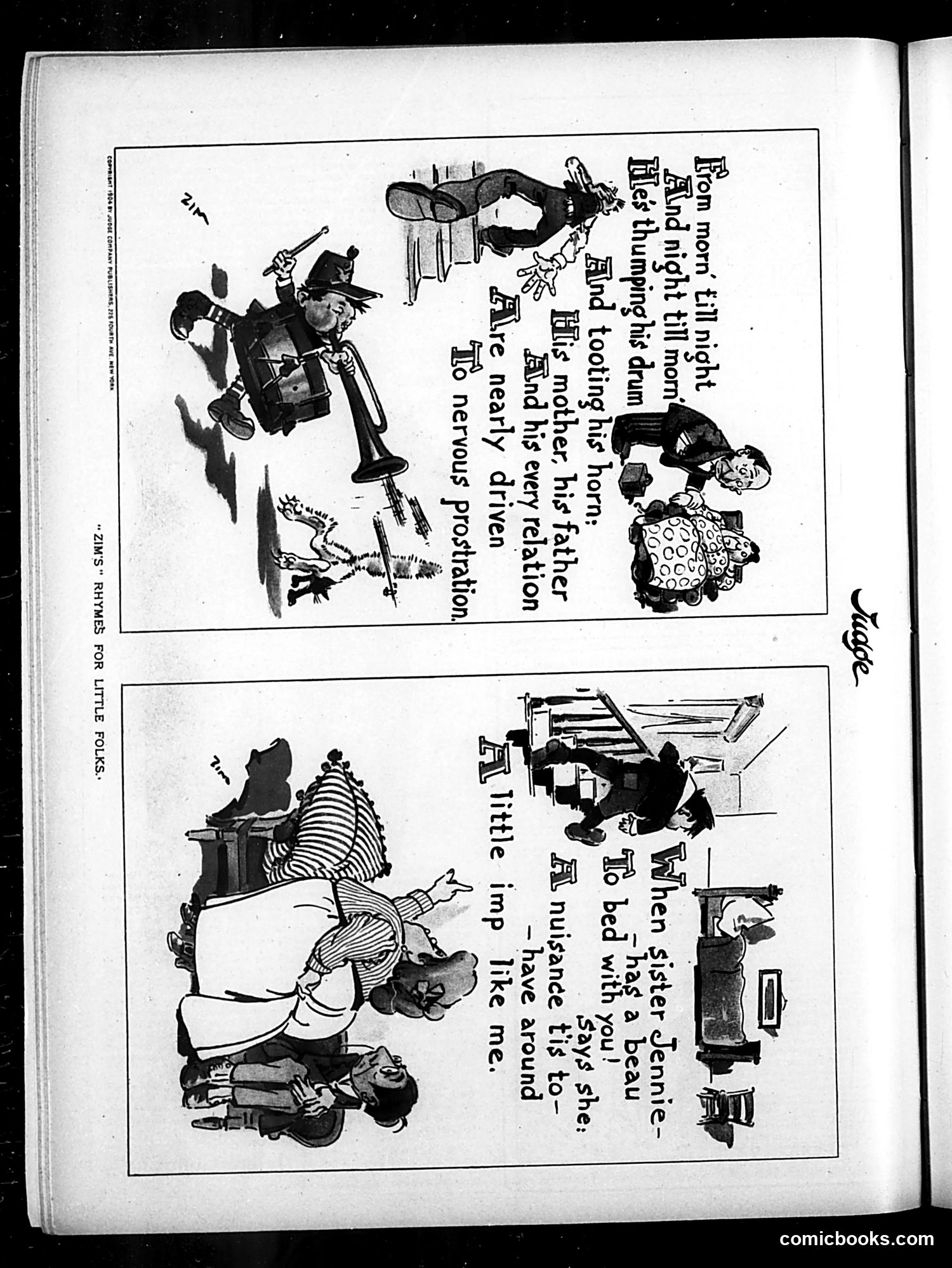
This page from *Judge* magazine presents two satirical cartoons mocking a noisy child character (labeled "Zim's Rhymes for Little Folks"). The top cartoon shows a young boy creating chaos with musical instruments—blowing a horn and beating a drum—while well-dressed adults around him cover their ears in distress. The accompanying verse humorously complains that the child's noise-making has driven his family "nearly...to nervous prostration." The bottom cartoon continues this theme, depicting the same mischievous boy as a domestic nuisance disrupting his household. The satire targets the universal parental frustration with unruly, loud children. Rather than political commentary, this represents domestic humor—poking fun at the challenges of child-rearing and noise pollution in close-quarters family life. The cartoons mock both the child's misbehavior and the exasperated reactions of exhausted adults.