
Judge, 1905-08-12 · page 5 of 16
Judge — August 12, 1905 — page 5: what you’re looking at
What you’re looking at
This Judge magazine piece satirizes the "reputation-fixer" industry—publicists hired to improve wealthy figures' public images. The narrator, "Dinkum Sniffens," visits John D. Rockefeller to debunk harsh rumors portraying him as a cold, miserly "money-grabber." The satire's point: Sniffens discovers Rockefeller is actually warm, jovial, and hospitable—but then reveals the deception. Rockefeller subtly bribes the visiting brass band with hundred-dollar bills (slipped into handshakes), and later lies about the band's size, correcting himself unconvincingly. The implication is clear: Rockefeller's friendliness is calculated performance, not genuine character. The cartoon mocks both Rockefeller's attempts at image rehabilitation and the entire reputation-fixing industry itself—suggesting wealthy industrialists' "reformed" public personas are merely staged theater hiding their true nature.
📄 Transcribed text from this page (OCR, searchable)
Machine-transcribed from the original scan — historical spelling and the odd misread are preserved.
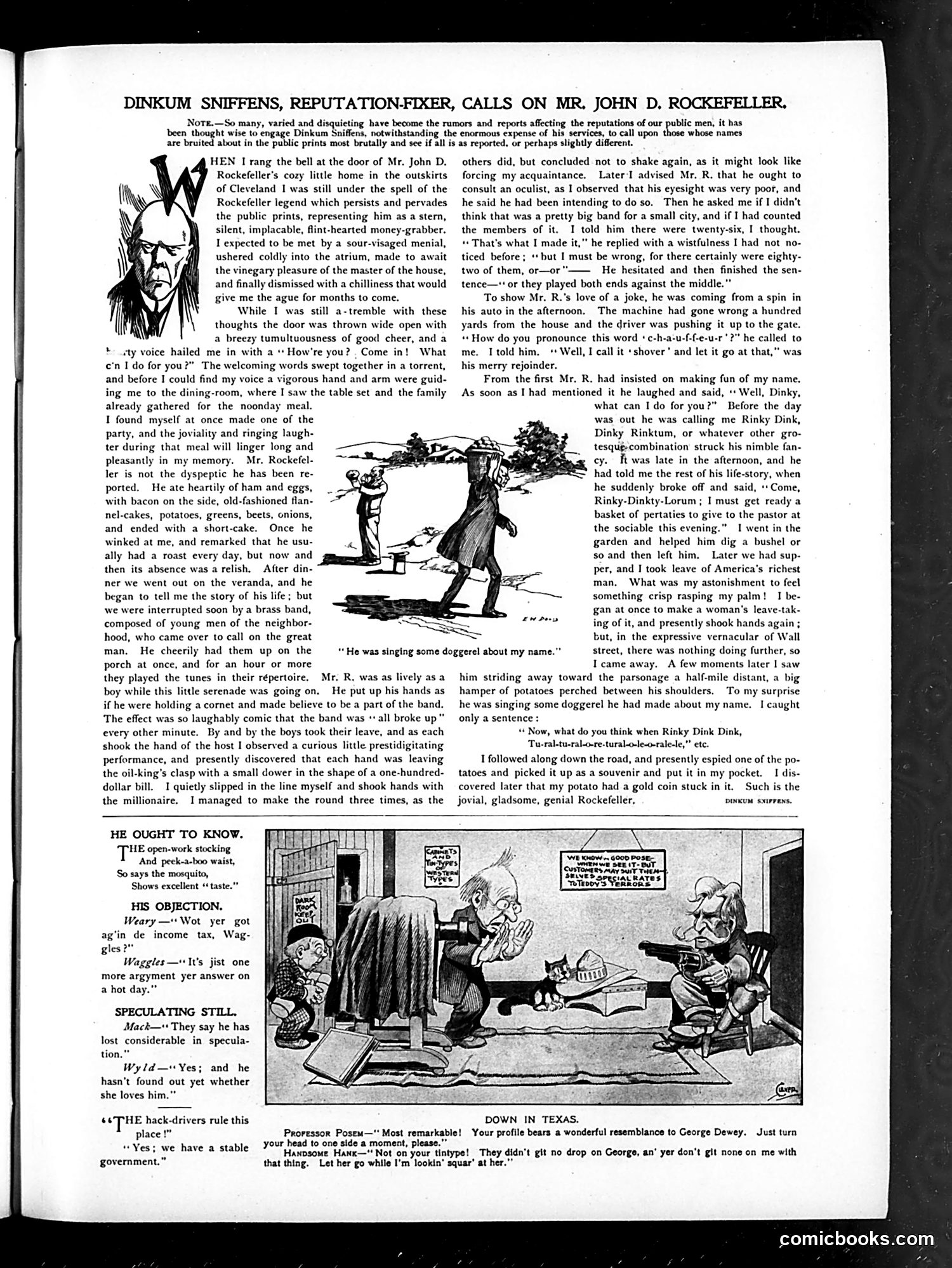
DINKUM SNIFFENS, REPUTATION-FIXER, CALLS ON MR, JOHN D, ROCKEFELLER, Note.—So many, varied and disquieting have become the rumors and reports affecting the reputations of our public men, it has been thought wise to engage Dinkum Sniffens, notwithstanding the enormous expense of his services, to call upon whose names are bruited about in the public prints most brutally and sce if all is as reported, or perhaps slightly different. HEN I rang the bell at the door of Mr. John D. Rockefeller’s cozy little home in the outskirts of Cleveland I was still under the spell of the Rockefeller legend which persists and pervades the public prints, representing him as a stern, silent, implacable, flint-hearted money-grabber. I expected to be met by a sour-visaged menial, ushered coldly into the atrium, made to aw the vinegary pleasure of the master of the house, and finally dismissed with a chilliness that would give me the ague for months to come. While I was still a-tremble with these thoughts the door was thrown wide open with a breezy tumultuousness of good cheer, and a * sty voice hailed me in with a “How're you? Come in! What c'n I do for you?” The welcoming words swept together in a torrent, and before I could find my voice a vigorous hand and arm were guid- ing me to the dining-room, where I saw the table set and the family already gathered for the noonday meal. I found myself at once made one of the party, and the joviality and ringing laugh- ter during that meal will linger long and pleasantly in my memory. Mr. Rockefel- ler is not the dyspeptic he has been re- ported. He ate heartily of ham and eggs, with bacon on the side, old-fashioned flan- nel-cakes, potatoes, greens, beets, onions, and ended with a short-cake. Once he winked at me, and remarked that he usu- ally had a roast every day, but now and then its absence was a relish, After din- ner we went out on the veranda, and he began to tell me the story of his life; but we were interrupted soon by a brass band, composed of young men of the neighbor- hood, who came over to call on the great man. He cheerily had them up on the “He was singing some doggerel about my name.” porch at once, and for an hour or more they played the tunes in their répertoire. Mr. R. was as lively asa boy while this little serenade was going on. He put up his hands as if he were holding a cornet and made believe to be a part of the band. ‘The effect was so laughably comic that the band was “all broke up" every other minute. By and by the boys took their leave, and as each shook the hand of the host I observed a curious little prestidigitating performance, and presently discovered that each hand was leaving the oil-king’s clasp with a small dower in the shape of a one-hundred- dollar bill. I quietly slipped in the line myself and shook hands with the millionaire. I managed to make the round three times, as the others did, but concluded not to shake again, as it might look like forcing my acquaintance. Later‘I advised Mr. R. that he ought to consult an oculist, as I observed that his eyesight was very poor, and he said he had been intending to do so. Then he asked me if I didn’t think that was a pretty big band for a small city, and if I had counted the members of it. I told him there were twenty-six, I thought. «That's what I made it,” he replied with a wistfulness I had not no- ticed before; ++ but I must be wrong, for there certainly were eighty- two of them, or—or""—— He hesitated and then finished the sen- tence—« or they played both ends against the middle.” To show Mr. R.'s love of a joke, he was coming from a spin in his auto in the afternoon. The machine had gone wrong a hundred yards from the house and the driver was pushing it up to the gate. ** How do you pronounce this word ‘c-h-a-u-f-f-e-u-r'?” he called to me. I told him. ‘Well, I call it *shover’ and let it go at that,” was his merry rejoinder. From the first Mr. R. had insisted on making fun of my name. As soon as I had mentioned it he laughed and said, «* Well, Dinky, what can Ido for you?" Before the day was out he was calling me Rinky Dink, Dinky Rinktum, or whatever other gro- tesqug-combination struck his nimble fan- cy. Rtwas late in the afternoon, and he had told me the rest of his life-story, when he suddenly broke off and said, + Come, Rinky-Dinkty-Lorum ; I must get ready a basket of pertaties to give to the pastor at the sociable this evenin; I went in the garden and helped him dig a bushel or so and then left him. Later we had sup- per, and I took leave of America’s richest man, What was my astonishment to feel something crisp rasping my palm! I be- gan at once to make a woman's leave-tak- ing of it, and presently shook hands again but, in the expressive vernacular of V street, there was nothing doing further, so Tcame away. A few moments later I saw him striding away toward the parsonage a half-mile distant, a big hamper of potatoes perched between his shoulders, To my surprise he was singing some doggerel he had made about my name. I caught only a sentence: “Now, what do you think when Rinky Dink Dink, Tu-ral-tu-ralo-re.tural-o-le-o-rale-le," etc. I followed along down the road, and presently espied one of the po- tatoes and picked it up as a souvenir and put it in my pocket. I dis- covered later that my potato had a gold coin stuck in it. Such is the jovial, gladsome, genial Rockefeller, DINKUM SSIFPENS, HE OUGHT TO KNOW. THE open-work stocking And peek-a-boo waist, So says the mosquito, Shows excellent “taste.” HIS OBJECTION. Weary —“ Wot yer got ag'in de income tax, Wag- gles?” Waggles—"' It’s jist_ one more argyment yer answer on a hot day.” SPECULATING STILL. Mack—« They say he has lost considerable in specula- tion.” Wyld—“Yes; and he hasn't found out yet whether she loves him.” seTHE hack-drivers rule this place !” Proressor Posem—"* Most remarkable! Your profile bears a wonderful resemblance to George Dewey. Just turn your head to one side a moment, please." Haxpsome Han —"\Not on your tintype! They didn't git no drop on George, an’ yer don't git none on me with government.” that thing. Let her go while I'm lookin’ squar’ at her.” «Yes; we have a stable WE Snow. 6090 POSE CoE ETE SET OUT, tives oreciat RATES Tehwvoys Vennons DOWN IN TEXAS. comicbooks.com