
Judge, 1905-08-12 · page 7 of 16
Judge — August 12, 1905 — page 7: what you’re looking at
What you’re looking at
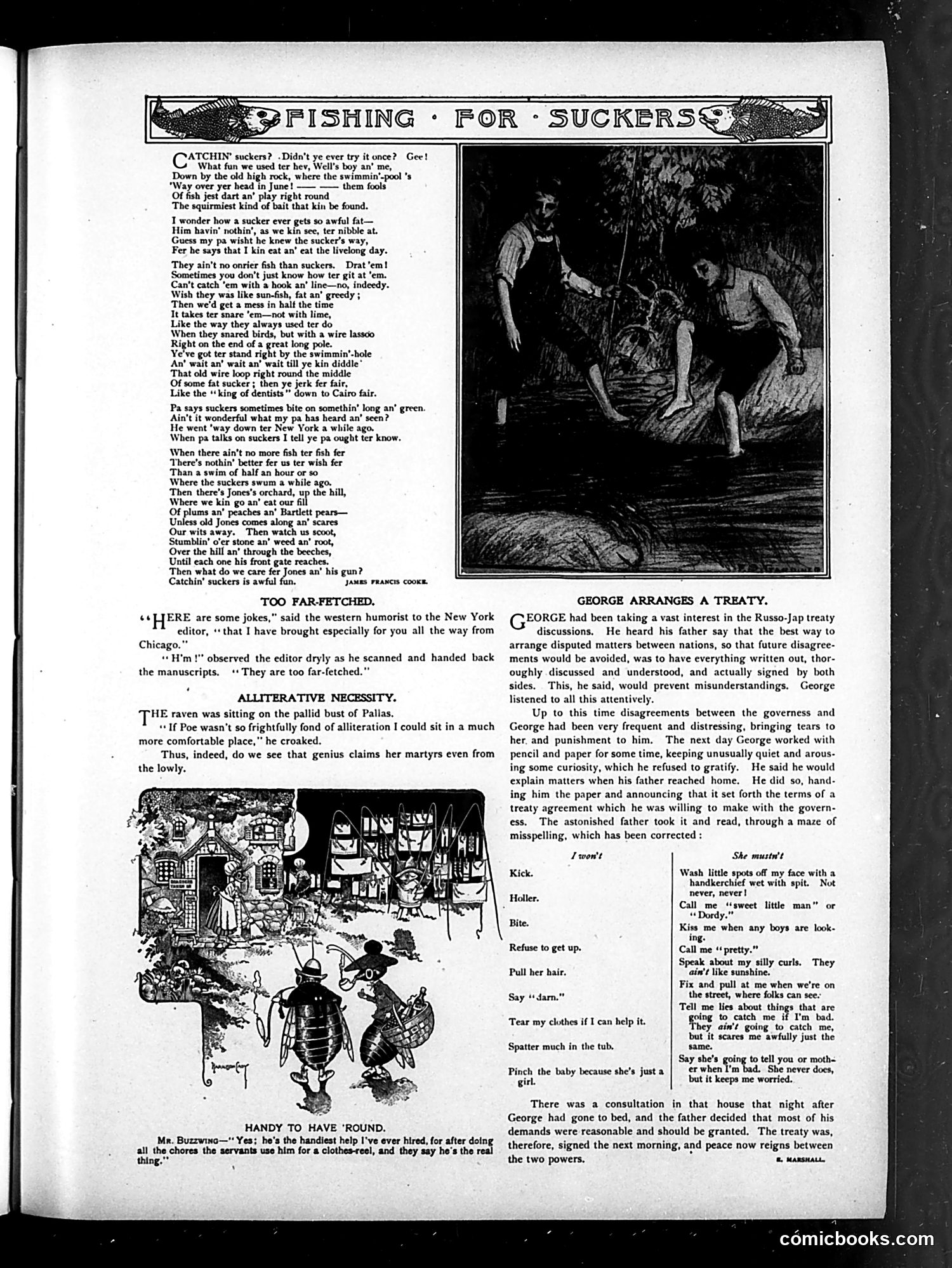
This page contains three distinct humor pieces typical of Judge's satirical content: **"Fishing for Suckers"** (main poem): A nostalgic rural dialect poem about boys catching fish, with extended metaphors about foolish people. The "sucker" fish serves as the stand-in for gullible individuals—a common satirical device. **"Too Far-Fetched"**: A meta-joke about a western humorist pitching jokes to a New York editor that are rejected as implausible. It satirizes the gap between regional humor sensibilities. **"George Arranges a Treaty"**: A children's anecdote where a boy, inspired by discussions of the Russo-Japanese Treaty (likely 1905), attempts to formalize disputes with his governess through a written agreement. The satire gently mocks both the formal diplomatic process and childhood earnestness. These pieces represent Judge's blend of social commentary, literary parody, and gentle domestic humor—common for American satirical magazines of the early 1900s.
📄 Transcribed text from this page (OCR, searchable)
Machine-transcribed from the original scan — historical spelling and the odd misread are preserved.
Ds. ATCHIN’ suckers? .Didn't ye ever try it once? Gee! What fun we used ter hey, Well’s boy an’ me, Down by the old high rock, where the swimmin'=pool 's ‘Way over yer head in June! —— —— them fools Of fish jest dart an’ play right round The squirmiest kind of bait that kin be found. I wonder how a sucker ever gets so awful fat— Him havin’ nothin’, as we kin see, ter nibble at. Guess my pa wisht’he knew the sucker’s way, Fer he says that I kin eat an’ eat the livelong day. ‘They ain't no onrier fish than suckers. Drat ‘em! Sometimes you don’t just know how ter git at ‘em. Can't catch "em with a hook an’ line—no, indeedy. Wish they was like sun-fish, fat an’ greedy ; Then we'd get a mess in half the time It takes ter snare 'em—not with lime, Like the way they always used ter do When they snared birds, but with a wire lassdo Right on the end of a great long pole. Ye've got ter stand right by the swimmin’-hole An’ wait an’ wait an’ wait till ye kin diddle* That old wire loop right round the middle Of some fat sucker ; then ye jerk fer fair, Like the ‘king of dentists" down to Cairo fair. Pa says suckers sometimes bite on somethin’ long an’ green. Ain't it wonderful what my pa has heard an’ seen? He went ‘way down ter New York a while ago. When pa talks on suckers I tell ye pa ought ter know. When there ain't no more fish ter fish fer ‘There's nothin’ better fer us ter wish fer ‘Than a swim of half an hour or so Where the suckers swum a while ago. Then there's Jones's orchard, up the hill, Where we kia go an’ eat our fill Of plums an’ peaches an’ Bartlett pears— Unless old Jones comes along an’ scares Our wits away. Then watch us scoot, Stumblin’ o'er stone an’ weed an’ root, Over the hill an’ through the beeches, Until each one his front gate reaches. Then what do we care fer Jones an’ his gun? Catchin’ suckers is awful fun. AMES FRANCIS COOKE. TOO FAR-FETCHED. 4s LJERE are some jokes,” said the western humorist to the New York editor, «that I have brought especially for you all the way from Chicago.” “H'm !" observed the editor dryly as he scanned and handed back the manuscripts. + They are too far-fetched.”” ALLITERATIVE NECESSITY. THE raven was sitting on the pallid bust of Pallas, ++ If Poe wasn't so frightfully fond of alliteration I could sit in a much more comfortable place," he croaked. Thus, indeed, do we see that genius claims her martyrs even from the lowly, HANDY TO HAVE ‘ROUND. Mr. Buzzwino—" Yes; he's the handiest help I've ever hired, for after doing ail the chores the servants use him for a clotheereel, and they say he's the real ng. egg <3 FISHING - FOR - SUCKERSS&; Holler. GEORGE ARRANGES A TREATY. GGEORGE had been taking a vast interest in the Russo-Jap treaty discussions. He heard his father say that the best way to arrange disputed matters between nations, so that future disagree- ments would be avoided, was to have everything written out, thor- oughly discussed and understood, and actually signed by both sides. This, he said, would prevent misunderstandings. George listened to all this attentively. Up to this time disagreements between the governess and George had been very frequent and distressing, bringing tears to her. and punishment to him. The next day George worked with pencil and paper for some time, keeping unusually quiet and arous- ing some curiosity, which he refused to gratify. He said he would explain matters when his father reached home. He did so, hand- ing him the paper and announcing that it set forth the terms of a treaty agreement which he was willing to make with the govern- ess. The astonished father took it and read, through a maze of misspelling, which has been corrected : She mustn't Wash little spots off my face with a handkerchief wet with spit. Not never, never! Call_me “sweet little man” or Twon't Kick. Bite. Kiss me when any boys are look- ing. Call me “pretty.” Speak about my silly curls. ain't like sunshine. Fix and pull at me when we're on the street, where folks can see. Tell me lies about things that are goine to catch me if I'm bad. hey ain't going to catch me, but it scares me awfully just the same. Say she’s going to tell you or moth Pinch the baby because she’s justa | ¢r when I'm She never does, girl but it keeps me worried. Refuse to get up. They Pull her hair. Say “darn.” Tear my clothes if I can help it. Spatter much in the tub. There was a consultation in that house that night after George had gone to bed, and the father decided that most of his demands were reasonable and should be granted. The treaty was, therefore, signed the next morning, and peace now reigns between the two powers. ¢ 1 MARSHALL comicbooks.com