
A complete issue · 18 pages · 1905
Judge — July 29, 1905
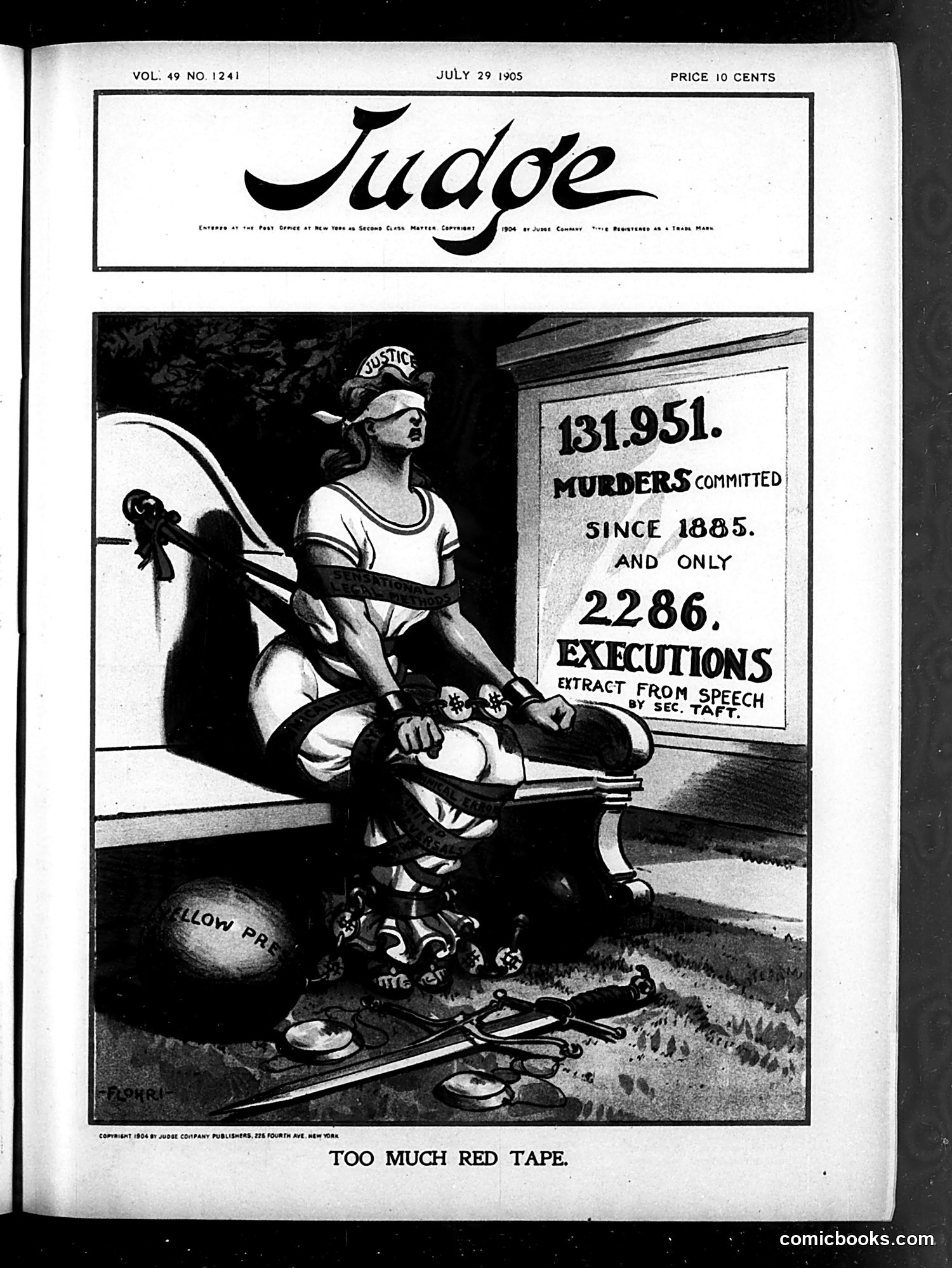
This political cartoon criticizes bureaucratic inefficiency in the American justice system. Lady Justice sits bound in red tape while holding scales, unable to function. The sign behind her presents a damning statistic: 131,951 murders committed since 1885, but only 2,286 executions—roughly a 1.7% execution rate. The "extract from speech by Sec. Taft" reference indicates Secretary of War William Howard Taft made public remarks about this disparity. The cartoon's message is clear: excessive legal procedure and red tape prevent swift justice. The artist argues that bureaucratic delays allow murderers to escape punishment, rendering the justice system ineffective. This reflects early 1900s frustration with what critics saw as overly complicated legal processes hindering public safety.
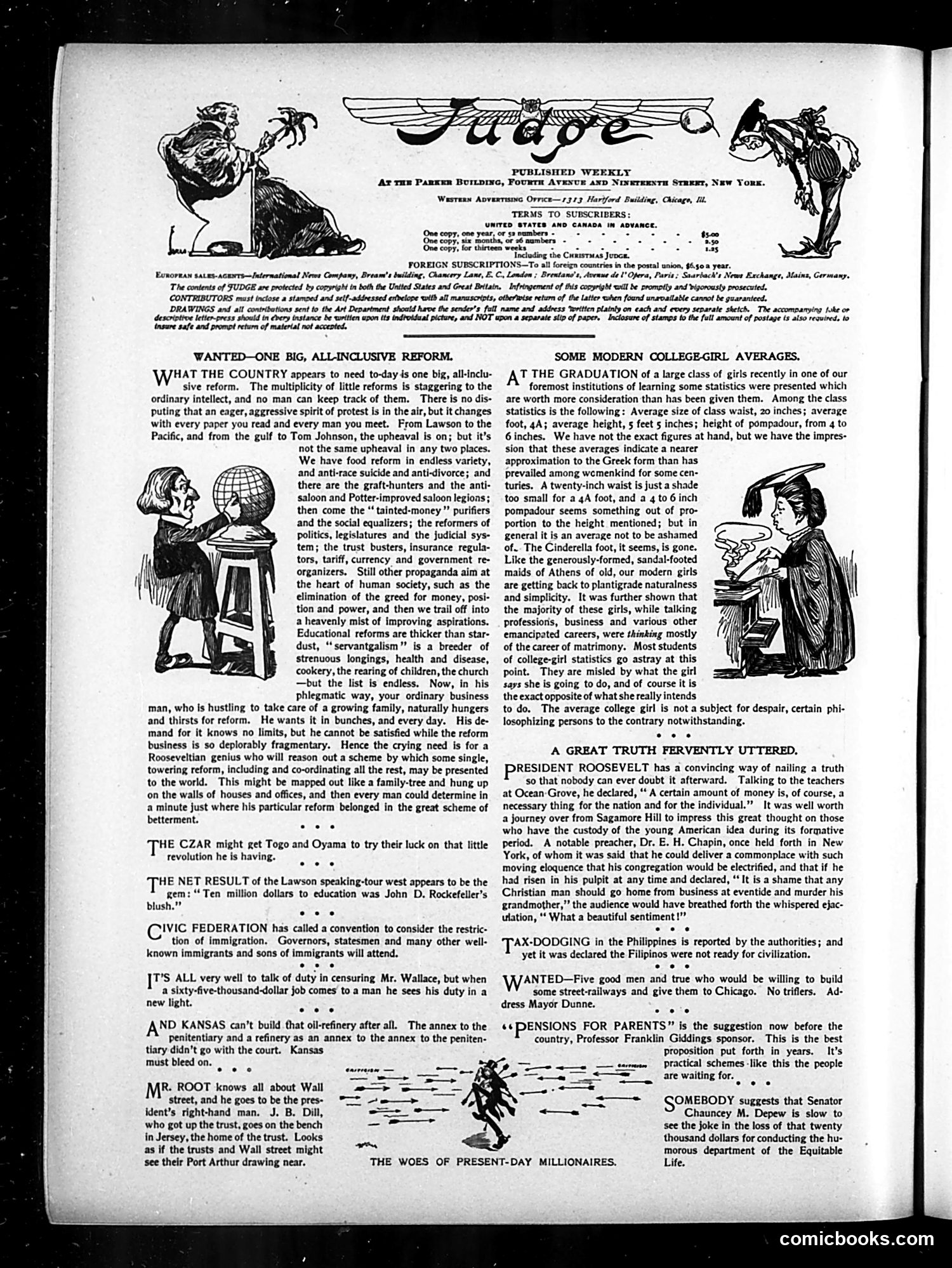
This page combines editorial commentary with satirical sections. The main cartoon, "The Woes of Present-Day Millionaires," depicts a wealthy figure being pursued or harassed—likely satirizing the regulatory challenges wealthy industrialists faced during the Progressive Era. Several brief articles mock contemporary targets: Roosevelt's habit of stating obvious truths as profundities; the Philippines' supposed unreadiness for civilization; and Senator Chauncey Depew's loss of $20,000 managing the Equitable Life insurance company during a scandal. The "College-Girl Averages" piece humorously analyzes female graduates' physical measurements against classical Greek ideals, poking fun at both academic pretension and emerging debates about women's education and social roles in the early 1900s.
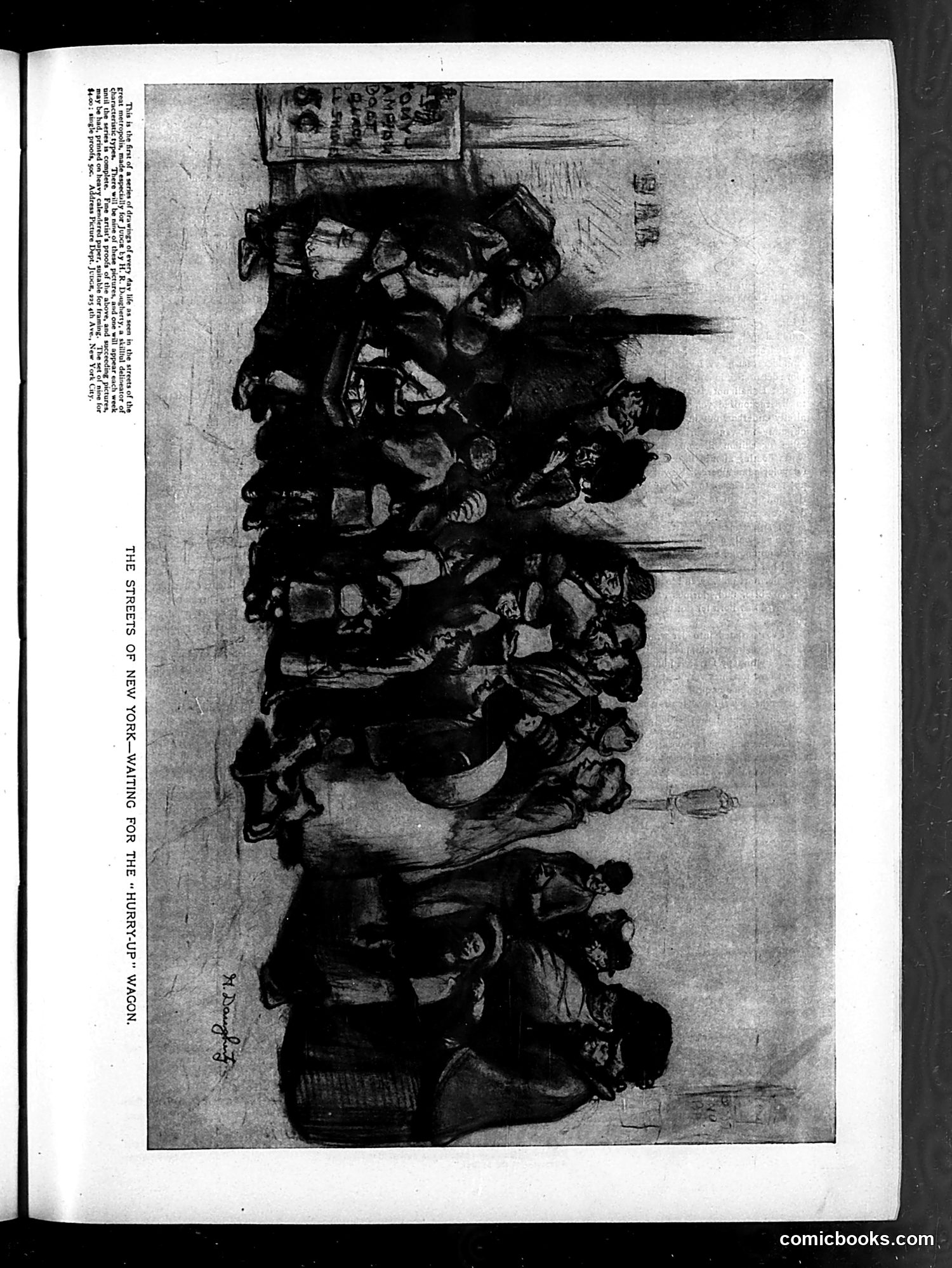
I can see this is a page from *Judge* magazine rotated 90 degrees, showing what appears to be a satirical illustration titled "The Streets of New York—Waiting for the Hearst-Pulp Wagon." The image depicts multiple figures in a crowded street scene, though the image quality and rotation make specific identification difficult. The title suggests this cartoon comments on New York street life and references William Randolph Hearst and Joseph Pulitzer—rival newspaper publishers known for sensationalist "yellow journalism." The satire likely critiques how New Yorkers were portrayed or exploited by competing newspapers' coverage, or mocks the public's appetite for sensational reporting. However, without clearer visibility of individual caricatures and their labels, I cannot confidently identify specific figures or the precise satirical point beyond this general context.
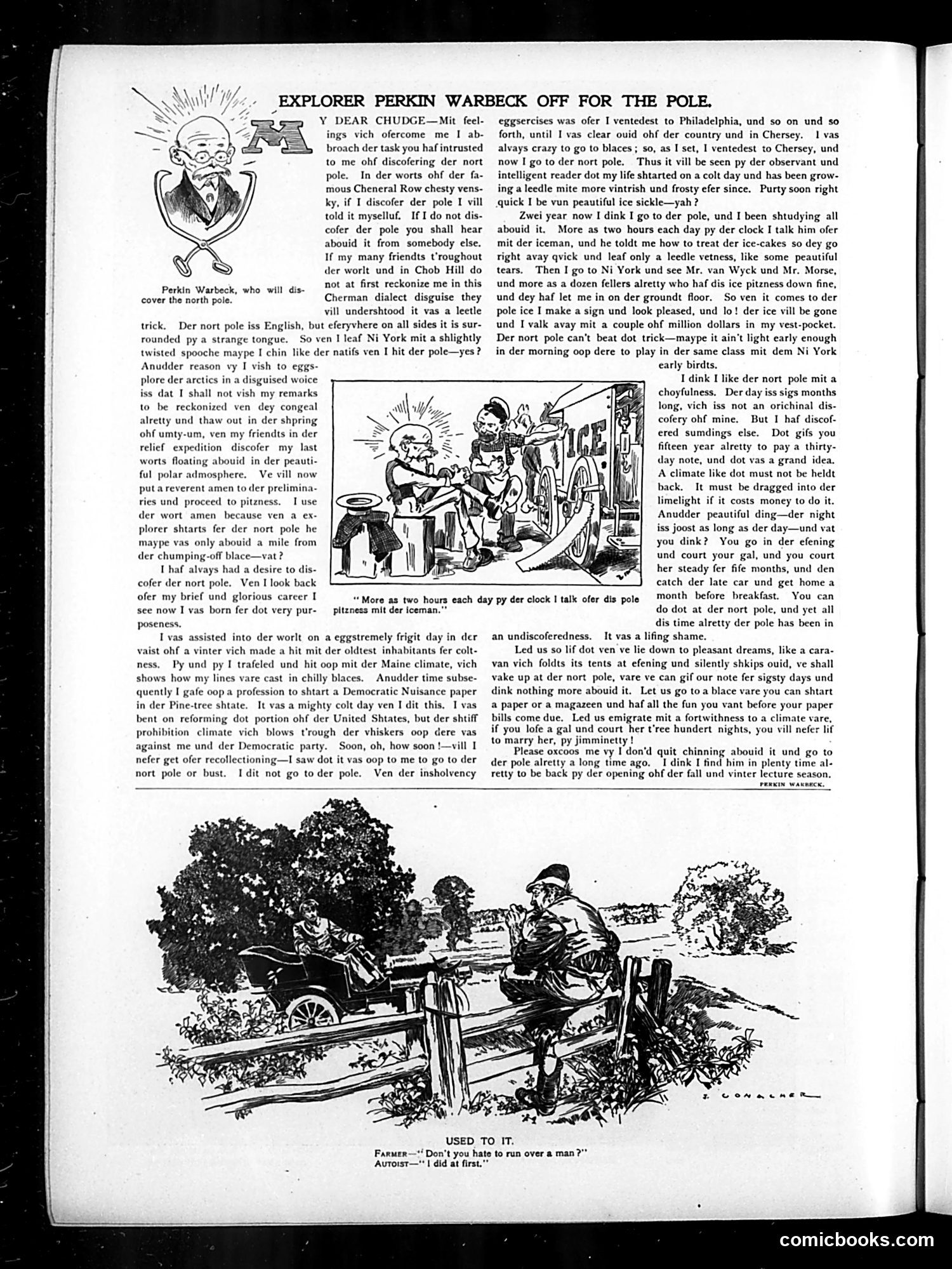
This page satirizes **explorer Perkin Warbeck's** claimed expedition to the North Pole. The caricatured Warbeck, shown with exaggerated features, recounts his polar ambitions in the main text, which humorously details his preparations and boasts about polar exploration. The cartoon depicts Warbeck as a somewhat buffoonish figure—his heavily accented German dialect in the text ("der pole," "vy") suggests he's a comic foreigner. The satire mocks both his grandiose explorer pretensions and the era's fascination with polar expeditions (a major 19th-century obsession). The bottom cartoon shows an automobile accident with the caption "Used to It," suggesting Warbeck's reckless nature extends beyond polar ventures—additional commentary on his incompetence or foolhardiness.
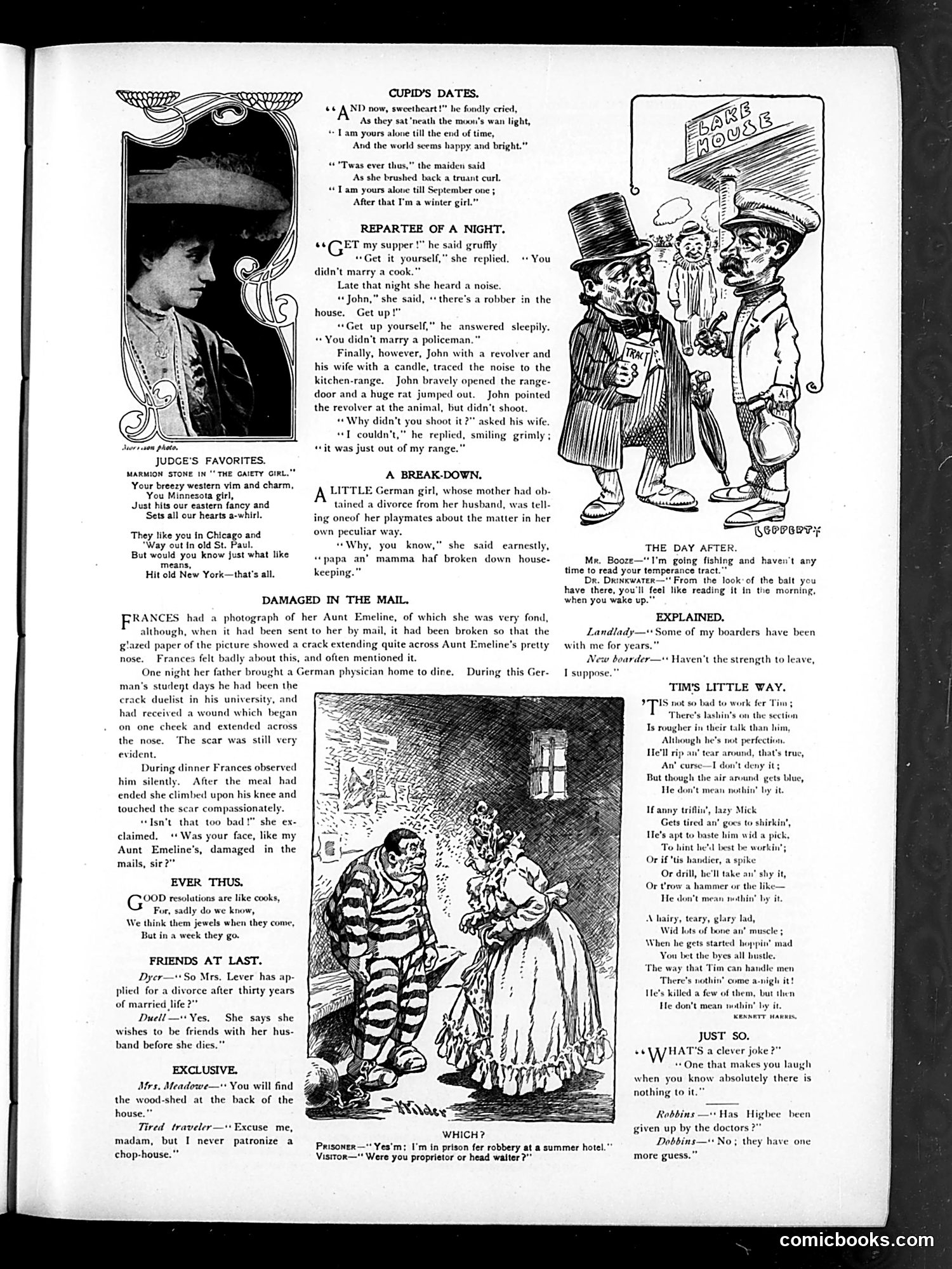
This page contains several short humorous pieces typical of Judge magazine's satirical content: **"Cupid's Dates"** mocks romantic sentiment—a woman promises eternal love "till September one; After that I'm a winter girl," suggesting summer romance is temporary and seasonal. **"Repartee of a Night"** presents domestic humor: a husband refuses household duties ("didn't marry a cook") and police protection, then makes a pun about shooting a rat being "out of my range." **"A Break-Down"** plays on language: a German-immigrant child says parents "broken down housekeeping" (meaning separated) rather than "broken up." **"Damaged in the Mail"** uses innocent observation for humor: a child compares her aunt's damaged photograph to a German guest's facial scar from dueling, innocently suggesting they're similar damage. The page reflects period attitudes toward immigrants, domestic roles, and genteel romance while relying on wordplay and situational comedy typical of early-1900s American satirical humor.
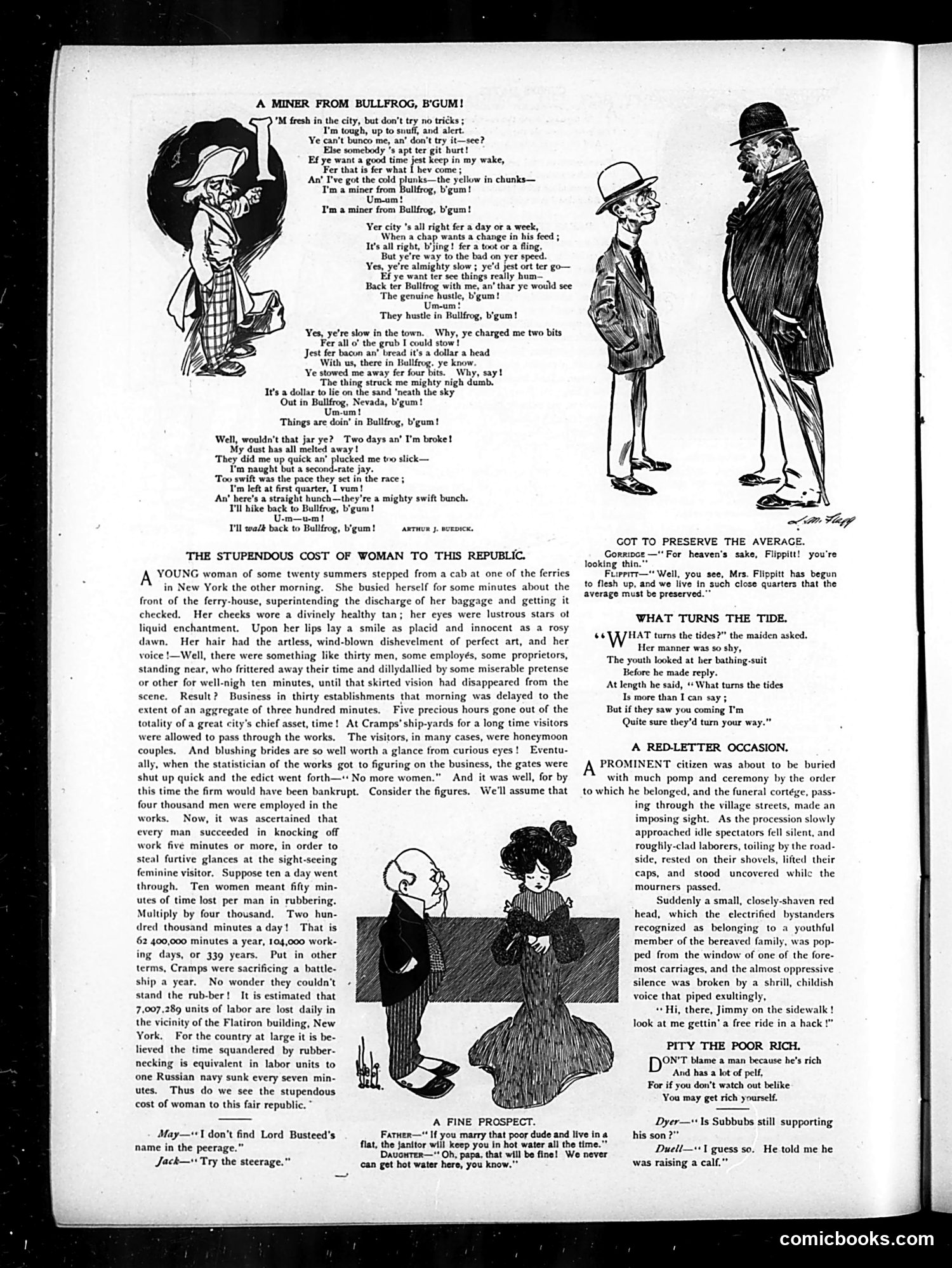
This satirical poem mocks a newly wealthy prospector from the Bullfrog mining district (Nevada) who arrives in New York City boasting of riches and frontier toughness. The humor centers on his culture shock: he's scandalized by city prices (four bits for food he'd pay a dollar for in mining camps) and quickly swindled by urban con artists, losing his fortune in two days. The caricature stereotypes the unsophisticated Western miner—rough dialect, swagger, naiveté—who discovers city dwellers are sharper hustlers than anyone back home. The satire cuts both ways: mocking both the boorish prospector and the slick urban schemers who fleece him. It reflects Judge magazine's Eastern urban perspective, positioning New York as a more sophisticated (if morally questionable) civilization than the rough mining frontier.
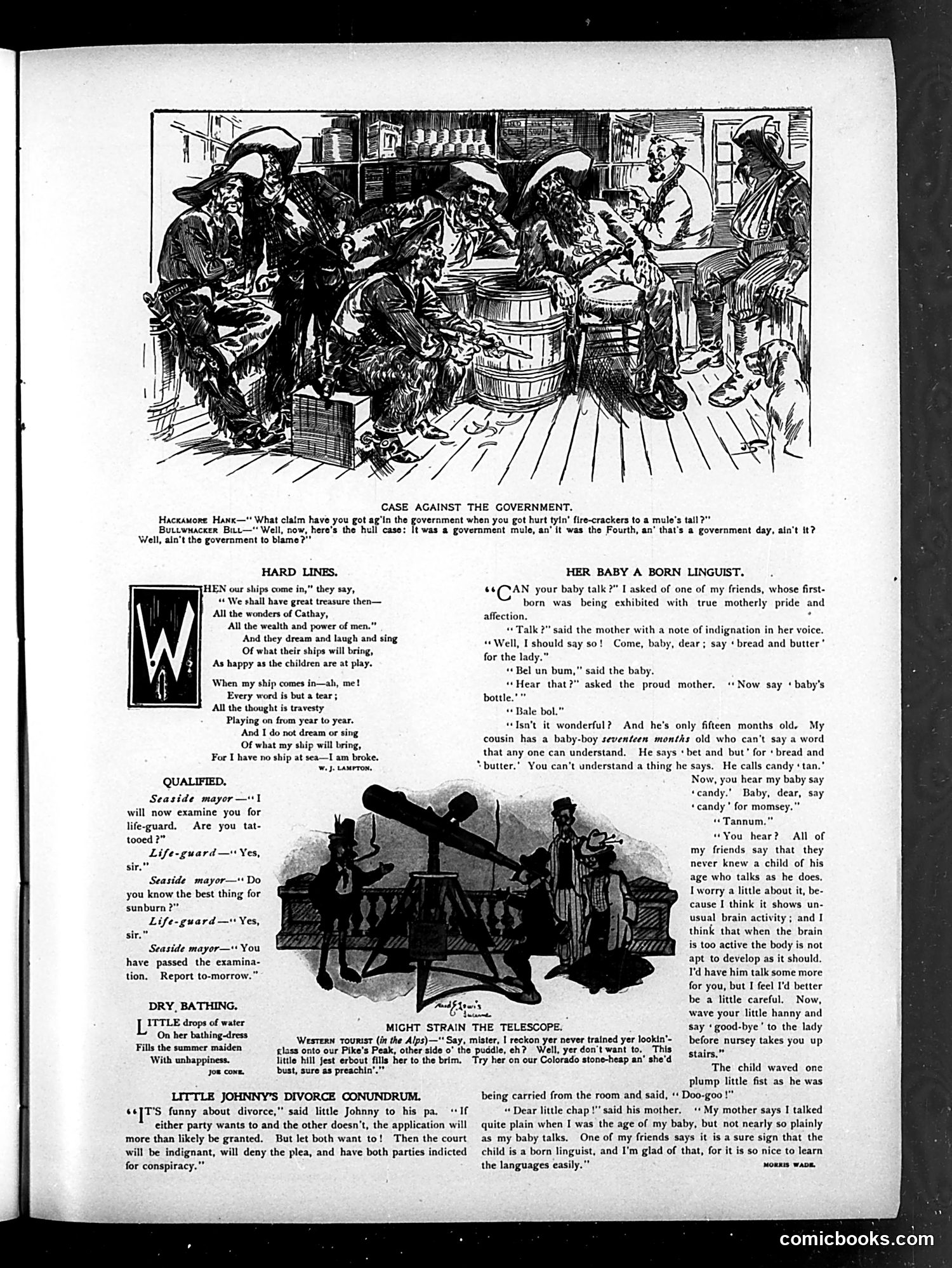
The top cartoon, "Case Against the Government," features two rural characters debating whether the government bears blame for an accident. One character tied firecrackers to a government mule on the Fourth of July—it exploded, injuring him. His argument: since it was a government mule on a government holiday, the government is responsible. The satire mocks absurd logic used to blame authorities for predictable consequences of one's own recklessness. The other pieces are lighter humor: "Hard Lines" contrasts optimistic dreams of wealth with broke reality; "Qualified" satirizes the minimal standards for lifeguards (only checking tattoos and sunburn knowledge); and "Her Baby a Born Linguist" gently mocks an overbearing mother misinterpreting her infant's babbling ("Bel un bum," "Tannum," "Doo-goo") as remarkable linguistic ability, while bragging to friends. The "Divorce Conundrum" jokes that courts grant divorce when one party wants it, but punish both parties if they *both* agree—legal absurdity presented as child's logic.
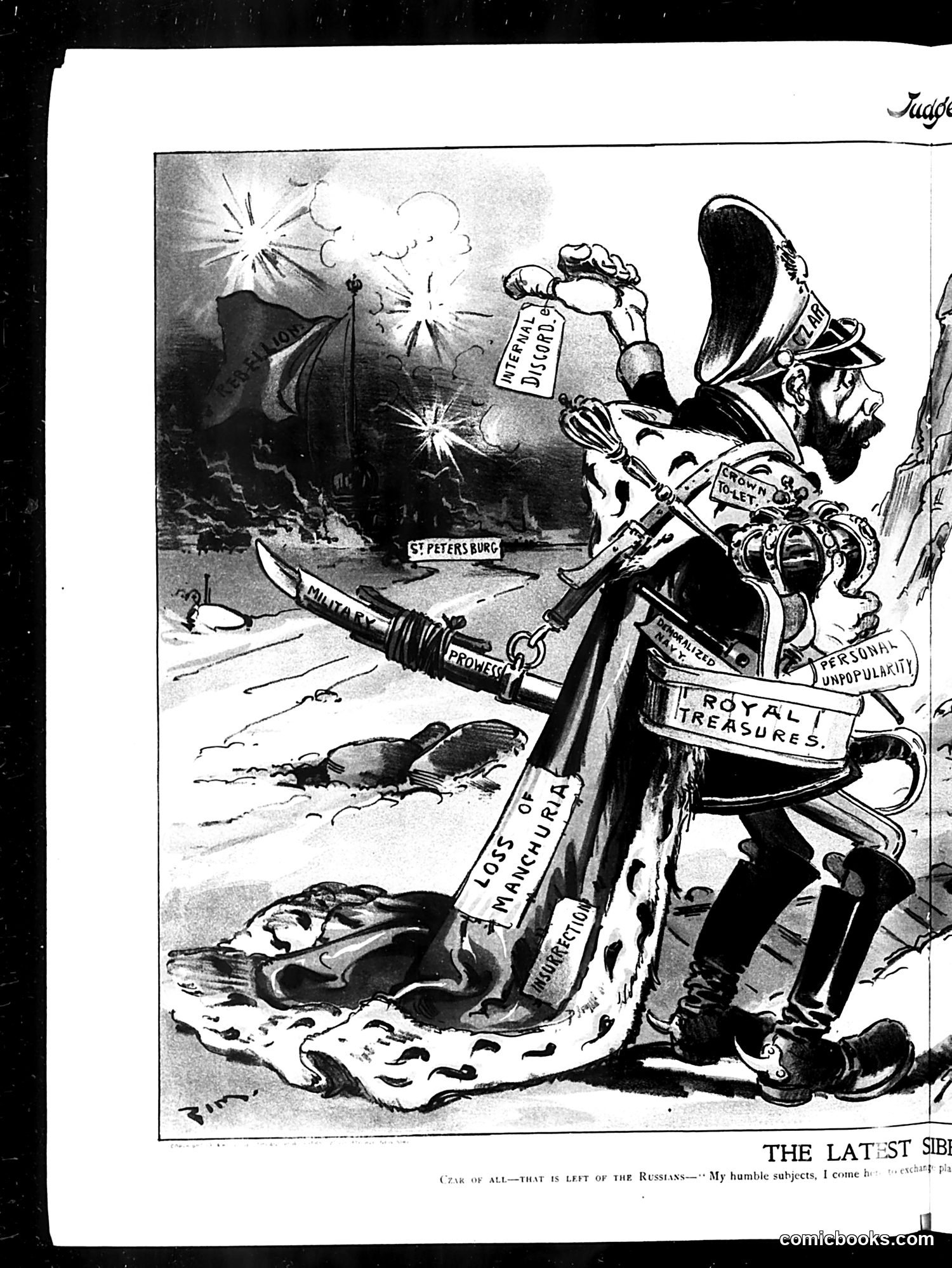
This political cartoon satirizes Russian imperial authority during a period of conflict. A caricatured figure (likely Czar Nicholas II, based on the caption's reference to "the Czar") stands among Russian casualties and destruction at St. Petersburg. He's laden with symbolic burdens labeled "Loss of Manchuria," "Military Provinces," "Royal Treasures," and "Personal Unpopularity"—apparently references to Russian military defeats and internal strife. The explosions and dead bodies represent battlefield losses, likely from the Russo-Japanese War (1904-1905). The satire mocks the Czar's claim of absolute authority ("My humble subjects") while Russia suffers military and economic collapse. The cartoon critiques imperial Russian leadership during this period of national crisis and humiliation.
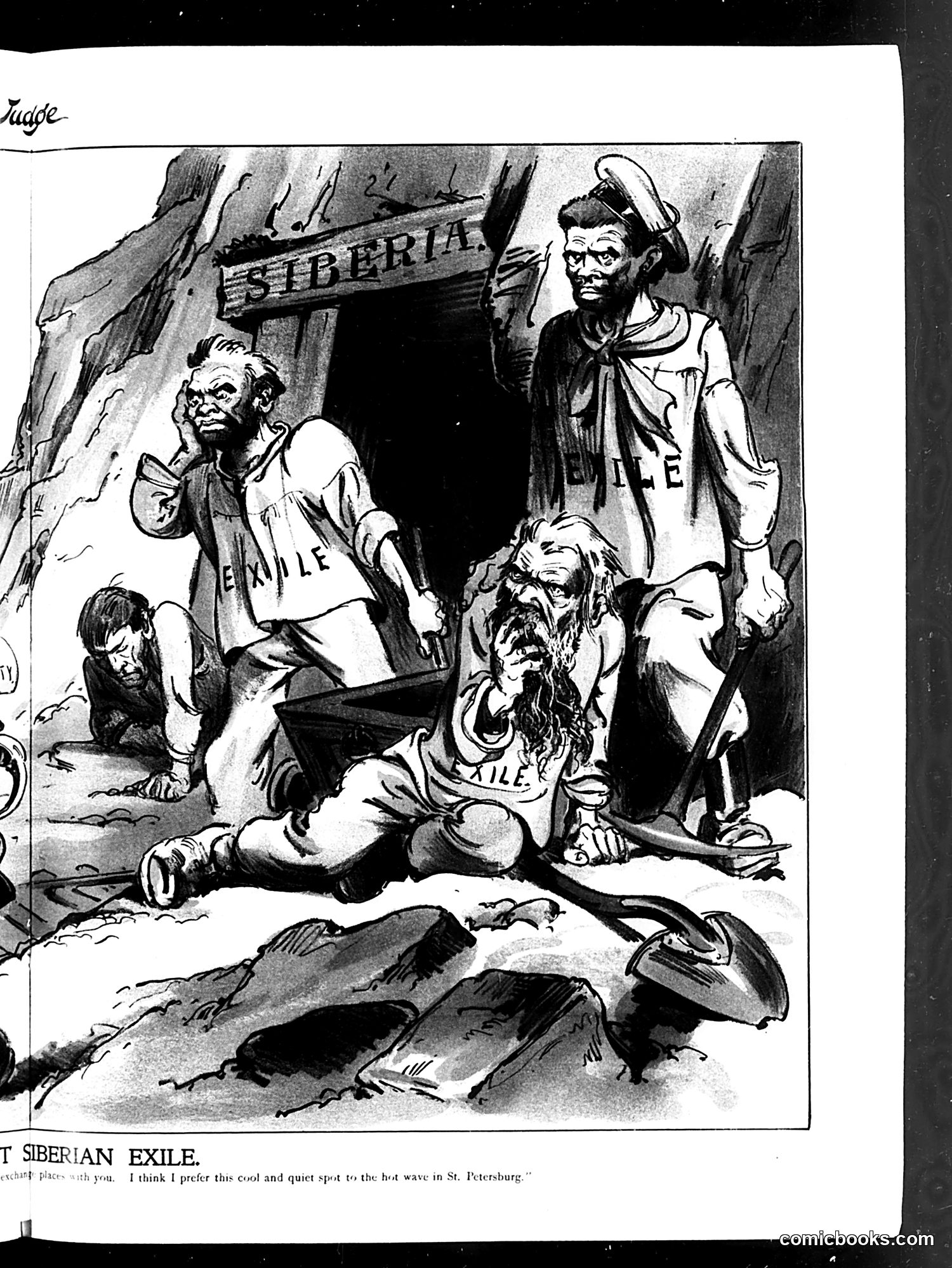
This Judge magazine cartoon satirizes Russian imperial punishment through exaggerated caricature. The image shows several figures labeled "EXILE" outside a structure marked "SIBERIA," apparently representing Russian prisoners or political exiles in Siberian labor camps—a notorious aspect of Tsarist Russia's justice system. The cartoon's caption references preferring "this cool and quiet spot to the hot wave in St. Petersburg," suggesting ironic commentary on either: Russian political turmoil, harsh summer conditions in the capital, or possibly mocking the Tsarist system's brutal exile practices. The grotesque, demonic facial features of the exiled figures employ period-typical racial/ethnic caricature common to 19th-century American satire. The cartoon likely appealed to American readers' anti-Russian sentiment or commentary on contemporary Russian affairs, though the specific historical context—the particular event or crisis referenced—remains unclear without additional publication date or contextual information.
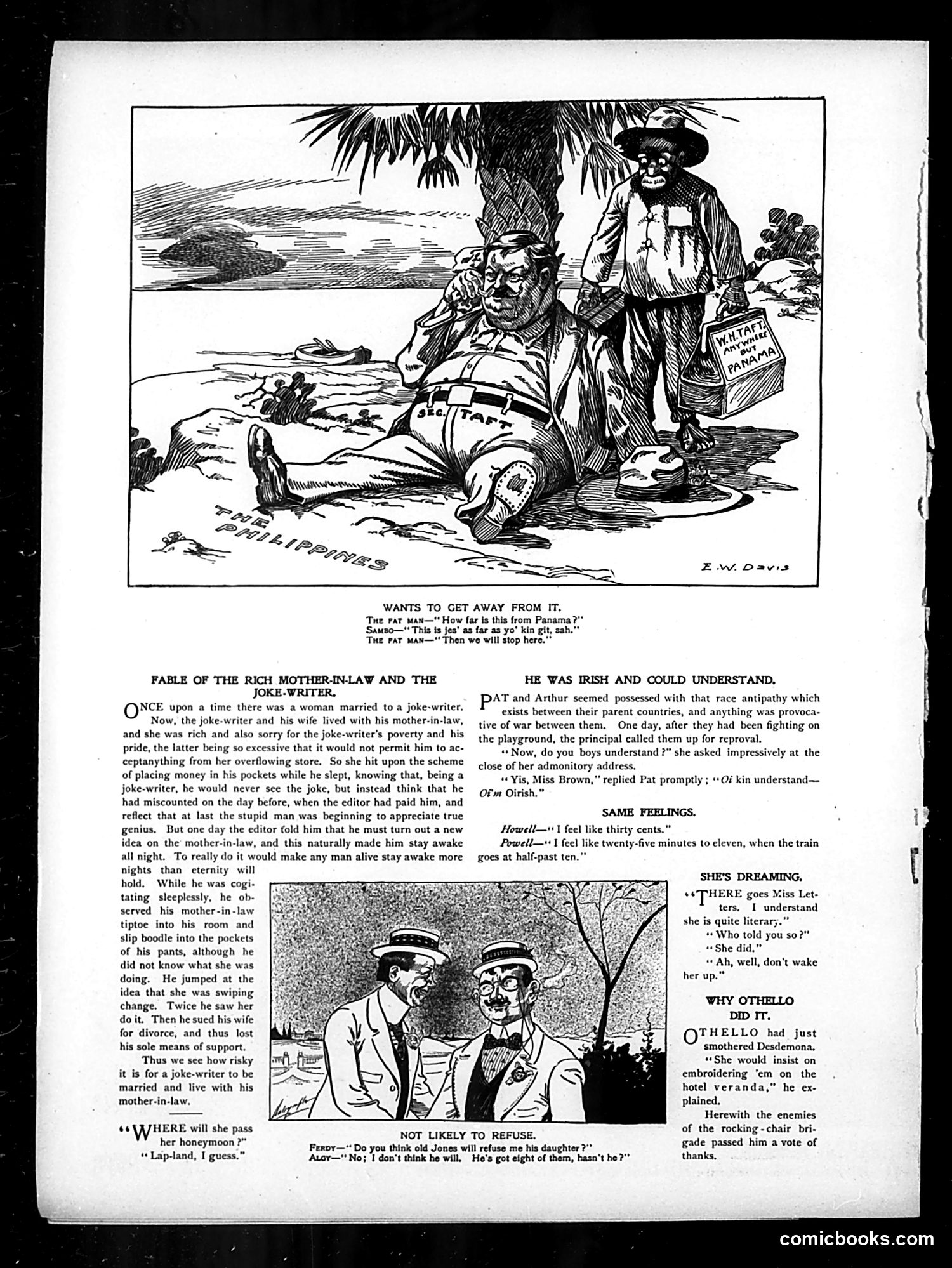
This page contains multiple satirical pieces reflecting early 20th-century American attitudes: **Top cartoon**: A "Fat Man" labeled "TARIFF" seeks to escape the Philippines, suggesting criticism of U.S. imperial trade policies and their unpopularity. **Main story**: "Fable of the Rich Mother-in-Law and the Joke-Writer" satirizes both poverty-stricken writers and their economic dependence. The joke-writer's pride prevents accepting help; when his mother-in-law secretly places money in his pockets, he misinterprets it as theft, divorcing his wife. The satire targets writers' fragile egos and impracticality. **Shorter pieces**: Include ethnic humor (Irish boy claiming he "understands" because he's Irish), wordplay about time and feelings, and a reference to Othello—all typical Judge magazine fare using puns and stereotypes. The overall tone reflects period attitudes: satirizing both the wealthy's paternalism and working-class pride, while casual ethnic stereotyping was standard comedy.
I can see this is a page from *Judge* magazine (as indicated by the comicbooks.com watermark), but the image is predominantly black with very low contrast, making the content nearly illegible. While I can faintly discern what appears to be some decorative patterns or possibly illustration elements, I cannot reliably make out specific figures, caricatures, text, or satirical content with enough clarity to provide accurate interpretation. To properly analyze the political or social satire, identify specific figures, or explain contemporary references, I would need a higher-contrast or clearer version of this page. As it stands, asserting specific meanings would violate the accuracy-first guideline you've requested.
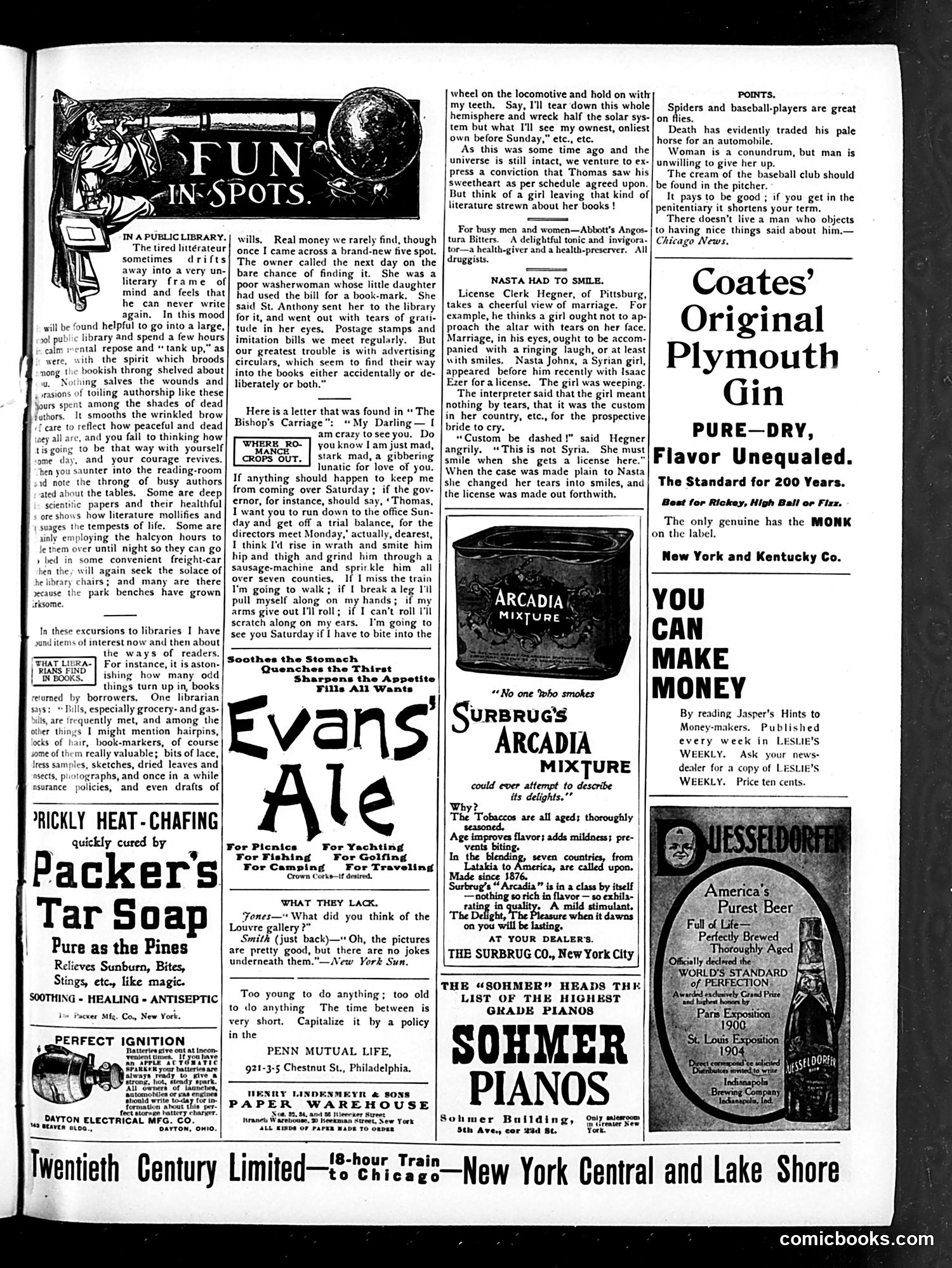
This page is primarily **advertising with some satirical short pieces**, not a political cartoon. The main content includes: **"Fun in Spots"** (top): A brief satire about a tired author finding solace in public libraries among dead authors' works—a gentle jab at struggling writers and literary pretension. **"Nasta Had to Smile"**: A humorous anecdote about a Pittsburgh license clerk who insists a Syrian bride smile rather than cry during marriage licensing, dismissing her cultural customs as unsuitable for America. This reflects early 20th-century attitudes toward immigrant assimilation and American exceptionalism. The page is dominated by **period advertisements** for Evans' Ale, Coates' Plymouth Gin, Sohmer Pianos, Surburg's Arcadia Mixture tobacco, and other products—typical of Judge's revenue model. No major political figures or events are referenced; the satire is domestic and social rather than political.
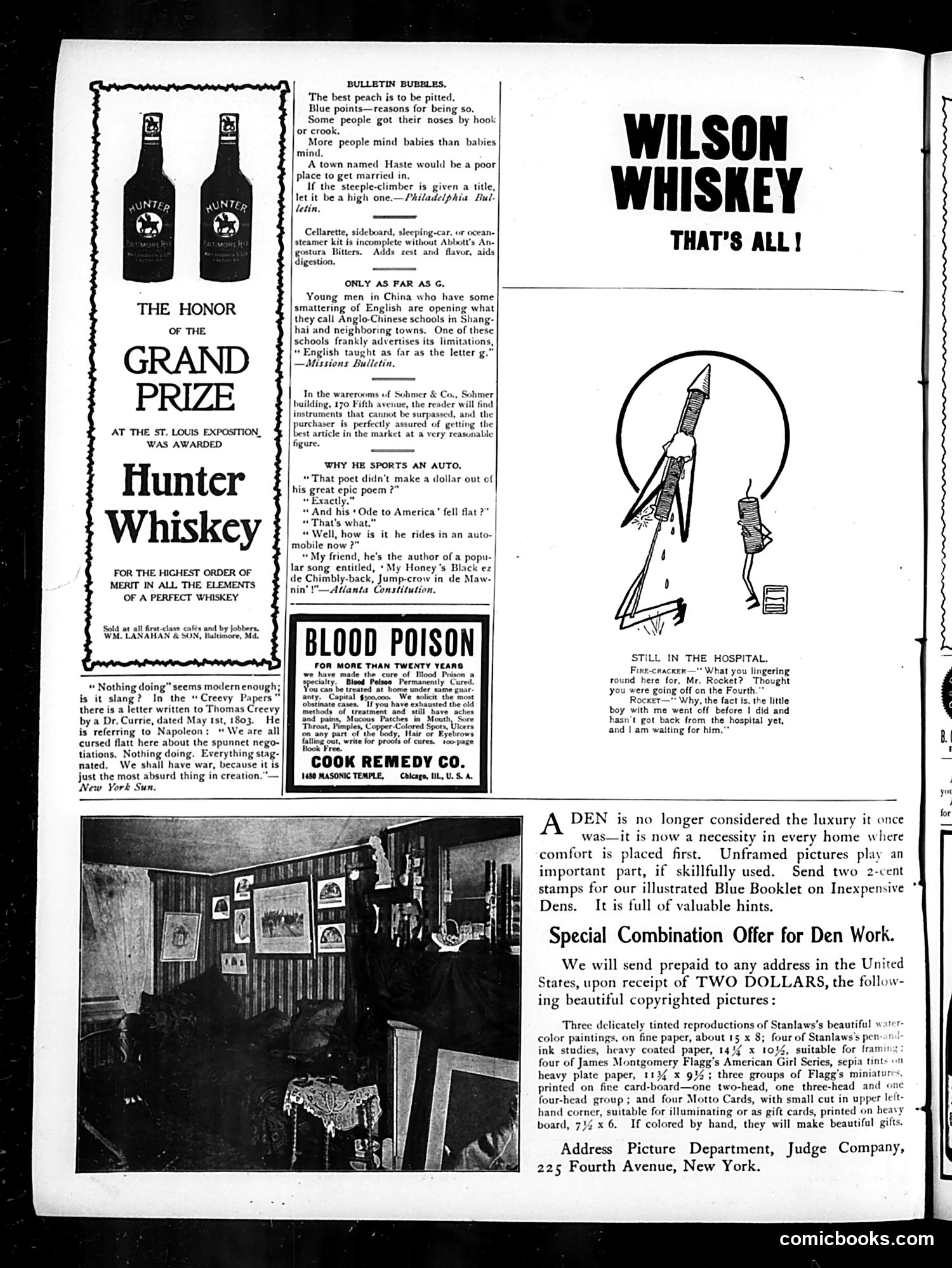
This page is primarily **advertisements and filler content**, typical of early 20th-century magazines. The left column contains "Bulletin Bubbles"—brief, witty observations on everyday life (peaches, noses, haste). These are light social commentary rather than political satire. The cartoon "Still in the Hospital" is a mild joke: a man waits at a hospital for a boy who went off before the Fourth of July holiday and hasn't returned. The humor lies in the man's patient, deadpan acceptance—he's still waiting, unclear if the boy will ever come back. Most of the page consists of **advertisements**: Hunter Whiskey (which won a grand prize), Cook Remedy Co. (advertising a "blood poison" cure—likely for syphilis, using the medical euphemism common then), Wilson Whiskey, and a "Den" decoration service offering art reproductions. The content reflects early 1900s consumer culture and advertising practices rather than political commentary. There are no identifiable political figures or satire of current events visible on this page.
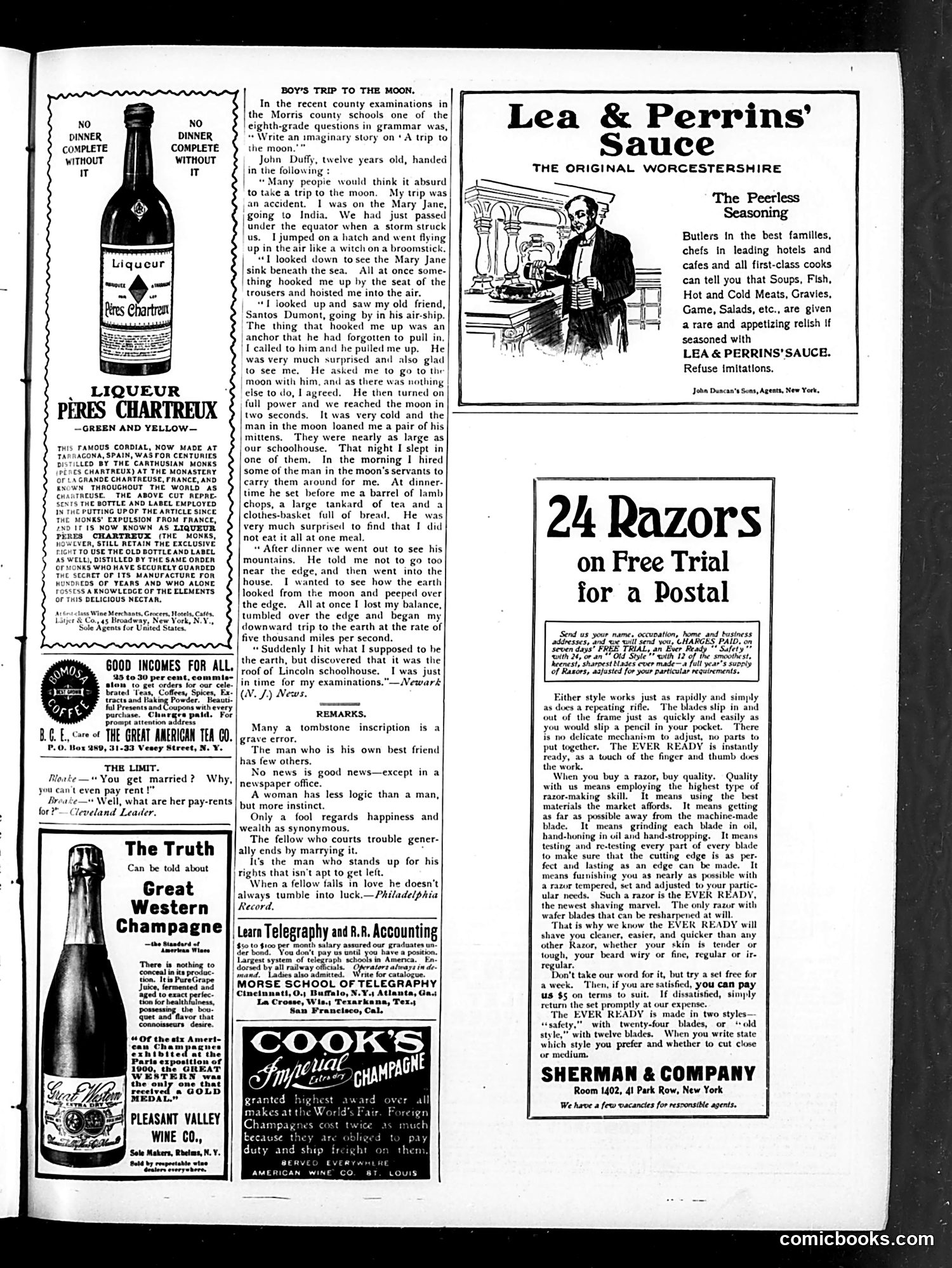
This page features a humorous children's composition contest entry from Morris County schools. A 12-year-old boy named John Duffy submitted an imaginative story about accidentally traveling to the moon via Brazilian aviation pioneer Alberto Santos-Dumont's airship. The narrative parodies early 20th-century scientific romance fiction—a popular genre—by combining fantastical elements (storm-lifted protagonist, moon travel in seconds) with matter-of-fact observations about the Man in the Moon's hospitality and enormous mittens. The satire targets both children's creative writing pretensions and the era's fascination with aviation and space travel. The humor lies in the incongruous juxtaposition: a schoolboy casually describes lunar hospitality with the same mundane tone used for ship travel, treating the impossible as routine. The page also includes period advertisements (Lea & Perrins sauce, razors, champagne, etc.), typical of Judge magazine's commercial layout.
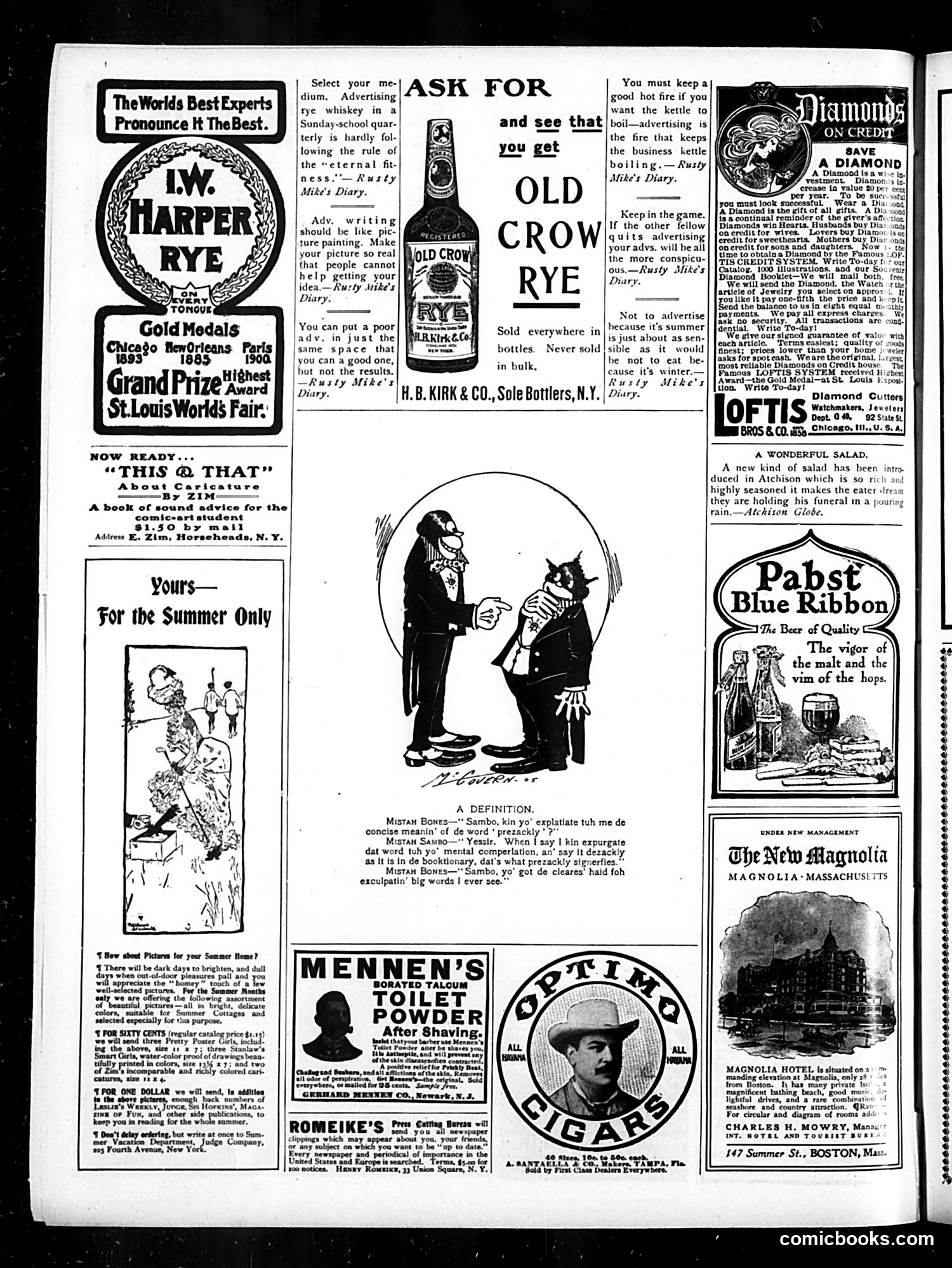
This page is primarily **advertising mixed with humor columns**, not a unified political cartoon. The main elements: **Central Cartoon**: Shows two men in formal dress having a conversation about the word "prezackly" (precisely). This depicts a **minstrel-show style dialogue** between characters named "Mistah Bones" and "Mistah Sambo"—reflecting the racist entertainment conventions of the era where white performers in blackface performed comic routines. **Advertising Content**: The bulk of the page features ads for Old Crow Rye whiskey, Pabst Blue Ribbon beer, Mennen's talc powder, and various services. Interspersed are brief humorous "Rusty Mike's Diary" quotes offering advertising advice. **Historical Context**: The minstrel dialogue would have been considered mainstream entertainment in this period, though it's deeply offensive by modern standards. The advertising advice reflects early 20th-century marketing philosophy. The page contains no coherent political satire—it's a typical Judge magazine layout mixing advertisements with brief comedic asides and illustrations.
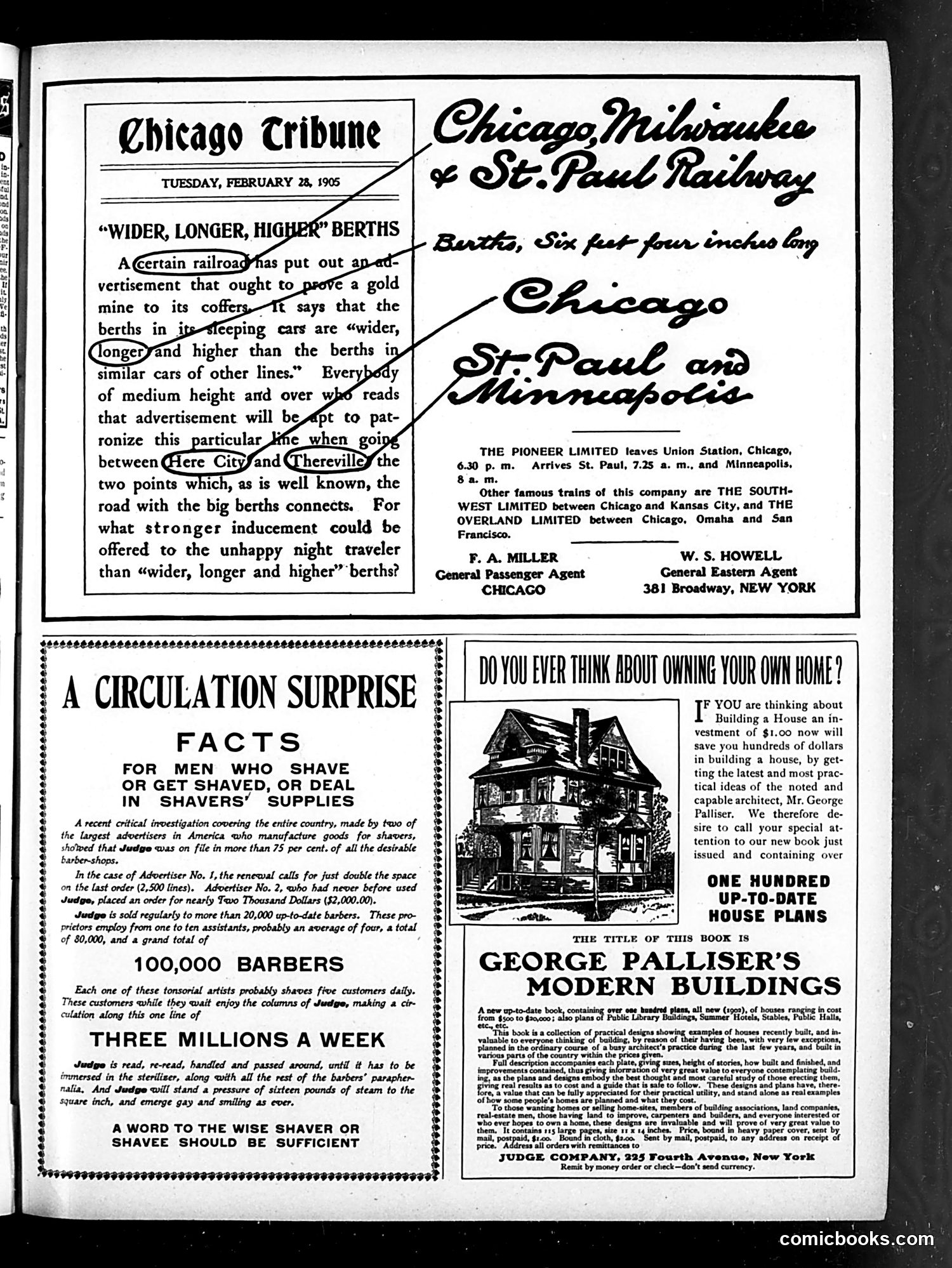
This page contains **primarily advertisements** rather than editorial cartoons or satire. The top half features a railroad advertisement mocking competitors' marketing claims. A certain railroad (unnamed) advertises "wider, longer, higher" berths. The Chicago Tribune article satirizes this by noting the obvious appeal of such amenities to night travelers—the joke being that the railroad's boast is simultaneously truthful yet absurdly understated as an inducement. The bottom half contains **advertising content**: 1. **A circulation fact piece** promoting Judge magazine's reach among barbers (100,000 barbers reading it weekly = 3 million weekly readers), targeting advertisers of shaving supplies. 2. **A home-building advertisement** for architect George Palliser's book of house plans, priced at $1.00. Neither section contains political satire or recognizable caricatures. The page functions primarily as a sales vehicle, using data and appeals rather than cartoon humor to convince advertisers of Judge's circulation value.
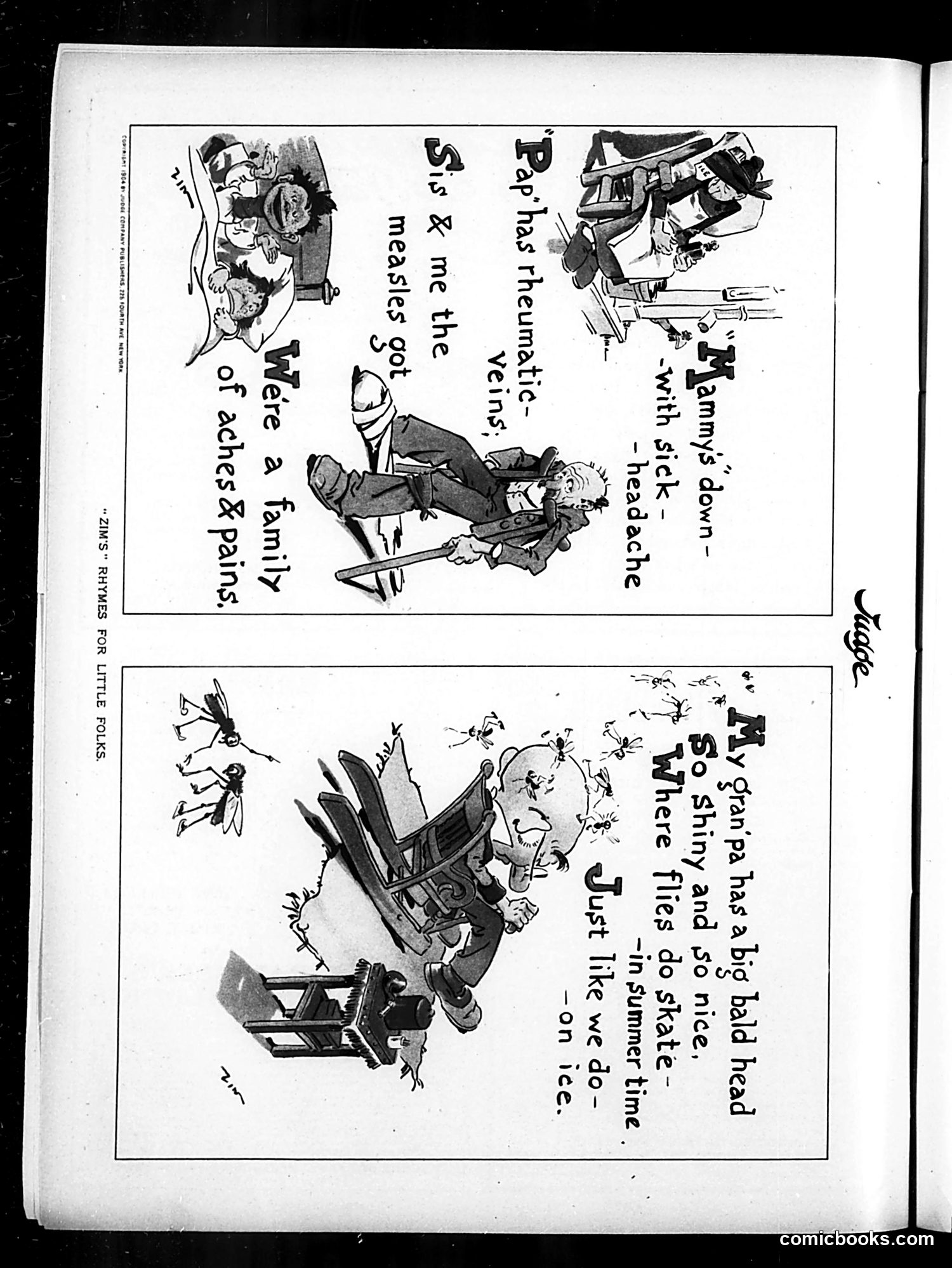
This page appears to be a children's humor section rather than political satire. It contains illustrated nursery rhymes by an artist named Zim, featuring domestic comedy scenarios. The top cartoon shows a father dealing with family chaos—children, a dog, and general household disorder—captioned as a family "measure of aches & pains." The bottom cartoon depicts a grandfather with a notably bald head, humorously described in verse: flies "skate" on his shiny head "like we do on ice" in summer. The family also suffers measles and rheumatism. The humor relies on exaggerated physical characteristics (baldness, illness) and the contrast between dignified adulthood and undignified bodily ailments. This is gentle, family-oriented comedy typical of early 20th-century children's magazine content—not political satire.