
Judge, 1905-07-29 · page 6 of 18
Judge — July 29, 1905 — page 6: what you’re looking at
What you’re looking at
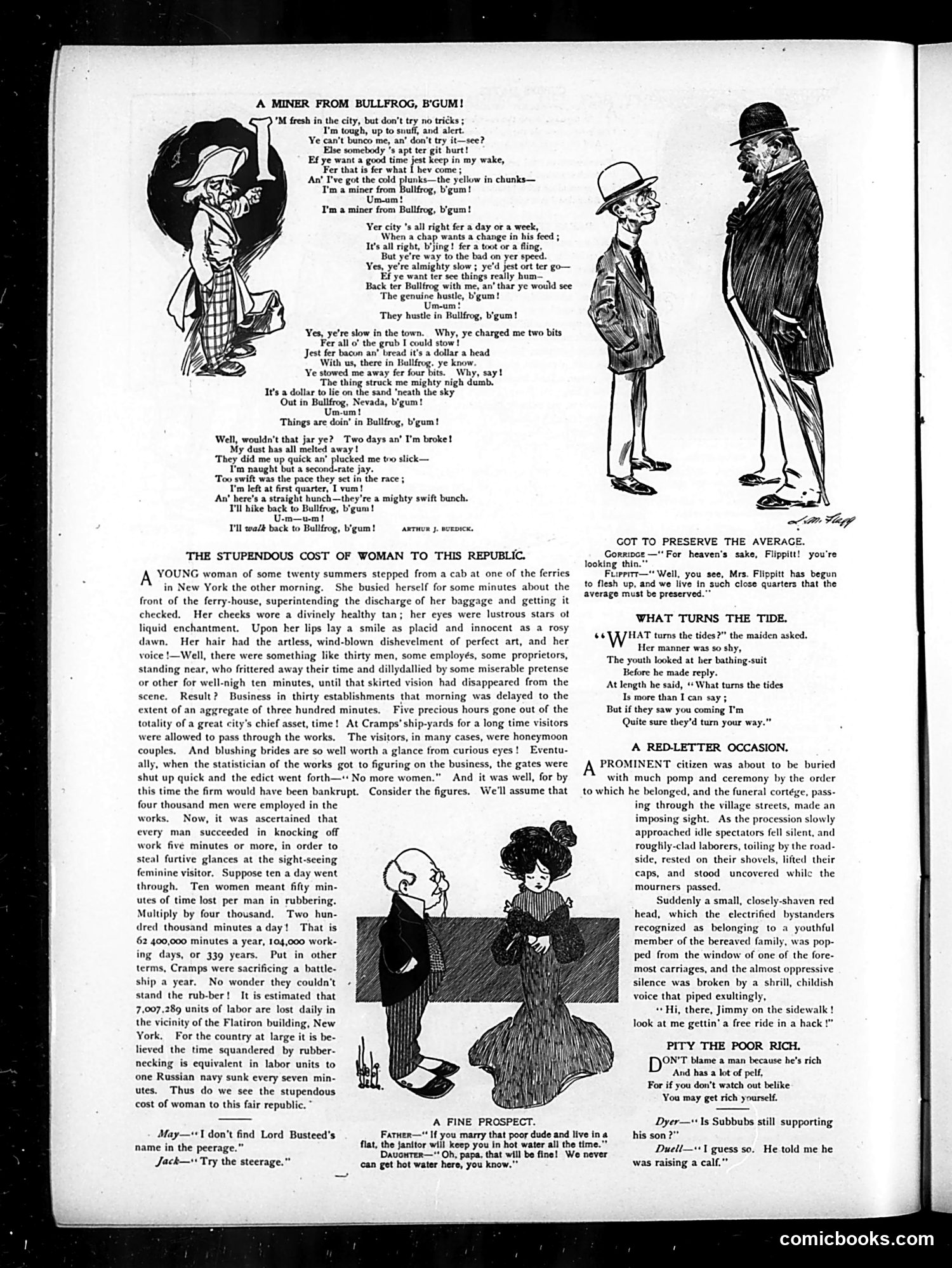
This satirical poem mocks a newly wealthy prospector from the Bullfrog mining district (Nevada) who arrives in New York City boasting of riches and frontier toughness. The humor centers on his culture shock: he's scandalized by city prices (four bits for food he'd pay a dollar for in mining camps) and quickly swindled by urban con artists, losing his fortune in two days. The caricature stereotypes the unsophisticated Western miner—rough dialect, swagger, naiveté—who discovers city dwellers are sharper hustlers than anyone back home. The satire cuts both ways: mocking both the boorish prospector and the slick urban schemers who fleece him. It reflects Judge magazine's Eastern urban perspective, positioning New York as a more sophisticated (if morally questionable) civilization than the rough mining frontier.
📄 Transcribed text from this page (OCR, searchable)
Machine-transcribed from the original scan — historical spelling and the odd misread are preserved.
A MINER FROM BULLFROG, B'GUM! 'M fresh in the city, but don’t try no tricks ; I'm tough, up to snuff, and alert. Ye can't bunco me, an’ don't try it—see? Else somebody 's apt ter git hurt! Ef ye want a good time jest keep in my wake, Fer that is fer what 1 hev come ; ‘An’ I've got the cold plunks—the yellow in chunks— Tm a miner from Balifrog, bigem! Umum! I'ma miner from Bullfrog, b’'gum! Yer city 's all right fer a day or a week, When a chap wants a change in his feed ; It's all right, b’jing! fer a toot or a fing, But ye’re way to the bad on yer speed. Yes, ye're almighty slow ; ye'd jest ort ter go— Ef ye want ter sce things really hum— Back ter Ballfrog with me, an’ thar ye would see ‘The genuine hustle, b’gum! Um-um! They hustle in Bullfrog, b’gum! Yes, ye’re slow in the town. Why, ye charged me two bits Fer all o' the grub I could stow! Jest fer bacon an" bread it’s a dollar a head With us, there in Bullfrog. ye know. Ye stowed me away fer four bits. Why, say! ‘The thing struck me mighty nigh dumb. It’s a dollar to lie on the sand ‘neath the sky Out in Bullfrog, Nevada, b’gum! Umum! ‘Things are doin’ in Bullfrog, b’gum! Well, wouldn't that jar ye? Two days an’ I'm broke! My dust has all melted away! ‘They did me up quick an’ plucked me tno slick— I'm naught bat a second-rate jay. ‘Too swift was the pace they set in the race; I'm left at first quarter, I vum! An’ here's a straight hunch—they're a mighty swift bunch. T'll hike back to Bullfrog, b'gum! U.m—um! T'll wade back to Bullfrog, b’gum! ARTHUR J, THE STUPENDOUS COST OF WOMAN TO THIS REPUBLIC. A YOUNG woman of some twenty summers stepped from a cab at one of the ferries in New York the other morning. She busied herself for some minutes about the front of the ferry-house, superintending the discharge of her baggage and getting it checked. Her cheeks wore a divinely healthy tan; her eyes were lustrous stars ot liquid enchantment. Upon her lips lay a smile as placid and innocent as a rosy dawn, Her hair had the artless, wind-blown dishevelment of perfect art, and her voice !—Well, there were something like thirty men, some employés, some proprietors, standing near, who frittered away their time and dillydallied by some miserable pretense or other for well-nigh ten minutes, until that skirted vision had disappeared from the scene. Result? Business in thirty establishments that morning was delayed to the extent of an aggregate of three hundred minutes. Five precious hours gone out of the totality of a great city’s chief asset, time! At Cramps’ ship-yards for a long time visitors were allowed to pass through the works. The visitors, in many cases, were honeymoon couples. And blushing brides are so well worth a glance from curious eyes! Eventu- ally, when the statistician of the works got to figuring on the business, the gates were shut up quick and the edict went forth—« No more women.” And it was well, for by this time the firm would have been bankrupt. Consider the figures. We'll assume that four thousand men were employed in the works, Now, it was ascertained that every man succeeded in knocking off work five minutes or more steal furtive glances at the sight-seeing feminine visitor. Suppose ten a day went through. Ten women meant fifty min- utes of time lost per man in rubbering. Multiply by four thousand. Two hun- dred thousand minutes a day! That is 62 400,000 minutes a year, 104,000 work- ing days, or 339 years. Put in other terms, Cramps were sacrificing a battle- ship a year. No wonder they couldn't stand the rub-ber! It is estimated that 7,007,289 units of labor are lost daily in the vicinity of the Flatiron building, New York. For the country at large it is be- lieved the time squandered by rubber- necking is equivalent in labor units to one Russian navy sunk every seven min- utes. Thus do we see the stupendous cost of woman to this fair republic.” A FINE PROSPECT. May—‘+1 don’t find Lord Busteed’s Farner— name in the peerag Jack—* Try the steerage.” can get hot water here, you know."* If you marry that poor dude and live in a flat, the janitor will keep you in hot water all the time.” Davowrer—"* Oh, papa. that will be fine! We never GOT TO PRESERVE THE AVERAGE. Gorrivce —" For heaven's sake, Flippitt! you're Well, you see, Mrs. Flippitt has begun to flesh up, and we live in such close quarters that the average must be preserved.” WHAT TURNS THE TIDE. 66 \JJHAT turns the tides?” the maiden asked. Her manner was so shy, The youth looked at her bathing-suit Before he made reply. At length he said, What turns the tides Is more than I can say ; But if they saw you coming I'm Quite sure they'd turn your way.” A RED-LETTER OCCASION. A PROMINENT citizen was about to be buried with much pomp and ceremony by the order to which he belonged, and the funeral cortége, pass- ing through the village streets, made an imposing sight. As the procession slowly approached idle spectators fell silent, and rouglily-clad laborers, toiling by the road- side, rested on their shovels, lifted their caps, and stood uncovered while the mourners passed. Suddenly a small, closely-shaven red head, which the electrified bystanders recognized as belonging to a youthful member of the bereaved family, was pop- ped from the window of one of the fore- most carriages, and the almost oppressive silence was broken by a shrill, childish voice that piped exultingly, “Hi, there, Jimmy on the sidewalk ! look at me gettin’ a free ride in a hacl PITY THE POOR RICH. ON'T blame a man because he’s rich id has a lot of pelf, you don’t watch out belike You may get rich yourself. Dyer: his son?” Duell—1 guess so. He told me he was raising a calf.” «Is Subbubs still supporting comicbooks.com