
Judge, 1905-07-29 · page 10 of 18
Judge — July 29, 1905 — page 10: what you’re looking at
What you’re looking at
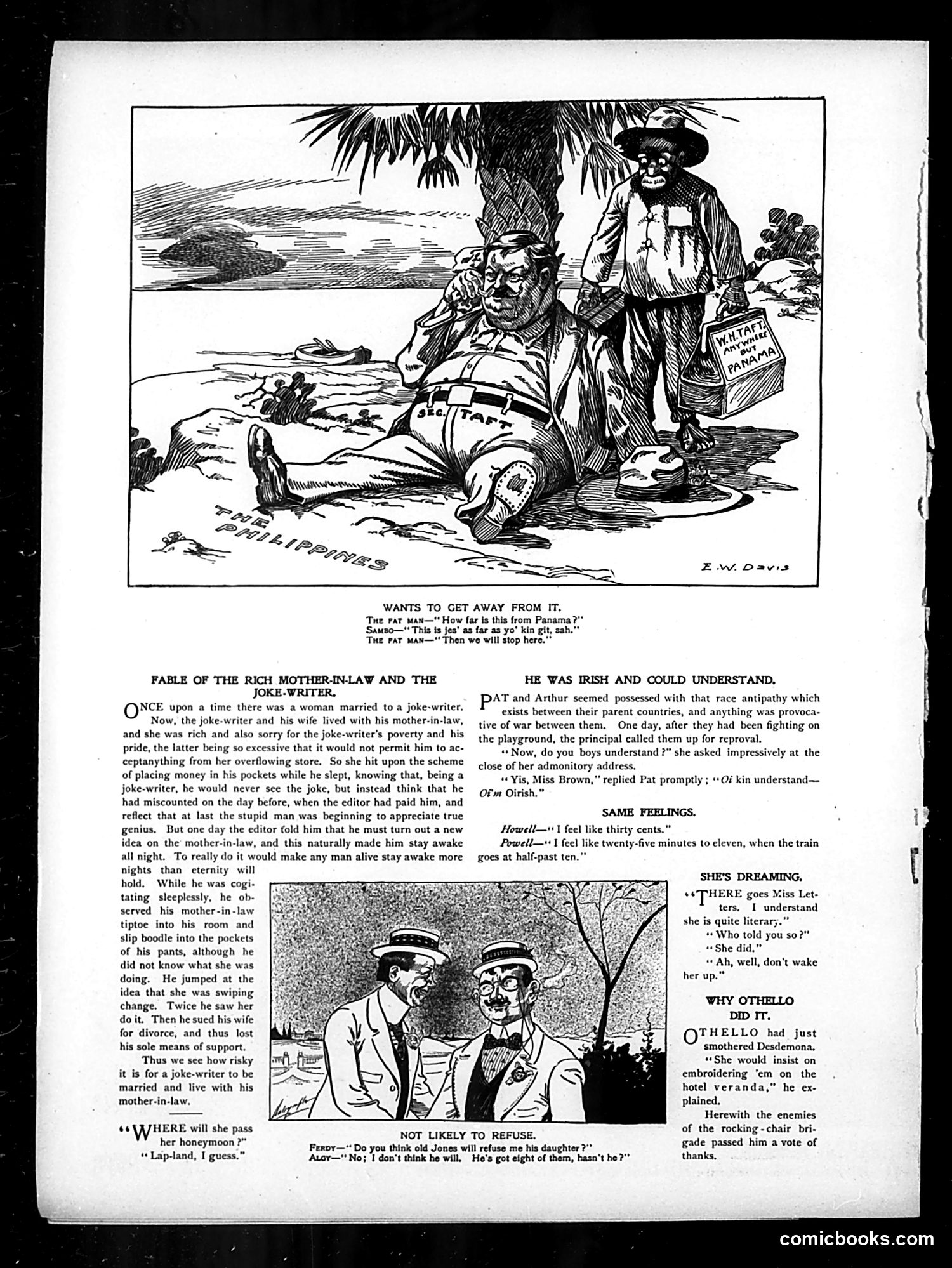
This page contains multiple satirical pieces reflecting early 20th-century American attitudes: **Top cartoon**: A "Fat Man" labeled "TARIFF" seeks to escape the Philippines, suggesting criticism of U.S. imperial trade policies and their unpopularity. **Main story**: "Fable of the Rich Mother-in-Law and the Joke-Writer" satirizes both poverty-stricken writers and their economic dependence. The joke-writer's pride prevents accepting help; when his mother-in-law secretly places money in his pockets, he misinterprets it as theft, divorcing his wife. The satire targets writers' fragile egos and impracticality. **Shorter pieces**: Include ethnic humor (Irish boy claiming he "understands" because he's Irish), wordplay about time and feelings, and a reference to Othello—all typical Judge magazine fare using puns and stereotypes. The overall tone reflects period attitudes: satirizing both the wealthy's paternalism and working-class pride, while casual ethnic stereotyping was standard comedy.
📄 Transcribed text from this page (OCR, searchable)
Machine-transcribed from the original scan — historical spelling and the odd misread are preserved.
N RY WV SS WANTS TO GET AWAY FROM IT, ‘Tue rat maN—" How far is this from Panama ‘Samso—" This ts jes’ as far as yo' kin git, sah. Tue rat MAN—" Then we will stop here.” FABLE OF THE RICH MOTHER-IN-LAW AND THE JOKE-WRITER. ONCE upon a time there was a woman married to a joke-writer. Now, the joke-writer and his wife lived with his mother-in-law, and she was rich and also sorry for the joke-writer’s poverty and his pride, the latter being so excessive that it would not permit him to ac- ceptanything from her overflowing store. So she hit upon the scheme of placing money in his pockets while he slept, knowing that, being a joke-writer, he would never see the joke, but instead think that he had miscounted on the day before, when the editor had paid him, and reflect that at last the stupid man was beginning to appreciate true genius. But one day the editor fold him that he must turn out a new idea on the mother-in-law, and this naturally made him stay awake all night. To really do it would make any man alive stay awake more nights than eternity will hold. While he was cogi- tating sleeplessly, he ob- served his mother: law tiptoe into his room and slip boodle into the pockets of his pants, although he did not know what she was doing. He jumped at the idea that she was swiping change. Twice he saw her do it. Then he sued his wife for divorce, and thus lost his sole means of support. Thus we see how risky it is for a joke-writer to be married and live with his mother-in-law, 66\YJHERE will she pass W her honeymoon ?” “+ Lap-land, I guess.” Ator—"N NOT LIKELY TO REFUSE. Ferpy—“ Do you think old Jones will refuse me his daughter ?"" I don't think he will, He's got eight of them, hasn't he?” HE WAS IRISH AND COULD UNDERSTAND, PAT and Arthur scemed possessed with that race antipathy which exists between their parent countries, and anything was provoca- tive of war between them. One day, after they had been fighting on the playground, the principal called them up for reproval. «Now, do you boys understand 2” she asked impressively at the close of her admonitory address. “Yis, Miss Brown," replied Pat promptly ; Qi kin understand— Oi'm Oirish. SAME FEELINGS. Howell—*'| feel like thirty cents.” Powell—1 feel like twenty-five minutes to eleven, when the train goes at half-past ten.” SHE'S DREAMING. + THERE goes Miss Let- ters, I understand she is quite literar;."" + Who told you so?” “She did.” «Ah, well, don’t wake her up.” DD Ir. OTHELLO had just smothered Desdemona. “She would insist on embroidering ‘em on the hotel veranda,” he ex- plained. Herewith the enemies of the rocking-chair bri- gade passed him a vote of thanks, comicbooks.com