
A complete issue · 24 pages · 1904
Judge — July 9, 1904
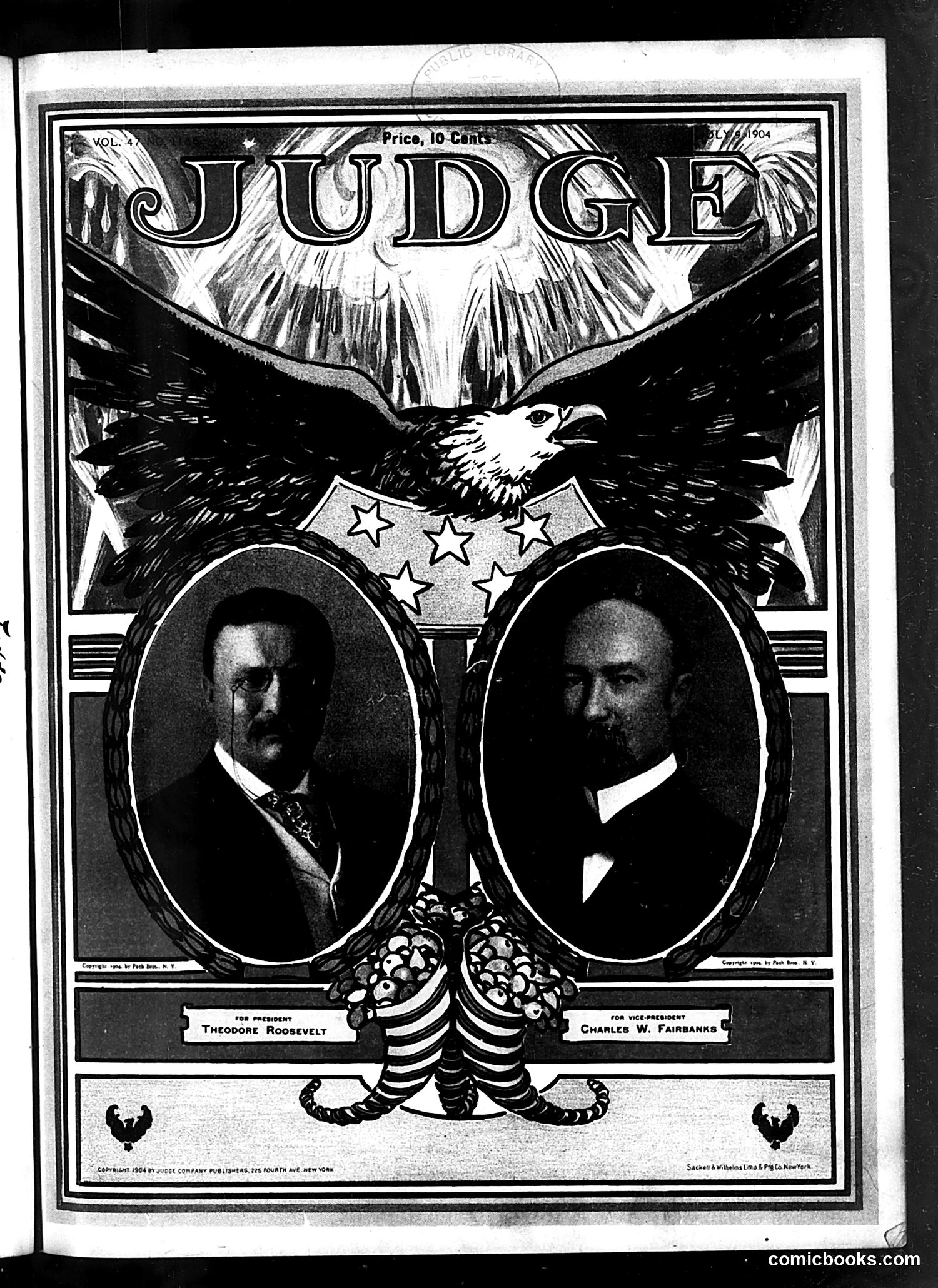
This is a 1904 election cover featuring **Theodore Roosevelt** (left) as presidential candidate and **Charles W. Fairbanks** (right) as vice-presidential running mate, as labeled below their portraits. The patriotic imagery—an eagle, shield with stars, and decorative eagle legs at bottom—frames these Republican nominees. The design celebrates their ticket with formal dignity typical of political promotion materials. Judge magazine, published in New York, was a satirical weekly that commented on current events and politics. This cover represents straightforward campaign promotion rather than satire, presenting the ticket to readers as worthy of support. The high production values reflect Judge's focus on affluent, educated audiences during the 1904 presidential race.
This appears to be a **Wilson Whiskey advertisement** rather than a political cartoon. The page displays the brand name "WILSON WHISKEY" in large bold text with the marketing slogan "That's All!" beneath it. The simple design and minimal content suggest this is a print advertisement from Judge magazine's advertising section. The tagline "That's All!" uses casual, confident language typical of early-to-mid 20th century whiskey marketing—implying the product speaks for itself and needs no further explanation. Without additional context about the specific issue date, I cannot determine if "Wilson" references any particular historical figure, or if it was simply the brand name. This is straightforward commercial advertising rather than satirical commentary.
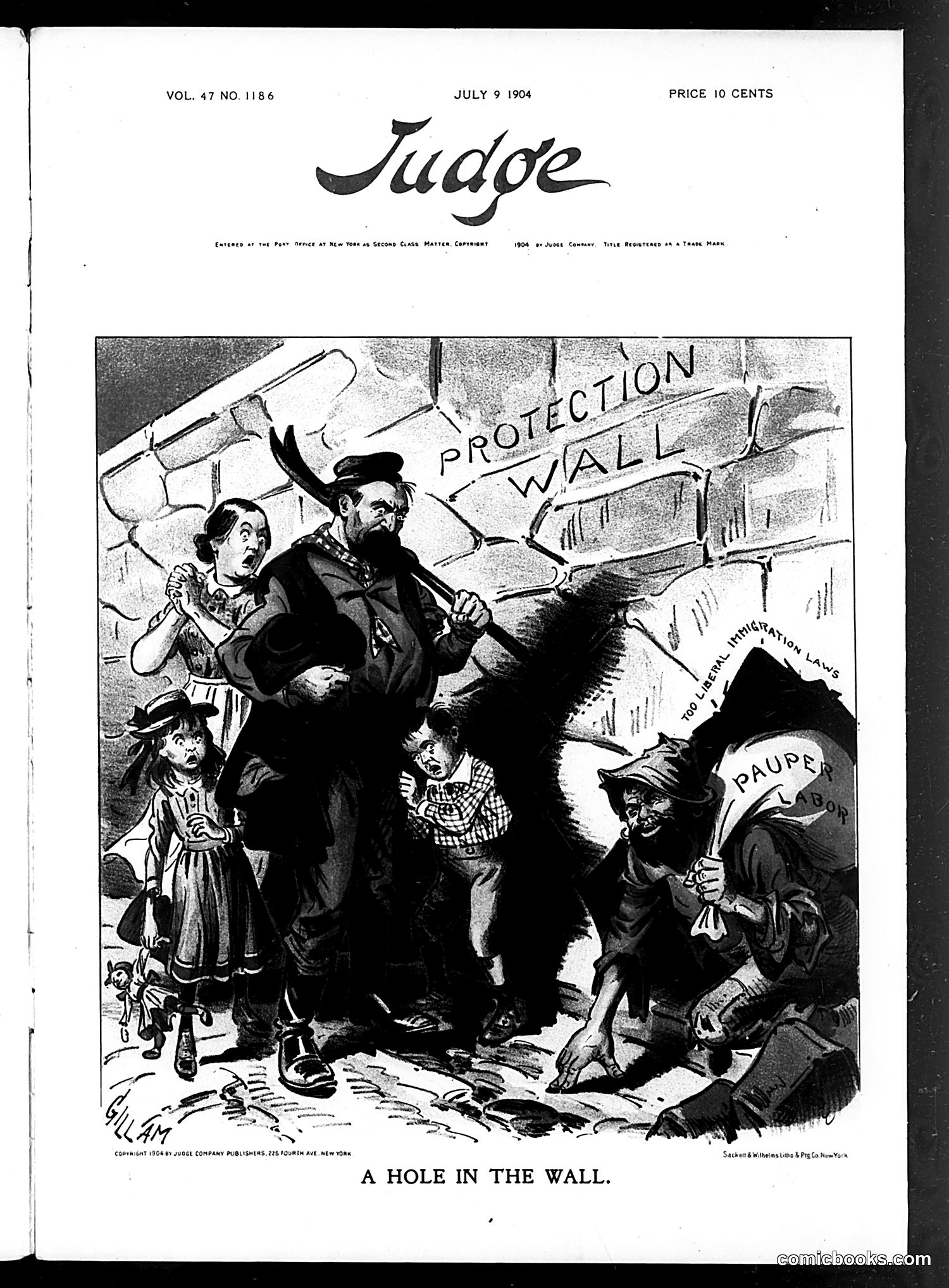
This political cartoon satirizes immigration policy and border security. A "Protection Wall" (labeled as such) is breached by a hole, allowing figures through despite the barrier's intended purpose. A large figure labeled "Pauperism" penetrates the wall while carrying children, suggesting the cartoon critiques how protective tariffs and immigration restrictions fail to prevent poverty and poor immigrants from entering America. The cartoon's title and imagery mock the ineffectiveness of such policies. The "Pauperization Laws" label (visible on the wall) likely references contemporary immigration restrictions meant to exclude paupers. The satire suggests these protectionist measures are fundamentally flawed—the "wall" cannot actually keep out the poor or prevent poverty, making such policies pointless or counterproductive.
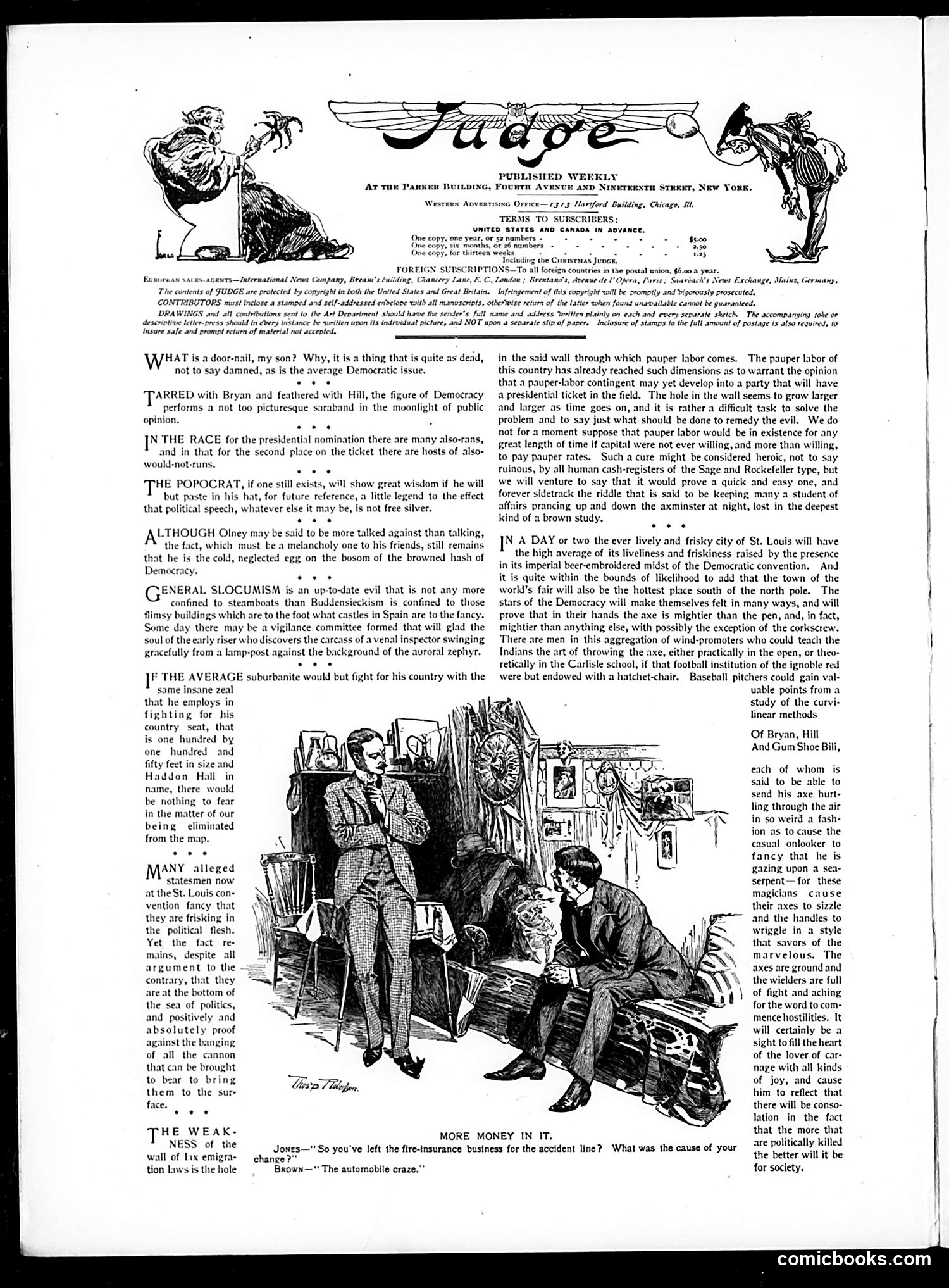
This page satirizes the 1904 presidential campaign. The main editorial discusses whether a "door-step my son" (likely referring to a candidate's weak public presence) should be Democratic nominee. References to "Bryan" and "Hill" indicate William Jennings Bryan and David B. Hill as potential candidates. The central cartoon titled "MORE MONEY IN IT" depicts two men discussing a businessman's shift from fire-insurance to the automobile business, suggesting the emerging auto industry represents greater profit opportunities than established sectors—a comment on industrial change and business priorities during the Progressive Era. The surrounding text critiques Democratic nomination strategy, general political slogans, and campaign weaknesses, typical of Judge's Republican-leaning satirical commentary on Democratic vulnerabilities heading into the 1904 election.
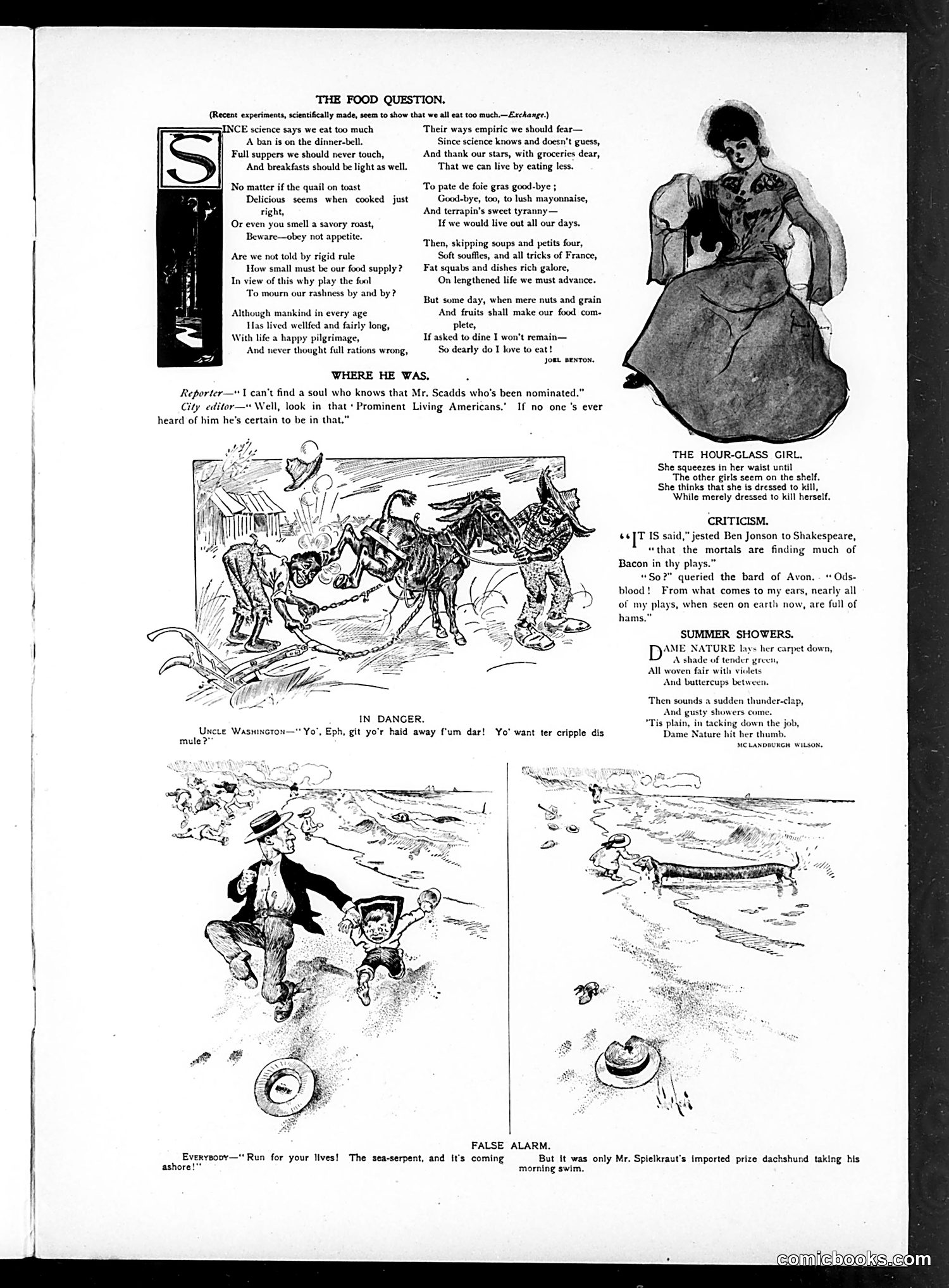
This page satirizes contemporary scientific claims about dietary restriction. The main poem mocks a new health trend claiming people eat too much, arguing that rigorous science demands we abandon rich foods (foie gras, terrapin, French cuisine) for nuts and grain to extend life. The satire's point: the author loves eating too much to actually follow this advice, suggesting the scientific pronouncements are impractical and perhaps overblown. The accompanying cartoons are lighter fare: "In Danger" shows Uncle Washington warning a man about a "sea-serpent" coming ashore—revealed as merely a wealthy man's imported dachshund. "The Hour-Glass Girl" criticizes the corset-wearing fashion trend that dangerously cinches women's waists. These pieces reflect Judge's typical mix of social commentary on health fads, fashion excess, and everyday absurdities facing Americans.
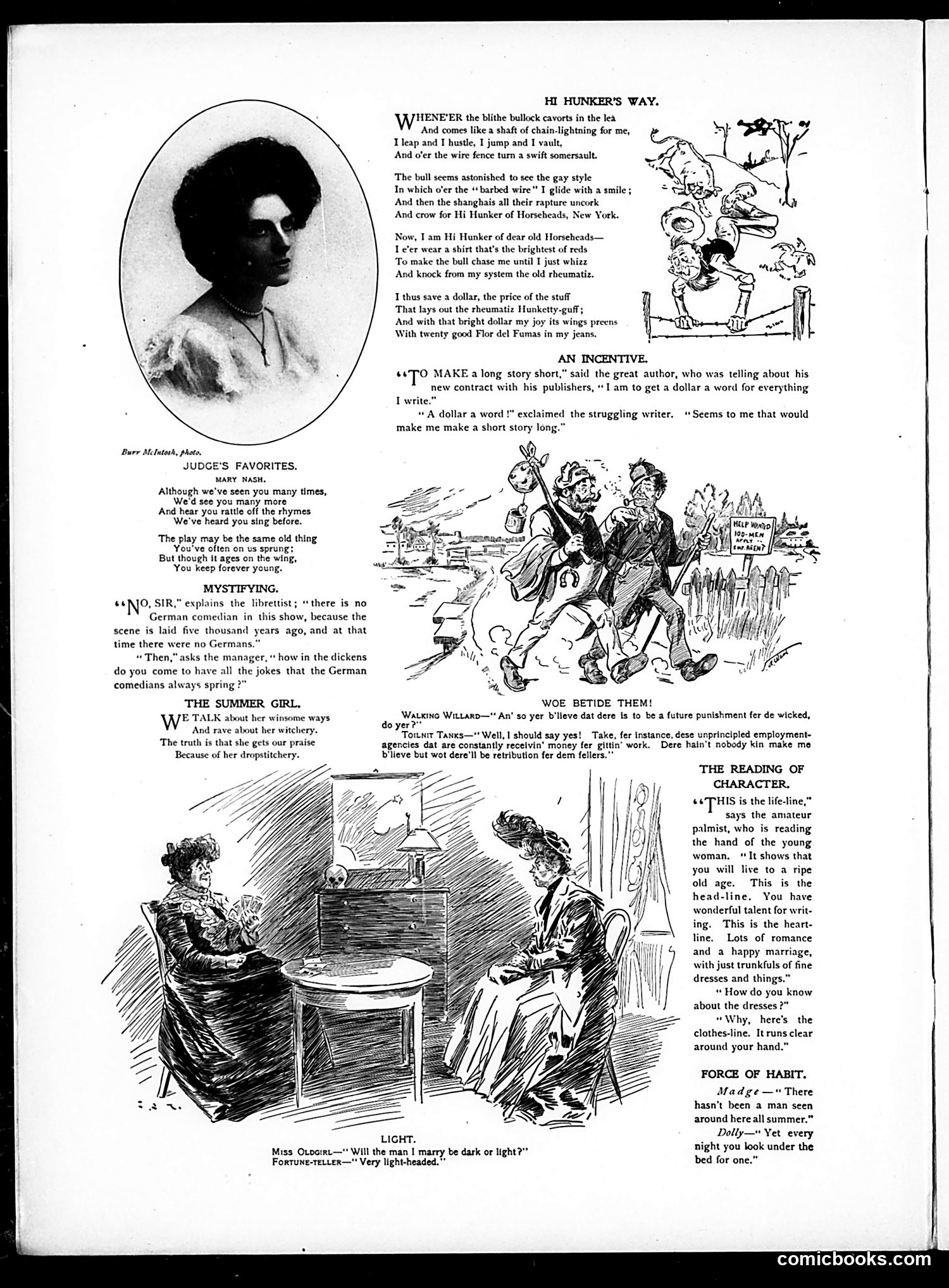
This page features several satirical pieces typical of early 20th-century American humor: **"Hi Hunker's Way"** depicts a rural character from Horseheads, New York, who uses a charging bull as free physical therapy to treat his rheumatism. The joke mocks both rustic folk remedies and the absurdity of risking life for minor savings—he saves a dollar on medicine but spends it on cigars. **"An Incentive"** satirizes struggling writers through a conversation about payment rates. When a famous author boasts of earning "a dollar a word," a desperate writer quips that such pay would tempt him to artificially lengthen his stories, mocking both literary integrity and economic desperation. The other sections—**"Judge's Favorites,"** **"Mystifying,"** **"The Summer Girl,"** and miscellaneous jokes—showcase typical period humor about theater, romance, fortune-telling, and domestic life, with light satire on social pretensions and gender relations. The page emphasizes accessible, working-class comedy rather than political commentary.
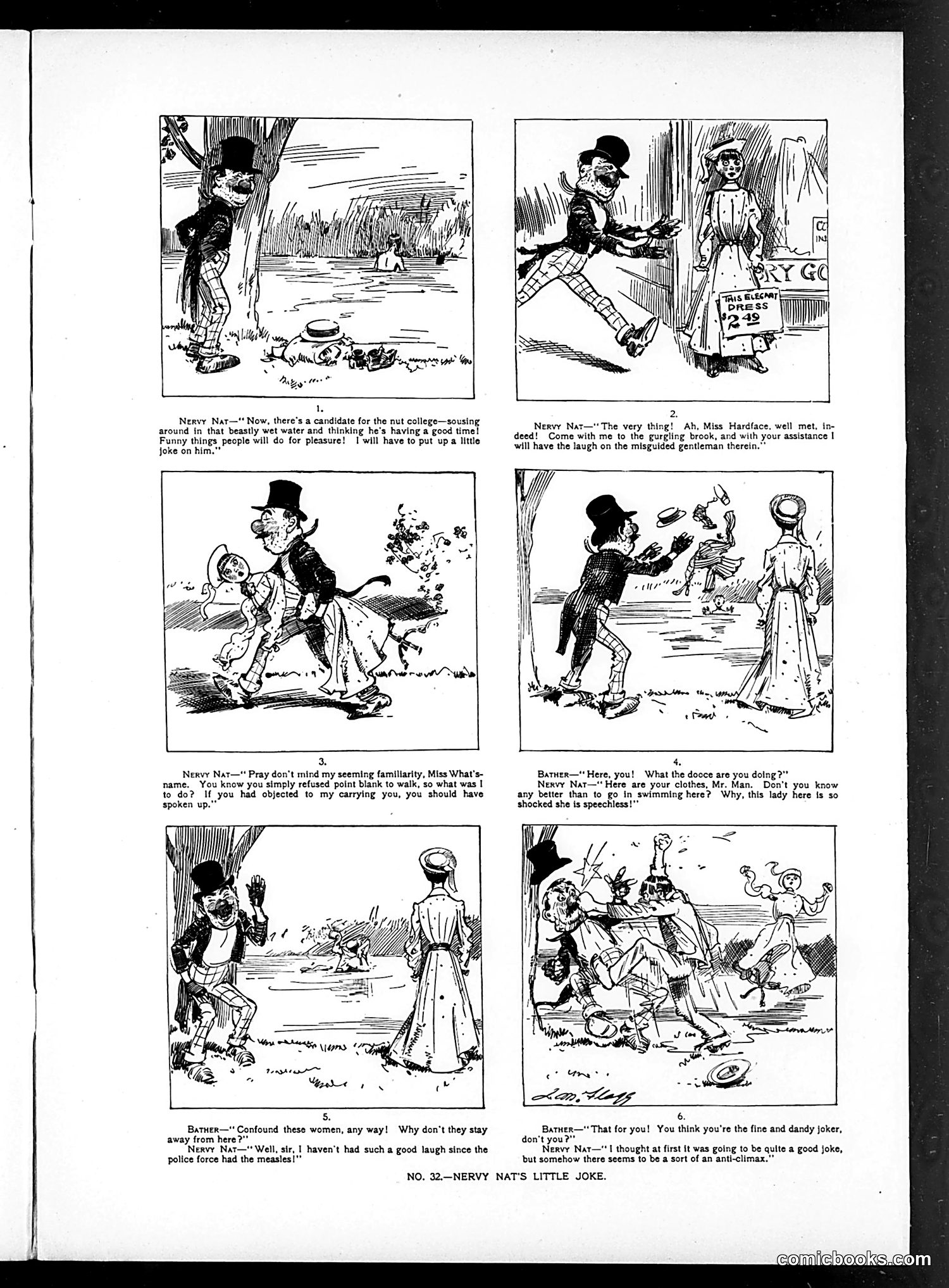
This is a six-panel comic strip depicting a prank by the character "Nervy Nat" on a gentleman bathing in a brook. Nat's "joke" involves stealing the man's clothes with assistance from a woman ("Miss Hardface" or "Miss What's-her-name"), leaving him stranded and embarrassed. The humor derives from early-20th-century slapstick comedy: the victim's humiliation, his desperate attempts to retrieve his dignity, and the prankster's eventual comeuppance. The final panel reveals an "anti-climax"—the prank backfires when the victim physically retaliates against Nat, scattering the gathered crowd. The satire appears mild, targeting no specific political figure or social issue. Instead, it's generic comedic entertainment typical of *Judge* magazine's lighter offerings—physical comedy and social embarrassment played for laughs among middle-class readers.
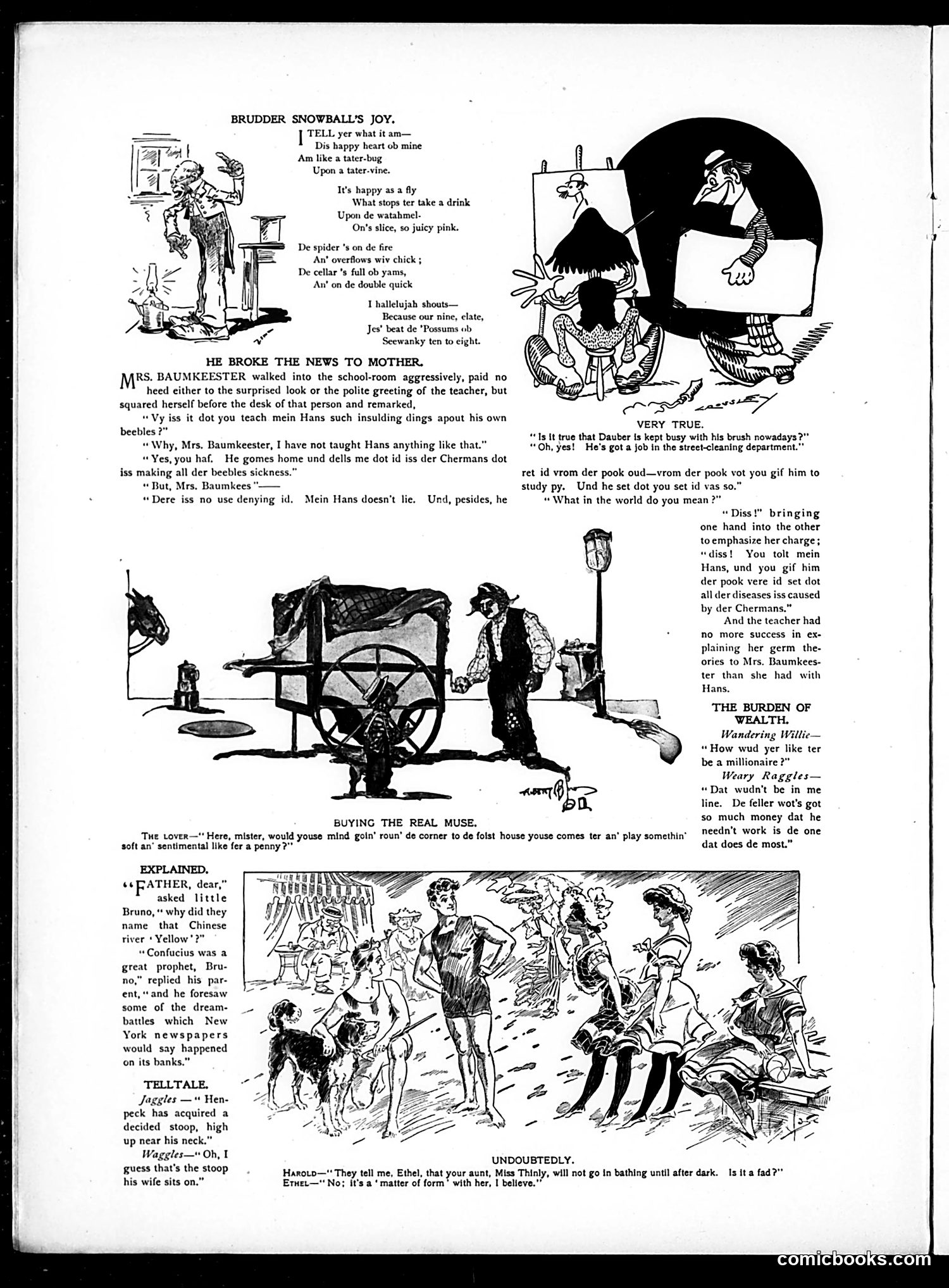
This page contains multiple satirical pieces typical of early-20th-century American humor: **"Brudder Snowball's Joy"** uses racist dialect humor common to the era, depicting an African American character celebrating a baseball victory in exaggerated vernacular. **"He Broke the News to Mother"** satirizes German-American immigrants through Mrs. Baumkeester, who speaks in broken English with German syntax. She angrily confronts a teacher, misinterpreting germ-theory education as anti-German propaganda—a timely joke given World War I tensions and nativist anxieties about immigrant loyalties. **Other brief jokes** include "The Burden of Wealth" (commentary on the wealthy avoiding work) and "Buying the Real Muse" (mocking street musicians). **"Explained"** jokes about Chinese stereotypes and New York newspapers' sensationalism. The page reflects Judge's satirical approach to contemporary social issues: immigration anxieties, racial attitudes, class commentary, and wartime suspicions—all presented through exaggerated caricature and dialect humor typical (and offensive by modern standards) of that era.
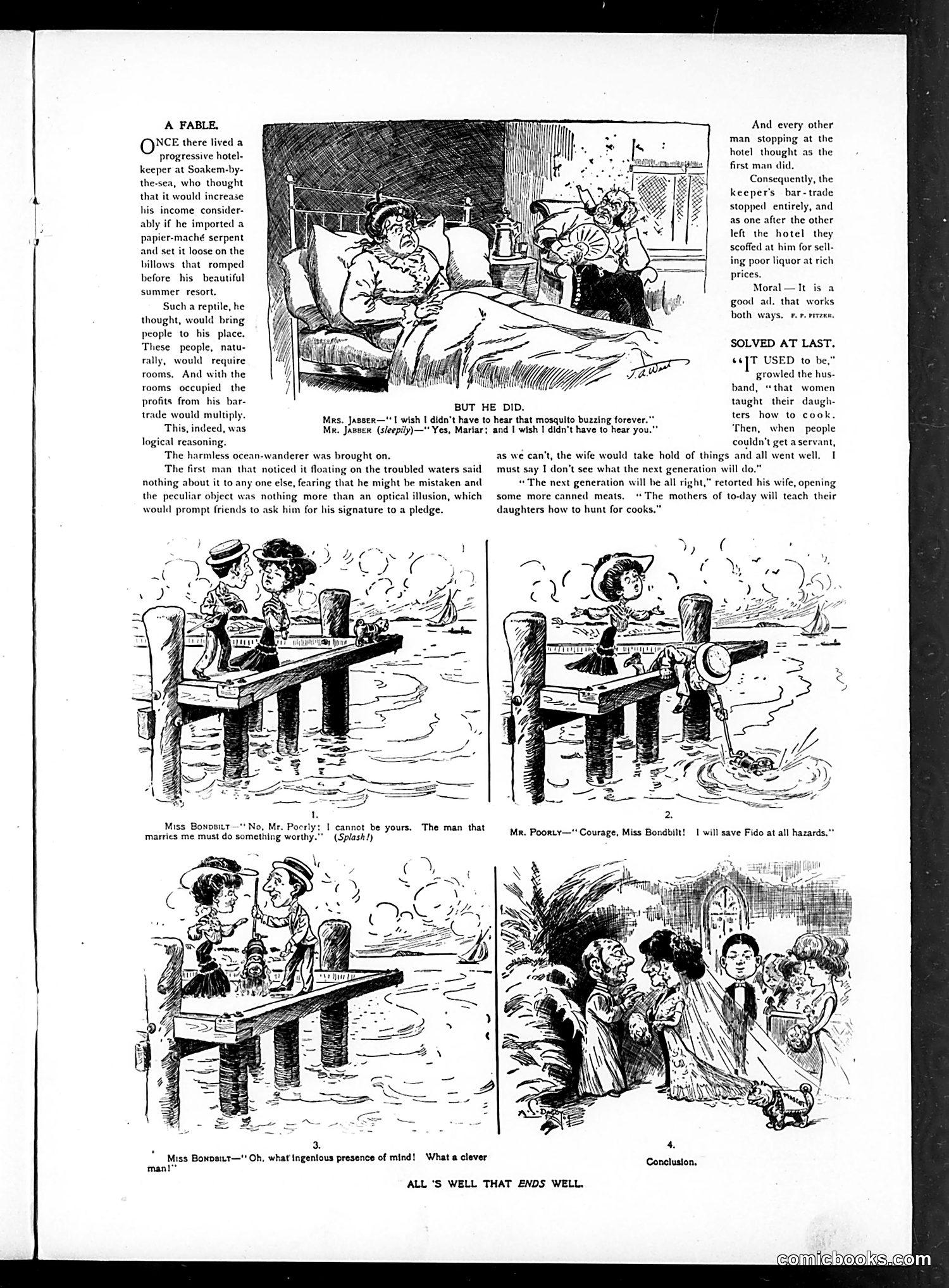
This page contains three separate satirical pieces: **"A Fable"** mocks resort marketing fraud. A hotel-keeper imports a fake papier-maché sea serpent to attract tourists, hoping increased guests will boost bar profits. Instead, guests recognize the hoax, lose confidence in the establishment (fearing the owner is a charlatan or drunk), and leave—ruining business. The moral criticizes dishonest advertising. **"Solved at Last"** satirizes changing domestic labor. A husband laments that modern mothers no longer teach daughters to cook, making servants essential. His wife retorts that modern mothers will instead teach daughters "how to hunt for cooks"—implying the servant shortage means women must find cooks rather than be them. This reflects early 20th-century anxieties about domestic help scarcity and shifting gender roles. **The comic strips** appear to depict a melodramatic romantic subplot involving Miss Bombelt rejecting a suitor, a man saving a dog, and a wedding conclusion—though specifics are unclear from image quality alone. The page satirizes consumer deception, domestic service crises, and romantic conventions typical of Judge's humor.
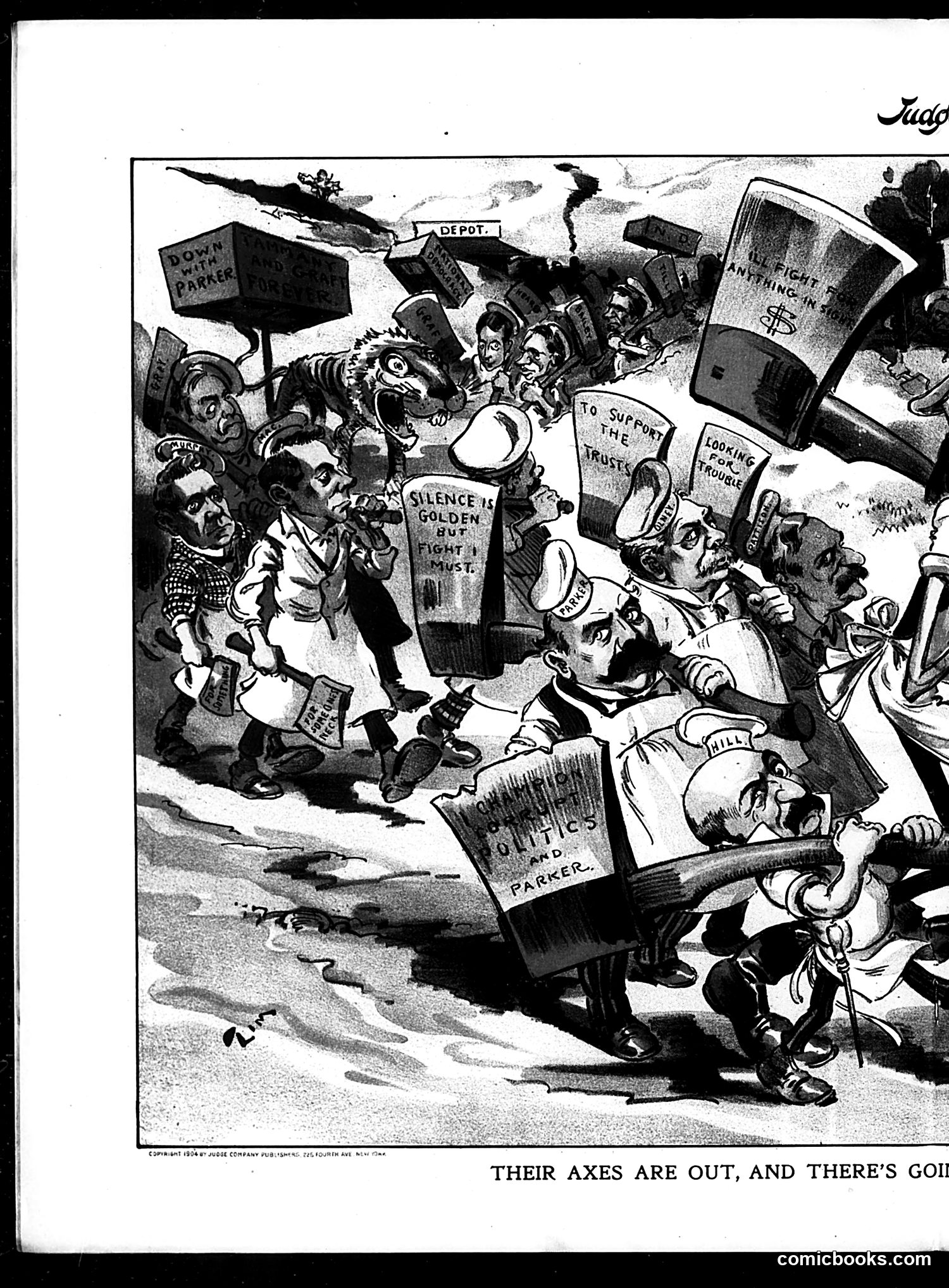
This Judge magazine cartoon depicts a chaotic scene centered on a tombstone reading "SILENCE IS GOLDEN BUT THE TRUTH MUST," surrounded by caricatured figures holding signs and implements. Visible signs reference "TO SUPPORT THE TRUST," "LOOKING FOR TROUBLE," and "POLITICS AND PARKER." A "DEPOT" sign appears overhead, and a large overturned container labeled with a dollar sign dominates the right side. The cartoon appears to satirize corruption or scandal involving political and business figures—likely referencing trust monopolies and attempts to suppress truth or evidence ("axes are out"). The crowded, violent composition suggests conflict between those protecting corporate interests and those seeking transparency. Without the full caption visible, the specific political figures and scandal remain unclear, though "Parker" may reference a specific politician or businessperson of the era.
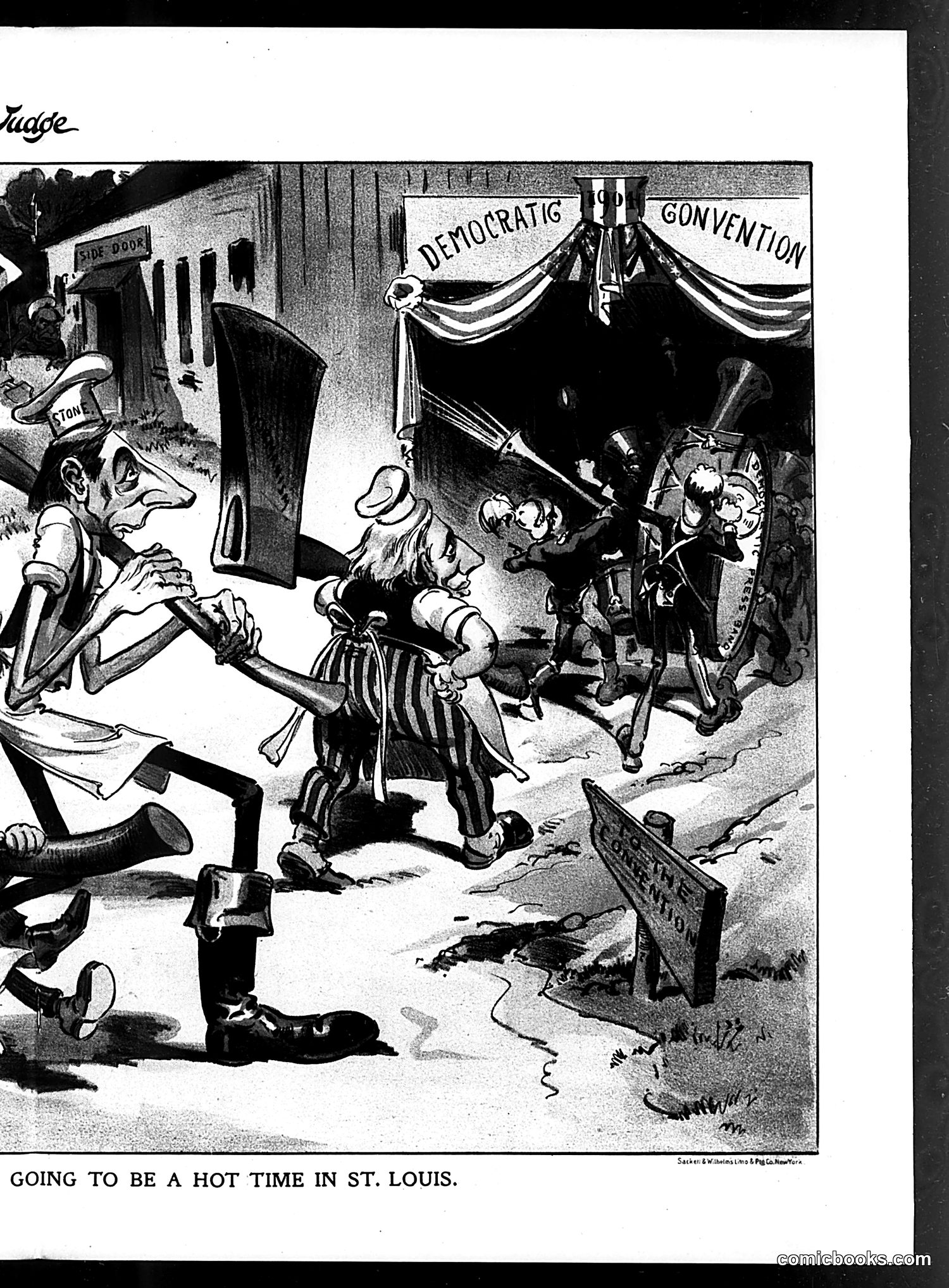
This Judge magazine cartoon satirizes tensions expected at a Democratic National Convention in St. Louis. The figure on the left—labeled "STOOL" and appearing disheveled—represents someone (likely a political opponent or troublemaker) being ejected from the convention venue. Inside the tent marked "DEMOCRATIC CONVENTION," various caricatured figures appear to be in heated conflict or chaos. The "hot time" caption suggests the cartoonist predicts violent confrontation or disorder at the Democratic gathering. The imagery mocks internal Democratic party strife, portraying the convention as chaotic and contentious. The style of caricature and the specific reference to St. Louis suggests this comments on a specific historical Democratic Convention, though the exact date isn't visible on this page.
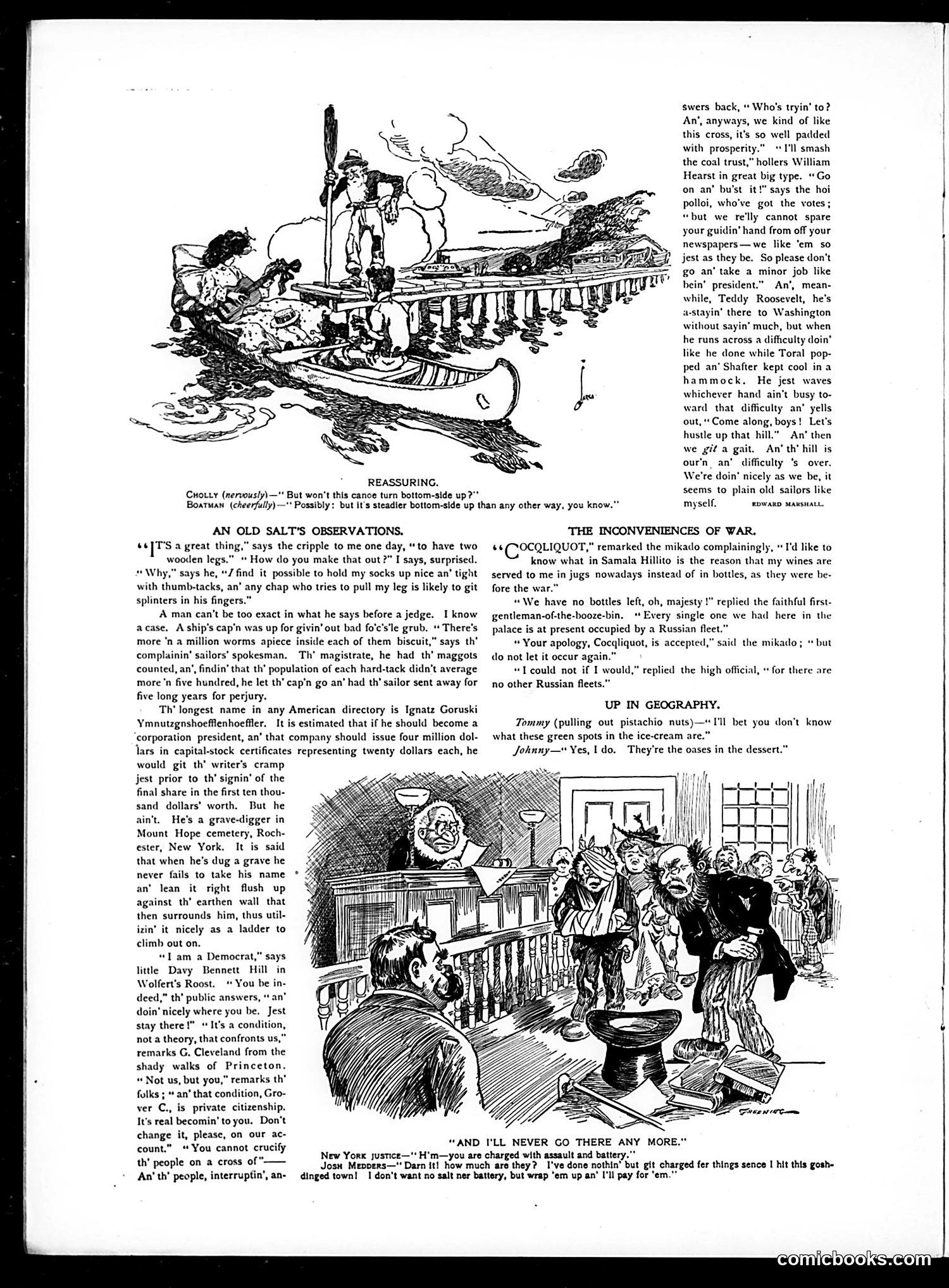
This page contains multiple satirical pieces reflecting early 1900s American politics and social commentary. **Top cartoon ("Reassuring")**: A boatman reassures a nervous passenger that their canoe is safer upside-down—absurdist humor about accepting paradoxical situations. **"An Old Salt's Observations"**: Folksy anecdotes mocking bureaucratic absurdity, including a ship captain prosecuted for exaggerating biscuit worm counts. **Political references**: Mentions of William Randolph Hearst (threatening to "smash the coal trust"), Teddy Roosevelt (praised for decisive action), and Grover Cleveland (criticized for private citizenship). These reflect contemporary debates about presidential power and reform. **"The Inconveniences of War"**: A Japanese mikado complains his wine bottles are now occupied by Russian prisoners—satirizing the Russo-Japanese War's disruptions to luxury and normalcy. The overall tone mocks both politicians and the public's complacency with status quo, while celebrating Roosevelt's activist leadership style.
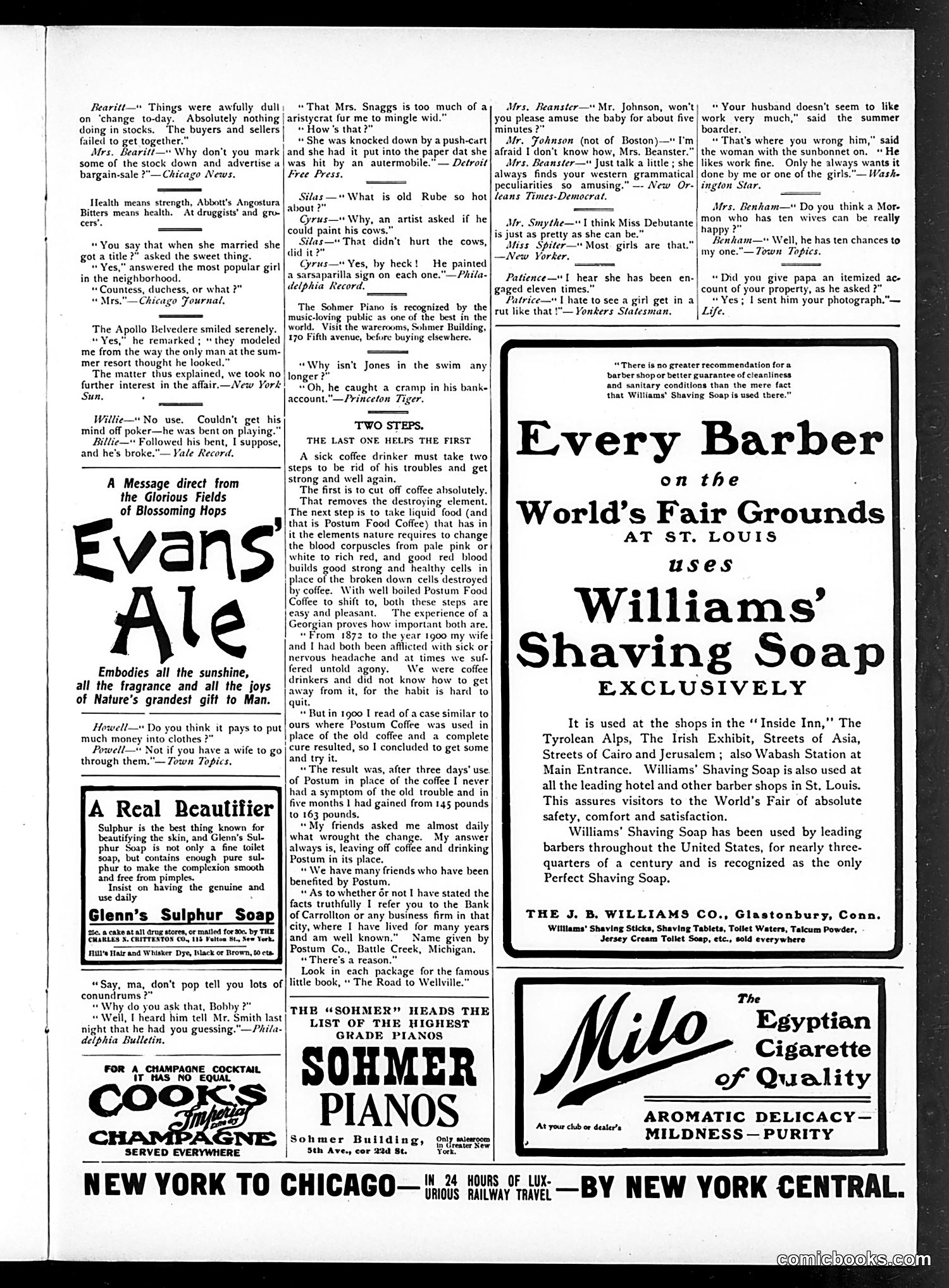
This page is primarily **advertising with brief comedic snippets** rather than political cartoons. The short jokes scattered throughout are typical early-1900s humor: - Stock market/marriage quips with mild social commentary - A classical sculpture (Apollo Belvedere) making self-deprecating remarks about male vanity - Domestic humor about wives and money - Rural characters discussing minor misunderstandings The substantive content is a lengthy **testimonial advertisement for Postum Food Coffee**, promoting it as a healthier alternative to regular coffee for treating headaches and nervousness—a common concern in this era when caffeine's effects were poorly understood. The page also features ads for **Evans Ale**, **Glenn's Sulphur Soap**, **Sohmer Pianos**, and **Williams' Shaving Soap**—typical of Judge's revenue model. There is **no significant political satire or social criticism** visible. This appears to be a standard issue page balancing light entertainment with paid advertising.
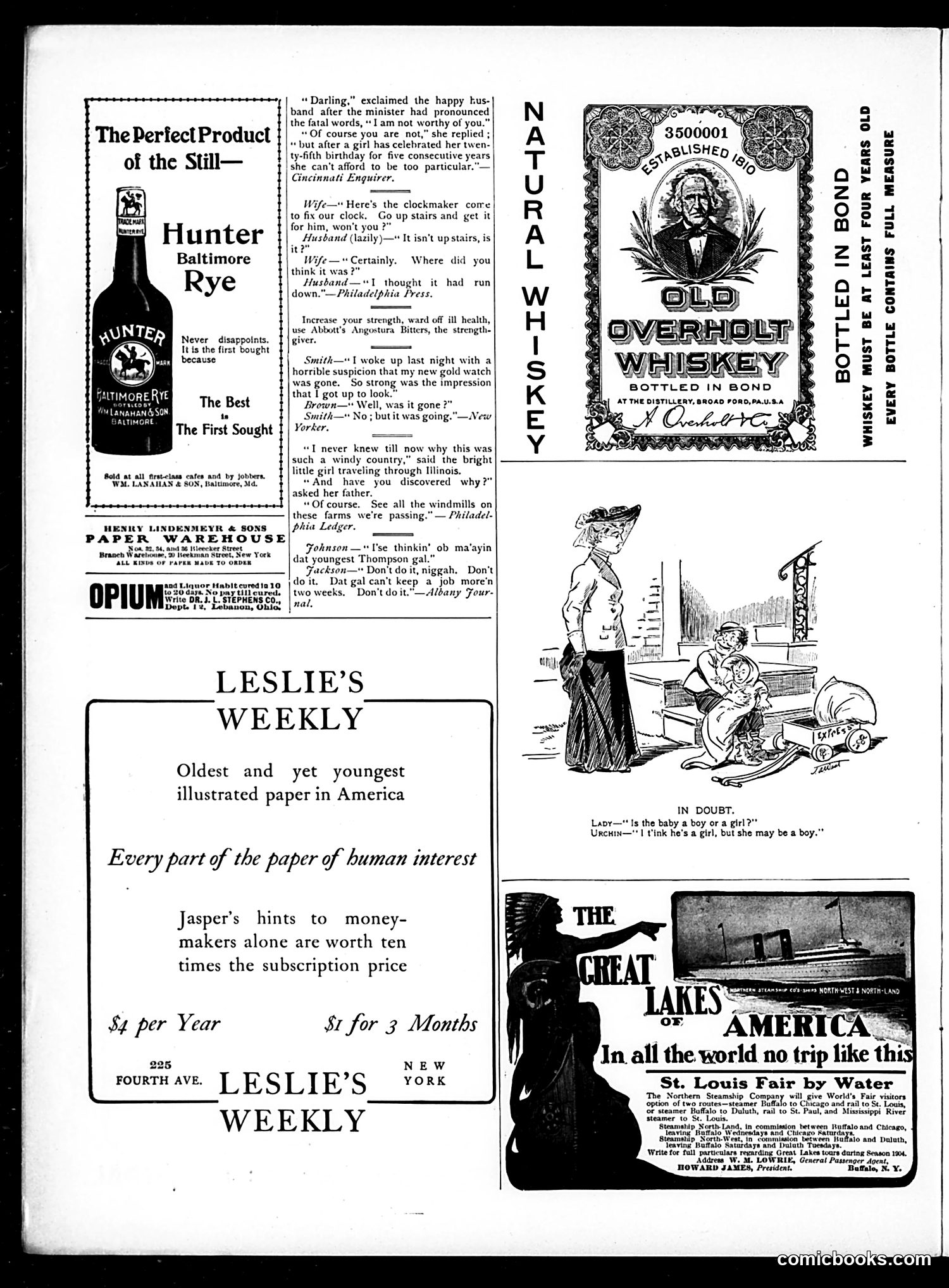
This page is primarily **advertising and filler content** rather than political satire. It contains: **Humor Sections:** Several brief jokes mocking domestic life and racial stereotypes typical of early 1900s magazines. One dialogue features racist dialect, reflecting the period's casual prejudice. **Advertisements:** Hunter Baltimore Rye whiskey, Old Overholt Whiskey, Leslie's Weekly magazine, paper warehouse services, and Great Lakes steamship travel. **Social Commentary (Implicit):** The domestic jokes—about husbands avoiding chores, wives nagging about age and marriage—reflect standard gender role humor of the era. The "windmill" joke plays on American regional stereotypes about Illinois. **No Clear Political Satire:** Unlike typical Judge content, this page lacks identifiable political figures or explicit social commentary. It's essentially a standard magazine page mixing light humor with commercial advertisements aimed at middle-class readers of the early 1900s.
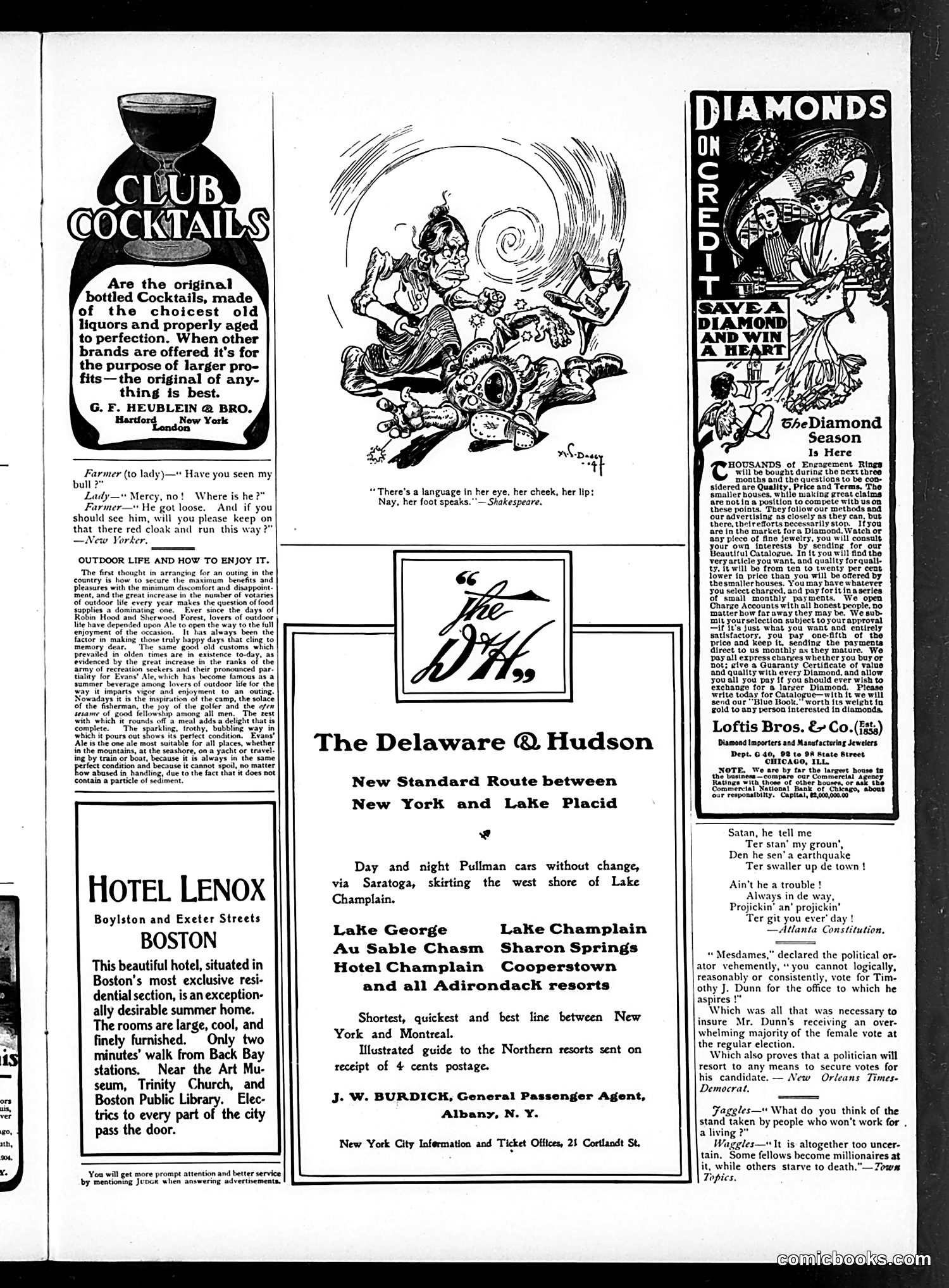
This page is primarily **advertisements and filler content** rather than editorial satire. The central cartoon depicts a grotesque figure surrounded by swirling chaos—likely a caricature of a politician or public figure, though the specific identity isn't marked. The Shakespeare quote beneath ("There's a language in her eye...") appears disconnected from the crude illustration, suggesting either editorial padding or commentary on someone's deceptiveness. The page's main content consists of **commercial ads**: Club Cocktails, Hotel Lenox, the Delaware & Hudson railroad, and notably, **Loftis Bros. jewelry promoting diamond engagement rings**. A small anecdote about a farmer and his escaped bull fills space. Without clearer labeling or context, the political cartoon's subject and satirical point remain **unclear**. The grotesque style suggests mockery of someone's character or intellect, but the page lacks the explanatory captions typical of Judge's political commentary. This appears to be filler material rather than substantive satire.
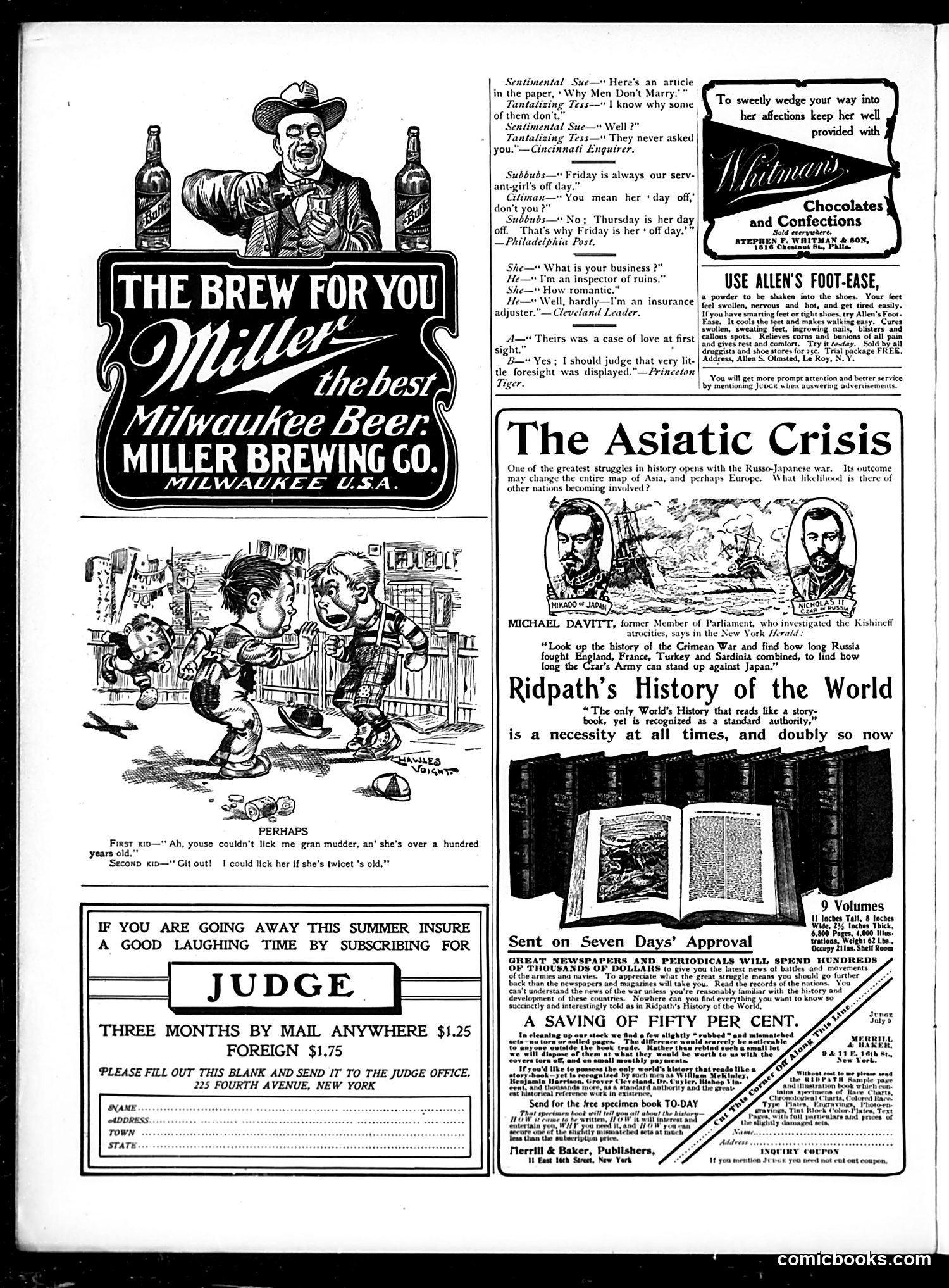
This page is primarily **advertising and humor filler** rather than political cartooning. The main content includes: **"Perhaps" Cartoon**: A comic exchange between two street urchins arguing about whose grandmother is tougher—one claims his 100-year-old grandmother can't be beaten; the other boasts he could lick her if she were twice as old. It's generic working-class humor with dialect comedy typical of early 1900s publications. **Advertisements**: Miller Beer, Whitman's Chocolates, Allen's Foot-Ease powder, and Ridpath's History of the World dominate the page. The history book ad notably references the Russo-Japanese War as current events, dating this to 1904-1905. **Light Humor Snippets**: Short jokes about servants' days off and insurance adjusters reflect mundane domestic concerns. The page lacks significant political satire—it's mostly commercial content interspersed with period humor relying on ethnic dialect and slapstick rather than substantive social commentary.
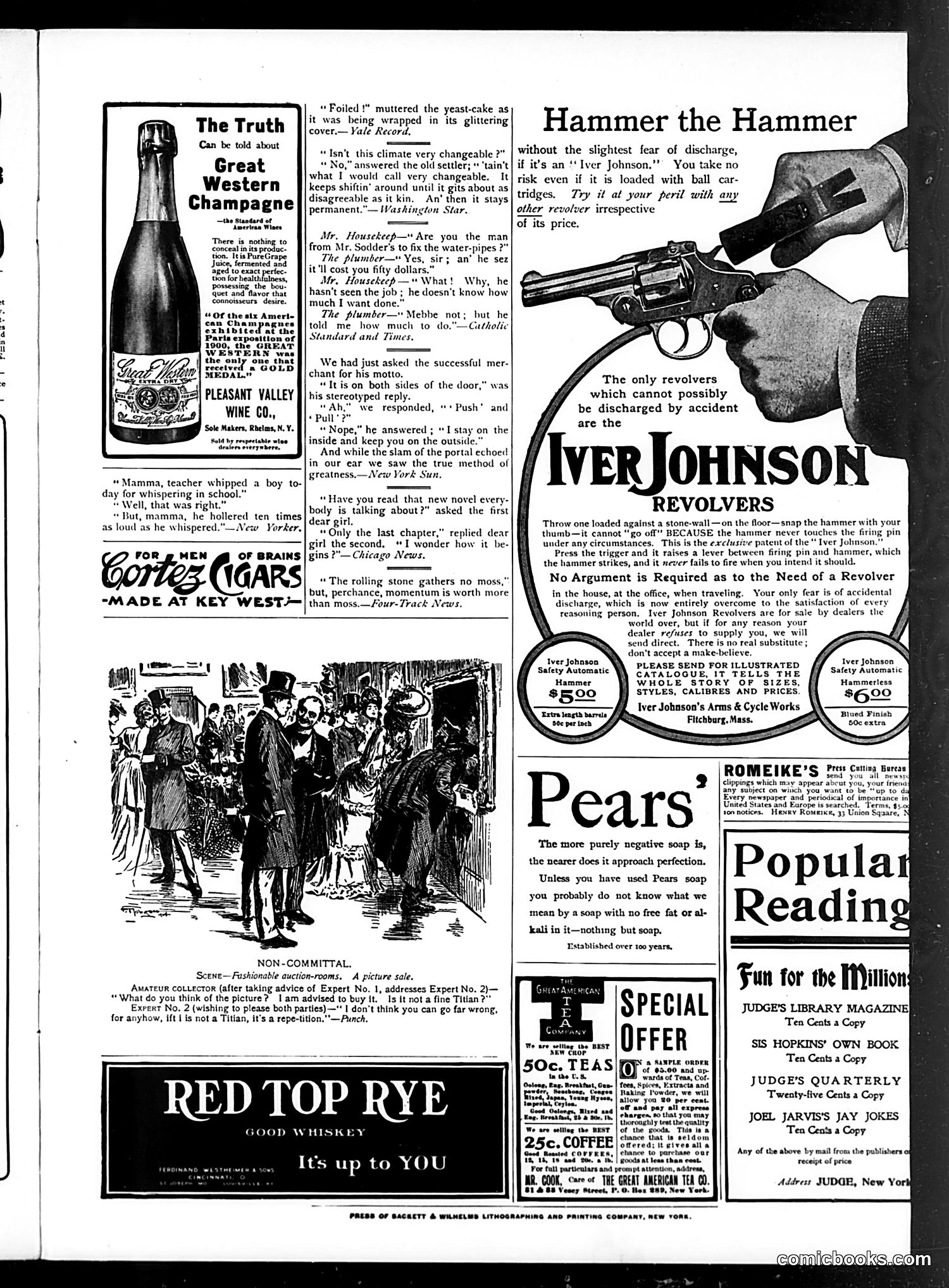
This page contains several short humorous pieces typical of *Judge* magazine's satirical style, plus period advertisements. The main cartoon, "Non-Committal," mocks art auction culture: an amateur collector asks two experts for opinions on a painting. Expert No. 2 gives deliberately vague praise ("you can't go far wrong"), hedging by suggesting it's either a valuable Titian or merely "a repetition" (imitation). The joke satirizes how dealers and experts avoid commitment to protect themselves from both parties—a timeless critique of evasive professionalism. Other brief items include jokes about weather, plumbers overcharging regardless of actual work needed, and a merchant who keeps customers on the outside while staying safely inside—gentle satire on business practices and social behavior. The *Iver Johnson* revolver advertisement emphasizes an "accidental discharge" safety feature—highlighting genuine safety concerns relevant to the era. Other ads promote champagne, cigars, soap, and whiskey as period-appropriate products.
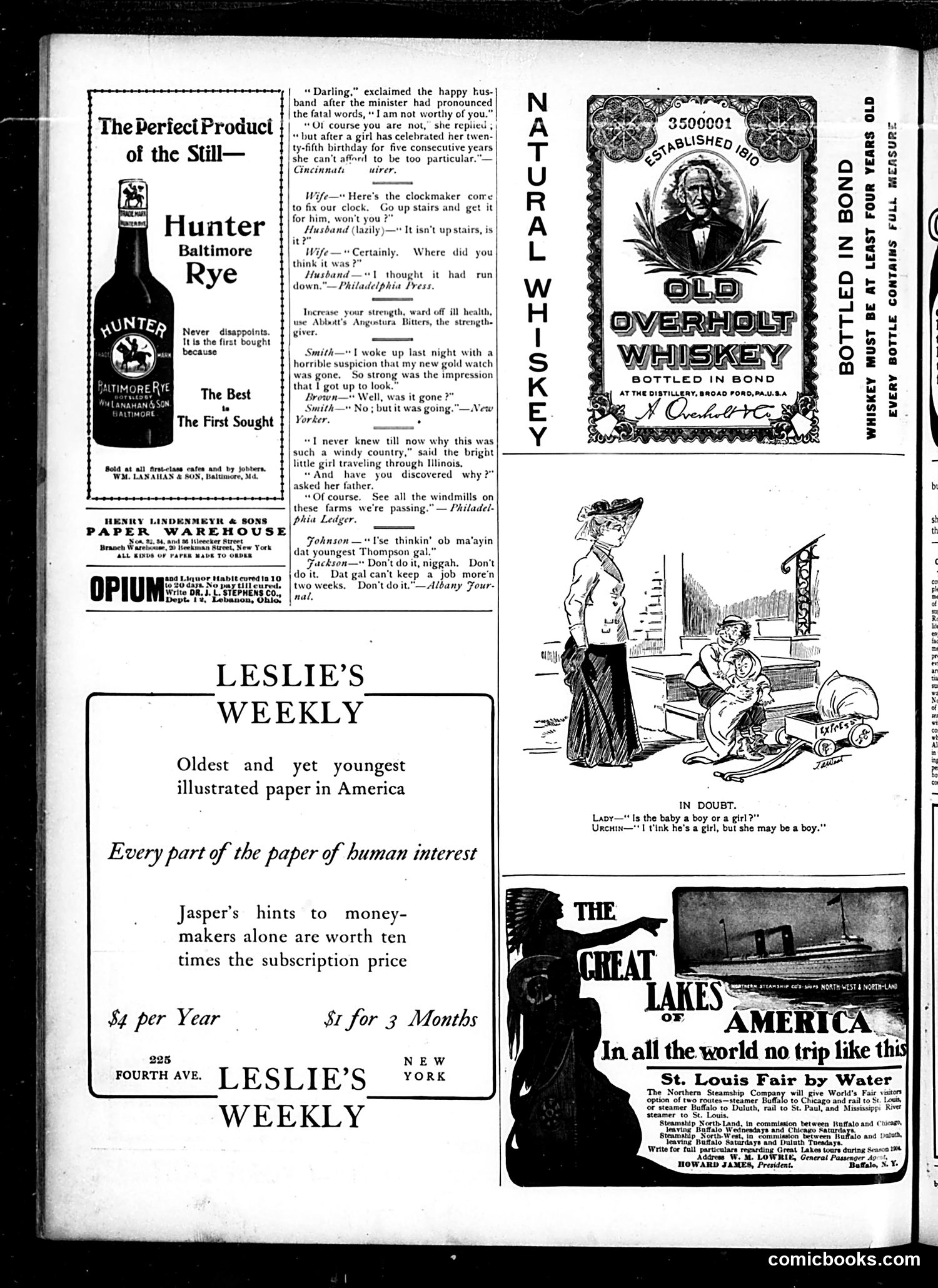
This page is primarily **advertising and filler content** rather than political satire. It contains: **Advertisements:** - Hunter Baltimore Rye whiskey ("The Perfect Product of the Still") - Old Overholt Whiskey (bottled in bond) - Leslie's Weekly magazine (subscription promotion) - Great Lakes steamship travel to St. Louis Fair - Paper warehouse and opium products **Comic Jokes/Filler:** Multiple short, domestic humor pieces featuring: - A newlywed wife's pragmatic response about marriage after celebrating her "twenty-fifth birthday for five consecutive years" (joke about lying about age) - Marital misunderstandings about clocks and watches - A child's innocent observation about Illinois windmills causing wind - Dialect humor involving African American characters and romantic prospects **Historical Context:** The racist dialect humor and the casual reference to opium products reflect early 1900s attitudes. The "twenty-fifth birthday" joke implies women repeatedly lied about their age—a social convention of the era. The page reflects Judge's lighter comedic content rather than its satirical political edge.
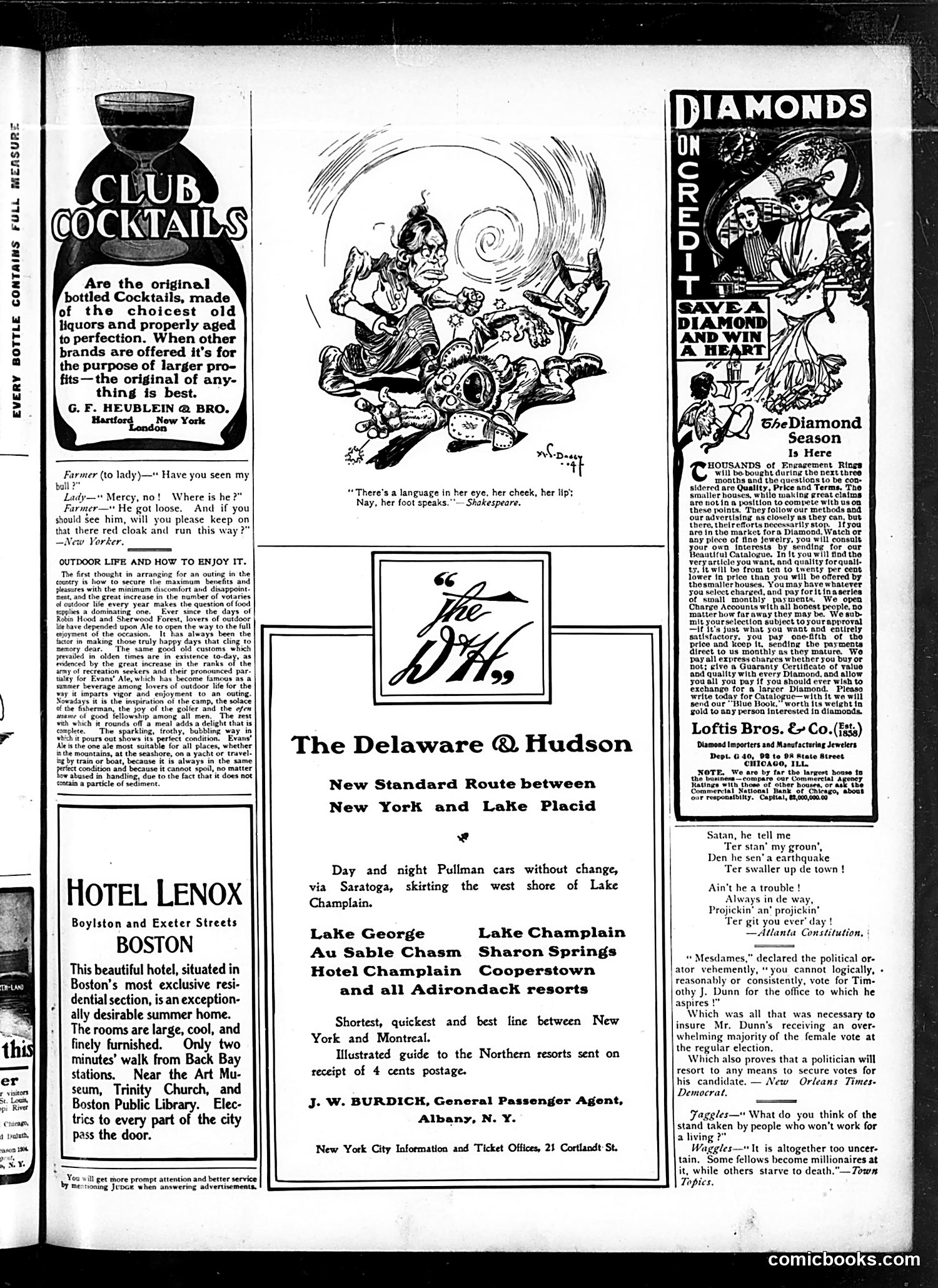
This page is primarily **advertising**, with minimal editorial cartooning. The main content includes: **Central cartoon**: A small illustration depicting figures in exaggerated poses around a spiral, captioning a Shakespeare quote about body language. The specific figures and satirical point are unclear from the image. **Advertisements dominate**: - Club Cocktails (top left) - Hotel Lenox in Boston - Delaware & Hudson Railway (center) - Loftis Bros. jewelry/diamonds (right) **Minor joke**: A brief "Farmer" anecdote about mistaken identity with a red cloak—likely a mild visual gag about rural misunderstanding. The page reflects early 20th-century *Judge* content: mostly commercial advertising interspersed with light humor rather than pointed political satire. The diamond advertisement's emphasis on "engagement rings" and "quality" suggests this is from a seasonal issue targeting holiday shoppers—a common Judge strategy of mixing editorial matter with lucrative advertising.
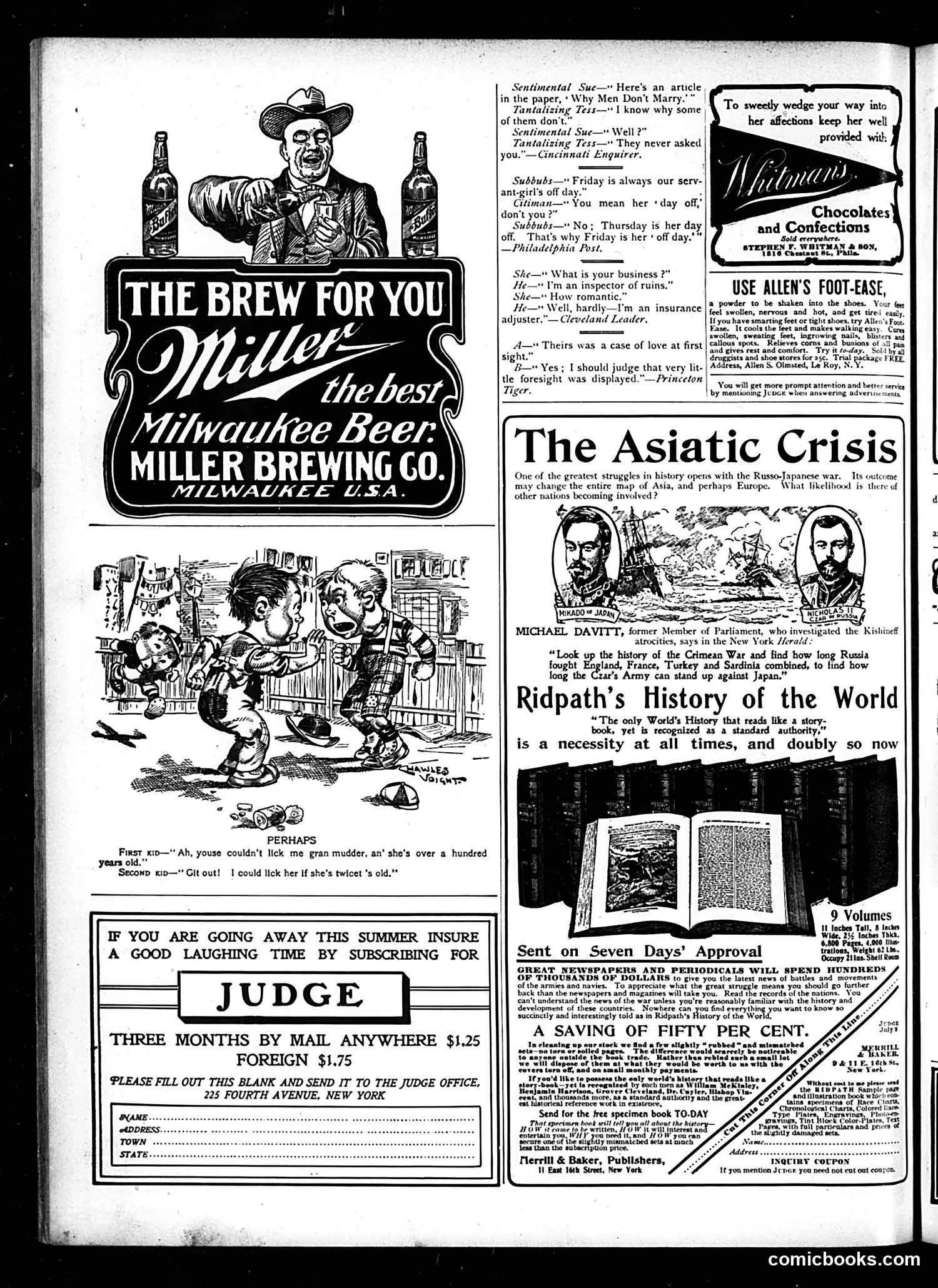
This page from Judge magazine (a satirical weekly) contains advertisements and humor pieces typical of early 1900s American periodicals. **Main Content:** The largest advertisement promotes Miller Brewing Company's Milwaukee Beer, featuring a caricatured cowboy figure holding bottles—appealing to working-class masculinity through crude humor. Below it, a cartoon depicts two children fighting, with dialogue about licking someone's grandmother, reflecting the era's working-class immigrant humor. **Sidebar Jokes:** Several brief gags mock courtship and gender relations—typical of Judge's humor targeting middle-class anxieties about marriage and domestic life. **Significant Article:** "The Asiatic Crisis" discusses the Russo-Japanese War (1904-1905), presenting it as potentially world-altering. Michael Davitt, a political figure, is quoted predicting Japan could resist Russia's military power. This reflects contemporary American interest in the conflict's geopolitical implications. **Book Advertisement:** Ridpath's History of the World is promoted as essential reading to understand the war's historical context—suggesting educated readers needed historical perspective on current events. The page primarily serves advertisers while maintaining Judge's satirical voice through humor and topical commentary.
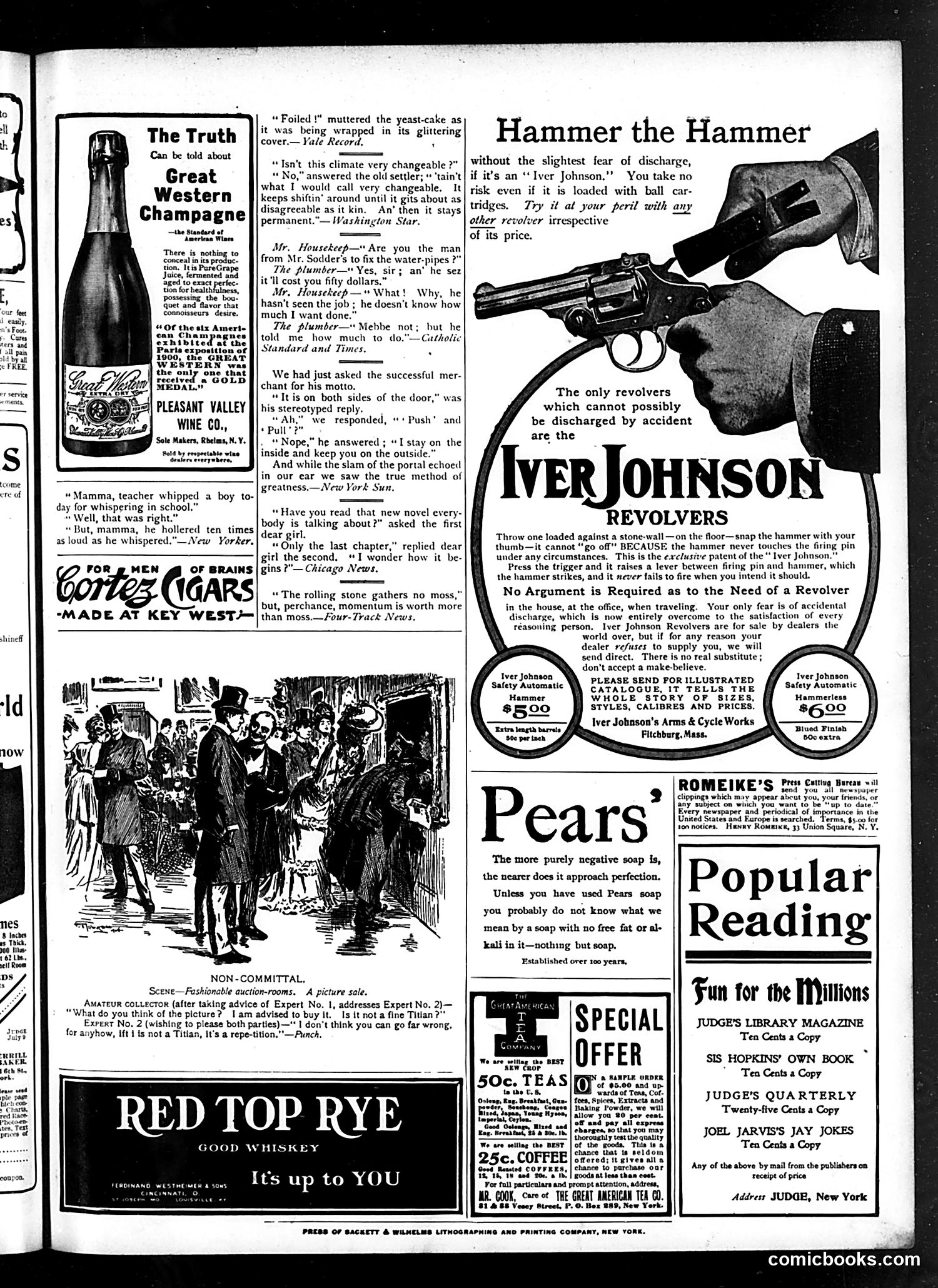
This page is primarily **advertising** interspersed with brief satirical jokes typical of Judge magazine's format. The main content is a large **Iver Johnson Revolvers advertisement** emphasizing the gun's safety features—specifically that it cannot accidentally discharge because the hammer never contacts the firing pin. This addresses contemporary concerns about accidental shootings, a major safety issue for the era when firearms were common household items. The scattered jokes are brief humor pieces: complaints about variable weather, plumbers overcharging, a merchant's cryptic business motto, a child's loud school disruption, and an art auctioneer's non-committal assessment. Supporting advertisements include **Great Western Champagne**, **Cortez Cigars**, **Red Top Rye whiskey**, **Pears soap**, and publications like *Judge's Library Magazine*. The page reflects early 20th-century American consumer culture and domestic anxieties, particularly around household safety and firearms ownership.
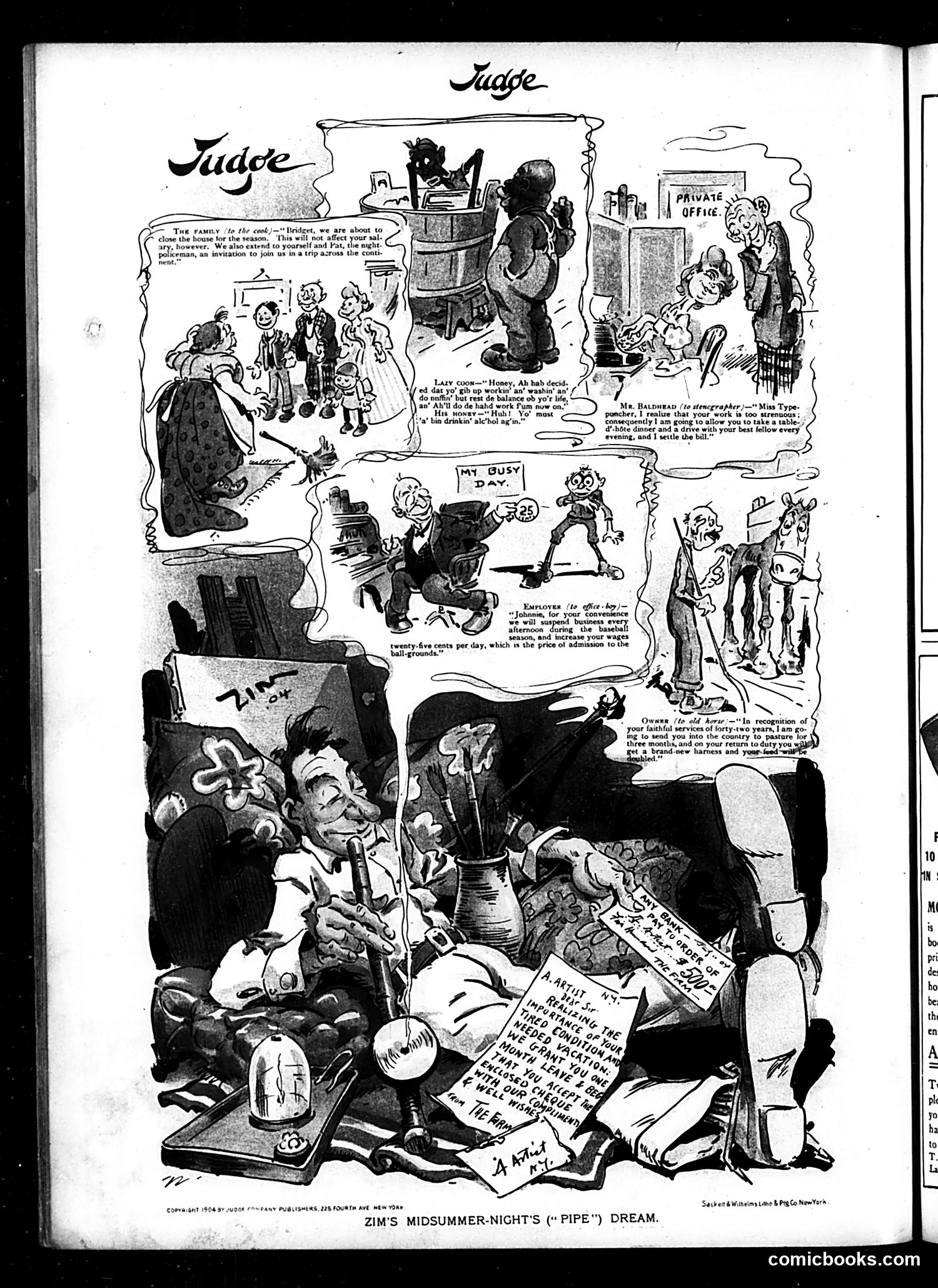
This 1904 page titled "Zim's Midsummer-Night's ('Pipe') Dream" presents multiple satirical vignettes mocking workplace fantasies and social stereotypes of the era. The cartoons depict: 1. **"Lazy coon"** — A racist caricature presenting an African American couple's fantasy of leisure, intended as satirical commentary on perceived idleness. 2. **"Lady coon"** — Similar stereotyping, suggesting the fantasy involves role-reversal where the woman stops working. 3. **"Employer to office-boy"** — An ironic fantasy where an employer grants afternoon closures during baseball season and raises wages by the exact cost of admission, mocking both employer generosity and worker aspirations. The overarching satire appears to mock various groups' unrealistic daydreams: working-class fantasies of leisure, and employers' fantasy of benevolent paternalism toward employees. The page reflects early 1900s Judge magazine's typical reliance on ethnic/racial caricature as humor while satirizing social hierarchies and economic realities.
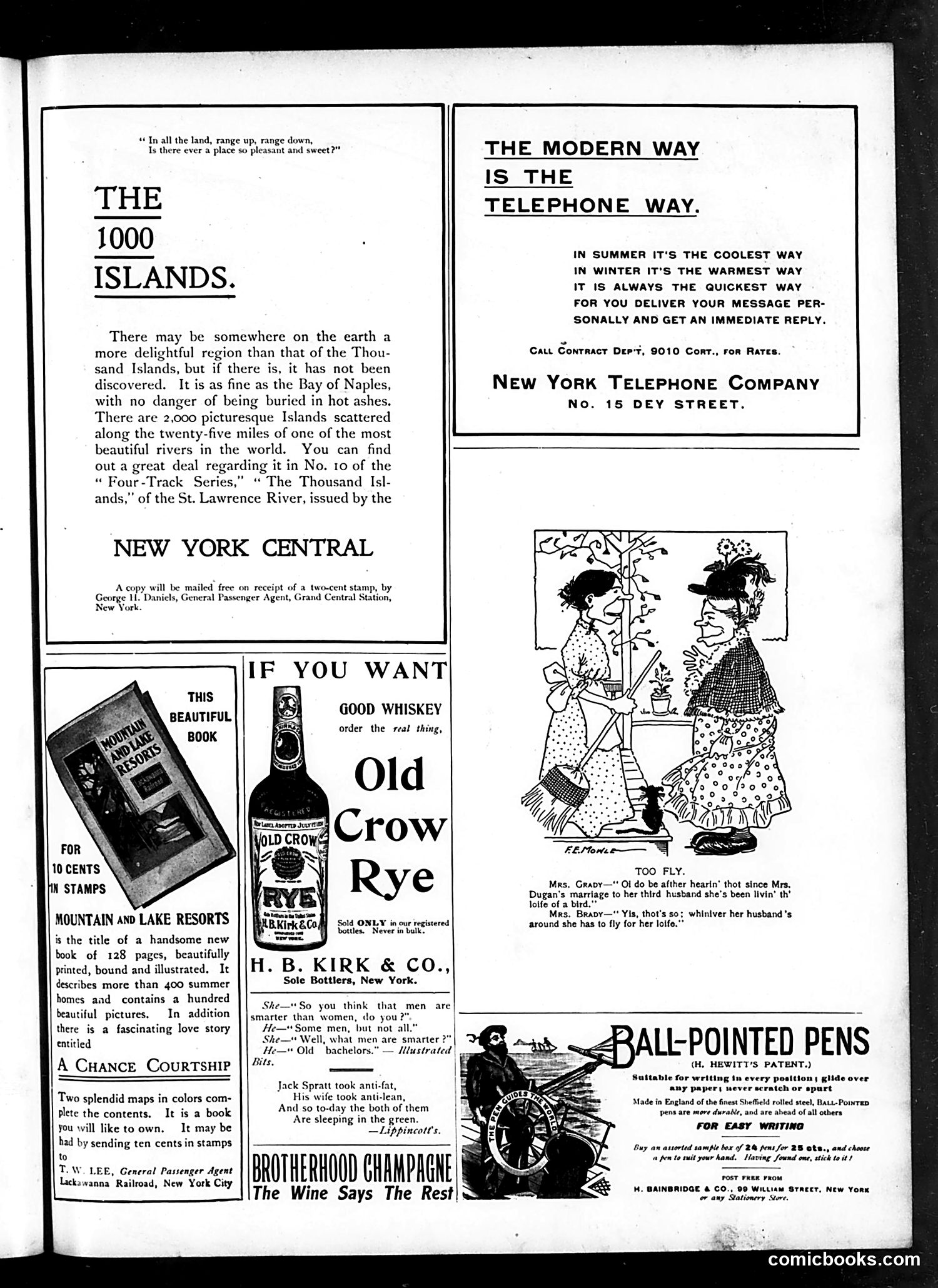
This page is primarily **advertising** with one notable cartoon. The advertisements promote various products and services typical of early 20th-century America: the Thousand Islands tourist destination, telephone service, whiskey, a resort guidebook, and writing pens. The single cartoon ("Too Fly") features two working-class Irish women (identifiable by their dialect and clothing). Mrs. Gravy mentions that Mrs. Dugan, now married to her third husband, "lives the life of a bird"—meaning she's supported and doesn't work. Mrs. Brady responds that whenever her husband leaves, "she has to fly for her loife" (life)—a joke implying the wife must work to survive without him. The satire targets the precarious economic status of working-class women dependent on marriage for survival, while poking gentle fun at Irish immigrant speech patterns common in period humor.
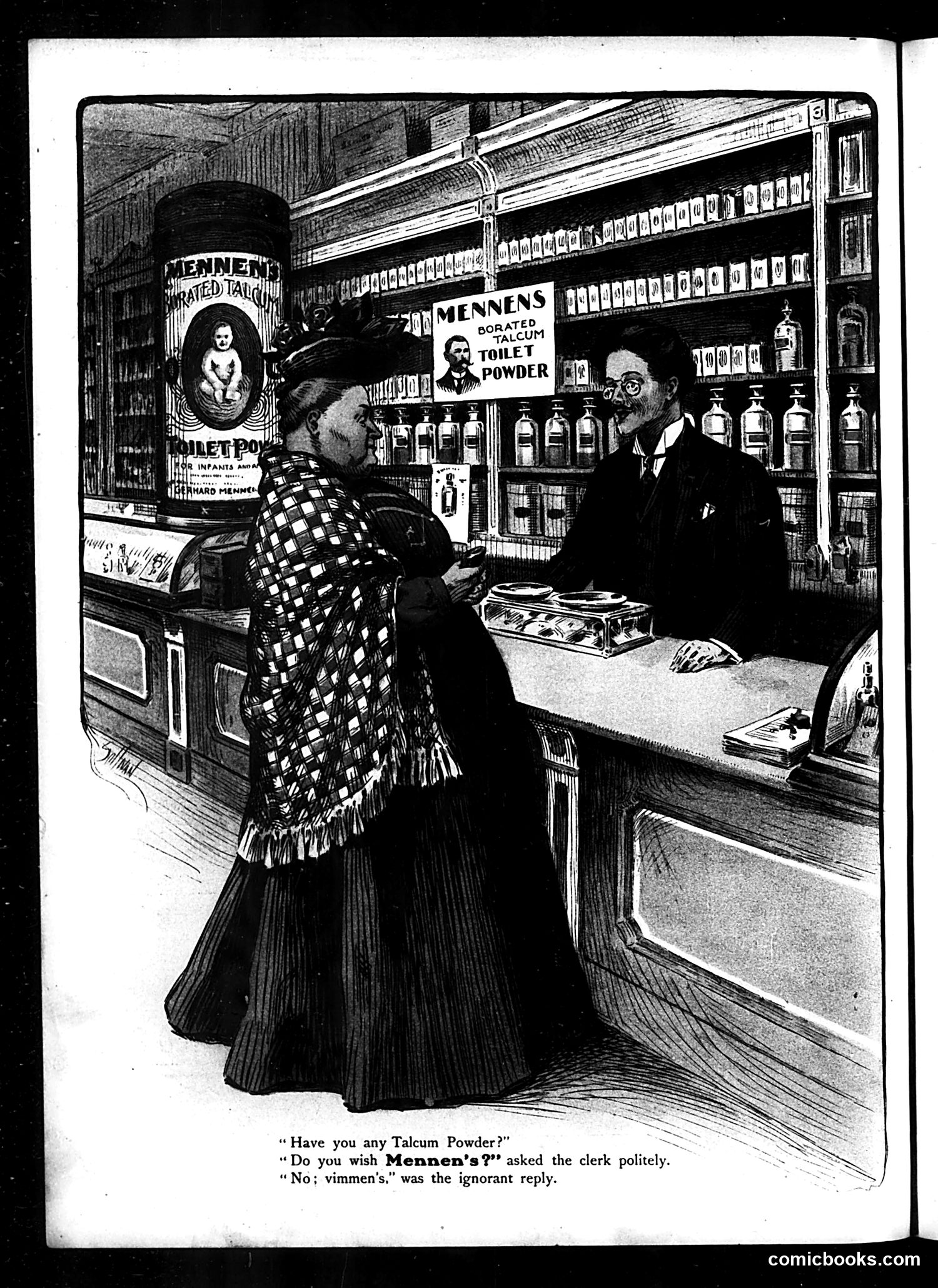
This is a single-panel satirical cartoon mocking a female customer's ignorance and accent. A woman in period dress (likely early 20th century) asks a male pharmacist clerk for talcum powder. When he professionally recommends "Mennen's" (a real brand), she responds "No; vimmen's" — her fractured English suggesting she's either a recent immigrant or uneducated working-class woman who mistakes the brand name for a generic product term. The humor relies on classist and xenophobic stereotypes common to Judge magazine's audience: mocking lower-class or immigrant women's speech patterns and intelligence. The "ignorant reply" caption confirms the intended mockery. This also serves as advertising for Mennen's talcum powder, a commercial product placement disguised as editorial humor.