
Judge, 1904-07-09 · page 12 of 24
Judge — July 9, 1904 — page 12: what you’re looking at
What you’re looking at
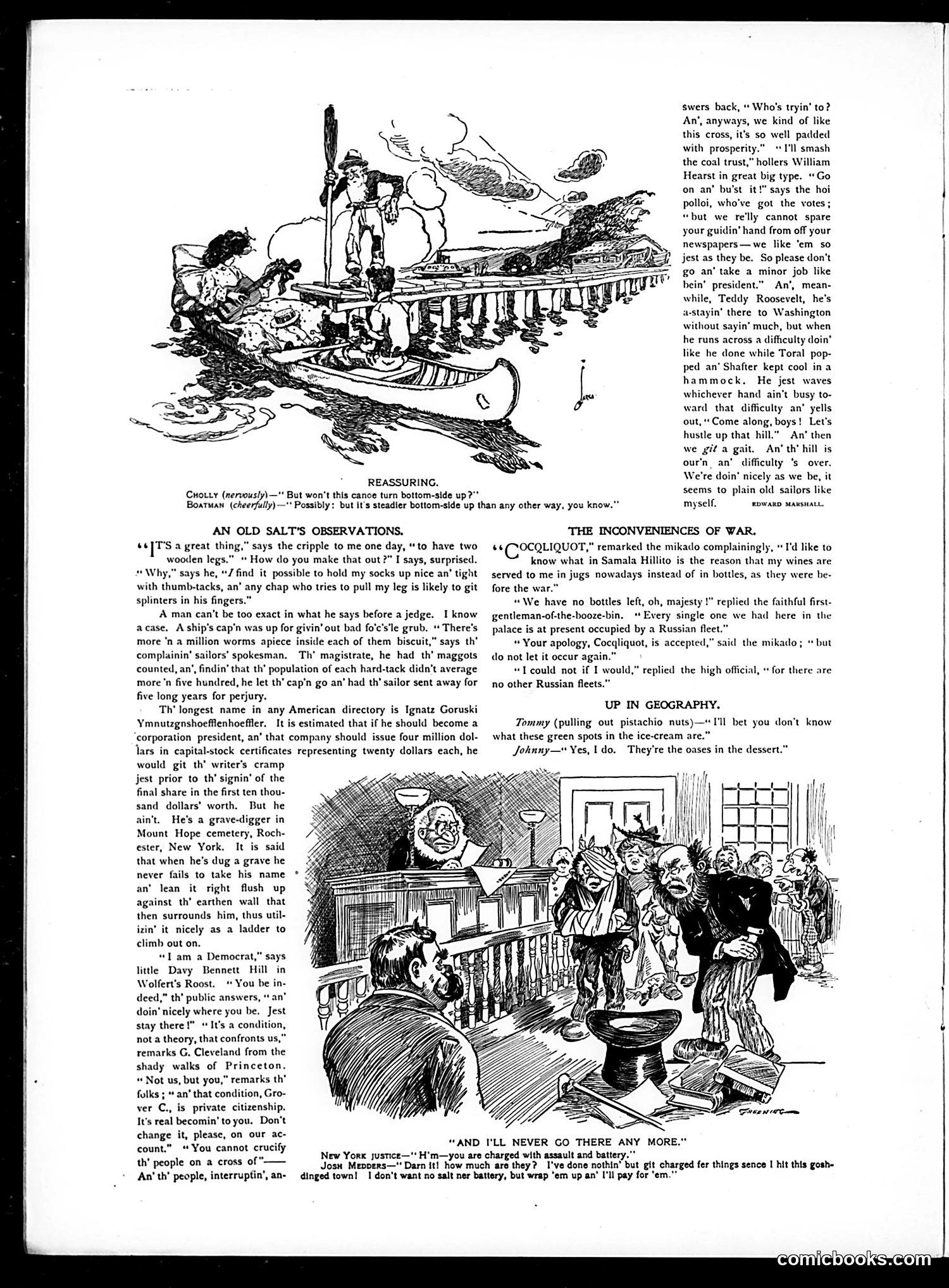
This page contains multiple satirical pieces reflecting early 1900s American politics and social commentary. **Top cartoon ("Reassuring")**: A boatman reassures a nervous passenger that their canoe is safer upside-down—absurdist humor about accepting paradoxical situations. **"An Old Salt's Observations"**: Folksy anecdotes mocking bureaucratic absurdity, including a ship captain prosecuted for exaggerating biscuit worm counts. **Political references**: Mentions of William Randolph Hearst (threatening to "smash the coal trust"), Teddy Roosevelt (praised for decisive action), and Grover Cleveland (criticized for private citizenship). These reflect contemporary debates about presidential power and reform. **"The Inconveniences of War"**: A Japanese mikado complains his wine bottles are now occupied by Russian prisoners—satirizing the Russo-Japanese War's disruptions to luxury and normalcy. The overall tone mocks both politicians and the public's complacency with status quo, while celebrating Roosevelt's activist leadership style.
📄 Transcribed text from this page (OCR, searchable)
Machine-transcribed from the original scan — historical spelling and the odd misread are preserved.
REASSURING. Crouty (nervously)—"' But won't this cance turn bottom-side up ?"" Boatuan (cheerfully)—" Possibly: but it's steadier bottom-side up than any other way, you know.”” myself, AN OLD SALT’S OBSERVATIONS. +4] T'S a great thing,” says the cripple to me one day, “to have two wooden legs.” How do you make that out?” I says, surprised. * Why,” says he, “/ find it possible to hold my socks up nice an’ tight with thumb-tacks, an’ any chap who tries to pull my leg is likely to git splinters in his fingers.” A man can’t be too exact in what he says before a jedge. I know acase. A ship's cap'n was up for givin’ out bad fo'c’s'le grub. “ There's more ‘na million worms apiece inside each of them biscuit,” says th’ complainin’ sailors’ spokesman. Th* magistrate, he had th’ maggots counted, an’, findin’ that th’ population of each hard-tack didn’t average more ‘n five hundred, he let th’ cap'n go an’ had th’ sailor sent away for five long years for perjury. Th’ longest name in any American directory is Ignatz Goruski Ymnutzgnshoefflenhoeffler. It is estimated that if he should become a ‘corporation president, an’ that company should issue four million dol- jars in capital-stock certificates representing twenty dollars each, he would git th’ writer’s cramp jest prior to th’ signin’ of the final share in the first ten thou- sand dollars’ worth. But he ain't, He's a grave-digger in Mount Hope cemetery, Roch- ester, New York. It is said that when he's dug a grave he never fails to take his name °* an’ lean it right flush up against th’ earthen wall that then surrounds him, thus util- izin’ it nicely as a ladder to climb out on. “Lam a Democrat,” says little Davy Bennett Hill in Wolfert’s Roost.“ You be i deed,” th’ public answers, * doin’ nicely where you be. Jest stay there!" «It's a condition, not a theory, that confronts us,” remarks G, Cleveland from the shady walks of Princeton. “ Not us, but you,” remarks th’ folks ; “ an’ that condition, Gro- ver C., is private citizenship. It’s real becomin’ to you. Don't change it, please, on our ac- count.” “You cannot crucify th’ people on a cross of "— An’ th’ people, interruptin’, an- New Yorx justice: dinged town! swers back, * Who's tryin’ to? An’, anyways, we kind of like this cross, it’s so well padded with prosperity.” «I'll smash the coal trust,” hollers William Hearst in great big type. “Go on an’ bu'st it!" says the hoi polloi, who've got the votes ; “but we re'lly cannot spare your guidin’ hand from off your newspapers —we like ‘em so jest as they be. So please don’t go an’ take a minor job like bein’ president.” An’, mean- while, Teddy Roosevelt, he’s a-stayin’ there to Washington without sayin’ much, but when he runs across a difficulty doin’ like he done while Toral pop- ped an‘ Shafter kept cool in a hammock. He jest waves whichever hand ain’t busy to- ward that difficulty an’ yells out, “Come along, boys! Let's hustle up that hill."” An‘ then we git a gait. An’ th’ hill is our'n, an’ difficulty 's over. re doin’ nicely as we be, it seems to plain old sailors like RDWARD MAMSHALL, ‘THE INCONVENIENCES OF WAR. #6 COCQLIQUOT,” remarked the mikado complainingly, « I'd like to know what in Samala Hillito is the reason that my wines are served to me in jugs nowadays instead of in bottles, as they were be- fore the war.” “We have no bottles left, oh, majesty !" replied the faithful first- gentleman-of-the-booze-bin. “Every single one we had here in the palace is at present occupied by a Russian fleet.” “Your apology, Cocqliquot, is accepted,” said the mikado ; “but do not let it occur again. “TI could not if I would,” replied the high official, * for there are no other Russian fleets.” UP IN GEOGRAPHY. Tommy (pulling out pistachio nuts)—« I'll bet you don’t know what these green spots in the ice-cream are, Johnny—* Yes, ldo. They're the oases in the dessert.” “AND I'LL NEVER GO THERE ANY MORE." H'm—you are charged with assault and battery.”” Josn Mepers—" Darn it! how much are they? I've done nothin’ but git charged fer things sence | hit this gosh- T don't want no salt ner battery, but wrap ‘em up an’ I'll pay for ‘em."”