
A complete issue · 16 pages · 1904
Judge — April 30, 1904
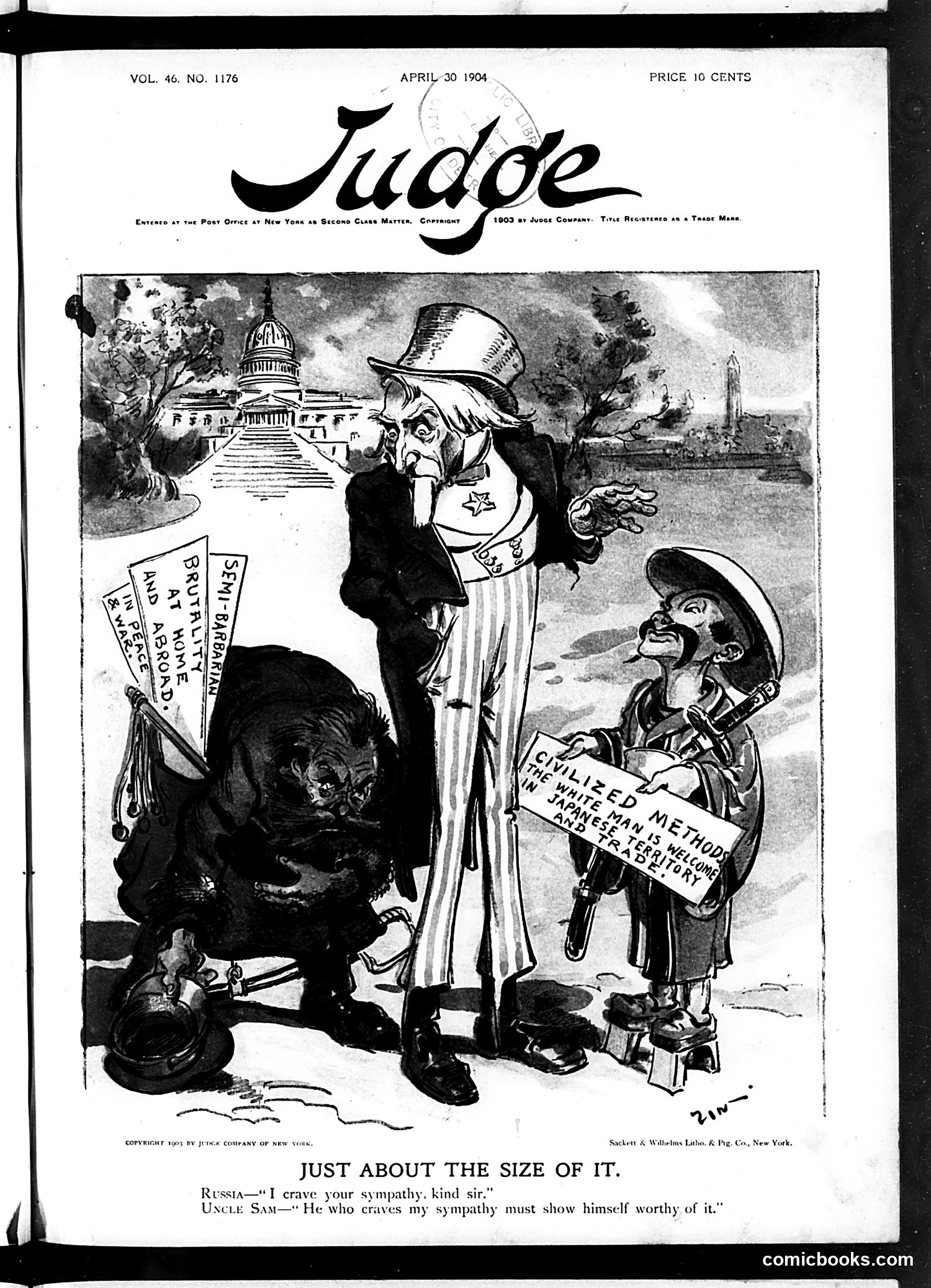
This April 1904 *Judge* cartoon satirizes Russian imperial expansion during the Russo-Japanese War. Uncle Sam (center, personifying the United States) stands between two figures: Russia (left, depicted as a dark bear) and Japan (right, a smaller caricatured figure). Russia's speech bubble references "sympathy," while Uncle Sam responds that whoever seeks American sympathy "must show himself worthy of it." The cartoon critiques Russia's aggressive territorial ambitions—the bear represents imperial overreach. Japan, labeled as using "civilized methods," holds documents about "unwritten law in Japanese territory," suggesting America viewed Japan's resistance as justified self-defense. The satire mocks Russian imperialism while implicitly endorsing Japanese sovereignty, reflecting American opinion during this geopolitical conflict.
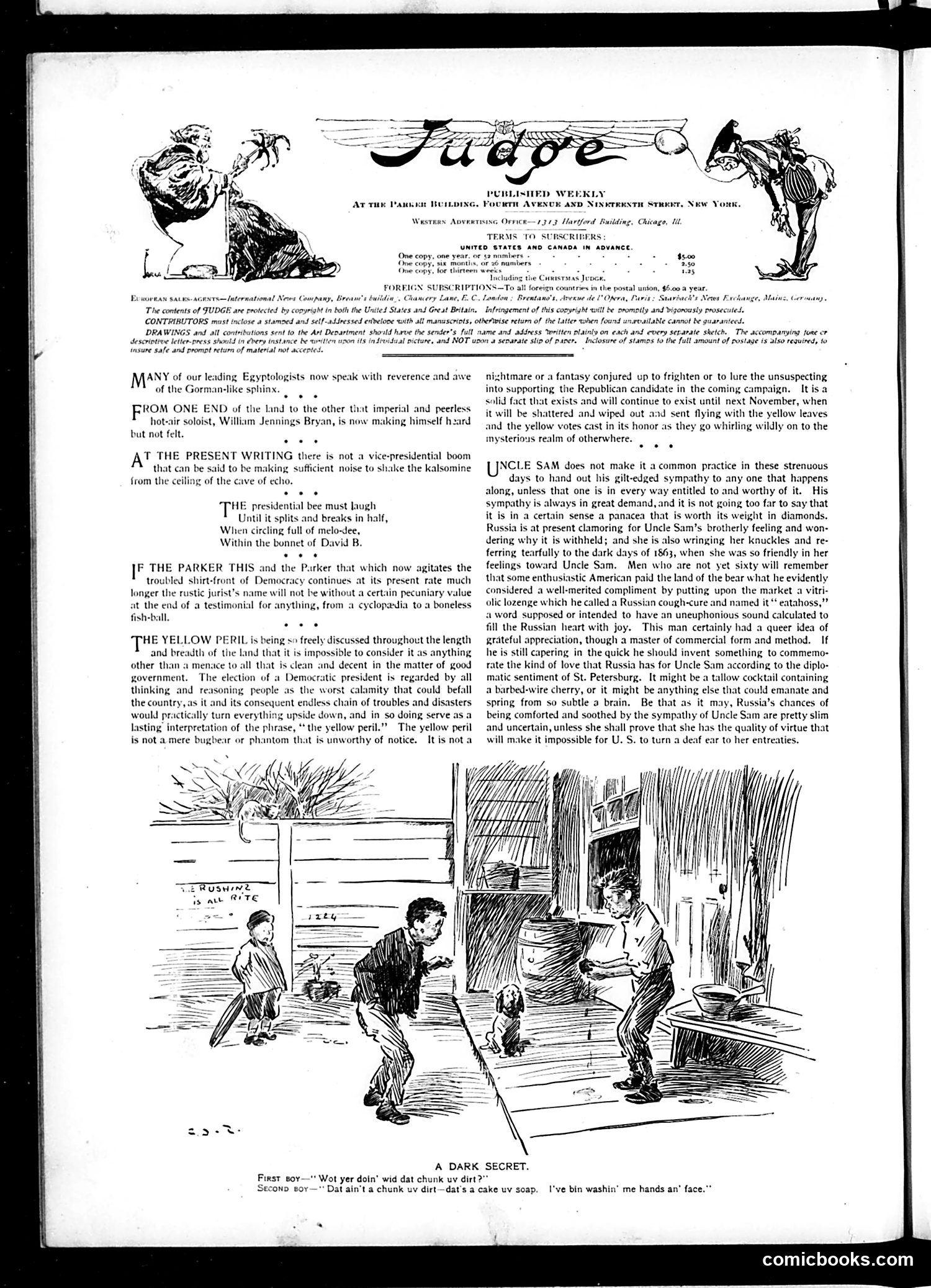
This page contains political commentary and a children's comic. The main articles discuss Republican politics and Uncle Sam's sympathies, likely referencing early 1900s electoral concerns. One piece critiques "the yellow peril" — a period-specific xenophobic reference to perceived threats from Asian immigration and competition. The bottom illustration, titled "A Dark Secret," depicts a domestic scene with children and appears to be a humorous take on child-rearing and cleanliness. The dialogue between two boys concerns getting dirty versus washing — likely satirizing parental concerns about children's hygiene or the use of commercial soap products. The overall page reflects Judge's mix of political satire for adult readers and lighter humor for family consumption, characteristic of early 20th-century American periodicals.
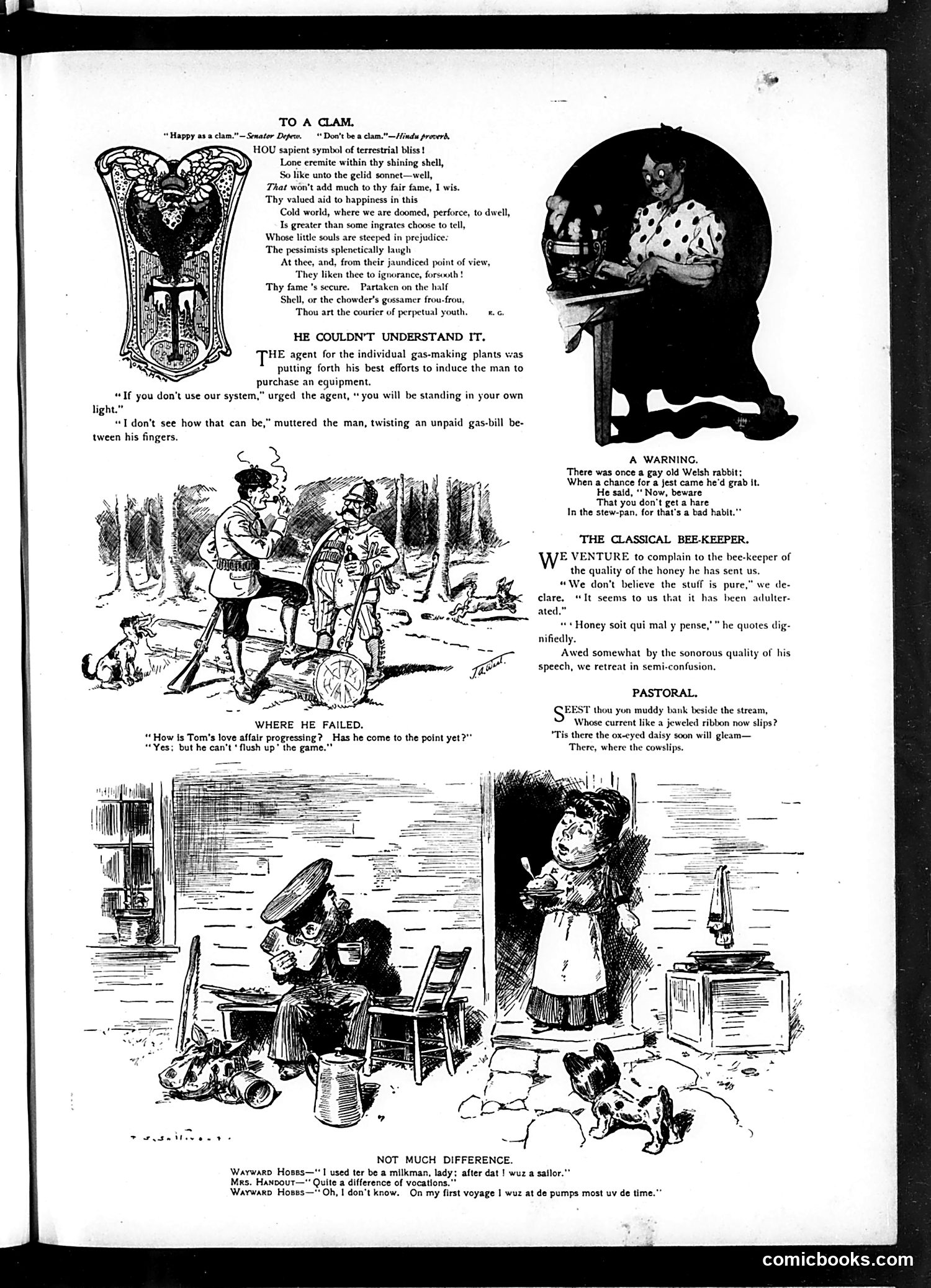
This page contains several satirical pieces and illustrations typical of early 20th-century Judge magazine humor: **"To a Clam"** presents a poem mocking clams as symbols of contentment in a harsh world—social commentary on acceptance of poor conditions. **"He Couldn't Understand It"** depicts a gas company agent trying to sell equipment to a skeptical customer, satirizing aggressive salesmanship and consumer resistance to new utilities. **"The Classical Bee-Keeper"** and **"Pastoral"** appear to be lighter humorous pieces about rural life. **"Not Much Difference"** shows a dialogue between a Wayward Horse and Mrs. Handout about the difference between being a milkman versus a sailor—likely joking about social class distinctions and occupational similarities. The illustrations use period-typical caricature style common to satirical magazines of this era.
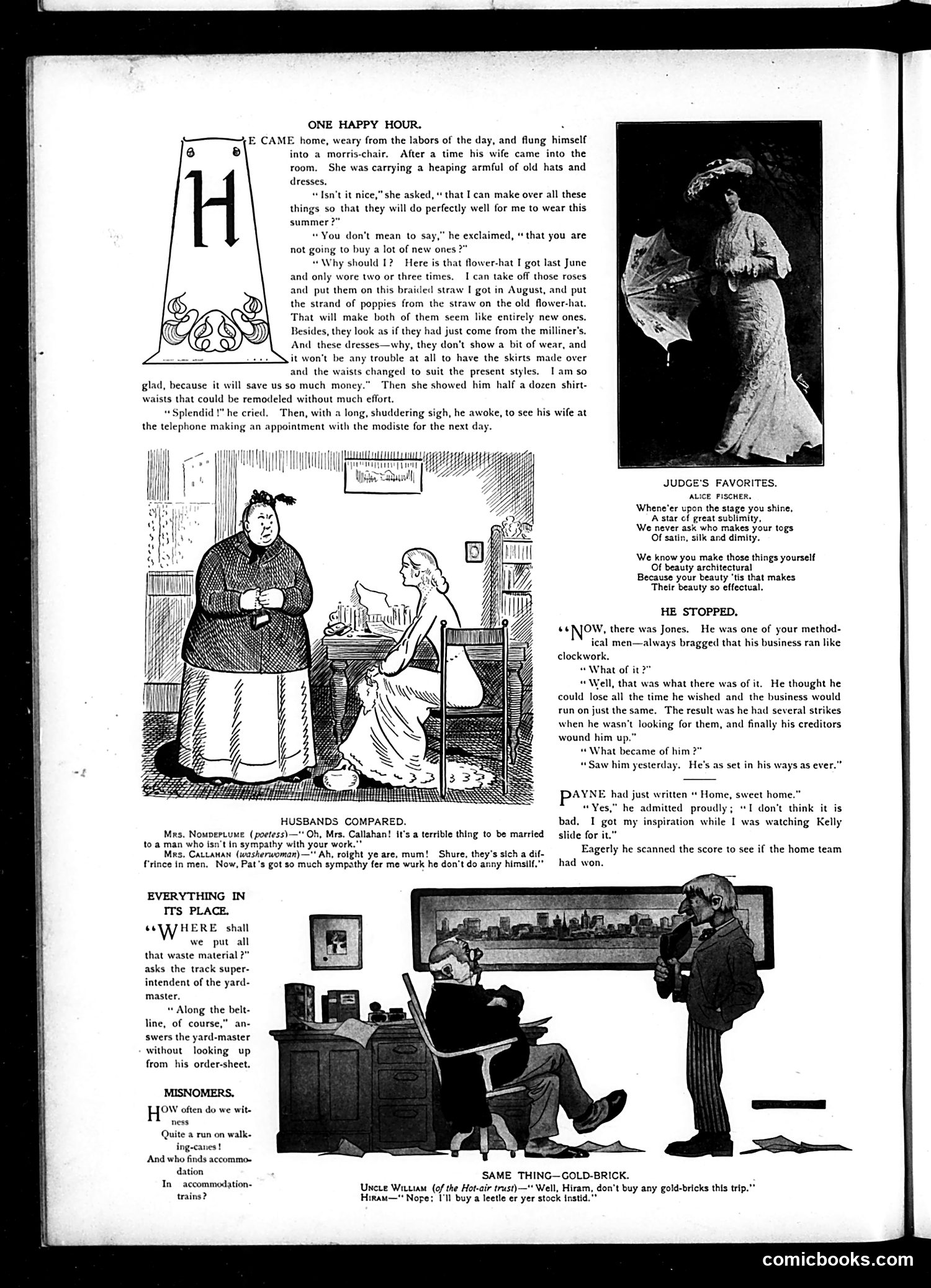
This page contains multiple satirical sketches and text pieces typical of early 20th-century humor magazine content. **"One Happy Hour"** depicts a domestic scene where a wife presents her husband with old hats and dresses to refurbish for summer wear, claiming she'll save money by remodeling rather than buying new. The satire targets both wasteful consumerism and the tedious domestic economy women were expected to manage. **"Husbands Compared"** mocks different marital types through brief character sketches, using contrasting personalities for comedic effect. The remaining sections—"Everything in Its Place," "Misnomers," and "Uncle William of the Hot-Air Trust"—appear to be miscellaneous joke items and character sketches typical of Judge's format, without specific political references evident from the visible content.
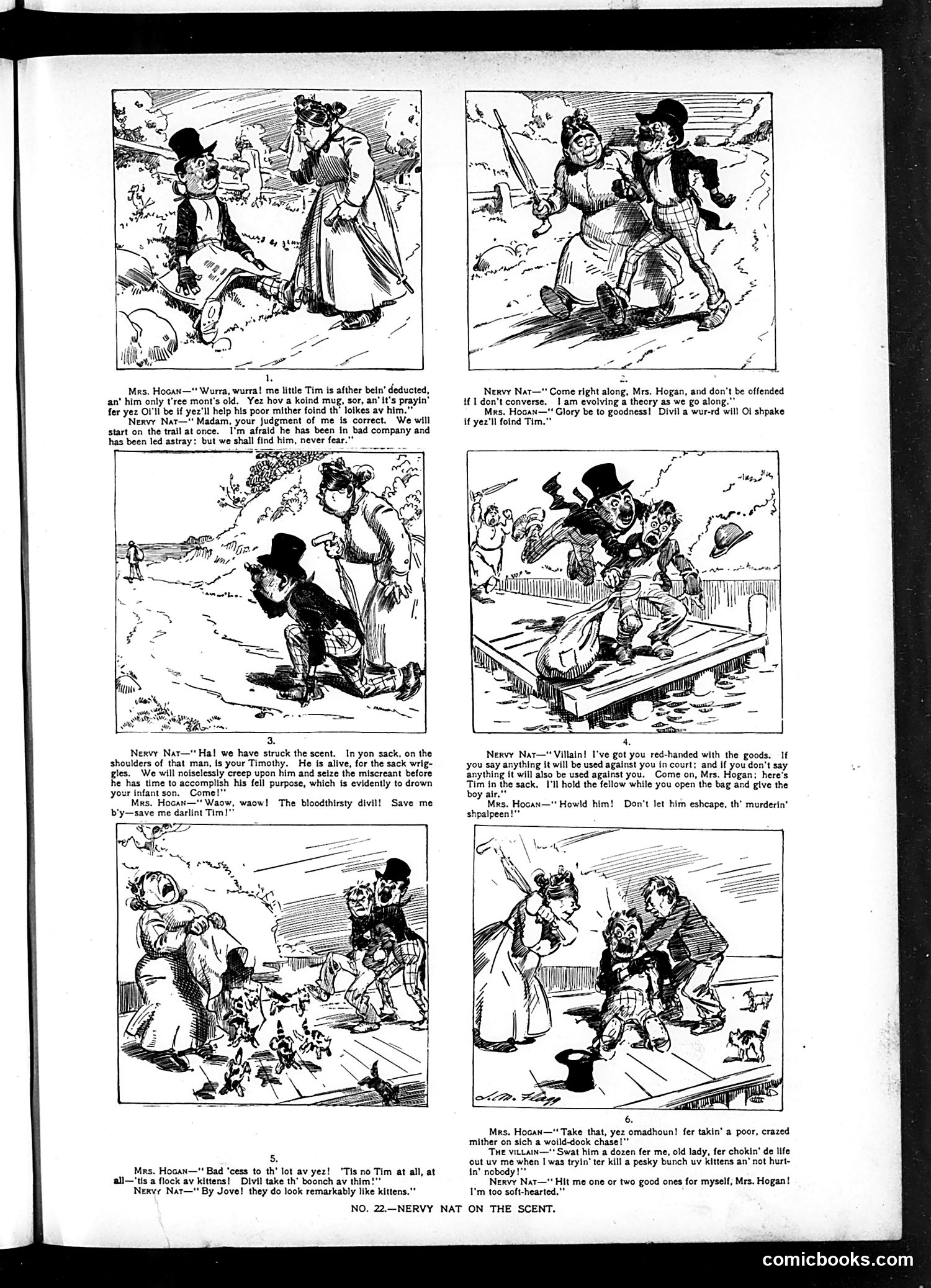
This is a comedic strip featuring "Nervy Nat," an apparent detective parody, hired by an Irish immigrant woman (Mrs. Hogan, characterized by heavy dialect) to find her three-month-old son. The satire mocks both incompetent detective fiction and nativist stereotypes of Irish immigrants. Nat confidently pursues a false lead—a man carrying a sack—certain he's found the kidnapper. After a dramatic "arrest," they discover the sack contains only kittens, not the baby. The "villain" reveals he was merely trying to drown the cats. The joke's layered absurdity—a three-month-old couldn't have wandered far, the detective's overconfidence produces zero results, and everyone ends up equally ridiculous—satirizes both melodramatic mystery stories popular at the time and perhaps Irish stereotypes through exaggerated dialect humor common in Judge's satirical approach.
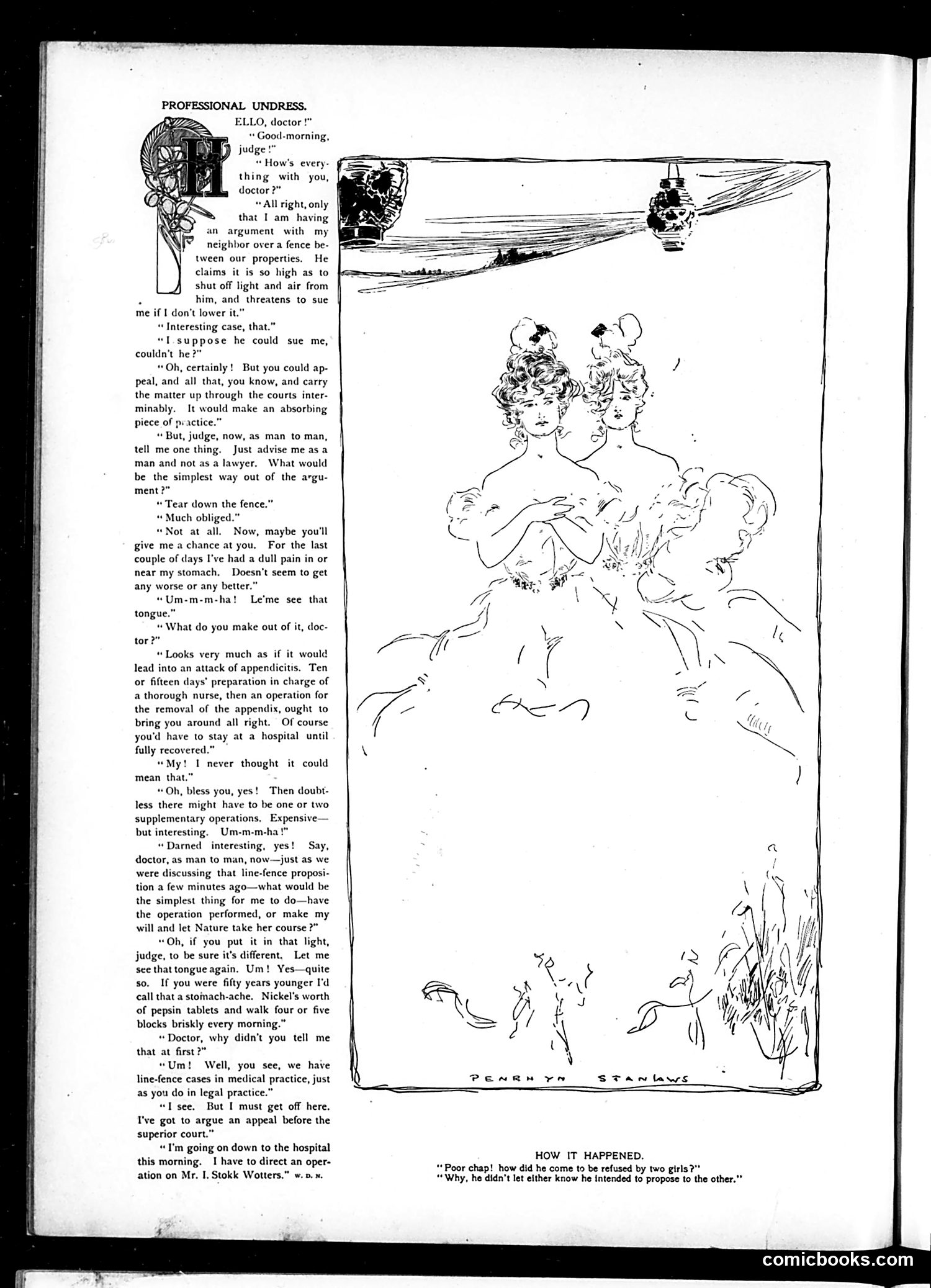
This satirical piece mocks the self-interested incentives of professionals—specifically lawyers and doctors. A judge and doctor converse, with each initially giving self-serving advice to the other: the doctor recommends costly, unnecessary litigation over a fence dispute; the judge prescribes an expensive appendix operation. When each reverses roles and asks for candid "man to man" advice, both instantly change their recommendations to the simplest, cheapest solutions (tear down the fence; take pepsin tablets and walk). The cartoon's title and final panel expose how professionals prioritize billable hours over clients' actual needs. The bottom panel reinforces the theme of duplicity: a man's proposal rejection stems from poor communication rather than circumstance—another failure of honesty. The satire critiques professional ethics and the profit motive corrupting advice-giving, a timeless concern.
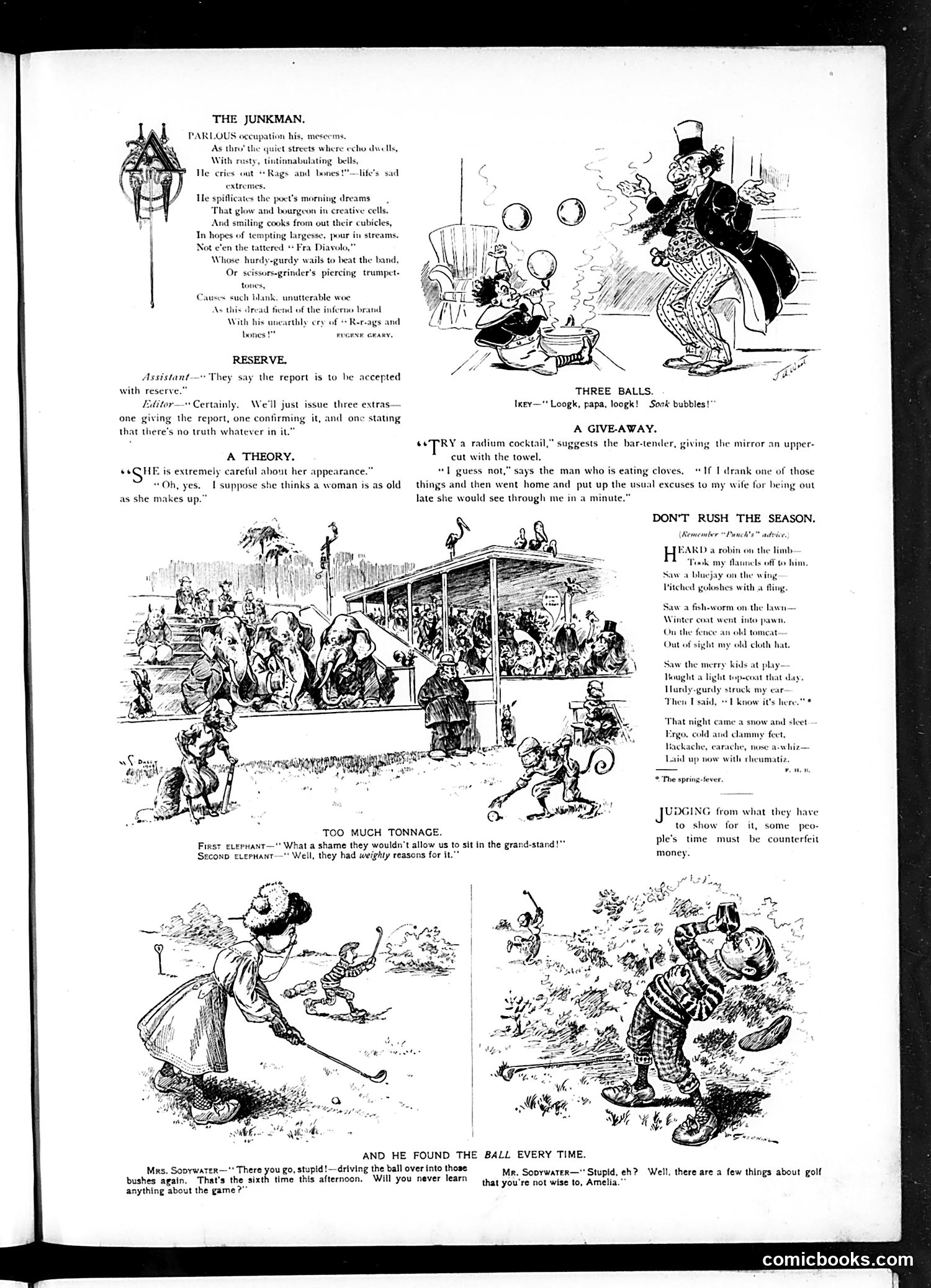
This Judge magazine page combines several brief satirical pieces mocking everyday irritations and social pretensions of the era. **"The Junkman"** opens with a poem criticizing the junk collector's loud street cries and their disruptive effect on city life—presented as worse than other urban nuisances like organ grinders or scissors-grinders. **"Reserve"** and **"A Theory"** mock newspaper editorial practices and women's vanity respectively, using brief dialogue jokes. **"Three Balls"** jokes about pawnbrokers (traditionally marked by three balls). **"Don't Rush the Season"** satirizes those who prematurely adopt spring activities—wearing light coats during unseasonal snow, leading to illness—cautioning against premature seasonal optimism. **"Too Much Tonnage"** and **"Golf"** are visual gags about servants being excluded from grandstands for weight reasons, and a wife's frustration with her husband's poor golf skills. The humor relies on recognizable urban types and domestic situations rather than specific political references.
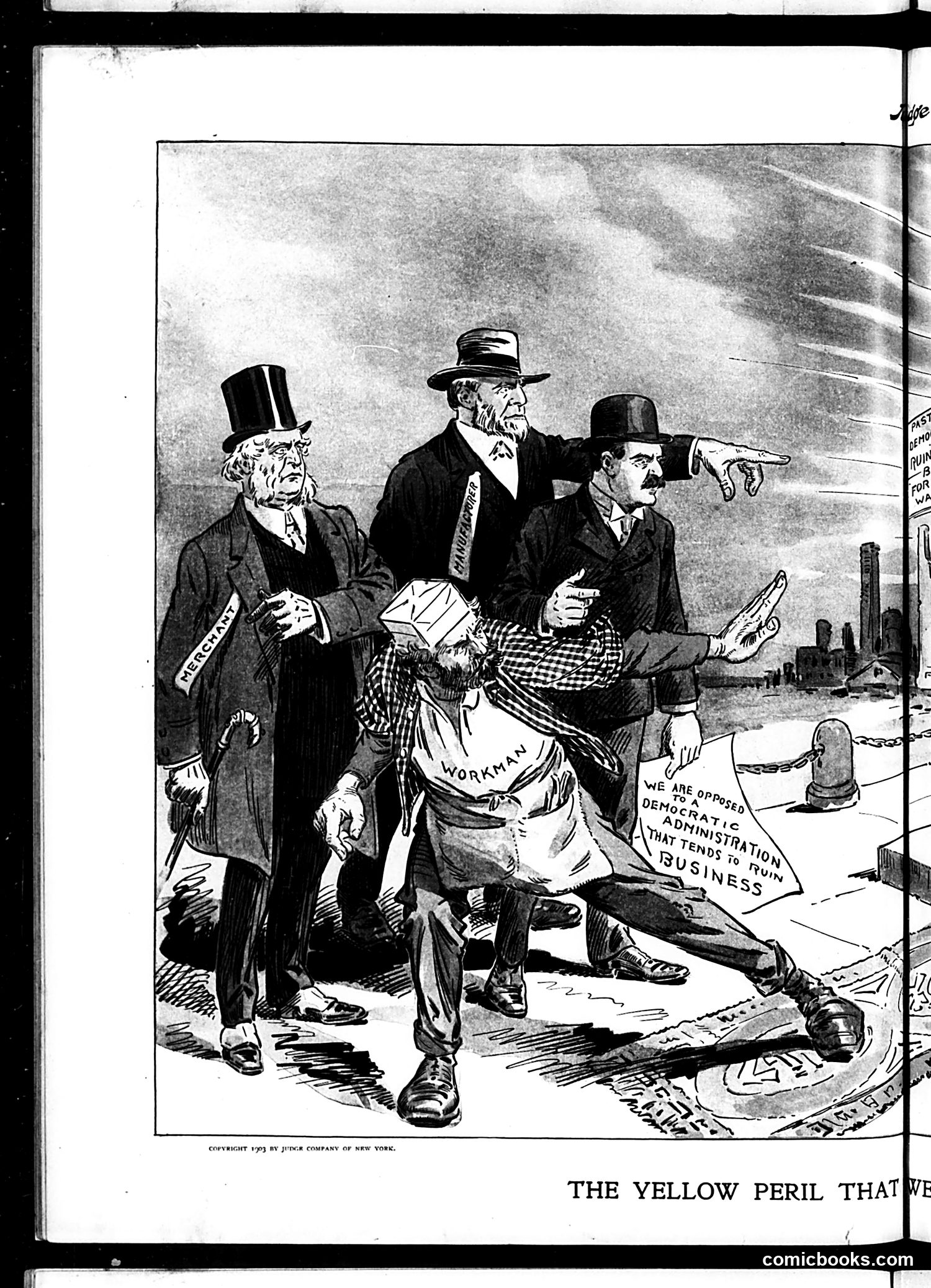
This political cartoon from *Judge* magazine depicts three well-dressed men in top hats physically attacking or restraining a figure labeled "WORKMAN." The assailants appear to represent business or political interests, while the sign reads "WE ARE OPPOSED TO DEMOCRATIC ADMINISTRATION THAT TEND TO RUIN BUSINESS." The cartoon satirizes opposition to Democratic policies, suggesting that wealthy business interests actively work against labor and working-class protections under the guise of protecting "business." The "yellow peril" reference in the title (likely continuing below the visible frame) may indicate xenophobic economic anxieties of the era. The overall message critiques how business elites weaponize anti-Democratic rhetoric while literally oppressing workers.
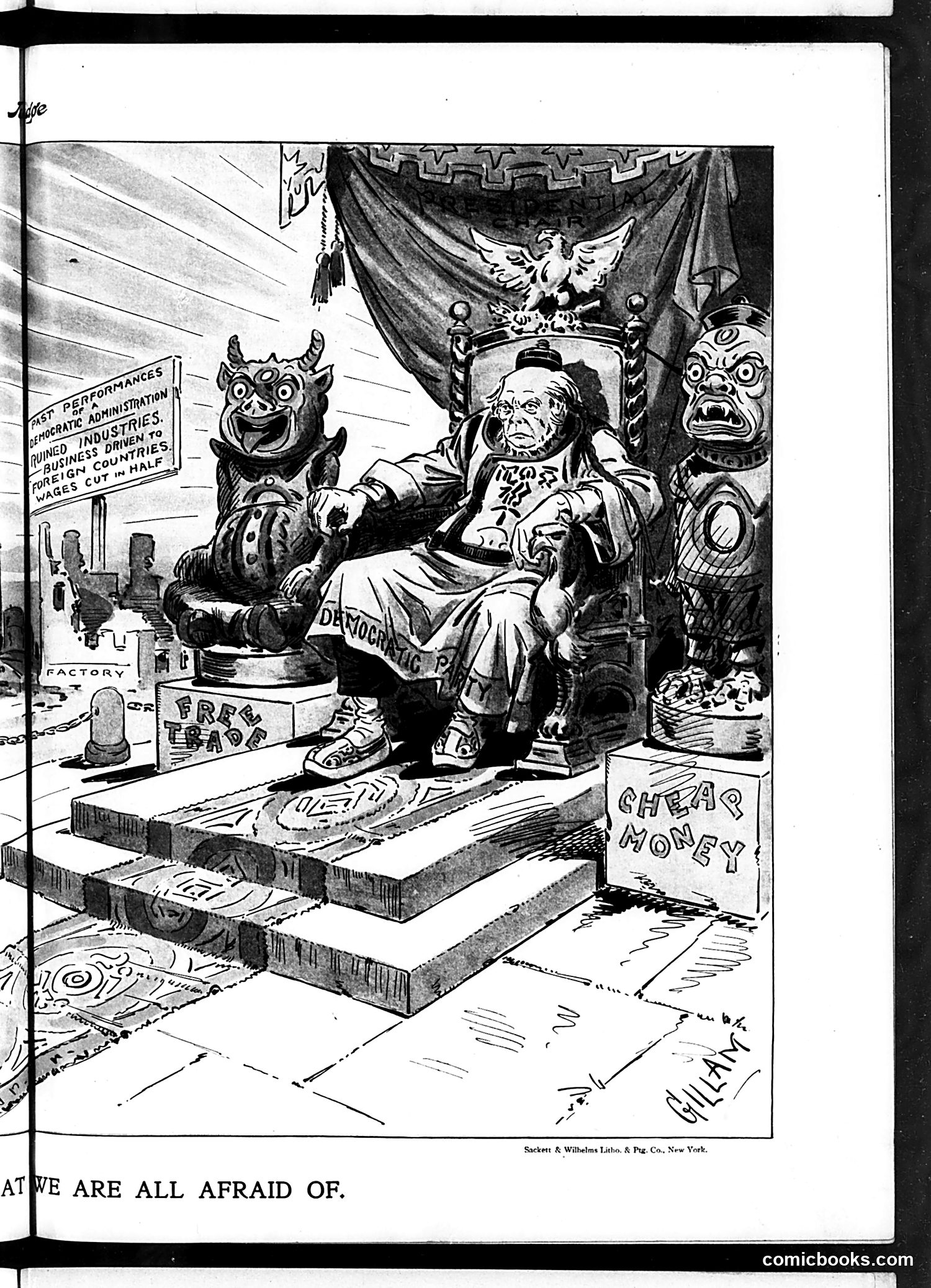
This satirical cartoon depicts a figure labeled "DEMOCRATIC" seated on a throne, surrounded by grotesque demons or monsters representing various economic fears. The visible text references "CHEAP MONEY" and mentions concerns about "business industries" and "foreign countries." A sign on the left reads "BEST PERFORMANCES DURING ADMINISTRATION." The cartoon appears to satirize Democratic economic policies, suggesting the party's governance produces monstrous consequences—likely referencing inflation, currency devaluation ("cheap money"), or mismanagement of business and international trade. The demons embody public anxieties about economic mishandling. The satire criticizes Democratic administration by visually equating their policies with people's deepest financial fears. Without a visible date, the specific historical moment remains unclear, though this appears to be early-to-mid 20th century political commentary from *Judge* magazine.
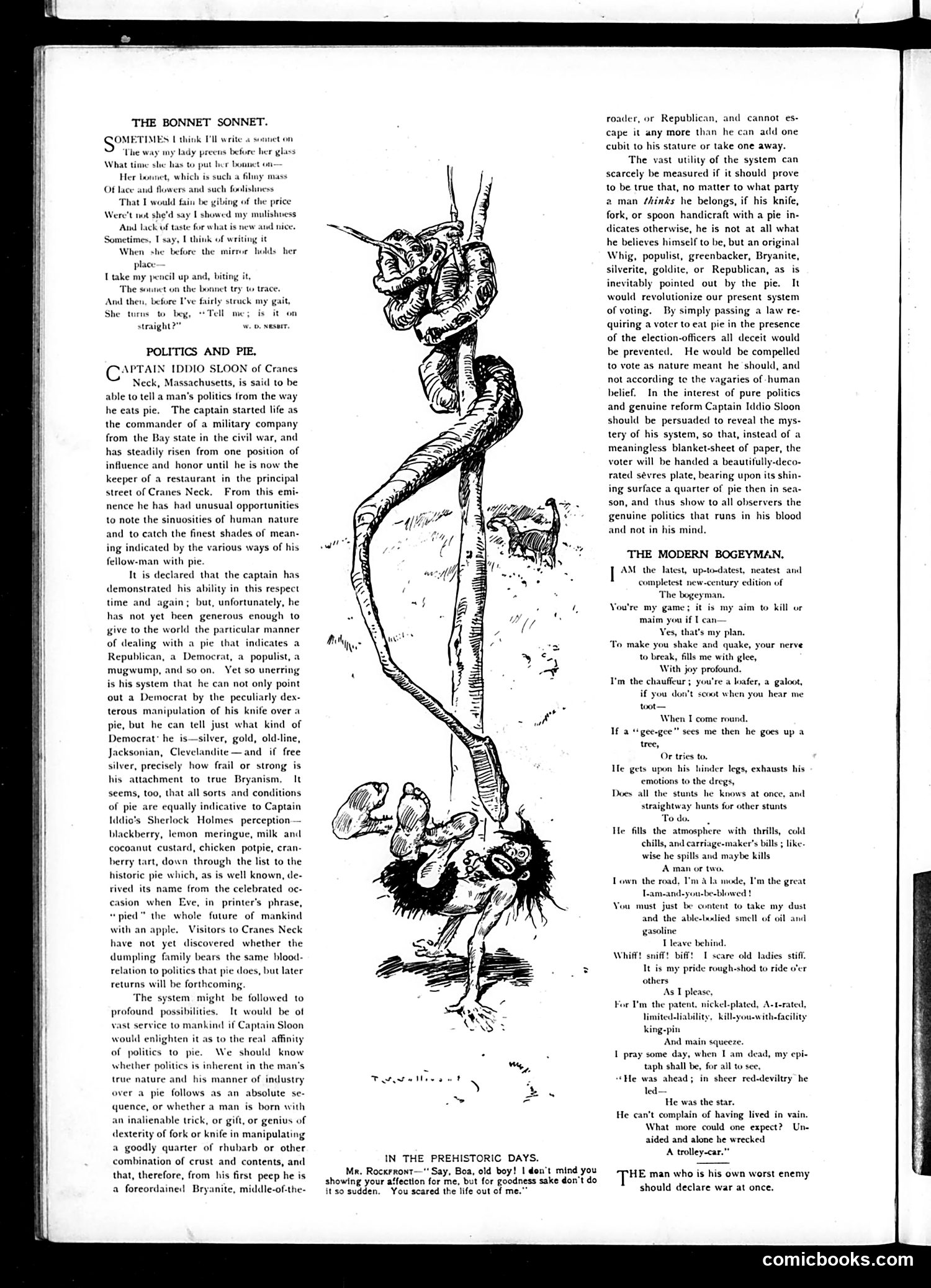
This is a humorous mock-serious article about Captain Iddio Sloon, a Massachusetts restaurant keeper who supposedly can determine a man's political affiliation by observing how he eats pie. The satire targets late-19th-century American political divisions and obsessive partisan categorization. The accompanying grotesque illustration depicts a distorted figure eating pie in an exaggerated manner, emphasizing the absurdity of the premise. The joke operates on multiple levels: it mocks Captain Sloon's presumed expertise as pseudoscientific nonsense; satirizes the era's intense party factionalism (mentioning "silver," "gold," "Bryanism," Populists, and Democrats); and suggests that political identity might be predetermined rather than chosen—implying politics itself is somewhat ridiculous and inescapable. The text humorously proposes using pie-eating behavior as a voter verification method, highlighting how arbitrary and absurd contemporary political divisions seemed to Judge's editors.
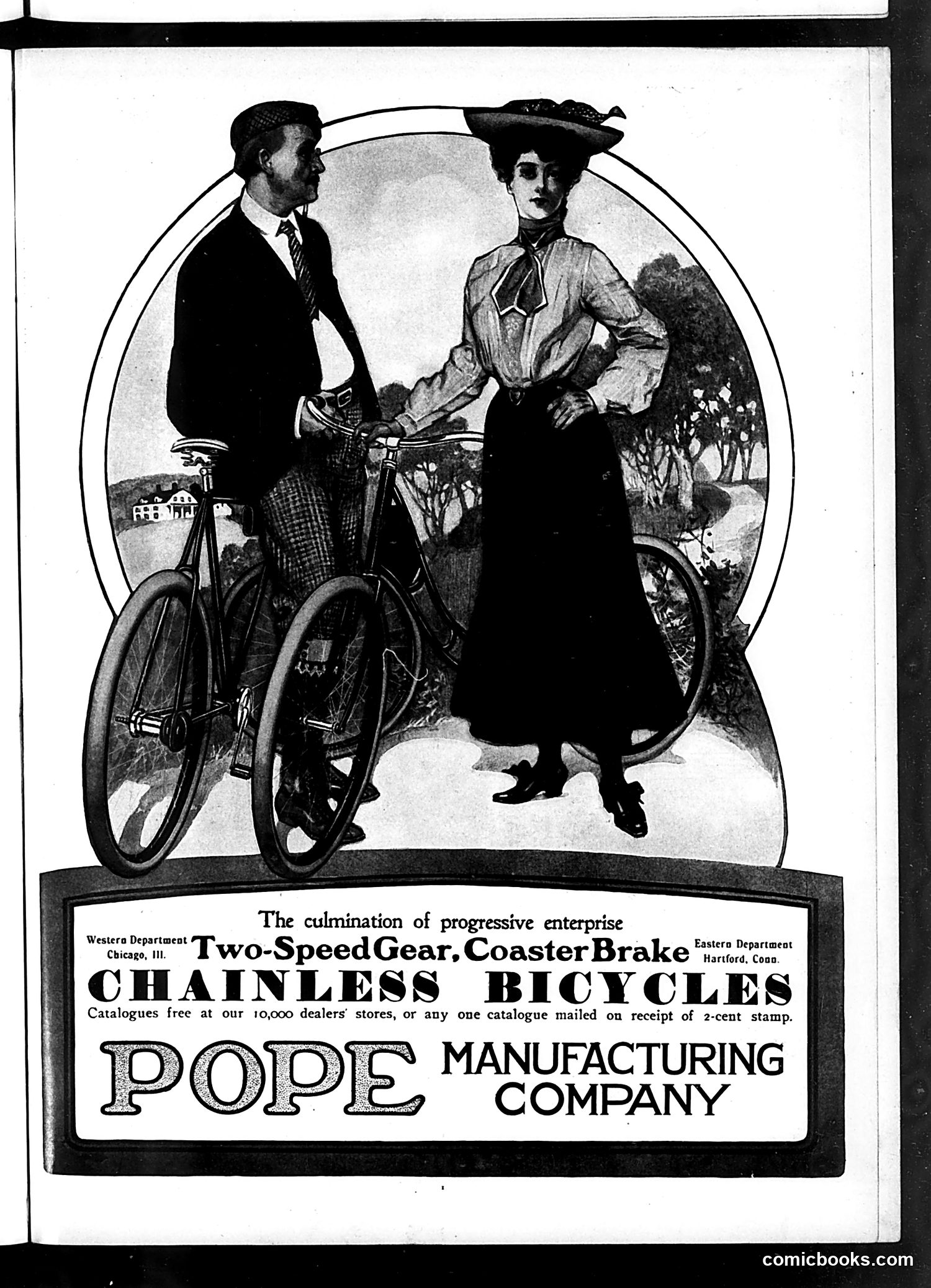
This is primarily a **product advertisement**, not political satire. Pope Manufacturing Company advertised their "chainless bicycles" with two-speed gear and coaster brake—innovations marketed as "the culmination of progressive enterprise." The image shows a well-dressed couple with their bicycles, appealing to affluent consumers. The woman wears fashionable early 1900s attire including a large hat; the man wears a suit and tie. This reflected bicycles' status as modern leisure equipment for the middle and upper classes. The advertisement emphasizes availability ("10,000 dealers' stores") and offers free catalogues for a two-cent stamp. Pope Manufacturing was a major American bicycle manufacturer. The "chainless" design was a genuine technical advancement marketed to appeal to customers seeking modern, progressive products—though this particular ad contains no satirical content typical of Judge magazine.
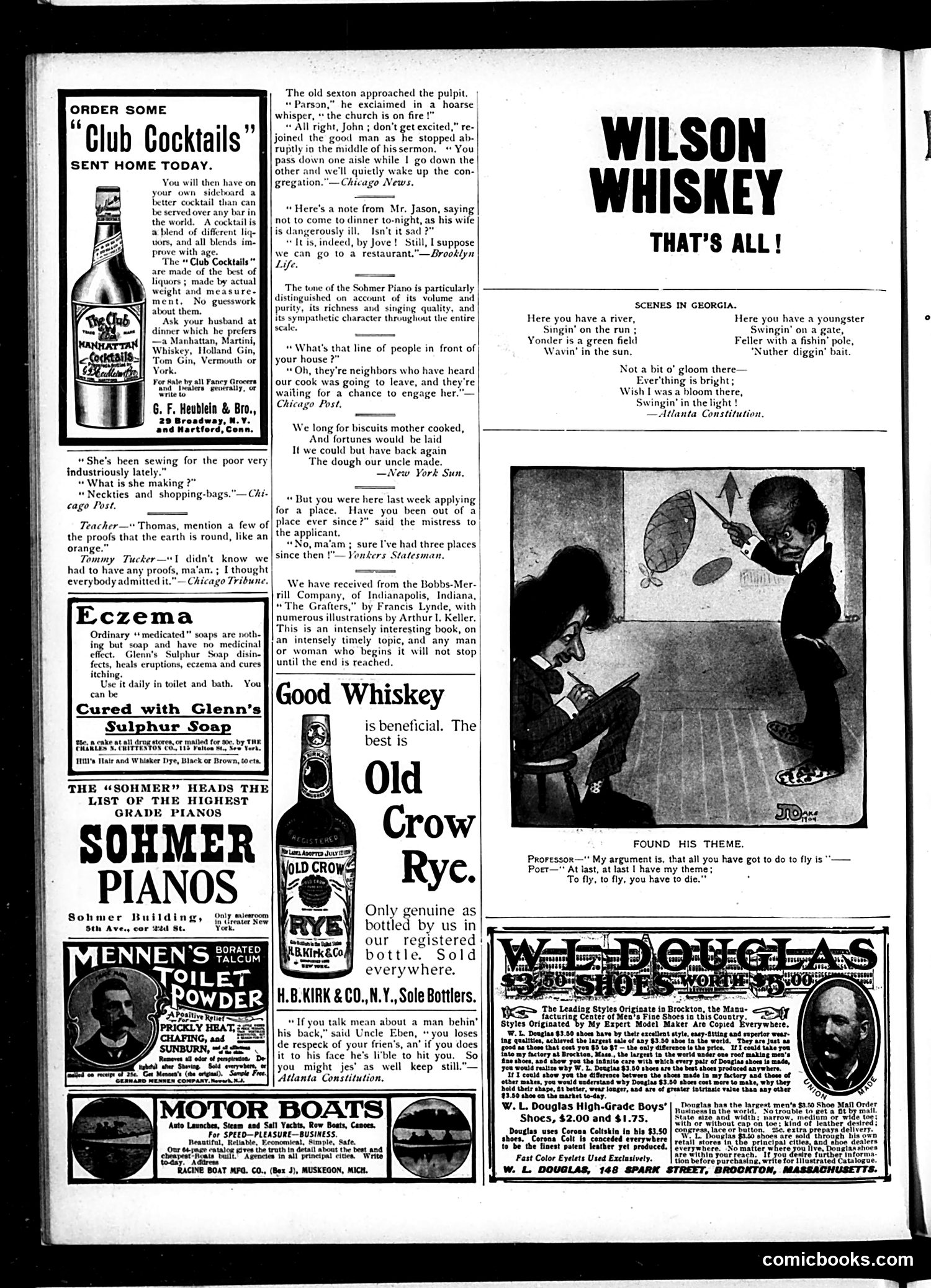
This page is primarily **advertising**, typical of early 20th-century magazines. The dominant content includes ads for cocktail mixes, pianos, motor boats, talcum powder, and whiskey—interspersed with brief humorous anecdotes. The small jokes scattered throughout reflect period humor: a sexton calmly extinguishing a church fire during a sermon; a widow considering a restaurant dinner after her husband's illness cancellation; job applicants cycling through multiple positions. These are gentle, domestic comedies with no evident political satire. The **Wilson Whiskey** advertisement ("That's All!") and accompanying Georgia scene illustration appear to be straightforward marketing, not satirical commentary. The page lacks political cartoons or identifiable caricatures of public figures. It represents typical Judge magazine filler—mixing light domestic humor with commercial advertising to fill editorial space between more substantial satirical content elsewhere in the publication.
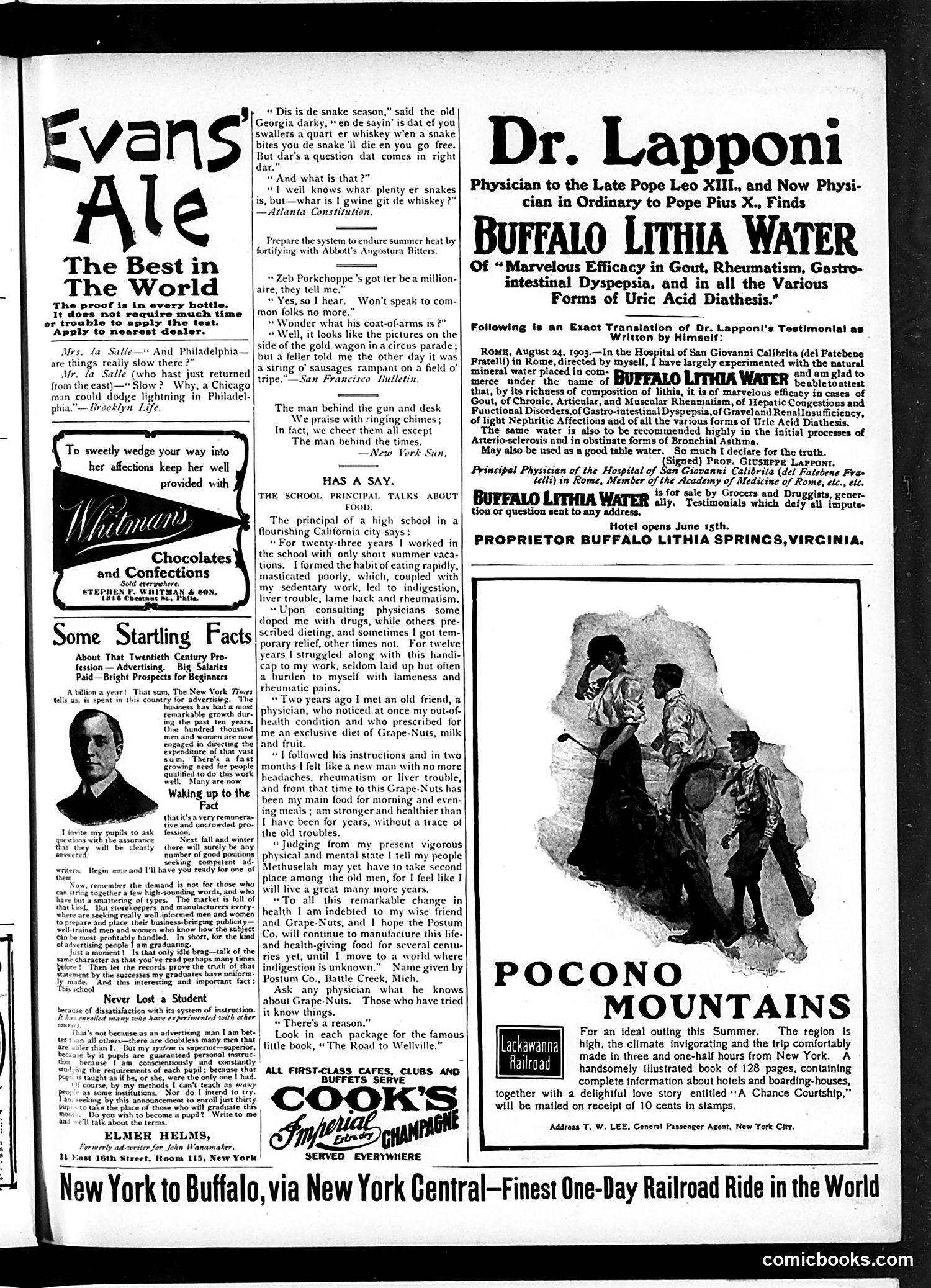
This page is primarily **advertising and humor content**, not political cartoons with significant satirical meaning. The main pieces are: **Evans' Ale advertisement** (top left) - a product endorsement using a rural dialogue joke about whiskey and snakes from the Atlanta Constitution, common period humor playing on African American dialect stereotypes. **Whitman's Chocolates ad** - romance-themed marketing suggesting sweets win affection. **Elmer Helms' Advertising School** - vocational training advertisement claiming graduates never leave dissatisfied, with a testimonial from a school principal describing how proper diet (Grape-Nuts) cured his digestive troubles. **Buffalo Lithia Water advertisement** (right side) - medicinal water promoted by "Dr. Lapponi," physician to Pope Leo XIII, claiming efficacy for gout, rheumatism, and dyspepsia. **Pocono Mountains tourism** - vacation destination promotion. The page reflects **early 1900s advertising culture**: patent medicine claims, immigrant and racial stereotypes in humor, and appeals to health through commercial products were standard editorial content in American magazines.
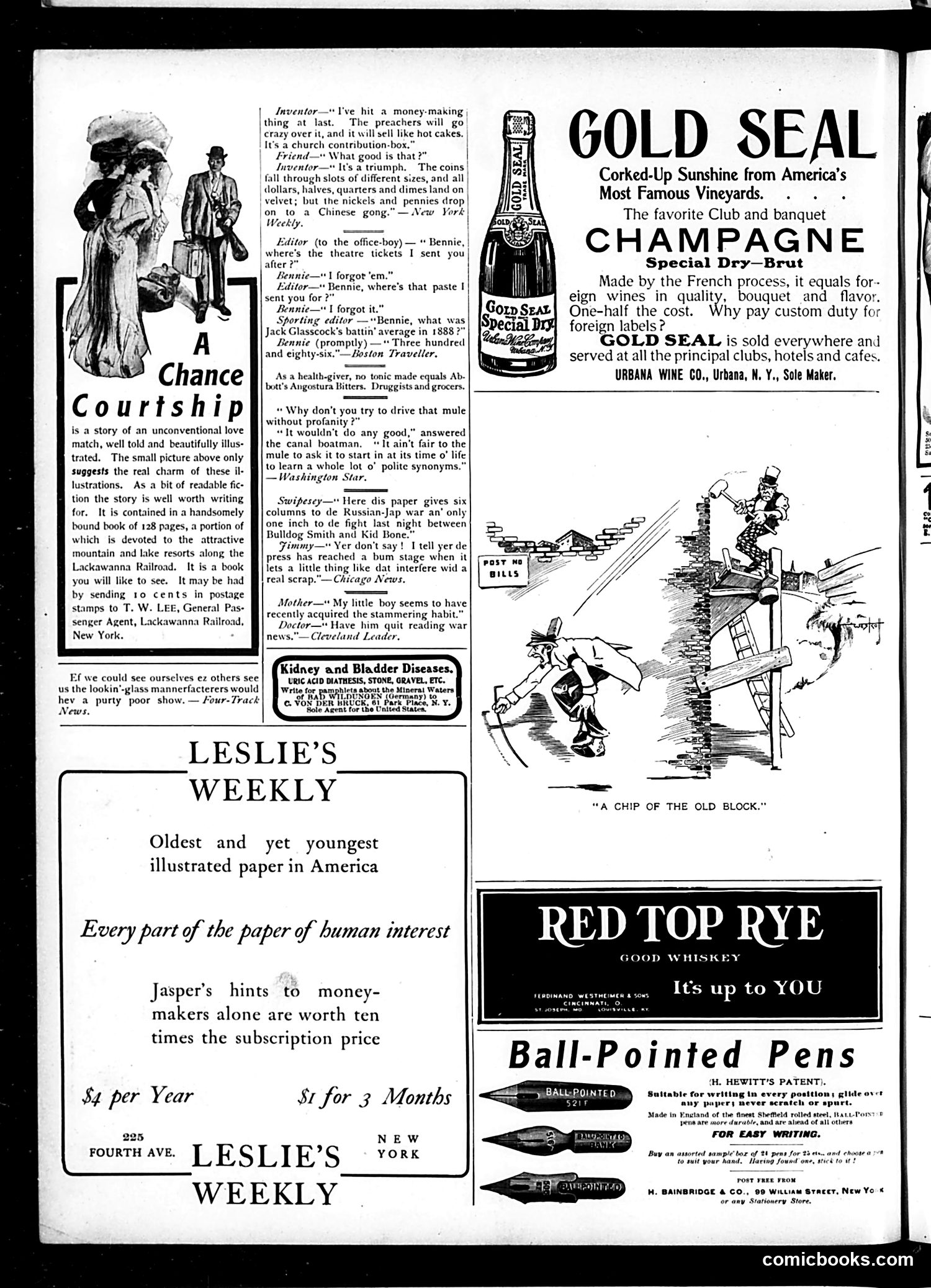
This appears to be primarily a **page of advertisements and brief humorous items** rather than a cohesive political cartoon or editorial message. The content includes: **Humorous Anecdotes:** Several short jokes mock everyday situations—a church contribution box designed to separate coins by value (nickels/pennies fall on a gong while larger coins land on velvet), an office boy who conveniently remembers baseball statistics but forgets actual tasks, and a canal worker's colorful language with mules. **Social Commentary:** One item satirizes newspaper priorities, contrasting extensive coverage of the Russian-Japanese War against minimal space for a local boxing match—suggesting mockery of either sensationalism or misplaced editorial judgment. **Advertising:** The bulk of the page promotes Gold Seal Champagne, Red Top Rye whiskey, Ball-Pointed Pens, and Leslie's Weekly magazine itself, interspersed with medical ads and a book promotion for "A Chance Courtship." The satirical tone is gentle, focused on human foibles rather than political targets. The page reflects early 1900s consumer culture and middle-class American humor.
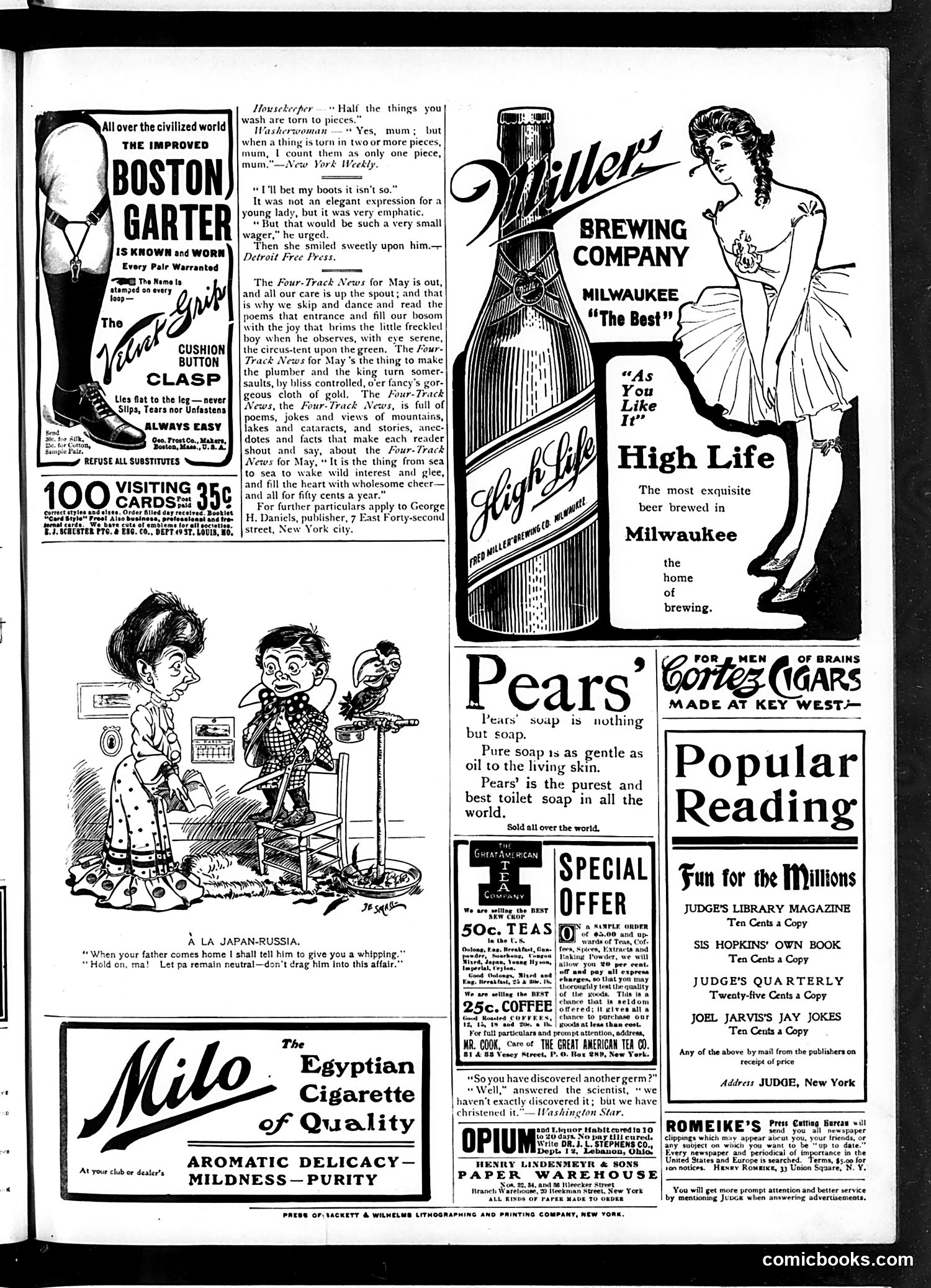
This page is primarily **advertising**, with two brief humorous text snippets and one cartoon. ## The Cartoon ("À La Japan-Russia") A mother threatens to tell the father to whip the child; the child replies, "Hold on, ma! Let pa remain neutral—don't drag him into this affair." This is a **political satire** referencing the Russo-Japanese War (1904-1905), when neutrality was a major diplomatic issue. The joke equates parental discipline with international conflict, mocking the child's invocation of neutrality as an excuse to avoid punishment—likely satirizing contemporary debates over whether nations should intervene in foreign conflicts. ## The Text Jokes Brief anecdotes about hosiery durability and a young woman's emphatic (but unladylike) language. ## Advertisements The page features numerous period product ads: Boston garters, High Life beer (Milwaukee), Pears' soap, Milo cigarettes, and various publications (Judge's Library Magazine, etc.). These reflect early 20th-century consumer marketing.
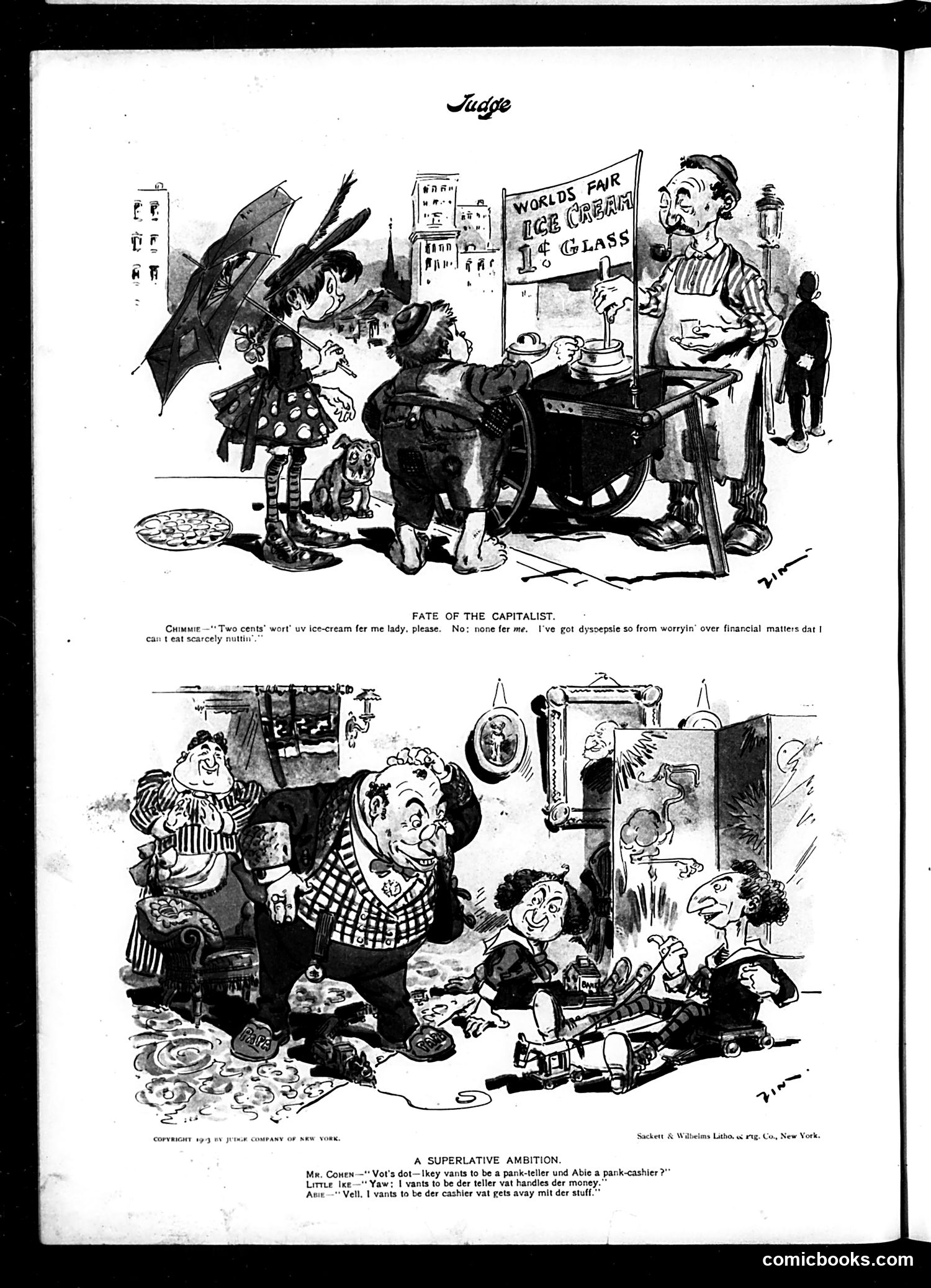
**Top Cartoon: "Fate of the Capitalist"** A wealthy businessman at an ice-cream stand claims he's lost his appetite due to financial anxieties, yet indulges his companion. The satire mocks capitalists who, despite professing worry over money matters, continue lavish spending—suggesting their concerns are performative or that wealth insulates them from genuine hardship. **Bottom Cartoon: "A Superlative Ambition"** Using exaggerated Yiddish-inflected dialect, immigrant Jewish characters discuss their sons' aspirations: one wants to be a bank teller, the other a bank cashier. The punchline reveals their real goals—one wants access to money; the other wants to steal it. This reflects period stereotypes portraying Jewish immigrants as inherently dishonest or criminally inclined, a deeply offensive but common anti-Semitic trope in early 20th-century American satire. Both cartoons target class anxieties and xenophobic fears prevalent in the era.