
A complete issue · 21 pages · 1903
Judge — November 28, 1903
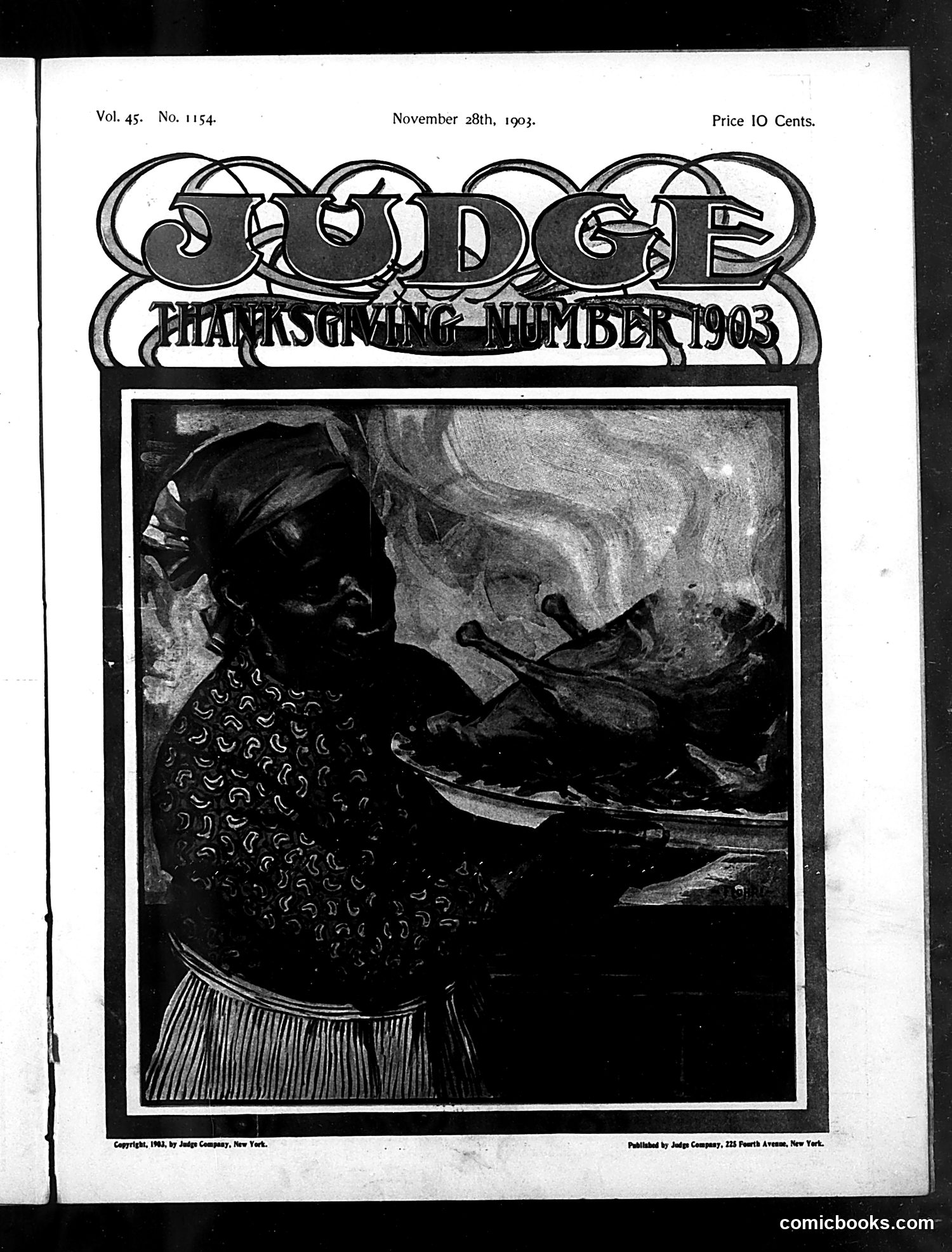
This is the cover of Judge's Thanksgiving issue from November 28, 1903. The image shows a figure in elaborate patterned clothing and headwear, depicted in a caricatured style common to the era, preparing or presenting what appears to be poultry for a meal. Without additional context or visible text identifying the specific figure, the satire's exact target remains unclear. However, given Judge's role as a satirical publication, this likely comments on contemporary political or social figures through the Thanksgiving metaphor—a common trope associating current events or personalities with holiday preparations. The ornate costume and exaggerated features suggest the subject was likely a public figure recognizable to 1903 readers. The specific meaning would require period newspapers or Judge's editorial materials for confirmation.
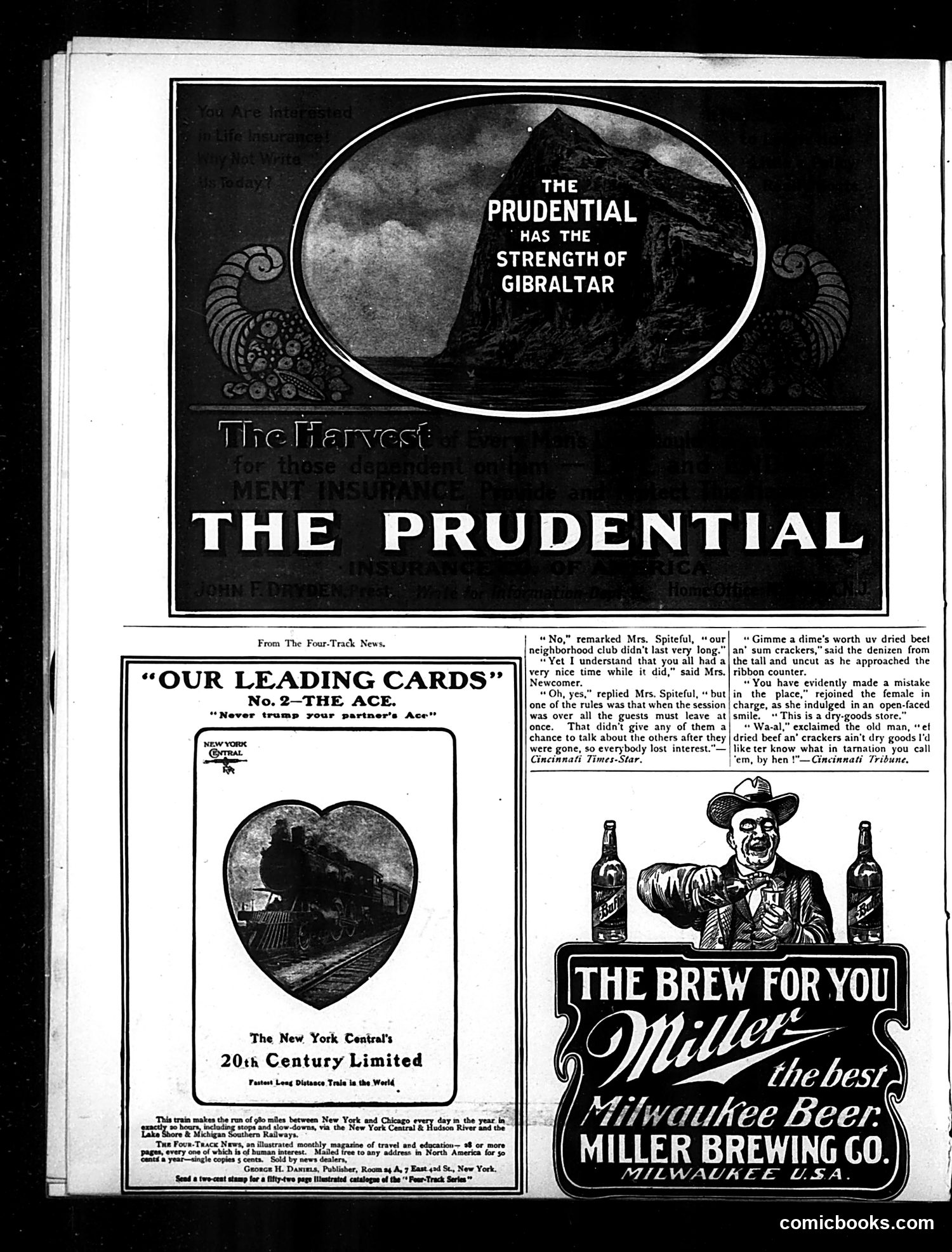
This page is primarily **advertising rather than editorial content**. The top features a Prudential Insurance advertisement emphasizing the company's strength ("has the strength of Gibraltar"), a common insurance industry metaphor of the era. Below are two distinct ads: one for the New York Central's "20th Century Limited" luxury train (using a heart-shaped image), and one for Miller Beer, featuring a jovial character promoting "The Brew for You." The small text snippets appear to be reader letters or brief humor items unrelated to the advertisements. Without clearer context or visible cartoon figures with political significance, this appears to be a standard **magazine page mixing advertising with miscellaneous content**, rather than satirical commentary. The ads reflect early 20th-century consumer marketing strategies.
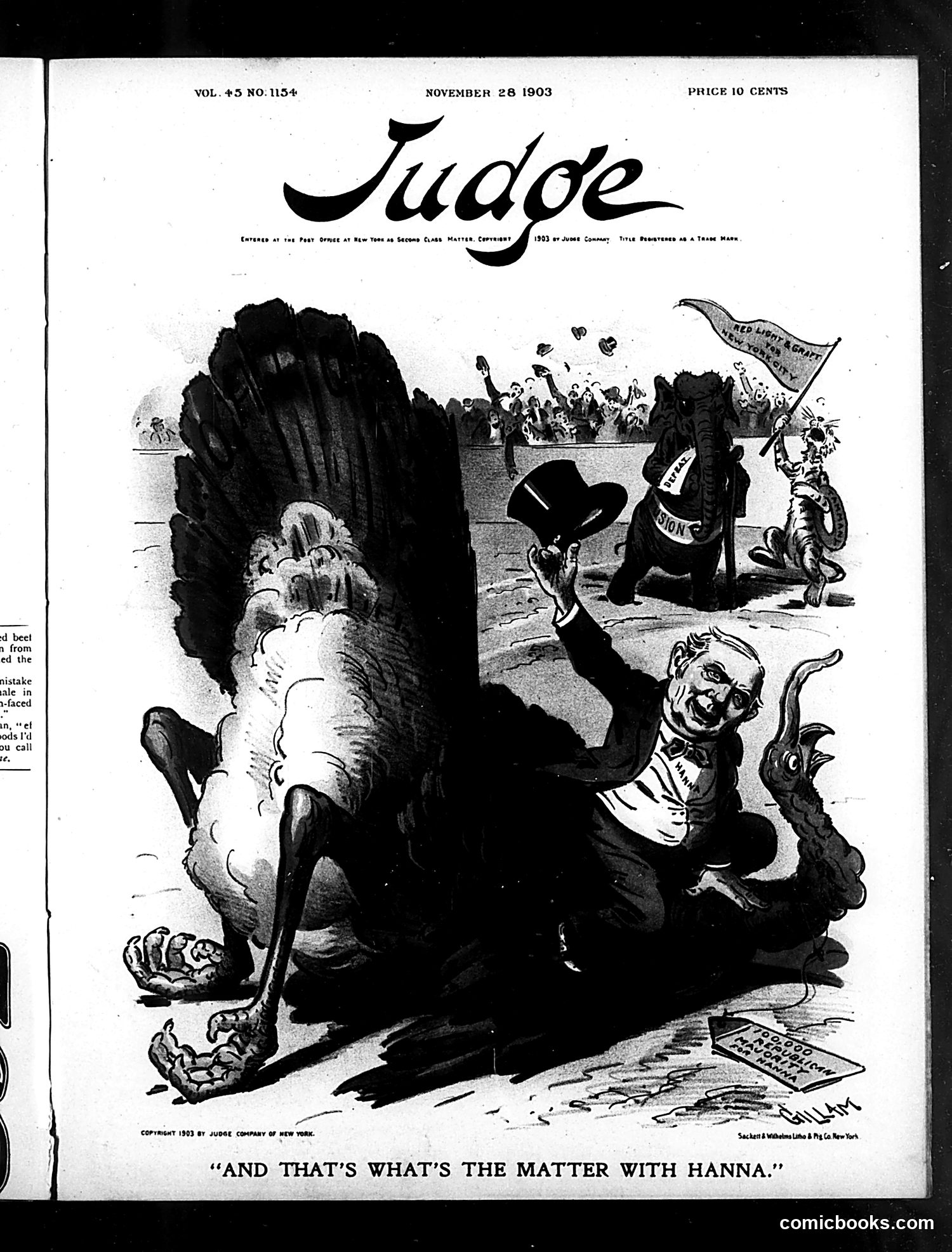
This November 1903 *Judge* cartoon satirizes a political figure named Hanna (likely Mark Hanna, prominent Republican politician and McKinley ally). The caricature depicts him as a grotesque figure with exaggerated features, seated in what appears to be a theater or stadium setting with crowds in the background. The cartoon's satirical point centers on criticizing Hanna's political influence or controversial actions—though the specific incident isn't entirely clear from the image alone. The theatrical setting and cheering crowd suggest public controversy or scandal. The grotesque rendering was typical of *Judge*'s harsh political caricature style, intended to ridicule and delegitimize the subject among readers.
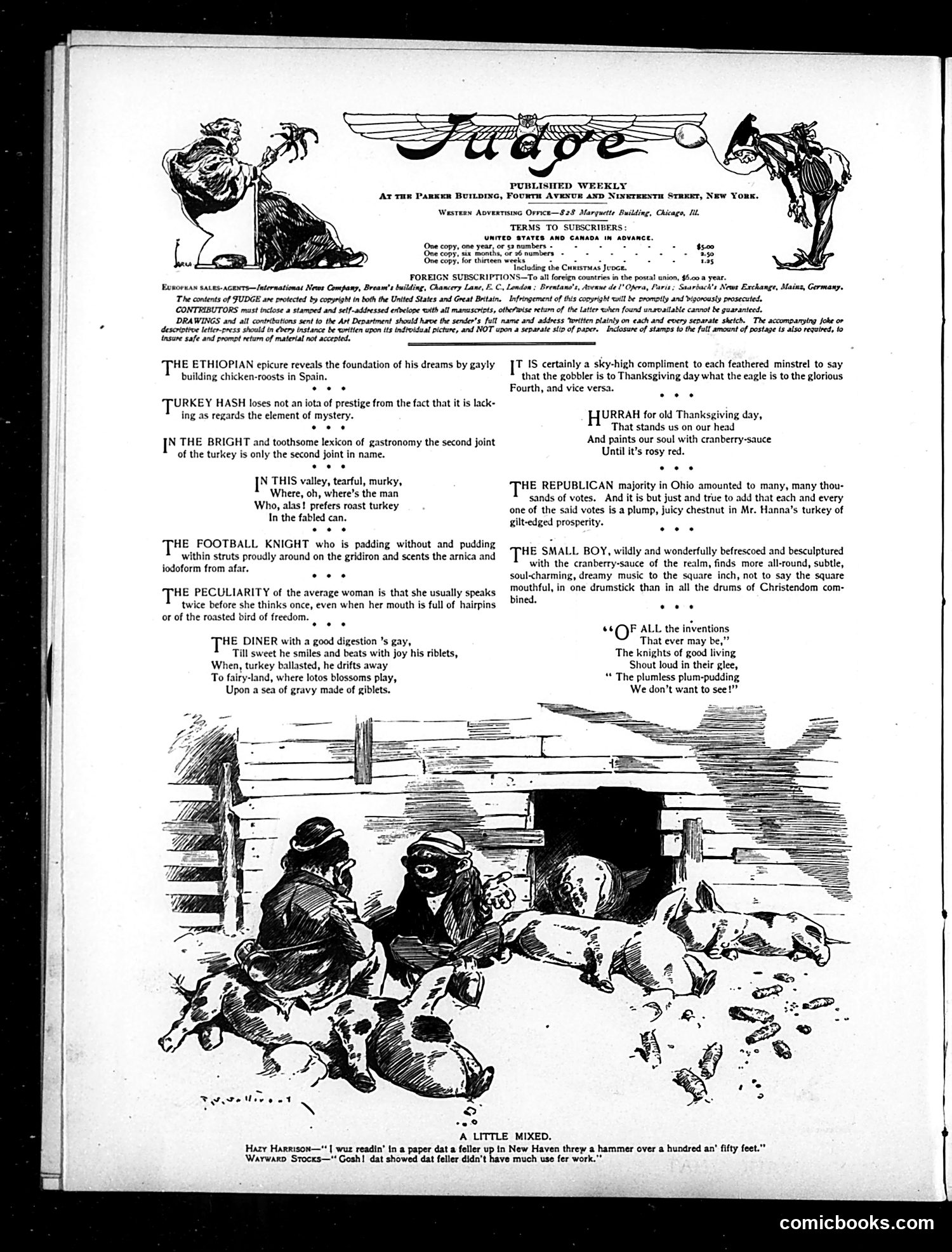
This page combines holiday humor with political commentary. The main cartoon titled "A Little Mixed" depicts two figures in a pig pen—likely referencing a contemporary political scandal or controversy involving corruption or moral failings. The juxtaposition of politicians with pigs suggests they're "wallowing" in wrongdoing. The scattered text pieces above—about turkey, Thanksgiving, and Republican politics—reference the 1920s era. One mentions "THE REPUBLICAN majority in Ohio" and a vote involving "a plump, juicy chestnut in Mr. Hanna's turkey of gilt-edged prosperity," suggesting criticism of Ohio Republican Senator Mark Hanna's political machine and economic policies. The overall tone mixes holiday themes with satirical jabs at political corruption and party leadership, typical of Judge's approach during this period.
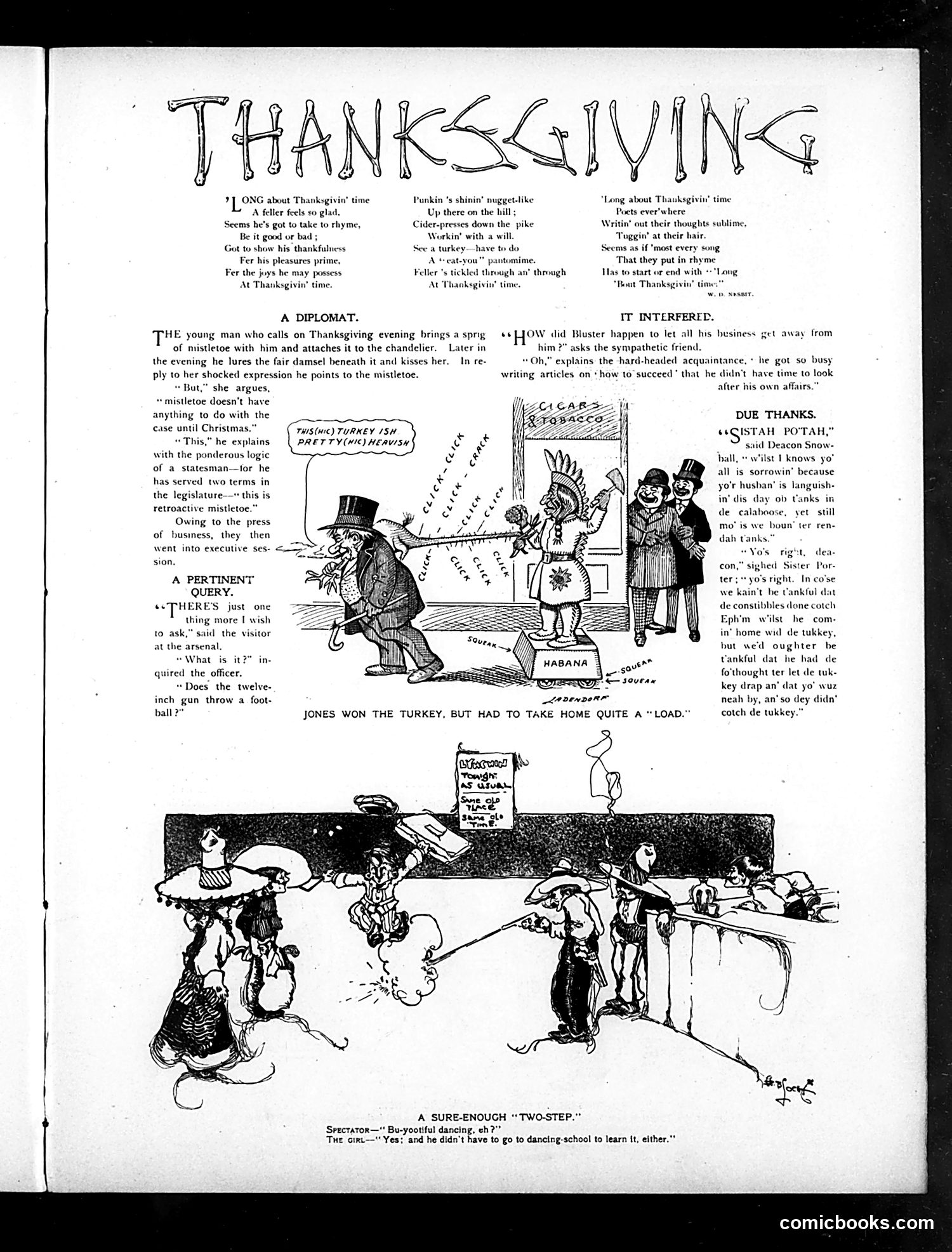
This page collects Thanksgiving-themed verses and comic sketches. The main satirical pieces include: **"A Diplomat"**: A young man uses "retroactive mistletoe" as a flimsy legal excuse to kiss a woman on Thanksgiving (when mistletoe isn't traditionally relevant until Christmas). The joke mocks politicians' use of convoluted logic to justify questionable behavior. **"It Interfered"**: A man became so busy writing self-help articles about success that he neglected his own business and failed—satirizing the hypocrisy of advice-givers who don't follow their own guidance. **"Jones Won the Turkey"**: A man must carry home a large, heavy turkey—the "load" suggesting drunkenness or exhaustion. The remaining items are light verse about Thanksgiving traditions and minor comic sketches about mistletoe, turkeys, and dancing. The overall tone is gentle holiday humor rather than sharp political satire, typical of Judge's mixed content.
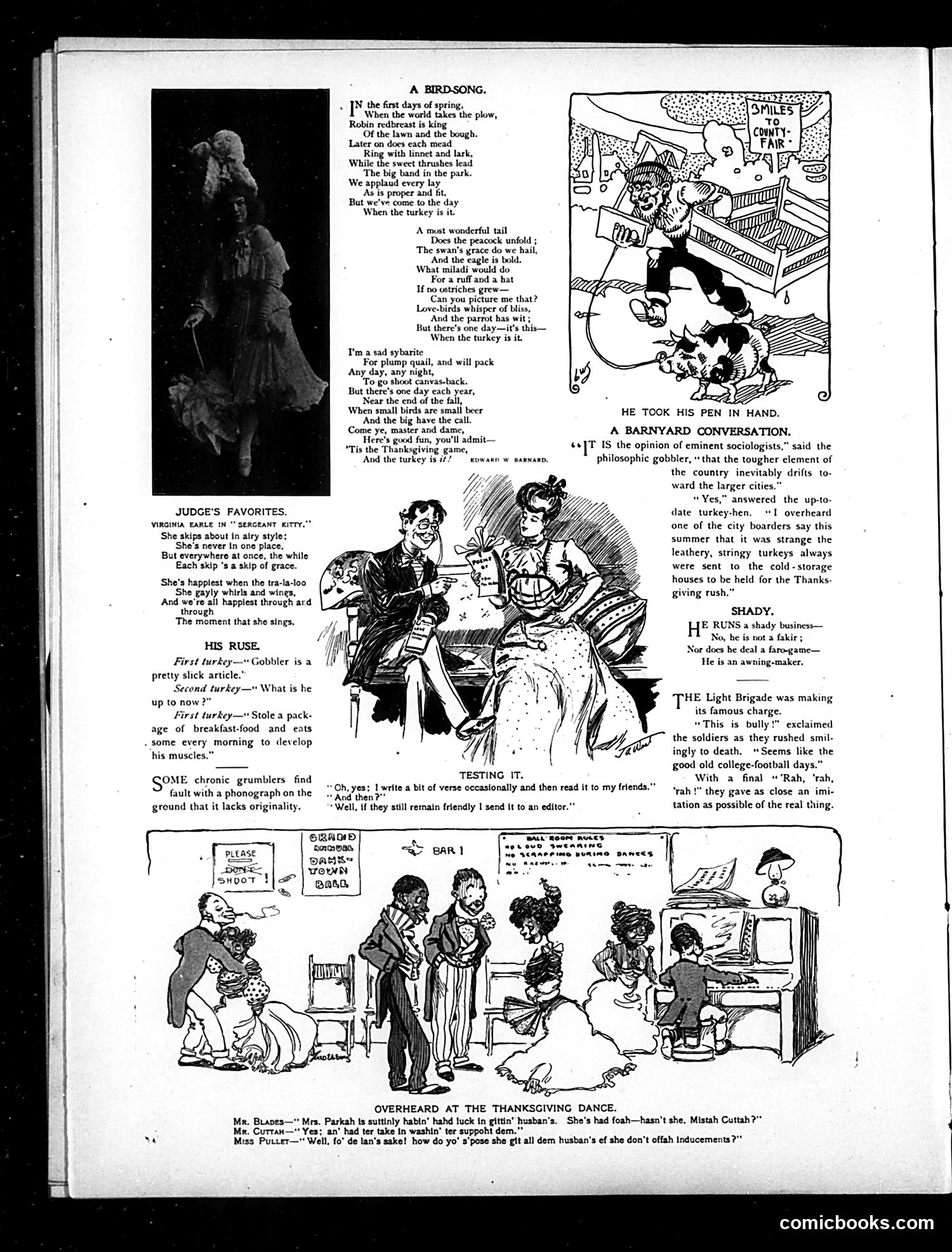
This page celebrates Thanksgiving through multiple satirical pieces, all centered on turkeys as the holiday's main subject. **"A Bird-Song"** is a poem humorously ranking birds by cultural importance, concluding that while peacocks, swans, and eagles are admired year-round, "the turkey is it"—meaning the turkey alone defines a specific holiday and moment of glory. **"A Barnyard Conversation"** depicts a pompous turkey-gobbler pontificating about urban sociology to a turkey-hen, who cynically reveals she overheard city boarders discussing how tough, stringy turkeys are relegated to cold storage before Thanksgiving—undermining his pretentious philosophizing with the grim reality that turkeys are primarily valued as food. The lower cartoon, **"Overheard at the Thanksgiving Dance,"** uses racial dialect humor (common in early-20th-century Judge) to joke about a woman's multiple marriages, with women wondering how she attracts husbands without "offering inducements." The page also includes lighter content: theatrical reviews, puns about awning-makers running "shady" businesses, and jokes about turkeys trying various schemes (eating muscle-building food) to avoid their fate.
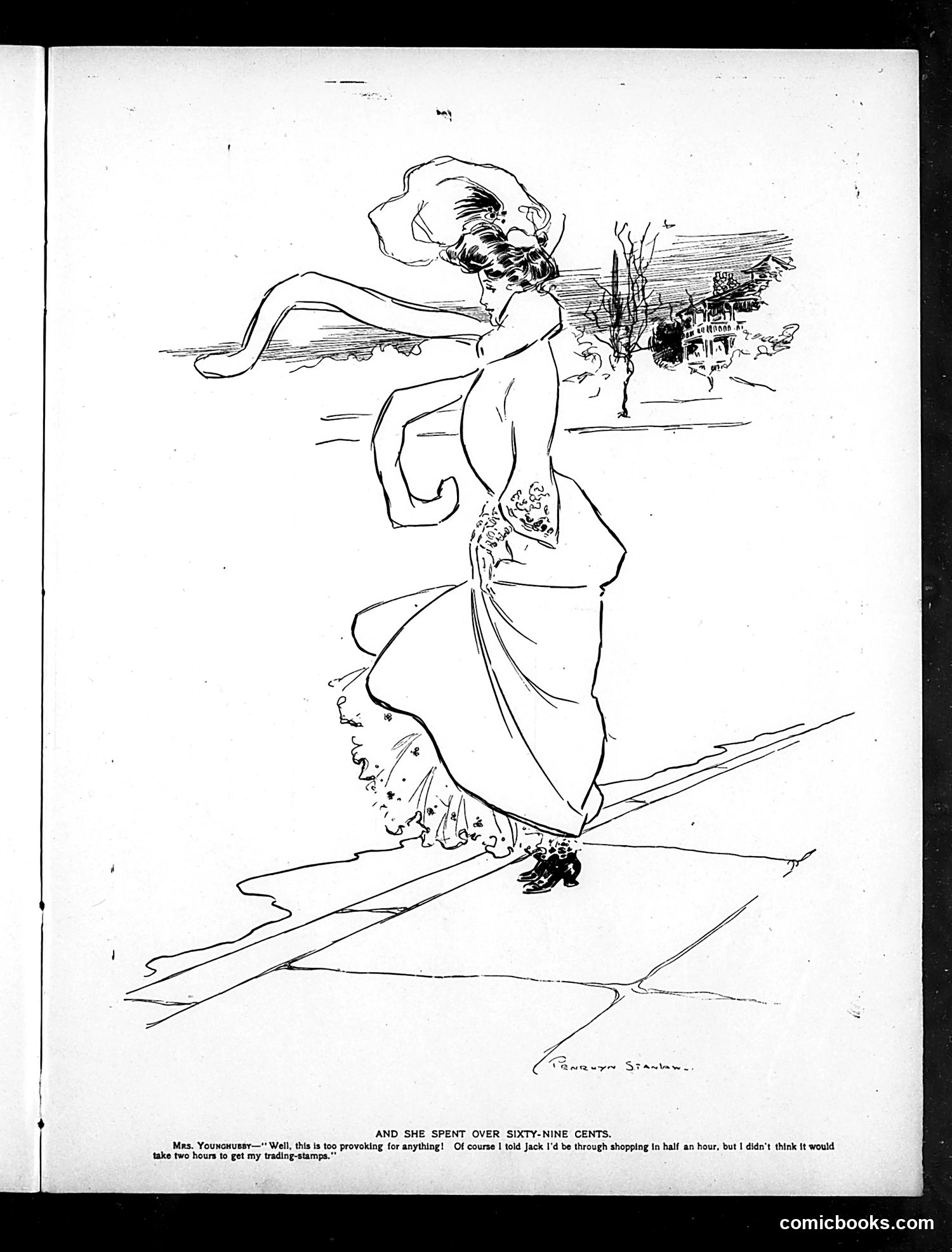
This cartoon satirizes early 20th-century consumer culture and trading stamps—a popular retail promotion where customers collected stamps with purchases to redeem for goods. The joke centers on Mrs. Youngbussey's complaint: she promised her husband Jack she'd finish shopping in 30 minutes, but spent two hours instead—not primarily shopping, but waiting to collect and presumably organize her trading stamps. The cartoon mocks how this premium scheme, meant to reward customers, actually consumed their time inefficiently. The figure's elaborate dress and flowing hair suggest a fashionable woman of leisure, emphasizing the humor that even wealthy or well-off women got caught up in penny-pinching collection schemes. The satire critiques both consumer materialism and how promotional gimmicks paradoxically wasted the very time they promised to save.
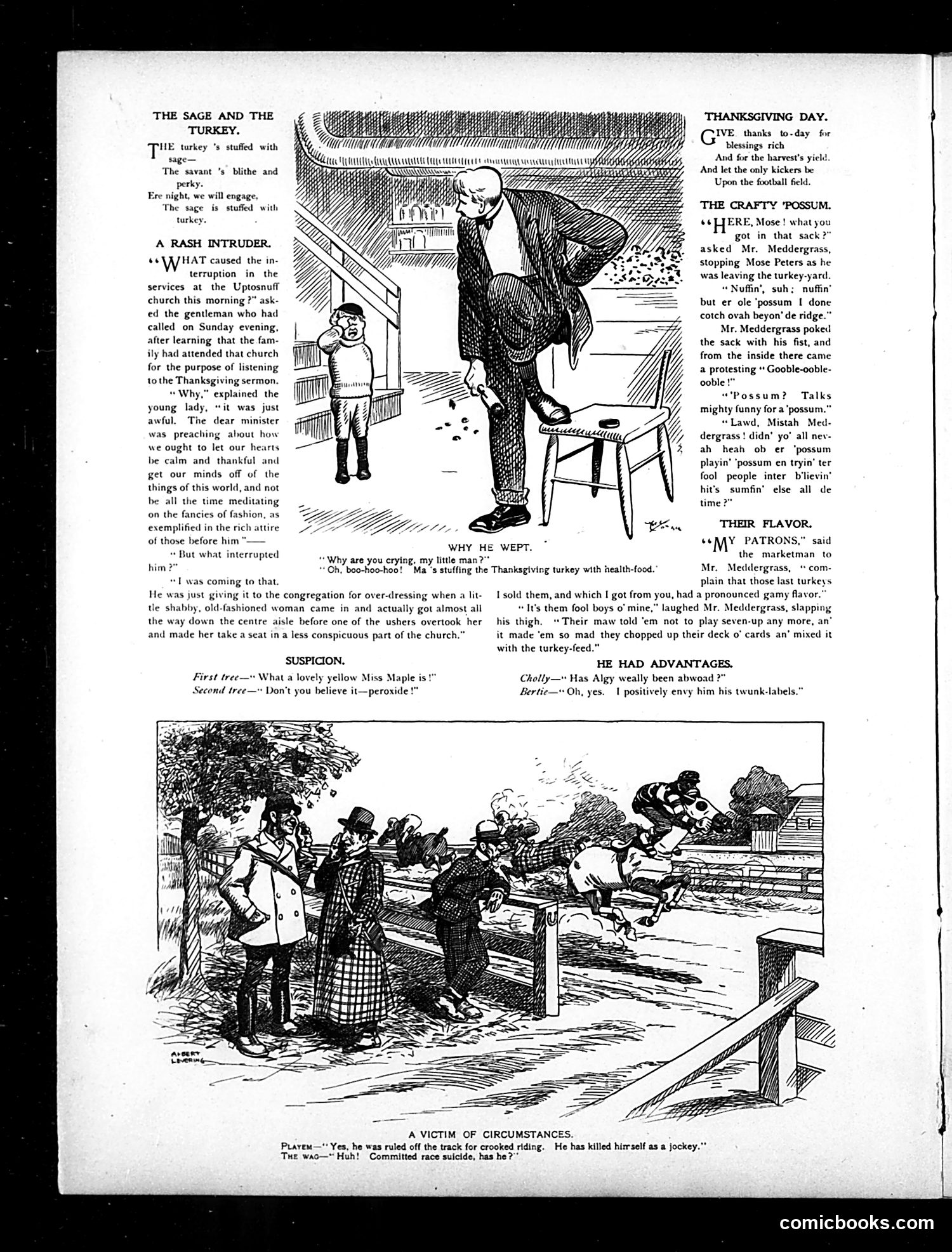
This page contains multiple satirical vignettes mocking American Thanksgiving customs and social hypocrisy: **"The Sage and the Turkey"** satirizes class-based church attendance. A minister preaches against materialism and fashionable dress, but is interrupted when ushers forcibly remove a shabby, elderly woman from the center aisle—exposing the congregation's actual values. The irony: those lectured about spiritual humility enforce social segregation. **"The Crafty Possum"** uses racial dialect humor (period-typical for Judge) where a Black worker tricks his employer by having a possum play dead, then speak—a folk-tale reference to deception. **"Why He Wept"** jokes about health-food faddism: a boy cries because his mother stuffs the Thanksgiving turkey with "health-food" instead of traditional ingredients. **"Their Flavor"** and **"He Had Advantages"** offer brief jokes about turkeys' gamey taste and social pretension. **"A Victim of Circumstances"** presents dark humor about a disgraced jockey who "committed race suicide." Overall, the page satirizes upper-class hypocrisy, faddish health trends, and American materialism disguised as piety.
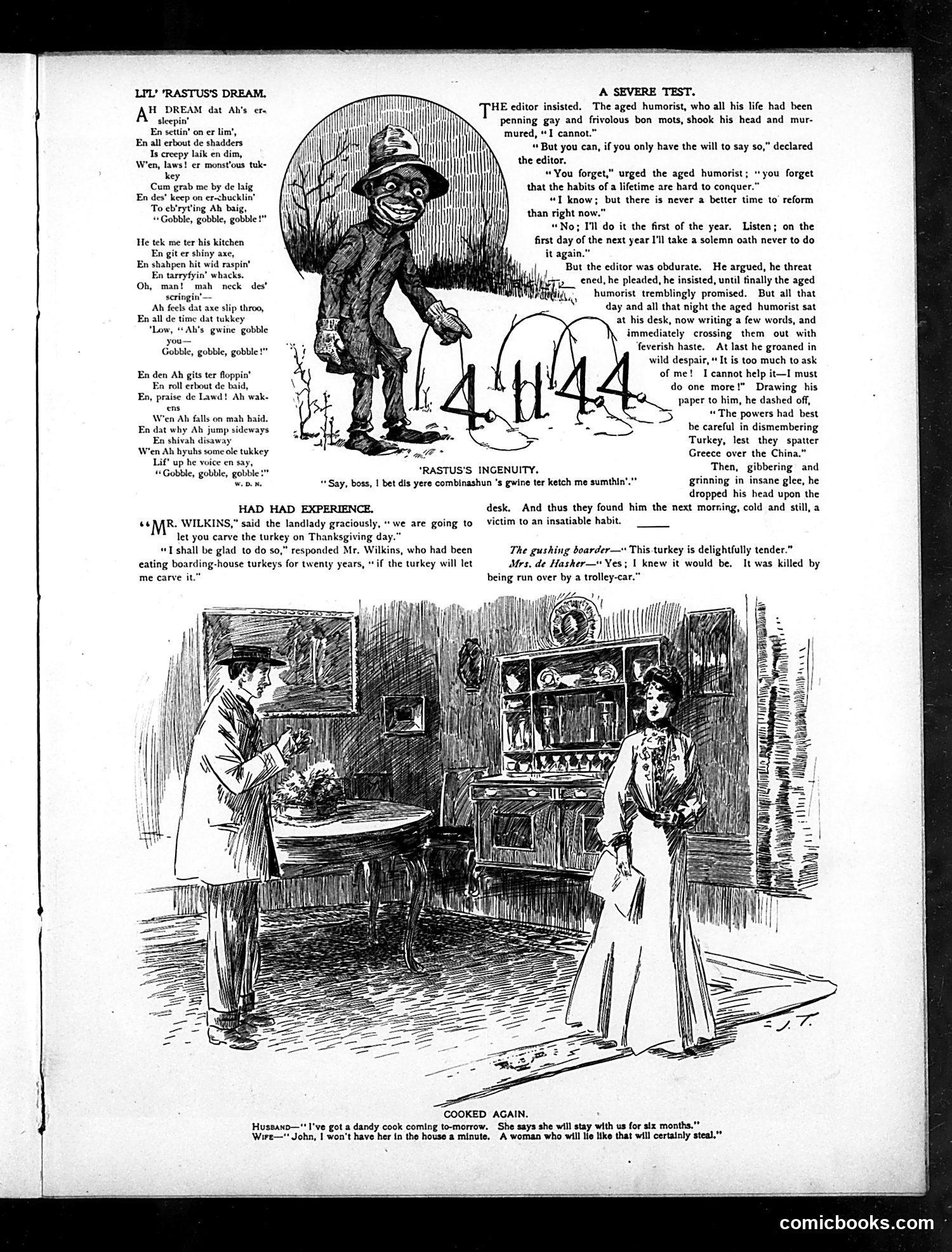
This page contains three separate humorous pieces typical of early Judge satire: 1. **"Lil' Rastus's Dream"**: A dialect poem using racist caricature conventions common to the era, depicting a Black character's nightmare about a turkey chasing him. The humor relies on minstrelsy-style dialect and the incongruity of a turkey as threat. 2. **"Had Had Experience"**: A brief joke about Mr. Wilkins, a boarding-house resident, sardonically suggesting a twenty-year-old turkey might resist being carved—mocking cheap boarding-house food quality. 3. **"A Severe Test"**: A longer narrative about an aged humorist editor who cannot stop writing frivolous bon mots despite promising reform. His compulsion is treated as pathological, culminating in dark comedy when he dies at his desk—unable to resist one more joke. The bottom illustration shows a domestic scene where a wife threatens to fire a new cook who admits she'll stay only six months, calling her a liar and thief—satirizing servant reliability concerns.
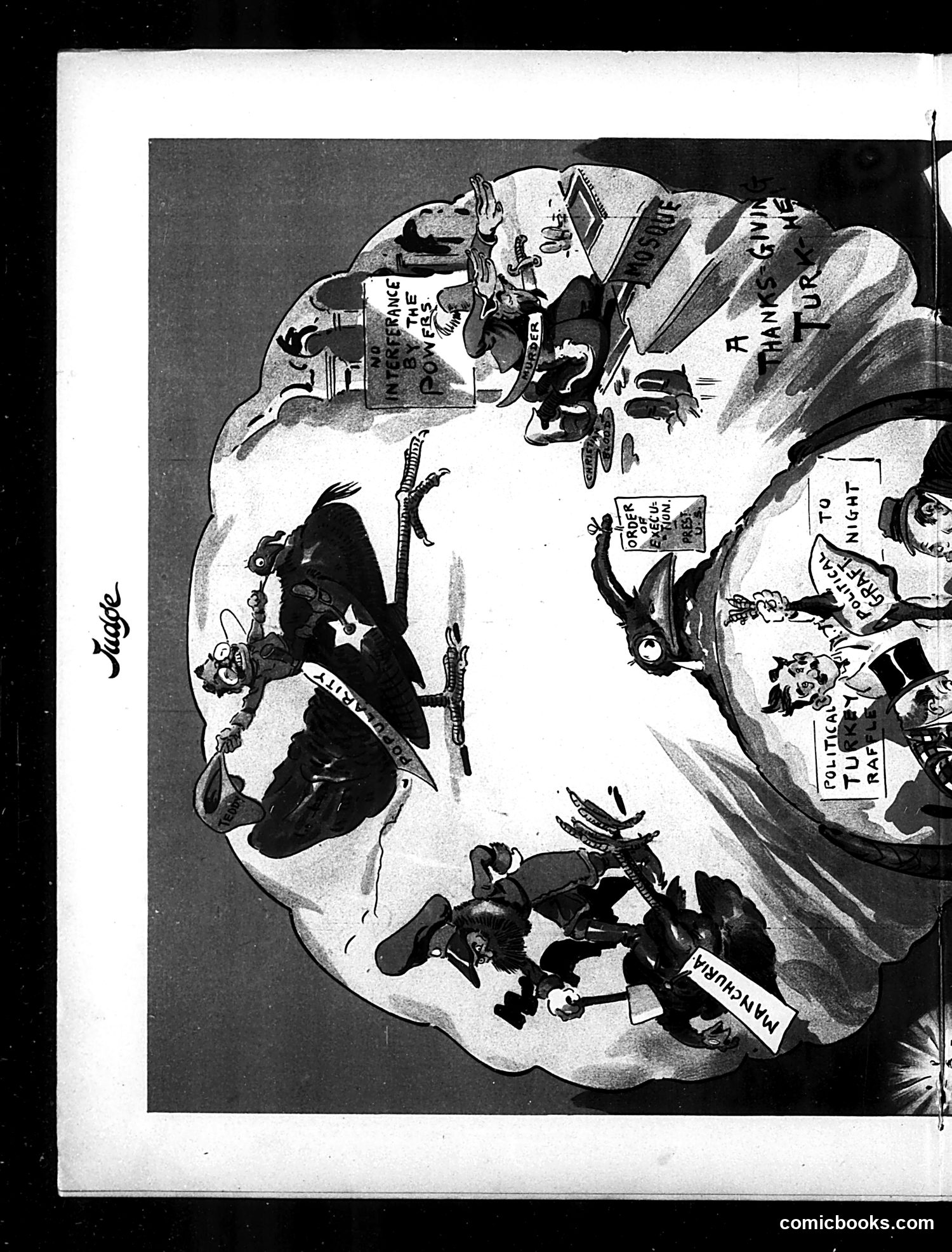
This Judge magazine cartoon depicts a large spherical Earth surrounded by various figures and labeled elements representing global political concerns. The central dark figure appears to be a caricatured representation of a threatening force or ideology, possibly militarism or authoritarianism, dominating the planet. Visible labels reference concepts like "Political Truth" and what appear to be references to international conflicts or power struggles of the era. The cartoonist uses the globe as a stage to satirize how different nations and ideologies compete for global influence. Without clearer date confirmation or more legible text, the specific historical moment remains somewhat unclear, though the composition suggests commentary on early-to-mid 20th century international tensions and competing worldviews for planetary dominance.
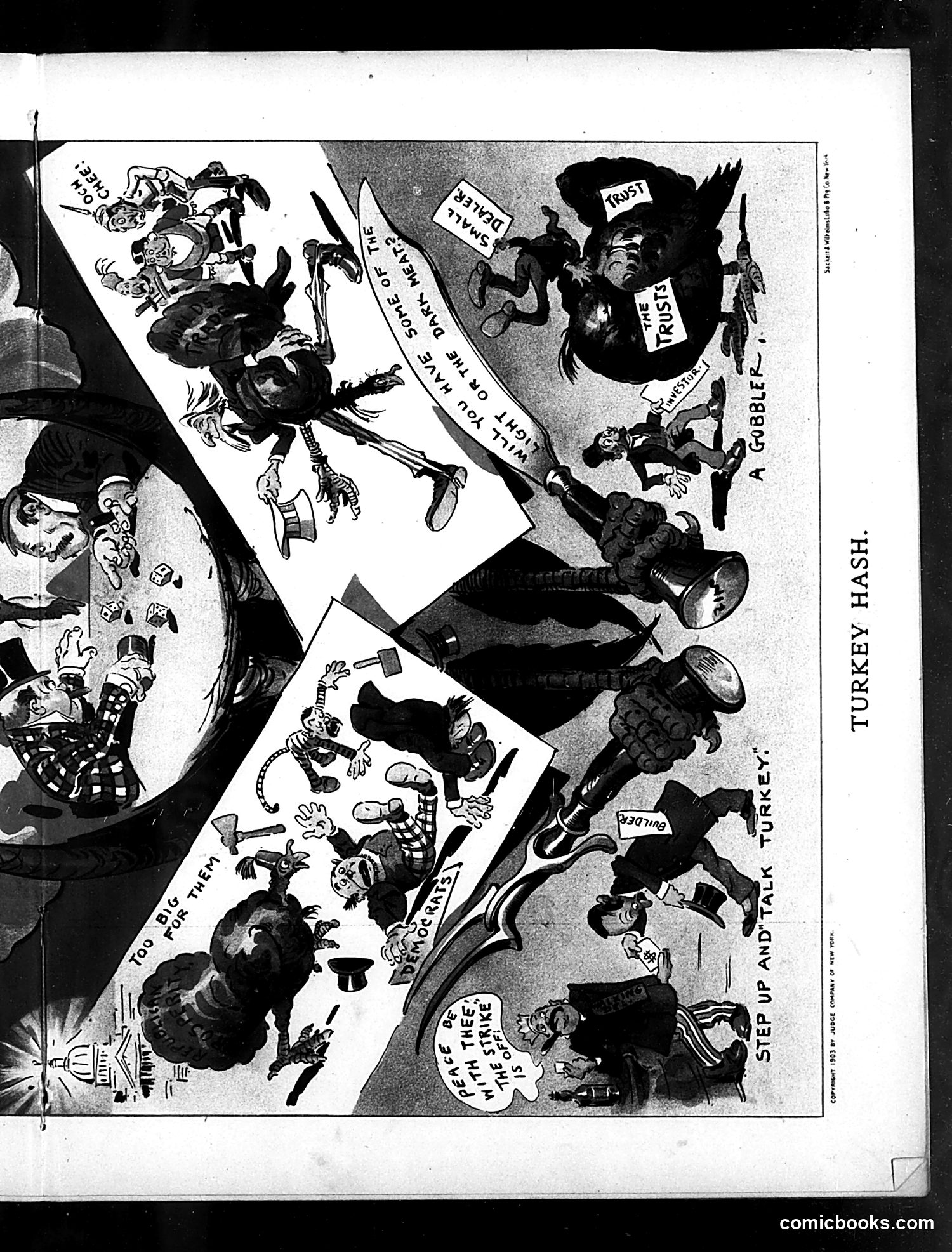
This appears to be a political cartoon titled "Turkey Hash," with the subtitle "Step Up and Talk Turkey - Turkey Hash." The image shows multiple caricatured figures arranged around what appears to be a map or geographical diagram, with various speech bubbles and labels. However, the OCR text is severely corrupted and illegible, making it impossible to read the specific dialogue or labels clearly. Without being able to decipher the text bubbles and identify which historical figures are depicted, I cannot reliably explain what political or social commentary this cartoon was making. The imagery suggests this addresses international relations involving Turkey (likely during a period of Ottoman political significance), but I cannot confidently identify the specific context, date, or satirical point without clearer source material.
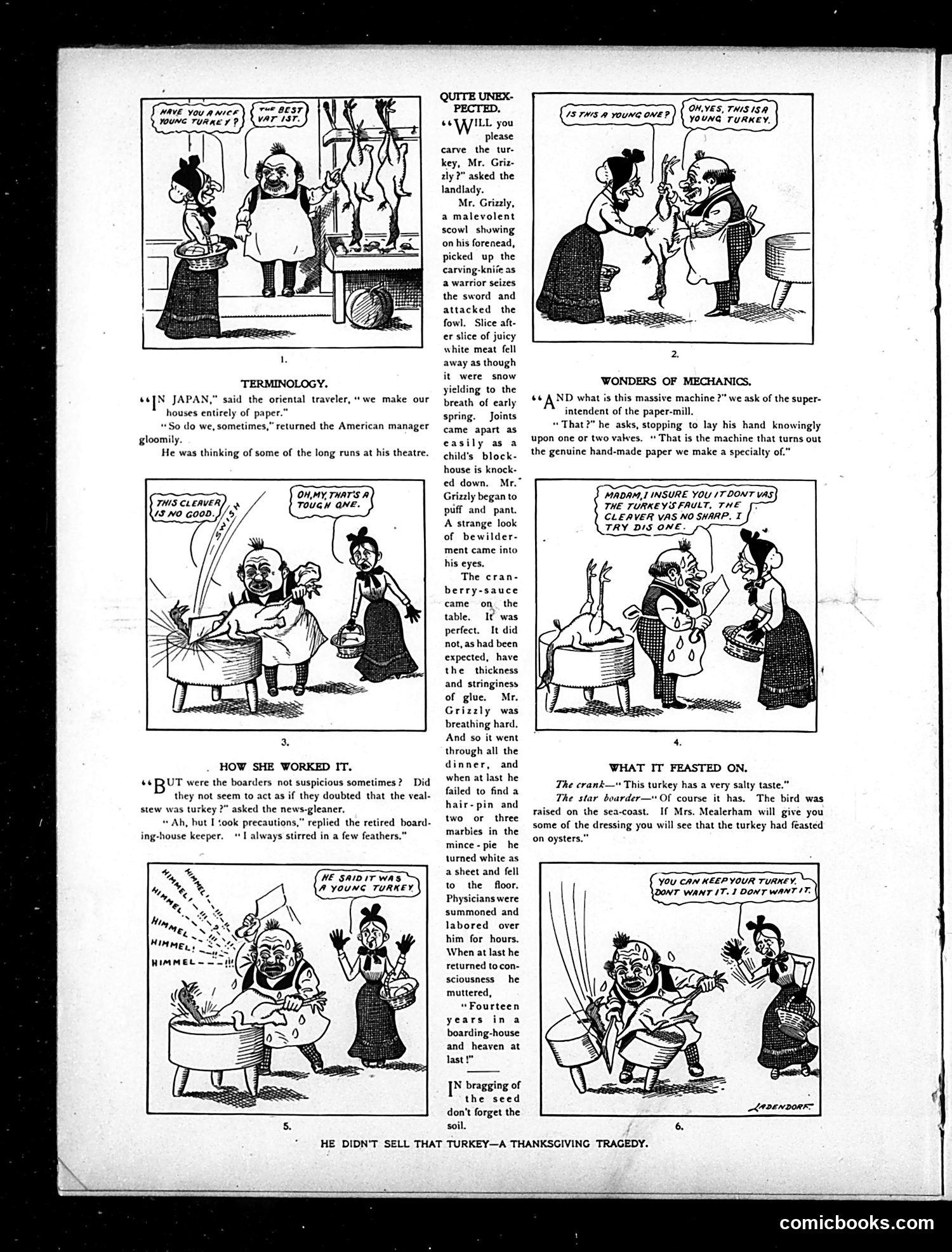
This is a multi-panel humorous commentary on boarding-house life and food quality in early 20th-century America. The main narrative follows Mr. Grizzly, who expects the Thanksgiving turkey to be inadequate—as boarding-house meals notoriously were. The satire mocks the common practice of boarding-house keepers substituting cheaper meats (veal stew) for turkey, hiding the deception by adding feathers. The joke's twist: when the turkey turns out to be *genuinely excellent*, Mr. Grizzly is so shocked by quality food that he collapses. Supporting vignettes mock related absurdities: a theater manager comparing flimsy houses to paper (referencing poor theatrical productions), a paper mill's "hand-made" machinery (suggesting false claims), and turkeys supposedly fattened on oysters and salt. The central satire targets the widespread expectation that boarding-house meals were fraudulent or substandard—so much so that actual quality food becomes unbelievable to long-term residents.
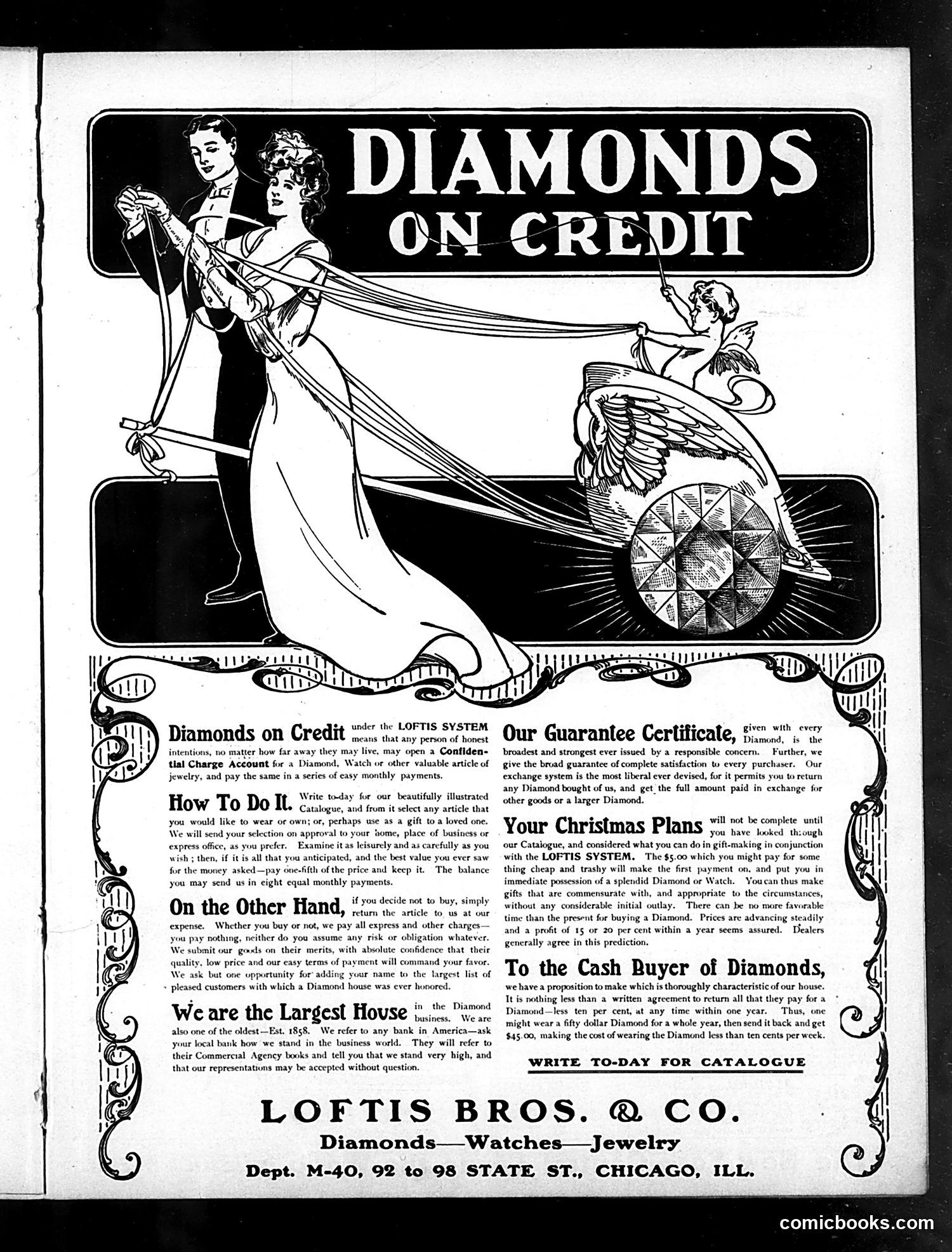
This is primarily a **jewelry advertisement**, not political satire. It appears in *Judge* magazine (likely early 1900s based on style) promoting the Loftis Bros. & Co. credit system for purchasing diamonds and watches from Chicago. The decorative illustration depicts an elegant couple and Cupid presenting diamonds—typical early-20th-century aspirational imagery targeting consumers who couldn't afford luxury items outright. The "on credit" angle was relatively novel marketing at the time. **The satirical angle** (if any) is subtle: the ad mocks the gap between desire and means by making luxury accessible through installment payments—a somewhat tongue-in-cheek commentary on consumer culture and "living beyond one's means." The guarantee certificates and promises of easy monthly payments represent the era's emerging consumer credit economy. This is essentially advertising disguised as magazine content, targeting middle-class readers with disposable income who wanted social status markers like diamonds.
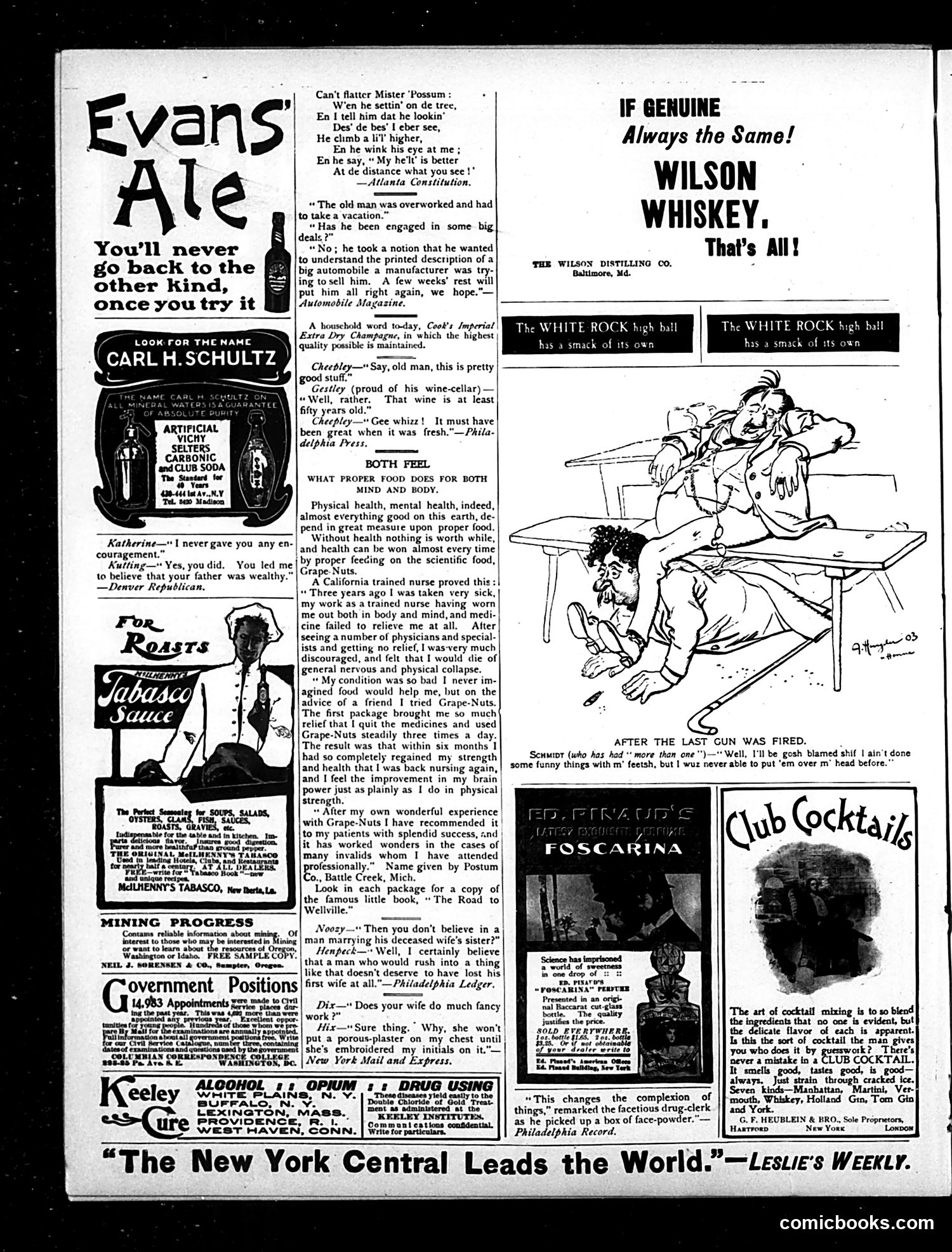
This Judge magazine page contains **primarily advertisements and brief comic vignettes** rather than a unified political cartoon. The main content includes: 1. **Product ads** for Evans Ale, Wilson Whiskey, Grape-Nuts cereal, and other goods—typical of 1910s-era magazines. 2. **Short humor pieces** featuring domestic scenes: a couple arguing about wealth ("Cutting"), a man confused by automobile instructions, and various wordplay jokes about wine aging and marriage. 3. **One illustrated cartoon** (bottom right) showing a drunken soldier after battle, captioned "After the Last Gun Was Fired"—the humor derives from his wobbly posture and slurred speech, depicting intoxication. The page reflects **early 20th-century attitudes**: casual stereotypes in dialect humor ("Mister 'Possum"), gender dynamics in marriage jokes, and alcohol consumption treated as comedy. There's no apparent political satire—this is simply a typical Judge page mixing ads, light domestic humor, and illustrated gags aimed at middle-class readers.
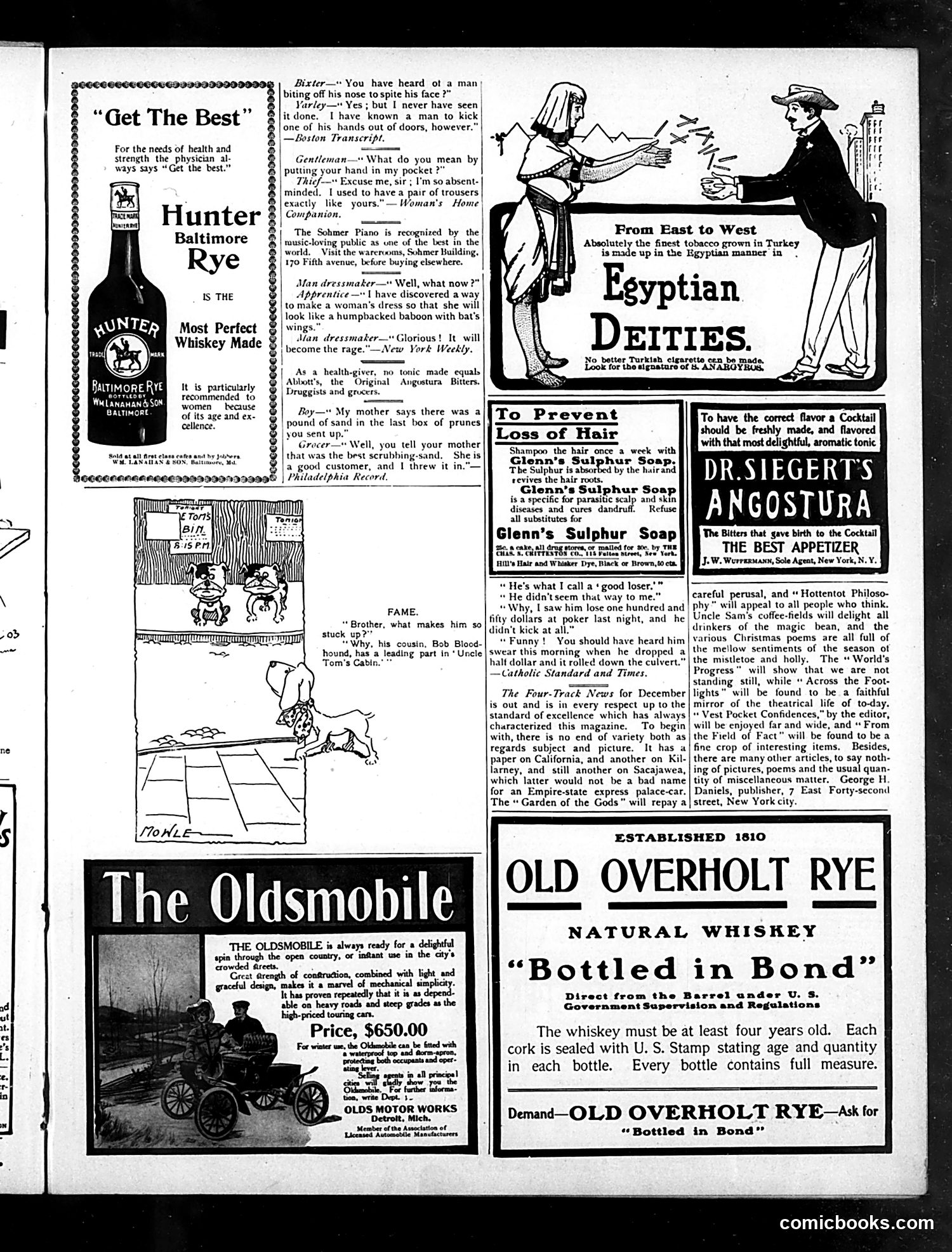
This page is primarily **advertising with light satirical commentary**. The central cartoons are brief joke vignettes that were typical of Judge's humor: The **"Fame" cartoon** depicts social pretension—a man's arrogance stems solely from having a distant relative (a bloodhound!) perform in a theatrical production, satirizing how people borrowed status from tenuous celebrity connections. The **fashion designer cartoon** mocks exaggerated women's silhouettes of the era, with the apprentice proposing designs that make women resemble "a humpbacked baboon with bat's wings"—absurdist commentary on impractical haute couture trends. Other brief jokes mock: petty dishonesty (a thief's pocket-picking excuse), domestic complaint (sand in prunes), and male vanity (a man kicking his own hand out the door). The page is otherwise dominated by **period advertisements** for whiskey, automobiles, pianos, hair products, and patent medicines—typical Judge content that blended commercialism with satire. These ads reflect early 1900s consumer culture and dubious medical claims.
This is primarily an **advertising page** from Judge magazine, with several short humorous anecdotes interspersed between ads. The page contains no political cartoons. Instead, it features **social humor** typical of early 20th-century American magazines: - A joke about a man building a chicken house for "pink camels" (absurdist humor) - An anecdote about a woman asking a suitor if he'd love her when old - A child's misunderstanding of "octogenarian" as a disease - A joke about gossips being like automobiles—destructive and loud The **advertisements** promote products common to the era: Kodak cameras, Deimel underwear, Angostura Bitters, champagne, pens, and Whitman's chocolates. These ads reflect consumer goods marketed to middle-class readers. One ad jokes that Southern Railway excursion tickets offer "perpetual comfort"—typical period advertising copy. The page represents **leisure reading**: light humor, consumer culture, and product promotion aimed at affluent readers, with no satirical political content.
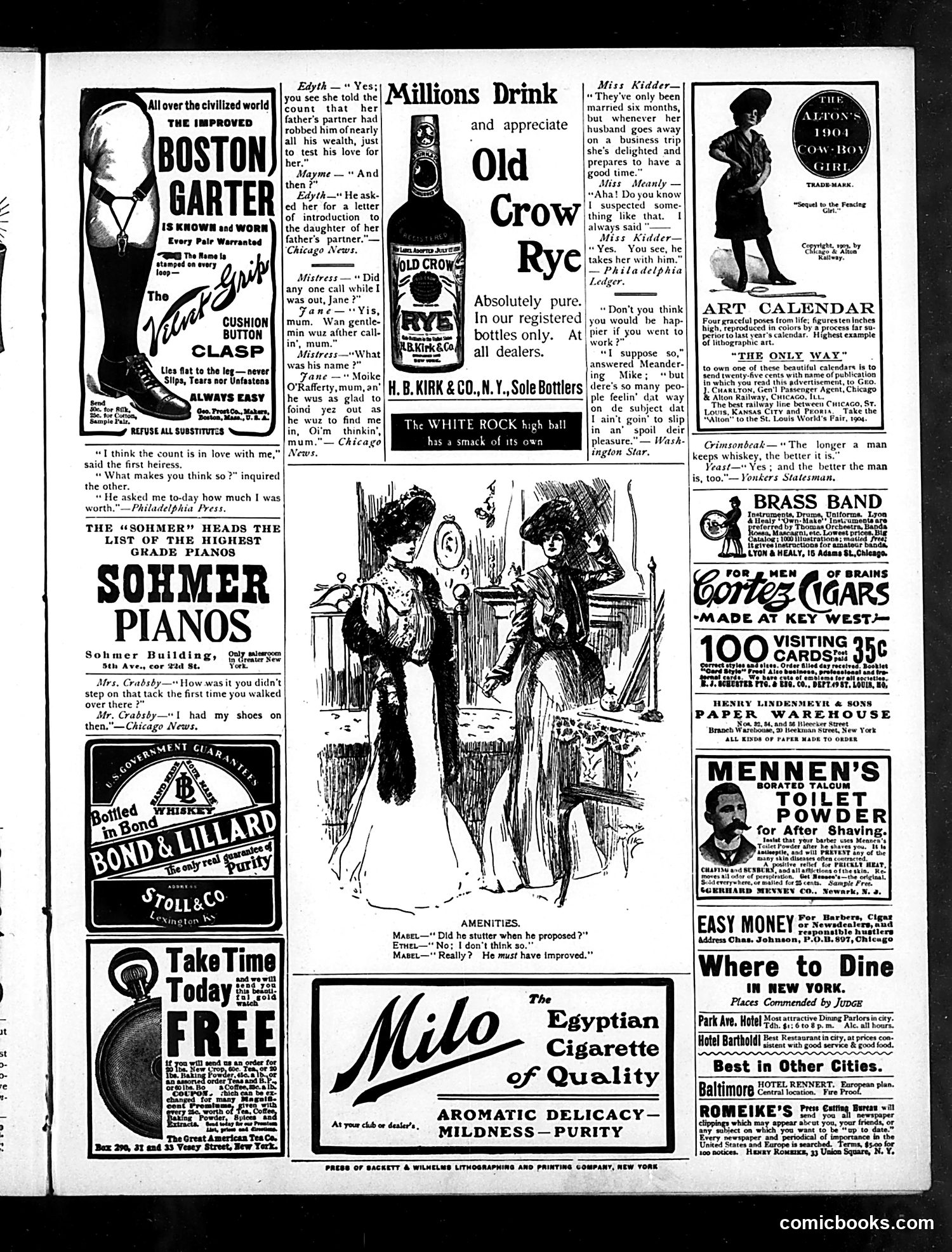
This is primarily an **advertising and humor miscellany page** from Judge magazine (early 1900s), not a unified political cartoon. The page contains multiple short humorous anecdotes (dialogues) satirizing social conventions of the era: - **Romantic/marital humor**: Women delighted when husbands leave on business (implying domestic tension or desire for independence) - **Servant dialect comedy**: A maid's thick Irish accent ("Moike O'Rafferty," "Oi'm thinkin'") was typical period humor, though offensive by modern standards - **Class commentary**: A wealthy heiress tests a count's love by asking his opinion of her worth—satirizing both mercenary marriages and aristocratic social climbing The bulk of the page comprises **period advertisements** for liquor (Old Crow Rye, Bond & Lillard whiskey), pianos, cigars, toiletries, and dining establishments—reflecting early-20th-century consumer culture. The cartoon illustration shows two fashionably dressed women in conversation, typical of Judge's social satire about women's behavior and expectations. No specific political figures or events are referenced; the humor targets universal social pretensions and domestic dynamics.
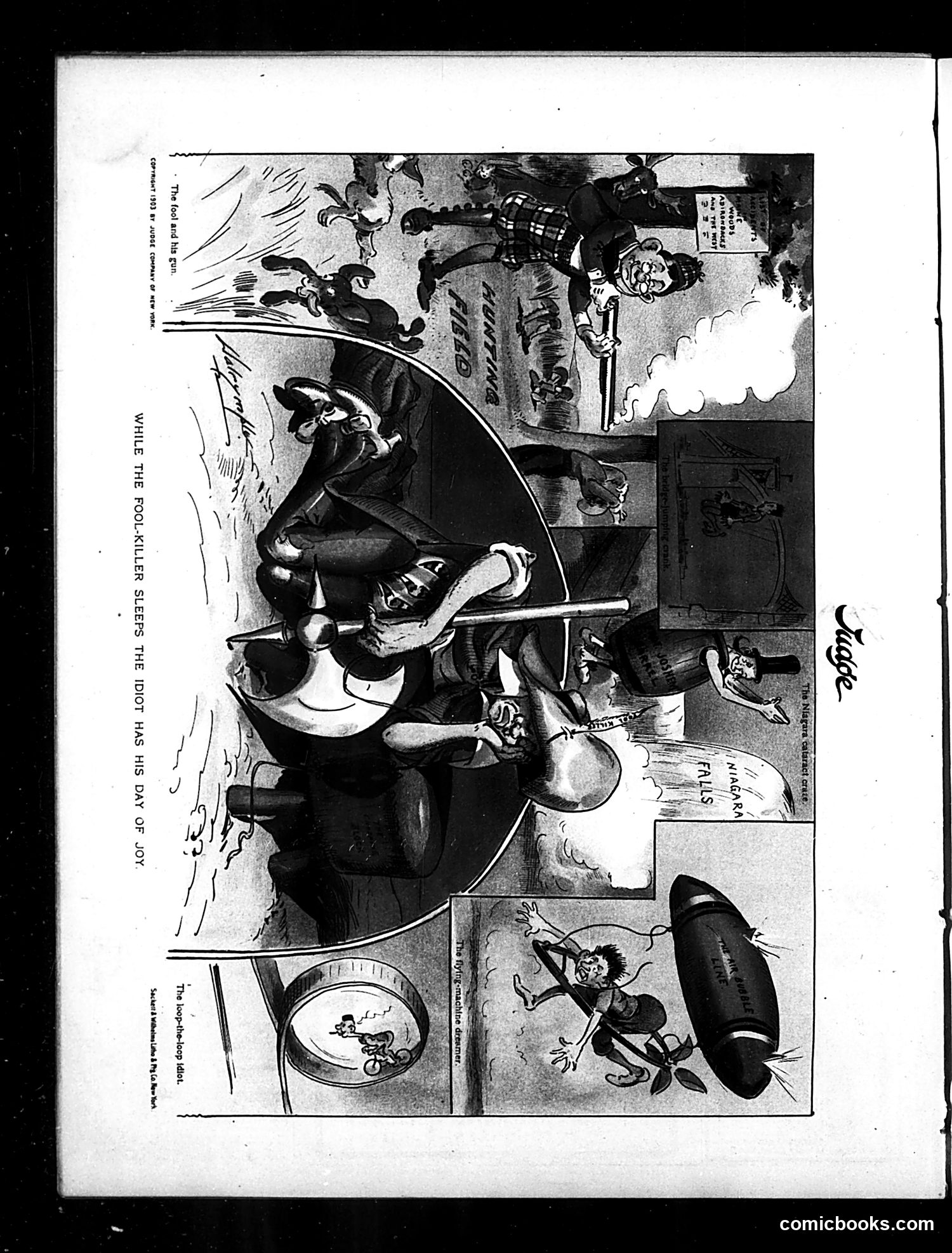
This 1903 Judge page satirizes dangerous fads through multiple comic panels. The central figure appears to be a foolish man repeatedly endangering himself—handling firearms carelessly ("The fool and his gun") and attempting a loop-the-loop maneuver (likely on a bicycle or early motorcycle, referencing the contemporary craze for loop-the-loop stunts). The cartoons mock both the idiocy of participating in these dangerous trends and, implicitly, the public's fascination with them. The repeated depictions of the same character in progressively perilous situations emphasize how recklessly people pursued fashionable thrills despite obvious risks. This reflects early 1900s anxieties about modern technology and youth culture embracing dangerous novelties without regard for safety—a recurring satirical theme in Judge's social commentary.
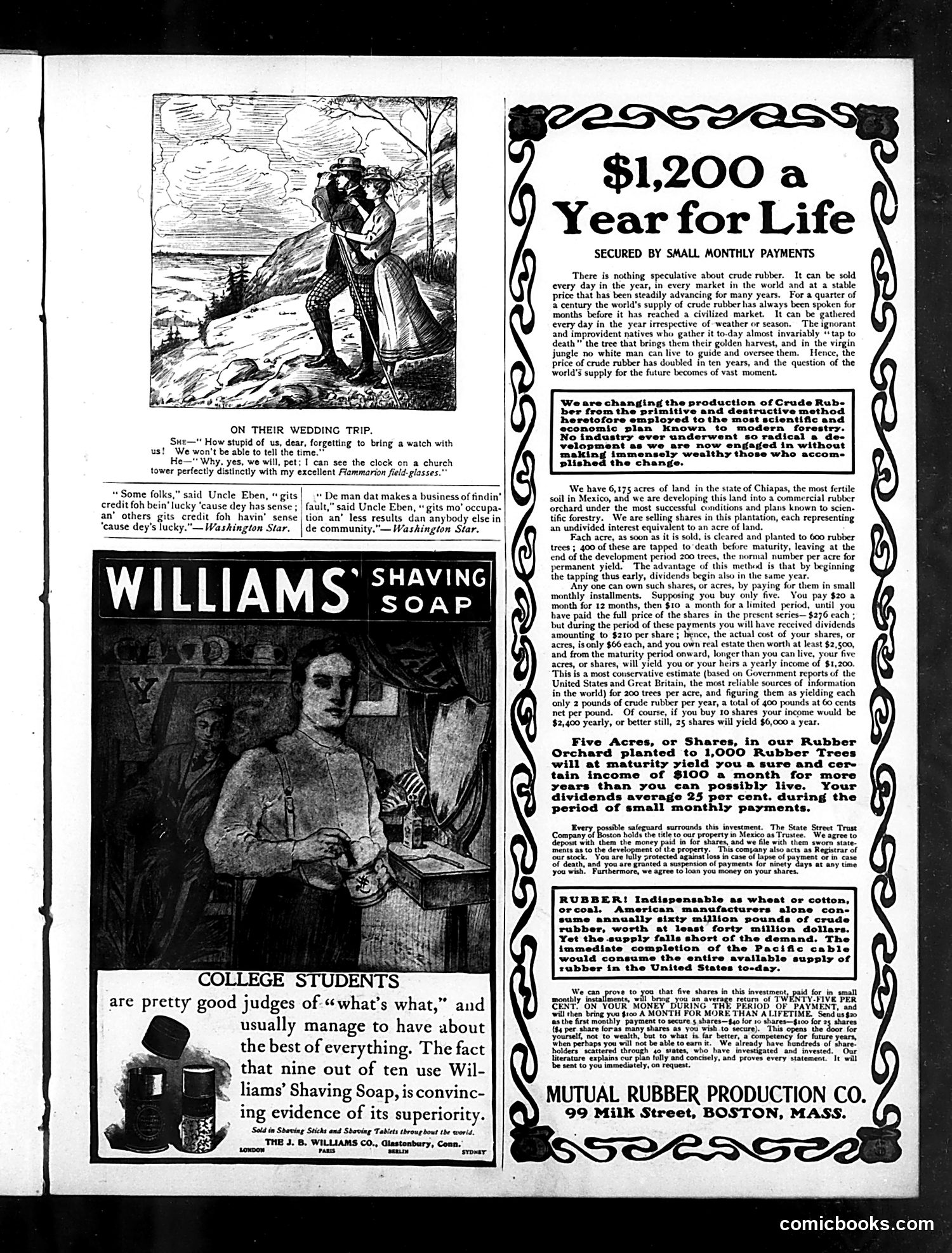
This page contains two distinct elements: **Left side:** Three brief satirical cartoons with jokes, including one about a honeymoon couple using field-glasses to read a church clock, and two separate Uncle Eben jokes about luck versus sense. These are typical Judge magazine humor pieces—light social commentary in cartoon form. **Right side:** A full-page advertisement for Mutual Rubber Production Co., promoting investment in rubber plantation shares in Chiapas, Mexico. The ad promises $1,200 yearly income for life through small monthly payments. **Historical context:** This appears designed to capitalize on early-20th-century investment enthusiasm and rubber's commercial importance (used for tires, etc.). The promise of passive income through small payments to acquire tropical plantation "shares" represents the type of speculative investment schemes common to this era—mixing legitimate commodity scarcity concerns with promotional language meant to attract ordinary investors seeking wealth. The contrast between Judge's satirical cartoons mocking human folly and this optimistic investment pitch is notable.
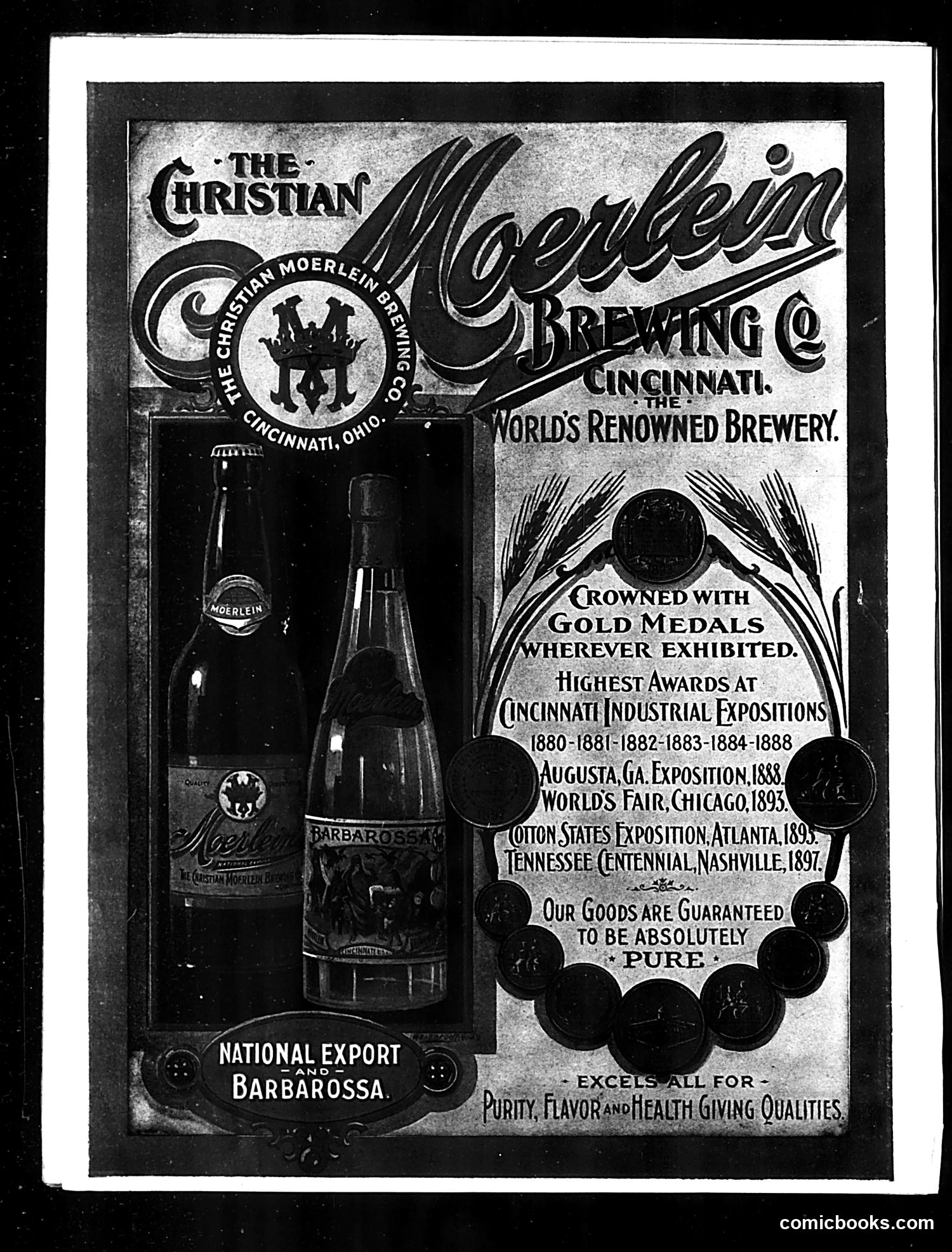
This is a **full-page advertisement**, not a cartoon or satire. It promotes The Christian Moerlein Brewing Company of Cincinnati, Ohio, advertising their beer products "National Export" and "Barbarossa." The ad emphasizes the brewery's legitimacy through claims of gold medal awards at various industrial expositions (1880-1888) and major world fairs (Chicago 1893, Atlanta 1895, Nashville 1897). The circular arrangement of medal imagery serves as visual proof of quality. Key selling points highlighted: purity, flavor, and health-giving qualities—standard marketing claims for breweries of this era. The "world's renowned brewery" tagline positions the company as internationally respected. This reflects late-19th-century American brewery competition and the marketing practice of displaying exposition awards as proof of superior product quality.

I can see this is a page from *Judge* magazine (as indicated by the comicbooks.com watermark), but the image is extremely dark and degraded, making it nearly impossible to discern specific cartoon content, text, or figures with any clarity. While I can make out what appears to be a repeating pattern of circular shapes arranged in columns on the right side of the page, and a white margin on the left, I cannot reliably identify any political figures, caricatures, satirical references, or the intended meaning of the content. The OCR text provided only shows "comicbooks.com" without substantive article or caption text. Without legible visual or textual information, I cannot accurately explain what this page satirizes.