
A complete issue · 18 pages · 1903
Judge — May 30, 1903
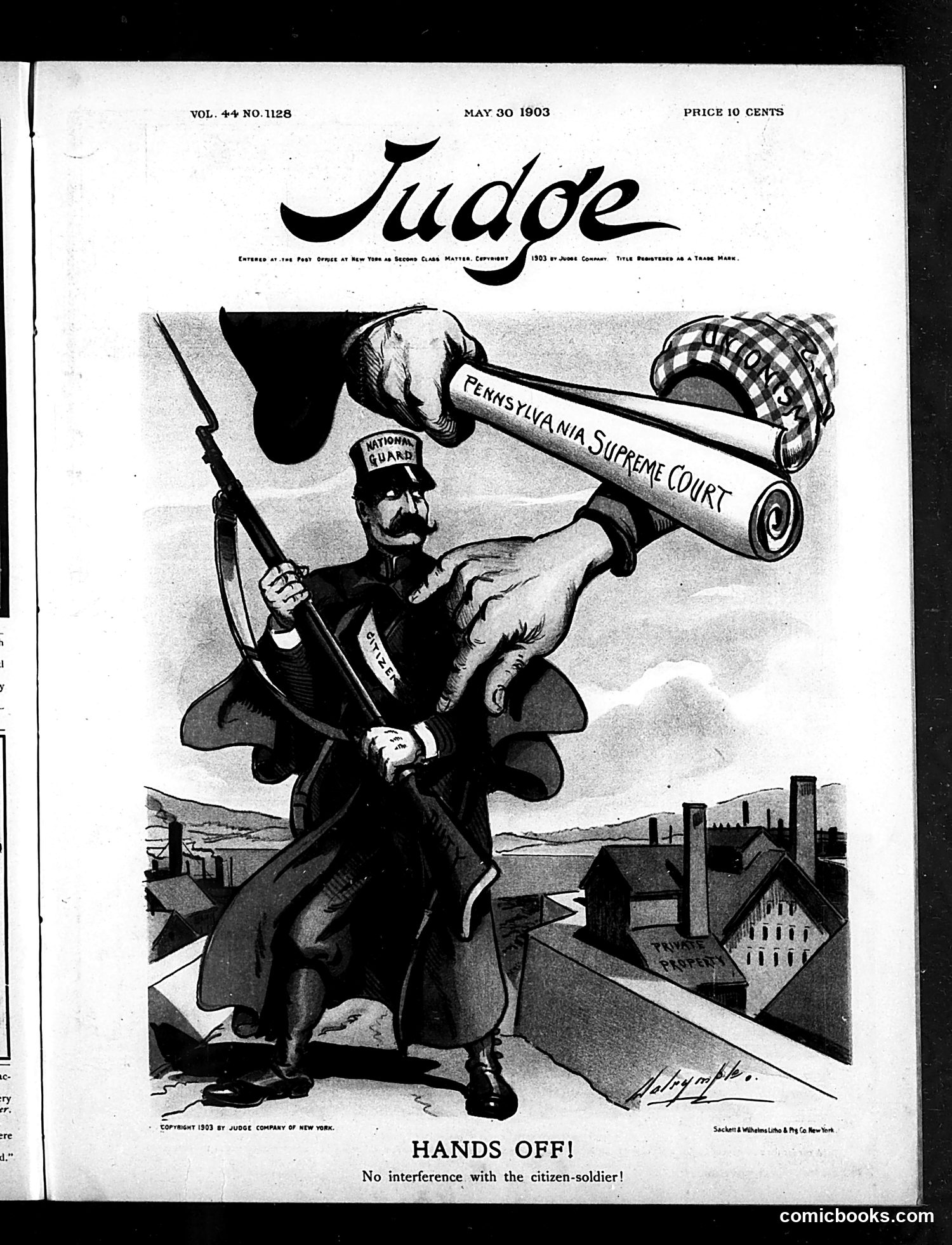
This political cartoon depicts a uniformed National Guard soldier wielding both a rifle and a large megaphone labeled "Pennsylvania Supreme Court." The soldier stands protectively over an industrial cityscape, with the caption "HANDS OFF! No interference with the citizen-soldier." The satire appears to address tensions between civilian authority and military power during labor disputes or civil unrest in Pennsylvania around 1903. The cartoon defends the National Guard's autonomy—specifically the Pennsylvania Supreme Court's authority—against perceived interference from civilian government or strikers. The soldier's dual weaponry symbolizes both literal military force and legal authority. This likely relates to labor conflicts of the era where courts and militia worked together against organized labor movements.
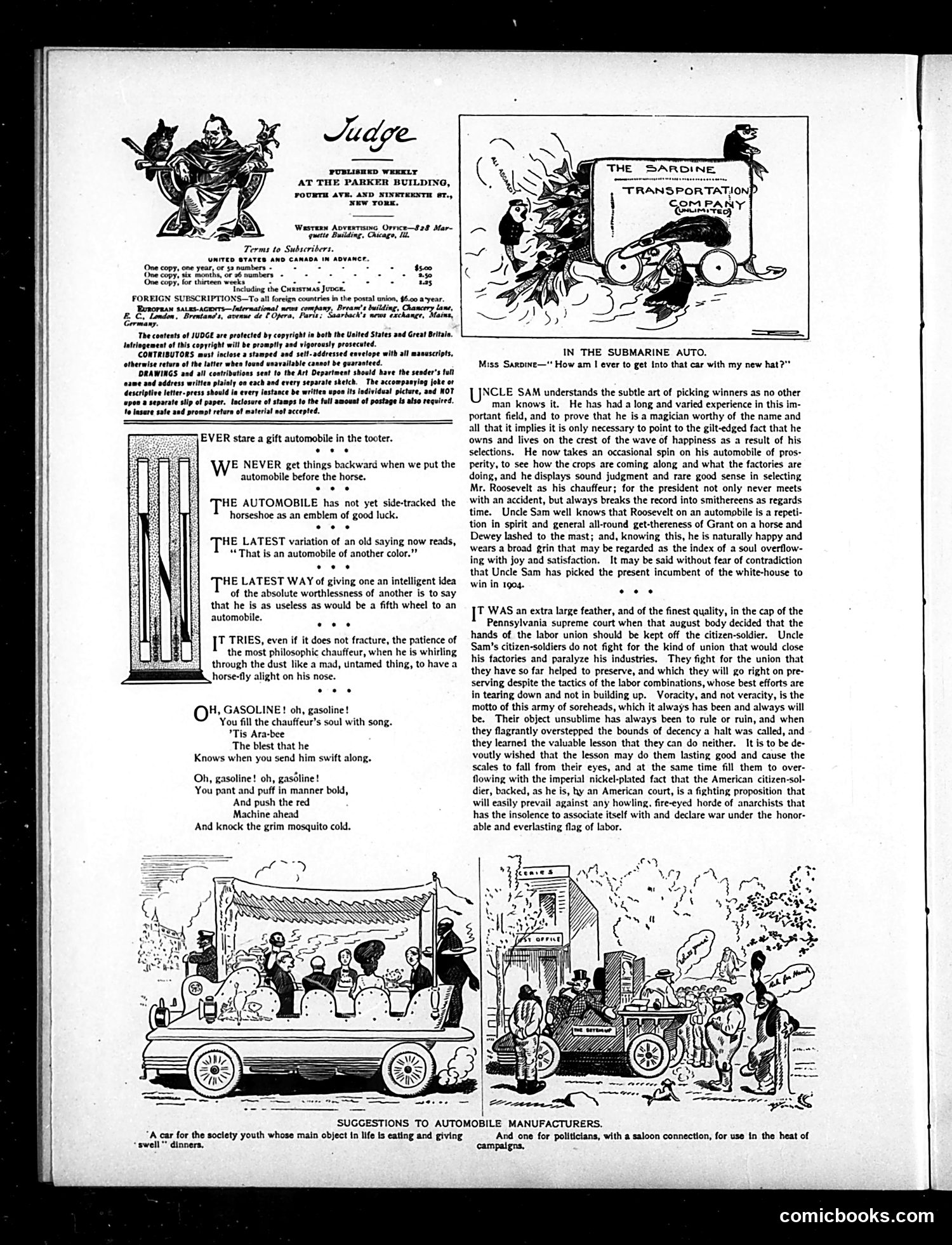
This page satirizes early automobile culture through multiple angles. The central section titled "In the Submarine Auto" mocks the absurdity of automobiles by depicting them as impractical compared to horses—a common critique as cars were still novel and unreliable. The text celebrates Uncle Sam's wisdom in understanding automobiles, suggesting he recognizes their value despite skeptics. However, the illustrated "Suggestions to Automobile Manufacturers" at the bottom shows cartoonists mocking proposed ridiculous car features: one depicts a vehicle designed as a dining car, another as a political campaign platform. The overall message critiques both automobile mania and impractical design trends emerging from manufacturers attempting to make cars solve every social need—reflecting genuine debates about automotive purpose in early 1900s America.
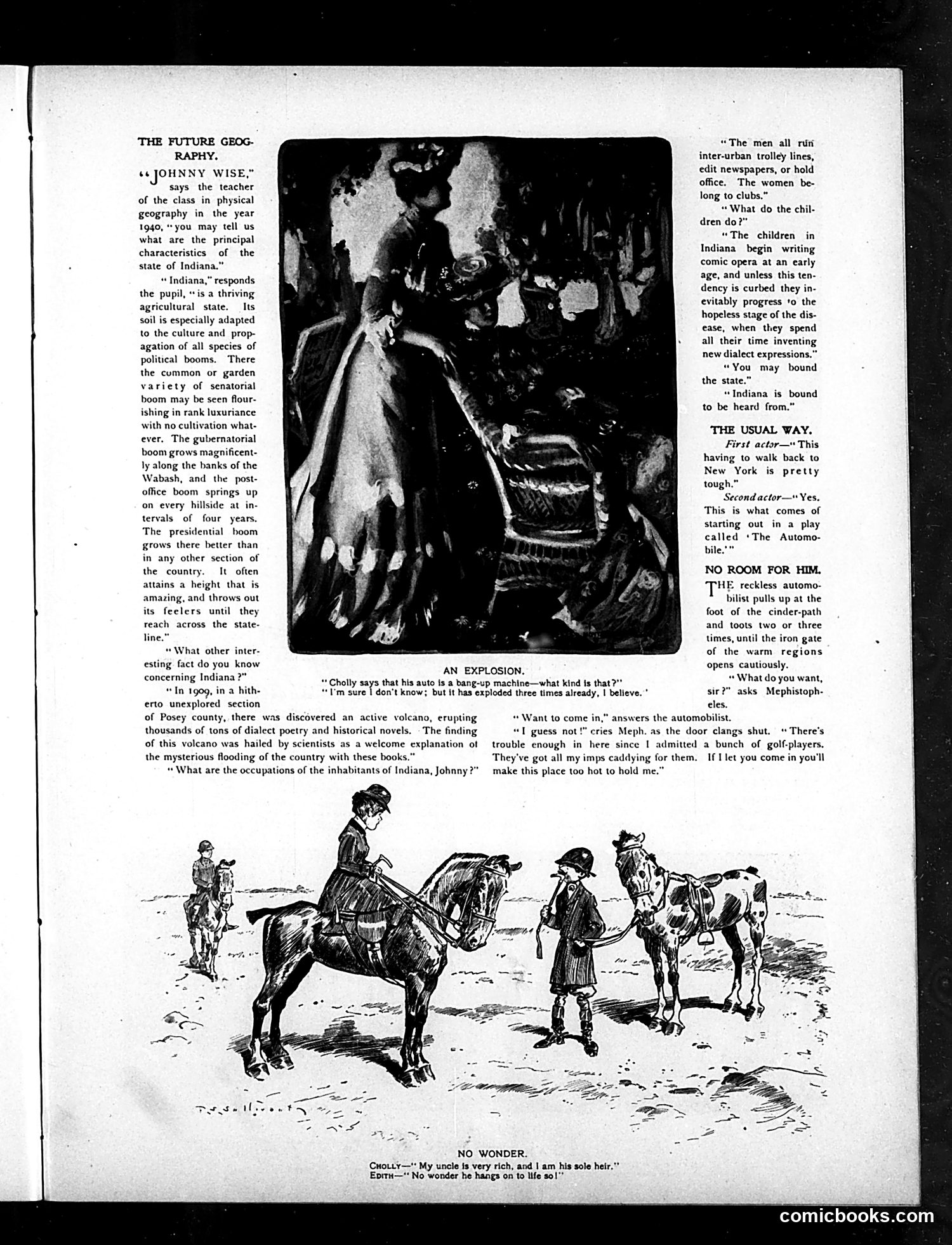
This page from *Judge* magazine contains satirical commentary on Indiana's geography and characteristics, along with unrelated comic sketches. The main text mocks Indiana as an "agricultural state" with unremarkable features—its soil, booms (economic and literal plant growth), and general character. The satire presents Indiana as unremarkable and emphasizes its flatness and lack of distinction. The lower illustration labeled "NO WONDER" depicts a wealthy uncle on horseback telling a child (Crolly) that he is "very rich" and the child's sole heir. The child (Edith) replies she's unsurprised by his generosity—the joke being the uncle's obvious wealth makes his willingness to share an inheritance logical rather than remarkable. The page's various section headers ("THE USUAL WAY," "NO ROOM FOR HIM") introduce separate comic vignettes unrelated to the main Indiana satire.
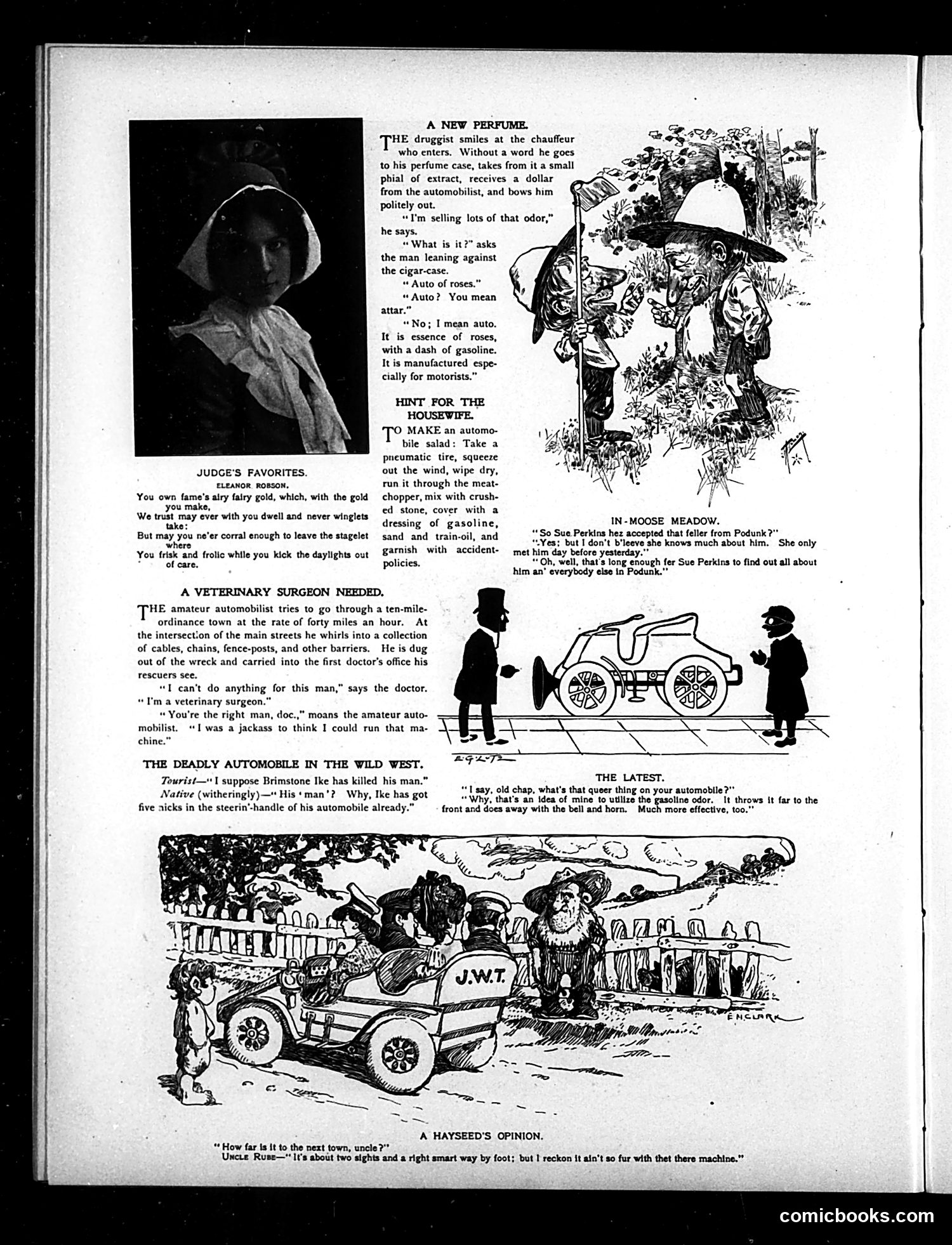
This page satirizes early automobiles and their impact on society circa 1900-1910. The sketches mock motorists and their newfound obsession with cars: **"A New Perfume"** depicts a chauffeur selling "Auto of Roses"—a perfume marketed as essence of roses mixed with gasoline, targeting motorists. The joke: cars smell terrible. **"Judge's Favorites"** features Eleanor Robson, likely a contemporary actress, praising wealthy automobilists. **"A Veterinary Surgeon Needed"** ridicules an amateur driver causing chaos in town, requiring a veterinarian rather than a mechanic. **"The Deadly Automobile in the Wild West"** and **"A Hayseed's Opinion"** present rural perspectives, suggesting automobiles are dangerous, violent intrusions into traditional America—portrayed as wild beasts rather than progress. The satire reflects urban/rural tensions over modernization.
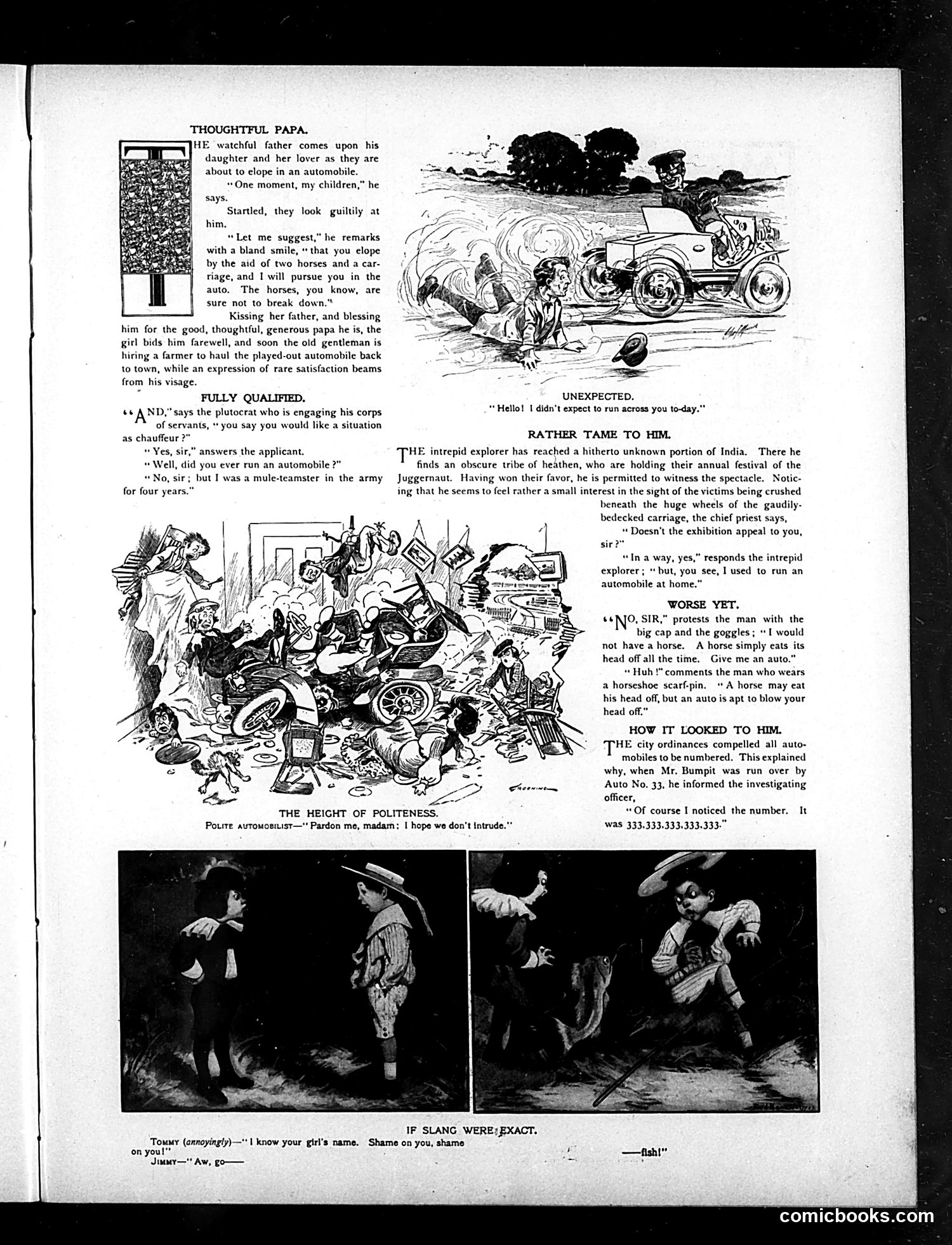
This page satirizes the early automobile era's unreliability and dangers. Multiple jokes target the same theme: cars break down constantly and are unpredictable compared to horses. The opening story shows a father cleverly reversing his daughter's elopement plans—he'll chase them in the automobile (which will inevitably fail), while they escape safely by horse-drawn carriage. Other sketches play variations: a chauffeur applicant's mule-team experience seems inadequate; an explorer finds a fatal Juggernaut festival less impressive than automobile accidents; a man prefers an auto over a horse, only to be told autos are more likely to kill you; and someone hit by car No. 33 obsesses over the number. The humor relies on the audience's shared frustration with early automobiles—unreliable machines that were simultaneously dangerous and prone to breaking down. These jokes likely date to the 1900s-1910s, when automobiles were still novel and notoriously unreliable technology.
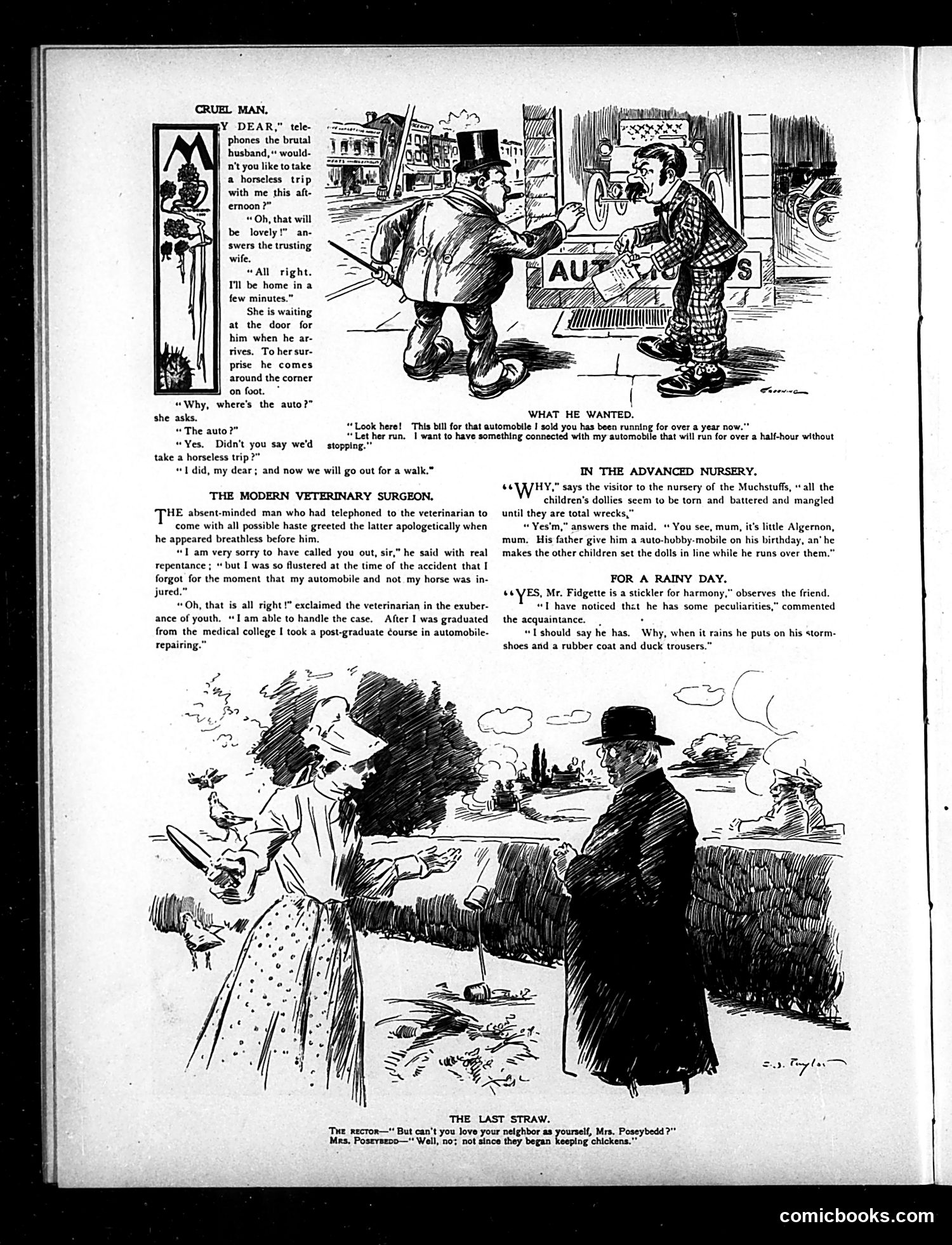
This page contains four early-automobile-era jokes satirizing emerging car culture (circa 1900s-1910s): **"Cruel Man"**: A husband tricks his wife into thinking they're taking an automobile ride ("horseless trip"), then surprises her by taking a walk instead—mocking husbands who promise modern conveniences then disappoint. **"Modern Veterinary Surgeon"**: A man calls a veterinarian for his injured automobile, not horse. The vet claims he can handle it after taking a post-graduate course in "automobile-repairing." The joke: vets are so unfamiliar with cars that they confuse their professional expertise. **"What He Wanted"**: A car dealer complains a customer hasn't paid his bill; the customer wants something connected to his automobile that actually works for more than half an hour—mocking early automobiles' notorious unreliability. **"Advanced Nursery"**: A child receives a toy automobile and runs over his siblings' dolls with it, mimicking dangerous driving—satirizing how automobiles were genuinely hazardous novelties that inspired reckless behavior. All four jokes reflect society's anxious fascination with this new, unpredictable technology.
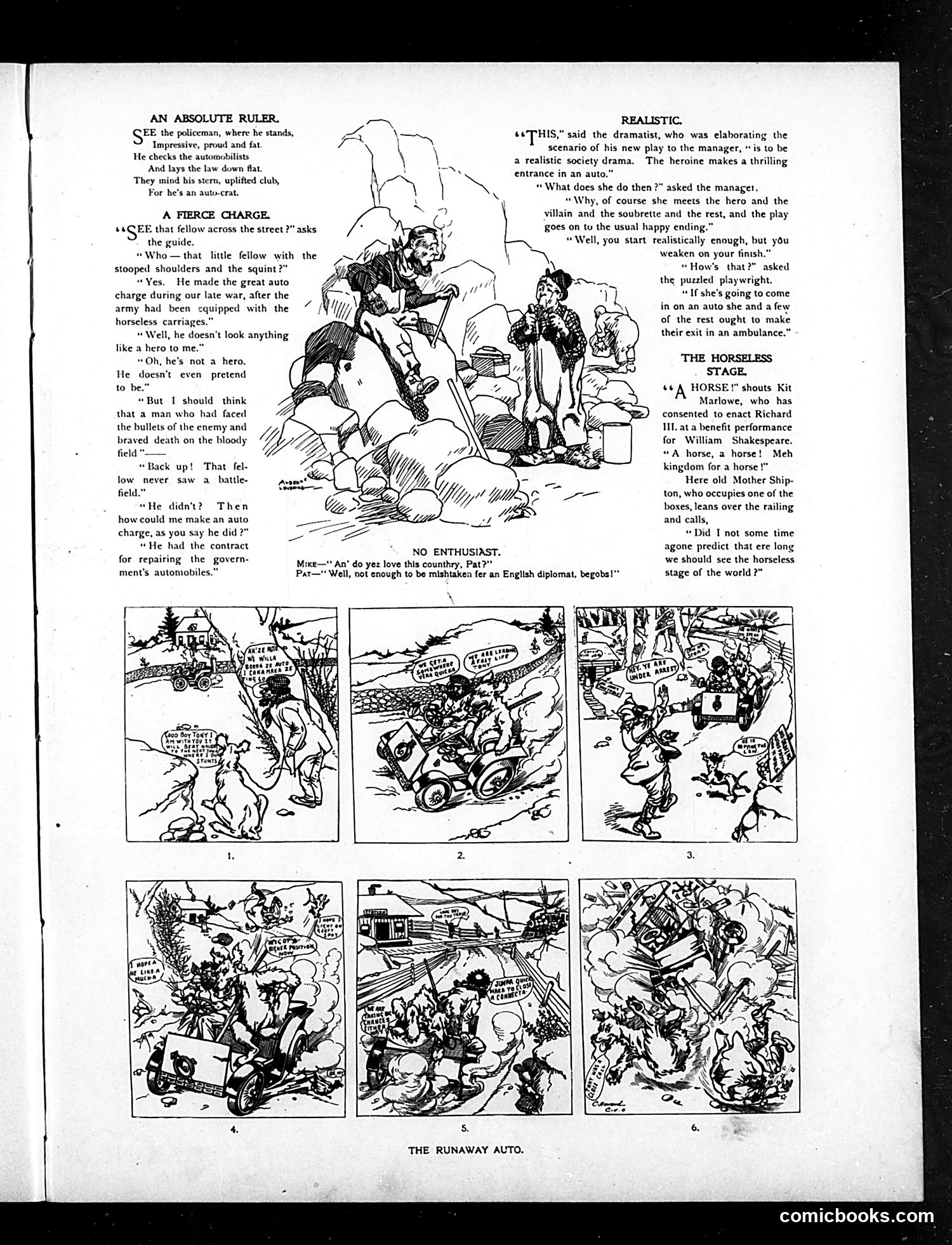
This page satirizes early automobiles and their cultural impact around the 1900s-1910s. Key sections: **"An Absolute Ruler"** and **"A Fierce Charge"** mock the newfound authority of traffic police and exaggerate the importance of early auto repair contractors during wartime. **"No Enthusiast"** plays on Irish-American dialect humor, with "Pat" claiming limited patriotism—humorously distinguishing himself from English diplomats rather than expressing genuine national pride. **"Realistic"** jokes that realistic theater becomes unrealistic when an automobile accident inevitably occurs—the heroine should exit by ambulance, not happy ending. **"The Horseless Stage"** features Kit Marlowe's famous Shakespeare line ("A horse! A horse!") reimagined when Mother Shipton (a legendary English prophetess) ironically predicts the "horseless stage," suggesting automobiles will replace traditional horse-drawn transportation. The six comic strips below ("The Runaway Auto") depict chaotic automotive mishaps. Overall, the page captures period anxieties and humor about automobiles disrupting established society.
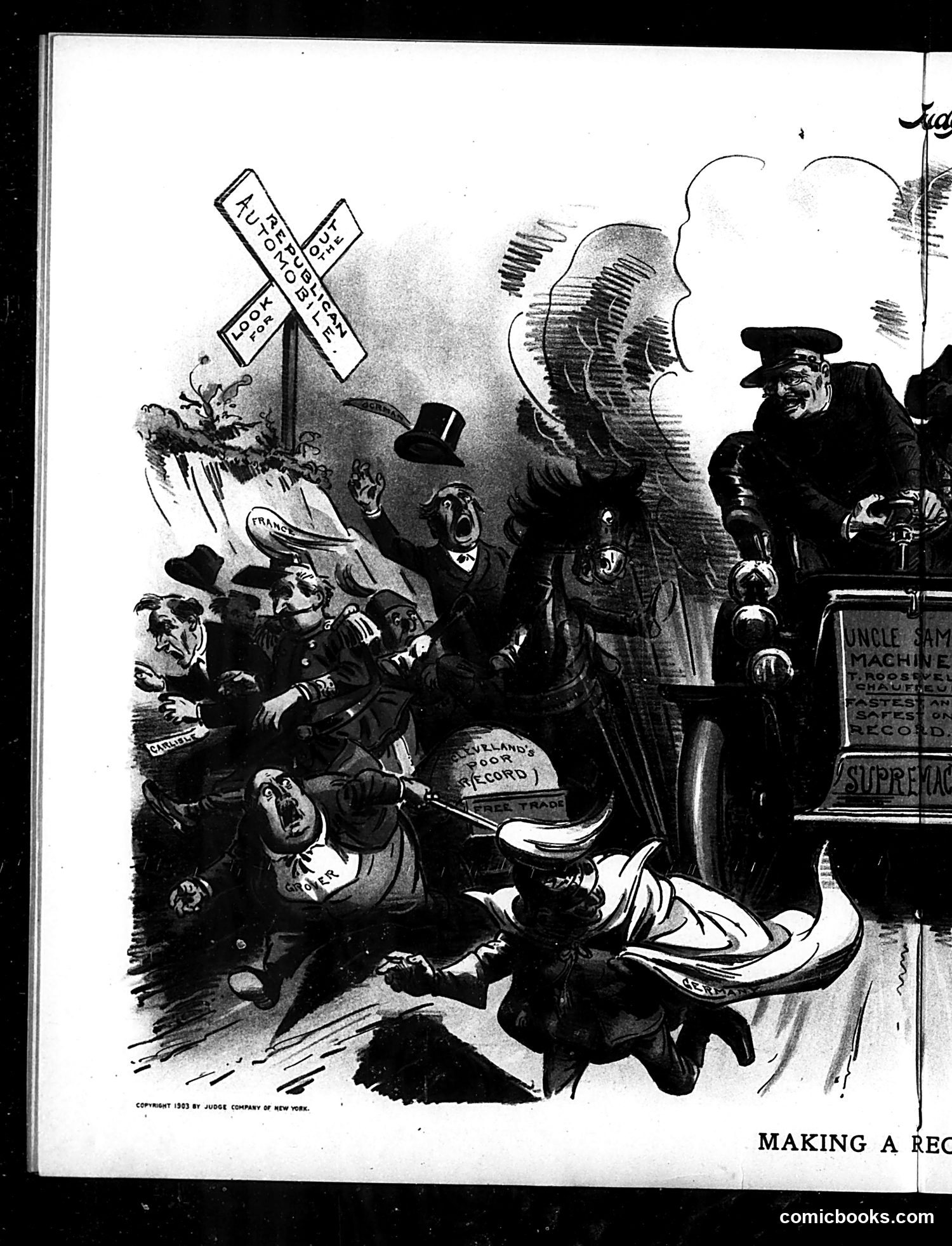
This appears to be a political cartoon titled "Making a Rec[ord]" from Judge magazine (copyright 1923). The image depicts figures labeled with business/trade terms being operated like a mechanical recording device by what appears to be a wealthy businessman or industrialist (right side, in top hat). The cartoon satirizes how business interests—represented by caricatured figures labeled with commercial terms—are being manipulated to produce desired "records" (likely referring to business statistics, trade reports, or public narratives). The cross in the background and general composition suggest this critiques the relationship between big business and public discourse during the 1920s. The exact identity of the central figure remains unclear without additional context, though the imagery suggests commentary on industrial power and manufactured consent.
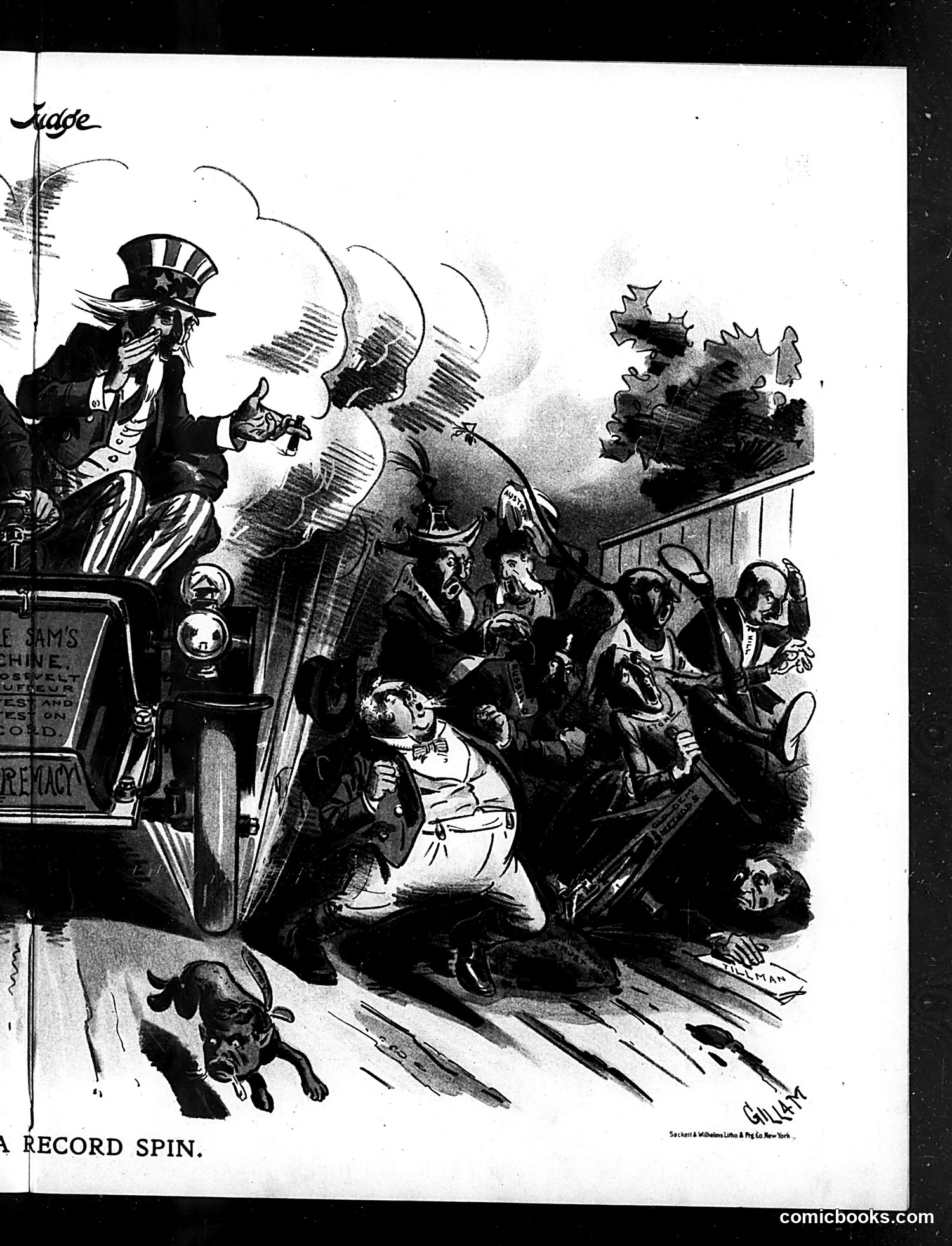
This cartoon depicts Uncle Sam (identifiable by his top hat and stars-and-stripes attire) operating what appears to be a phonograph or record player. He's cranking the handle while various figures—appearing to represent different nations or groups—are caught in the spinning motion, being thrown about chaotically. The title "A Record Spin" suggests a pun on both phonograph records and the political meaning of "spin." The cartoon satirizes how Uncle Sam (U.S. government/policy) manipulates international affairs, causing turmoil among other nations. The frantic, disordered figures suggest the destabilizing consequences of American intervention or propaganda. The dog at bottom-left adds commentary, though its specific meaning is unclear without additional context.
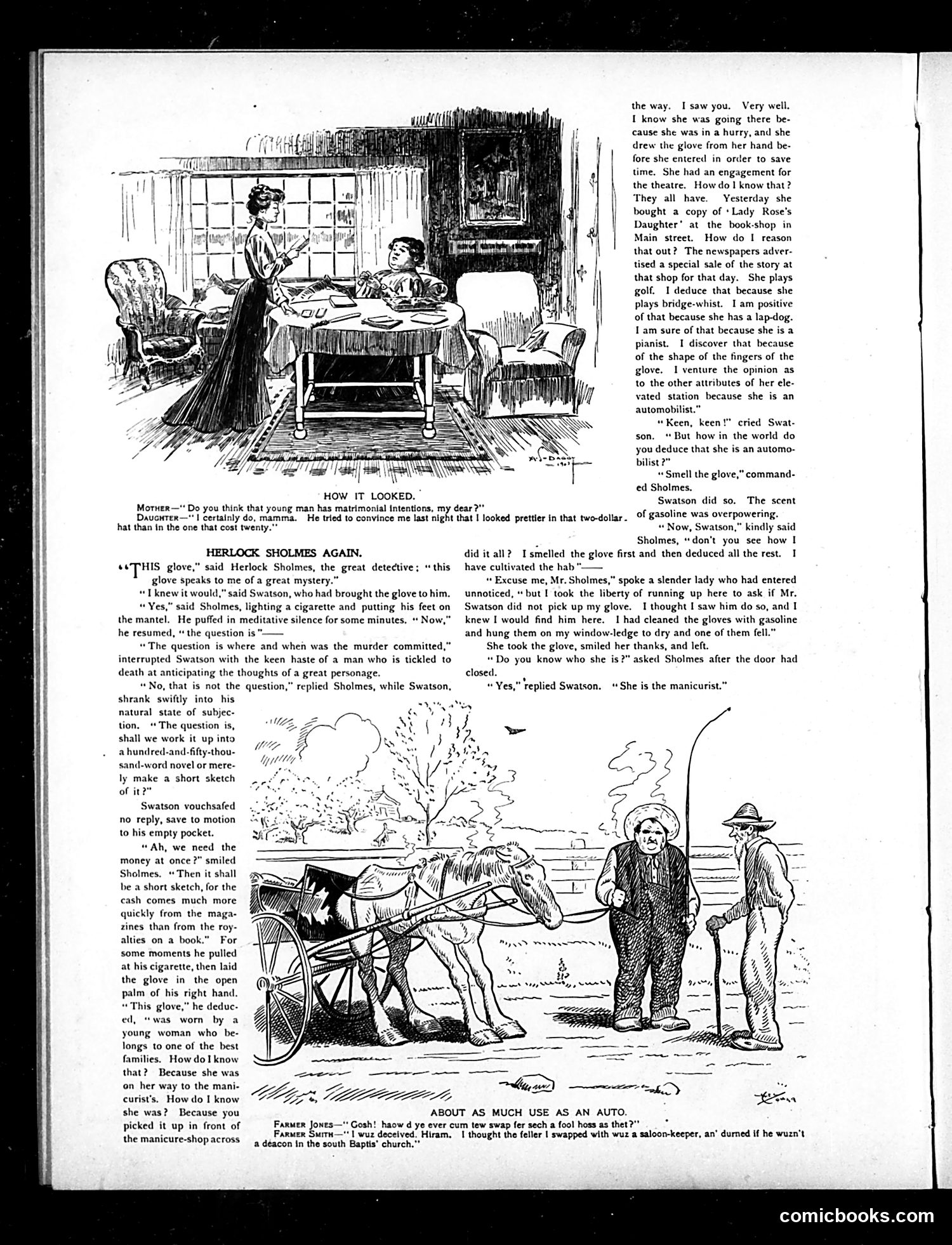
This page contains two satirical pieces mocking popular detective fiction and early automobiles. **"Herlock Sholmes Again"** parodies Sherlock Holmes stories. The detective makes elaborate deductions from a found glove—claiming the owner plays golf, bridge, piano, is an automobilist—all from examining the glove and smelling gasoline on it. The joke's punchline: the glove's actual owner, a manicurist who enters unnoticed, reveals she simply cleaned her gloves with gasoline and hung them to dry. Sholmes's overwrought reasoning is absurd; he's completely wrong. The satire targets both the popularity of Holmes stories and their often-implausible logical leaps. **"About as Much Use as an Auto"** (bottom cartoon) shows a farmer who traded a horse for an automobile—presented as a foolish swap. Early automobiles were unreliable; the joke suggests they're less useful than actual horses. This reflects early-1900s skepticism about automobiles as practical transportation. The top cartoon shows a mother questioning her daughter's suitor about his intentions, a period courtship convention.
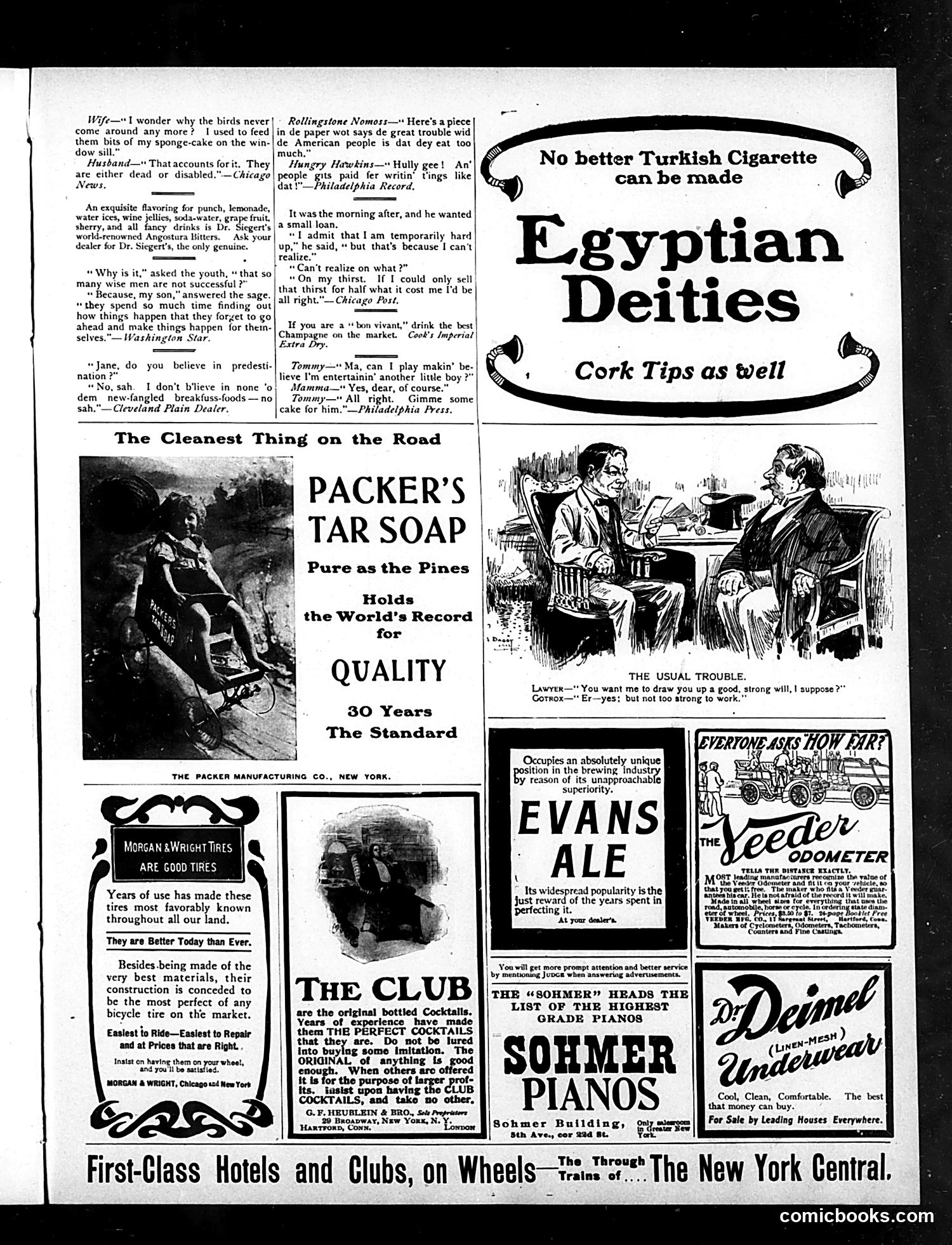
This page from Judge magazine is primarily **advertising with interspersed humor snippets** rather than political cartoons. The advertisements dominate (Packer's Tar Soap, Morgan & Wright Tires, Evans Ale, Sohmer Pianos, etc.). The scattered jokes are domestic/social humor typical of the era: - A wife's terrible sponge-cake kills birds - Tommy manipulates his mother into getting cake by pretending to entertain a friend - A man wants a will drawn, but "not too strong to work" (playing on "strong will") One item references **"Rollingstone Nomoss"** (a African American dialect character) discussing complaints about Americans eating too much—satirizing the absurdity that people are *paid* to write such obvious observations. **The cartoon "The Usual Trouble"** shows a lawyer and client discussing a will, with the client worried it's too restrictive—mild satire on legal caution versus practical life needs. Overall, this is a **commercial advertising page with light, apolitical humor**—no significant political commentary or satirical targets are evident.
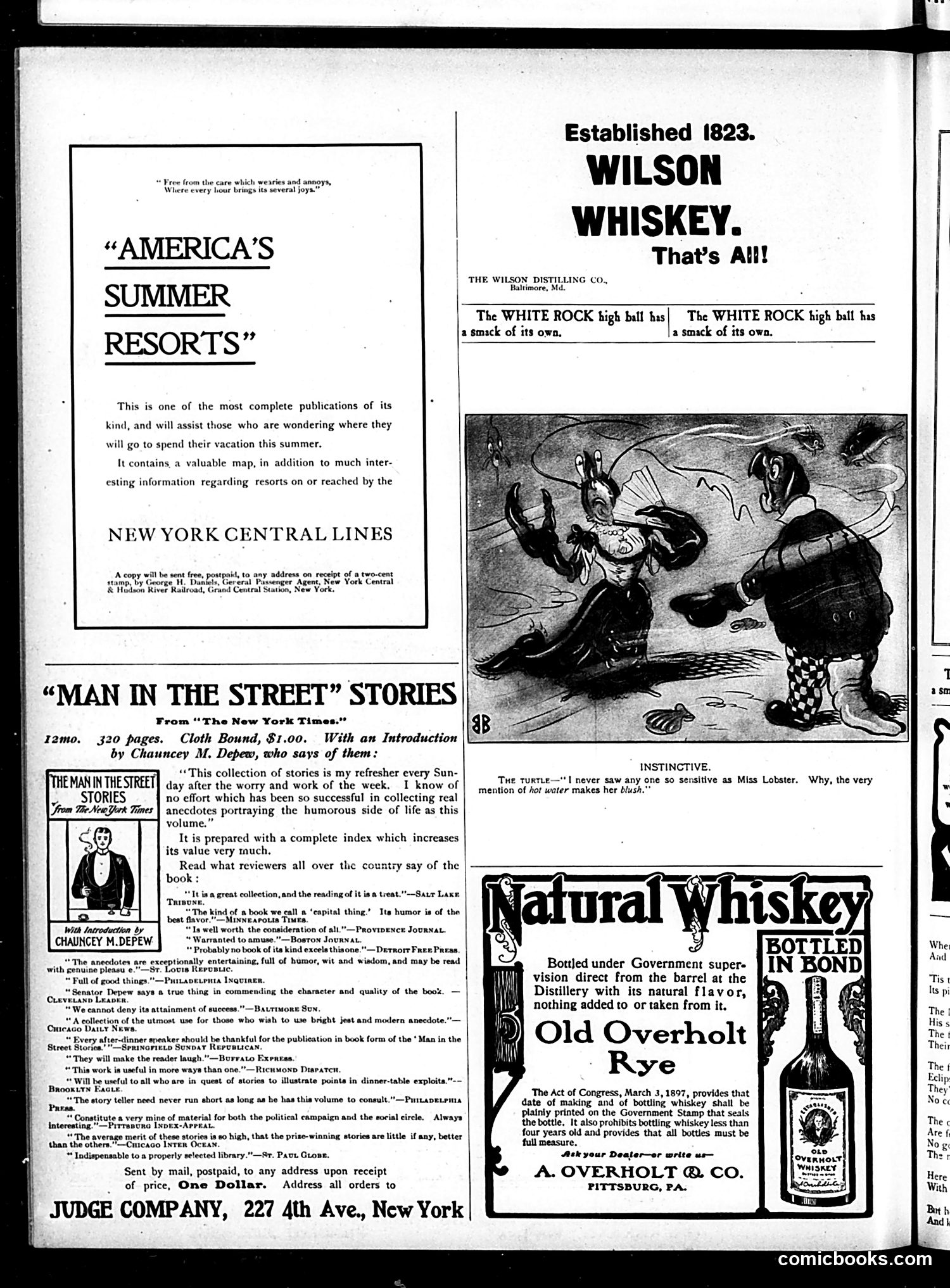
This page is primarily **advertising and promotional content** rather than political satire. The main elements are: **Central Cartoon:** The illustration labeled "INSTINCTIVE" depicts a turtle and lobster in conversation, with the turtle saying it's never seen anyone as sensitive as Miss Lobster, and questioning why water makes her "balk." This is a lighthearted pun on the lobster's physical sensitivity to water temperature—likely satirizing overly delicate sensibilities. **Advertisements:** The page features multiple product promotions: - Wilson Whiskey (established 1823) - White Rock beverages - Natural Whiskey/Old Overholt Rye (emphasizing government regulation and aging standards) - New York Central Lines vacation travel guide - A book collection called "Man in the Street Stories" **Purpose:** Judge magazine used these pages to generate revenue while providing entertainment. The content reflects early 1900s consumer culture and railroad-era tourism advertising alongside genteel humor aimed at affluent readers.
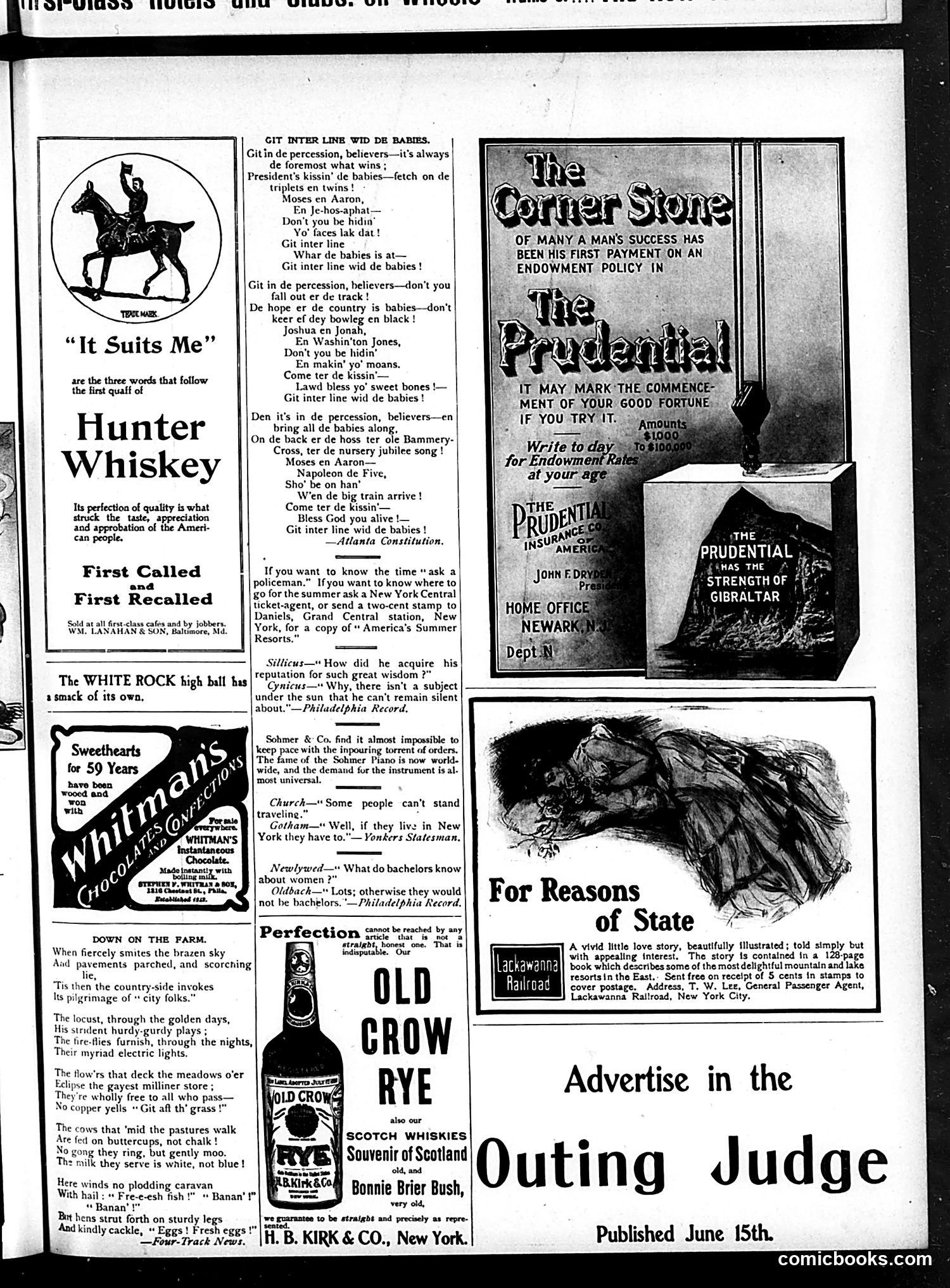
This is primarily an **advertising page** from Judge magazine (published June 15th), with minimal editorial content. The main cartoon, "Git Inter Line Wid De Babies," uses **racist dialect humor** common to the era. It depicts African American figures in exaggerated vernacular celebrating a presidential visit where the president kisses babies. The satire targets politicians' performative baby-kissing during campaign appearances—a standard political stunt—by portraying the practice as absurdly universal and indiscriminate. The page is dominated by **liquor advertisements** (Hunter Whiskey, Old Crow Rye, White Rock) and insurance/book promotions typical of the period. Several brief jokes mock urban life and bachelorhood. The cartoon's "humor" relies on racial caricature rather than sophisticated political commentary. Modern readers would recognize this as reflecting the casual racism embedded in early 20th-century American media, while the underlying joke about politicians' photo-op authenticity remains recognizable.
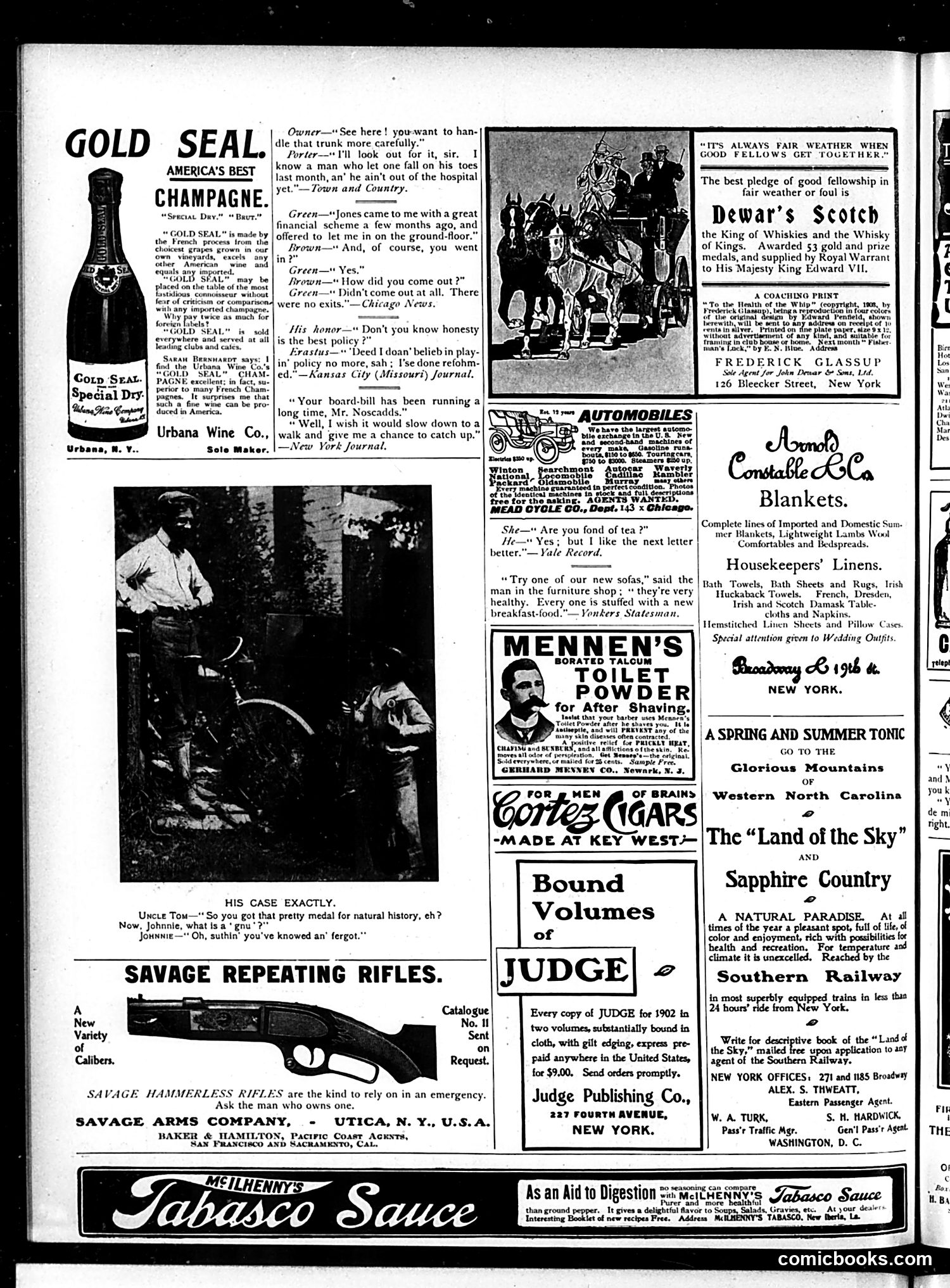
This page is primarily **advertisements and short jokes**, typical of Judge magazine's format. The main content includes: **"His Case Exactly"** (bottom left): A cartoon dialogue where Uncle Tom asks his nephew Johnnie what a "gnu" is. The joke relies on a pun: Johnnie answers "somethin' you've known and forgot"—playing on "gnu" sounding like "new." It's a simple wordplay joke with no political significance. **Other brief jokes** scattered throughout concern: - A porter warning about dropping a trunk (injury humor) - A financial scheme that offers no "exits" (double meaning) - A boarder whose bill "runs" too fast **The rest is advertising** for champagne, rifles, whiskey, furniture, cigars, linens, rail travel, and other products typical of early 1900s periodicals. There are **no identifiable political figures or social satire** on this page—it's primarily commercial content interspersed with light humor, representative of how Judge balanced satirical commentary with revenue-generating advertisements.
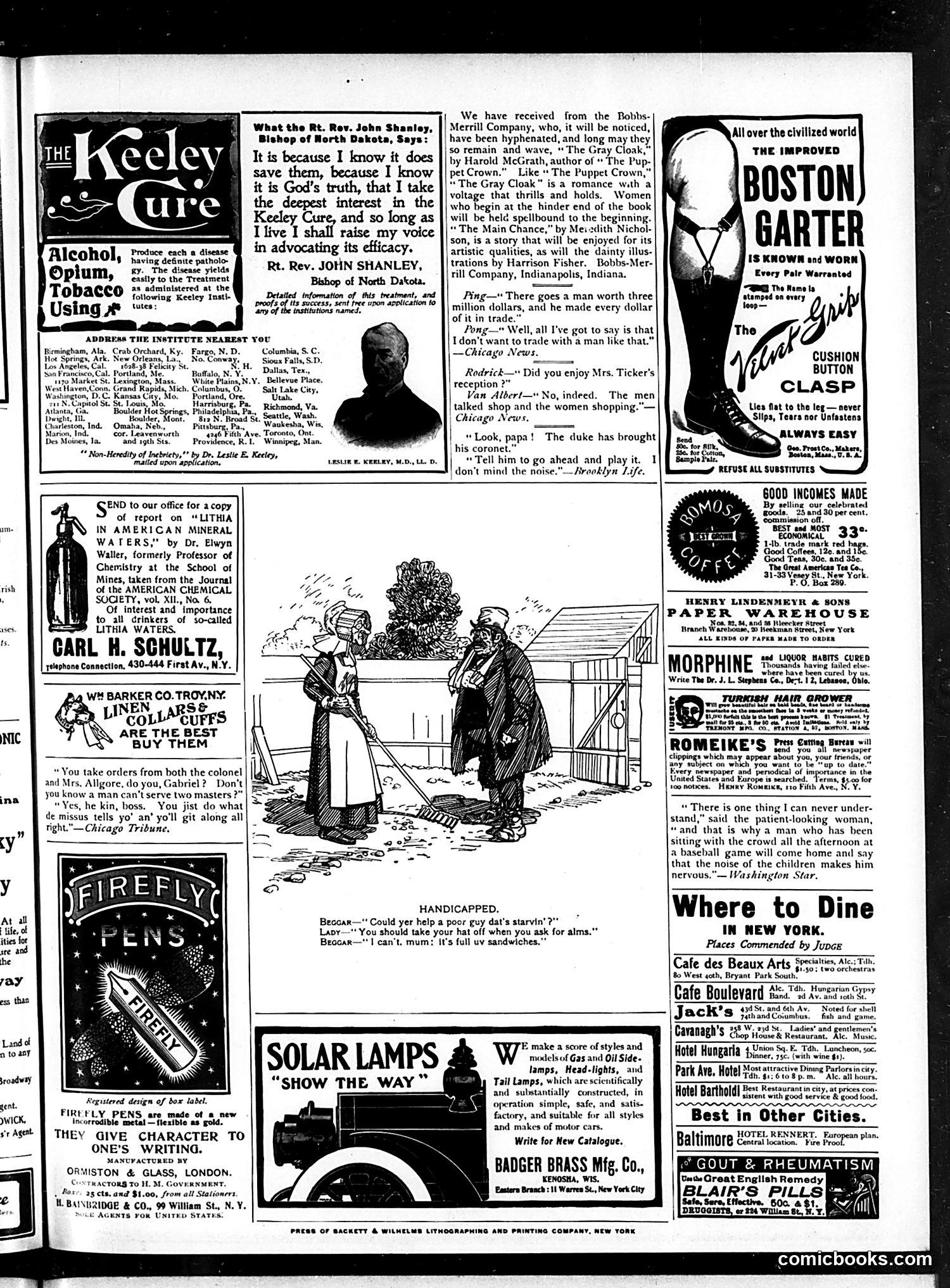
This page collects advertisements, testimonials, and small comic scenarios—typical of early 1900s periodicals. **The main cartoon** ("Handicapped") depicts a beggar asking "Could yer help a poor guy dat's startin'" while a well-dressed woman replies she'll take his hat when he asks for alms, as sandwiches fill it. The joke satirizes charity and poverty: beggars were expected to accept whatever scraps came their way, and the woman treats him as a nuisance while mocking his condition. **Testimonials** promote the Keeley Cure, a treatment for alcoholism and drug addiction, endorsed by Bishop John Shanley. This reflects Progressive Era faith in medical "cures" for social problems. **Comic snippets** mock class pretension, marital dynamics, and wealth. One jokes that a millionaire made his fortune through trade—unsuitable for respectable society. **Advertisements** promote garters, pens, teas, and patent medicines—standard commercial fare. The page is primarily commercial rather than satirical.
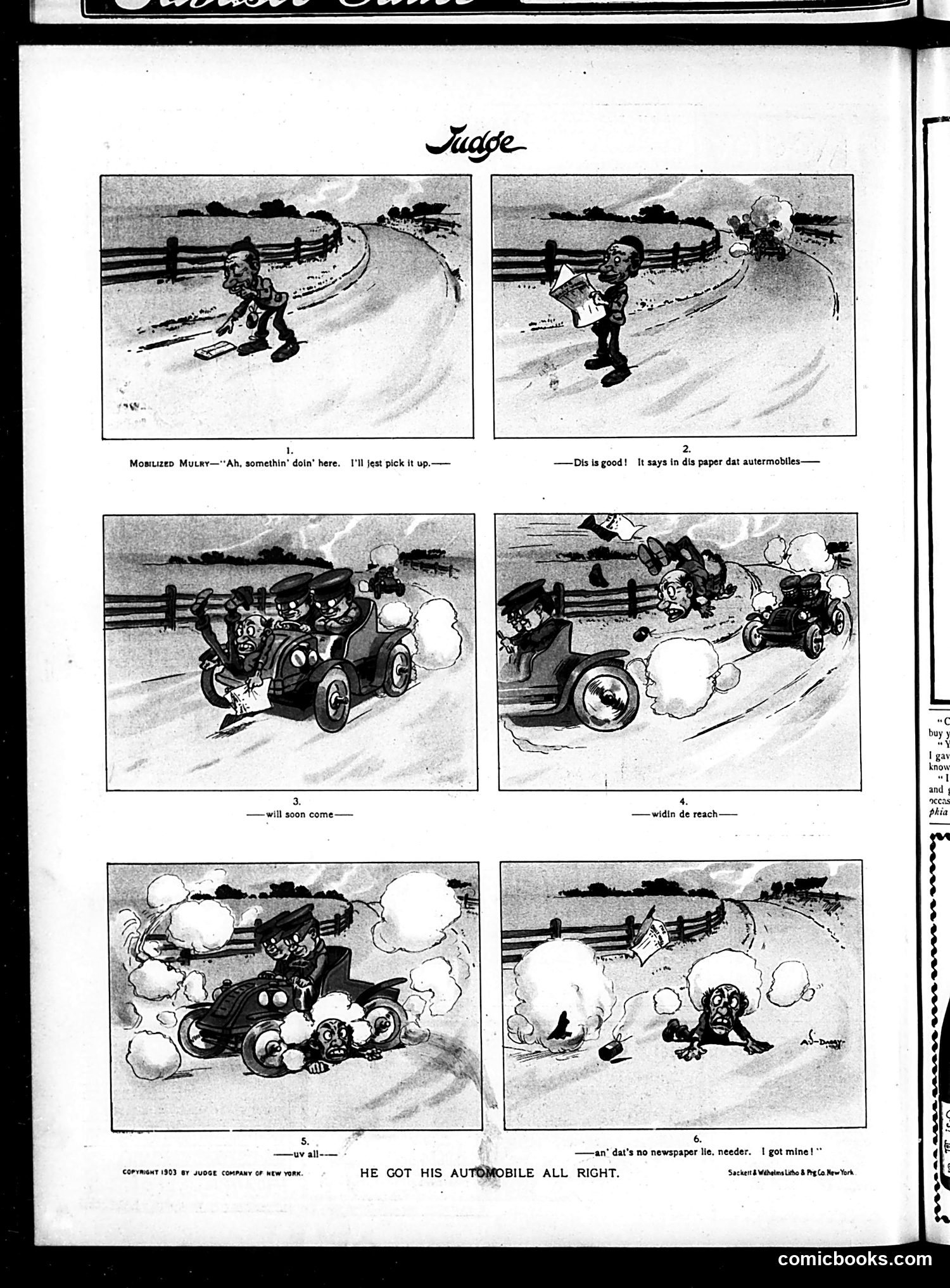
This is a six-panel comic strip satirizing the early automobile craze. A character identified as "Mobilized Mulcty" encounters an automobile in panel 1, then steals or acquires it through increasingly chaotic means across panels 2-5, culminating in a crash in panel 6. The satire targets working-class aspirations and the get-rich-quick mentality of the early 1900s. The title's irony—"he got his automobile all right"—undercuts this ambition; he obtains the car through criminal means, and it ends in disaster. The final caption mocks sensationalism: "an' dat's no newspaper lie, needer. I got mine!" The dialect suggests the character is depicted as working-class or immigrant. The joke reflects anxieties about rapid social mobility and automobile culture during the automobile industry's explosive growth period.
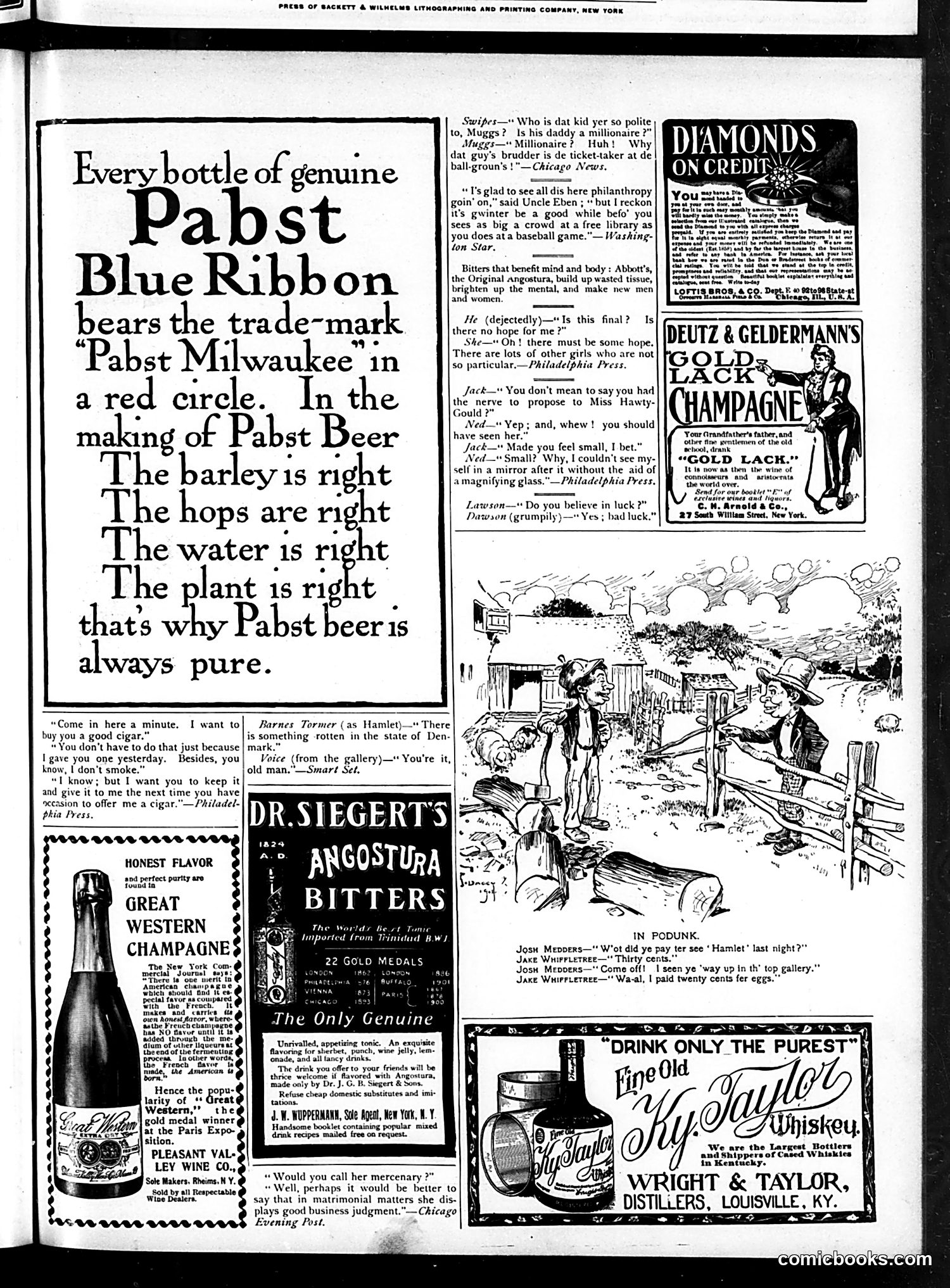
This page from *Judge* magazine is primarily devoted to **period advertisements** for alcohol and tobacco products rather than political satire. The visible content includes: **Main Advertisement**: Pabst Blue Ribbon beer emphasizes purity through its ingredients and manufacturing process—a marketing approach typical of the era. **Supporting Content**: Several short humorous anecdotes appear scattered throughout—comic exchanges about cigars, dating, luck, and theater attendance. These are gentle, non-political jokes rather than satire. One references *Hamlet*, which appears in a theatrical context on the page itself. **Other Ads**: Champagne, bitters, whiskey, and wine advertisements dominate the layout, each making quality and heritage claims common to turn-of-the-century marketing. **Key Point for Modern Readers**: This reflects an era when advertisements prominently featured in humor magazines, and alcohol/tobacco promotion was completely unrestricted and normalized in mainstream publications. The humor here is purely social comedy, not political commentary.
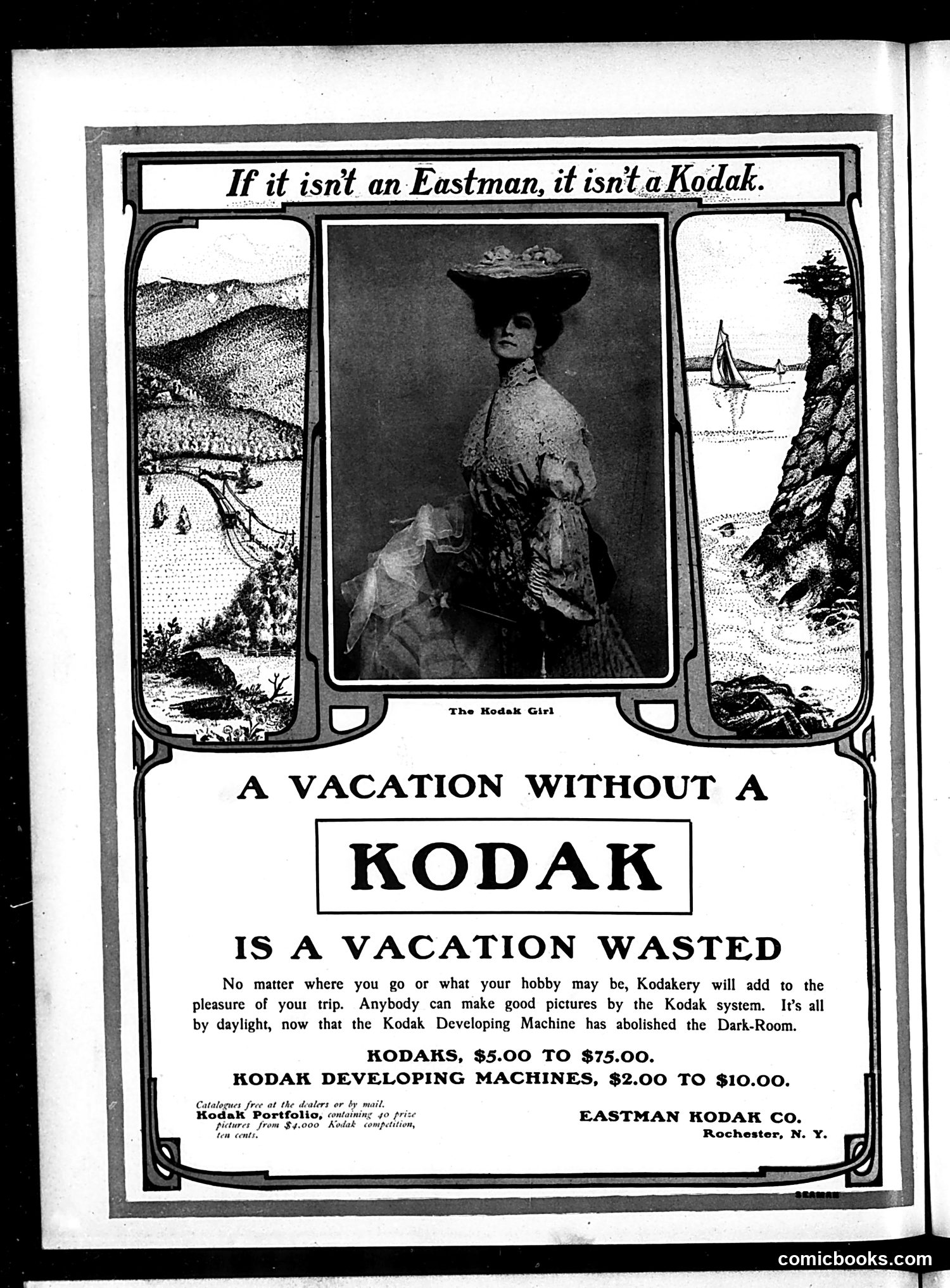
This is primarily **advertising, not satire or political commentary**. It's a Kodak camera advertisement from the Eastman Kodak Company, appearing in *Judge* magazine. The page features "The Kodak Girl"—a fashionable woman in early 1900s dress (large hat, elegant clothing)—positioned as an aspirational figure representing vacation photography. The tagline "A vacation without a Kodak is a vacation wasted" is straightforward marketing copy promoting consumer camera ownership. The header "If it isn't an Eastman, it isn't a Kodak" emphasizes the company's brand dominance and warns against inferior competitors. The scenic vignettes flanking the central portrait (landscape, coastline) suggest the vacation experiences Kodak cameras would capture. This represents early consumer advertising targeting middle-class leisure activities—positioning photography as essential to modern vacations rather than an optional luxury.