
A complete issue · 49 pages · 1901
Judge — December 28, 1901
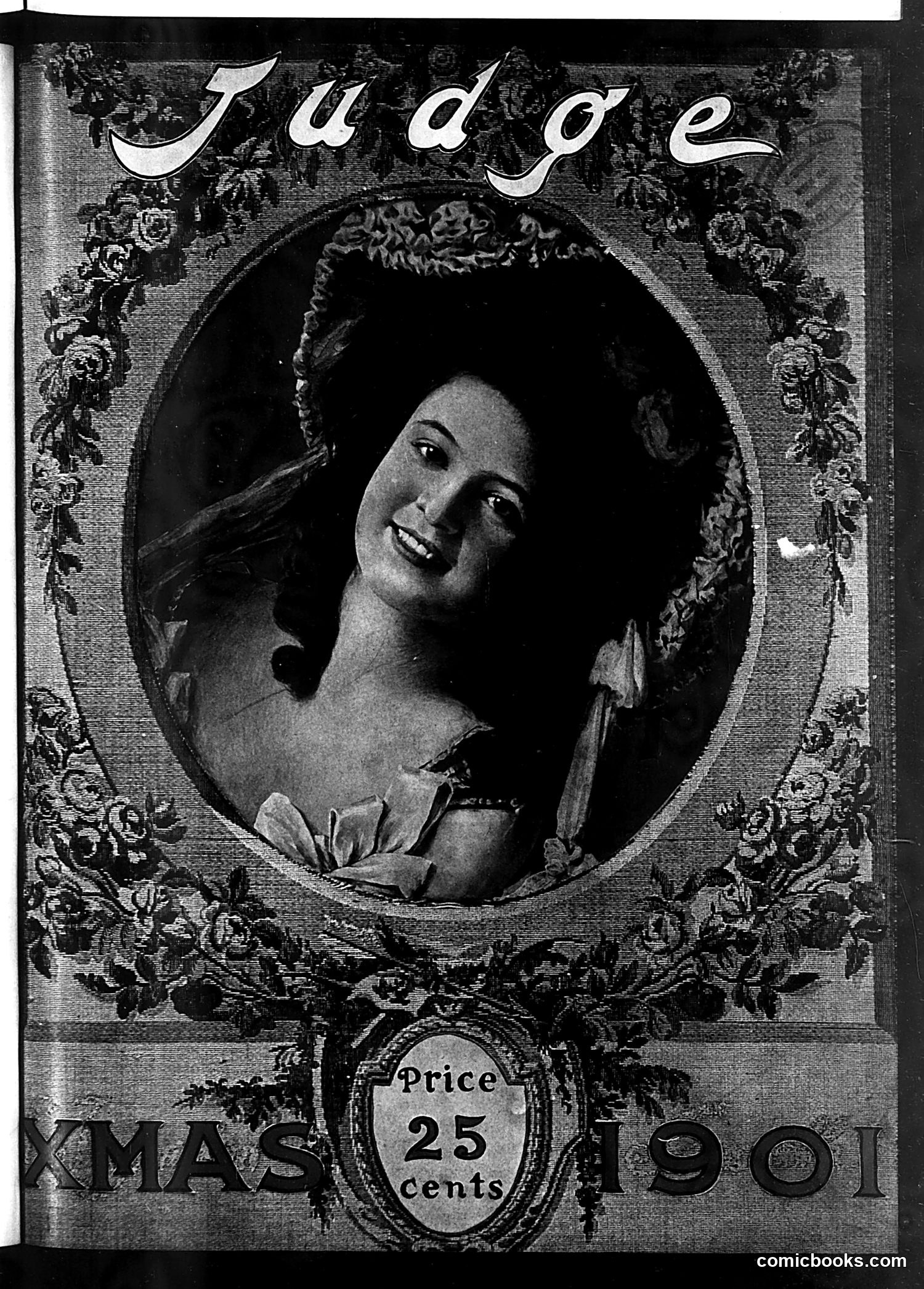
This appears to be a **Christmas 1901 cover** from *Judge* magazine (visible as "XMAS 1901" at bottom). The page is primarily a **decorative portrait advertisement** rather than political satire. The cover features an **elegant woman's portrait** framed by ornamental floral garlands in a classical oval medallion style. The word "Judge" appears at top in decorative lettering, with "Price 25 cents" displayed below. This is a **holiday issue cover** emphasizing aesthetic beauty and seasonal celebration rather than commentary. The formal portrait style and elaborate decorative border reflect early 1900s commercial art conventions. Without additional context or identifying text, the specific identity of the woman pictured remains unclear.
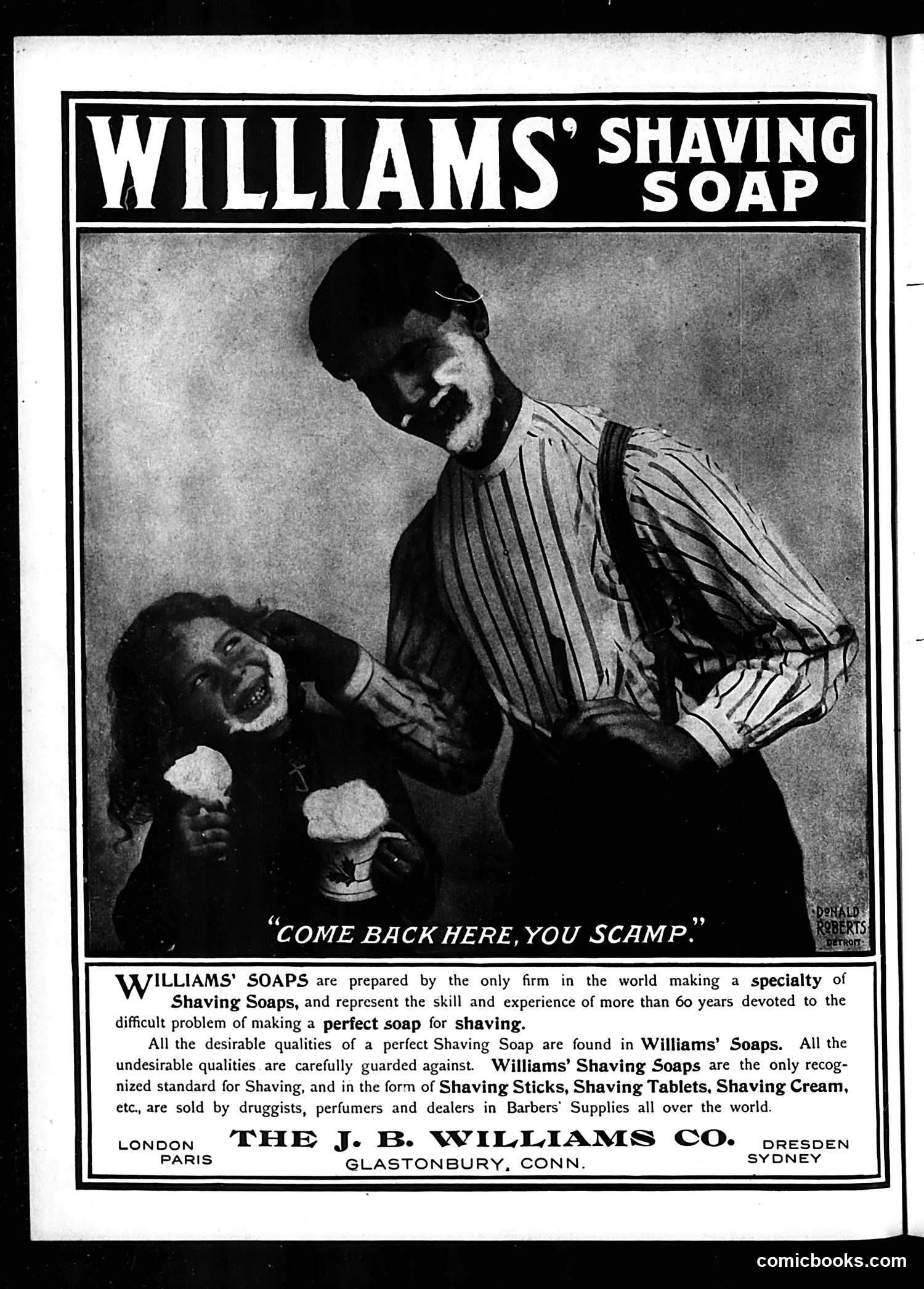
This is primarily a **Williams' Shaving Soap advertisement**, not satirical content. The image shows a barber or shaving attendant applying lather to a client's face, with the client saying "Come back here, you scamp" — likely a humorous plea for the barber to return and complete the shave. The ad emphasizes that Williams' is "the only firm in the world making a specialty of Shaving Soaps" with over 60 years of experience. It claims their product is the only "recognized standard for Shaving" and is available as soap, sticks, tablets, and cream through druggists and barber suppliers worldwide. The company was headquartered in Glastonbury, Connecticut, with offices in London, Paris, Dresden, and Sydney. This appears to be vintage advertising rather than satirical commentary.
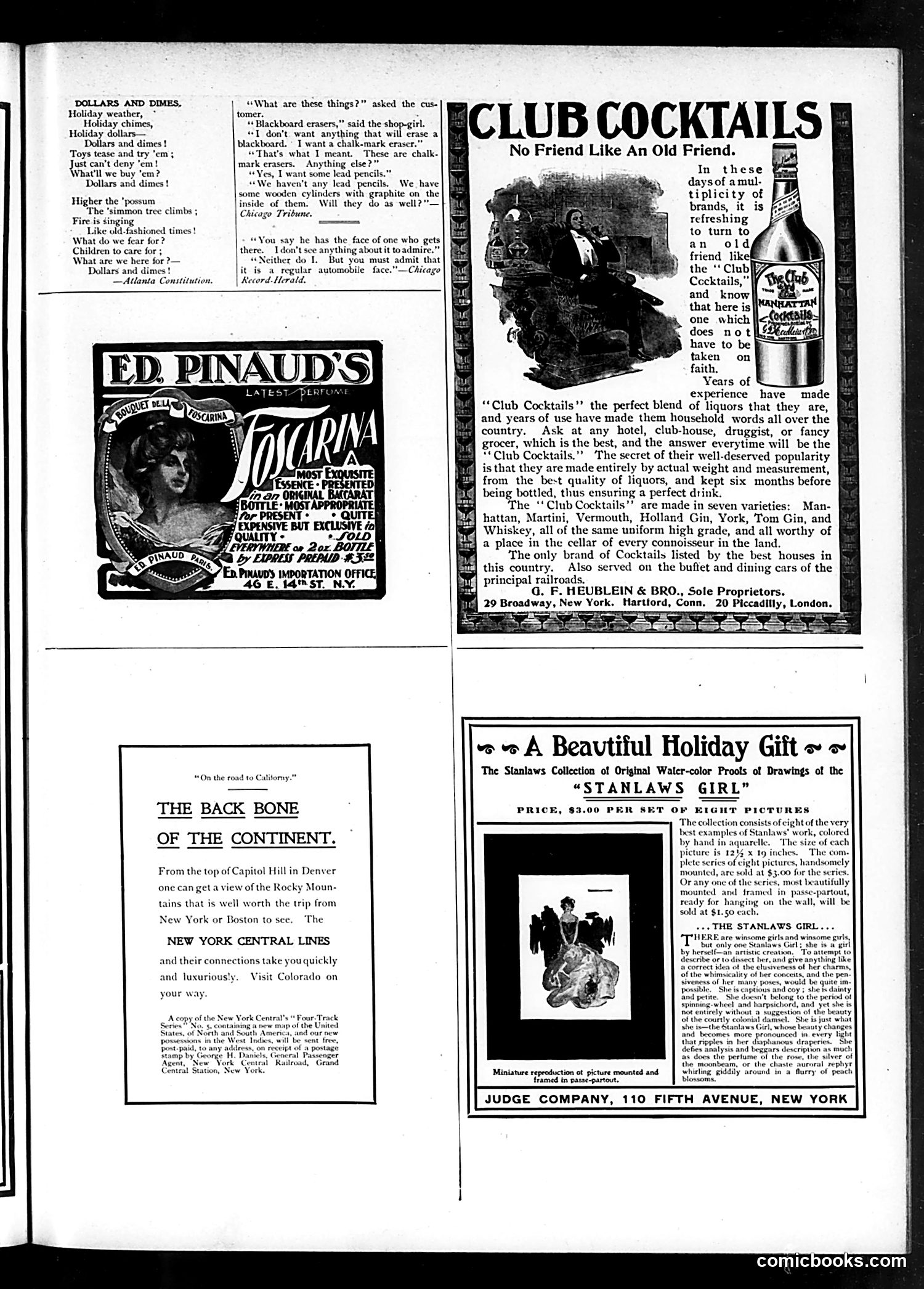
This page is primarily **advertising and commercial content** rather than political satire or cartoons. The notable elements are: 1. **Ed. Pinaud's Toscana** - A perfume/toiletry advertisement emphasizing quality and bottle presentation 2. **Club Cocktails** - A spirits advertisement featuring an old dog, using the slogan "No Friend Like An Old Friend." The ad emphasizes the product's quality, seven varieties, and distribution through major hotels and railroads 3. **New York Central Lines** - Travel advertisement promoting Colorado tourism and Rocky Mountains 4. **Stanlaws Girl** - An advertisement for water-color art prints by a collection called "The Stanlaws Collection" The page contains no discernible political satire or social commentary. It appears to be a typical Judge magazine page from the early 20th century, mixing the magazine's standard content with paid advertisements.
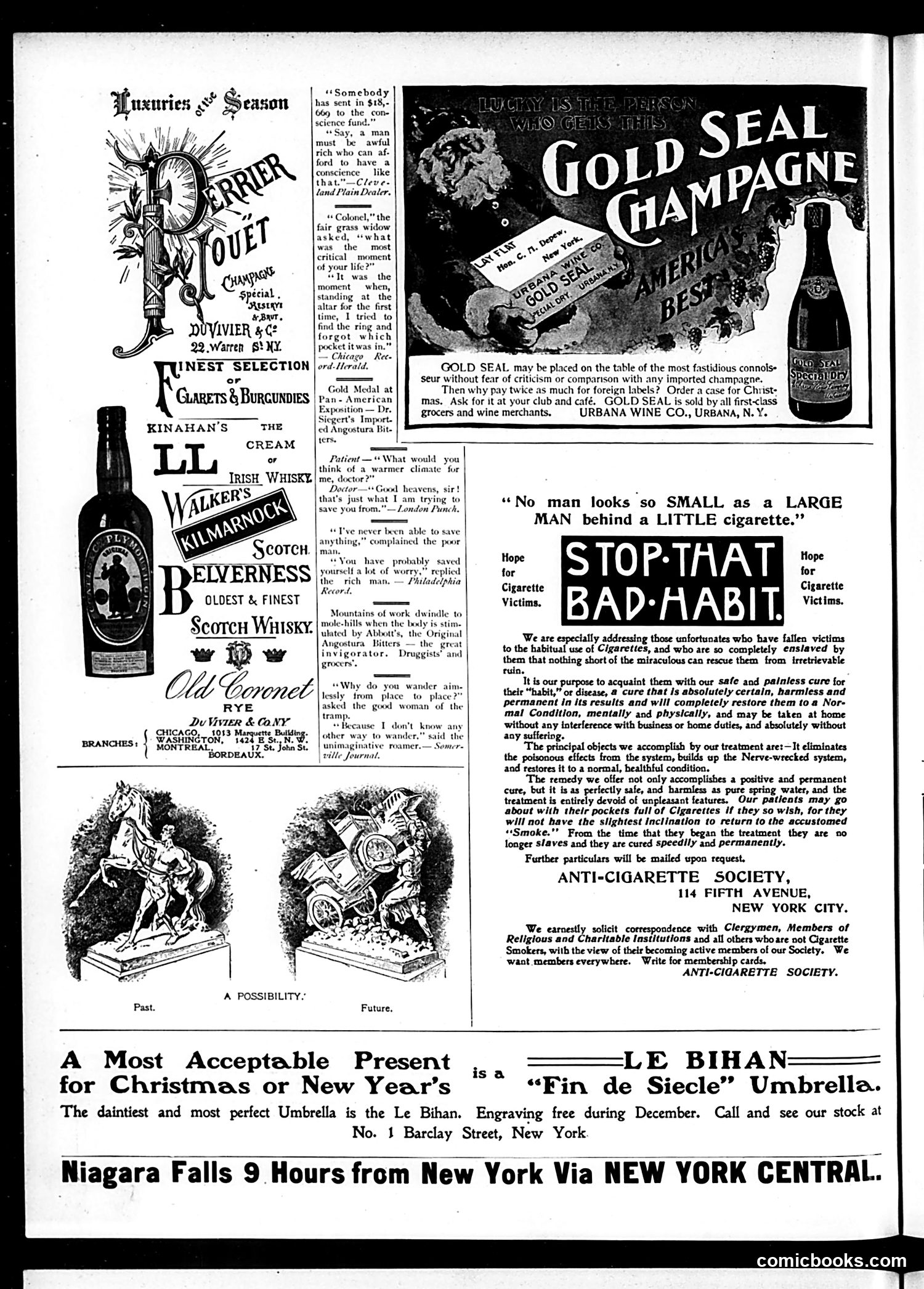
This page is primarily **advertising**, not political satire. The main content includes: - **Liquor ads** (Pouquet Champagne, Walker's Scotch Whisky, Old Coronet Rye) - **Gold Seal Champagne** advertisement - **Anti-Cigarette Society** public service message warning against smoking's dangers and offering a "cure" - **Le Bihan umbrella** gift suggestion - **Travel advertisement** for Niagara Falls via New York Central The only cartoon elements are decorative illustrations accompanying the alcohol advertisements. There is **no apparent political commentary or satire** on this particular page—it's a typical commercial magazine layout from what appears to be the early 20th century, reflecting period attitudes about tobacco, alcohol, and consumer goods.
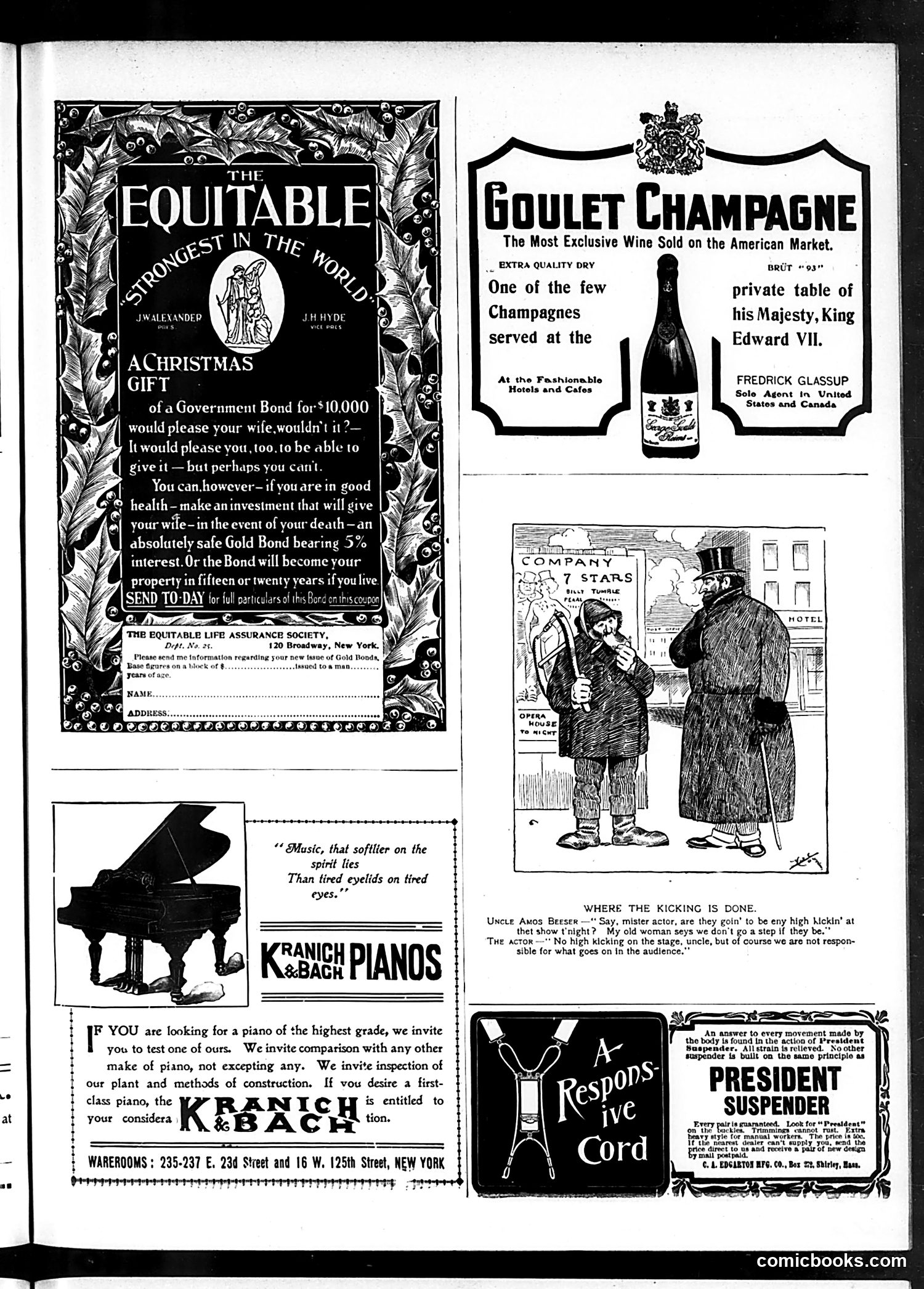
This page consists primarily of **advertisements** rather than editorial satire. The main content includes: 1. **The Equitable Life Assurance Society** - promoting $10,000 government bonds as Christmas gifts, positioned as life insurance 2. **Kranich & Bach Pianos** - a luxury instrument advertisement emphasizing quality and inviting comparison with competitors 3. **Goulet Champagne** - marketed as exclusive, claiming to be served at King Edward VII's private table 4. **A brief cartoon** titled "Where the Kicking is Done" - a simple exchange between an uncle asking an actor about "high kicking" (likely referring to leg-raising dance moves popular in vaudeville theater). The joke plays on double meaning: the uncle worries about stage content, but the actor suggests audience members might misbehave. 5. **President Suspender** - a mechanical suspender advertisement The page represents typical early-20th-century Judge magazine content: luxury product advertising mixed with light humor. The cartoon's reference to theatrical "high kicking" reflects contemporary vaudeville entertainment concerns.
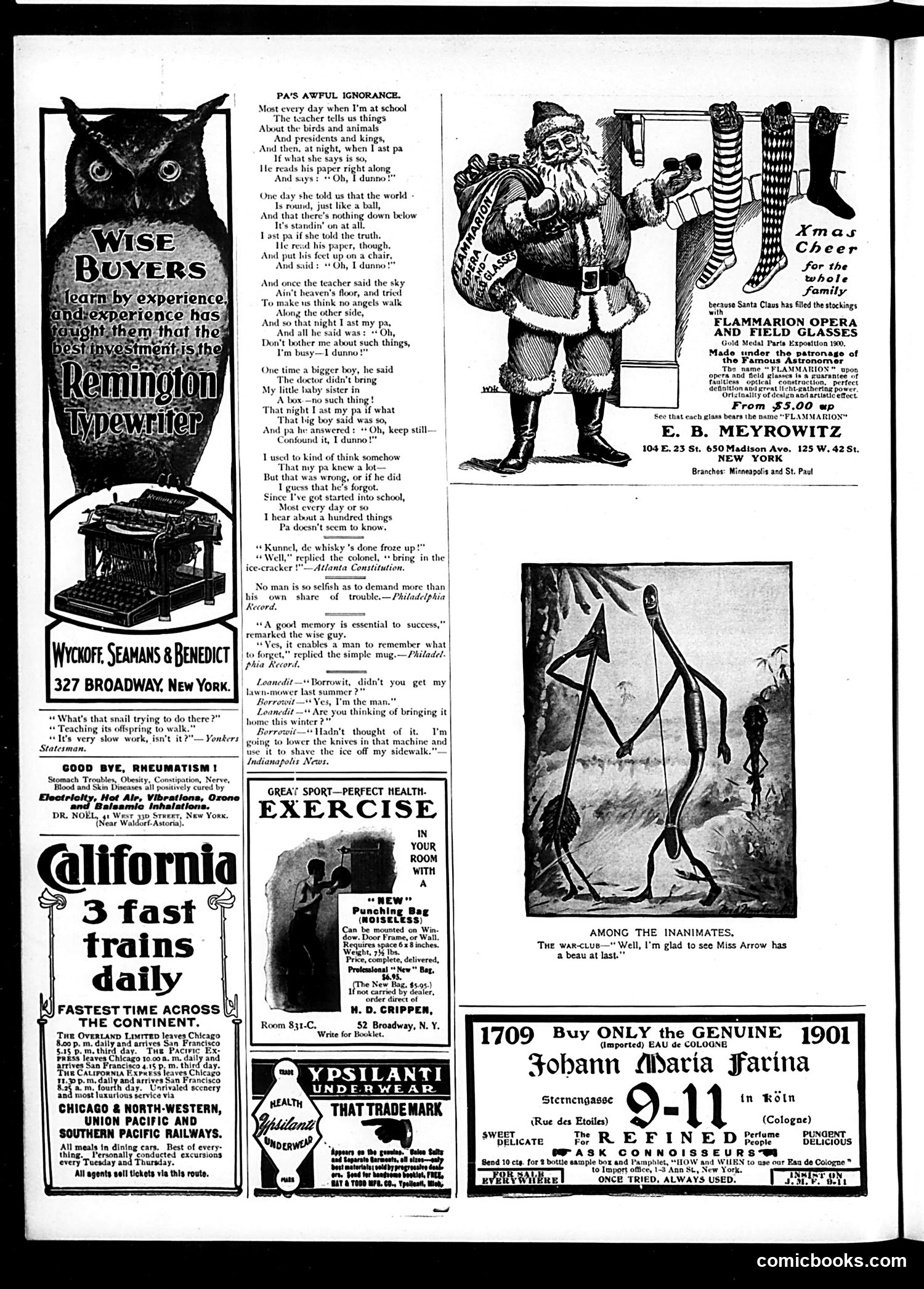
This page combines satirical content with period advertising. The main cartoon, "Pa's Awful Ignorance," depicts a running joke about an American father's deliberate refusal to engage with knowledge. The child repeatedly asks Pa factual questions about the world (the shape of the earth, where babies come from, etc.), and Pa consistently responds "I dunno!" while reading his newspaper—suggesting willful avoidance of intellectual curiosity. The satire targets working-class masculine anti-intellectualism and paternal disengagement from education. It contrasts the child's earnest school learning with the father's studied indifference, implying this attitude perpetuates ignorance across generations. Other jokes on the page mock memory, borrowing etiquette, and Southern dialect humor (the "Colonel" whisky freeze joke). The remainder consists entirely of period advertisements: typewriters, California trains, medical treatments (electricity for rheumatism), exercise equipment, and luxury binoculars—typical Judge magazine content mixing social commentary with commercial endorsements.
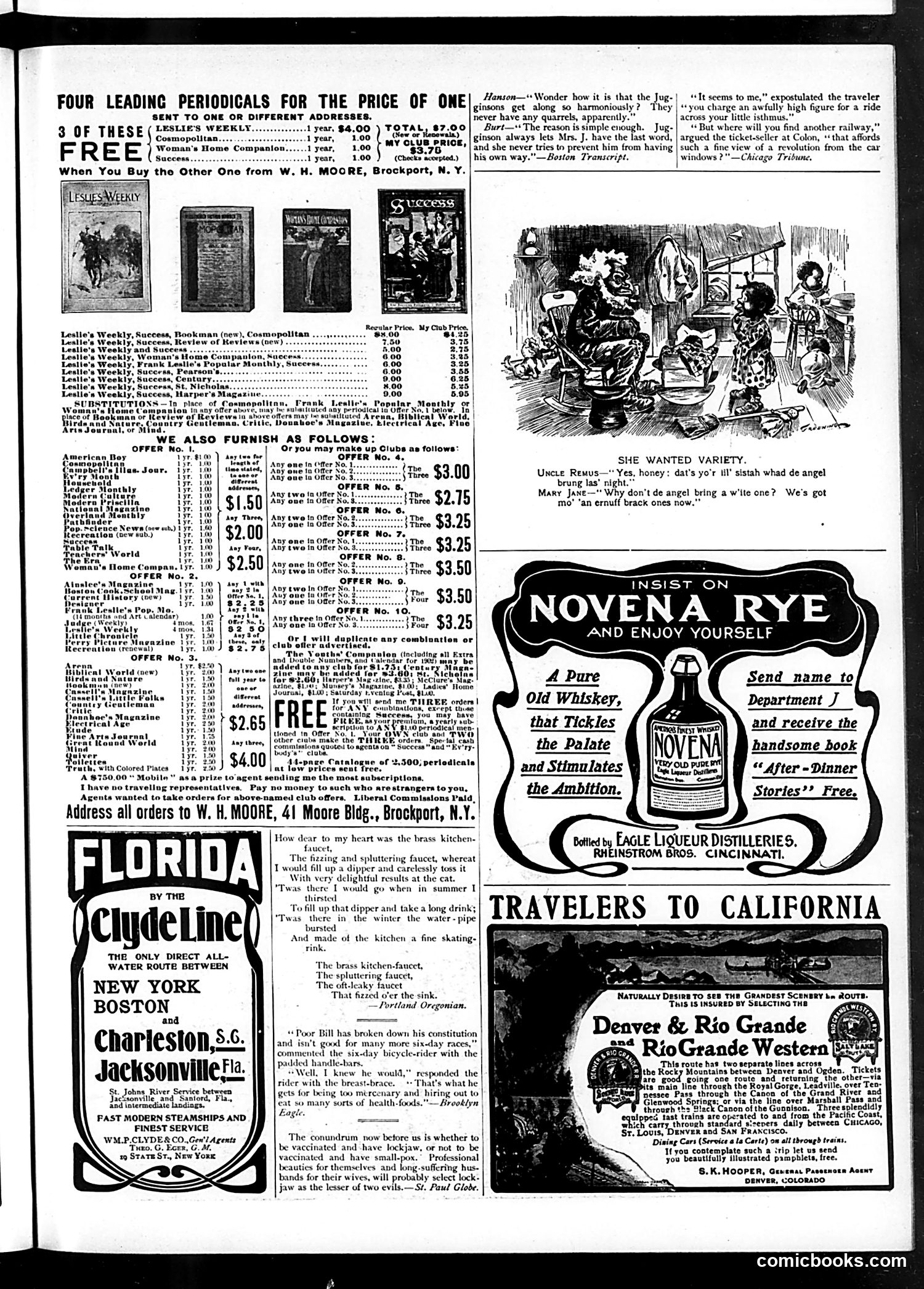
This page is primarily **advertising and subscription offers**, not political satire. The dominant content features W.H. Moore's magazine bundle deals—selling multiple periodicals (Leslie's Weekly, Success, Cosmopolitan, etc.) at discounted rates. The small **cartoon** titled "She Wanted Variety" depicts a domestic scene where a woman asks her husband to "bring a wife one" because "We've got to have variety." It's mild social humor about marriage monotony—not political commentary. Below are advertisements for Noven Rye whiskey, a railroad route to California, and a poem about a leaky kitchen faucet (nostalgic humor). **No identifiable political figures or events appear.** The page represents typical early-1900s magazine advertising, with lightweight domestic humor and product pitches rather than the sharp political satire Judge magazine was known for elsewhere.
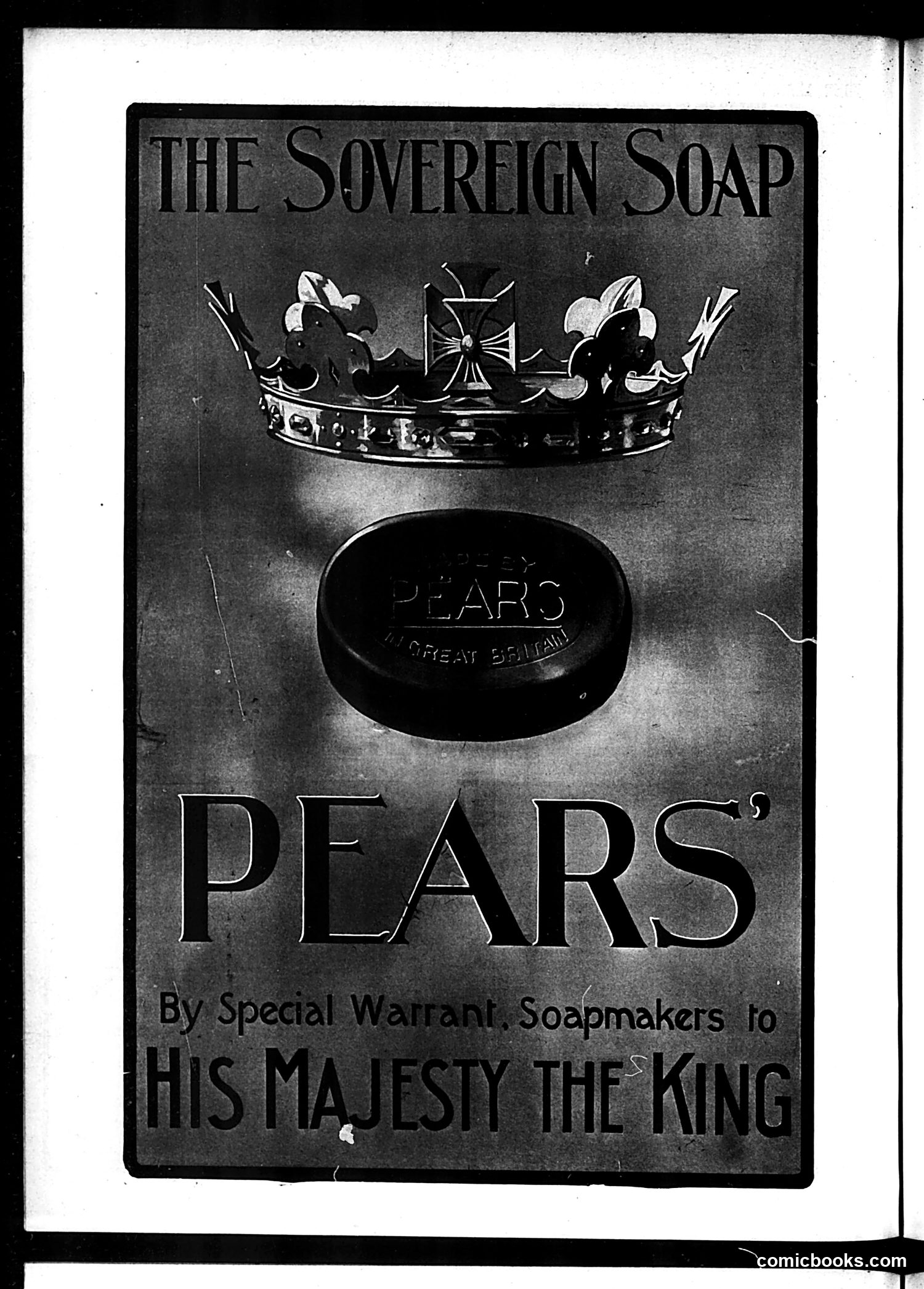
This is a vintage advertisement for Pears' soap, not a political cartoon. The ad features a decorative crown at the top and displays a bar of soap marked "PEARS" and "GREAT BRITAIN." The text claims the product holds a "Special Warrant" as "Soapmakers to His Majesty the King," indicating royal patronage or approval. The satire likely works through the grandiose presentation—using royal imagery and official warrant language to market an ordinary household product. By invoking the monarchy and British patriotism, the advertisement elevates a commonplace soap bar to prestigious status, appealing to consumers' aspirations for quality and respectability associated with royal endorsement.
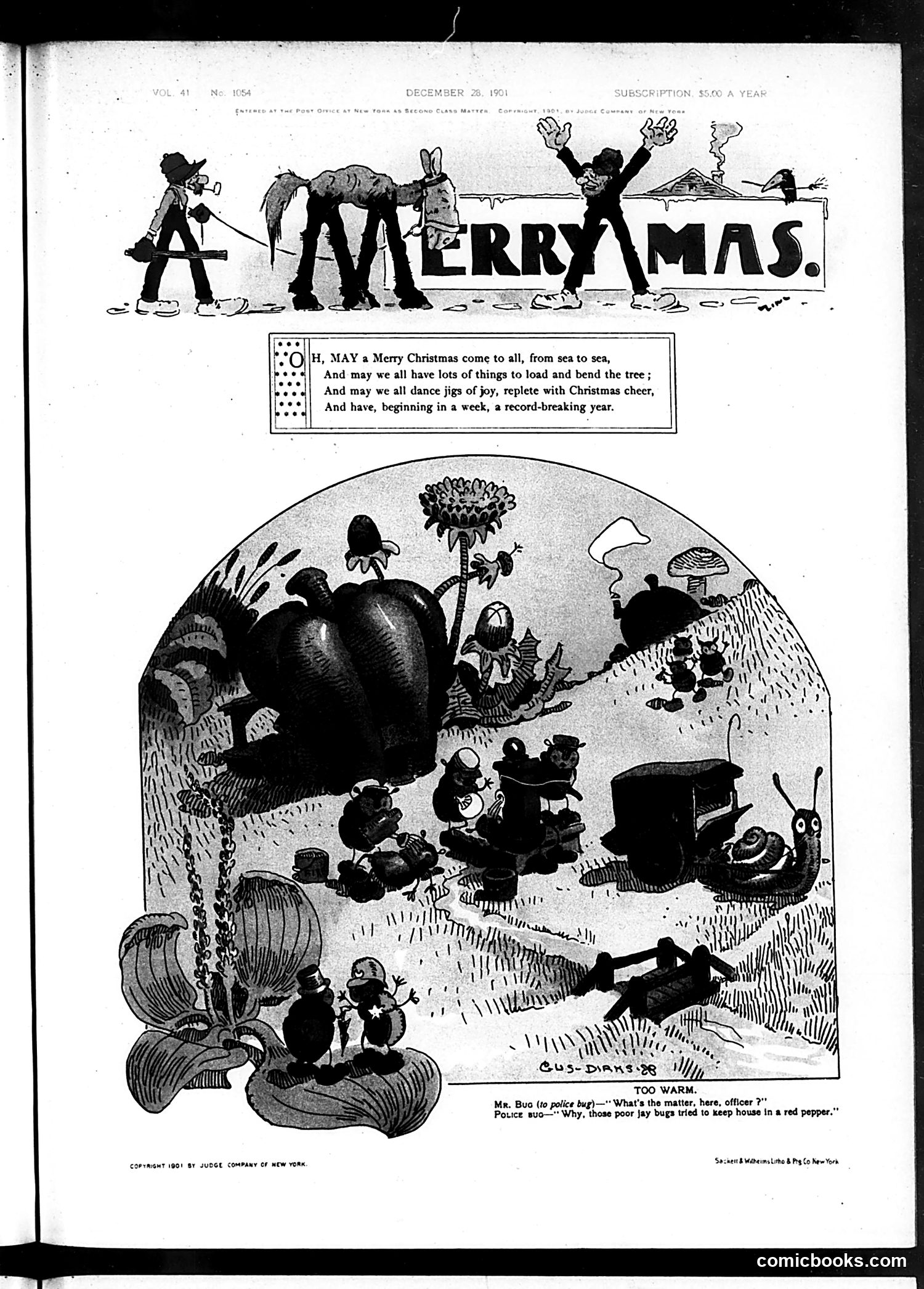
This Christmas issue combines holiday sentiment with anthropomorphic satire. The top illustration shows figures decorating a giant "MERRY XMAS" banner with festive imagery. The main cartoon depicts a surreal garden scene where insects conduct human activities. A police bug encounters Mr. Bus (likely representing a business figure), explaining that "poor jay bugs" attempted to establish a household inside a red pepper—a cramped, unsuitable space. The joke satirizes working-class poor attempting to live in inadequate housing conditions. The "red pepper" represents a confined, unsuitable dwelling, while the "jay bugs" are hapless laborers. The humor relies on the incongruity of insects trying human domesticity while the underlying commentary critiques the poor's housing struggles and exploitation. The page dates from 1901, when tenement housing and labor conditions were major social issues in America.
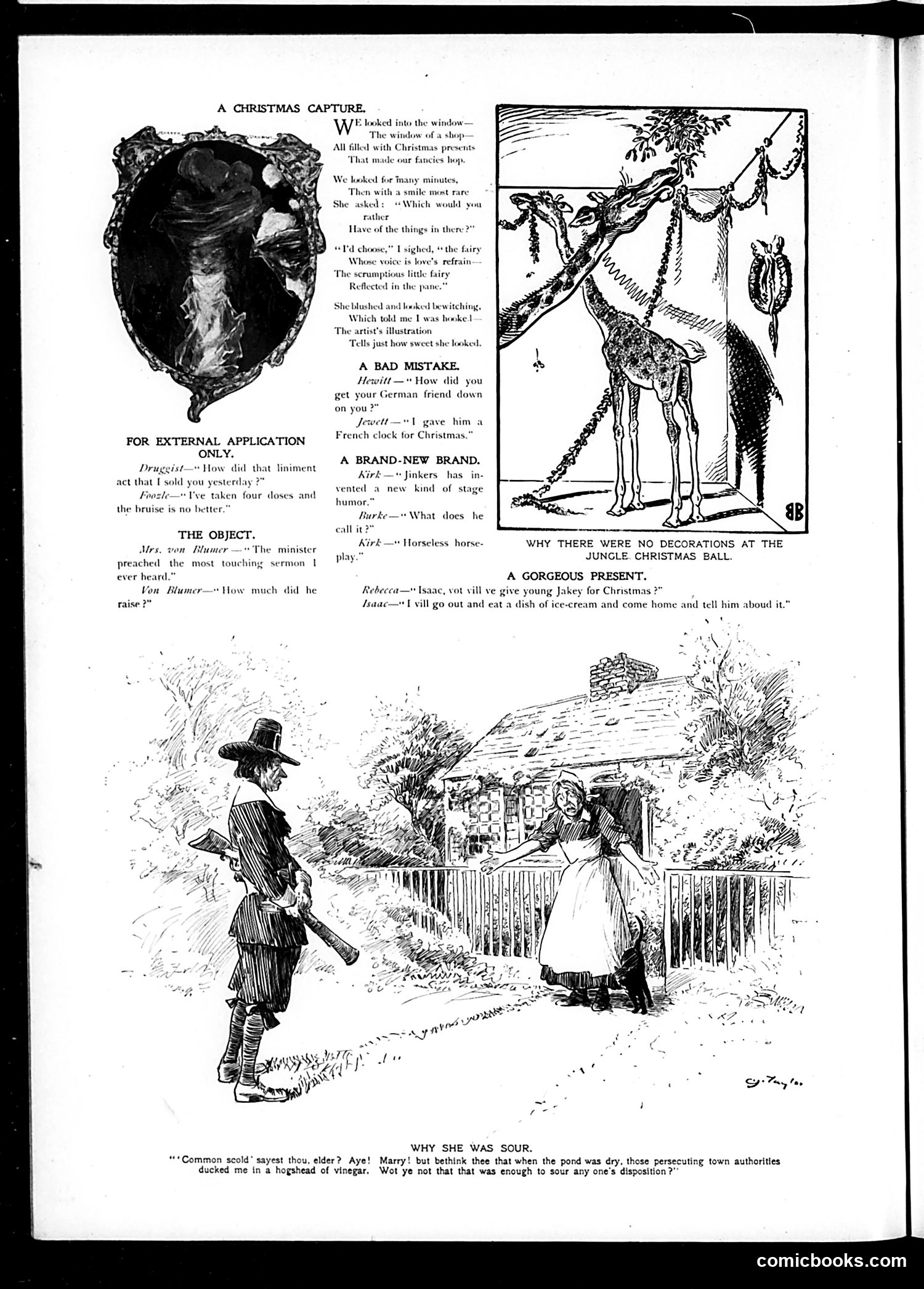
This page contains multiple short humor pieces typical of Judge's satirical style: **"A Christmas Capture"** depicts a romantic moment where a man, asked what gift he'd prefer from a shop window, cleverly answers that he'd choose the woman's reflection in the glass—a flirtatious compliment. **"A Bad Mistake"** jokes about German-American relations through a character who gave his German friend a French clock as a gift, creating diplomatic friction. **Other brief jokes** include wordplay about liniment effectiveness, a new comedic style called "horseless horse-play," and an exchange between Jewish characters (indicated by Yiddish-inflected speech) about giving a child ice-cream as a "present" rather than an actual gift. **"Why She Was Sour"** features a woman referencing being ducked in vinegar during witch-trial persecution, explaining her sour disposition. The humor relies on period-specific references, ethnic stereotypes in dialogue, and gentle romantic/domestic comedy typical of early-20th-century American magazine humor.
This appears to be a satirical cartoon from Judge magazine, though the OCR text is heavily corrupted and largely illegible, making precise identification difficult. **Visual Content:** The image shows two scenes: an upper panel depicting figures in an ornate interior (possibly a palace or formal setting) with cherubs or allegorical figures, and a lower panel showing what appears to be a caricatured figure in profile, rendered in heavy shadow. **What We Can Determine:** The ornate architectural details and allegorical imagery suggest political or social satire targeting high society or government figures. The heavy use of contrast and exaggerated features is typical of Judge's satirical style from the late 19th/early 20th century. **Limitations:** Without legible OCR text or clearer caption identification, I cannot definitively identify which political figures or events are being satirized. The corrupted text prevents me from determining the specific social commentary intended. A higher-quality image or source document would be needed for accurate historical analysis.
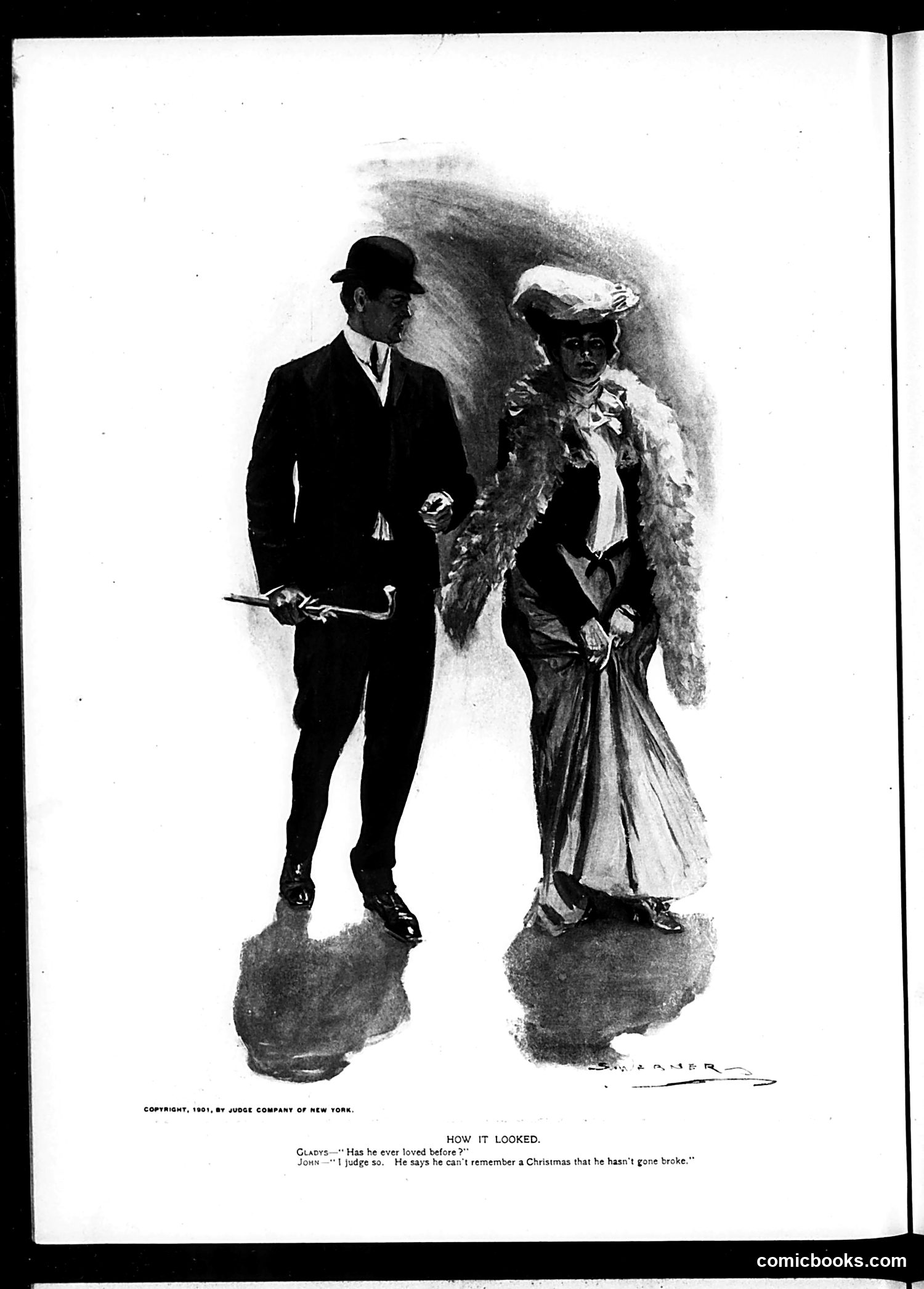
This cartoon satirizes a suitor's romantic history through financial irresponsibility. A well-dressed man (John) discusses a potential romantic rival (Gladys asks about) with another character. The joke hinges on the man's admission that he "can't remember a Christmas" without going broke—implying he's repeatedly spent lavishly on past romantic interests, suggesting a pattern of unsuccessful love affairs marked by wasteful spending. The satire targets early 1900s courtship customs and male financial foolishness. The expensive fur stole and fashionable dress the woman wears suggest the costly nature of maintaining romantic relationships, especially for men expected to provide gifts. The humor derives from using bankruptcy as evidence of previous romantic entanglements—a commentary on both romantic excess and poor judgment.
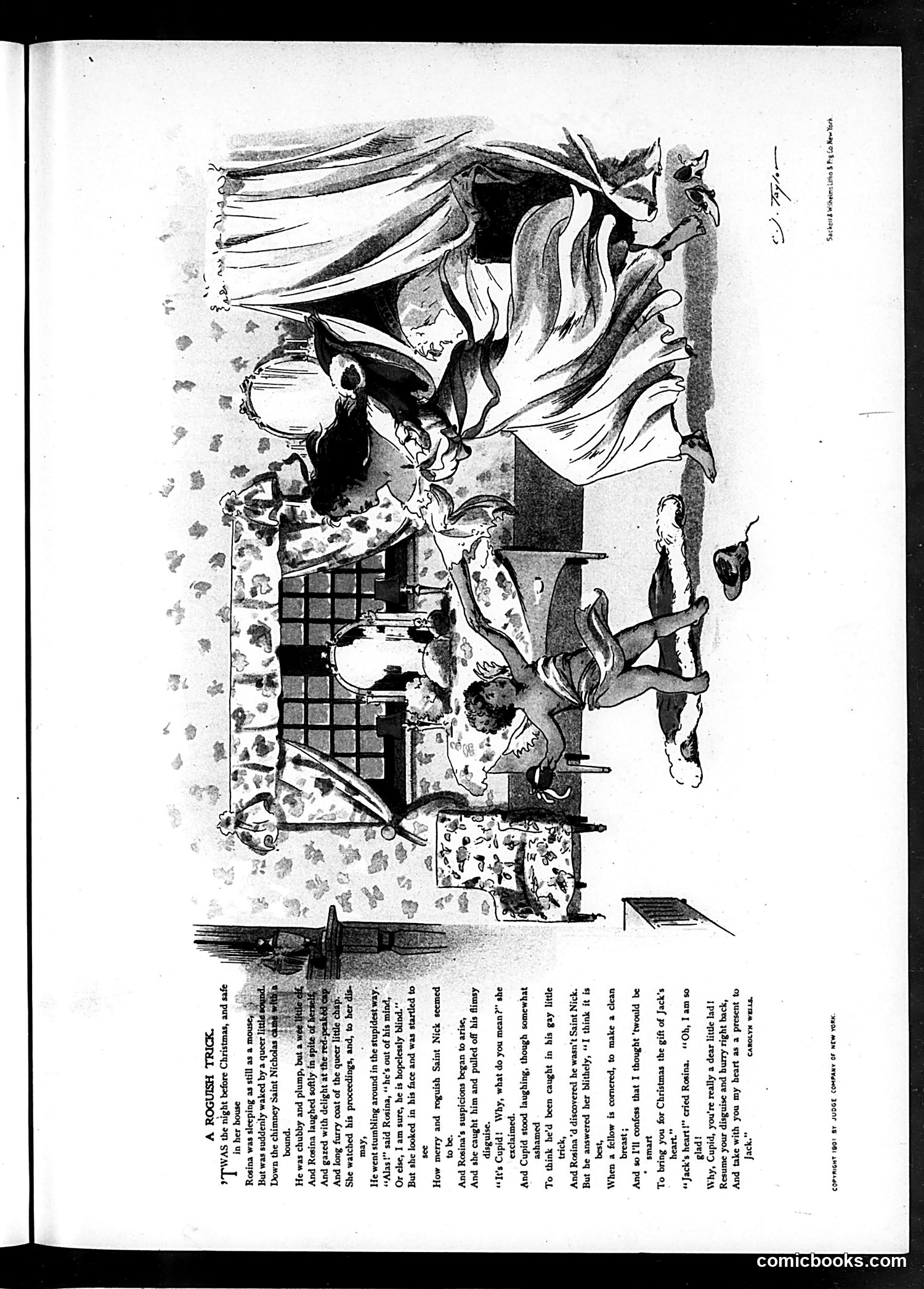
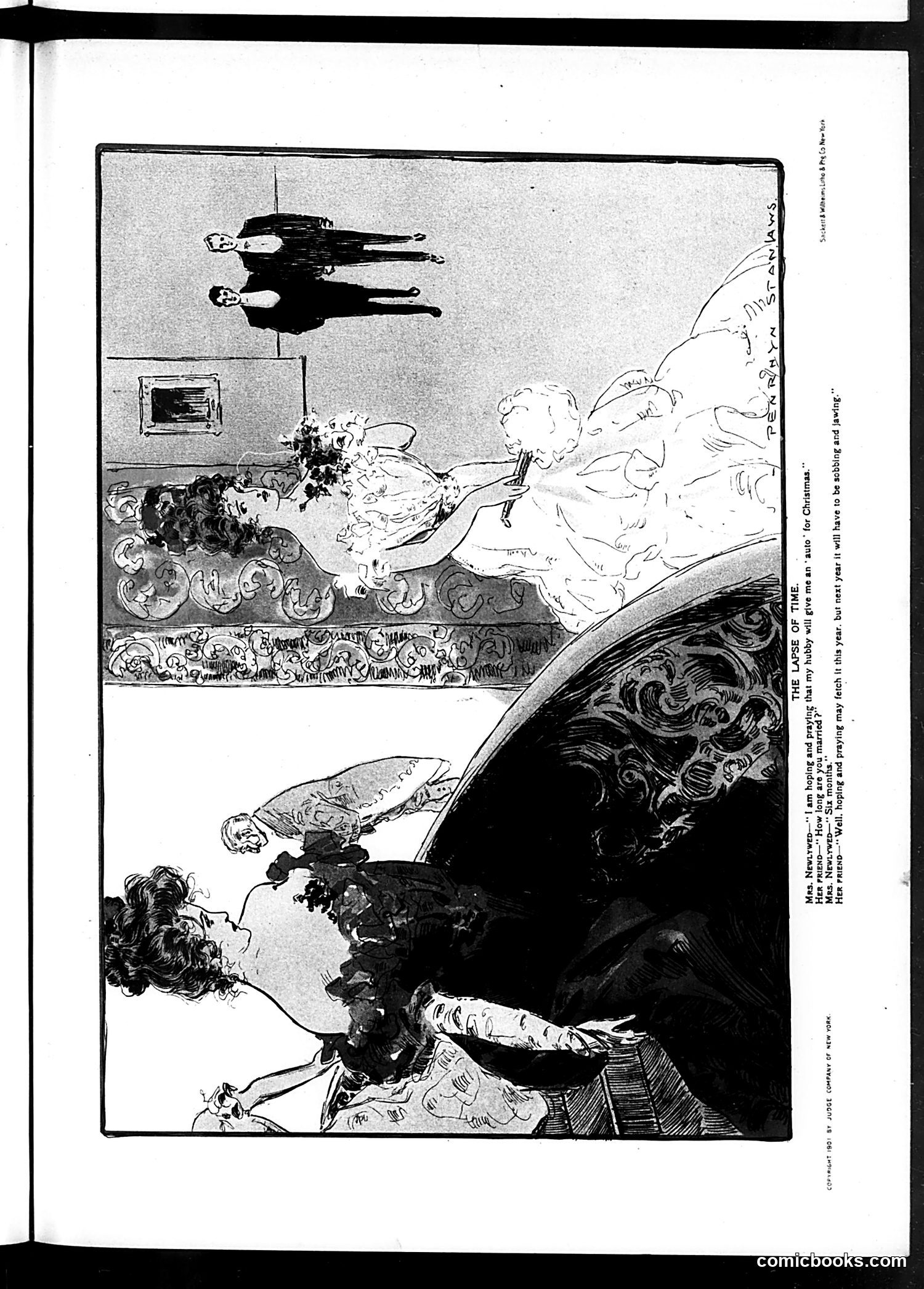
The OCR text is too corrupted to read reliably, making a full interpretation difficult. However, the illustration itself appears to be a political cartoon showing a domestic scene rotated 90 degrees. The image depicts what seems to be a kitchen or household interior with figures engaged in some form of activity or chaos. There are flowing fabrics or curtains, and the composition suggests satirical commentary on domestic life or household management. Without legible text identifying specific political figures or current events referenced, and given the severely degraded OCR output, I cannot confidently identify which satirical point Judge intended. The style and printing quality suggest this is from Judge's era of social commentary, likely targeting domestic or gender-related social issues common to early-to-mid 20th century American satire, but specific details remain unclear from this reproduction. A clearer image or legible source text would be necessary for accurate historical interpretation.
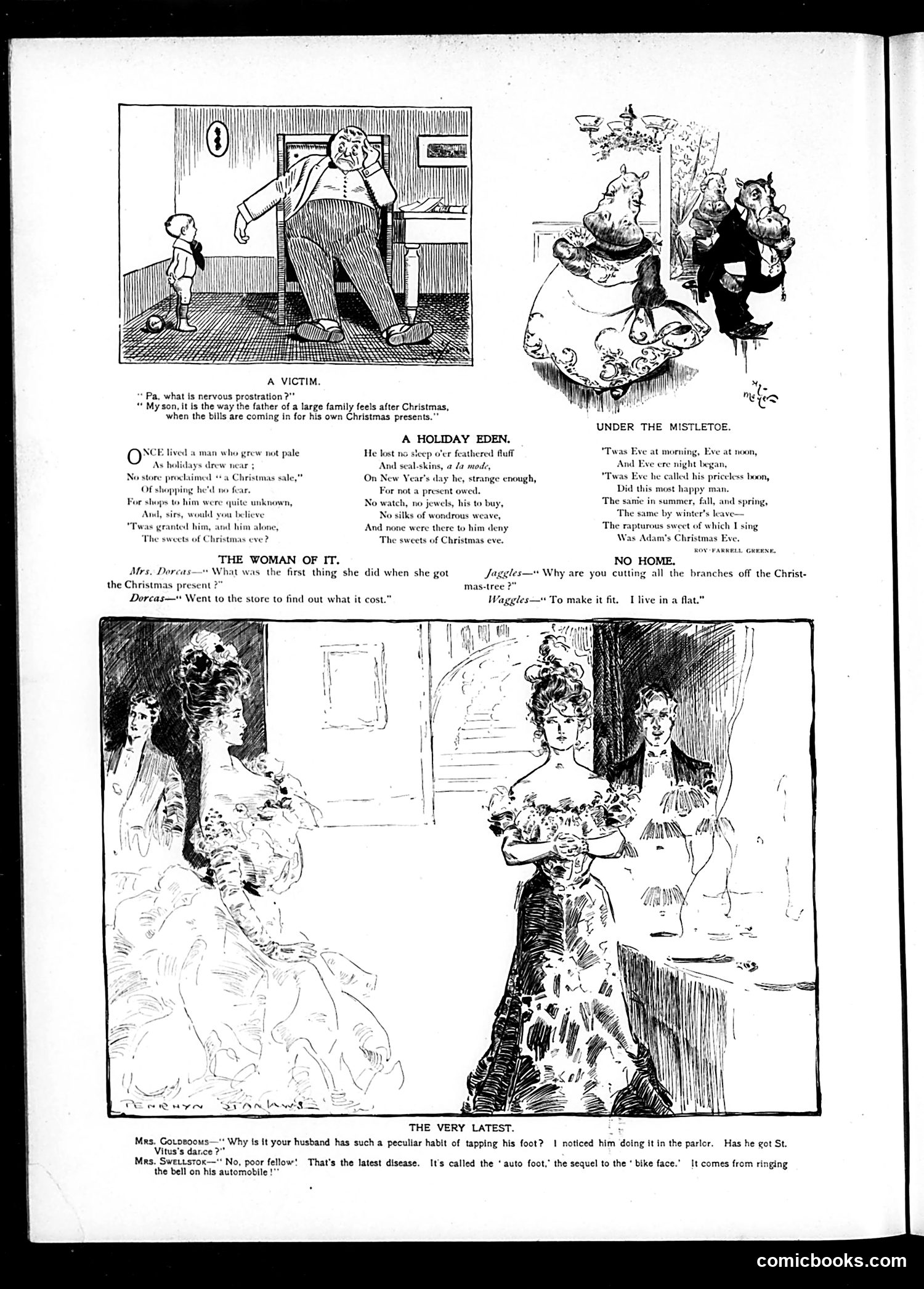
This page presents several holiday-themed satirical cartoons mocking middle-class American anxieties of the early 1900s. **"A Victim"** depicts a father experiencing "nervous prostration" (mental exhaustion) from Christmas bills—satirizing how gift-giving creates financial stress disguised as festive generosity. **"The Woman of It"** jokes that women's first instinct upon receiving gifts is checking the price tag, mocking both consumer materialism and gender stereotypes about female vanity. **"No Home"** satirizes urban apartment living by showing someone cutting down a Christmas tree to fit cramped quarters—commenting on how modernization and city life force compromises on traditional customs. **"The Very Latest"** mocks new automobile culture by inventing a disease called "auto foot" (from constant bell-ringing) as the sequel to "bike face" (from cycling)—ridiculing how emerging technologies create absurd new social anxieties and physical ailments in the public imagination. The poems celebrate simpler, pre-commercial holiday values, creating ironic contrast with the satirized modern complaints.
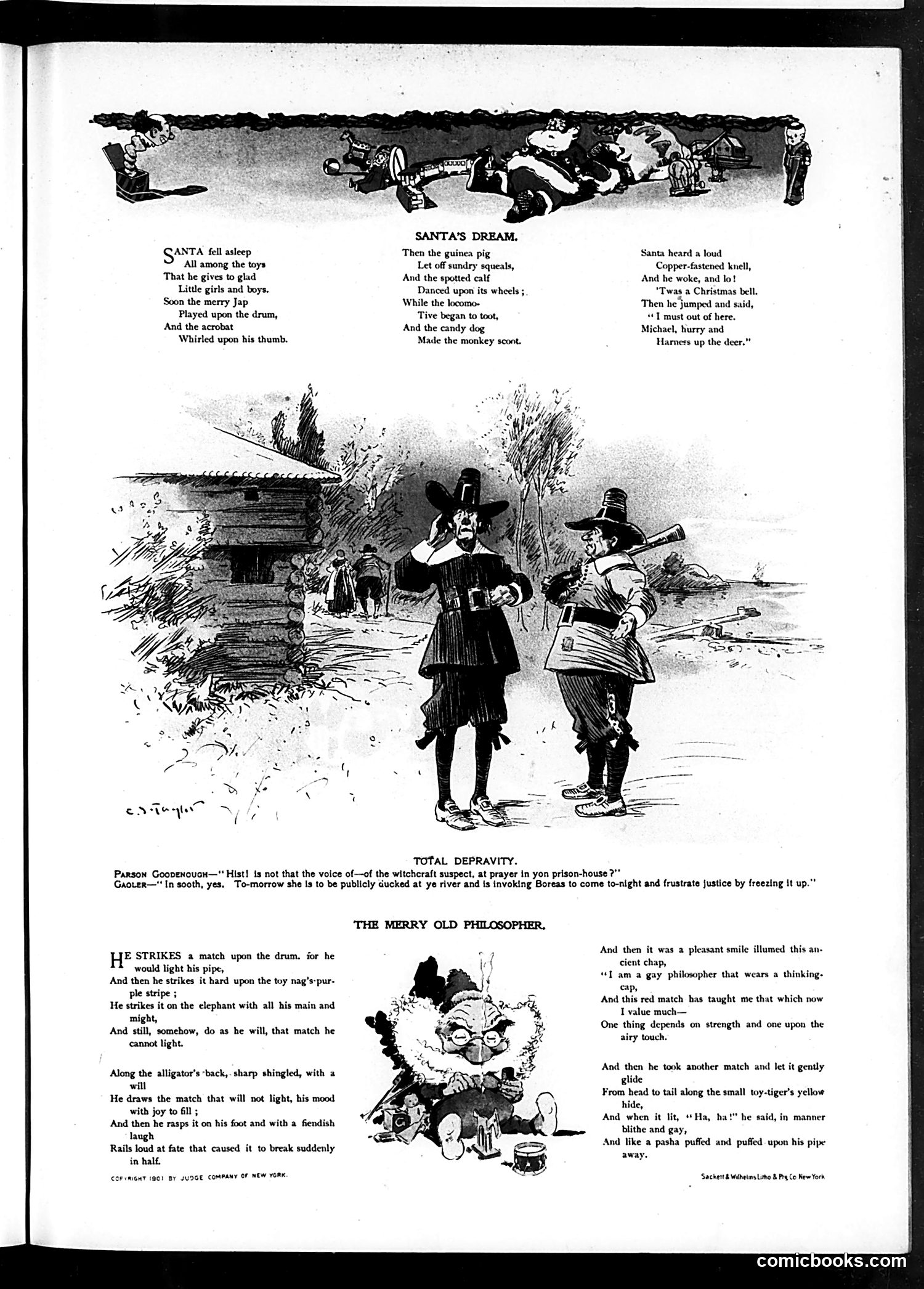
This page contains three separate humorous pieces from Judge magazine (circa 1901): **"Santa's Dream"**: A whimsical poem about toys coming to life while Santa sleeps—the guinea pig squeals, mechanical toys dance and move. Santa wakes to a church bell and hastily departs. The humor lies in the chaos of animated playthings. **"Total Depravity"**: A darker colonial-era cartoon depicting a suspected witch in prison awaiting execution by drowning ("ducking"). The parson and jailer discuss her prayer to the wind god Boreas to freeze the river and prevent her punishment. This satirizes both superstitious witch-hunt hysteria and the absurdity of invoking pagan gods while Christian authorities execute someone. **"The Merry Old Philosopher"**: A poem about an old man trying unsuccessfully to light a match on various toys, becoming frustrated until he realizes different surfaces require different techniques. The "moral" is that some things depend on strength, others on delicate touch—a gentle life lesson presented through slapstick failure. The cartoons use whimsy and irony to comment on human folly, superstition, and the value of patience.
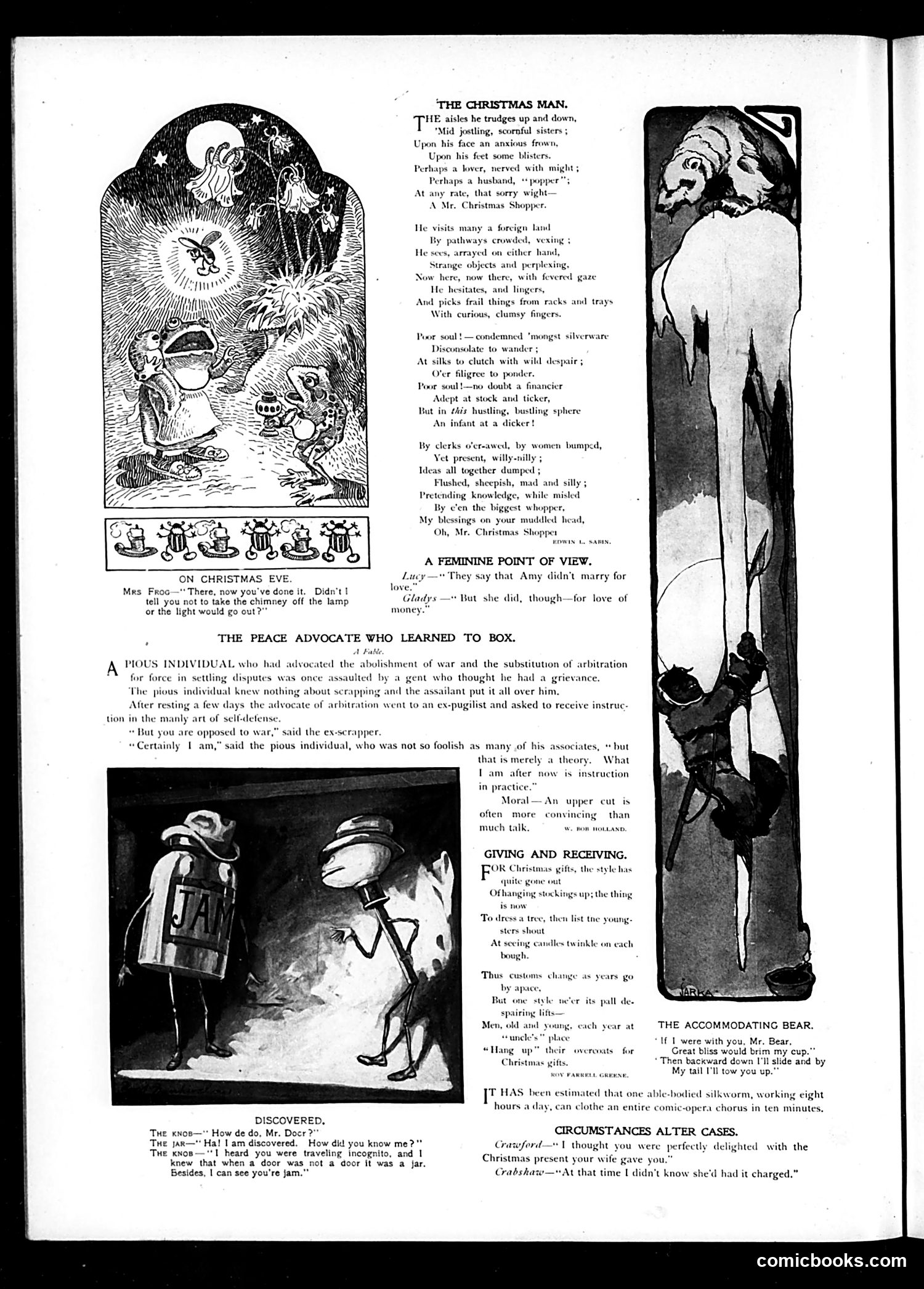
This page contains several Christmas-themed satirical pieces typical of early 20th-century American humor. **"The Christmas Man"** mocks the harried male holiday shopper—overwhelmed, confused, physically exhausted by crowds and uncomfortable navigating stores. The satire targets masculine inadequacy at consumer activities traditionally dominated by women, portraying him as clumsy and out of his element among "silks" and "filigree." **"The Peace Advocate Who Learned to Box"** satirizes pacifist ideology through a fable: a war-abolition advocate beaten up learns boxing for "self-defense," then admits practical necessity trumps theory. The moral critiques idealistic pacifism as ineffectual. Remaining pieces are lighter: **"On Christmas Eve"** is domestic humor about lamp maintenance; **"Giving and Receiving"** comments on evolving gift customs; **"The Accommodating Bear"** is whimsical; and several brief joke items use wordplay (door/jar puns, etc.). The overall tone satirizes both consumer culture anxieties and progressive political ideals through gentle, contemporary social observation.
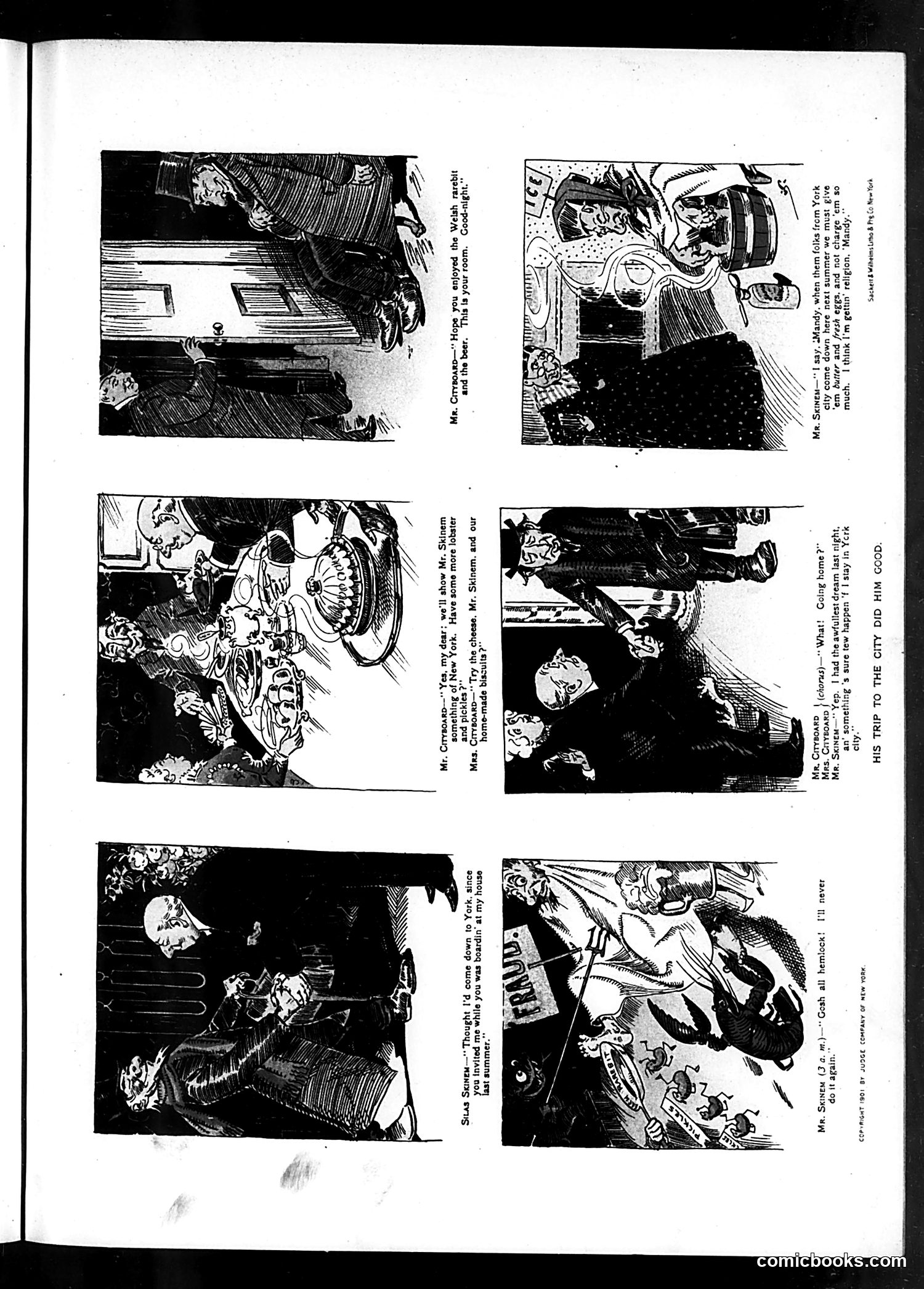
The OCR text is severely corrupted and unreadable, making it impossible to identify specific captions or dialogue from the cartoons. However, examining the **six black-and-white comic panels** visible: The images appear to depict domestic or social scenarios rendered in dramatic, exaggerated style typical of early-to-mid 20th century satirical comics. The panels show figures in various indoor situations with heavy cross-hatching and expressionistic linework. **Without legible text**, I cannot reliably identify: - Which historical/political figures are caricatured - What specific events or social issues are being satirized - The intended humor or critical message To properly explain this page's meaning to a modern reader, I would need either: - A clearer image of the text captions - The magazine's publication date - Visible bylines or titles The style suggests mid-20th century American satire, but the corrupted OCR prevents accurate historical interpretation.
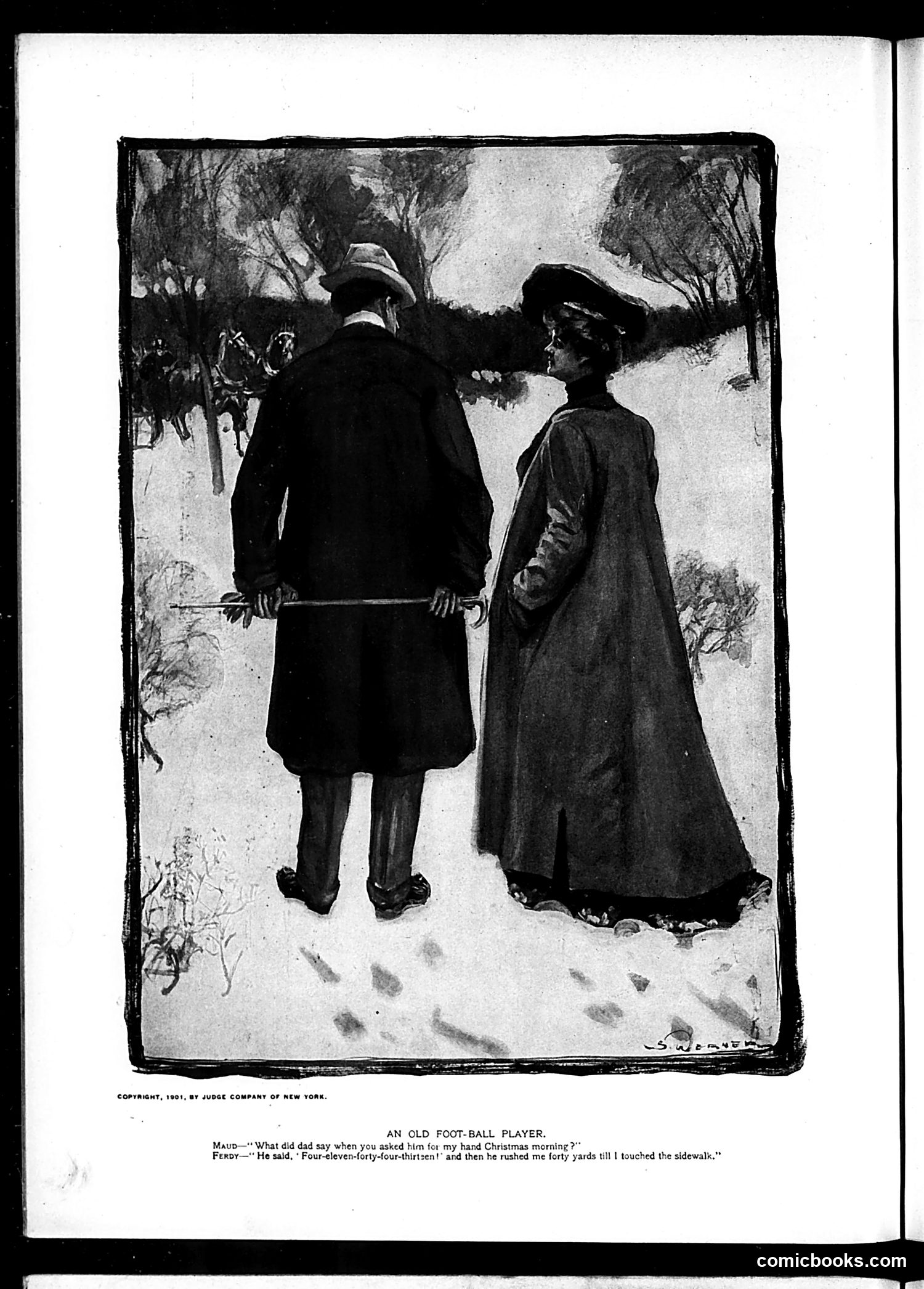
This cartoon satirizes an aging former football player. The father, apparently a grizzled ex-athlete, responds to a suitor's marriage proposal using football terminology and metaphors. Rather than giving a straight answer, he shouts what sounds like a play call ("Four-eleven-forty-four-thirtzen"), then physically tackles the young man, carrying him forty yards until he hits the sidewalk. The joke targets the stereotype of washed-up athletes who remain mentally stuck in their playing days, unable to interact normally with civilian life. It mocks both their inability to abandon football logic and their excessive physicality. The cartoon implies that such men are comically unsuited to modern domestic situations—they respond to serious life moments through their sport's violent framework rather than social convention.
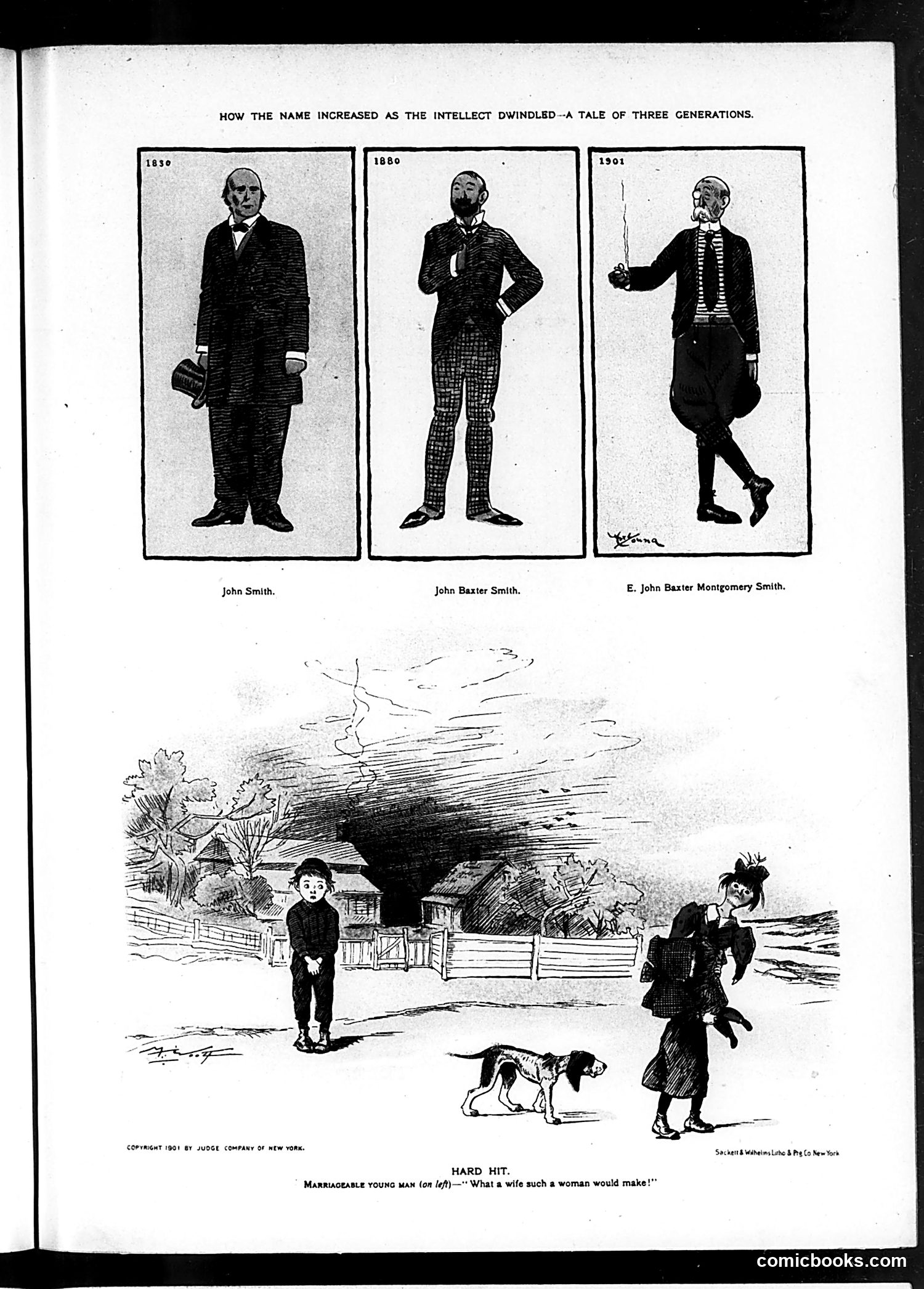
## Top Cartoon: "How the Name Increased as the Intellect Dwindled" This satirizes social pretension across three generations. The first figure (1839), "John Smith," is a plain, dignified man with a briefcase—apparently successful and honest. His son (1880), "John Baxter Smith," adds a middle name and displays himself more ostentatiously in fashionable checked pants. The grandson (1901), "E. John Baxter Montgomery Smith," wears an exaggerated dandy outfit and carries a cane—his name has grown absurdly elaborate while his apparent substance has diminished. The satire mocks how descendants abandon practical virtue for hollow gentility and pretentious naming conventions while losing intellectual rigor. ## Bottom Cartoon: "Hard Hit" A young man observes a woman and remarks admiringly about what a fine wife she'd make. The commentary appears skeptical of his judgment—"hard hit" suggests he's been struck by romantic foolishness rather than wisdom.
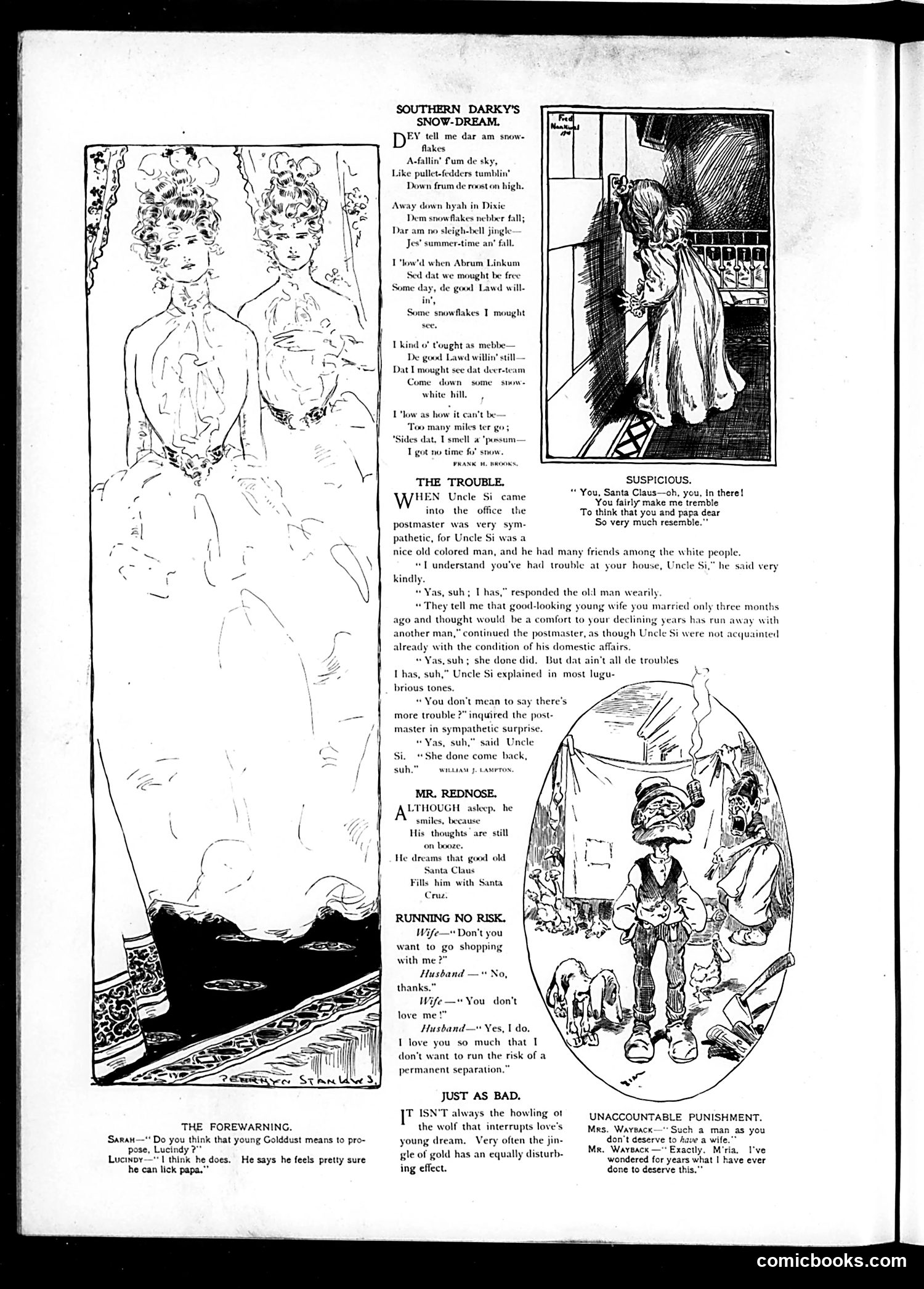
This page contains several short humor pieces reflecting early 20th-century attitudes. The title piece, "Southern Darky's Snow-Dream," uses dialect humor to depict an enslaved or formerly enslaved Black man in the South expressing a fantastical wish to see snow—a dream presented as comical and impossible. The poem relies on racial stereotype and vernacular mockery common to the era. The other sketches ("The Trouble," "Suspicious," "Mr. Rednose," "Running No Risk," "Just as Bad," "The Forewarning," "Unaccountable Punishment") are domestic humor pieces about marital relationships and infidelity, featuring white characters. "The Trouble" presents Uncle Si, a "nice old colored man," whose young wife has run away with another man—a scenario treated with sympathy toward Uncle Si but framed around racial caricature. The page reflects Judge magazine's mix of racial humor (now deeply offensive) and middle-class domestic comedy typical of early American satirical publications.
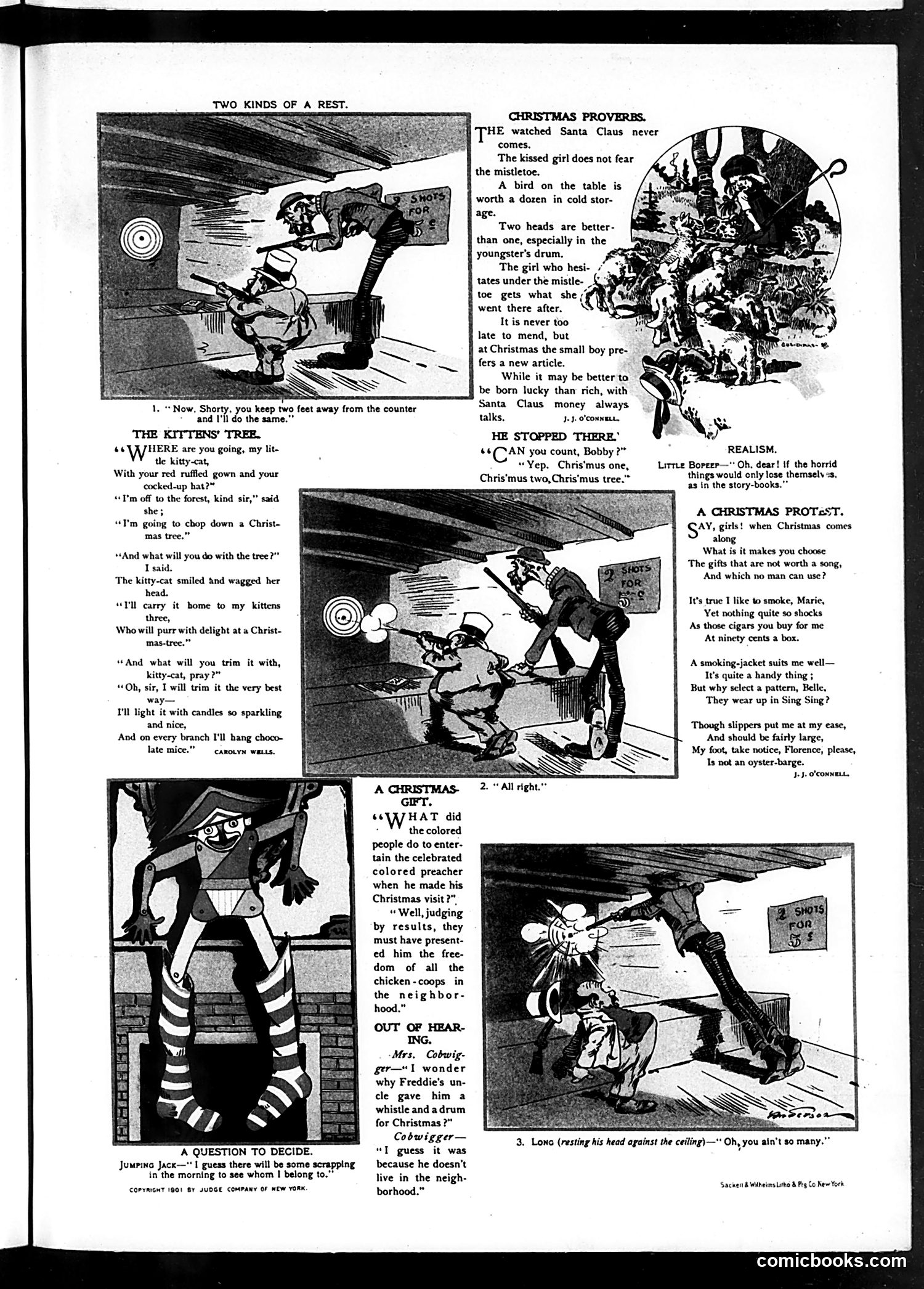
This page contains several humorous Christmas-themed pieces typical of early 1900s American satirical humor: **"The Kittens' Tree"** is a whimsical poem-illustrated story about a cat planning to decorate a Christmas tree with candles and chocolate mice—a charming domestic fantasy. **"A Christmas Gift"** and **"Out of Hearing"** are brief racial and class-based jokes. The first contains a derogatory stereotype about Black people and chicken-stealing. The second mocks working-class parents giving noisy gifts (whistle and drum) to relatives who don't live nearby—crude but reflecting period class attitudes. **"Christmas Proverbs"** offers gentle satirical observations about holiday materialism and consumer culture. **"A Christmas Protest"** is a poem criticizing poorly-chosen gifts—cigars, smoking jackets, and oversized slippers—expressing frustration with gift-giving mismatches, likely targeted at women shoppers. The page reflects Judge's mix of genteel humor and period prejudices typical of early 1900s American satire.
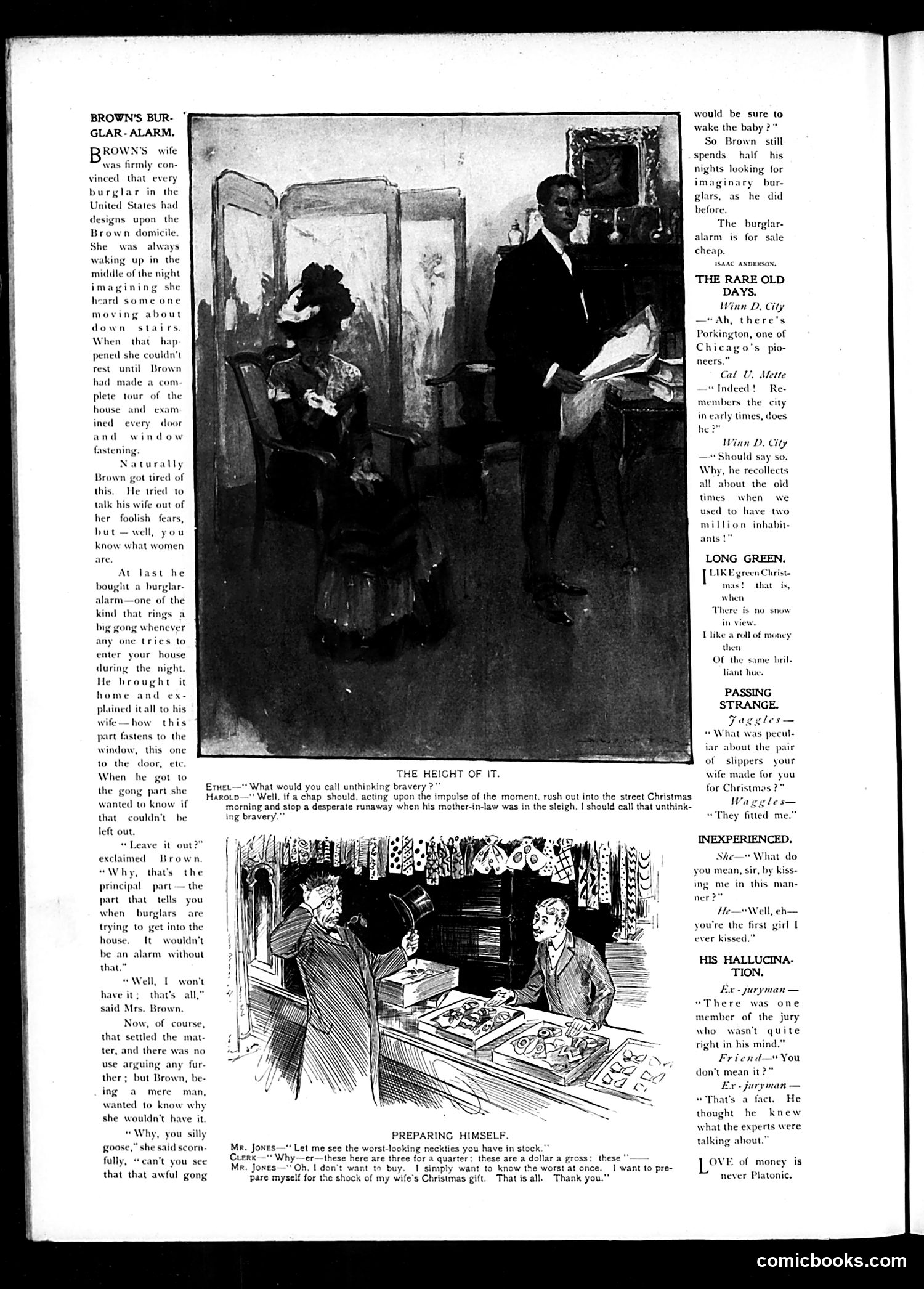
This page contains several short humorous sketches satirizing domestic life and human nature in early 20th-century America. **"Brown's Burglar Alarm"** mocks anxious wives and marital dynamics. Mrs. Brown, obsessed with imaginary burglars, demands her husband install an alarm—but when he explains the loud gong announces intruders, she refuses it because it would wake the baby. The satire targets women's irrational fears and their ability to frustrate practical solutions through contradictory logic. **Other sketches** lampoon: - "The Height of It": A man's reckless courage is overrated - "Long Green": Nostalgia for Chicago's larger past population - "Passing Strange": A man's confusion over his wife's gift - "Inexperienced": A young man's first kiss - "His Hallucination": Mockery of jury members lacking expertise The recurring theme is domestic absurdity and the gap between intention and outcome—typical of Judge magazine's satirical humor targeting middle-class American life and relationships.
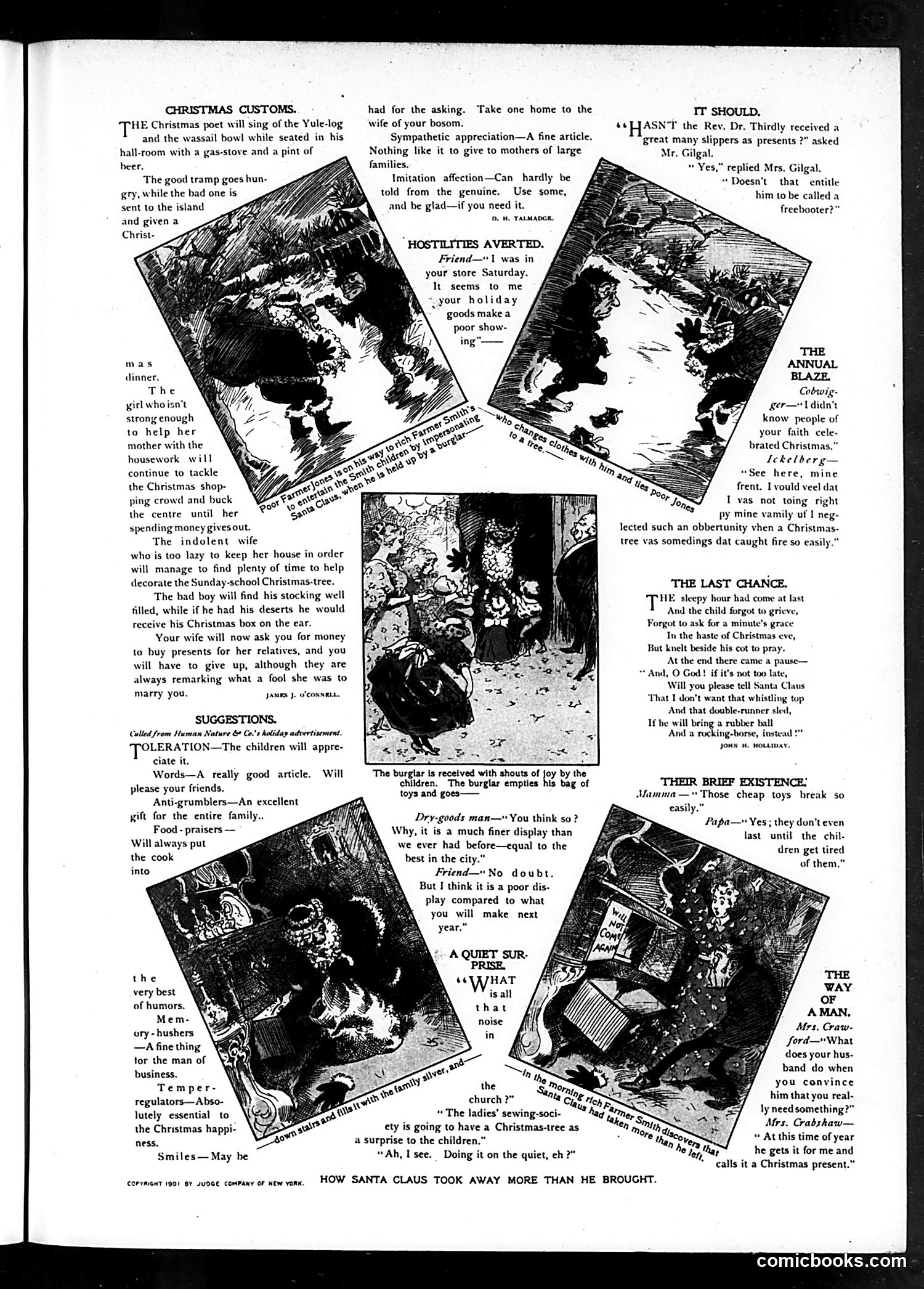
This satirical page mocks Victorian-era Christmas hypocrisy through multiple short pieces: **"Christmas Customs"** skewers middle-class holiday behavior: the poet romanticizing Christmas while drinking beer; lazy wives neglecting housework but volunteering for church decoration; parents rewarding bad behavior with gifts while punishing good children. **"Suggestions"** ironically advertises fake virtues as gifts—"toleration," "imitation affection"—implying these qualities are absent in actual households. **The illustrated vignettes** depict domestic absurdities: a burglar joyfully received by children (suggesting poor security/judgment); a shopkeeper's competitive holiday displays; a child's prayer asking God to redirect Santa's gifts; marital negotiation where husbands only buy wives what they want if framed as Christmas presents. The **overall satire** targets commercialization, domestic discord, and how Christmas exposes rather than improves human nature. The recurring theme: Christmas customs reveal selfishness, greed, and dishonesty beneath respectable Victorian surfaces—a pointed critique of the era's sentimental holiday mythology.
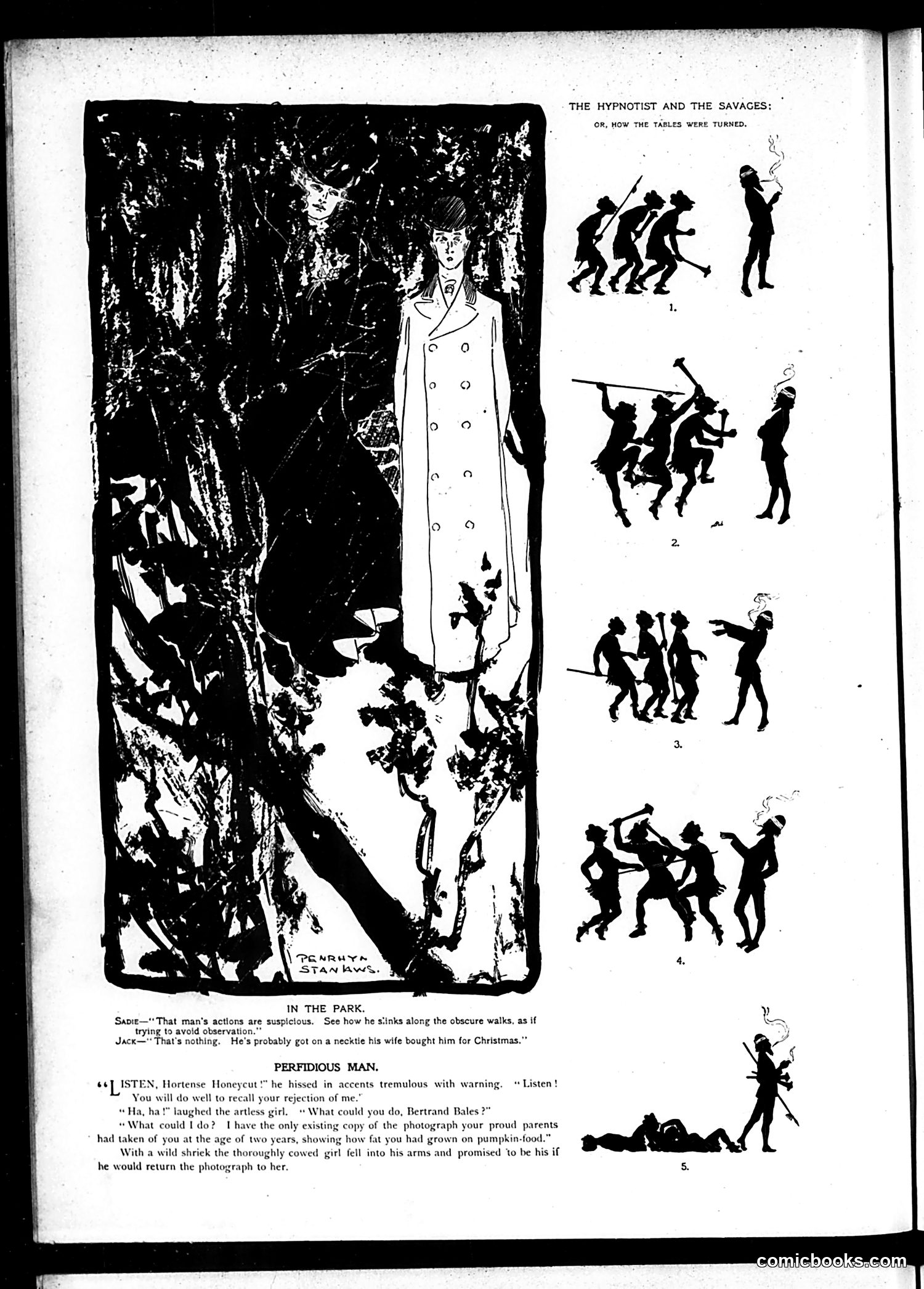
This page contains two separate humorous pieces typical of early 20th-century American satire. **"In the Park"** is a brief joke playing on marital tensions: a man sneaking suspiciously through park paths is actually just self-conscious about wearing an ugly Christmas necktie his wife gave him—implying wives give tasteless gifts their husbands must awkwardly wear. **"Perfidious Man"** is a melodramatic parody mocking romantic villain tropes. A rejected suitor blackmails a woman by threatening to reveal an embarrassing childhood photograph showing her as a chubby toddler. The exaggerated severity—she surrenders to his demands over a photo of infant obesity—satirizes overwrought Victorian romance fiction and theatrical villainy. **"The Hypnotist and the Savages"** (right panel) shows sequential illustrations likely depicting a hypnotist attempting to control "savages" who instead turn the tables on him—a satirical commentary on colonialism and racial attitudes, mocking the era's pseudoscientific racism and Western presumptions of superiority over non-Western peoples.
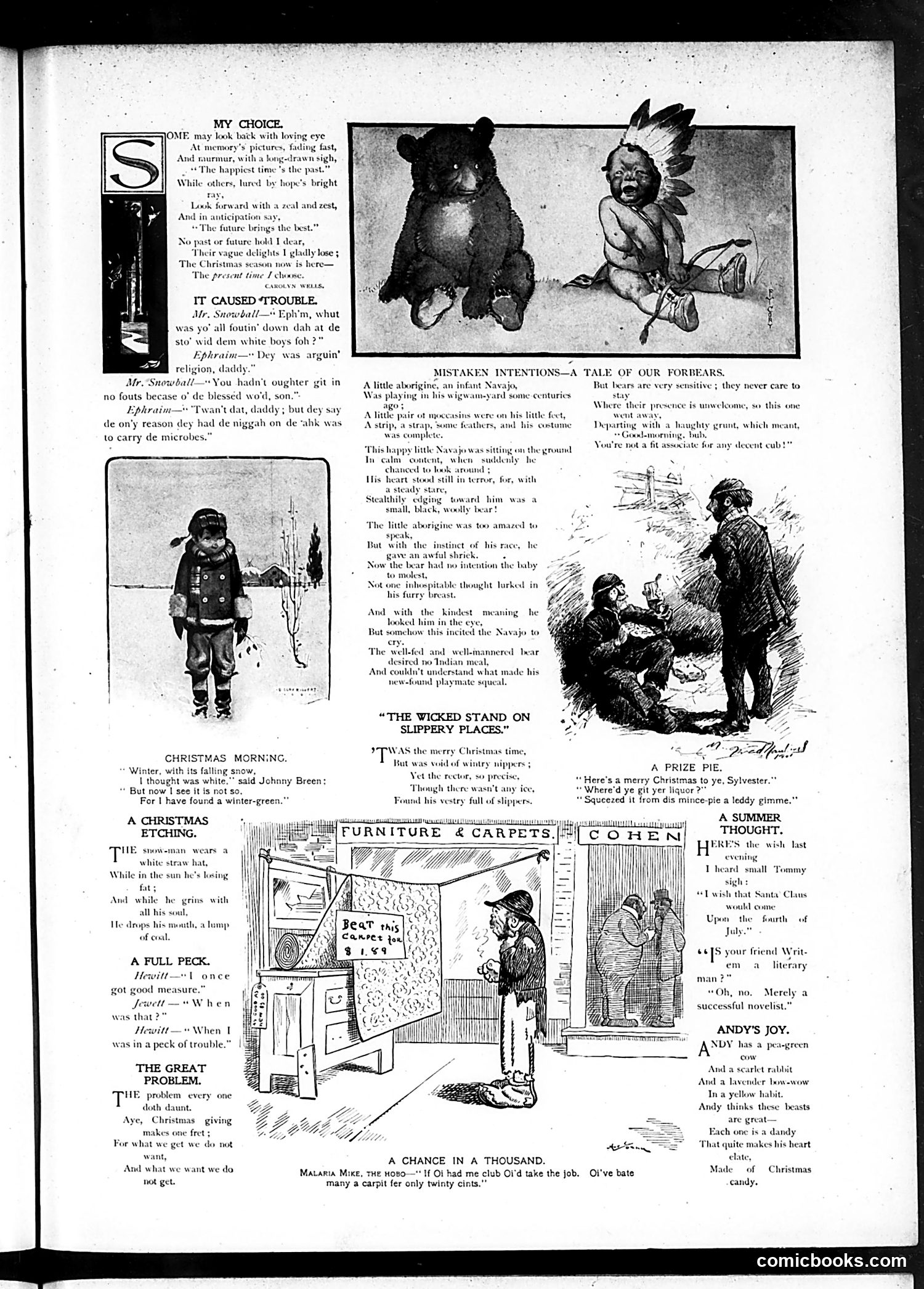
This page contains multiple short humorous pieces typical of early 20th-century American satirical magazines: **"It Caused Trouble"** presents a racist dialogue between Black characters ("Mr. Snowball" and "Ephraim") about a Christmas fight, using heavy dialect stereotypes common to the period's offensive humor. **"Mistaken Intentions"** tells a sentimental story of a Native American ("Navajo") infant and a bear, with the ironic point that the bear meant no harm but the child misinterpreted its intentions—reflecting patronizing attitudes toward indigenous peoples. **Other pieces** include Christmas-themed verse and brief comic vignettes about winter, gift-giving anxiety, and domestic situations. "The Wicked Stand on Slippery Places" appears to reference a minister finding slippers in his vestry (unclear satirical intent). **Overall**: The page reflects Judge's mix of gentle humor, seasonal sentiment, and deeply problematic racial caricatures that were normalized in early 20th-century American publishing but are recognized as offensive today.
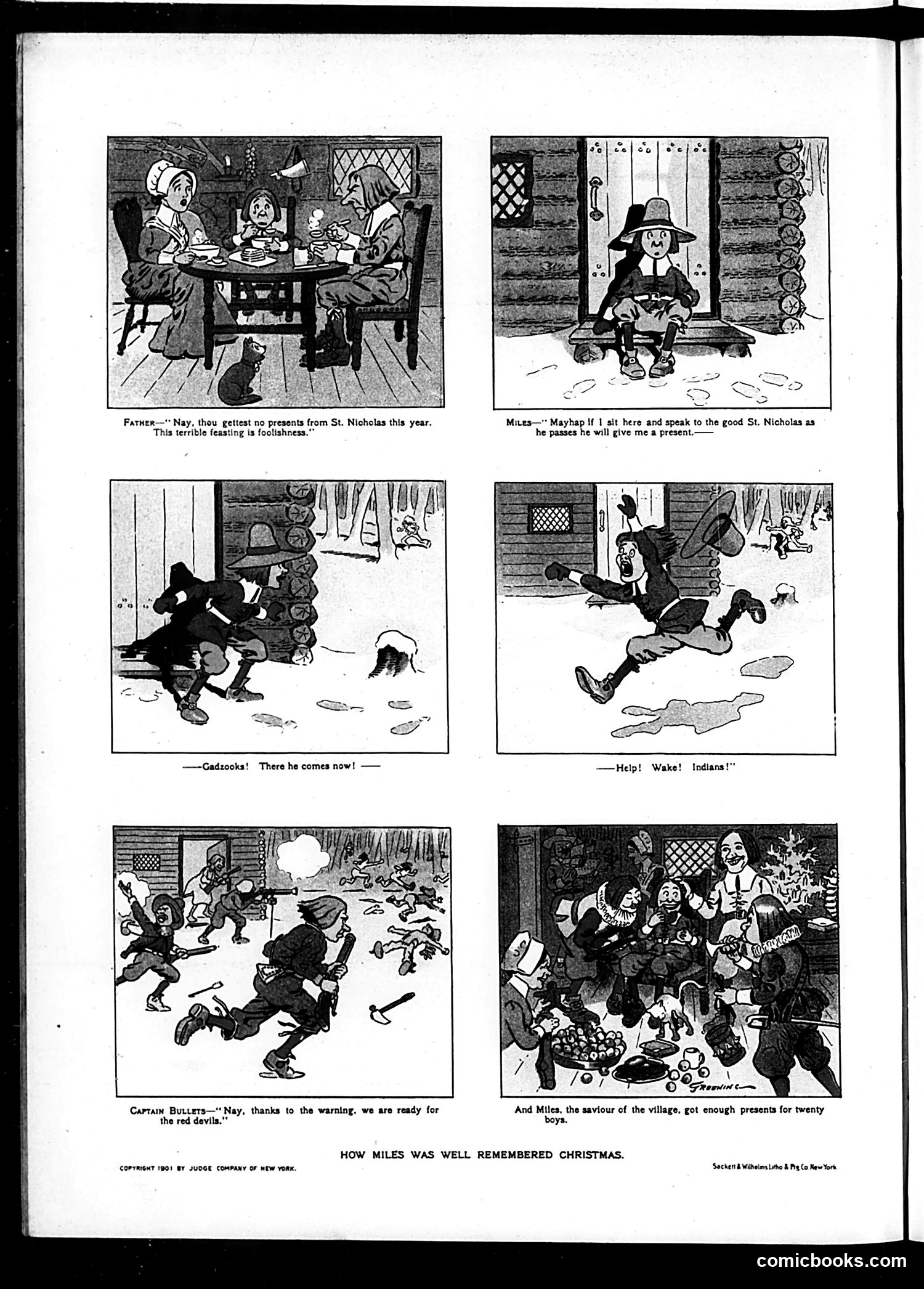
This 1901 Judge comic tells a moral tale about a boy named Miles. A stern father forbids Christmas feasting as "foolishness" and denies Miles presents from St. Nicholas. Miles instead prays sincerely to the saint. When "Indians" (likely referring to Native Americans, depicted as threats/"red devils") attack the village, Miles warns the townspeople, becoming the community's "saviour." The story rewards his virtue: Miles receives presents from twenty grateful boys—far exceeding what St. Nicholas alone would have given. The satire critiques both Puritan severity toward Christmas celebration and presents the boy's selfless heroism as the true Christmas value. The "Indians as villains" framing reflects period attitudes common in early 1900s American popular media.
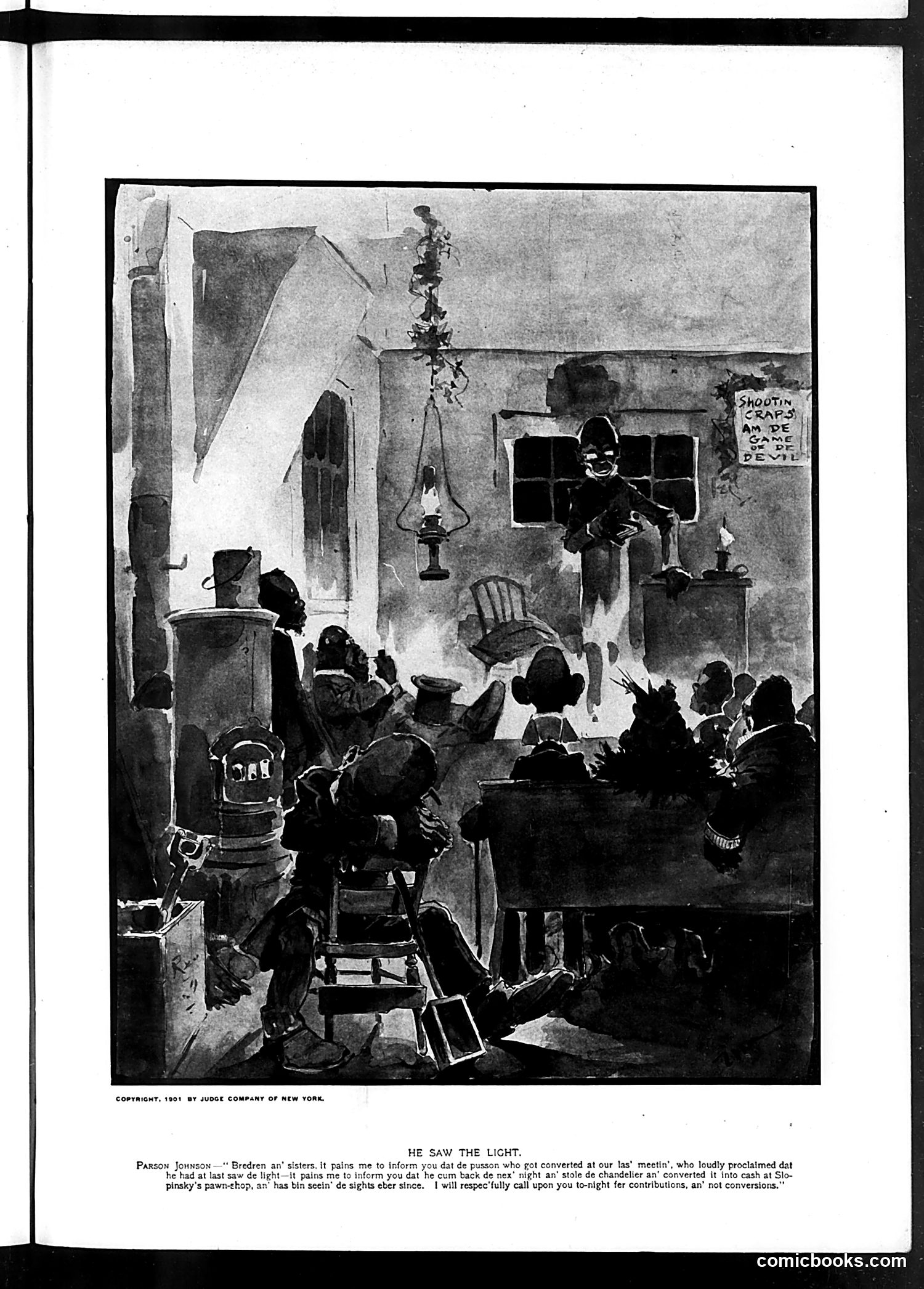
This cartoon satirizes religious hypocrisy and conversion fraud. A Black preacher (Parson Johnson, drawn in period dialect) addresses his congregation about a recent "convert" who claimed spiritual transformation at a revival meeting. The supposed convert actually stole the church chandelier that same night, pawned it at "Slopinsky's" (a Jewish pawnbroker, reflecting period ethnic stereotypes), and has been living it up on the proceeds. The satire's target is twofold: fraudulent religious conversions that lack genuine moral change, and the irony that the preacher now must ask for money ("contributions") rather than genuine spiritual commitment. The cartoon reflects Judge's skepticism toward revival meetings and suggests that conversion claims were sometimes opportunistic rather than sincere. The ethnic caricatures reflect 1901 prejudices standard to the era.
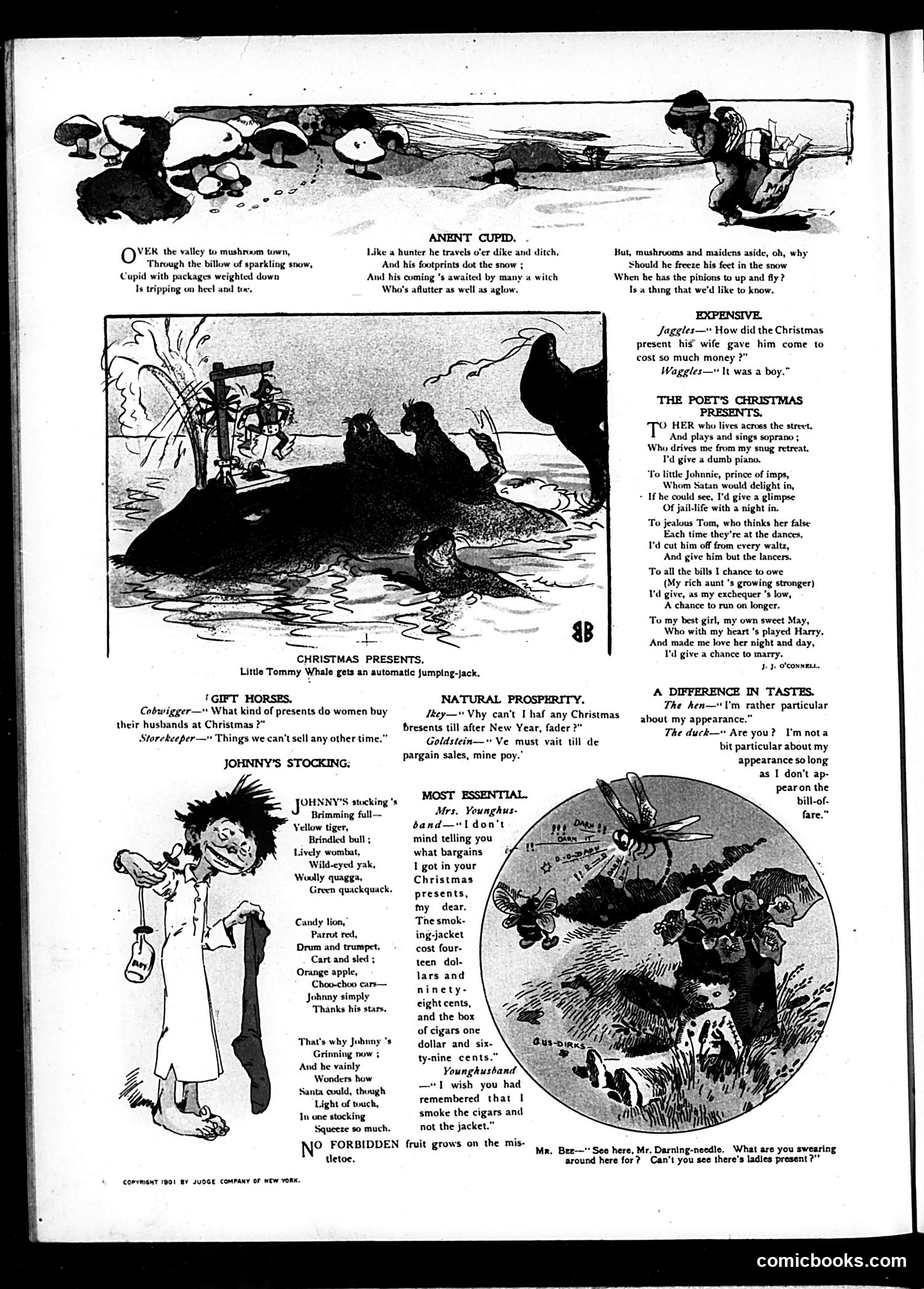
This page collects Christmas-themed humor pieces typical of early 1900s satirical magazines: **"Anent Cupid"**: A whimsical poem questioning why Cupid trudges through snow delivering love when he has wings—a playful critique of romantic sentimentality. **"Expensive"/"The Poet's Christmas Presents"**: Brief jokes mocking consumerism. One quip: a wife's Christmas present costs so much because "it was a boy" (newborn expenses). The longer poem satirizes materialism by listing imaginary gifts—from pianos for annoying neighbors to jail time for rivals—reflecting middle-class financial anxieties and romantic jealousy. **"Johnny's Stocking"**: Humorous contrast between a boy's overflowing stocking of fantastical creatures (wombats, quaggas) and why he's happy: practical gifts like a smoking jacket and cigars. **"Natural Prosperity"**: A dialect joke about a Jewish merchant ("Goldstein") delaying Christmas sales until after New Year for better bargains. **"A Difference in Tastes"**: A hen and duck discussing appearance standards—mild barnyard humor. The page reflects period preoccupations: consumer excess, class anxieties, ethnic stereotyping, and domesticity.
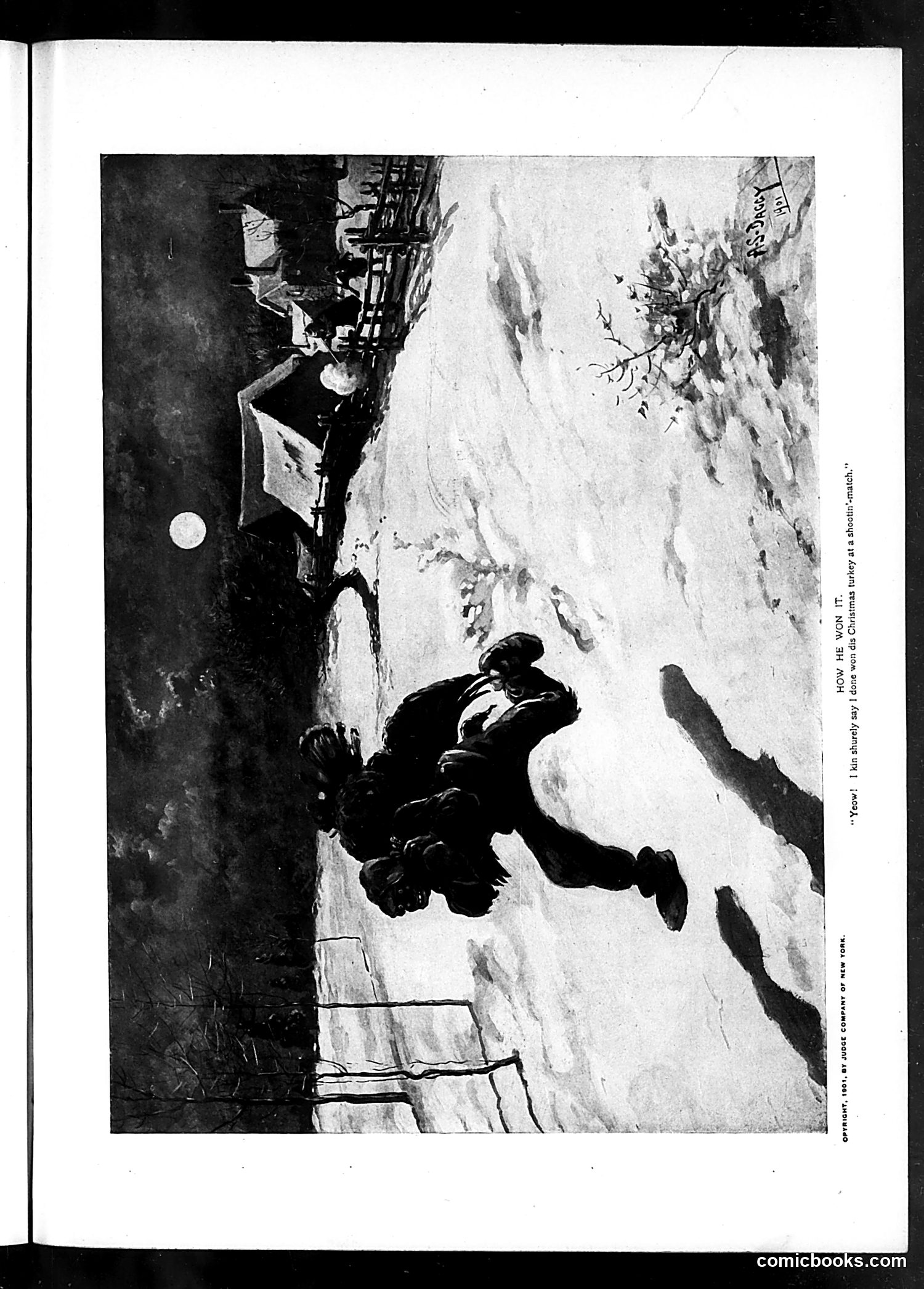
The OCR text is too corrupted to read clearly, but the image shows a political cartoon rotated 90 degrees. It depicts a figure in formal dress (appearing to be a politician or official) in an exaggerated, undignified pose—seemingly falling or stumbling backward on what looks like snowy or icy terrain. The cartoon likely satirizes a political figure's misstep, failure, or loss of power. The winter/slippery setting suggests instability or loss of footing—a common metaphor in political satire for political downfall or embarrassment. Without legible text or a clear date visible, I cannot identify the specific figure or historical event referenced. The style and printing suggest this is from Judge magazine's golden age (late 19th/early 20th century), but the specific political context remains unclear from what's visible here.
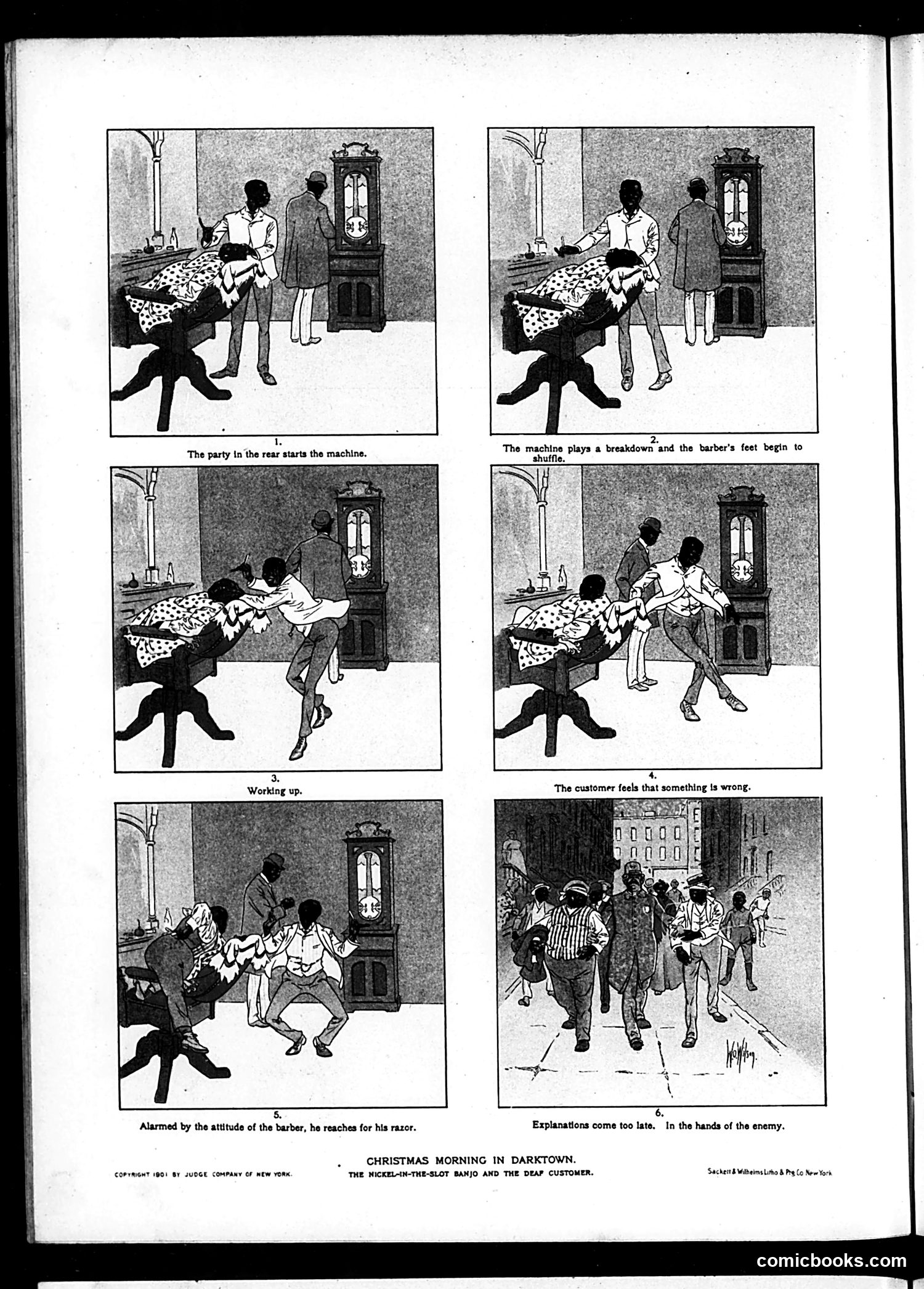
This six-panel comic strip satirizes a mechanical novelty—a coin-operated banjo machine—through a racial caricature scenario. The narrative follows a barber and customer discovering the device: the barber operates it (panel 1), the customer experiences its jarring effect (panels 2-3), and misinterprets the barber's alarmed response as threatening (panel 5), leading to a chaotic street chase (panel 6). The humor relies on period stereotypes: the title "Darktown" references a common 19th-century racist framework in American entertainment. The "deaf customer" subtitle suggests communication failure drives the escalating comedy. The satire targets the novelty itself—the ridiculous, malfunctioning machine—rather than delivering social critique. For modern readers, the racial framing is offensive and reflects Judge magazine's casual contemporaneous prejudices, though the core joke concerns mechanical absurdity and misunderstanding.
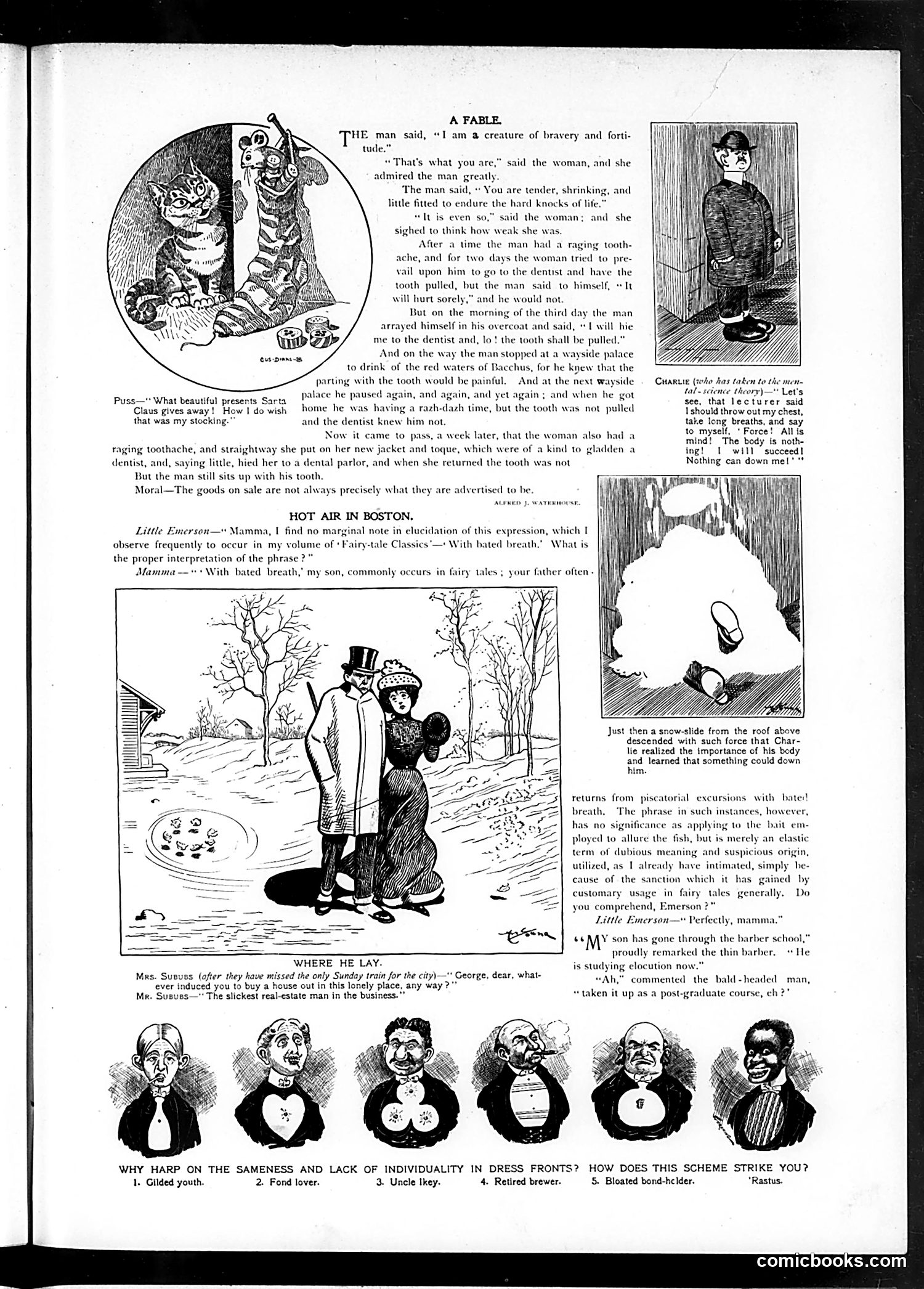
**"A Fable"** satirizes gender stereotypes. A man claims bravery while the woman accepts she's weak—yet when facing a toothache, the "brave" man delays going to the dentist, drinks alcohol for courage, and never gets treatment. The woman simply goes to the dentist and solves her problem. The moral mocks advertising's false claims, but the real joke targets the man's performative masculinity versus the woman's practical competence. **"Hot Air in Boston"** ridicules pretentious intellectual discourse. A boy asks his mother about "bated breath" from fairy tales; she provides a lengthy, circular non-explanation. Meanwhile, snow crashes on the boy, proving that real consequences (gravity, physics) matter more than verbose philosophizing. It's satire of Boston's reputation for overwrought intellectualism disconnected from practical reality. **"Where He Lay"** and the dress-front caricatures appear to be brief satirical quips about real-estate deception and class stereotypes, respectively.
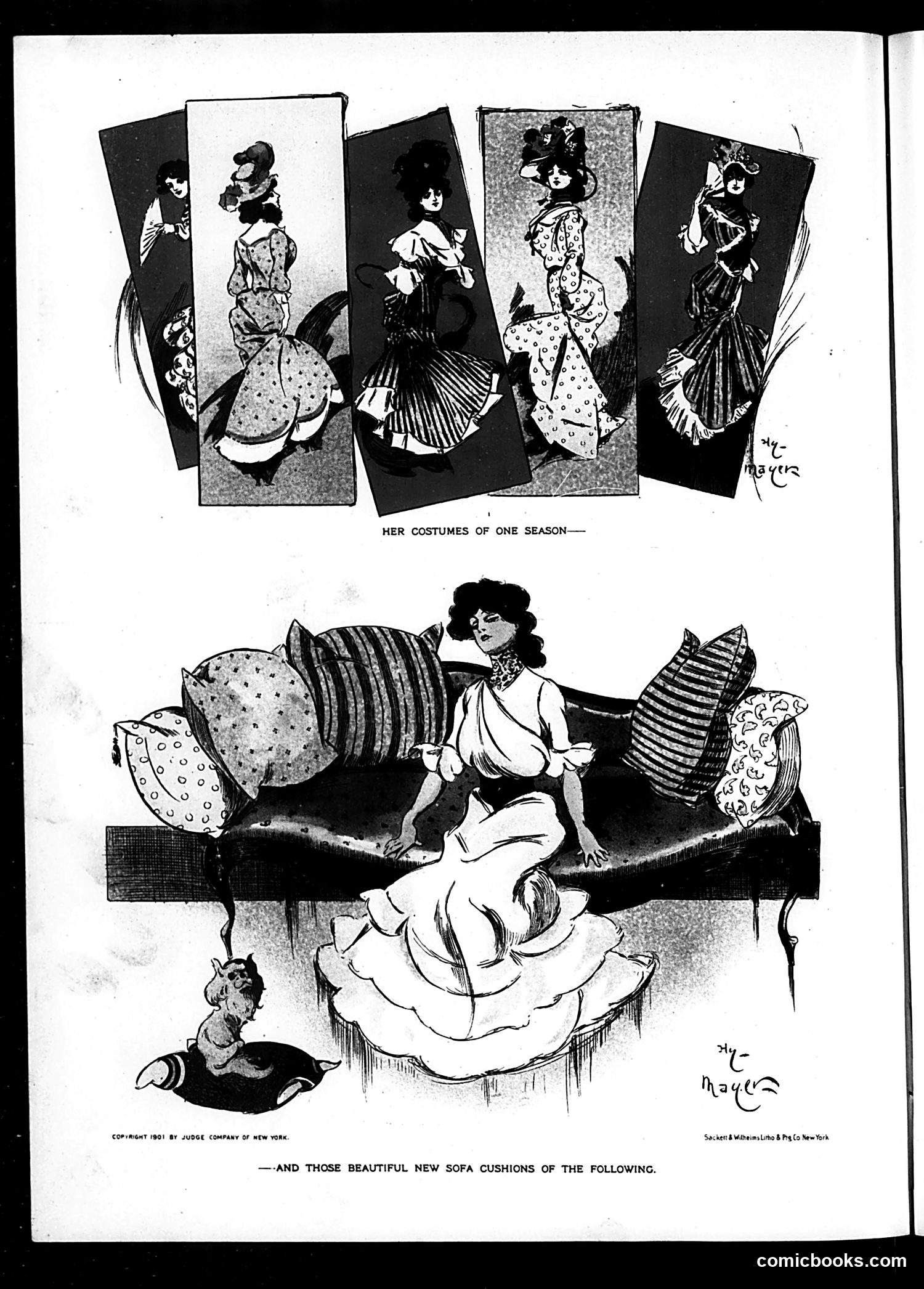
This page satirizes women's fashion extravagance in the early 1900s. The top panel shows five different elaborate outfits a fashionable woman might wear in a single season—each featuring ornate details, large hats, and voluminous skirts typical of the Gibson Girl era. The bottom panel amplifies the satire: a woman sits on a sofa surrounded by decorative cushions, presumably the "beautiful new sofa cushions of the following" season. A small child lies on the floor, humorously suggesting that even children's furniture competes with women's fashion expenditures. The joke targets the conspicuous consumption and constant wardrobe cycling among wealthy women—the idea that seasonal fashion required entirely new wardrobes. The cushions visual punchline implies fashion's frivolity rival domestic furnishings themselves, mocking both the fashion industry and women's perceived weakness for shopping.
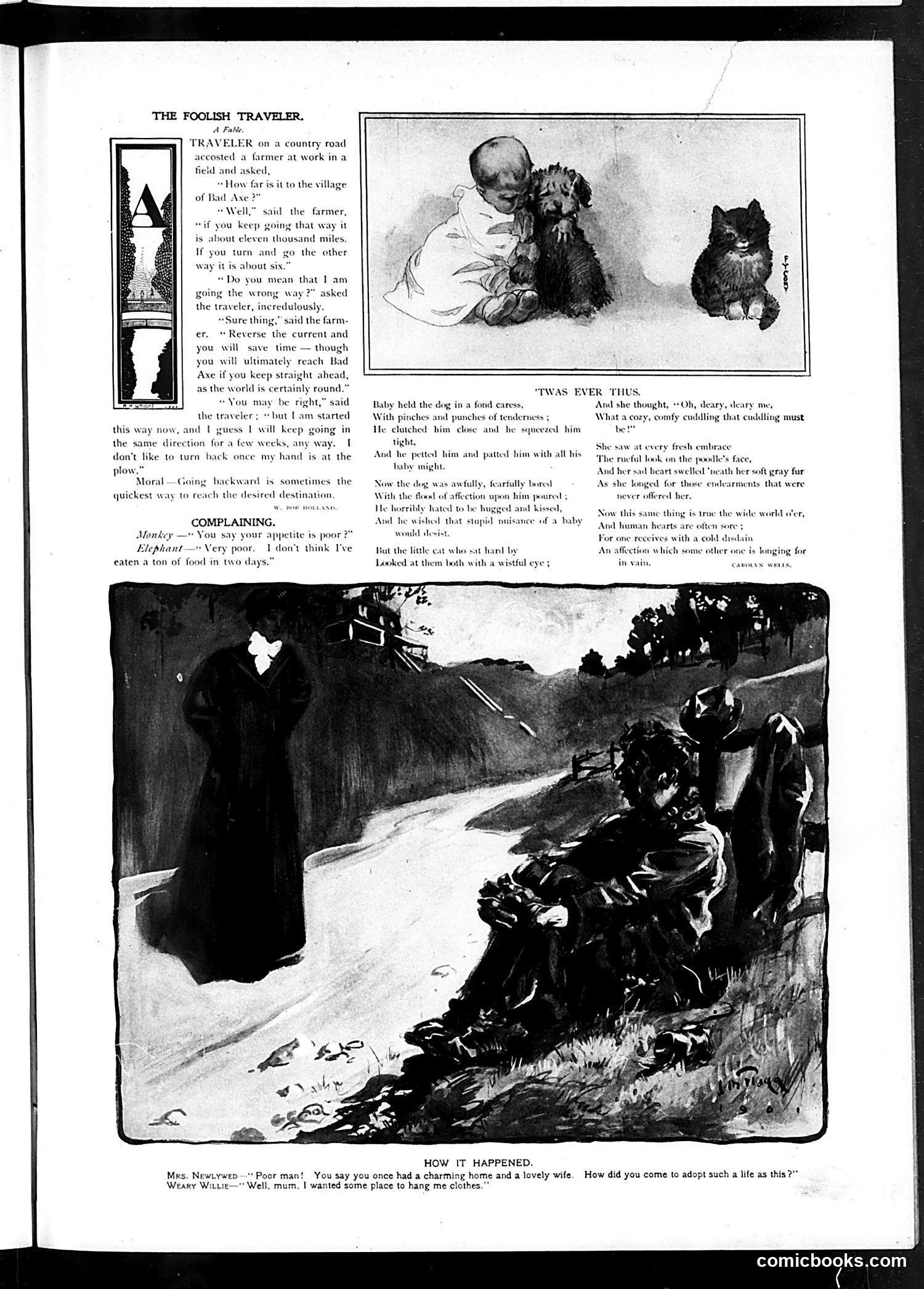
This page contains three separate satirical pieces from *Judge* magazine: **"The Foolish Traveler"** (main story with illustration): A fable mocking stubborn persistence. A lost traveler asks a farmer directions to Bad Axe village. The farmer explains two routes—one eleven thousand miles, one six miles—but the traveler, having already started down the wrong way, refuses to turn back. The moral: sometimes backtracking is fastest, but people irrationally continue bad decisions once committed. **"Complaining"** (brief joke): A monkey and elephant exchange about poor appetite—mundane animal humor. **"'Twas Ever Thus"** and **"How It Happened"** (illustrated stories): Contrasting tales about affection and desire. A baby roughly pets an annoyed dog while a nearby cat watches longingly, wishing for such attention. Below, a well-dressed woman questions a poor man about abandoning his "charming home and lovely wife," revealing he simply needed somewhere to hang clothes—absurdist social commentary on poverty and priorities. The page satirizes human irrationality, stubbornness, and the paradoxes of desire.
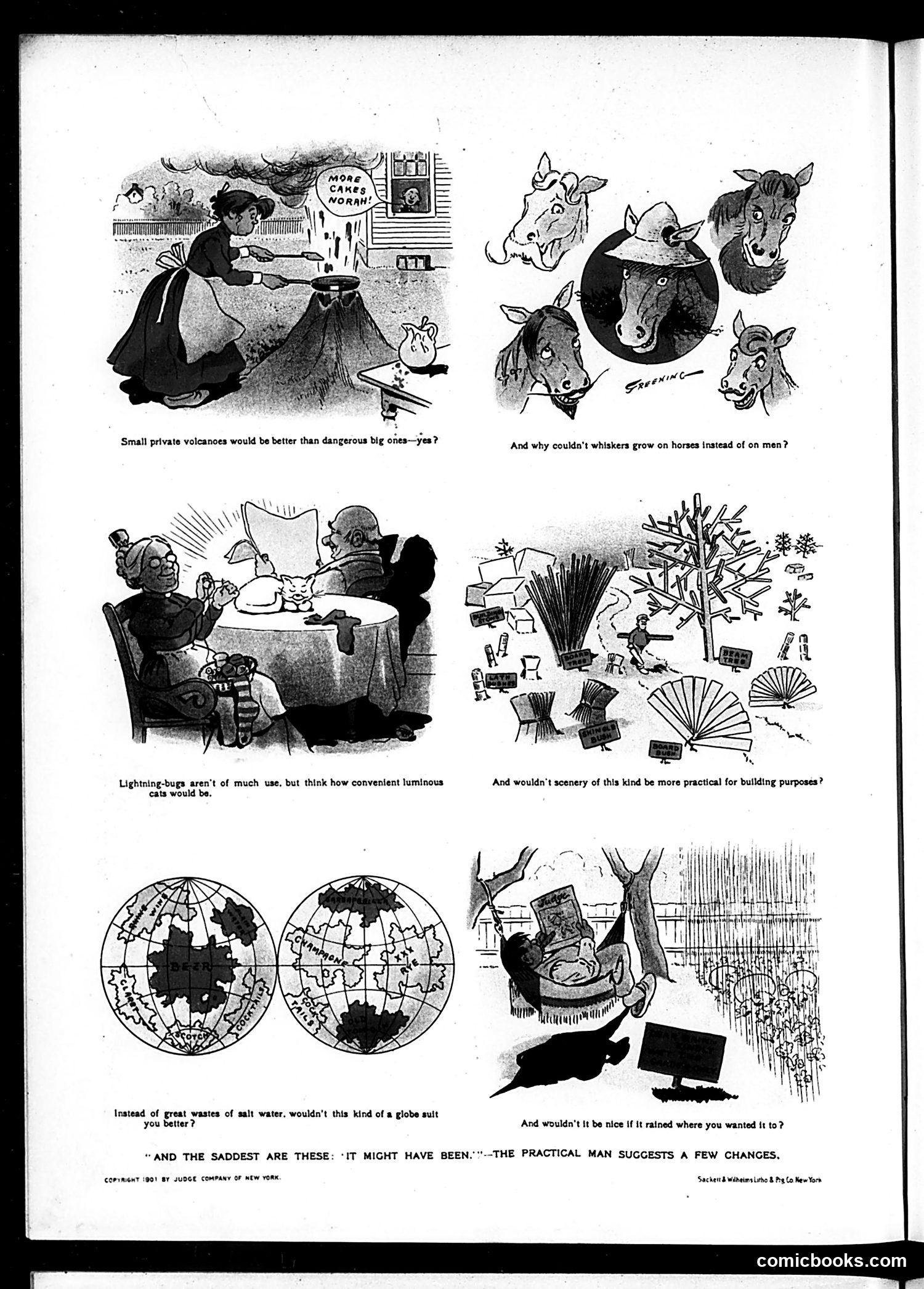
This satirical page mocks the arrogance of those who believe they could "improve" nature through impractical redesigns. Each panel presents absurd hypothetical improvements: smaller private volcanoes instead of dangerous large ones, luminous cats for lighting, horses with whiskers instead of men, scenery composed of giant fans for "building purposes," a globe with less ocean, and rain that falls where desired. The satire targets the turn-of-century mentality of technological optimism and human supremacy—the belief that science and reason could (and should) fundamentally reshape the natural world. The final caption, quoting the poem "It Might Have Been," suggests that wishing for such changes is foolish nostalgia rather than practical improvement. The "Practical Man" is revealed as actually quite impractical, highlighting the gap between technological confidence and actual wisdom.
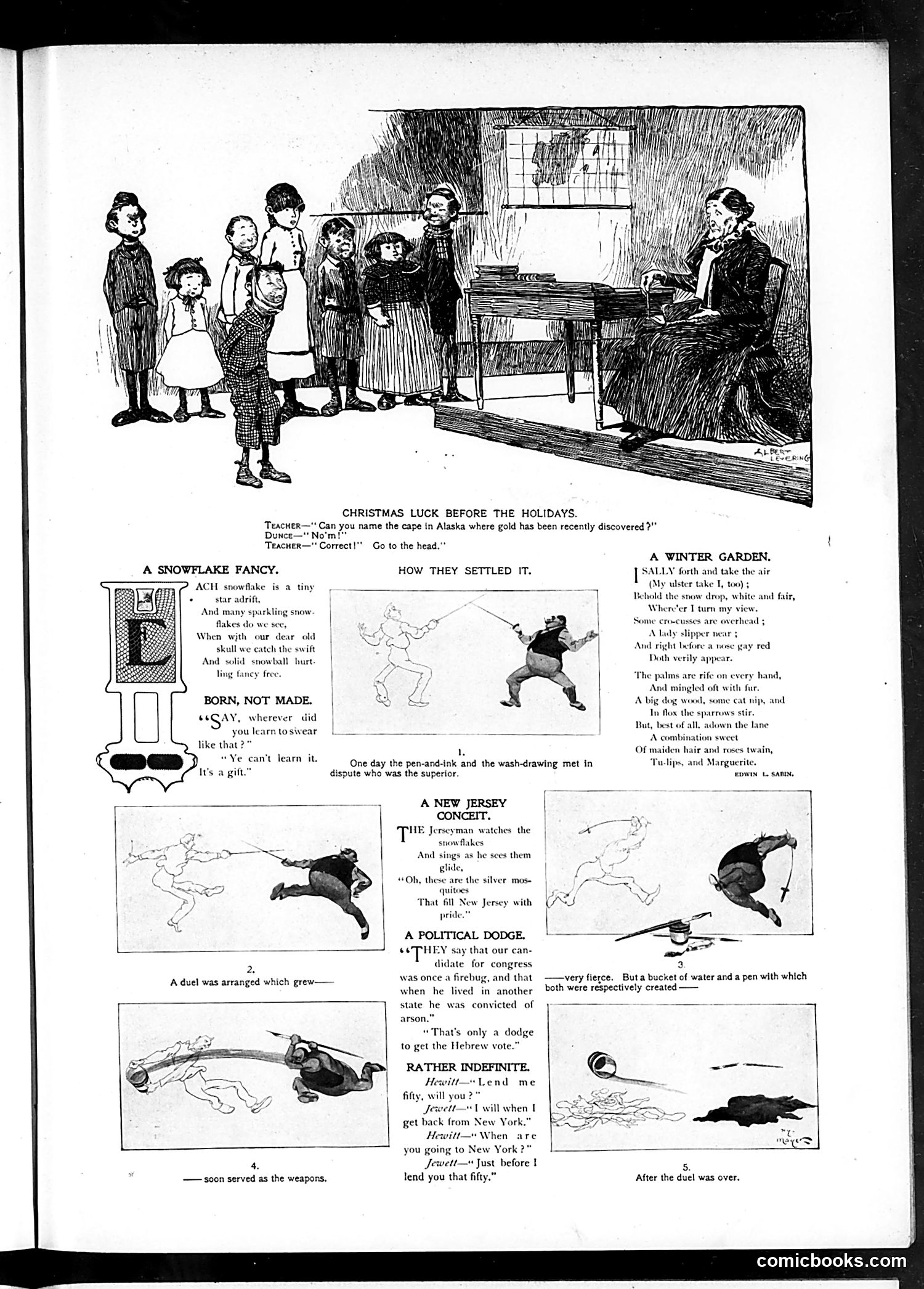
This page contains multiple brief satirical pieces typical of late 19th/early 20th-century American humor: **"Christmas Luck Before the Holidays"**: A schoolroom joke where a dunce cannot name an Alaskan cape where gold was discovered—likely referencing the contemporary Klondike Gold Rush, a major news story of that era. **"A Political Dodge"**: Satirizes a congressional candidate's past arson conviction. The joke suggests politicians exploit prejudices (here, "the Hebrew vote") to deflect from scandals—implying candidates use deflection tactics rather than address serious crimes. **"A New Jersey Conceit"**: Mocks New Jersey residents' supposed boastfulness by having a Jerseyman humorously call mosquitoes "silver" to praise his state. **Other items**: "A Snowflake Fancy," "Born, Not Made," "How They Settled It," "Rather Indefinite," and "A Winter Garden" are brief humorous vignettes about drawing methods, swearing, artistic disputes, and romantic misunderstandings—typical period humor with no specific political content. The page reflects Judge's mix of topical political satire and genteel domestic comedy.
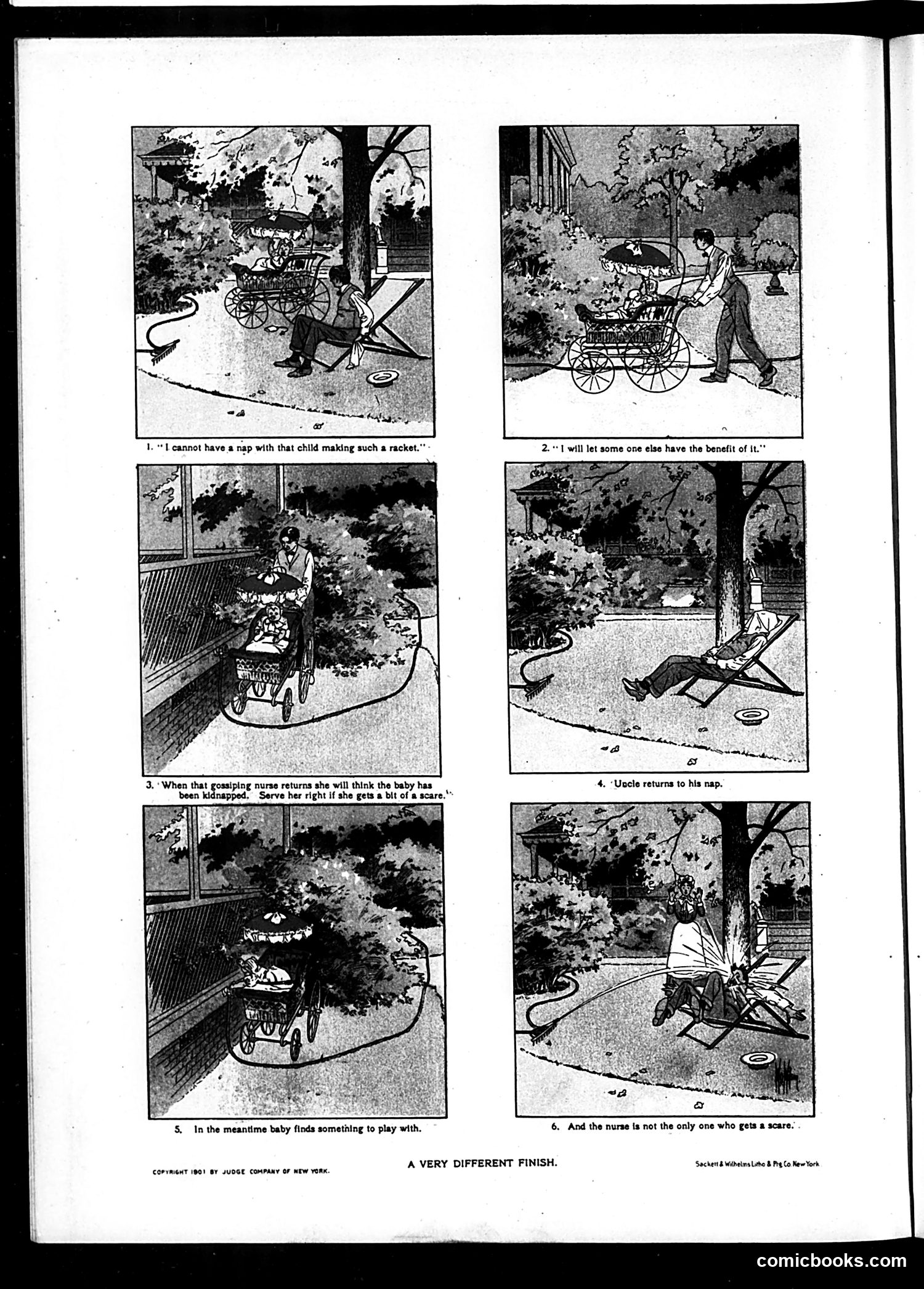
This is a six-panel comic strip titled "A Very Different Finish" depicting a domestic comedy scenario. The narrative follows an uncle attempting a nap while a nanny cares for a baby in a garden setting. The joke centers on unintended consequences: the uncle asks the nanny to keep the noisy baby quiet so he can rest (panel 1-2), but while she's distracted, the baby plays with the uncle's discarded hat (panel 5). The hat apparently contains a snake or similar creature that frightens both the nanny and the uncle when discovered (panels 4, 6). The satire mocks the uncle's attempt to escape parental responsibility and the ironic result—he gets "a scare" worse than any nap disruption. The humor relies on slapstick surprise and the deflation of the uncle's selfish expectations.
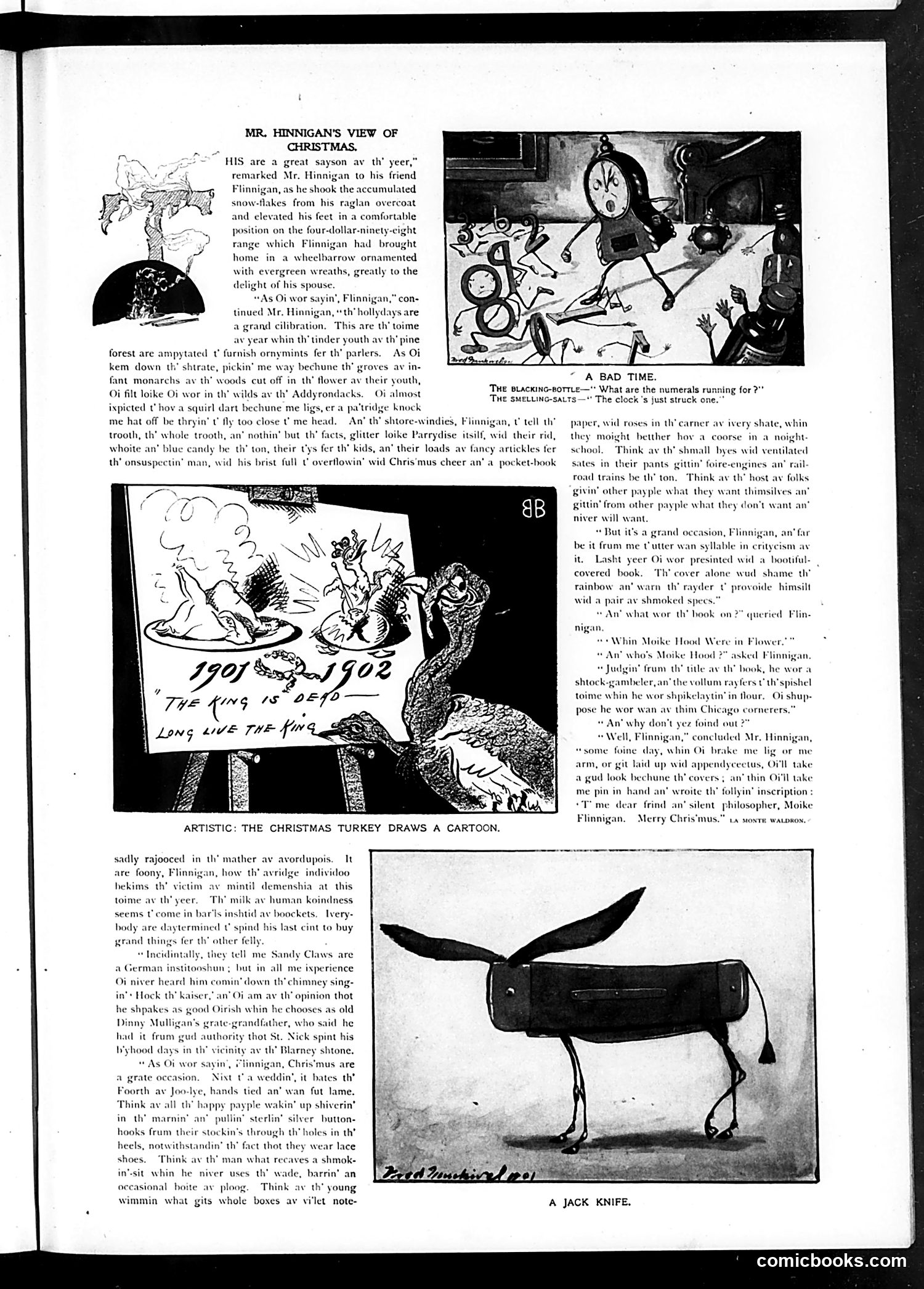
This page presents a humorous Irish-immigrant monologue in heavy dialect, featuring characters Mr. Hinnigan and Flinnigan discussing Christmas customs. The satire gently mocks working-class Irish-American culture through exaggerated phonetic spelling ("shtrate" for street, "Chris'mus" for Christmas). The cartoons illustrate Hinnigan's observations: one shows a turkey drawing a satirical cartoon labeled "1901-1902: The King is Dead, Long Live the King" (likely referencing Queen Victoria's 1901 death and Edward VII's succession), and another depicts "A Jack Knife"—apparently a visual gag about Christmas gifts. The humor derives from Hinnigan's malapropisms, sentimental observations about holiday generosity, and references to Irish-American experiences. The piece appears designed for Judge magazine's audience to enjoy lighthearted ethnic humor while Hinnigan earnestly celebrates Christmas traditions and working-class life.
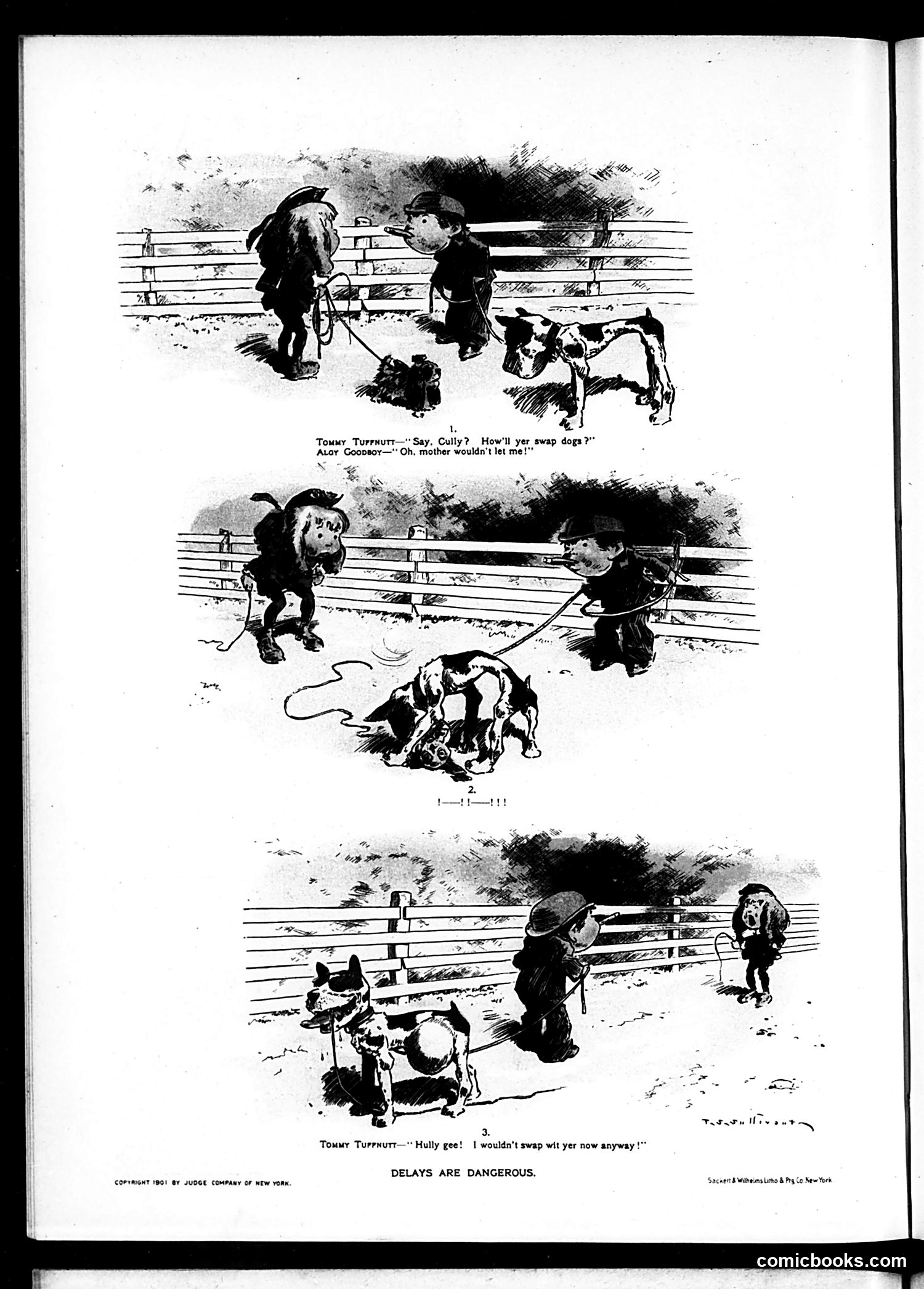
This three-panel comic depicts two working-class boys ("Tommy Turnnurt" and "Alcy Goopsor") with their dogs near a fence. The humor relies on dialect comedy popular in late 19th-century American humor. In panel 1, Tommy proposes swapping dogs. Alcy refuses, claiming his mother won't allow it. Panel 2 shows the dogs fighting or tangling together. Panel 3 reveals Tommy's changed mind: he now refuses to swap. **The satirical point:** The title "Delays Are Dangerous" suggests the moral lesson—Alcy's initial hesitation (delay in accepting the swap) proved wise. By waiting, he avoided the disastrous fight that occurred, which would have resulted in a worse-condition dog. The cartoon mocks the impulsive nature of children while endorsing caution and parental wisdom. The crude dialect and working-class setting were typical Judge magazine fare, satirizing urban immigrant or lower-class speech patterns common to period American humor.
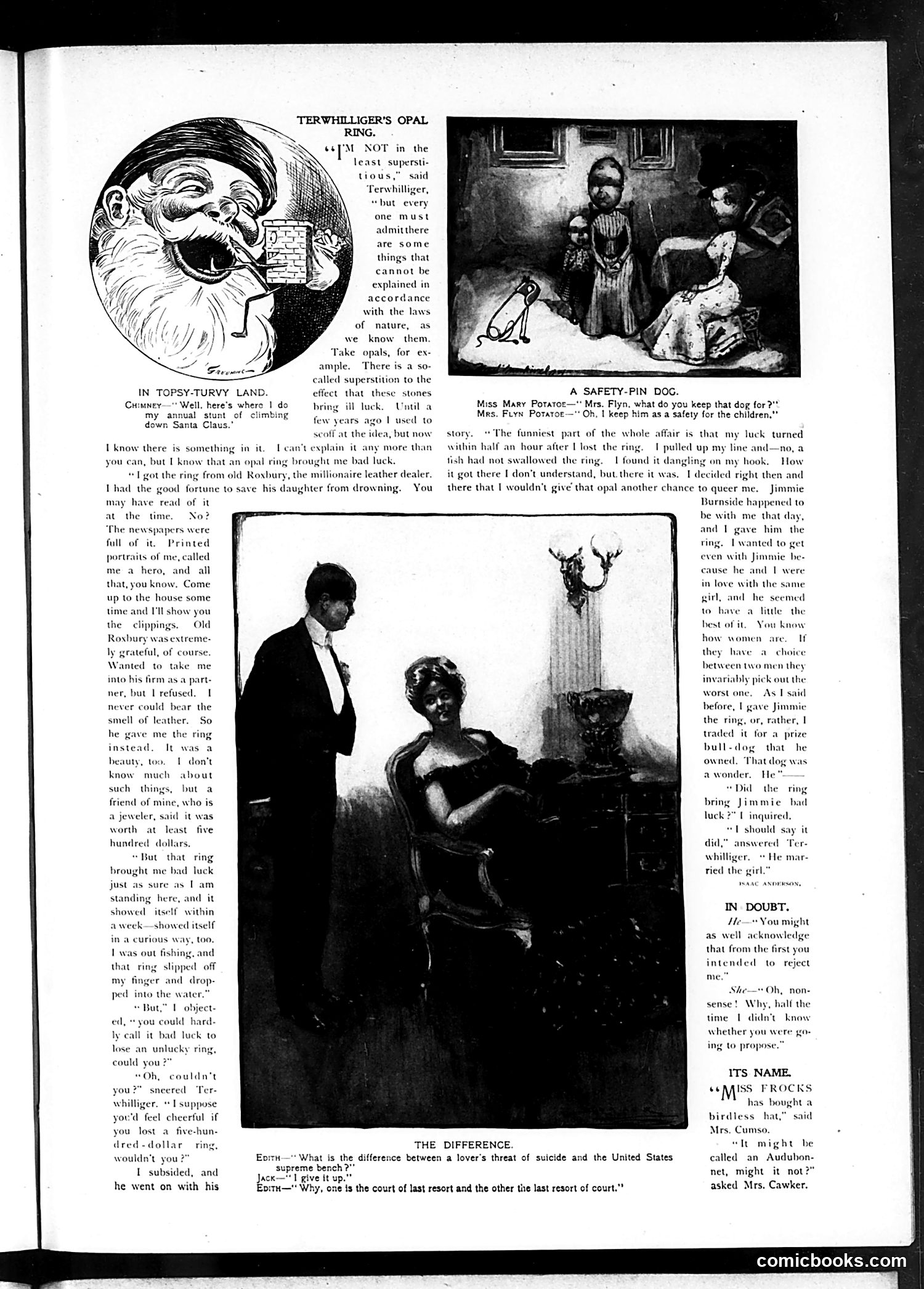
This page contains three satirical pieces typical of Judge magazine's humor: **"Terwhilliger's Opal Ring"** is a superstition story where a character claims an opal ring brings bad luck—a common Victorian superstition about opals. The irony is that losing the ring (supposedly unlucky) into water while fishing actually *removes* the bad luck, undermining superstitious logic. **"In Topsy-Turvy Land"** mocks Santa Claus mythology and children's credulity through absurdist wordplay. **"A Safety-Pin Dog"** plays on the double meaning of "safety"—a woman keeps a dog as protection for children, but the joke's punchline (visible in dialogue) likely involves the absurdity of this claim. **"The Difference"** presents a legal joke: comparing a lover's threat of suicide to Supreme Court decisions, then asking what differs between them—answered that one is "court of last resort" and the other "last resort of court" (wordplay on legal vs. romantic desperation). The page reflects early 20th-century American middle-class anxieties about superstition, courtship, and legal absurdities through punning humor.
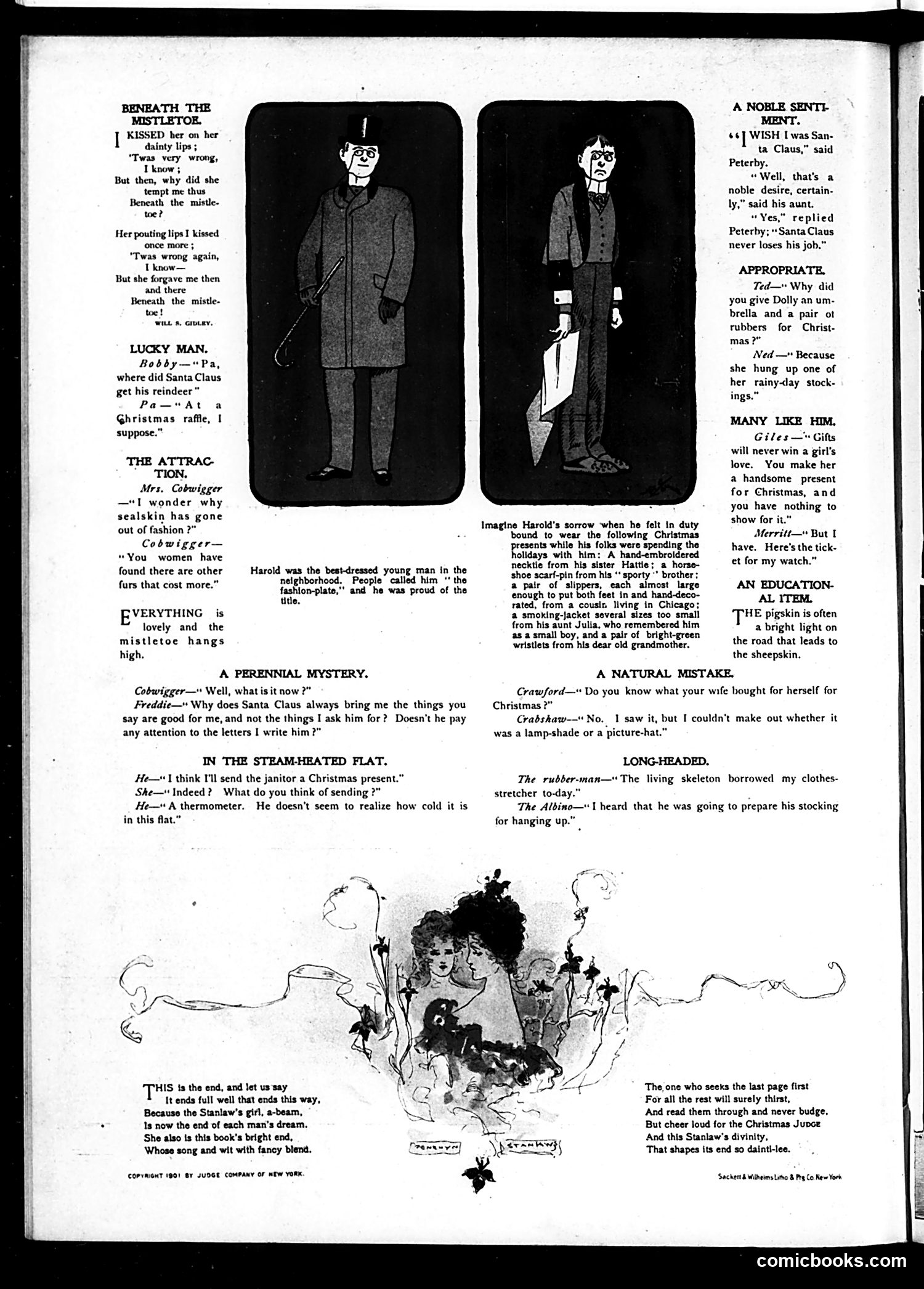
This page from Judge magazine collects brief holiday-themed jokes and comic vignettes typical of early 1900s American humor. The content includes: **Mistletoe sketches**: Romantic/flirtatious scenarios using the Christmas tradition as cover for kissing—reflecting period social customs where mistletoe provided socially acceptable excuses for physical affection. **Social satire**: Jokes targeting contemporary concerns like fashion trends (sealskin furs, expensive gifts), marital dynamics (cold apartments, wives' spending), and class anxieties (keeping up appearances through gift-giving and clothing). **Character humor**: A "fashion plate" named Harold faces the indignity of wearing homemade Christmas gifts from relatives—poking fun at genteel pretension meeting family obligation. **Economic commentary**: A boy's observation that Santa brings practical gifts (what parents want him to have) rather than what he requests suggests skepticism about commercialization and parental control. The page concludes with an illustrated poem celebrating the magazine itself and its fictional character Stanlaw's daughter—typical self-promotional ending for period publications.
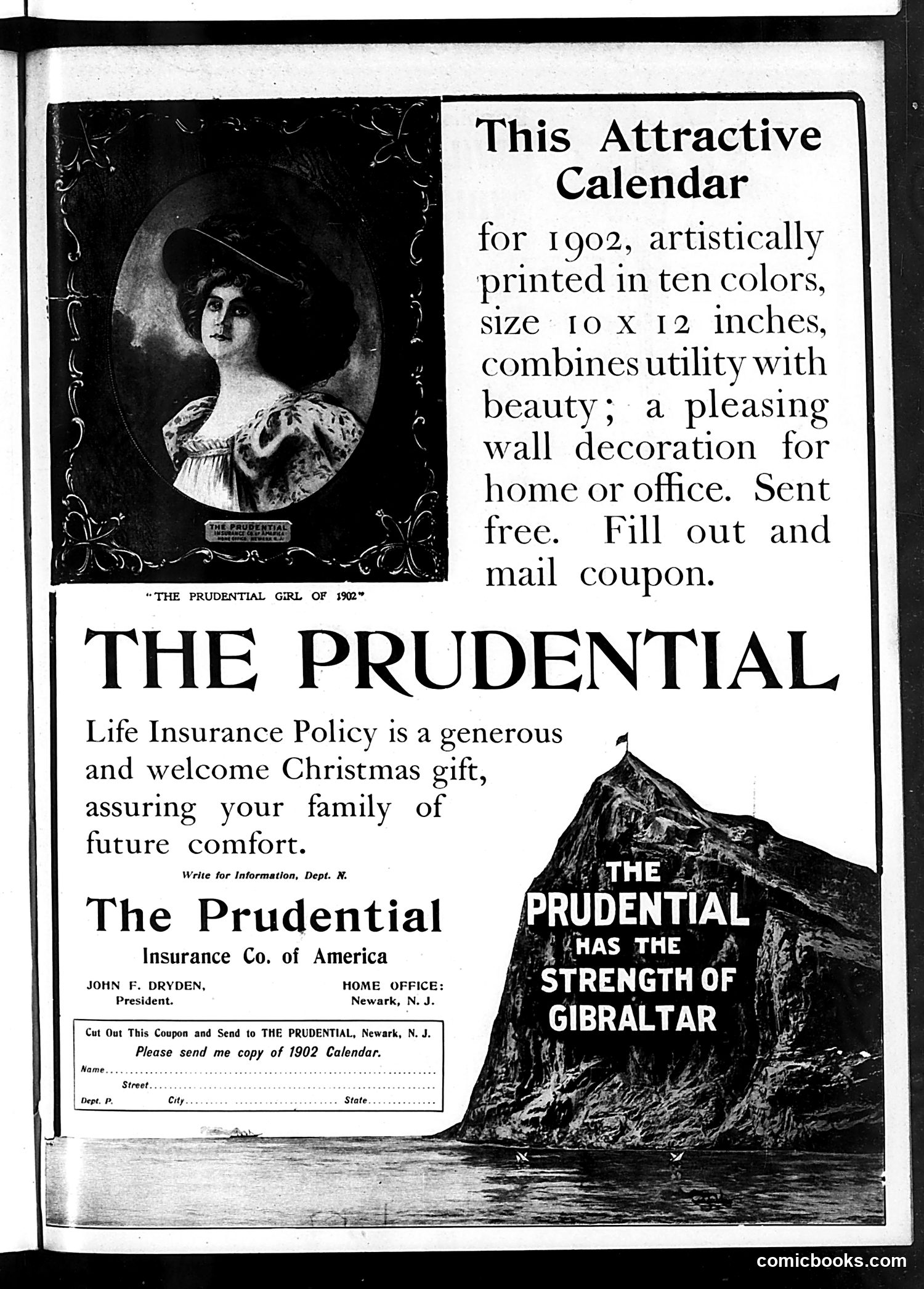
This is primarily **advertising**, not satire. The Prudential Insurance Company uses Judge magazine's pages to promote two products: 1. **A free 1902 calendar** featuring "The Prudential Girl of 1902"—an idealized portrait of an attractive woman in fashionable dress and hat, positioned as aspirational imagery 2. **Life insurance as a Christmas gift**, marketed as providing family security and "future comfort" The accompanying image of Gibraltar's Rock reinforces Prudential's slogan: "The Prudential Has the Strength of Gibraltar"—equating the company's stability with an immovable natural landmark. **For modern readers:** This reflects early 1900s marketing that combined attractive imagery with practical financial products, using prestigious magazine placement to build consumer trust. The "Prudential Girl" represents the brand's attempt to associate insurance—typically seen as serious or morbid—with beauty, modernity, and aspirational living.
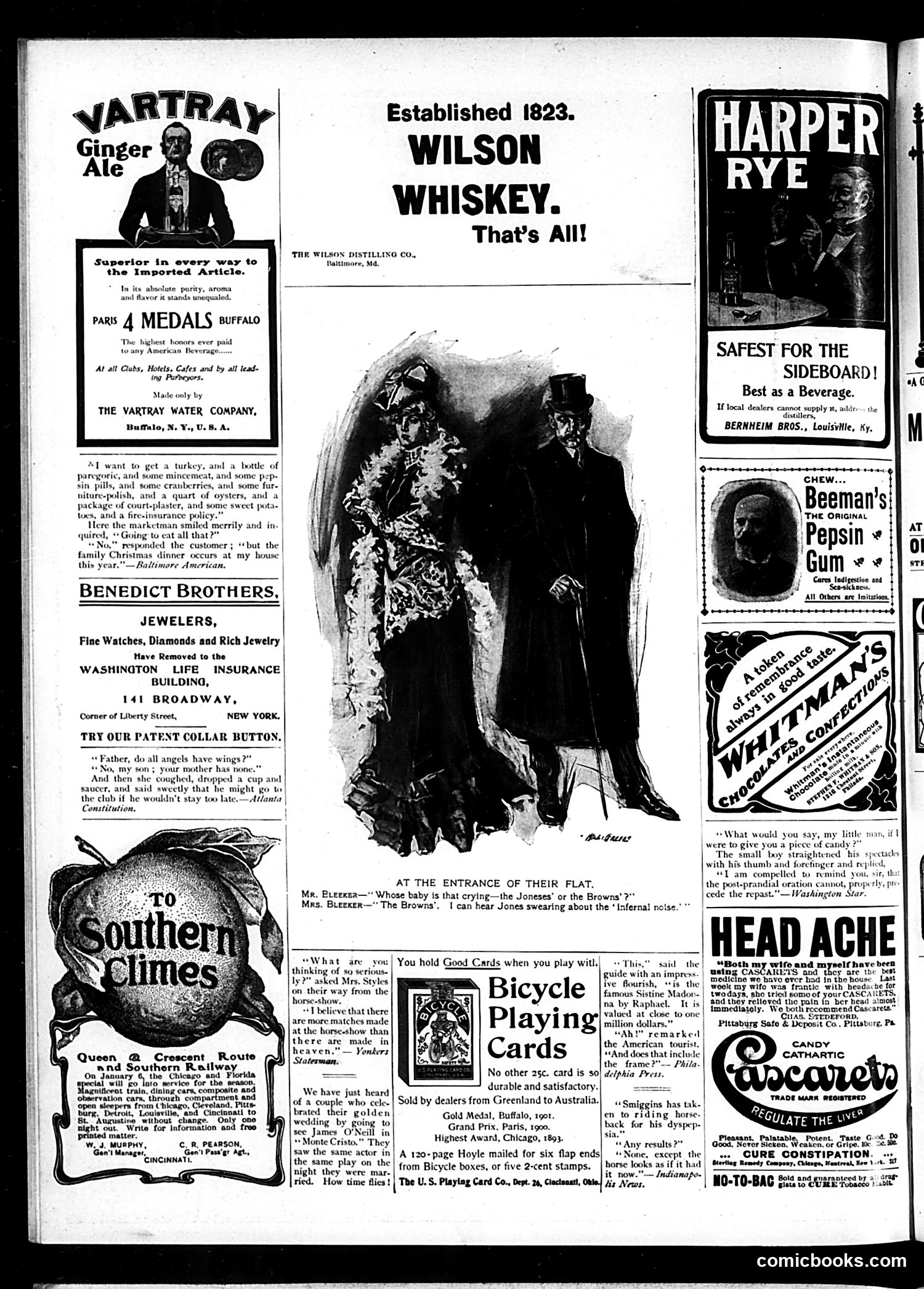
This is primarily an **advertising page** with one central cartoon illustration titled "At the Entrance of Their Flat." ## The Main Cartoon The illustration depicts a domestic scene where a couple argues about a crying baby at their apartment entrance. The caption includes dialogue where neighbors speculate whose baby it is—the Joneses' or the Browns'—with one character noting he can hear Jones "swearing about the 'infernal noise.'" **The joke**: This is gentle domestic humor typical of the era, playing on the annoyance of noisy neighbors and babies in close urban apartment living. The humor derives from the implied marital discord and Mr. Jones's audible frustration. ## The Page's Primary Content The bulk of the page consists of period advertisements for: - Alcoholic beverages (Wilson Whiskey, Vartray Ginger Ale, Harper Rye) - Jewelry (Benedict Brothers) - Playing cards and travel services - Patent medicines and remedies **Context for modern readers**: This reflects early 1900s consumer culture and notably **pre-Prohibition advertising of alcohol**, which would become illegal in 1920.
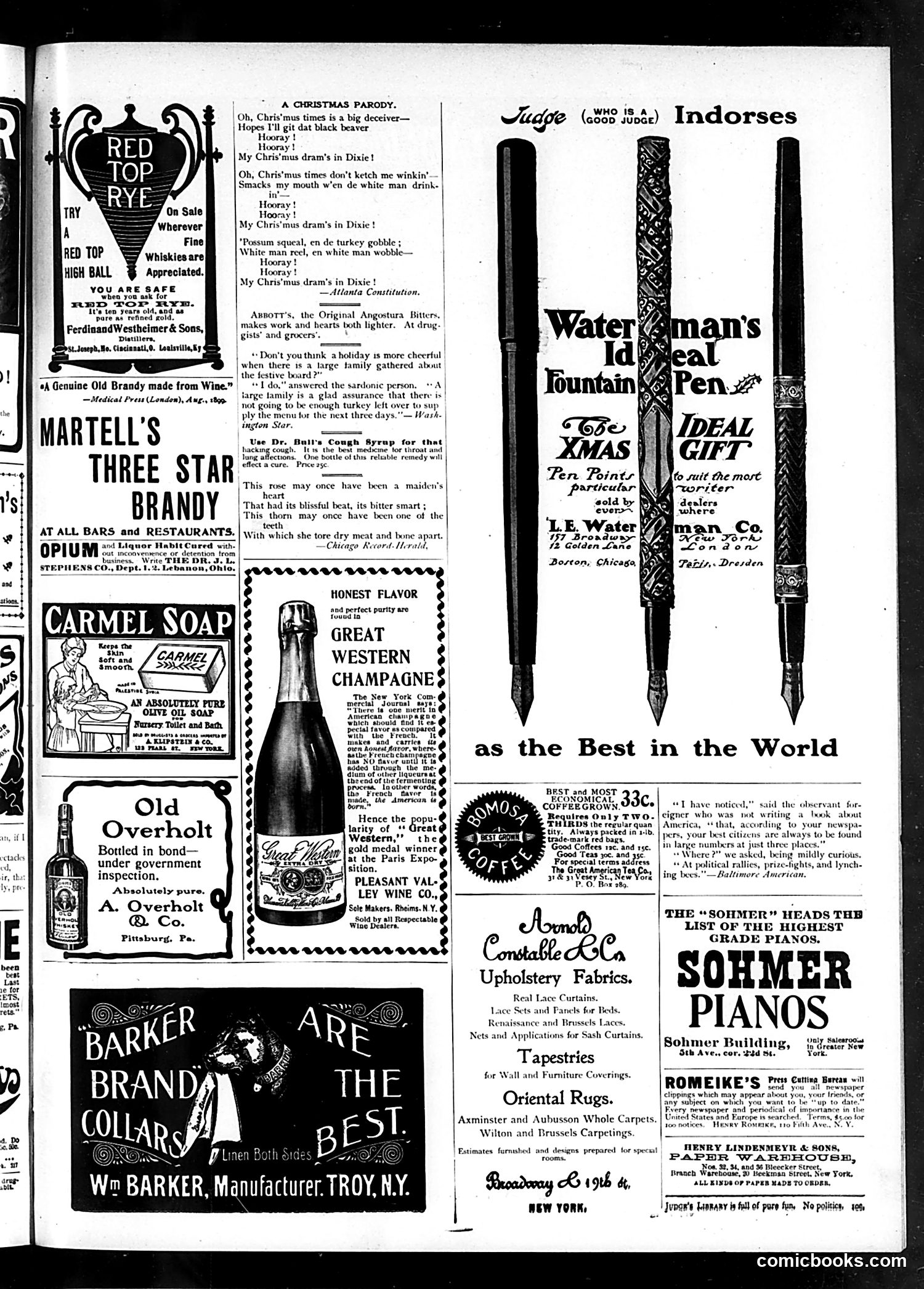
This page is primarily **advertisements with one satirical poem**. The notable content is "A Christmas Parody," a dialect poem appearing racist by modern standards. It depicts an African American speaker excited about Christmas in the American South ("Dixie"), expressing hopes for gifts and alcohol while making caricatured observations about white people drinking. The poem reflects **late 19th/early 20th-century minstrelsy tradition**—a deeply offensive genre where white audiences consumed exaggerated, dehumanizing portrayals of Black people for entertainment. The use of nonstandard dialect ("w'en de white man"), the focus on alcohol and food, and the overall comedic framing exemplify how such material was considered acceptable satirical humor in this era. The surrounding advertisements (brandy, champagne, whiskey, soap) suggest the publication's audience and commercial context. This page demonstrates how racist caricature was normalized in mainstream American publications.
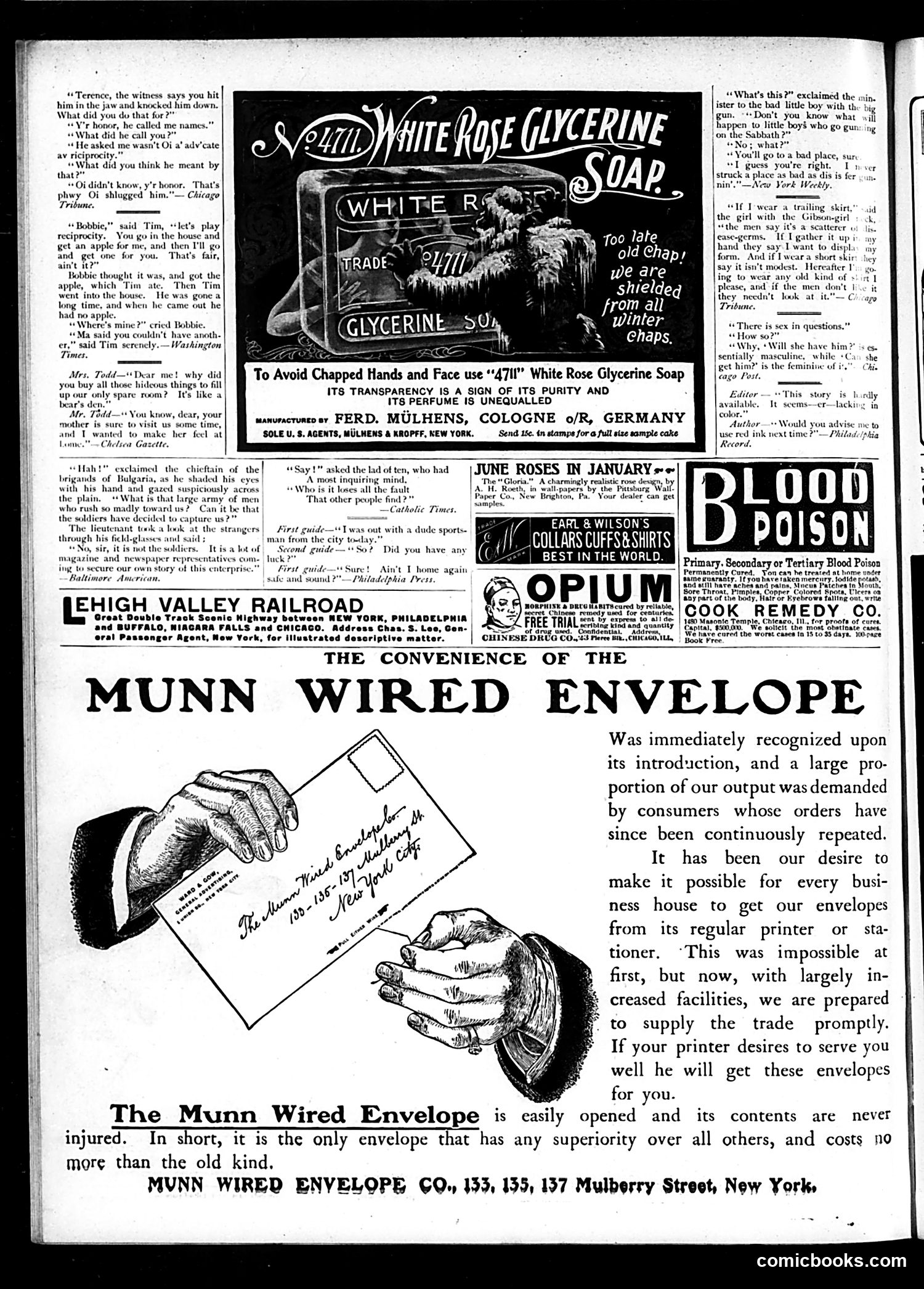
This page is primarily **advertising**, not political satire. It contains several product advertisements interspersed with brief joke columns typical of Judge magazine's format. The visible content includes: **Advertisements:** - "47th White Rose Glycerine Soap" (German-made) - "Blood Poison" remedy (a patent medicine) - Earl & Wilson's collars and shirts - Lehigh Valley Railroad - Munn Wired Envelope Company **Joke Columns:** Brief humorous exchanges about reciprocity between children, religious observance, women's fashion, and courtship—typical period humor reflecting conventional social attitudes. **Historical Context:** The advertisements reveal early 20th-century consumer culture—patent medicines (many fraudulent by modern standards), German luxury goods, and business innovations like the "wired envelope." The jokes reflect era-specific social norms around religion, gender roles, and class. The page lacks significant political cartooning or satirical commentary on current events, instead serving as a revenue-generating vessel for advertisers reaching Judge's educated, middle-class readership.
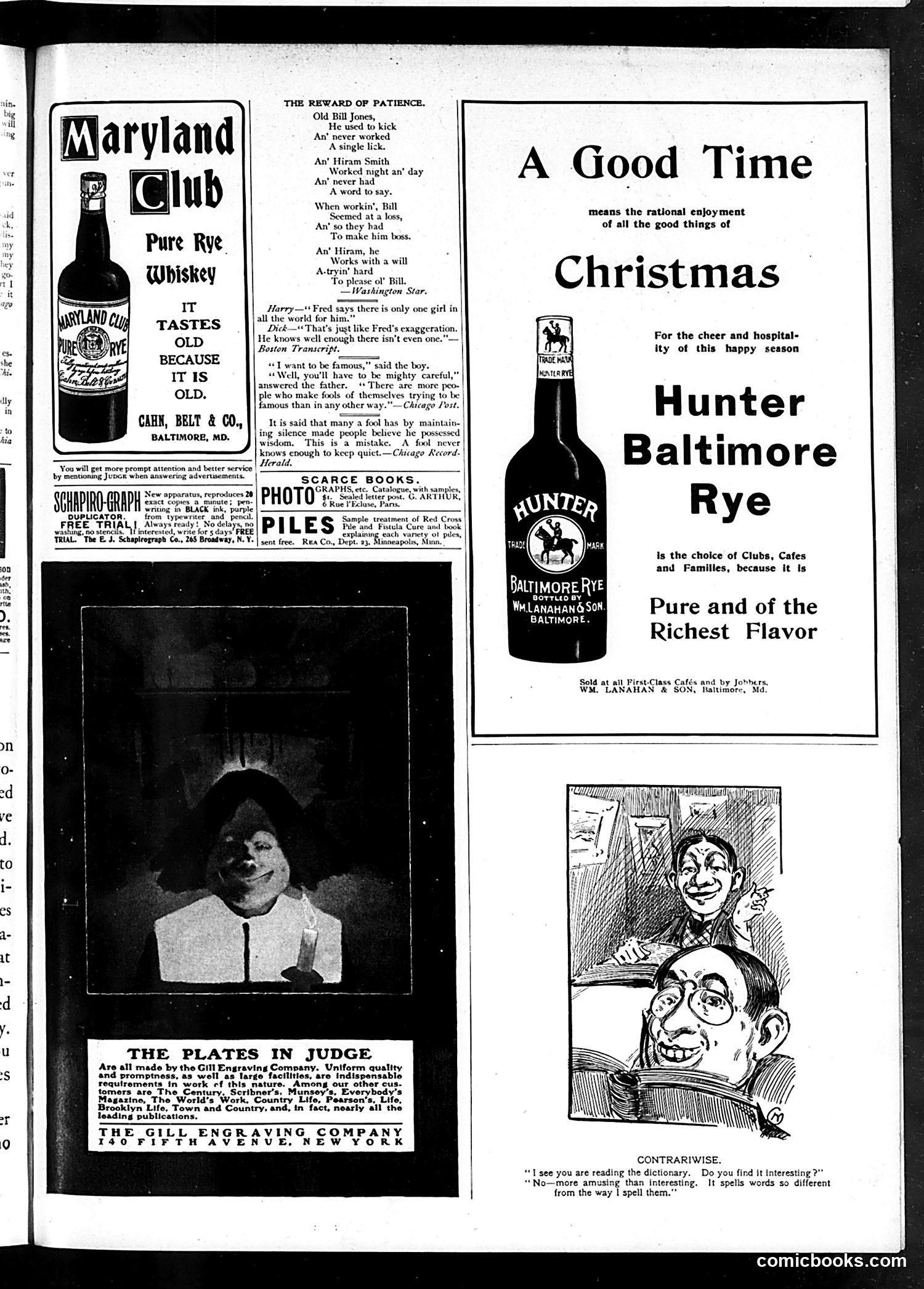
This page is primarily **advertising** for whiskey and rye brands (Maryland Club, Hunter Baltimore Rye), with minimal satirical content. The small text sections include: **"The Reward of Patience"**: A brief moral poem contrasting lazy "Bill Jones" with hardworking "Hiram Smith," concluding that patience leads to promotion—a straightforward (not satirical) homily on work ethic. **Dialogue jokes**: Two brief, generic jokes about romantic exaggeration and the value of silence in appearing wise—standard humor with no specific political reference. **"Contrariwise"**: A children's joke about dictionary spelling conventions. The **photograph** labeled "The Plates in Judge" shows a woman's portrait and advertises the Gill Engraving Company's printing services. This page contains **no identifiable political cartoons or satire**. It's a typical early-20th-century magazine spread mixing advertisements, light humor, and business notices. The content reflects period attitudes about work and propriety but lacks the pointed social commentary one might expect from Judge's satirical reputation.
This page is primarily **advertising and filler content** with multiple unrelated advertisements rather than political cartoons requiring historical context. The one substantive piece is a dialogue-based comic strip at the top featuring a **burglar breaking into a home**. The humor is straightforward: the burglar expects to find money but discovers his victim is impoverished—the homeowner admits he has no cash, only "two poems sent to the *Scribe*" and other literary submissions. The burglar, disappointed, abandons the robbery and leaves. The joke satirizes the financial struggles of struggling writers and the worthlessness of literary aspirations as currency. No specific political figures or events are referenced. The remainder consists of Christmas gift advertisements (jewelry, cigars, medicines, train travel packages), with period humor based on misunderstandings and social awkwardness rather than contemporary politics.
This is primarily an **advertising page**, not a satirical cartoon. The page is dominated by book advertisements from Chester Billings & Son, a publisher at 58 Nassau Street in New York. The listings include titles typical of late 19th-century publishing: translations of European literature (*Madam du Barry*, works by Maxime Gorky and Tolstoy), practical guides (*Modern Palmistry*, *100 New House Plans*), and notably a sex-education manual titled *The Science of Life* by John Cowan, prominently advertised at "$100.00 in Gold." At the page's bottom is an advertisement for **Vigoral**, a "beef drink" marketed as a tonic for weak stomachs and "retiring invalids"—typical patent-medicine advertising of the era. There are **no political cartoons or satire visible**. The page functions as a merchant's catalog showcasing available publications and patent remedies to Judge's readers.
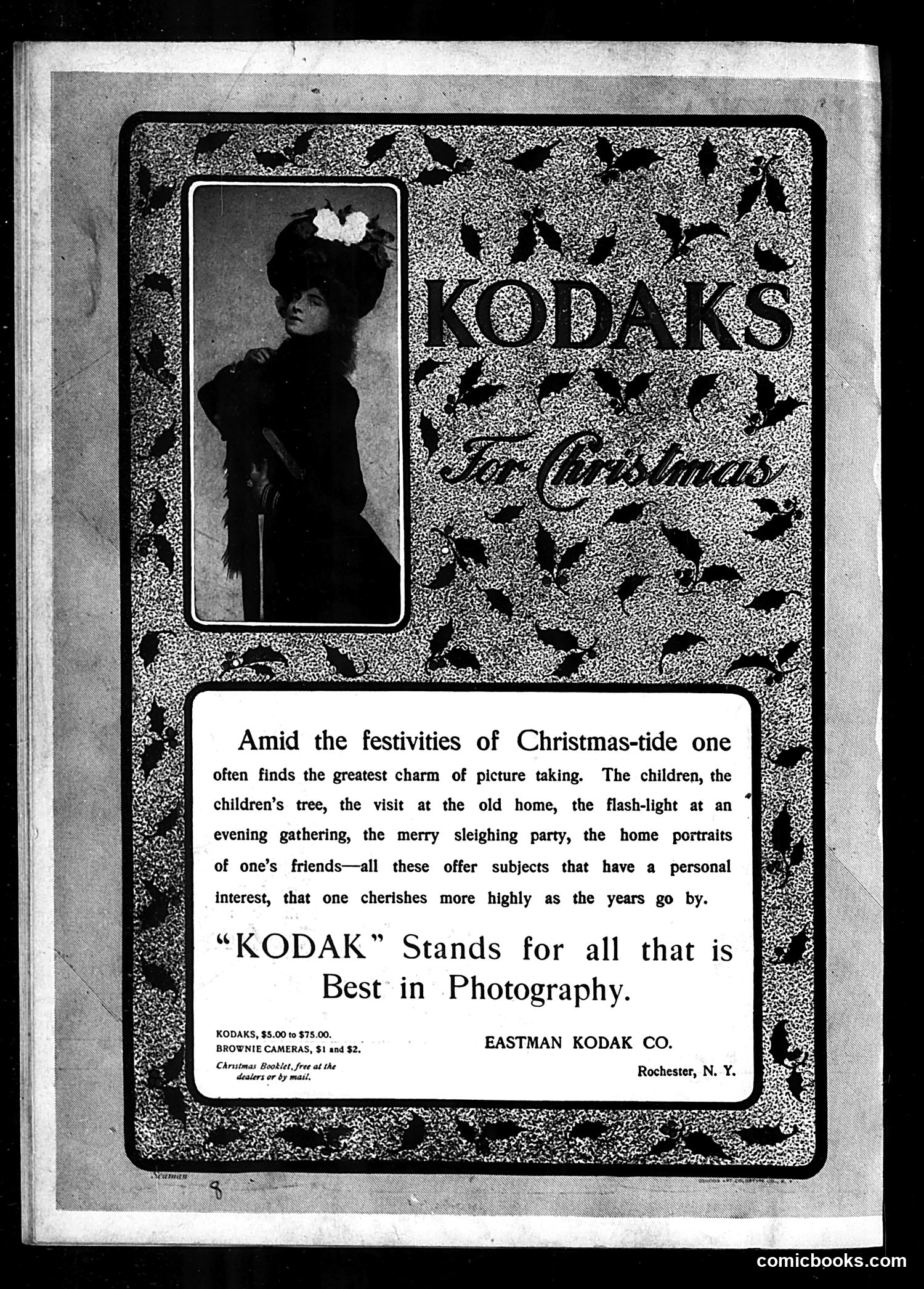
This page is primarily an **advertisement, not satire or political content**. It's a Kodak camera advertisement from Judge magazine's Christmas issue. The ad features a stylized portrait photograph of a woman in early 1900s attire with a white feather in her hair, set against a decorative border with birds. The text promotes Kodak cameras for holiday picture-taking, emphasizing personal and sentimental subjects: children, Christmas trees, family gatherings, and home portraits. The message appeals to middle-class consumers by framing photography as a way to preserve cherished memories. The ad concludes with Kodak's tagline: "Stands for all that is Best in Photography." Pricing ranges from $5 to $75, with Brownie cameras (entry-level models) at $1-$2. This represents early mass-market camera advertising targeting holiday gift-givers.

I can see this is a page from *Judge* magazine (as indicated by the watermark), but the image is almost entirely black or severely underexposed, making it impossible to discern any cartoon illustrations, text, or satirical content with confidence. The page appears to be either a back cover, advertisement section, or a severely damaged/degraded scan. While the OCR detected "comicbooks.com" (likely a modern watermark added by the archive), I cannot identify any political figures, social references, or satirical points from the actual content. To provide accurate historical analysis as requested, I would need a clearer, readable version of this page.