
Judge, 1901-12-28 · page 23 of 49
Judge — December 28, 1901 — page 23: what you’re looking at
What you’re looking at
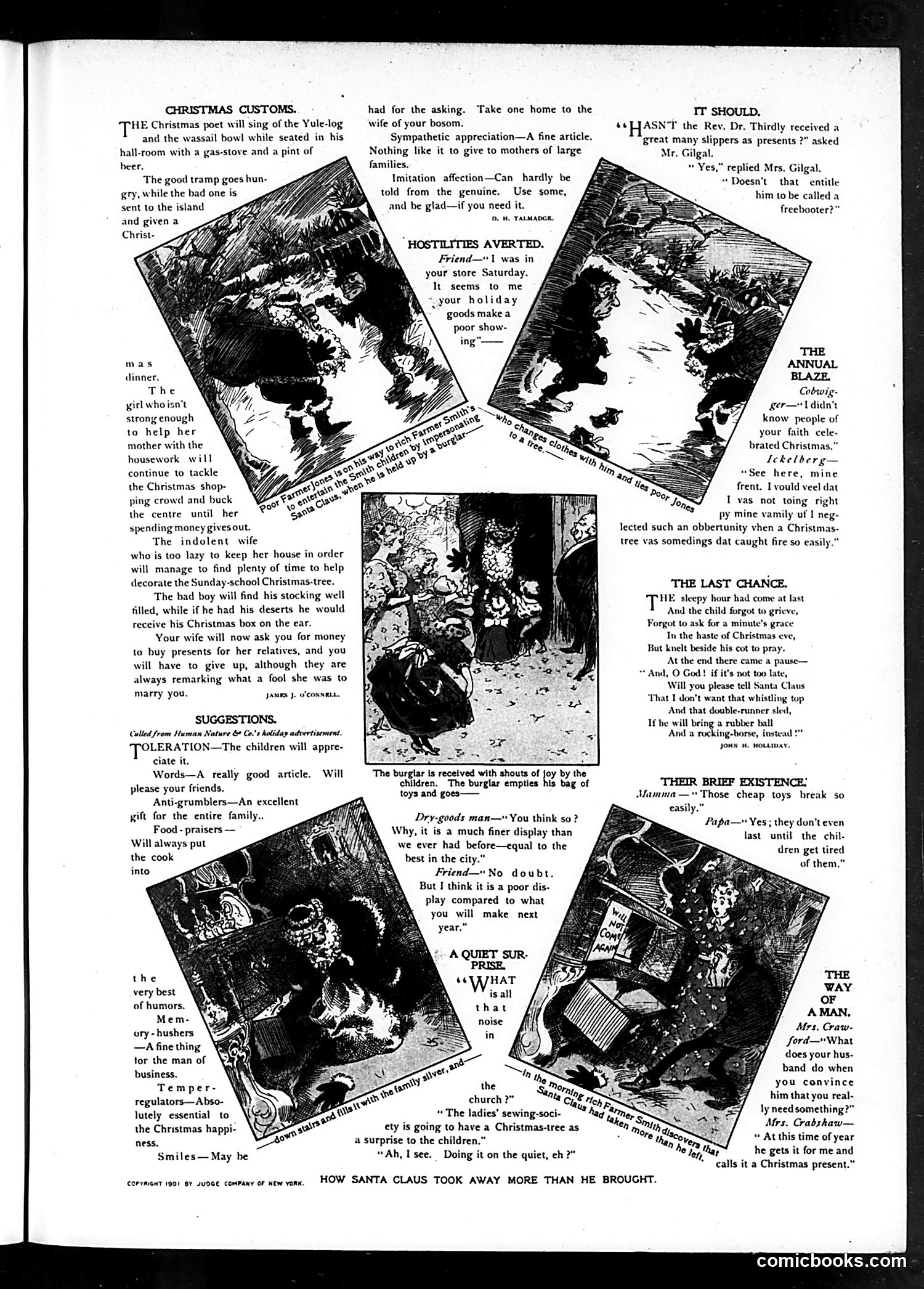
This satirical page mocks Victorian-era Christmas hypocrisy through multiple short pieces: **"Christmas Customs"** skewers middle-class holiday behavior: the poet romanticizing Christmas while drinking beer; lazy wives neglecting housework but volunteering for church decoration; parents rewarding bad behavior with gifts while punishing good children. **"Suggestions"** ironically advertises fake virtues as gifts—"toleration," "imitation affection"—implying these qualities are absent in actual households. **The illustrated vignettes** depict domestic absurdities: a burglar joyfully received by children (suggesting poor security/judgment); a shopkeeper's competitive holiday displays; a child's prayer asking God to redirect Santa's gifts; marital negotiation where husbands only buy wives what they want if framed as Christmas presents. The **overall satire** targets commercialization, domestic discord, and how Christmas exposes rather than improves human nature. The recurring theme: Christmas customs reveal selfishness, greed, and dishonesty beneath respectable Victorian surfaces—a pointed critique of the era's sentimental holiday mythology.
📄 Transcribed text from this page (OCR, searchable)
Machine-transcribed from the original scan — historical spelling and the odd misread are preserved.
CHRISTMAS CUSTOMS. HE Christmas poet will sing of the Yule-log and the wassail bowl while seated in his hall-room with a gas-stove and a pint of beer. ‘The good tramp goes hun- gry, while the bad one is sent to the island and given a Christ- dinner. The girl whoisn’t strong enough to help her mother with the housework will continue to tackle the Christmas shop- ping crowd and buck the centre until her spending money givesout. The indolent wife who is too lazy to keep her house in order will manage to find plenty of time to help decorate the Sunday-school Christmas-tree. The bad boy will find his stocking well filled, while if he had his deserts he would receive his Christmas box on the ear. Your wife will now ask you for money to buy presents for her relatives, and you will have to give up, although they are always remarking what a fool she was to marry you. Jains J. o'CONNRLL. SUGGESTIONS. Called from Human Nature & Co.'s holiday advertisement, TOLERATION—The children will appre- ciate it, Words—A really good article. Will please your friends. Anti-grumblers—An excellent xift for the entire family.. Food - praisers — Will always put the cook the of humors. Mem- ory -hushers —A fine thing tor the man of business. Temper- regulators—Abso- lutely essential to the Christmas happi- Smiles—May be COPYMGNT 1901 BY JUDGE COMPANY OF NEW YORK. ety is going to have a Christmas-tree as tia, eas a surprise to the children.” “Ah, I see. had for the asking. wife of your bosom. Sympathetic appreciation—A fine article. Nothing like it to give to mothers of large families. Imitation affection—Can hardly be told from the genuine. Use some, and be glad—if you need it. D. M. TALMADGR, Take one home to the “HOSTILITIES AVERTED. Friend—"1 was in your store Saturday. It seems to me your holiday * goods make a poor show- = ‘The burglar Is recelved with shouts of joy by the children. The burglar empties toys and goes—— is bag of Dry-goods man—"You think so? Why, it is a much finer display than we ever had before—equal to the best in the city.” Friend- But I think it is a poor dis- play compared to what you will make next year.” A QUIET SUR. PRISE, “ec HAT is all that church 2" 8 ric, By “The ladies' sewing-soci- Doing it on the quiet, eh?" HOW SANTA CLAUS TOOK AWAY MORE THAN HE BROUGHT. ea aprer TT SHOULD. seHASN'T the Rev. Dr. Thirdly received a ‘great many slippers as presents 2” asked Mr. Gilgal. “ Yes,” replied Mrs. Gilgal. “Doesn't that entitle him to be called a freebooter?” BLAZE. Cobwig- ger—"I didn't know people of your faith cele- brated Christmas Ickelberg— “See here, mine frent. I vould veel dat I vas not toing right py mine vamily uf I neg- lected such an obbertunity vhen a Christma tree vas somedings dat caught fire so easily ‘THE LAST CHANCE. HE sleepy hour had come at last And the child forgot to grieve, Forgot to ask for a minute's grace In the haste of Christmas eve, But knelt beside his cot to pray. At the end there came a pause— “+ And, O God ! if it's not too late, Will you please tell Santa Claus ‘That I don’t want that whistling top And that double-runner sled, If he will bring a rubber ball And a rocking-horse, instead !"* Mamma—* Those cheap toys break so easily.” Papa—' Yes ; they don'teven last until the chil- dren get tired of them.” Mrs. Craw- Sord—"What does your hus- band do when you convince him that you real- ly need something?” Mrs. Crabshaw— “ At this time of year he gets it for me and calls it a Christmas present.” comicbooks.com