
A complete issue · 18 pages · 1899
Judge — July 1, 1899
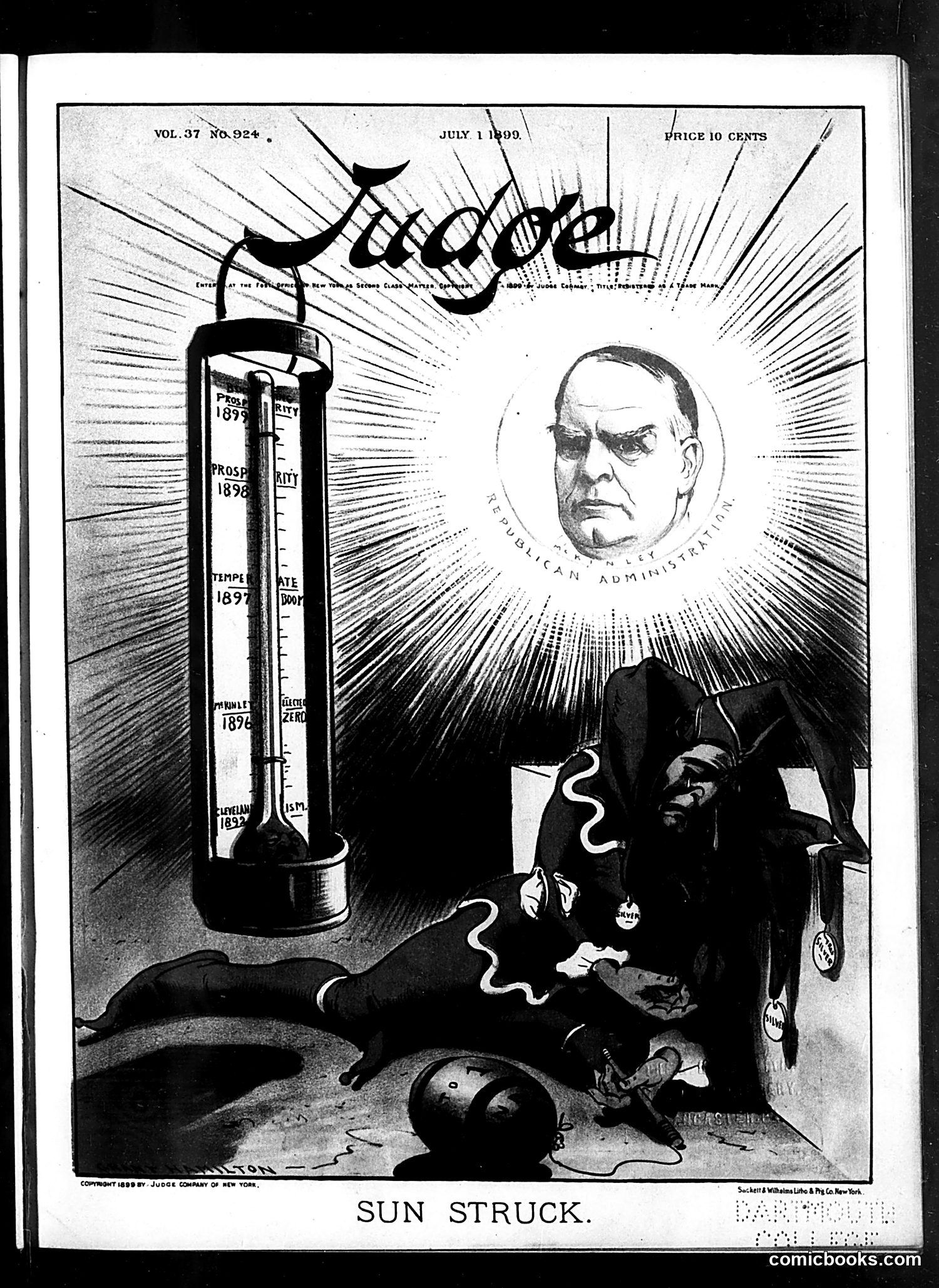
This political cartoon satirizes a member of President McKinley's Republican administration. The figure, labeled "Republican Administration" in a halo, stands triumphantly while a devil-like creature writhes below, struck by sunlight from a barometer/thermometer rising dramatically. The "sun struck" title appears to reference both literal heat and a figurative blow. The barometer's markings (1897, 1898, 1899, etc.) suggest rising prosperity metrics—likely economic indicators improving under Republican stewardship following the 1890s depression. The demonic figure likely represents either Democratic opposition or economic hardship being defeated by administration policies. The satire celebrates Republican success, though the exaggerated religious imagery (halo, divine light) suggests Judge was mocking the administration's self-congratulatory tone.
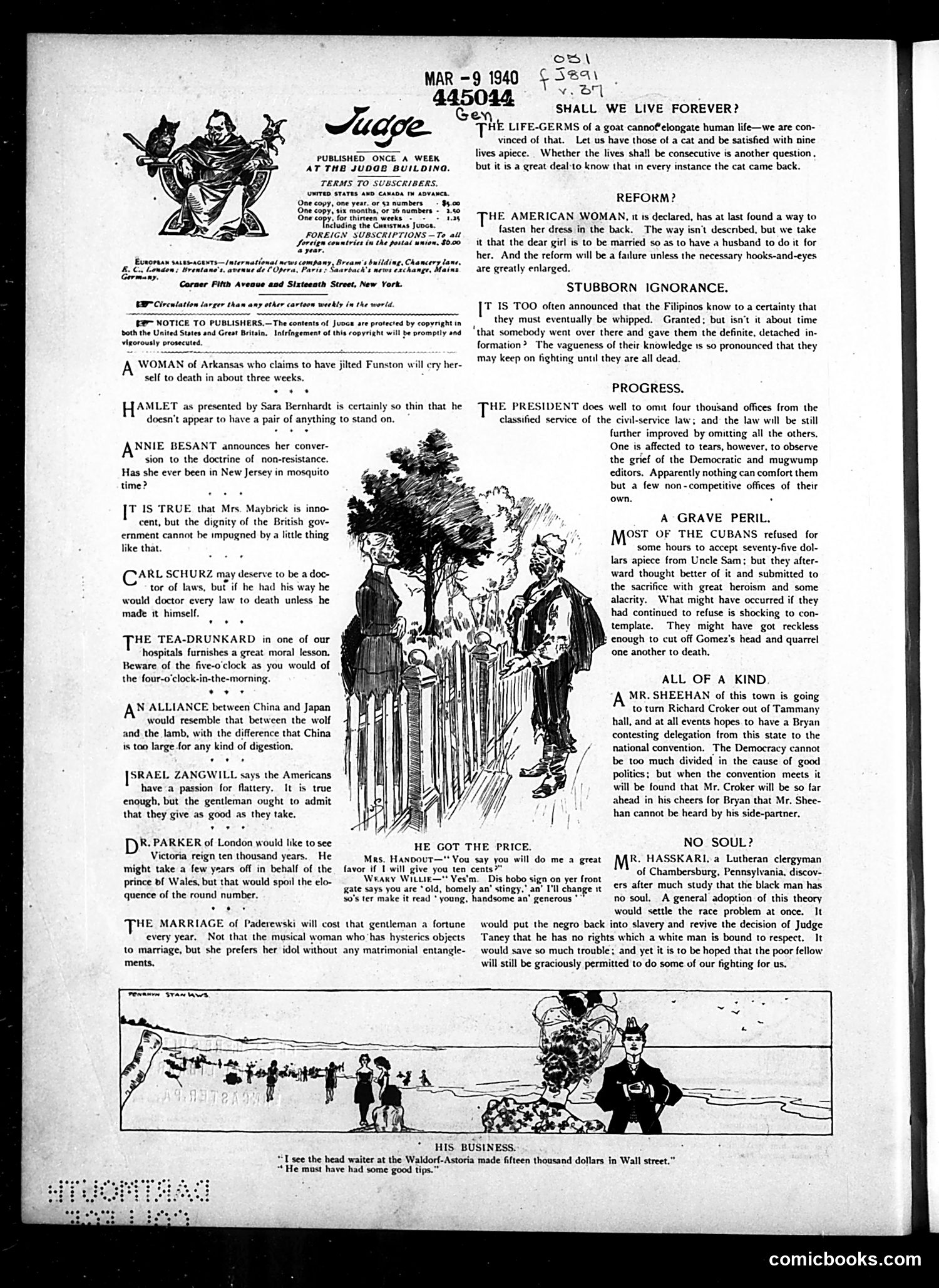
This page contains several short satirical commentary pieces typical of Judge's format, plus a cartoon illustration showing figures in formal dress (appearing to be a social or political scene). The main cartoon's exact meaning is unclear without clearer identification of the figures, though the formal setting suggests commentary on high society or political events. The text pieces mock various topics: women's fashion reform, stubborn ignorance (possibly regarding war preparedness), civil service reform, the situation with Cuba, political conventions, and a theory about race and slavery attributed to a "Mr. Hassarll" of Pennsylvania—apparently criticizing a racist argument. The bottom panel labeled "HIS BUSINESS" shows what appears to be a social/financial satire about Wall Street dealings. The overall tone reflects typical 1940 American political commentary and social criticism.
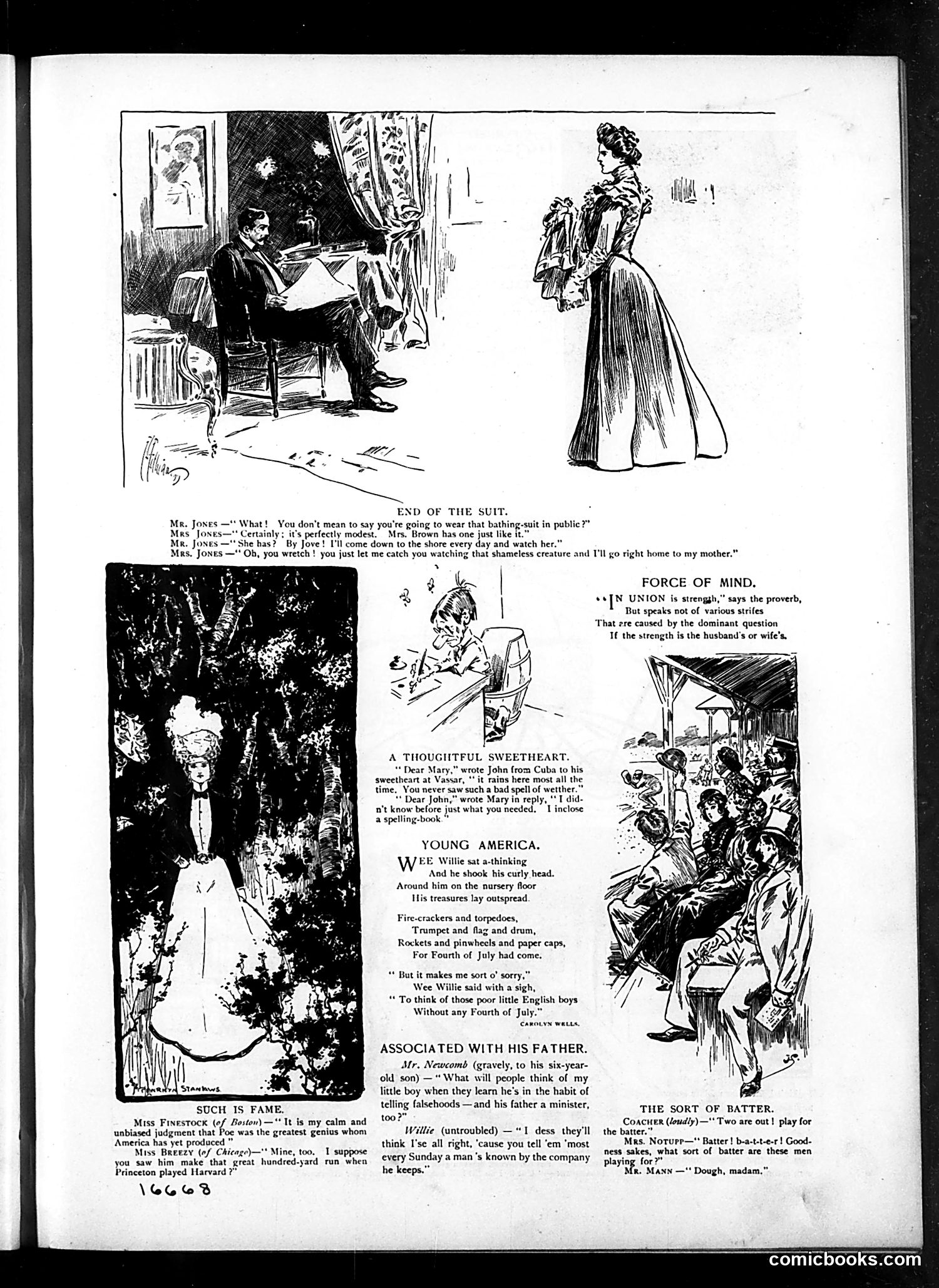
This page contains several satirical pieces typical of early 20th-century American humor: **"End of the Suit"** mocks marital disputes over a wife's desire to wear a bathing suit in public—apparently scandalous at the time. The husband objects to her appearing nearly undressed before strangers. **"Such is Fame"** satirizes celebrities, quoting actresses who became famous for minor roles yet now command high wages and prestige. **"Force of Mind"** and other pieces satirize domestic power dynamics, suggesting husbands' authority depends on dominance over wives. **"Young America"** is a sentimental poem about childhood Independence Day celebrations, contrasting with "Associated with His Father," which mocks fathers teaching sons dishonesty. The overall tone reflects early-1900s anxieties: changing gender roles, celebrity culture, and concerns about moral instruction of youth.
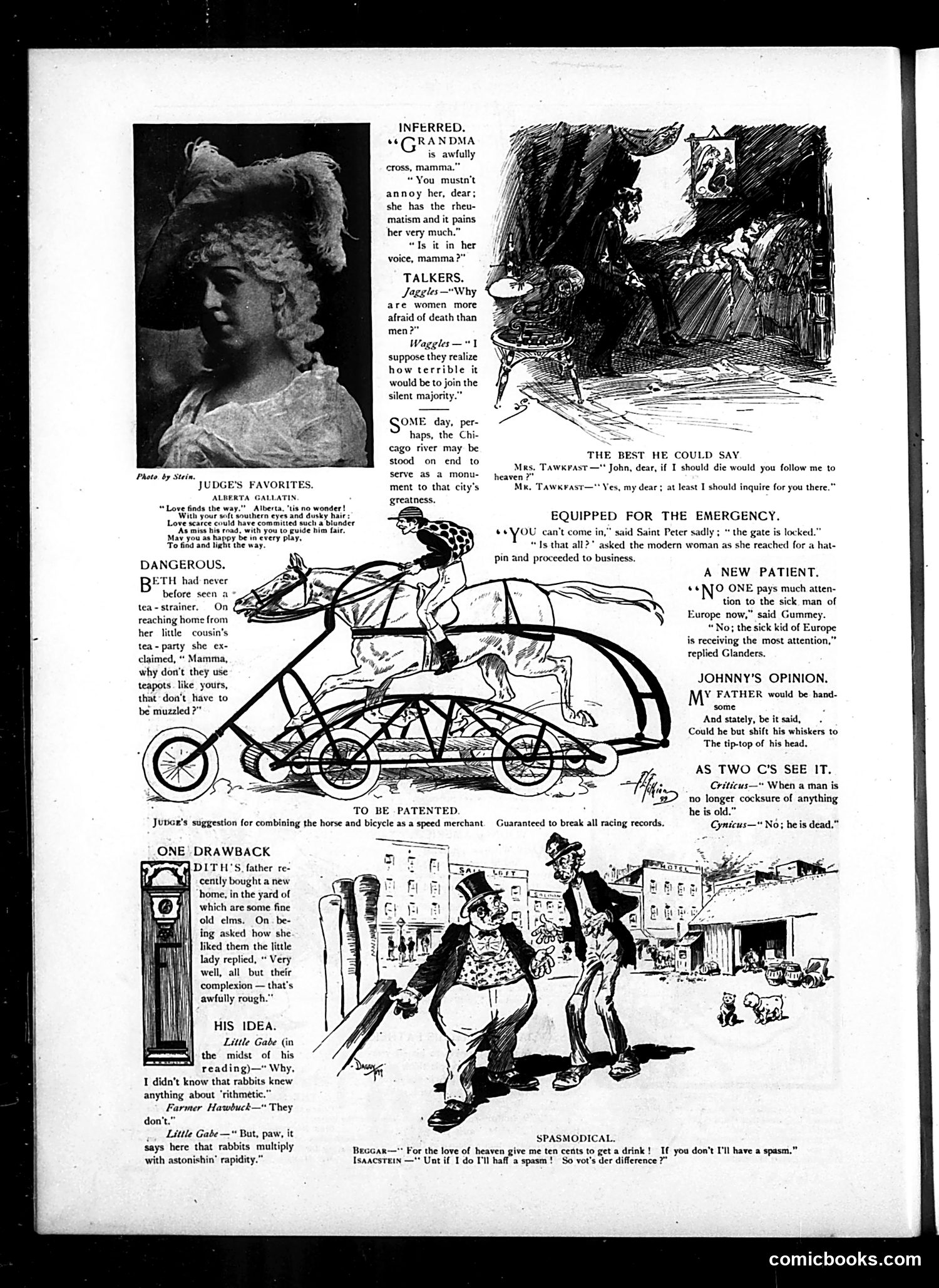
This page contains several unrelated satirical cartoons and humorous dialogue pieces typical of early 20th-century Judge magazine. **"Judge's Favorites"** features Alberta Gallatin, likely a public figure of the era, with quotations about love and happiness. **"Dangerous"** mocks a woman's tea party etiquette complaint about weapons-like teacups. **"To Be Patented"** satirizes an absurd mechanical contraption combining horses and bicycles—a visual joke about impractical inventions. **"One Drawback"** presents dialogue about rabbits' reproductive abilities, playing on folk beliefs. **Lower cartoons** ("The Best He Could Say," "Equipped for the Emergency," "A New Patient," etc.) offer miscellaneous domestic and social humor typical of the magazine's general satirical approach to everyday life. The page lacks clear political commentary, focusing instead on wordplay and visual absurdity.
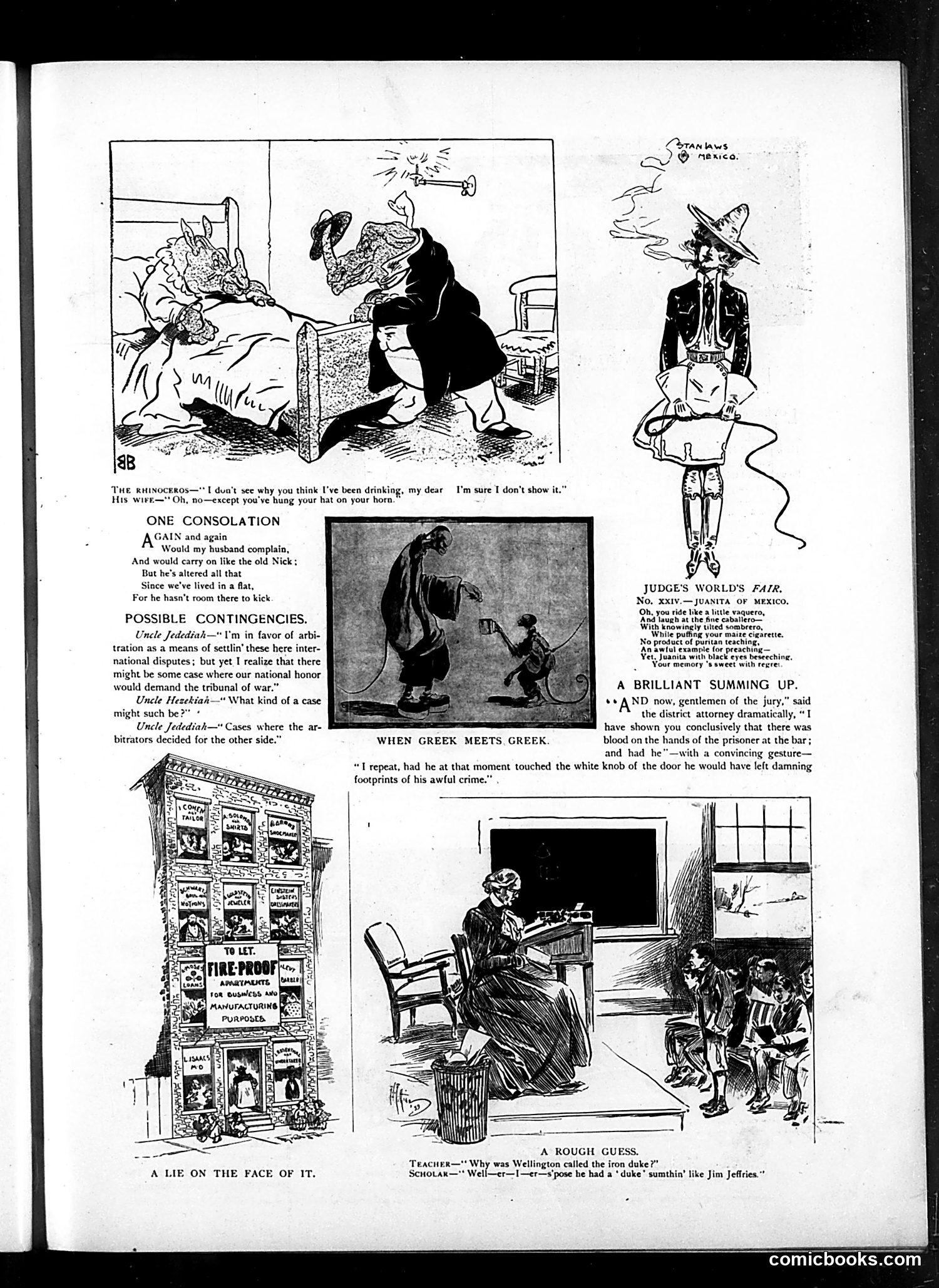
This page contains several unrelated satirical pieces typical of Judge magazine's format: **"One Consolation"** jokes about marital disputes—a husband living in a small flat has less room to physically express his anger than in a house. **"Possible Contingencies"** satirizes isolationist hypocrisy: Uncle Jedediah claims to favor international arbitration for disputes, but admits he'd only support war if the arbitrators ruled *against* America—revealing that his principles are merely nationalist self-interest disguised. **"Judge's World's Fair: Juanita of Mexico"** appears to be romantic verse about a Mexican woman (likely referencing a World's Fair exhibition). **"When Greek Meets Greek"** and **"A Brilliant Summing Up"** are brief courtroom humor pieces. **"A Rough Guess"** is a school joke where a student confuses the Duke of Wellington with boxer Jim Jeffries, playing on period boxing celebrity. The page is primarily humor and light satire rather than pointed political commentary. The arbitration piece is the most substantive satirical content, critiquing turn-of-century American isolationism.
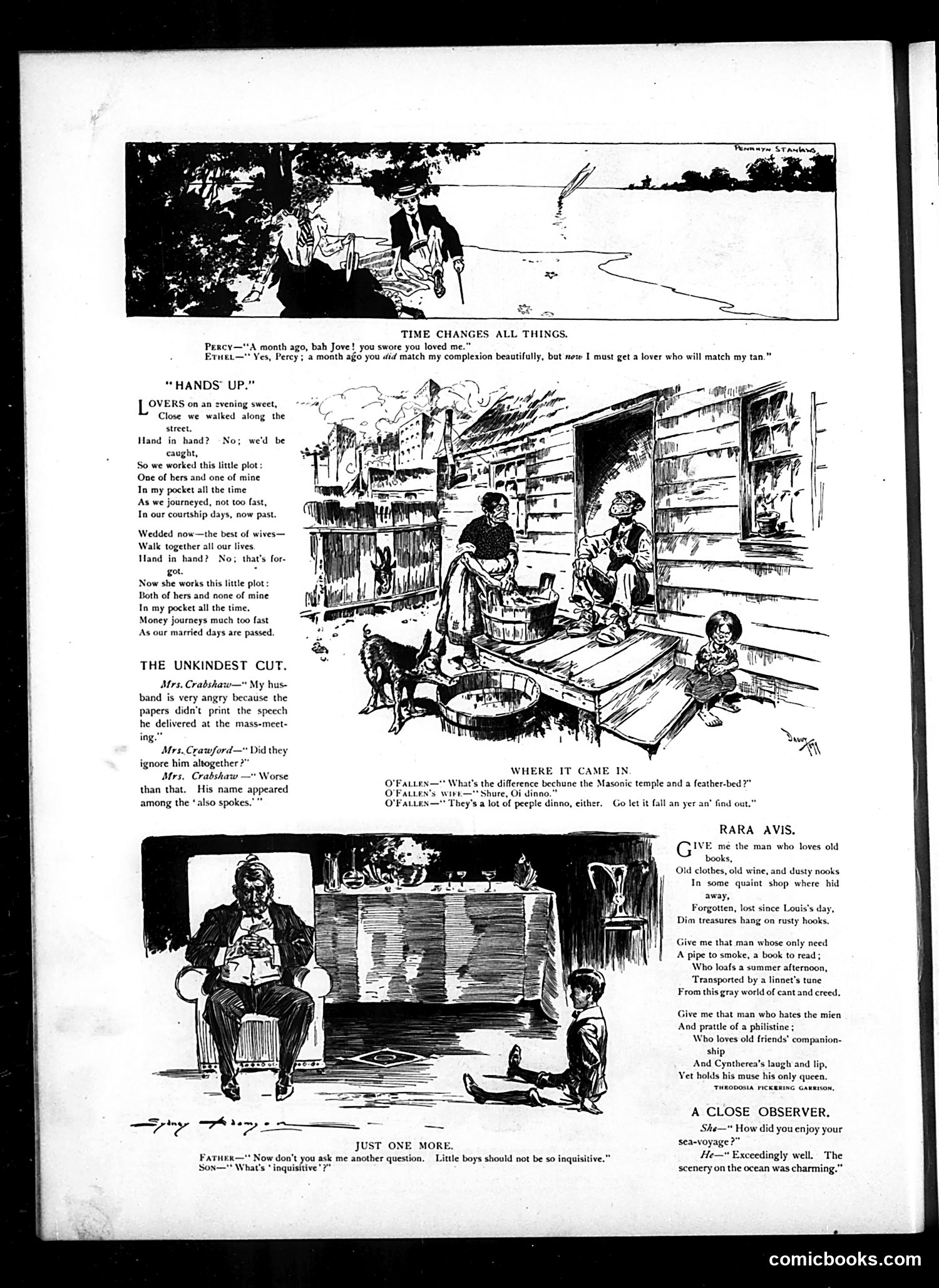
This page contains several short satirical pieces typical of early 20th-century American humor: **"THE CHANGES ALL THINGS"** (top): A joke about a woman who initially loved her suitor for matching her complexion, but now—tanned from sun exposure—needs a new lover with darker skin to match her changed appearance. The satire targets superficial romantic standards. **"HANDS UP"**: A poem contrasting courting couples holding hands in public (requiring secrecy) versus married couples where the wife now controls the husband's money, metaphorically "holding his hand" in his pocket to prevent spending. **"THE UNKINDEST CUT"**: Mrs. Crabshaw's husband is angry his speech went unpublished; Mrs. Crawford replies he was ignored entirely—worse than being omitted. **"RARA AVIS"** (Latin: "rare bird"): A sentimental poem praising the uncommon man who loves old books, quiet contemplation, and genuine friendship over social pretense. **Bottom vignettes**: Brief humor sketches about children's inquisitiveness and vacation small talk. The page emphasizes domestic comedy, class attitudes, and social hypocrisy typical of Judge's satirical voice.
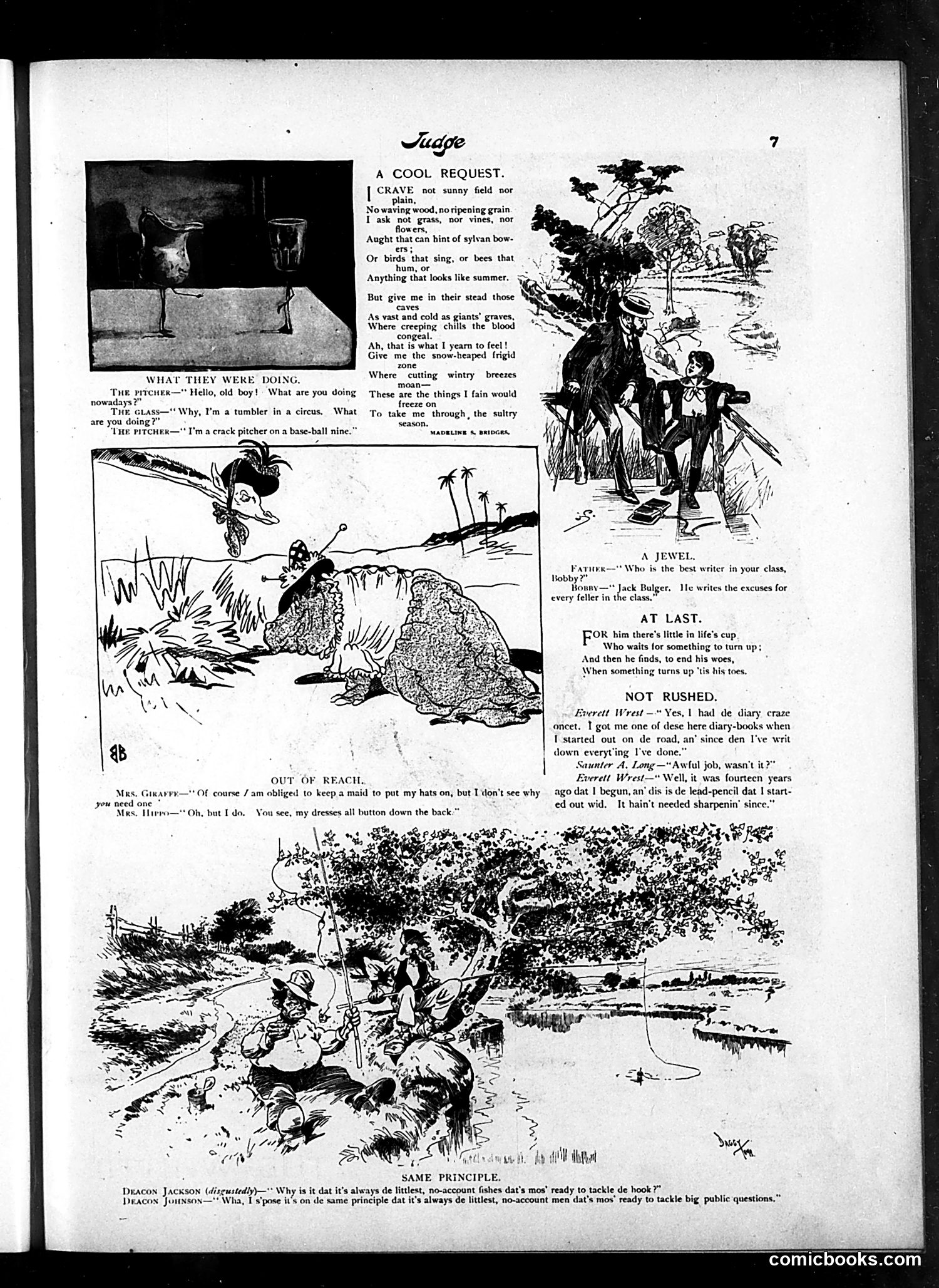
This page contains several humorous short jokes and illustrations typical of early 20th-century American satirical magazines. **"A Cool Request"** is a poem by Madeline S. Bridges expressing a desire for cold, winter weather rather than summer pleasures—a contrarian sentiment presented as comic whimsy. **"What They Were Doing"** plays on double meanings: a glass "tumbler" (acrobat in a circus) and a pitcher "crack pitcher" (baseball player) create puns through profession-related wordplay. **"A Jewel"** jokes that the best student writer is Jack Bulger, who excels at writing excuses for other students—satirizing academic dishonesty. **"Out of Reach"** relies on physical comedy: a woman needs a maid to button her dress because the buttons are on her back, making self-dressing impossible. **"Same Principle"** compares small, foolish fish readily taking bait to small, foolish men readily engaging in public debates—a gentle class commentary suggesting working-class men lack judgment. The page is largely lighthearted domestic humor with minimal political content.
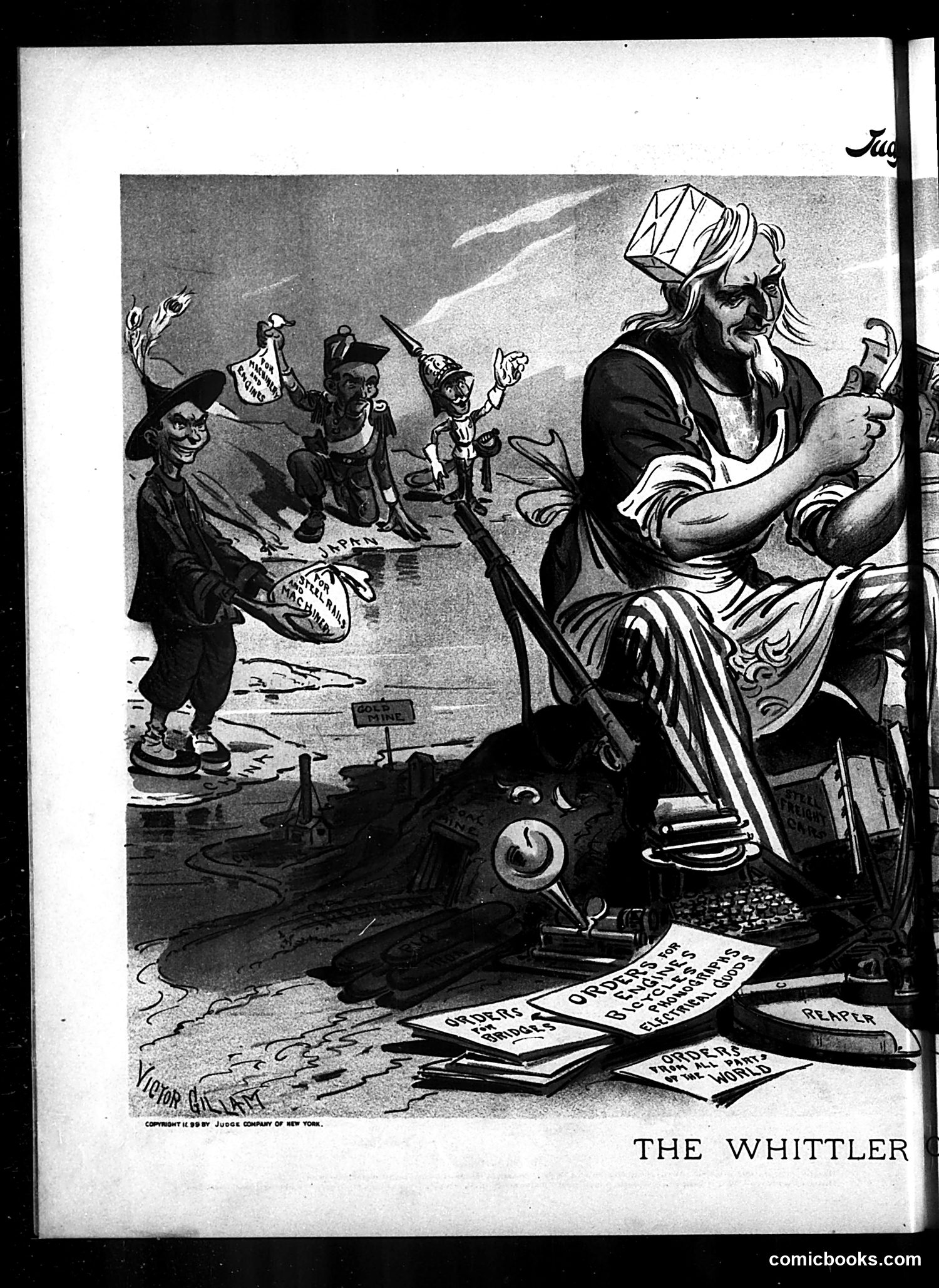
This cartoon depicts "The Whittler"—a figure labeled as Death or the Reaper, seated prominently on the right with a scythe. He appears to be whittling away at various international orders and agreements, represented by papers scattered at his feet reading "ORDERS FOR PEACE" and similar phrases. On the left, caricatured figures (appearing to represent Asian nations, possibly Japan based on visible labels) watch anxiously as Death systematically destroys peace initiatives. The satire suggests that despite diplomatic efforts and peace orders being established globally, death and conflict continue to undermine them—fate literally "whittles away" at humanity's attempts at international peace. The cartoon critiques the futility of peace agreements against inevitable war and destruction.
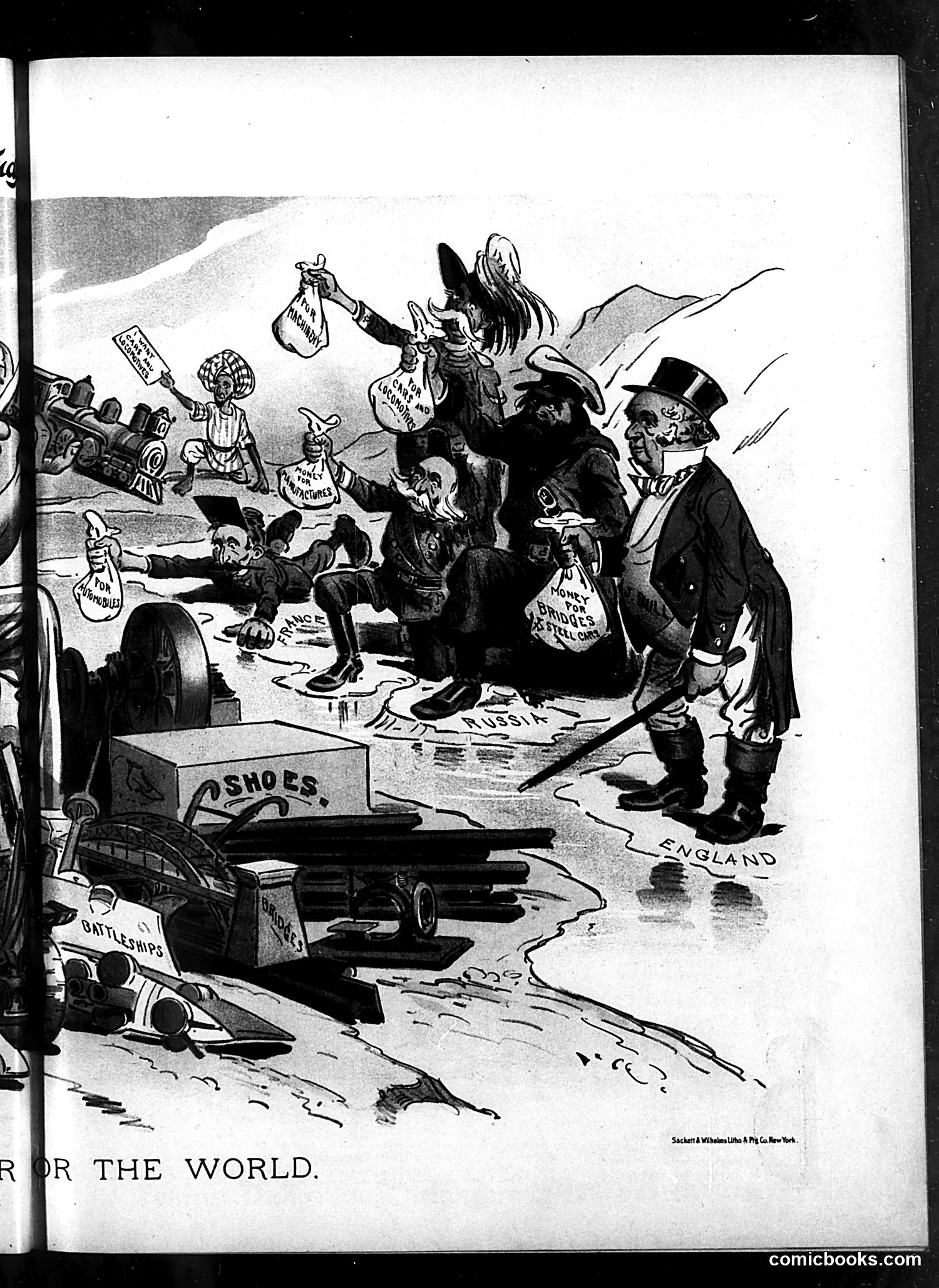
This is a satirical cartoon depicting European powers as greedy figures fighting over resources and territory. The labeled bags appear to contain "Money for Armaments" and other military/economic spoils. England (labeled at bottom right) stands apart, observing the continental chaos. The central winged figure (likely representing a destructive force or war profiteer) distributes these resources while various caricatured national representatives scramble and fight below. Military equipment like "Battleships" and "Shoes" lie scattered, suggesting the cartoon critiques the arms race and militarization consuming European nations. The overall message appears critical of international competition for military dominance and the economic waste of the pre-WWI era. The positioning of England as a separate observer may suggest American (or British) detachment from—or complicity in—continental conflict.
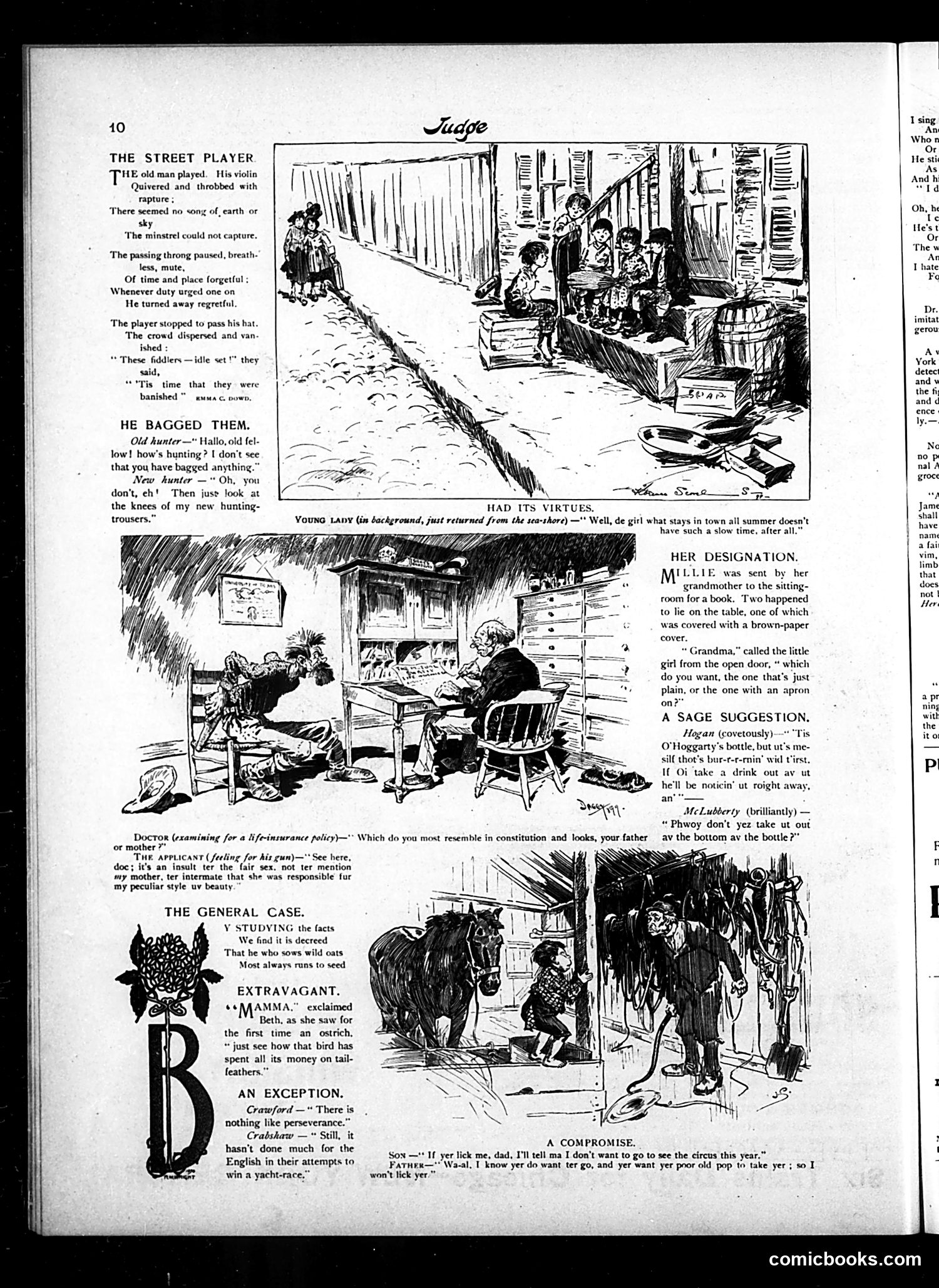
This page contains multiple brief satirical sketches typical of Judge magazine's humor circa early 1900s: **"The Street Player"**: A sentimental poem about a street musician whose artistry captivates passersby—until he passes the hat, whereupon the crowd disperses calling him an "idle" vagrant. The satire targets public hypocrisy: people appreciate art when free but resent supporting artists. **"He Bagged Them"**: A hunter's joke about killing game—the punchline is his torn trousers from brambles, not actual hunting success. Mild physical humor. **"Her Designation"**: A child innocently confuses a book's plain cover with an apron, satirizing children's literal-minded interpretation of adult language. **"The General Case"**: Verse satirizing the proverb "he who sows wild oats reaps the whirlwind"—conventional morality humor. **Other sketches**: Brief domestic comedies about extravagance, perseverance, and parent-child bargaining over circus attendance. The page reflects Judge's typical formula: genteel, sentimental satirical verse paired with domestic comic vignettes and social observation humor aimed at middle-class readers.
This page from *Judge* magazine contains primarily **humorous verse and jokes** rather than political cartoons. The main content includes: **"When the Band Plays 'Dixie'"** — A nostalgic poem celebrating how the patriotic Southern anthem "Dixie" stirs emotional responses, especially among Civil War veterans. This reflects post-Spanish-American War era nostalgia and sectional reconciliation. **"A Song of Summer"** — A complaint about inconsiderate streetcar passengers who refuse to move, satirizing urban rudeness. **Various short jokes** about salary negotiations, soap-borrowing, and social behavior—typical of the era's light humor magazine format. The page is **mostly advertising** for products like Sohmer pianos, Evans ale, Chester suspenders, Packer's Tar Soap, and Wilson Whiskey. The references to "Manila" and "Spanish prisoners" indicate this is from the early 1900s, during American colonial expansion in the Philippines following the Spanish-American War.
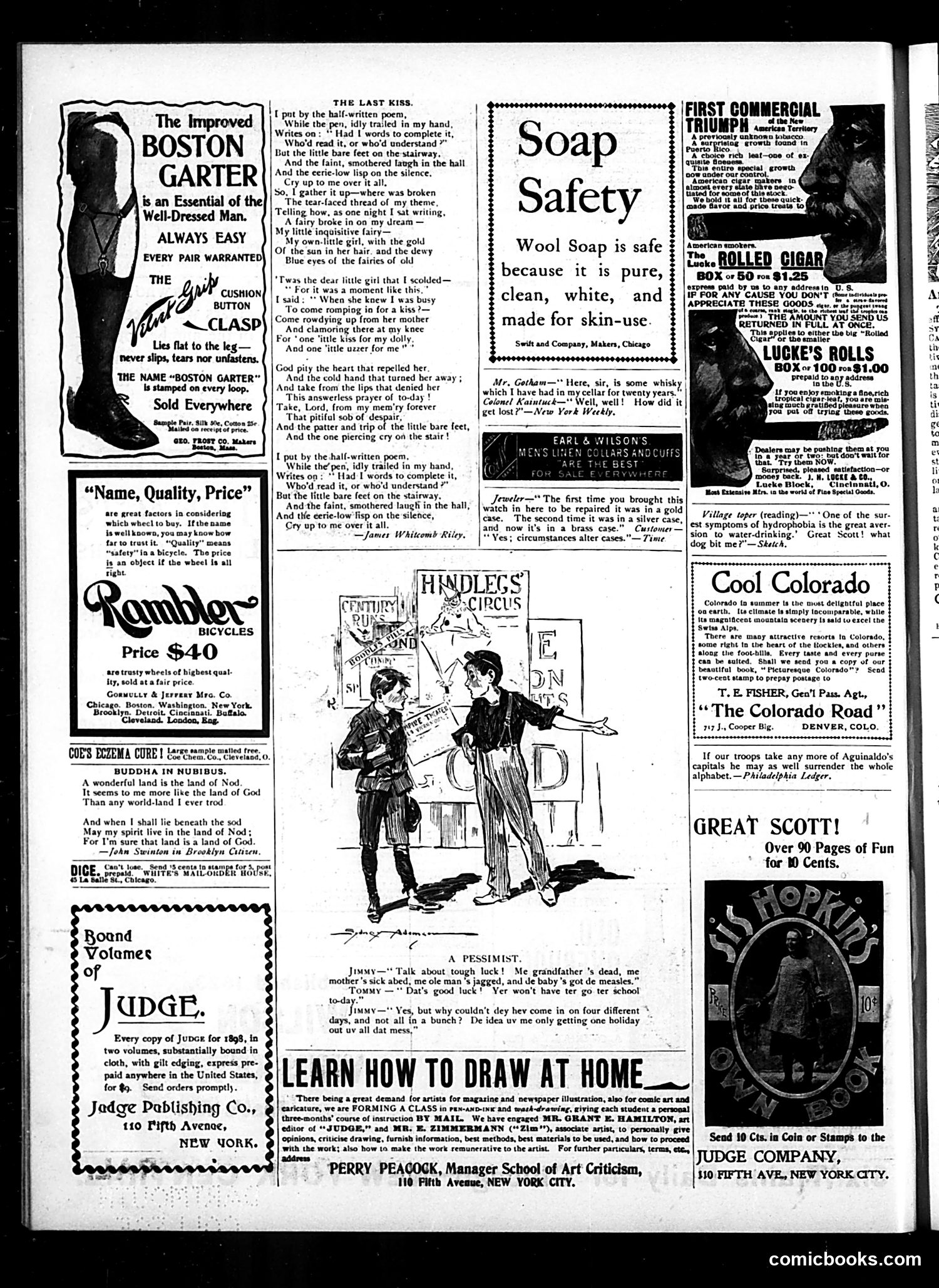
This page is primarily **advertisements and light humor** rather than political satire. Judge magazine (1898) was a general-interest publication mixing ads with poetry and jokes. The main illustrated cartoon, titled "A Pessimist," depicts two working-class men discussing hardships—illness, drinking problems, and disease. The humor is gentle social observation about poverty and misfortune, typical of the era's "common man" comedy. Other content includes: - **James Whitcomb Riley's poem** "The Last Kiss," sentimental verse about a writer regretting he scolded his daughter for interrupting his work - **Short joke items** about watches changing cases and whiskey aging, typical period humor - **Product advertisements** (Boston Garters, Rambbler bicycles, soap) occupying significant space The page reflects Judge's mix of genteel literature, everyday humor, and commercial content—no sharp political commentary is evident. The tone is moralistic and sentimental rather than satirical.
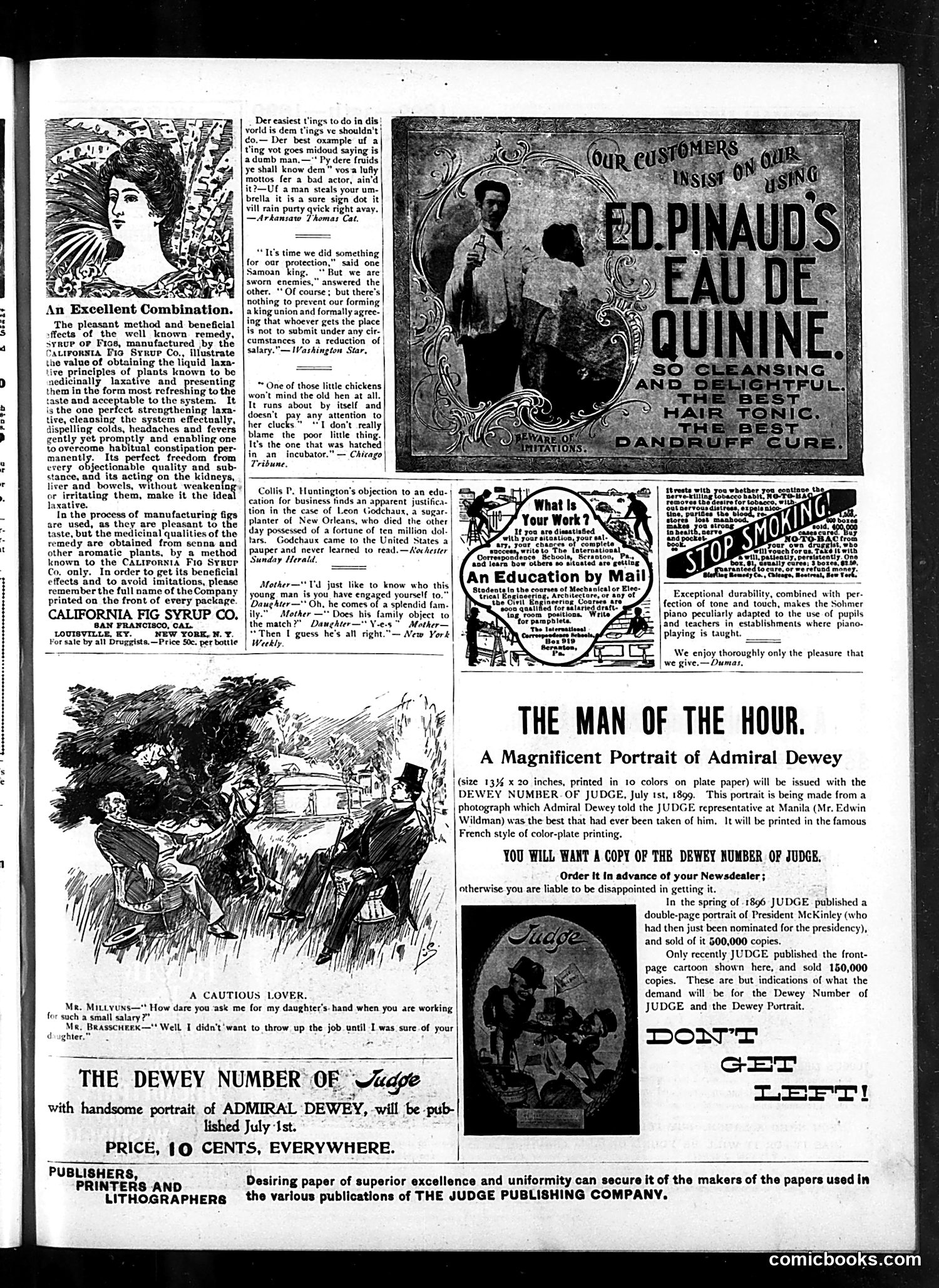
This Judge magazine page is primarily **advertising and filler content** rather than political satire. The main items are: **Product advertisements** for Fig Syrup, Stop Smoking remedy, and Sohmer pianos dominate the space. **"The Man of the Hour"** section promotes an upcoming special edition featuring Admiral Dewey—a reference to the Spanish-American War (1898), where Dewey became a national hero after his naval victory. Judge is capitalizing on his popularity by publishing a commemorative portrait issue. **Small humor items** appear throughout—mostly mild ethnic jokes (a character speaking in German-accented dialect) and brief anecdotes about relationships and money, typical of the era's light magazine filler. **One mild social jab**: A note about businessman Collis P. Huntington opposing business education, contrasted with a self-made millionaire who couldn't read—suggesting education skepticism could be foolish. The page reflects late-1890s consumer culture and patriotic fervor more than substantive political commentary.
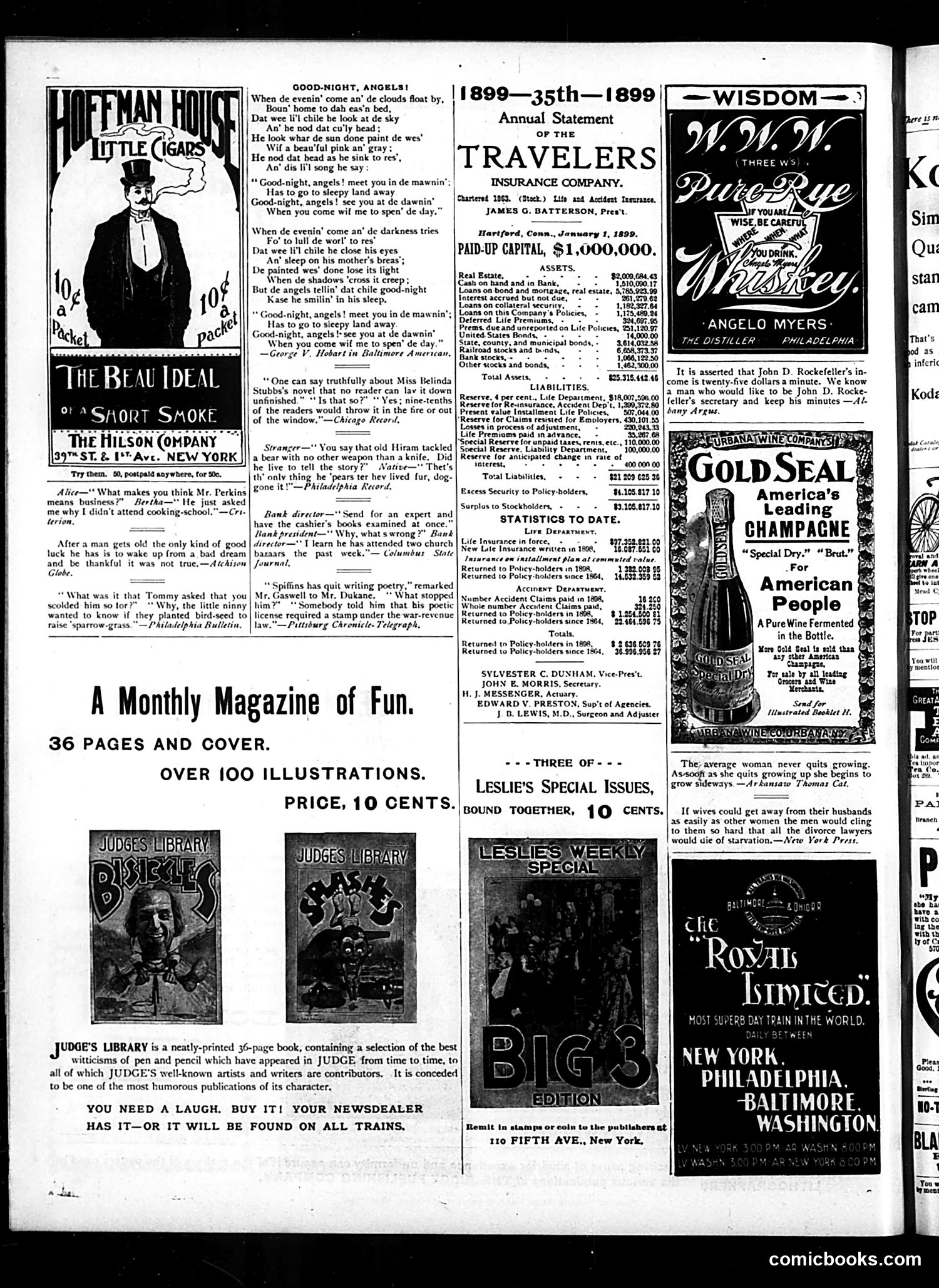
This page is primarily **advertising and promotional content** rather than political satire. The main elements include: **"Good-Night, Angels"** — A sentimental poem in dialect verse about a child saying goodnight, likely reflecting late-19th-century popular taste for genteel, nostalgic content. **"The Beau Ideal"** — A cigar advertisement featuring a distinguished gentleman in top hat, marketing "short smoke" cigars at 10 cents per packet. **Miscellaneous jokes and quips** — Brief humorous anecdotes on dating, cooking, and poetry, typical of Judge's lightweight comic filler. **Judge's Library promotion** — Advertising Judge's own 36-page compilation book (10 cents). **Travelers Insurance Company statement** — A detailed financial report showing assets and liabilities from 1899, indicating corporate advertising presence in the magazine. **Leslie's Weekly Special** — Cross-promotion of competitor publications. The page reflects Judge's hybrid nature: part satirical magazine, part general-interest humor publication sustained by advertising revenue. There is **no identifiable political cartoon or social satire** visible here.
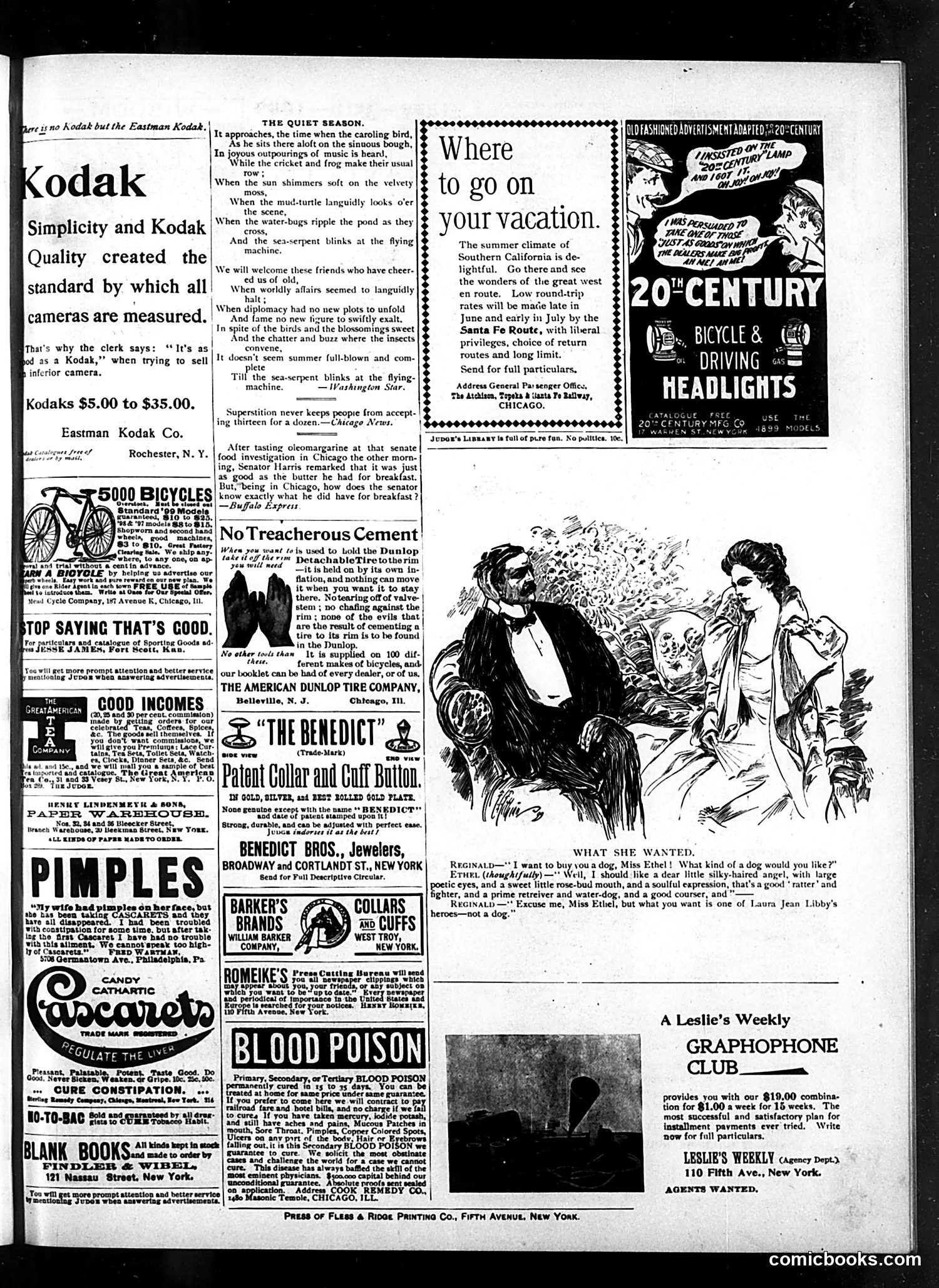
This page is primarily **advertising**, with minimal satirical content. The notable cartoon is titled "WHAT SHE WANTED," depicting a dialogue between a man and woman (Reginald and Ethel) about dog preferences. The woman expresses desire for "a dear little silky-haired angel, with large poetic eyes" — describing an idealized small dog. The man misunderstands, thinking she wants an actual dog, when she's actually describing a romantic ideal or perhaps mocking sentimental expectations. The humor appears gentle rather than biting political satire. The page features typical period advertisements (Kodak cameras, bicycles, patent collars, medical remedies) interspersed with occasional jokes and a poem titled "THE QUIET SEASON" about summer wildlife. The magazine's satirical edge is minimal on this particular page, which functions largely as an advertising vehicle with light entertainment.
This page is primarily **advertising and filler content** rather than political satire. The dominant elements are: **Main Content:** - A sentimental dialect poem ("Good-night, Angels") about a Black child going to sleep—typical of late-19th-century "plantation" sentimentality in mainstream publications - The Travelers Insurance Company's annual financial statement - Multiple advertisements for products (cigars, champagne, whiskey, trains) and Judge's own publications **Humor Sections:** The small comedic vignettes use period stereotypes: a woman asking why a man didn't attend cooking school (gender role humor); a joke about John D. Rockefeller's wealth; observations about marriage and divorce. **Historical Context:** This reflects 1890s America: the racial attitudes embedded in the dialect poem were considered acceptable entertainment; advertisements target male readers; insurance and railroad companies were major advertisers. The humor is domestic and class-based rather than political. The page demonstrates Judge's business model—mixing light satire with substantial advertising revenue.
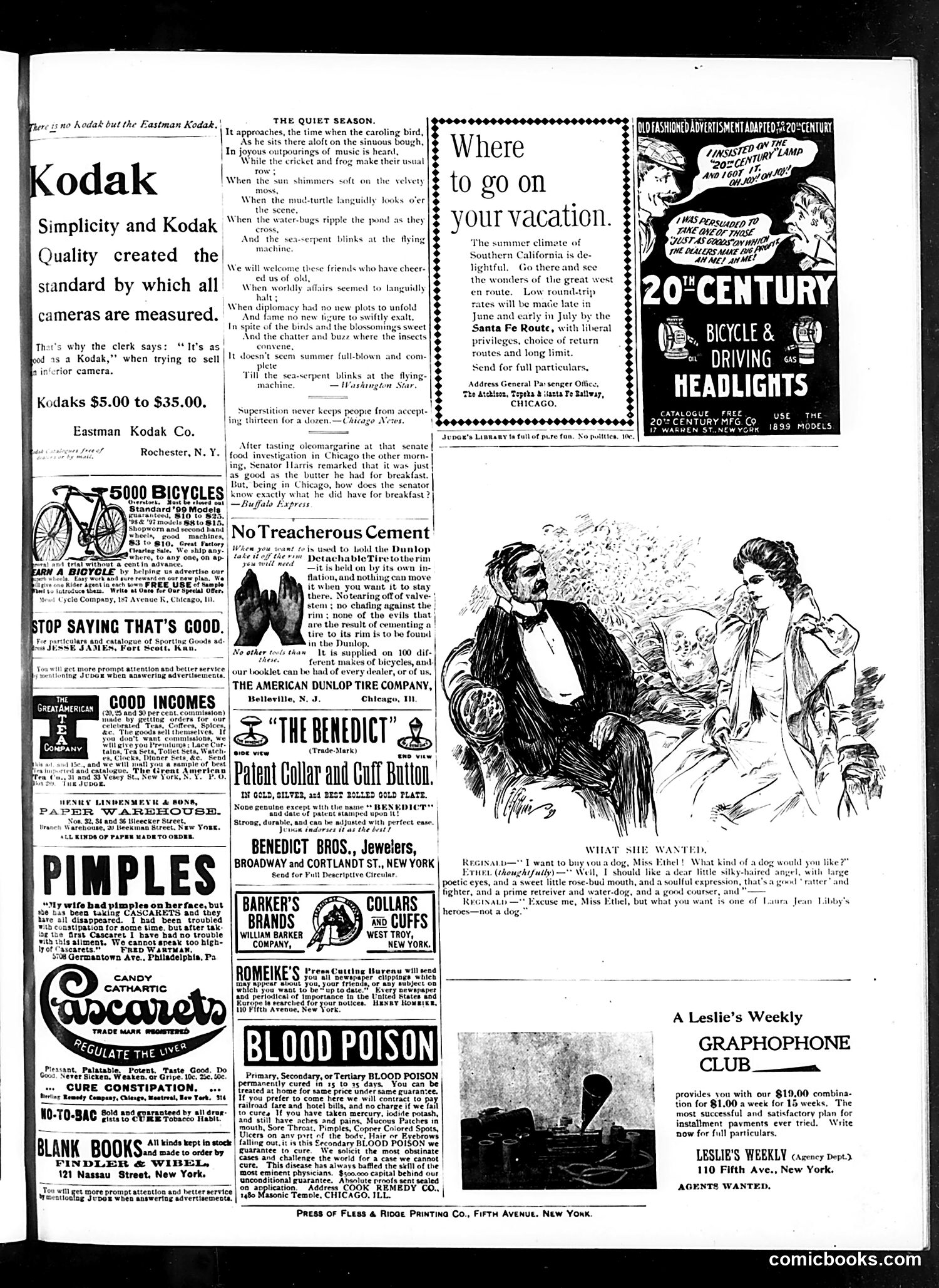
This is primarily an **advertising page** with limited editorial content. The main cartoon appears in the lower right: a sketch titled "What She Wanted" showing a man and woman in conversation, illustrating a brief joke about dog preferences that plays on the woman's desire for a specific type of companion. The page is dominated by **turn-of-the-century product advertisements** including: - Kodak cameras - Bicycles - Patent collar buttons - Remedies for pimples, constipation, and blood poisoning - Blank books and office supplies The only substantial editorial content is **"The Quiet Season,"** a sentimental poem celebrating summer's natural sounds (birds, crickets, water), followed by a brief joke about a Chicago senator's breakfast habits. The advertisements reflect **period medical anxieties** (blood poison, constipation) and consumer products typical of early 1900s American commerce. The page functions mainly as a revenue source through advertising rather than satirical commentary.
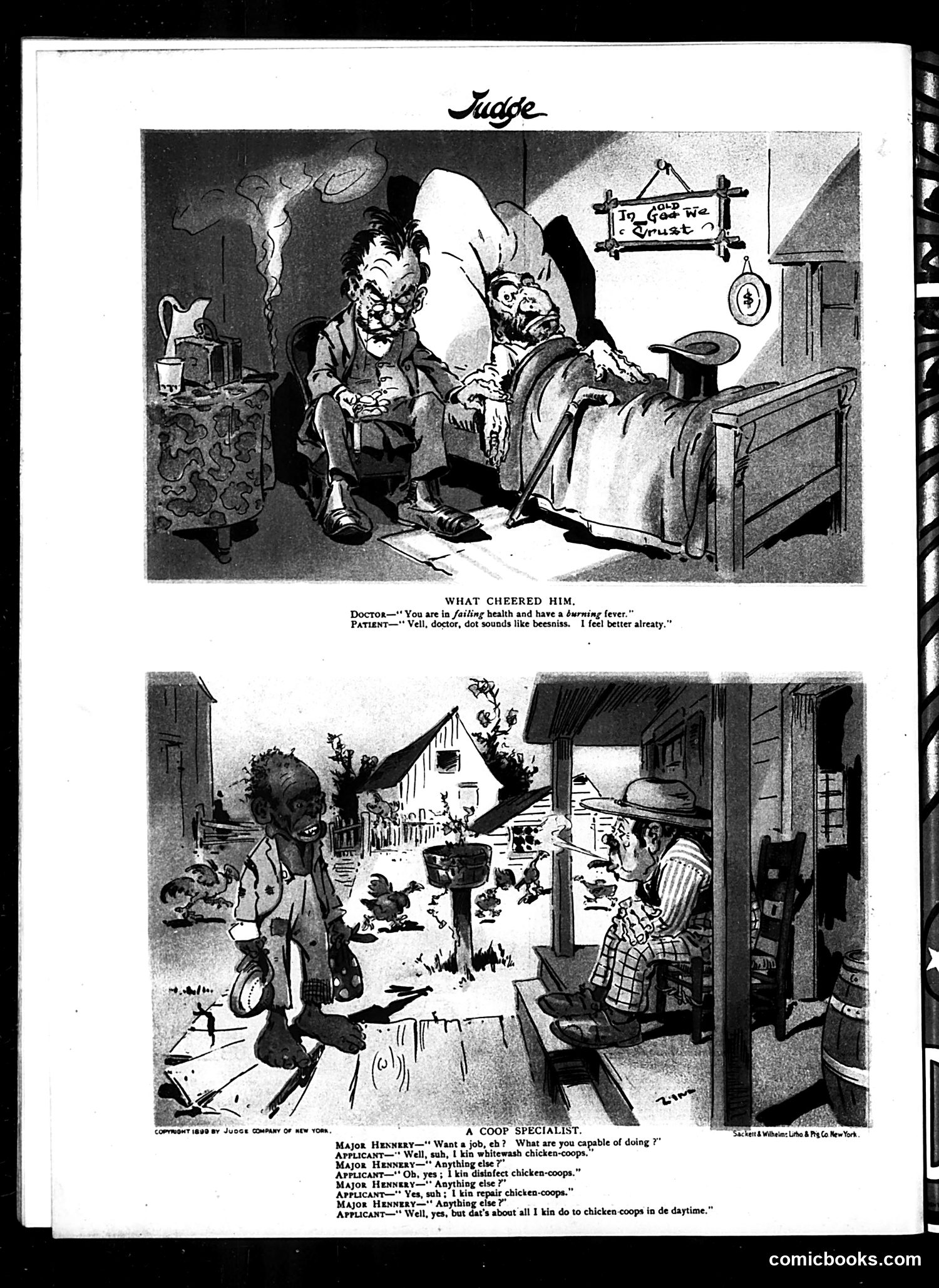
**Top cartoon ("What Cheered Him"):** A sick patient tells his doctor that hearing he has a "burning fever" and is in "failing health" actually makes him feel better—because it "sounds like business." This is satire on commercial opportunism: the patient is apparently someone who profits from illness or misfortune, so bad news literally cheers him up. **Bottom cartoon ("A Coop Specialist"):** A job applicant tells Major Haxberry he can whitewash, disinfect, and repair chicken-coops, and admits that's "about all I kin do to chicken-coops in de daytime." The heavy dialect and the absurdity of someone's entire skillset revolving around chicken-coops is the joke—mocking either unemployable workers or, possibly, immigrants with extremely limited abilities or English proficiency. The humor relies on ethnic caricature common to the era.