
Judge, 1899-07-01 · page 3 of 18
Judge — July 1, 1899 — page 3: what you’re looking at
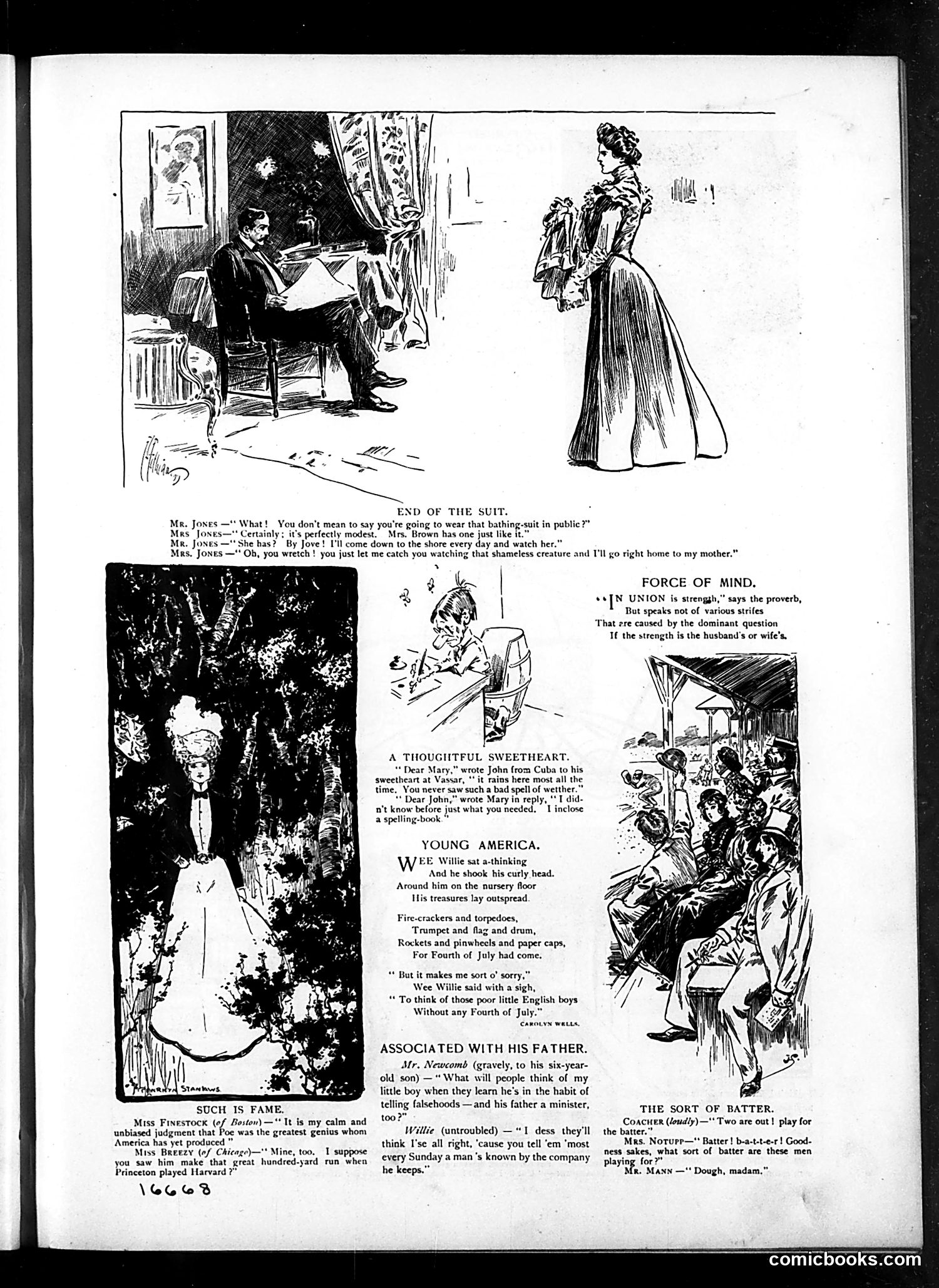
What you’re looking at
This page contains several satirical pieces typical of early 20th-century American humor: **"End of the Suit"** mocks marital disputes over a wife's desire to wear a bathing suit in public—apparently scandalous at the time. The husband objects to her appearing nearly undressed before strangers. **"Such is Fame"** satirizes celebrities, quoting actresses who became famous for minor roles yet now command high wages and prestige. **"Force of Mind"** and other pieces satirize domestic power dynamics, suggesting husbands' authority depends on dominance over wives. **"Young America"** is a sentimental poem about childhood Independence Day celebrations, contrasting with "Associated with His Father," which mocks fathers teaching sons dishonesty. The overall tone reflects early-1900s anxieties: changing gender roles, celebrity culture, and concerns about moral instruction of youth.
📄 Transcribed text from this page (OCR, searchable)
Machine-transcribed from the original scan — historical spelling and the odd misread are preserved.
END OF THE SUIT. What! You don’t mean to say you're going to wear that bathing-suit in public ? Mrs‘ Jones— Certainly ; it's perfectly modest. Mrs. Brown has one just like it.” Mr. Jones —"* She has? "By Jove! I'll come down to the shore every day and watch her.” Mrs. Jones —* Ob, you wretch ! you just let me catch you watching that shameless creature and I'll go right home to my mother." SUCH IS FAME, Miss Finestock (of Boston) —“* It is my calm and unbiased judgment that Poe was the greatest genius whom ‘America has yet produced ” Miss Breezy (of Chicage)—* Mine, too. I suppose you saw him make that great hundred-yard run when Princeton played Harvard ?” \GGeS A THOUGHTFUL SWEETHEART. “Dear Mary,” wrote John from Cuba to his ‘sweetheart at Vassar, “* it rains here most all the time. You never saw such a bad spell of wetther.” ** Dear John,” wrote Mary in reply, ‘*T did- n't know before just what you needed. ‘I inclose a spelling-book.” YOUNG AMERICA, W lie sat a-thinking And he shook his curly head. Around him on the nursery floor His treasures lay outspread Fire-crackers and torpedoes, ‘Trumpet and flag and drum, Rockets and pinwhecls and paper caps, For Fourth of July had come, “* But it makes me sort 0’ sorry,” Wee Willie said with a sigh, ** To think of those poor little English boys Without any Fourth of July.” CAROLYN WELLS. ASSOCIATED WITH HIS FATHER. Mr, Newcomb (gravely, to his six-year- ‘old son) — “What will people think of my little boy when they learn he's in the habit of telling falsehoods — and his father a minister, too?” Willie (untroubled) — “1 dess they'll think I'se all right, ‘cause you tell ‘em ‘most every Sunday a man's known by the company he keeps.” FORCE OF MIND. UNION is strenggh,” says the proverb, seyN I But speaks not of various strifes ‘That ere caused by the dominant question If the strength is the husband's or wife's. THE SORT OF BATTER. Coactter (loudly) —" Two are out ! play for the batter.” Mrs. Norurr—"* Batter ! b-a-t-t-e-r ! Good- ness sakes, what sort of batter are these men playing for?” Mr. Mann —'* Dough, madam,” comicbooks.com