
Judge, 1899-07-01 · page 6 of 18
Judge — July 1, 1899 — page 6: what you’re looking at
What you’re looking at
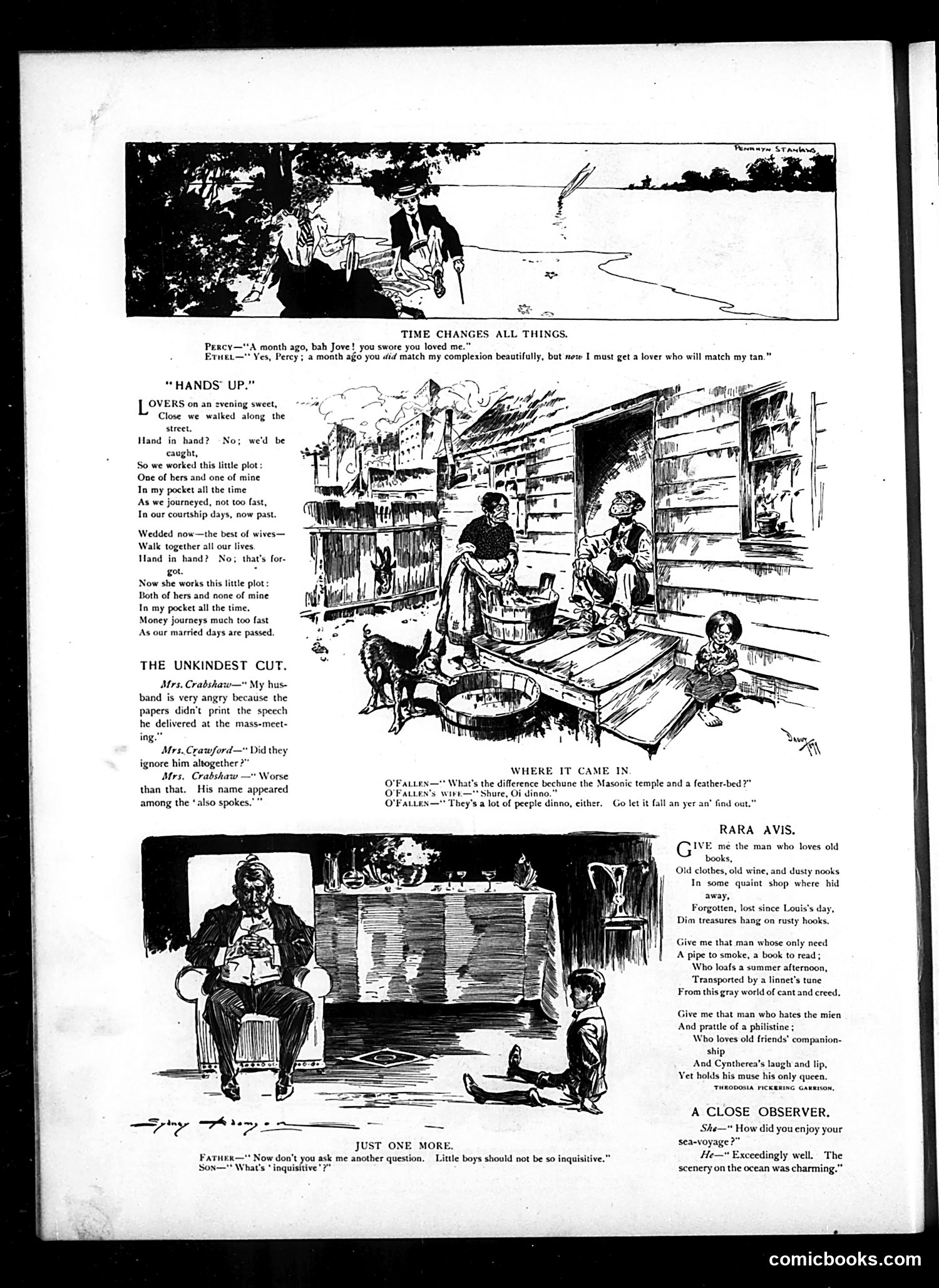
This page contains several short satirical pieces typical of early 20th-century American humor: **"THE CHANGES ALL THINGS"** (top): A joke about a woman who initially loved her suitor for matching her complexion, but now—tanned from sun exposure—needs a new lover with darker skin to match her changed appearance. The satire targets superficial romantic standards. **"HANDS UP"**: A poem contrasting courting couples holding hands in public (requiring secrecy) versus married couples where the wife now controls the husband's money, metaphorically "holding his hand" in his pocket to prevent spending. **"THE UNKINDEST CUT"**: Mrs. Crabshaw's husband is angry his speech went unpublished; Mrs. Crawford replies he was ignored entirely—worse than being omitted. **"RARA AVIS"** (Latin: "rare bird"): A sentimental poem praising the uncommon man who loves old books, quiet contemplation, and genuine friendship over social pretense. **Bottom vignettes**: Brief humor sketches about children's inquisitiveness and vacation small talk. The page emphasizes domestic comedy, class attitudes, and social hypocrisy typical of Judge's satirical voice.
📄 Transcribed text from this page (OCR, searchable)
Machine-transcribed from the original scan — historical spelling and the odd misread are preserved.
—_Fennaya STANMNS, Y—"'A month ago, bah Jove! you swore you loved me.” £L—"" Yes, Percy; a month ago you did match my complexion beautifully, but now I must get a lover who will match my tan.” “HANDS UP.” OVERS on an evening sweet, Close we walked along the street, Hand in hand? No; we'd be caught, So we worked this little plot : One of hers and one of mine In my pocket all the time As we journeyed, not too fast, In our courtship days, now past. Wedded now—the best of wives— Walk together all our lives. Mand in hand? No; that's for- got. : Now she works this little plot : Both of hers and none of mine In my pocket all the time. Money journeys much too fast As our married days are passed. THE UNKINDEST CUT. Mrs, Crabshaw—" My bus- band is very angry because the papers didn’t print the speech he delivered at the mass-meet- ing" Mrs. Crawford—" Did they ignore him altogether 2" Sees we: we Tee Cenken Waris WHERE IT CAME IN F * What's the difference bechune the Masonic temple and a feather-bed 2” than that, His name appeared > wire" Shore, OF dina among the ‘also spoke: They's a lot of peeple dinno, either. Go let it fall an yer an’ find out.” RARA AVIS. GIVE meé the man who loves old books, id clothes, old wine, and dusty nooks In some quaint shop where hid away, Forgotten, lost since Louis's day, Dim treasures hang on rusty hooks. Give me that man whose only need A pipe to smoke, a book to read ; Who loafs a summer afternoon, ‘Transported by a linnet’s tune From this gray world of cant and creed. Give me that man who hates the mien And pratile of a philistine ; Who loves old friends’ companion- ship And Cyntherea’s laugh and lip, Yet holds his muse his only queen. THRODOSIA FICKERIXG GAERISON, A CLOSE OBSERVER. She—" How did you enjoy your JUST ONE MORE. Sea-voyage? don’t you ask me another question. Little boys should not be so inquisitive.” He— Exceedingly well. The Son—"* What's * inquisitive?” scenery on the ocean was charming.” comicbooks.com