
A complete issue · 16 pages · 1895
Judge — January 5, 1895
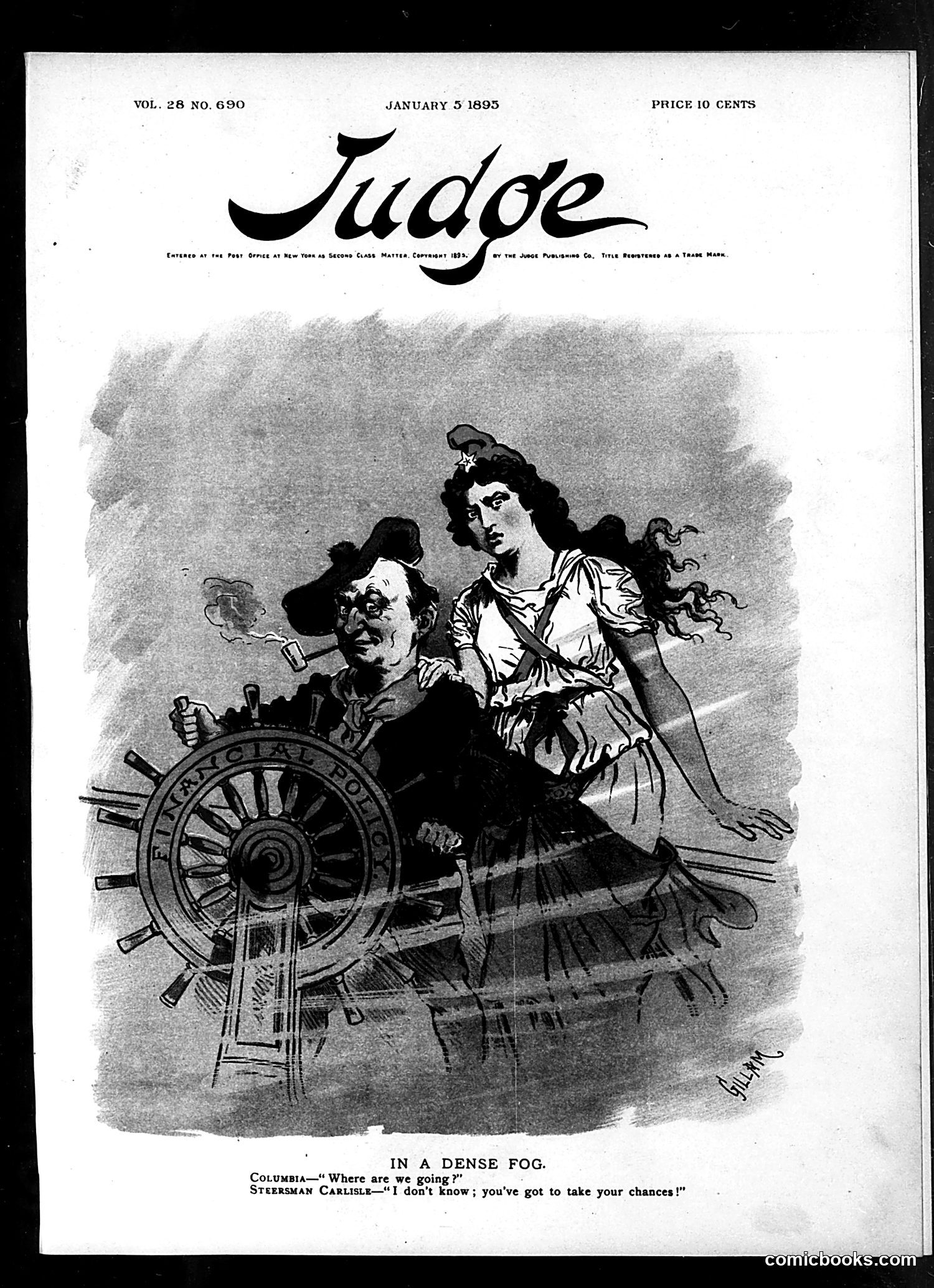
This Judge magazine cover from January 5, 1895 presents a maritime-themed political allegory. Columbia (personified America, identifiable by her classical dress and star-topped crown) sits at a ship's wheel with Steersman Carlisle. Columbia asks "Where are we going?" and Carlisle responds "I don't know; you've got to take your chances!" The cartoon satirizes Secretary of the Treasury John G. Carlisle's leadership during a period of economic uncertainty—likely referencing the financial panic and depression of the mid-1890s. The "dense fog" represents economic confusion and lack of clear policy direction. The image critiques Carlisle as an incompetent navigator steering the nation blindly through financial crisis, leaving America's fate to chance rather than competent governance.
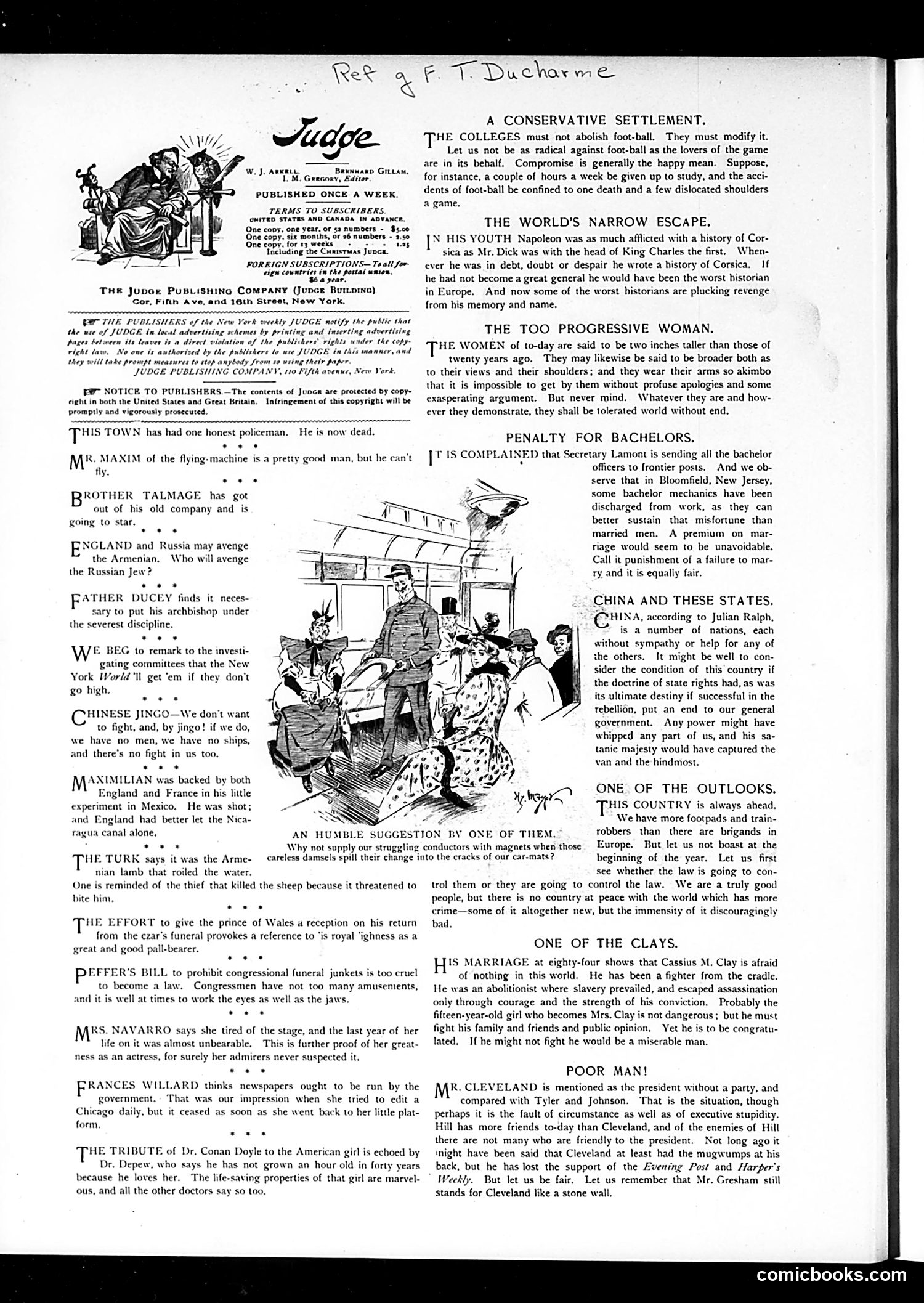
This page contains editorial commentary and satirical commentary rather than a distinct political cartoon. The main illustrated piece shows a military/governmental figure surrounded by what appear to be chaotic or rebellious figures, likely satirizing administrative disorder or political turmoil. The text sections mock various contemporary figures and issues: "A Conservative Settlement" critiques college compromise on football; "The Too Progressive Woman" jokes about women's changing roles; "Penalty for Bachelors" comments on social policies; and sections on international affairs reference China, Russia, and Armenia—suggesting this is from the post-WWI era when these geopolitical tensions were active. Several brief satirical notes mock politicians and public figures, though without clearer context or dates, specific identifications remain uncertain. The overall tone is conservative and skeptical of progressive social change.
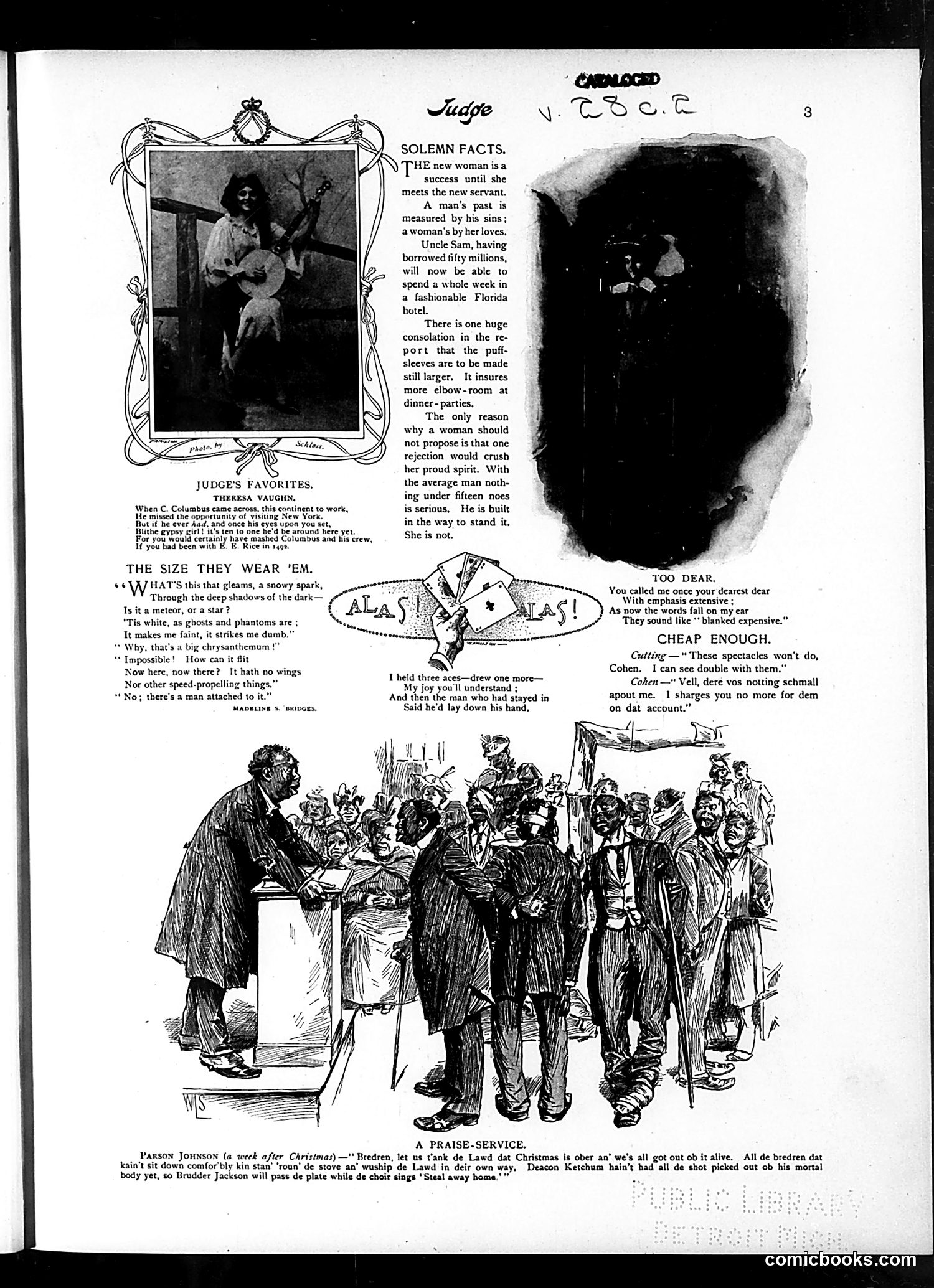
This page contains several satirical pieces typical of Judge's humor: **"Judge's Favorites"** features Theresa Vaughn, a performer known for her stage presence during the era when Columbus discovered America. **"The Size They Wear 'Em"** is a poem mocking spiritualism and séances—likely referencing the popular craze for communicating with ghosts that swept America in the late 19th/early 20th centuries. The humor targets believers in supernatural phenomena. **"A Praise-Service"** depicts a church scene with clergy and congregation, satirizing religious practice and sermon-giving, with a caption referencing Parson Johnson's Christmas blessing. **"Too Dear" and "Cheap Enough"** appear to be brief comedic dialogues about expense and value. The overall page reflects Judge's typical satirical approach to contemporary social phenomena: spiritualism, entertainment culture, and religious hypocrisy.
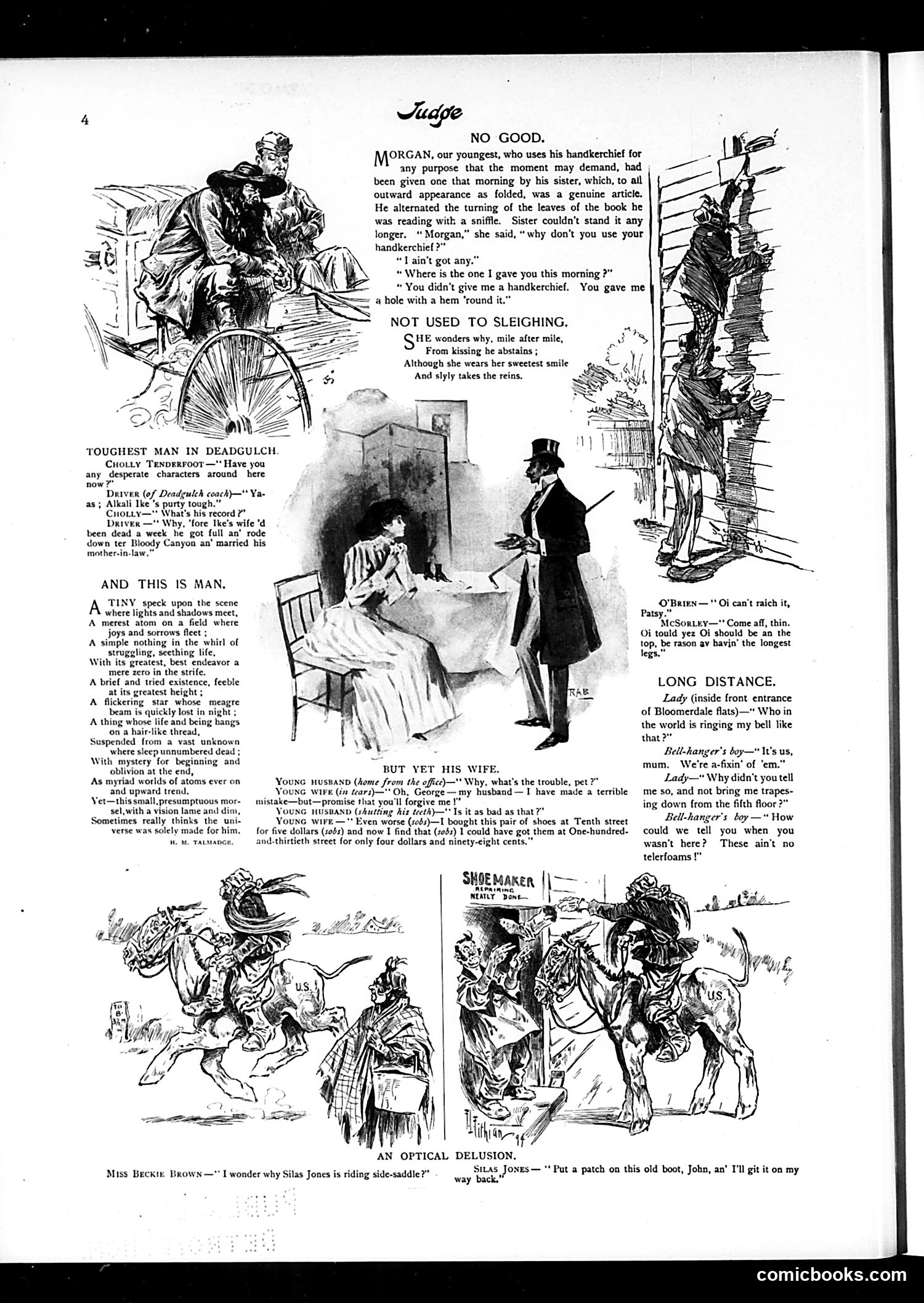
This page contains multiple brief satirical sketches typical of late-19th/early-20th-century American humor: **"No Good"** mocks a young boy (Morgan) who destroys a handkerchief his sister gave him, then lies about it—gentle domestic satire. **"Toughest Man in Deadgulch"** jokes about frontier masculinity through an exaggerated anecdote: a tough man got drunk and married his mother-in-law after his wife died—mocking Wild West stereotypes. **"And This Is Man"** is philosophical verse contrasting humanity's cosmic insignificance with our arrogant self-importance. **"But Yet His Wife"** satirizes consumerism and marital anxiety: a wife confesses buying expensive shoes, fearing her husband's anger over the price difference. **"An Optical Delusion"** appears to show working-class Irish laborers (suggested by dialect) attempting a physical task. **"Long Distance"** mocks the inconvenience of pre-telephone era: a repairman rings repeatedly; the lady complains he didn't notify her—ironic since communication technology didn't exist. The humor targets class dynamics, consumer culture, and everyday domestic frustrations.
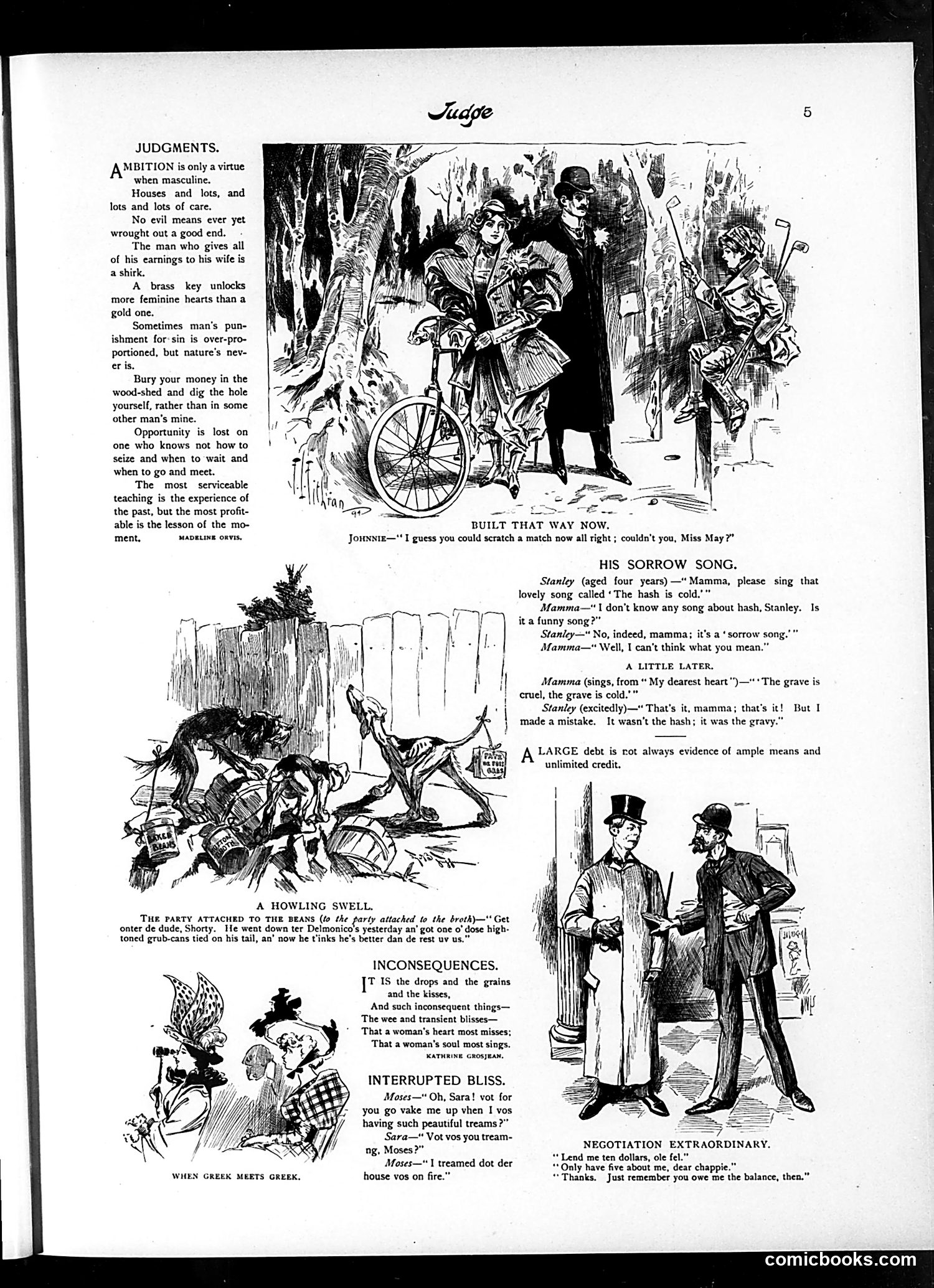
This page contains miscellaneous humor and social commentary typical of early-20th-century Judge magazine. **Main content includes:** - **"Judgments"** section: Cynical aphorisms about ambition, money, and human nature (attributed to Madeline Orvis) - **Multiple comic sketches** with illustrations showing everyday social situations: a woman on a bicycle rejecting a man's advances ("Built That Way Now"); working-class men discussing a pretentious acquaintance ("A Howling Swell"); a child misunderstanding a song about "hash" and "gravy" as "sorrow" - **Ethnic humor**: Several sketches employ stereotypical Jewish ("Moses") and immigrant dialects, common in period humor - **Thematic satire**: The page mocks affectation, pretension, class anxiety, and domestic situations—reflecting Victorian/Edwardian concerns about social climbing, courtship rituals, and marriage dynamics The humor relies on wordplay, misunderstandings, and character types rather than political references. It's light social satire targeting middle-class anxieties and behavioral quirks.
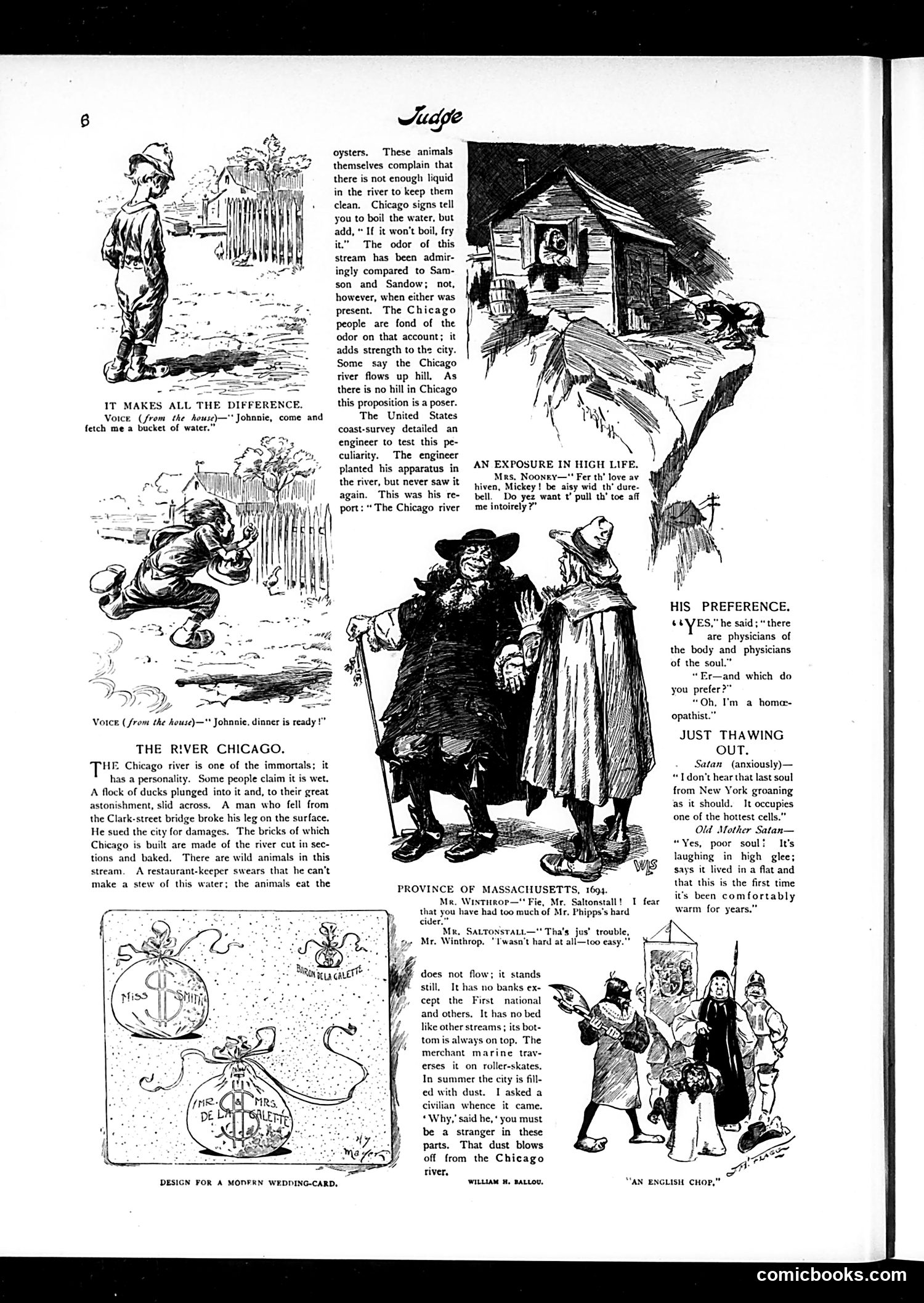
This page mocks **the Chicago River's notorious pollution** in the late 19th/early 20th century. The main article, "The River Chicago," sarcastically catalogs the river's infamous filthiness: it's so foul that oysters can't stay clean in it, the water requires boiling (or frying), and it smells worse than famous strongmen. Jokes claim ducks slide across it, a man broke his leg falling on its surface, and its sediment is used to make bricks. The river allegedly doesn't flow but stands still, has no banks except banks (pun), and generates dust clouds over the city. **Surrounding cartoons** use unrelated jokes (a homeopathist doctor, souls in hell laughing, colonial-era drinking) typical of Judge's miscellaneous humor pages. The satire targets Chicago's **civic pride coexisting with environmental degradation**—residents paradoxically love the smell because it supposedly "adds strength to the city," mocking misplaced boosterism about obvious public health hazards.
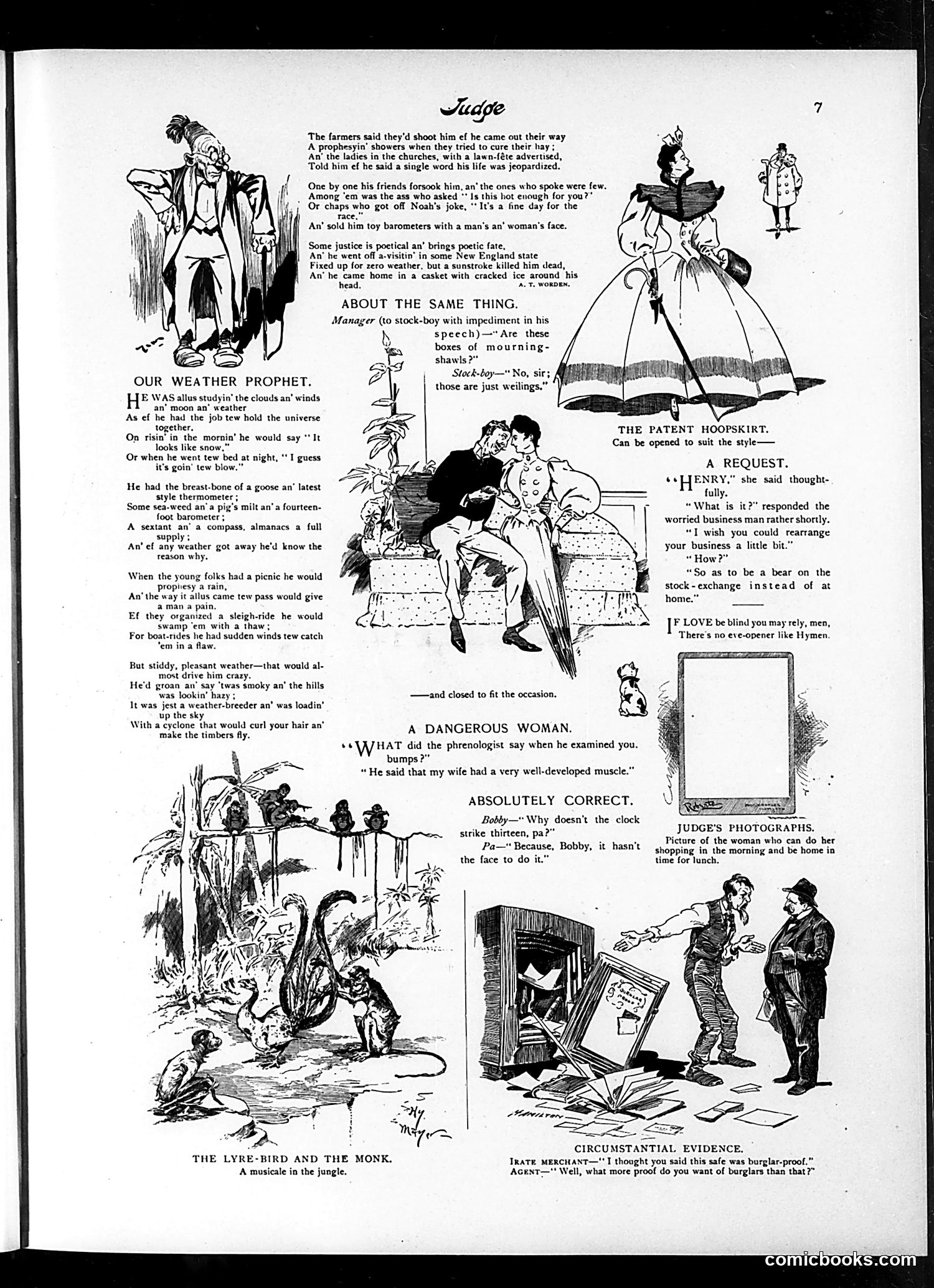
This page from *Judge* satirizes a self-proclaimed weather predictor through a narrative poem. The main cartoon depicts a man who obsessively studies weather signs (goose breastbones, compasses, almanacs) and makes constant forecasts—so frequently that locals mock and avoid him. Farmers threaten violence; churchgoers warn him to stay silent; friends abandon him. The satire's ironic payoff: after years of predictions, he dies from a *sunstroke* during zero-weather preparation—killed by his own miscalculation and returned home "with cracked ice around his head." The joke targets pseudoscientific practitioners and blowhards who claim specialized knowledge they lack. Additional short jokes on the page mock similar pretension (phrenology, "patent" inventions) and absurdity in everyday life. The artwork style and crude typography are typical of 1880s-90s American humor magazines.
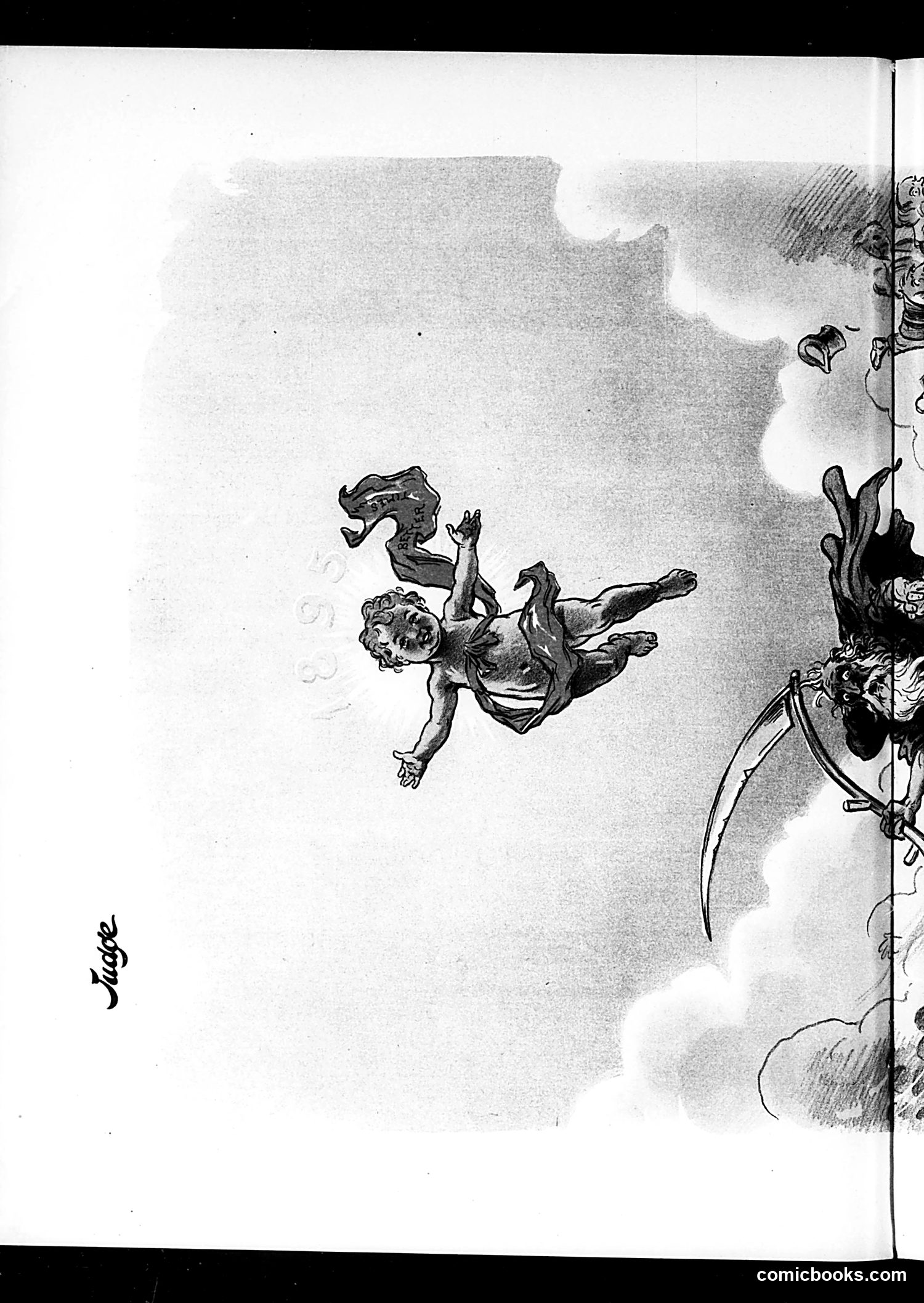
This appears to be a largely illegible OCR extraction with only numerical/character fragments visible. The actual cartoon shows a cherub or putto (classical winged child figure) floating through clouds in a dreamy scene, rendered in black ink with gray wash shading. On the right edge, there are partial ornamental designs or decorative elements, possibly part of a larger composition or border. Without legible accompanying text, I cannot identify the specific political or social satire intended. The classical cherub imagery suggests this may reference heavenly or idealized themes common in Gilded Age satire, but the exact target and meaning remain unclear. The signature on the left appears present but is not clearly legible enough to attribute with certainty.
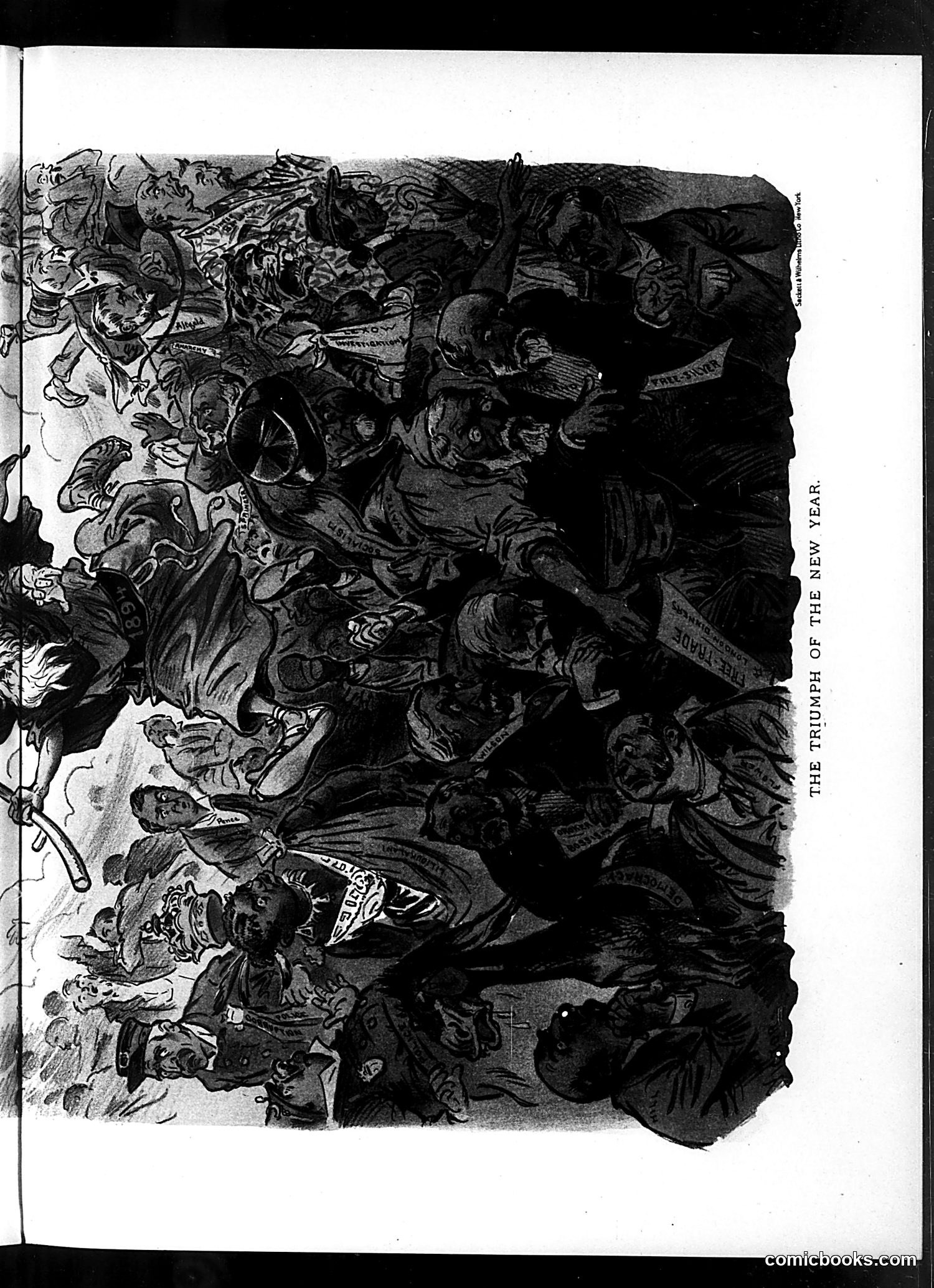
This satirical engraving depicts a chaotic New Year's celebration scene. The title "The Triumph of the New Year" appears on the right side. The composition shows numerous figures in various states of revelry and disorder—people drinking, carousing, and creating mayhem. The style is characteristic of 19th-century political satire in *Judge* magazine, using exaggeration and crowded composition to mock social behavior. The cartoon likely satirizes excessive New Year's festivities and the chaos of public celebration, possibly critiquing drunkenness, rowdiness, or social disorder associated with holiday revelry. Without clearer identification of specific figures or clearer OCR text, the exact political targets remain unclear, but the overall message appears to be mocking undisciplined public behavior during holiday celebrations.
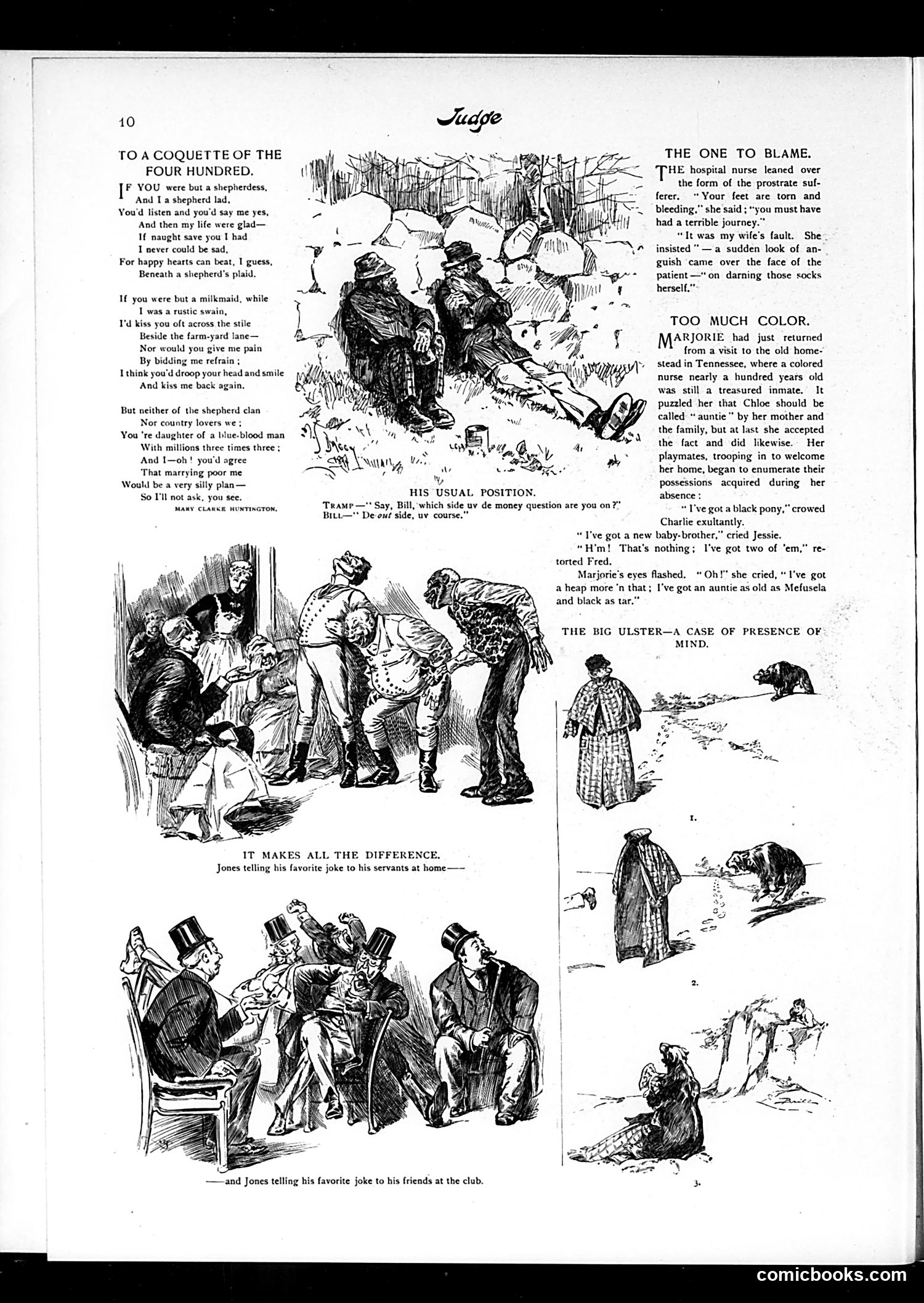
This page contains several distinct satirical pieces typical of Judge's social commentary: **"To a Coquette of the Four Hundred"** is a poem mocking wealthy upper-class ("Four Hundred") women who reject suitors beneath their social station. The satire suggests such women would be more receptive to romance if they weren't constrained by class prejudice. **"It Makes All the Difference"** contrasts how a man's joke lands differently depending on audience—appearing charming to servants but ridiculous to peers at his club. It satirizes social pretense and how people perform differently across class boundaries. **"Too Much Color"** jokes about a Southern girl visiting Tennessee, where she encounters an elderly Black woman called "auntie" and later boasts to friends about possessing "an auntie as old as Methuselah and black as tar"—satirizing both the commodification of family connections and racial attitudes of the period. The remaining brief sketches mock minor social foibles: a husband blaming his wife for his injuries, and class divisions in conversation ("De out side" of money).
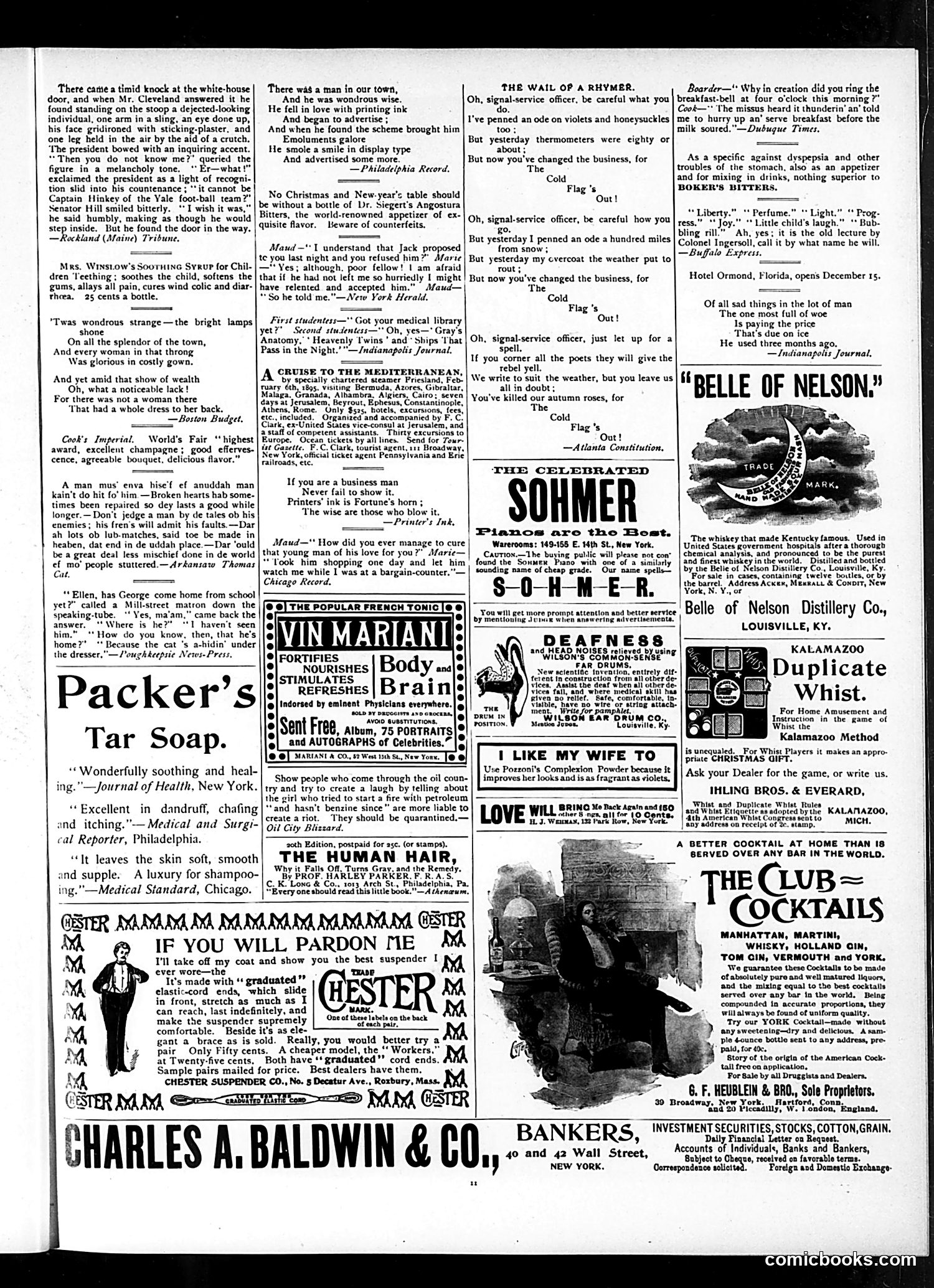
This page is primarily **advertising and comic verse**, with one notable political cartoon. The main satirical piece mocks **Senator David B. Hill** (the injured figure) arriving at the White House after Cleveland rejected his political ambitions. Hill appears battered and bruised, a physical metaphor for his political defeat when Cleveland sought his support. The Yale football reference implies Hill was "outplayed" politically. The joke relies on readers' familiarity with Hill's recent political setbacks. The remainder consists of period advertisements (patent medicines, soaps, financial services) typical of 1890s magazines, plus lighthearted verse about love, printing, and marriage. Nothing else on the page contains significant political or social satire—it's largely commercial space. The specific historical context requires knowing Hill's recent political struggles with Cleveland to appreciate the cartoon's humor.
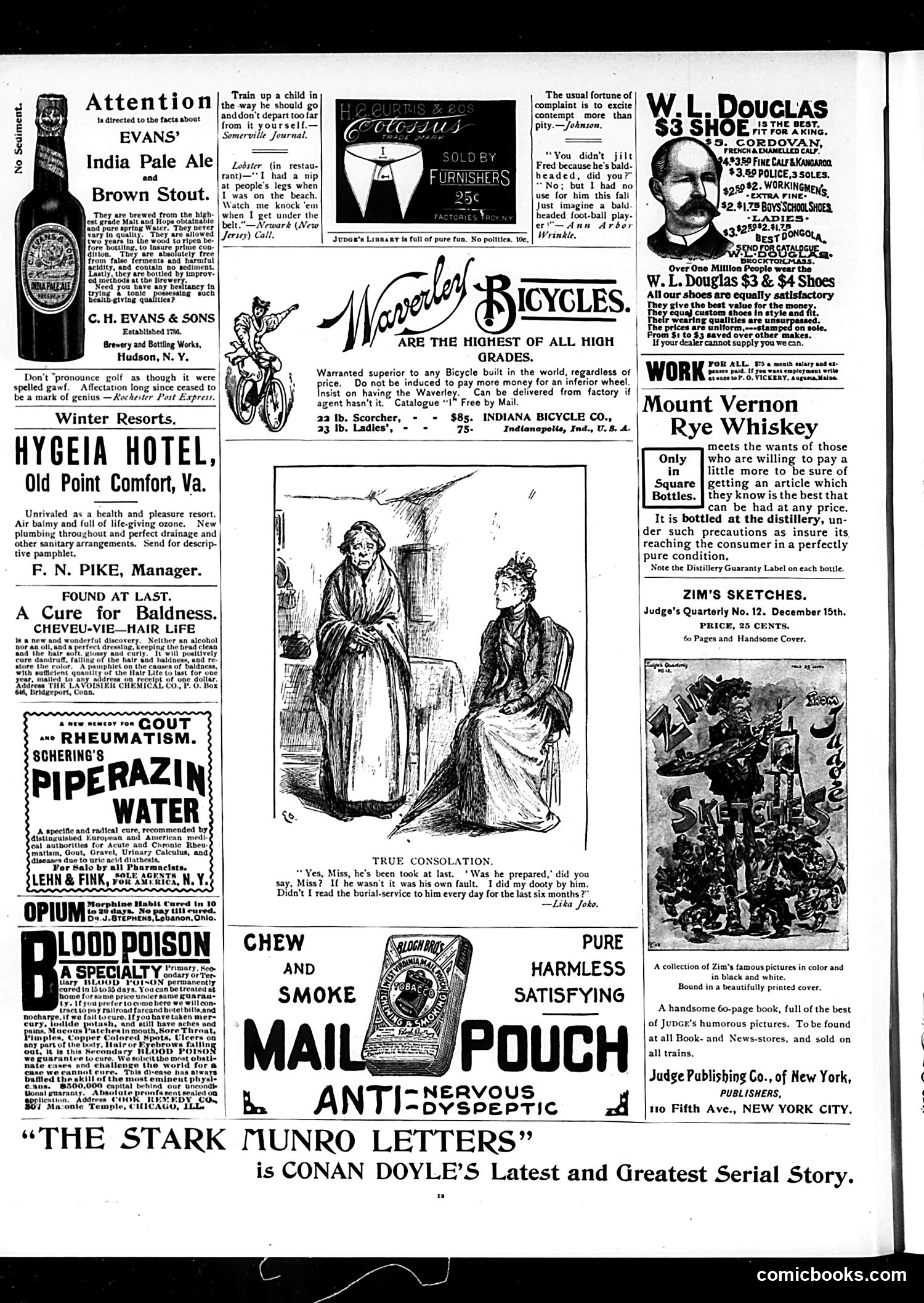
This page is primarily **advertising**, with one small cartoon joke embedded among product promotions. The main cartoon, titled "TRUE CONSOLATION," depicts an elderly woman consoling another woman about a man's death. The joke plays on class/servant dynamics: the speaker claims she fulfilled her duty by reading the burial service to the deceased "every day for the last six months"—implying she performed this obligation dutifully but mechanically, as if it were a servant's chore rather than an act of genuine care. The dark humor lies in this grim interpretation of "duty." The page otherwise features period advertisements for: Evans' ale, bicycles, shoes (W.L. Douglas brand), whiskey, hair loss remedies, rheumatism cures, and opium treatments—typical early 20th-century product marketing. There are also small joke snippets (about golf pronunciation, a lobster's boasting) that appear to be filler content. The page reflects contemporary advertising practices and medical/pharmaceutical claims now considered dubious or dangerous.
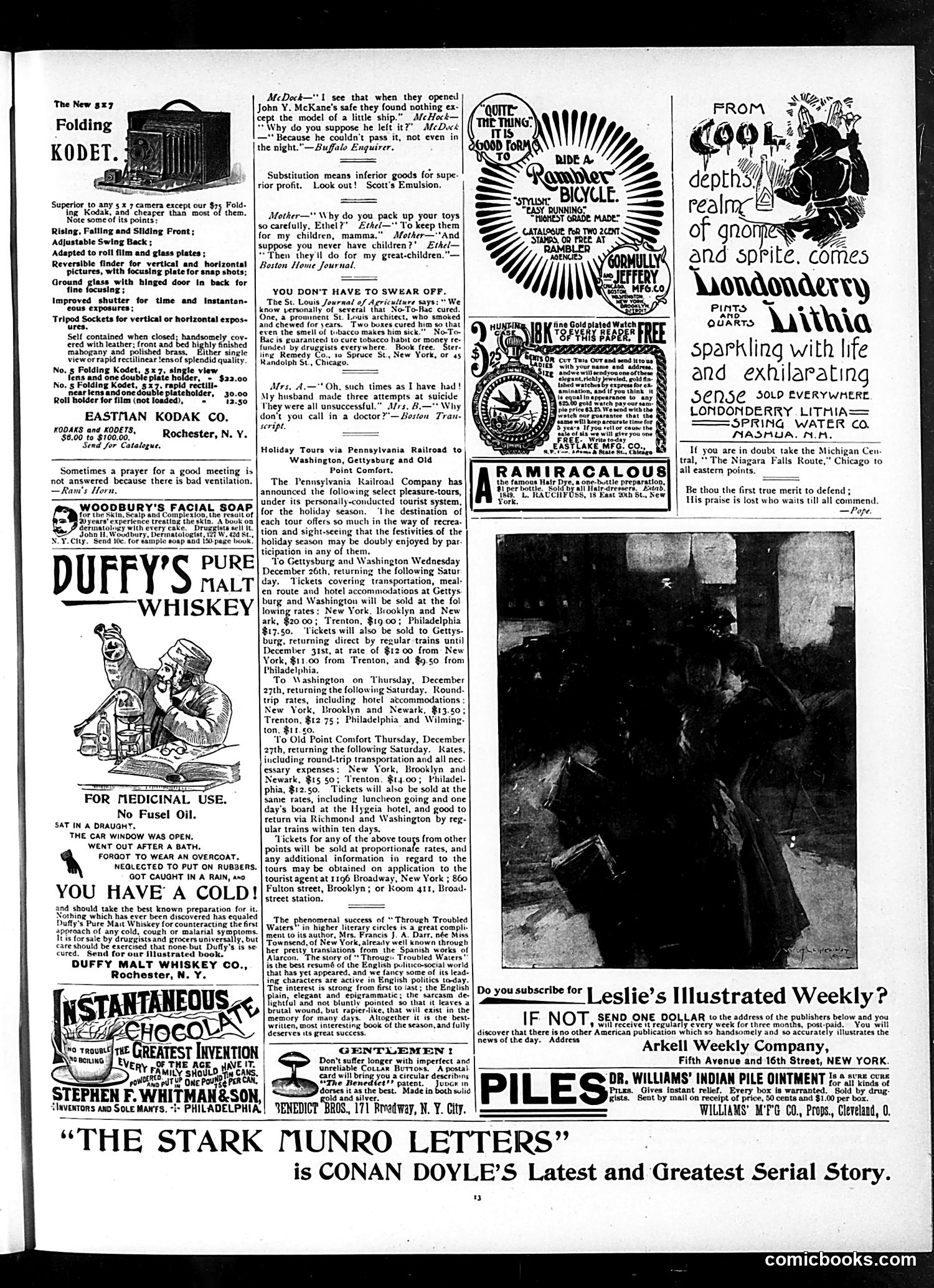
This page is primarily **advertising and filler material** rather than political satire. It contains: **Visible Content:** - Camera advertisements (Kodak folding cameras) - Medicinal product ads (Duffy's Malt Whiskey "for medicinal use," Williams' Indian Pile Ointment) - Soap and chocolate advertisements - Several brief humorous anecdotes/jokes (not political cartoons) **The Humor:** The few jokes present are domestic/social rather than political—about marriage difficulties, parenting, and tobacco habits. One brief joke references "John Y. McKane's safe" (likely a local Brooklyn figure from the 1890s involved in a corruption scandal), but the reference is obscure without additional context. **Literary Content:** Promotion for Conan Doyle's "Stark Munro Letters" serial story and Leslie's Illustrated Weekly subscription. This appears to be a **back-of-magazine page** consisting mainly of classifieds and commercial content with light humor, typical of period publications.
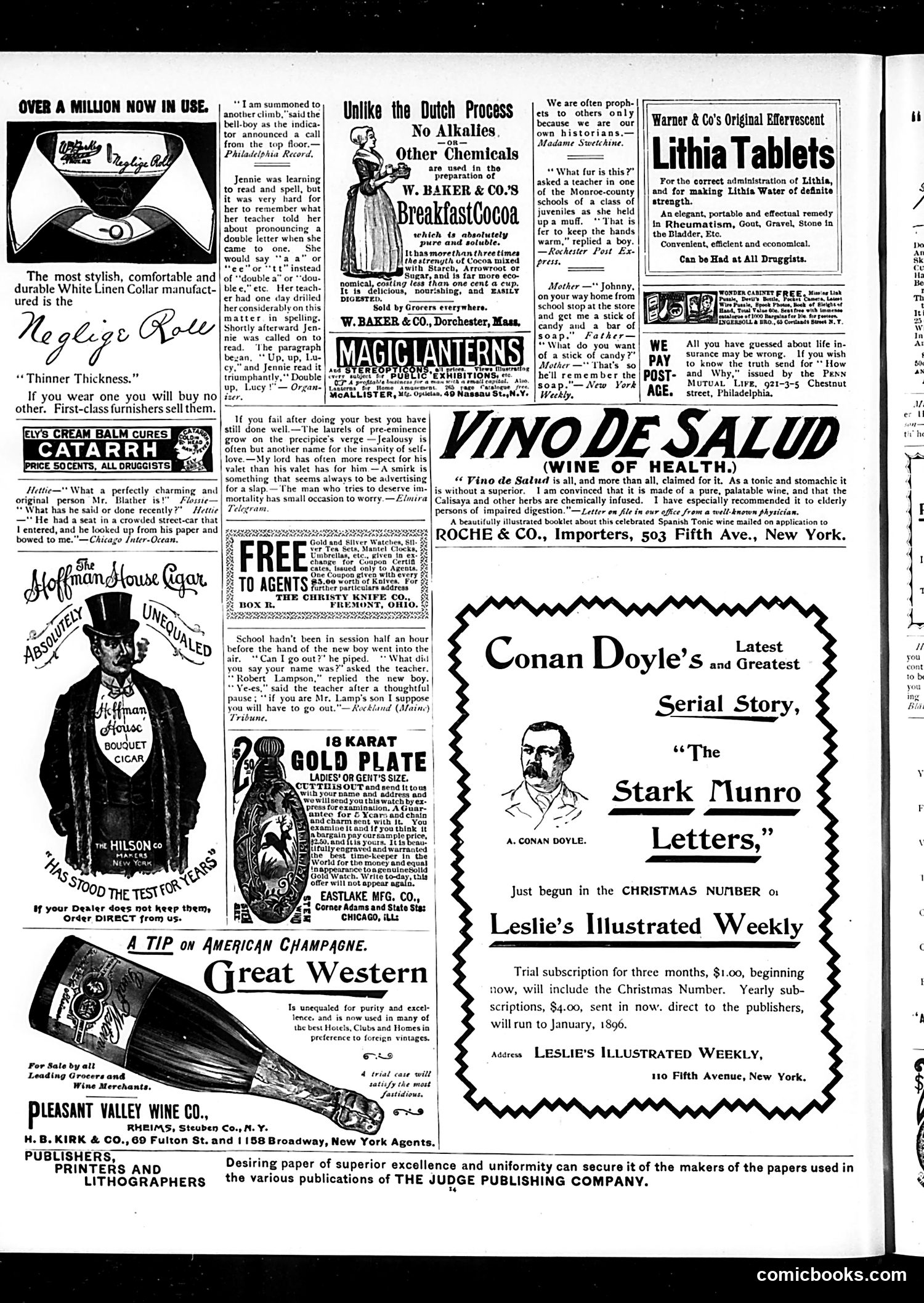
This is primarily an **advertising page** from Judge magazine, not a political cartoon. It contains product advertisements (cocoa, cigars, wine, lithia tablets, collars) mixed with brief humorous anecdotes. The small jokes—about a bellhop climbing stairs, a child mispronouncing "double a" as "double soap," and a new student named Lampson being allowed to leave class because "if you are Mr. Lamp's son, you will have to go out"—are **puns and wordplay** typical of early 1900s humor magazines. They rely on homophones and logical absurdities rather than political satire. The page also advertises **Conan Doyle's "Stark Munro Letters"** serial story in Leslie's Illustrated Weekly. There are **no identifiable political cartoons or caricatures** visible that require historical context to decode.
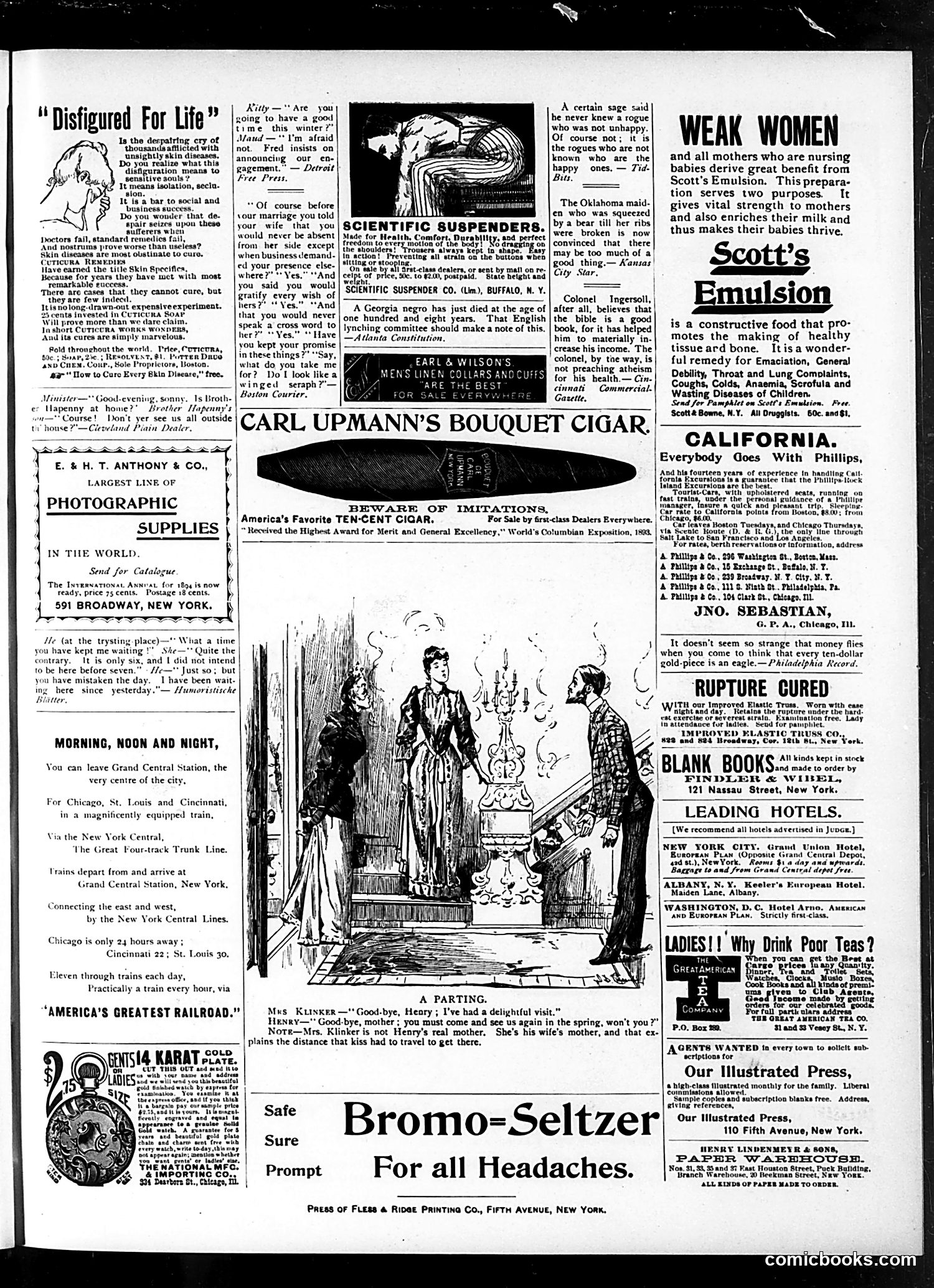
This page is primarily **advertising**, not political satire. It's a magazine section dominated by product advertisements rather than cartoons with political meaning. The few cartoons present are **mild domestic humor** without political content. "A Parting" shows a couple saying goodbye, with dialogue about missing a spring visit. "Disfigured For Life" is a doctor advertisement using before-and-after rhetoric to sell skin treatment. The page's main feature is **Carl Upmann's Bouquet Cigar** advertisement, prominently placed at center. Other ads promote Scott's Emulsion (a nutritional supplement), Scientific Suspenders, railroad service, and hotels. The small jokes scattered throughout are light observations about romance and behavior—a woman discussing her engagement announcement, a Georgia man's longevity noted for a lynching committee, Colonel Ingersoll's views on the Bible's practical benefits. These contain no satire, just casual period humor. This appears to be a standard Judge magazine page where editorial content takes backseat to revenue-generating advertisements.
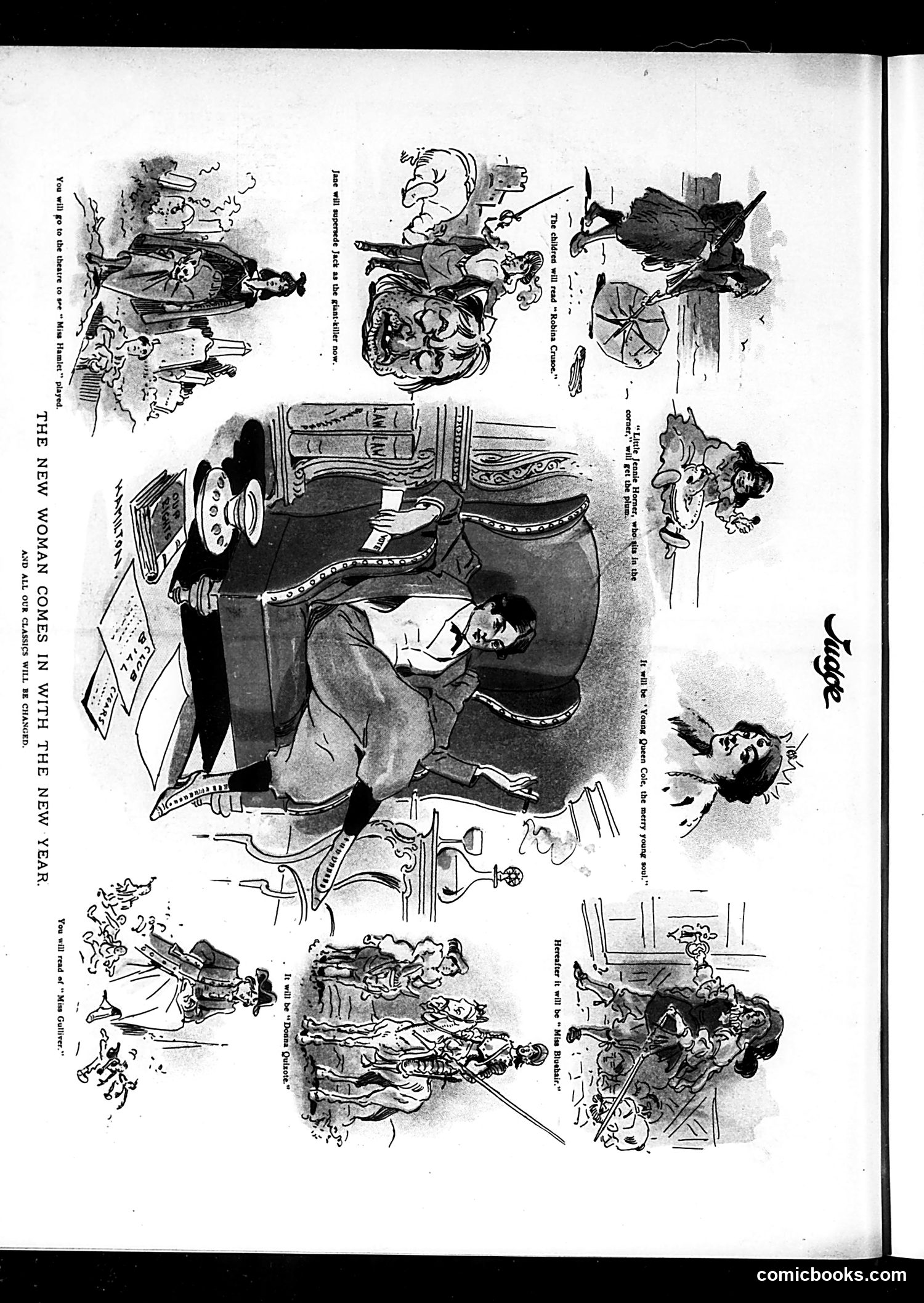
This satirical page mocks the emerging "New Woman" of the late 19th/early 20th century—independent women entering previously male-dominated spheres like theater and literature. The central cartoon shows a woman in a chair surrounded by classical works being rewritten with female protagonists: "Miss Hamlet" and "Miss Gulliver" replace the male originals. Smaller vignettes display chaotic scenes, apparently depicting the absurd consequences of women's liberation. The satire's point: allowing women into traditionally masculine cultural institutions will destroy classic literature and social order. The caricatured exaggeration and the phrase "all our classics will be changed" express anxiety about women's growing social roles and independence—positioning feminism as a threat to established traditions rather than legitimate progress. This reflects common conservative backlash against women's suffrage and social advancement in this era.