
Judge, 1895-01-05 · page 10 of 16
Judge — January 5, 1895 — page 10: what you’re looking at
What you’re looking at
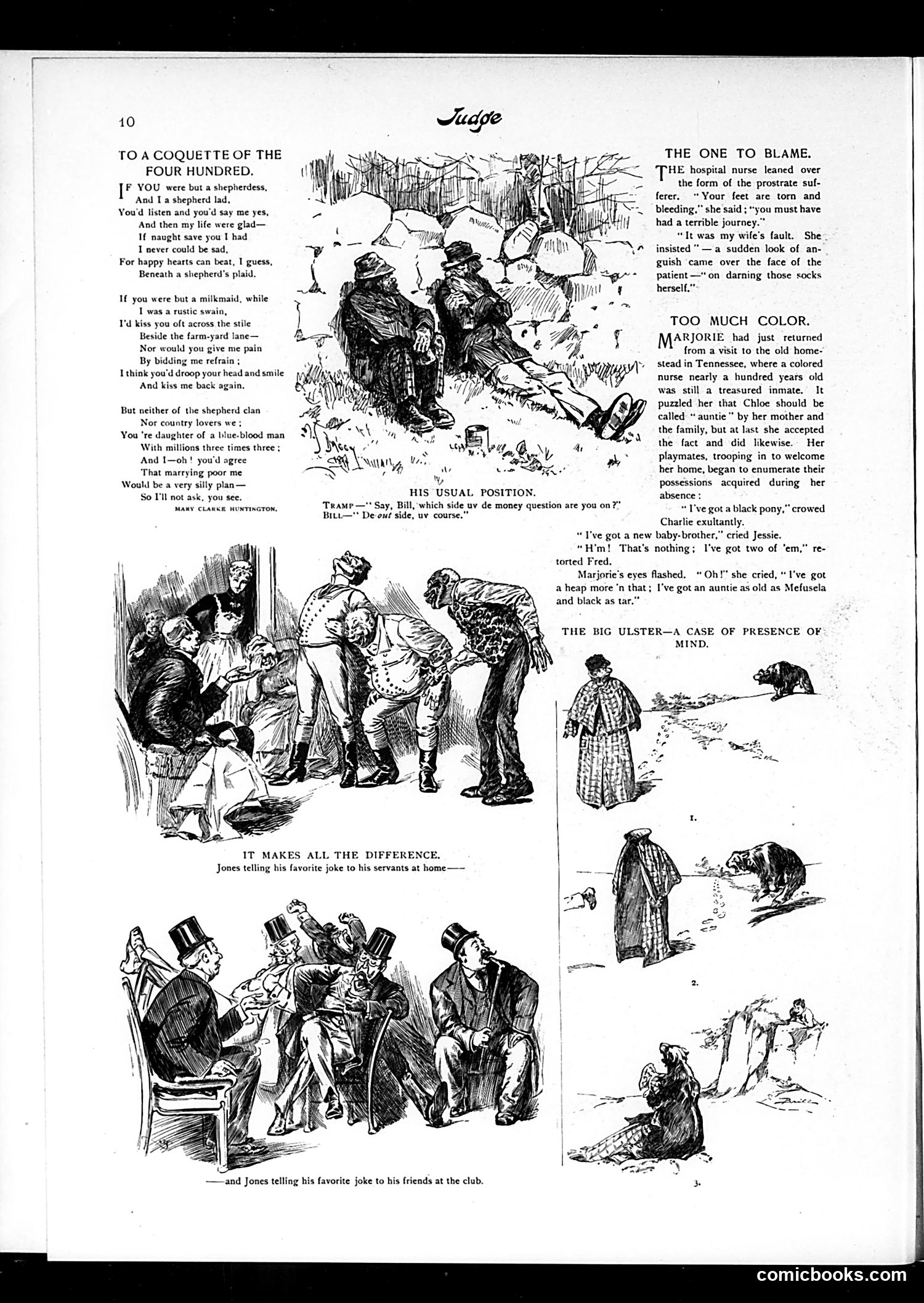
This page contains several distinct satirical pieces typical of Judge's social commentary: **"To a Coquette of the Four Hundred"** is a poem mocking wealthy upper-class ("Four Hundred") women who reject suitors beneath their social station. The satire suggests such women would be more receptive to romance if they weren't constrained by class prejudice. **"It Makes All the Difference"** contrasts how a man's joke lands differently depending on audience—appearing charming to servants but ridiculous to peers at his club. It satirizes social pretense and how people perform differently across class boundaries. **"Too Much Color"** jokes about a Southern girl visiting Tennessee, where she encounters an elderly Black woman called "auntie" and later boasts to friends about possessing "an auntie as old as Methuselah and black as tar"—satirizing both the commodification of family connections and racial attitudes of the period. The remaining brief sketches mock minor social foibles: a husband blaming his wife for his injuries, and class divisions in conversation ("De out side" of money).
📄 Transcribed text from this page (OCR, searchable)
Machine-transcribed from the original scan — historical spelling and the odd misread are preserved.
10 TO A COQUETTE OF THE FOUR HUNDRED. [F YOU were but a shepherdess, And Ta shepherd lad, You'd listen and you'd say me yes, And then my life were glad— If naught save you I had I never could be sad, For happy hearts can beat, I guess, Beneath a shepherd's plaid. If you were but a milkmaid, while I was a rustic swain, I'd kiss you oft across the stile Beside the farm-yard lane— Nor would you give me pain By bidding me refrain ; I think you'd droop your head and smile And kiss me back again, But neither of the shepherd clan Nor country lovers we ; You ‘re daughter of a blue-blood man oy 7/) 7 eA <= . ‘ sie in oe be, ; oss THE ONE TO BLAME, THE hospital nurse leaned over the form of the prostrate suf- ferer. “Your feet are torn and bleeding,” she said ; “you must have had a terrible journey.’ “It was my wife’s fault. She insisted” —a sudden look of an- guish came over the face of the patient —“‘on darning those socks herself.” TOO MUCH COLOR. MAJORIE had just returned from a visit to the old home- stead in Tennessee, where a colored nurse nearly a hundred years old was still a treasured inmate. It puzzled her that Chloe should be called “auntie” by her mother and the family, but at last she accepted With millions three times three ; Ss P AV, @ \y A the fact and did likewise. Her And'-3h? you'd opree 94 Way veh py Playmates, trooping in to welcome ‘That marrying poor me oes 1% “ ce SOR her home, began to enumerate their Would be a very silly plan— v . possessions acquired during her So I'll not ask, you see. HIS"USUAL POSITION. _ : absence : iat Coane) TNT, ‘Tramr— Say, Bill, which side uv de money question are you on?" Biti—"* De out side, uv course,’ IT MAKES ALL THE DIFFERENCE, Jones telling his favorite joke to his servants at home—— —and Jones telling his favorite joke to his friends at the club. “I've got a black pony,” crowed Charlie exultantly. “I've got a new baby-brother,” cried Jessie. “Hm! That's nothing; I've got two of ‘em,” re- torted Fred. Marjorie’s eyes flashed. * Oh!" she cried, “I've got a heap more ‘n that; I've got an auntie as old as Mefusela and black as tar.” THE BIG ULSTER—A CASE OF PRESENCE OF MIND, comicbooks.com