
A complete issue · 16 pages · 1892
Judge — February 13, 1892
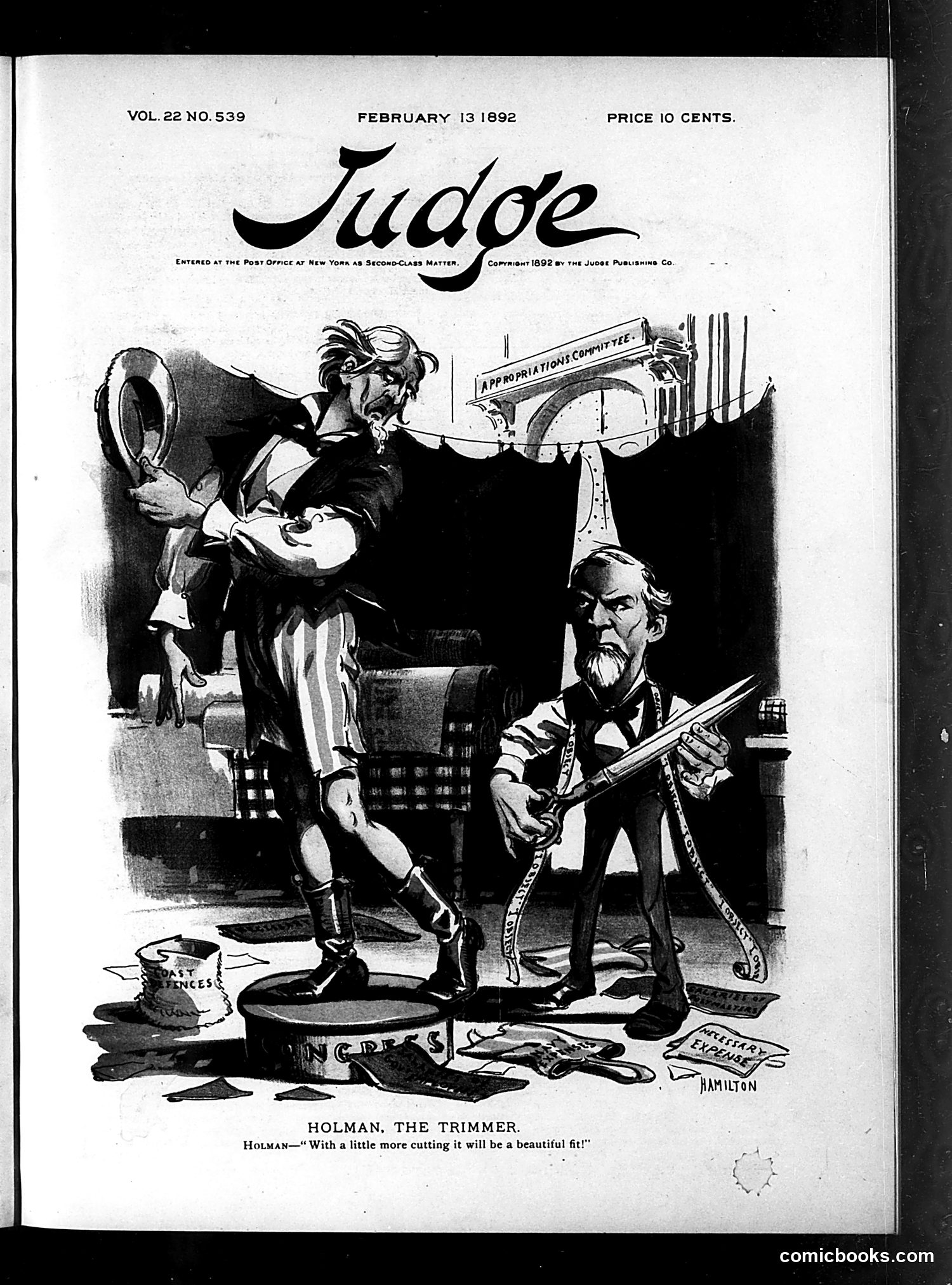
This political cartoon satirizes William Holman, an Indiana congressman known for inconsistent positions. The central figure (Holman) is depicted as a barber or "trimmer," literally cutting away at a large item labeled "Appropriations Committee" while holding scissors and a razor. A military or official figure on the right watches skeptically. The satire plays on "trimmer"—someone who adjusts their stance to suit circumstances. Holman appears to be trimming government appropriations, but the cartoon suggests his efforts are performative or hypocritical. The scattered tools and materials around him imply confusion or waste. The caption's joke about "cutting" to make something "beautiful" mocks his claimed fiscal responsibility while suggesting destructive incompetence.
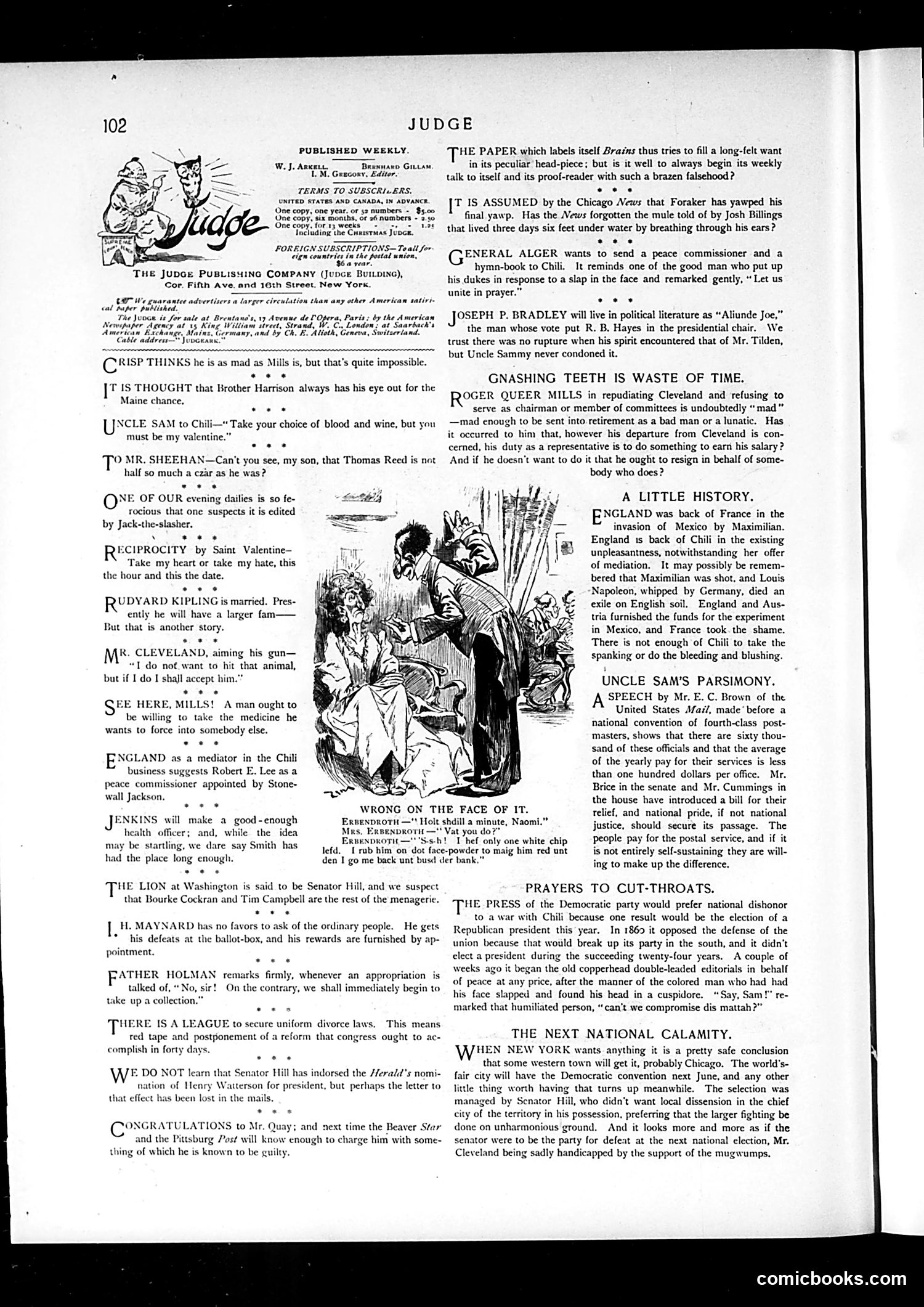
This page contains political commentary and satirical notes rather than a single cartoon. The main illustrated piece (center-right) appears to show a confrontation scene, likely depicting a political dispute or negotiation, though specific identities aren't clear from the image alone. The text snippets mock various political figures and issues of the era, including references to Cleveland, Chicago politics, and Democratic party strategy regarding the "Chili business" (possibly a tariff dispute). One section titled "A Little History" sarcastically compares England's historical interventions to current American foreign policy debates. The overall tone suggests this is commentary on late 19th-century American politics, with particular focus on presidential politics and regional political tensions, though specific dates and figures require clearer context to identify with certainty.
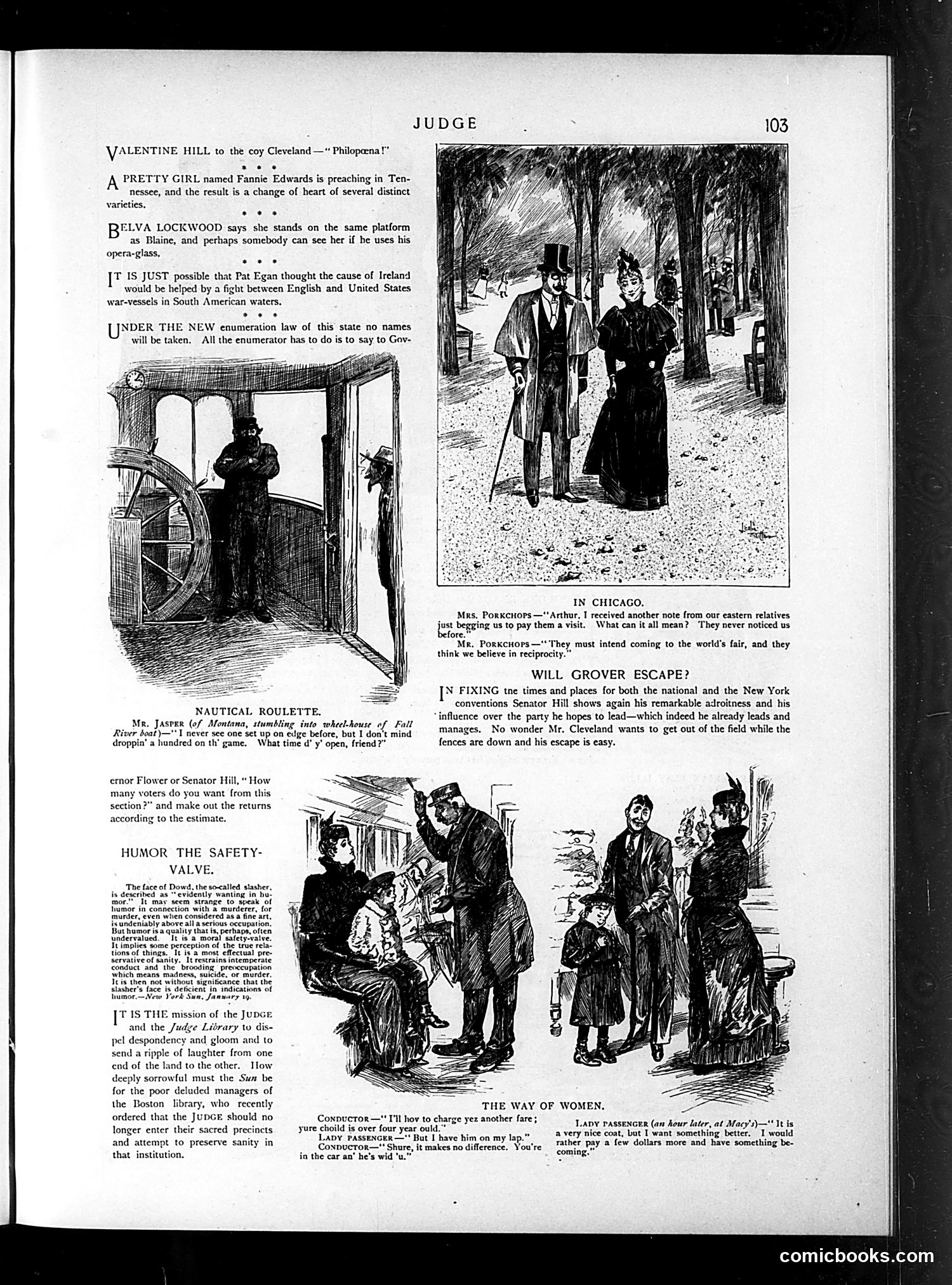
This page contains several political-social commentaries typical of early 20th-century American humor: **"In Chicago"** satirizes a visitor's complaint about Irish relatives arriving unannounced, with a quip about reciprocal visitation—social commentary on immigration and family obligations. **"Will Grover Escape?"** references Senator Hill's influence over party management and Cleveland's political maneuvering, suggesting backroom political dealing was widely recognized and mocked. **"Nautical Roulette"** appears to joke about river commerce and risk-taking. **"The Way of Women"** depicts domestic scenes with gender-based humor about marriage and social expectations. The cartoons use recognizable figures and contemporary political situations (Cleveland administration era) to satirize immigration, political corruption, and gender roles—topics resonating with Judge's educated, middle-class readership concerned with social propriety and political ethics.
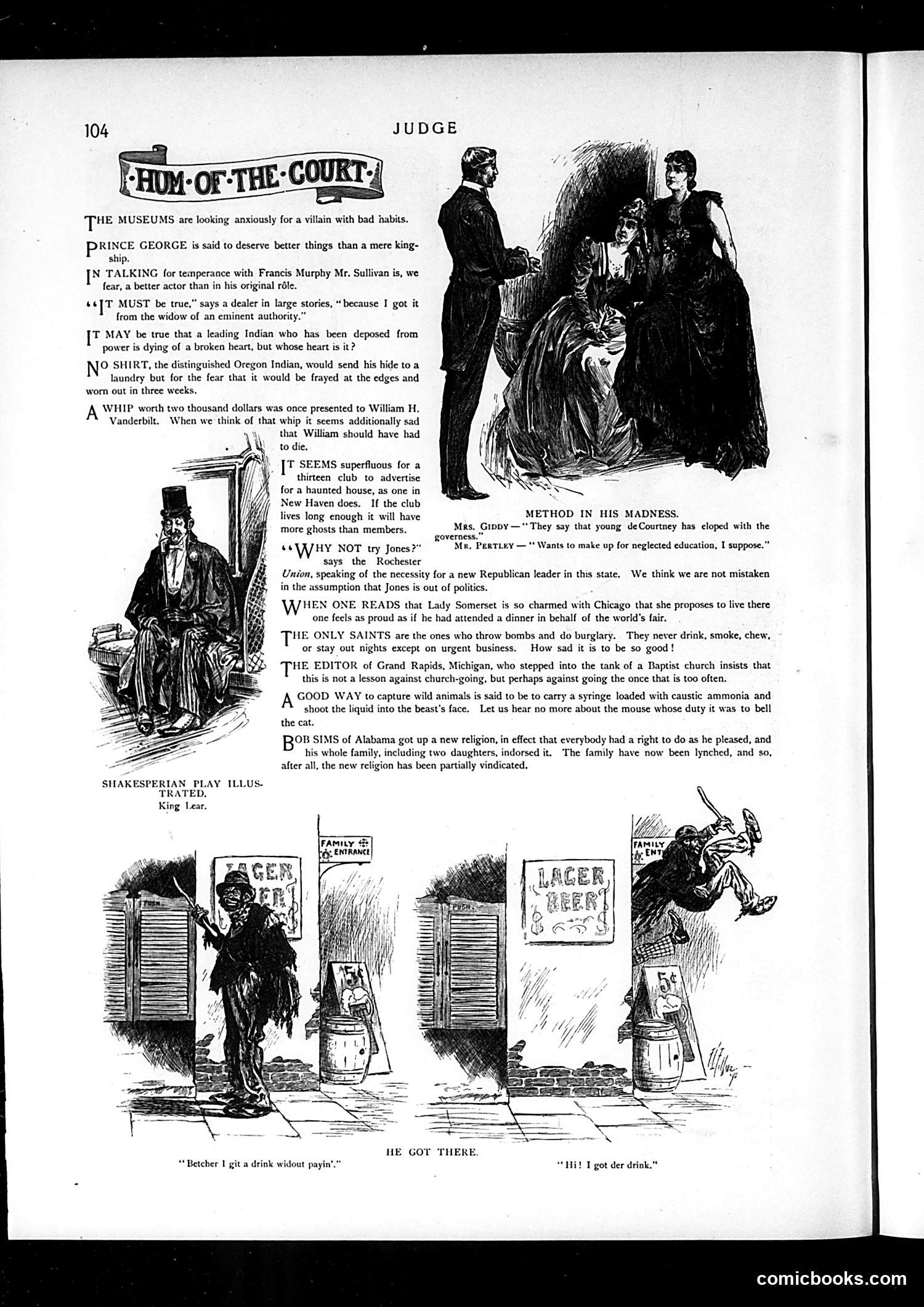
This page contains brief satirical commentary on 1890s American public figures and social issues, plus two cartoon vignettes at the bottom. The upper cartoon depicts a society scandal: a young man (deCourtney) has eloped with a governess. The humor turns on class pretension—the governess claims to be "making up for neglected education," implying social climbing rather than genuine romance. The bottom cartoons, titled "Shakespearian Play Illustrated: King Lear," show a darkly comedic twist on homelessness and alcohol. Two ragged men outside bars—one with "Gent" and "Family Entrance" signs, the other with "Lager Beer"—attempt to obtain drinks. The first claims he got one "without payin'" (theft); the second celebrates actually getting a drink. The joke satirizes urban poverty and the desperation of the destitute, using Shakespeare as ironic contrast to their degraded circumstances.
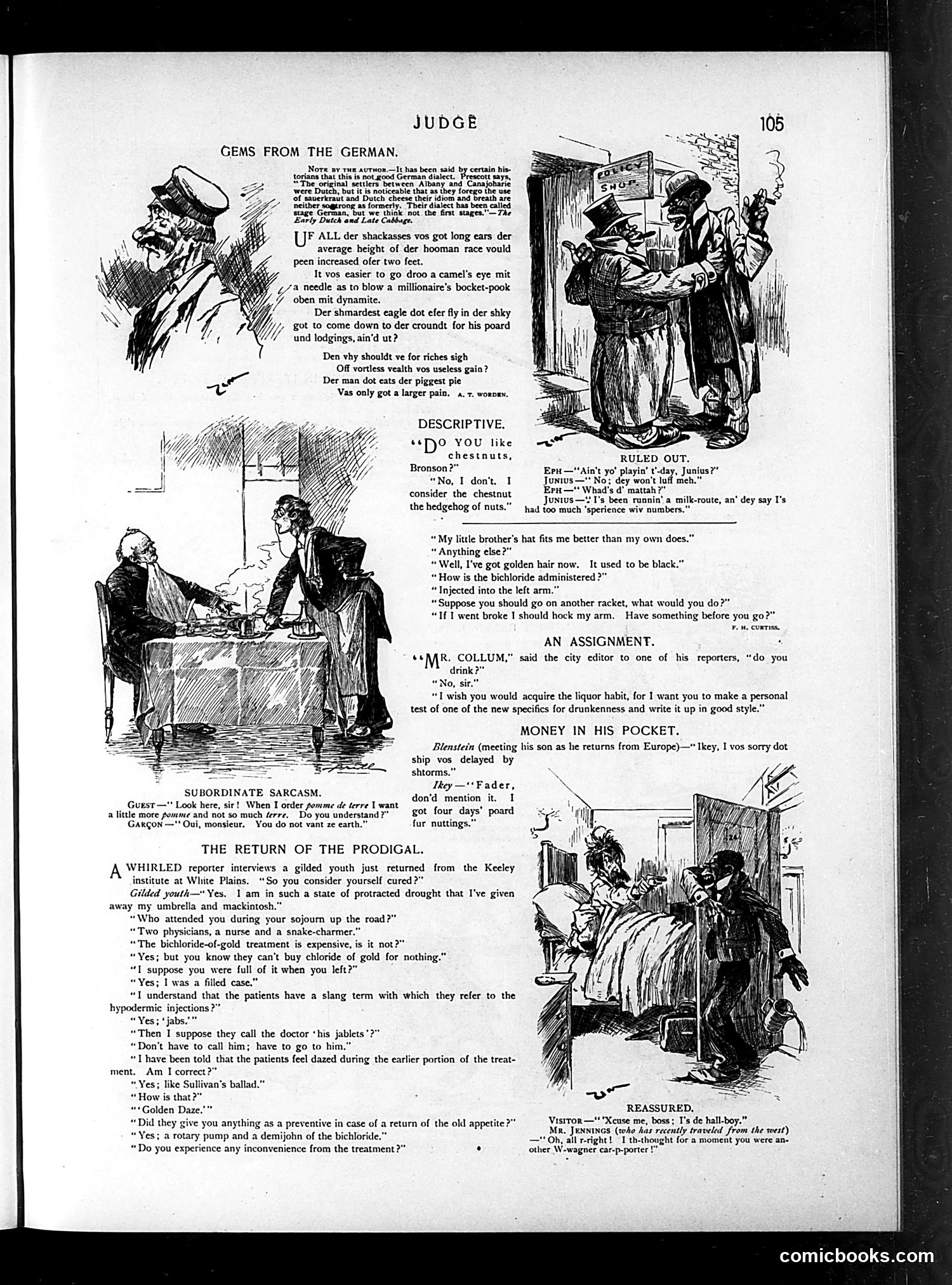
This page from *Judge* magazine contains several satirical pieces mocking German-American dialect and contemporary social issues: **"Gems from the German"** presents exaggerated German-accented English ("der shackasses," "vos got") in philosophical aphorisms—a common stereotype of German immigrants' speech patterns and perceived pomposity. **"Ruled Out"** depicts African American characters (Ephraim and Junius) discussing employment discrimination; Junius is rejected from performing because his experience with "milk-route" work supposedly gave him too much familiarity with "numbers"—likely referencing the illegal numbers gambling game. **"The Return of the Prodigal"** satirizes the Keeley Institute, a famous alcohol-addiction treatment facility, through interviews about the "bichloride-of-gold" cure (a questionable medical treatment of the era). The humor mocks both the treatment's dubious efficacy and patients' lingering addiction. **"Money in His Pocket"** uses exaggerated Jewish-dialect stereotypes ("Ikey," "Blenstein") in a joke about a son profiting during delayed ship travel. The page reflects *Judge*'s reliance on ethnic stereotyping and contemporary medical skepticism as sources of humor.
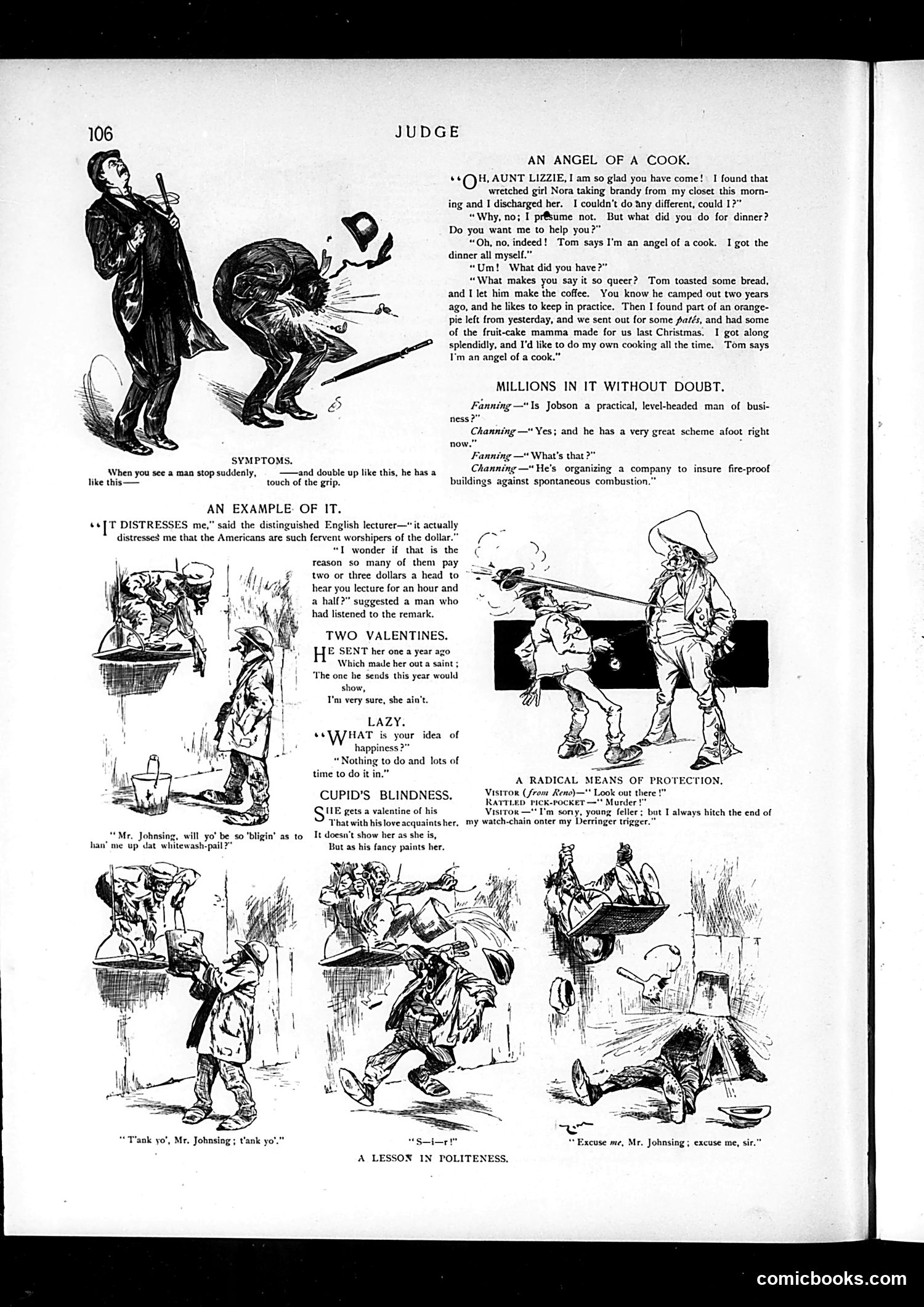
This page collects several brief satirical pieces typical of Judge magazine's humor: **"An Angel of a Cook"** mocks a woman who brags about cooking despite merely assembling pre-made items (toast made by her husband, store-bought pastries). The satire targets domestic pretension. **"An Example of It"** shows a British lecturer condemning American materialism, only to be reminded that Americans pay him handsomely for speeches—highlighting hypocrisy. **"A Lesson in Politeness"** depicts a servant repeatedly apologizing to his employer Mr. Johnsing while the employer remains dismissive, satirizing class dynamics and false civility. Additional short pieces mock absurdities: a "radical means of protection" involving shooting at train windows, valentines revealing true character, Cupid's blindness to reality, and a dubious insurance scheme for spontaneous combustion. The cartoons use exaggerated facial expressions and physical comedy typical of late-19th/early-20th century satirical illustration.
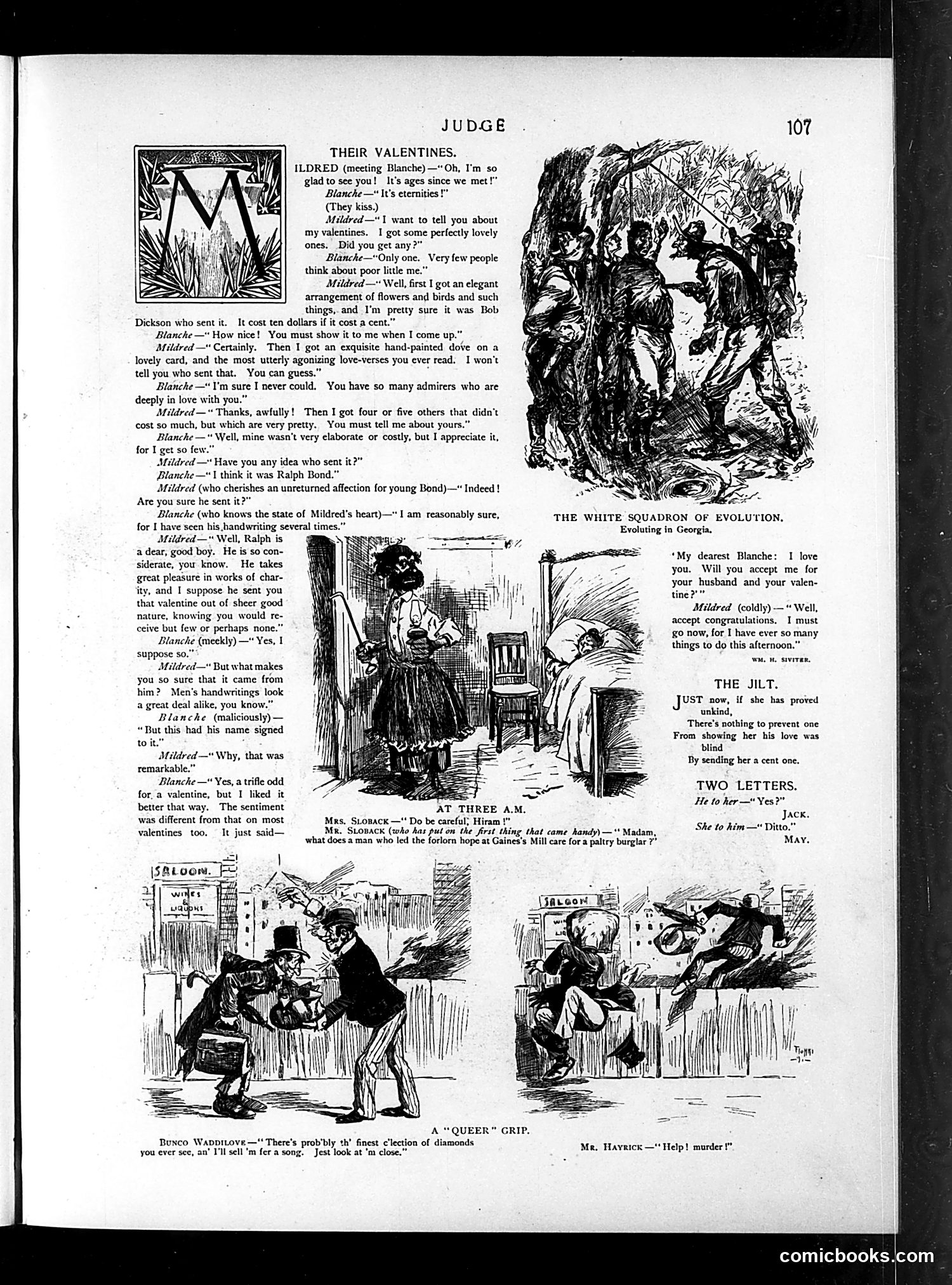
This page contains humor sketches typical of late 19th-century American satire. **"Their Valentines"** depicts two young women, Mildred and Blanche, discussing Valentine's Day gifts. The joke hinges on class anxiety and romantic competition: Mildred received expensive, elaborate valentines (ten dollars, hand-painted cards) and assumes they're from admirers, while Blanche received a modest card—apparently from Ralph Bond, signed with his name. Mildred is secretly in love with Ralph, so she attempts to dismiss his gesture as mere "charity," implying Ralph sent it out of pity rather than affection. Blanche's final comment—that Ralph actually *signed his name* on the valentine (unusual and forward)—suggests genuine romantic interest, frustrating Mildred's self-deception. **Lower sketches** appear to be unrelated comic vignettes: "The White Squadron of Evolution" (unclear context), "The Jilt" (rejected lover), "Two Letters" (brief exchanges), "A Queer Grip" (con artists with diamonds), and "At Three A.M." (domestic chaos). The humor relies on recognizable social scenarios about courtship, jealousy, and class pretension.
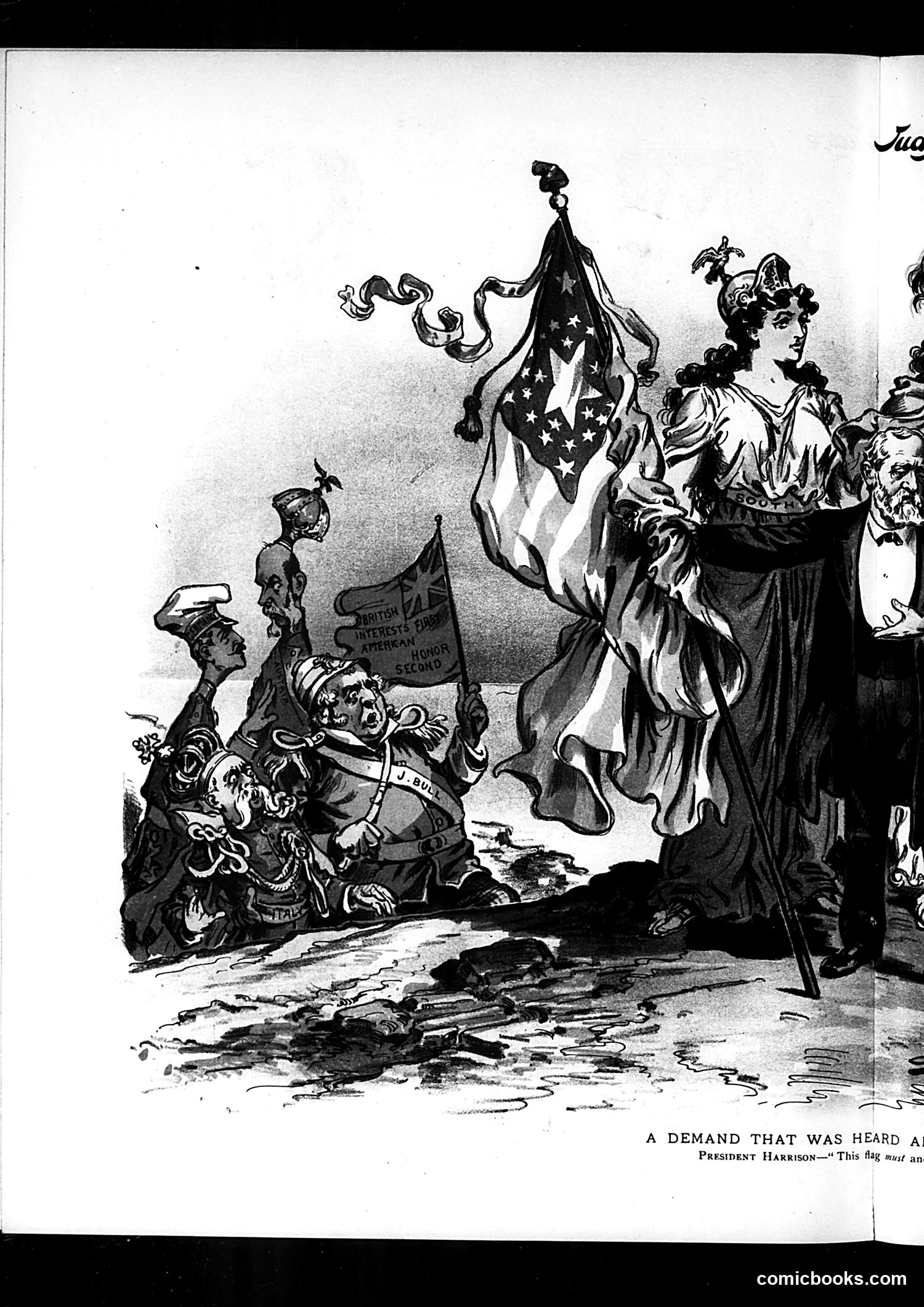
This Judge magazine cartoon depicts President Harrison responding to demands about the American flag. The image shows allegorical female figures (representing concepts like Liberty or America) confronting military or political figures on the left, who carry a flag labeled "British Interests" and "American Honor." The satire criticizes Harrison's administration for allegedly prioritizing British interests over American honor. The elaborate classical style of the allegorical women contrasts sharply with the caricatured military figures, emphasizing the cartoon's moral judgment. The incomplete caption suggests this relates to a specific policy dispute—likely concerning trade, territorial disputes, or diplomatic relations with Britain during Harrison's presidency (1889-1893). The cartoon advocates for American interests against perceived British influence.
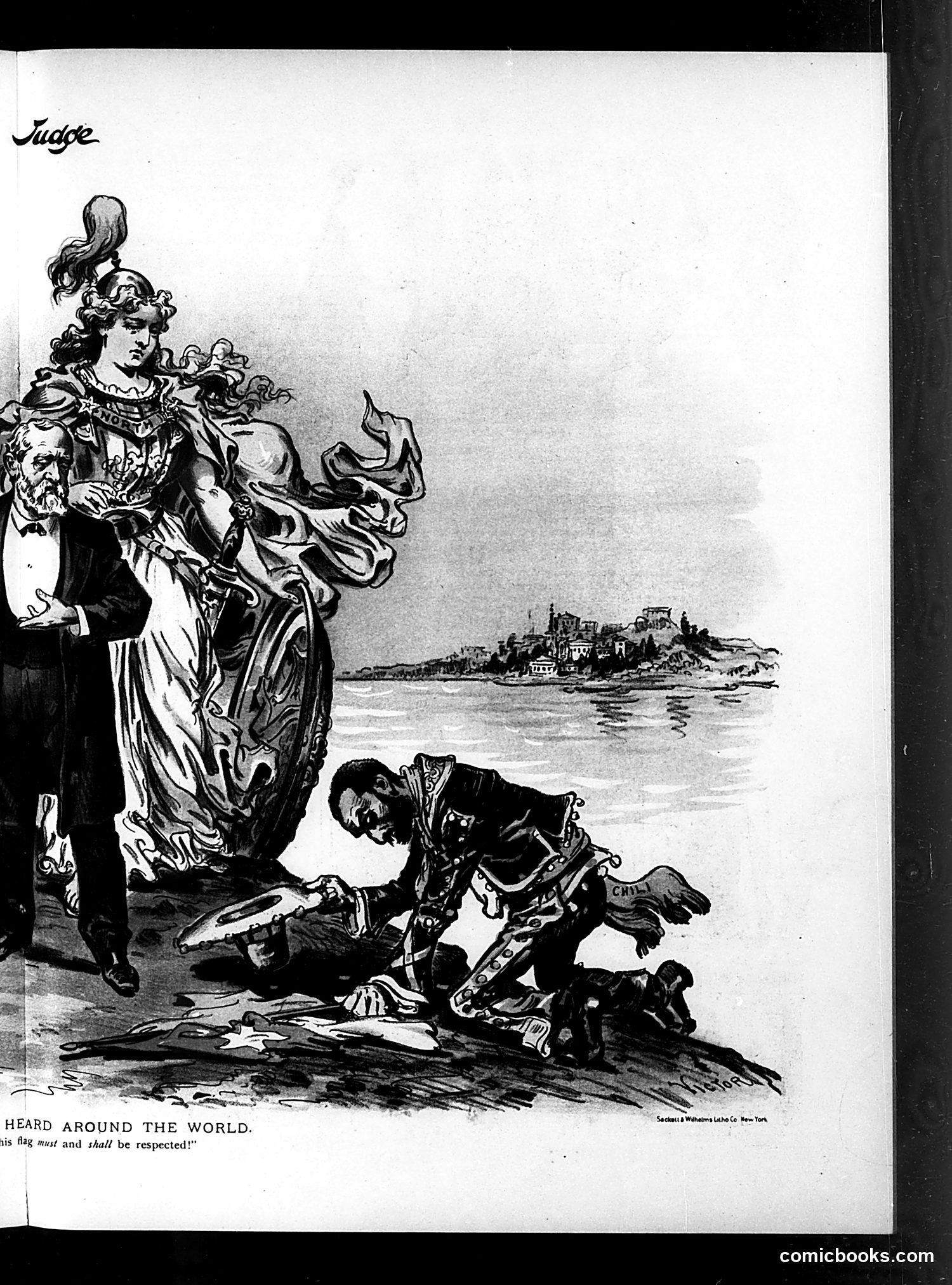
This Judge cartoon satirizes international respect for national authority. Lady Justice (identifiable by her classical robes, Medusa-like hair, and lion companion) stands imposingly on the left, while a military officer kneels or bows submissively before her on the right. The distant cityscape across water suggests a foreign nation or colonial setting. The caption—"his flag must and shall be respected!"—appears to mock either a world leader's bluster about national sovereignty or the cartoon critiques how military power genuinely commands global deference. The irony lies in Justice appearing to enforce this submission, though whether the cartoonist endorses or criticizes this dynamic remains unclear from the image alone. The cartoon likely comments on early 20th-century imperialism or nationalist rhetoric.
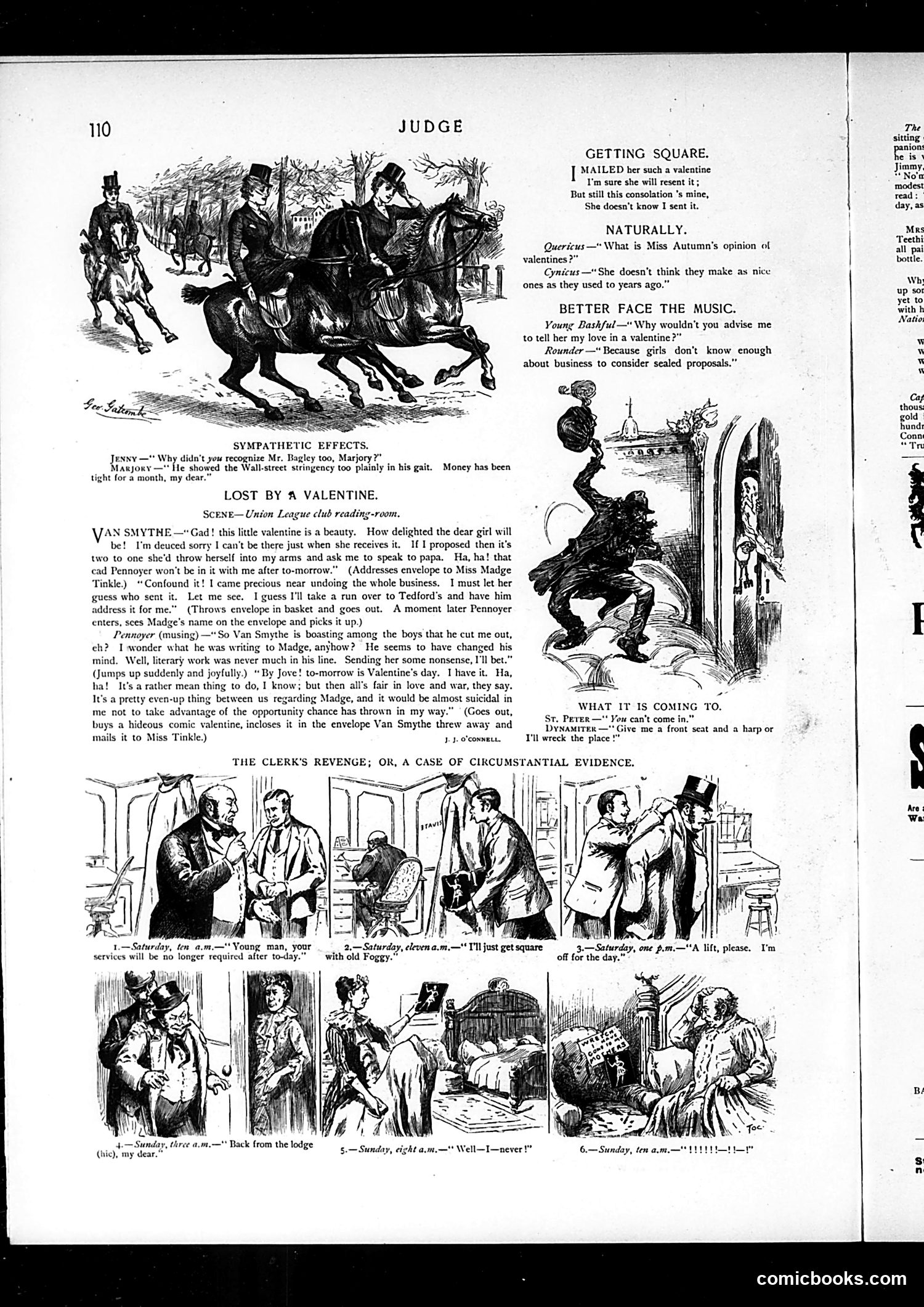
This page collects several humorous vignettes satirizing courtship, love letters, and Valentine's Day customs among upper-class Americans circa the 1880s-90s. **Main narratives:** "Lost by a Valentine" depicts two rivals—Van Smythe and Pennoyer—competing for Miss Madge Tinkle's affection. Van Smythe sends a romantic valentine, but Pennoyer intercepts it, replaces it with a crude "hideous comic valentine," and mails it in Van Smythe's name, sabotaging his proposal attempt. **Supporting items** mock Valentine's Day itself: women finding modern valentines inferior to older ones; men afraid to confess love through sealed letters; a dynamo/anarchist joke (obscure reference). **"The Clerk's Revenge"** depicts an employer firing a clerk Saturday morning; the clerk gets drunk at a lodge; returns Sunday hungover; the employer, suspicious but lacking proof, can't definitively blame him—circumstantial evidence only. The humor targets romantic miscalculation, class anxieties, and the consequences of scheming among idle wealthy men. All are light domestic satire typical of Judge's era.
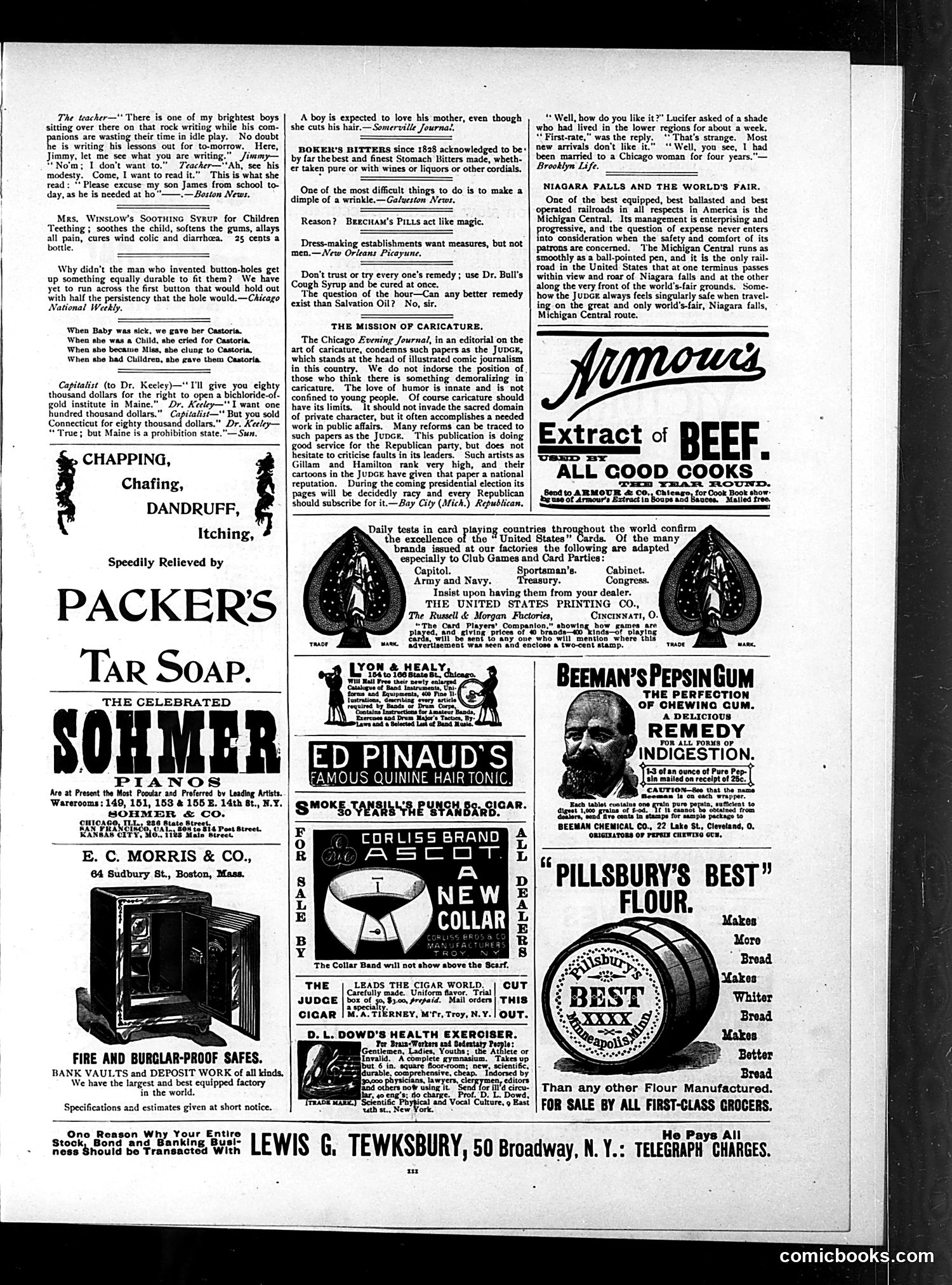
This page is primarily **advertising and filler content** rather than political cartoons. The visible cartoon material is minimal: **The cartoon shown** depicts a schoolteacher discovering a student (Jimmy) isn't doing homework as assumed, but writing an excuse note: "Please excuse my son James from school to-day, as he is needed at ho[me]." It's a gentle joke about parental excuses for truancy. **The substantive text** is an editorial defending caricature as a legitimate art form, citing Judge's own cartoonists (Gillam and Hamilton) as nationally respected. It argues caricature serves reform by criticizing public figures—though it should avoid attacking private character. The piece supports Judge's Republican editorial stance. **Otherwise, the page is dominated by advertisements** for patent medicines (Castoria, Beecham's Pills), safes, pianos, flour, and soap—typical of 1890s magazine pages. These ads, not the editorial content, likely generated the publication's revenue.
This page is **primarily an advertising section** with limited editorial content. The notable elements: **Editorial Content:** The opening mentions the Boston Library reading-rooms banned *Judge* and other humorous papers—a real restriction the magazine protested, arguing humor brightens life. There's also endorsement of John C. Hutchinson's glove advertisement as an example of honest business. **Advertisements:** The page features typical period ads for cameras (Kodak), bicycles (Overman Wheel), ladies' clothing, medical "cures" (catarrh remedies, a "drunkenness cure"), steel pens, and hotels. Many advertise dubious patent medicines and remedies common to the era. **No Cartoons:** Unlike typical *Judge* content, this page contains **no satirical illustrations or cartoons**—it's a commercial section. The "Victors" bicycle logo is the only illustrated branding element visible. The page illustrates how late-19th-century magazines monetized through extensive advertising, including many health-related products we'd now recognize as quackery.
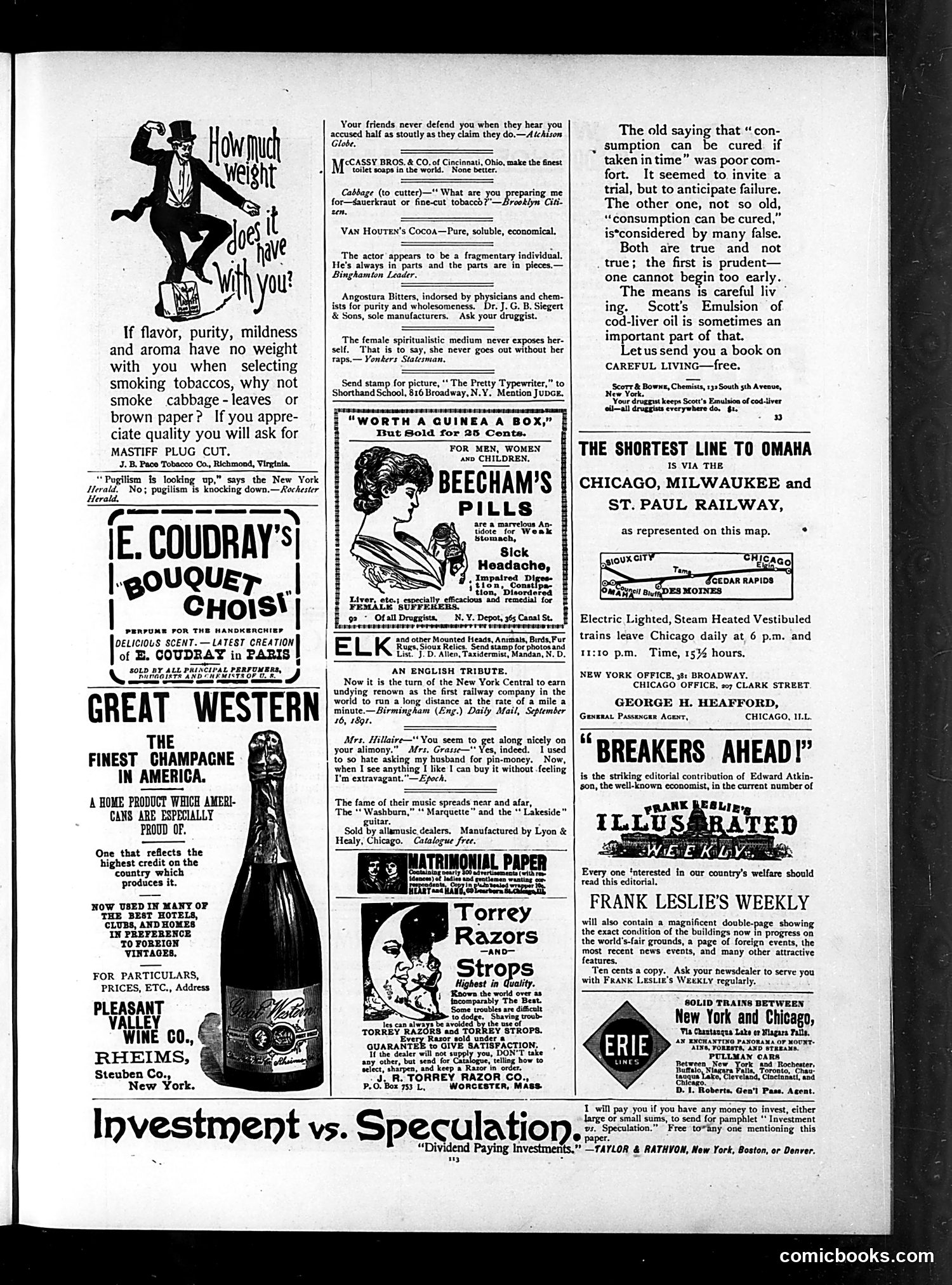
This is primarily an **advertising page** from Judge magazine, with minimal editorial content. The few jokes/cartoons present are brief one-liners rather than substantial satire: **The main cartoon** shows a man balancing on a scale labeled "How much weight does it have with you?" — a visual pun advertising Mastiff Plug Cut tobacco. The joke plays on "weight" (literal and figurative quality). **Sidebar jokes** include: - A boxing pun: "Pugilism is looking up" vs. "knocking down" - Quips about spiritualist mediums, actors, and alimony **The advertisements** represent typical turn-of-the-century products: tobacco, champagne, perfume, pills, razors, and railroads. Most ads make health or quality claims (Beecham's Pills for digestion, Scott's Emulsion for consumption/tuberculosis treatment). The page reflects **1890s consumer culture and advertising tropes**—particularly exaggerated health claims that would later face regulation. The tone is light and commercial rather than politically satirical.
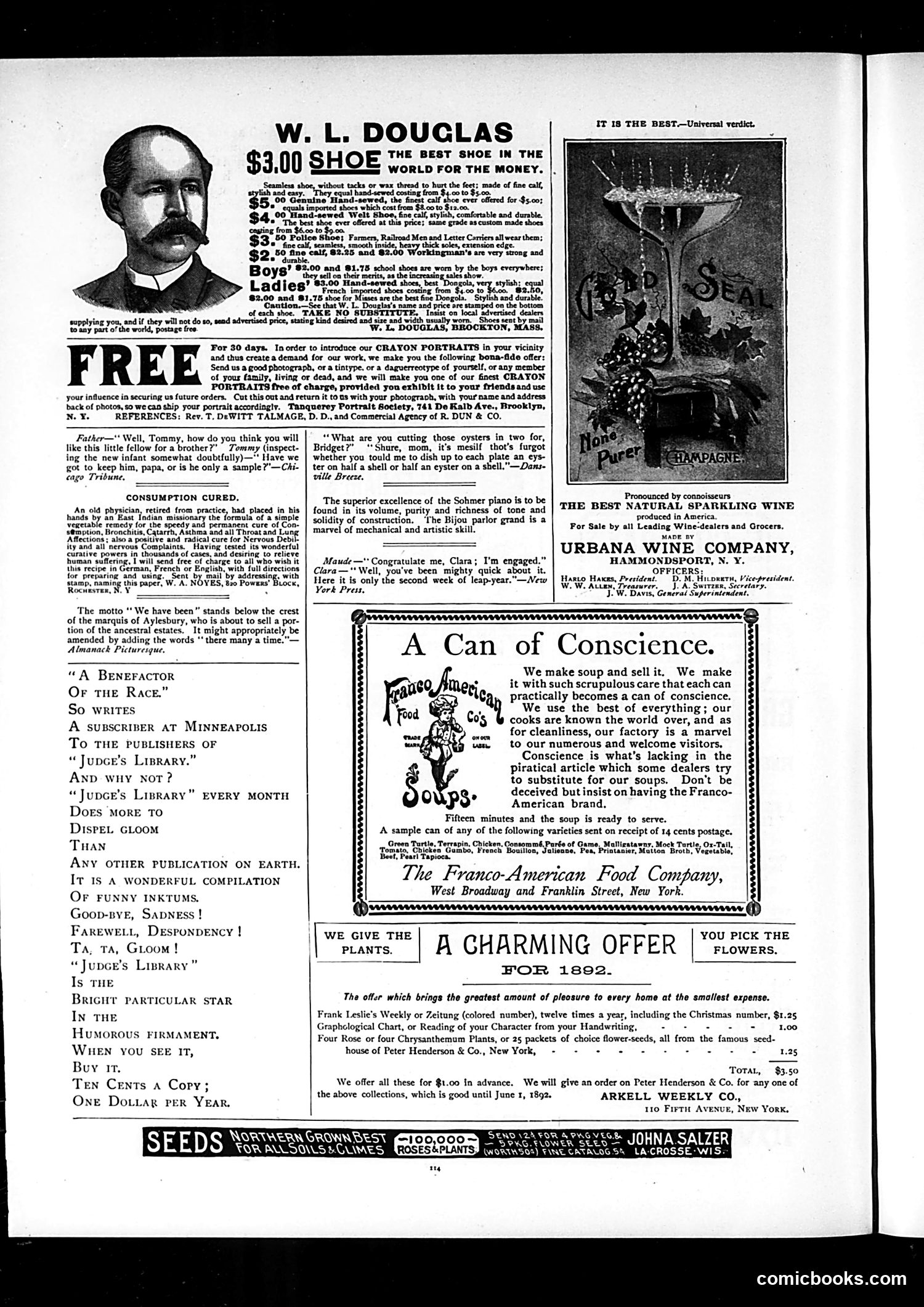
This is primarily an **advertising page** from Judge magazine, with minimal editorial cartoon content. The main visual element is a photograph labeled "CHAMPAGNE" showing what appears to be a wine bottle or promotional image. The page features advertisements for consumer goods typical of the 1890s: W.L. Douglas shoes, portrait services, Franco-American soup, and seeds. There are brief humorous anecdotes scattered between ads—including a joke about a father asking his son if the new baby is permanent or a "sample," and an Irish maid confused about oyster portions. A notable text item promotes "Judge's Library," claiming it relieves gloom and depression better than any publication on earth. The page lacks substantive political satire or identifiable caricatures of specific public figures. Instead, it reflects **genteel 1890s humor** aimed at middle-class consumers: domestic confusion, immigrant dialect jokes, and product endorsements. The overall function is commercial rather than satirical.
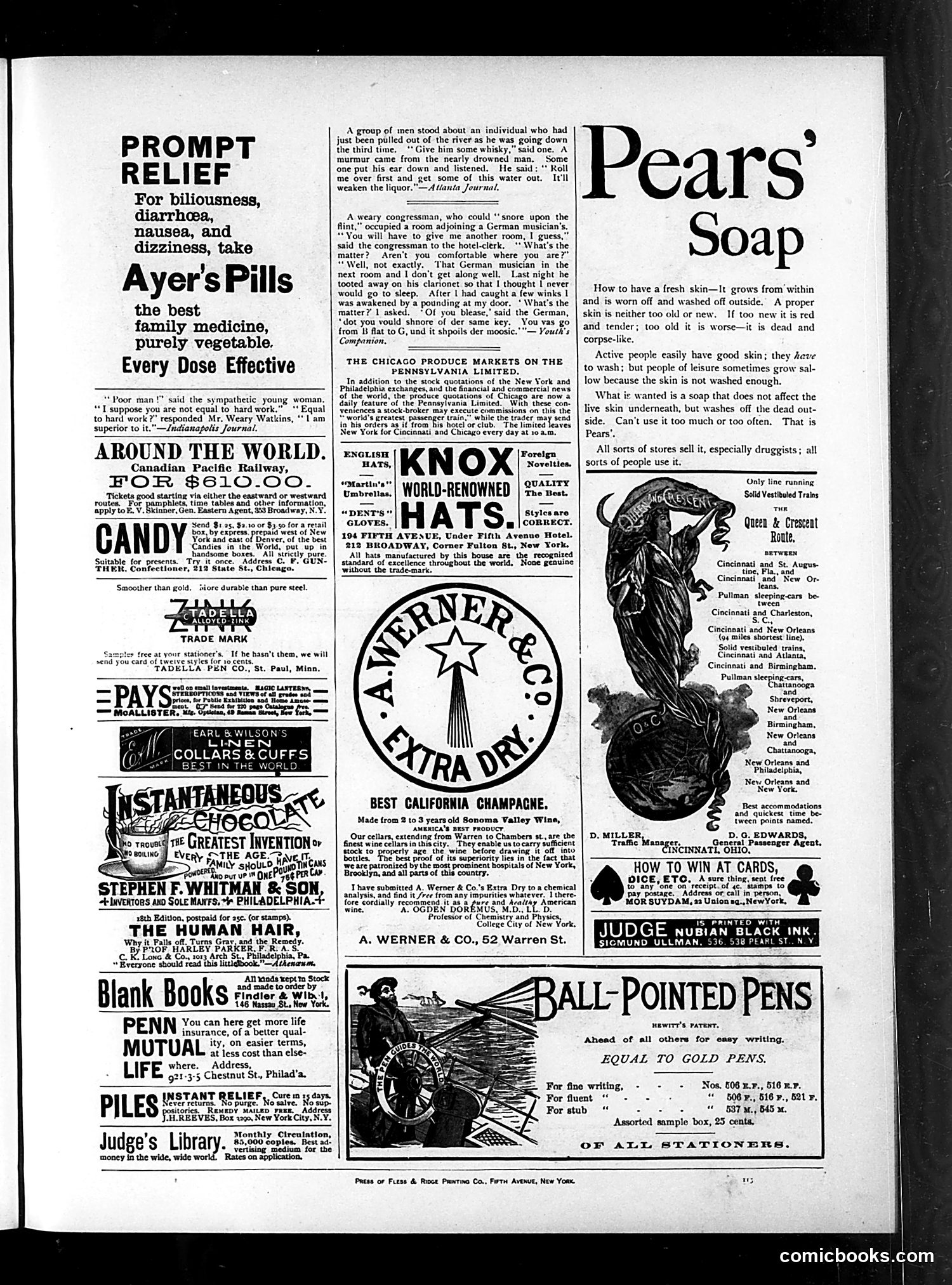
This page is **primarily advertisements** for late 19th/early 20th-century products (Ayer's Pills, Pears' Soap, Knox Hats, etc.), with several brief comic anecdotes interspersed. The humor relies on **wordplay and mild social observation** rather than political satire: - A nearly-drowned man wants water removed from his stomach before being given whisky—a joke about priorities and practicality - A congressman complains that a German musician's clarinet solos disrupt his snoring, and the musician responds by asking him to snore in the same key—satirizing both the congressman's rudeness and the absurdity of musical pedantry - An opening anecdote plays on the phrase "equal to hard work," with a vagrant claiming he's "superior to it"—gentle class humor The **Pears' Soap advertisement** includes descriptive text about skin care, positioning soap as essential for maintaining proper complexion. Overall, this reflects **Judge magazine's** mix of light social comedy and commercial advertising typical of American periodicals from this era. No specific political figures or events are referenced.
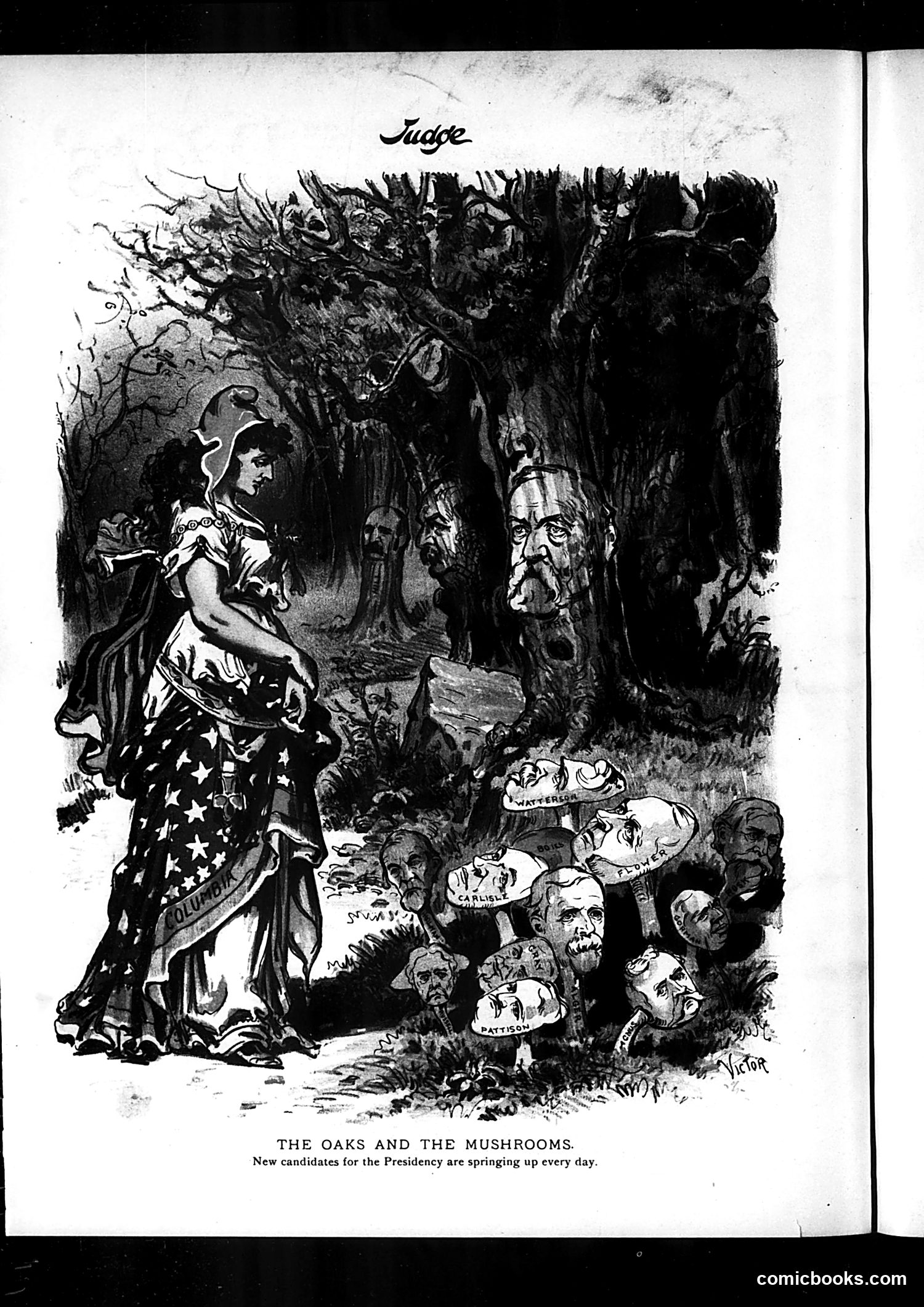
This political cartoon satirizes the 1884 presidential election cycle. Lady Liberty (left, in starred dress) watches as numerous political candidates—depicted as tiny mushrooms sprouting from the ground—emerge beneath towering oak trees (established politicians). The caption's subtitle notes that "new candidates for the Presidency are springing up every day." The satire works through contrast: mushrooms are weak, temporary growths that appear overnight, while oaks are established and enduring. The cartoon mocks the proliferation of lesser-known or hastily-assembled candidates challenging established political figures. Several mushroom-heads bear visible labels, though most are illegible in reproduction. This reflects contemporary frustration with the crowded primary/nomination process and the emergence of marginal candidates during competitive election years.