
A complete issue · 17 pages · 1891
Judge — April 4, 1891
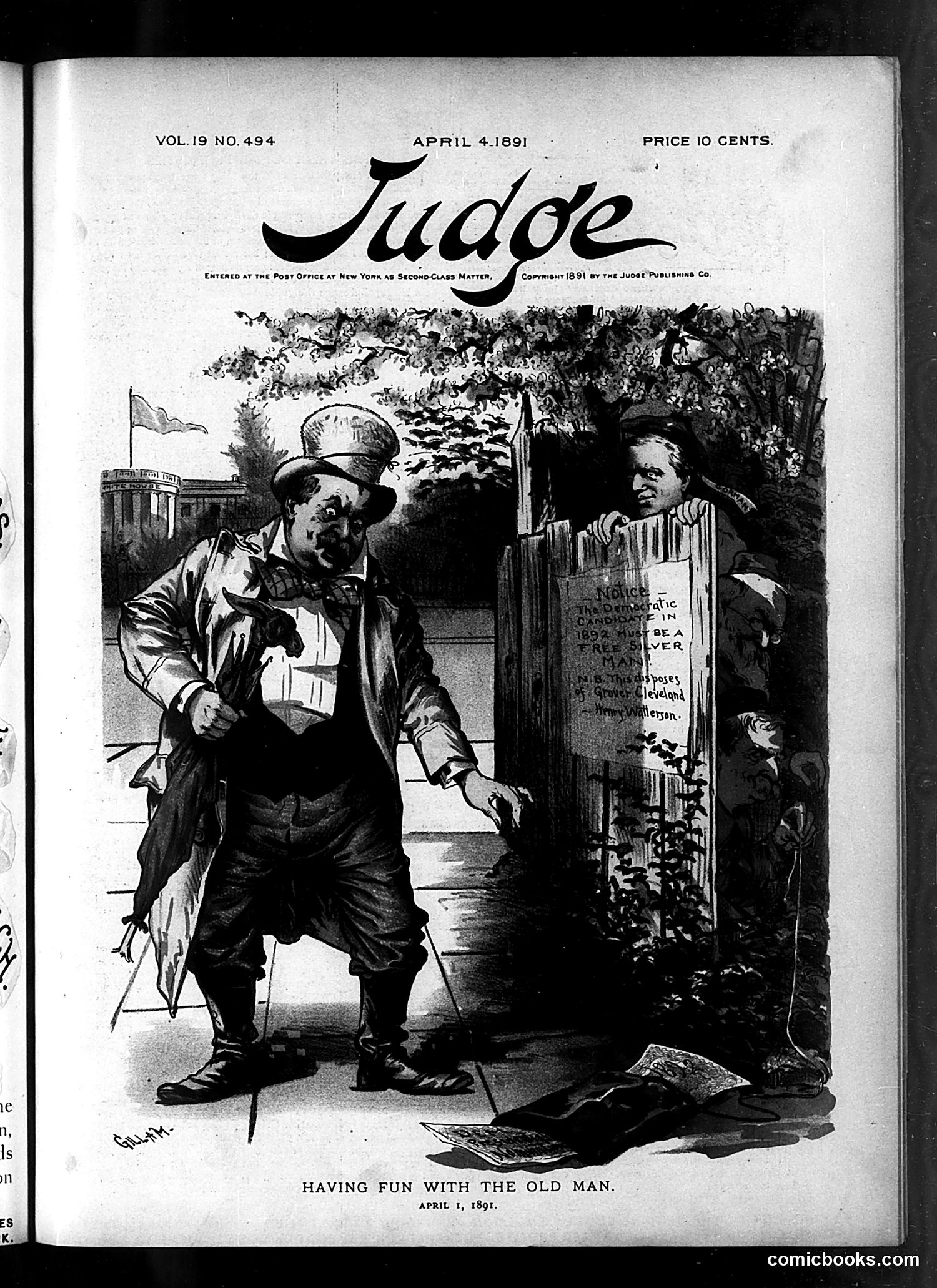
This cartoon depicts a figure in formal dress and top hat confronting what appears to be an elderly or caricatured man at a fence marked with a notice. The title suggests mockery or teasing of an older authority figure. The setting includes a government building with a flag in the background, suggesting political commentary. The notice on the fence is partially legible but unclear in this image quality. Without clearer visibility of the notice's text or identifying details of the figures, I cannot definitively state which specific political figures or events this references. The cartoon likely comments on April Fool's Day (dated April 1, 1891) political pranks or ridicule of a contemporary public figure, but the specific target remains uncertain from this reproduction.
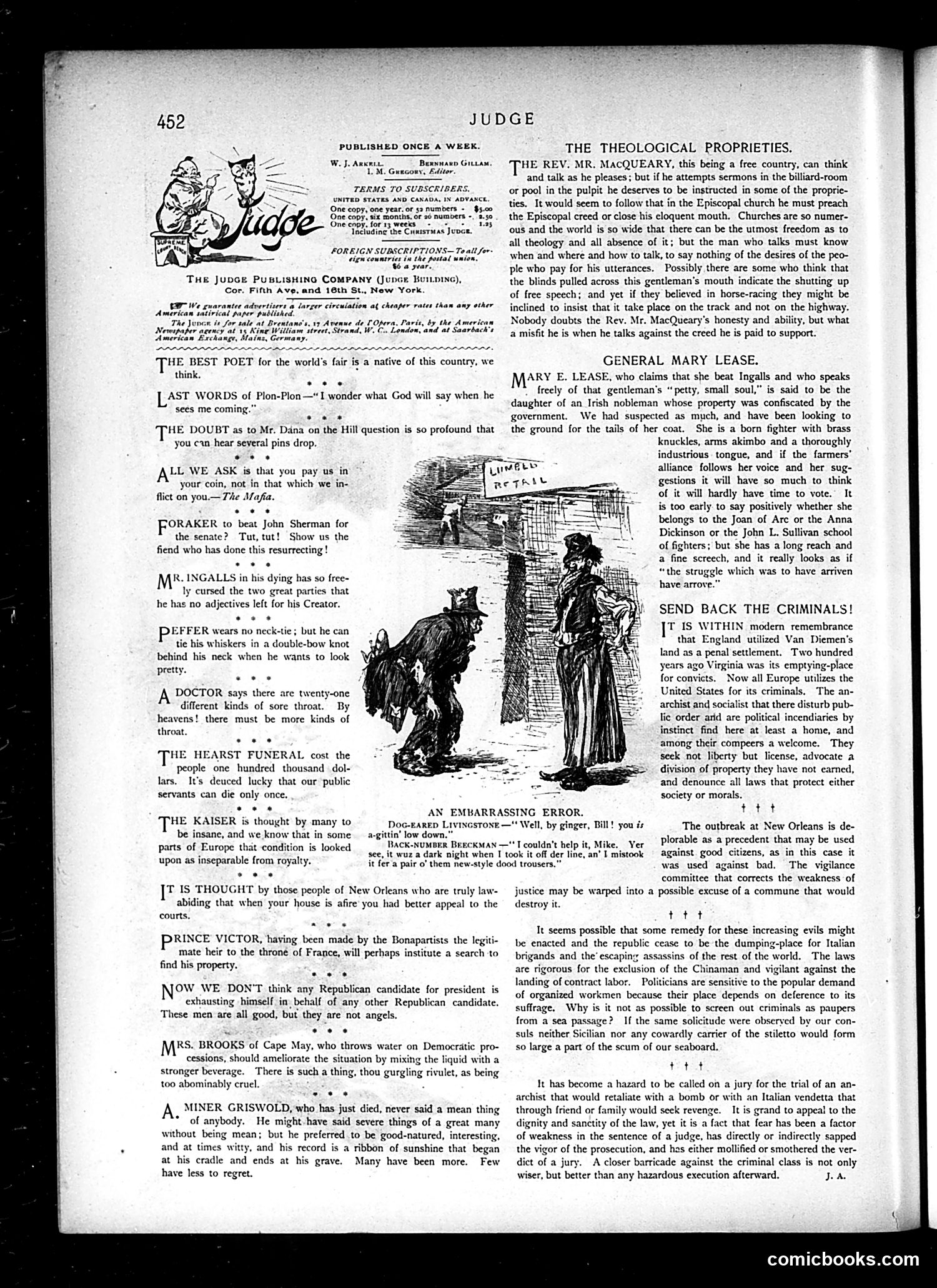
This page from *Judge* magazine contains several short political jabs and one sketch. The cartoon depicts what appears to be a street scene with figures in period dress, though specific identities aren't clearly labeled in the visible portion. The text snippets target various public figures and political issues of the era: references to "Fion-Fion" (likely a theatrical figure), criticisms of Dana on "the Hill question," and jabs at Republican presidential candidates. There's commentary on Ingalls' political demise, critiques of various officials' behaviors, and social observations about convict labor and colonial policies. Without clearer date markers or more explicit labels, precise identification of all targets remains difficult, though the satire targets politics, society, and public figures typical of *Judge's* partisan commentary.
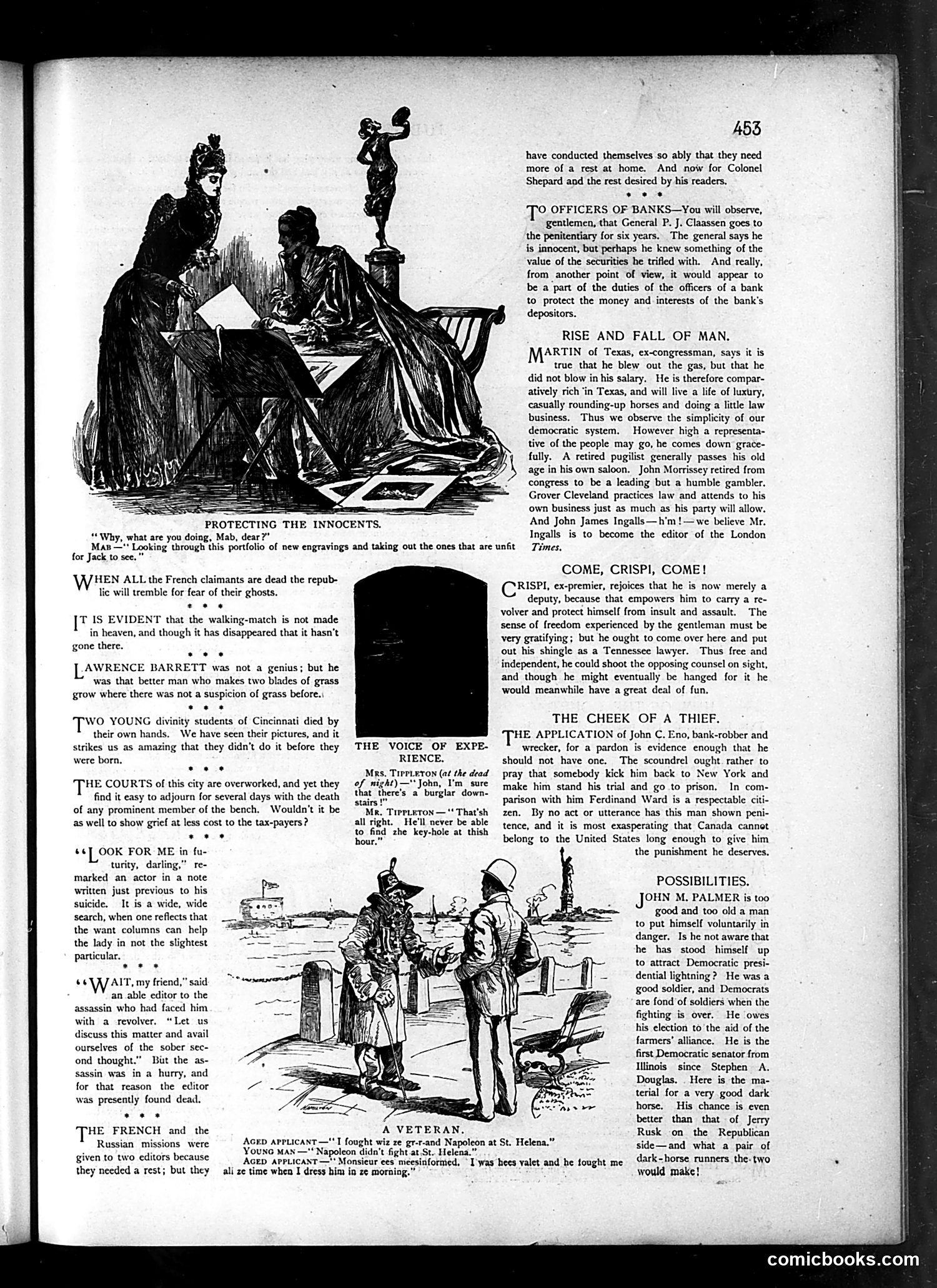
This page contains multiple brief satirical items typical of Judge's format. The main illustration, "Protecting the Innocents," shows two figures examining documents—likely satirizing concerns about protecting the public from some perceived threat, though the specific reference is unclear without additional context. The text items mock various figures and situations: politicians' conduct, military decisions, and individual scandals. References include Martin of Texas (a congressman), General P.J. Cluseret, and John C. Eno (a bank robber seeking a pardon). The satire targets corruption, incompetence, and hypocrisy among public figures and institutions. The "Cheek of a Thief" section criticizes Eno's pardon application, while other items mock politicians' self-serving behavior and the courts' inefficiency. Without dating information, the specific historical context remains unclear.
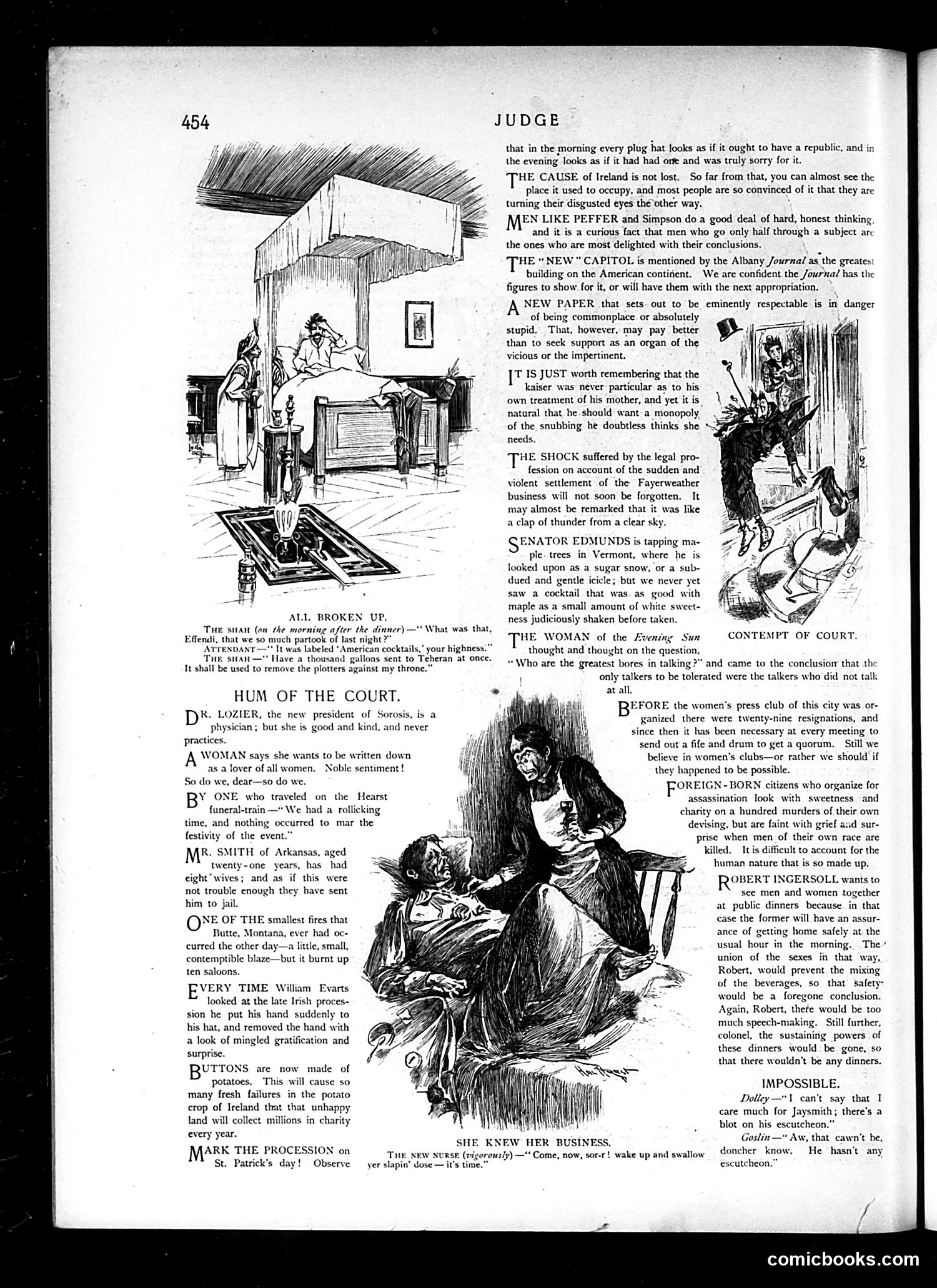
This page contains satirical commentary on contemporary 1890s American politics and society. The cartoons mock: **"All Broken Up"** depicts the Shah of Persia complaining about "American cocktails" after a dinner, threatening to send gallons to remove "plotters against my throne"—satire on foreign dignitaries' unfamiliarity with American customs and the stereotype of Persian despotism. **"She Knew Her Business"** shows a nurse tending a patient, accompanying text about women's clubs struggling with attendance (twenty-nine resignations before one club even formed). The satire mocks women's organizations as inherently dysfunctional. Other brief items ridicule Senator Edmunds, the Kaiser's mother-treatment, and Irish emigration. References to William Evarts, the Fayerweather legal case, and Hearst's funeral train anchor these in specific 1890s events, though exact context is now obscure. The overall tone is cynical about women's advancement, foreign affairs, and Irish-American issues—typical of Gilded Age satirical journalism.
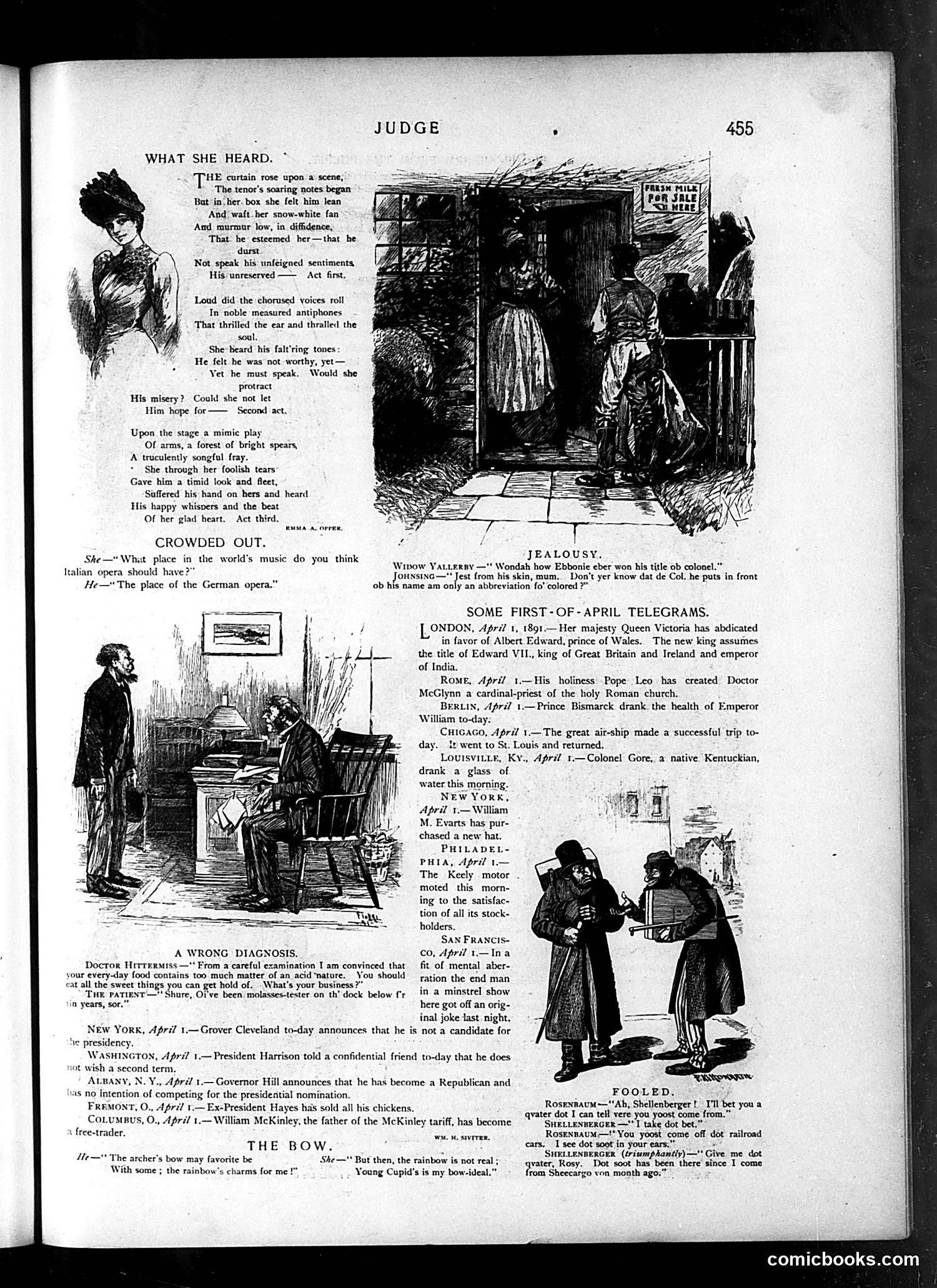
This page combines theatrical satire with contemporary political humor typical of April Fools' Day coverage. **"What She Heard"** satirizes opera-goers distracted by romantic advances. While a tenor performs on stage, a man in her box whispers declarations of love, drowning out the music. The joke targets both pretentious opera culture and the absurdity of courtship interrupting art. **"Crowded Out"** uses a racist dialect joke about German versus Italian opera, reflecting period prejudices about immigrant musical traditions. **"Some First-of-April Telegrams"** mocks political figures through obviously false "news": Cleveland denying presidential ambitions, Harrison rejecting a second term, and Governor Hill becoming Republican—all implausible reversals of their actual positions, marking them as April Fools' jokes. The remaining cartoons target specific professions: a doctor misdiagnosing a molasses-tester's diet, and Rosenbaum and Shellenberger (railroad workers) discussing how one's appearance reveals his occupation. The page essentially satirizes public figures, opera culture, and working-class stereotypes through period-typical humor.
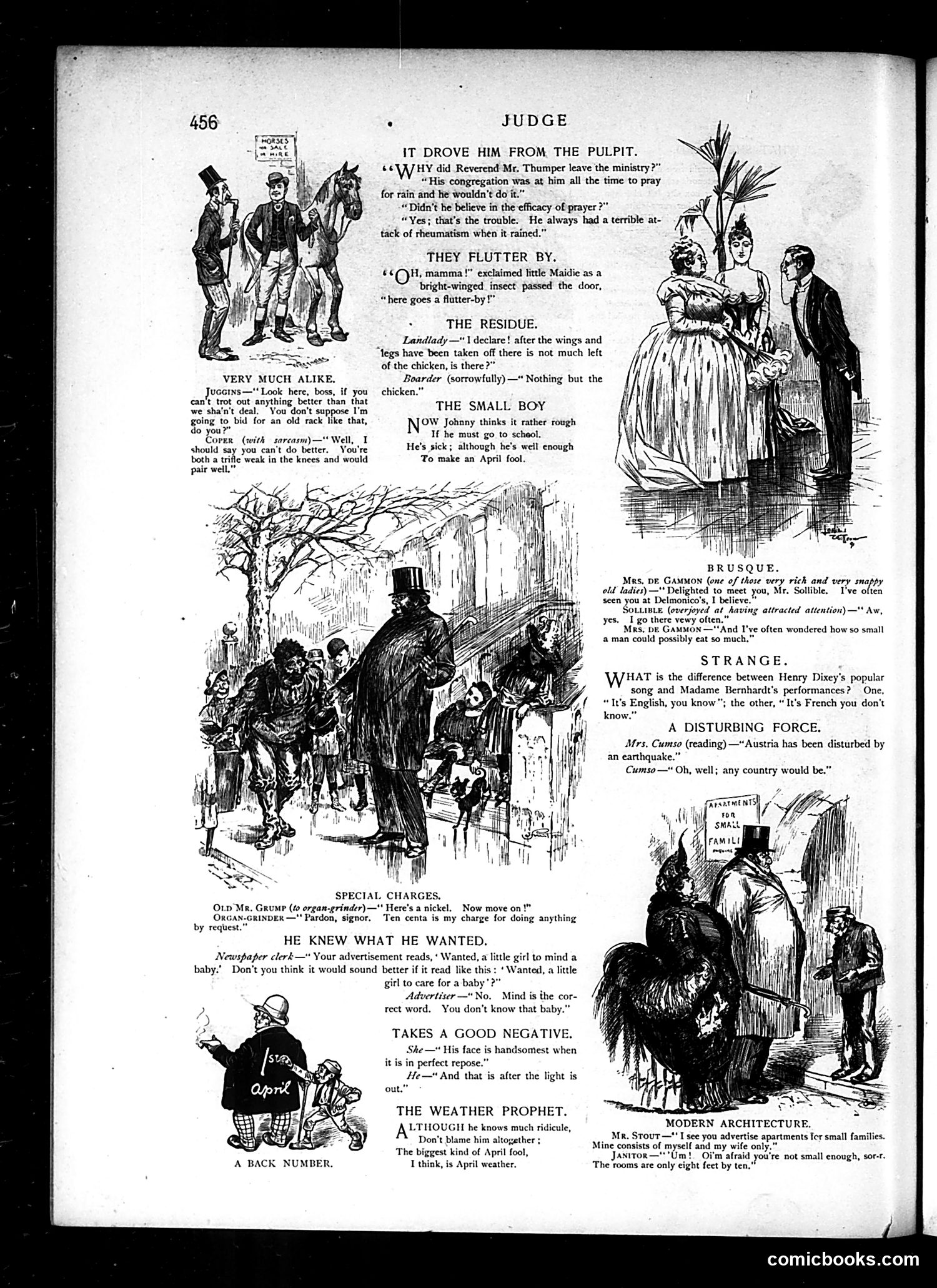
This page from *Judge* (a late 19th-century American humor magazine) contains multiple short satirical pieces: **"It Drove Him from the Pulpit"**: Mocks a minister who won't pray for rain because it triggers his rheumatism—satire on religious hypocrisy and self-interest. **"They Flutter By" and "The Residue"**: Gentle wordplay jokes about a child mispronouncing "butterfly" and a boarder's complaint about meager chicken portions. **"The Small Boy"**: Social commentary on truancy—a sick child well enough to cause mischief but not school. **"Brusque"** and **"Strange"**: Brief character sketches mocking pretentious wealthy people and vaudeville performers (Henry Dixey and Sarah Bernhardt). **"A Disturbing Force"**: Political quip about Austria's earthquake, implying the country is naturally troublesome. **"He Knew What He Wanted"**: Wordplay about "mind" versus "care for" a baby, suggesting the baby is uncontrollable. **"Modern Architecture"**: Housing satire—a landlord claims apartments are too small even for a couple. The page exemplifies *Judge*'s mix of topical satire, social criticism, and mild humor aimed at middle-class readers.
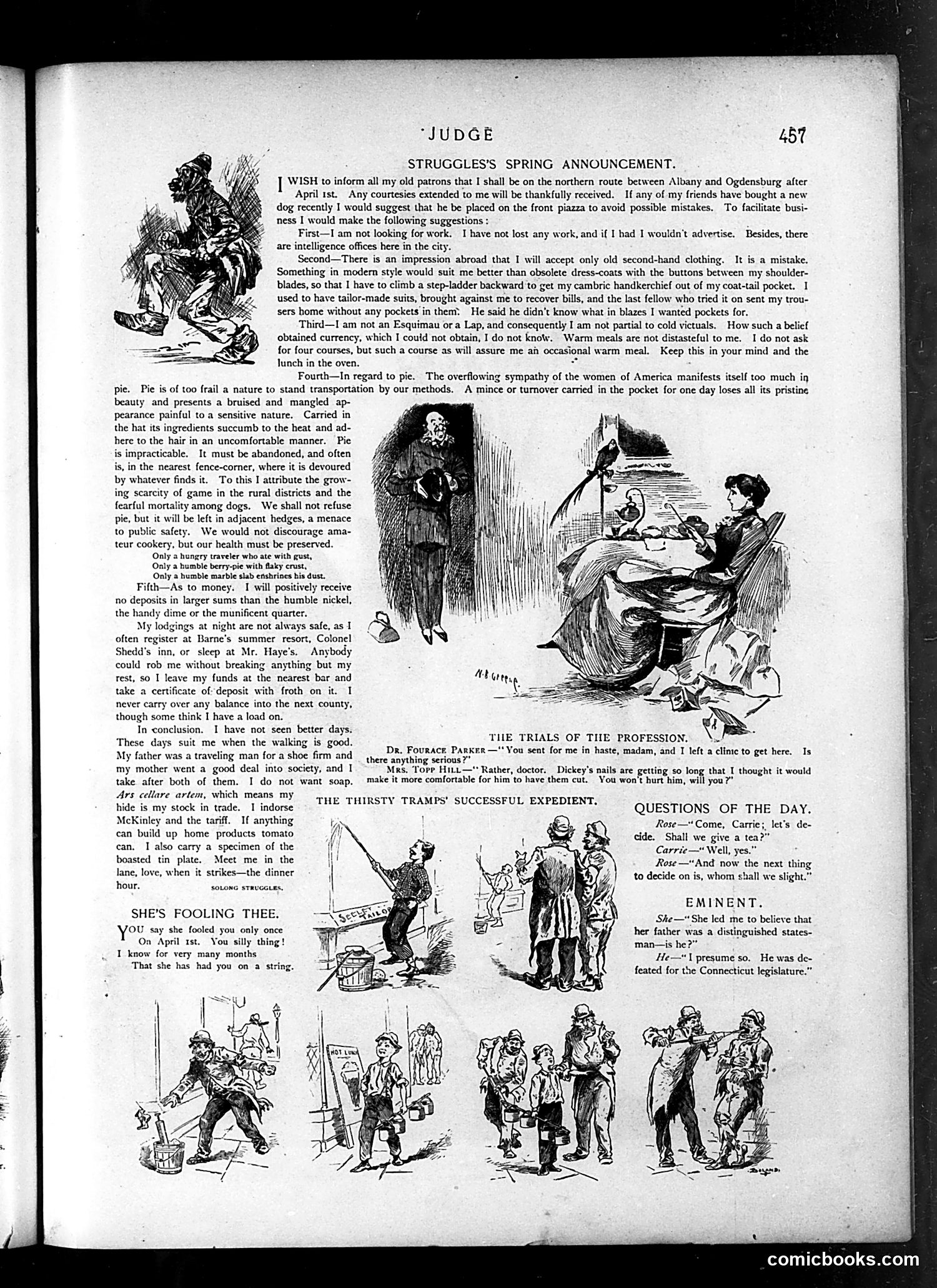
This is a humorous piece satirizing vagrant life and begging culture in late 19th-century America. The central figure, "Struggles" (appearing to be a stock character representing a tramp or itinerant beggar), issues deadpan "announcements" about his traveling route and demands—a parody of legitimate business notices. The satire targets both the vagrant himself and American charity culture. Each numbered point mocks common excuses or complaints: he claims he's not looking for work, doesn't want old clothing donations, refuses cold food, despises pie (which gets damaged in pockets), and demands only small cash deposits. The absurdist humor culminates in his boast of supporting McKinley and the tariff—incongruous political opinions for a homeless man. The accompanying cartoons illustrate the hardships of vagabond life. The satire critiques both exploitative treatment of wanderers and the patronizing, ineffective "sympathy" middle-class Americans extended through inappropriate charity like pie and worn-out coats.
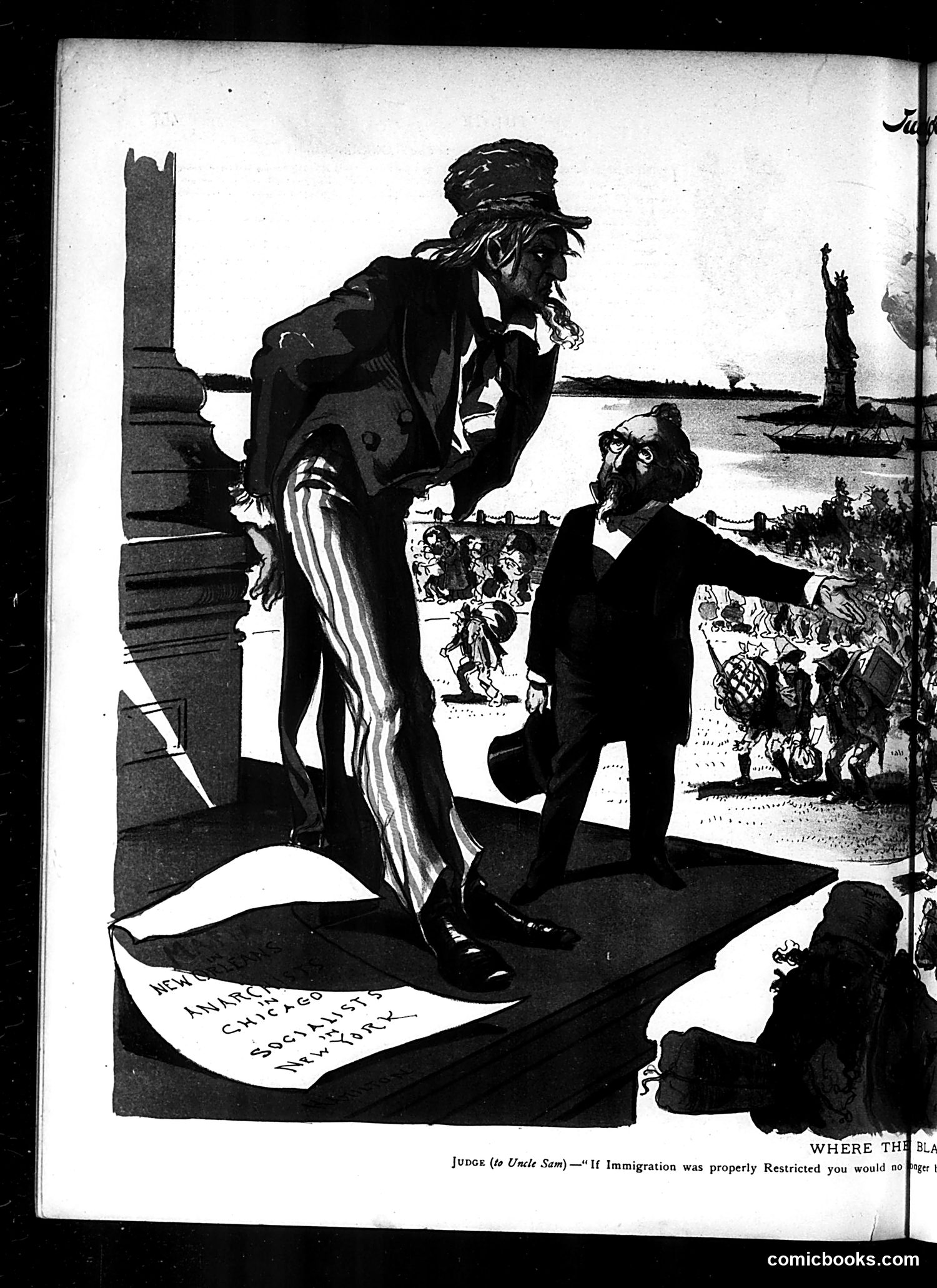
This Judge magazine cartoon depicts Uncle Sam (personified America) as a tall figure being addressed by "Judge" (the magazine's satirical voice). The caption criticizes U.S. immigration policy, with Judge telling Uncle Sam: "If Immigration was properly Restricted you would no [longer have these problems]." The background shows the Statue of Liberty and crowded masses of immigrants arriving by ship—visual shorthand for immigration concerns of the era. The cartoon advocates for immigration restriction as a solution to unnamed social problems. This reflects early-to-mid 20th century nativist sentiment in American political discourse, when restrictionist immigration policies gained traction. The satire targets what Judge's editors viewed as Uncle Sam's failure to implement sufficient immigration controls.
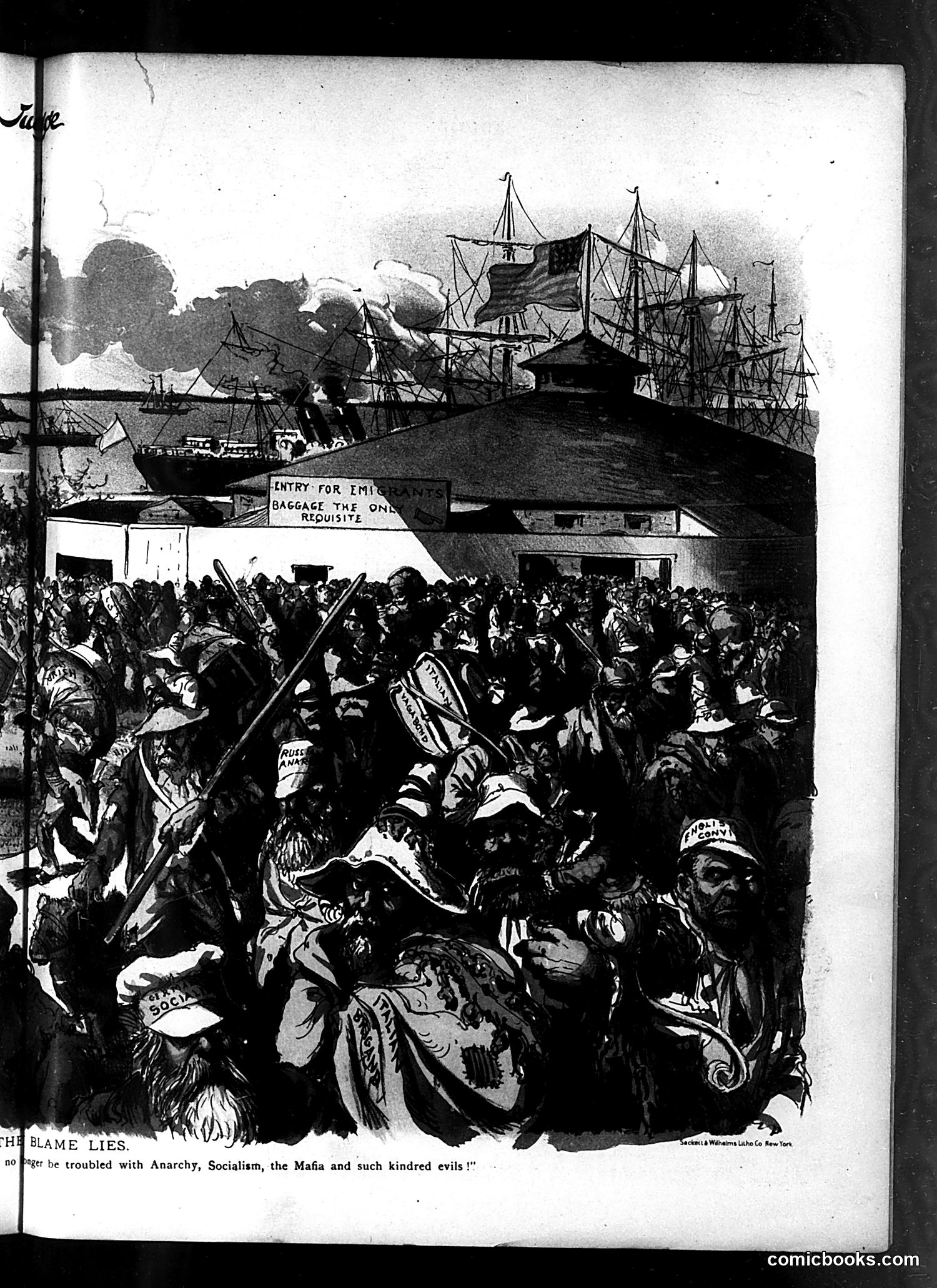
This cartoon satirizes nativist anxieties about immigration. A massive crowd of immigrants—depicted with exaggerated ethnic features and wearing caps labeled with various nationalities—masses at a dock preparing to board ships. A sign reads "ENTRY FOR EMIGRANTS: BAGGAGE THE ONLY REQUISITE," suggesting immigrants enter with minimal scrutiny. The caption blames immigrants for "Anarchy, Socialism, the Mafia and such kindred evils," a common late 19th/early 20th-century stereotype. The cartoon mockingly suggests America's social problems stem from foreign arrivals rather than domestic causes. Judge magazine, aimed at elite audiences, used such imagery to stoke fears about undesirable foreign elements threatening American society—reflecting the period's widespread anti-immigrant sentiment and suspicion of radical ideologies associated with European newcomers.
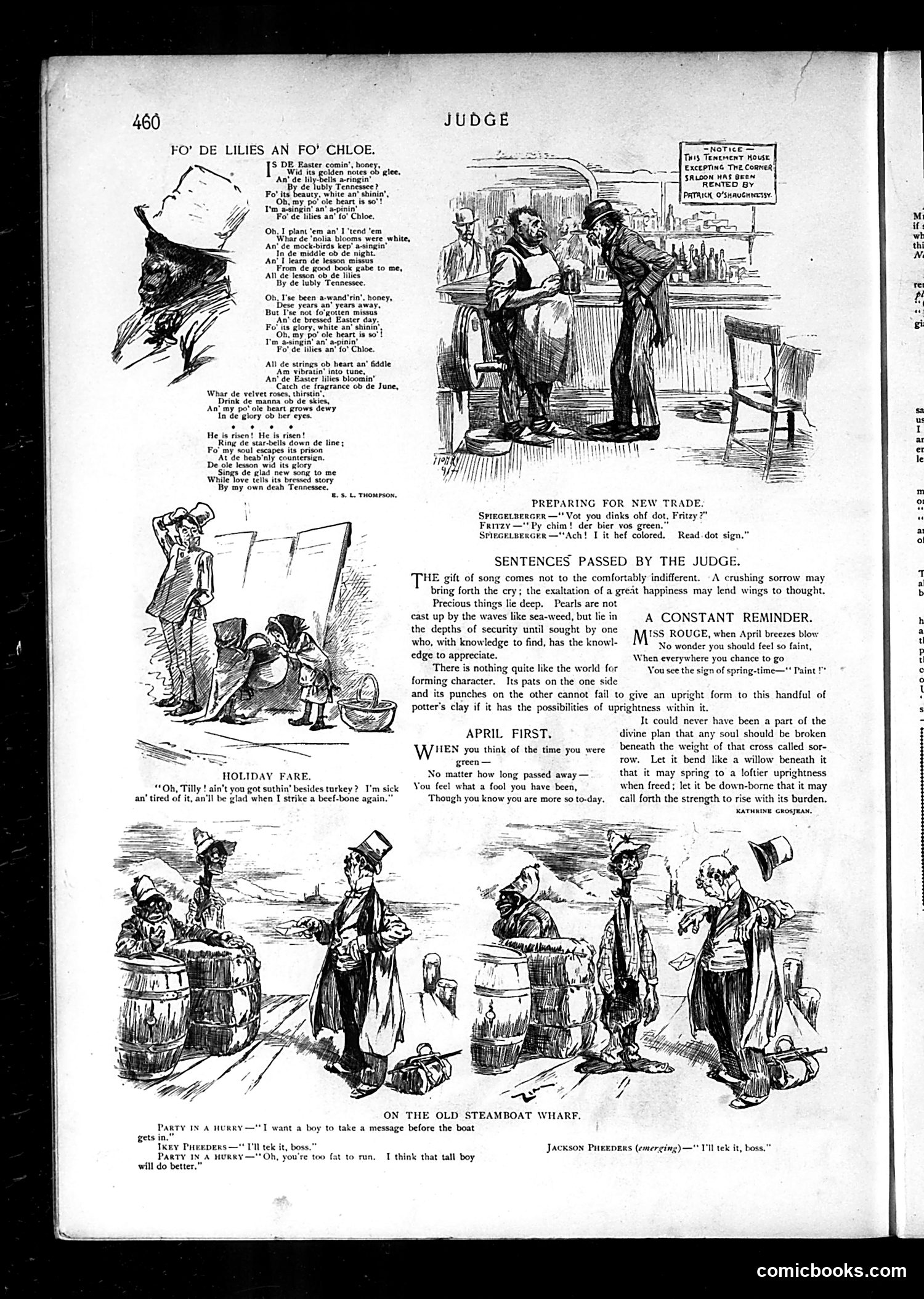
This page contains sentimental and comedic content typical of late 19th-century American humor magazines. **"Fo' De Lilies An Fo' Chloe"** is a nostalgic poem written in exaggerated African American dialect, depicting a formerly enslaved person reminiscing about antebellum plantation life and Easter lilies associated with a beloved white woman ("missus"). The romanticized tone reflects the page's era's problematic nostalgia for the antebellum South. **"Preparing for New Trade"** shows German immigrants discussing beer, with a notice about a tenement house rented to "Patrick O'Shaughnessy"—satirizing ethnic tensions as Irish and German immigrants competed economically in urban areas. **Multiple cartoons** depict working-class life: "Holiday Fare" shows domestic complaints; "On the Old Steamboat Wharf" uses physical comedy about hiring a messenger, where a fat boy is rejected in favor of a tall one. The accompanying prose sections ("Sentences Passed by the Judge") offer sentimental moral reflections on suffering and character-building—typical of the magazine's mix of humor and uplift.
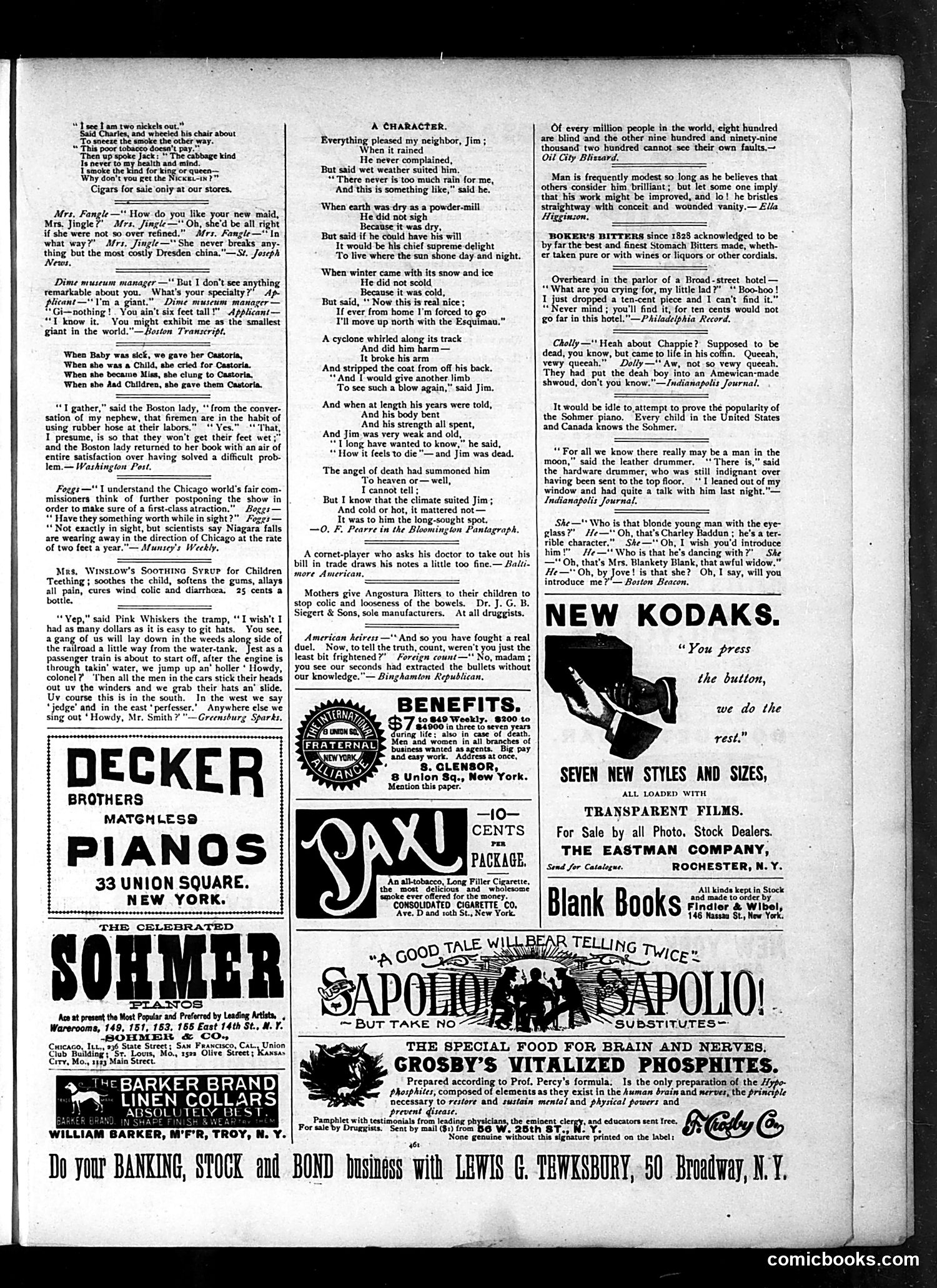
This page is primarily **advertisements and humorous short pieces**, not political cartoons. The main content includes: **Humorous Vignettes:** Several brief jokes about social situations—a woman hiring an overly refined maid who refuses plain dishes, a dime museum manager hiring a "giant" who admits he's unusually short, and a tramp describing hat-stealing schemes from moving trains. **Central Poem: "A Character":** A longer piece celebrating an perpetually cheerful neighbor named Jim who finds contentment in all weather and circumstances—rain, drought, snow, even a cyclone that breaks his arm. The satire targets **excessive optimism and forced positivity**, presenting Jim as almost absurdly content regardless of misfortune. **Advertisements:** Piano manufacturers, cigars, patent medicines (Castoria for children), and other period products dominate the page—typical Judge magazine filler. **No identifiable political figures or events** appear. This is a humor and advertising page with no contemporary political reference that would be lost to modern readers.
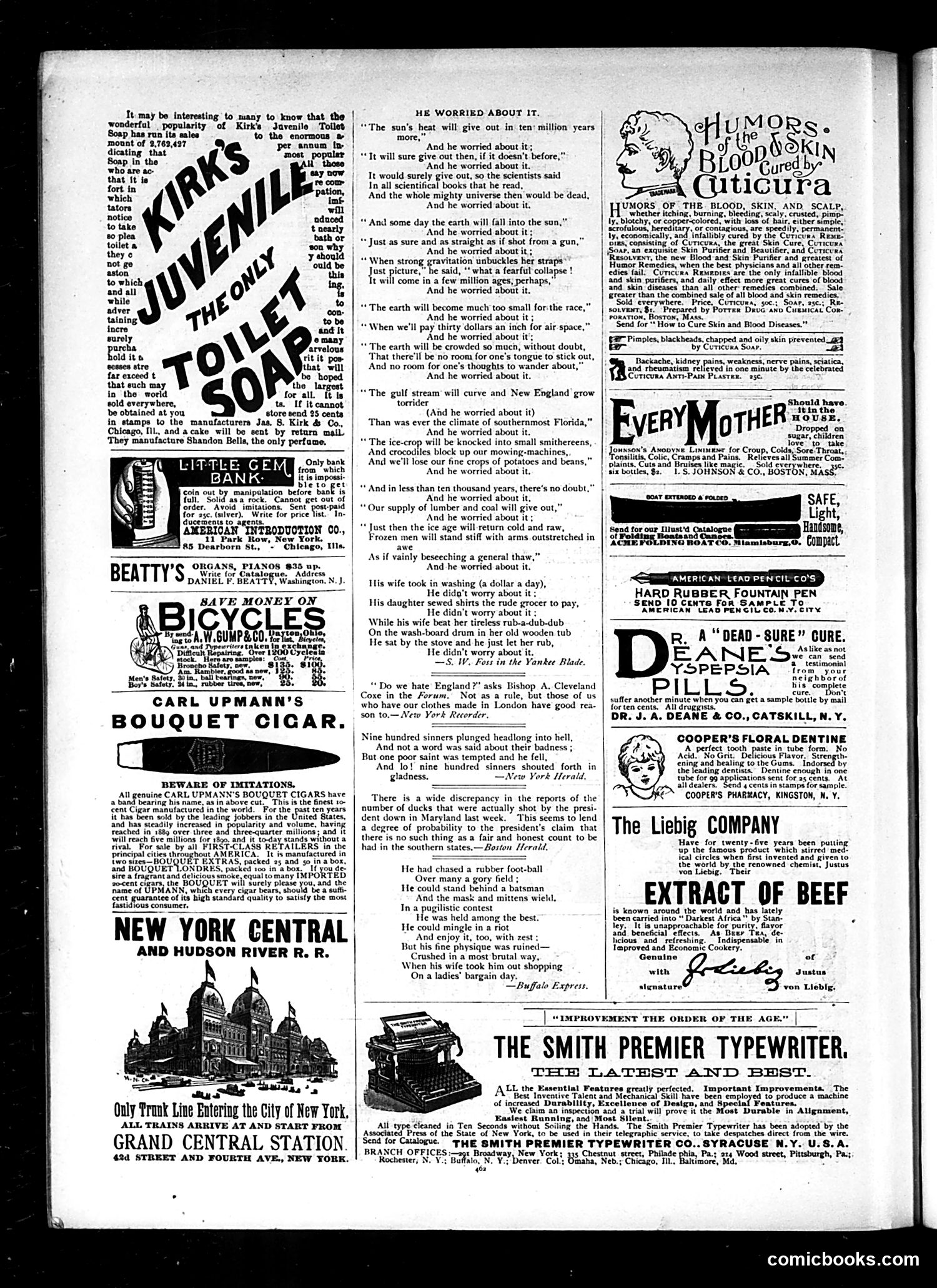
This page features a humorous poem mocking anxious doomsdayers who obsess over distant, catastrophic scenarios: the sun's heat dying out in ten million years, Earth falling into the sun, gravity failing, overpopulation causing air shortages, climate change, and crop failures. The satire targets Victorian-era pessimists and scientific alarmists who became paralyzed by theoretical future disasters beyond human control or immediate concern. The repetitive refrain "And he worried about it" emphasizes the absurdity—the protagonist frets uselessly over cosmic events occurring millions of years hence that no individual action can prevent. This reflects late-19th-century anxieties about scientific predictions and determinism, gently ridiculing those who lost sleep over inevitable, distant doom rather than addressing present-day concerns. The page surrounds this with period advertisements, typical of Judge's format.
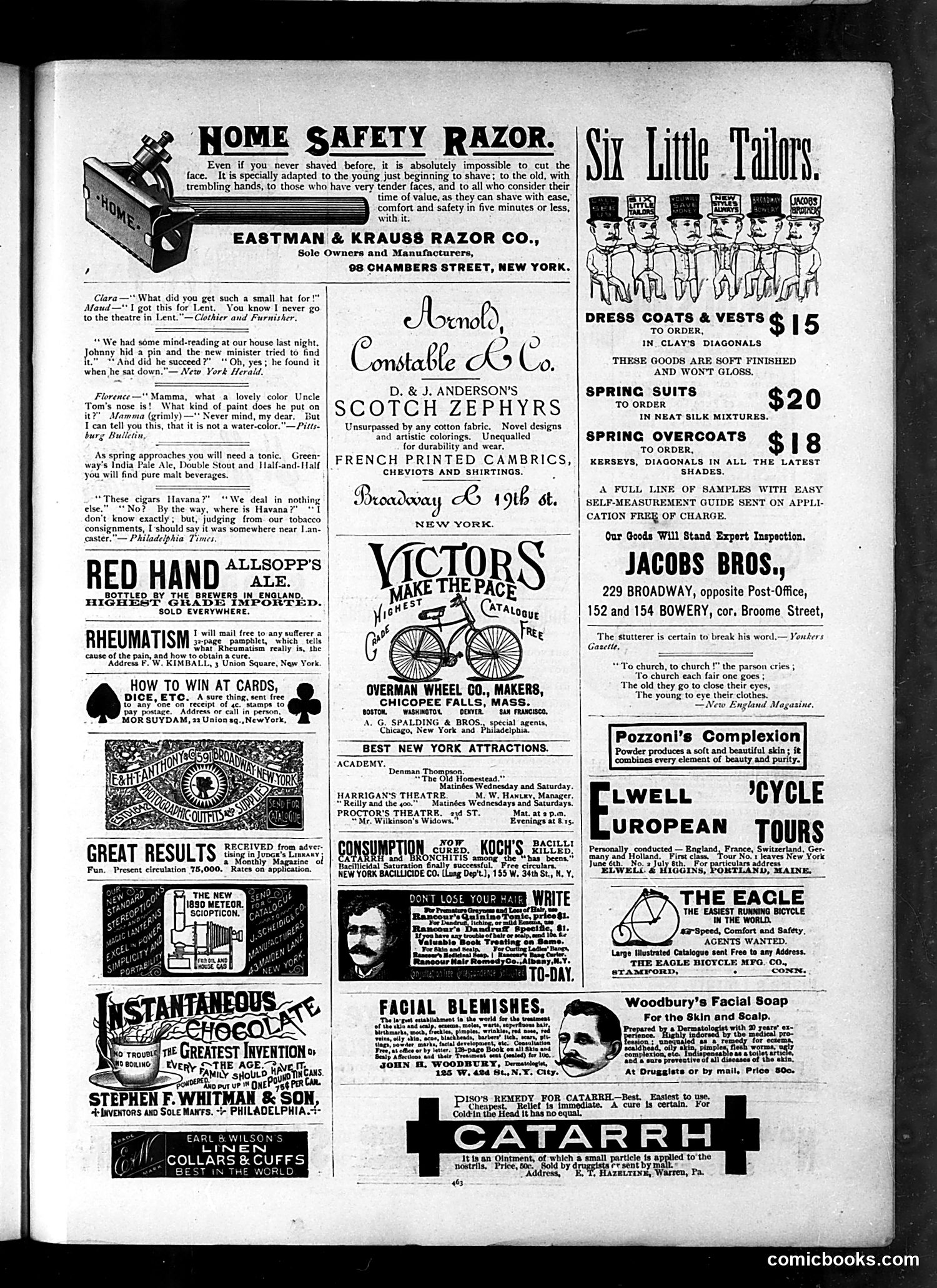
This is primarily an **advertising page** from Judge magazine, with minimal editorial cartoon content. The page features various commercial advertisements for late 19th-century products and services—razors, clothing, bicycles, patent medicines, and theatrical attractions. The few humor items present are brief **jokes** rather than political satire: - A joke about a woman buying a small hat "for Lent" (implying she won't attend theater during Lenten season) - A minister attempting mind-reading at a dinner party - A child asking about an uncle's complexion being "paint" rather than water-color These are gentle domestic humor, typical of Judge's lighter content—not political commentary. The **advertisements** reflect the era's consumer culture and include period remedies like treatments for rheumatism and hair loss, alongside legitimate goods like clothing and bicycles. The Jacobs Bros. tailoring advertisement and the Home Safety Razor represent typical commercial messaging of the 1890s. This page demonstrates how Judge mixed advertising with editorial content, rather than serving primarily as a political-satire publication on this particular issue.
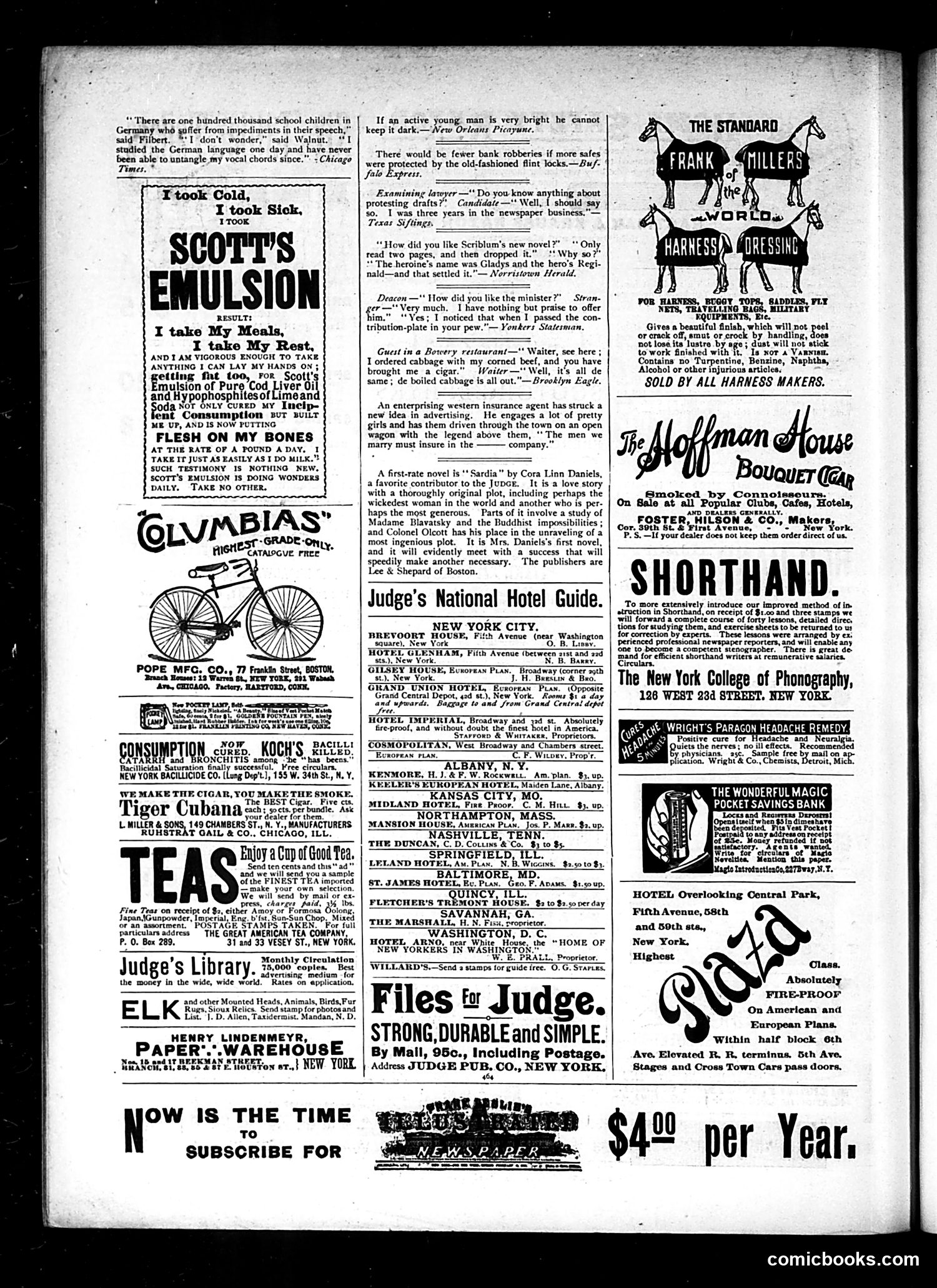
This is primarily an **advertising page** from Judge magazine, a late-19th-century American satirical publication. The page contains minimal editorial cartoon content—instead, it features numerous product advertisements interspersed with short humorous anecdotes and jokes. The few visible jokes reflect period attitudes: one mocks German language difficulty, another plays on "protesting drafts" (military conscription avoidance), and a third makes a double-entendre joke about a minister's praise correlating with generous donations. These are generic humor items, not political satire. The advertisements reflect contemporary concerns: Scott's Emulsion for tuberculosis/consumption, "Koch's Bacillus" products (referencing Robert Koch's tuberculosis research), cigar brands, and tea suppliers. The insurance agent anecdote at bottom uses attractive women as advertising gimmicks—standard for the era. **No identifiable political figures or cartoon caricatures are visible.** This appears to be a standard commercial page typical of Judge's revenue model during the 1880s-1890s.
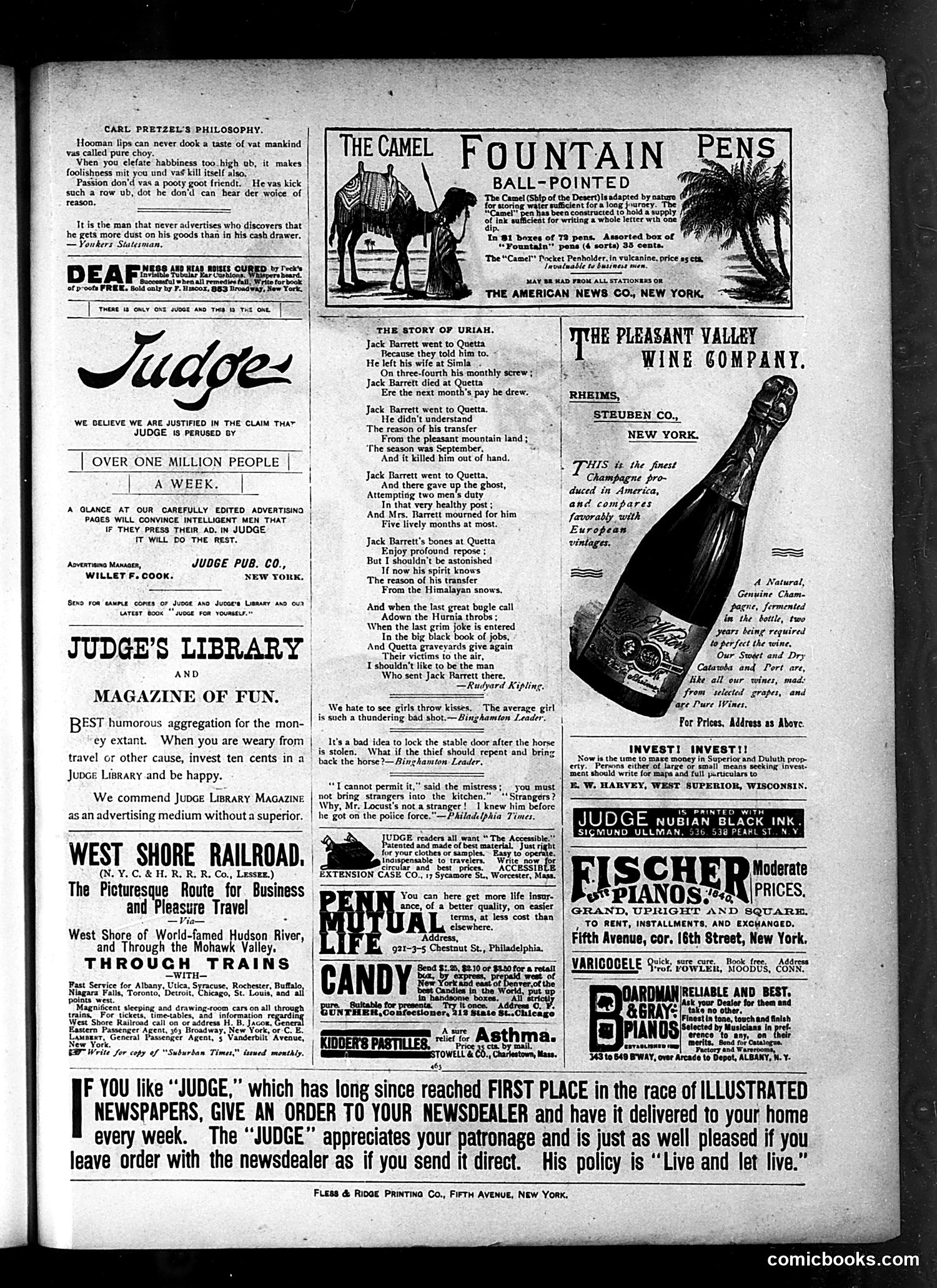
This page is primarily **advertising and filler content** rather than political cartoons. The main elements are: **"Carl Pretzel's Philosophy"**: A humor column featuring a German-accented character dispensing folksy wisdom about happiness, passion, and business advertising. This was a recurring feature mocking German immigrants through stereotypical dialect humor—common in Gilded Age American publications. **The Camel Fountain Pens advertisement**: Standard product advertising featuring an orientalist image of a camel and Arab figure. **"The Story of Uriah"**: A Rudyard Kipling poem about a British soldier (Jack Barrett) sent to the deadly garrison town of Quetta, India, where he dies from overwork and disease. It's a darkly ironic commentary on British colonial military administration and bureaucratic indifference to soldiers' lives. The remaining content consists of **Judge Library promotion, railroad advertisements, and miscellaneous product ads** (wine, pianos, ink, candy). This appears to be a typical late 19th-century magazine page mixing editorial content with commercial notices.
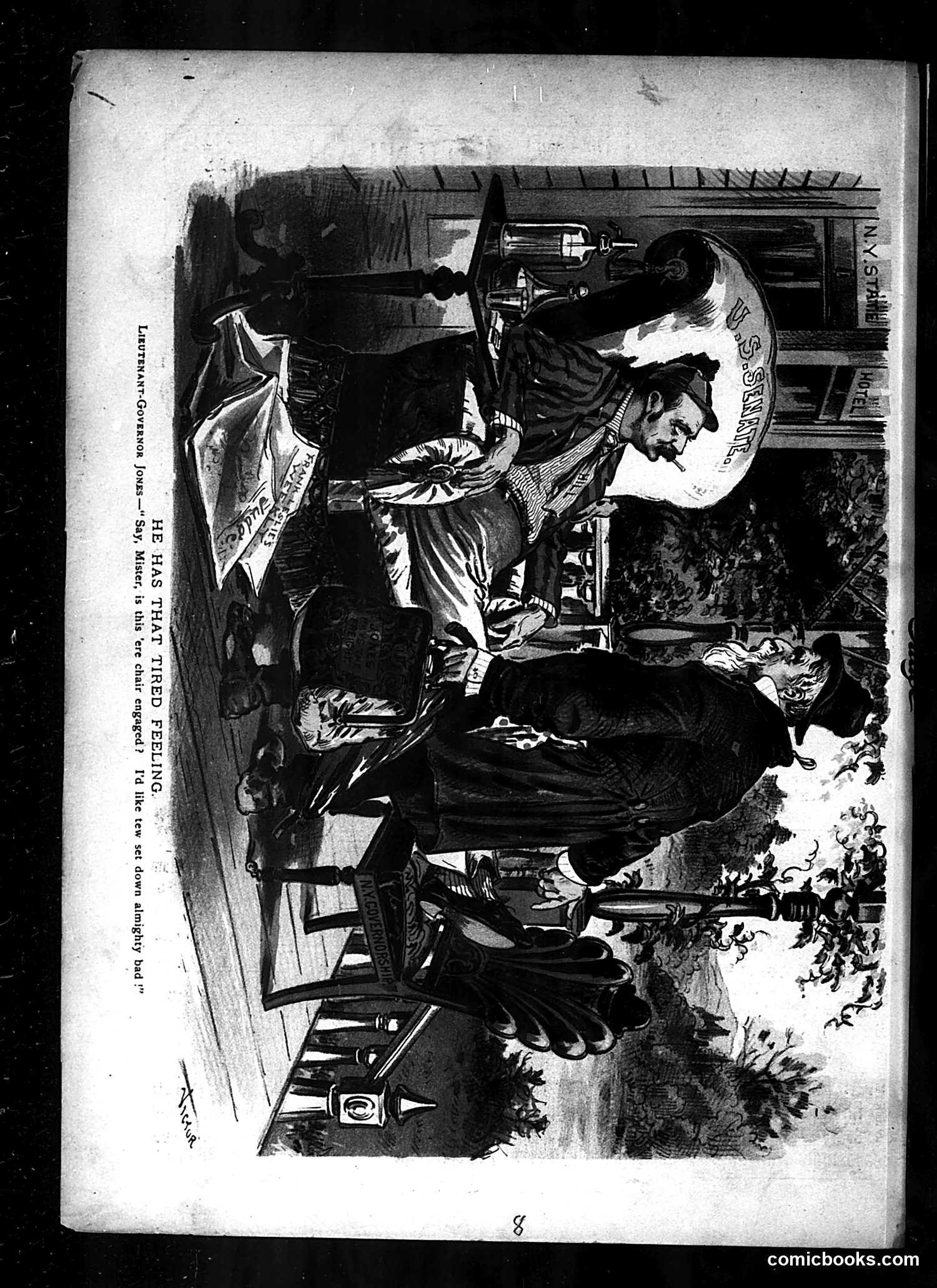
This political cartoon satirizes **Lieutenant-Governor Jones** (identity unclear without additional context). The figure, depicted as a working-class man in worn clothes, appears exhausted and seeks to sit in a chair. The caption's dialectal speech ("'ere," "tew") emphasizes his working-class status. The satire likely critiques Jones as tired, worn out, or unfit for office—suggesting he's physically or politically exhausted. The "tired feeling" may reference his performance or popularity. The cartoon appears to mock his apparent weariness or suggest he's not up to the demands of his position. Without knowing the specific date and political context of this *Judge* issue, the exact target of criticism remains unclear, though the visual mockery of the lieutenant-governor's apparent fatigue is evident.

I can see this is a page from *Judge* magazine, but the image is almost entirely black with only a white binding edge visible on the left side and some faint marks on the right edge. The OCR text only shows "comicbooks.com," which appears to be a website watermark rather than actual magazine content. I cannot discern any cartoon illustrations, text, figures, caricatures, or political references from this image. The page appears either blank, heavily damaged, improperly scanned, or photographed under inadequate lighting conditions. Without visible content, I cannot explain the satire or historical context to a modern reader. A clearer scan or photograph would be needed to analyze this *Judge* page properly.