
Judge, 1891-04-04 · page 7 of 17
Judge — April 4, 1891 — page 7: what you’re looking at
What you’re looking at
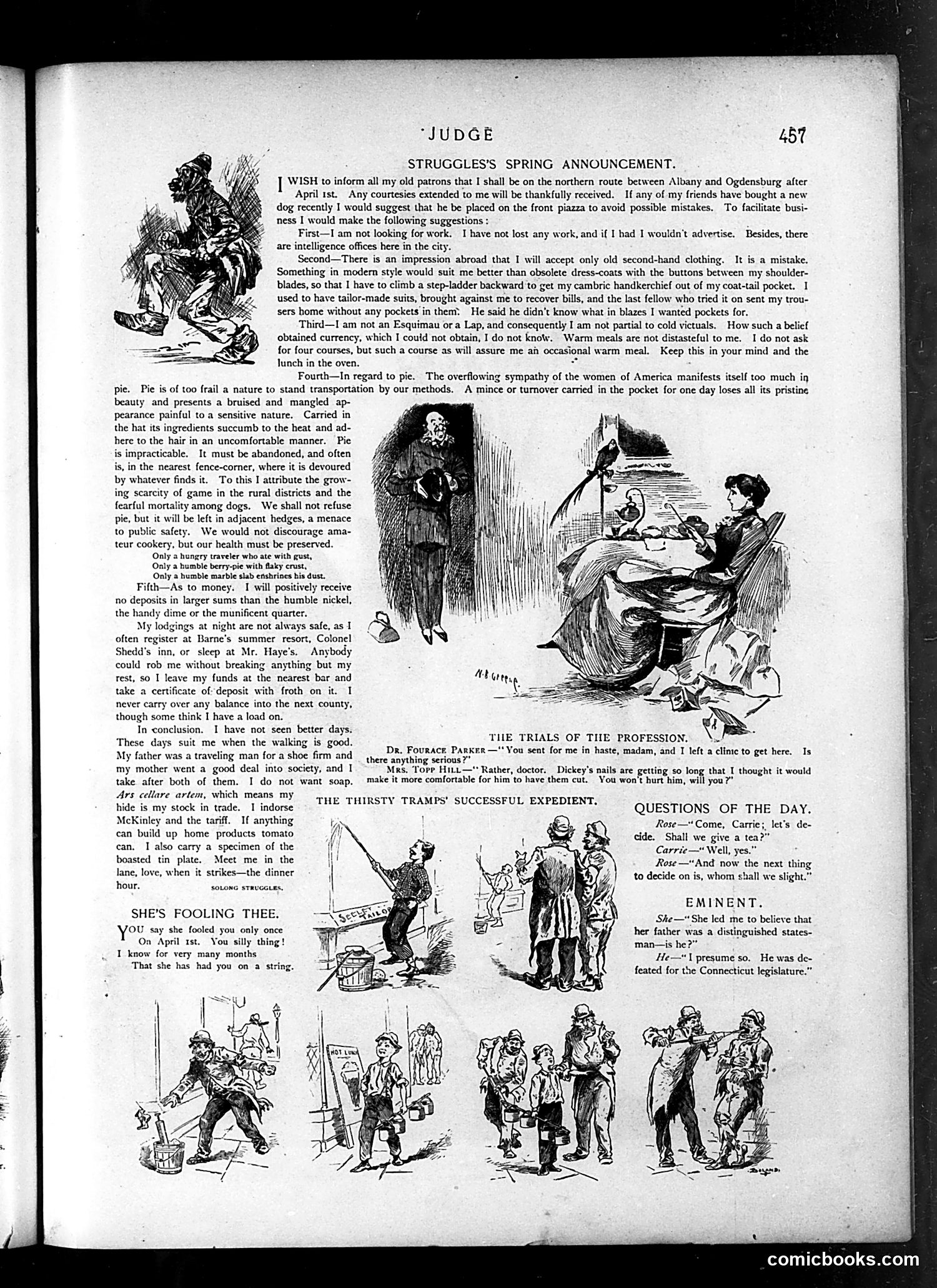
This is a humorous piece satirizing vagrant life and begging culture in late 19th-century America. The central figure, "Struggles" (appearing to be a stock character representing a tramp or itinerant beggar), issues deadpan "announcements" about his traveling route and demands—a parody of legitimate business notices. The satire targets both the vagrant himself and American charity culture. Each numbered point mocks common excuses or complaints: he claims he's not looking for work, doesn't want old clothing donations, refuses cold food, despises pie (which gets damaged in pockets), and demands only small cash deposits. The absurdist humor culminates in his boast of supporting McKinley and the tariff—incongruous political opinions for a homeless man. The accompanying cartoons illustrate the hardships of vagabond life. The satire critiques both exploitative treatment of wanderers and the patronizing, ineffective "sympathy" middle-class Americans extended through inappropriate charity like pie and worn-out coats.
📄 Transcribed text from this page (OCR, searchable)
Machine-transcribed from the original scan — historical spelling and the odd misread are preserved.
“JUDGE STRUGGLES’S SPRING ANNOUNCEMENT. ] WISH to inform all my old patrons that I shall be on the northern route between Albany and Ogdensburg after April 1st. Any courtesies extended to me will be thankfully received. If any of my friends have bought a new dog recently I would suggest that he be placed on the front piazza to avoid possible mistakes. To facilitate busi- ness I would make the following suggestions : ; First—I am not looking for work. I have not lost any work, and if I had I wouldn't advertise. Besides, there are intelligence offices here in the city. Second—There is an impression abroad that I will accept only old second-hand clothing. It is a mistake. Something in modern style would suit me better than obsolete dress-coats with the buttons between my shoulder- blades, so that I have to climb a step-ladder backward to get my cambric handkerchief out of my coat-tail pocket. I used to have tailor-made suits, brought against me to recover bills, and the last fellow who tried it on sent my trou- sers home without any pockets in them: He said he didn’t know what in blazes I wanted pockets for. Third—I am not an Esquimau or a Lap, and consequently I am not partial to cold victuals. How such a belief obtained currency, which I could not obtain, I do not know. Warm meals are not distasteful to me. I do not ask for four courses, but such a course as will assure me ah occasional warm meal. Keep this in your mind and the lunch in the oven. - Fourth—In regard to pie. The overflowing sympathy of the women of America manifests itself too much in pie. Pie is of too frail a nature to stand transportation by our methods. A mince or tumover carried in the pocket for one day loses all its pristine beauty and presents a bruised and mangled ap- pearance painful toa sensitive nature. Carried in the hat its ingredients succumb to the heat and ad- here to the hair in an uncomfortable manner. Pie is impracticable. It must be abandoned, and often is, in the nearest fence-corner, where it is devoured by whatever finds it. To this I attribute the grow- ing scarcity of game in the rural districts and the fearful mortality among dogs. We shall not refuse pie, but it will be left in adjacent hedges, a menace to public safety. We would not discourage ama- teur cookery, but our health must be preserved. Only a hungry traveler who ate with gust, Only a humble berry-pie with flaky crust, Only a humble marble slab enshrines his dust. Fifth—As to money. I will positively receive no deposits in larger sums than the humble nickel, the handy dime or the munificent quarter. My lodgings at night are not always safe, as I often register at Barne’s summer resort, Colonel Shedd’s inn, or sleep at Mr. Haye’s. Anybody could rob me without breaking anything but my rest, so I leave my funds at the nearest bar and take a certificate of-deposit with froth on it. I never carry over any balance into the next county, though some think I have a load on. In conclusion. I have not seen better days. These days suit me when the walking is good. My father was a traveling man for a shoe firm and there suything serious ?* my mother went a good deal into society, and I Mrs. Tope Hitt—' Rather, doctor. Dickey's nails are getting so long that I thought it would take after both of them. I do not want soap, make it more comfortable for him'to have them cut. You won't hurt him, will you 2" Ars cellare artem, which means my hide is my stock in trade. I indorse McKinley and the tariff. If anything . E), TIE TRIALS OF TIIE PROFESSION. Dr. Fouracr Parker —'* You sent for me in haste, madam, and I left a clinic to get here. Is THE THIRSTY TRAMPS' SUCCESSFUL EXPEDIENT, QUESTIONS OF THE DAY. can build up home products tomato can. I also carry a specimen of the boasted tin plate. Meet me in the lane, love, when it strikes—the dinner hour. SOLONG STRUGGLES. SHE’S FOOLING THEE. YOU say she fooled you only once On April rst. You silly thing! I know for very many months That she has had you on a string. Rose—Come, Carrie;, let's de- cide. Shall we give a tea?” Carrie—* Well, yes.” Rose—“And now the next thing to decide on is, whom shall we slight.” EMINENT. She—"She led me to believe that a distinguished states- He—1 presume so. He was de- feated for the Connecticut legislature.” comicbooks.com