
Judge, 1891-04-04 · page 3 of 17
Judge — April 4, 1891 — page 3: what you’re looking at
What you’re looking at
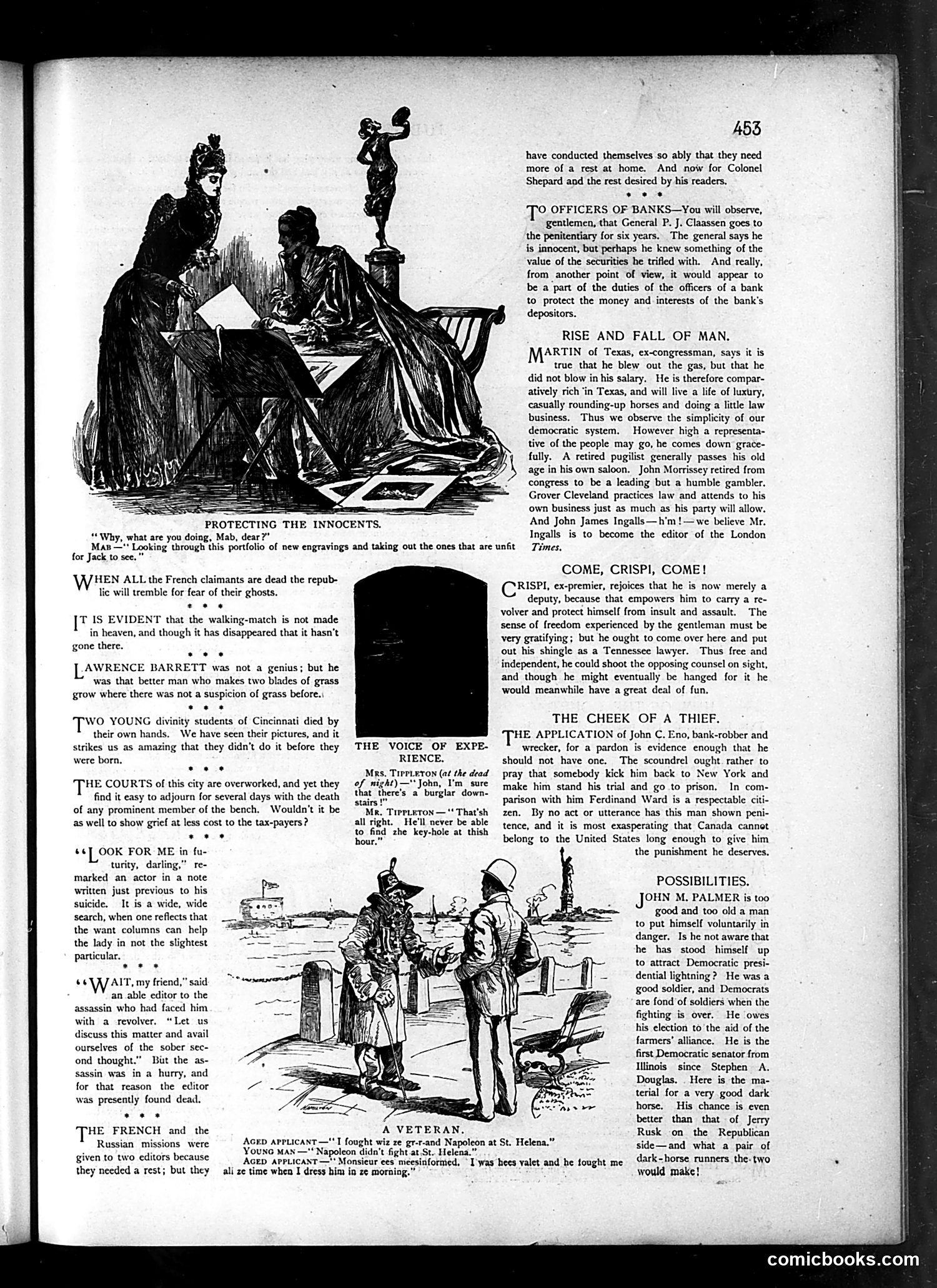
This page contains multiple brief satirical items typical of Judge's format. The main illustration, "Protecting the Innocents," shows two figures examining documents—likely satirizing concerns about protecting the public from some perceived threat, though the specific reference is unclear without additional context. The text items mock various figures and situations: politicians' conduct, military decisions, and individual scandals. References include Martin of Texas (a congressman), General P.J. Cluseret, and John C. Eno (a bank robber seeking a pardon). The satire targets corruption, incompetence, and hypocrisy among public figures and institutions. The "Cheek of a Thief" section criticizes Eno's pardon application, while other items mock politicians' self-serving behavior and the courts' inefficiency. Without dating information, the specific historical context remains unclear.
📄 Transcribed text from this page (OCR, searchable)
Machine-transcribed from the original scan — historical spelling and the odd misread are preserved.
PROTECTING THE INNOCENTS. “Why, what are you doing, Mab, dear?” Man—" Looking through this portfolio of new engravings and taking out the ones that are unfit for Jack to see.” HEN ALL the French claimants are dead the repub- lic will tremble for fear of their ghosts. ees T IS EVIDENT that the walking-match is not made in heaven, and though it has disappeared that it hasn't gone there. ares LAWRENCE BARRETT was not a genius; but he was that better man who makes two blades of grass grow where there was not a suspicion of grass before.: eee Two YOUNG divinity students of Cincinnati died by their own hands. We have seen their pictures, and it strikes us as amazing that they didn’t do it before they were born, soe THE COURTS of this city are overworked, and yet they find it easy to adjourn for several days with the death of any prominent member of the bench. Wouldn't it be as well to show grief at less cost to the tax-payers? eee sey OOK FOR ME in fu- turity, darling,” re- marked an actor in a note written just previous to his suicide. It is a wide, wide search, when one reflects that the want columns can. help the lady in not the slightest particular. one sey HV A!T, my friend,” said: an able editor to the assassin who had faced him with a revolver, “Let us discuss this matter and avail ourselves of the sober sec- ond thought.” But the as- sassin was in a hurry, and for that reason the editor was presently found dead. eee THE VOICE OF EXPE- RIENCE. Mrs. TirrLeton (at the dead of night)—" John, I'm_ sure that there's a burglar down- stairs!" Mr. Trerteton —‘* That'sh all right. He'll never be able to find zhe key-hole at thish have conducted themselves so ably that they need more of a rest at home. And now for Colonel Shepard and the rest desired by his readers. oes ‘O OFFICERS OF BANKS—You will observe, gentlemen, that General P. J. Claassen goes to the penitentiary for six years. The general says he is innocent, but perhaps he knew something of the value of the securities he trifled with. And really, from another point of view, it would appear to be a part of the duties of the officers of a bank to protect the money and interests of the bank's depositors. RISE AND FALL OF MAN. ARTIN of Texas, ex-congressman, says it is true that he blew out the gas, but that he did not blow in his salary. He is therefore compar- atively rich ‘in Texas, and will live a life of luxury, casually rounding-up horses and doing a little law business. Thus we observe the simplicity of our democratic system. However high a representa- tive of the people may go, he comes down grace- fully. A retired pugilist generally passes his old age in his own saloon. John Morrissey retired from congress to be a leading but a humble gambler. Grover Cleveland practices law and attends to his ‘own business just as much as his party will allow. And John James Ingalls—h'm !—we believe Mr. Ingalls is to become the editor of the London Times, COME, CRISPI, COME! RISPI, ex-premier, rejoices that he is now merely a deputy, because that empowers him to carry a re- volver and protect himself from insult and assault. The sense of freedom experienced by the gentleman must be very gratifying; but he ought to come over here and put out his shingle as a Tennessee lawyer. Thus free and independent, he could shoot the opposing counsel on sight, and though he might eventually be hanged for it he would meanwhile have a great deal of fun. THE CHEEK OF A THIEF. 'HE APPLICATION of John C. Eno, bank-robber and wrecker, for a pardon is evidence enough that he should not have one. The scoundrel ought. rather to pray that somebody kick him back to New York and make him stand his trial and go to prison. In com- parison with him Ferdinand Ward is a respectable cit zen. By no act or utterance has this man shown peni- tence, and it is most exasperating that Canada cannot belong to the United States long enough to give him the punishment he deserves. POSSIBILITIES. JOHN M. PALMER is too good and too old a man to put himself voluntarily in danger, Is he not aware that he has stood himself up to attract Democratic presi- dential lightning? He was a good soldier, and Democrats are fond of soldiers when the fighting is over. He ‘owes his election to the aid of the farmers’ alliance. He is the first Democratic senator from Illinois since Stephen A. Douglas. . Here is the ma- terial for a very good dark horse. His chance is even better than that of Jerry A VETERAN. AGED APrLicayt—""I fought wiz ze gr-r-and Napoleon at St. Helena.” Youxe MAN —"‘Napoleon didn’t fight at St. Helena.” AGED APPLICANT—'* Monsieur ees meesinformied, ° I was hees valet and he fought me ali ze time when I dress him in ze morning.” THE FRENCH and the Russian missions were given to two editors because they needed a rest; but they Rusk on the Republican side—and what a pair of dark-horse runners the-two would make! comicbooks.com