
Judge, 1891-04-04 · page 2 of 17
Judge — April 4, 1891 — page 2: what you’re looking at
What you’re looking at
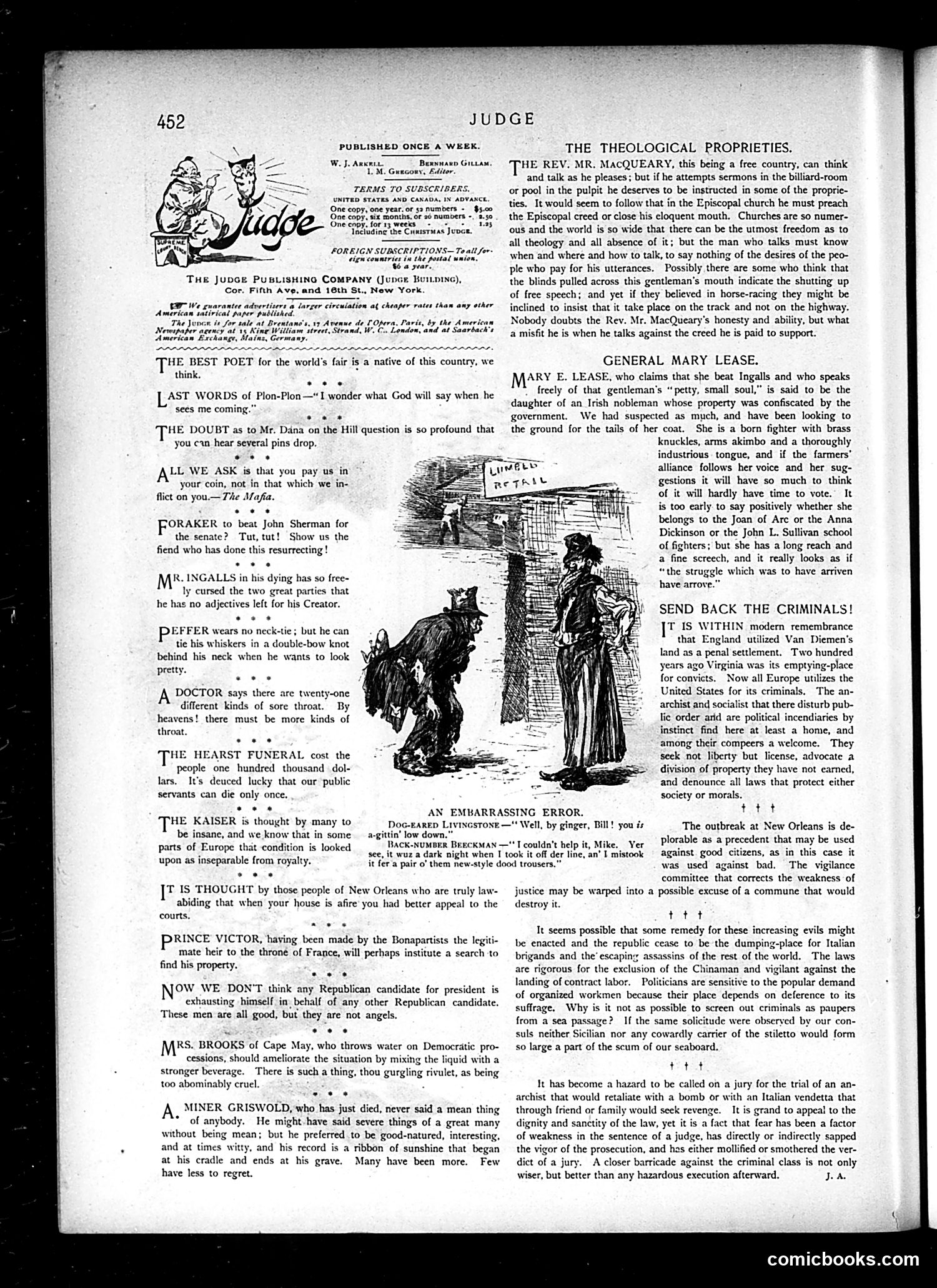
This page from *Judge* magazine contains several short political jabs and one sketch. The cartoon depicts what appears to be a street scene with figures in period dress, though specific identities aren't clearly labeled in the visible portion. The text snippets target various public figures and political issues of the era: references to "Fion-Fion" (likely a theatrical figure), criticisms of Dana on "the Hill question," and jabs at Republican presidential candidates. There's commentary on Ingalls' political demise, critiques of various officials' behaviors, and social observations about convict labor and colonial policies. Without clearer date markers or more explicit labels, precise identification of all targets remains difficult, though the satire targets politics, society, and public figures typical of *Judge's* partisan commentary.
📄 Transcribed text from this page (OCR, searchable)
Machine-transcribed from the original scan — historical spelling and the odd misread are preserved.
JUDGE PUBLISHED ONCE A WEEK. iaNMAKD GILLAM. . M. Guncony, Euiter. TERMS TO SUBSCRIBERS. UNITED STATES AND CANADA, IN. ADVANCE. ‘One copy, one year.or s2 numbers = $5.00 ‘One copy, si months, or 26 numbers -, 2.50 One copy, for 13 weeks + 135, Teluding the Cruuststas Jub Teall for. 6 a year THE JUDGE PUBLISHING COMPANY (JupcE BuiLnine), Cor. Fifth Ave. and 16th St., New York. (BWe guarantee advertisers a larger circulation at cheaper rates than any other American satirical paper published. Avenue de [Ope is, by the American eet, Strand, W. Co wand at Saarbach's 7 THE BEST POET for the world’s fair is a native of this country, we think. . LAST WORDS of Plon-Plon—I wonder what God will say when he sees me coming.” sine THE DOUBT as to Mr. Dana on the Hill question is so profound that you can hear several pins drop. eee LL WE ASK is that you pay us in your coin, not in that which we in- flict on you.— The Mafia. < see FORARER to beat John Sherman for the senate? Tut, tut! Show us the M*. INGALLS in his dying has so free- ly cursed the two great parties that he has no adjectives left for his Creator. EFFER wears no neck-tie; but he can tie his whiskers in a double-bow knot behind his neck when he wants to look pretty. DOCTOR says there are twenty-one different kinds of sore throat. By heavens! there must be more kinds of throat. ‘THE HEARST FUNERAL cost the people one hundred thousand dol- lars. It's deuced lucky that our public servants can die only once. a eh THE KAISER is thought by many to be insane, and we know that in some parts of Europe that condition is looked upon as inseparable from royalty. see T IS THOUGHT by those people of New Orleans who are truly law- abiding that when your house is afire you had better appeal to the courts. PRINCE VICTOR, ‘having been made by the Bonapartists the legit mate heir to the throné of France, will perhaps institute a search to find his property. eee OW WE DON'T think any Republican candidate for president is exhausting himself in, behalf of any other Republican candidate. These men are all good, but they are not angels. eee MBS. BROOKS of Cape May, who throws water on Democratic pro- cessions, should ameliorate the situation by mixing the liquid with a stronger beverage. There is such a thing, thou gurgling rivulet, as being too abominably cruel. ‘ A, MINER GRISWOLD, who has just died, never said a mean thing of anybody. He might-have said severe things of a great many without being mean; but he preferred to be good-natured, interesting, and at times witty, and his record is a ribbon of sunshine that began at his cradle and ends at his grave. Many have been more. Few have less to regret. AN EMBARRASSING ERROR. Doc-earep Livincstoxe —"* Well, by ginger, Bill! you é acgittin’ low dow BACK-NUMBER BE see, it wuz a dark night when I took it off der line, an’ I mistook it fer a pair o' them new-style dood trousers.” CKMAN —'T couldn't help it, Mike. Yer THE THEOLOGICAL PROPRIETIES. HE REV. MR. MacQUEARY, this being a free country, can think and talk as he pleases; but if he attempts sermons in the billiard-room or pool in the pulpit he deserves to be instructed in some of the proprie- ties. It would seem to follow that in the Episcopal church he must preach the Episcopal creed or close his eloquent mouth. Churches are so numer- ous and the world is so wide that there can be the utmost freedom as to all theology and all absence of it; but the man who talks must know when and where and how to talk, to say nothing of the desires of the peo- ple who pay for his utterances. Possibly there are some who think that the blinds pulled across this gentleman's mouth indicate the shutting up of free speech; and yet if they believed in horse-racing they might be inclined to insist that it take place on the track and not on the highway. Nobody doubts the Rev. Mr. MacQueary’s honesty and ability, but what a misfit he is when he talks against the creed he is paid to support. GENERAL MARY LEASE. ARY E. LEASE, who claims that she beat Ingalls and who speaks freely of that gentleman's “petty, small soul,” is said to be the daughter of an Irish nobleman whose property was confiscated by the government. We had suspected as much, and have been looking to the ground for the tails of her coat. She is a born fighter with brass knuckles, arms akimbo and a thoroughly industrious tongue, and if the farmers’ alliance follows her voice and her sug- gestions it will have so much to think of it will hardly have time to vote. It is too early to say positively whether she belongs to the Joan of Arc or the Anna Dickinson or the John L, Sullivan school of fighters; but she has a long reach and a fine screech, and it really looks as if “the struggle which was to have arriven have arrove.” SEND BACK THE CRIMINALS! ]7 1S WITHIN modern remembrance that England utilized Van Diemen’s land as a penal settlement. Two hundred years ago Virginia was its emptying-place for convicts. Now all Europe utilizes the United States for its criminals. The an- archist and socialist that there disturb pub- lic order arid are political incendiaries by instinct find here at least a home, and among their compeers a welcome. They seek not liberty but license, advocate a division of property they have not earned, and denounce all laws that protect either society or morals. tutst The outbreak at New Orleans is de- plorable as a precedent that may be used against. good citizens, as in this case it was used against bad. The vigilance committee that corrects the weakness of justice may be warped into a possible excuse of a commune that would destroy it. tatet It seems possible that some remedy for these increasing evils might be enacted and the republic cease to be the dumping-place for Italian brigands and the’ escaping assassins of the rest of the world. The laws are rigorous for the exclusion of the Chinaman and vigilant against the landing of contract labor. Politicians are sensitive to the popular demand of organized workmen because their place depends on deference to its suffrage. Why is it not as possible to screen out criminals as paupers from a sea passage? If the same solicitude were observed by our con suls neither Sicilian nor any cowardly carrier of the stiletto would form so large a part of the scum of our seaboard. ttt It has become a hazard to be called on a jury for the trial of an an- archist that would retaliate with a bomb or with an Italian vendetta that through friend or family would seek revenge. It is grand to appeal to the dignity and sanctity of the law, yet it is a fact that fear has been a factor of weakness in the sentence of a judge, has directly or indirectly sapped the vigor of the prosecution, and has either mollified or smothered the ver- dict of a jury. A closer barricade against the criminal class is not only wiser, but better than any hazardous execution afterward. JA comicbooks.com