
A complete issue · 18 pages · 1891
Judge — February 7, 1891
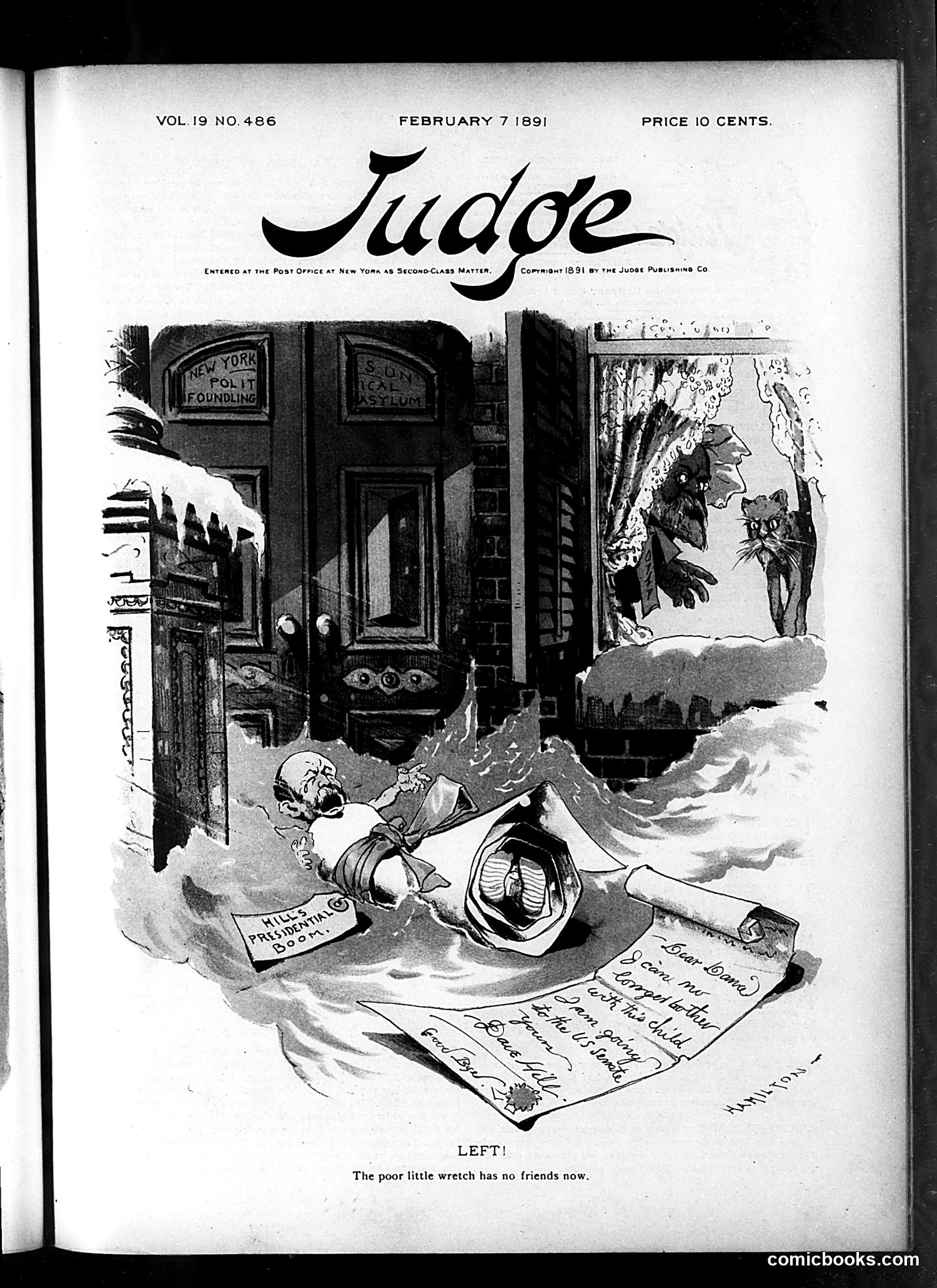
This cartoon satirizes the plight of someone labeled "the poor little wretch" who "has no friends now." The scene depicts a figure cast out in the snow near the "New York Foundling Asylum," surrounded by discarded items including what appears to be a fireman's helmet and scattered papers. The exact political or social context remains unclear without additional information about contemporary events from February 1891. However, the imagery suggests commentary on abandonment, institutional care, or possibly criticism of New York's charitable systems during this period. The harsh winter setting emphasizes the subject's vulnerability and isolation. The specific identity of "the wretch" and the satirical target—whether an individual, policy, or institution—cannot be definitively determined from the visual and textual evidence alone.
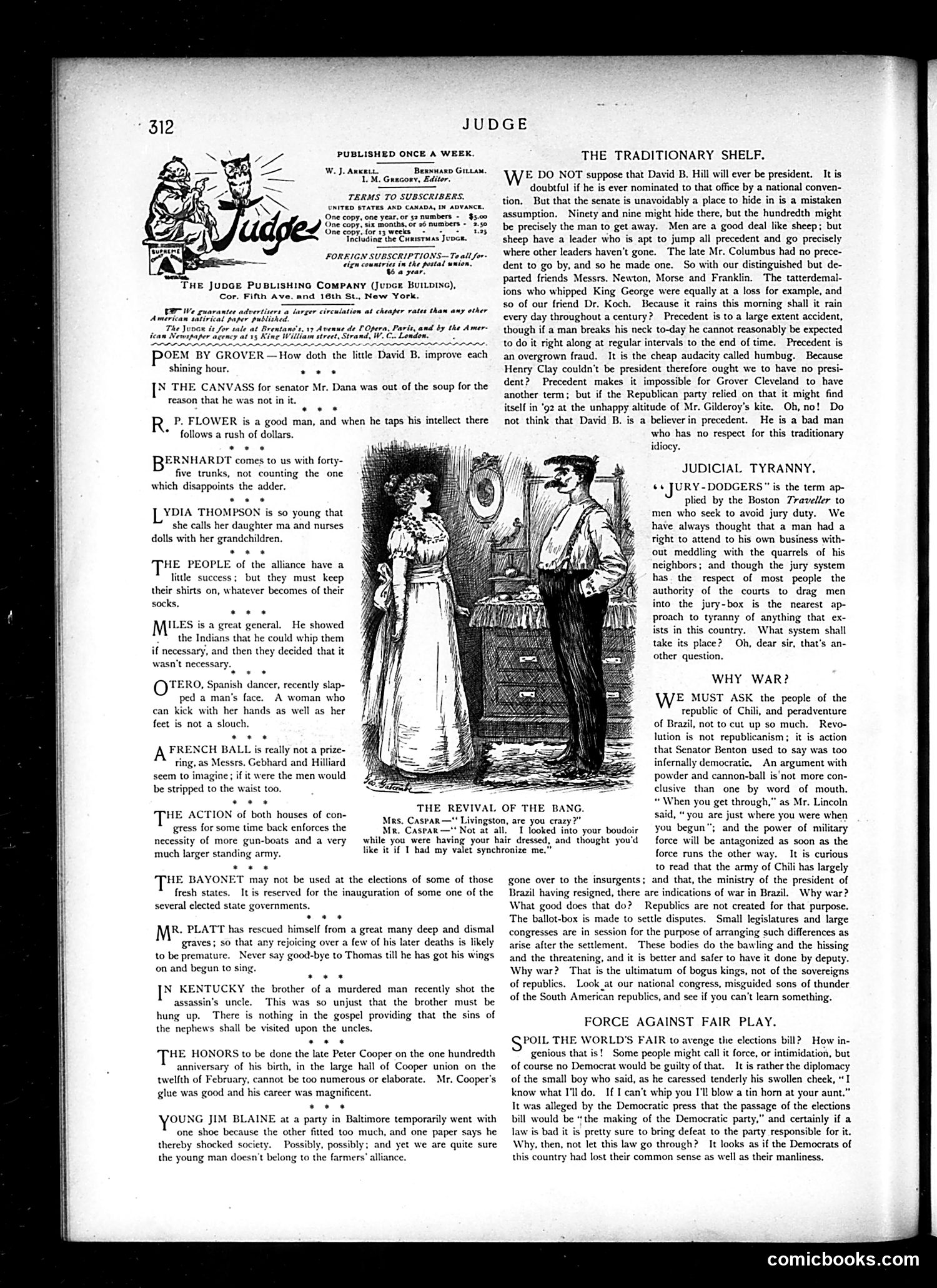
This cartoon depicts a domestic scene where a woman confronts a man about infidelity. The woman (Mrs. Caspar) sarcastically remarks that she saw her husband with another woman while he was "having [his] hair dressed," suggesting he's making excuses for an affair. The man's defensive posture and her knowing expression convey marital tension over suspected philandering. The title "The Revival of the Bang" likely references the fashionable hairstyle of the era (bangs), but uses it as a double entendre for romantic entanglement. The cartoon satirizes middle-class infidelity and the transparent excuses men employ to cover affairs, mocking both masculine dishonesty and the social pretense surrounding marital fidelity during this period.
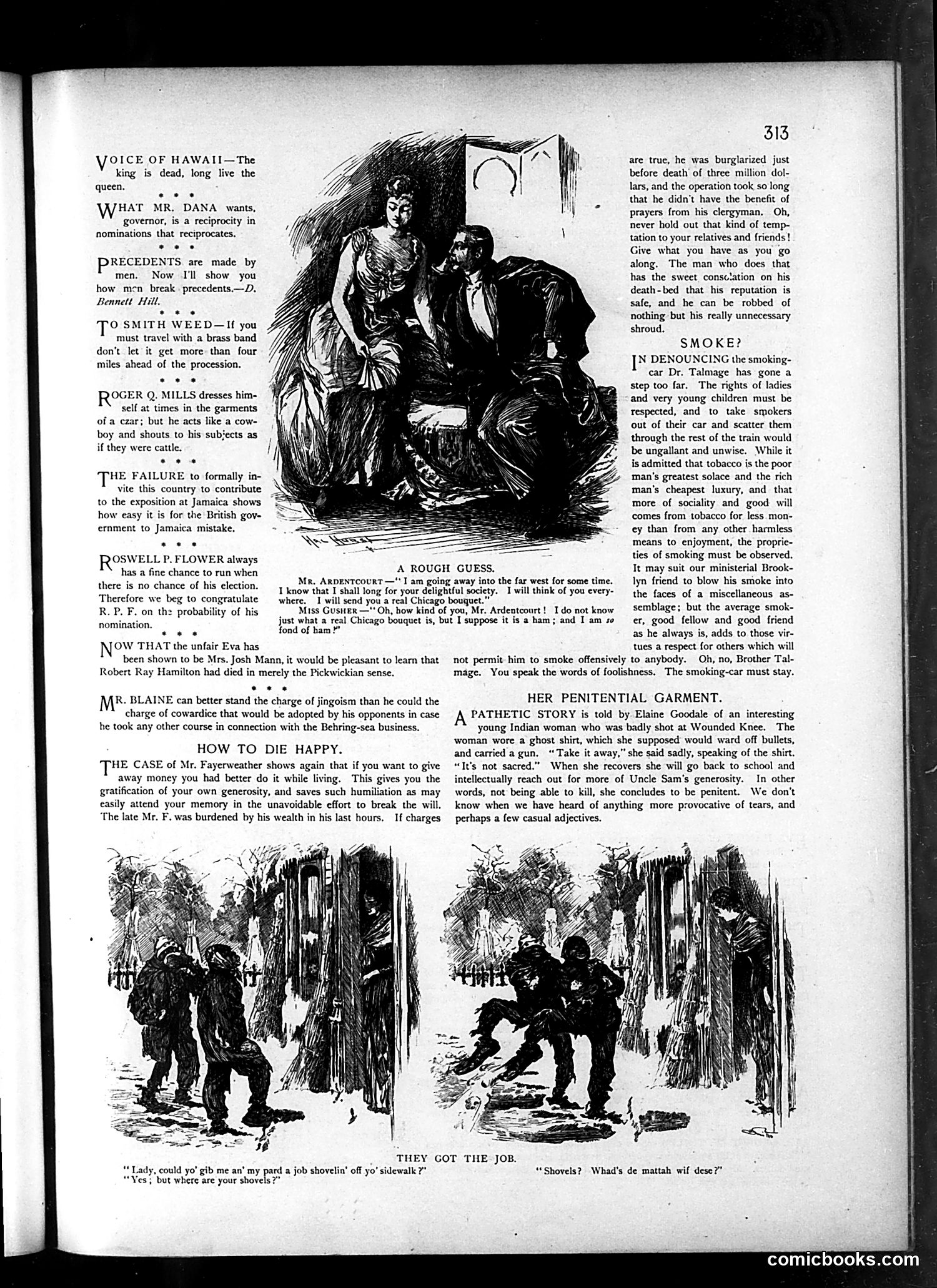
This page from *Judge* magazine contains two cartoon panels satirizing labor practices, likely from the Gilded Age era. The bottom illustrations labeled "They Got the Job" mock working-class desperation through dialect humor. In both scenes, laborers seek shoveling work. The left panel shows a worker asking about job availability; the right shows him being asked "Shovels? What's de match wif dese?" The satire targets both the exploitative employers demanding workers provide their own tools and the degrading stereotypical portrayals of working-class immigrants (suggested by the dialect). The humor derives from the absurdity of requiring impoverished job-seekers to supply equipment—revealing the era's harsh labor conditions while using offensive caricature as the delivery mechanism.
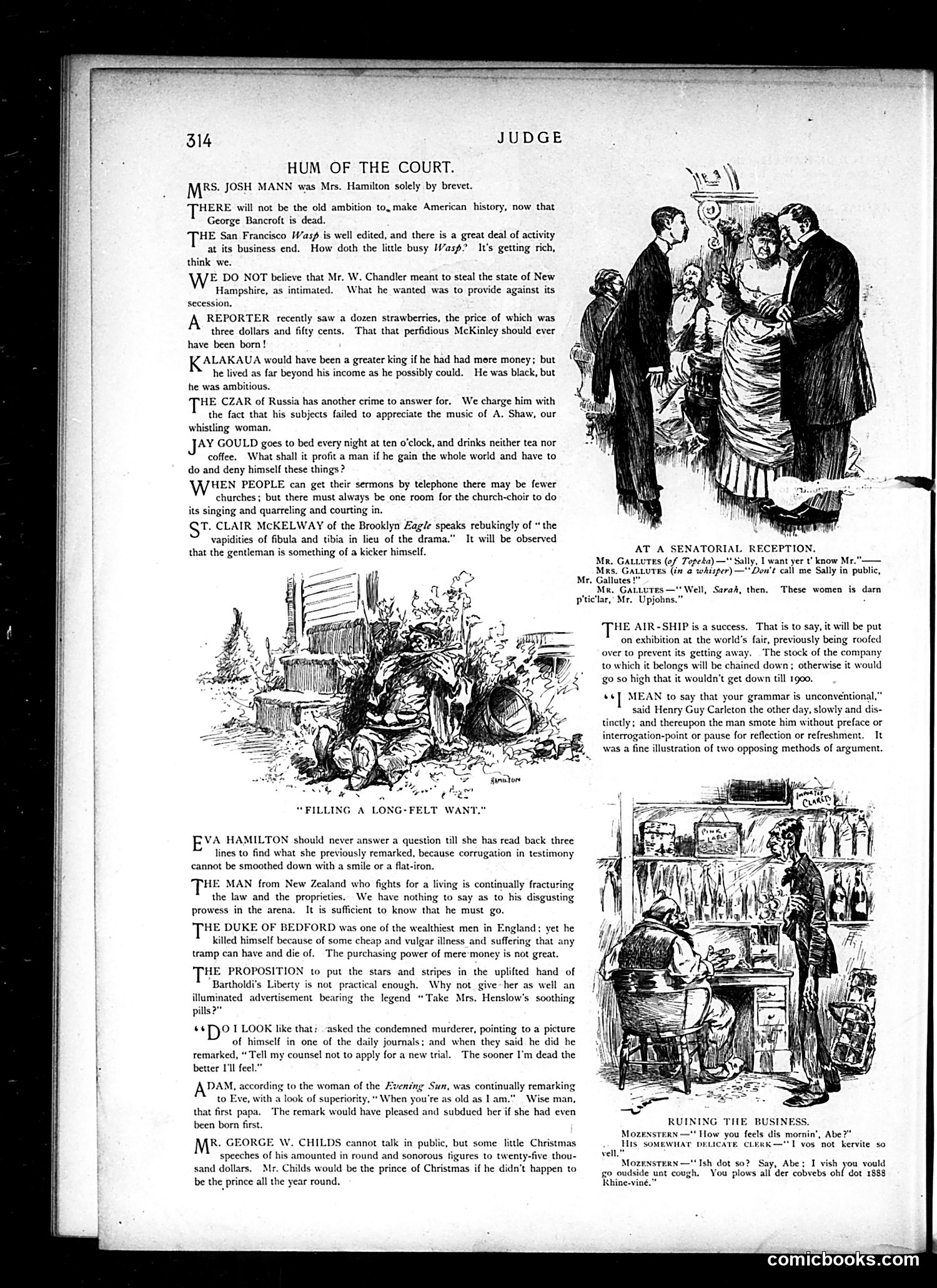
This page contains brief satirical commentary on contemporary figures and events, typical of Judge's "Hum of the Court" column. **Key references:** - **McKinley**: The strawberry anecdote blames President McKinley for high prices, reflecting anti-McKinley sentiment - **W. Chandler**: A political figure allegedly involved in New Hampshire political manipulation - **Jay Gould**: The wealthy industrialist is mocked for his austere lifestyle despite vast wealth - **Duke of Bedford**: Criticized for suicide despite riches, suggesting money cannot buy happiness - **Bartholdi's Liberty**: Satirizes proposals to add commercial advertisements to the Statue of Liberty - **Air-ship**: Jokes about an aviation exhibition at the World's Fair (likely 1893 Chicago fair), predicting stock prices will skyrocket The cartoons show domestic and business scenes. The satire's point: wealth and status don't guarantee contentment or moral virtue; politicians are corrupt; commercialism is invading everything.
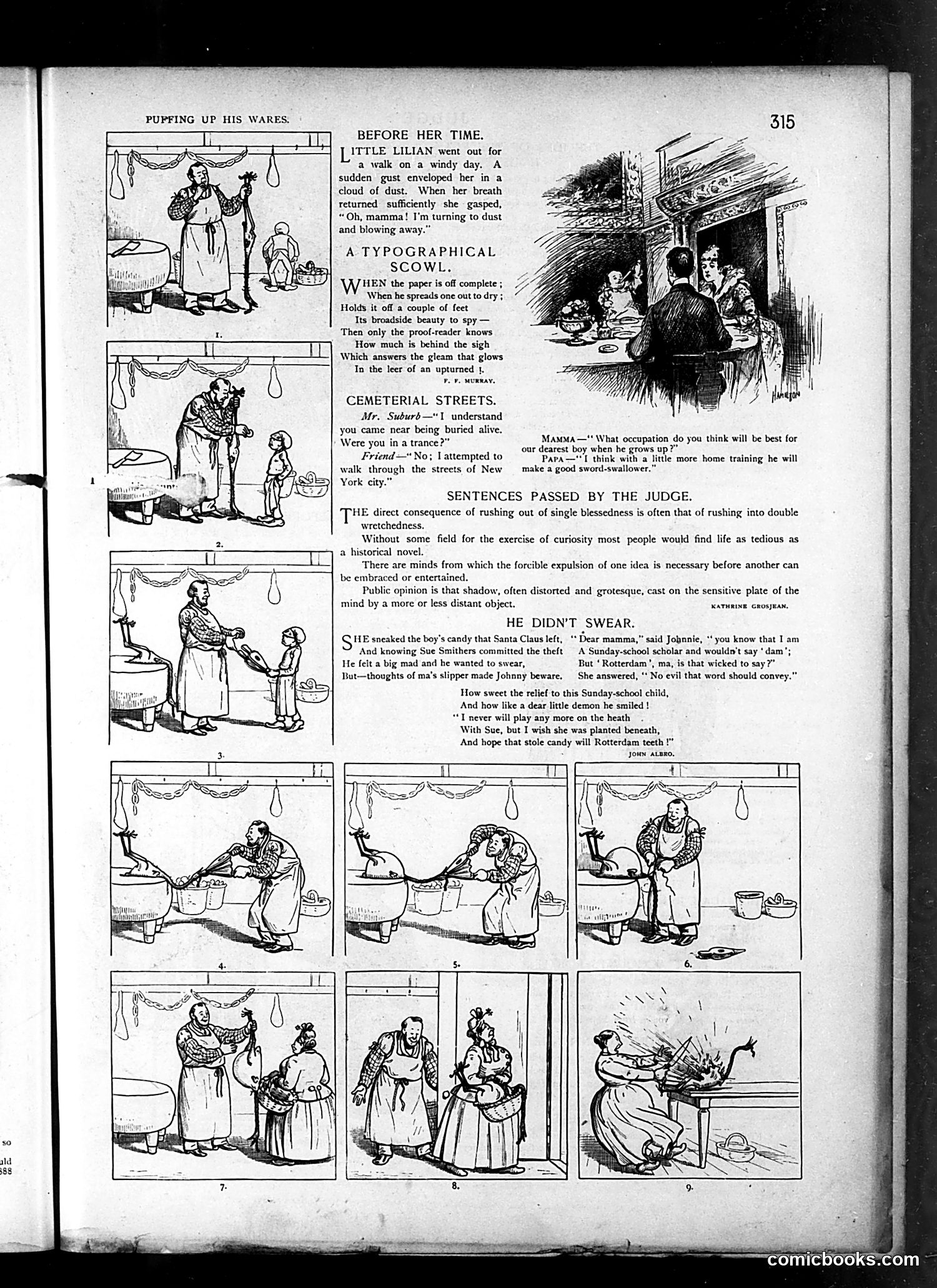
This page contains several brief humorous sketches typical of Judge's satirical style: **"Before Her Time"** jokes about a child caught in dust during a windy walk, gasping she's "turning to dust." **"A Typographical Scowl"** pokes fun at proofreaders examining freshly printed papers, playing on the visual appearance of a turned letter "1" resembling a scowling face. **"Cemeterial Streets"** contrasts suburban safety with urban danger—a man nearly died attempting to walk through New York City streets, implying they're hazardously crowded or chaotic. **"Sentences Passed by the Judge"** offers satirical aphorisms about human nature and public opinion. **"He Didn't Swear"** presents ironic humor: a Sunday school boy, forbidden to curse, creatively substitutes "Rotterdam" for profanity—then wishes harm on the girl who stole his candy. The joke satirizes the false piety of religious instruction, showing how constraint produces worse thoughts than honest swearing would. The comics and jokes reflect turn-of-century American urban life, social pretension, and moral hypocrisy.
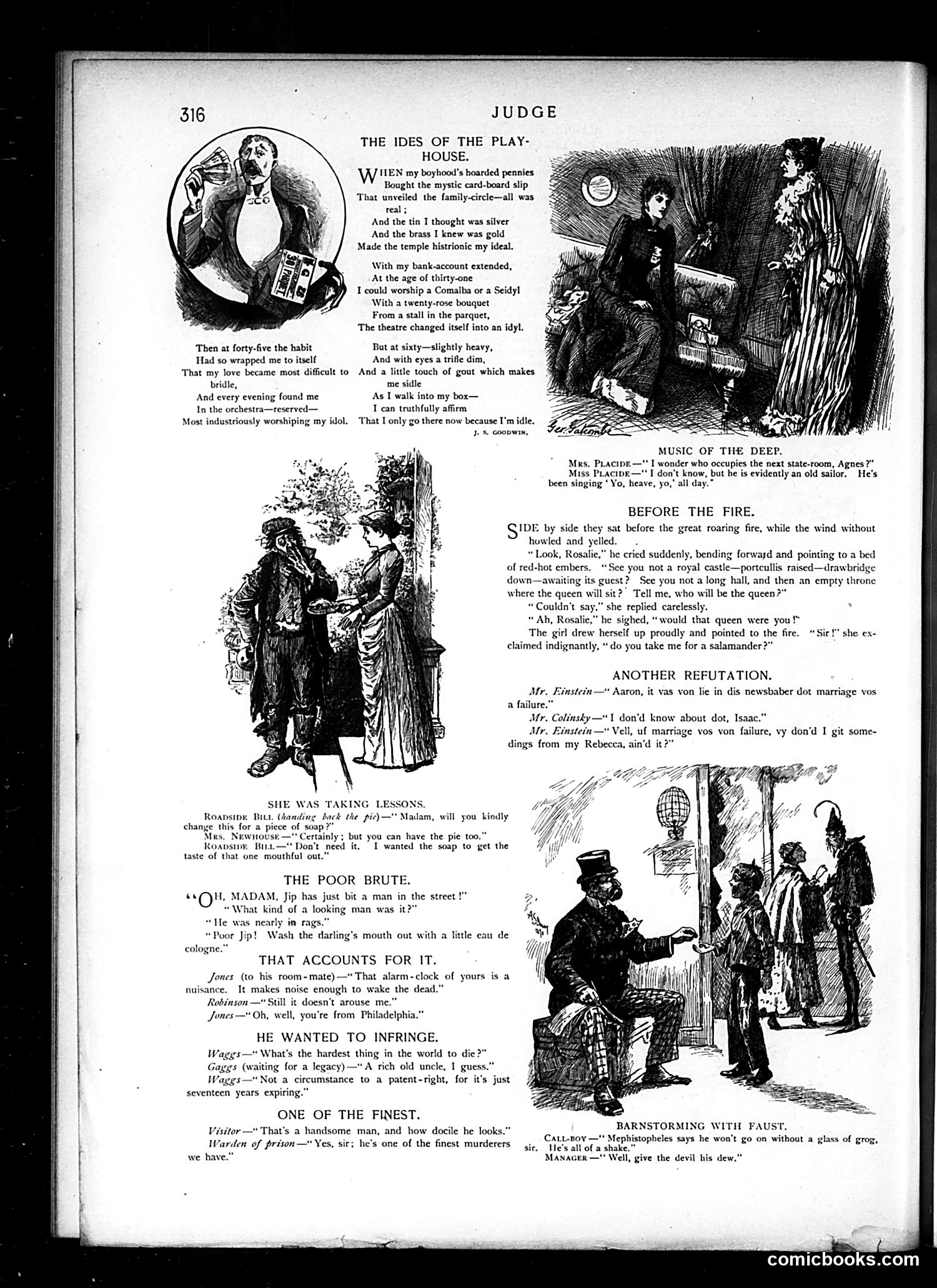
This page contains multiple brief humorous pieces typical of Judge's satirical format: **"The Ides of the Playhouse"** is a nostalgic poem about theater-going. The speaker recalls childhood wonder at theater magic, then traces how repeated attendance transformed his passion into mere habit by age 60-plus—he now attends only "because I'm idle," suggesting the decay of wonder and romance through routine. The other short pieces are typical Judge humor: **"Before the Fire"** plays on romantic miscommunication (a suitor's flowery fantasy rejected); **"Another Refutation"** uses Jewish immigrant dialect for domestic comedy; **"The Poor Brute"** jokes about class—a wealthy woman indulges her dog's bad behavior because the victim was poor; **"That Accounts For It"** is a Philadelphia joke (implying Philadelphians are exceptionally dull); **"He Wanted to Infringe"** plays on patent law expiration; **"One of the Finest"** offers dark irony about a handsome murderer. The cartoons are character vignettes without specific political reference—general social satire of the era's manners and foibles.
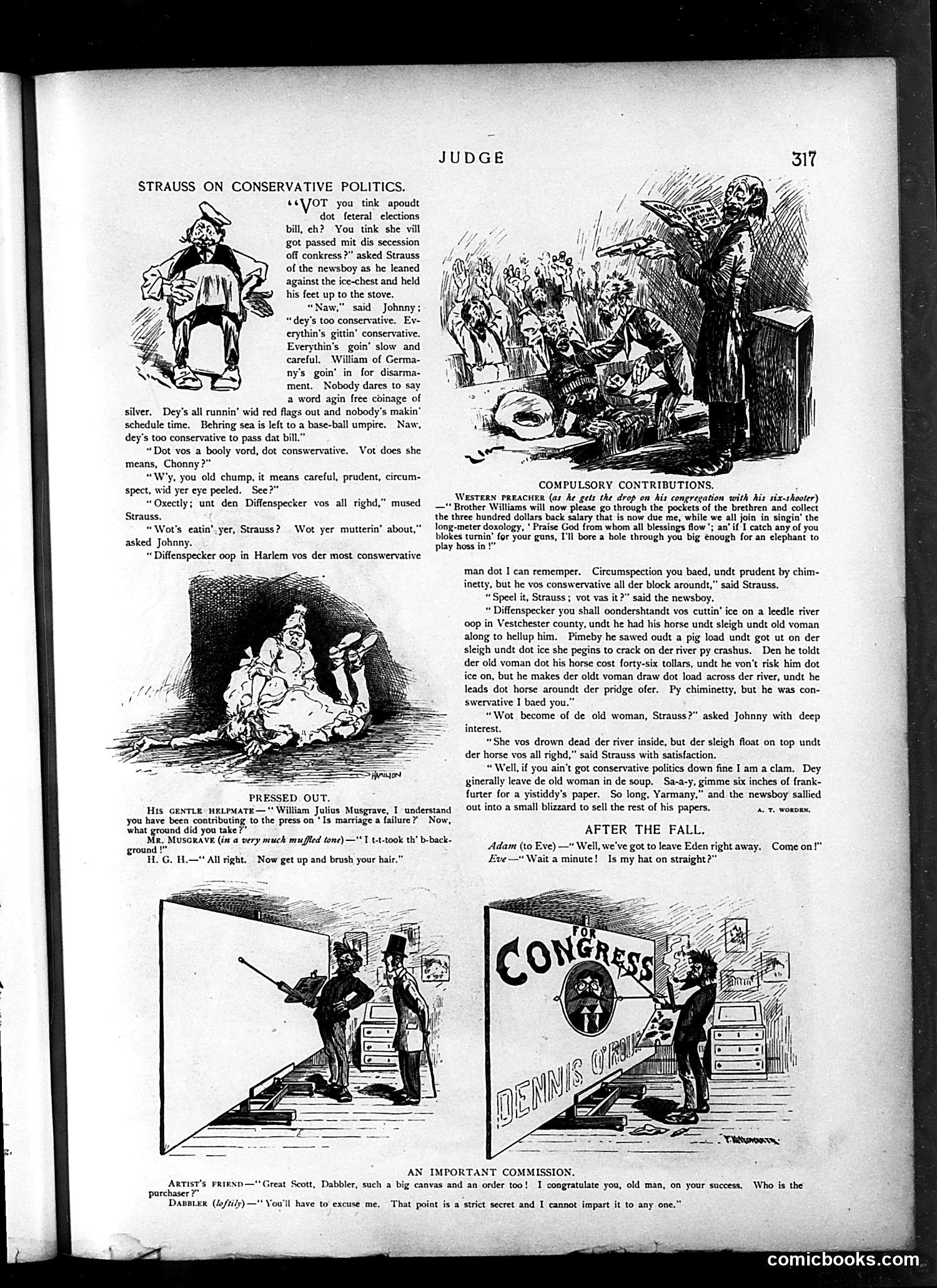
This page contains several satirical pieces mocking American politics and social pretension in the 1890s. **"Strauss on Conservative Politics"** features a Yiddish-accented character (Strauss) telling a newsboy about an excessively cautious man who let an old woman drown rather than risk his horse crossing thin ice—illustrating how excessive conservatism produces absurd, harmful outcomes. The piece references contemporary political paralysis (federal elections bill, silver coinage debates, disarmament). **"Compulsory Contributions"** depicts a Western preacher robbing his congregation at gunpoint to collect back salary—mocking both frontier violence and corrupt clergy. **"After the Fall"** shows Adam and Eve expelled from Eden; Eve's vanity about her hat mirrors concerns about superficial appearances over substance. **"An Important Commission"** satirizes artistic pretension through a painter claiming his patron's identity is "secret"—likely mocking either fraudulent art dealings or artists' inflated self-importance. The Yiddish dialect humor reflects contemporary immigrant stereotypes prevalent in American satire of this era.
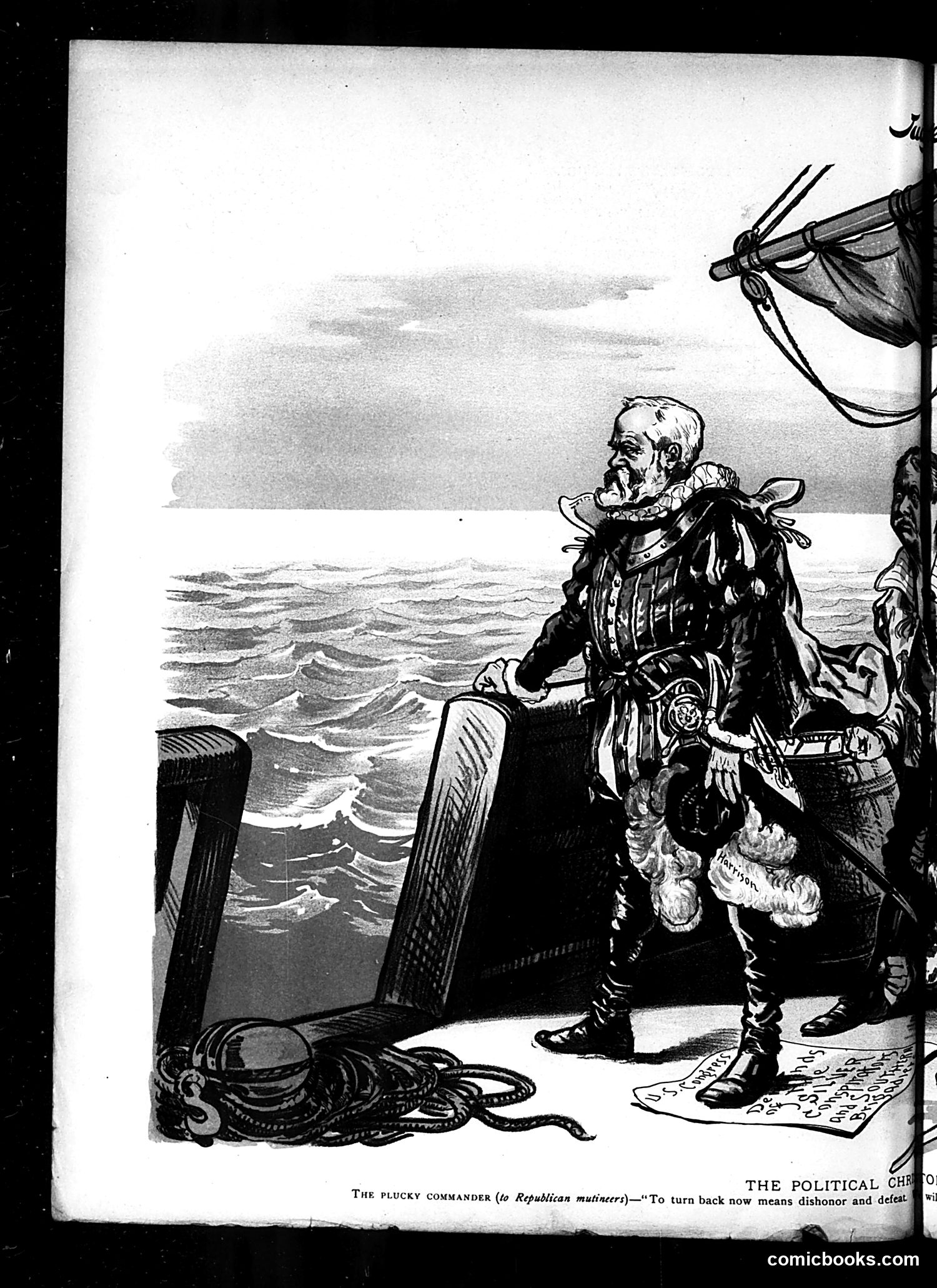
This is a political cartoon titled "The Plucky Commander" addressing "Republican mutineers." The image shows a military officer on a ship's deck, gesturing toward the ocean while speaking to soldiers behind him. The caption indicates he's exhorting them not to retreat, warning that "to turn back now means dishonor and defeat." The satire appears to mock Republican Party leadership during a period of internal conflict—likely depicting a commander figure urging party members to maintain course despite discord within their ranks. The nautical setting metaphorically represents the party as a ship navigating turbulent waters, with the "mutineers" representing rebellious Republican factions. Without the magazine's date, I cannot identify the specific historical moment or which Republican leader is caricatured, but the cartoon clearly ridicules internal party division and questions whether retreat is truly dishonorable.
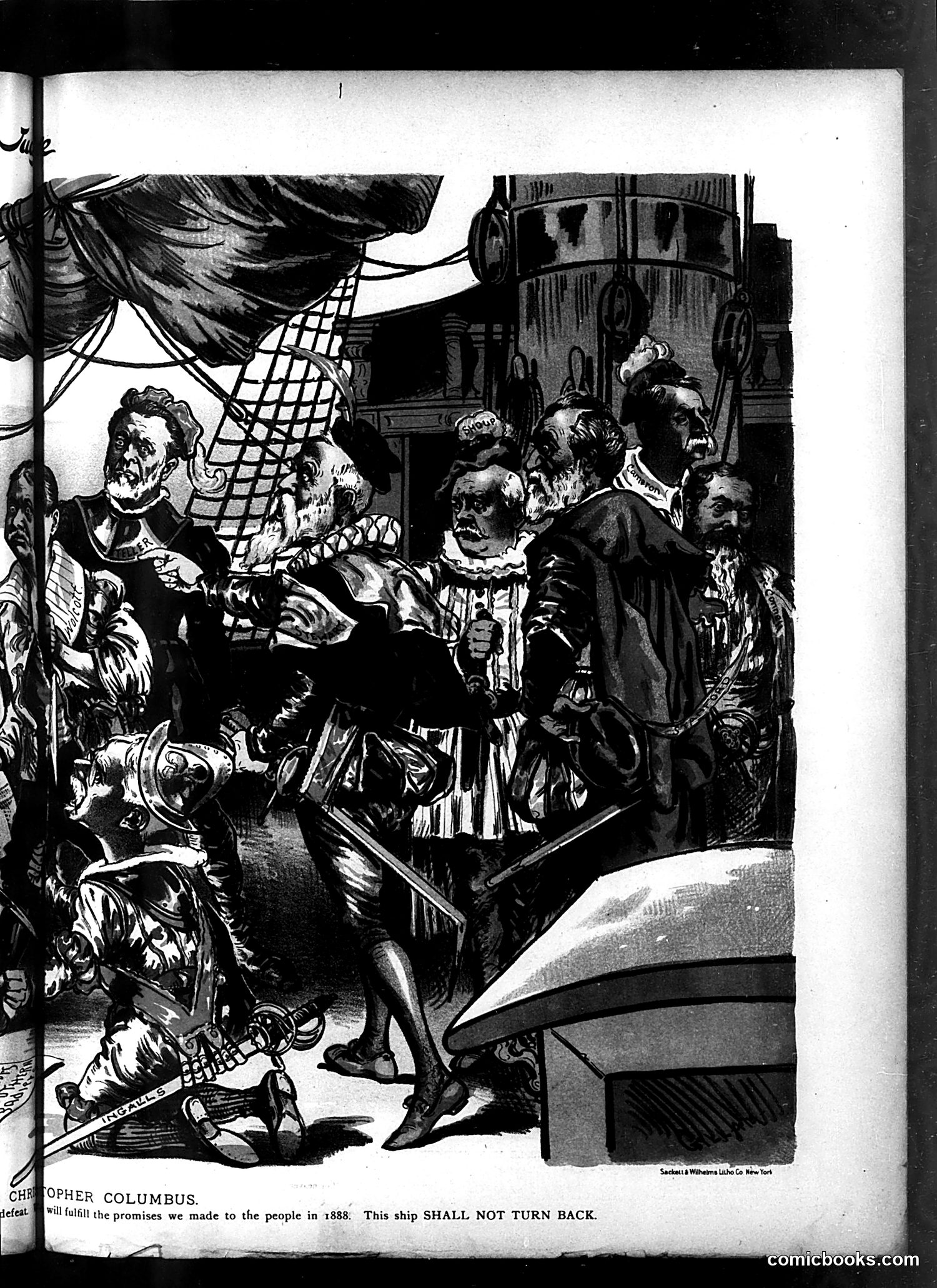
This is a satirical cartoon about Christopher Columbus and a ship, likely referencing American political promises. The text indicates Columbus will "fulfill the promises we made to the people in 1888" and declares "This ship SHALL NOT TURN BACK." The cartoon appears to be commentary on a political campaign or policy commitment from 1888—possibly related to economic policy, expansion, or a specific political platform. The elaborate period costumes and ship suggest both historical reference and allegorical meaning. The satire likely criticizes politicians for invoking historical precedent or grand promises while questioning whether they'll actually be kept. The "shall not turn back" phrase suggests commitment despite potential obstacles or opposition. Without the magazine's date and full context, the specific 1888 reference and which political figure is invoked remain unclear, though this appears to be critiquing broken or questionable political commitments.
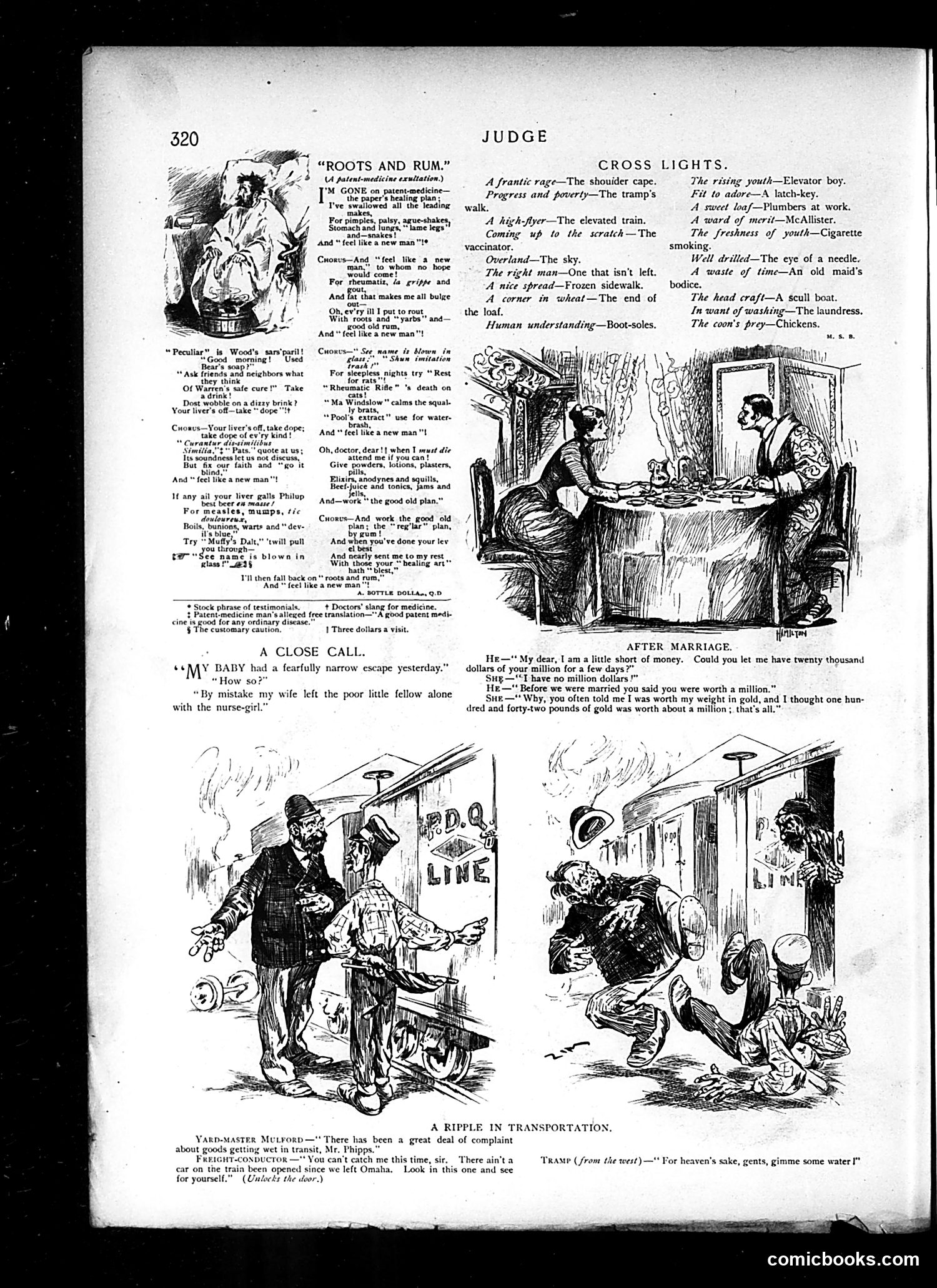
This page contains **satirical commentary on patent medicines** and various social observations typical of late-19th century American humor. The main feature, "Roots and Rum," mocks the patent medicine industry—a major cultural problem of the era. The song-format satire ridicules people who consume dubious "cures" (containing alcohol and unregulated ingredients) for every ailment, repeatedly claiming to "feel like a new man." The humor targets both the fraudulent medicine manufacturers and gullible consumers who prefer patent remedies to legitimate doctors. The smaller cartoons and jokes address: - **"A Close Call"**: A domestic humor piece about a baby narrowly avoiding the nurse-girl - **"After Marriage"**: A joke about a bride who claimed wealth before marriage but lacked it after - **"Cross Lights"**: Brief witty definitions (e.g., "The freshness of youth—Cigarette smoking") - **"A Ripple in Transportation"**: Railway complaints The page reflects Progressive Era skepticism toward unregulated commerce and the widespread snake-oil medicine problem that eventually prompted FDA regulation.
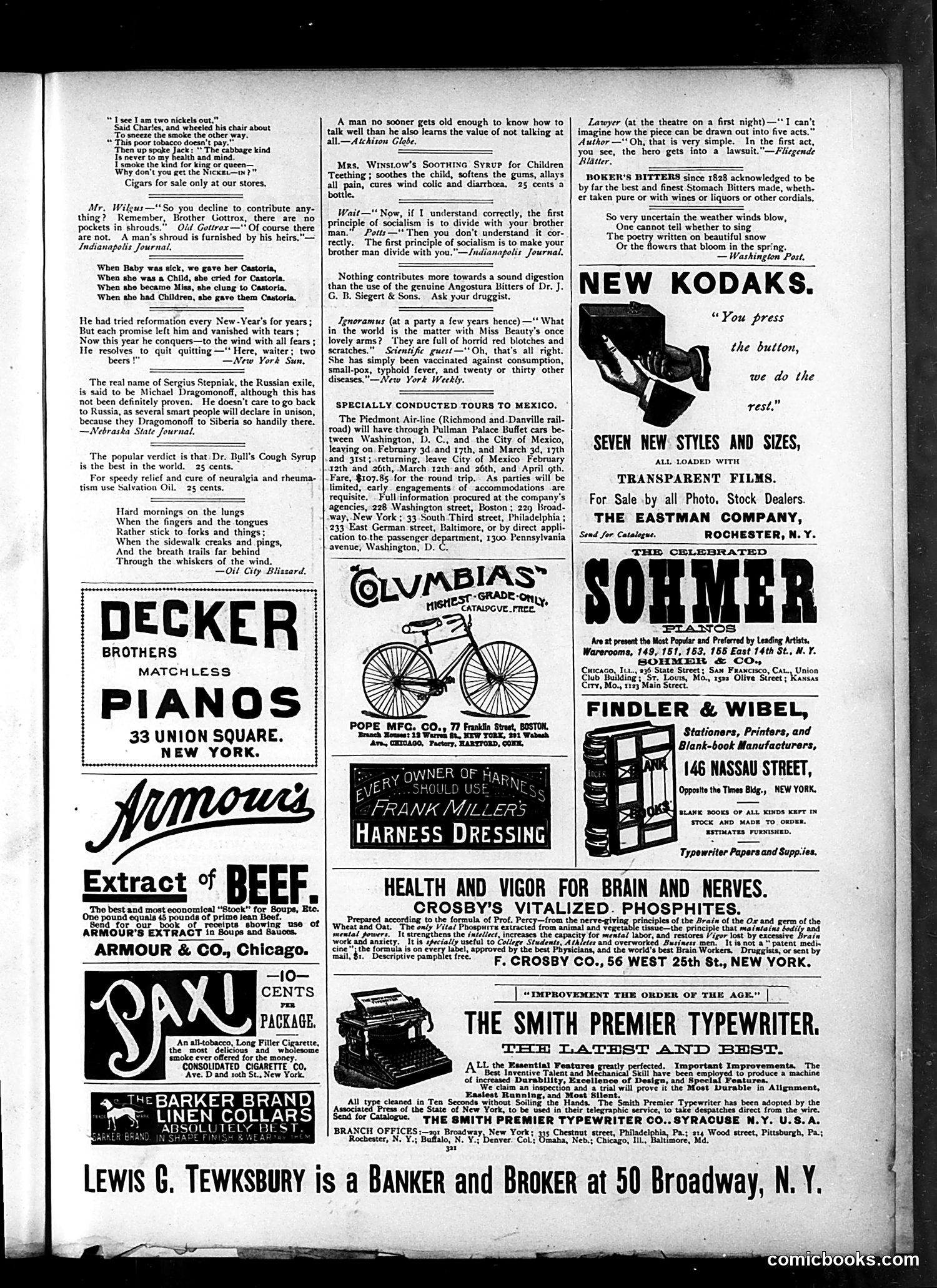
This is primarily an **advertising page** with minimal political or satirical content. The page features numerous product advertisements (pianos, typewriters, bicycles, beef extract, cigars, and patent medicines) typical of late 19th-century magazines. The few short humorous pieces present are gentle social satire rather than political commentary: - **"Charles and Jack" dialogue**: A mild joke about tobacco quality and pricing - **Brother Gottrox exchange**: Wordplay about shrouds and inheritance (pun on "heirs") - **Socialism joke**: Satirizes socialist principles as self-serving rather than altruistic—a common conservative critique of the era - **"Hard mornings" poem**: Describes winter weather effects on the body There is **no identifiable political cartoon** on this page. The content reflects typical Judge magazine humor: gentle mockery of human nature, consumer culture, and contemporary ideas, rather than biting political satire. The page prioritizes commercial revenue through advertising over editorial content.
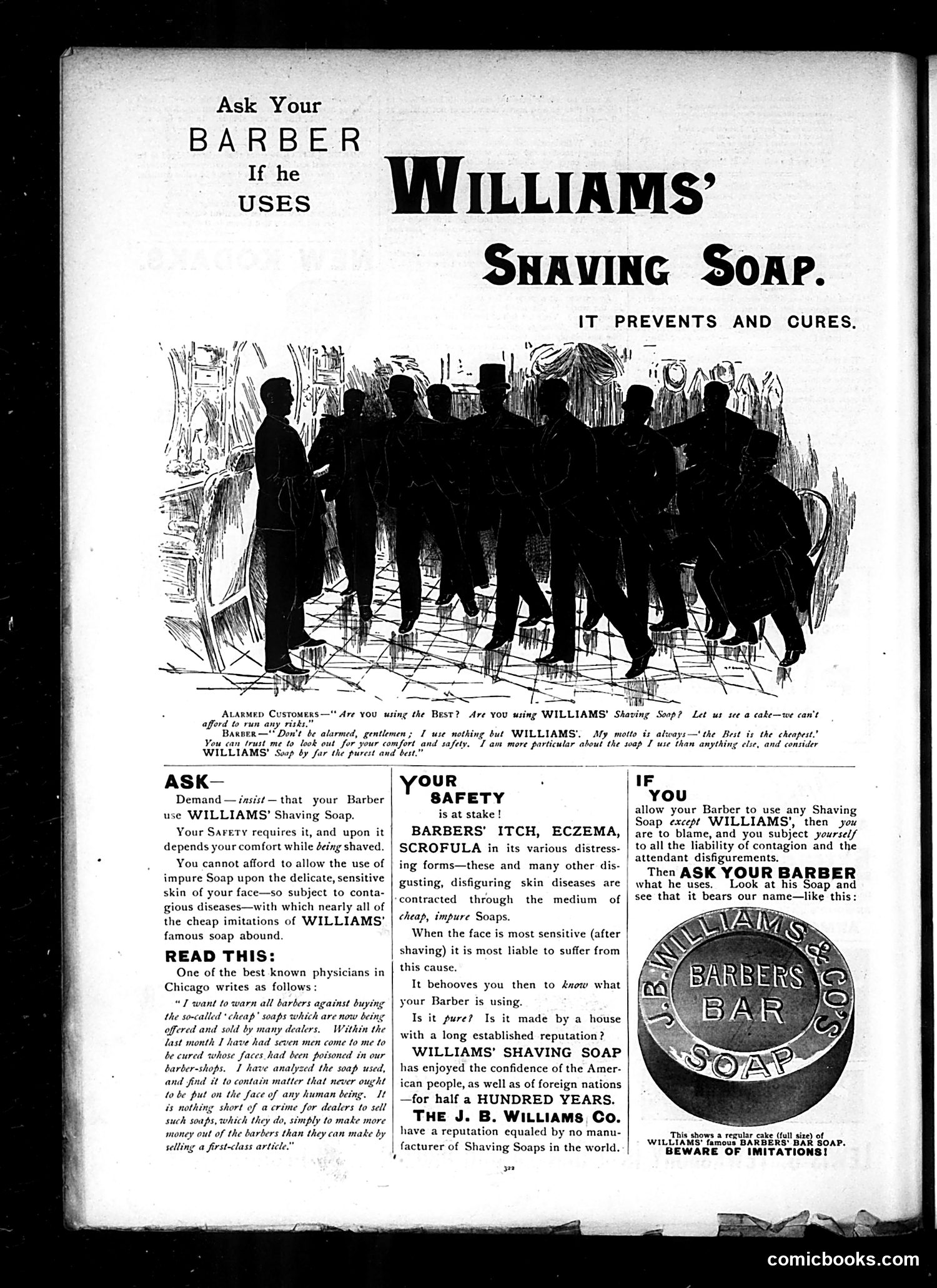
This is primarily a **product advertisement**, not political satire. It promotes Williams' Shaving Soap to barbers and their customers during an era of widespread concern about hygiene and contagious disease. The illustrated scene depicts alarmed barbershop customers questioning whether the barber uses Williams' soap, with the barber reassuring them he does. The central pitch exploits **genuine health anxieties**: the text warns that cheap imitations cause serious skin diseases like barber's itch, eczema, and scrofula—conditions actually common in early barbershops due to unsanitary practices. A quoted physician's testimony (likely genuine or plausible-sounding) validates fears about contaminated cheap soaps. The ad emphasizes Williams' 50-year reputation and purity, positioning premium soap as essential health protection. This reflects turn-of-the-century advertising strategy: manufacturing consumer anxiety about disease and safety to drive brand loyalty. The message is essentially: don't risk your health on cheap imitations—demand the trusted, pure product.
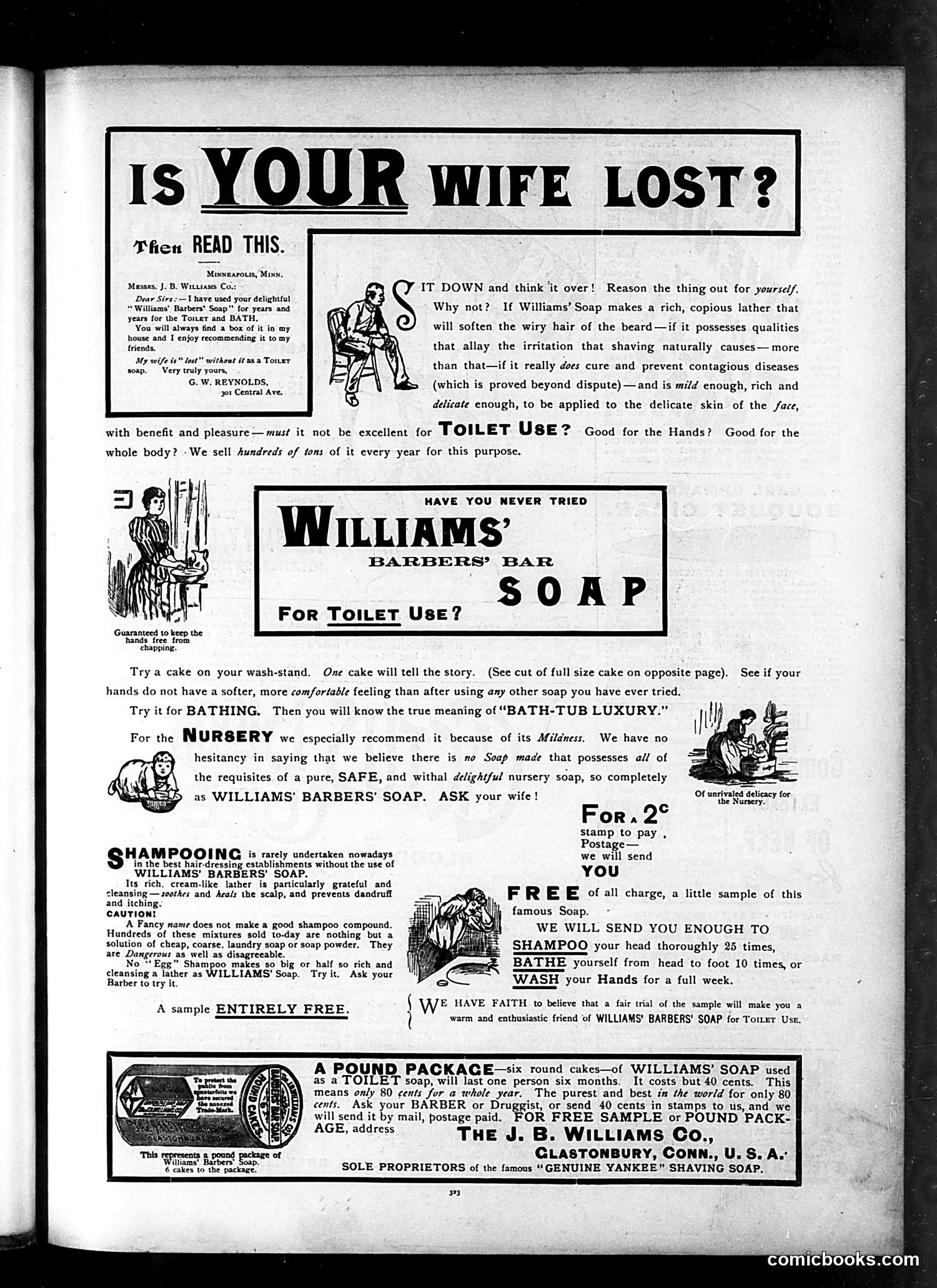
This page is primarily a **product advertisement** rather than political satire or editorial cartoon. The sensational headline "IS YOUR WIFE LOST?" is clickbait—a rhetorical device to grab attention and draw readers into a soap advertisement. The "joke" is that a wife needs Williams' Soap so much she'd be "lost" without it. A testimonial letter from a Minnesota customer (G. W. Reynolds) claims his wife won't use anything else. The page promotes the soap's multiple uses: shaving, bathing, shampooing, nursery care, and hand-washing. It emphasizes the product's mildness, lathering quality, and supposed medicinal properties (preventing "contagious diseases"). The small illustrations show satisfied users. The offer of a free sample for 2¢ postage was a common marketing tactic of the era. **This is straightforward commercial advertising**, not editorial commentary, typical of Judge magazine's revenue model.
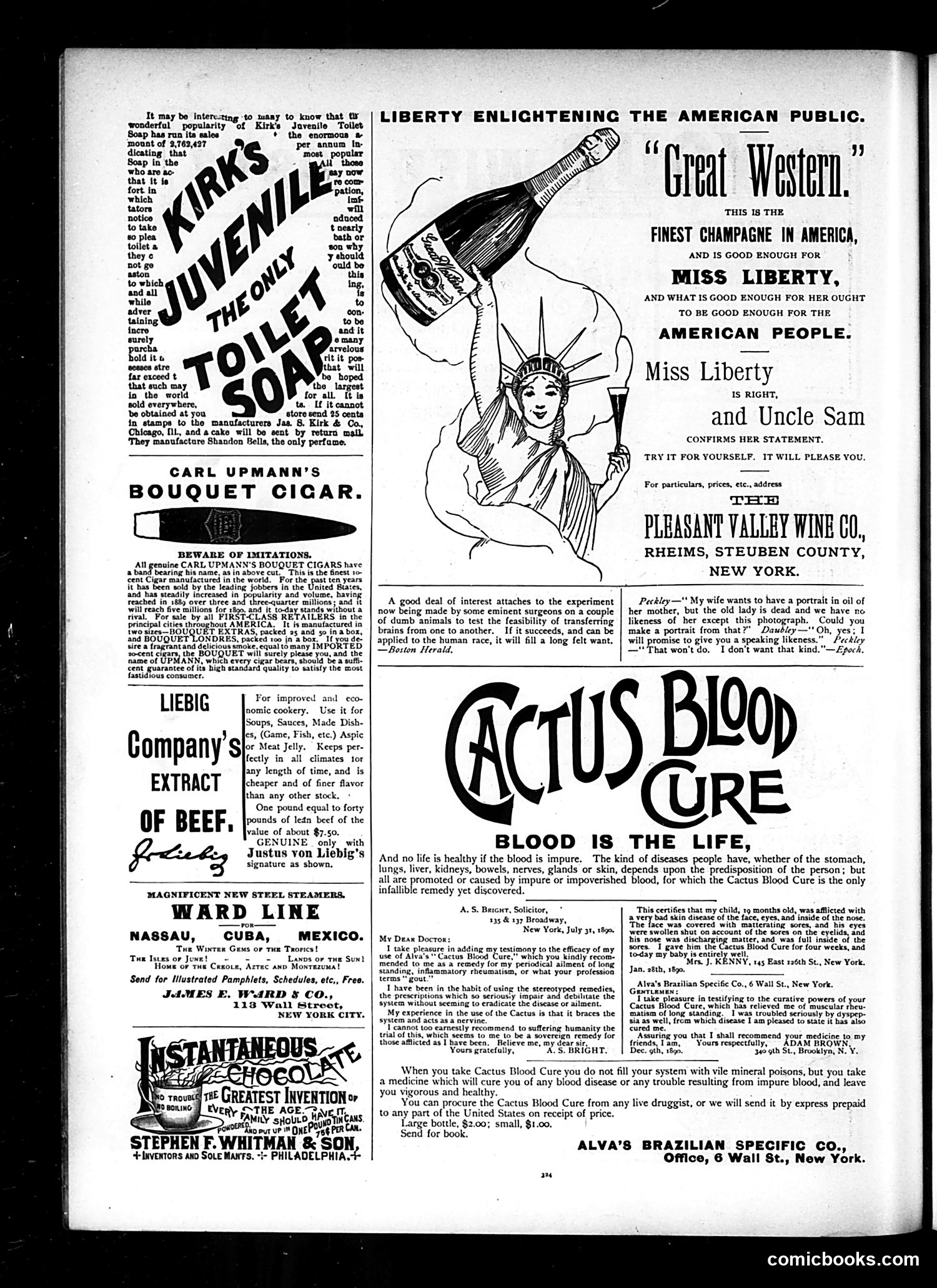
This page is primarily **advertisements** with one satirical item. The main cartoon/satire concerns **"Great Western" champagne**. The image shows the Statue of Liberty holding a champagne bottle aloft. The text uses patriotic language—"Liberty Enlightening the American Public"—to humorously equate drinking this specific wine brand with American values. It claims the champagne is "good enough for Miss Liberty" and therefore "good enough for the American people," with "Uncle Sam" confirming this statement. The satire mocks **nationalist advertising appeals**: manufacturers wrapping commercial products in patriotic imagery and rhetoric to suggest that consuming their brand represents American pride or duty. By having Lady Liberty herself endorse cheap champagne, Judge ridicules the absurdity of conflating consumer goods with national identity. The remaining page contains standard late-19th-century ads (cigars, beef extract, steamship lines, chocolate) with no apparent satirical intent.
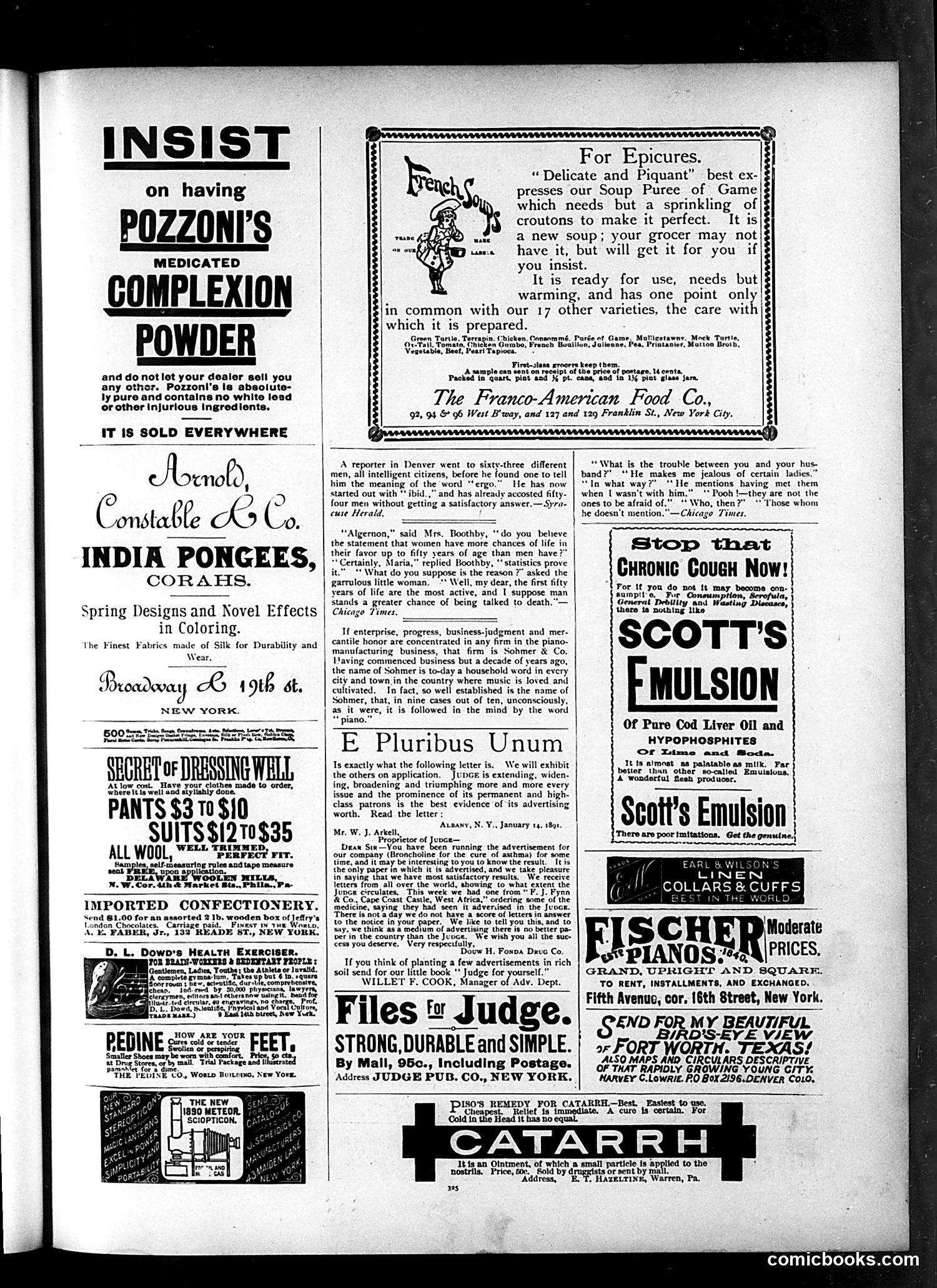
This is primarily an **advertising page** from Judge magazine, circa 1891. The visible content consists almost entirely of commercial advertisements with minimal editorial or satirical content. Notable ads include: - **Pozzoni's Complexion Powder**: A beauty product explicitly marketed as containing no lead or "injurious ingredients"—suggesting competitors' powders contained toxic substances (white lead was common in cosmetics then, causing serious health damage). - **Franco-American Food Company**: Advertising canned soups and prepared foods, marketed as convenient and refined for "epicures." - **Scott's Emulsion**: A cod liver oil product advertised as a health remedy. - Various clothing, piano, and confectionery advertisements. The page reflects **late 19th-century consumer culture**, with ads targeting middle-class aspirations for health, refinement, and convenience. The frank admission that competitors' products contain dangerous ingredients is notable—such advertising directly compared products by naming harmful content, a practice later restricted by regulation. No political satire or cartoons are evident on this particular page.
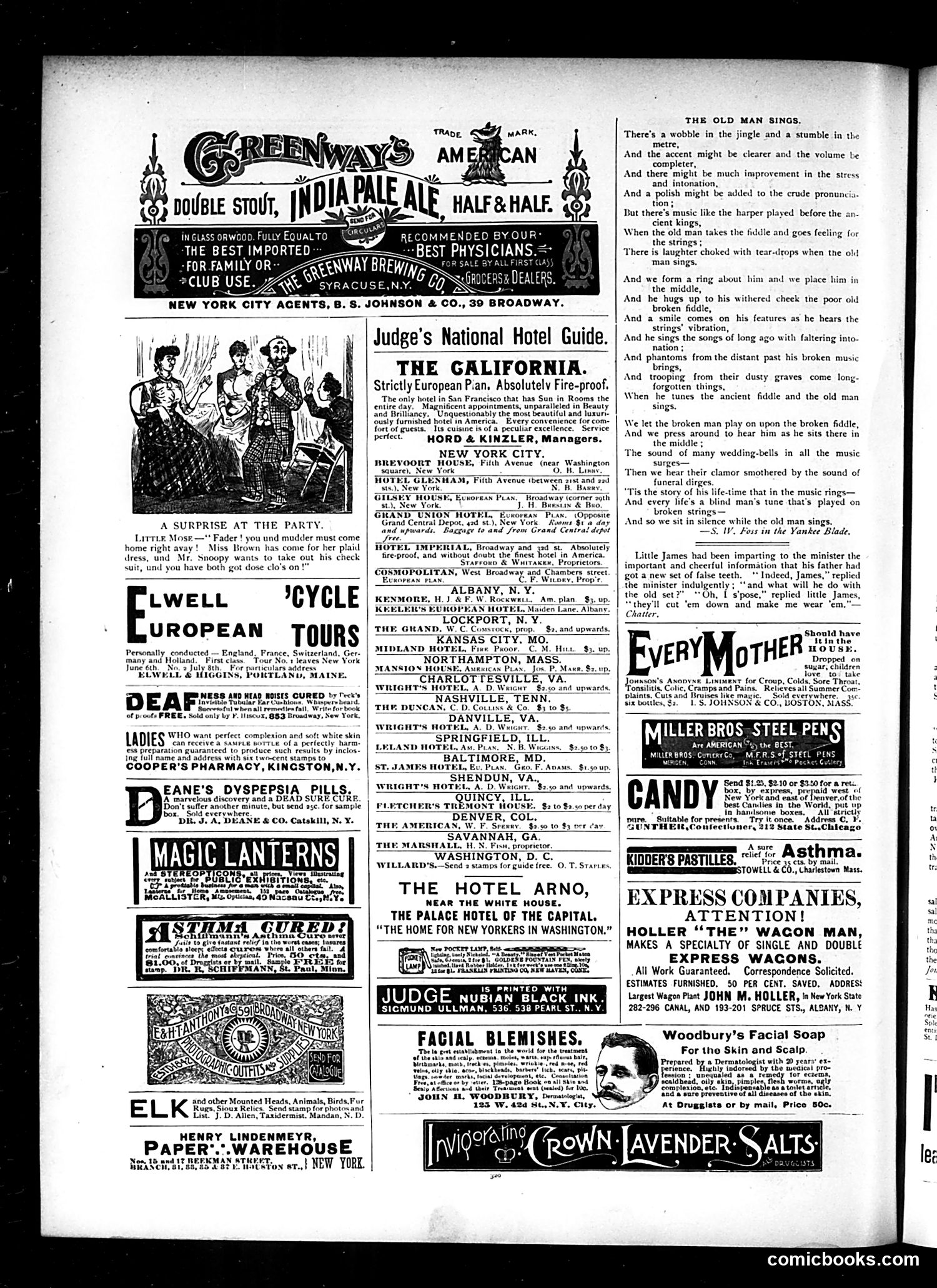
This cartoon satirizes immigrant life and class pretense in turn-of-the-century New York. "Little Mose," a child speaking in exaggerated immigrant dialect ("Fader," "und"), interrupts a social gathering by revealing that his parents have borrowed clothing from neighbors—a plaid dress from Miss Brown and a suit from Mr. Snoopy—without permission. The joke mocks working-class immigrants attempting to appear respectable at parties while living in poverty, unable to afford their own clothes. The humor derives from the embarrassing exposure of their deception and financial desperation. This reflects period attitudes toward immigrants as dishonest or absurdly pretentious.
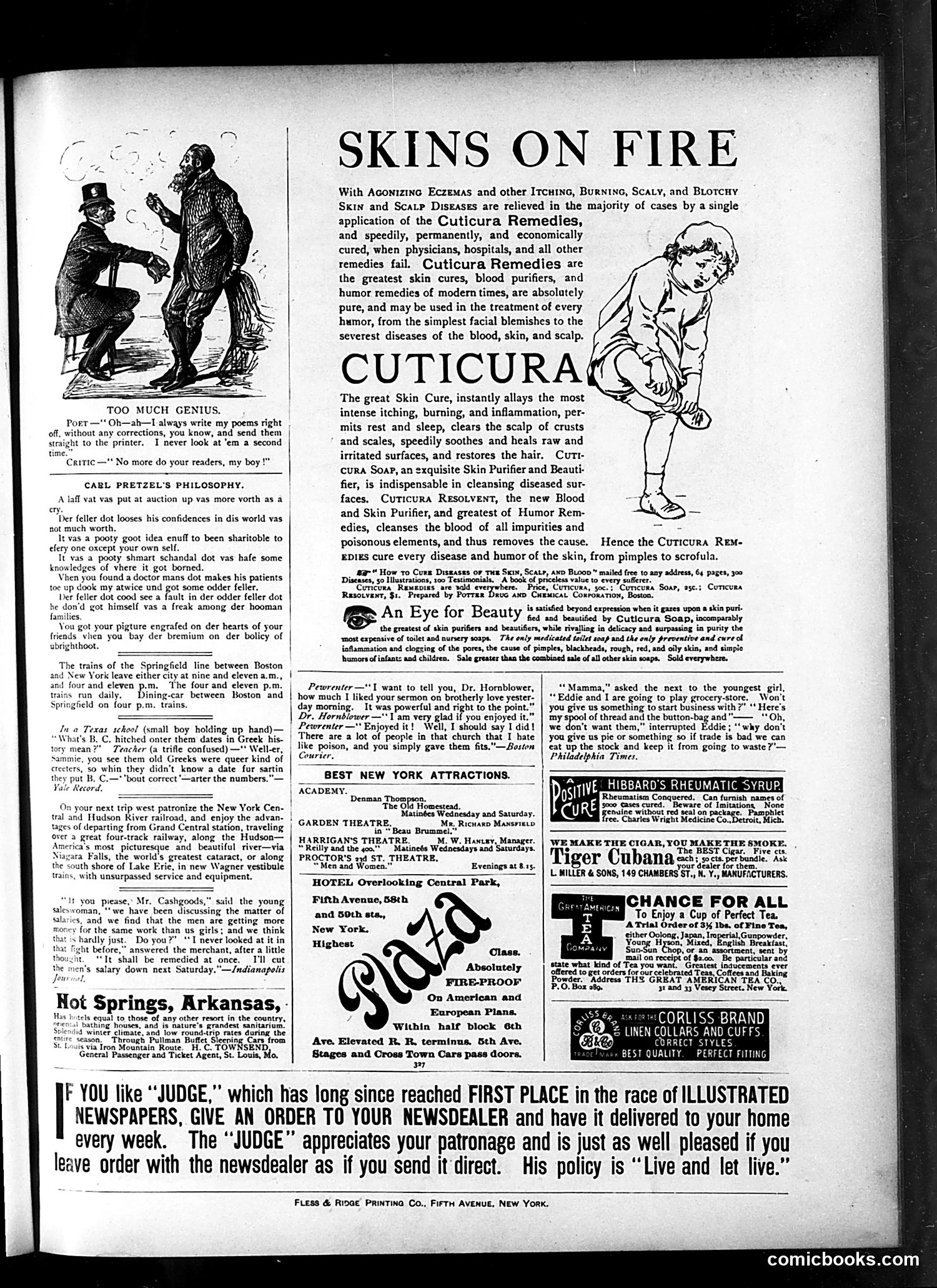
This page is **primarily an advertisement**, not political satire. The dominant content is a multi-section advertisement for Cuticura Remedies, a patent medicine claiming to cure skin diseases, eczema, and blood disorders. The small cartoon vignettes scattered throughout are **filler humor**, not political commentary: - "Too Much Genius" jokes about a poet's careless writing - "Carl Pretzel's Philosophy" features dialect humor (a German-accented character offering folksy observations) - Other brief anecdotes about everyday life These cartoons reflect **late-19th-century Judge magazine's typical mix**: light social humor rather than pointed political satire. The German-dialect character was a common comedic stereotype of the era. The page's real purpose is **selling Cuticura products** through exaggerated medical claims typical of patent medicines before FDA regulation. The mix of modest humor and aggressive advertising was standard for this publication.
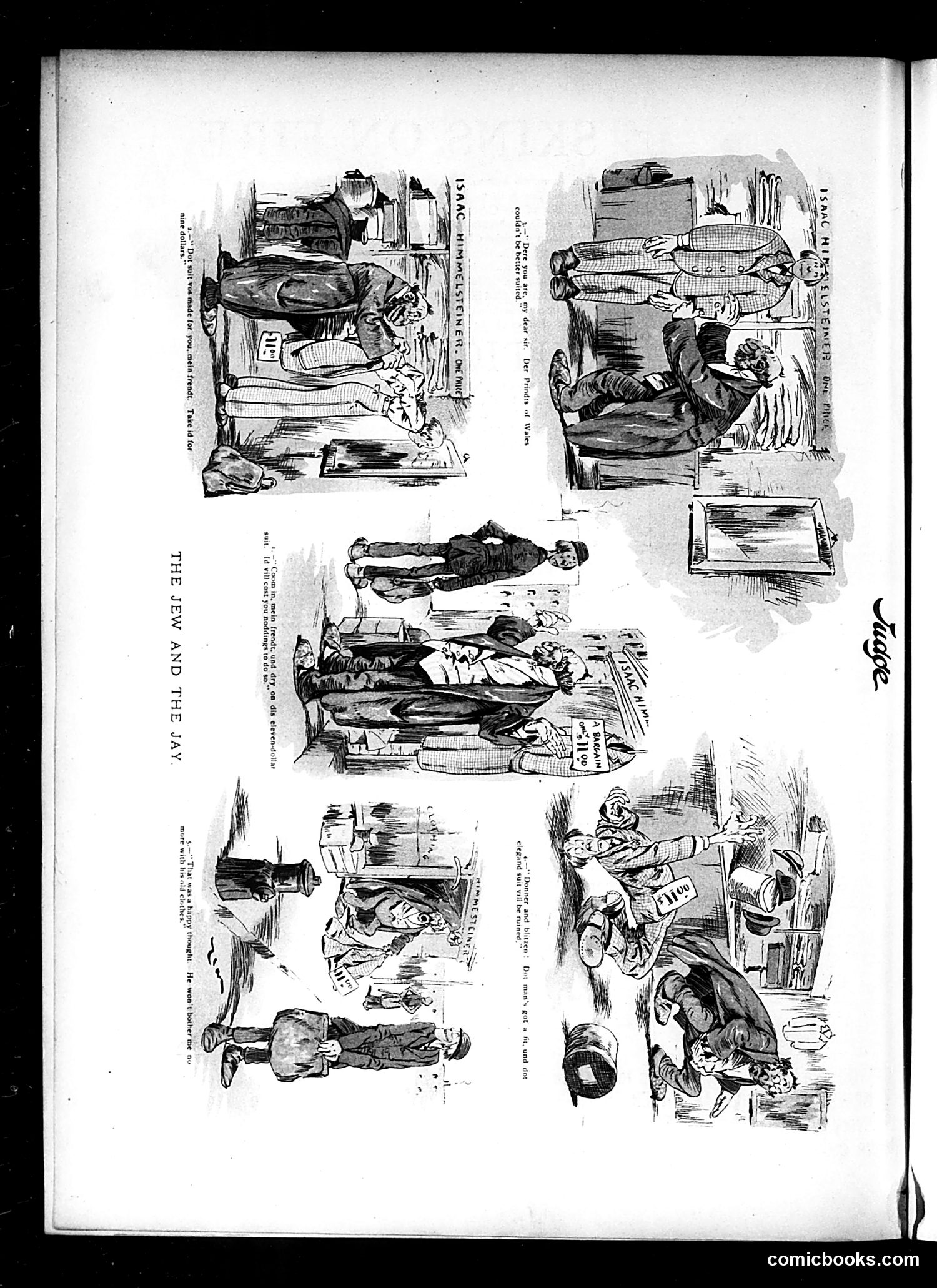
This page contains a multi-panel comic strip satirizing a clothing transaction between a Jewish merchant (depicted with stereotypical caricature and Yiddish-inflected dialect) and an apparently naive customer referred to as "the Jay" (slang for a gullible rube or country person). The humor relies on period stereotypes: the merchant uses exaggerated Yiddish speech patterns while employing classic sales tactics—first quoting an inflated price ($11), then manipulating the customer down to $9, creating a false sense of getting a deal. The strip appears to mock both the perceived shrewdness of Jewish merchants and the foolishness of easily-duped customers. The title itself treats this as entertainment premised on ethnic/religious caricature, reflecting Judge magazine's casual use of such stereotypes in late 19th/early 20th-century American satire.