
A complete issue · 16 pages · 1891
Judge — January 17, 1891
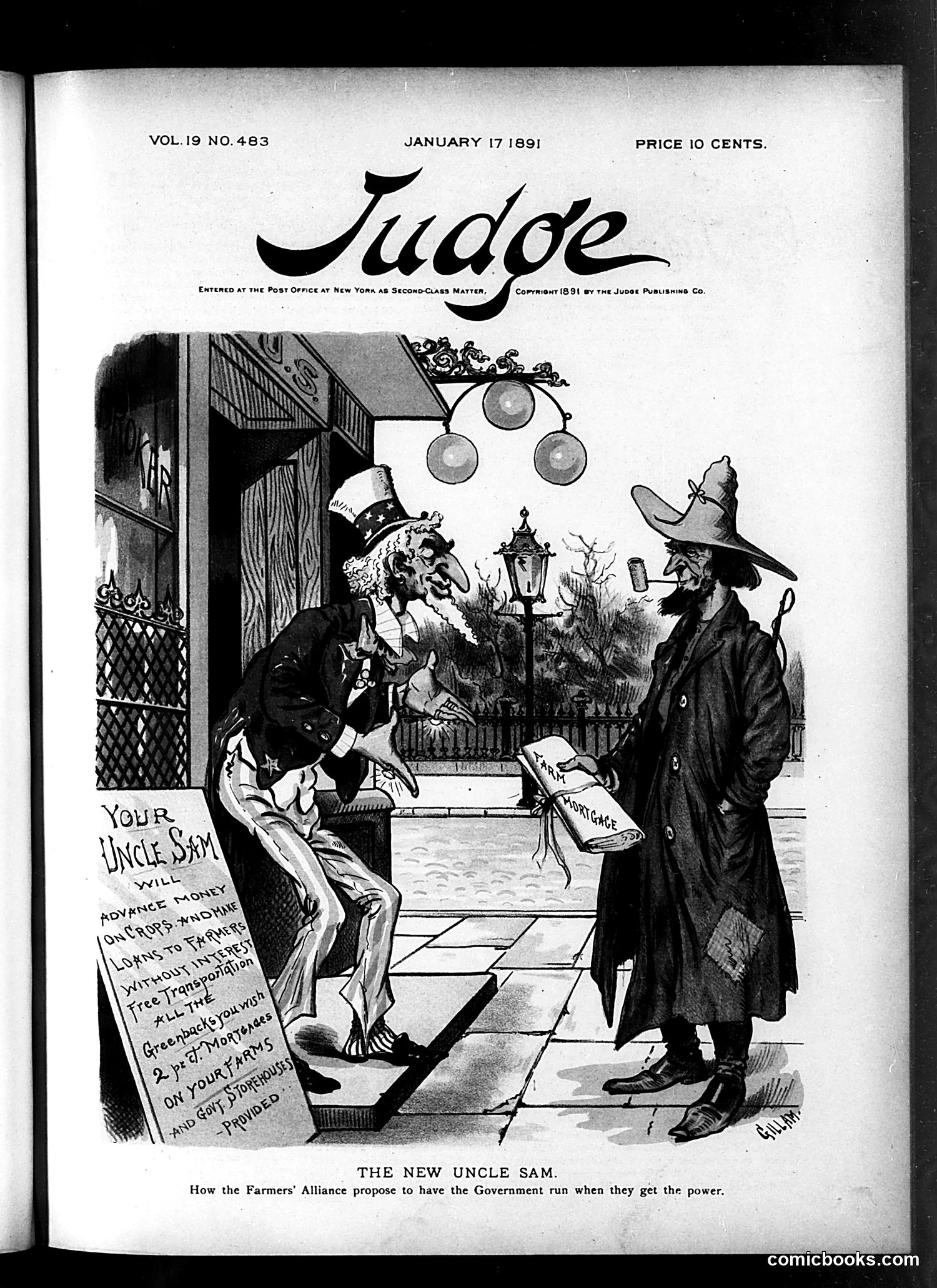
This January 1891 *Judge* cartoon satirizes the Farmers' Alliance political movement. Uncle Sam (left), depicted as skeletal and impoverished, confronts a well-dressed figure (right, likely representing established political interests or creditors) holding a "Mortgage" document. The accompanying sign promises Uncle Sam will "advance money on crops, whiskey, loans at interest" and other exploitative terms—mocking the financial burdens farmers faced. The three glowing orbs above suggest dangling promises or false hope. The caption states the Alliance proposes having "the Government run when they get the power"—the cartoonist skeptically depicting their reformist agenda as naive fantasy. The satire questions whether the Alliance could genuinely improve farmers' desperate economic circumstances or merely represented another false solution.
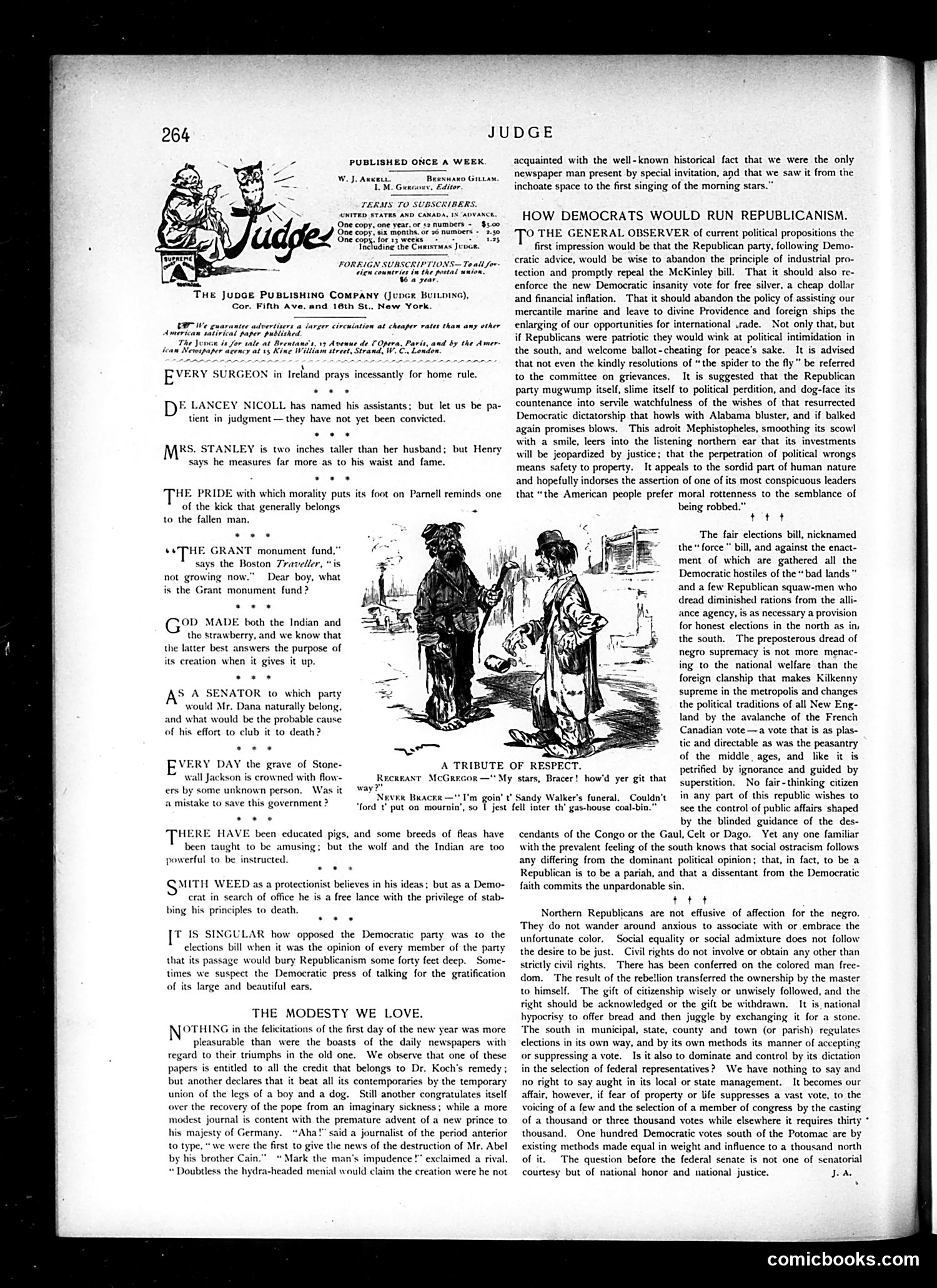
This page contains satirical commentary on Democratic political proposals, accompanied by a sketch titled "A Tribute of Respect" showing what appears to be a funeral scene. The main article "How Democrats Would Run Republicanism" critiques Democratic policy positions, arguing they would harm the economy through inflation, abandon industrial protection, and weaken national defense. The piece sarcastically suggests Democrats would welcome "ballot-cheating" and patronage systems. The smaller sketch "A Tribute of Respect" depicts two figures at what appears to be a grave or funeral, with dialogue suggesting commentary on a specific political death or defeat—likely referencing a Republican political figure or cause, though the specific identity isn't clear from this image alone. The overall tone is partisan Republican mockery of Democratic governance proposals.
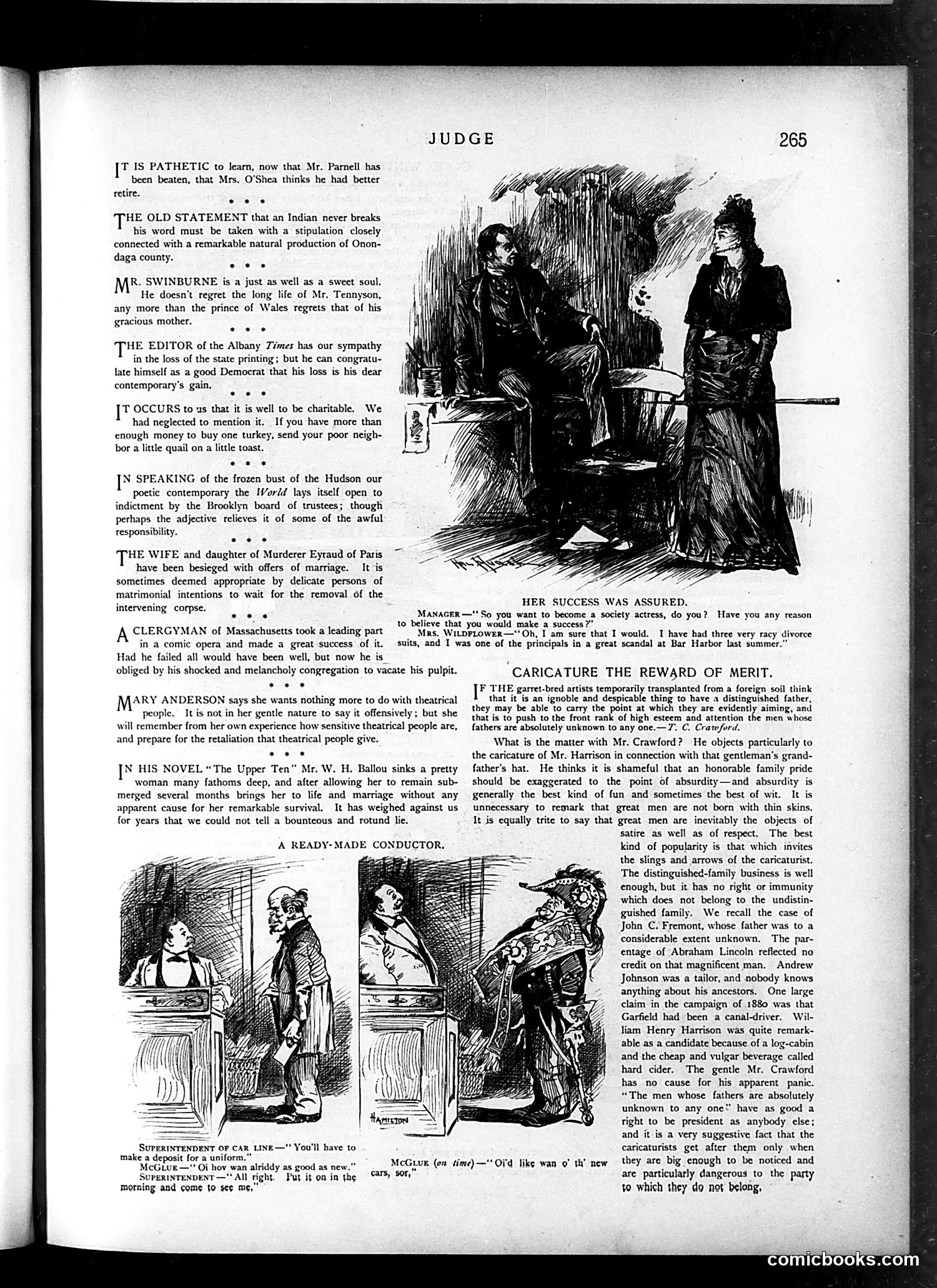
This page contains editorial commentary and satirical illustrations rather than a single coherent cartoon. **Top illustration**: Shows two figures in conversation, likely depicting a social or political exchange, though specific identities aren't clear from the image alone. **"A Ready-Made Conductor" cartoon** (bottom): Features a man in formal dress interacting with what appears to be a uniformed conductor or official at a window/booth. The caption suggests humor about depositing money for a uniform—likely satirizing either pretentious social climbing or incompetent officials acquiring authority through appearance rather than merit. **Editorial notes** reference specific people (Parnell, Swinburne, Harrison) and publications (Albany Times, Brooklyn board of trustees), suggesting topical commentary on 1880s-1890s figures and institutions, but requires historical context to fully interpret.
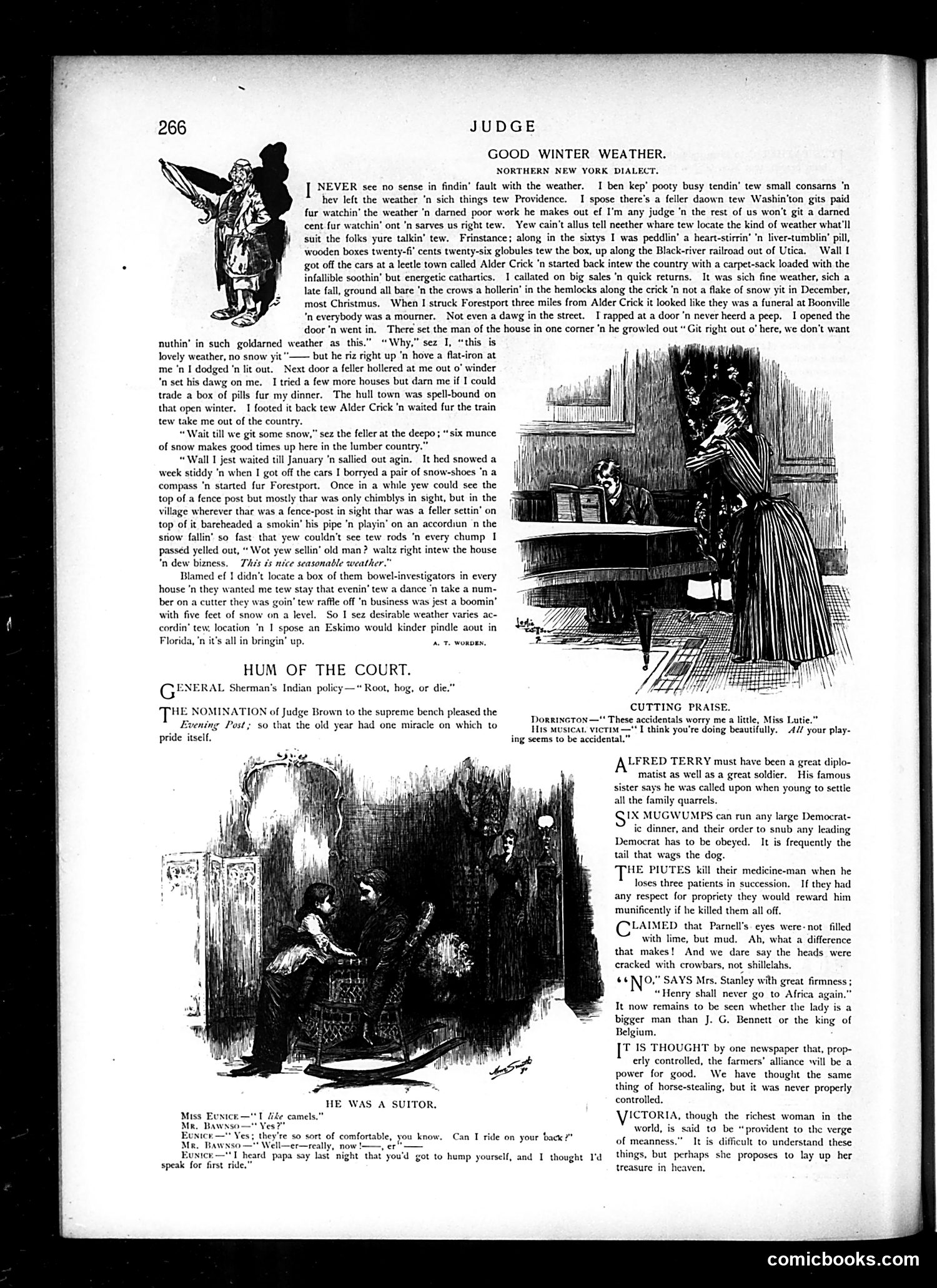
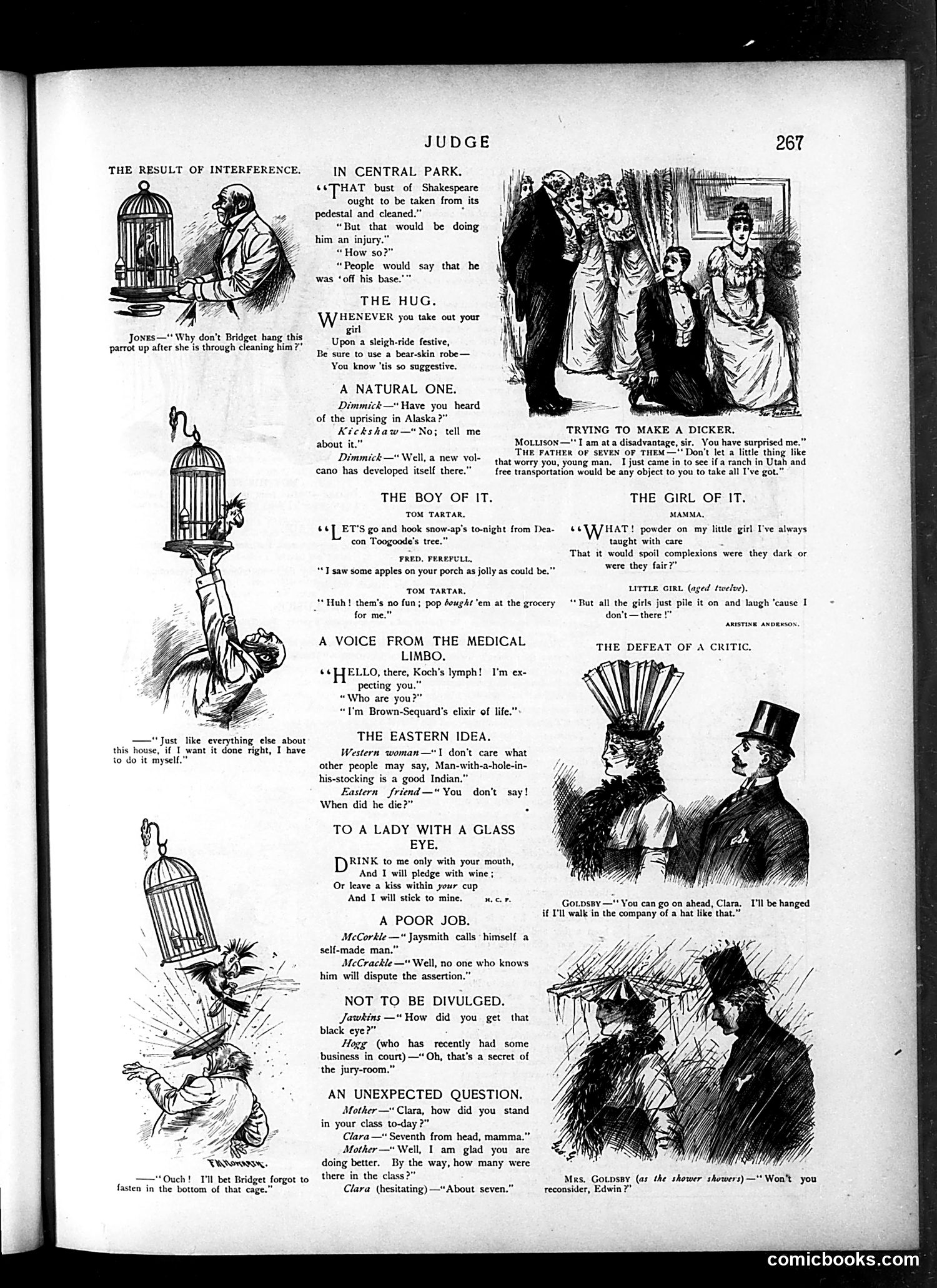
This page collects brief humorous sketches satirizing various social absurdities of the era. Key pieces include: **"The Result of Interference"**: A husband complains that his wife Bridget's interference ruins household tasks—he must do everything himself, even cage-cleaning. **"In Central Park"**: Characters debate cleaning a Shakespeare bust, fearing he'd be called "off his base"—a pun on both pedestals and sanity. **"The Eastern Idea"**: Western and Eastern women debate whether "Man-with-a-hole-in-his-stocking" is a "good Indian," likely referencing stereotypes about Native Americans. **"A Poor Job"**: Self-made men receive mockery; Jaysmith's self-creation is disputed by those knowing him. **"The Father of Seven"**: A desperate father offers a stranger a Utah ranch plus "free transportation" to take his seven children—commentary on large families as burdensome. **"The Girl of It"**: A girl questions whether powder spoils complexions when "all the girls" use it—gentle satire on feminine vanity and peer pressure. The humor targets marriage dynamics, pretension, and social conventions.
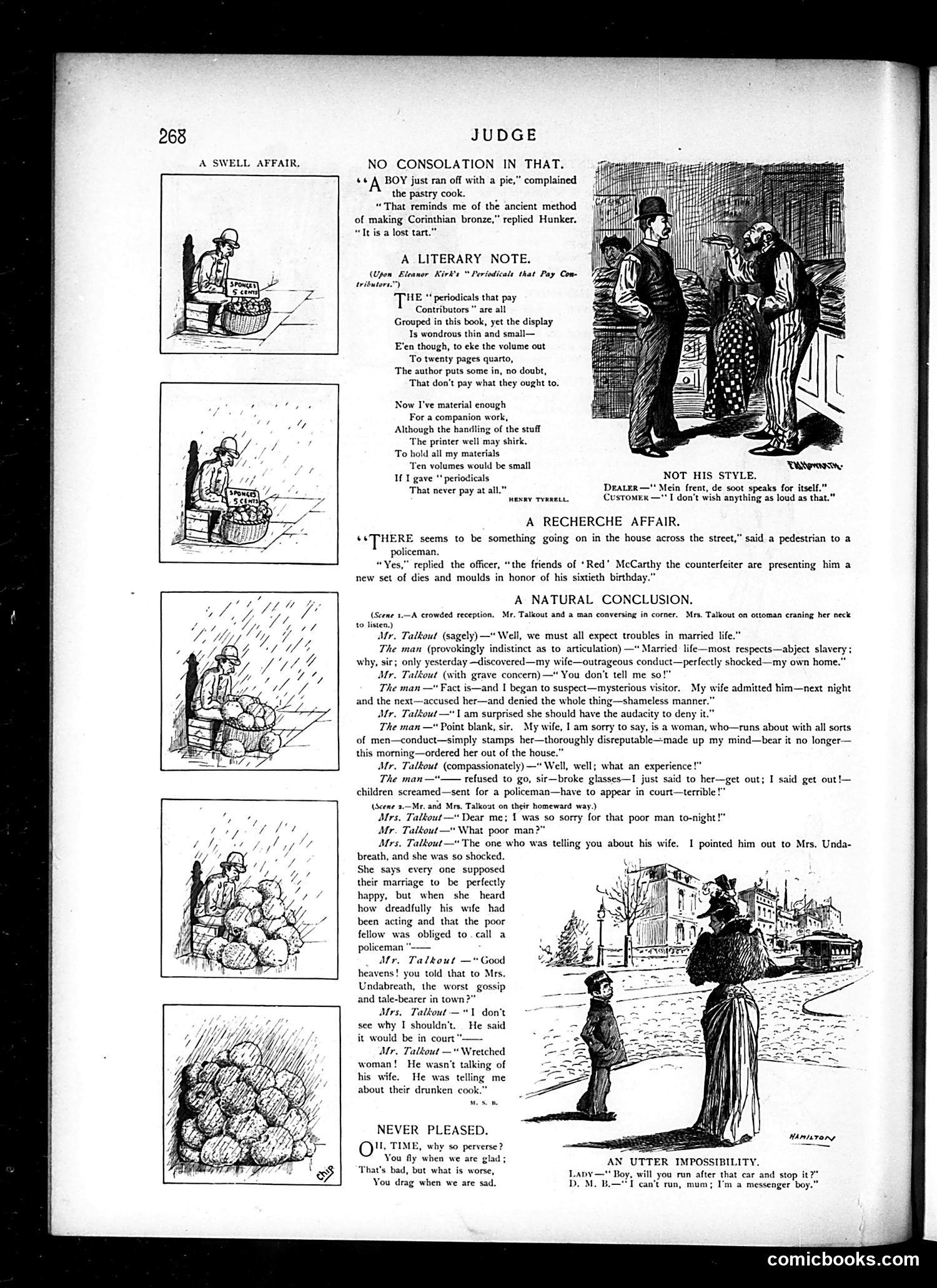
This page contains several standalone satirical pieces typical of Judge magazine: **"A Swell Affair"** is a visual gag showing a boy repeatedly stealing pies in rain—the punchline is a terrible pun ("lost tart" instead of "lost art"). **"A Literary Note"** mocks Eleanor Kirk's book about magazines that pay contributors, sarcastically suggesting the author had to include fake publications to reach twenty pages, and the author implies many so-called "paying" periodicals actually don't compensate writers. **"A Recherche Affair"** jokes darkly about Red McCarthy (appears to be a real counterfeiter) receiving "dies and moulds" as birthday gifts—a double meaning, since counterfeiters literally use these tools. **"A Natural Conclusion"** satirizes how gossip spreads: Mr. Talkout overhears a man's vague complaints about his wife's misconduct and mysterious visitors, then Mrs. Talkout repeats this to the town gossip. The twist: the man was actually discussing their drunken cook, not his wife—but the damage to his reputation is done. The remaining pieces are brief humorous observations about time and an impossible request.
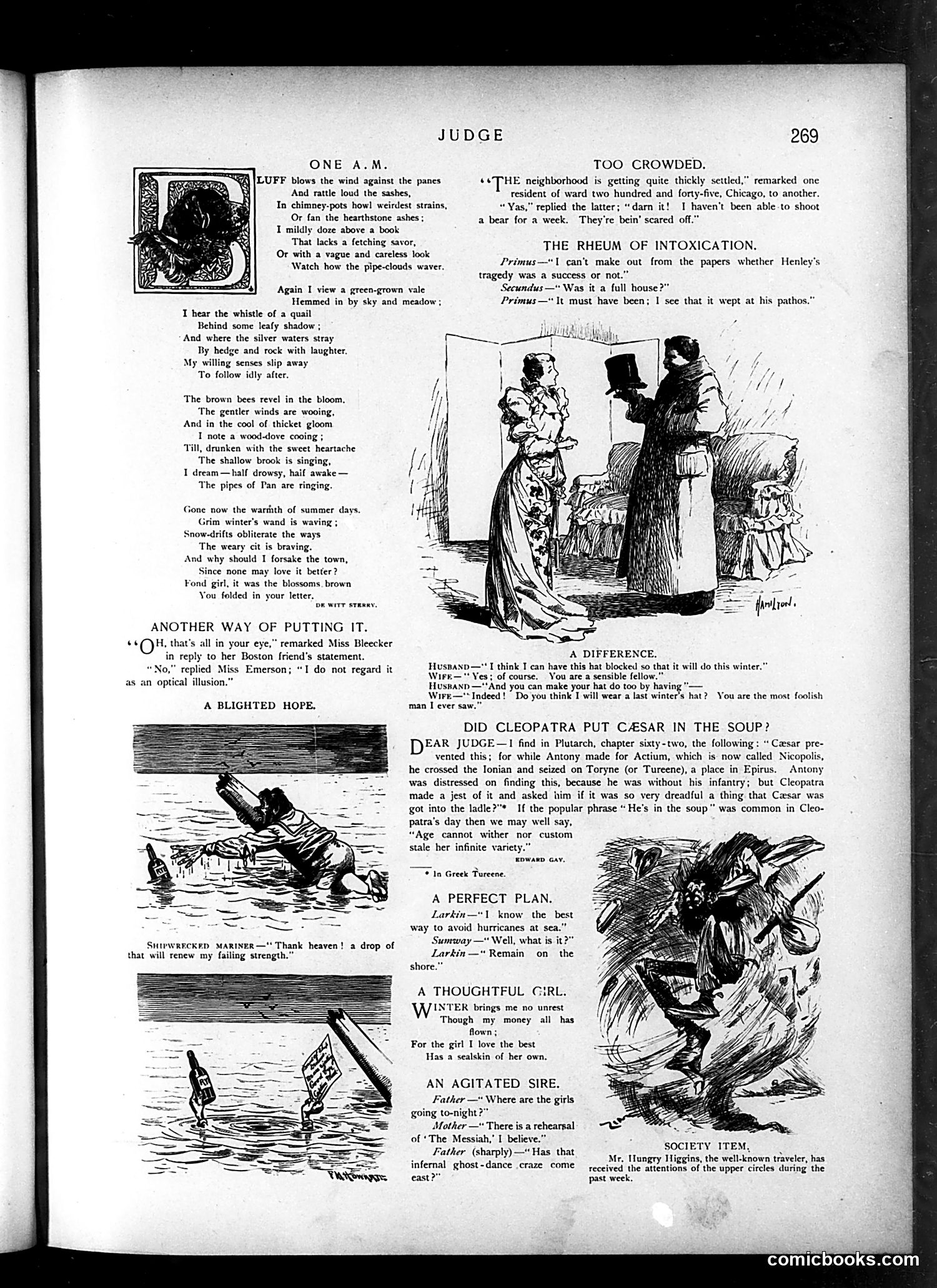
This page contains several short satirical pieces typical of late 19th-century humor magazines: **"Too Crowded"** mocks wealthy Chicago residents complaining that urban expansion has driven away game animals—a joke about how civilization encroaches on hunting grounds. **"The Rheum of Intoxication"** plays on "Henley's tragedy" (likely William Ernest Henley's theatrical work) with a pun: calling a play successful because it "wept" (moved audiences emotionally), treating tears literally as evidence of a "full house." **"A Difference"** satirizes gender double standards in marriage—husbands can reuse hats from previous seasons, but wives cannot, highlighting arbitrary female fashion expectations. **"Did Cleopatra Put Caesar in the Soup?"** is a learned joke suggesting the ancient phrase "in the soup" (meaning in trouble) existed in Cleopatra's era, making contemporary slang appear timeless. The remaining pieces are brief domestic humor sketches about marriage, travel advice, and fashion consciousness. The illustrations complement these verbal jokes with period-appropriate social commentary.
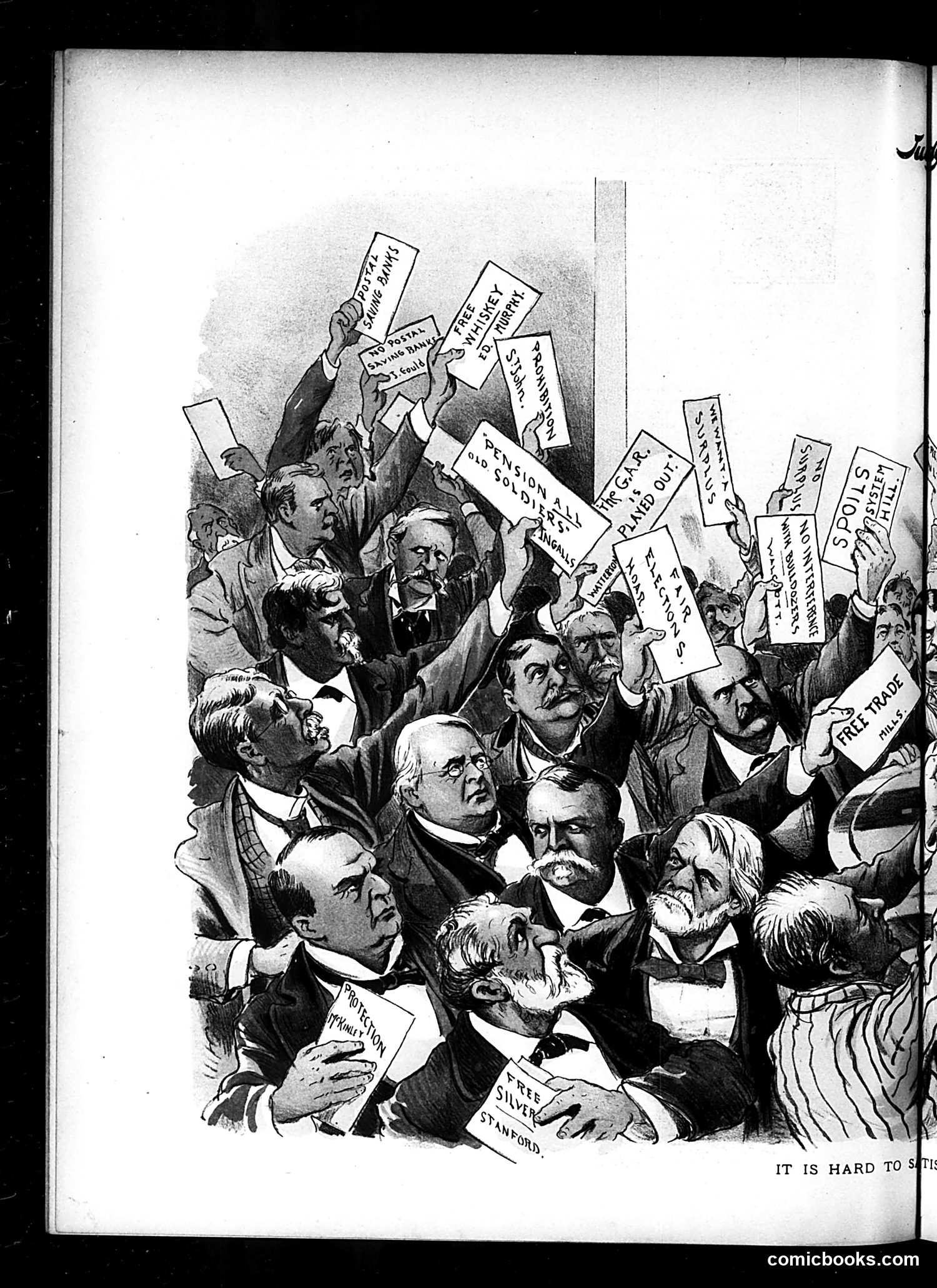
This Judge magazine cartoon depicts a crowd of men in formal 19th-century attire holding various protest signs. Visible placards reference issues including "FREE TRADE," "OLD SOLDIERS," "PENSION," "SILVER," and what appears to be economic or political demands. The cartoon's caption begins "IT IS HARD TO S..." (incomplete in the OCR). The image appears to satirize competing political interest groups or lobbyists clamoring simultaneously for government attention and resources. The densely packed crowd with conflicting signs suggests chaos or cacophony in the political process—each faction demanding something different, making it difficult for policymakers to address all concerns. Without the complete caption or publication date visible, the specific historical context remains unclear, though the economic terminology suggests late 19th-century American political debates.
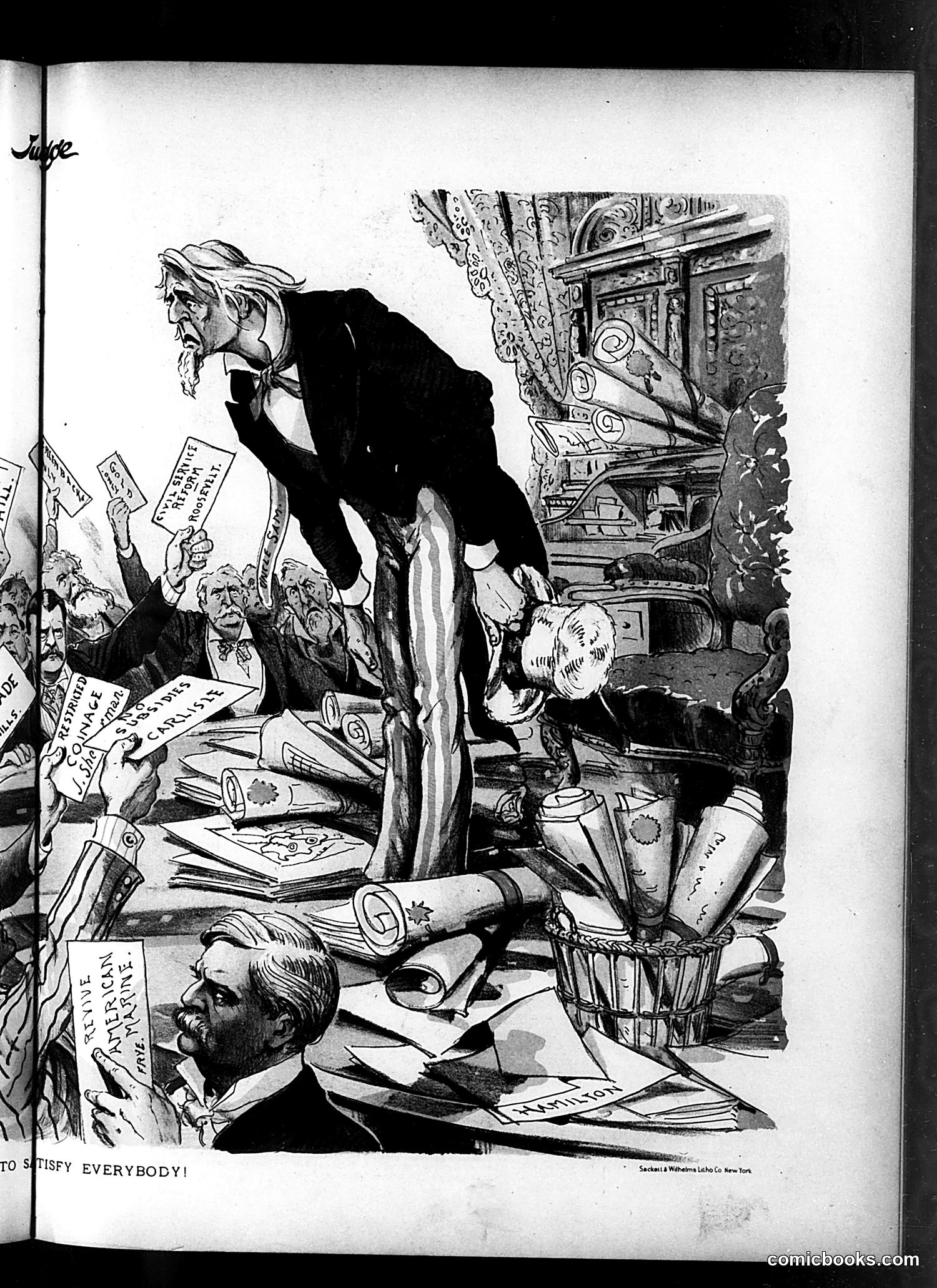
This satirical cartoon depicts a tall, gaunt figure in formal dress presiding over a chaotic scene of multiple smaller figures holding signs and documents. The setting appears to be an ornate government or institutional building. The cartoon criticizes political or bureaucratic mismanagement and corruption. The central figure appears to be a politician or official attempting to "satisfy everybody" (visible in the caption at bottom), while surrounded by clamoring petitioners, special interests, and documents marked with seals or official stamps. The visual chaos—scattered papers, bottles, demanding crowds—suggests the impossibility of pleasing all constituencies simultaneously, or critiques how officials attempt to appease competing interests through empty gestures rather than substantive action. Without clearer identification of specific figures or visible dates, the precise political context remains unclear, though this reflects broader Progressive Era concerns about political corruption and favoritism.
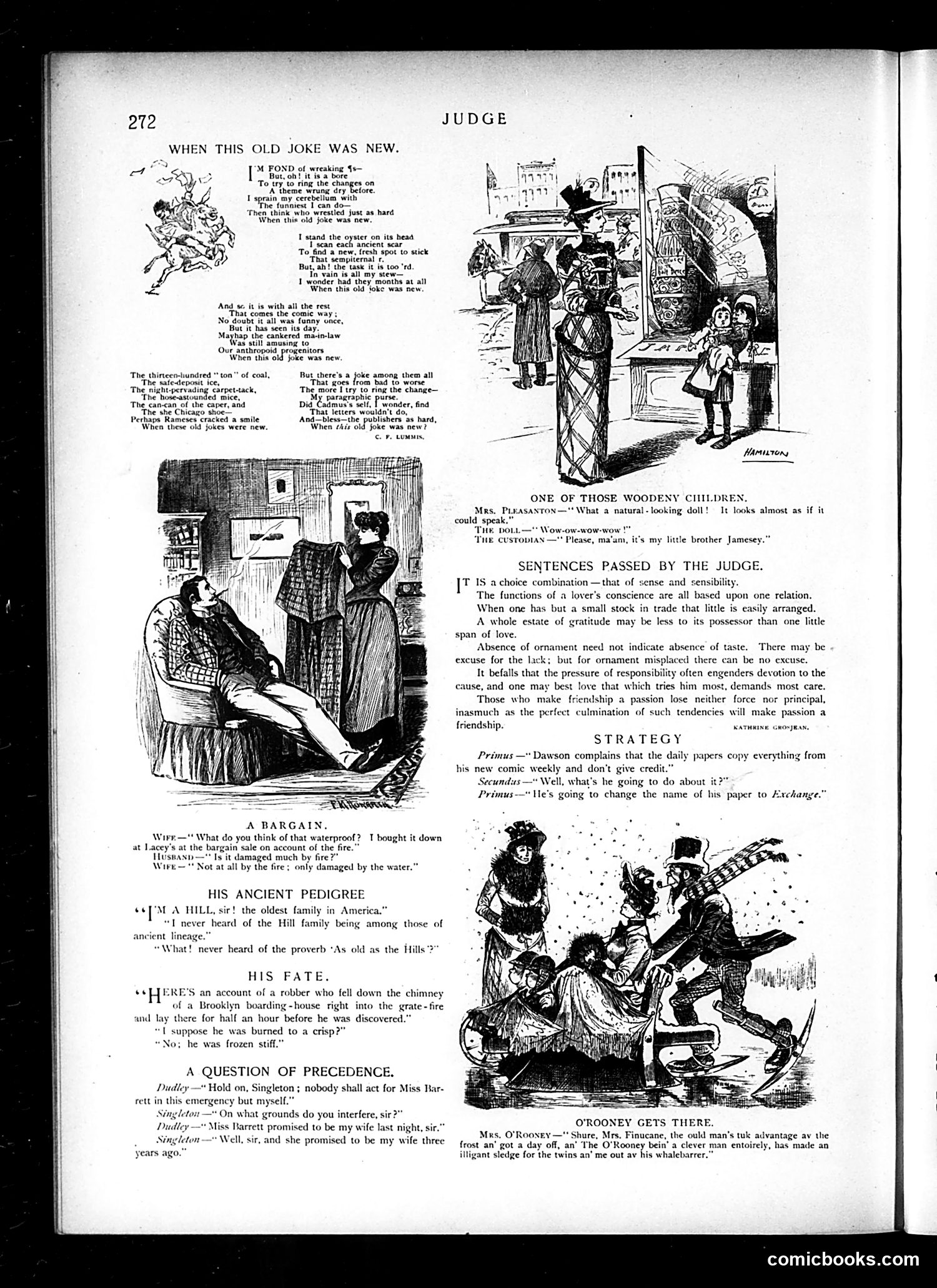
This page features humorous commentary on joke-writing itself. The lead poem laments that all comedic material has been exhausted—the writer struggles to find fresh angles on tired subjects (oysters, mothers-in-law, etc.), wondering if these jokes were even funny when first invented. The smaller jokes illustrate the theme: "A Bargain" plays on fire-sale damage (water, not fire, ruined goods); "His Ancient Pedigree" puns on "old as the Hills"; "His Fate" describes a robber frozen (not burned) falling down a chimney; "A Question of Precedence" presents competing marriage claims. The illustrations depict domestic and street scenes typical of Victorian-era comic relief. "O'Rooney Gets There" shows Irish working-class characters (indicated by dialect) fashioning a sled from frost. The editorial section "Sentences Passed by the Judge" offers philosophical observations about love, gratitude, and friendship—moralizing humor typical of *Judge*'s approach. The overall message: repetition exhausts comedy.
This page is primarily **advertising**, not political satire or editorial cartooning. It contains various commercial advertisements typical of Judge magazine's revenue model. The one narrative element is a small comic dialogue titled "NOT BORN YESTERDAY" depicting what appears to be a governess and young boy named Tommy. The joke relies on a child's logical literalism: when the governess scolds him for misbehavior she wouldn't have done at his age, Tommy points out she's always been older than him—she was literally never his age, so the comparison is absurd. It's a mild, domestic humor piece playing on generational differences and a child's clever but innocent reasoning. The remaining content consists of advertisements for luxury goods (Shandon Bells Perfume, Carl Upmann cigars, Pears' Soap), patent medicines (consumption cure), shoes, furniture, pianos, typewriters, and insurance—reflecting the commercial focus of Judge as a revenue-generating publication for affluent readers.
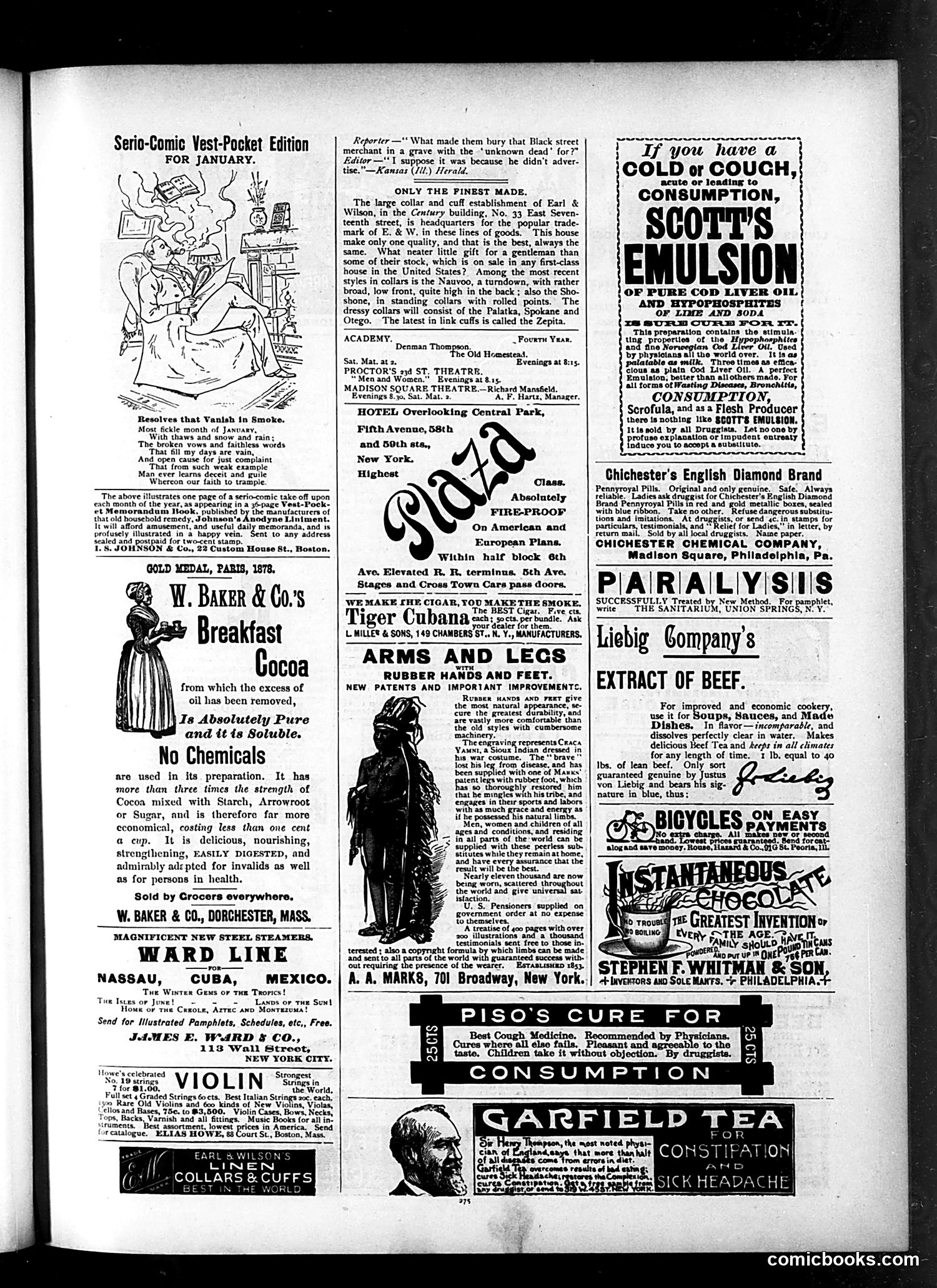
This appears to be primarily a **19th-century advertising and notices page** rather than a satirical cartoon page. The dominant visual element is a large illustration of a person with artificial limbs (referenced in the "ARMS AND LEGS" advertisement section), likely advertising prosthetic devices. The small notable satirical item is a brief editor's quip: a reporter asks why a Black street merchant was buried in a grave marked "unknown dead," and the editor replies it's because the merchant "didn't advertise." This is **commentary on advertising's perceived power**—the joke being that lack of publicity makes one literally invisible or forgotten. The page is otherwise dominated by advertisements for consumer goods (cocoa, cigars, steamship lines, violins, collars, extract of beef), patent medicines (Scott's Emulsion for consumption, Piso's cure), and theatrical notices. The content reflects late 19th-century commercial messaging rather than sustained political satire.
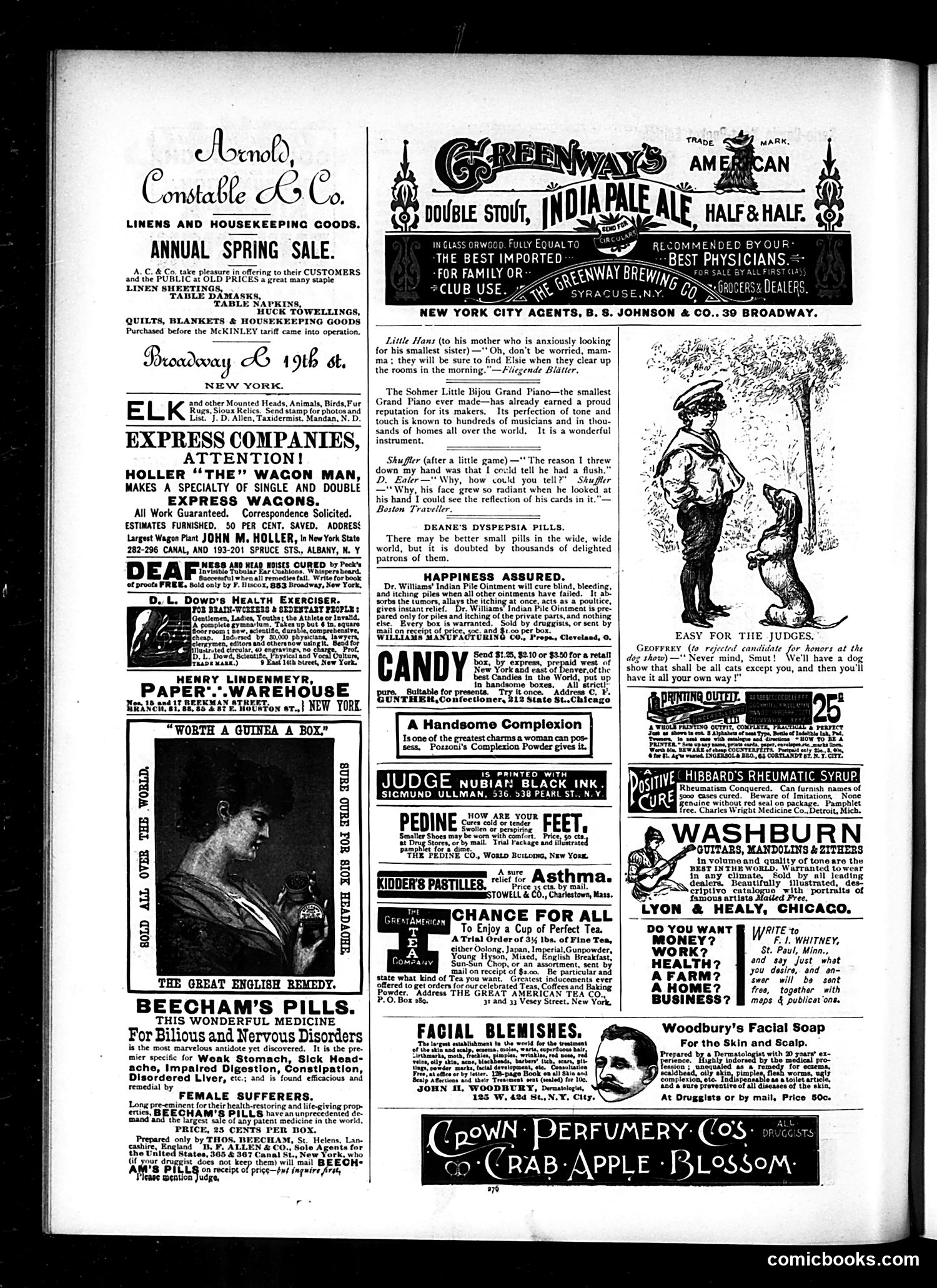
This page is primarily **advertising**, not satirical content. It's filled with patent medicines, commercial products, and services typical of late 19th-century American magazines. The visible cartoon ("Easy for the Judges") shows a figure in period dress, though the image quality makes specific commentary unclear. The accompanying text jokes about a small piano and a card game anecdote. Notable context: Several ads reference the **McKinley Tariff** (mentioned in the Arnold Constable sale), suggesting this dates to the 1890s when that protective trade policy was debated. Many ads promote dubious "remedies"—Beecham's Pills, Dr. Williams' Indian Pile Ointment, Deane's Dyspepsia Pills—representing the era when patent medicines made unverified health claims before FDA regulation. The page reflects Judge's dual nature: satirical commentary mixed with revenue from period advertisements that would seem quackish to modern readers.
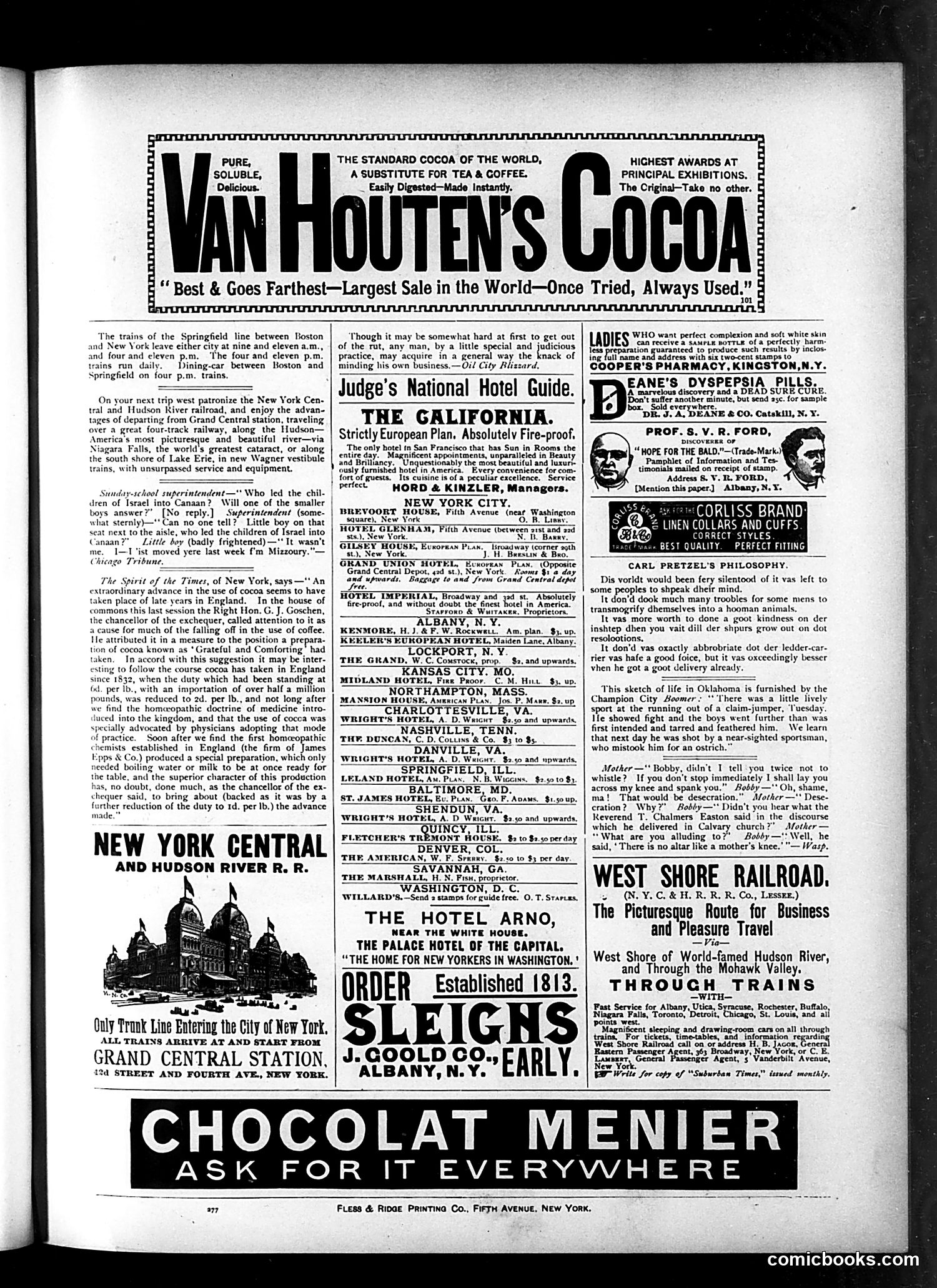
This is primarily an **advertising page** from Judge magazine, not a satirical cartoon page. The dominant content consists of commercial advertisements for hotels, railroads, cocoa, and patent medicines. The **only joke/cartoon content** is a brief Sunday-school dialogue: a superintendent asks children who led Israel into Canaan; a frightened boy replies "It wasn't I—I just moved here last week from Missouri." The humor relies on the child's misunderstanding the biblical question as an accusation, confusing religious instruction with a local accusation—a common era joke playing on childhood innocence and immigrant mobility. The remainder is boilerplate advertising for Van Houten's Cocoa, the New York Central Railroad, various hotels (California, Hotel Arno, etc.), and "Cooper's Pharmacy" promoting a skin-whitening product—typical commercial content of late 19th/early 20th-century magazines. The page reflects how magazines funded themselves through heavy advertising.
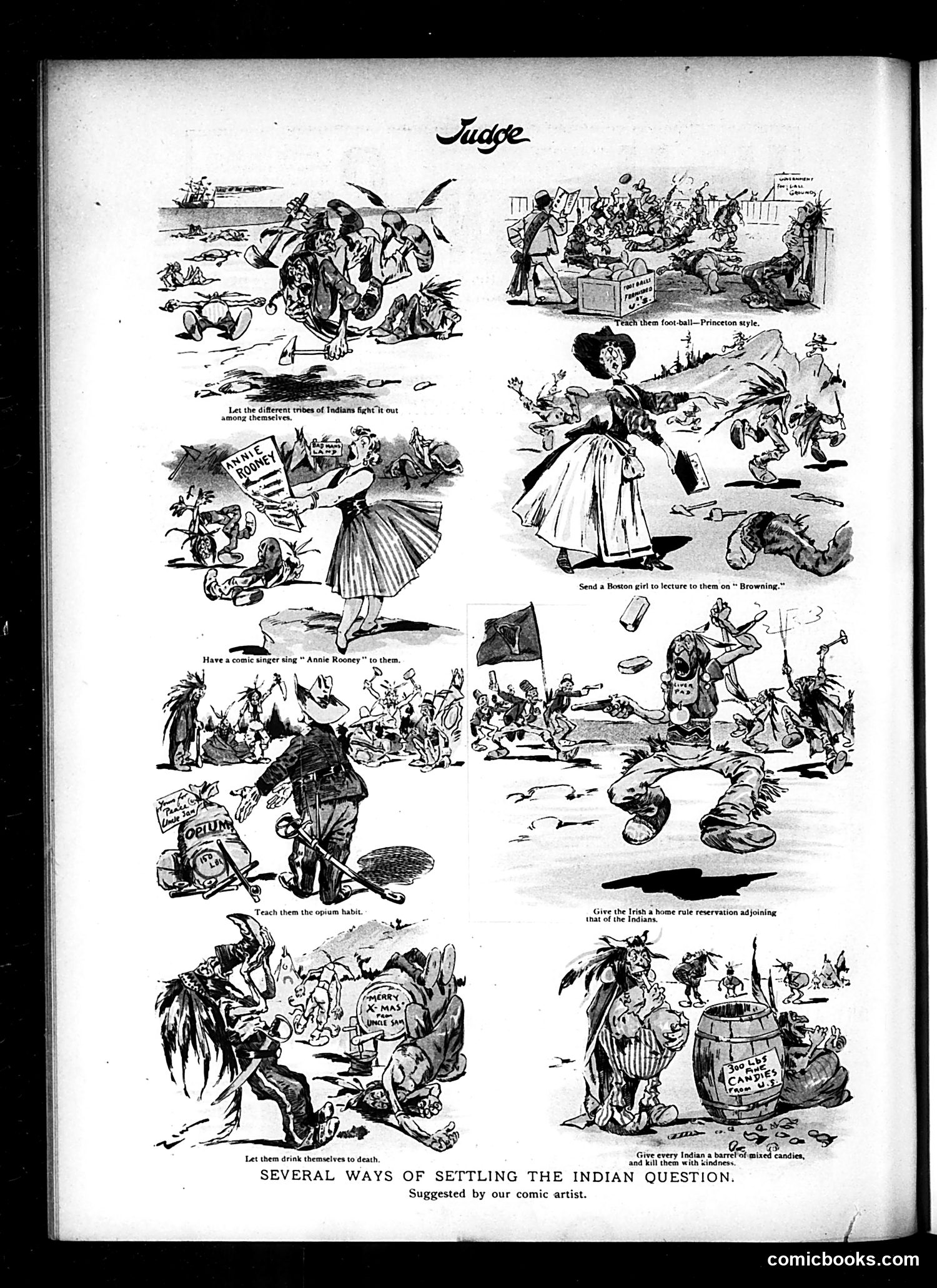
This satirical page from *Judge* magazine presents six mocking proposals for resolving the "Indian Question"—the late-19th-century U.S. policy debate over Native Americans. The cartoons employ racist stereotypes and dark humor, suggesting absurd solutions: letting tribes fight each other, relocating Irish people to adjacent reservations, forcing alcohol consumption leading to death, teaching "savage habits," bribing with candy, and offering "kindness" (shown as paternalistic control). The satire targets both U.S. Indian policy's inadequacy and contemporary attitudes toward marginalized groups—Native Americans and Irish immigrants alike. The proposals range from violent to patronizing, reflecting actual failed policy approaches while exposing their cruelty through exaggeration. The cartoons mock the era's pseudo-humanitarian rhetoric masking genocidal intent.