
Judge, 1891-01-17 · page 6 of 16
Judge — January 17, 1891 — page 6: what you’re looking at
What you’re looking at
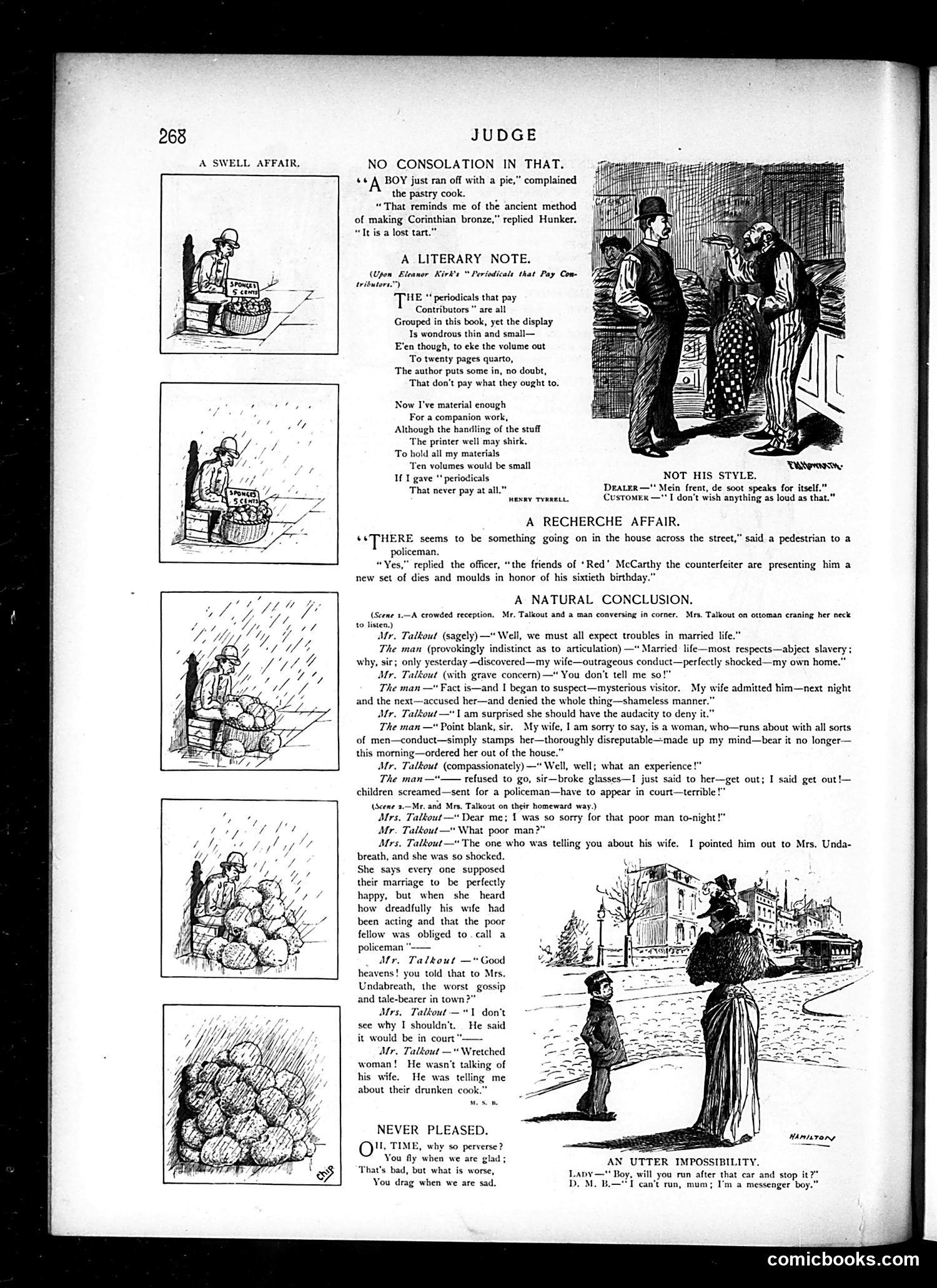
This page contains several standalone satirical pieces typical of Judge magazine: **"A Swell Affair"** is a visual gag showing a boy repeatedly stealing pies in rain—the punchline is a terrible pun ("lost tart" instead of "lost art"). **"A Literary Note"** mocks Eleanor Kirk's book about magazines that pay contributors, sarcastically suggesting the author had to include fake publications to reach twenty pages, and the author implies many so-called "paying" periodicals actually don't compensate writers. **"A Recherche Affair"** jokes darkly about Red McCarthy (appears to be a real counterfeiter) receiving "dies and moulds" as birthday gifts—a double meaning, since counterfeiters literally use these tools. **"A Natural Conclusion"** satirizes how gossip spreads: Mr. Talkout overhears a man's vague complaints about his wife's misconduct and mysterious visitors, then Mrs. Talkout repeats this to the town gossip. The twist: the man was actually discussing their drunken cook, not his wife—but the damage to his reputation is done. The remaining pieces are brief humorous observations about time and an impossible request.
📄 Transcribed text from this page (OCR, searchable)
Machine-transcribed from the original scan — historical spelling and the odd misread are preserved.
268 JUDGE A SWELL AFFAIR. NO CONSOLATION IN THAT. ++ A BOY just ran off with a pie,” complained the pastry cook. “That reminds me of the ancient method of making Corinthian bronze," replied Hunker. “Tt is a lost tart.” A LITERARY NOTE, (Upon Eleanor Kirk's “ Periodicals that Pay Com- tributors: HE “ periodicals that pay Contributors” are all Grouped in this book, yet the display Is wondrous thin and small— E’en though, to eke the volume out To twenty pages quarto, The author puts some in, no doubt, ‘That don't pay what they ought to. Now I've material enough For a companion work, Although the handling of the stuff ‘The printer well may shirk, To hold all my materials ‘Ten volumes would be small If I gave ** periodicals NOT HIS STYLE. That never pay at all.” Deater—"* Mein frent, de soot speaks for itself.” Newey reneLt, Cusromex —"* I don’t wish anything as loud as that.” A RECHERCHE AFFAIR. ‘THERE seems to be something going on in the house across the street,” said a pedestrian to a policeman. “Yes,” replied the officer, “the friends of ‘Red’ McCarthy the counterfeiter are presenting him a new set of dies and moulds in honor of his sixtieth birthday. A NATURAL CONCLUSION, (Scene 1.—A crowded reception. Mr. Talkout and a man conversing in corner. Mrs. Talkout on ottoman craning her neck to listen.) Mr, Tatkout (sagely)—" Well, we must all expect troubles in married life.” The man (provokingly indistinct as to articulation) —* Married life—most respects—abject slavery : why, sir; only yesterday —discovered—my wife—outrageous conduct—perfectly shocked—my own home.” Mr. Talkout (with grave concern) —" You don't tell me so! The man —" Fact is—and I began to suspect—mysterious visitor. My wife admitted him—next night and the next—accused her—and denied the whole thing—shameless manner.” Mr, Talkout —"\ am surprised she should have the audacity to deny it.” The man — Point blank, sir. My wife, I am sorry to say, is a woman, who—runs about with all sorts of men—conduct—simply stamps her—thoroughly disreputablemade up my mind—bear it no longer— this morning—ordered her out of the house.” ‘Mr. Tatkout (compassionately) —"* Well, well; what an experience!" The man—"— refused to go, sir—broke glasses—I just said to her—get out; I said get out!— children screamed—sent for a policeman—have to appear in court—terrible!” (Scene 2.—Mr. and Mrs, Talkoat on their homeward way.) Mrs, Talkout—" Dear me; 1 was so sorry for that poor man to-night!” Mr. Talkout —* What poor man?” Mrs. Talkout —“ The one who was telling you about his wife. 1 pointed him out to Mrs. Unda- breath, and she was so shocked. She says every one supposed their marriage to be perfectly happy, but when she heard how dreadfully his wife had been acting and that the poor fellow is obliged to. call a policeman "-— Mr, Talkout —* Good heavens! you told that to Mrs. Undabreath, the worst gossip and tale-bearer in town? Mrs, Talkout —“1 don't see why I shouldn't. He said it would be in court "—— Mr, Talkout —“ Wretched voman! He wasn’t talking of his wife. He telling me about their drunken cook.” NEVER PLEASED. ini oO". TIME, why so perverse? = 2 ees 1 You fly when we are glad; AN UTTER IMPOSSIBILITY. t's bad, but what is worse, " Lapy—" Boy, will you run after that car and stop it?” You drag when we are sad. D. M. B=" can't run, mum; I'm a messenger boy. comicbooks.com