
Judge, 1891-01-17 · page 3 of 16
Judge — January 17, 1891 — page 3: what you’re looking at
What you’re looking at
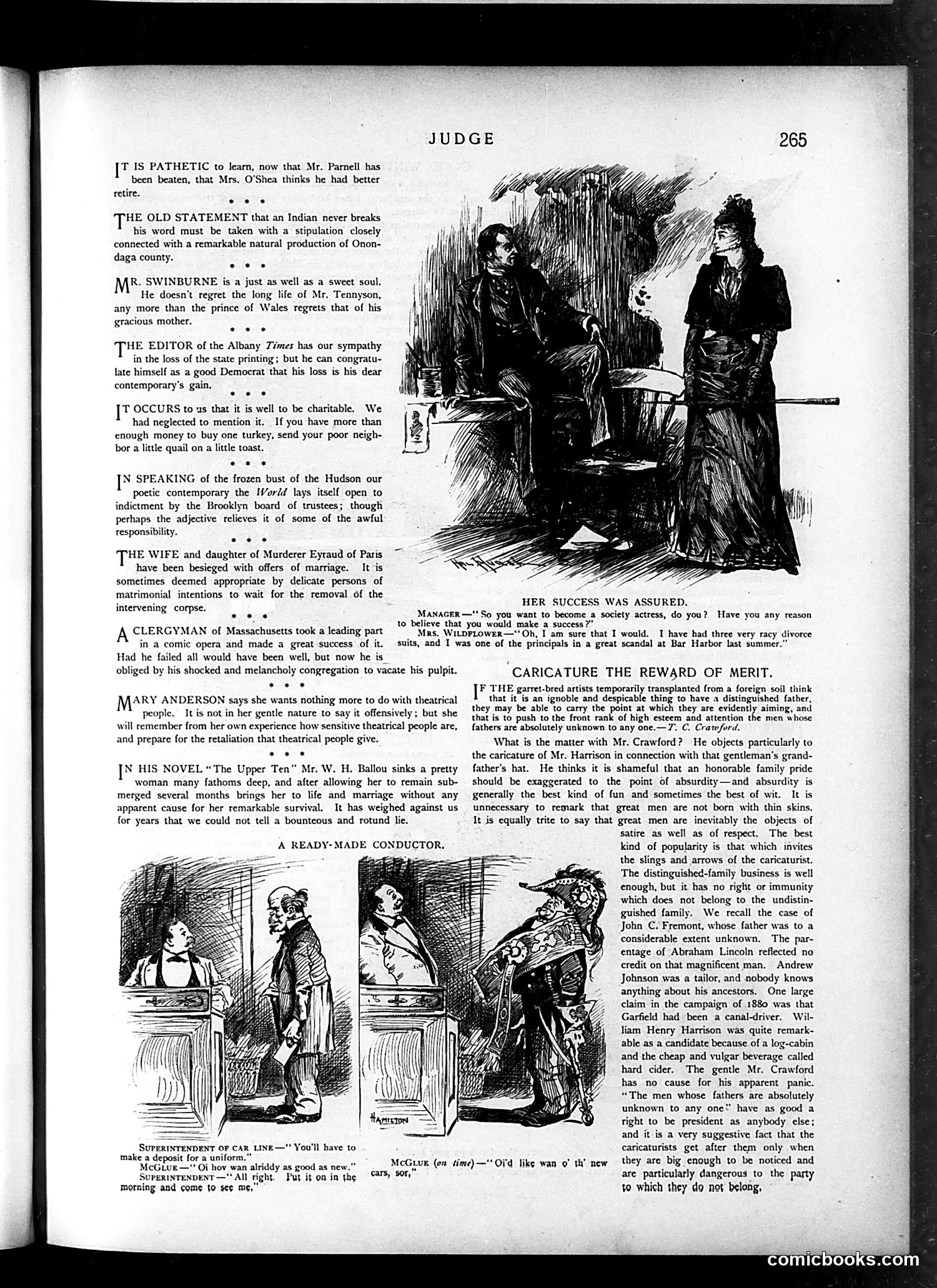
This page contains editorial commentary and satirical illustrations rather than a single coherent cartoon. **Top illustration**: Shows two figures in conversation, likely depicting a social or political exchange, though specific identities aren't clear from the image alone. **"A Ready-Made Conductor" cartoon** (bottom): Features a man in formal dress interacting with what appears to be a uniformed conductor or official at a window/booth. The caption suggests humor about depositing money for a uniform—likely satirizing either pretentious social climbing or incompetent officials acquiring authority through appearance rather than merit. **Editorial notes** reference specific people (Parnell, Swinburne, Harrison) and publications (Albany Times, Brooklyn board of trustees), suggesting topical commentary on 1880s-1890s figures and institutions, but requires historical context to fully interpret.
📄 Transcribed text from this page (OCR, searchable)
Machine-transcribed from the original scan — historical spelling and the odd misread are preserved.
T IS PATHETIC to learn, now that Mr. Parnell has been beaten, that Mrs. O'Shea thinks he had better retire. cee HE OLD STATEMENT that an Indian never breaks his word must be taken with a stipulation closely connected with a remarkable natural production of Onon- daga county. oietis R. SWINBURNE is a just as well as a sweet soul. He doesn’t regret the long life of Mr. Tennyson, any more than the prince of Wales regrets that of his gracious mother. ‘THE EDITOR of the Albany Times has our sympathy in the loss of the state printing; but he can congratu- late himself as a good Democrat that his loss is his dear contemporary’s gain, [7 OCCURS to us that itis well to be charitable. We had neglected to mention it. If you have more than enough money to buy one turkey, send your poor neigh- bor a little quail on a little toast. eee [% SPEAKING of the frozen bust of the Hudson our poetic contemporary the IWorld lays itself open to indictment by the Brooklyn board of trustees; though perhaps the adjective relieves it of some of the awful responsibility. ‘THE WIFE and daughter of Murderer Eyraud of Paris have been besieged with offers of marriage. It is sometimes deemed appropriate by delicate persons of matrimonial intentions to wait for the removal of the intervening corpse. sae A CLERGYMAN of Massachusetts took a leading part in a comic opera and made a great success of it. Had he failed all would have been well, but now he is obliged by his shocked and melancholy congregation to vacate his pulpit. sae ARY ANDERSON says she wants nothing more to do with theatrical people. It is not in her gentle nature to say it offensively ; but she will remember from her own experience how sensitive theatrical people are, and prepare for the retaliation that theatrical people give. cee N HIS NOVEL “The Upper Ten” Mr. W. H. Ballou sinks a pretty woman many fathoms deep, and after allowing her to remain sub- merged several months brings her to life and marriage without any apparent cause for her remarkable survival. It has weighed against us for years that we could not tell a bounteous and rotund lie. A READY-MADE CONDUCTOR, Ling—"* You'll have to m. an alriddy as good as new.” T—"All right. Put it on in the ab morning and come to se¢ me,” MANAGER — to believe that you would make a success?” Mrs. WILDPLoweR—"'Oh, Iam sure that I would. suits, and I was one of the principals in a great scandal at Bar Harbor last summer." McGiur (0% time)—'*Oi'd like wan 9 th’ new ih Bit) | Wy HER SUCCESS WAS ASSURED. So you want to become a society actress, do you? Have you any reason T have had three very racy divorce “CARICATURE THE REWARD OF MERIT. [F THE garret-bred artists semporarily wransplanted from a foreign soil think that it is an ignoble and despicable thing to have a distinguished father, they may be able to carry the point at which they are evidently aiming, and that is to push to the front rank of high esteem and attention the men whose fathers are absolutely unknown to any one.—7. C, Crawford. What is the matter with Mr. Crawford? He objects particularly to the caricature of Mr. Harrison in connection with that gentleman's grand- father’s hat. He thinks it is shameful that an honorable family pride should be exaggerated to the point of absurdity—and absurdity is generally the best kind of fun and sometimes the best of wit. It is unnecessary to remark that great men are not born with thin skins. It is equally trite to say that great men are inevitably the objects of satire as well as of respect. The best kind of popularity is that which invites the slings and arrows of the caricaturist. The distinguished-family business is well enough, but it has no right or immunity which does not belong to the undistin- guished family. We recall the case of John C. Fremont, whose father was to a considerable extent unknown. The par- entage of Abraham Lincoln reflected no credit on that magnificent man. Andrew Johnson was a tailor, and nobody knows anything about his ancestors. One large claim in the campaign of 1880 was that Garfield had been a canal-driver. Wil- liam Henry Harrison was quite remark- able as a candidate because of a log-cabin and the cheap and vulgar beverage called hard cider. The gentle Mr. Crawford has no cause for his apparent panic. “The men whose fathers are absolutely unknown to any one!” have as good a right to be president as anybody else; and it is a very suggestive fact that the caricaturists get after them only when they are big enough to be noticed and are particularly dangerous to the party to which they do not belong,