
A complete issue · 16 pages · 1890
Judge — June 21, 1890
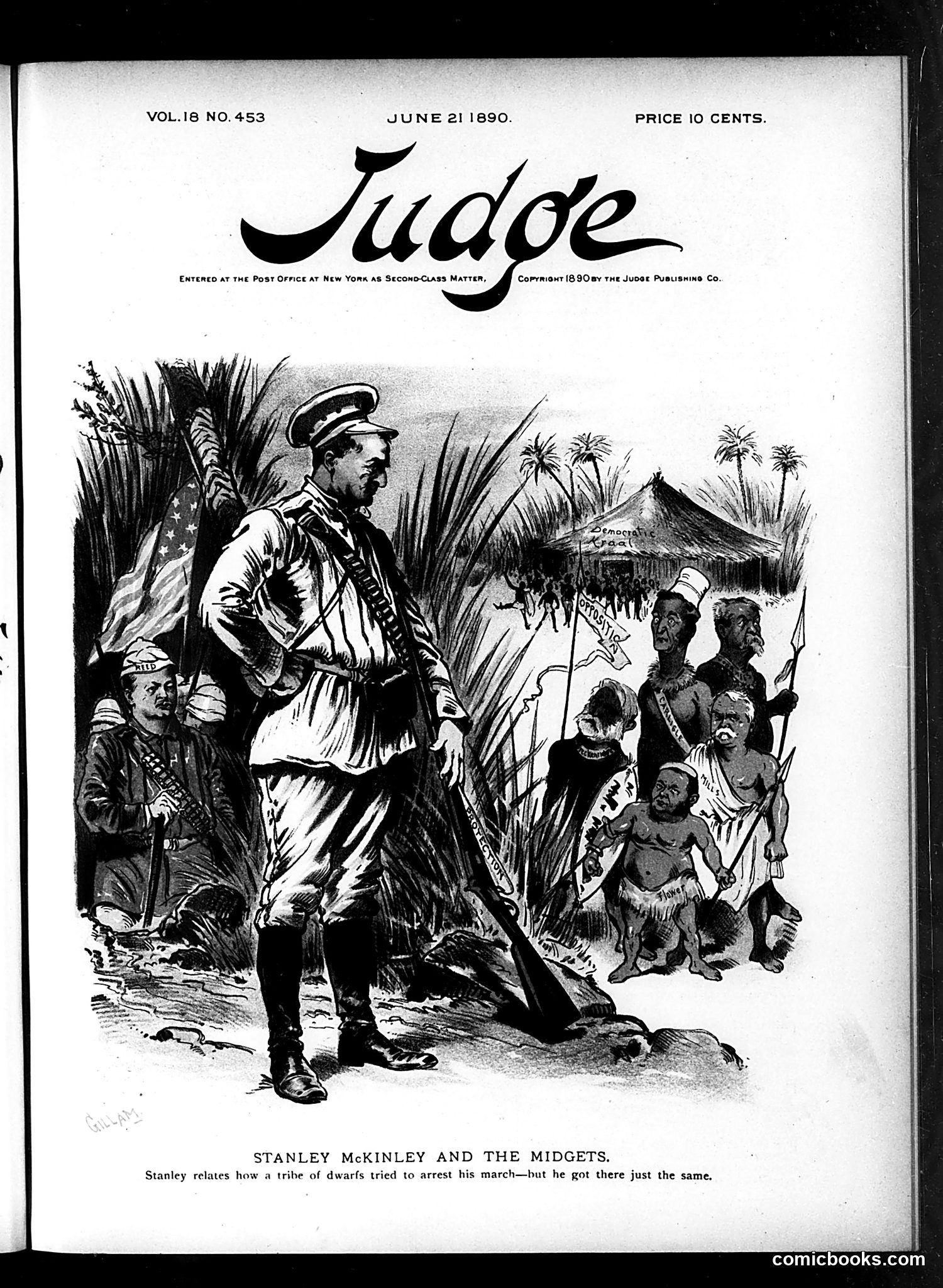
This Judge magazine cartoon (June 21, 1890) satirizes **Stanley McKinley** (likely referencing explorer Henry Morton Stanley or a political figure of that name) through a crude joke combining colonialism with contemporary politics. The caption states: "Stanley relates how a tribe of dwarfs tried to arrest his march—but he got there just the same." The cartoon depicts a tall Western military figure confronting indigenous peoples of various sizes in a tropical setting. The satire appears to mock both the subject's colonial adventures and, possibly, political opposition to McKinley's policies or ambitions. The dehumanizing caricatures of the indigenous people reflect the deeply racist attitudes typical of 1890s American satirical publications. The "midgets" metaphor likely diminishes political opponents as insignificant obstacles.
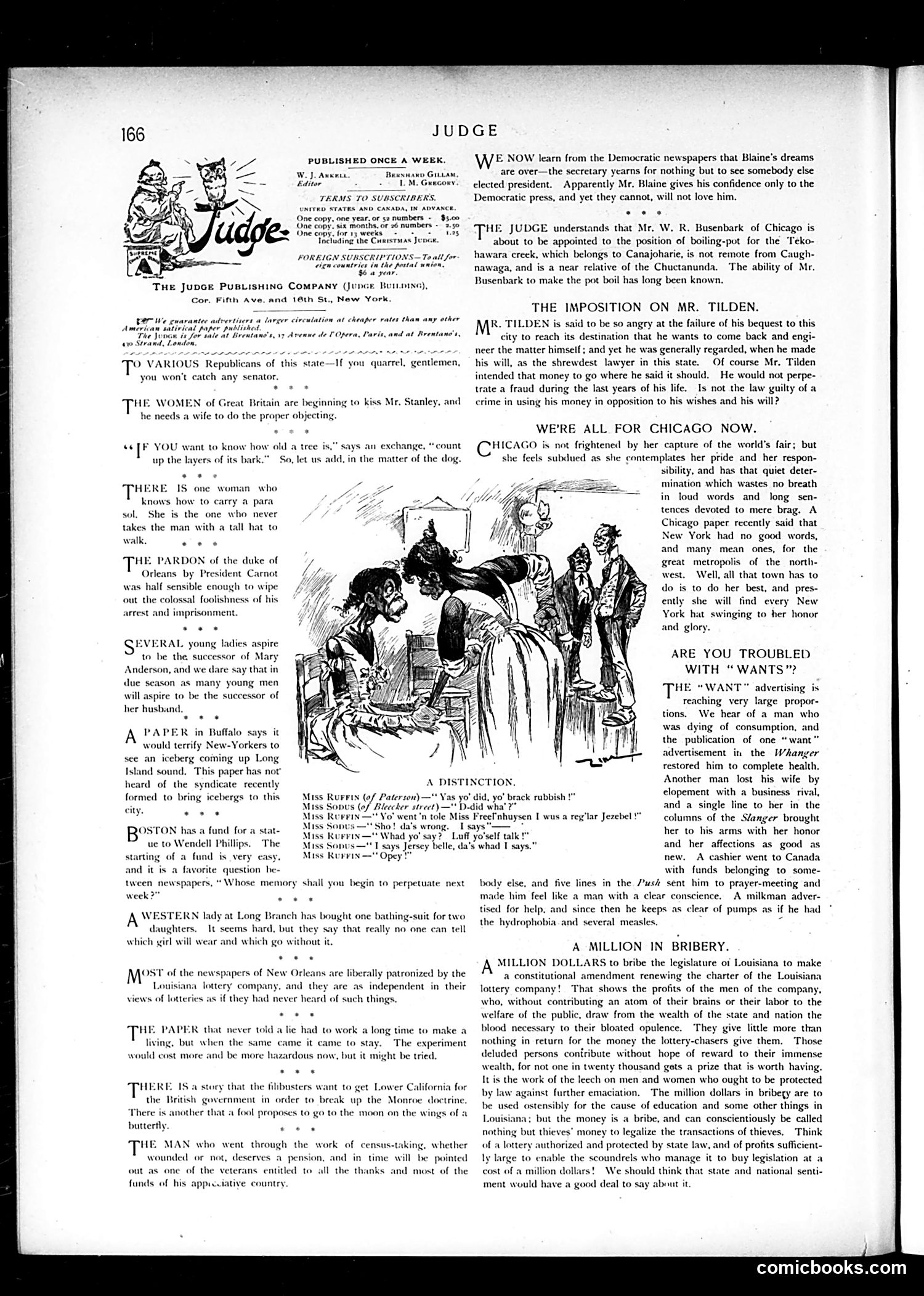
This page contains satirical commentary and editorial content typical of Judge magazine. The main cartoon depicts what appears to be a social scene with multiple figures gathered around a central character, rendered in Judge's characteristic sketch style. The text references Democratic newspapers' coverage of political ambitions, mentions Chicago society figure Mrs. W.R. Husenbank, and discusses various social and political topics including a woman who "never takes the man with a tall hat to walk" (likely a society joke). The right column contains editorial commentary on Chicago civic pride, "wants" advertisements as social commentary, and criticism of Louisiana lottery bribery schemes. Without clearer dates or identifying labels in the image itself, specific political figures and events remain unclear, though the satire targets both Democratic politics and Gilded Age social pretension.
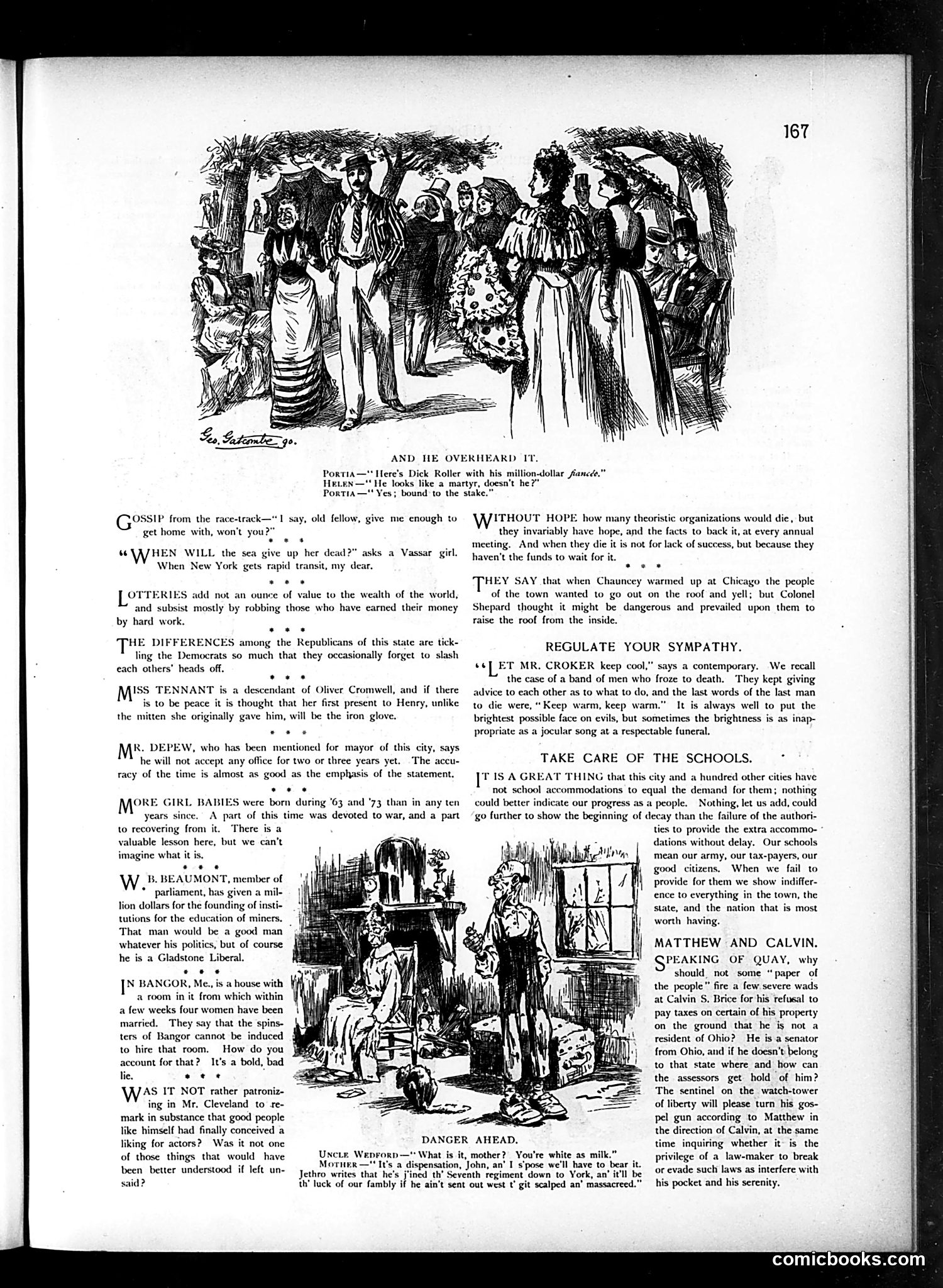
This page contains political commentary and social satire typical of early 20th-century Judge magazine. The top illustration depicts a social gathering where characters discuss scandals and gossip ("Gossip from the race-track," references to New York transit, lotteries, and Republican politics). The bottom illustration, captioned "Danger Ahead," shows what appears to be a domestic scene with working-class figures, touching on poverty and labor concerns. The dialogue mentions property taxes and senatorial representation, suggesting critique of how political leaders (specifically "Calvin," likely Calvin Stewart or similar Ohio politician) neglect working citizens' economic struggles. The various text snippets satirize contemporary issues: wealth inequality, inadequate school funding, patronage politics, and the disconnect between elected officials and ordinary constituents struggling with basic survival.
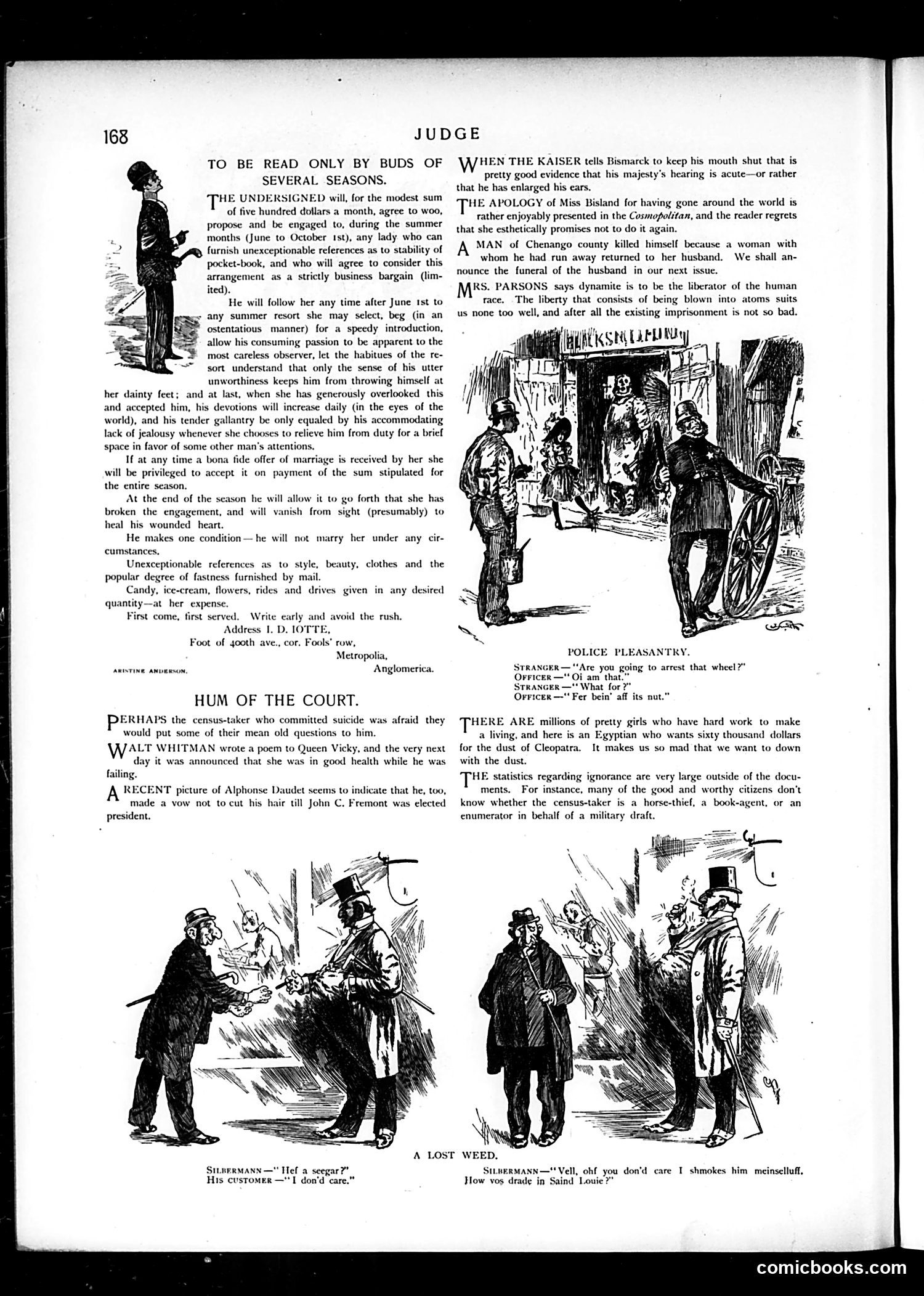
This page from Judge satirizes late 19th-century American social customs and contemporary news. The main feature is a mock "personal ad" offering a man's services as a paid summer romance—he'll court a wealthy woman for $500/month, shower her with attention and gifts (at her expense), then disappear if she accepts a genuine marriage proposal. The satire targets wealthy women seeking fashionable summer resort romances and the performative nature of courtship among the leisure class. The "Hum of the Court" section contains brief satirical jabs at current events: references to a census-taker's suicide, Walt Whitman's poem to Queen Victoria, and contemporary figures like Kaiser Wilhelm and Alphonse Daudet. The cartoons depict street scenes with working-class characters. The overall tone mocks both upper-class pretension and social absurdities of the era.
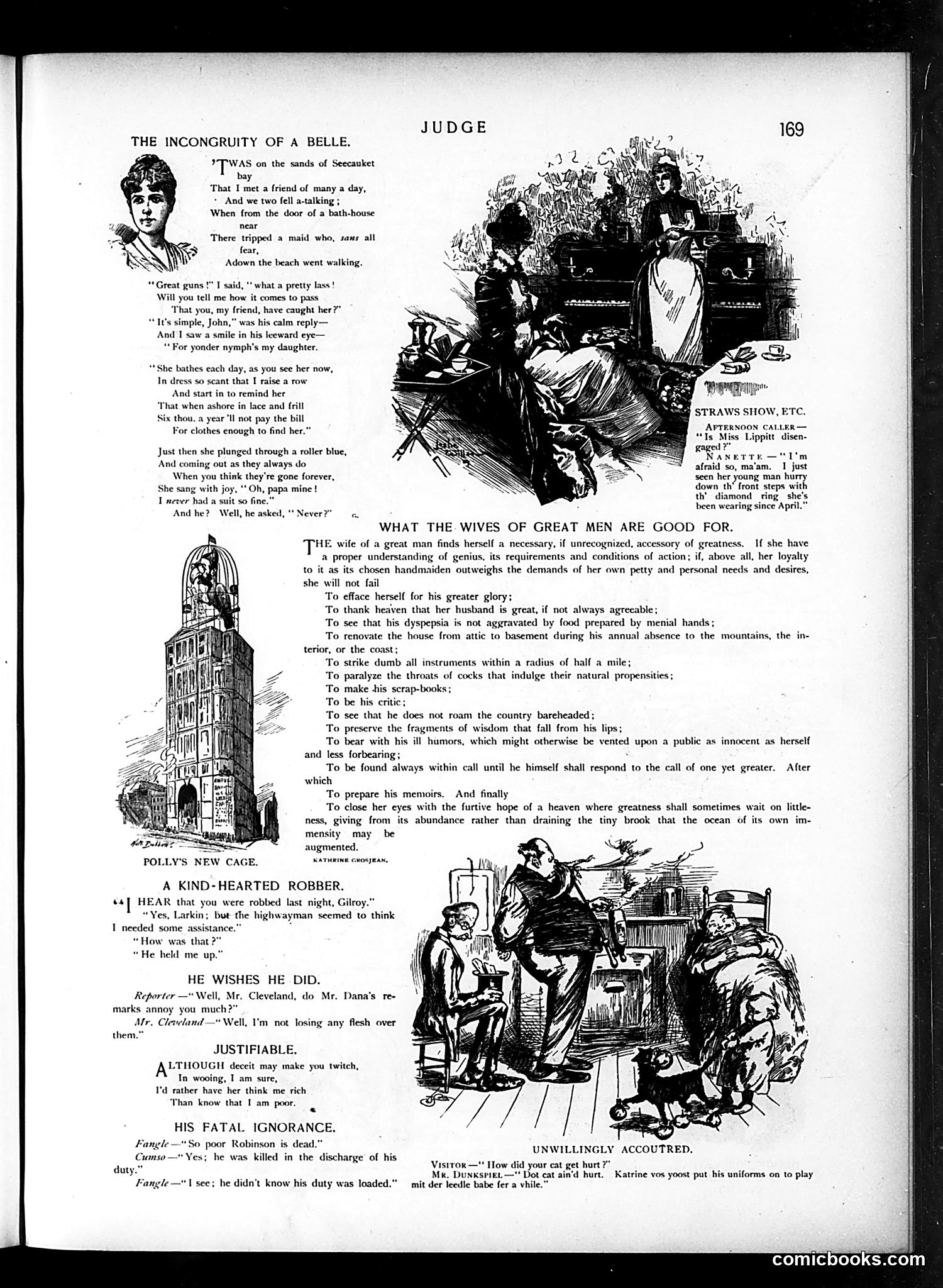
This page contains multiple satirical pieces typical of Judge's social commentary: **"The Incongruity of a Belle"** mocks the contradiction between women's modest dress requirements on land versus their minimal bathing attire at the beach. The joke hinges on a father's complaint that his daughter's modest shore wardrobe costs thousands yearly, yet she wears almost nothing while bathing—exposing the arbitrary nature of Victorian dress codes. **"What the Wives of Great Men Are Good For"** is a lengthy satirical essay listing a wife's duties to support her husband's greatness: managing his health, preserving his home, controlling noise, serving as his secretary, and accepting his moods. The sardonic tone critiques how wives sacrifice personal needs to advance male achievement, only hoping for recognition in heaven. The remaining brief items—about a robber's politeness, Cleveland's indifference to Dana's criticism, and deceiving women about wealth—are typical Judge humor: short situational jokes exploiting class anxieties and gender dynamics of the era.
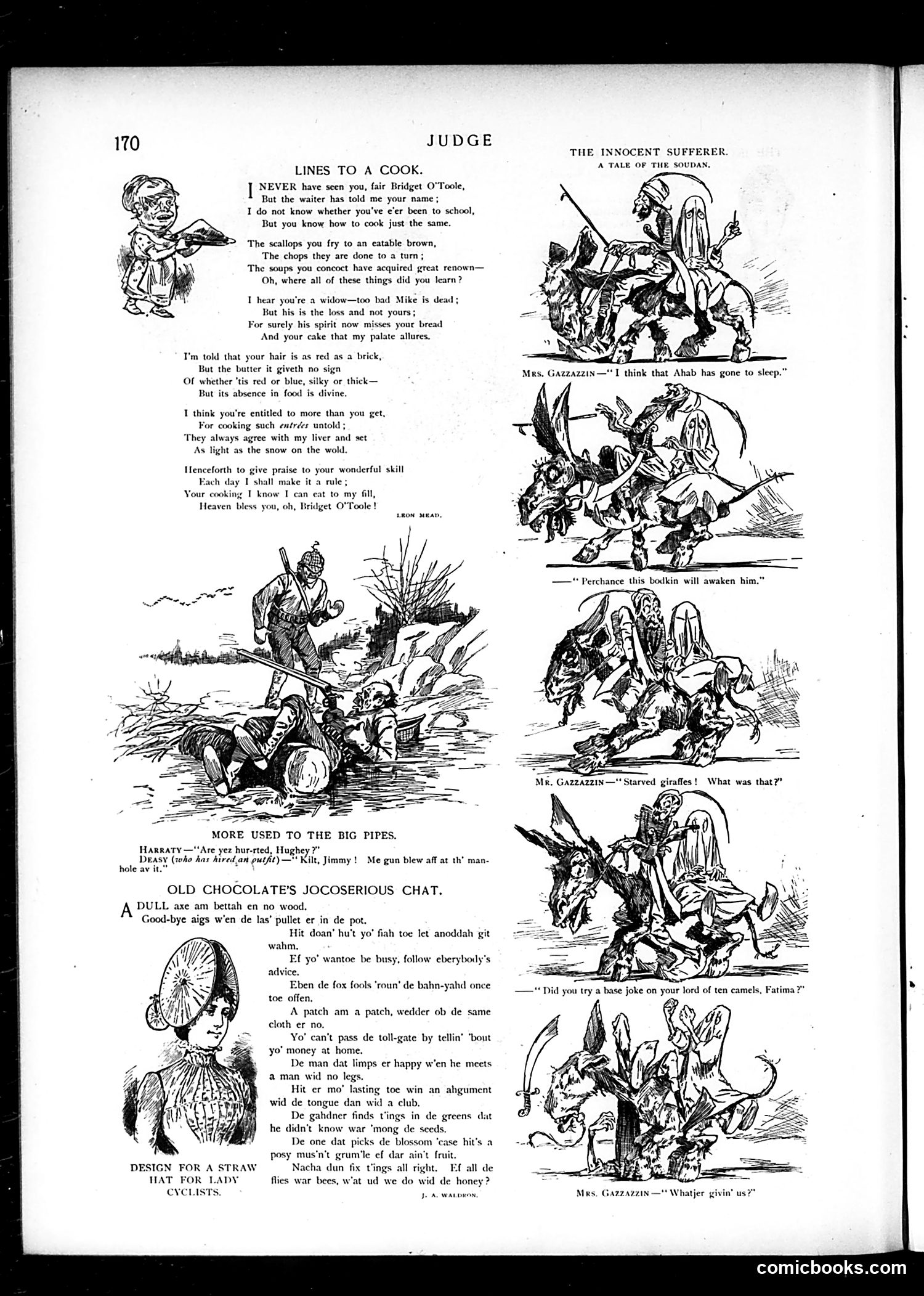
This page contains three distinct pieces of satirical content: **"Lines to a Cook"** is a humorous poem praising an Irish cook named Bridget O'Toole, likely a servant. The satire gently mocks both the cook's working-class status and the speaker's obsequious flattery—he praises her cooking while making pointed observations about her red hair and butter-less dishes, suggesting she skims ingredients for personal use. **"The Innocent Sufferer"** depicts a comic narrative (right side) set in Sudan, showing British colonial figures and native peoples. The captions suggest slapstick humor involving miscommunication and cultural misunderstanding during British imperial activities. **"Old Chocolate's Jocoserious Chat"** presents folk wisdom in exaggerated dialect spoken by an African American character ("Old Chocolate"), featuring homespun proverbs. This reflects period minstrelsy conventions, though the actual advice offered is genuinely sensible. The page reflects late-19th-century American humor: workplace satire, imperial adventure mockery, and racial caricature typical of Judge's editorial sensibility.
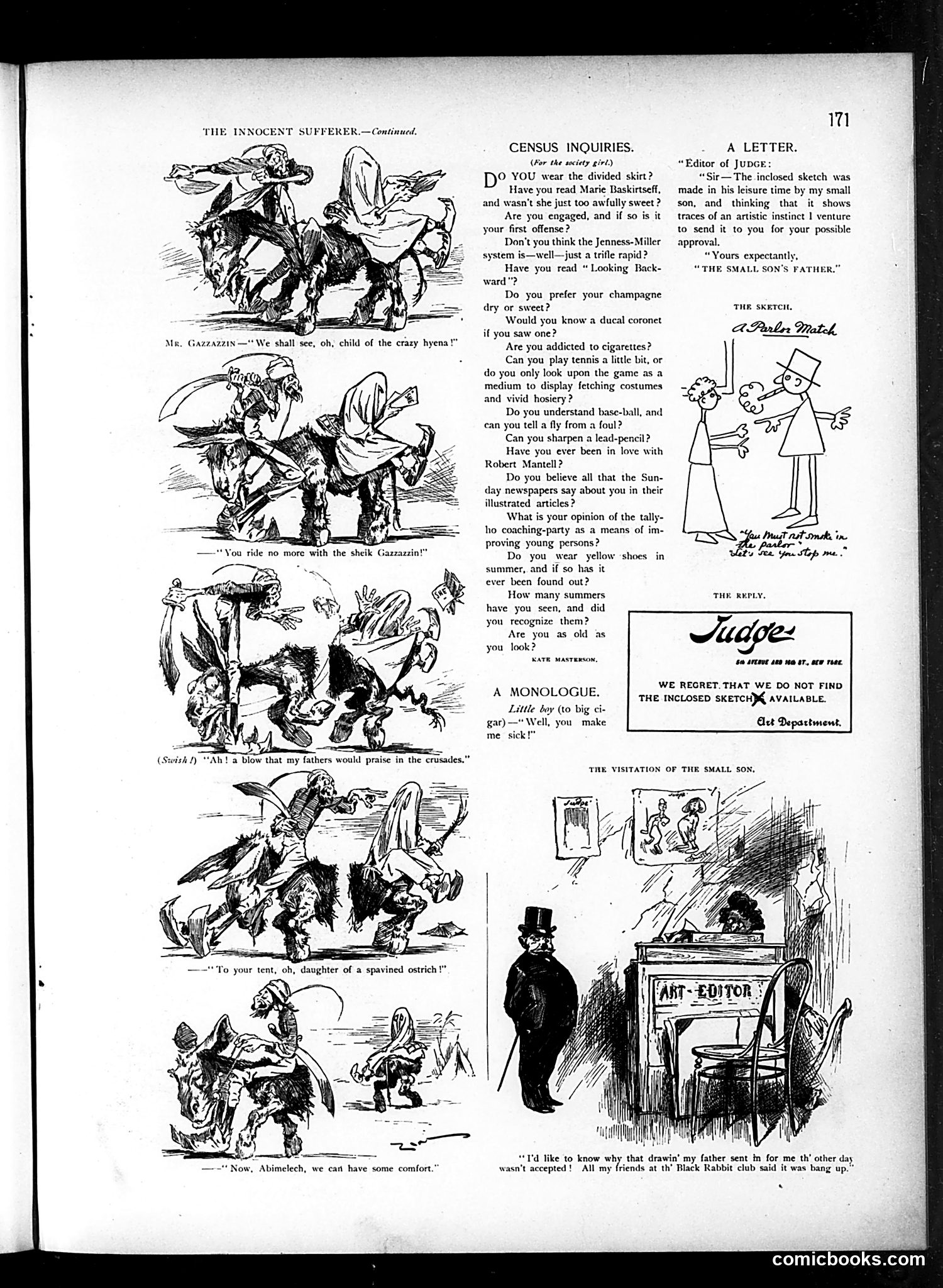
This page contains multiple satirical pieces mocking late 19th-century society trends: **"Census Inquiries"** parodies intrusive census questions while satirizing the "New Woman"—mocking fashionable concerns like the divided skirt, aesthetic movements (Marie Bashkirtseff references), and progressive ideas ("Looking Backward," likely Bellamy's socialist novel). The questions ridicule women's adoption of cigarettes, athletics, and affected sophistication. **"The Innocent Sufferer"** cartoons (left side) depict exaggerated figures in dramatic poses, likely satirizing overblown theatrical performances or affected social behavior, though specific references remain unclear. **"The Visitation of the Small Son"** shows a child's rejected artwork at an art editor's desk—a humorous commentary on amateur artistic pretension, with the child's father expecting acceptance based on friends' praise. The overall theme mocks contemporary social pretension, women's changing roles, and inflated expectations of mediocre work.
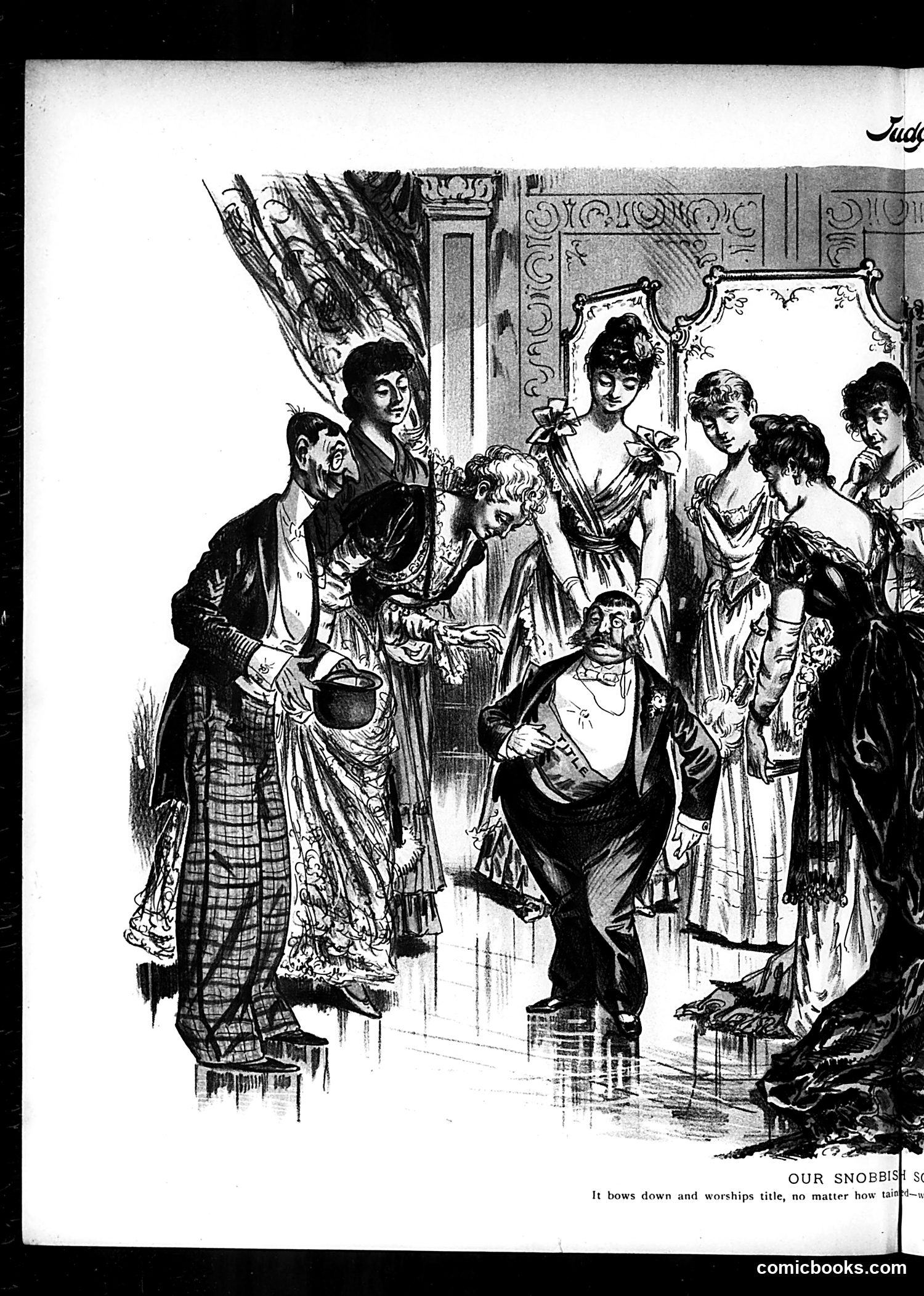
This satirical illustration critiques American social snobbery regarding titles and aristocracy. The central figure appears to be a wealthy or prominent American (possibly a nouveau riche businessman or social climber) who is bowing obsequiously before a group of fashionably dressed women in an ornate interior setting. The caption "It bows down and worships title, no matter how tainted" suggests the cartoon mocks Americans who fawn over European nobility or aristocratic credentials, regardless of whether those titles have dubious or disreputable origins. The snobbish figure's exaggerated deference contrasts with the implied critique that American democracy should not defer to Old World class hierarchies. This reflects Judge magazine's frequent satirizing of American social pretension and the era's obsession with European aristocratic connections.
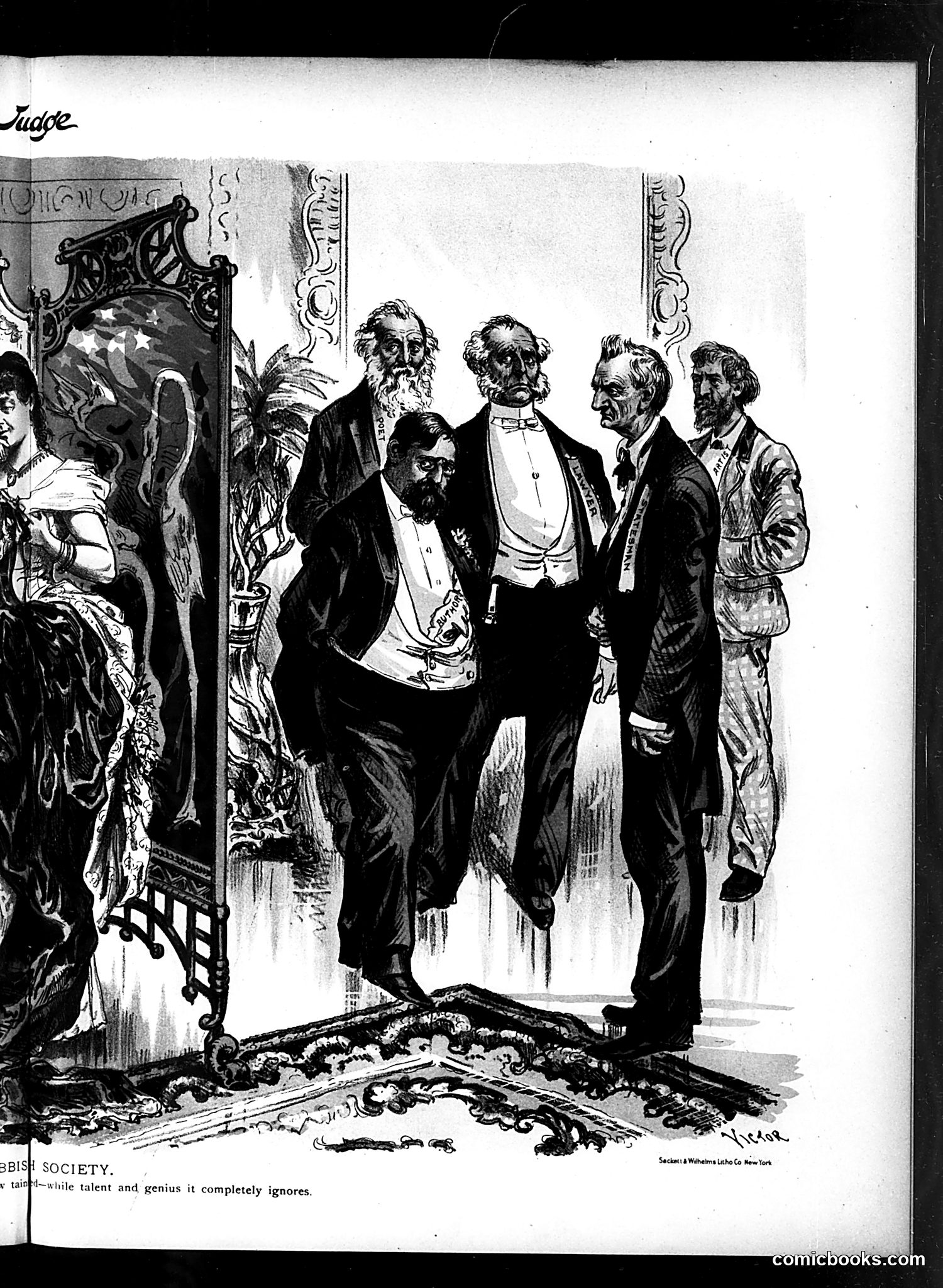
This Judge magazine cartoon satirizes "Snobbish Society" — likely the American upper class or social elite of the Gilded Age. The illustration shows five well-dressed men in formal attire (tuxedos and white tie) in an ornate interior, appearing to snub or ignore someone (partially visible at left). The visible text critiques how snobbish society "completely ignores" talent and genius, suggesting that wealthy social circles excluded accomplished individuals based on class prejudice rather than merit. The exaggerated formal dress and decorative architectural elements emphasize the pretentiousness being mocked. This reflects late 19th/early 20th-century American anxieties about class rigidity and whether merit-based advancement could overcome inherited social status.
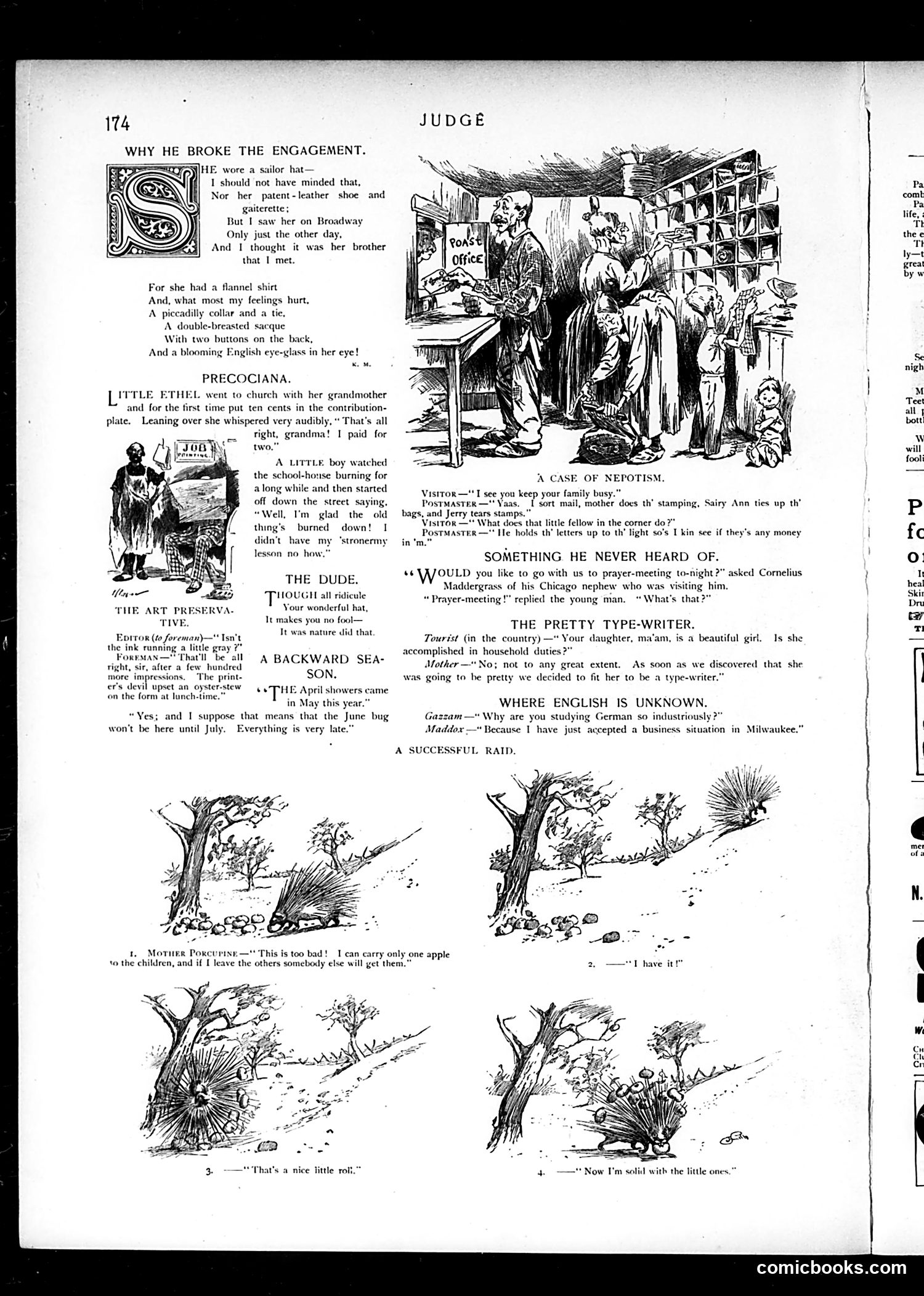
This page contains multiple short satirical pieces typical of late 19th-century American humor: **"Why He Broke the Engagement"** mocks a woman wearing masculine or unfashionable clothing (sailor hat, flannel shirt, double-breasted jacket, monocle) seen on Broadway—suggesting anxieties about changing women's fashion and gender roles. **"Precociana"** offers brief jokes about children, including one about a boy glad his school burned down. **"The Dude"** ridicules fashionable young men obsessed with appearance. **"A Case of Nepotism"** satirizes postal service corruption, showing a postmaster employing family members (including a child holding letters to light, presumably to detect money). **"The Pretty Type-Writer"** and **"Where English Is Unknown"** are brief social jabs at typewriter-operator culture and Milwaukee's German immigrant population. **"A Successful Raid"** depicts a mother with apples, its joke unclear from context. The overall tone reflects genteel, class-conscious satire targeting fashion, immigration, government corruption, and changing social roles.
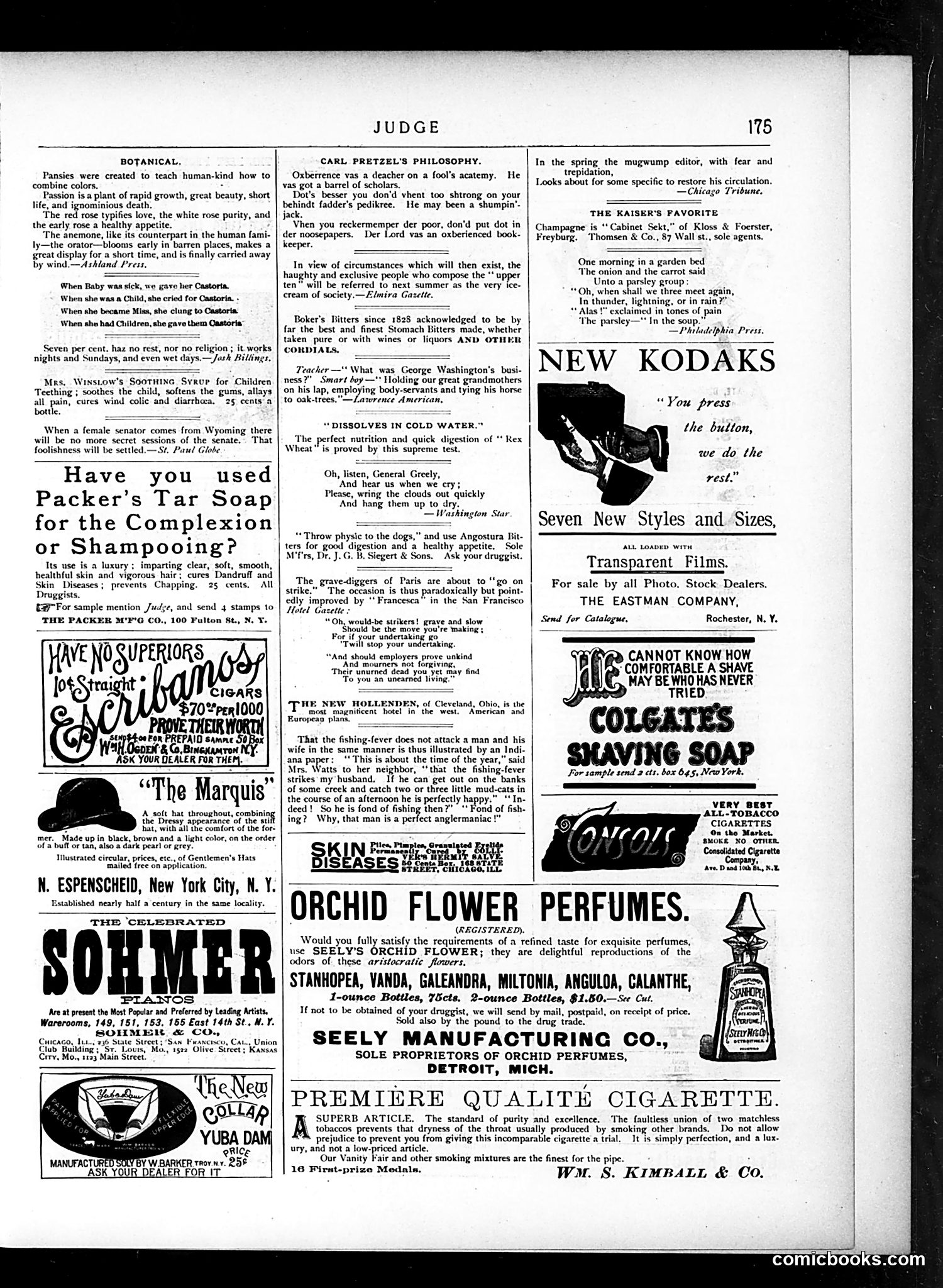
This page from *Judge* magazine is primarily **advertising**, with some short humorous philosophical quotes and satirical commentary scattered throughout. The main notable content is **"Carl Pretzel's Philosophy,"** featuring a German-accented character offering aphorisms. The accent and name suggest ethnic humor typical of the era—a "Dutch" (German-immigrant) character dispensing folk wisdom in broken English. The jokes are mild: observing that a fool's teacher is himself foolish, and that discretion about others' misfortunes is godly. The **advertisements** dominate: patent medicines (Mrs. Winslow's Soothing Syrup, Packer's Tar Soap), pianos, hats, and cigars. These reflect Gilded Age consumer culture and widespread faith in commercial remedies. **"The Marquis"** hat advertisement is straightforward product promotion. The **satirical bits** are lightweight—mocking "the upper ten" (wealthy elites) and making light jokes about fishing and grave-diggers striking. Overall, this is a commercial page mixing light satire with period advertising rather than substantive political commentary.
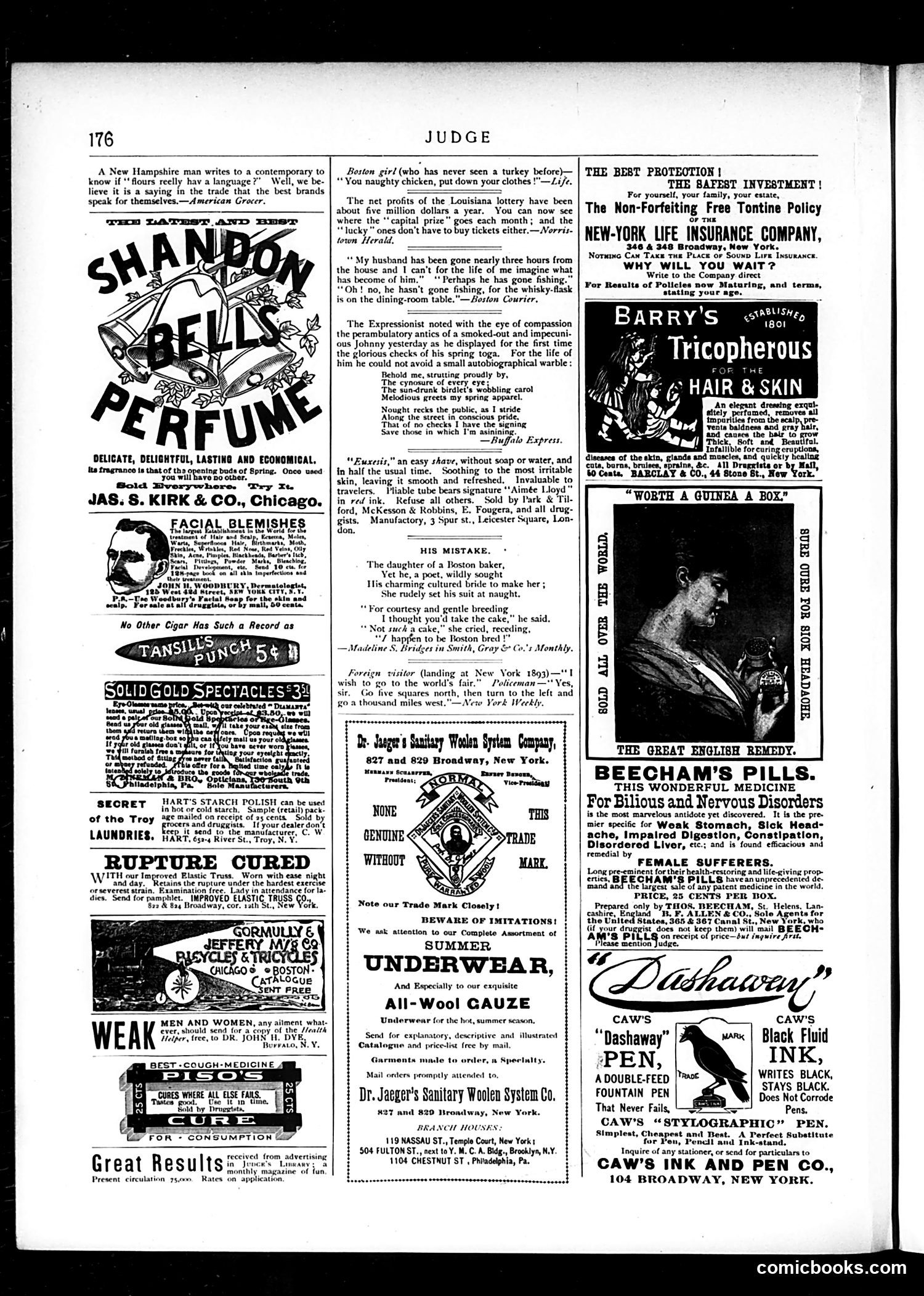
This is primarily an **advertising page** with scattered short humorous items interspersed. The cartoons/jokes are brief and topical rather than political: **Key humor pieces:** 1. **"Boston girl and the turkey"** — A joke about provincial ignorance: a sheltered Boston woman mistakes a turkey for a chicken and tells it to put down "clothes" (feathers), mocking rural naiveté. 2. **"Husband gone fishing"** — A domestic joke: a wife can't find her husband; when told he went fishing, she notes the whisky flask is still on the table, implying he's actually at a bar. 3. **"Expressionist's song"** — A poem mocking a poor man proudly strutting in his only decent outfit (spring suit with visible checks/patterns), unaware everyone sees through his shabby confidence. 4. **"Boston baker's daughter"** — A pun-based joke where a poet suitor says "take the cake" (accept my proposal); she refuses, noting she's "Boston bred" (not "bread"), rejecting the baker's world. The page reflects **late-19th-century American humor**: domestic comedy, class humor, and gentle mockery of regional types (Boston girls, foreigners). No significant political content is present.
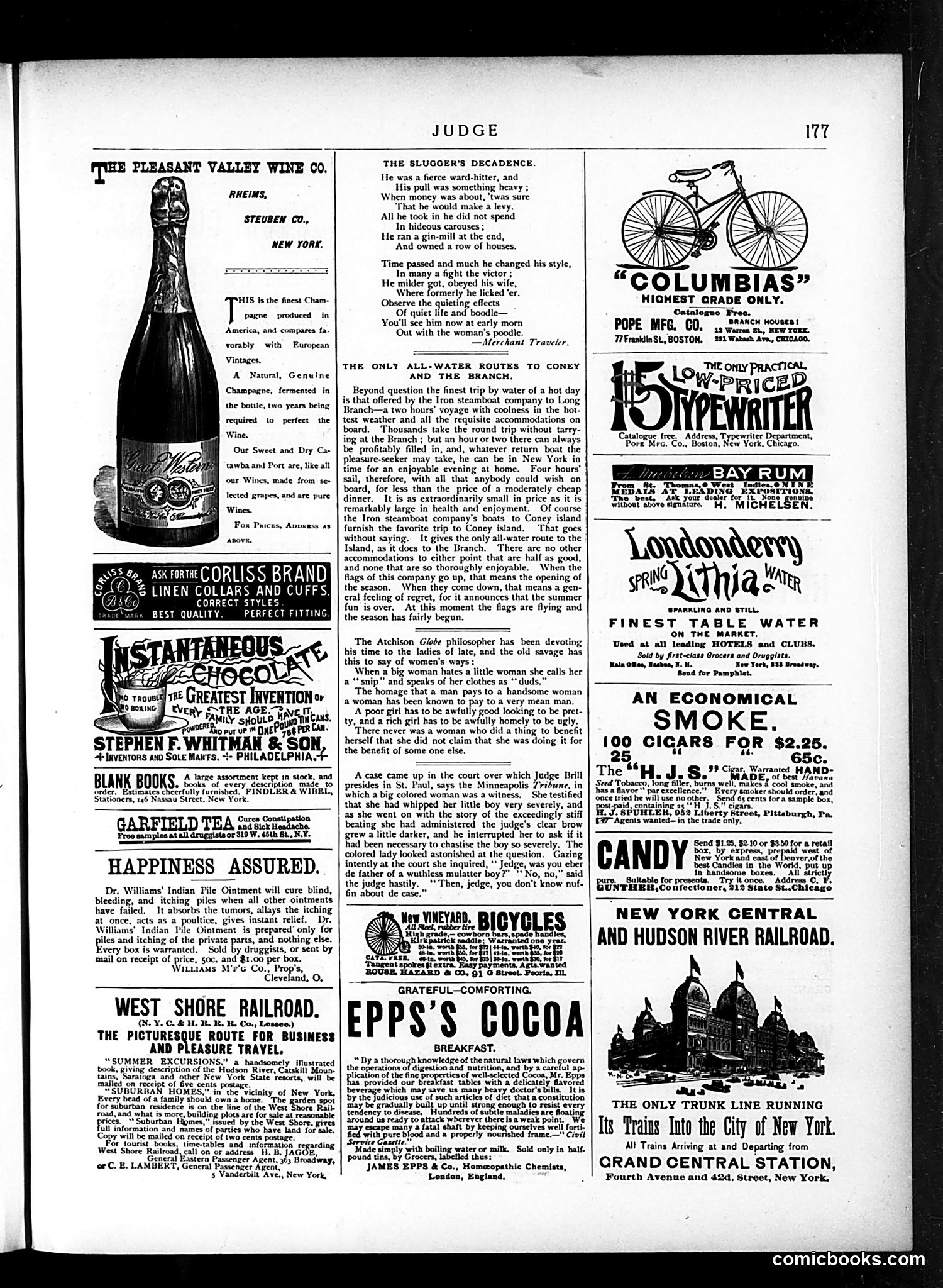
This page is primarily **advertising**, typical of Judge magazine's revenue model. The top half contains commercial ads for wine, collars, chocolate, and other products. The only substantial editorial content is **"The Slugger's Decadence,"** a satirical poem about a working-class boxer or street fighter ("ward-hitter") whose character has softened with age and prosperity. The joke is that this once-violent man—who previously fought brutally and extracted money ("levy") from others—has become domesticated by wealth and marriage. Now, instead of fighting or carousing, he walks his wife's poodle in the morning. The satire targets the **perceived hypocrisy or softening of rough, masculine types** who gain respectability through money and domestication. It's a humorous commentary on class mobility and changing masculine identity in Gilded Age America—the idea that wealth transforms even the toughest street character into a respectable (if slightly ridiculous) gentleman. The poem credits a "Merchant Traveler," suggesting it's reprinted from another publication.
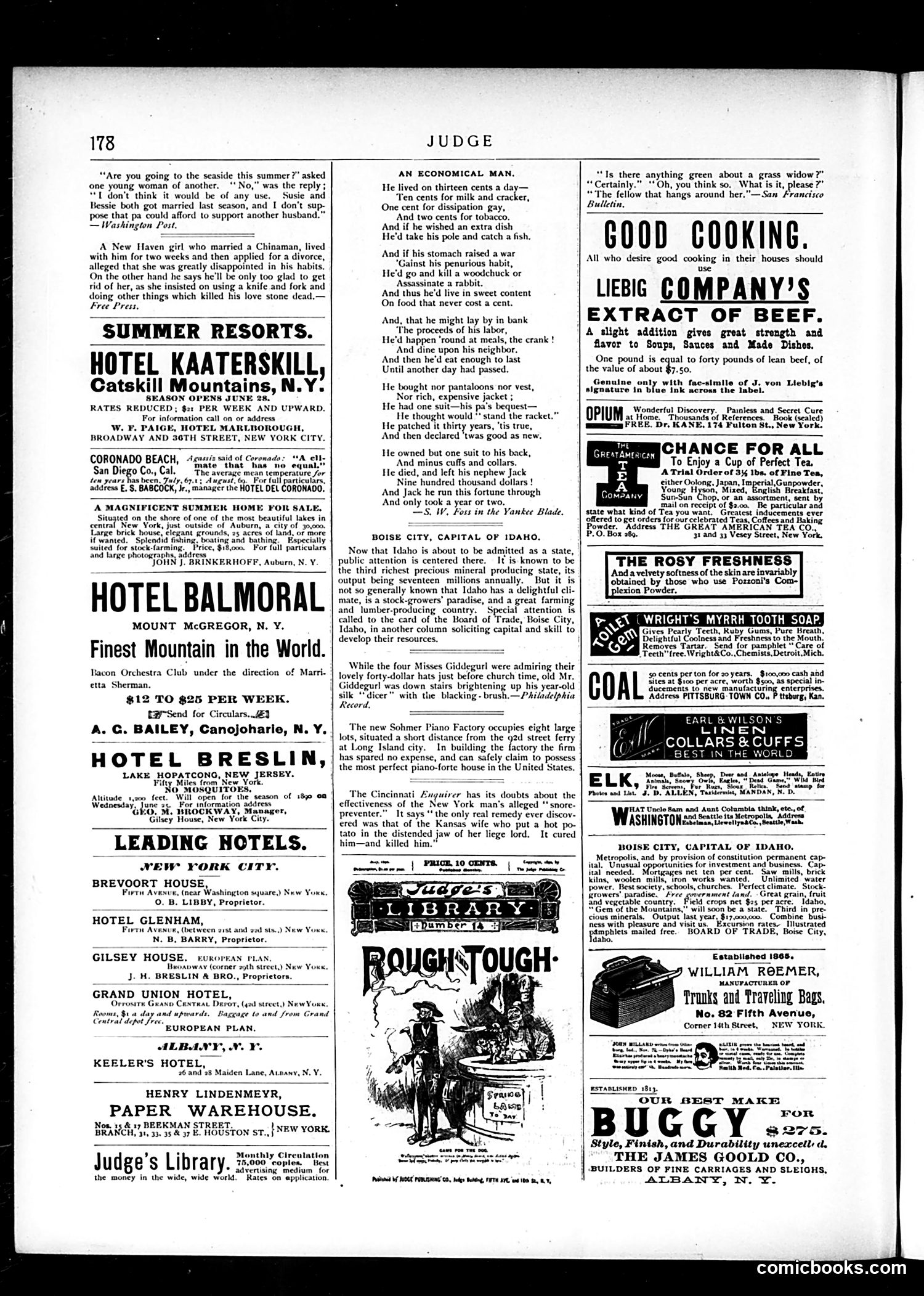
This page is primarily **advertisements and light humor pieces** rather than political satire. The main content includes: **Humor pieces:** - A joke about a young woman avoiding seaside resorts because marriage prospects have dried up - A satirical poem about an "economical man" who lives extremely frugally (13 cents daily) yet somehow accumulates wealth to leave his nephew—the joke being his stingy habits make him a parasite on others' hospitality **Promotional content:** The bulk of the page advertises Gilded Age summer resorts (Hotel Kaaterskill, Coronado Beach, Hotel Balmoral), New York City hotels, and a real estate listing. There's also promotional material for Idaho statehood, emphasizing its mineral wealth and agricultural potential. **The cartoon** (lower right) titled "Rough & Tough" appears to be an advertisement or serial illustration, though its specific meaning is unclear from this excerpt. Overall, this represents typical Judge magazine filler: light domestic humor combined with commercial advertising targeting wealthy readers interested in leisure travel and investments.
This page is primarily **advertisements** with short humorous filler content typical of Judge magazine. The main satirical pieces are brief: 1. **"Consider the lilies"** joke: A Boston Herald quote about expensive lilies becomes a segue to advertise inexpensive wall plaster—the humor is in the abrupt commercial pivot. 2. **Three short jokes**: One mocks racing "tip" sellers who profit by selling advice rather than using it themselves; another features a rural Vermont woman shocked by a Colonel Ingersoll lecture (likely referencing the famous atheist lecturer's controversial views); a third jokes about milking cows. 4. **"Oldest inhabitant" verse**: Plays on the cliché figure of small-town folklore. 5. **Side-whiskers observation**: Suggests that well-groomed, dignified men with side-whiskers must be wealthy and leisured—busy working men can't maintain them. The page is overwhelmingly **product advertisements** (cocoa, wall plaster, shutters, soap) with minimal editorial cartooning.
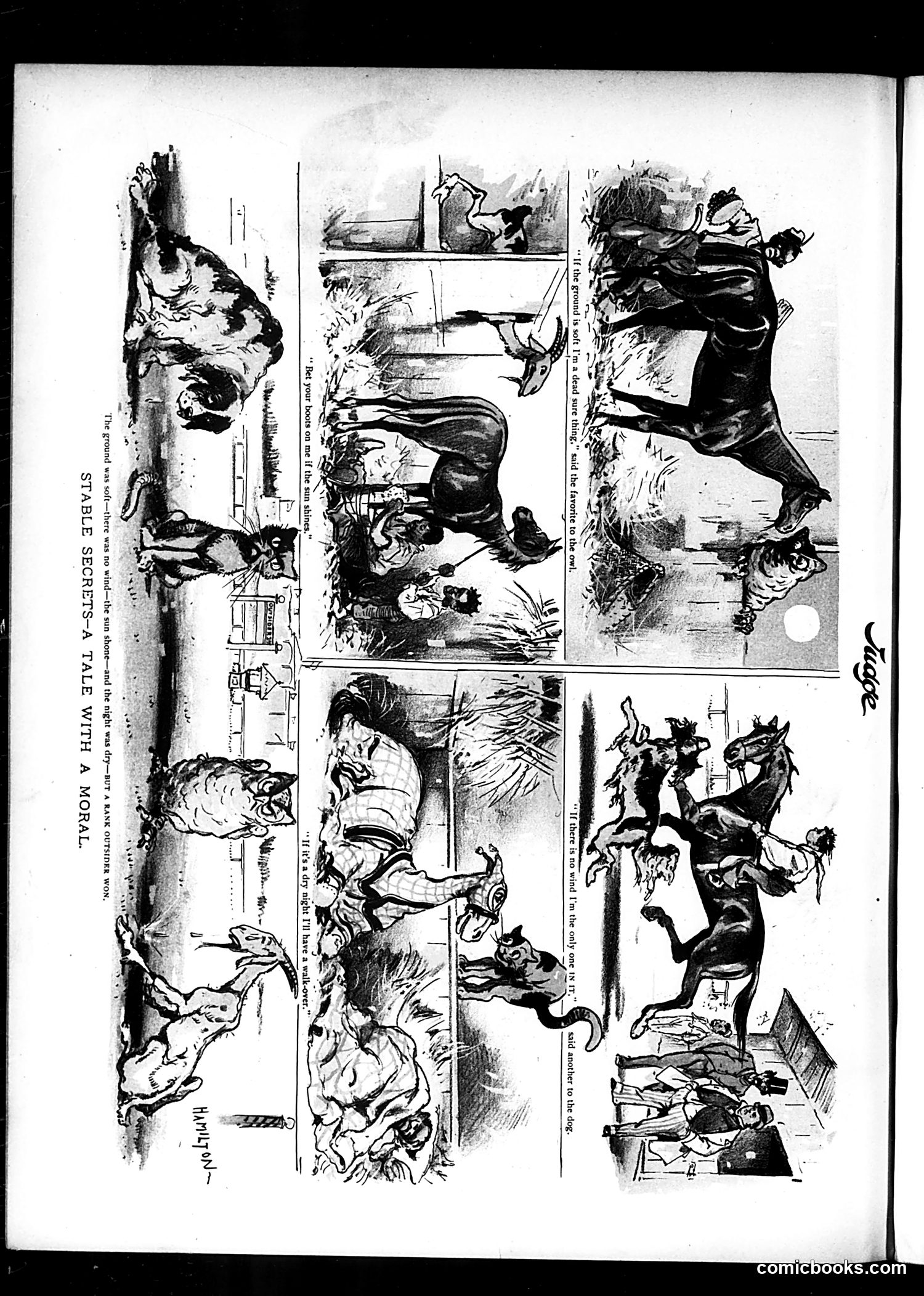
This is a multi-panel satirical story about horse racing. The title suggests a moral tale about secrets revealed through betting or competition. The narrative appears to follow a horse race where an unexpected "rank outsider" wins despite favorable conditions (soft ground, no wind, dry night) that should have benefited the favored horses. The panels depict various characters—likely trainers, jockeys, gamblers, and stable hands—in dramatic reactions to the upset victory. The satire likely targets racing corruption, fixed races, or gambling schemes common in the era, suggesting that despite careful planning or alleged fixed outcomes, unpredictable results still occur. Without clearer panel text, the exact moral remains unclear, but it appears to critique dishonesty or overconfidence in horse racing circles.