
A complete issue · 16 pages · 1890
Judge — February 22, 1890
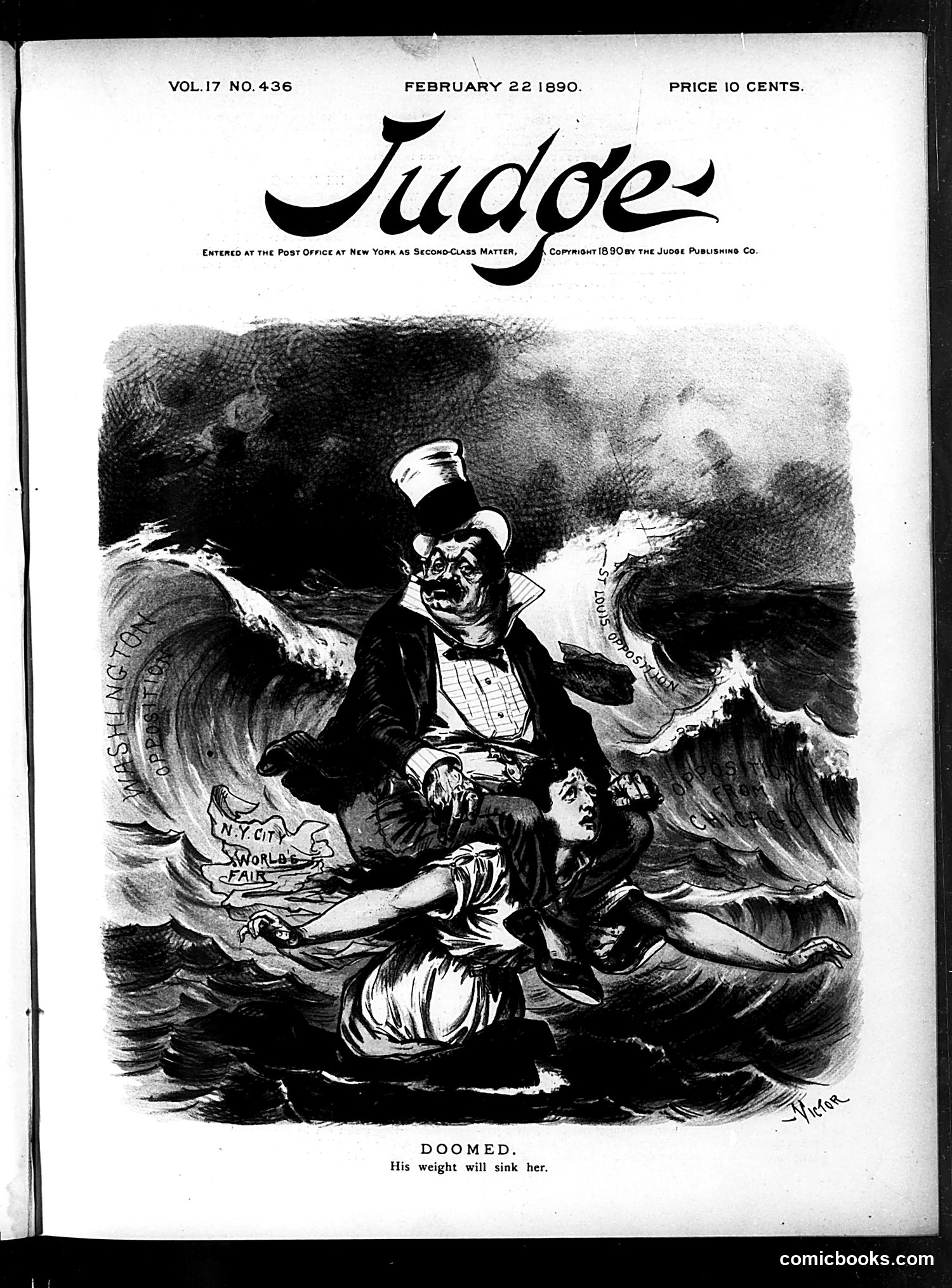
This political cartoon depicts a demonic or villainous figure in formal dress and top hat, labeled with "N.Y. WORLD'S FAIR," sinking two female allegorical figures (likely representing concepts such as virtue or justice) into turbulent waters. The caption reads "DOOMED. His weight will sink her." The cartoon appears to satirize the New York World's Fair through the metaphor of a corrupting force dragging down something valuable. The demon figure suggests the fair—or those managing it—represents moral corruption or financial mismanagement that threatens to destroy worthwhile endeavors. Without additional historical context about the 1890 World's Fair controversies, the specific target remains unclear, though the imagery suggests critique of contemporary fair management or its societal impact.
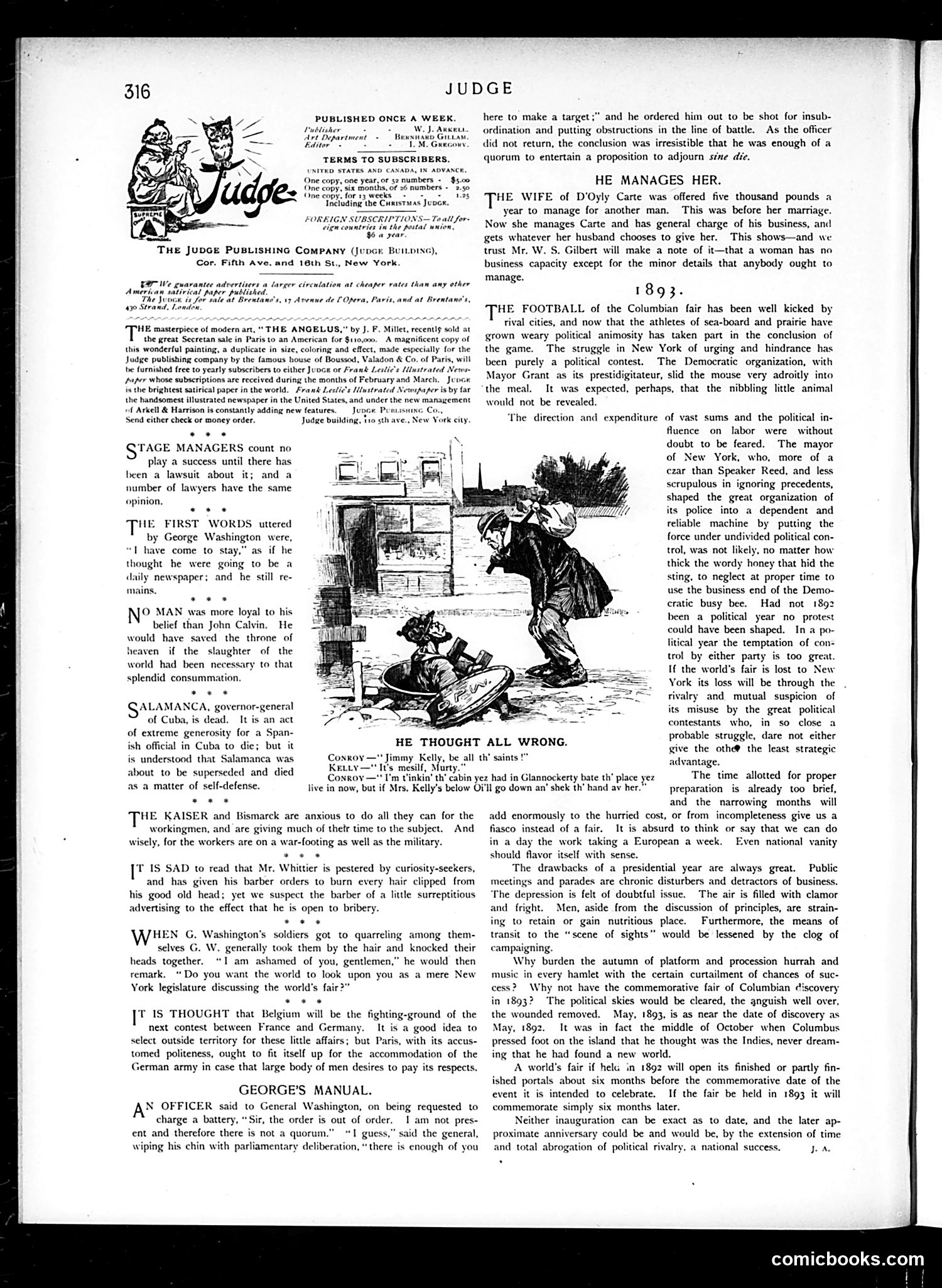
This cartoon satirizes **Jimmy Kelly** (a boxer) and **Mary** (likely his wife), depicted as working-class figures. The dialogue suggests Kelly has criticized his wife's domestic spending or management—she defends herself by noting she lives "below O'll go down an' she'll th' hand ay her," implying financial constraints. The satire mocks working-class marital disputes over household budgets, a common comedic subject in period humor. The title "He Thought All Wrong" suggests Kelly misjudged the situation. The illustration's rough, street-level setting emphasizes the working-class context, typical of Judge's satirical approach to contemporary American social dynamics and domestic conflicts.
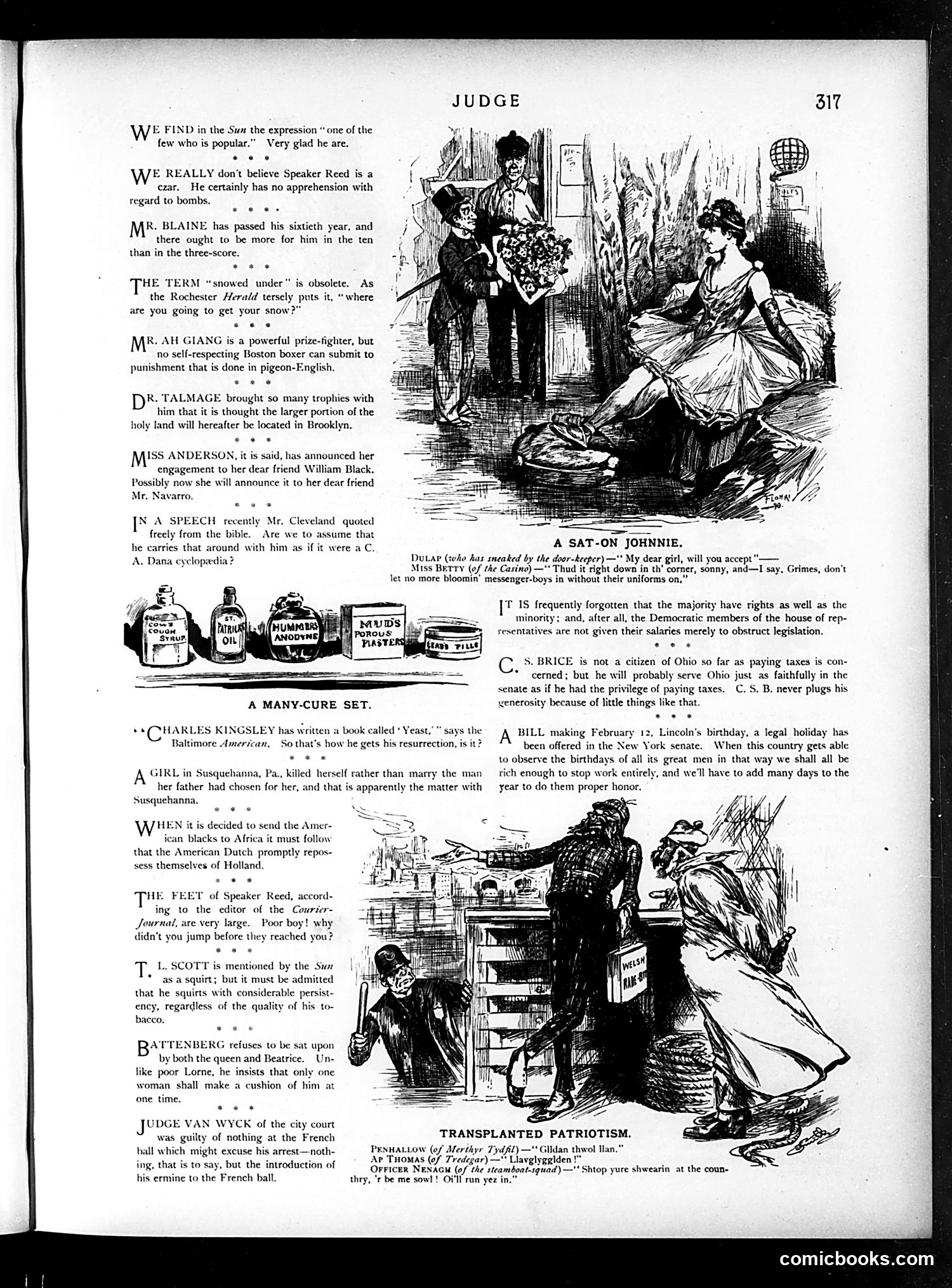
This page contains multiple satirical brief items and illustrations typical of Judge's format. **"A Sat-On Johnnie"** appears to mock a theatrical figure, likely referencing a performer or public personality known by that nickname. **"A Many-Cure Set"** shows patent medicine bottles, satirizing the era's widespread quackery—unregulated, often-fraudulent "cure-all" medicines that were common consumer products. **"Transplanted Patriotism"** depicts what appears to be an immigrant or foreigner awkwardly adopting American patriotic customs, suggesting satirical commentary on assimilation and citizenship. The short text items mock various public figures (politicians, celebrities) and social issues of the period—taxes, legal holidays, seating etiquette. The overall tone is typical of Judge's irreverent, gossipy approach to contemporary affairs.
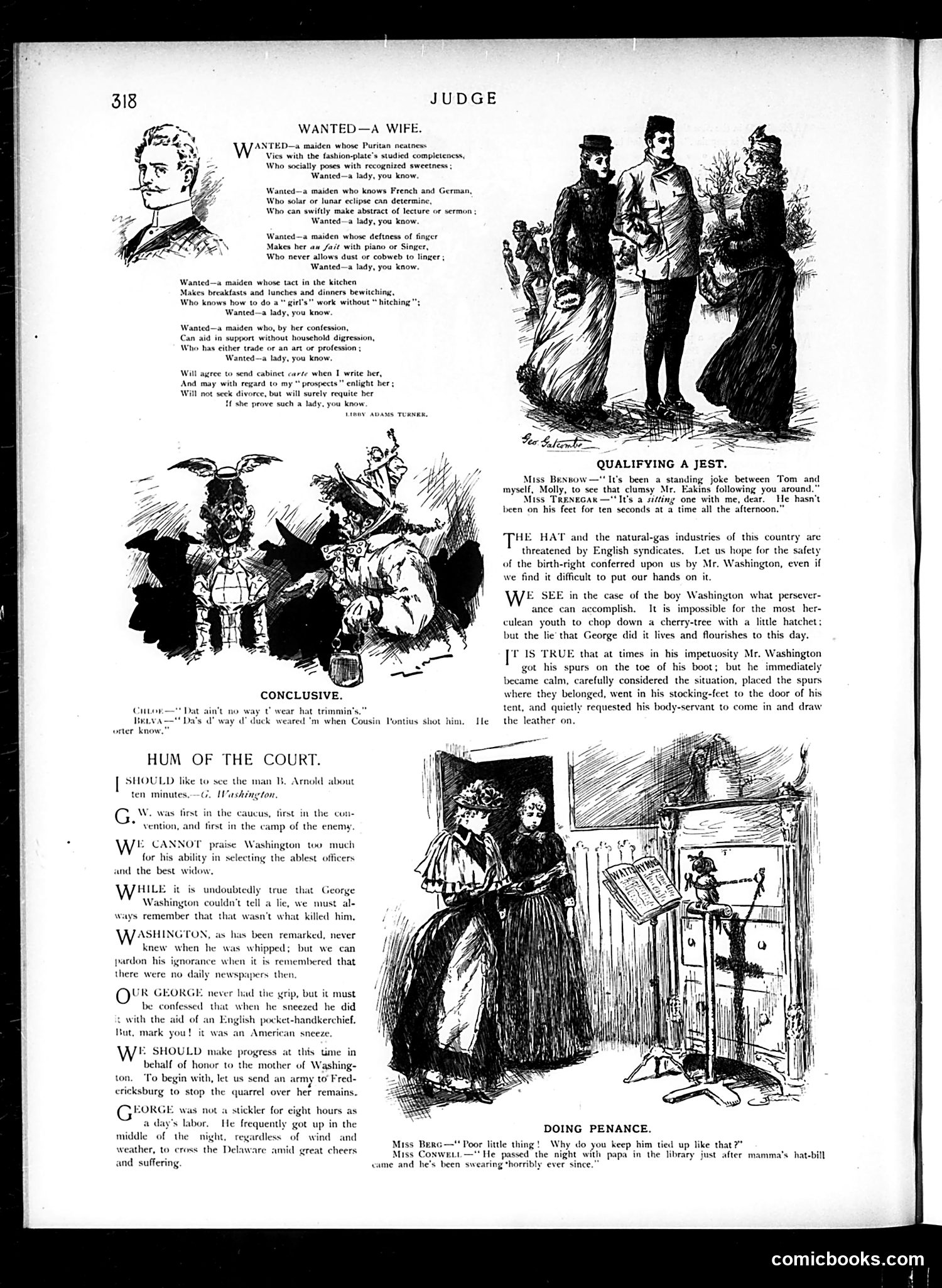
This page satirizes **unrealistic ideals of womanhood** in the late 19th century through the poem "Wanted—A Wife." The speaker demands an impossible woman: Puritan-modest yet fashionable, multilingual, musically skilled, domestically perfect, AND capable of financial support—all without complaint. The satire targets male hypocrisy: men want women educated and economically productive, yet confined to traditional domestic roles. The "Hum of the Court" section contains jokes about **George Washington**, playing on the famous cherry-tree legend (the lie that "lives and flourishes") and his image as infallible. The jokes mock blind hero-worship and suggest Washington succeeded despite flaws, not because of mythical perfection. Minor sketches ("Qualifying a Jest," "Doing Penance") contain period social humor about clumsy suitors and domestic quarrels. The overall tone is **satirical critique** of unrealistic gender expectations and national mythology.
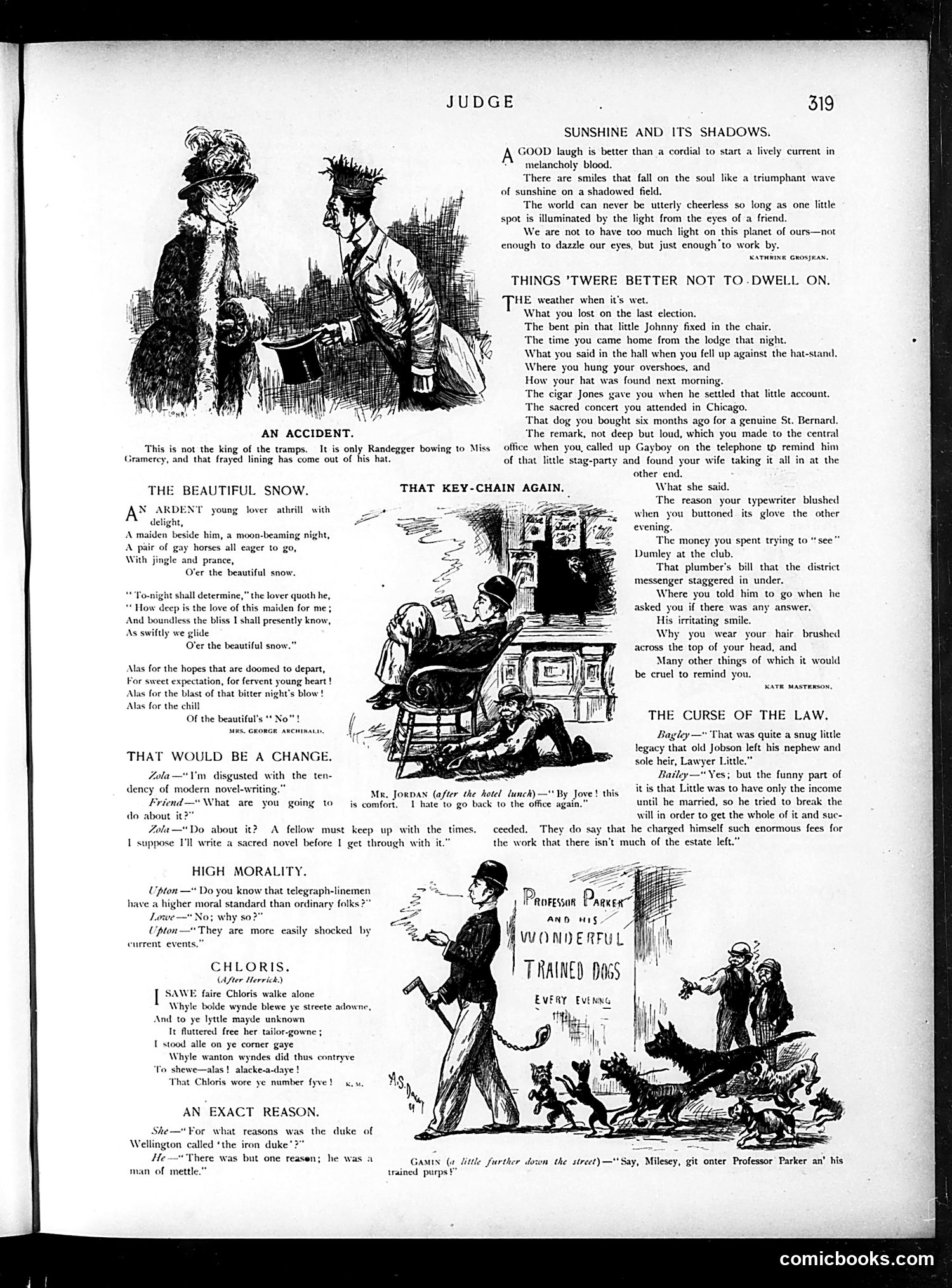
This page from *Judge* magazine contains several satirical pieces and illustrations targeting turn-of-the-century social conventions and literary trends. **"The Beautiful Snow"** mocks sentimental Victorian poetry by contrasting a young lover's romantic expectations during a snowy carriage ride with reality—his date simply refuses him. The joke: romantic literature promised passion; real life delivered rejection. **"That Would Be a Change"** references the famous naturalist novelist Émile Zola, who was known for depicting society's uglier aspects. The humor derives from Zola claiming disgust with modern novels' tendencies while preparing to write a "sacred novel"—a transparent contradiction suggesting even reformers exploit current fashions. **"High Morality"** is a pun: telegraph linemen are "more shocked by current events"—playing on "current" (electricity) versus news. **"Chloris"** parodies archaic poetic language while depicting wind revealing a woman's shoe size—deflating both pretentious verse and Victorian modesty with a practical detail. **"The Curse of the Law"** satirizes how lawyers exploit inheritance disputes, charging excessive fees that deplete estates they're supposed to protect.
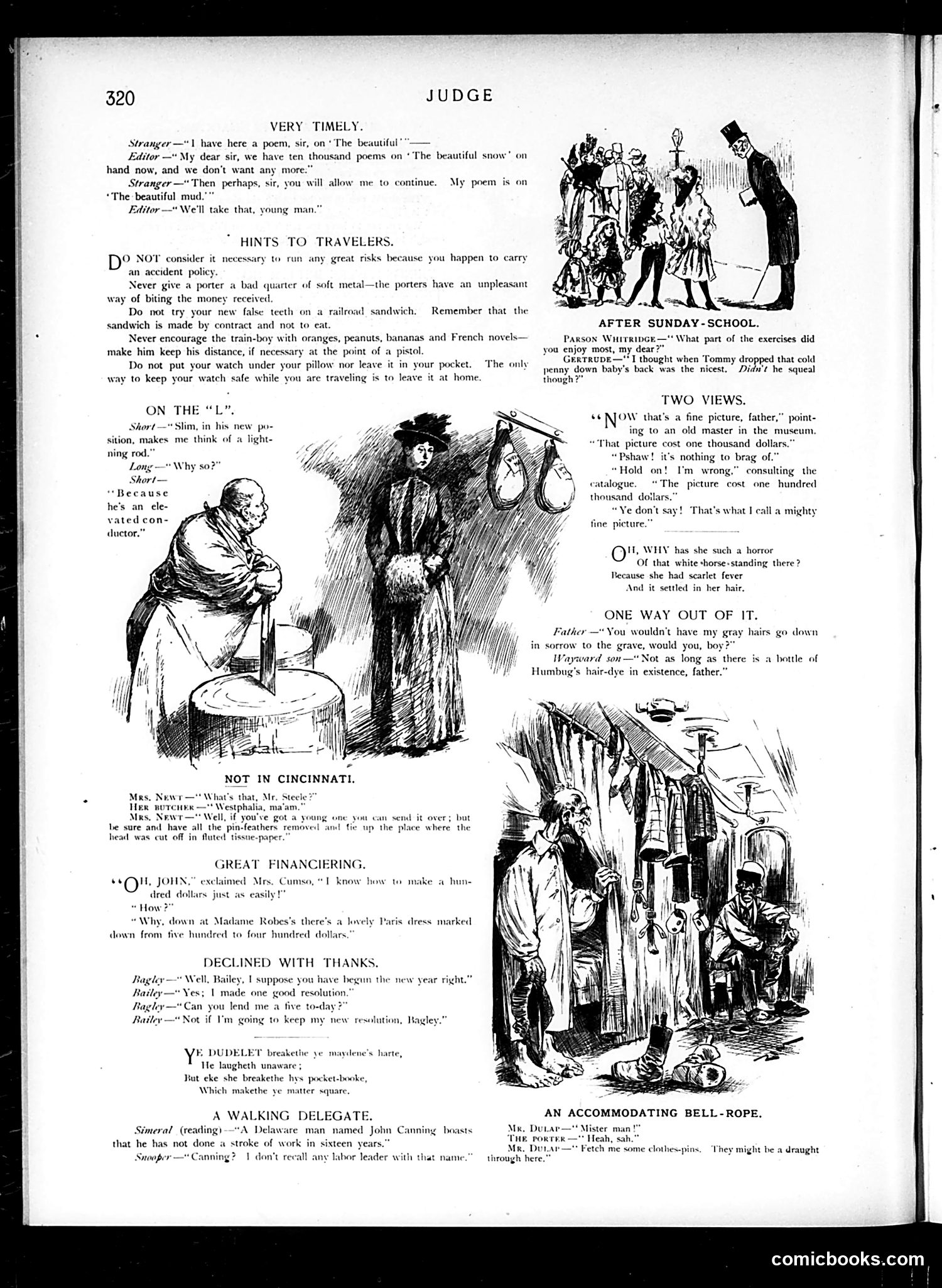
This page contains multiple brief satirical sketches typical of late-19th-century American humor: **"Very Timely"**: A poetry editor rejects thousands of submissions about "the beautiful" but accepts one about "the beautiful mud"—mocking both the oversupply of sentimental poetry and lowbrow editorial standards. **"Hints to Travelers"**: Practical travel advice with dark humor (don't rely on accident insurance, watch porter behavior, avoid false teeth on trains). **"On the L"**: A pun about an elevated-train conductor being described as "elevated"—wordplay on the Chicago "L" rapid transit system. **"Great Financiering"**: A wife congratulates herself for "making" money by buying a dress marked down from $500 to $400—satirizing women's poor financial reasoning. **"After Sunday-School"**: A child recalls enjoying church most when dropping a cold penny down a baby's back—innocent childhood cruelty. The remaining sketches are brief, gentle jokes about relationships, resolutions, and urban life. The humor is wholesome, pun-based satire targeting common social behaviors rather than specific political figures.
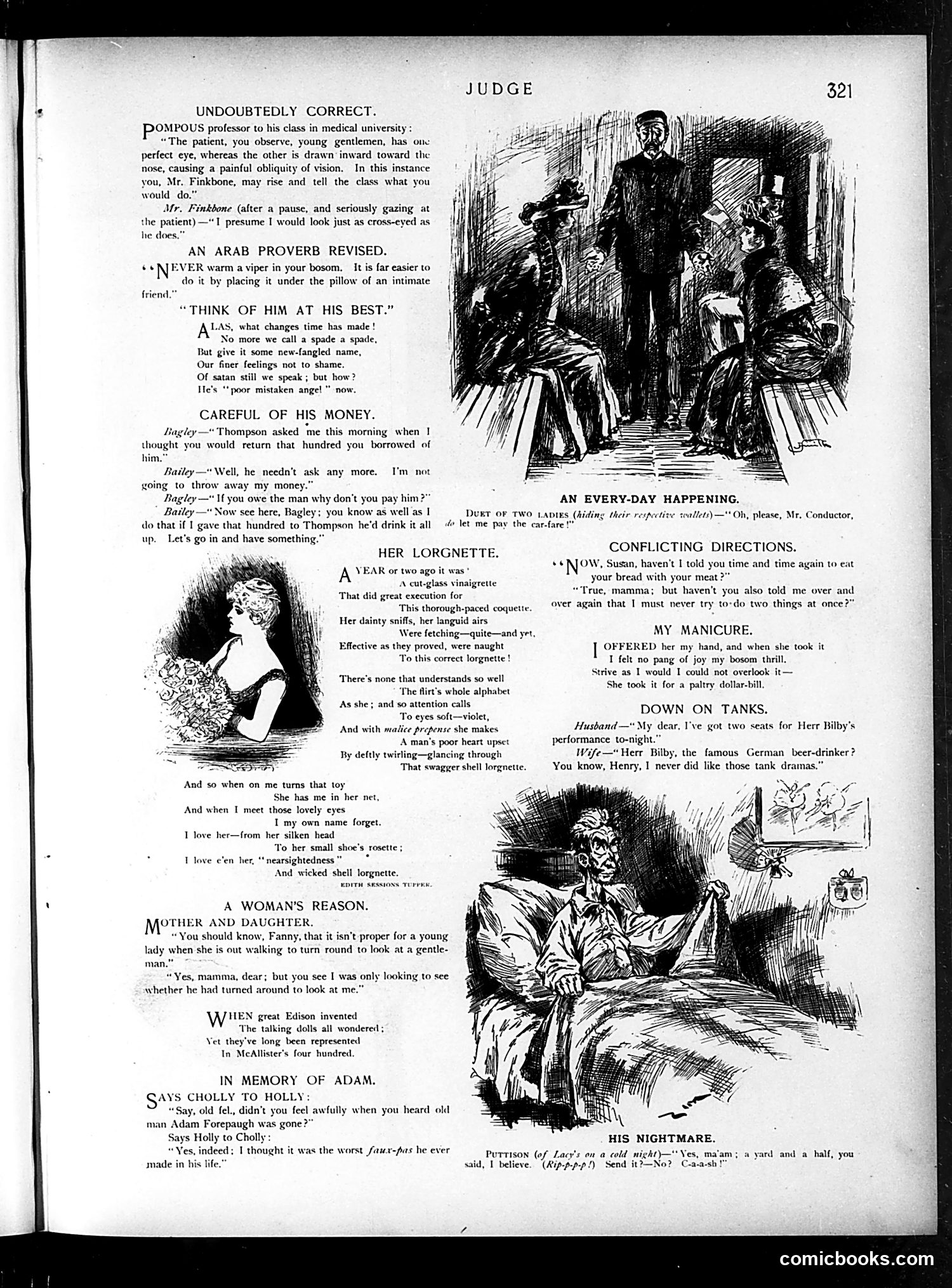
This page contains multiple short humor pieces typical of late-19th/early-20th century American satirical magazines: **The cartoons** depict everyday social situations: a pompous medical professor embarrassed by a student's literal answer; two women negotiating streetcar fares; a man having a nightmare about fabric measurements. **The written jokes** mock contemporary social conventions and hypocrisies: a woman's "reasoning" about why turning to look at men is acceptable; conflicting maternal advice about eating; euphemistic language replacing direct speech ("poor mistaken angel" instead of "Satan"); a man valuing money over friendship; women using lorgnettes as flirtation tools. **Key satire targets**: the pretension of the upper class, gender relations and courtship rituals, parental contradictions, and linguistic euphemism masking reality. The "Tank dramas" reference likely indicates a theatrical trend of the period (unclear without additional context). Overall, these are gentle social comedies about manners and middle-class behavior rather than hard political satire.
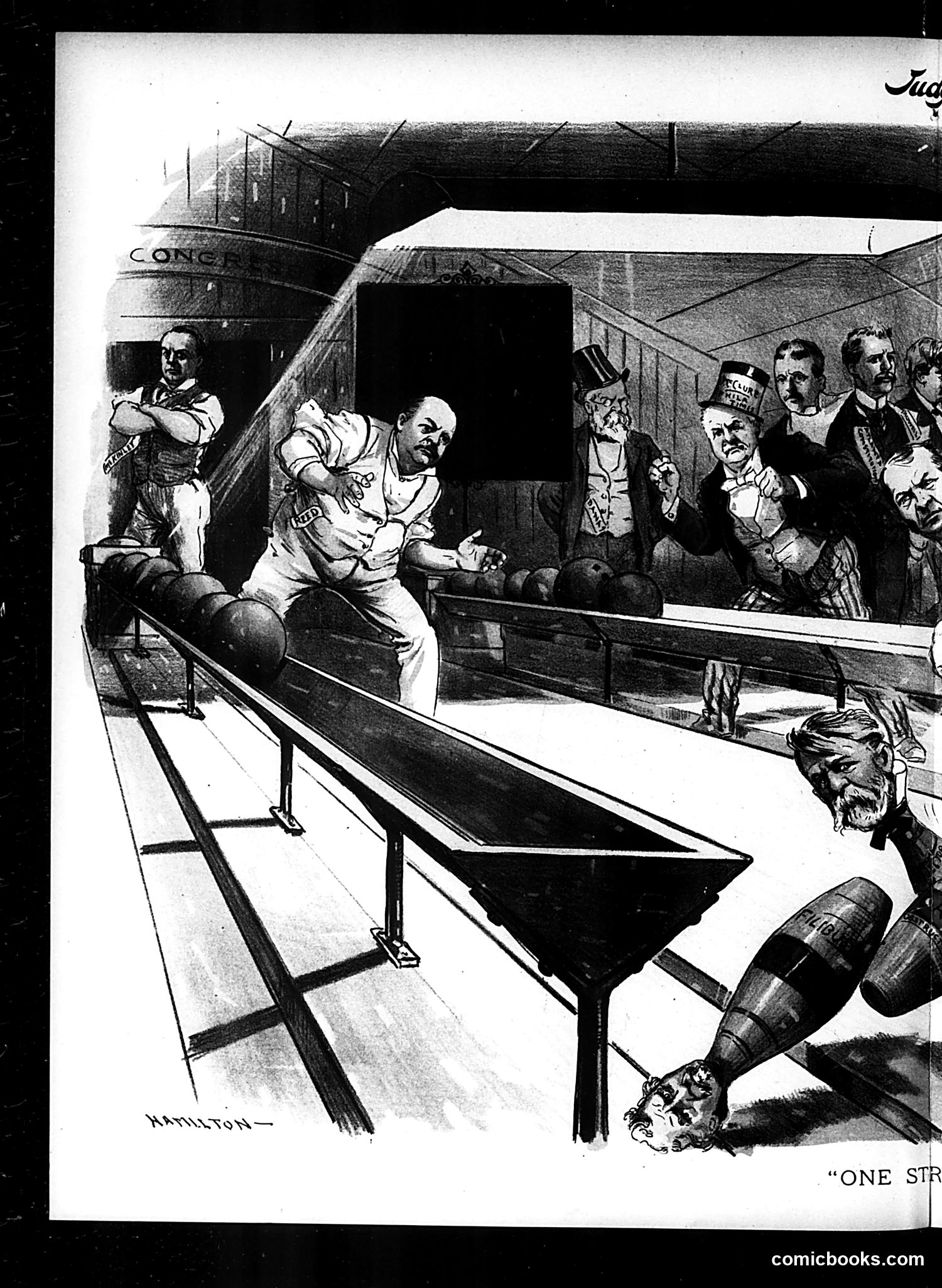
This appears to be a political cartoon from *Judge* magazine, signed by Hamilton. The image shows what looks like an industrial or manufacturing scene with a man in work clothes prominently featured in the center, surrounded by well-dressed observers or officials in a raised viewing area. The setting suggests a factory or production facility, possibly a weapons or munitions plant given the barrel-shaped objects visible in the foreground. The cartoon likely satirizes industrial labor conditions, management oversight, or wartime production—common *Judge* themes. However, without complete caption text and a clear date, I cannot definitively identify the specific figures, political figures referenced, or the exact event being satirized. The fragmented OCR text ("ONE STR") doesn't clarify the cartoon's intended message.
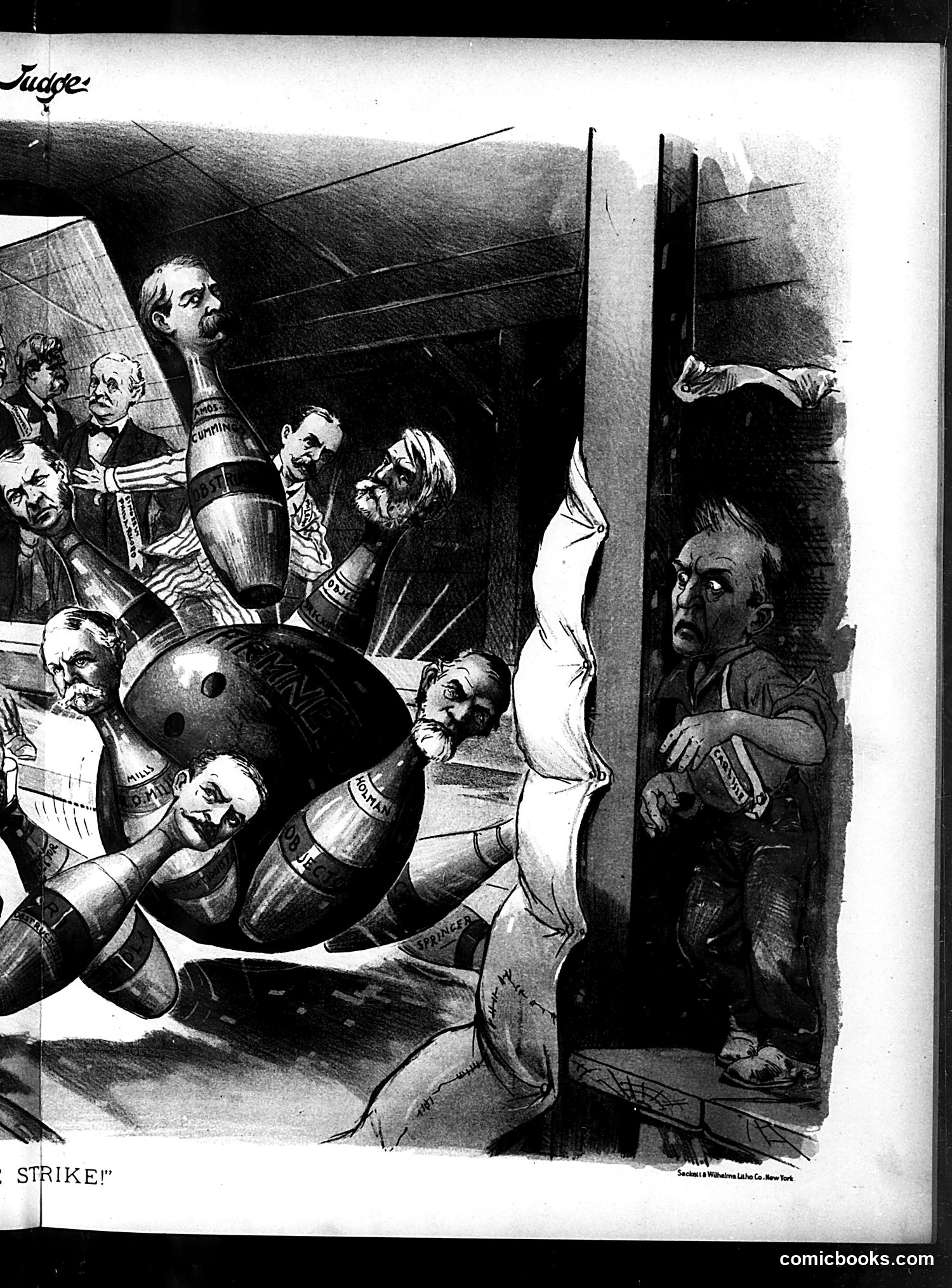
This **Judge** magazine cartoon depicts a labor strike scene. On the left, well-dressed figures (likely capitalists or politicians) hold large bombs labeled with what appear to be corporate or industrial names, suggesting they control weapons or destructive power. On the right, a working-class man stands alone at a doorway, appearing confrontational or defiant. The cartoon satirizes the power imbalance during labor disputes: the wealthy elite possess literal and figurative "explosives" (economic control, political influence), while workers have only their bodies and determination to resist. The title "STRIKE!" reinforces this is commentary on labor unrest, likely from the late 19th or early 20th century when such conflicts were common and often violent.
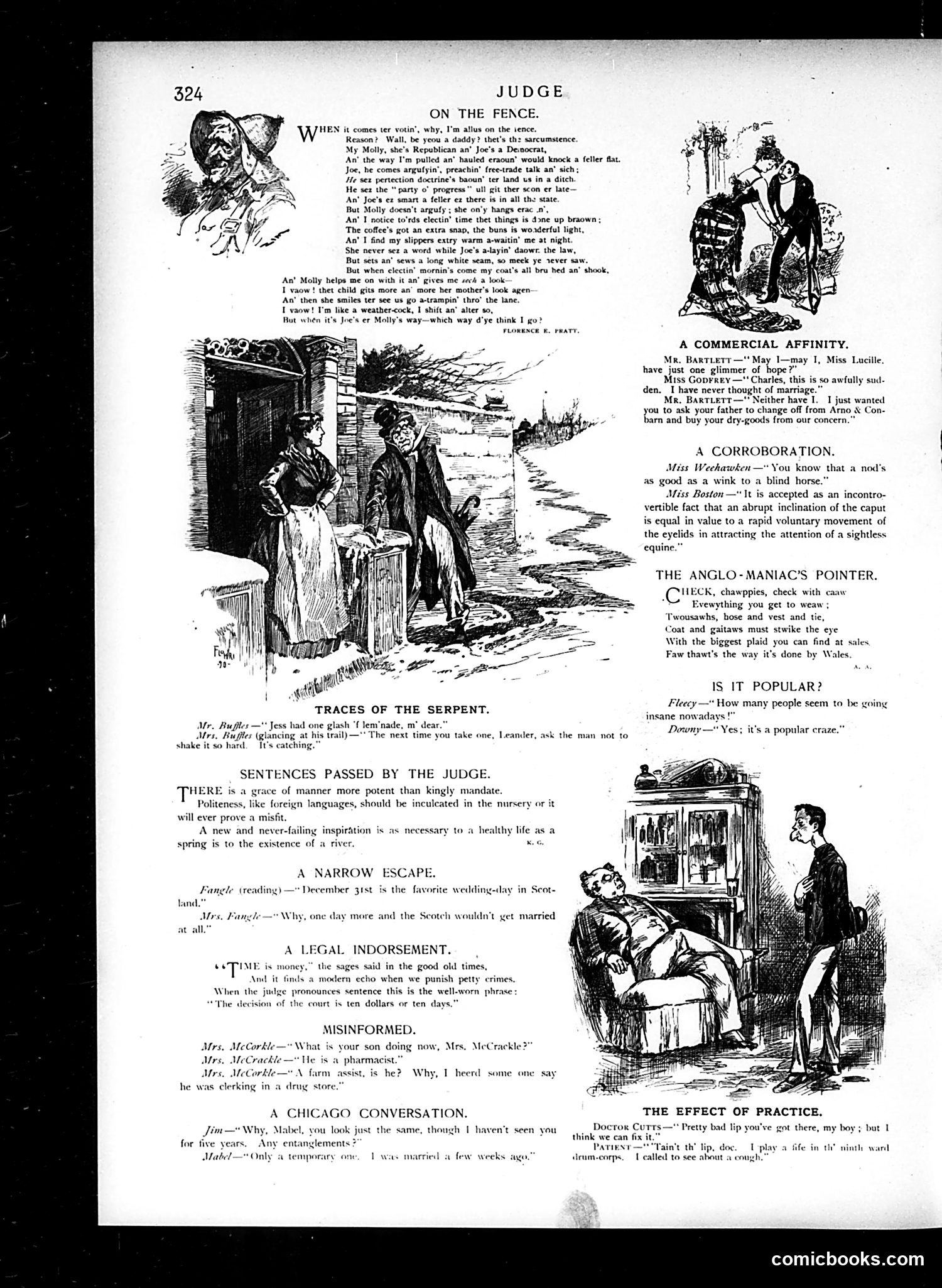
This poem satirizes an indecisive voter swayed by domestic manipulation rather than political conviction. The narrator claims neutrality between two positions (likely protectionism vs. free trade, based on Joe's arguments), but his wife Molly—without arguing—subtly influences his vote through domestic comfort: better coffee, warmer slippers, and affectionate gestures. The satire targets male voters who believe themselves independent thinkers while actually being influenced by their wives' domestic management. The "weathercock" metaphor emphasizes his lack of principle. The piece mocks both the husband's self-deception about his autonomy and, implicitly, women's indirect political power during an era when they couldn't vote directly. The surrounding content includes various brief humorous sketches on unrelated topics (commercialism, affected English mannerisms, etc.).
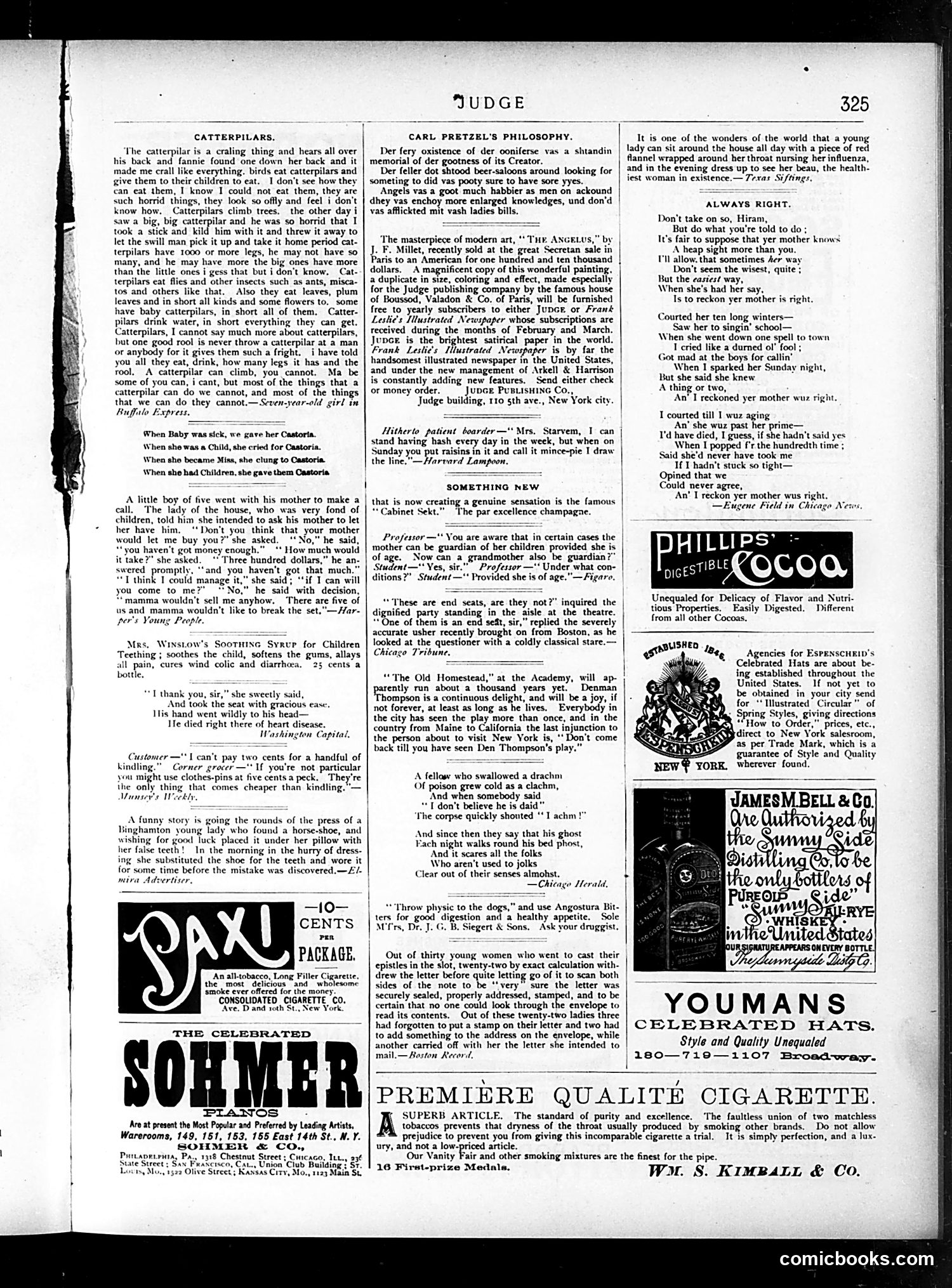
This page is primarily **advertising and filler content** rather than political satire. The main elements include: **Editorial Content:** - A child's essay on caterpillars (likely humorous for its earnest, unpolished style) - Several brief anecdotes about children's remarks and domestic situations - These appear designed as light, family-friendly humor **Advertisements:** The page is dominated by ads for consumer products: Castoria (children's medicine), Mrs. Winslow's Soothing Syrup, Soxi cigarettes, Sohmer pianos, Phillips' Cocoa, James M. Bell & Co. whiskey, and Youmans hats. **Notable Context:** The James M. Bell advertisement explicitly claims to be "the only bottlers of Pure Old Sunny Side Whiskey in the United States" — suggesting competitor concerns about product authenticity during the Prohibition era or earlier patent disputes. **Assessment:** This is a typical late 19th/early 20th-century magazine page balancing light editorial content with commercial revenue. No significant political satire or social commentary is present.
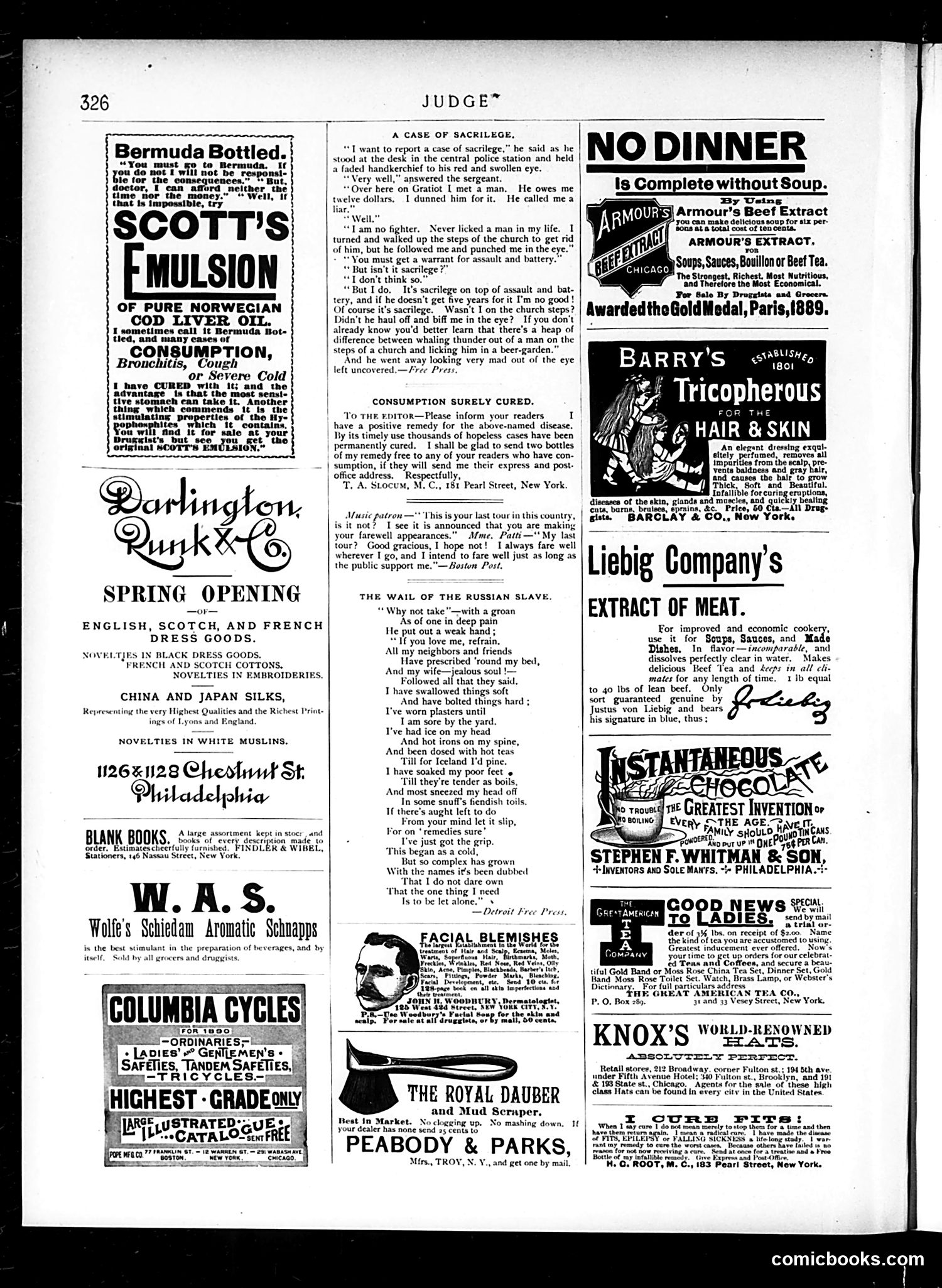
This is primarily an **advertising page** rather than a satirical editorial spread. The dominant content consists of commercial advertisements for patent medicines, retail goods, and services typical of late 19th-century American publications. The one notable satirical piece is **"A Case of Sacrilege,"** a short humor column about a man beaten on church steps who protests that the assault constitutes "sacrilege" because it occurred on holy ground. The joke mocks the man's literal-minded piety—he's more concerned with the *location* of his beating than the assault itself, suggesting religious hypocrisy or misplaced priorities. The advertisements reflect period concerns: Scott's Emulsion (cod liver oil for consumption/tuberculosis), Liebig's Extract of Meat, hair treatments, and dry goods. These ads reveal contemporary medical beliefs and consumer culture more than they satirize it. **For modern readers:** This page documents how 19th-century magazines blended editorial content with advertising revenue, and shows what "health" products and commercial pitches looked like in this era.
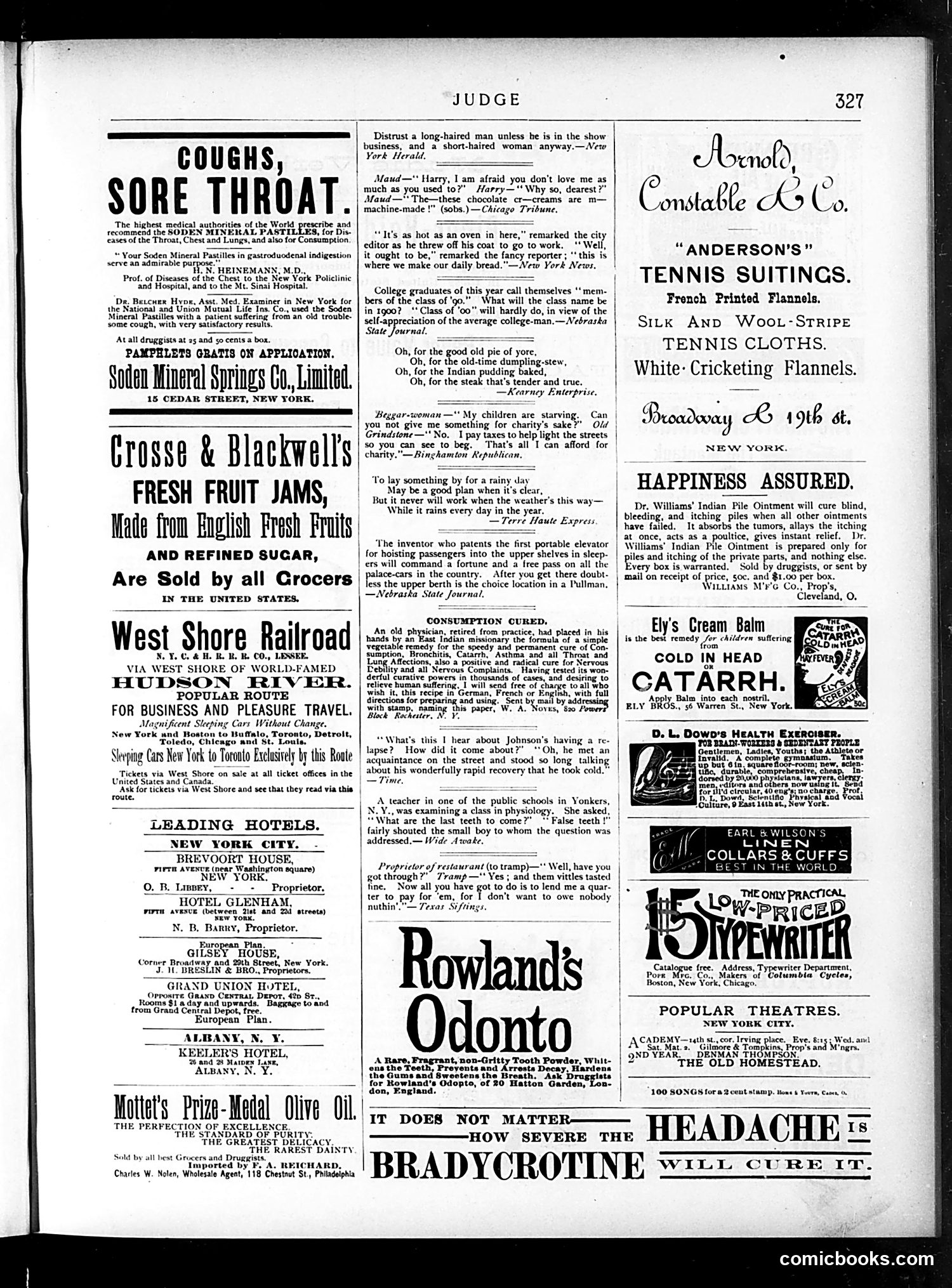
This page is **predominantly advertising**, typical of late-19th-century magazines. It contains multiple product advertisements (mineral pastilles, jams, railroads, hotels, olive oil) interspersed with brief humorous quips rather than a cohesive political cartoon. The scattered jokes reflect period concerns: a woman upset her boyfriend bought machine-made (versus hand-made) chocolates; city editors working in hot offices; college graduates' self-importance; nostalgic references to "old-fashioned" food; and class commentary (a poor woman begging from a wealthy man claiming his taxes support her). One quip warns readers to "distrust a long-haired man unless he is in the show business, and a short-haired woman anyway"—reflecting contemporary gender and appearance anxieties of the era. The overall effect is light social satire rather than sharp political commentary, with humor aimed at consumer culture, modern conveniences, and social pretension.
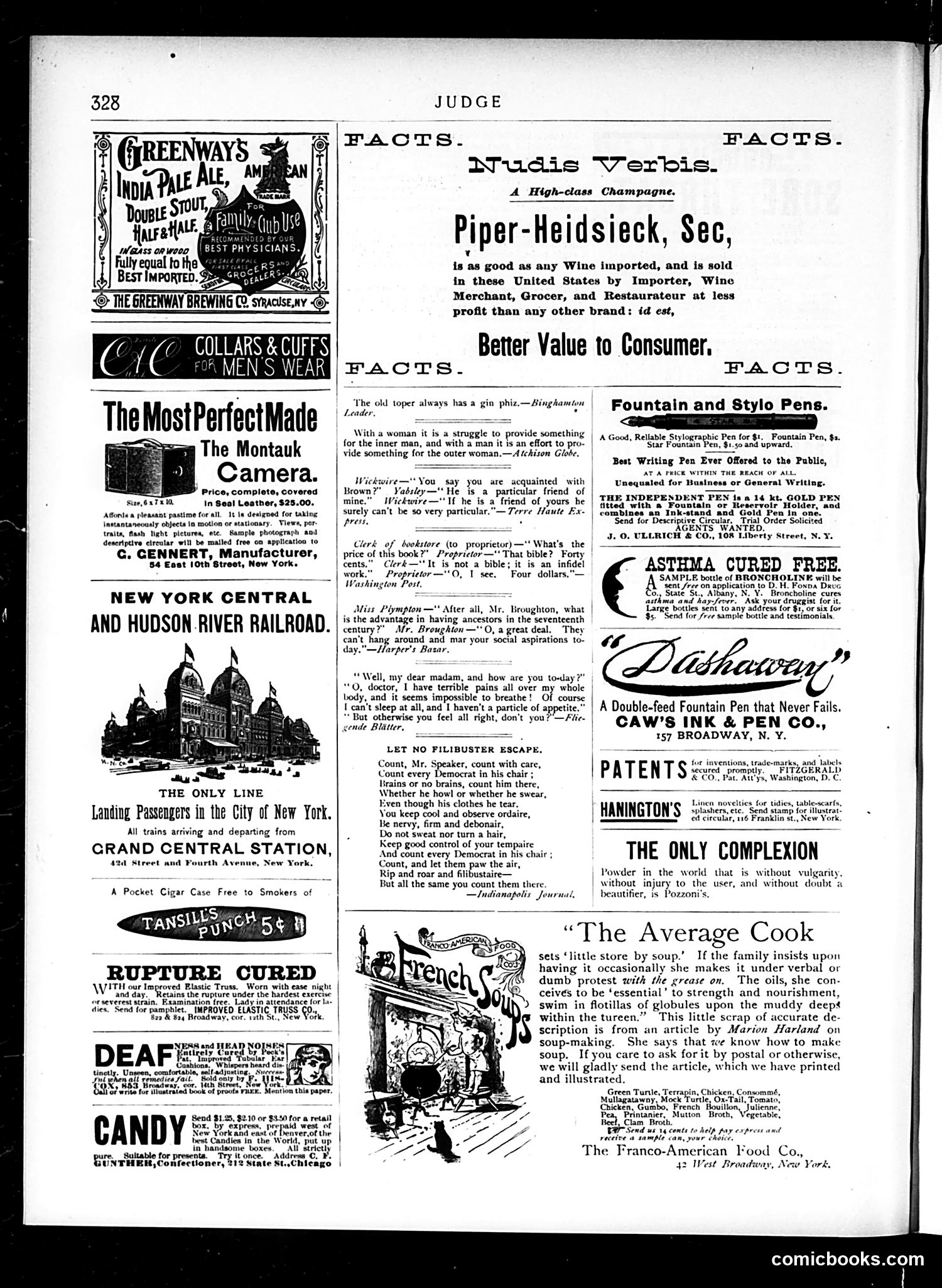
This page is primarily **advertising content** with minimal satirical cartoons. The ads promote various products (champagne, fountain pens, cameras, railroad service) alongside brief humorous snippets. The few joke items present are typical Judge fare—short, punchy observations about everyday life. One example mocks women's domestic struggles ("providing something for the inner man"), another jokes about ancestors not "hanging around" to ruin one's social standing in the 17th century. A doctor-patient exchange satirizes hypochondriacs. The "Let No Filibuster Escape" section appears to be political commentary on Congressional obstruction tactics, using a counting metaphor, though specific figures aren't identified. Most of the page consists of commercial advertisements for branded products, which was standard Judge content—the magazine monetized space through ads while interspersing light humor. Without additional context about publication date, specific political events referenced remain unclear.
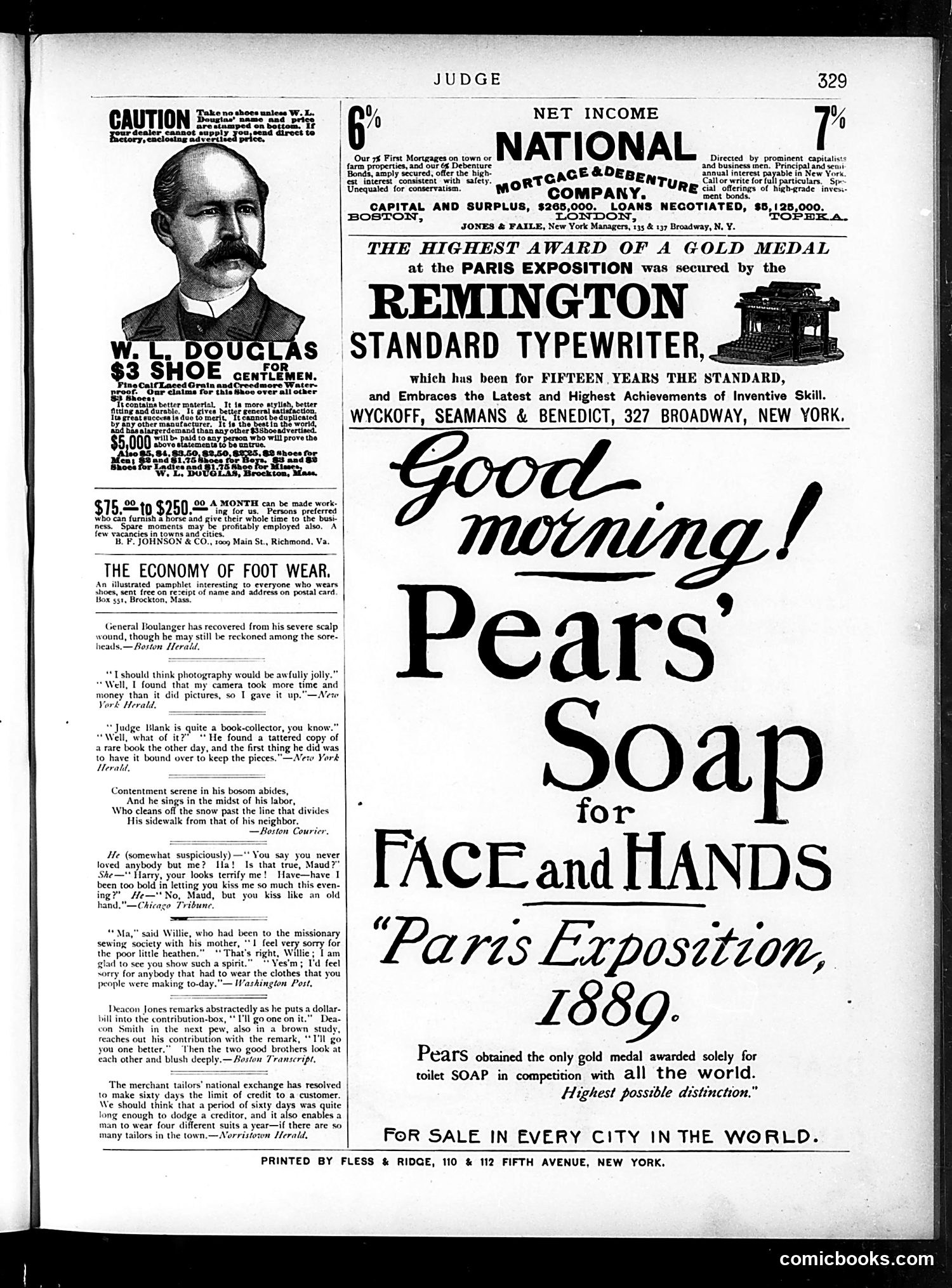
This page is primarily **advertising**, not political satire. It contains multiple commercial advertisements from the late 19th century, including: - **W.L. Douglas $3 Shoes** for gentlemen (with a portrait of the founder) - **National Mortgage & Debenture Company** financial services - **Remington Standard Typewriter** (claiming a gold medal from the 1889 Paris Exposition) - **Pears' Soap** for face and hands (prominently advertised as award-winning) - Various smaller ads for shoe pamphlets, employment opportunities, and merchant tailoring The page also contains brief **humorous snippets** typical of Judge magazine—short jokes about photography, book collecting, courtship, and tailors' credit policies—but these are filler content rather than cohesive cartoons. The Pears' Soap advertisement is the most visually dominant, emphasizing its 1889 Paris Exposition gold medal. No political figures or satirical commentary appear on this page.
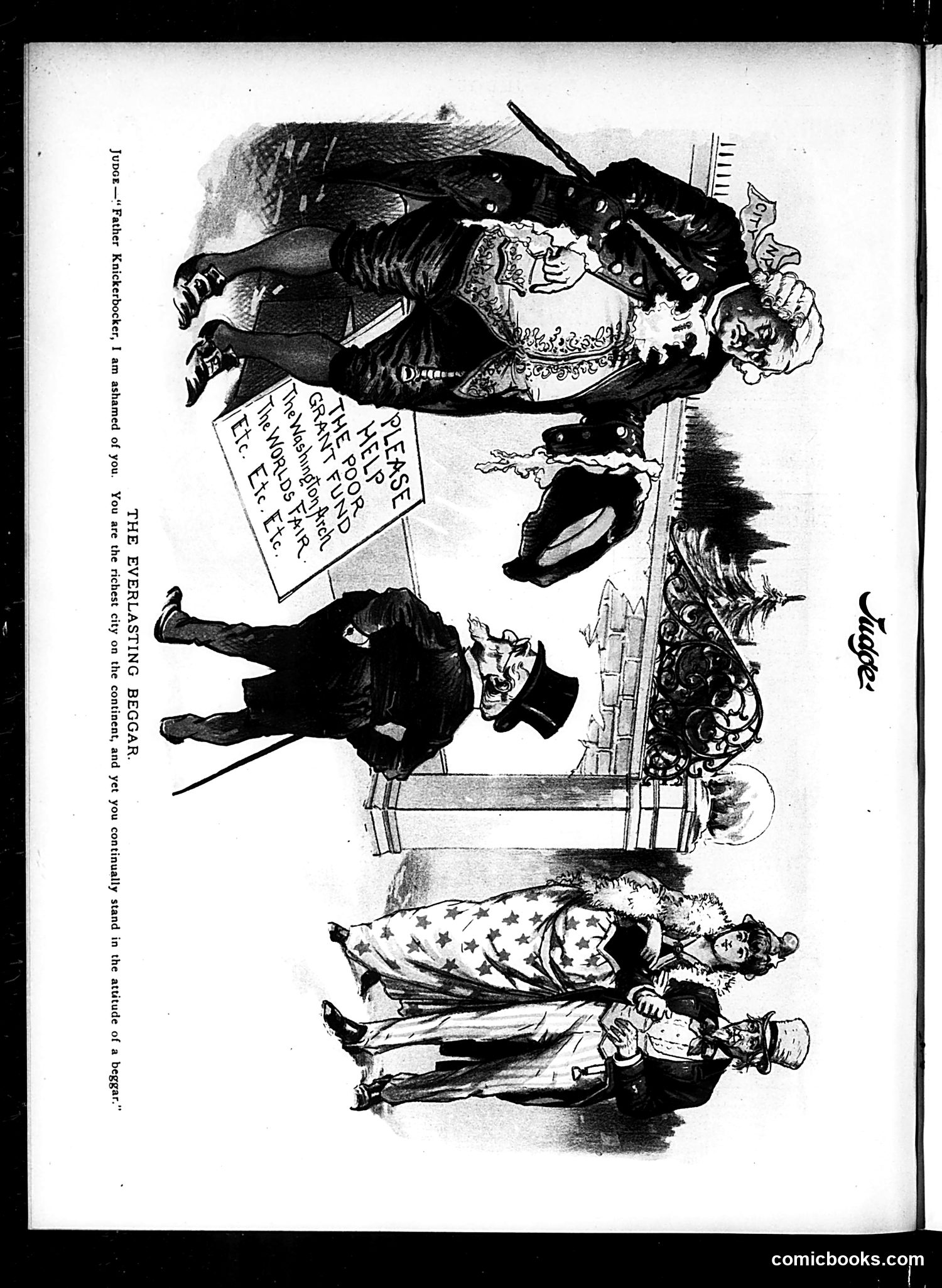
This Judge cartoon satirizes New York City (personified as "Father Knickerbocker," a traditional symbol of Manhattan) for perpetually begging for money despite being wealthy. The image shows Knickerbocker in ragged clothes, literally begging with a sign listing financial needs ("PLEASE HELP POOR..."). The satire critiques the city's chronic municipal budget crises and infrastructure funding problems—despite New York's obvious wealth and status as "the richest city on the continent," it constantly petitions citizens and the state for money. The joke is the contradiction: a powerful, wealthy metropolis positioned as a pauper, perpetually underfunded for public needs despite its resources.