
Judge, 1890-02-22 · page 5 of 16
Judge — February 22, 1890 — page 5: what you’re looking at
What you’re looking at
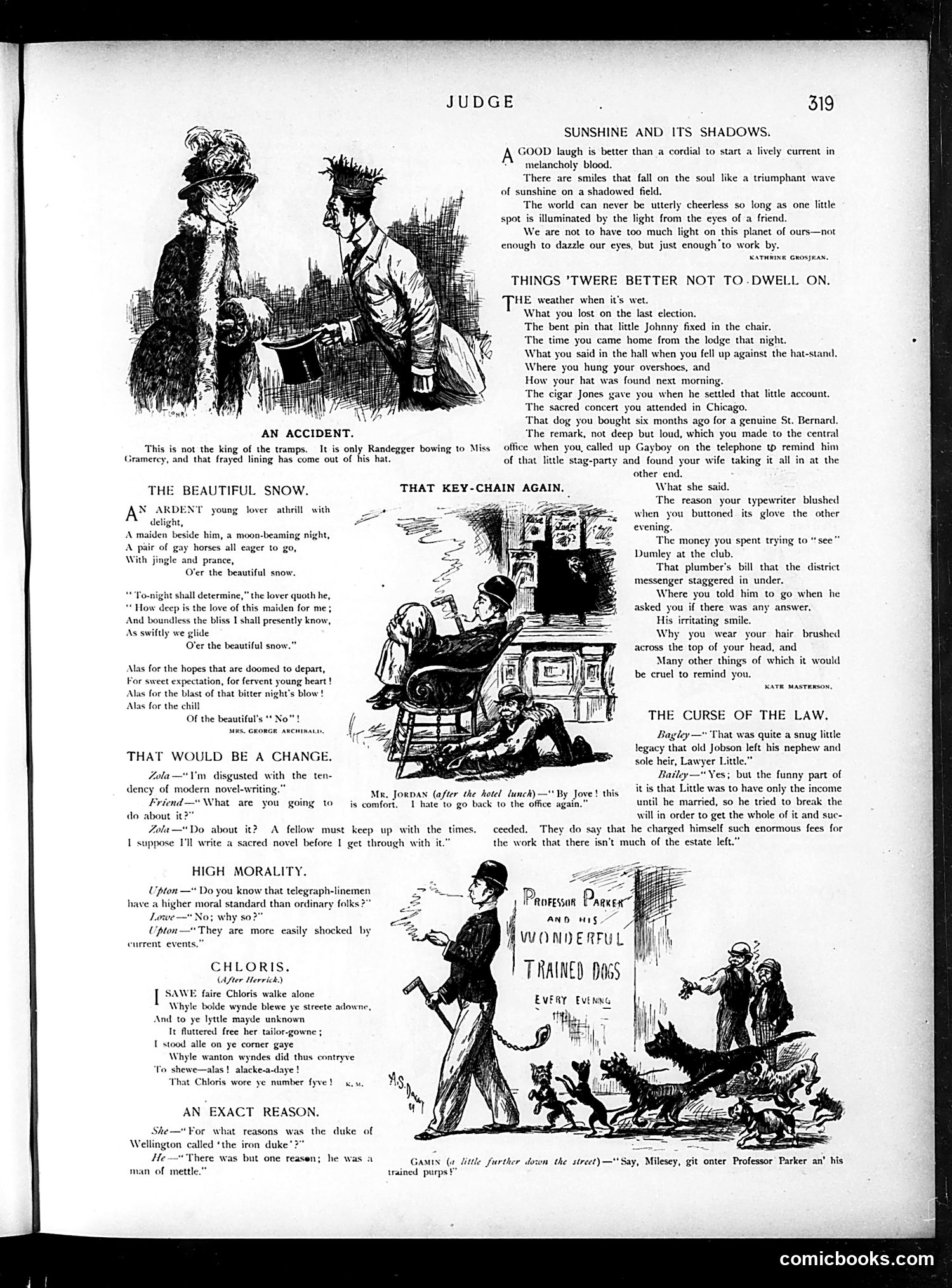
This page from *Judge* magazine contains several satirical pieces and illustrations targeting turn-of-the-century social conventions and literary trends. **"The Beautiful Snow"** mocks sentimental Victorian poetry by contrasting a young lover's romantic expectations during a snowy carriage ride with reality—his date simply refuses him. The joke: romantic literature promised passion; real life delivered rejection. **"That Would Be a Change"** references the famous naturalist novelist Émile Zola, who was known for depicting society's uglier aspects. The humor derives from Zola claiming disgust with modern novels' tendencies while preparing to write a "sacred novel"—a transparent contradiction suggesting even reformers exploit current fashions. **"High Morality"** is a pun: telegraph linemen are "more shocked by current events"—playing on "current" (electricity) versus news. **"Chloris"** parodies archaic poetic language while depicting wind revealing a woman's shoe size—deflating both pretentious verse and Victorian modesty with a practical detail. **"The Curse of the Law"** satirizes how lawyers exploit inheritance disputes, charging excessive fees that deplete estates they're supposed to protect.
📄 Transcribed text from this page (OCR, searchable)
Machine-transcribed from the original scan — historical spelling and the odd misread are preserved.
AN ACCIDENT. This is not the king of the tramps. Gramercy, and that frayed lining has come out of his hat. THE BEAUTIFUL SNOW. N ARDENT delight, young lover athrill with A maiden beside him, a moon-beaming night, A pair of gay horses all eager to go, With jingle and Orr nce, he beautiful snow. “To-night shall determine,” the lover quoth he, “How deep is the love of this maiden for me; And boundless the bliss I shall presently know, As swiftly we glide O'er the beautiful snow.” Mas for the hopes that are doomed to depart, For sweet expectation, for fervent young heart ! Alas for the blast of that bitter night's blow ! Alas for the chill Of the beautiful’s ** No”! MRS. GRORGR ARCHIBALD. THAT WOULD BE A CHANGE. Zola—"V'm disgusted with the ten- dency of modern novel-writing.” Friend—* What are do about it Zola—"VDo about it? you going to is comfort. JUDGE It is only Randegger bowing to Miss THAT KEY-CHAIN AGAIN, Mr. Jorpan (after the T hate to go b A fellow must keep up with the times. I suppose I'll write a sacred novel before I get through with it.” HIGH MORALITY. Upton — Do you know that telegraph-linemen have a higher moral standard than ordinary folks?” Lowe —* No; why so?" Upton They are more current ¢' . shocked by CHLORIS. (After Herrick) [ SAWE faire Chloris walke alone Whyle bolde wynde blewe ye streete adowne, And to ye lyttle mayde unknown It uttered free her tailor-gowne ; I stood alle on ye corner gaye Whyle wanton wyndes did thus contryve ‘To shewe—alas ! alacke-a-daye ! ‘That Chloris wore ye number fyve! x. AN EXACT REASON. She—" For what reasons Wellington called ‘the iron duke’? He—* There was but one reasen; he was a man of mettle. as the duke of GAMIN (a little further down the street)— trained purps 319 SUNSHINE AND ITS SHADOWS. A GOOD laugh is better than a cordial to start a lively current in melancholy blood. There are smiles that fall on the soul like a triumphant wave of sunshine on a shadowed field. The world can never be utterly cheerless so long as one little spot is illuminated by the light from the eyes of a friend. We are not to have too much light on this planet of ours—not enough to dazzle our eyes, but just enough'to work by. KATHIINE GROSJRAN, THINGS ’TWERE BETT THE weather when it’s wet. What you lost on the last election. The bent pin that little Johnny fixed in the chair. The time you came home from the lodge that night. What you said in the hall when you fell up against the hat-sts Where you hung your overshoes, and How your hat was found next morning. The cigar Jones gave you when he settled that little account. The sacred concert you attended in Chicago. hat dog you bought six months ago for a genuine St. Bernard. The remark, not deep but loud, which you made to the central office when you, called up Gayboy on the telephone tp remind him of that little stag-party and found your wife taking it all in at the other end. What she said. The reason your typewriter blushed when you buttoned its glove the other evening. he money you spent ti Dumley at the club. That plumber’s bill that the district messenger staggered in under. Where you told him to go when he asked you if there was any answer. His irritating smile. Why you wear your hair brushed across the top of your head, and Many other things of which it would be cruel to remind you. KATH MASTERSON, NOT TO.DWELL ON. THE CURSE OF THE LAW. Bagley —* That was quite a snug little legacy that old Jobson left his nephew and sole heir, Lawyer Little.” “Yes; but the funny part of le was to have only the income until he married, so he tried to break the will in order to get the whole of it and suc- ceeded. They do say that he charged himself such enormous fees for the work that there isn’t much of the estate left.” tel lunch) —"" By Jove! this to the office again.” AND HIS AWOMDERFUL TRAINED Doss EVERY Evening as = CaP y, Milesey, git onter Professor Parker an’ his comicbooks.com