
A complete issue · 16 pages · 1890
Judge — February 15, 1890
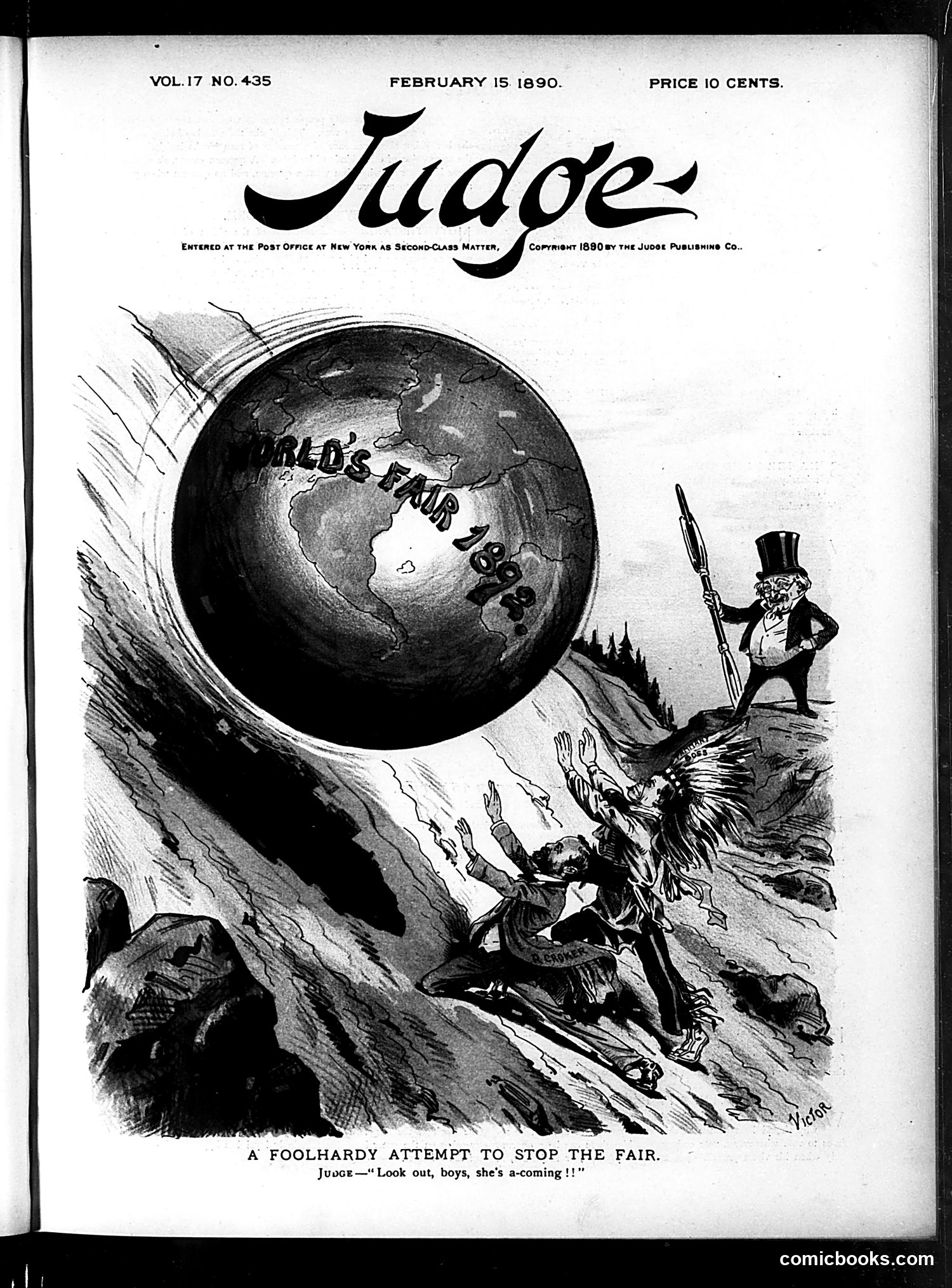
This February 1890 *Judge* cartoon satirizes opposition to the upcoming World's Columbian Exposition (Chicago's 1893 World's Fair). The massive globe labeled "WORLD'S FAIR 1893" rolls downhill like an unstoppable force, while figures below attempt futilely to halt it—one wielding a rifle, another gesturing from above in a top hat. The caption—"Look out, boys, she's a-coming!!"—treats the fair as an inevitable, feminine force of progress that cannot be stopped by protesters or critics. The cartoon mocks those opposing the fair's construction and expense as foolish and powerless against modernization. The sweeping artistic style emphasizes the fair's momentum and cultural significance.
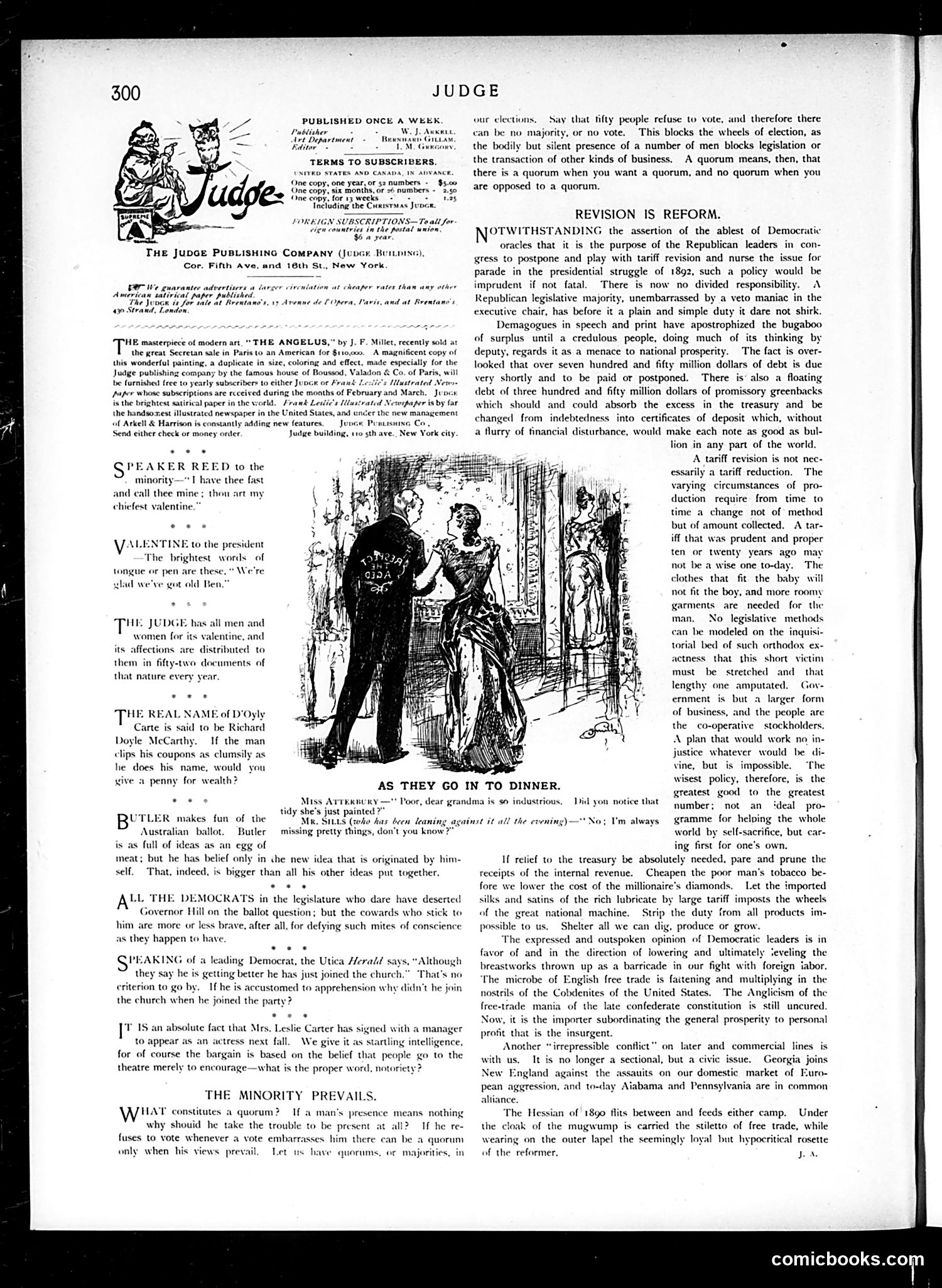
The main cartoon titled "As They Go In to Dinner" depicts a social interaction between two figures—a man in formal attire and a woman in an evening dress. The dialogue references "Miss Atterbury" and concerns whether her grandmother is "industrious," with the man claiming he's "always mighty things, you know?" The surrounding text discusses political matters including tariff revision, Democratic and Republican legislative positions, and economic policy debates of the era. References mention treasury relief, free trade, and tariffs on imported goods. Without clear identifying labels on the cartoon itself, the specific figures remain unclear. The page appears to satirize both social pretense and political economic debates typical of the Gilded Age or Progressive Era, though the exact historical moment is uncertain from this image alone.
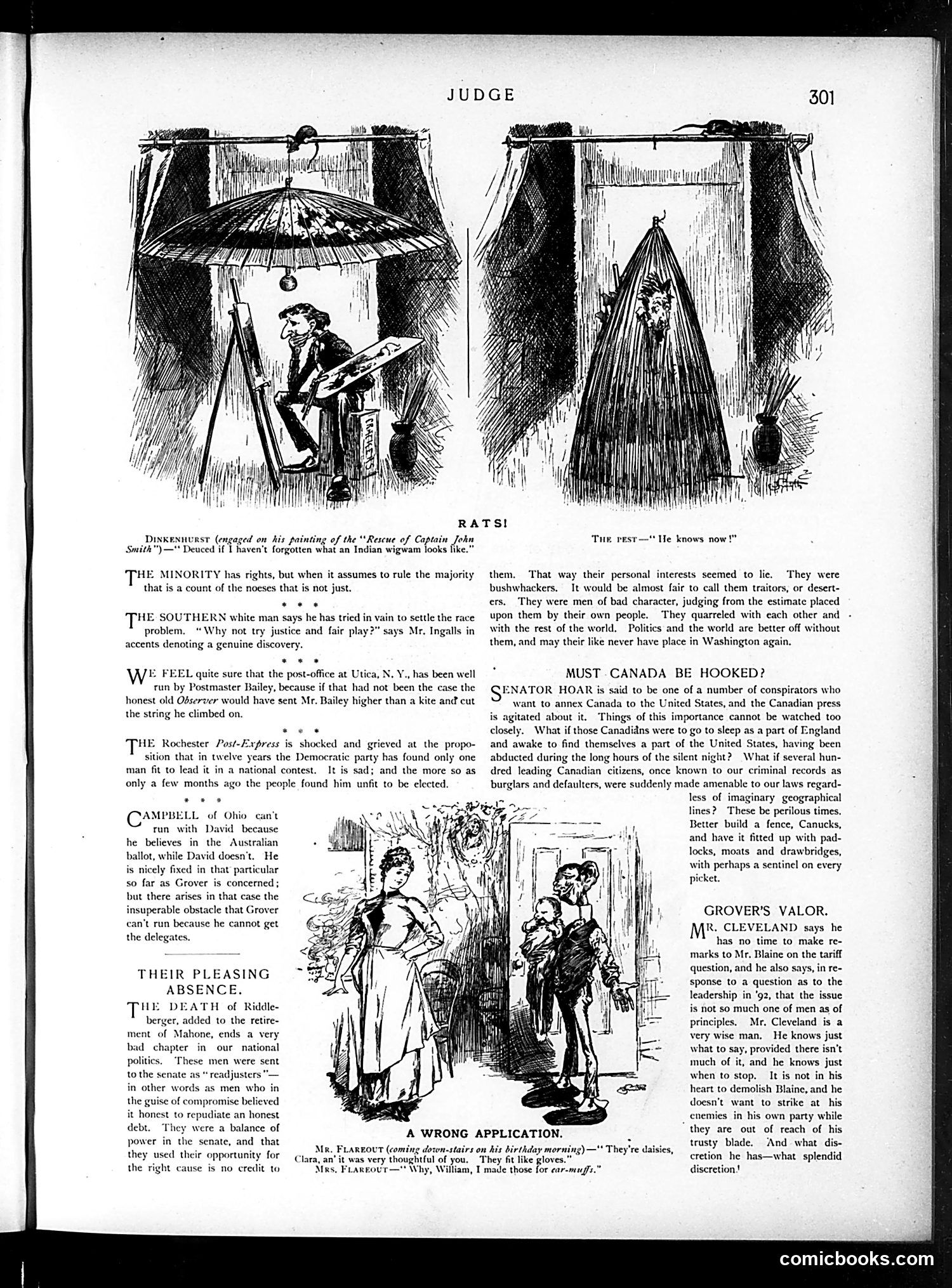
This page contains several political cartoons and commentary from Judge magazine. The top cartoons labeled "RATS!" mock political figures—one depicts "Disherust" commenting on a painting, the other shows "The Pest" with someone saying "He knows now!" The text discusses minority rights, Southern race relations, and Canadian annexation concerns. One section references the post office at Utica, N.Y., and Democratic Party failures. Another criticizes Ohio politician Campbell's views on Australian ballot systems. The lower cartoon "A Wrong Application" shows a domestic scene with dialogue about gloves and clasps, appearing to be social satire rather than political commentary. The final section "Grover's Valor" discusses Cleveland's political strategy regarding tariffs and party conflicts, praising his discretionary restraint. The overall page mixes political criticism with social humor typical of 1890s Judge magazine.
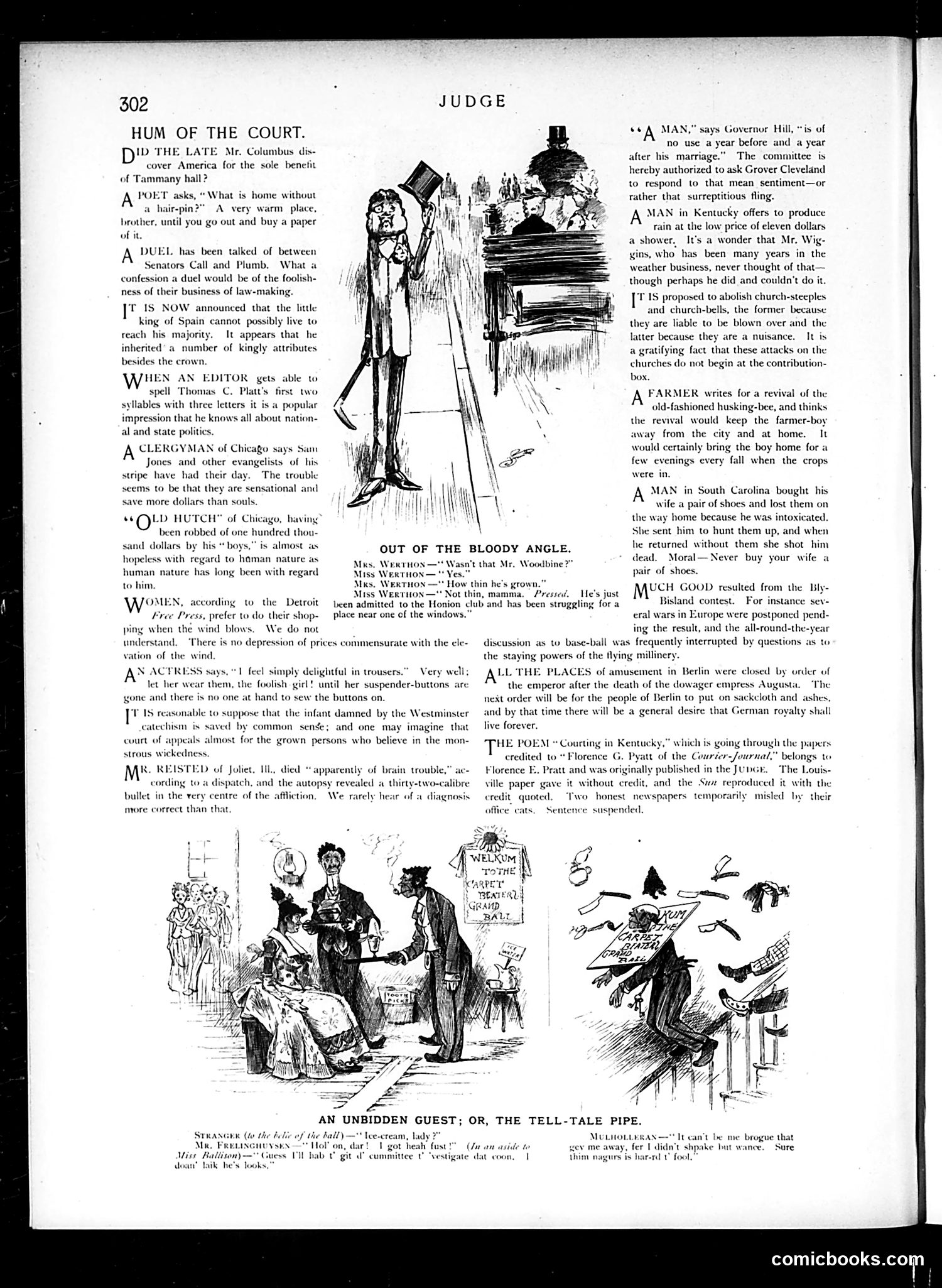
This page from *Judge* magazine contains brief satirical commentary on 1880s American politics and society, plus illustrations. Key targets include: **Political figures**: Governor Hill (likely David B. Hill of New York) is mocked for dismissive remarks about marriage; Grover Cleveland is referenced regarding his marital status (a contemporary scandal). **Tammany Hall** appears in the opening joke—a reference to New York's corrupt Democratic political machine. **Social commentary**: The satire targets evangelical preachers (Sam Jones), women's fashion choices (wearing trousers), and absurd news items (a man selling artificial rain; church steeples being too unstable). The "Out of the Bloody Angle" cartoon depicts a society gossip scene about a thin gentleman named Woodbine—"pressed" is a pun suggesting financial hardship. Overall, *Judge* functioned as a humor magazine delivering topical jabs at politicians, religious figures, and contemporary absurdities for educated urban readers.
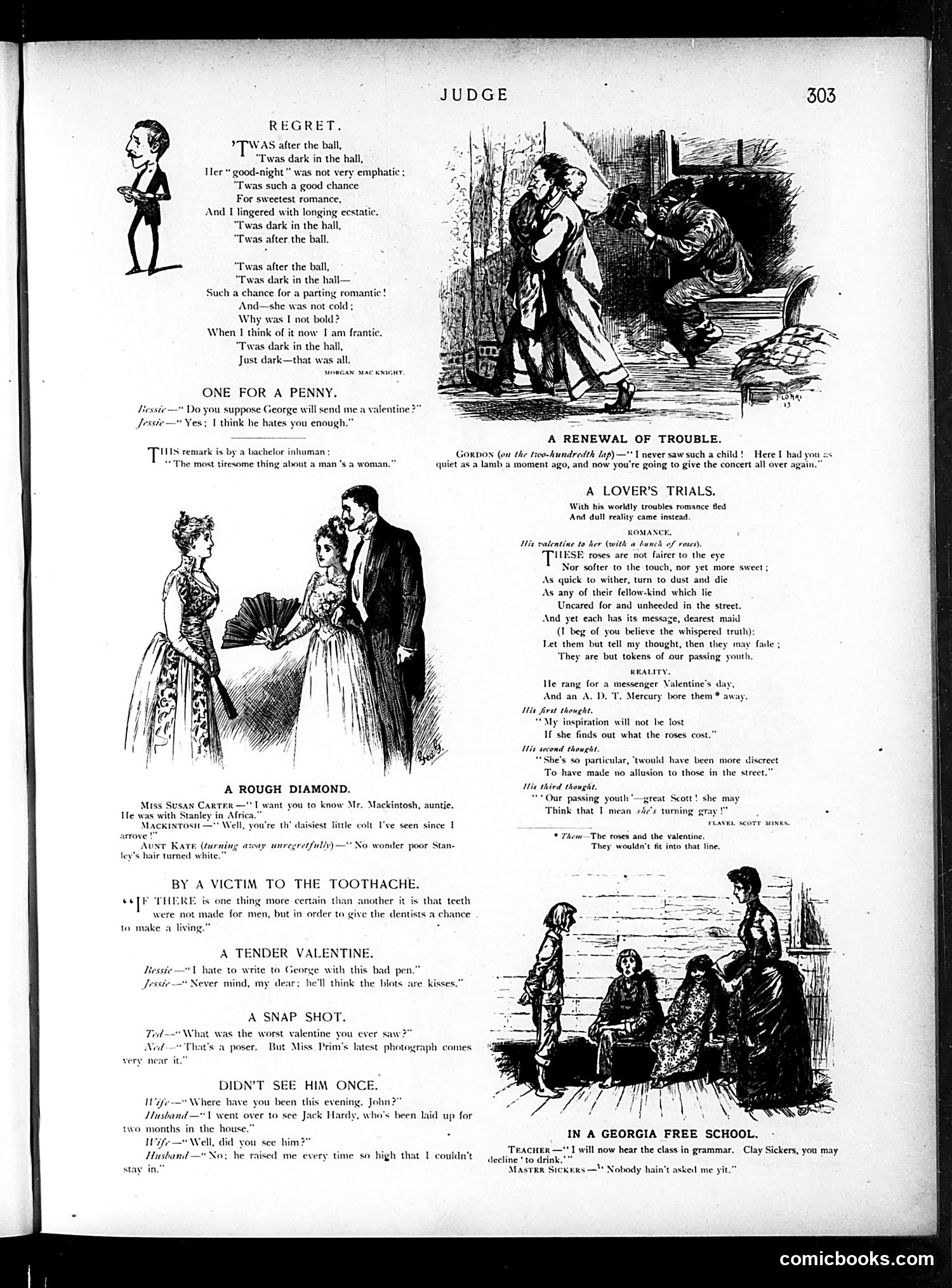
This page from Judge contains multiple short satirical pieces typical of the magazine's humor: **"Regret"** is a sentimental poem about a missed romantic opportunity in a dark hallway after a ball—poking fun at male timidity and romantic hesitation. **"A Rough Diamond"** mocks an uncouth man (Mackintosh) who traveled with the famous explorer Stanley; his crude behavior supposedly caused Stanley's hair to turn white. **"A Lover's Trials"** contrasts romantic fantasy with reality, showing how practical concerns (the cost of roses) undermine genuine sentiment. **"By a Victim to the Toothache"** is a cynical joke suggesting teeth exist primarily to benefit dentists. **"In a Georgia Free School"** appears to mock Southern rural education, portraying a student's grammatical incompetence. The cartoons mock courtship anxieties, social pretension, romantic delusion, and regional educational shortcomings—typical late-19th-century Judge fare targeting middle-class foibles and perceived Southern backwardness.
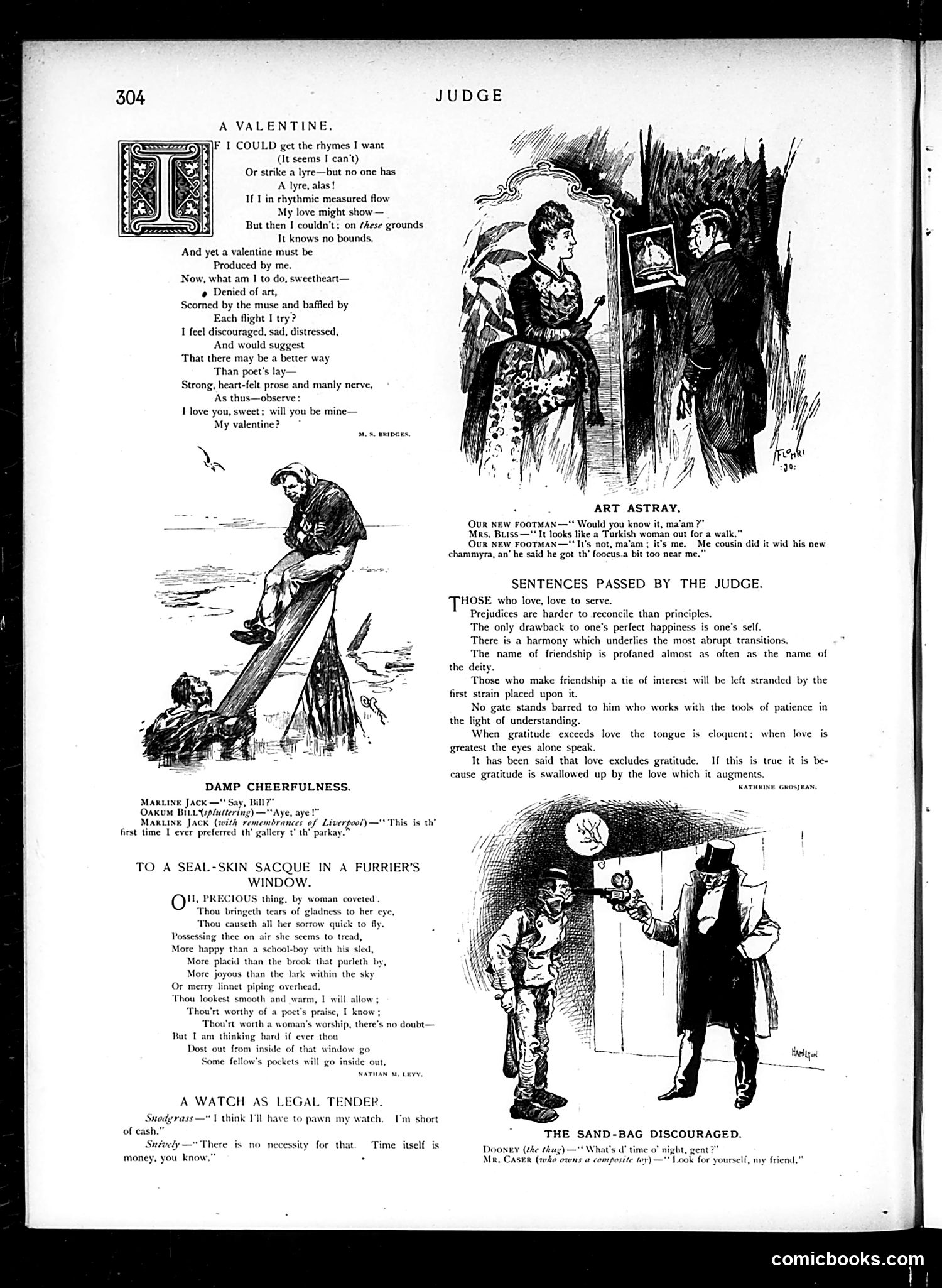
This Judge magazine page from the late 19th century contains satirical poems and cartoons on romantic and urban themes: **"A Valentine"** mocks a suitor's inability to express love poetically, humorously settling for plain, direct prose instead. **"Art Astray"** jokes about a new footman who was accidentally photographed with a camera focused too close, making him unrecognizable—the cousin's "chamois" (likely "camera") mishap resulted in a blurry image resembling "a Turkish woman." **"Damp Cheerfulness"** features sailors in rough conditions preferring the ship's gallery to shore leave—gallows humor about maritime life. **"To a Seal-Skin Sacque"** satirizes women's desire for expensive fur coats by suggesting the purchase will empty men's wallets ("pockets will go inside out"). **"A Watch as Legal Tender"** plays on pawn-shop desperation during financial hardship. **"The Sand-Bag Discouraged"** depicts a mugger thwarted by a victim who turns the tables—early urban crime satire. The page exemplifies Judge's blend of domestic comedy, social observation, and working-class humor.
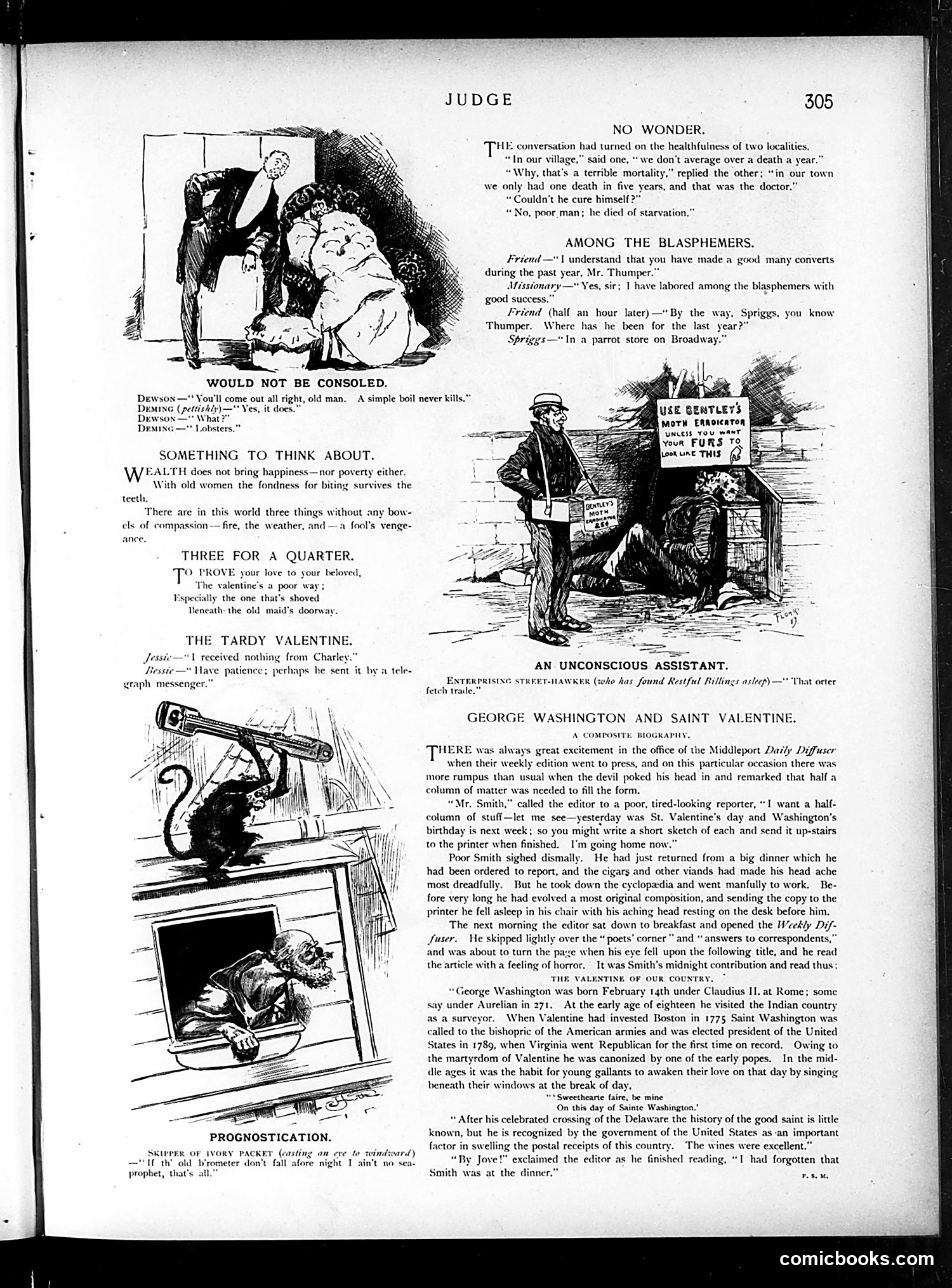
This page contains several humorous short pieces typical of Judge's satirical humor, plus one longer comedic narrative. The cartoons mock everyday absurdities: a doctor so poor he starves (ironic commentary on medical profession earnings); a missionary who claims many "converts among blasphemers" but was actually working in a parrot store (suggesting his converts were parrots—mocking religious conversion claims); and a street hawker using a sleeping vagrant as an advertisement display. The main story satirizes newspaper production deadlines. A tired reporter, assigned to write about both George Washington and Saint Valentine, falls asleep at his desk. His accidental manuscript hilariously conflates the two figures—crediting Washington with Valentine's biography, mixing dates and events absurdly. The editor's horror upon reading this garbled composite biography is the joke's payoff. The satire targets both journalistic carelessness and the mechanical nature of deadline-driven newspaper work that produces nonsense when reporters are exhausted.
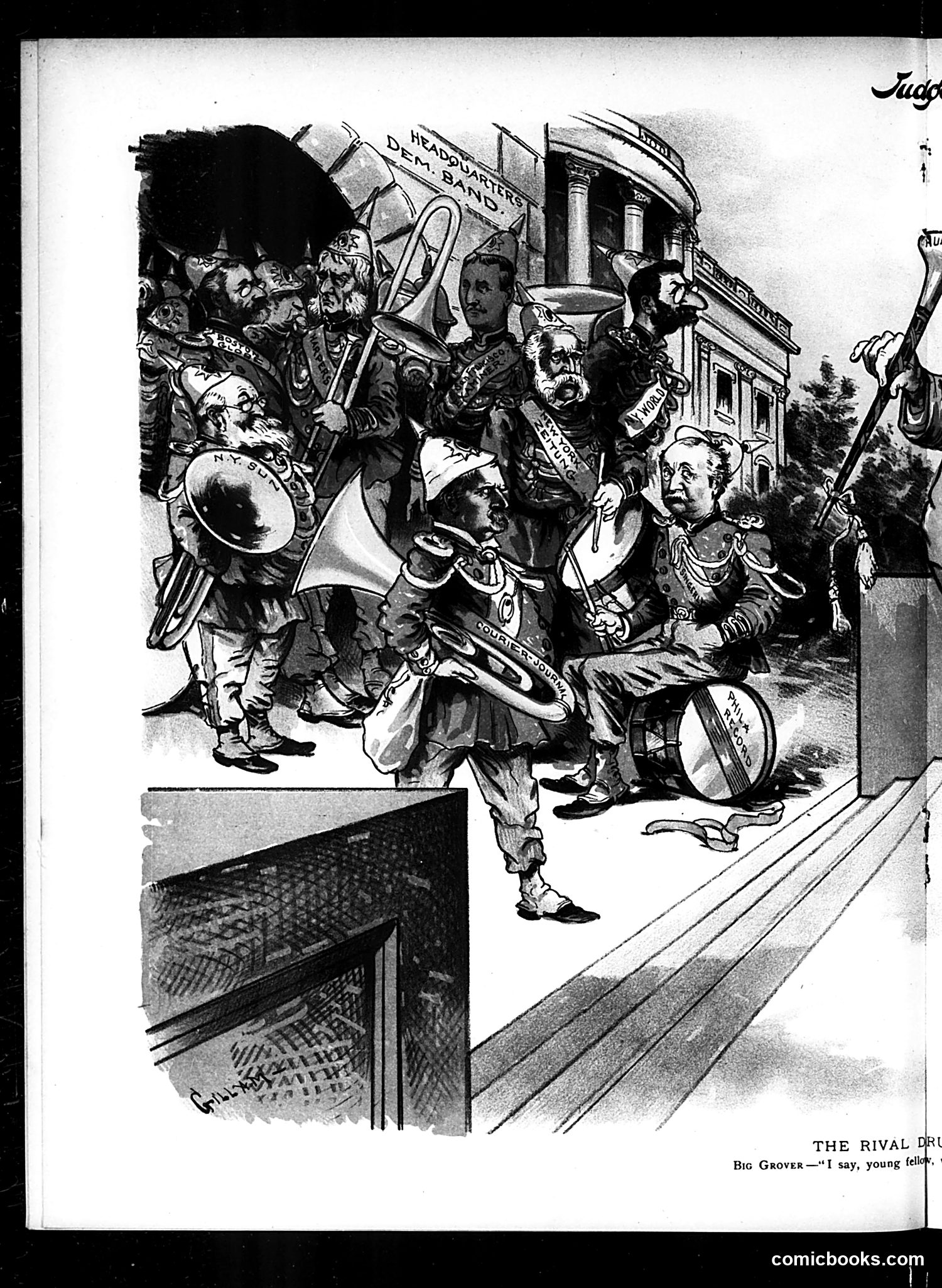
This political cartoon depicts a military band scene centered on a confrontation between two drum majors or conductors. The figure in the foreground (labeled "Big Grover," appearing to be Grover Cleveland) commands a bass drum while facing off against military and political figures in ornate uniforms behind him. The "headquarters" and "band" signage suggests institutional or governmental authority. The satire appears to mock rival political or military leadership competing for control or supremacy—a "rival drummers" metaphor for competing powers or factions. The elaborate uniforms and caricatured features are typical of Judge's late 19th-century political commentary style. Without the full page context or date, the specific historical event or political rivalry referenced remains unclear, though Cleveland's prominent positioning suggests this addresses a significant contemporary political conflict.
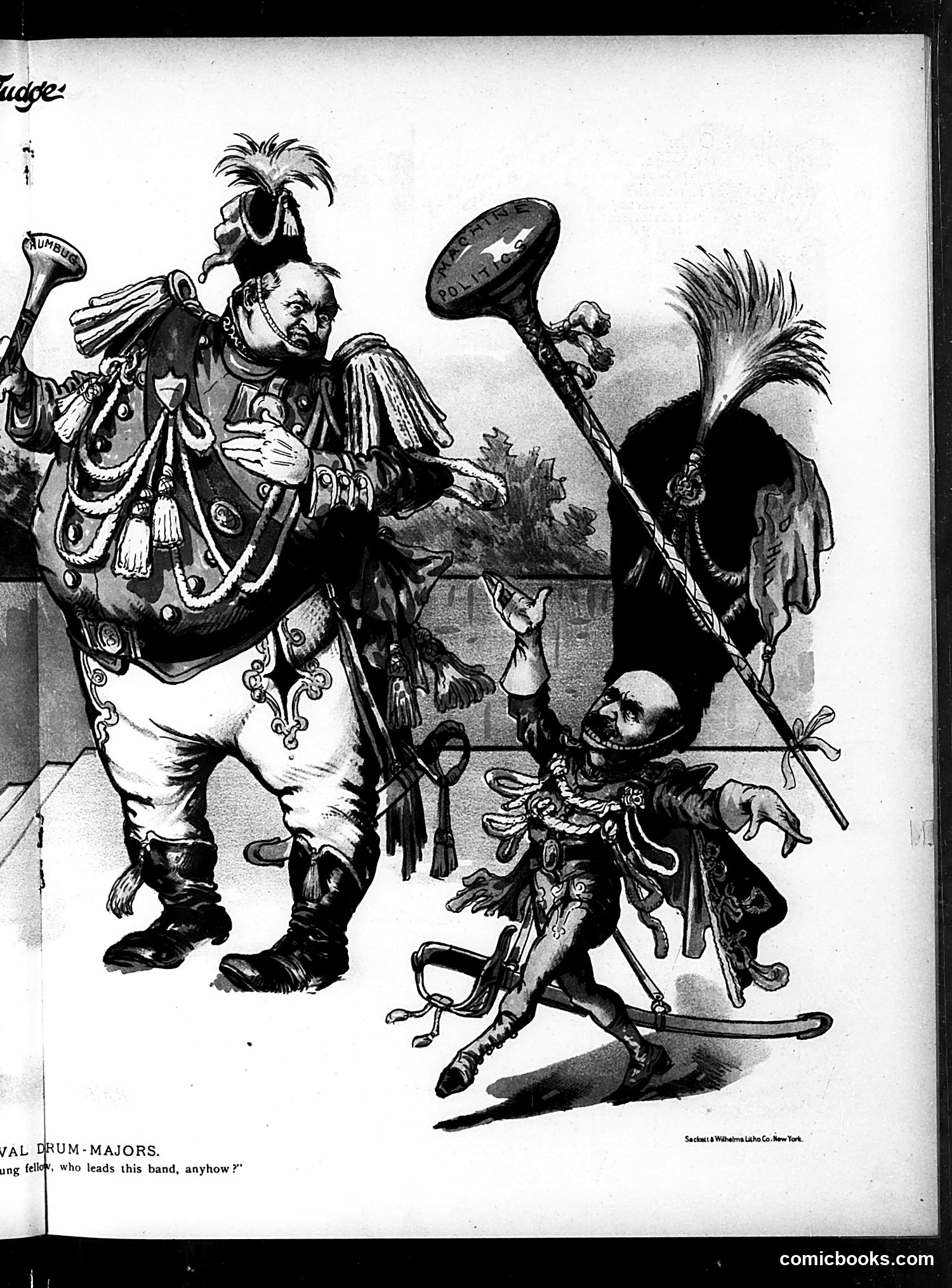
This satirical cartoon depicts two figures in military regalia competing for leadership of a naval "band." The larger figure on the left, adorned with elaborate decorative insignia and holding a mallet, appears to be a high-ranking naval officer or politician. The smaller, more grotesque figure on the right wields a conductor's baton, suggesting a rival claimant to authority. The caption—"Now, who leads this band, anyhow?"—indicates a power struggle or disputed leadership. Without additional context indicating the specific date or figures involved, it likely satirizes a contemporary naval or political dispute over command authority. The exaggerated costumes and caricatured style emphasize the absurdity of the rivalry, typical of Judge magazine's approach to mocking institutional conflicts and ego-driven competition.
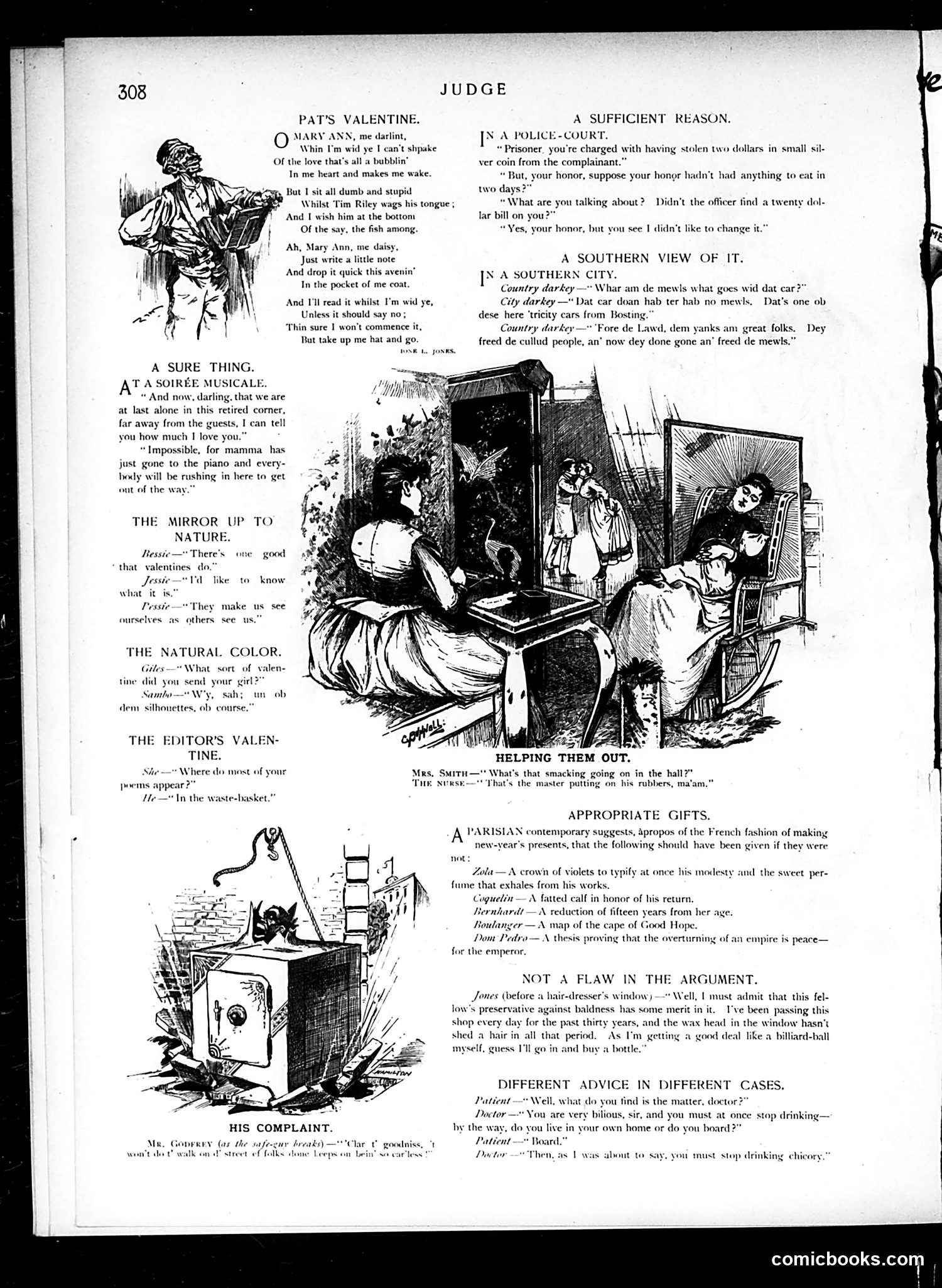
This page contains multiple short humorous pieces typical of 1890s satirical magazines: **"Pat's Valentine"** depicts an Irish immigrant (indicated by dialect) unable to express his love eloquently, proposing his girlfriend write him a note instead—poking fun at working-class Irish characters common in period American humor. **"A Sufficient Reason"** satirizes a police-court defendant caught with a $20 bill after stealing $2, claiming he "didn't like to change it"—absurd logic mocking petty criminals. **"A Southern View of It"** uses exaggerated dialect to joke about the South's wonder at electric streetcars, with freed Black characters praising Yankees for both freeing enslaved people and now "freeing mules" from labor. The humor targets Southern unfamiliarity with modern technology. **Minor sketches** include romance, Valentine's Day themes, and observations about human nature—standard Judge fare. The page reflects period attitudes: Irish and Black vernacular stereotypes presented as inherently comic, condescension toward rural/Southern ignorance, and gentle mockery of courtship rituals.
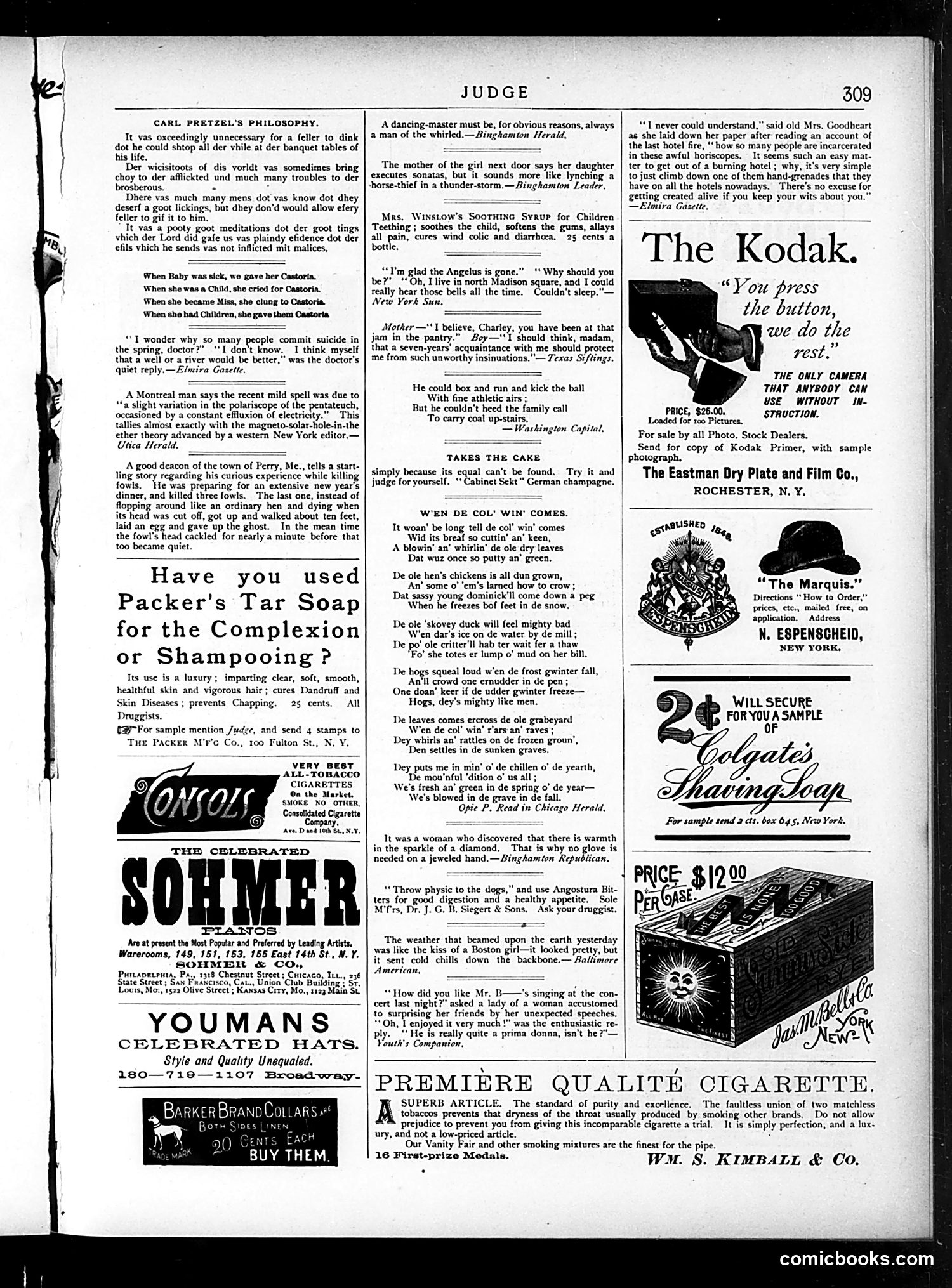
This page from *Judge* (a late 19th-century American satirical magazine) is primarily **advertising with brief humorous filler content**, not political cartoons. The page features: **"Carl Pretzel's Philosophy"**: A recurring dialect-humor column using exaggerated German-immigrant speech ("shtop," "vhile") to deliver folksy observations about life's troubles and pleasures. This reflects the era's common reliance on ethnic caricature for comedy. **Short jokes and quips**: Scattered one-liners on marriage, spring suicides, and provincial oddities—typical filler material mocking rural life and relationships. **Advertisements**: The bulk of the page advertises consumer goods (Packer's Tar Soap, Sohmer Pianos, Youmans Hats, Kodak cameras), reflecting *Judge*'s business model. **No significant political content**: Unlike some *Judge* issues, this page contains no editorial cartoons or topical satire targeting politicians or major events. The page's humor relies heavily on ethnic stereotyping and domestic comedy now considered dated or offensive.
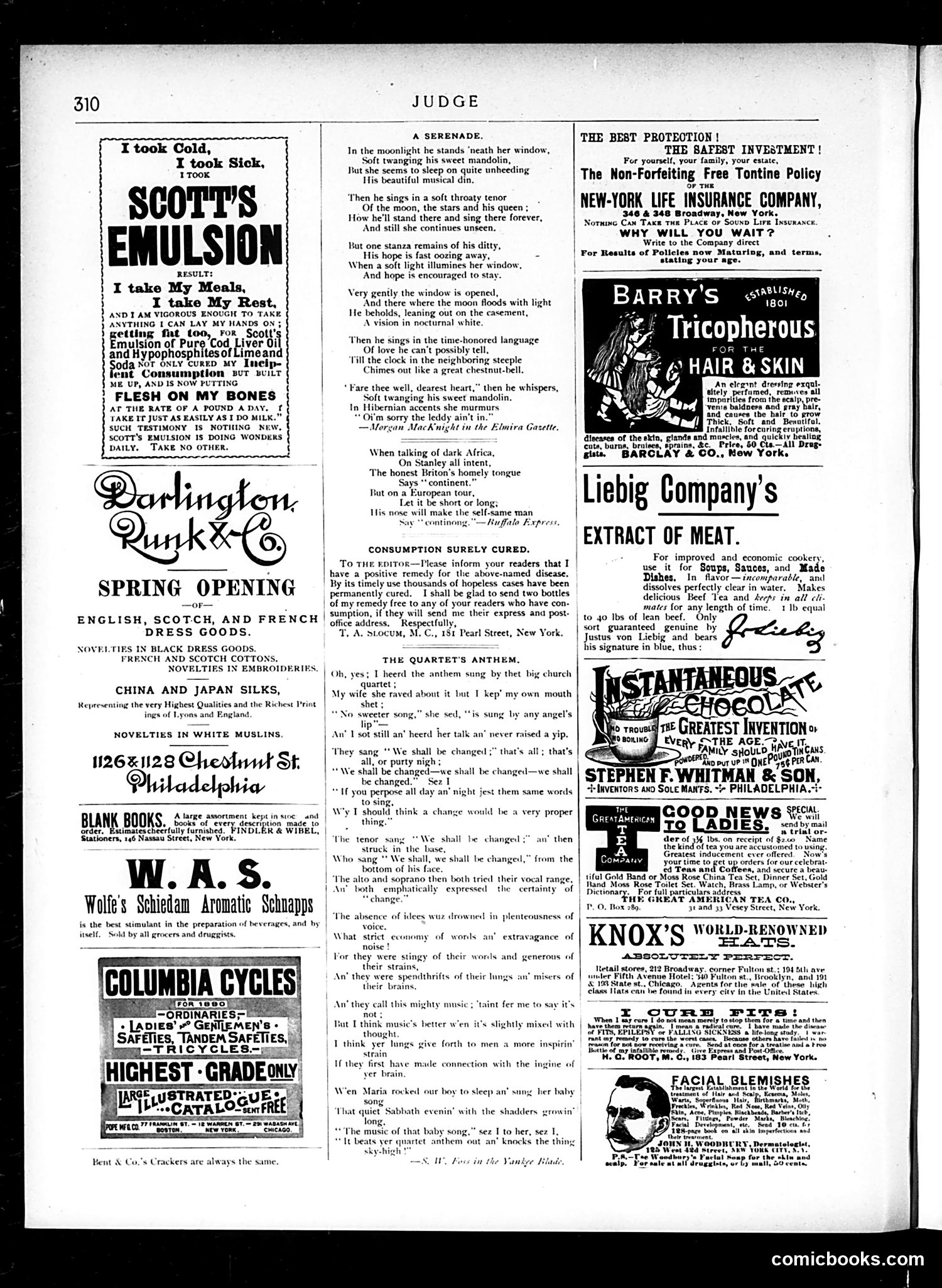
This page is primarily **advertising with light satirical content**. The main illustrated piece is "A Serenade"—a humorous poem by Morgan McKnight about a romantic serenade with an ironic twist: the woman answering the window is an Irish servant ("Oi'm sorry the leddy ain't in"), deflating the romantic fantasy. Below appears "The Quartet's Anthem," a dialect comedy piece mocking church singers who repetitively belt out "We shall be changed" with excessive vocal effort and minimal lyrical variation—satire of overwrought religious music performances. The page is dominated by **period advertisements** for Scott's Emulsion (cod liver oil tonic), insurance, hair products, and other goods typical of late-19th-century magazines. These ads use testimonials and dubious medical claims common to the era. The satire targets **working-class characters** (Irish servants, overzealous church singers) and promotes consumer products with exaggerated health promises—reflecting Judge's mix of social humor and commercial interests.
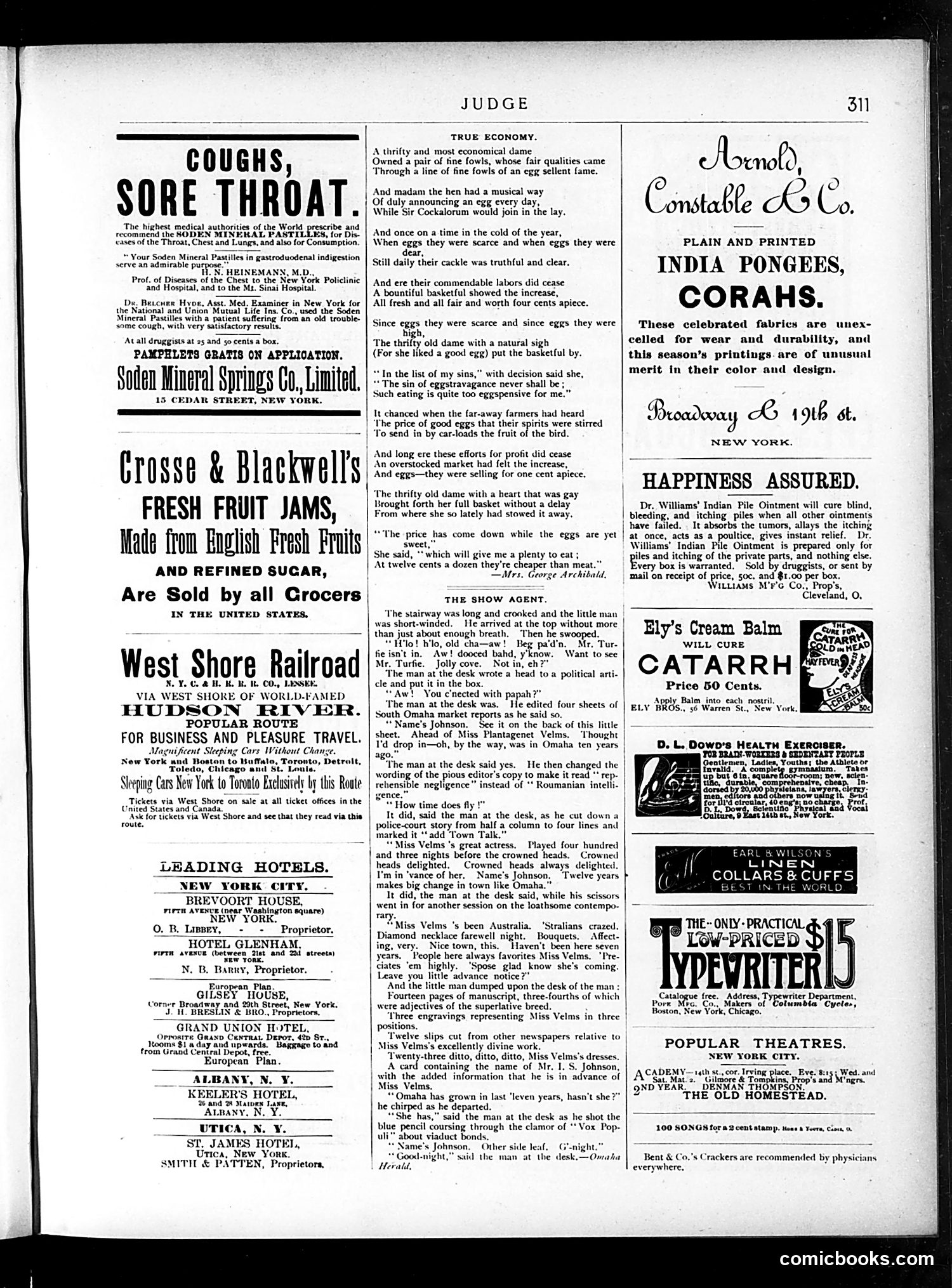
This page is primarily advertisements with one humorous poem in the center column titled "TRUE ECONOMY." The poem mocks speculative hoarding during price fluctuations. A thrifty woman owns hens producing abundant eggs. When eggs become scarce and expensive, she hoardsher full basket, refusing to eat them as "eggspensive." Once farmers flood the market and prices crash to one cent per dozen, she triumphantly retrieves her stored eggs, declaring them now "cheaper than meat." The satire targets miserly economics and market manipulation: the woman's self-denial during scarcity seems virtuous but proves foolish when abundance arrives. The heavy egg puns ("eggstravagance," "eggspensive") underscore the joke's lightweight nature—it's gentle mockery of penny-pinching logic rather than serious social criticism. The humor relies on the audience understanding commodity price cycles and human irrationality regarding consumption.
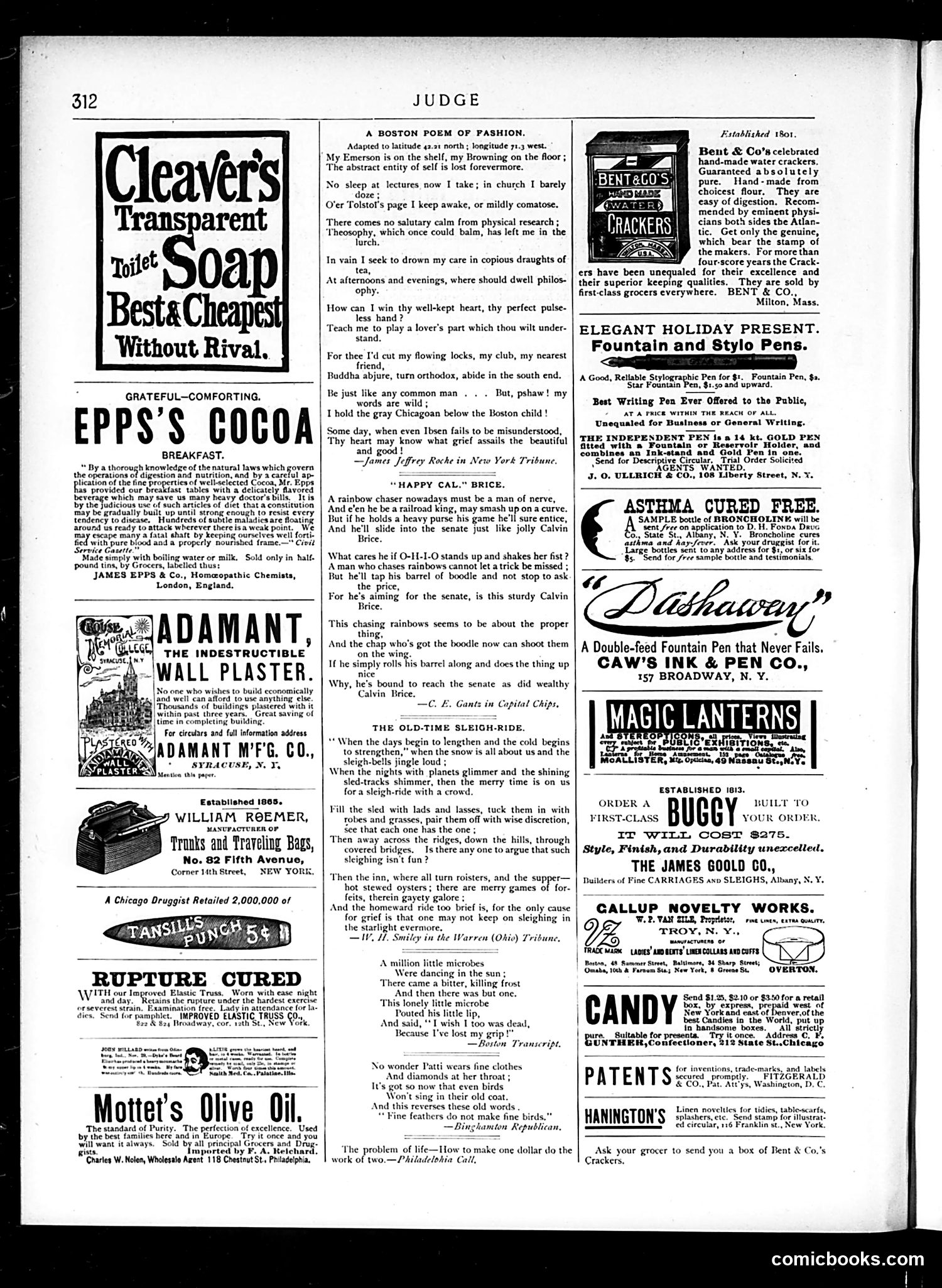
This page contains a satirical poem mocking **Calvin Stewart Brice**, an Ohio railroad magnate and Republican politician of the 1890s. The poem attacks Brice's pursuit of a U.S. Senate seat through wealth and corruption rather than merit or principle. The satire works through repeated metaphors: Brice is a "rainbow chaser" (ambitious schemer) who uses his "barrel of boodle" (slush fund of money) to buy political influence, disregarding Ohio's protests ("O-H-I-O stands up and shakes her fist"). The poem ridicules how a wealthy industrialist can simply slide into the Senate by "tapping his barrel"—suggesting that money, not character or constituents' wishes, determines political outcomes. This reflects late-19th-century Gilded Age anxieties about wealthy robber barons literally purchasing political power. The tone is one of cynical disgust at openly transactional politics.
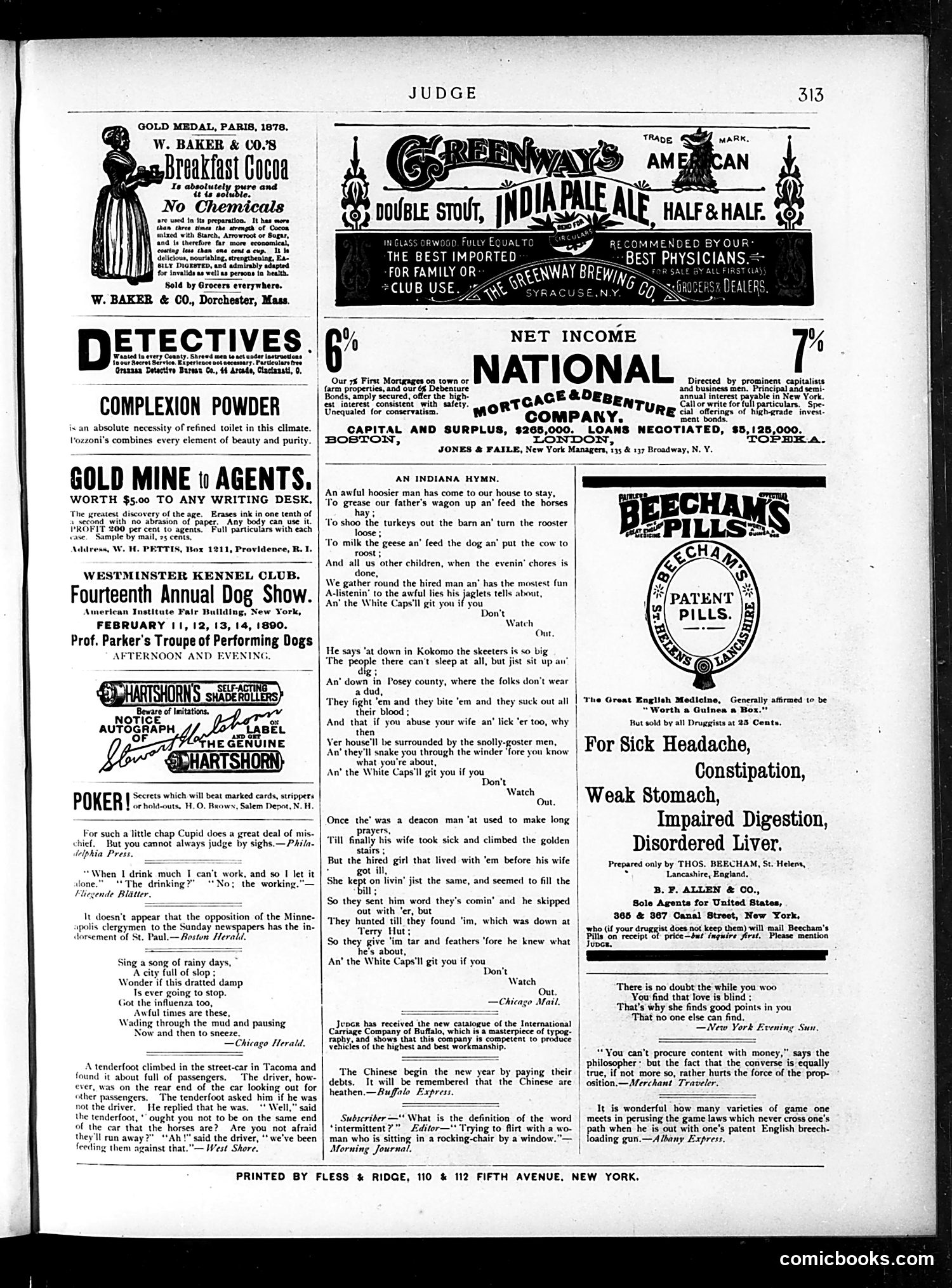
This page is primarily **advertising**, typical of late 19th-century magazines. It contains product ads (cocoa, beer, complexion powder, dog shows) interspersed with brief humorous items and jokes. The main satirical content is "An Indiana Hymn"—a rural dialect poem mocking Midwestern (specifically Indiana) speech and culture. It depicts an unsophisticated farmhand entertaining children with tall tales and superstitions (references to "White Caps"—likely the vigilante group). The humor relies on exaggerated dialect ("hoosier," "an'," "mostest") to portray rural Hoosiers as uneducated and credulous. Other brief jokes mock minor social irritants: clergymen opposing Sunday newspapers, city dampness and influenza, a naive tenderfoot's confusion about street-car etiquette, and marital discord. The humor is gentle, observational rather than biting. The page reflects Judge's typical late-1800s sensibility: mocking rural/ethnic populations and everyday annoyances for urban middle-class readers.
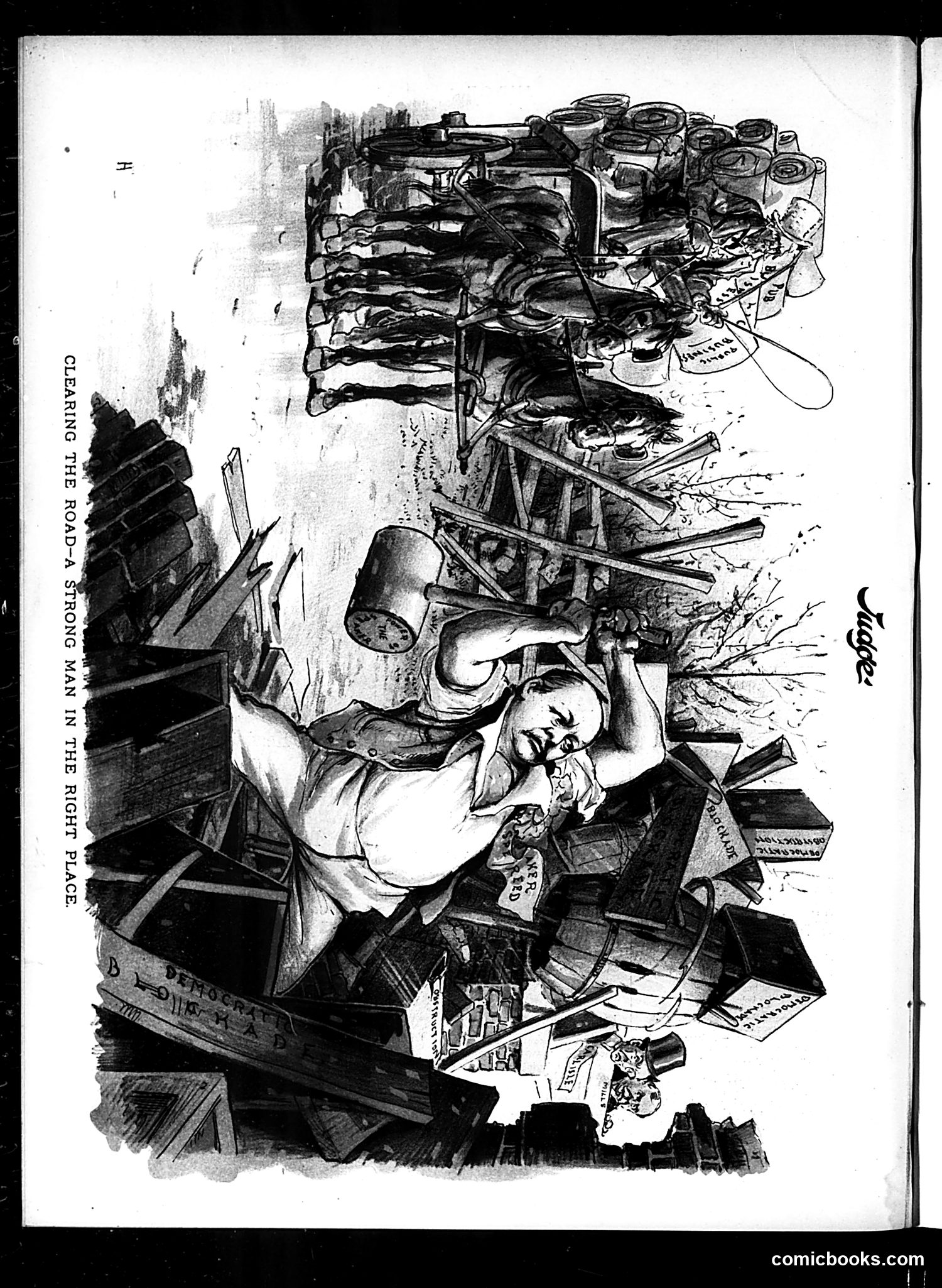
The OCR text is largely corrupted/unreadable, but the image shows a satirical cartoon rotated 90 degrees. It depicts a portly figure surrounded by numerous bottles and jars, with various food items and debris scattered about. The figure appears to be in a state of excess or gluttony. Based on the visual composition and Judge magazine's style, this likely satirizes overconsumption, possibly of alcohol or food products during Prohibition-era America. The abundance of labeled containers suggests commentary on either black-market goods or commercial excess. However, without legible text identifying specific figures or clear historical references visible in the image itself, I cannot definitively state whom this caricatures or what exact political/social issue it targets. The artistic style and setting suggest early 20th-century American social commentary.