
A complete issue · 16 pages · 1890
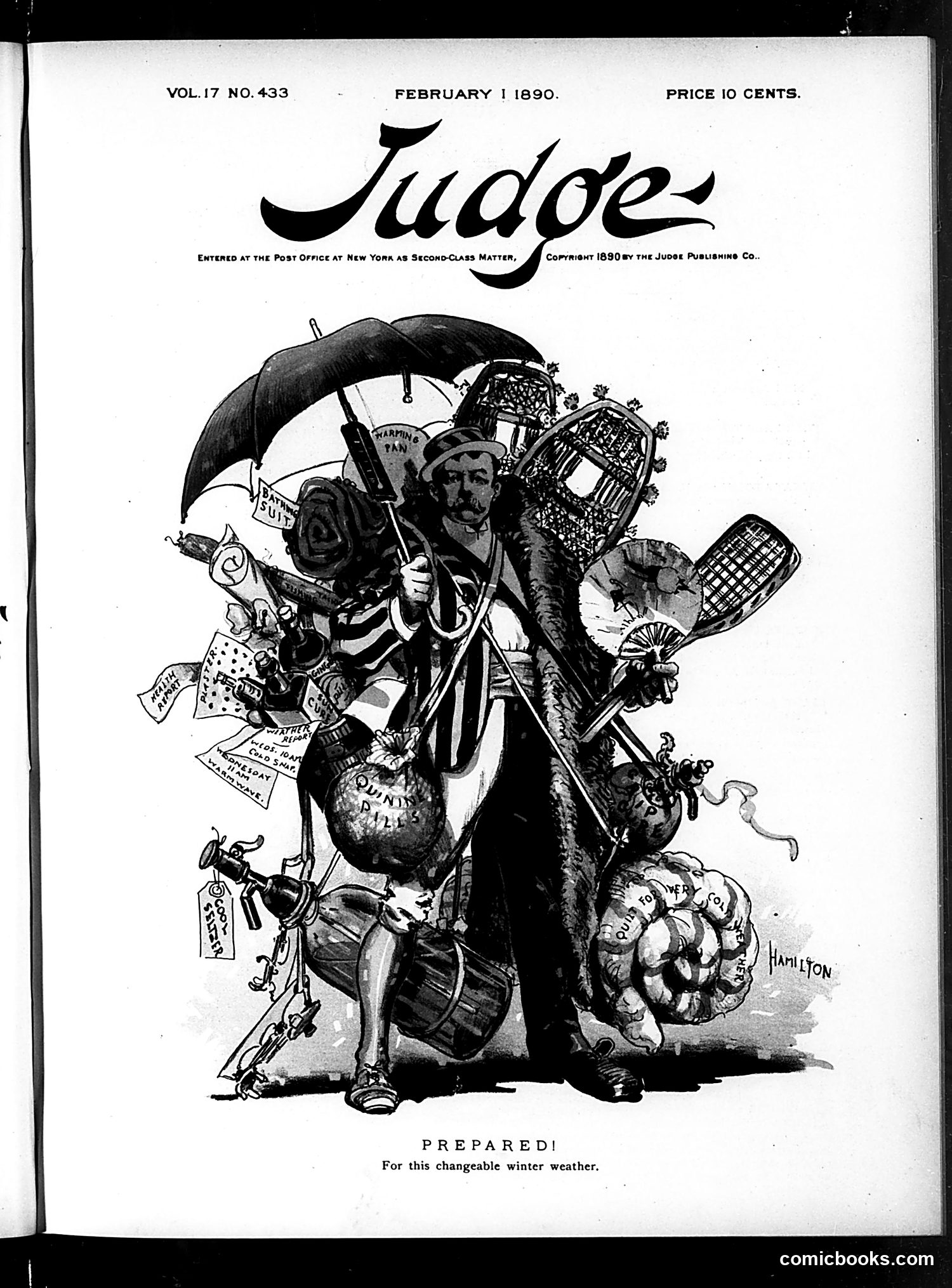
Judge — February 1, 1890
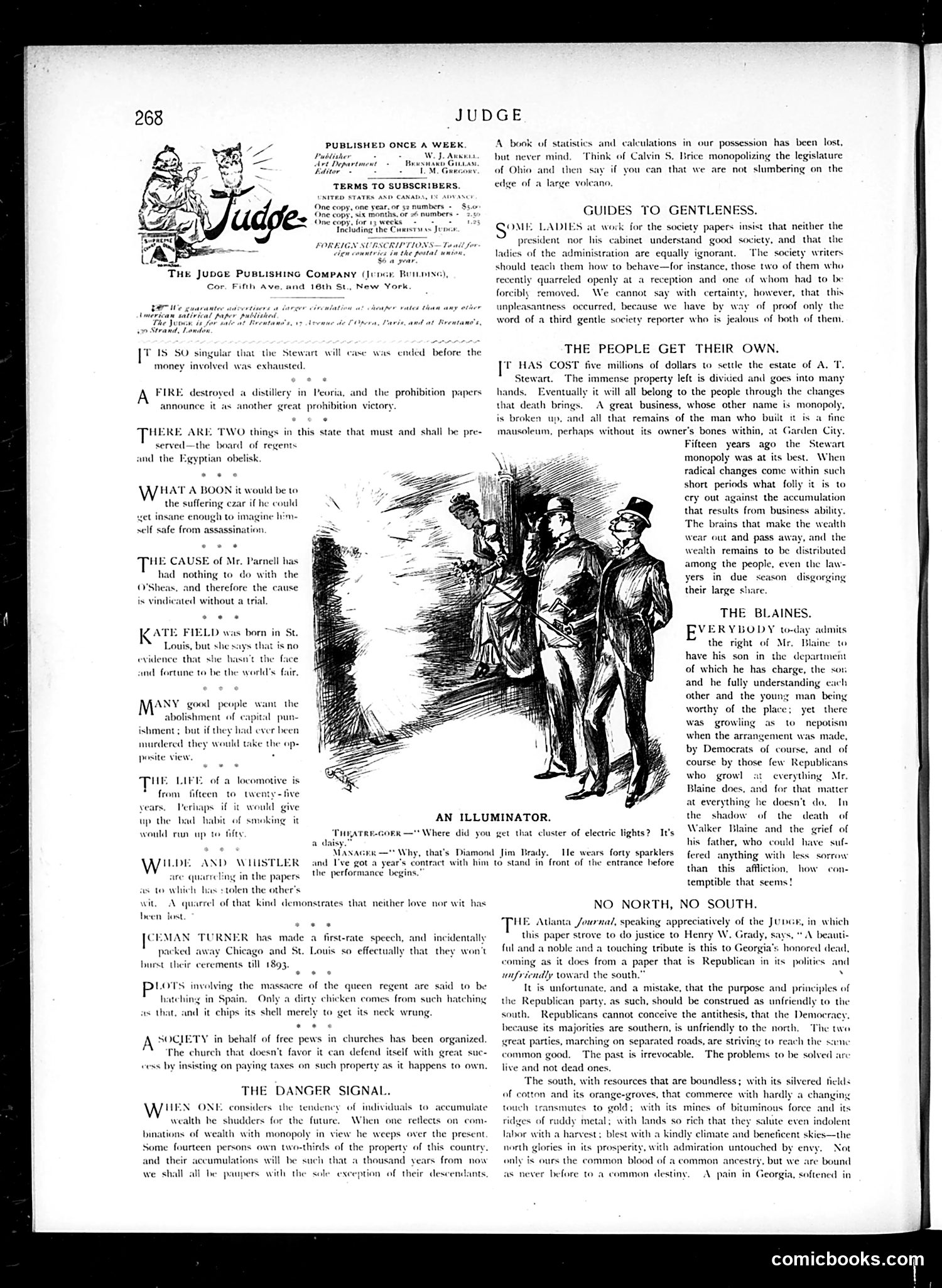
This page contains several brief satirical commentary pieces rather than a single cartoon. The main illustration shows what appears to be three men in period dress having a conversation, captioned "AN ILLUMINATOR." The text pieces mock various contemporary figures and issues: - "Guides to Gentleness" criticizes society women's ignorance about administration - "The People Get Their Own" discusses A.T. Stewart's estate settlement - "The Blaines" references the Blaine family's political prominence and wealth - "No North, No South" critiques Republican hypocrisy regarding southern politics The specific historical references (Stewart's estate, the Blaines, Republican southern policy) date this to the 1880s-1890s era. Without clearer identification of the illustrated figures, I cannot definitively name them, though the context suggests prominent political or business figures of that period.
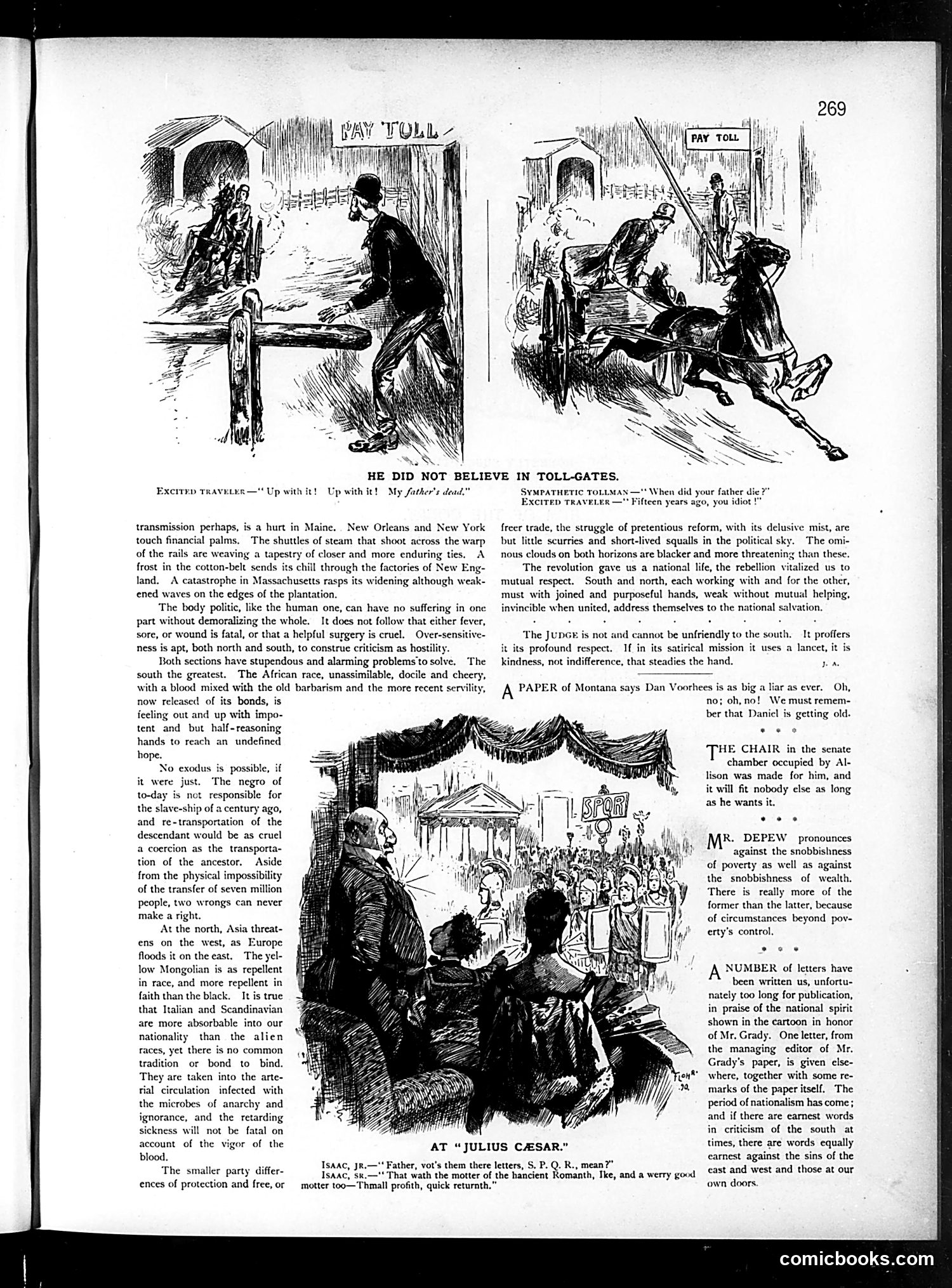
This page contains three satirical cartoons addressing post-Civil War American divisions and Reconstruction-era politics. **"He Did Not Believe in Toll-Gates"** (top): Shows a traveler refusing to pay tolls, satirizing resistance to financial obligations or taxes. **"At Julius Caesar"** (bottom): Depicts a Senate scene referencing Shakespeare's *Julius Caesar*. The caption jokes about letters and political intrigue, likely satirizing contemporary congressional disputes or political backstabbing during Reconstruction. The accompanying editorial text criticizes both North and South for mutual hostility post-war, argues against excessive sectionalism, and defends satirical journalism's role in addressing national problems. It also mentions Dan Voorhees (likely a political figure) and discusses "Grady" (possibly Henry Grady, advocate of the "New South"). The overall message: America must move beyond regional antagonism toward national unity.
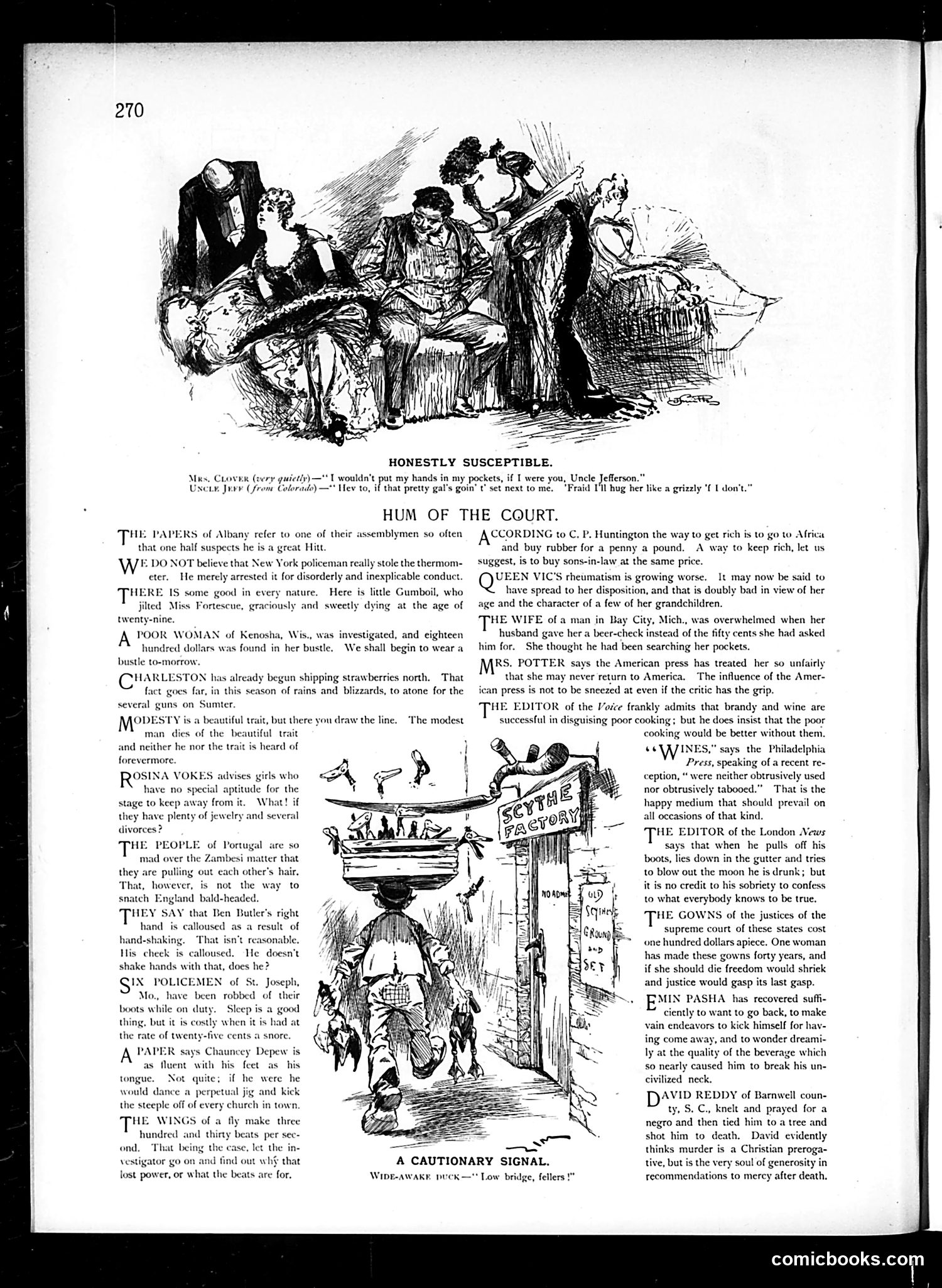
This page from Judge magazine contains satirical short items ("Hum of the Court") mocking contemporary public figures and social absurdities, plus one cartoon at top. **The cartoon "Honestly Susceptible"** depicts a flirtation between Mrs. Cloven and Uncle Jeff from Colorado. The joke: Uncle Jeff fears he'll hug the attractive woman "like a grizzly" if given the chance—satirizing male susceptibility to pretty women. **The text items** are brief satirical jabs at 1880s-90s figures and news: - Albany politician gossip - Ben Butler's "calloused" hands (suggesting corruption, not honest labor) - Queen Victoria's worsening rheumatism and disposition - C.P. Huntington's wealth-building advice (the railroad magnate) - References to Portugal's Zambesi colonial dispute - An apparent reference to a woman (likely an actress) complaining American press treated her unfairly The humor relies on topical references now obscure. The overall tone is genteel ridicule of the powerful, wealthy, and foolish.
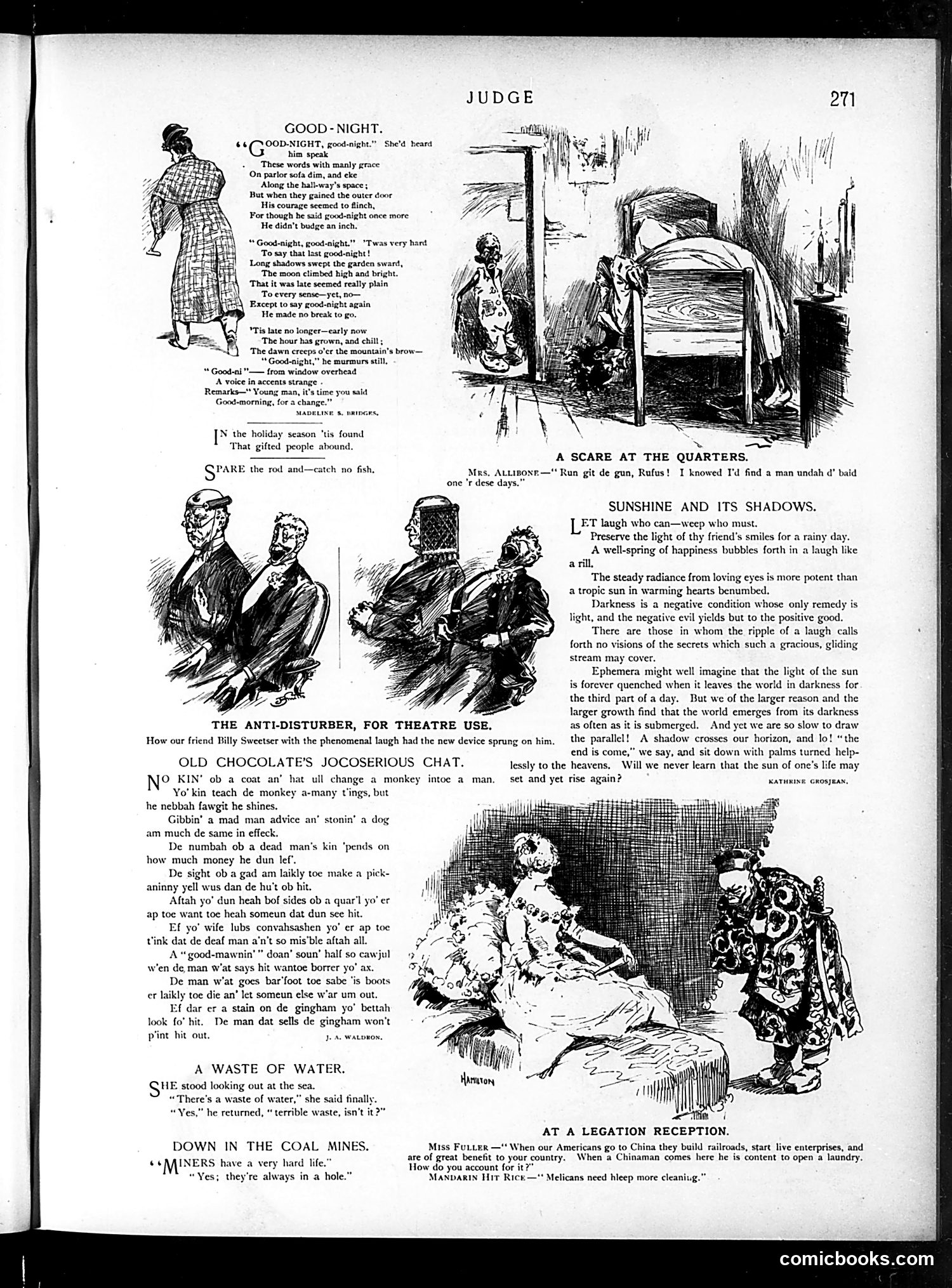
This page from Judge (a satirical weekly) contains several unrelated humor pieces typical of the era: **"Good-Night"** satirizes a persistent suitor unable to leave after his visit—he repeatedly says goodnight but lingers. A woman finally shouts from a window that he should say "good-morning" instead, mocking his refusal to depart. This is gentle domestic comedy. **"A Scare at the Quarters"** appears to be a dialect-humor piece about an enslaved woman finding a man under her bed, using heavily stereotyped African American speech patterns common to the period's problematic humor conventions. **"Sunshine and Its Shadows"** is philosophical verse about optimism and resilience, unrelated to satire. **"Old Chocolate's Jocoserious Chat"** presents folk wisdom in stereotyped dialect, a format Judge frequently used. **"At a Legation Reception"** contains an apparent critique of Chinese immigration, suggesting Chinese visitors only open laundries while Americans build railroads and enterprises—reflecting xenophobic attitudes of the era. The page mixes sentimental poetry, domestic comedy, and period-typical racial caricature rather than sharp political satire.
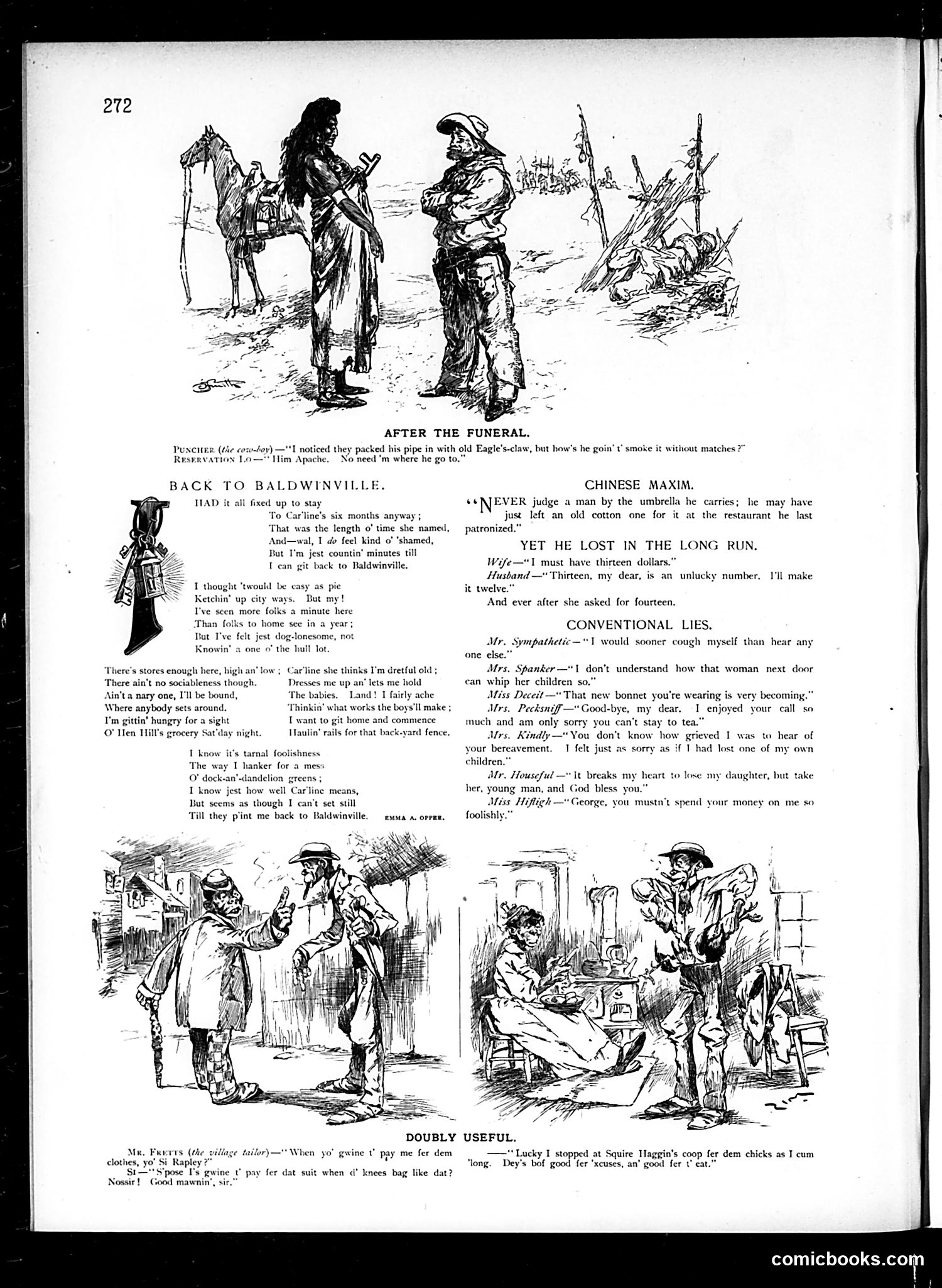
This page contains several satirical pieces targeting rural versus urban life and social hypocrisy: **"Back to Baldwinville"** (main story): A country man visiting the city finds urban life alienating despite its attractions—too many strangers, no genuine community. He's homesick for small-town simplicity and his wife's familiar nagging. The satire mocks both rural provincialism and the isolating nature of city living. **"Chinese Maxim," "Yet He Lost in the Long Run," and "Conventional Lies"**: These are brief joke commentaries on human behavior—about dishonesty in restaurants, marital power dynamics, and the falseness of polite social expressions ("I enjoyed your call" when you didn't). **"Doubly Useful"** (bottom): A village tailor and a man argue about payment for clothes; the man mentions using chicken excuses both for avoiding the tailor and for eating. The humor lies in the practical opportunism of rural life. The page satirizes social pretense and the clash between rural authenticity (however unsophisticated) and urban artificiality.
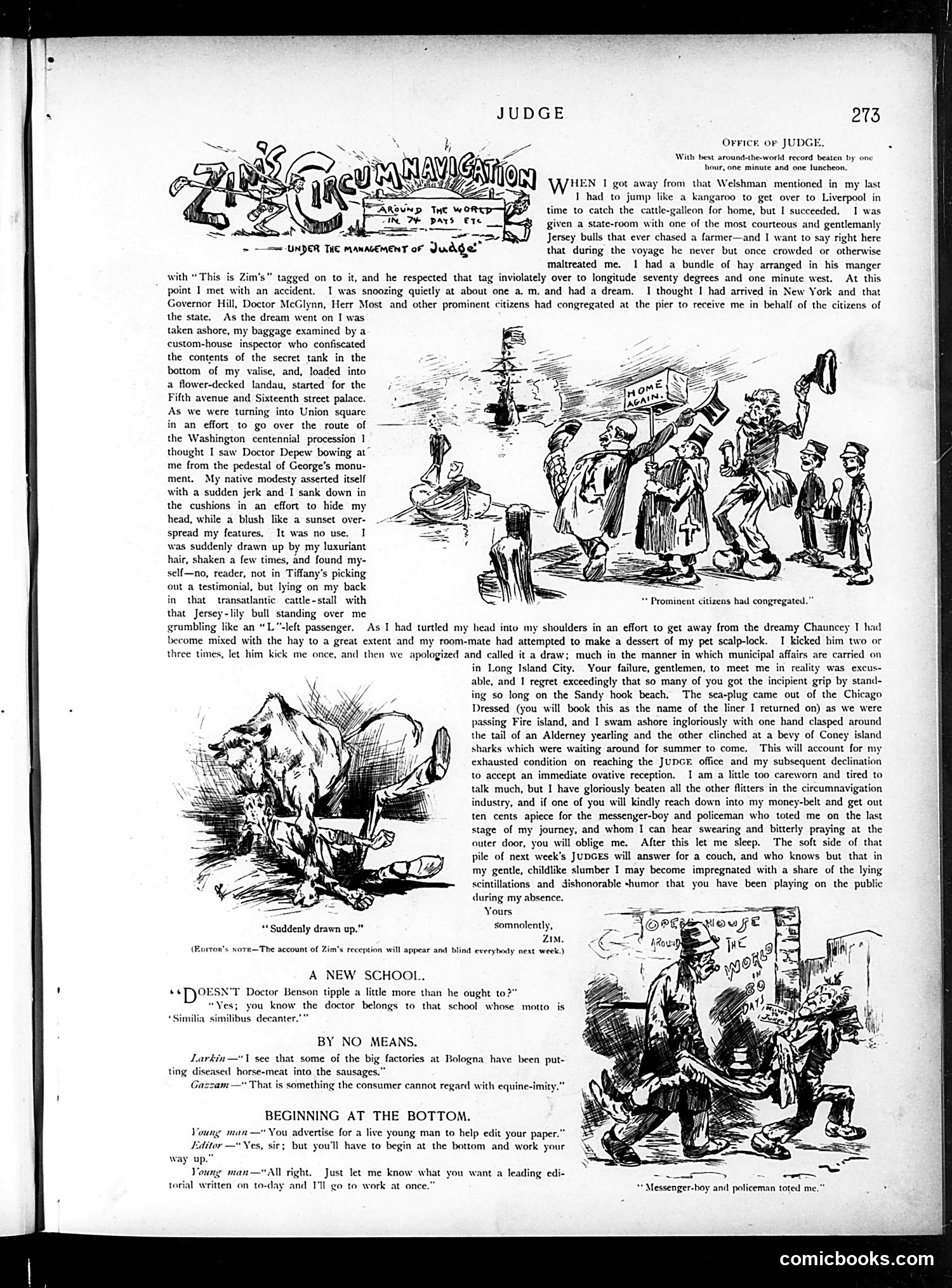
This page satirizes the author's around-the-world journey, completed one hour faster than a previous record. The humor centers on a dream sequence mocking prominent New York figures: **Governor Hill, Doctor McGlynn, and Herr Most** are imagined greeting the traveler at the pier—likely a jab at their public prominence or recent notoriety. The main comic bit involves the author sharing his ship's stateroom with a Jersey bull, who attacks him during the dream. The "Jersey-lily" reference appears to mock the animal's temperament alongside the dream scenario. The satirical point: civic leaders would never actually welcome this traveler home in reality, so the bull—an ungentlemanly brute—becomes a metaphor for their indifference. The lengthy complaint about lack of reception and request for "ten cents" for messenger-boy and policeman tips underscores the satirical deflation of the author's achievement into something comically unremarkable to those who matter.
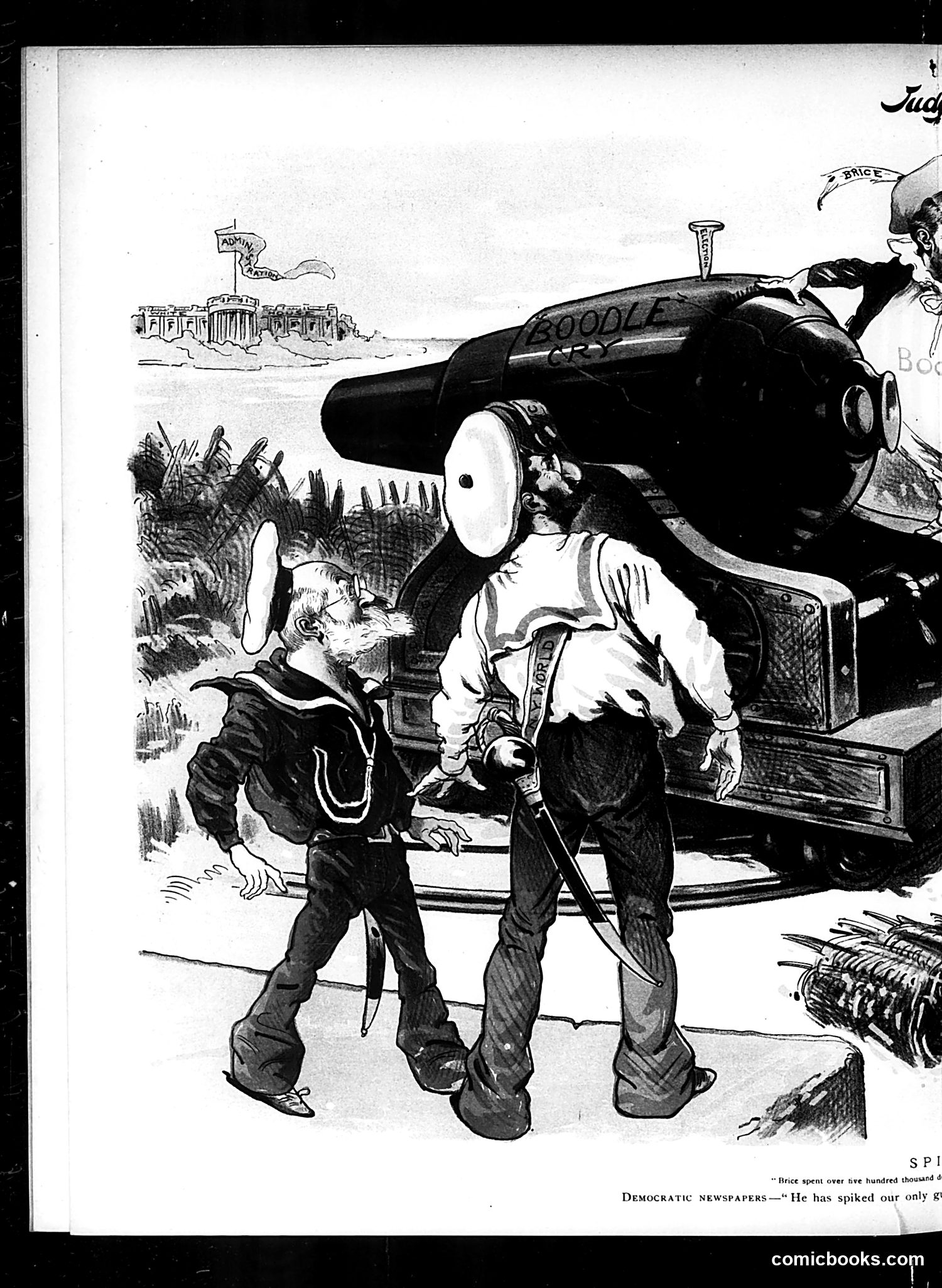
This is a satirical cartoon from *Judge* magazine criticizing Democratic newspapers. The image shows two anthropomorphic figures (appearing to represent newspaper editors or Democratic operatives) operating a large cannon labeled "GOODLE" aimed at the U.S. Capitol building in the background. The caption references someone named Brice spending "over five hundred thousand" (dollars, presumably) and accuses Democratic newspapers of having "spiked our only g[un]" — suggesting they've disabled or compromised a weapon or tool of political attack. The cartoon appears to be political commentary on Democratic media manipulation or suppression of opposing viewpoints, though without the full date and context, the specific historical incident remains unclear. The cannon metaphor suggests weaponized journalism or propaganda.
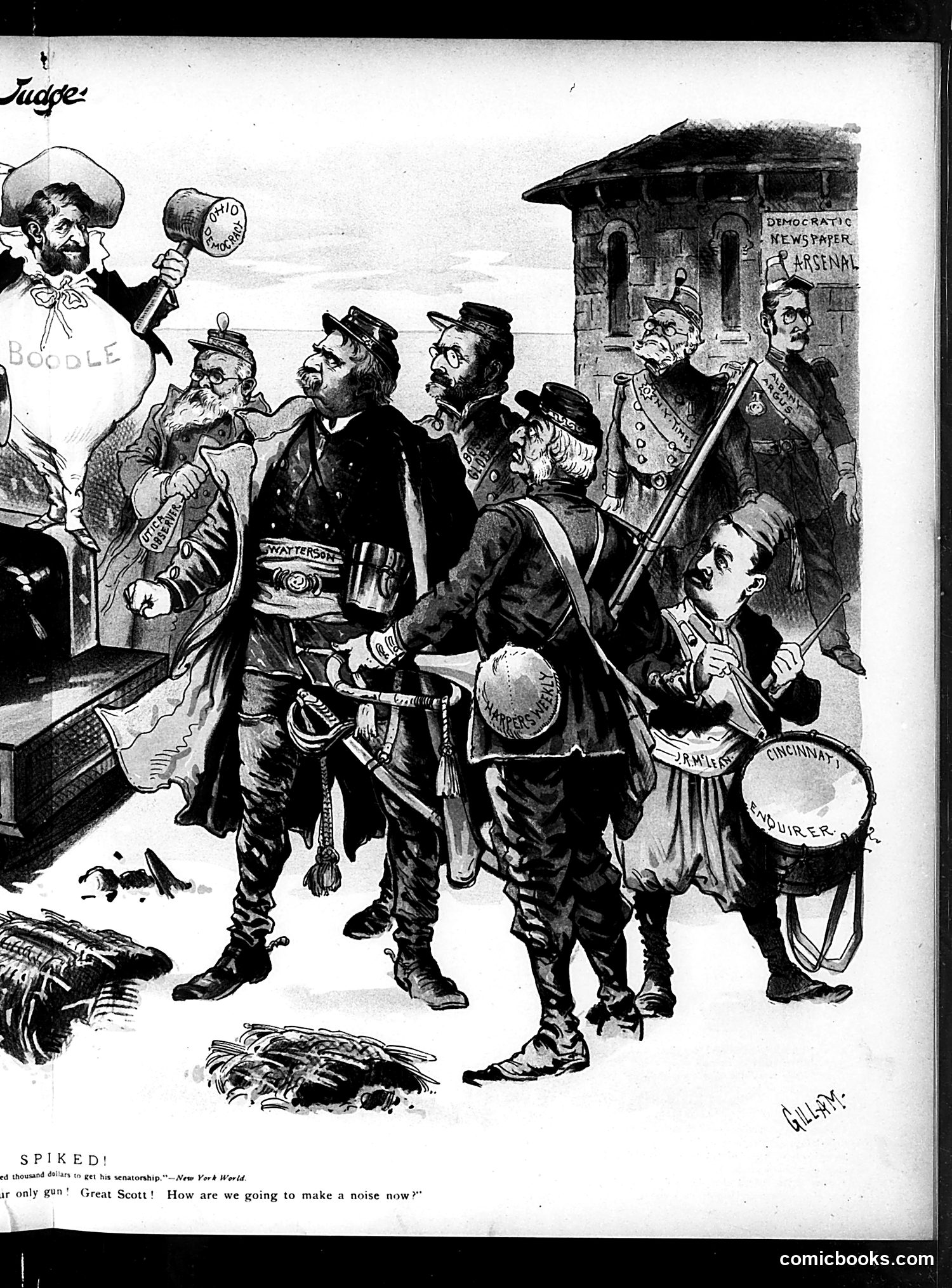
This cartoon satirizes military/political figures receiving bribes or payoffs. The central figure labeled "SATTERLEE" (likely a contemporary political figure) stands prominently in military uniform, surrounded by other uniformed officials. One holds a drum labeled "DEMOCRATIC NEWSPAPER" and "ARSENAL." The caption "SPIKED!" suggests their plans have been blocked or exposed. The dialogue references making a "noise"—implying these figures relied on propaganda or media manipulation to advance their agenda, now thwarted. The cartoon appears to criticize corruption within Democratic political circles and military leadership, suggesting they used newspaper influence and financial inducements to gain power. The exaggerated caricatures and grotesque facial features were typical of Judge's satirical style, used to mock political hypocrisy and graft. Without the publication date, the specific identities remain unclear, though this reflects late 19th or early 20th-century American political scandals.
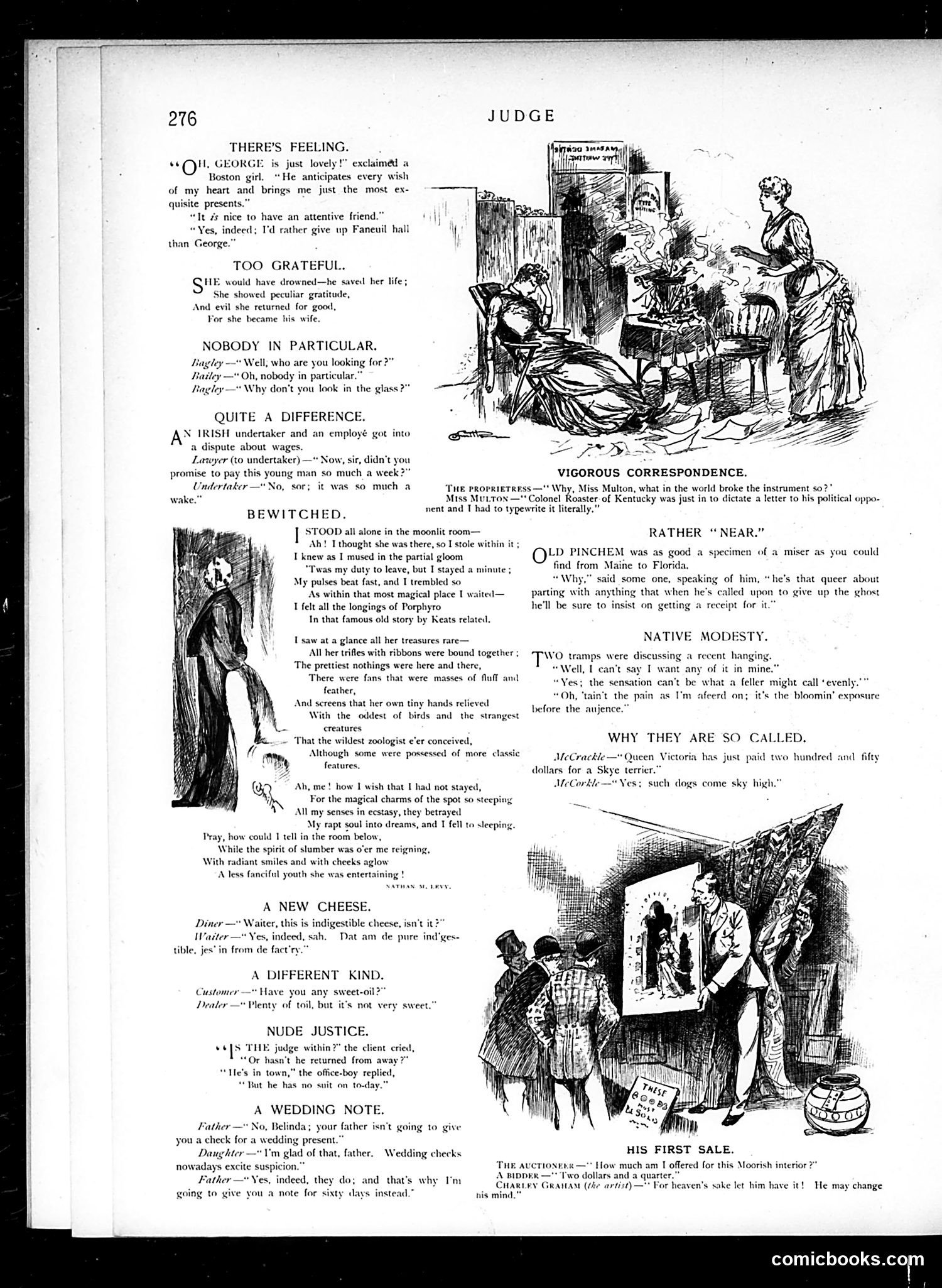
This page contains multiple short humorous pieces typical of late-19th-century American satirical magazines: **Main satirical targets:** - **"Too Grateful"**: A dark joke about a woman who drowns a man after he saves her life by marrying him—satirizing marriage as a worse fate than death. - **"Bewitched"**: A literary reference to Keats's poem "The Eve of St. Agnes," mocking romantic idealization. The speaker sneaks into a woman's bedroom expecting magic but falls asleep—deflating romantic fantasy with mundane reality. - **"Vigorous Correspondence"**: Mocks Colonel Roaster of Kentucky for dictating political letters so aggressively that he breaks a typewriter, satirizing politicians' bombastic rhetoric. - **"Rather Near"**: Old Pincher the miser is so stingy he'll demand a receipt even when dying, satirizing extreme miserliness. - **"Native Modesty"**: Tramps discuss a hanging, one noting the victim's embarrassment at public exposure—dark gallows humor. - **Skye terrier joke**: Wordplay on "sky high" (expensive) versus actual sky terriers. The page is primarily humor and satire targeting romantic excess, political bombast, greed, and social pretension.
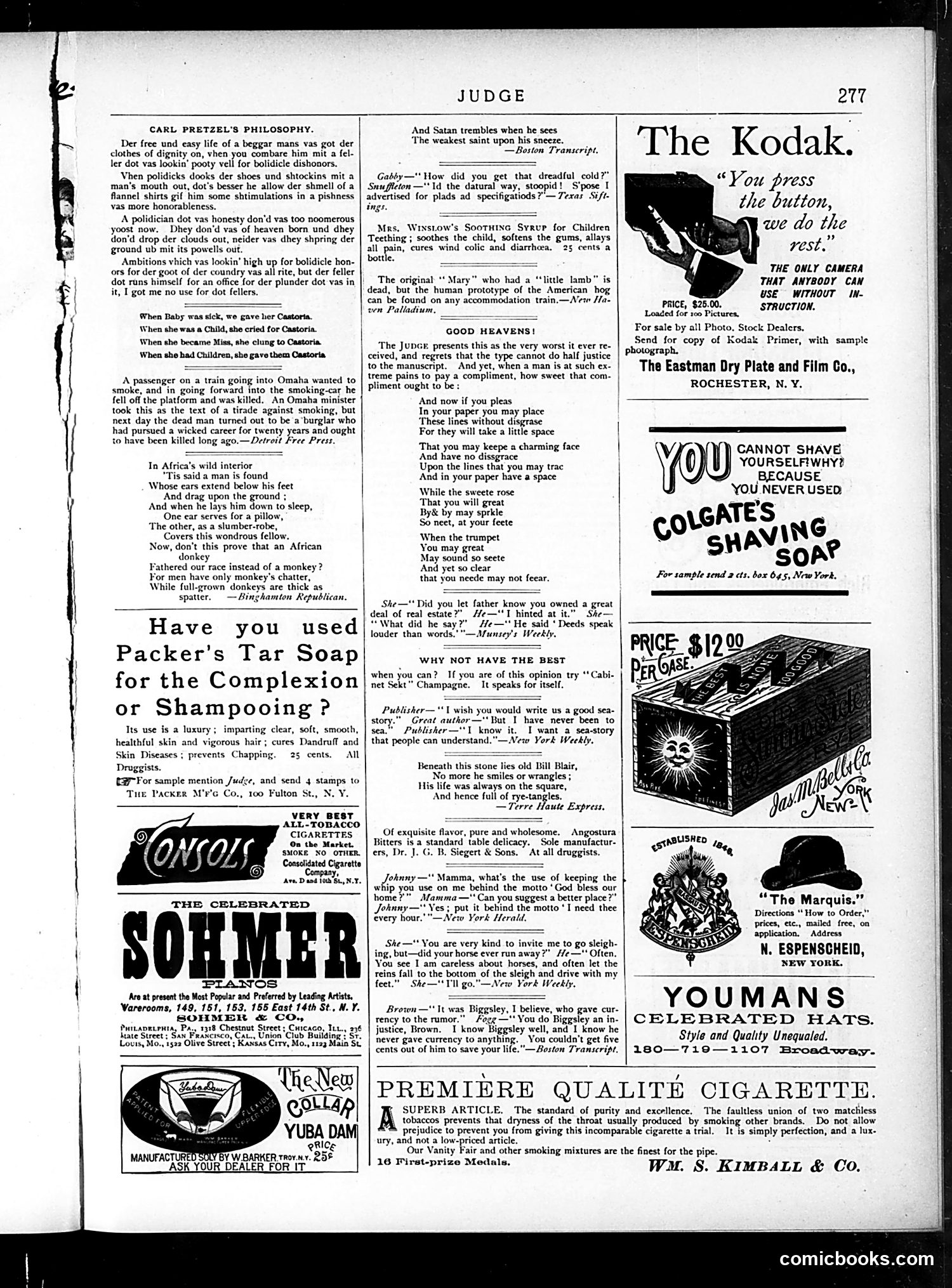
This page is primarily **advertising and miscellaneous content** rather than political cartoons. The main satirical element is "Carl Pretzel's Philosophy"—a recurring character feature using deliberately thick German-accented dialect to comment on social hypocrisy. Pretzel contrasts beggars with dignity against politicians who pursue office for personal gain rather than public good. The satire targets **political corruption**, suggesting that honest politicians are rare and those seeking office purely for plunder deserve contempt. This reflects Progressive Era concerns about machine politics and self-serving elected officials. The page also includes humorous anecdotes (a burglar killed while smoking) and advertising for period products (Castoria, tar soap, cigarettes, pianos). The deliberately garbled "compliment" poem at bottom appears to be humorous reader submission. The overall tone criticizes moral hypocrisy in politics while maintaining Judge's satirical voice through ethnic character humor—a common but now-outdated approach for the early 1900s.
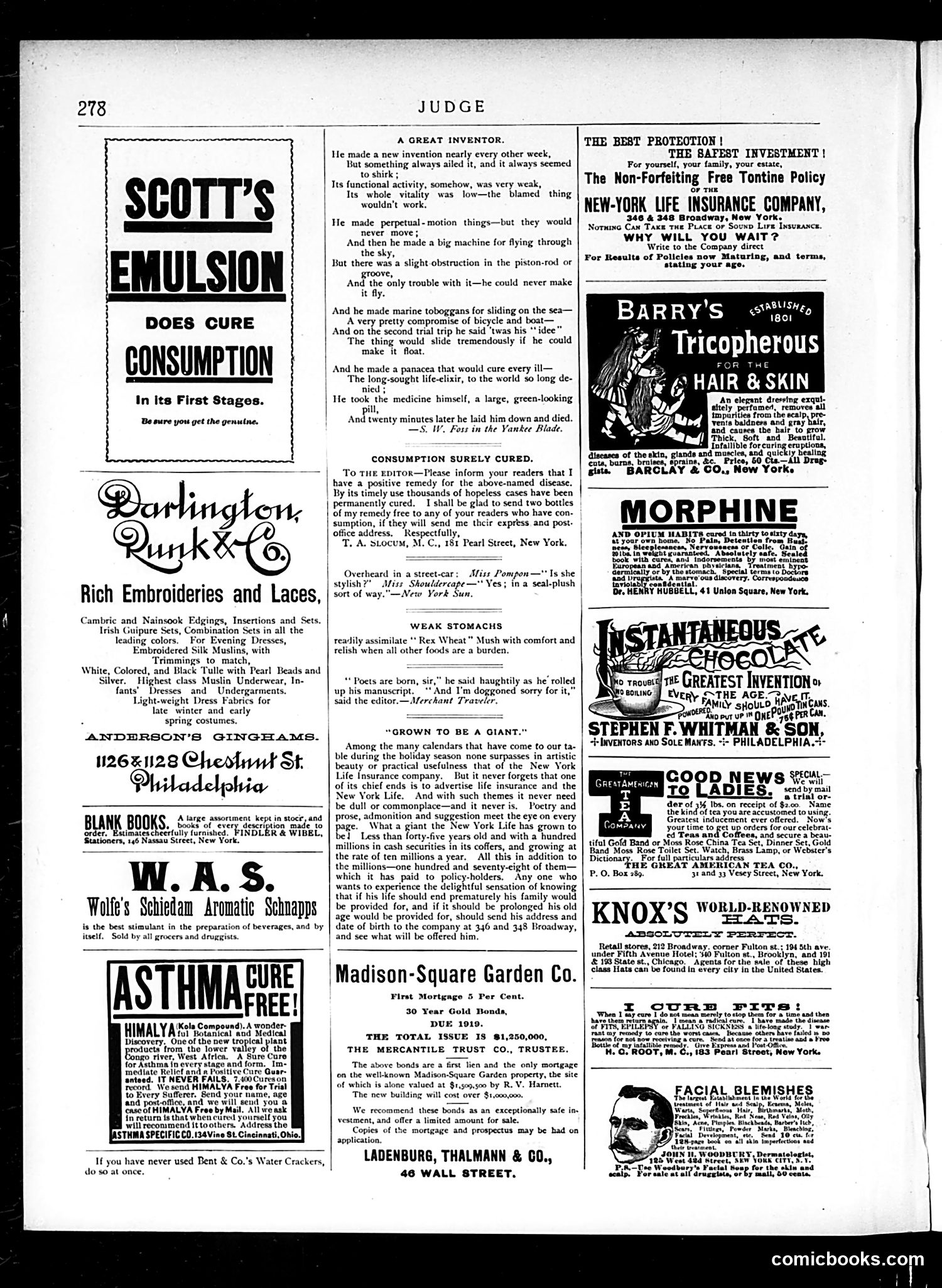
This page is primarily **advertising**, not a satirical cartoon. The main textual content is a humorous poem titled "A Great Inventor" by S.W. Foss, depicting an incompetent inventor whose creations consistently fail—perpetual motion machines that don't move, flying contraptions that won't fly, and most darkly, a miracle cure (panacea) that kills him when he tests it himself. The poem satirizes the era's epidemic of fraudulent medical claims and quack remedies. The irony is sharp: the inventor creates a "panacea" promising to cure all disease, only to die from it—a commentary on the dangerous snake-oil medicines flooding the market. The page is surrounded by period advertisements for actual dubious products (Scott's Emulsion for consumption, morphine remedies, "Instantaneous Chocolate" cures) that embody the same false medical claims the poem mocks, creating an unintentional meta-commentary on Judge's own advertising practices.
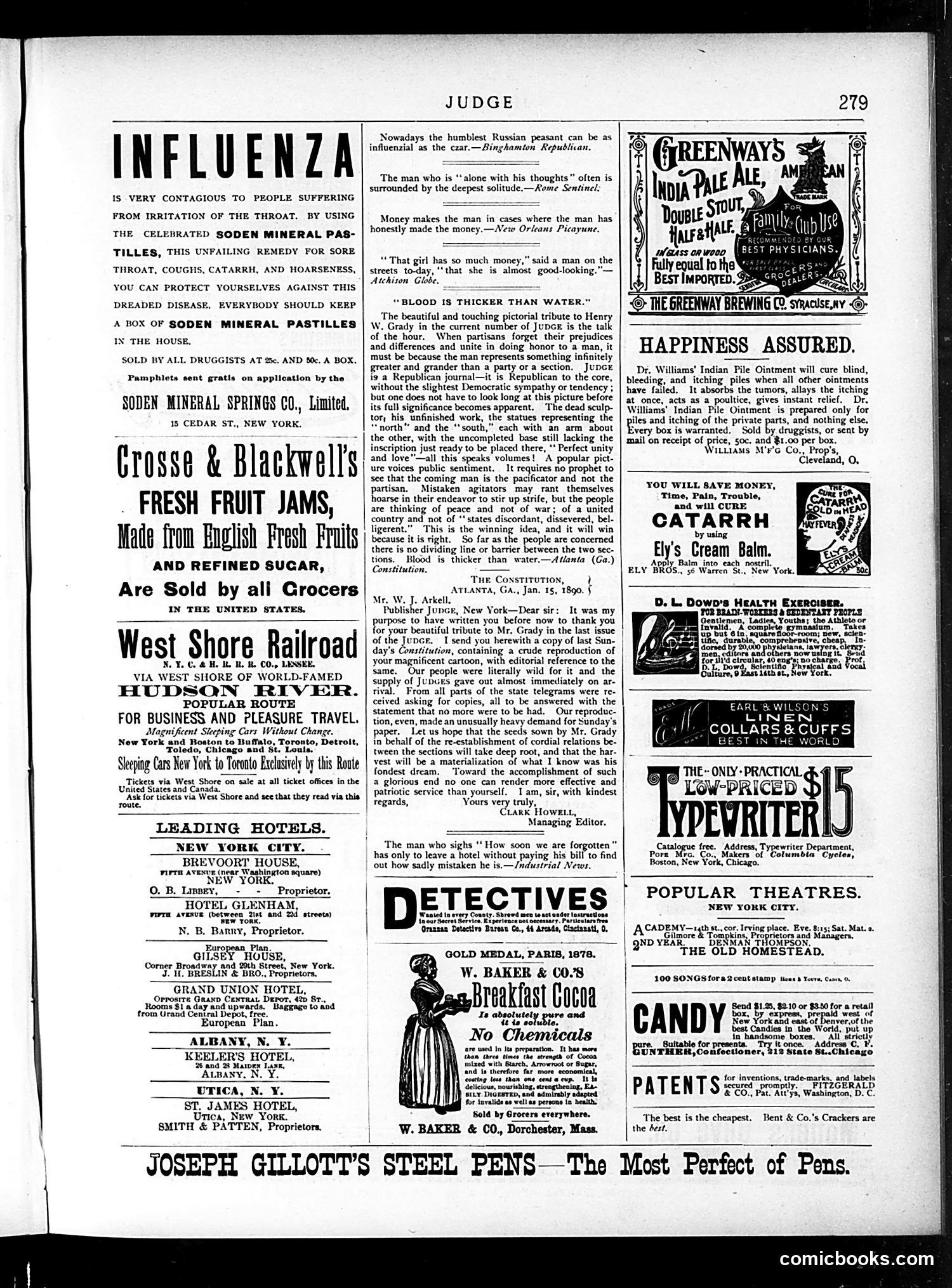
This page is primarily **advertising and editorial content** rather than political cartoons. The main text discusses a recent Judge cartoon tribute to Henry W. Grady (a prominent Georgia editor and "New South" advocate who died in 1889), praising how it transcends partisan divisions by depicting North and South unified around his legacy. The satirical commentary consists of brief **quoted aphorisms** mocking various social absurdities: Russian peasants gaining political "influence" through influenza; the paradox of solitude; money determining social standing and even attractiveness. The page is dominated by **period advertisements** for patent medicines (Soden pastilles for influenza), jams, railroad travel, hotels, cocoa, typewriters, and other products—typical of 1890s magazine content. **No specific political cartoon is visible** on this page, though the editorial references Judge's earlier Grady tribute as symbolizing sectional reconciliation.
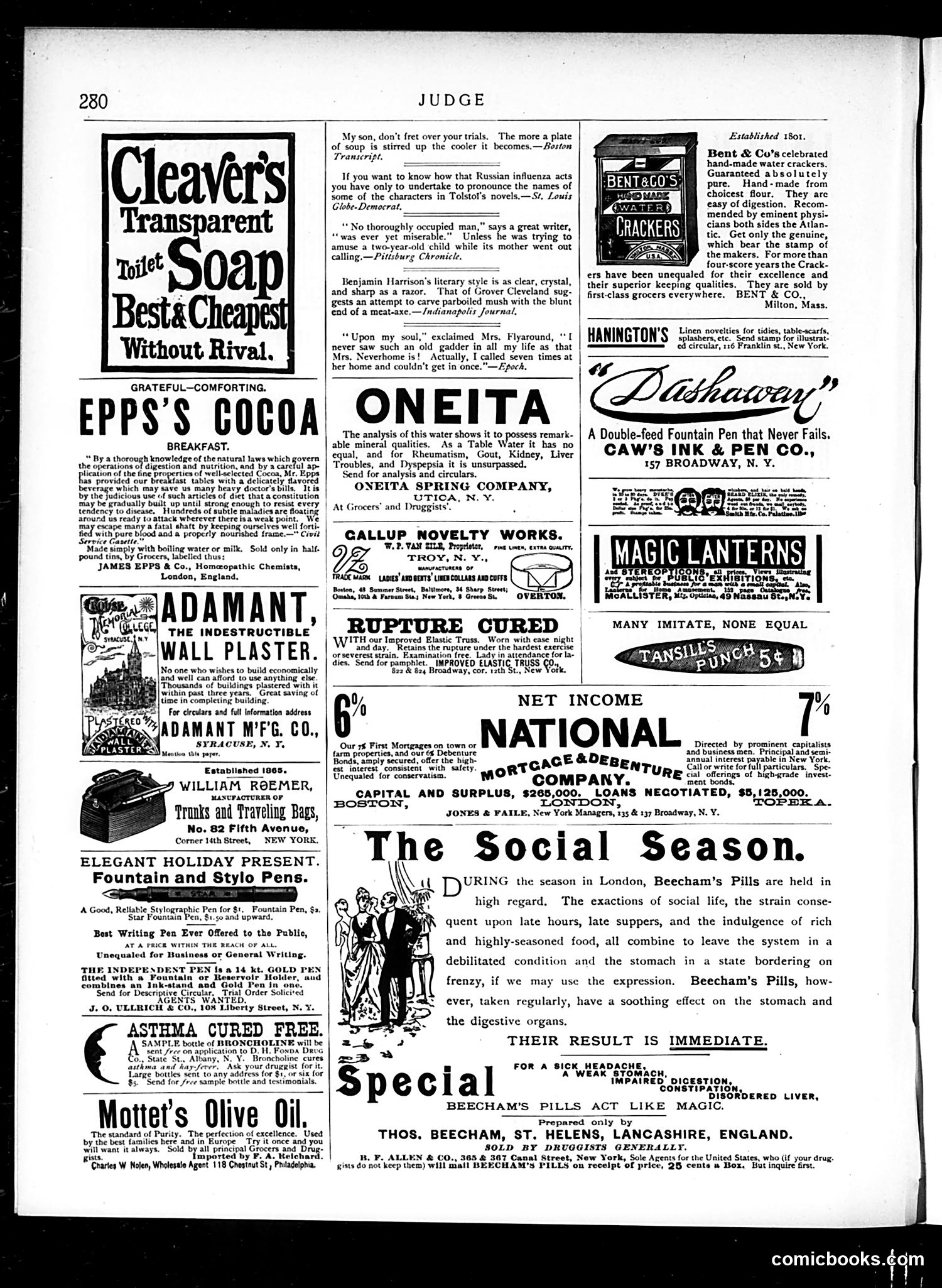
This page is primarily advertising (Judge magazine, established 1801), with the major content being a large advertisement for **Beecham's Pills** centered on "The Social Season." The ad uses social satire: it depicts London's wealthy enjoying exhausting late-night parties, suppers, and rich foods that strain their digestive systems into "a state bordering on frenzy." The remedy? Beecham's Pills, which "act like magic" and produce "immediate" results for headaches, indigestion, and liver complaints. The humor targets Victorian-era excess—the implication that fashionable society literally makes itself ill through overindulgence, and that patent medicines conveniently cure self-inflicted ailments. The surrounding quotes mock various subjects (Russian names, Benjamin Harrison's writing style, social climbers), typical of Judge's satirical format, but the page is dominated by commercial advertising rather than political cartoons.
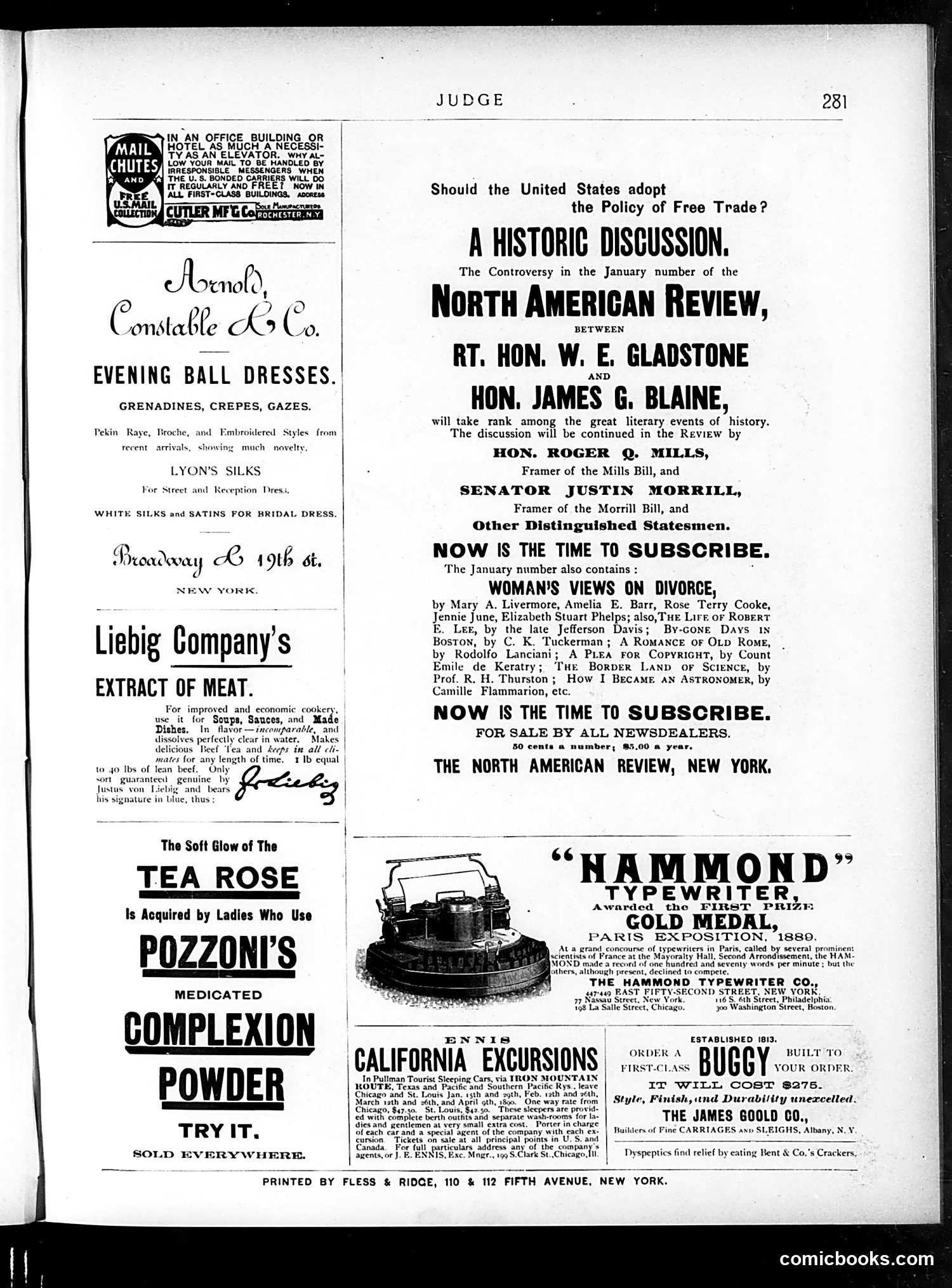
This page is primarily **advertising and promotional content**, not political satire or cartoons. The main editorial content advertises the **North American Review's** January issue, featuring a high-profile debate on **free trade policy** between British Prime Minister **W. E. Gladstone** (a free-trade advocate) and American politician **James G. Blaine** (a protectionist). This was a genuine historical controversy in the 1880s-90s about whether the U.S. should adopt Britain's free-trade model or maintain protective tariffs. The surrounding advertisements—for evening gowns, meat extract, complexion powder, typewriters, carriages, and California excursions—are typical period marketing with no satirical intent. The page illustrates how **Judge** functioned as both satirical magazine and advertising vehicle, mixing editorial promotion with commercial notices. The free-trade debate itself was genuinely significant contemporary political discourse, not satire.
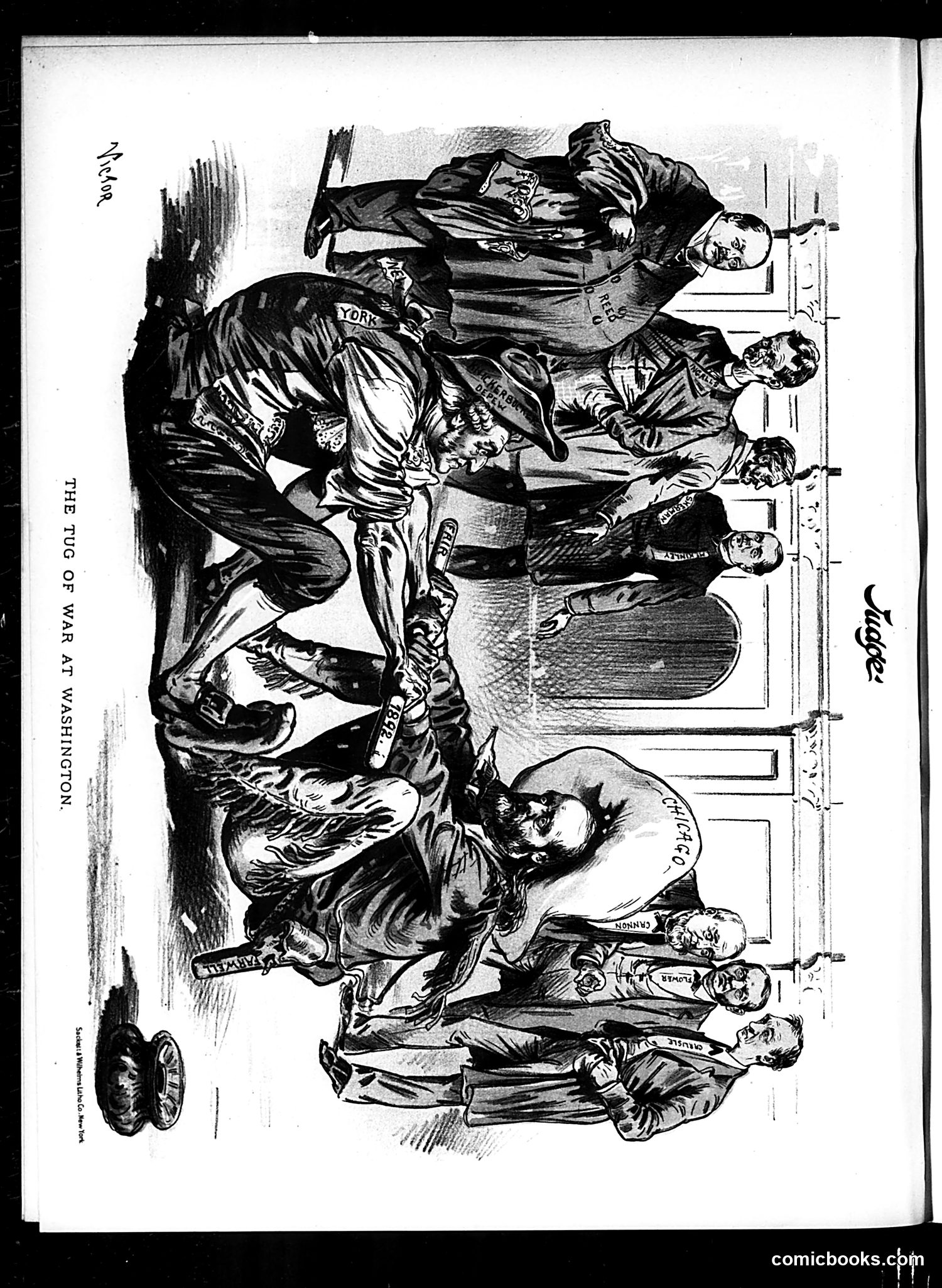
This political cartoon depicts a literal tug-of-war over what appears to be a government position or resource. Multiple figures in formal dress strain against a rope, suggesting competing political factions fighting for control or influence in Washington, D.C. The satire critiques the intense partisan struggle and self-interested maneuvering among politicians. Rather than cooperating for the public good, they're portrayed as childishly competing for advantage, with everyone pulling in different directions. The specific political context—which faction or issue is referenced—remains unclear without the publication date and clearer labeling of individual figures. However, the general message about Washington gridlock and political infighting would have resonated with Judge magazine's readers regardless of the specific era.