
Judge, 1890-02-01 · page 3 of 16
Judge — February 1, 1890 — page 3: what you’re looking at
What you’re looking at
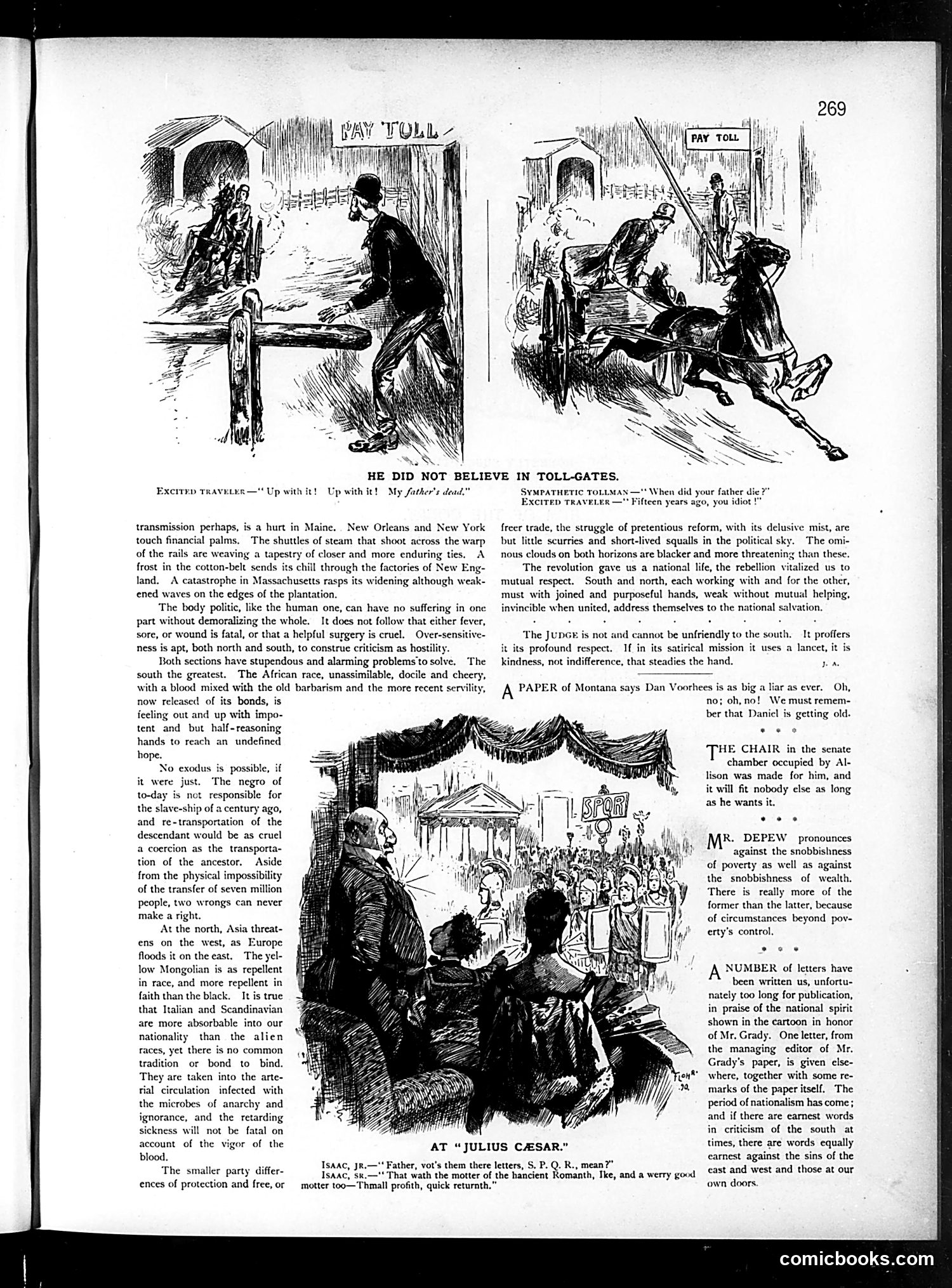
This page contains three satirical cartoons addressing post-Civil War American divisions and Reconstruction-era politics. **"He Did Not Believe in Toll-Gates"** (top): Shows a traveler refusing to pay tolls, satirizing resistance to financial obligations or taxes. **"At Julius Caesar"** (bottom): Depicts a Senate scene referencing Shakespeare's *Julius Caesar*. The caption jokes about letters and political intrigue, likely satirizing contemporary congressional disputes or political backstabbing during Reconstruction. The accompanying editorial text criticizes both North and South for mutual hostility post-war, argues against excessive sectionalism, and defends satirical journalism's role in addressing national problems. It also mentions Dan Voorhees (likely a political figure) and discusses "Grady" (possibly Henry Grady, advocate of the "New South"). The overall message: America must move beyond regional antagonism toward national unity.
📄 Transcribed text from this page (OCR, searchable)
Machine-transcribed from the original scan — historical spelling and the odd misread are preserved.
HE DID NOT BELIEVE IN TOLL-GATES. EXcITEp TRAVELER" Up with it! Up with it! My father's dead,” transmission perhaps, is a hurt in Maine. New Orleans and New York touch financial palms. The shuttles of steam that shoot across the warp of the rails are weaving a tapestry of closer and more enduring ties. A frost in the cotton-belt sends its chill through the factories of New E land. A catastrophe in Massachusetts rasps its widening although weak- ened waves on the edges of the plantation. The body politic, like the human one, can have no suffering in one part without demoralizing the whole. It does not follow that cither fever, sore, or wound is fatal, or that a helpful surgery is cruel. Over-sensitive- ness is apt, both north and south, to construe criticism as hostility. Both sections have stupendous and alarming problems'to solve. The south the greatest. The African race, unassimilable, docile and cheer with a blood mixed with the old barbarism and the more recent servilit now released of its bonds, is ieeling out and up with impo- tent and but half-reasoning hands to reach an undefined hope. No exodus is possible, if it were ju he negro of to-day is not responsible for the slave-ship of a century ago, and re-transportation of the descendant would be as cruel a coercion as the transporta- tion of the ancestor, Aside from the physical impossibility of the transfer of seven million people, two wrongs can never make a right. At the north, Asia threat- ens on the west, as Europe floods it on the east. The yel- low Mongolian is as repellent in race, and more repellent in faith than the black. It is true that Italian and Scandinavian are more absorbable into our nationality than the alien races, yet there is no common tradition or bond to bind. They are taken into the arte- rial circulation infected with the microbes of anarchy and ignorance, and the retarding sickness will not be fatal on account of the vigor of the blood. The smaller party differ- ences of protection and free, or moter too—Thmall profith, quick returnth,” SYMPATHETIC TO! EXCITED TRAVELER — freer trade, the struggle of pretentious reform, with it but little scurries and short-lived squalls in the political s When did your father di een years ago, you idiot delusive mist, are The omi- nous clouds on both horizons are blacker and more threatening than these. The revolution gave us a national life, the rebellion vitalized us to mutual respect. South and north, each working with and for the other, must with joined and purposeful hands, weak without mutual helping, invincible when united, address themselves to the national salvation. is not and not be unfriendly to the south, It proffers 3 . If in its satirical mission it uses a lancet, it is kindness, not indifference, that steadies the hand. wae A? AT “JULIUS C4SAR.” “Father, vot's them there letters, S. P. Q. R., mean?” * That wath the motter of the hancient Romanth, Ike, and a werry good 'APER of Montana says Dan Voorhees is as big a liar as ever. Oh, no; oh,no! We must remem- ber that Daniel is getting old. see THE CHAIR in the senate chamber occupied by Al- lison was made for him, and it will fit nobody else as long as he wants it, R. DEPEW pronounces against the snobbishness of poverty as well as against the snobbishness of wealth. There is really more of the former than the latter, because of circumstances beyond pov- erty’s control. A NUMBER of letters have been written us, unfortu- nately too long for publication, in praise of the national spirit shown in the cartoon in honor of Mr. Grady. One letter, from the managing editor of Mr. Grady's paper, is given else- where, together with some re- marks of the paper itself. The period of nationalism has come; and if there are earnest words in criticism of the south at times, there are words equally earnest against the sins of the cast and west and those at our own doors. comicbooks.com