
A complete issue · 18 pages · 1889
Judge — December 21, 1889
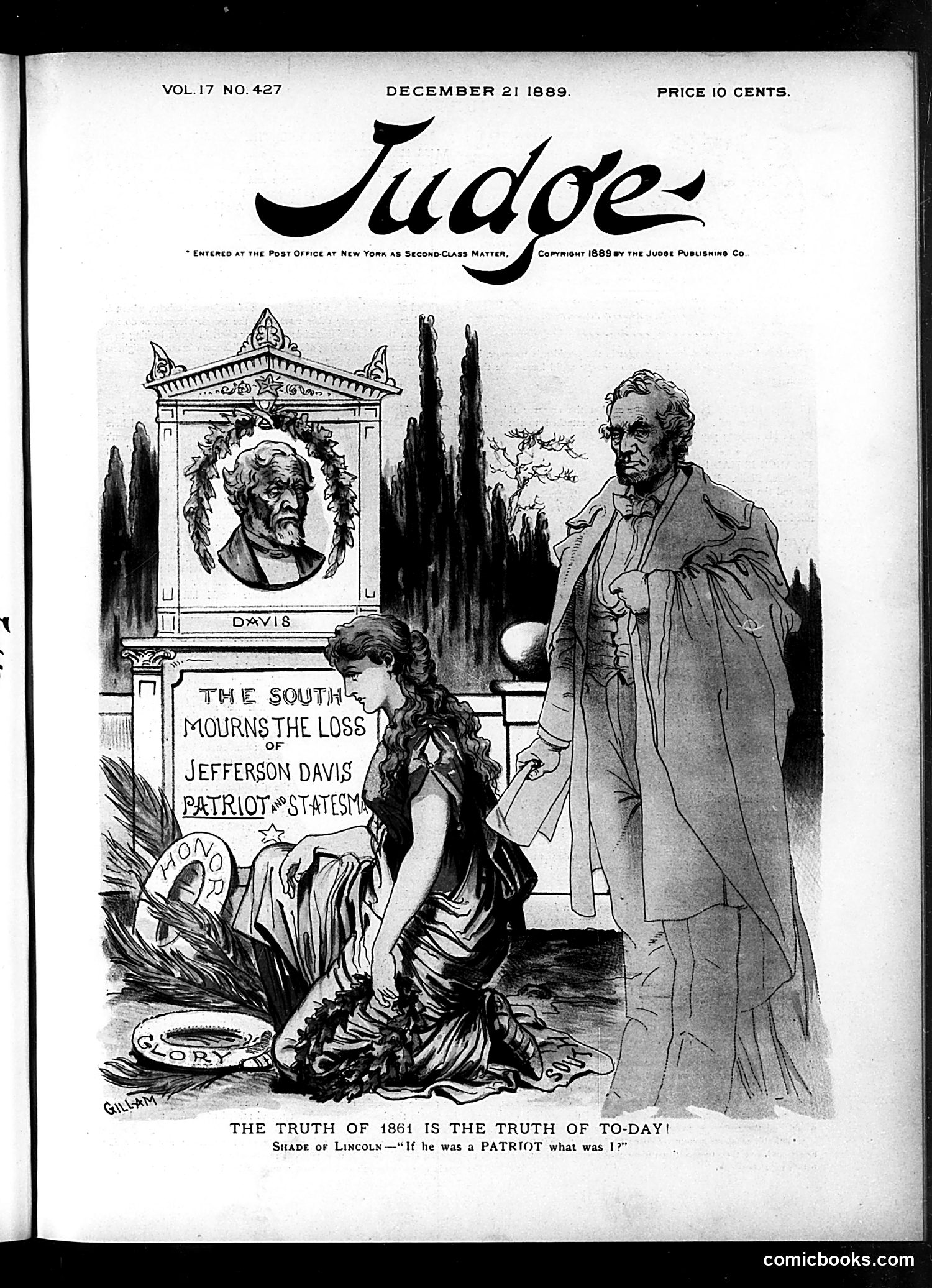
This political cartoon mourns Jefferson Davis, the former Confederate president who recently died. The allegorical female figure representing "The South" kneels grieving before Davis's monument, while a ghostly figure (identified by caption as Lincoln's shade) stands observing. The satire targets Southern nostalgia for the Confederacy. Lincoln's ghost challenges Davis's patriotism with the pointed question: "If he was a PATRIOT what was I?"—implying Davis fought against the Union and therefore cannot claim patriotic status. The cartoon argues that Southern mourning of Davis represents misplaced reverence for a traitor. Judge, a Republican-leaning publication, uses this commentary to critique ongoing sectional tensions and the romanticization of the Lost Cause.
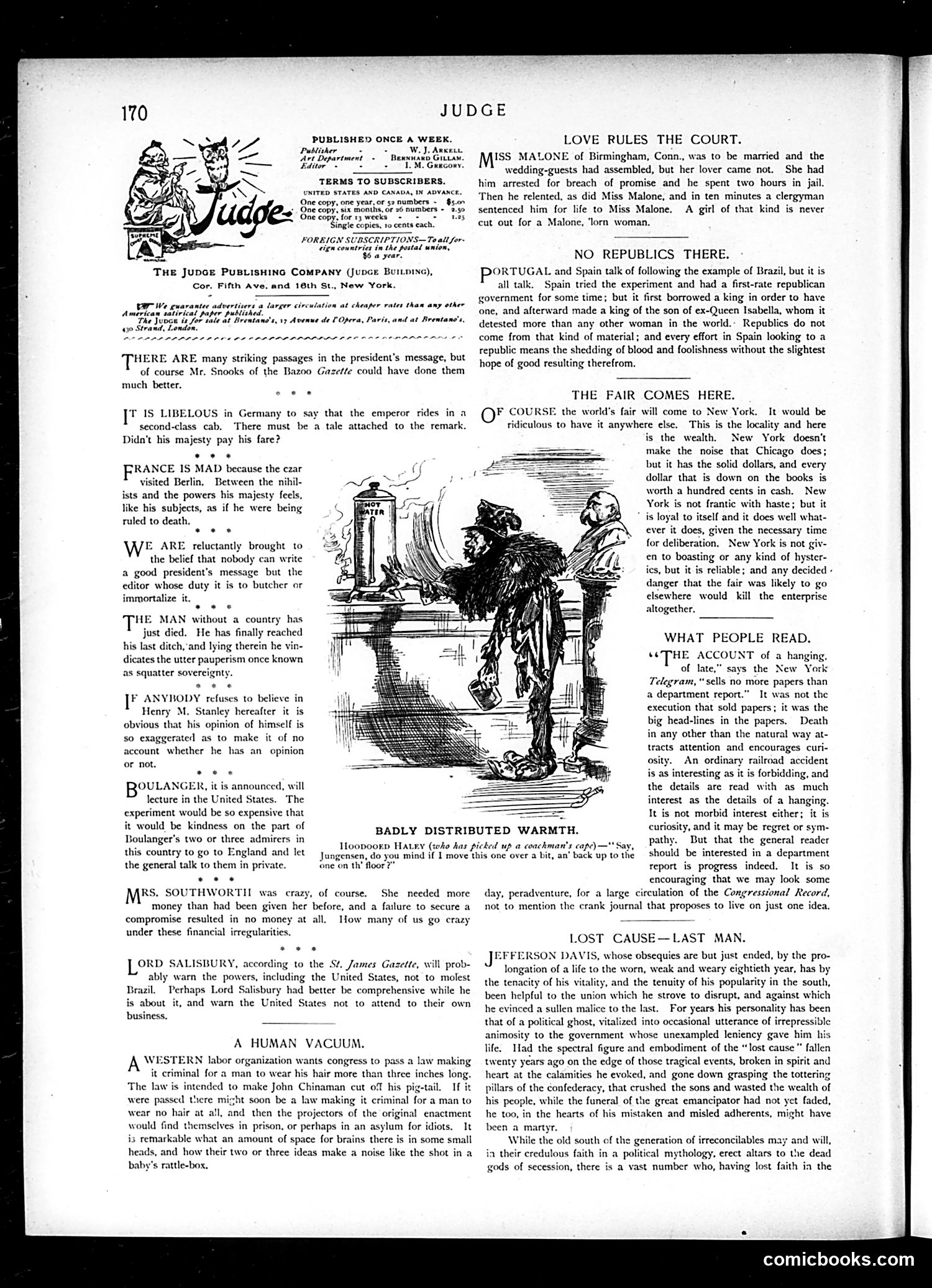
The main cartoon titled "BADLY DISTRIBUTED WARMTH" depicts a figure in ragged clothes standing near a water barrel or container, addressing someone inside. The accompanying caption references "Hoodford Haley (who picked up a coachman's cape)" saying "Say, Jingolum, do you mind if I move this over a bit, eh? back up to the one on front?" The satire appears to target **wealth inequality and class disparity** during the Gilded Age. The ragged figure likely represents the poor or working class seeking to share in warmth/resources, while the juxtaposition with discussion of a "coachman's cape" suggests contrast between wealthy and impoverished citizens. The cartoon's title ironically comments on how prosperity and comfort are unevenly distributed in society. The page also contains political commentary on various topics including republicanism and journalism standards.
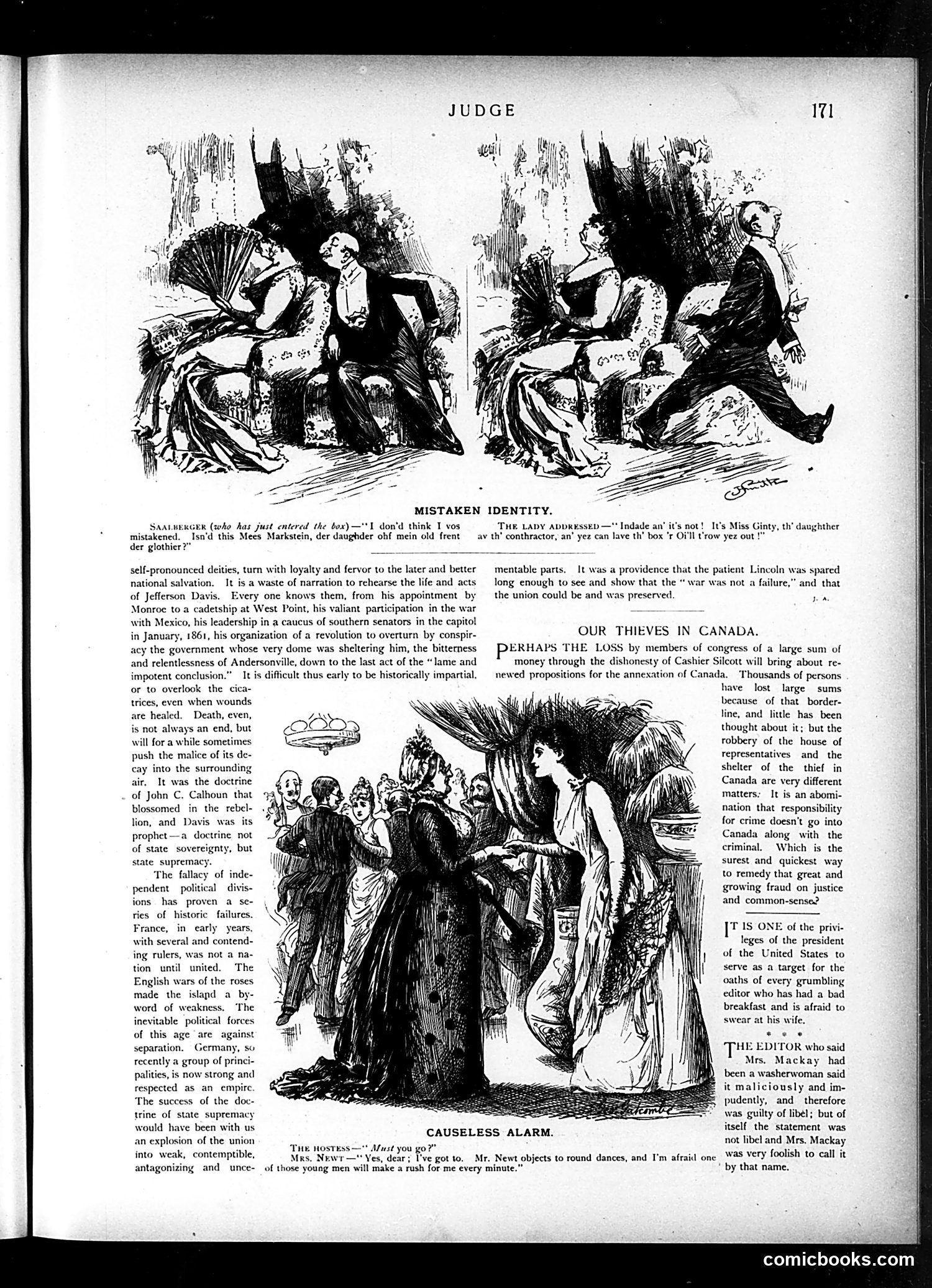
This page contains three separate pieces: **"Mistaken Identity"** (top): A man enters a courtroom and is confused for someone else. The humor involves ethnic dialect comedy—a German-accented character mishears "Miss Markstein" and thinks it's his old friend's daughter. The punchline relies on the period's popular "immigrant dialect" humor. **"Our Thieves in Canada"** (right): Editorial commentary on Cashier Silcott's theft from the U.S. House of Representatives. The piece criticizes that Silcott fled to Canada unpunished, using this incident to argue *for* Canadian annexation as a solution to cross-border crime and fraud. **"Causeless Alarm"** (bottom): A brief social joke about a woman worried that unmarried men will rush the dance floor—her escort objects to round dances. The page illustrates *Judge*'s mix of topical political commentary (post-Civil War, Reconstruction-era debates) alongside lighter social satire and ethnic humor typical of 1870s American magazine culture.
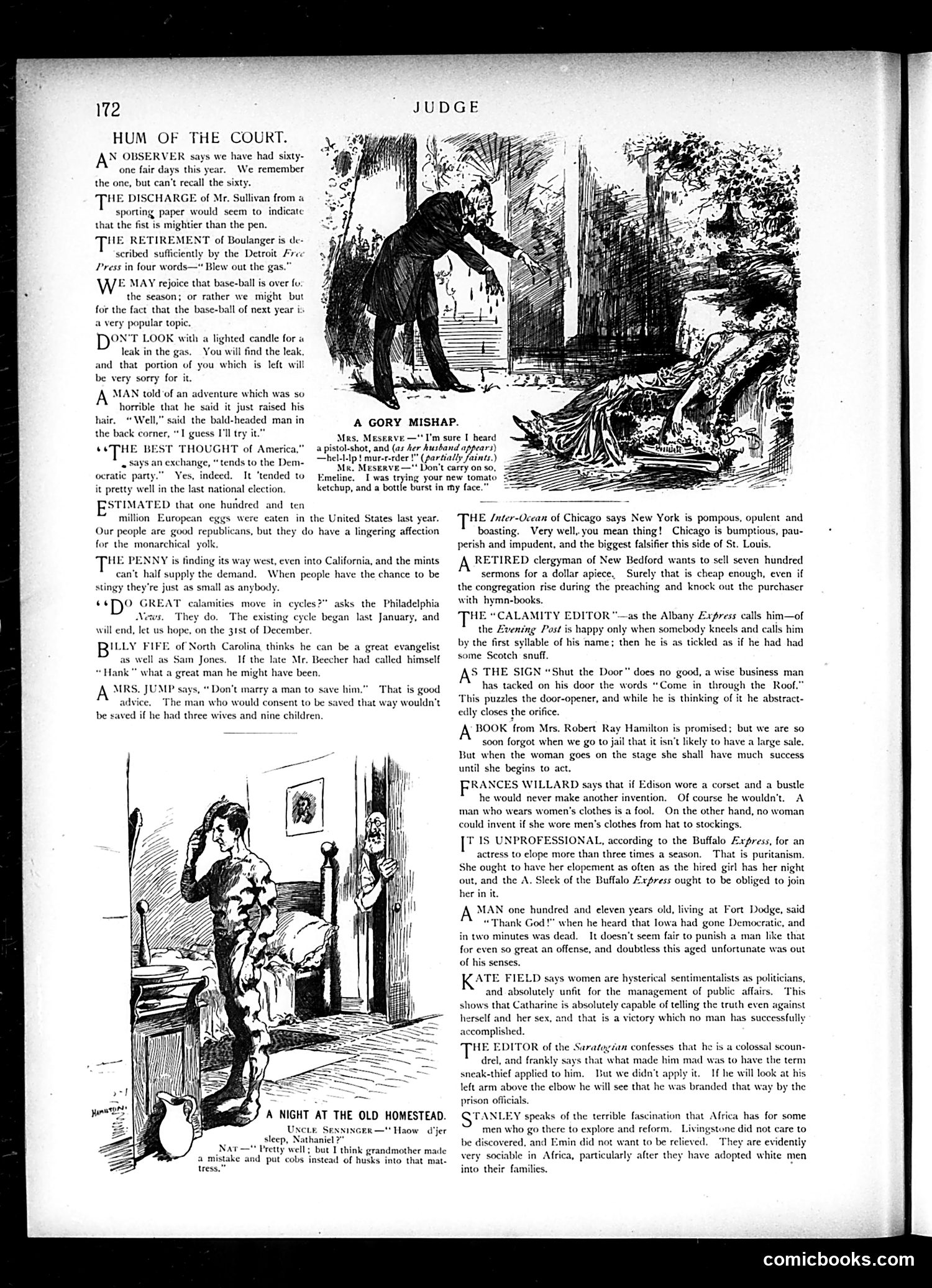
This page contains brief editorial quips and two cartoon vignettes typical of Judge's "Hum of the Court" humor section. **The cartoons:** - "A Gory Mishap" depicts a domestic misunderstanding: Mrs. Meserve mistakes her husband's tomato ketchup bottle explosion for a gunshot murder, fainting dramatically while he calmly explains the accident. - "A Night at the Old Homestead" shows Uncle Sensinger and Nathaniel discussing homemade beverages—grandmother's mistake of using cobs instead of husks in their (likely alcoholic) concoction. **The editorial jokes** mock various targets: Boulanger's retirement (French general), baseball popularity, Democratic politics, European egg imports, penny circulation, evangelist Billy Fife, and various public figures like Frances Willard and Edison. The satire reflects 1880s-90s American concerns: politics, gender roles (Willard's corsets/invention commentary), and class attitudes toward European goods and immigration. The humor is deliberately light and absurdist rather than addressing serious issues.
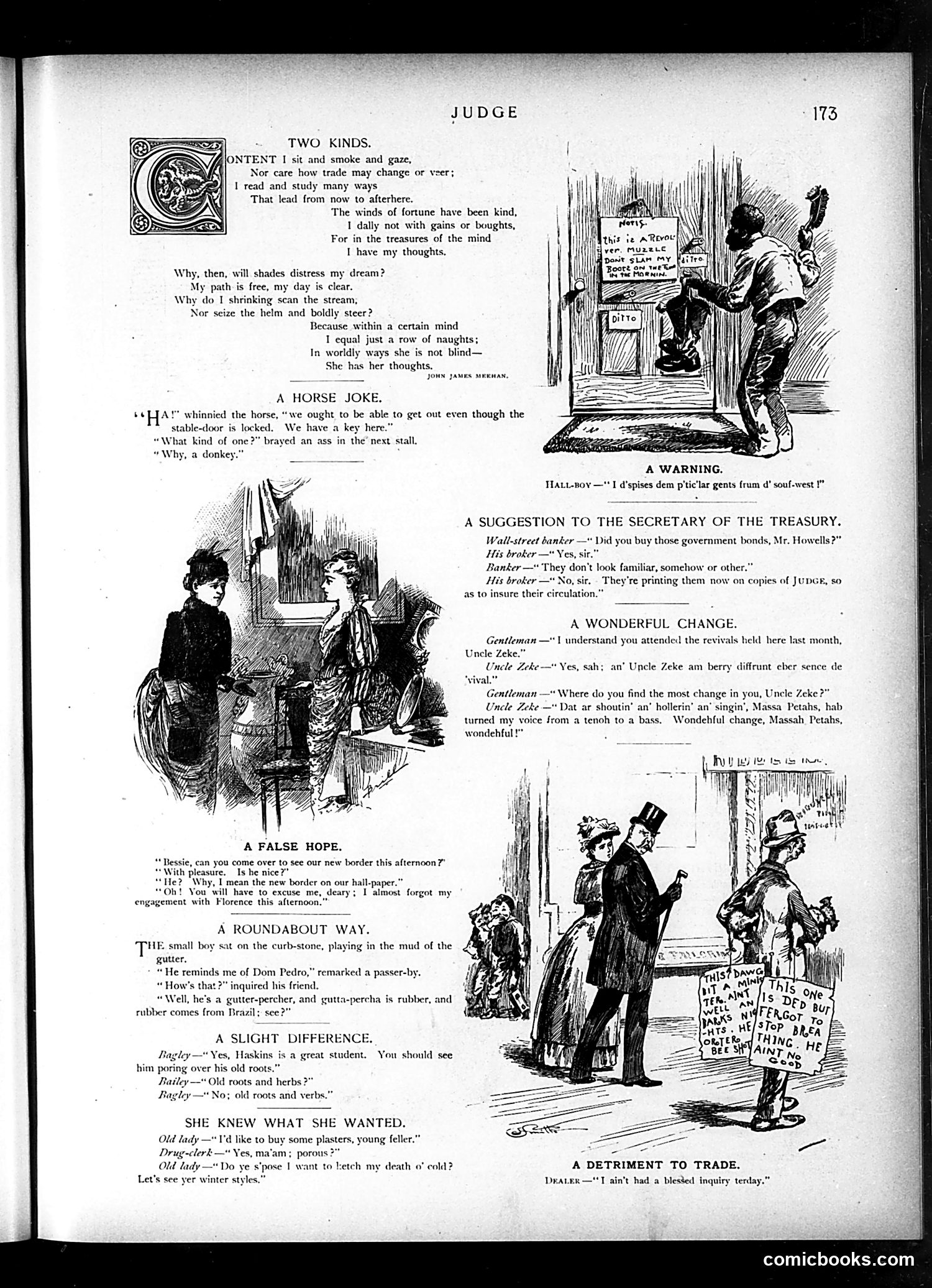
This page contains **multiple short jokes and satirical pieces** rather than a single political cartoon: **"Two Kinds"** contrasts two philosophies—one accepting fortune's gifts through intellectual pursuits, another anxious despite security—apparently about different responses to life's uncertainties. **"A Horse Joke"** is a simple pun: a donkey as a "key" to escape. **"A Suggestion to the Secretary of the Treasury"** satirizes government bond circulation by joking that new bonds are printed on Judge magazine copies to ensure people actually read/distribute them—mocking the bonds' unpopularity or the government's promotional desperation. **"A Wonderful Change"** uses racist dialect humor about a revival converting Uncle Zeke, with the "change" being his voice shifting from tenor to bass—period-typical minstrelsy stereotypes. The remaining pieces are domestic humor and wordplay without clear political significance. The page reflects Judge's mix of satirical commentary (Treasury bonds) and conventional period humor (racist stereotypes, puns).
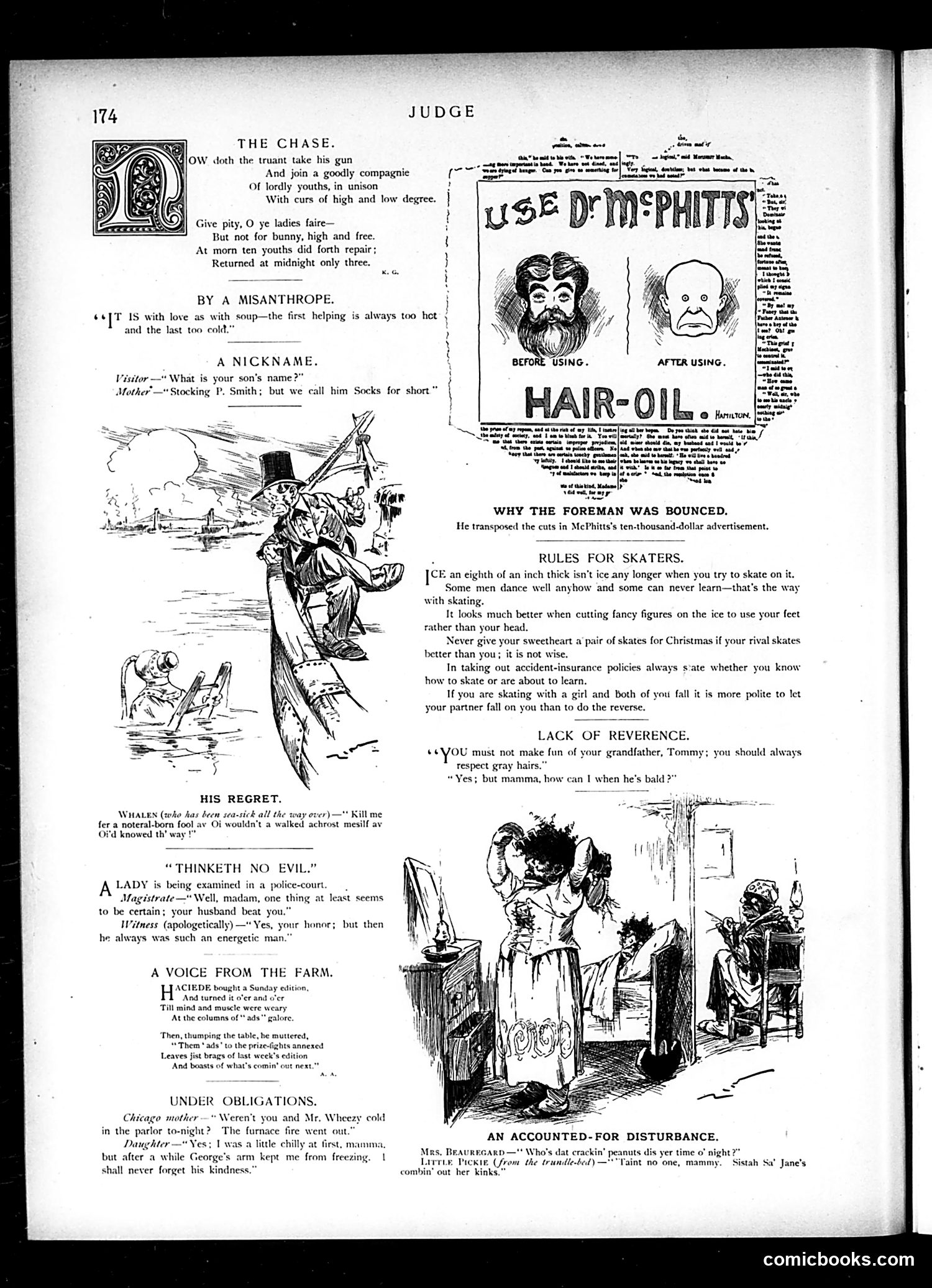
This page combines humor pieces typical of late-19th/early-20th century American satire: **"The Chase"** presents a poem about hunting, where ten youths depart armed but only three return—likely satirizing the dangers or incompetence of amateur hunters. **"Use Dr. McPhitts Hair-Oil"** is a product advertisement showing a bearded man "before" and clean-shaven "after," claiming the oil's effectiveness. The adjacent article "Why the Foreman Was Bounced" jokes that a print worker lost his job for accidentally transposing the advertisement's images. **"Rules for Skaters"** offers humorous winter sport advice, including the famous joke about a bald grandfather—poking fun at absurd literal interpretations of social etiquette. **Other pieces** include brief comedic dialogues about relationships, farming, and domestic life—typical Judge fare mocking middle-class manners and behavior. The page is primarily **light humor and advertising**, with no apparent political commentary. The content reflects turn-of-the-century American domestic life and consumer culture rather than substantive satire.
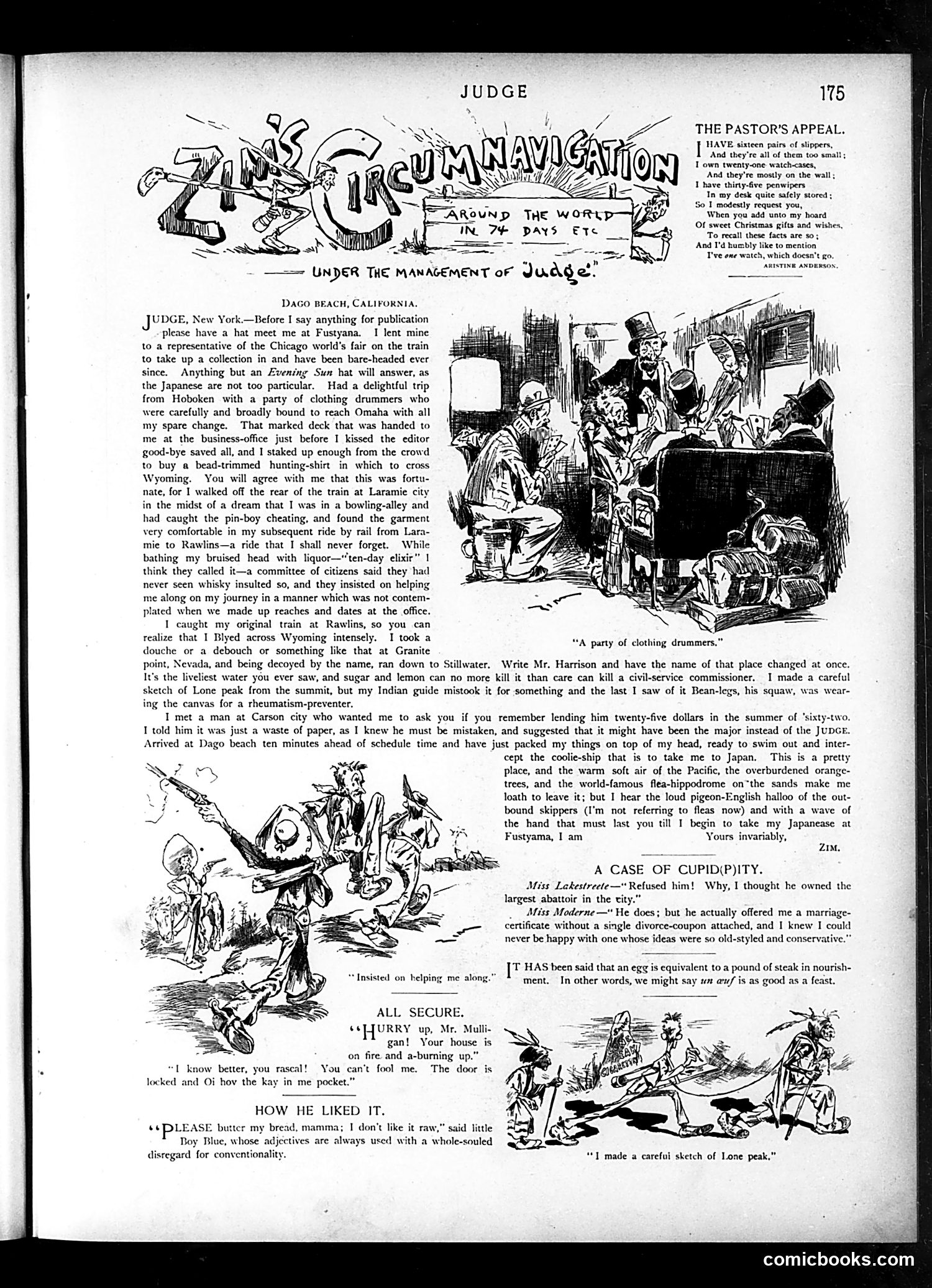
This page contains humorous travel letters and illustrations typical of Judge's satirical style. The main content is a letter from "Zim," a correspondent describing a chaotic journey across America to Japan via Dago Beach, California. The humor relies on exaggerated mishaps—losing his hat to a Chicago world's fair representative, getting cheated at cards by clothing salesmen, nearly falling from a train while dreaming, and hiring a guide who uses his valuable sketch as a rheumatism remedy. The sidebar "Pastor's Appeal" satirizes clergy who receive excessive Christmas gifts they don't need—sixteen pairs of slippers, twenty-one watch-cases, thirty-five pen-wipers—while their own single watch remains broken. This gentle satire criticizes the culture of gift-giving excess. A brief "Cupid(p)ity" joke mocks modern women's attitudes toward marriage, suggesting a woman would reject a wealthy man if his marriage proposal lacked a pre-arranged divorce clause—commentary on rising divorce rates and changing marriage attitudes in the era.
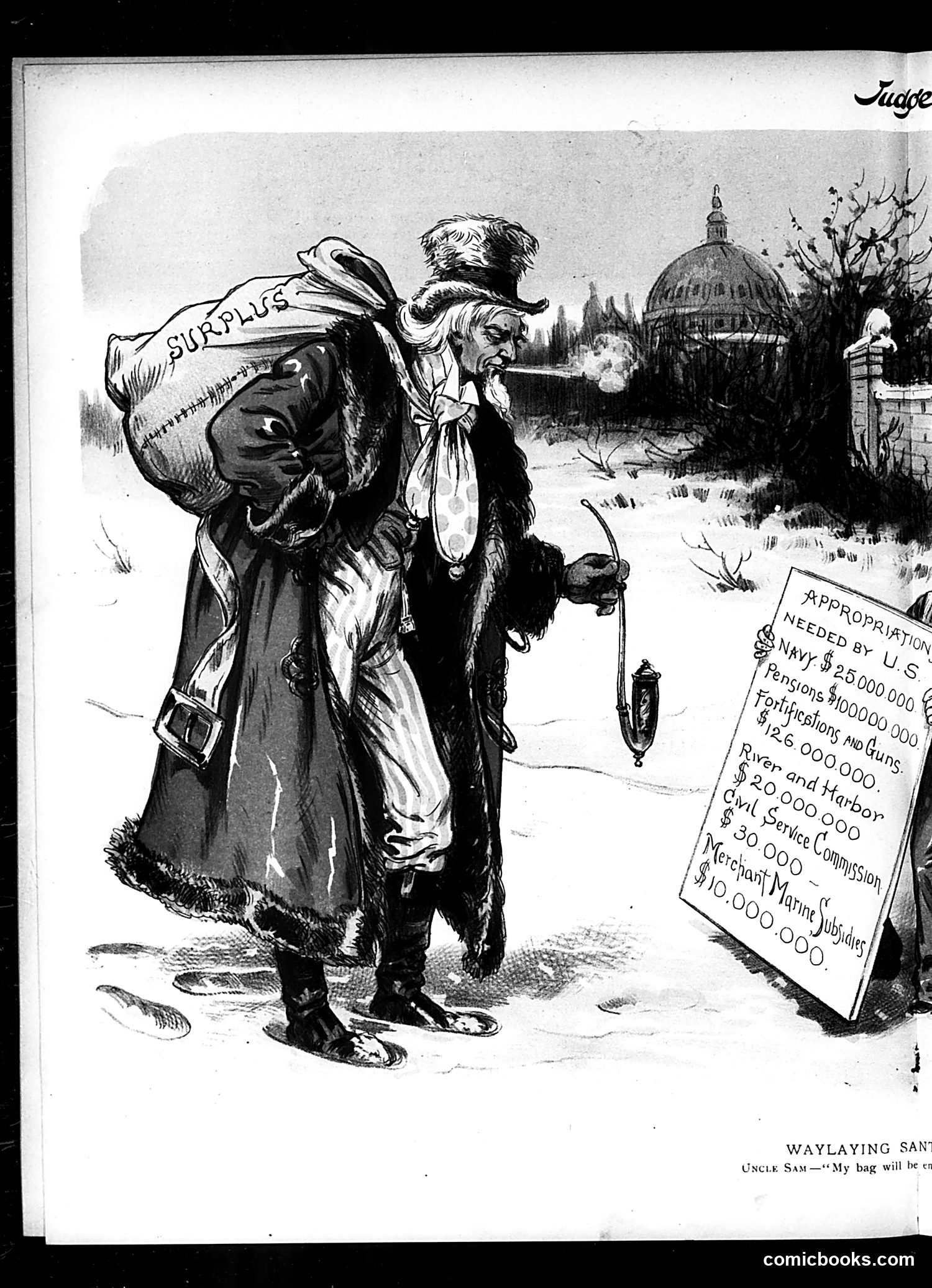
This satirical cartoon depicts Uncle Sam (personified as an old man with a beard) being "waylaid" by a figure carrying a large sack labeled "SURPLUS." The accompanying list shows federal appropriations needed by the U.S. Navy, including funding for pensions, fortifications, naval guns, river and harbor improvements, civil service, and merchant marine subsidies—totaling substantial sums. The satire critiques excessive government spending and budget requests. Uncle Sam appears burdened and possibly waylaid (ambushed/robbed) by these financial demands, suggesting the government is being overwhelmed or taken advantage of by various departments seeking funds. The Capitol dome in the background reinforces the political context. This likely comments on post-Civil War military spending and the debate over appropriate federal budget allocation during the Reconstruction era.
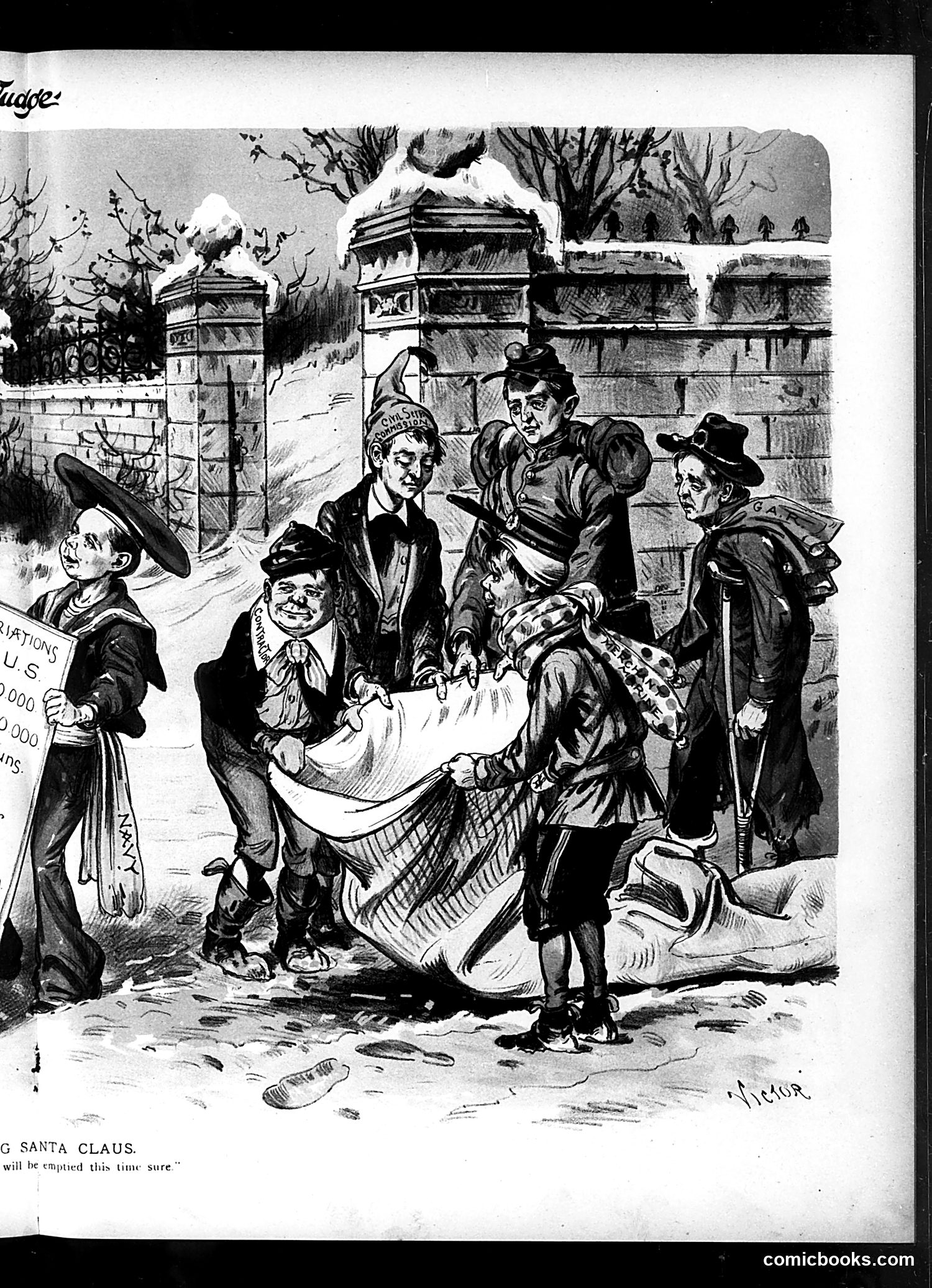
This political cartoon satirizes government spending or resource distribution, likely from the late 19th or early 20th century. Multiple caricatured figures—appearing to represent politicians or government officials—stand around a large stocking or sack, examining its contents with expressions ranging from satisfaction to greed. The caption "will be emptied this time sure" suggests the cartoon critiques how public funds or national resources are being depleted or misappropriated by officials. The "Santa Claus" reference likely mocks politicians who present themselves as beneficent while actually draining resources for their own interests. The exaggerated facial features and clothing suggest these figures represent specific political personalities of the period, though their exact identities remain unclear without additional context.
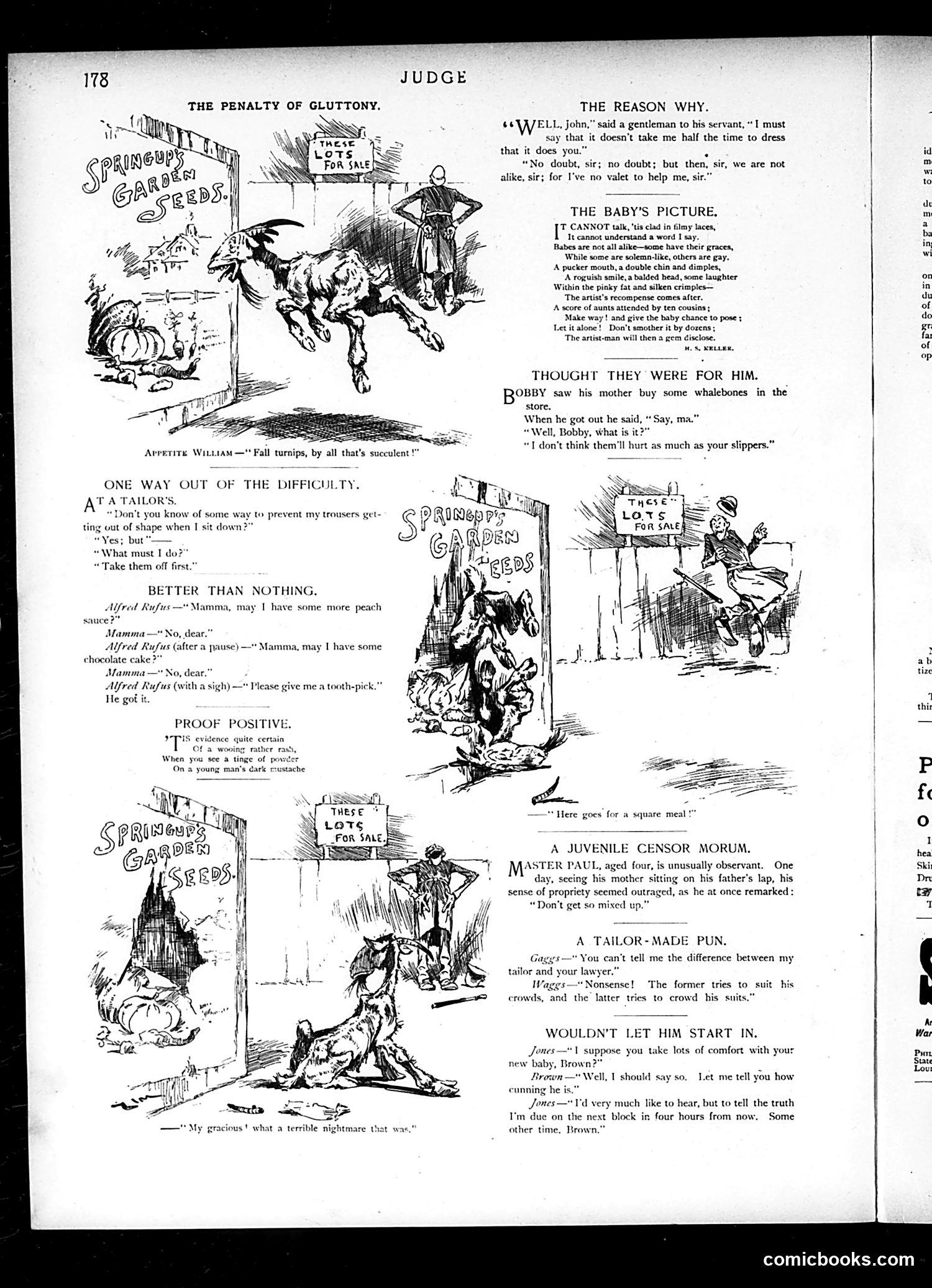
This page from *Judge* contains multiple brief humorous pieces targeting Victorian-era social conventions and behaviors: **"The Penalty of Gluttony"** depicts a well-dressed man struggling with an overindulgent lifestyle, satirizing wealthy men's excessive eating habits and the physical consequences. **"The Baby's Picture"** mocks the affectation of having formal portrait photographs taken of infants, poking fun at upper-class vanity and the gathering of relatives for such occasions. **"One Way Out of the Difficulty"** presents a tailor's practical solution to trouser maintenance—crude humor about class and domestic problems. **"Thought They Were For Him"** features innocent child misunderstanding, where young Bobby mistakes whalebone corset stays (women's undergarment stiffeners) for something else, playing on period propriety about discussing women's clothing. The remaining pieces use wordplay and domestic situations for gentle humor about marriage, servants, and everyday life. Overall, the page reflects *Judge*'s satirical approach to Victorian middle and upper-class manners, pretensions, and hypocrisies.
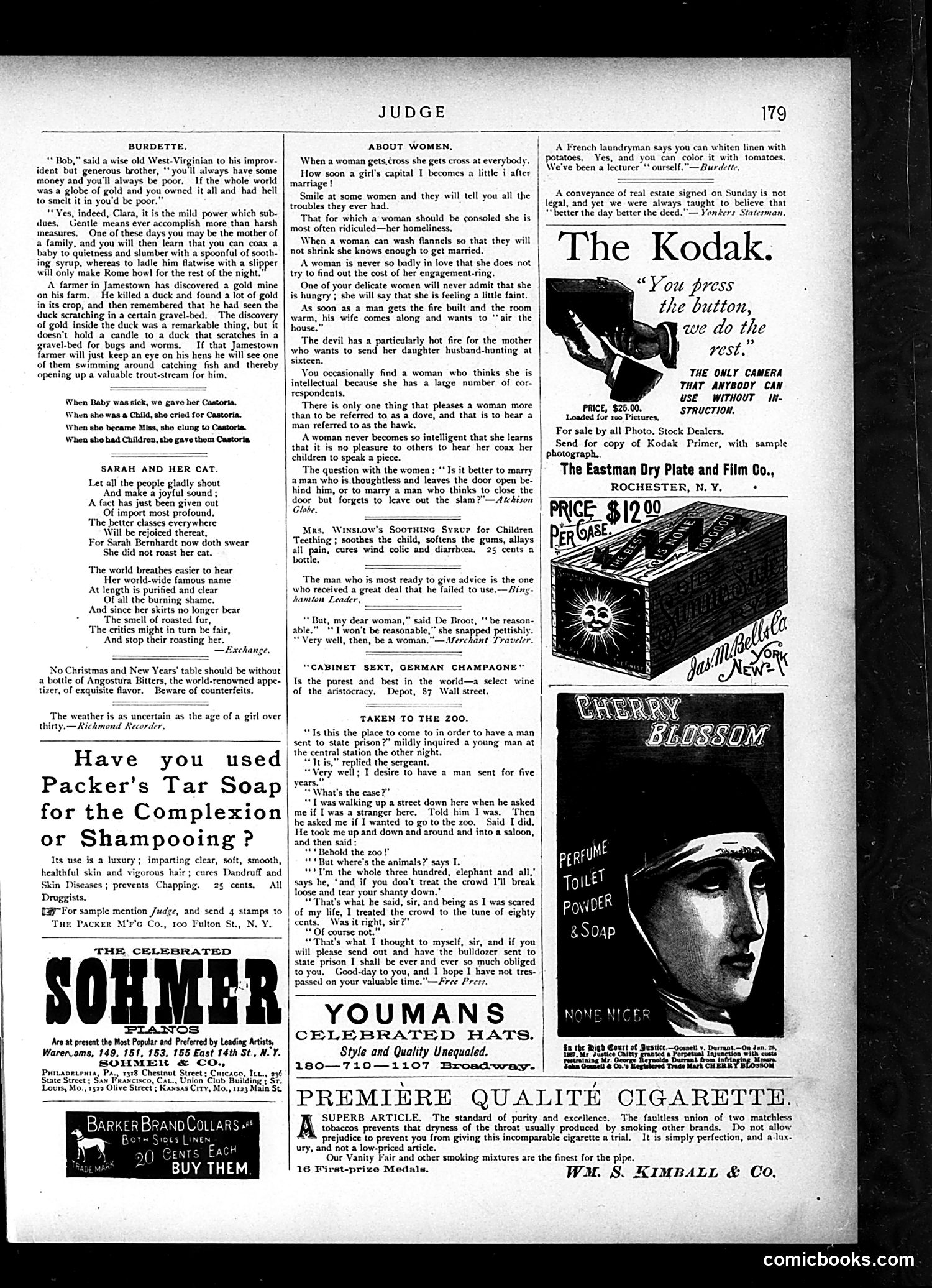
This page from Judge magazine (likely early 1900s) is primarily **advertising with brief satirical commentary** rather than political cartoons. The main content includes: **Satirical Sections:** - "Burdette" column: Humorous observations about generosity, parenting, and a tall tale about a duck finding gold - "Sarah and Her Cat": Mock-serious piece about actress Sarah Bernhardt, sarcastically "relieved" she didn't roast her cat (apparently a rumor damaging her reputation) - "About Women": Brief, dismissive quips mocking female behavior—typical of the era's condescending gender humor **Advertisements:** The page is dominated by product ads (Castoria, Packer's Tar Soap, Sohmer Pianos, Kodak cameras, perfume), reflecting Judge's revenue model. The humor relies on period-specific references (Bernhardt's notoriety, gender stereotypes) that require historical context. The "women" section exemplifies outdated sexist attitudes common to early 20th-century publications.
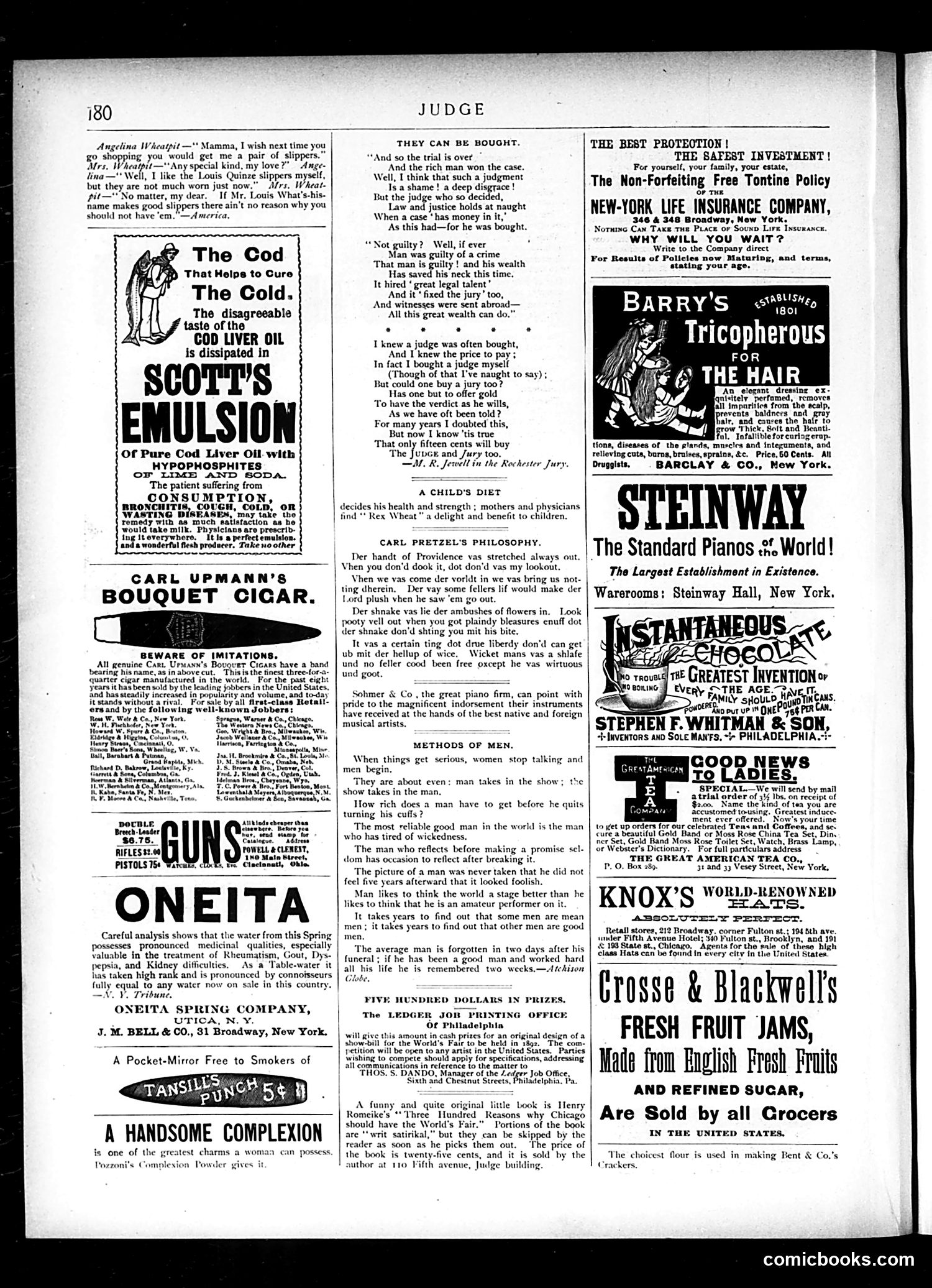
This page is primarily **advertising with one notable poem** satirizing judicial corruption. The main satirical content is a poem titled "They Can Be Bought," which attacks wealthy defendants who escape justice through bribery. The poem's narrator confesses to having personally purchased a judge and notes bitterly that juries can be bought for "only fifteen cents." The satire targets the American legal system's corruption during the Gilded Age, when wealth could literally purchase favorable verdicts. The concluding reference to "the Rochester Jury" suggests this references a specific, likely notorious case. The remainder of the page consists of period product advertisements (Scott's Emulsion cod liver oil, Carl Upmann cigars, Oneita spring water, Steinway pianos, etc.) and a humorous dialect piece featuring "Carl Pretzel's Philosophy"—ethnic humor using German-inflected English, common to Judge magazine's comedic conventions of the era. The page demonstrates how satirical magazines mixed serious social criticism with commercial advertising and ethnic comedy.
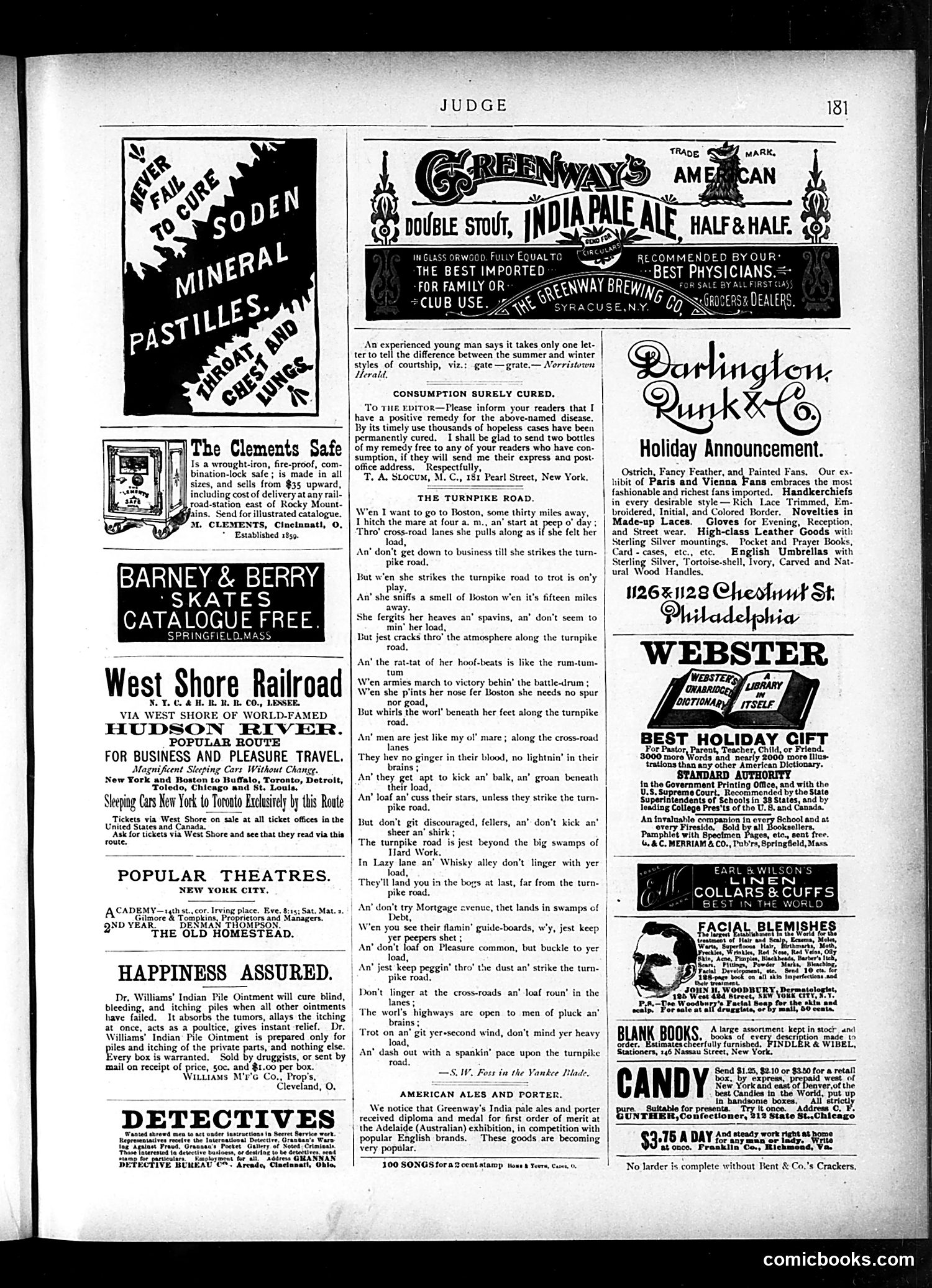
This page is primarily **advertising and filler content** from Judge magazine, not political satire. The layout features commercial ads (safes, skates, railroads, theatrical notices, patent medicines) surrounding two pieces of light entertainment: 1. **"The Turnpike Road"** — A dialect poem using extended metaphor. A farmer compares his mare's vigor on improved turnpike roads versus poor country lanes to how men need "progress" (metaphorical turnpikes) to succeed. The poem counsels against laziness ("Lazy Lane"), debt ("Mortgage Avenue"), and pleasure-seeking, advocating instead for hard work and self-improvement. This reflects **19th-century American values of industriousness and infrastructure development**. 2. **Brief jokes** about courtship styles and consumption (tuberculosis) remedies. The page reflects Judge's mixed model: serious satirical commentary elsewhere, but significant space devoted to paying advertisements and innocuous humor filler. Nothing here requires specialized historical knowledge beyond recognizing period attitudes toward work ethic and commerce.
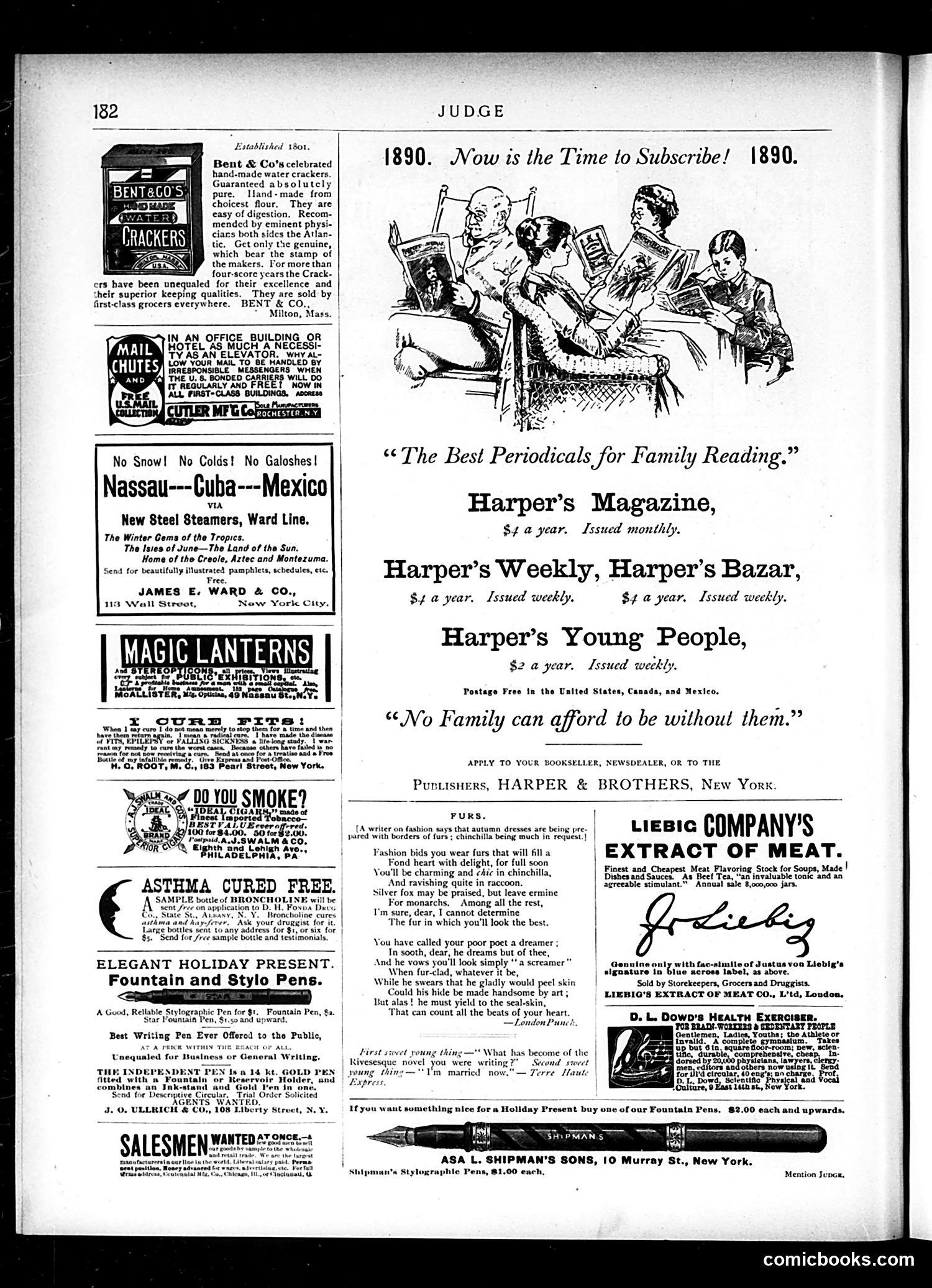
This is primarily an **advertising page** from Judge magazine, circa 1890, with minimal satirical content. The main visual element is a subscription appeal cartoon at top-center showing a family reading Harper's publications together, promoting the magazine line as "The Best Periodicals for Family Reading." The page is dominated by advertisements for consumer goods (crackers, steamship travel, magic lanterns, pens, furs, meat extract) and patent medicines typical of the era. One notable ad promotes "Broncholine" as an asthma cure—a common snake-oil remedy of the period. The only humor appears in brief dialogue snippets: a "First sweet young thing" joke about a writer abandoning her novel upon marriage, and a fashion poet praising furs (chinchilla and ermine). These reflect genteel 1890s magazine humor aimed at middle-class readers. The page demonstrates how 19th-century magazines sustained themselves through advertising revenue while promoting their own publications as essential household items.
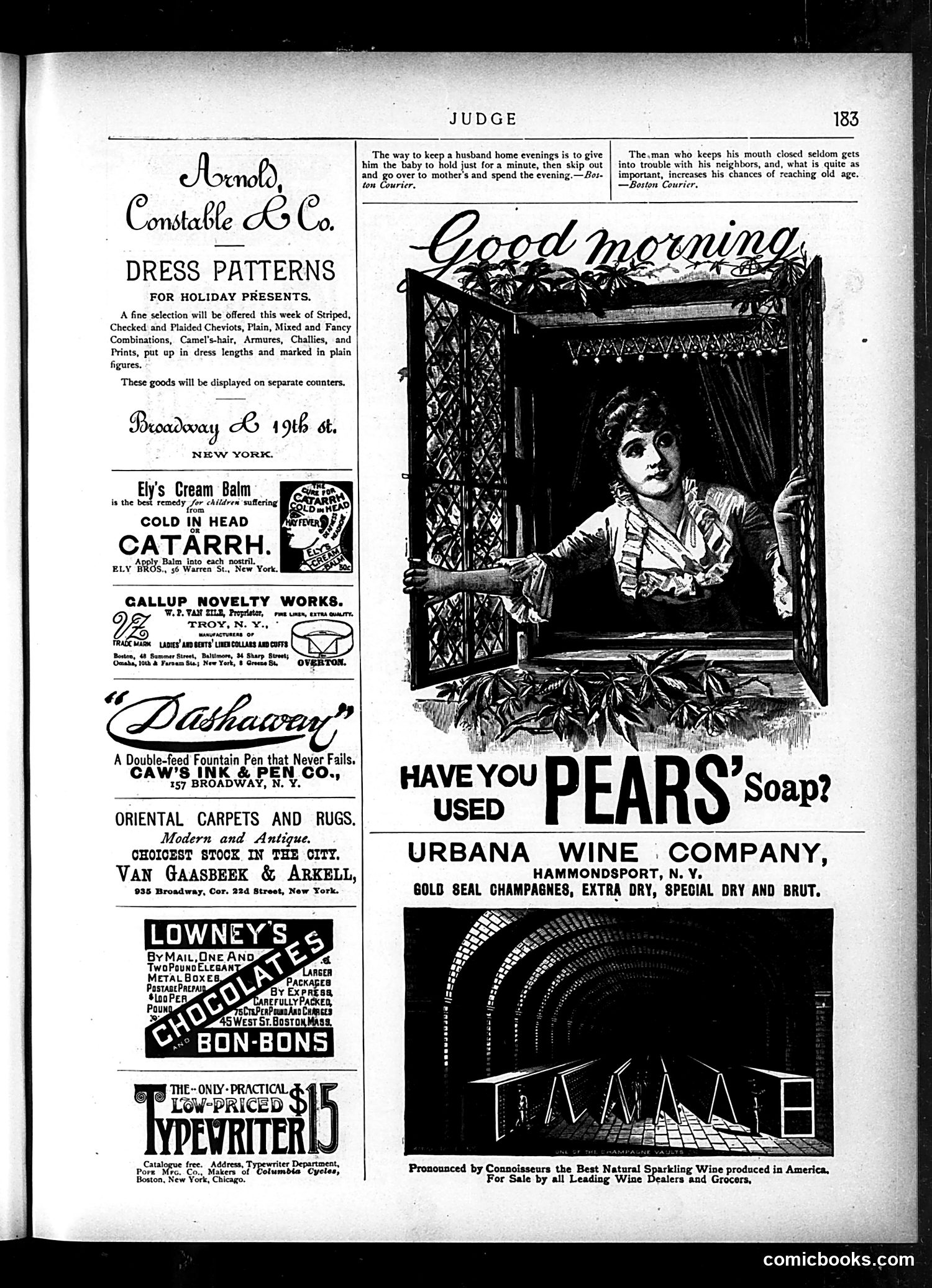
This page is primarily **advertising**, not satire or political commentary. The dominant content includes: - A large advertisement for **Pears' Soap** featuring an illustration of a woman at a window, using the slogan "Have You Used Pears' Soap?" - An advertisement for **Urbana Wine Company** champagne from Hammondsport, N.Y. - Multiple smaller ads for dress patterns, fountain pens, chocolates, Oriental carpets, and patent medicines (catarrh balm) The only editorial content consists of two brief **moral maxims** in quotation boxes—advice about keeping husbands home and the benefits of discretion. These appear to be filler humor typical of Judge's format. The page reflects late 19th/early 20th-century consumer culture and advertising conventions rather than political or social satire. No specific political figures or events are referenced or caricatured.
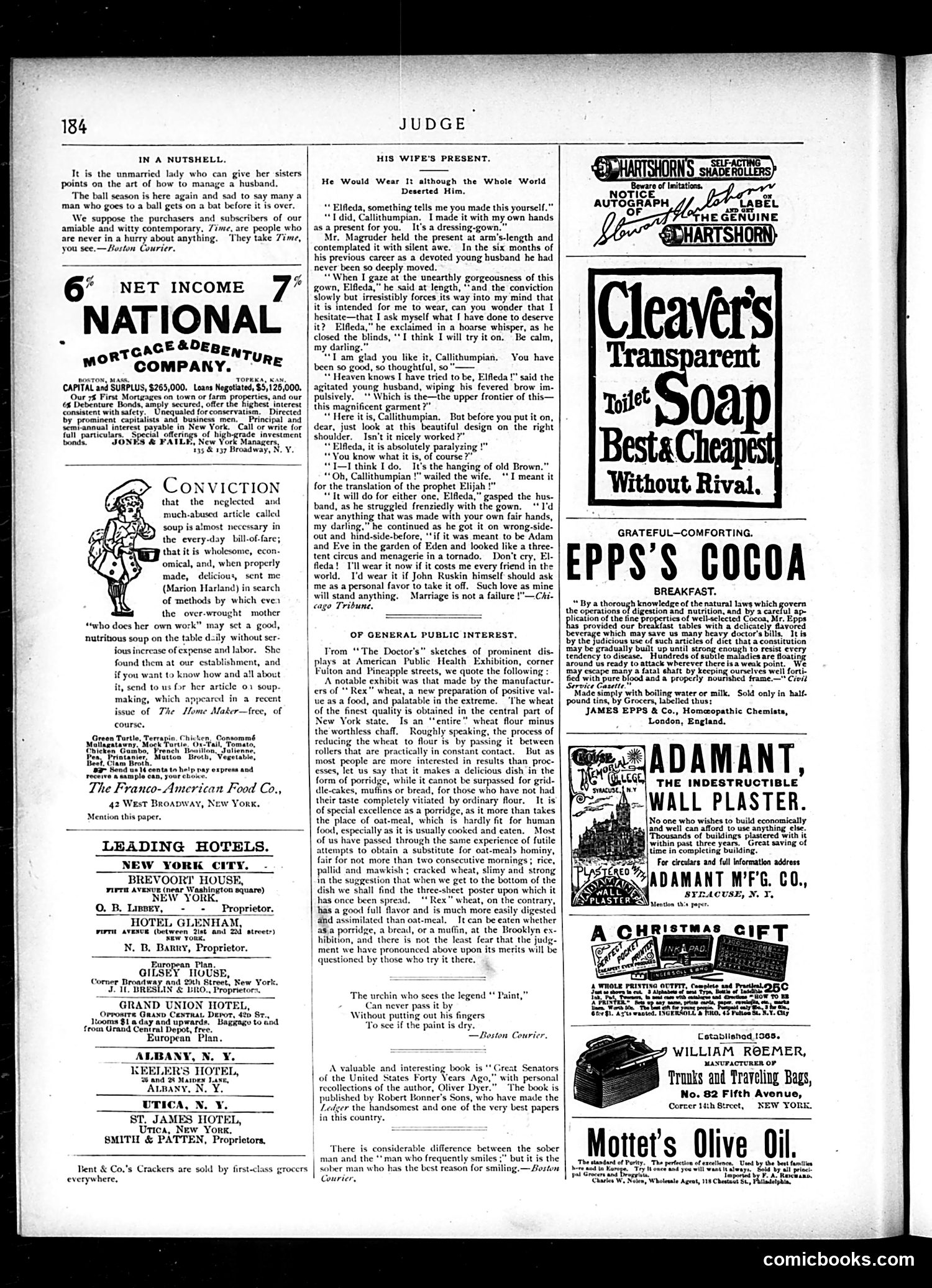
This page is primarily **advertisements and filler content** with one notable cartoon story. The main satirical piece is "HIS WIFE'S PRESENT," a humorous domestic sketch about a husband receiving a homemade dressing-gown from his wife Elfleda. The joke plays on **exaggerated sentimentality**: the husband Callithumpian treats the garment with mock-reverent, overwrought emotion ("I think I will try it on. Be calm, my darling"), treating a simple handmade gift as though it were a priceless treasure. The satire mocks both **sentimental Victorian domestic ideology** and the tendency of newlyweds to dramatize ordinary married life. The page's opening section "IN A NUTSHELL" contains brief satirical jibes—one mocking unmarried women's marital advice, another about drunken men at balls, and a dig at the magazine *Time* for being slow-paced. The remainder consists of hotel advertisements, investment company pitches, and product ads (soap, cocoa, olive oil)—typical of *Judge's* era advertising strategy.
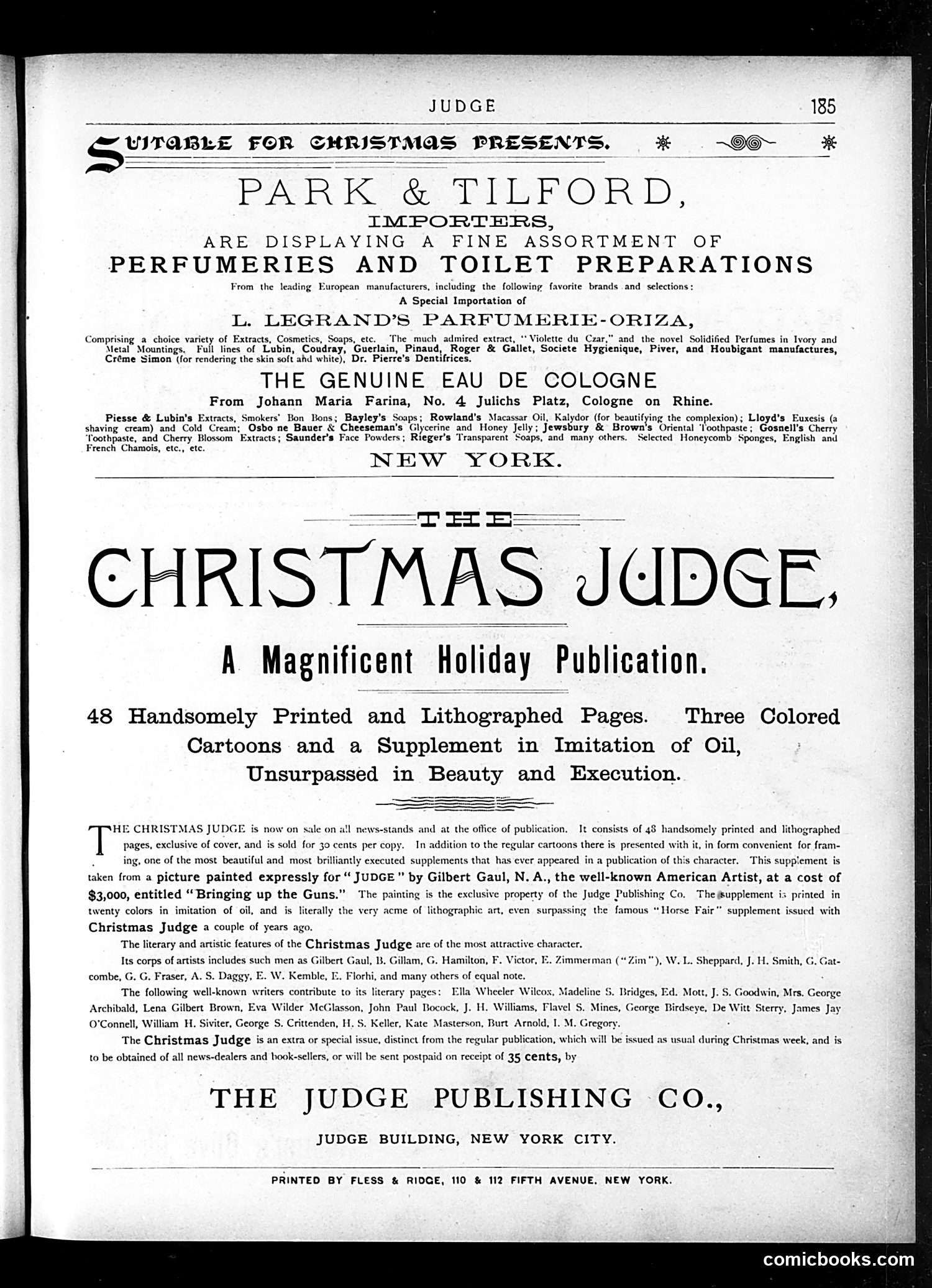
This page is primarily **advertising and promotional content**, not a political cartoon. It consists of two distinct sections: **Upper section:** An advertisement for Park & Tilford, importers displaying European perfumes and toiletries (Legrand's, Lubin, Guerlain, etc.) for Christmas gift-giving in New York. **Lower section:** A promotional announcement for *The Christmas Judge*, a special holiday edition of Judge magazine. It boasts 48 pages, three colored cartoons, and a costly supplement ($3,000 commissioned artwork titled "Bringing up the Guns" by artist Gilbert Gaul). The ad lists prominent artists and writers contributing to the issue, including E.W. Kemble and Ella Wheeler Wilcox, and announces the special issue costs 35 cents. **Historical context:** This represents Judge's commercial strategy—combining satirical content with luxury advertising to appeal to wealthy readers during the holiday season. The expensive artwork and celebrity contributors reflect Judge's status as a premium American humor publication in what appears to be the late 19th century.
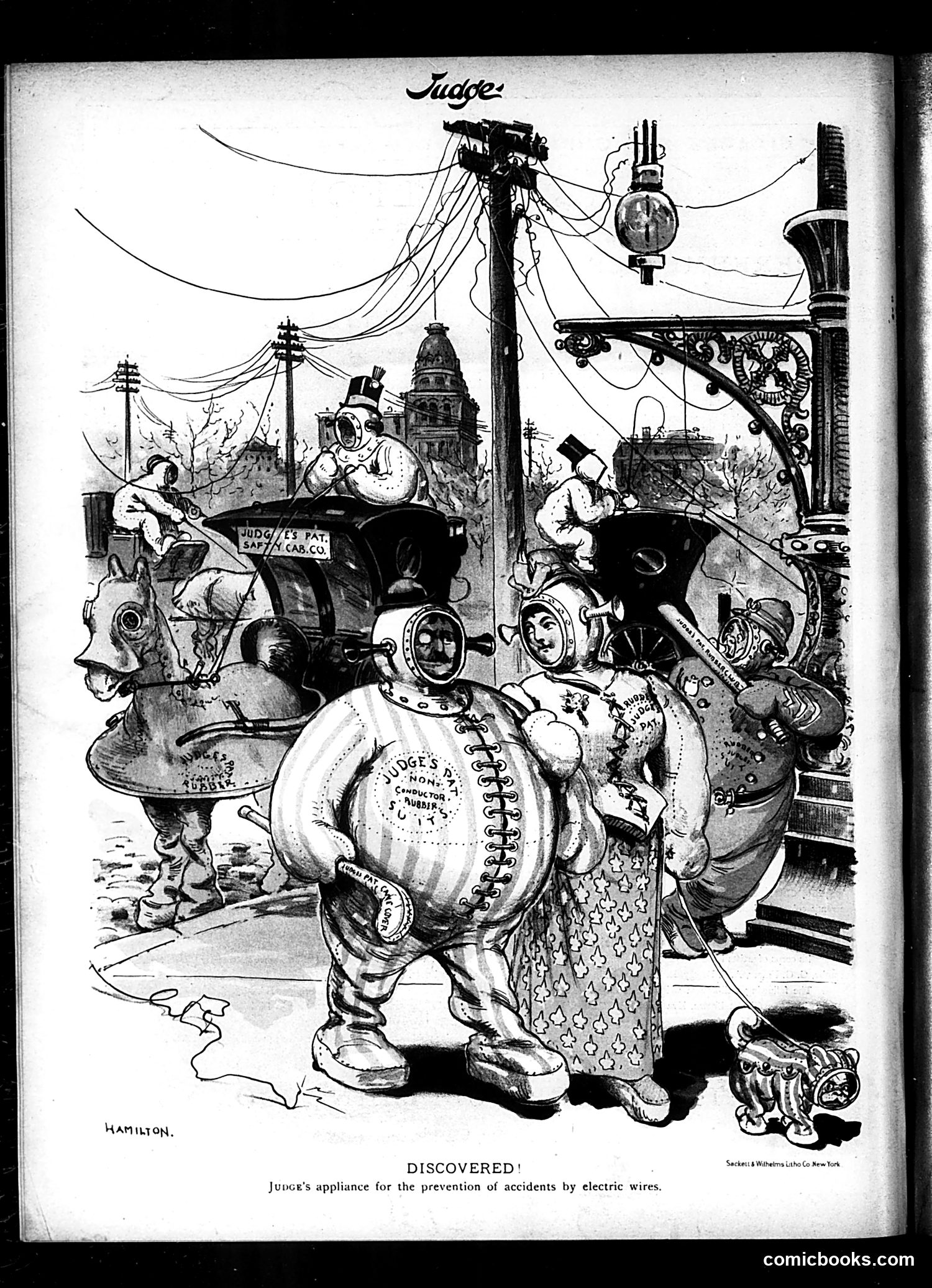
This political cartoon by Hamilton satirizes concerns about accidental electrocution from overhead electric wires, a genuine public hazard in early industrial America. The cartoon depicts absurdly oversized, padded "protective suits" worn by figures in an urban setting dense with electrical poles and wires. The suits are labeled "Judge's Patent" and resemble inflated balloons or armor. The satire works on two levels: it mocks both the genuine danger of unregulated electrical infrastructure AND the ridiculous "solutions" being proposed or marketed. Rather than addressing the root problem (safer wire design or installation standards), the cartoon suggests people simply accept the hazard and wear comical protective gear instead. The "discovery" is ironic—this impractical invention solves nothing while highlighting how the problem demands real regulatory action, not consumer workarounds.