
Judge, 1889-12-21 · page 2 of 18
Judge — December 21, 1889 — page 2: what you’re looking at
What you’re looking at
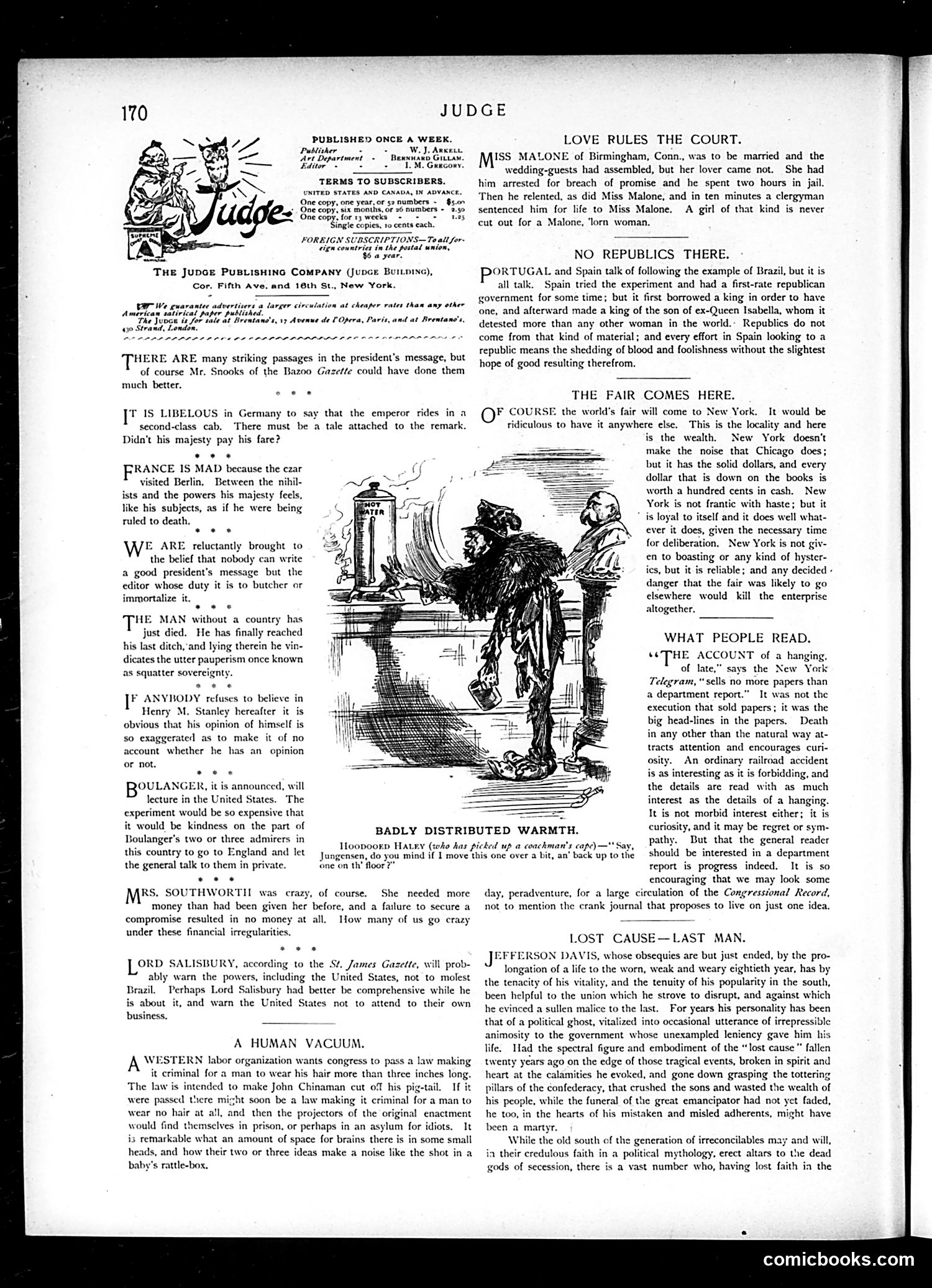
The main cartoon titled "BADLY DISTRIBUTED WARMTH" depicts a figure in ragged clothes standing near a water barrel or container, addressing someone inside. The accompanying caption references "Hoodford Haley (who picked up a coachman's cape)" saying "Say, Jingolum, do you mind if I move this over a bit, eh? back up to the one on front?" The satire appears to target **wealth inequality and class disparity** during the Gilded Age. The ragged figure likely represents the poor or working class seeking to share in warmth/resources, while the juxtaposition with discussion of a "coachman's cape" suggests contrast between wealthy and impoverished citizens. The cartoon's title ironically comments on how prosperity and comfort are unevenly distributed in society. The page also contains political commentary on various topics including republicanism and journalism standards.
📄 Transcribed text from this page (OCR, searchable)
Machine-transcribed from the original scan — historical spelling and the odd misread are preserved.
JUDGE PUBLISHED ONCE A WEEK. Publisher W. J. Amerie. ‘Art Department ~~ Bexxwano GILLan. Editor. = 1. M. Grecony. TERMS TO SUBSCRIBERS. UNITED STATES AND CANADA, IN ADVANCE. ign countries in the postal union, $6 @ year, THE JuDGE PUBLISHING CoMPANy (Jupce BurLpiNc), Cor. Fifth Ave. and 16th St., New York. We guarantee advertivers a larger circulation at cheaper rates than any other American satirical paper published. The Jubce is for sale at Brentano's, 17 Aver 400 Strand, London. 1 de POpera, Pavit, and at Brentano's, HERE ARE many striking passages in the president's message, but of course Mr. Snooks of the Bazoo Gazette could have done them much better, I" IS LIBELOUS in Germany to say that the emperor rides in a second-class cab. There must be a tale attached to the remark. Didn't his majesty pay his fare? eee RANCE IS MAD because the czar visited Berlin. Between the nihil- ists and the powers his majesty feels, like his subjects, as if he were being ruled to death, see E ARE reluctantly brought to the belief that nobody can write a good president's message but the editor whose duty it is to butcher or immortalize it. see HE MAN without a country has just died. He has finally reached his last ditch, ‘and lying therein he vin- dicates the utter pauperism once known as squatter sovereignty. [F ANYBODY refuses to believe in Henry M. Stanley hereafter it is obvious that his opinion of himself is so exaggerated as to make it of no account whether he has an opinion or not. BOULANGER, it is announced, will lecture in the United States. The experiment would be so expensive that it would be kindness on the part of Boulanger’s two or three admirers in this country to go to England and let the general talk to them in priv: eee MBs: SOUTHWORTII was crazy, of course. She needed more money than had been given her before, and a failure to secure compromise resulted in no money at all. How many of us go craz; under these financial irregularities. ORD SALISBURY, according to the St. James Gazette, will prob- ably warn the powers, including the United States, not to molest Brazil. Perhaps Lord Salisbury had better be comprehensive while he is about it, and warn the United States not to attend to their own business. A HUMAN VACUUM. RN labor organization wants congress to pass a law making it criminal for a man to wear his hair more than three inches long. The law is intended to make John Chinaman cut off h iit were passed there might soon be a law making it criminal for a man to wear no hai 1, and then the projectors of the original enactment would find in prison, or perhaps in an asylum for idiots. It is remarkable what an amount of space for brains there is in some small and how their two or three ideas make a noise like the shot in 2 baby’s rattle-box. g-tail., BADLY DISTRIBUTED WARMTH. Hoopoorp Hate Jungensen, do one on th’ floor ?” who has picked up a coachman's cape)—"* Say, mind if 1 move this one over a bit, an’ back up to the LOVE RULES THE COURT. ISS MALONE of Birmingham, Conn., was to be married and the wedding-guests had assembled, but her lover came not. She had him arrested for breach of promise and he spent two hours in jail. ‘Then he relented, as did Miss Malone, and in ten minutes a clergyman sentenced him for life to Miss Malone. A girl of that kind is never cut out for a Malone, ‘lorn woman. NO REPUBLICS THERE. PORTUGAL and Spain talk of following the example of Brazil, but it is all talk. Spain tried the experiment and had a first-rate republican government for some time; but it first borrowed a king in order to have one, and afterward made a king of the son of ex-Queen Isabella, whom it detested more than any other woman in the world.- Republics do not come from that kind of material; and every effort in Spain looking to a republic means the shedding of blood and foolishness without the slightest hope of good resulting therefrom. THE FAIR COMES HERE. OF COURSE the world’s fair will come to New York. It would be idiculous to have it anywhere else. This is the locality and here is the wealth. New York doesn’t make the noise that Chicago does; but it has the solid dollars, and every dollar that is down on the books is worth a hundred cents in cash. New York is not frantic with haste; but it is loyal to itself and it docs well what- ever it does, given the necessary time for deliberation, New York is not giv- en to boasting or any kind of hyster- ics, but it is reliable; and any decided - danger that the fair was likely to go elsewhere would kill the enterprise altogether. WHAT PEOPLE READ. sTHE ACCOUNT of a hangin, of late,” says the New Yoo Telegram, “sells no more papers than a department report.” It was not the execution that sold papers; it was the big head-lines in the papers. Death in any other than the natural way at- tracts attention and encourages curi- osity. An ordi ailroad accident is as interesting as it is forbidding, and the details are read with as much interest as the details of a hanging. It is not morbid interest cither; it is curiosity, and it may be regret or sym- pathy. But that the general reader should be interested in a department report is progress indeed. It is so encouraging that we may look some day, peradventure, for a large circulation of the Congressional Record, not to mention the crank journal that proposes to live on just one idea. LOST CAUSE—LAST MAN. EFFERSON DAVIS, whose obsequies are but just ended, by the pro- longation of a life to the worn, weak and weary eightieth year, has by the tenacity of his vitality, and the tenuity of his popularity in the south, been helpful to the union which he strove to disrupt, and against which he evinced a sullen malice to the last. For years his personality has been that of a political ghost, vitalized into occasional utterance of irrepressible animosity to the government whose unexampled leniency gave him his life. Had the spectral figure and embodiment of the “lost cause" fallen twenty years ago on the edge of those tragical events, broken in spirit and heart at the calamities he evoked, and gone down grasping the tottering pillars of the confederacy, that crushed the sons and wasted the wealth of his people, while the funeral of the great emancipator had not yet faded, he too, in the hearts of his mistaken and misled adherents, might have been a marty While the old south of the generation of irreconcilables may and will, in their credulous faith in a political mythology, erect altars to the dead gods of secession, there is a vast number who, having lost faith ia the comicbooks.com