
A complete issue · 18 pages · 1889
Judge — November 30, 1889
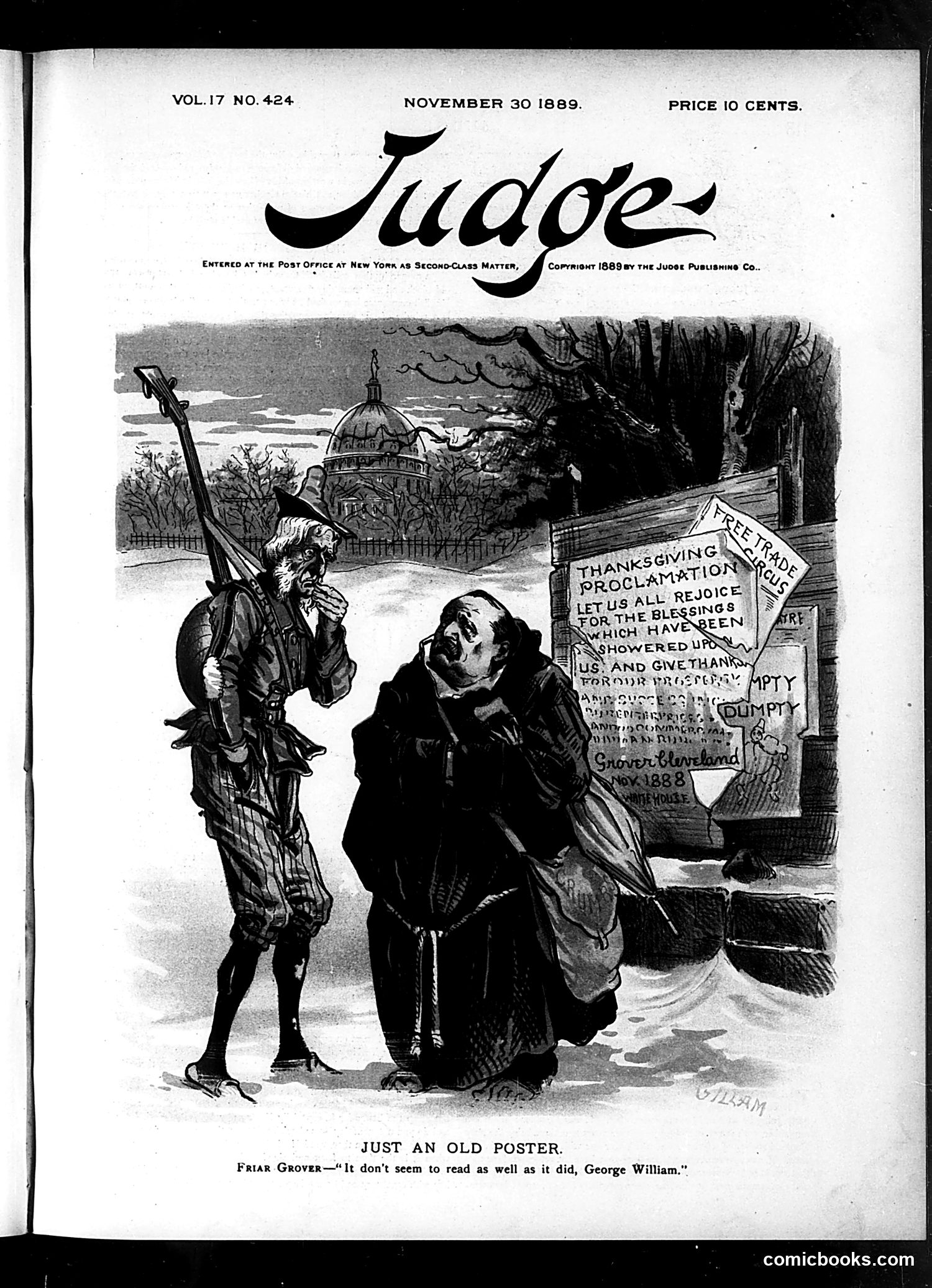
This November 1889 *Judge* cartoon satirizes a Thanksgiving proclamation. A figure identified as "Friar Grover" (referencing President Grover Cleveland) holds an old, weathered poster proclaiming thanksgiving blessings and prosperity. The poster appears tattered and outdated, with text mentioning "Free Trade" and references to Cleveland's administration. The satire mocks Cleveland's Thanksgiving proclamation as hollow rhetoric disconnected from reality. The worn, damaged poster suggests his words ring false or have aged poorly. The reference to "free trade" indicates this likely critiques Cleveland's tariff policies, which opponents blamed for economic hardship. The friar costume implies religious hypocrisy—preaching gratitude while policies harm citizens. The Capitol building visible in the background anchors this as political commentary on federal leadership.
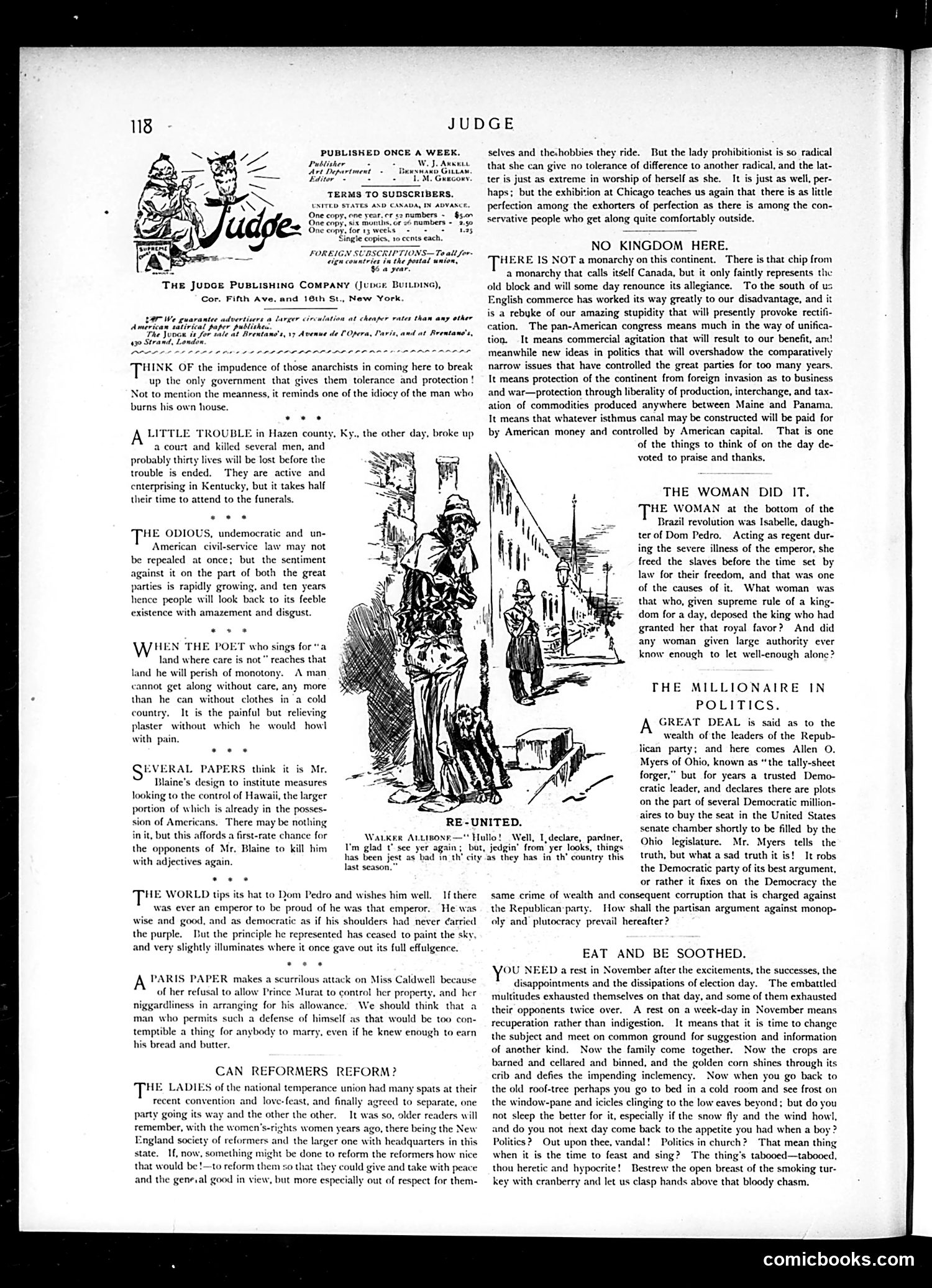
This page contains multiple political commentary pieces rather than a unified cartoon. Key sections include: **"No Kingdom Here"** criticizes pan-American Congress proposals, opposing commercial unification and protection policies that would benefit American interests over other nations. **"The Woman Did It"** references the Brazilian revolution, crediting a woman (Isabella, daughter of Dom Pedro) with freeing slaves and deposing the emperor—attributing major political upheaval to female action. **"The Millionaire in Politics"** discusses Republican wealth and alleged Democratic plots to buy Senate seats, satirizing corruption in both parties. Other brief items mock anarchists, Kentucky violence, and reformers' ineffectiveness. The overall tone is satirical commentary on contemporary American and international politics, targeting both major parties and progressive movements.
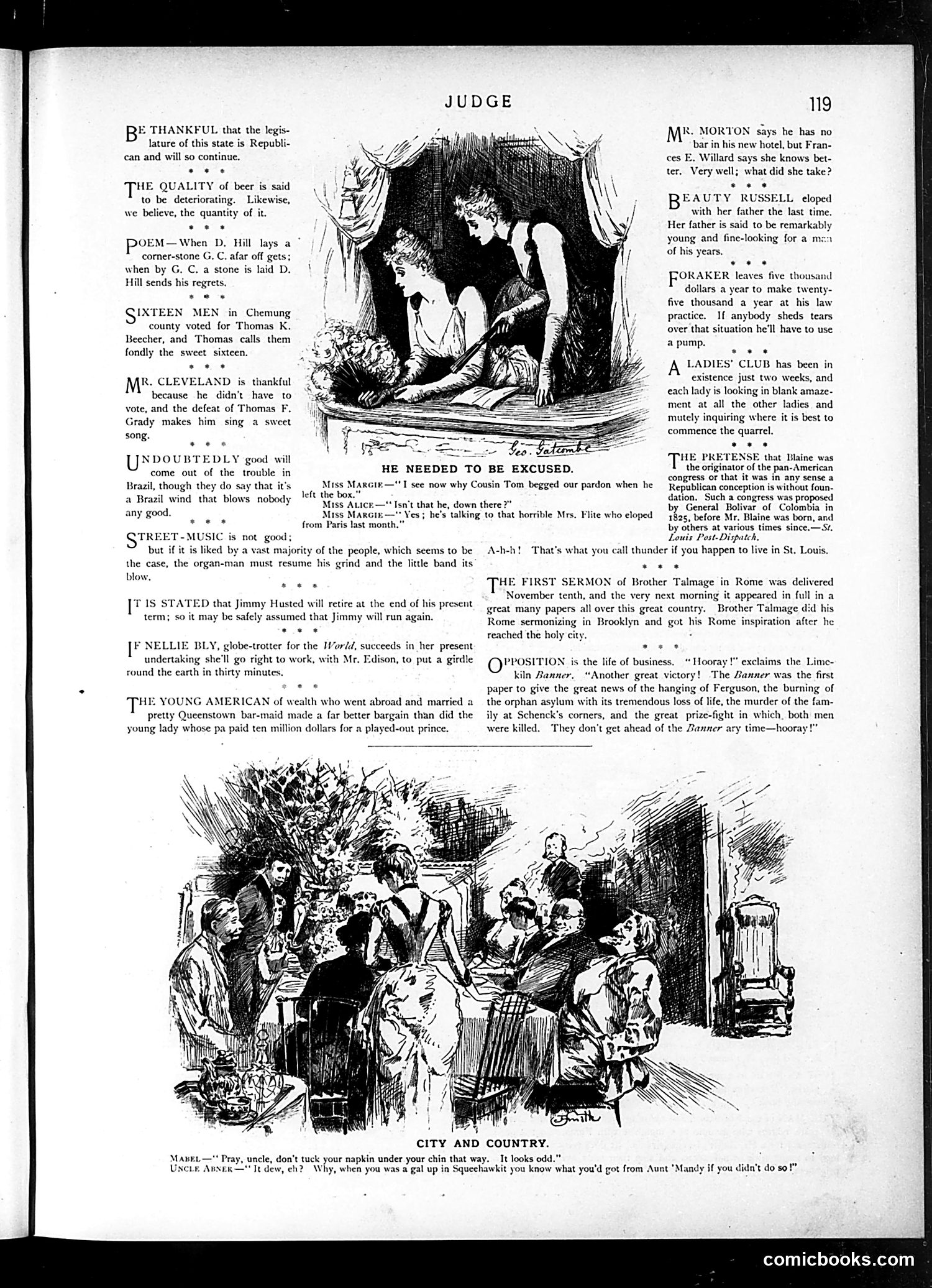
This page contains miscellaneous satirical commentary typical of Judge magazine's format. Key items include: **Political/Social Jabs:** - Mocking Cleveland's thankfulness for not voting, and a swipe at Thomas F. Grady - Commentary on D. Hill and G.C. (likely local political figures) exchanging regrets over cornerstone-laying ceremonies - Criticism of the "pan-American congress" pretense, attributing the idea to Bolivar (1825) rather than Blaine **Social Satire:** - Nellie Bly (the famous globe-trotter) joked about circling Earth in thirty minutes with Edison - A wealthy American who married an Irish barmaid made a better deal than a girl whose father paid ten million for a "played-out prince" - A new ladies' club where members distrust each other immediately **Humor:** - Beer quality declining along with quantity - Lawyer earning $25,000/year from $5,000 practice - Lower illustration: country manners ("Mandy") versus city etiquette The page reflects Gilded Age concerns: political patronage, wealth disparities, and changing social customs.
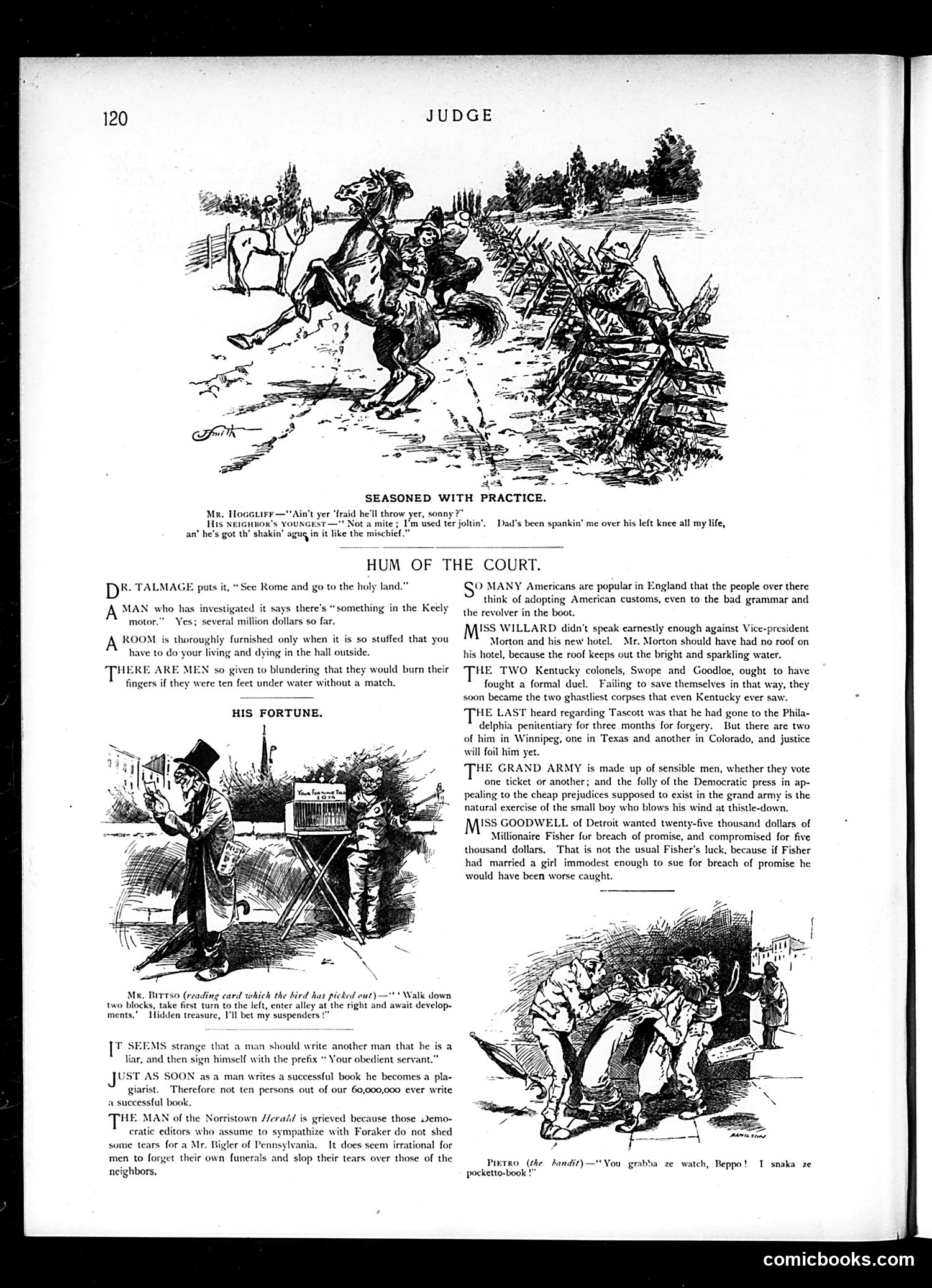
This page from Judge contains multiple satirical items mocking American society and politics of the era (likely 1880s-90s based on style). The top cartoon depicts a horse-riding mishap, with the caption "Seasoned with Practice"—satirizing inexperienced riders. "Hum of the Court" collects brief witticisms poking fun at American foibles: the Keely motor (a famous fraudulent perpetual-motion device that defrauded investors), overcrowded rooms, and wasteful habits. "His Fortune" mocks the practice of treasure-hunting through absurd directions. The remaining quips target: American writers' pretensions, Democratic newspaper hypocrisy regarding Congressman Foraker, American tourists' loud behavior abroad, Vice-President Morton, Kentucky feuds (the Swope-Goodloe case), a criminal named Tascott, and a breach-of-promise lawsuit. The bottom cartoon shows an Italian bandit robbing someone—ethnic stereotyping typical of the era. Overall, Judge satirizes American greed, incompetence, violence, and moral hypocrisy.
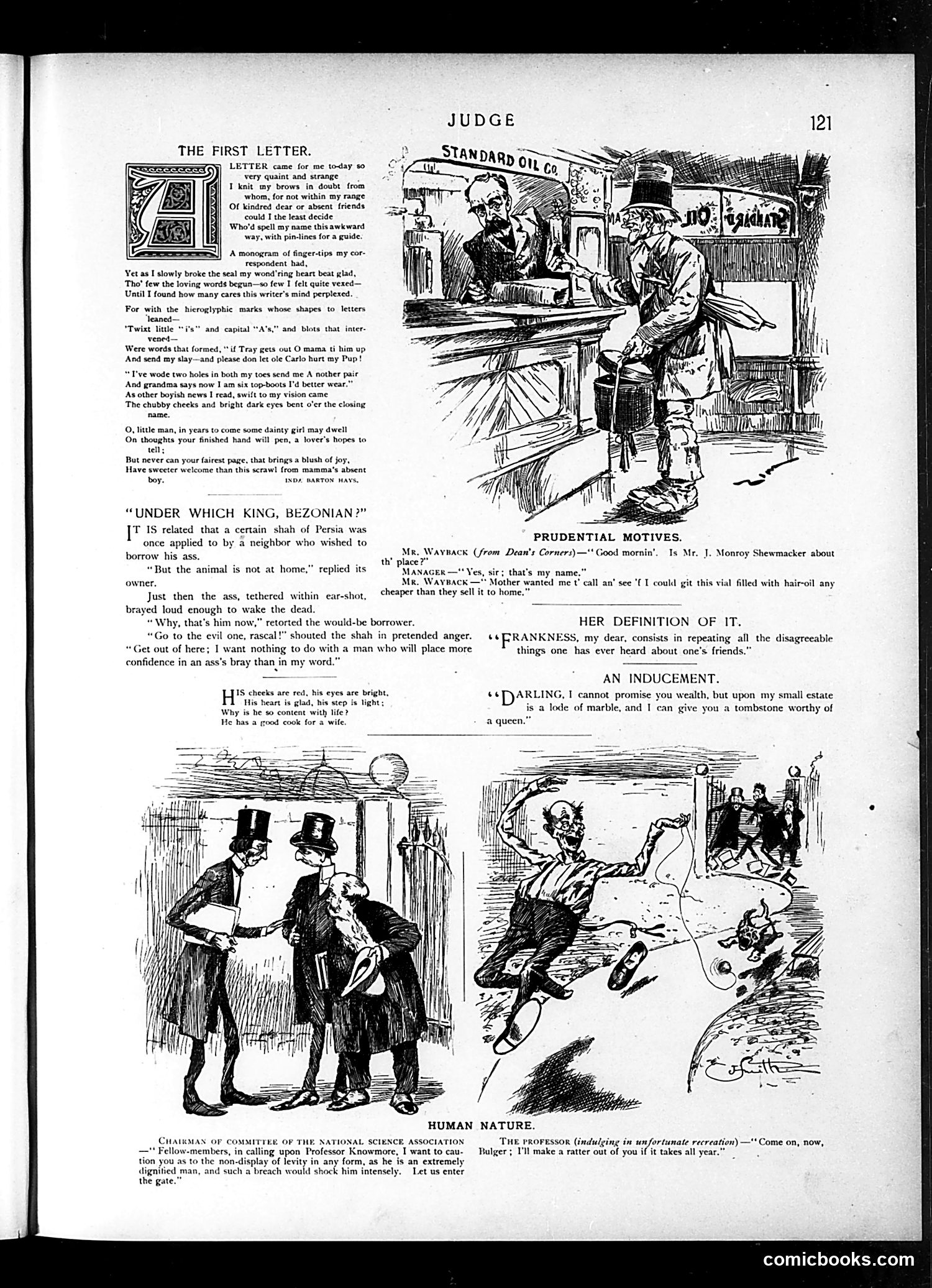
This page from Judge magazine contains several satirical cartoons and humorous pieces mocking Victorian social conventions and human nature. **"The First Letter"** sentimentally depicts a mother reading her young son's poorly spelled letter—charming precisely because of its childish imperfection and concern for pets and worn-out boots. **"Under Which King, Bezonian?"** adapts a Persian anecdote: a neighbor borrows a man's donkey, but the owner denies it's home. When the ass brays, proving otherwise, the owner refuses further dealings, saying he won't trust a man who believes an animal's noise over his word—satirizing absurd pride and stubbornness. **"Prudential Motives," "Her Definition of It,"** and **"An Inducement"** are brief joke vignettes mocking social hypocrisy: a woman's definition of "frankness" as gossiping about friends; a suitor's unromantic offer of a marble tombstone instead of wealth. **"Human Nature"** shows a pompous academic committee chairman warning against levity before visiting Professor Knowmore, then the professor himself joking about making a "ratter" (gambler) from someone—hypocrisy about dignity.
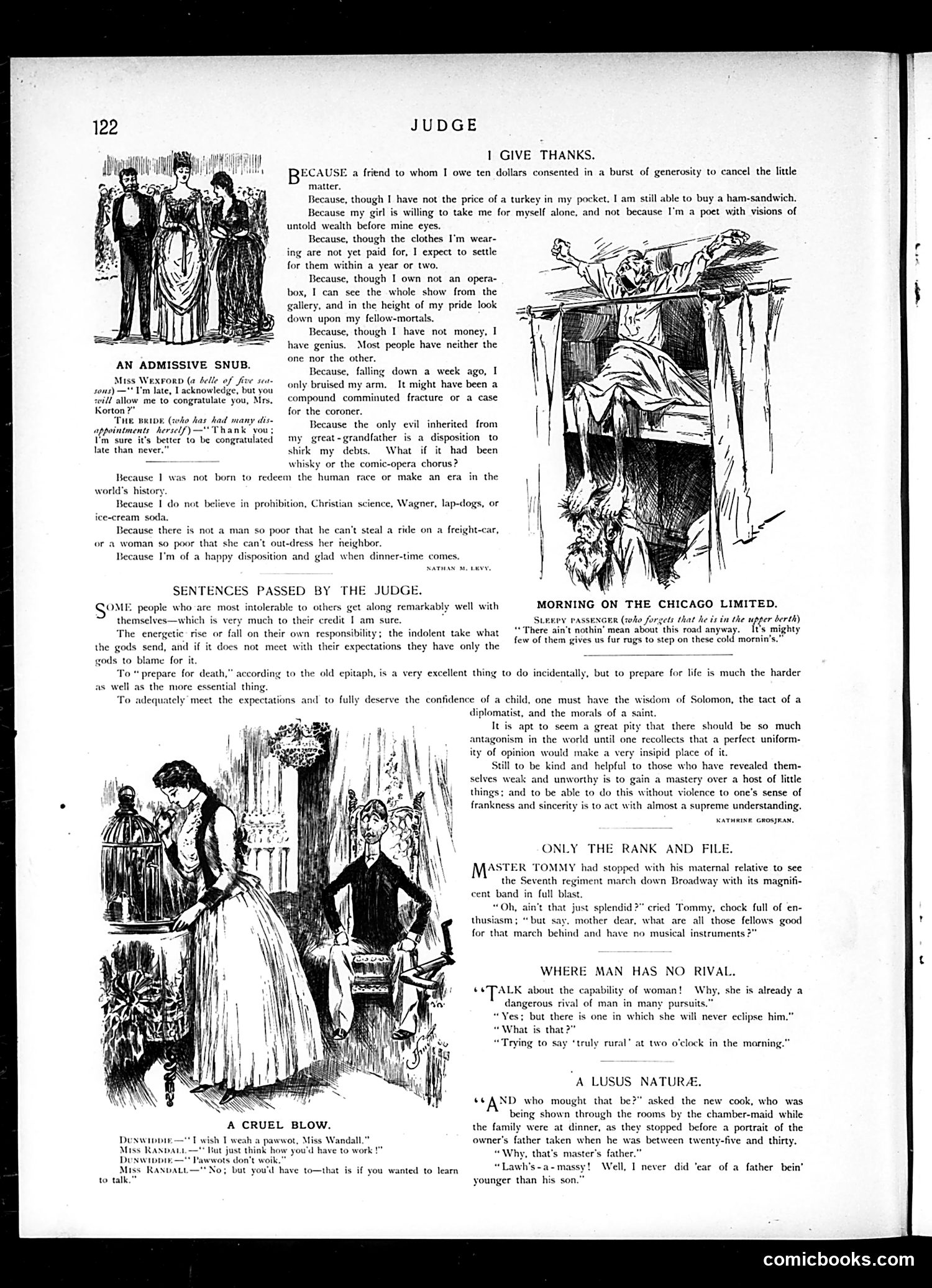
This page from Judge contains several satirical pieces mocking American social pretensions and gender dynamics circa the Gilded Age. **"I Give Thanks"** uses ironic gratitude to skewer materialism—the narrator thanks God for debts, unpaid clothes, and lack of wealth, while boasting of "genius" and stealing freight-car rides. The satire attacks both poverty and the self-deception of those who rationalize their circumstances. **"An Admissive Snub"** depicts a woman congratulating Mrs. Korton late, claiming tardiness is better than never. The joke plays on social awkwardness and hollow politeness. **"Only the Rank and File"** shows a boy asking why marching soldiers without instruments serve any purpose—satirizing military spectacle and the expendability of ordinary soldiers versus officers. **"Where Man Has No Rival"** presents a conversation about women's capability, with a punchline (cut off) suggesting one area where women supposedly cannot equal men—likely a sexist joke reflecting period attitudes. The illustrations are typical Judge cartoon style, mocking American social conventions, class anxiety, and gender relations.
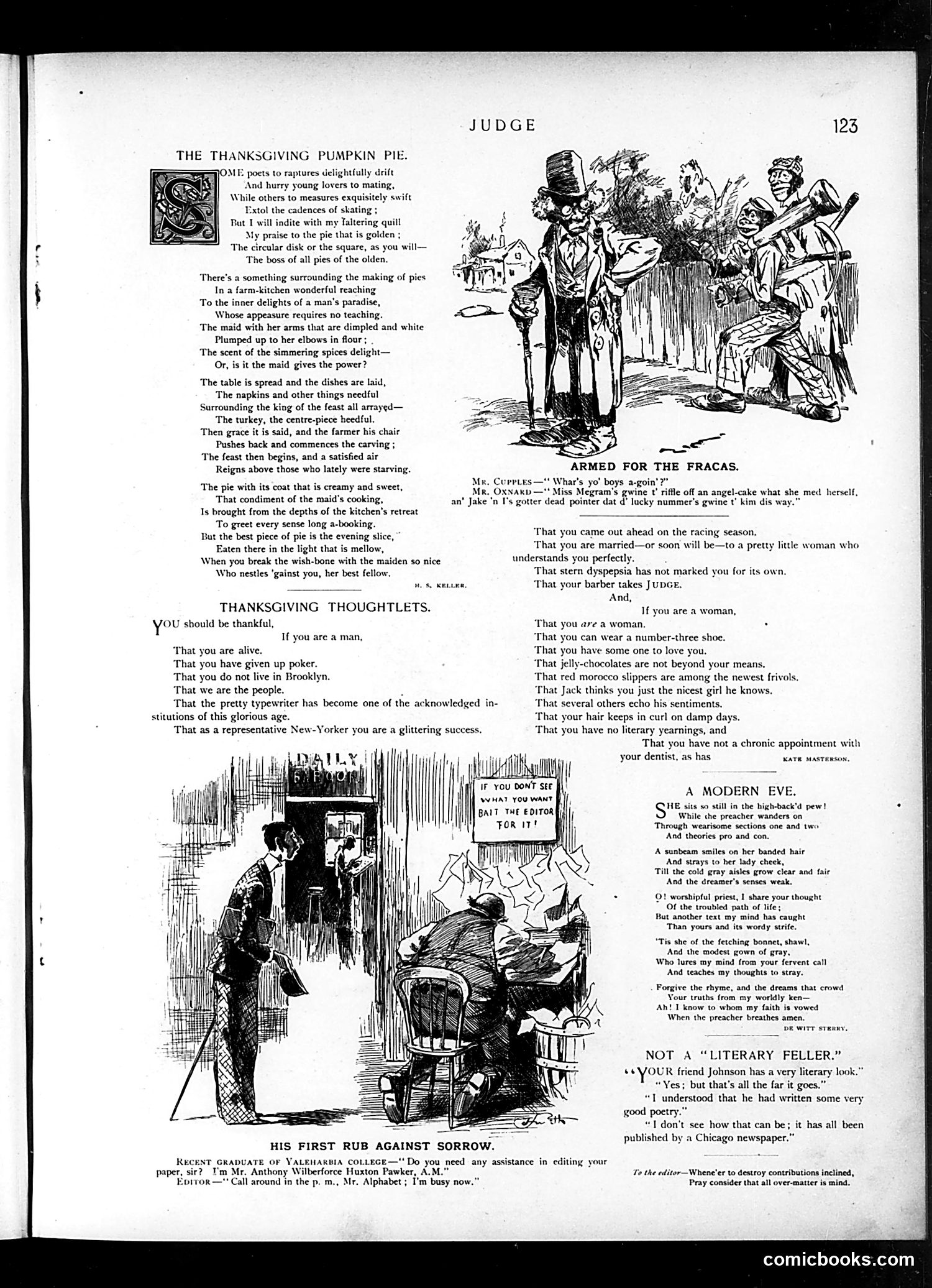
This page contains satirical poetry and humor typical of Judge's social commentary. **"The Thanksgiving Pumpkin Pie"** is nostalgic verse praising traditional holiday fare, celebrating the farmer's table and—with mild innuendo—the farmer's daughter. It represents turn-of-the-century sentimentalism about rural American life. **"Thanksgiving Thoughtlets"** offers backhanded gratitude: New Yorkers should be thankful they don't live in Brooklyn (inter-city rivalry), that typewriters exist (commenting on women entering the workplace), and satirizes materialism—chocolate, slippers, romantic attention. **"Armed for the Fracas"** depicts African American characters discussing a baking competition, rendered in period dialect. The term "fracas" (fight) humorously exaggerates the stakes of domestic competition, reflecting era-typical racial caricature conventions. **"A Modern Eve"** moralizes about a distracted church-goer—a woman whose thoughts wander from the sermon to a man, played for gentle comedy about romantic distraction versus spiritual devotion. The overall tone is lighthearted social satire aimed at upper-middle-class readers.
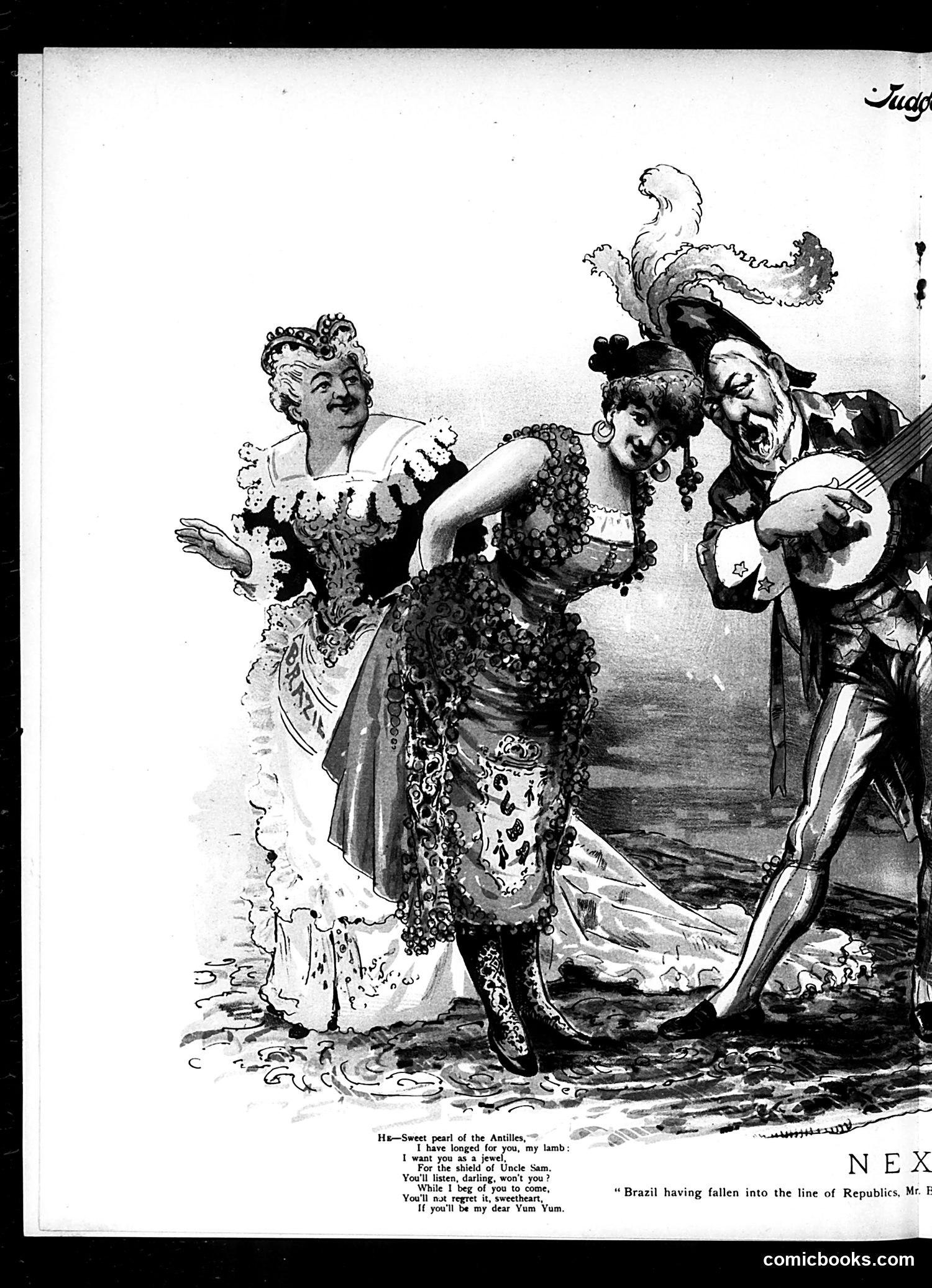
This Judge magazine cartoon satirizes American imperial ambitions following Brazil's transition to a republic. The figure on the right (likely representing the United States, with "Uncle Sam" referenced in the text) attempts to seduce a woman representing Cuba or the Caribbean ("Pearl of the Antilles"), speaking in romantic, possessive language about acquiring her as a "jewel" for America's "shield." The satire mocks U.S. foreign policy that treats nations as desirable acquisitions rather than sovereign entities. The reference to Brazil becoming a republic suggests timing during the late 19th century when the U.S. pursued Caribbean and Latin American expansion. The crude romanticization—addressing the island-nation as "sweetheart" and "Yum Yum"—ridicules American paternalism and territorial ambition disguised as benevolent interest. The attendant figures likely represent other imperial powers or interests competing for influence in the region.
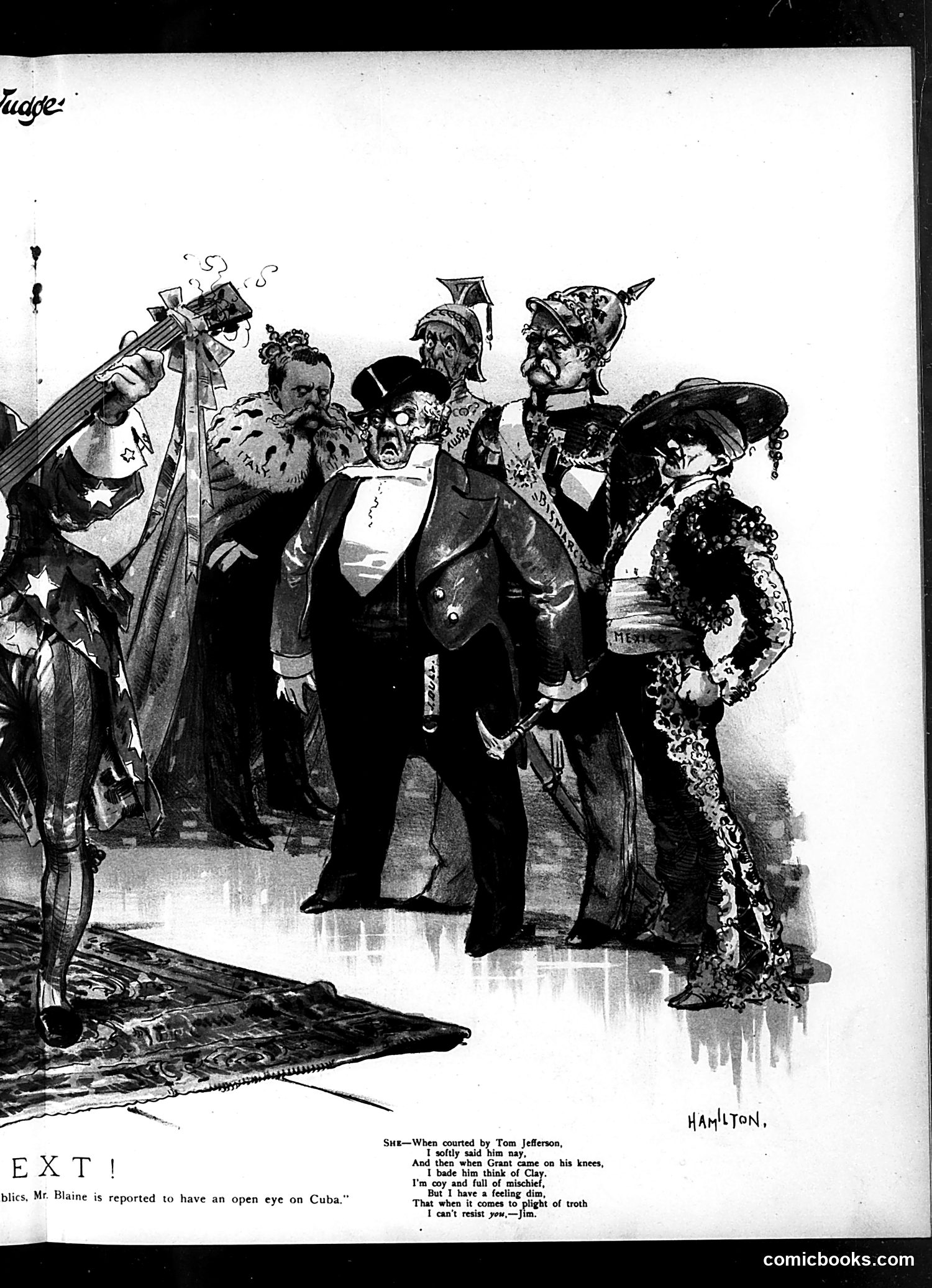
This appears to be a satirical cartoon about U.S. interest in Cuba. The figures represent American political leaders who have pursued Cuba as a territorial goal: - **"She" (Cuba)**, personified as a coquettish woman in elaborate dress, playfully rejects suitors - **Tom Jefferson** and **Grant** represent past presidents who sought Cuba - **"Jim"** likely refers to James G. Blaine, mentioned in the OCR text as having "an open eye on Cuba" The satire mocks American imperial ambitions by depicting Cuba as a woman leading politicians on romantically. Cuba teases that she'll finally capitulate to "Jim" (Blaine's administration), suggesting the U.S. will eventually acquire Cuba through persistent diplomatic pressure. This reflects late 19th-century American expansionism—the magazine criticizes both Cuba's coyness and American officials' repeated attempts at annexation.
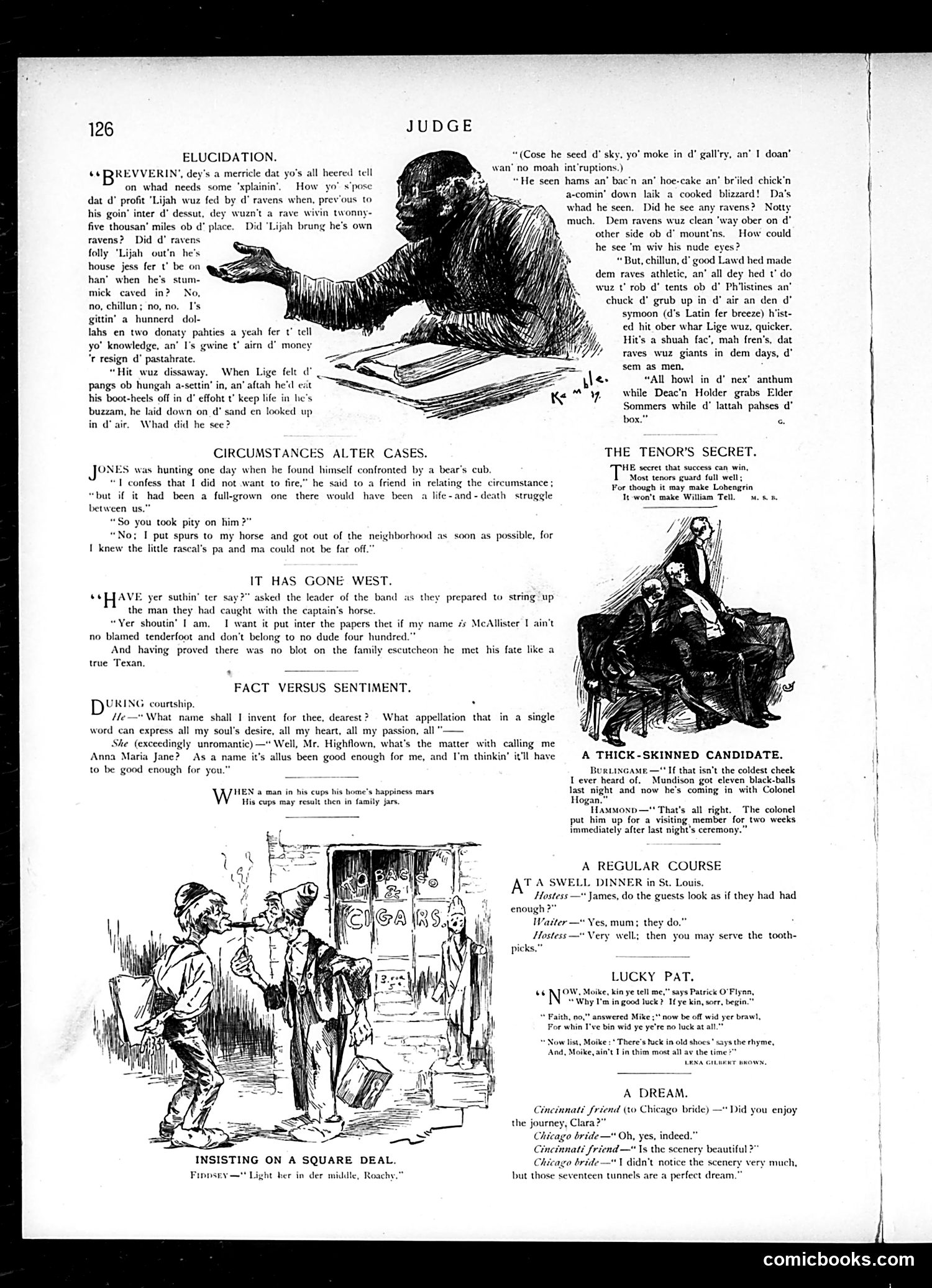
This page from *Judge* contains several satirical sketches mocking American social types and behaviors circa the Gilded Age. **"Elucidation"** features a Black preacher delivering a folk sermon reinterpreting the Biblical story of Elijah fed by ravens—a crude racial caricature using dialect to mock religious interpretation. The joke appears to be the preacher's absurd "scientific" explanation of how ravens could deliver food. **"Circumstances Alter Cases"** mocks a man's cowardice: he killed a bear cub without hesitation, but fled when realizing the parents were nearby—inverting expected bravery. **"It Has Gone West"** satirizes Western lynch-mob brutality and masculine pride: a condemned man's final concern is proving to the crowd he's not a "tenderfoot" or "dude." **"Fact Versus Sentiment"** contrasts romantic courtship posturing with pragmatic marriage reality. **"A Thick-Skinned Candidate"** mocks political ambition: a man blackballed from a club immediately seeks membership in another with different standards. The page reflects period anxieties about authenticity, social climbing, and regional character.
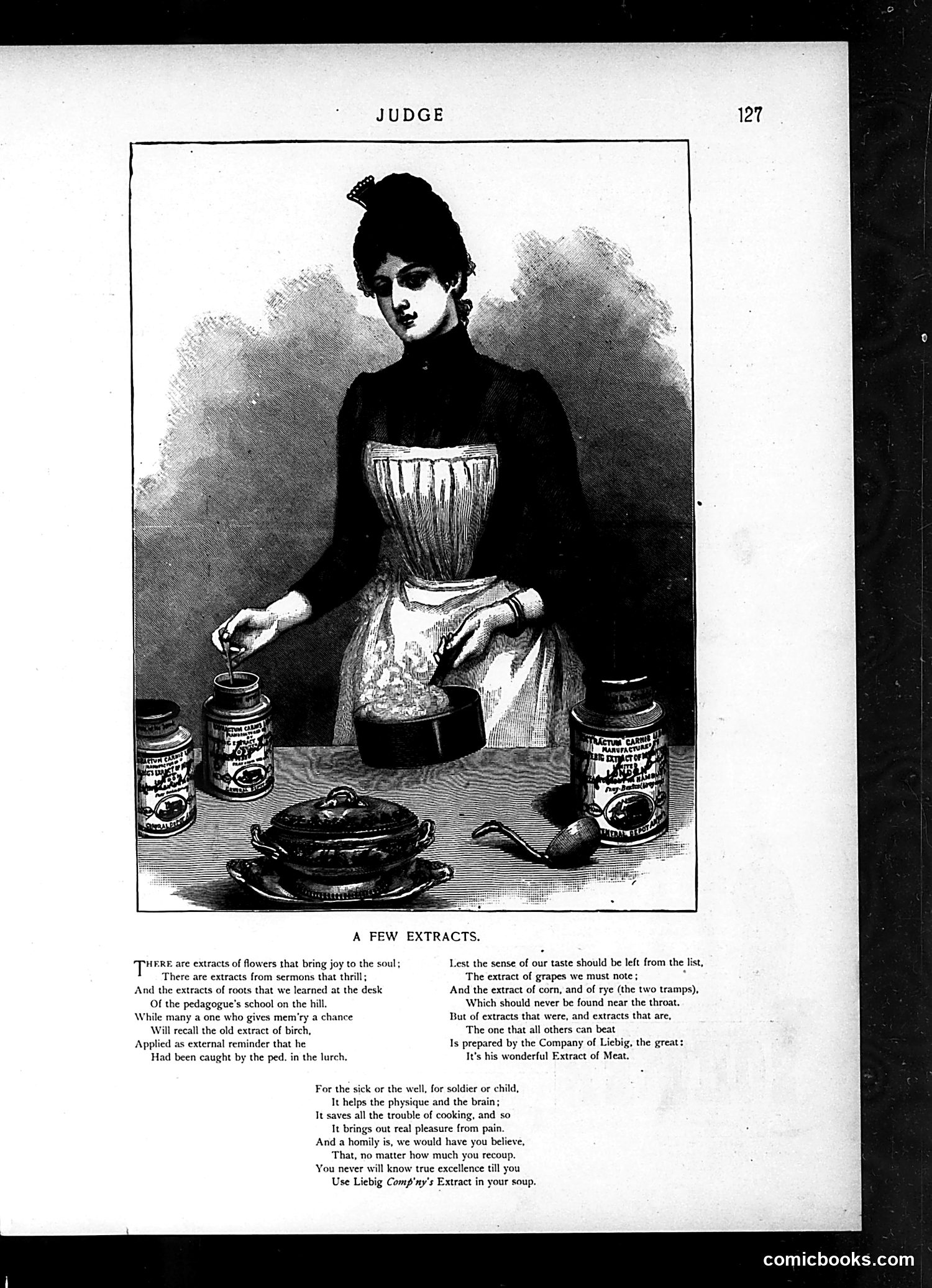
This page is primarily a **Liebig Extract of Meat advertisement** disguised as humorous verse. The illustration shows a fashionable woman preparing soup with Liebig's product, surrounded by branded jars. The satirical "poem" uses wordplay on "extracts" to humorously list various meanings—floral extracts, sermon excerpts, birch switches (school punishment), alcohol ("extract of corn, and of rye"), and finally Liebig's meat extract. The joke mocks the advertising copy's grandiose claims by comparing the meat extract to these absurd alternatives. The final stanza delivers the actual sales pitch: Liebig's extract simplifies cooking and allegedly brings health and pleasure to all—a common Victorian-era health product marketing tactic. This represents Judge magazine's **advertorial format**, where advertisements were presented as satirical content to amuse readers while promoting commercial products. The tone is lighthearted mockery of excessive advertising claims.
This page from *Judge* magazine contains mostly **advertisements and humor pieces**, not political cartoons with social commentary. The main content is "American Humor"—exaggerated tall tales illustrating how Americans supposedly embellish stories. Two examples: Civil War soldiers claiming impossible shooting accuracy (hitting a moving barrel's bunghole repeatedly), and a Californian claiming fireflies are so large they're used for cooking. There's also a brief dialogue titled "Behind the Age" about "Nahum Cravens" objecting to electric motors—apparently satirizing resistance to new technology, though the text is incomplete. The page is primarily filled with period advertisements for furs, pianos, sealskin garments, and patent medicines (Castoria, Angostura Bitters). The "Carl Pretzel's Philosophy" section uses a German-accented character for mild comic effect. No significant political figures or events are referenced.
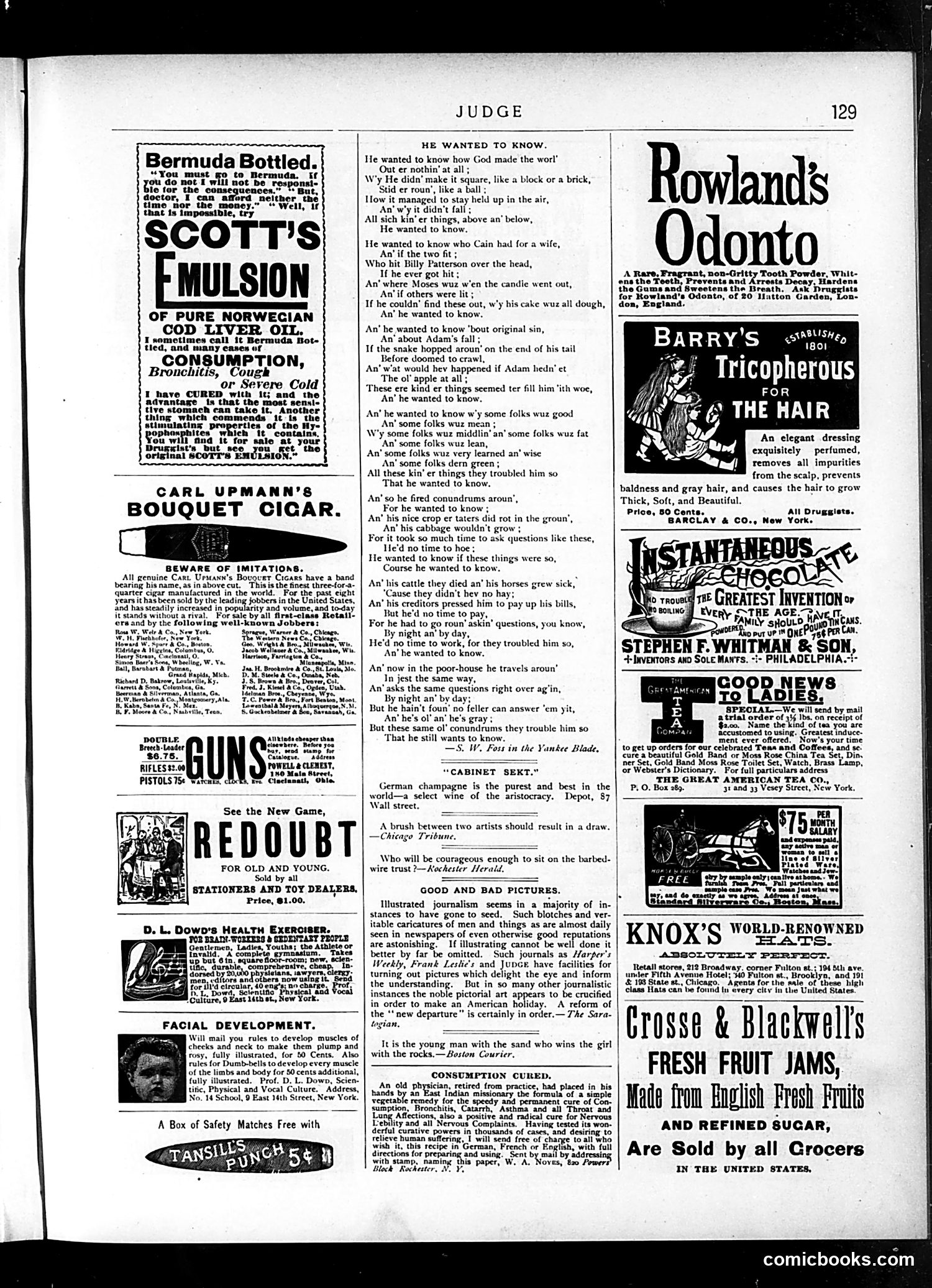
This page is primarily advertisements (Scott's Emulsion, cigars, games, exercise equipment), but the main literary content is a humorous dialect poem titled "He Wanted to Know." The poem satirizes an inquisitive, philosophically-minded rural character (suggested by the dialectal spelling: "w'y," "wuz," "er") whose endless questioning about cosmic mysteries, theology, and neighborhood gossip prevents him from doing practical farmwork. His curiosity causes his crops to rot, cattle to die, and horses to sicken—a satirical commentary on impractical intellectualism or excessive philosophizing interfering with productive labor. The joke is straightforward: the character's abstract wondering about God, Adam's fall, and metaphysical questions is portrayed as foolish distraction from real-world responsibilities. It's a rural/urban class satire, mocking small-town curiosity as obstacle to competence. The dialect reinforces the target as working-class or rural reader ridicule.
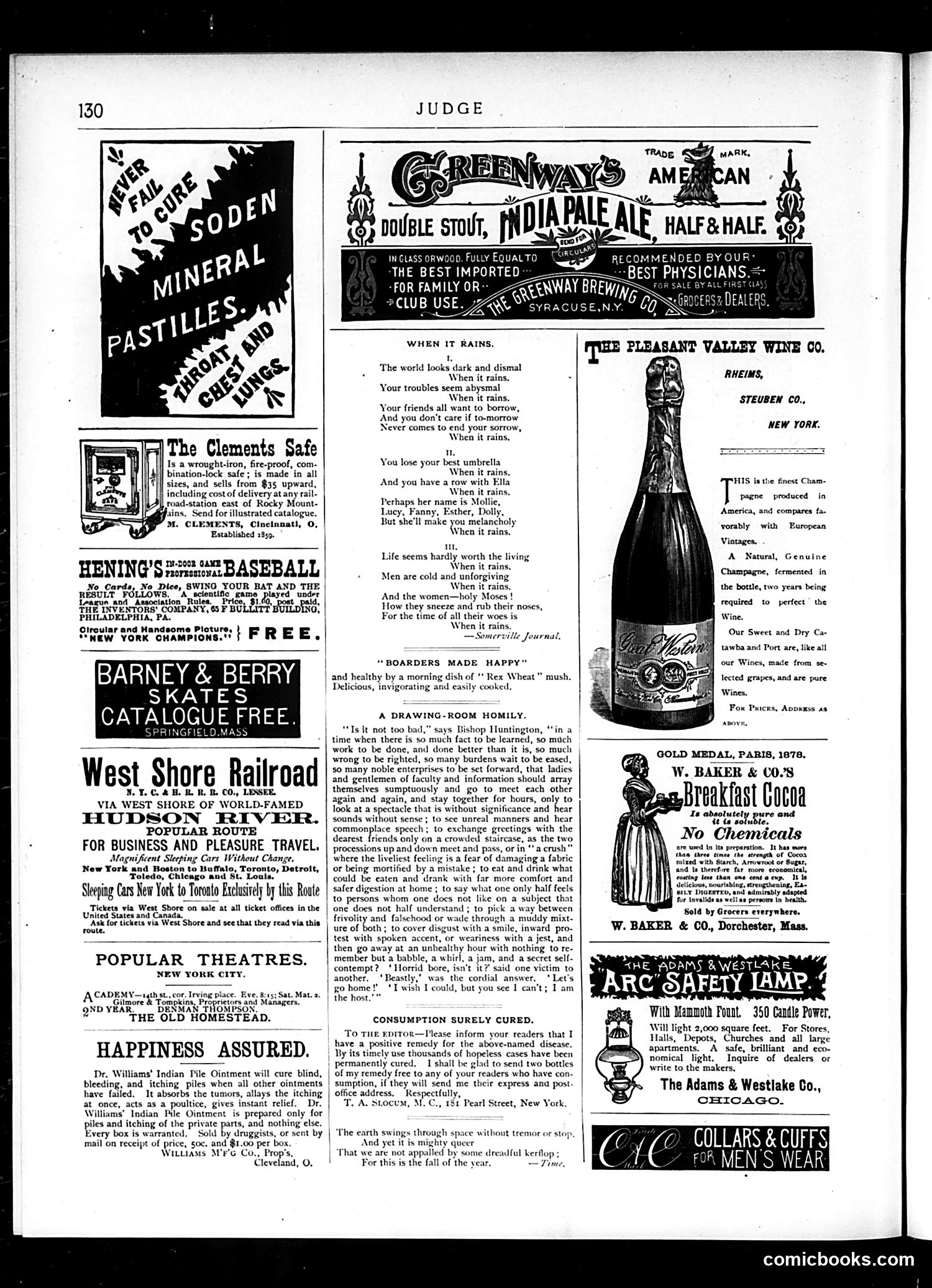
This page is primarily **advertisements and filler content** rather than political satire. The dominant feature is a poem titled "When It Rains" — a sentimental, humorous verse about how rainy weather dampens spirits, causes romantic arguments (with women named Mollie, Lucy, Fanny, etc.), and makes people generally disagreeable. The page is otherwise filled with **period commercial advertisements**: safes, baseball games, railroad services, theaters, beer, wine, cocoa, and other products typical of 1880s-90s America. There's also a lengthy prose piece, "A Drawing-Room Homily," attributed to Bishop Huntington critiquing the frivolity and social pretense of drawing-room gatherings among the wealthy. **No clear political cartoon or satire is evident.** The page appears to be filler between major editorial content in this issue of *Judge*. The "homily" offers mild social commentary on upper-class manners rather than sharp political critique.
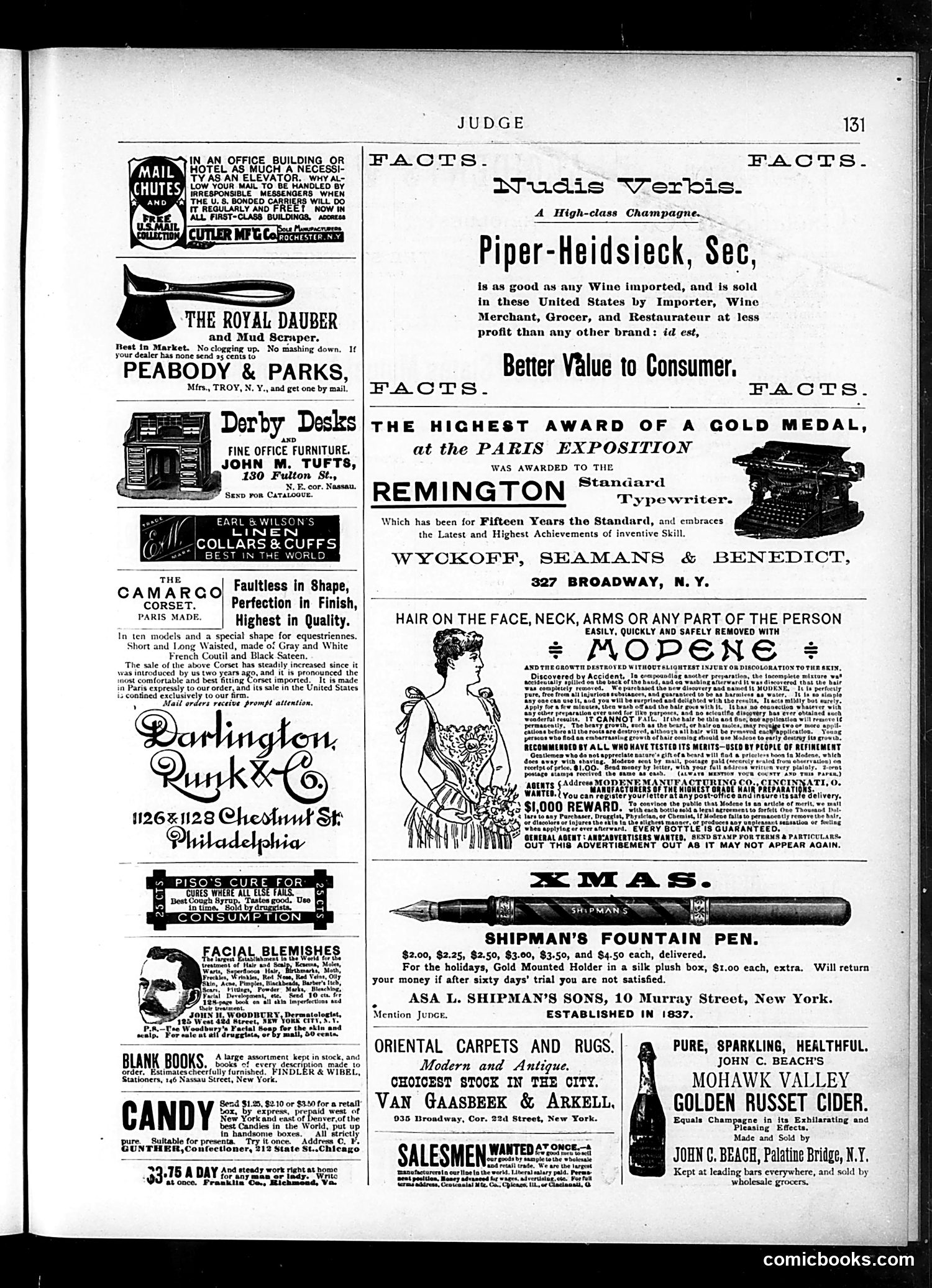
This page is **primarily advertisements** with no discernible political cartoon or satire. It's a typical late 19th-century Judge page dominated by commercial ads. Notable advertisements include: - **Piper-Heidsieck Champagne** and **Remington Typewriter** (gold medal winner) — luxury goods - **Modene hair removal product** — pitched as for "people of refinement," indicating vanity products marketed to the upwardly mobile - **Shipman's Fountain Pen**, **Camargo Corset** (Paris-made), and various office furniture — reflecting urban, professional-class consumer culture - **Shipman's Sons** established 1837, emphasizing longevity and trustworthiness The ads collectively reveal **Gilded Age consumer culture**: imported luxury goods, beauty/grooming products, office modernization, and appeals to refinement and status. The heavy advertising subsidized Judge's satirical content elsewhere in the magazine.
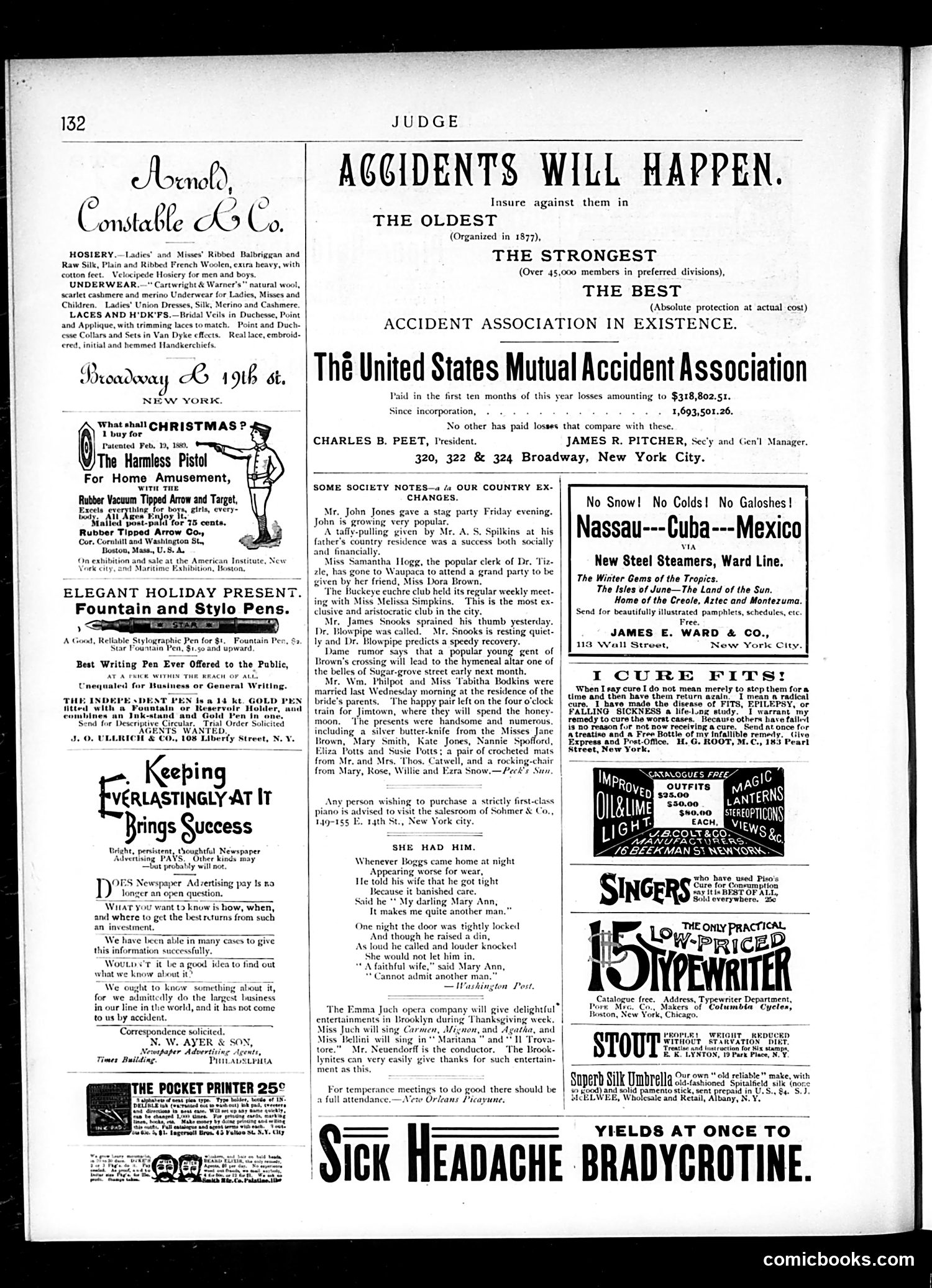
This page is primarily **advertising and society notes**, not political satire. The main content includes: **Advertisements:** Clothing retailers (Arnold, Constable & Co.), novelty toys (The Harmless Pistol), pens, and insurance dominate the page. The largest ad promotes the United States Mutual Accident Association, claiming superiority through age (founded 1877), size (45,000 members), and cost-effectiveness. **Society Section:** "Some Society Notes from Our Country Exchanges" offers humorous, mundane observations about small-town life—stag parties, taffy-pullings, euchre clubs, and a sprained thumb—presented with mock-serious tone typical of Judge's satirical style. **No identifiable political figures or cartoons appear.** The satire is gentle, directed at provincial American social conventions rather than specific political targets. This reflects Judge's shift toward lifestyle and consumer advertising by the 1910s.
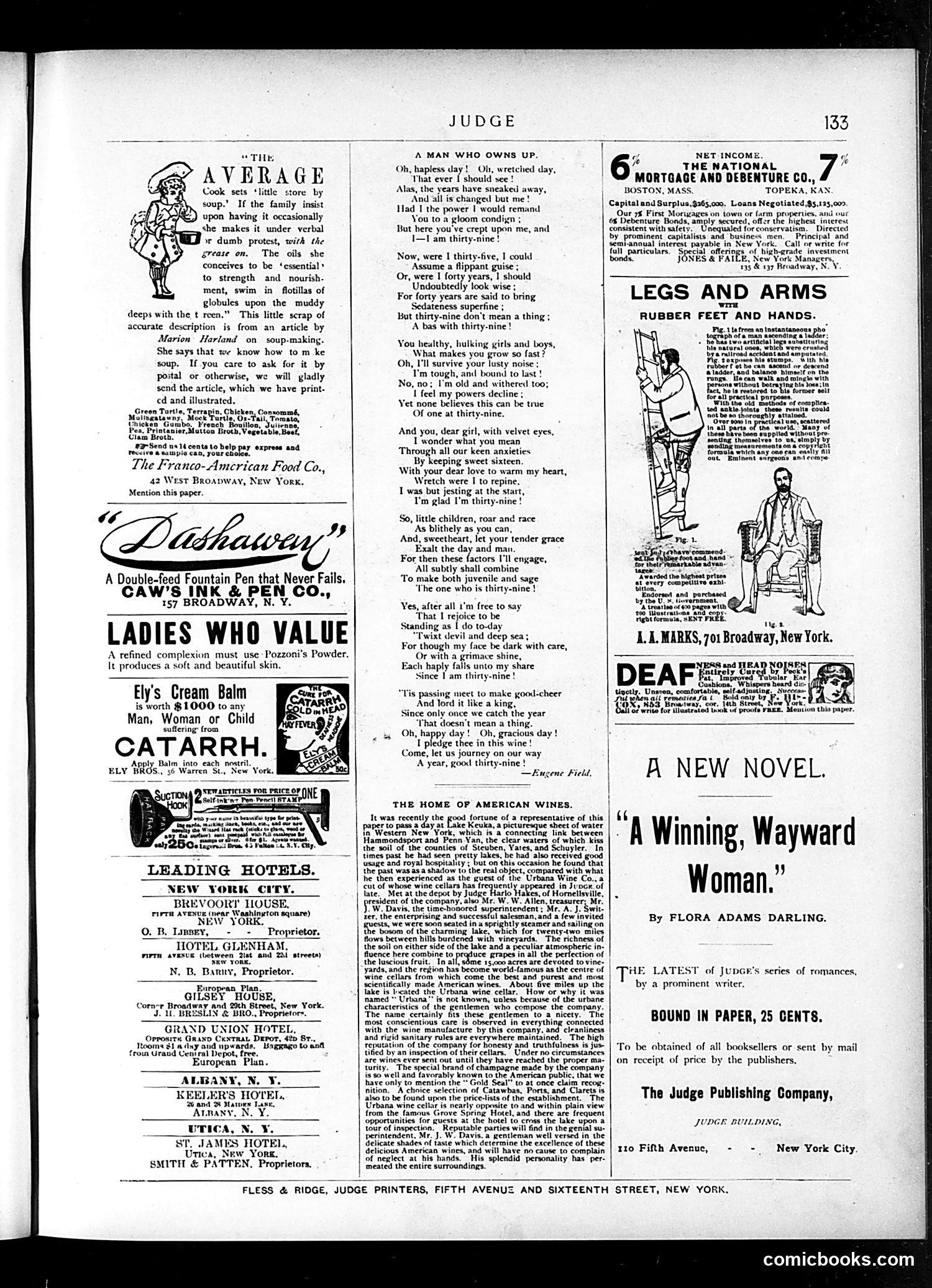
This page is primarily **advertising and literary content** rather than political satire. The main feature is a humorous poem titled "A Man Who Owns Up" by Eugene Field, a celebrated American humorist of the era. The poem playfully explores the anxiety of turning thirty-nine—a peculiar age that sits awkwardly between youth and middle age, lacking the cultural significance of other milestones like thirty-five or forty. The satire targets **male vanity and age anxiety**. The speaker oscillates between self-pity about aging and eventual acceptance, ultimately celebrating the freedom of this ambiguous life stage. Field's humor relies on the tension between the speaker's complaints and his realization that thirty-nine offers unique advantages. The surrounding advertisements (fountain pens, complexion powder, catarrh remedies, hotels) were typical Judge content. No identifiable political figures or specific contemporary events are referenced—this is social rather than political satire, capturing period anxieties about masculinity and aging.
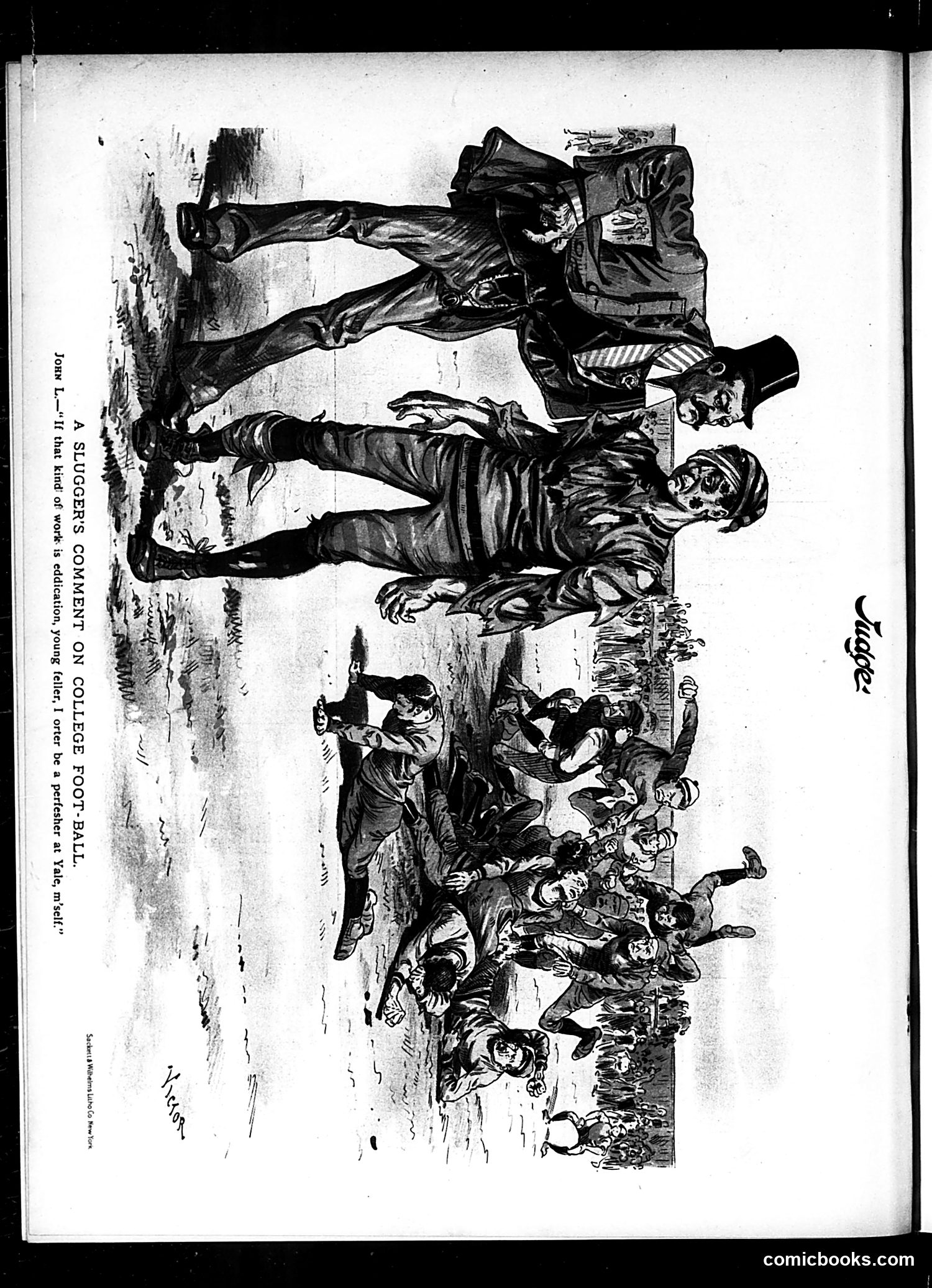
This cartoon satirizes the violence in college football by contrasting it with street fighting. The image shows two figures: a well-dressed man (likely representing a college athlete or administrator) in the upper portion, and below him, a rough street character identified as "John L." — appearing to reference John L. Sullivan, the famous bare-knuckle boxer. The joke mocks college football as being indistinguishable from common street brawling. Sullivan's character suggests that if the brutality on the football field counts as "education," then he—a professional fighter—should be qualified to teach at Yale, implying college football is no more respectable or educational than street violence. This reflects Progressive-era concerns about football's dangerous physicality and the contradiction between its promotion in prestigious universities and its similarity to lower-class fighting.