
A complete issue · 28 pages · 1889
Judge — March 2, 1889
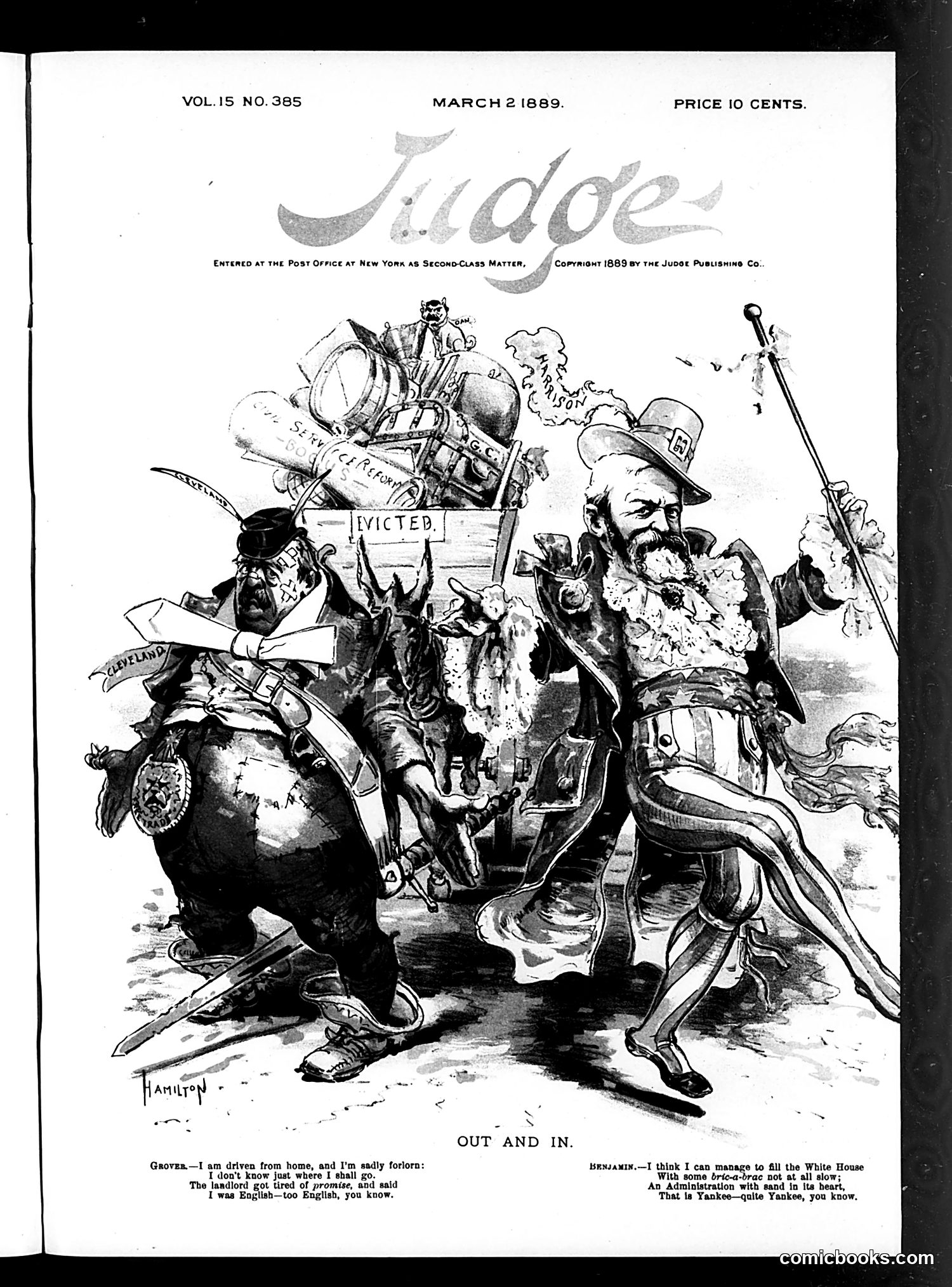
This cartoon depicts two figures in dialogue labeled "GROVES" (left) and "BENJAMIN" (right). Groves complains of being "driven from home" and "sadly forlorn," claiming his landlord evicted him despite promises, calling him "too English." Benjamin responds that he'll "fill the White House" with his administration, which has "sand in its heart"—a reference to grit and determination. The figures appear to represent political candidates or administrators of the era. The "eviction" language and contrast between "out" and "in" likely references the 1888 presidential transition, with one figure departing office while another assumes power. The satirical point critiques political displacement and broken promises during changes in administration.
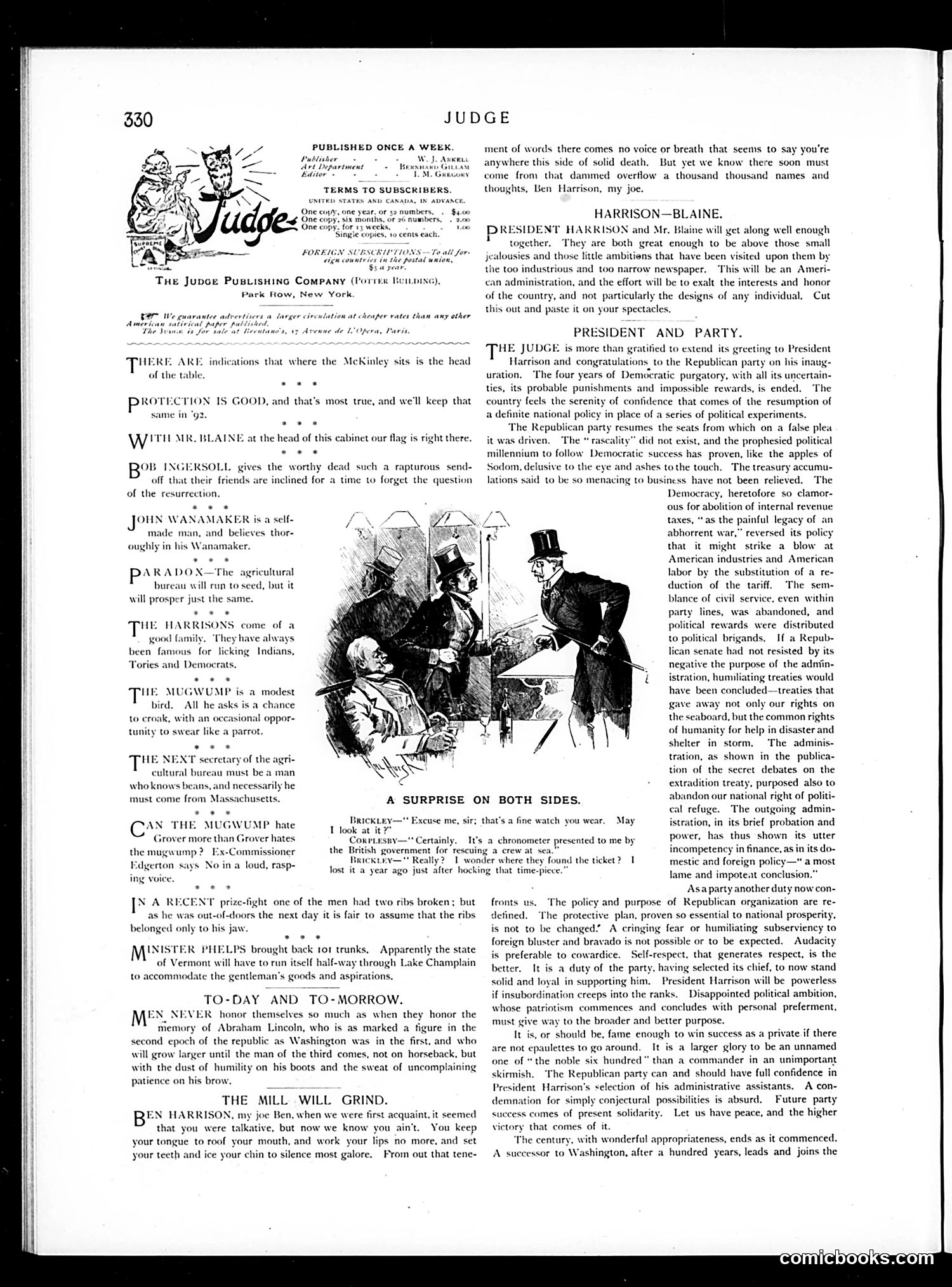
The main cartoon titled "A Surprise on Both Sides" depicts three figures in what appears to be a diplomatic or political confrontation. Based on the accompanying article "Harrison-Blaine," the figures likely represent President Harrison, Secretary of State Blaine, and a British official, given the top hat and formal dress. The cartoon satirizes tension over a watch presented by the British government—apparently a diplomatic gift with disputed ownership. The humor exploits the miscommunication and awkwardness between American and British officials over protocol and possession of the timepiece. The surrounding text discusses Republican party policy, tariffs, and administrative competence, suggesting this cartoon critiques diplomatic relations and international trade negotiations during Harrison's presidency (1889-1893).
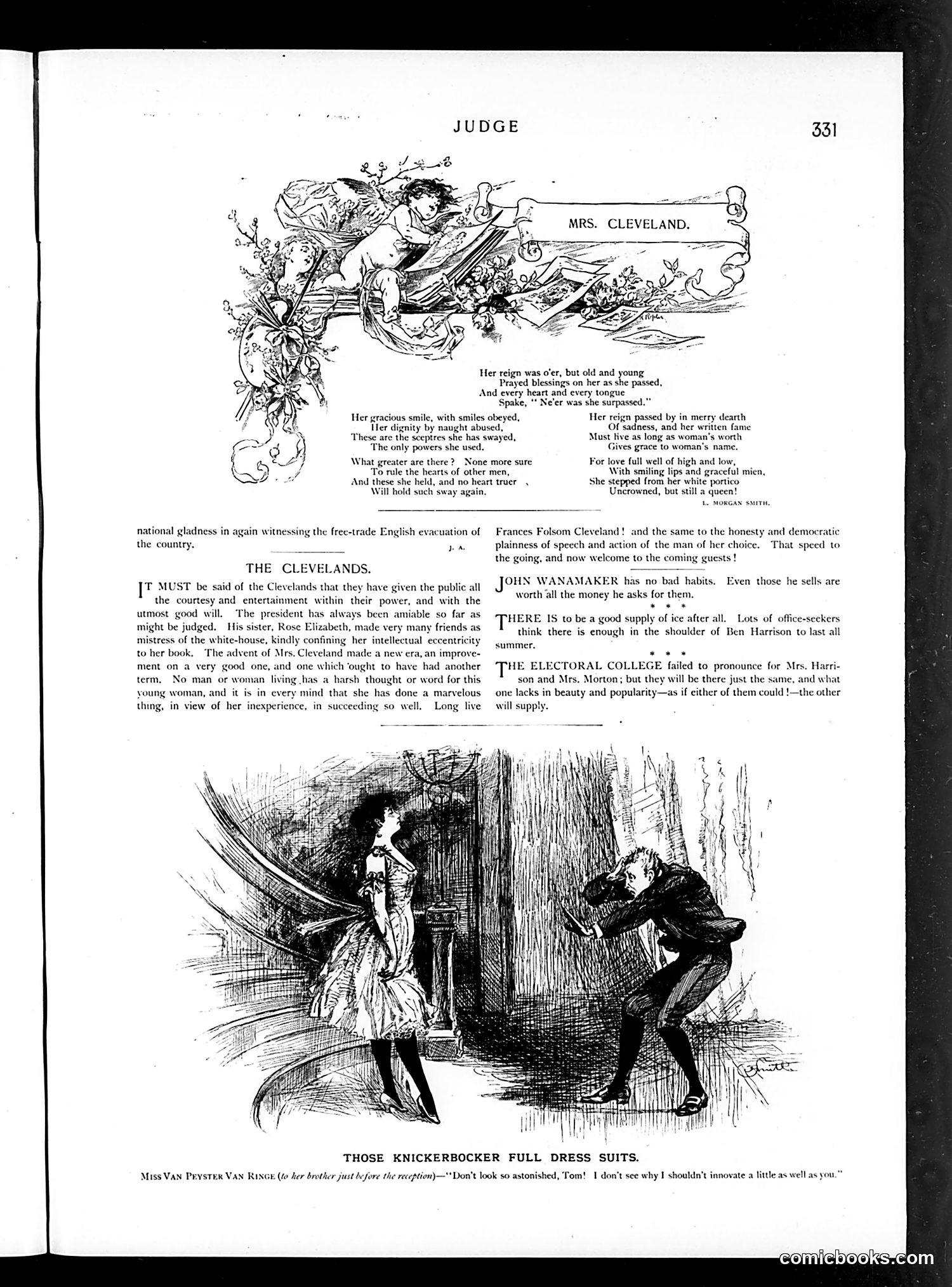
This page celebrates the departing **Mrs. Frances Folsom Cleveland**, wife of President Grover Cleveland. The poetic tribute (top) honors her grace and dignity during her time as First Lady, treating her departure as a dignified end to a successful "reign." The prose section praises both Clevelands for their courtesy and entertainment value, noting Mrs. Cleveland's particular success despite her youth and inexperience—a significant achievement for a young woman in that role. The lower cartoon satirizes **John Wanamaker** (prominent merchant/postmaster general), joking that even his inferior products are overpriced. A brief jab targets the **Electoral College**, suggesting that while it failed to endorse Harrison and Morton's wives for beauty/popularity, the women will appear anyway—implying the College's opinion is irrelevant. The bottom cartoon shows a woman in full dress, joking about women adopting men's fashion innovations (knickerbocker suits), reflecting contemporary debates about women's dress reform.
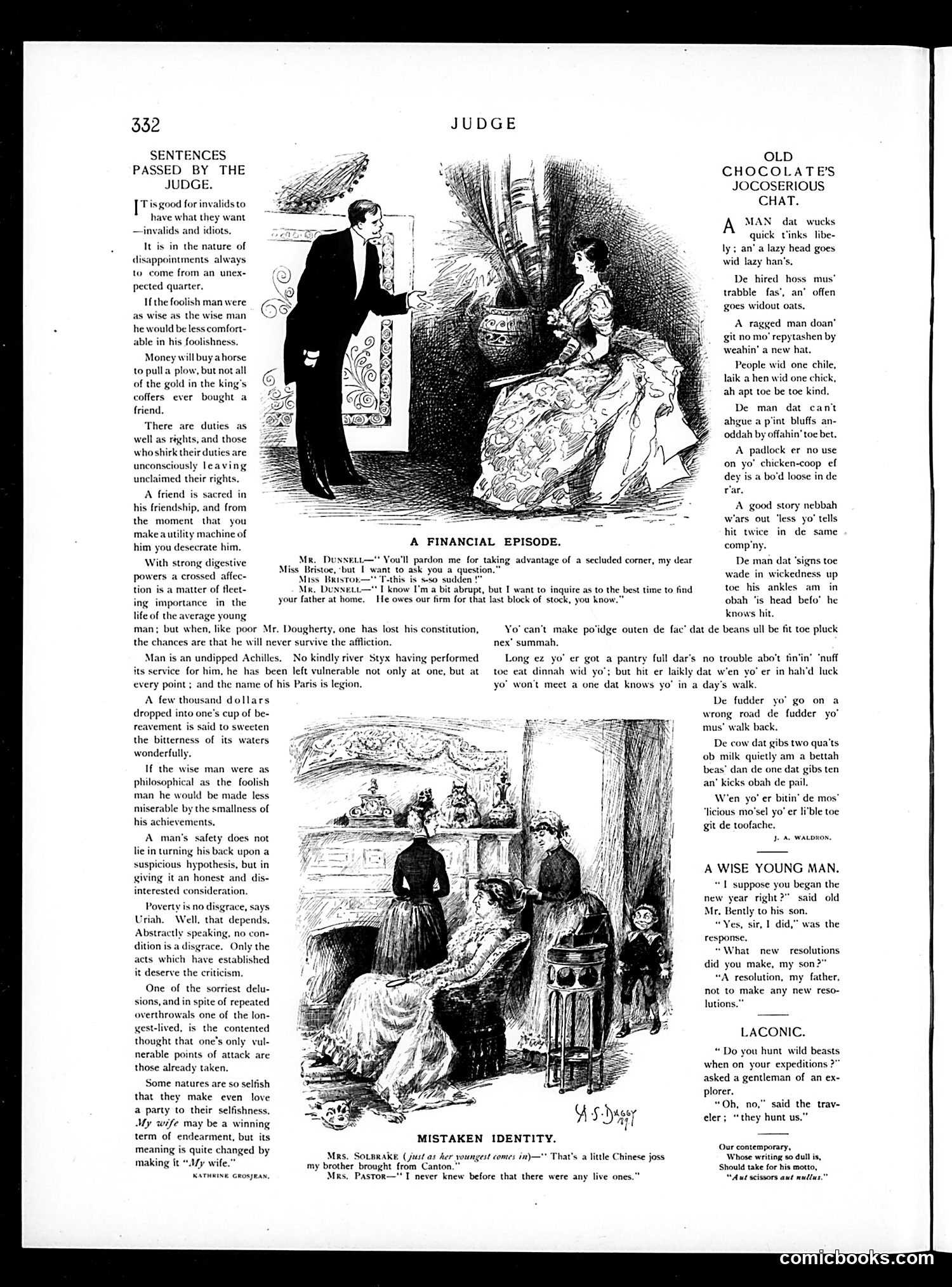
This page contains three distinct satirical pieces typical of Judge magazine's editorial format: **"Sentences Passed by the Judge"** (left column): Philosophical aphorisms mocking various human follies—foolishness, poor judgment, selfishness, and social climbing. These are general moral critiques rather than topical satire. **"A Financial Episode"** (top cartoon): A gentleman awkwardly interrupts a woman in a parlor to inquire about her father's whereabouts, seeking to collect a debt for unpaid stock. The satire targets both the creditor's crude persistence and the debtor's apparent avoidance—critiquing financial irresponsibility and aggressive debt collection. **"Mistaken Identity"** (bottom cartoon): Shows a conversation where one woman mistakes another's Chinese servant for her brother recently arrived from Canton. The joke relies on racial caricature stereotyping, reflecting the period's casual prejudices. **"Old Chocolate's Jocoserious Chat"** and other pieces: Dialect-heavy humor in African American vernacular, offering folk wisdom. These reflect period conventions of "plantation" humor. The page represents Judge's mix of genteel social satire and period-appropriate (though offensive by modern standards) racial humor.
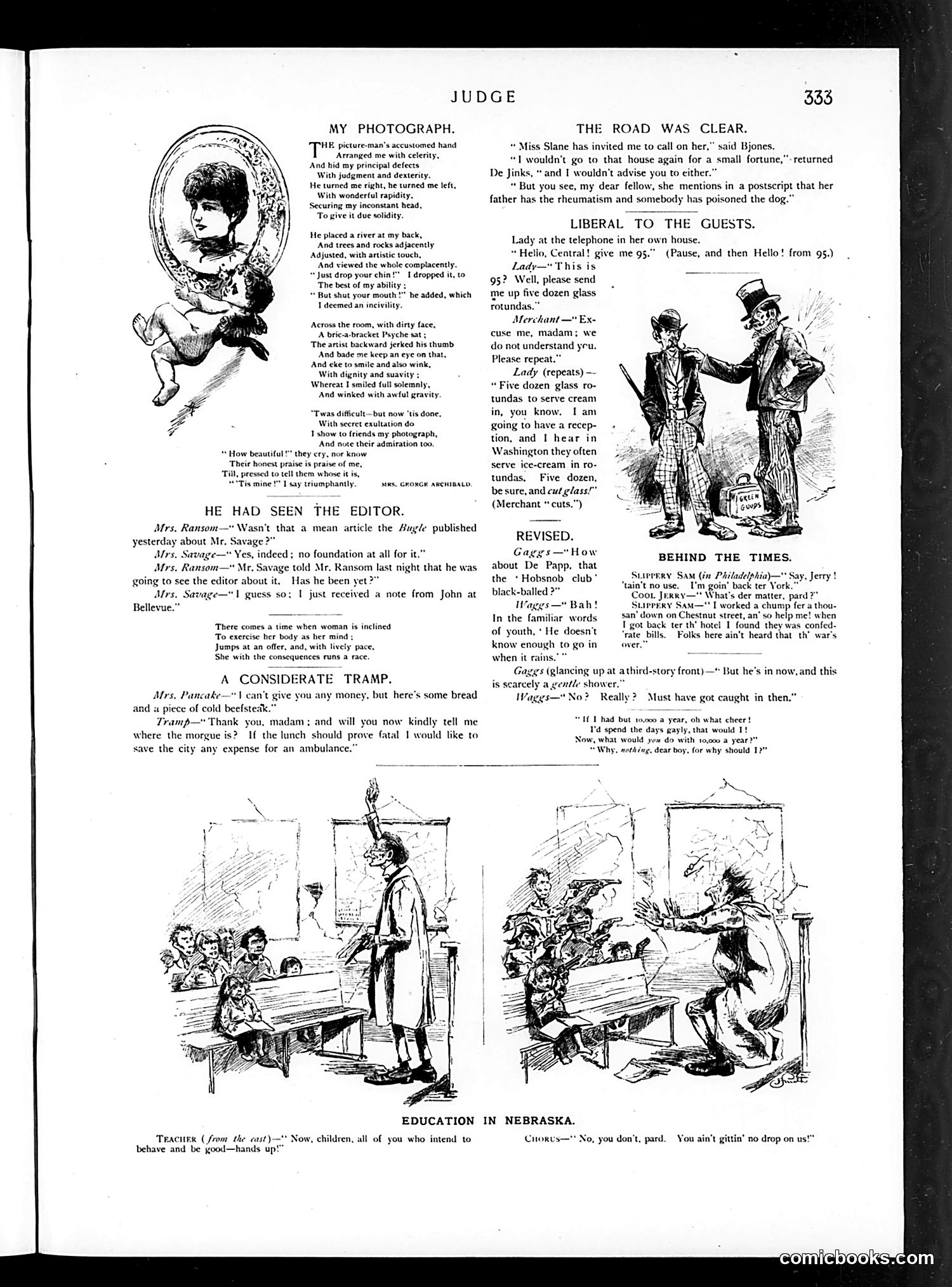
This Judge magazine page (page 333) contains several satirical pieces mocking American social pretensions and ignorance: **"My Photograph"**: A poem satirizing vanity and deceptive photography—the photographer artificially arranges an unattractive subject to look flattering, yet friends praise "the subject" when really they're just admiring the photographer's skill. **"He Had Seen the Editor"**: Gossip about a husband confronting a newspaper editor over a negative article; the note from "Bellevue" (a mental institution) implies he was committed—satirizing both media attacks and overreaction. **"Education in Nebraska"**: Rural schoolchildren are asked to raise hands if they'll behave, mocking perceived unsophistication in frontier education. **"Behind the Times"**: A con-man discovers Philadelphia still uses Confederate currency—absurdly suggesting the city hadn't caught up with the Civil War's outcome, mocking regional backwardness. **Other brief jokes** target affectation (a woman ordering "glass rotundas" for ice cream service, misusing Washington society terminology) and economic pretension. The overall theme: satirizing American social climbing, regional ignorance, and the gap between appearance and reality.
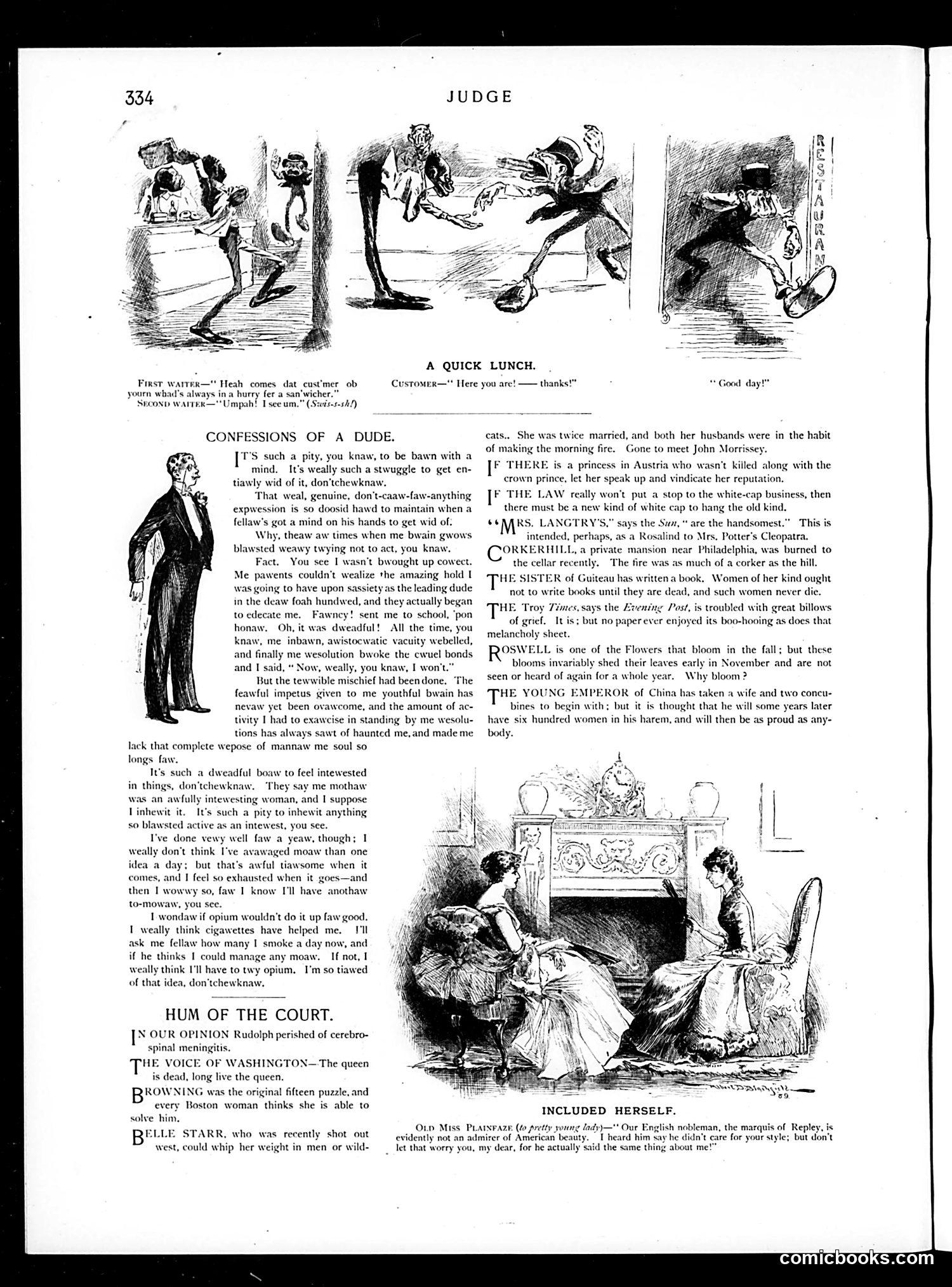
## "A Quick Lunch" Cartoon The top comics depict a waiter (rendered in stereotypical dialect) struggling to serve a rushing customer a sandwich. The humor relies on the waiter's exaggerated speech pattern ("Heah comes dat cust'mer") and physical comedy—the joke appears to be about incompetent service during a busy lunch rush. ## "Confessions of a Dude" This satirizes the "dude" archetype—wealthy, idle young men affected by upper-class pretensions. The character complains that having *any* intelligence interferes with maintaining the fashionable appearance of vacant vapidity. The satire mocks both the dude's affected speech ("weal," "bwain") and the social absurdity that aristocratic status apparently requires demonstrable stupidity. It's a critique of class affectation and shallow society values. ## Miscellaneous Quips The scattered "Hum of the Court" jokes reference contemporary figures like actress Lillie Langtry and apparently current events, though specific references are now obscure. The overall tone is gossipy society commentary.
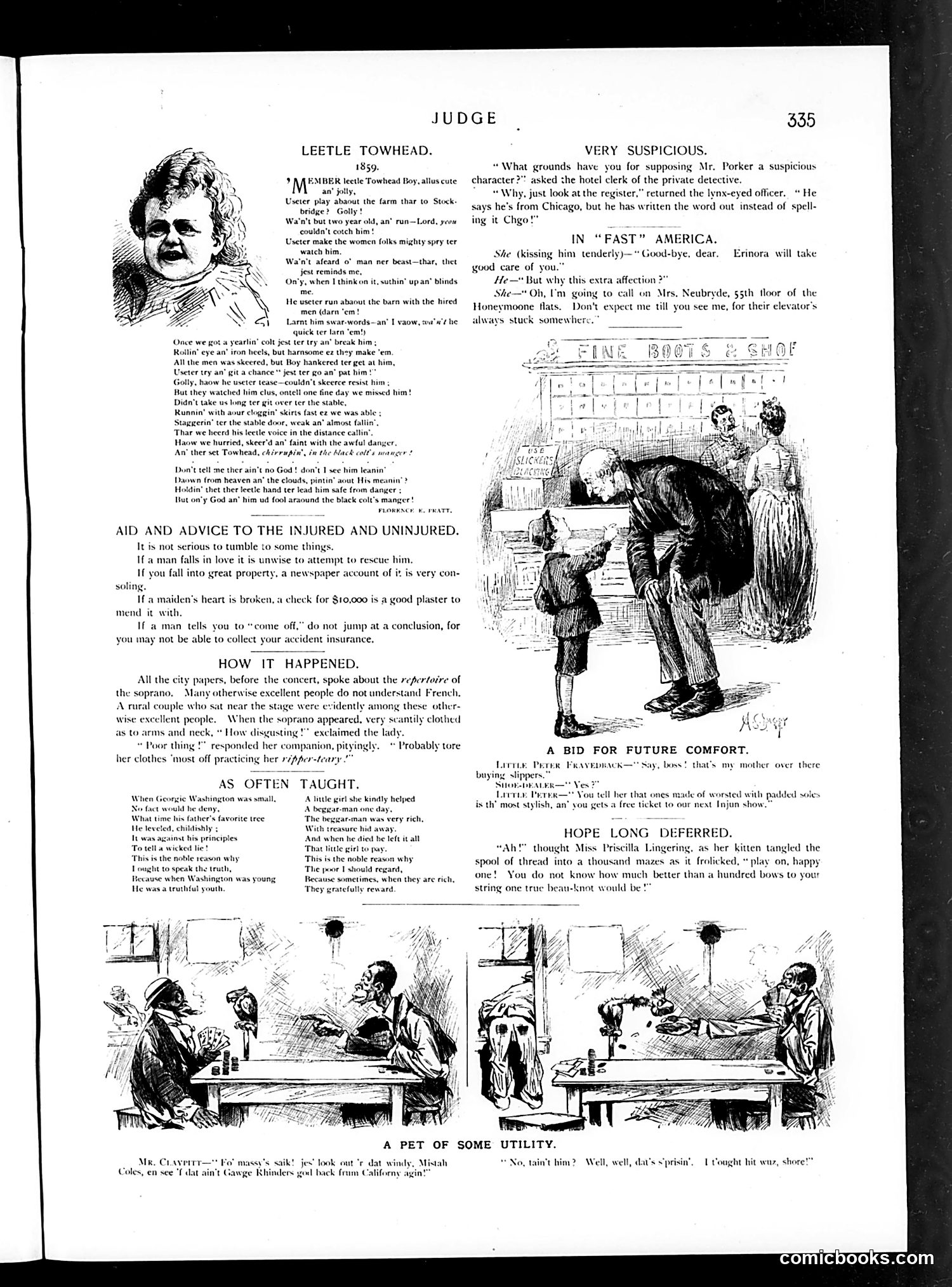
This page contains several unrelated short humor pieces typical of 1859 *Judge* magazine: **"Leetle Towhead"** is a sentimental dialect poem about a fearless toddler who nearly gets killed playing with a dangerous black horse—saved only by divine providence. The rural dialect and nostalgic tone suggest it's meant as touching Americana. **"How It Happened"** mocks rural ignorance: an unsophisticated couple at a concert thinks a scantily-dressed soprano is "disgusting," not realizing this is normal operatic costuming. **"As Often Taught"** contrasts children's moral lessons (honesty, charity) with the reality that a poor girl benefits only because a rich man dies and leaves her money—suggesting virtue goes unrewarded unless wealth intervenes. The remaining sections are brief joke vignettes about marital life, urban apartment buildings, and pets—typical period humor targeting middle-class domestic situations and gender relations. The overall tone is sentimental, moralistic, and gently satirical of American society.
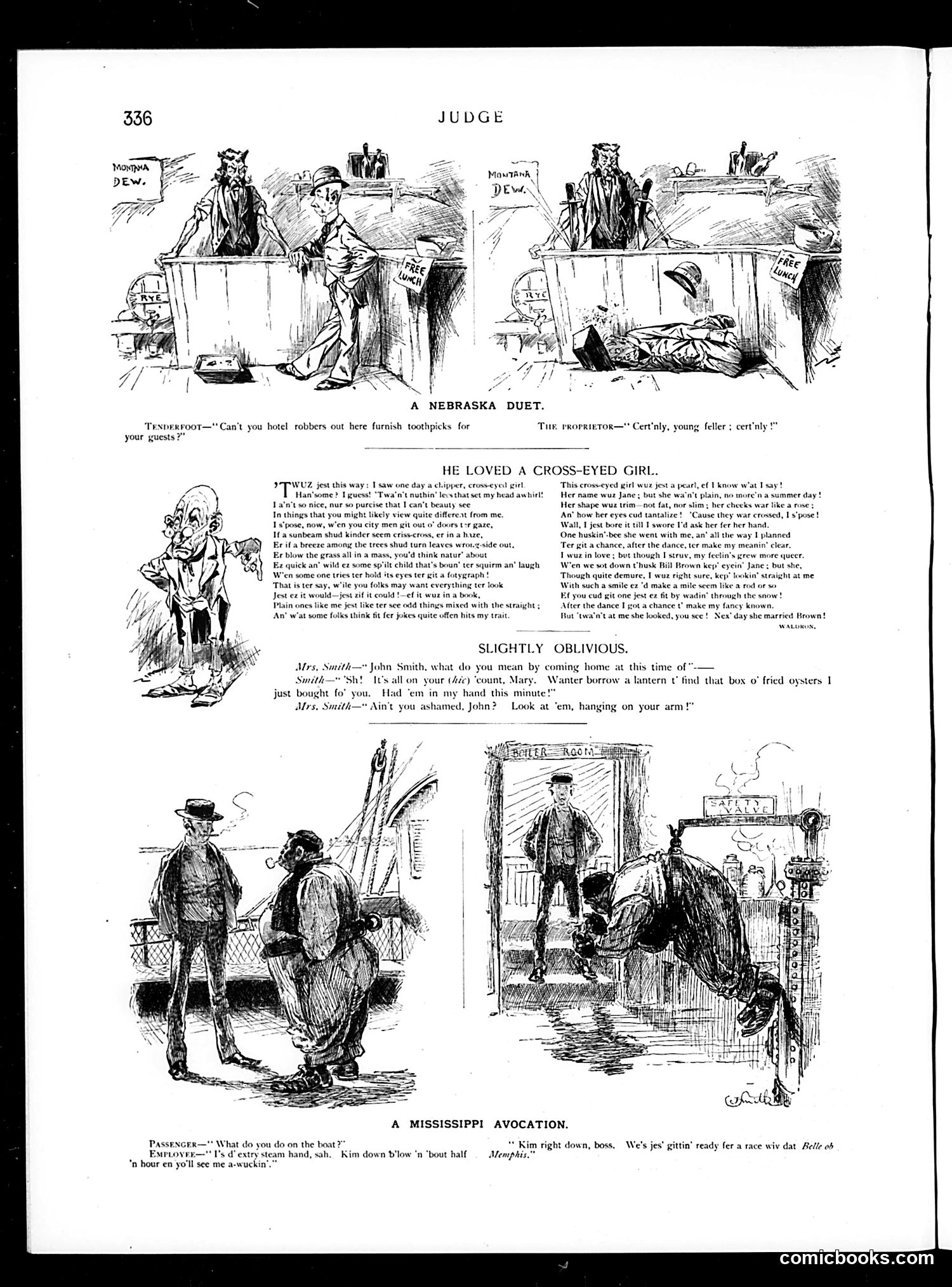
This page contains four separate humorous sketches typical of late 19th-century American satire: **"A Nebraska Duet"**: Mocks frontier roughness—a hotel proprietor casually offers to extract a guest's tooth (using a gun) as a "toothpick," suggesting lawlessness and crude frontier hospitality. **"He Loved a Cross-Eyed Girl"**: A rural dialect poem about a man's romantic misadventure. He loves a cross-eyed girl named Jane but loses her to a competitor (Bill Brown), satirizing rural courtship and unrequited love through exaggerated backwoods speech. **"Slightly Oblivious"**: Domestic humor—a husband forgetfully brings home a box of fried oysters instead of remembering his wife's request, revealing male absent-mindedness. **"A Mississippi Avocation"**: Racial caricature depicting Black riverboat workers discussing boat racing in exaggerated dialect, likely mocking both riverboat culture and Black speech patterns. These sketches use rural/regional stereotypes and dialect humor typical of Judge's satirical approach to American life.
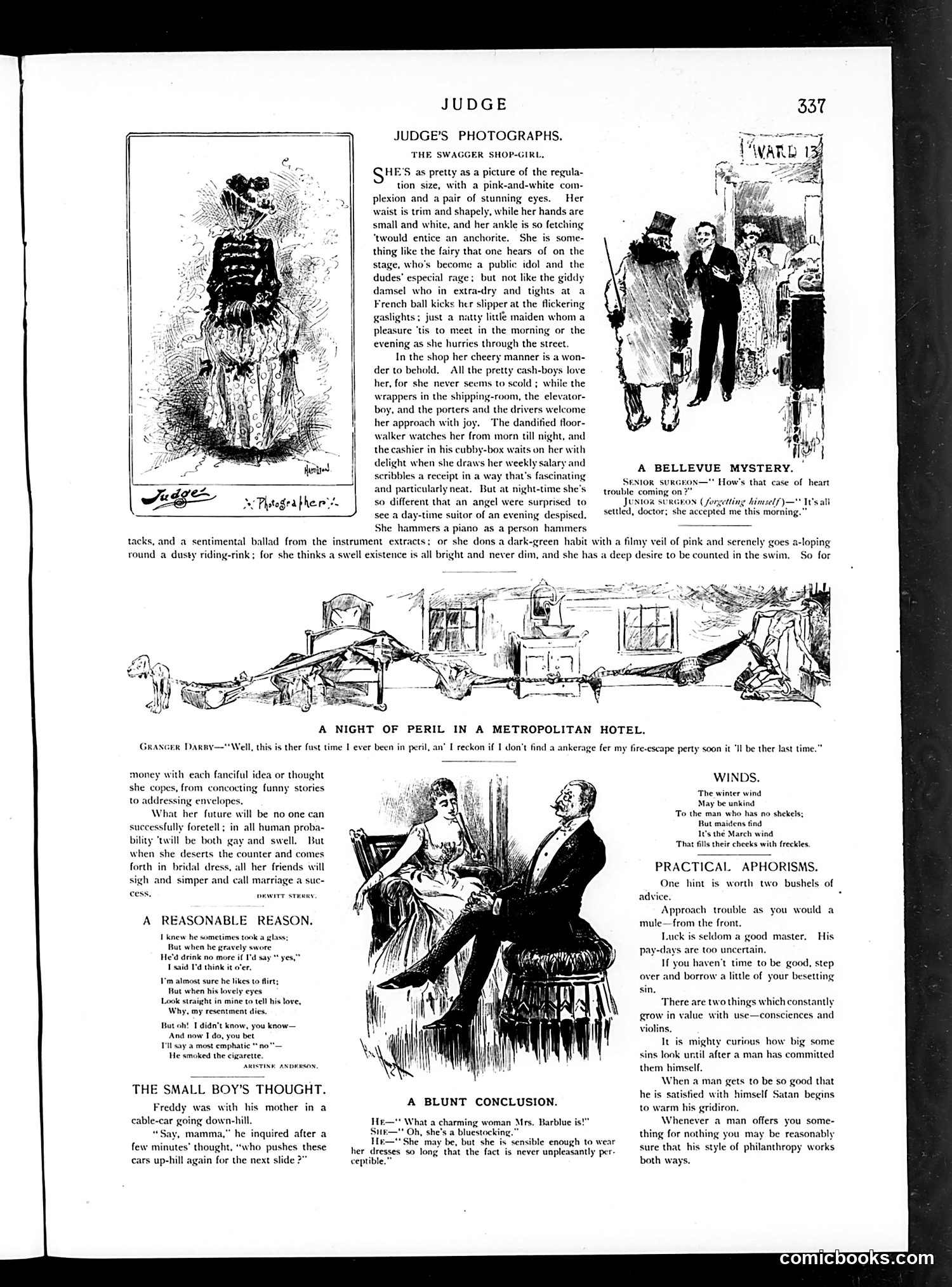
This Judge magazine page (circa early 1900s) contains several satirical pieces about gender roles and social manners: **"The Swagger Shop-Girl"** mocks the young female retail clerk—pretty, charming at work, but transforming into an unbearable, untalented person at night (banging piano, composing bad stories). The satire targets both her pretensions and the male employees' fawning behavior toward her. **"A Reasonable Reason"** presents a woman rejecting a suitor because he smokes cigarettes—treating it as an unforgivable vice worse than drinking or flirting, satirizing shifting moral standards and female hypocrisy. **Other pieces** include generic humor: a child's innocent question about cable cars, a "bluestocking" (educated woman) joke, and a hospital romance. The cartoons reflect fin-de-siècle anxieties about changing women's roles, retail work, and urban life. The tone is condescending toward working-class women and their supposed moral failings.
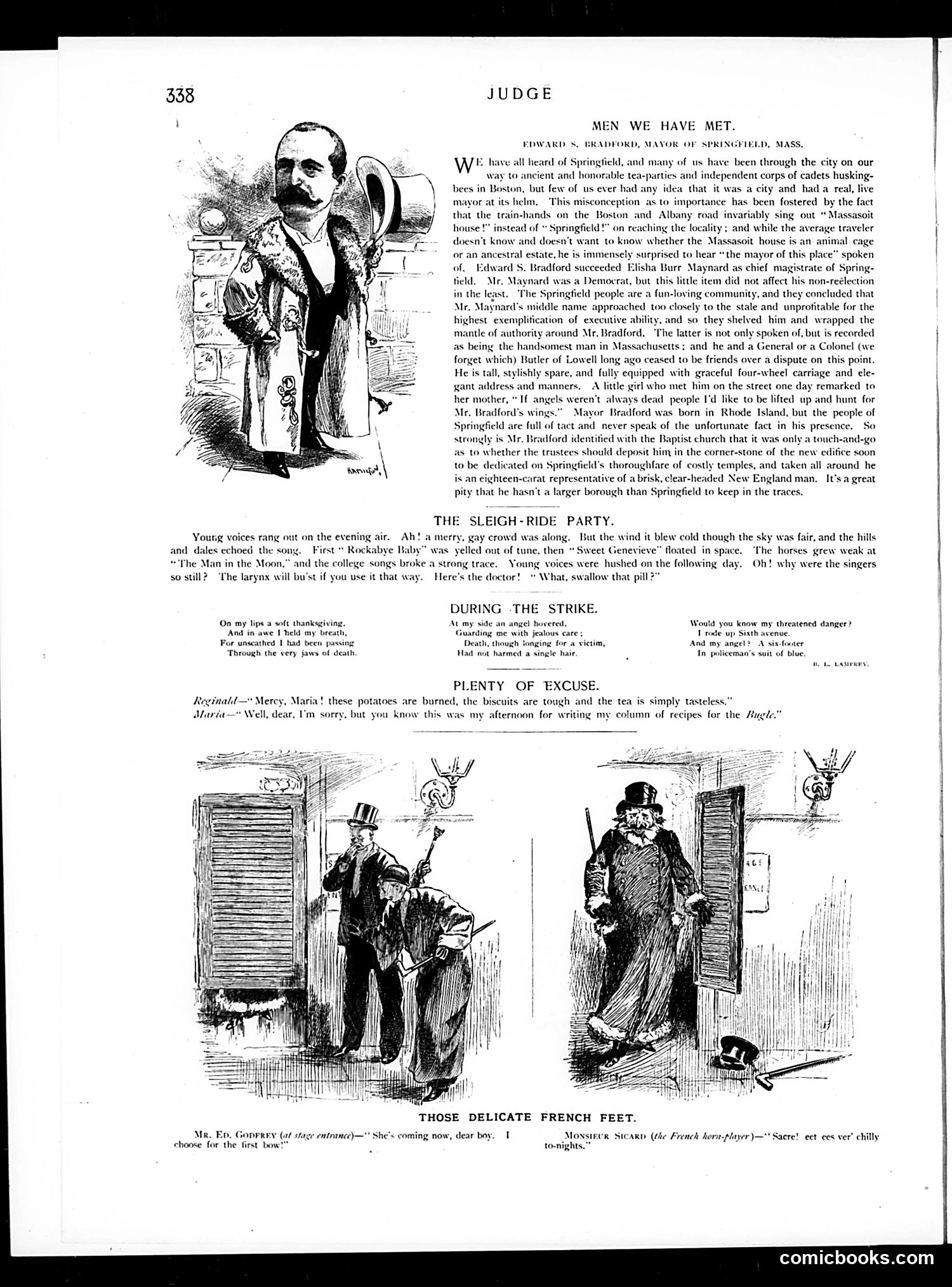
This page from *Judge* magazine contains several satirical pieces lampooning American society circa the late 1800s. **"Men We Have Met"** profiles Edward S. Bradford, Mayor of Springfield, Massachusetts, mocking the town's provincial pride and Bradford's reputation as an exceptionally handsome man (so much so that he and a General Butler supposedly feuded over who was handsomer). **"The Sleigh-Ride Party"** jokes about young people singing so lustily during a winter outing that they lose their voices afterward—a gentle mockery of youthful excess. **"During the Strike"** references labor unrest, humorously depicting someone's safety during "the strike" as protected by a six-foot-tall policeman in uniform rather than divine intervention. **"Plenty of Excuse"** shows a wife apologizing for burned food because she was busy writing a recipes column—satire on women balancing domestic duties with journalistic work. **"Those Delicate French Feet"** features a French horn player complaining it's cold, with the punchline implying an actress's French sensibilities make her vulnerable to chill.
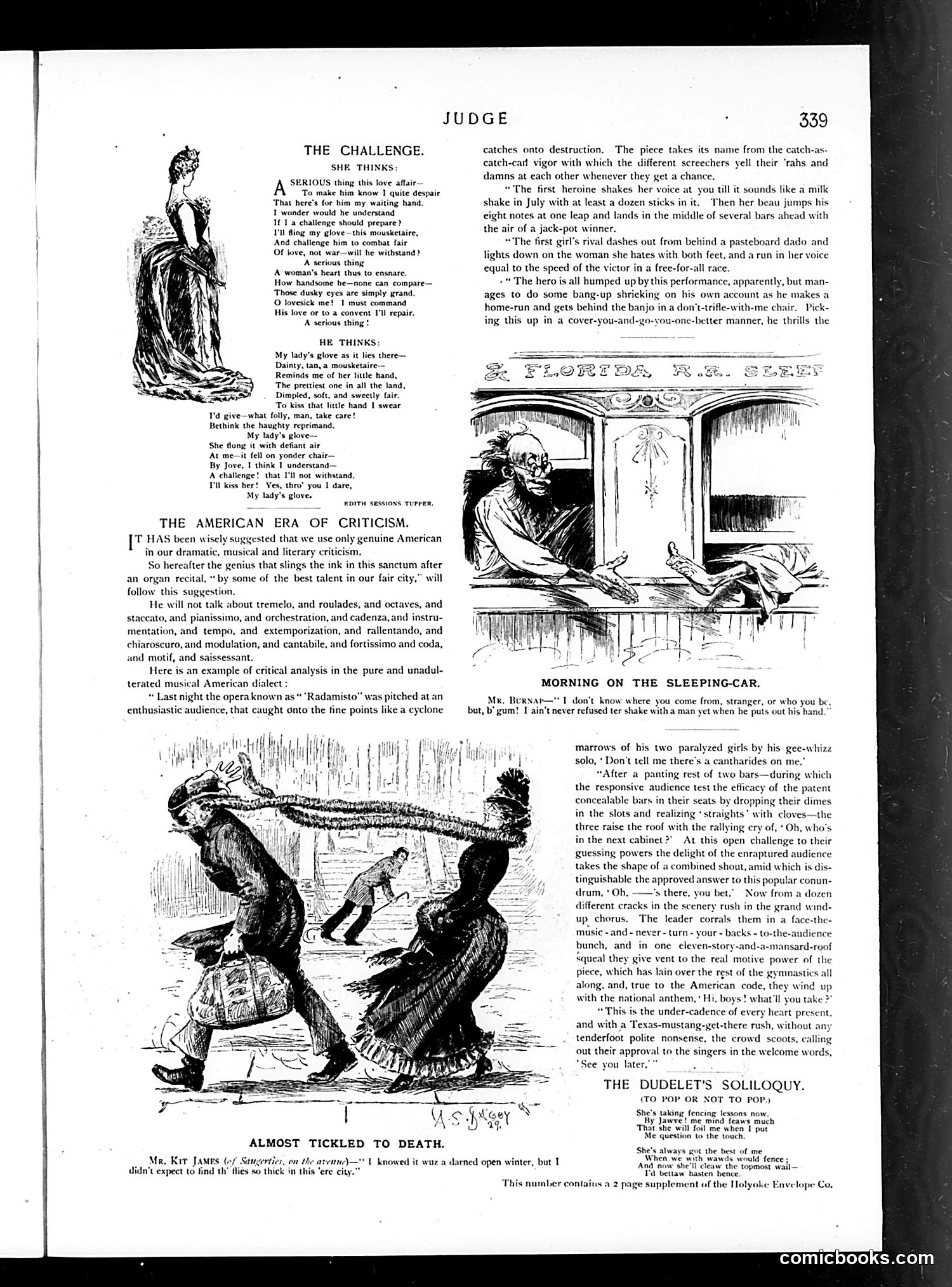
This page contains three distinct pieces of satirical content: **"The Challenge"** (top): A sentimental poem about a woman dropping her glove to signal romantic interest to a man, shown in alternating verses from each perspective. It's gentle romantic satire on courtship conventions. **"The American Era of Criticism"** (middle): Sharp satire mocking pretentious music criticism. Judge ridicules critics who use Italian musical terminology (tremolo, fortissimo, etc.) as affected and incomprehensible. The example "review" of an opera called "Radamisto" deliberately uses crude American slang ("pitched," "caught onto," "jack-pot") to mock both the performance and overwrought critical language—suggesting American plainspokenness is superior to European affectation. **"Morning on the Sleeping-Car"** (bottom): A cartoon showing a man on a train refusing to shake hands with a stranger, humorously illustrated. The page's primary satirical thrust targets artistic pretension and the uncritical American audience that accepts whatever European opera is served to them.
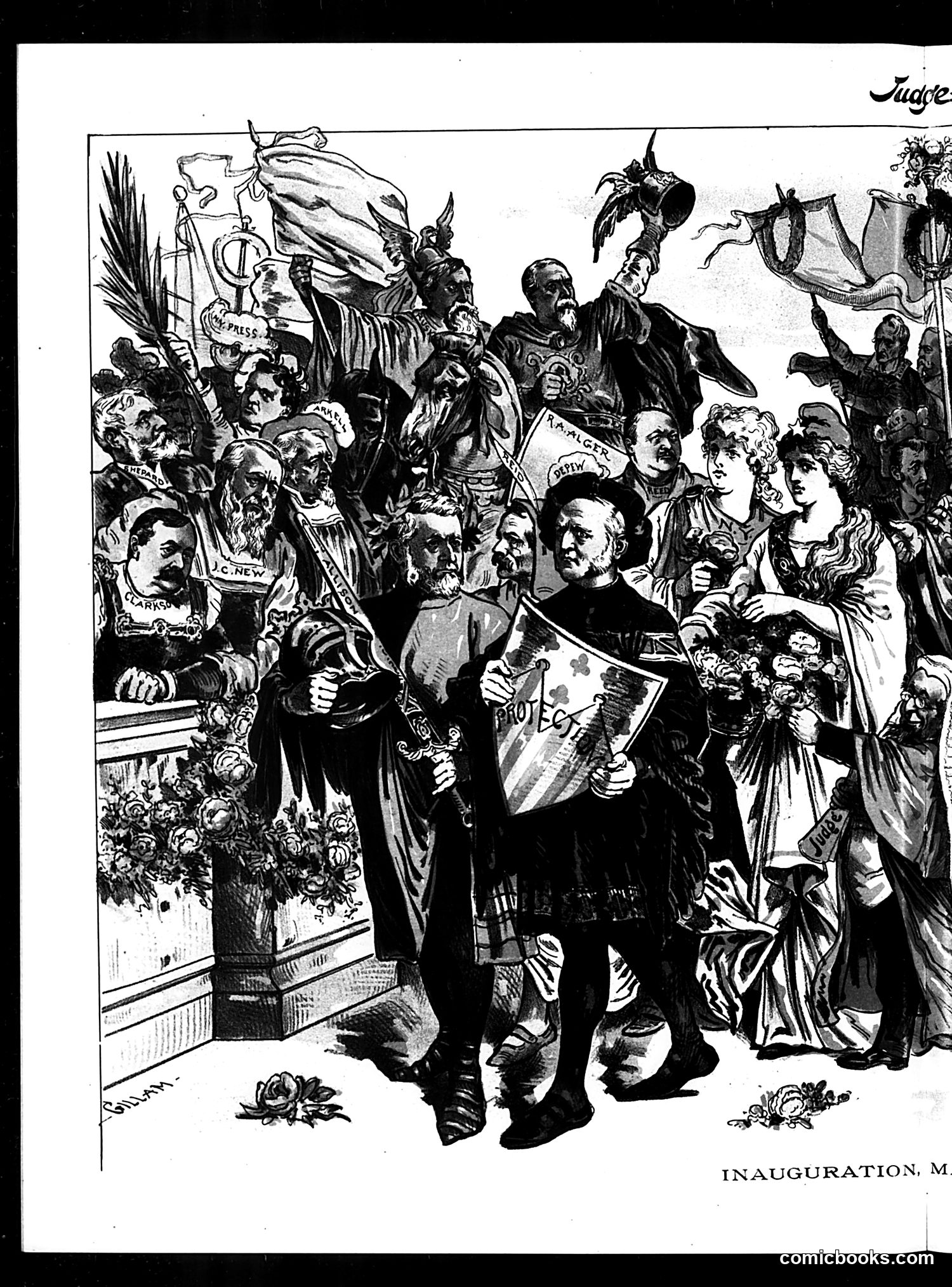
This appears to be a satirical illustration titled "Inauguration, M[onday(?)]" from Judge magazine depicting a presidential inauguration ceremony. The scene shows a formal government procession with military and civilian figures in the foreground presenting themselves before what appears to be a reviewing stand or official platform populated with numerous dignitaries and spectators. The dense crowd composition and elaborate ceremonial staging suggest commentary on either the pageantry of inaugurations themselves or specific political figures involved. However, without a visible date or clearer identifying labels in the image, I cannot definitively identify which president or specific historical moment is being satirized. The cartoonist's signature appears present but is not clearly legible in this reproduction.
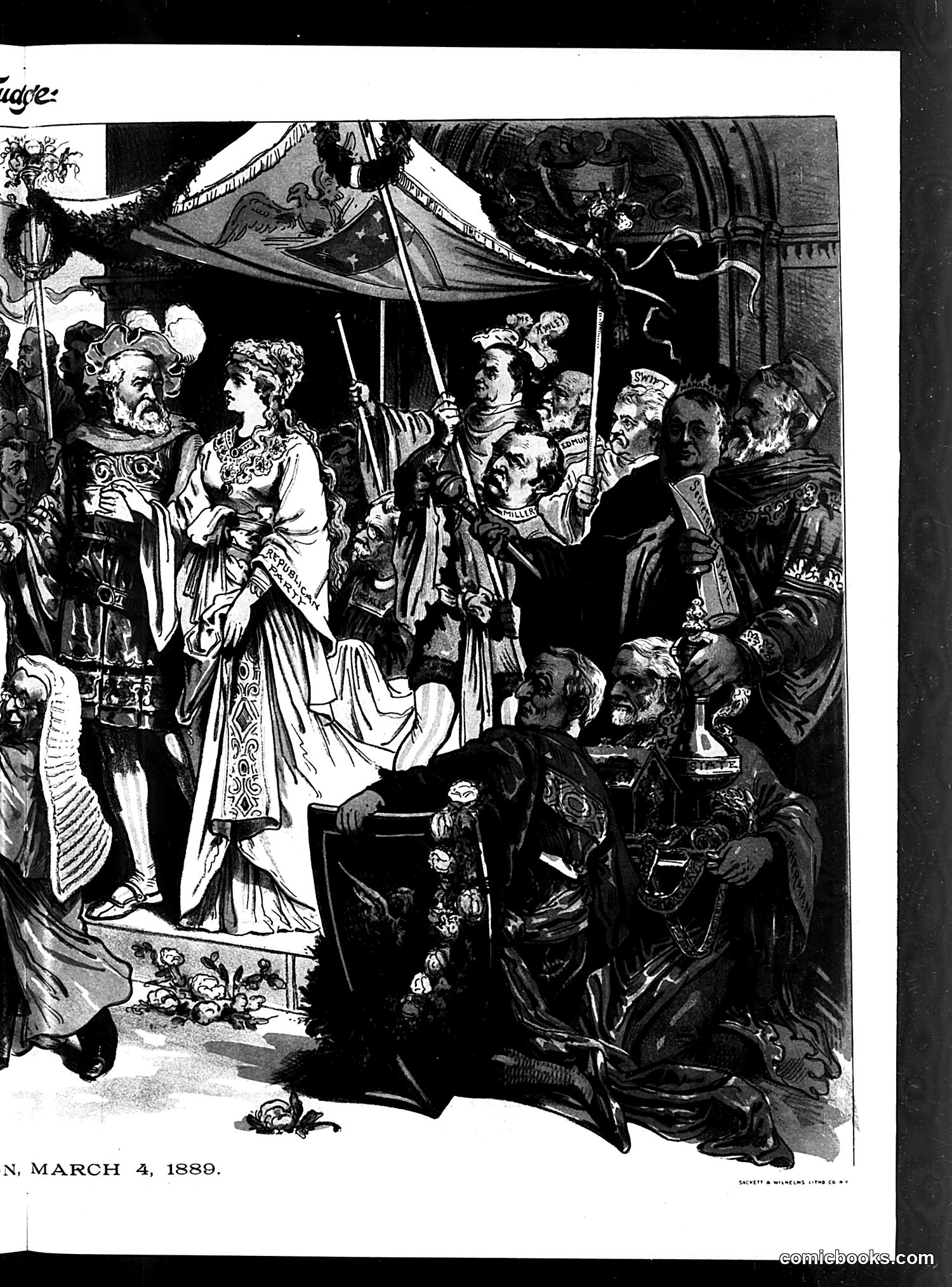
This engraving depicts a formal court or ceremonial scene, likely commemorating **Benjamin Harrison's presidential inauguration on March 4, 1889**. The central figures appear to be dignitaries in elaborate period dress, with some kneeling or bowing. Military/official standards and draped bunting suggest an official state ceremony. The satirical intent likely mocks the **formality and pageantry** of the inauguration or critiques Harrison's administration. The exaggerated poses and theatrical staging of the various figures suggests Judge magazine is poking fun at either the ceremony's grandeur or the participants' self-importance. Without clearer identification of specific figures or visible text labels, the exact satirical target remains somewhat unclear, though the overall tone appears mocking of high governmental ceremony.
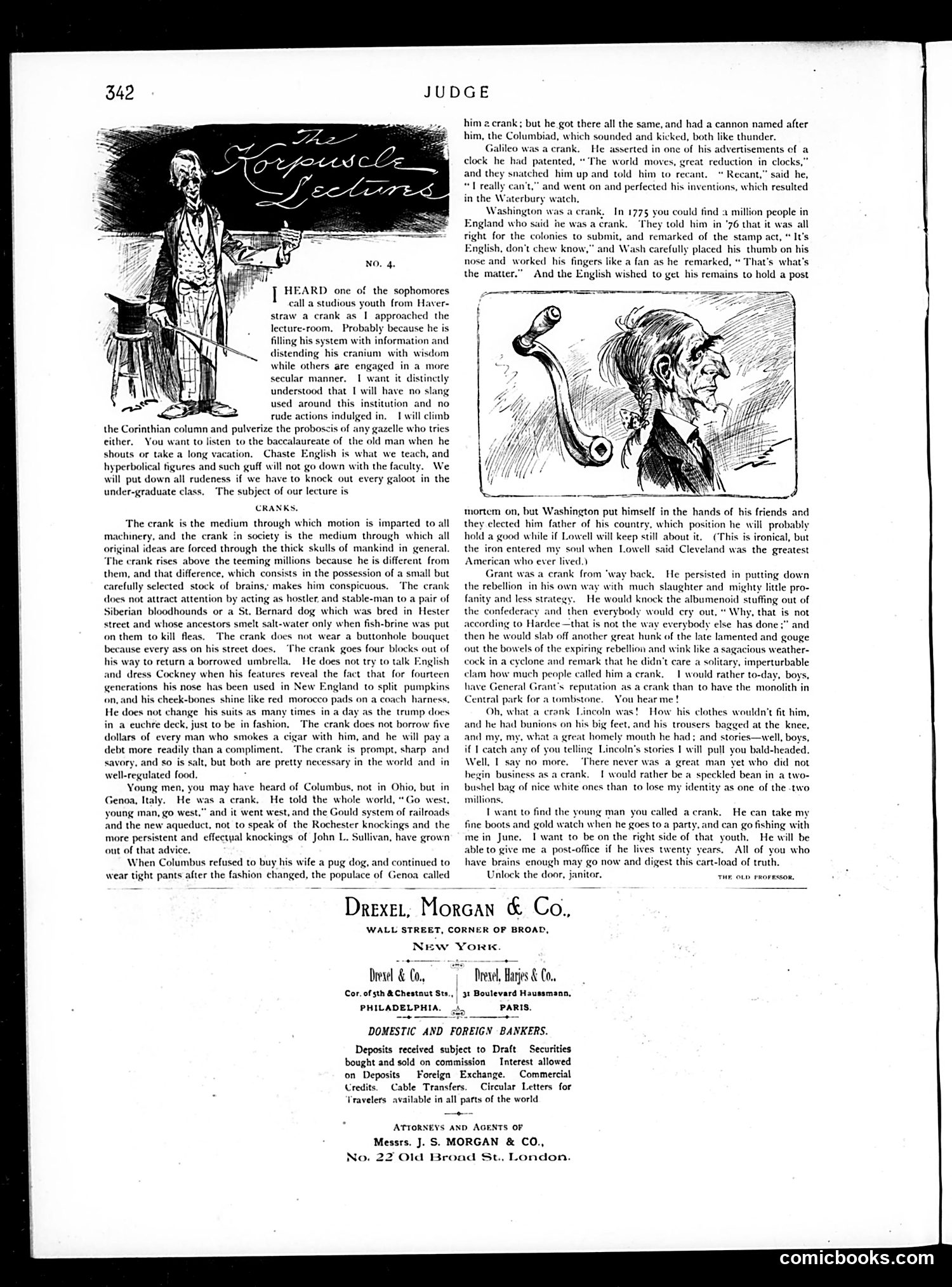
This page presents a lecture defending "cranks"—nonconformists and innovators—against student mockery. The unnamed professor argues that cranks are society's engine of progress, distinguishing them from mere eccentrics or social climbers. The lecture cites historical examples: Columbus (rejected as a crank for advocating westward expansion), Galileo (persecuted for scientific claims), and Washington (mocked in 1775 for independence advocacy). The professor celebrates cranks' intellectual integrity—they pursue truth over fashion, return borrowed items, and refuse to compromise principles for social acceptance. The satire targets both conformist mediocrity and the academy's suppression of original thought. By framing cranks as society's true benefactors rather than embarrassments, the piece mocks contemporary dismissal of unconventional thinkers and argues that progress requires embracing difference rather than enforcing bland uniformity. The page concludes with banking advertisements.
This is a full-page advertisement, not a cartoon or satirical content. It's a promotional piece for the Holyoke Envelope Company of Massachusetts, placed as a supplement in *Judge* magazine. The ad promotes mass-produced envelopes and stationery products, emphasizing their quality, affordability, and variety (500 styles updated twice yearly). Key selling points include gummed flaps made with "pure gum," competitive pricing, and free delivery to major cities. The prominence of "gummed goods" reflects late 19th/early 20th-century manufacturing—envelopes with pre-glued flaps were a significant innovation. The ad targets both high-end stationers and bulk "notion trade" buyers (general merchandise retailers). There is no satirical content here—it's straightforward commercial advertising typical of *Judge*'s revenue model.
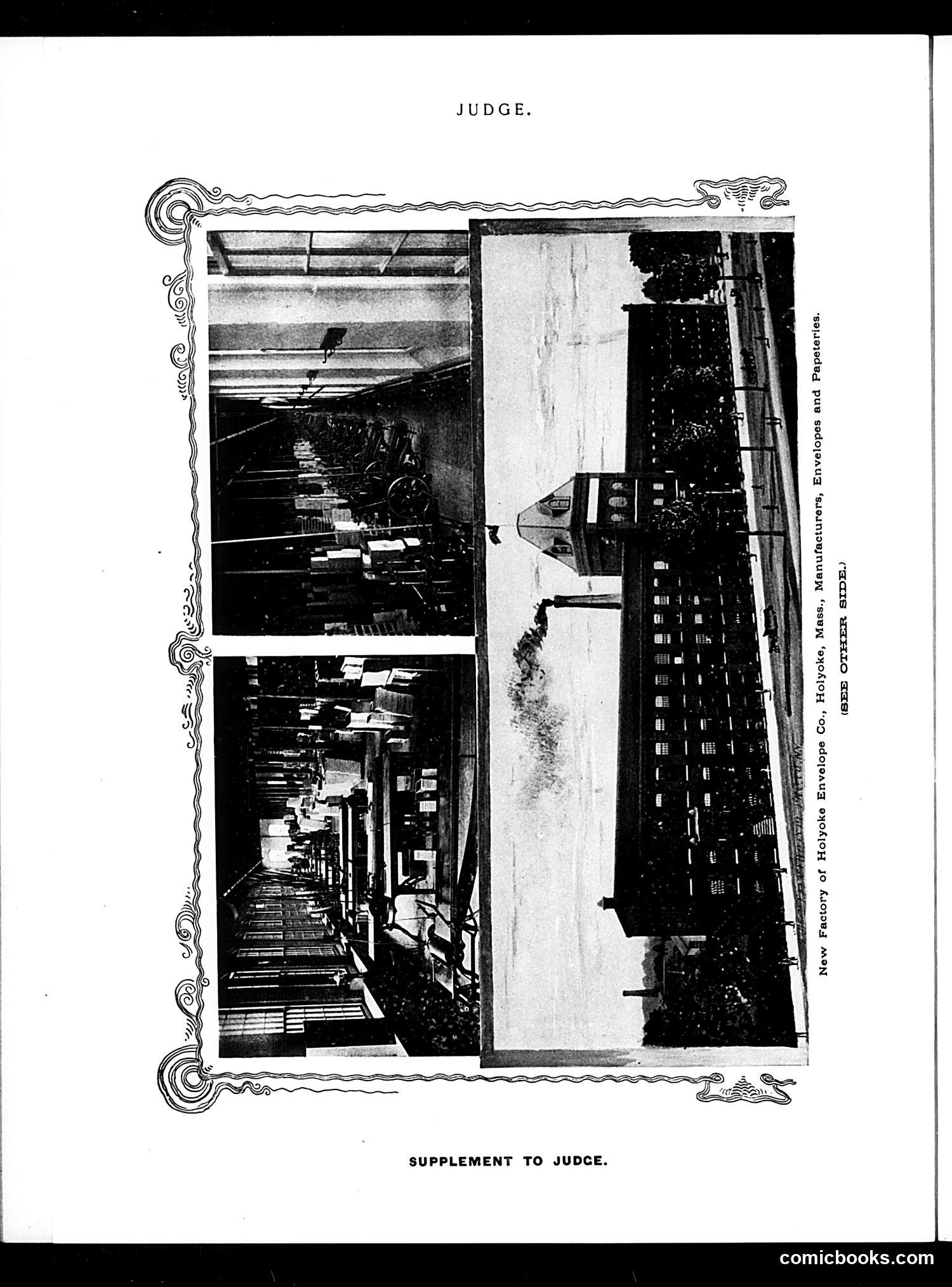
This appears to be a title/supplement page rather than a political cartoon. The page shows "JUDGE" at the top and "SUPPLEMENT TO JUDGE" at the bottom, with three black-and-white photographs arranged vertically. The caption text indicates these are images of a "New Factory of Hoopskle Envelope Co., Fabyle, Mfrs. Manufacturers, Envelopes and Typewriters, ESSEX." The photos show factory interiors and the building exterior. This is industrial/commercial content—not political satire. Judge magazine frequently featured such photographs documenting American business and manufacturing alongside its satirical content. Without clearer text, the specific point or any satirical intent remains unclear, though the factory documentation may have been included as contemporary business-related content of interest to the magazine's readers.
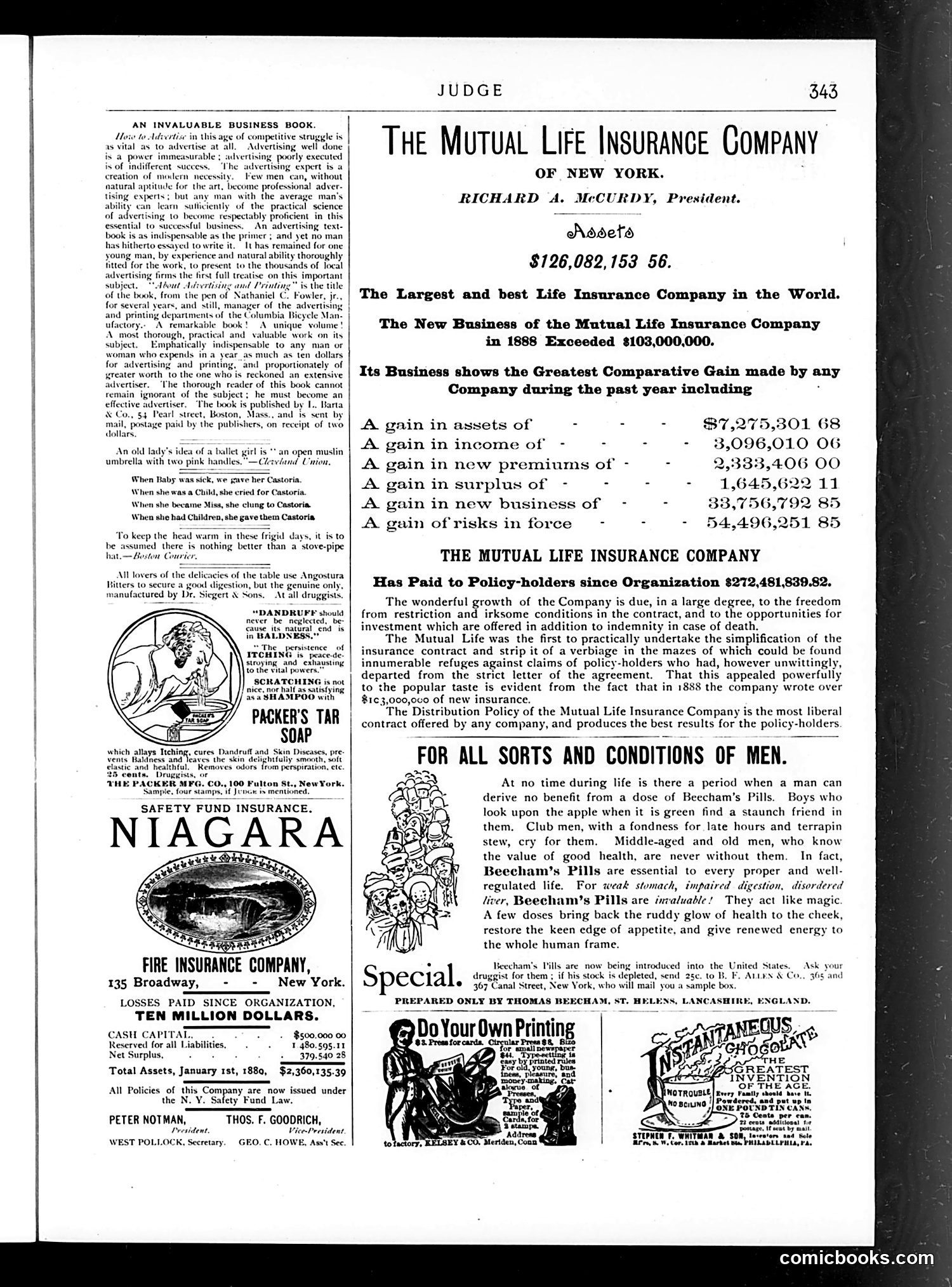
This page is primarily **advertising and corporate promotion**, not satire. It's a business magazine advertisement section featuring: **Main Content:** The Mutual Life Insurance Company of New York dominates the page, promoting itself as "The Largest and best Life Insurance Company in the World" under President Richard A. McCurdy. The ad showcases impressive financial gains from 1888. **Supporting Advertisements:** - Insurance companies (Niagara Fire Insurance) - Patent medicines (Beecham's Pills, Castoria) - Personal care products (Packer's Tar Soap for baldness/itching) - Printing services - Chocolate **Historical Context:** This reflects the Gilded Age boom in insurance and patent medicines. The extensive financial figures and claims of growth were typical corporate boasting of the era. The abundance of unregulated "cure-all" medicines (Beecham's Pills, Castoria) shows pre-FDA advertising standards. The page contains minimal editorial satire—it's largely straightforward commercial promotion typical of *Judge* magazine's revenue model.
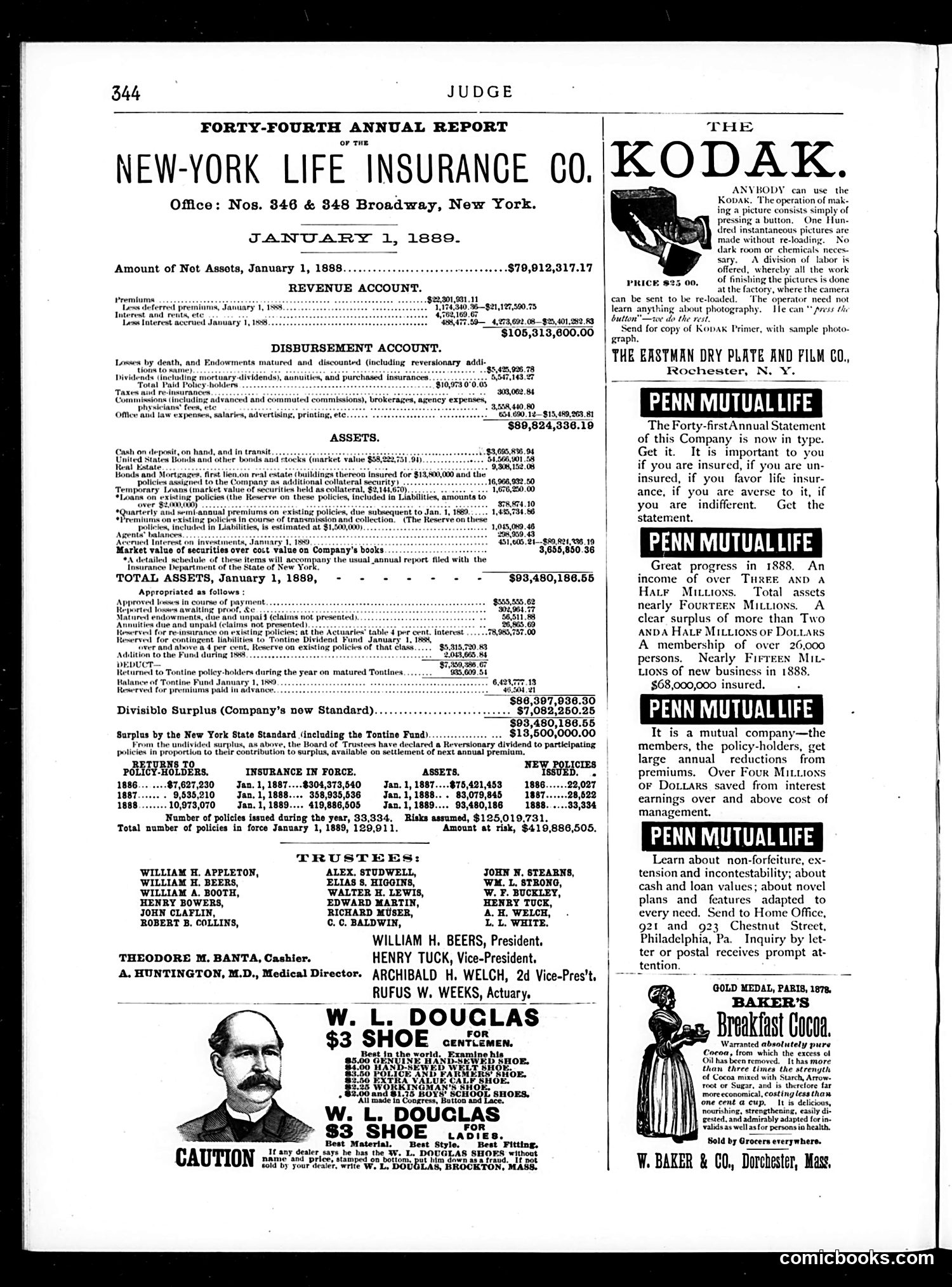
This page is primarily a **financial document and advertisement compilation**, not a political cartoon. The dominant content is the **Forty-Fourth Annual Report of the New-York Life Insurance Company**, displaying detailed financial statements, assets, liabilities, and corporate officers. This occupies the left two-thirds of the page. The right side contains **commercial advertisements**: Kodak cameras (emphasizing ease of use for ordinary people), Eastman Dry Plate and Film Company, Penn Mutual Life Insurance, and W.L. Douglas $3 shoes (with a portrait of Douglas and caution against counterfeits). **No political satire is evident here.** The page reflects Judge's function as both a satirical periodical and a venue for paid advertising and corporate announcements. The juxtaposition of insurance company financials with consumer product ads reveals late-19th-century publishing economics—Judge sold advertising space to major companies while maintaining its editorial mission elsewhere in the magazine.
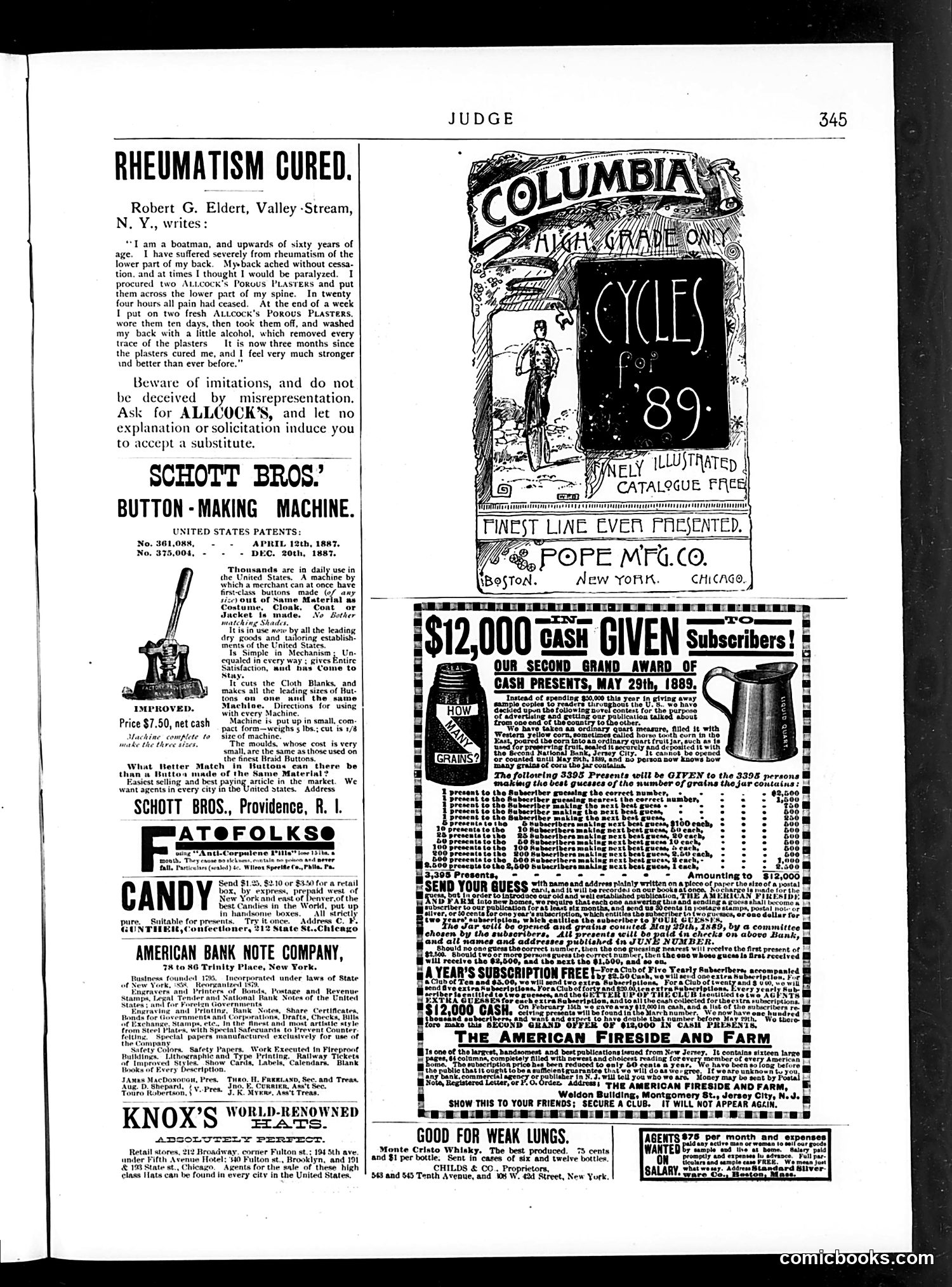
This page is primarily **advertisements and reader testimonials**, not satirical editorial content. The notable items include: **Top left**: A testimonial for Allcock's Porous Plasters, where a 60-year-old boatman claims the product cured his severe back rheumatism in 24 hours. The ad warns against imitations. **Center**: Various commercial advertisements for button-making machines, candy, bank notes, and hats. **Dominant feature (right side)**: A massive "$12,000 Cash Given to Subscribers" contest announcement for May 29th, promising cash prizes to readers who correctly guess how many grains of corn fill a jar. Winners receive $50-$300 depending on accuracy ranking. **Top right**: A Columbia bicycle advertisement. The page reflects *Judge*'s business model: mixing satirical journalism with paid advertisements and reader engagement contests to boost circulation and generate revenue.
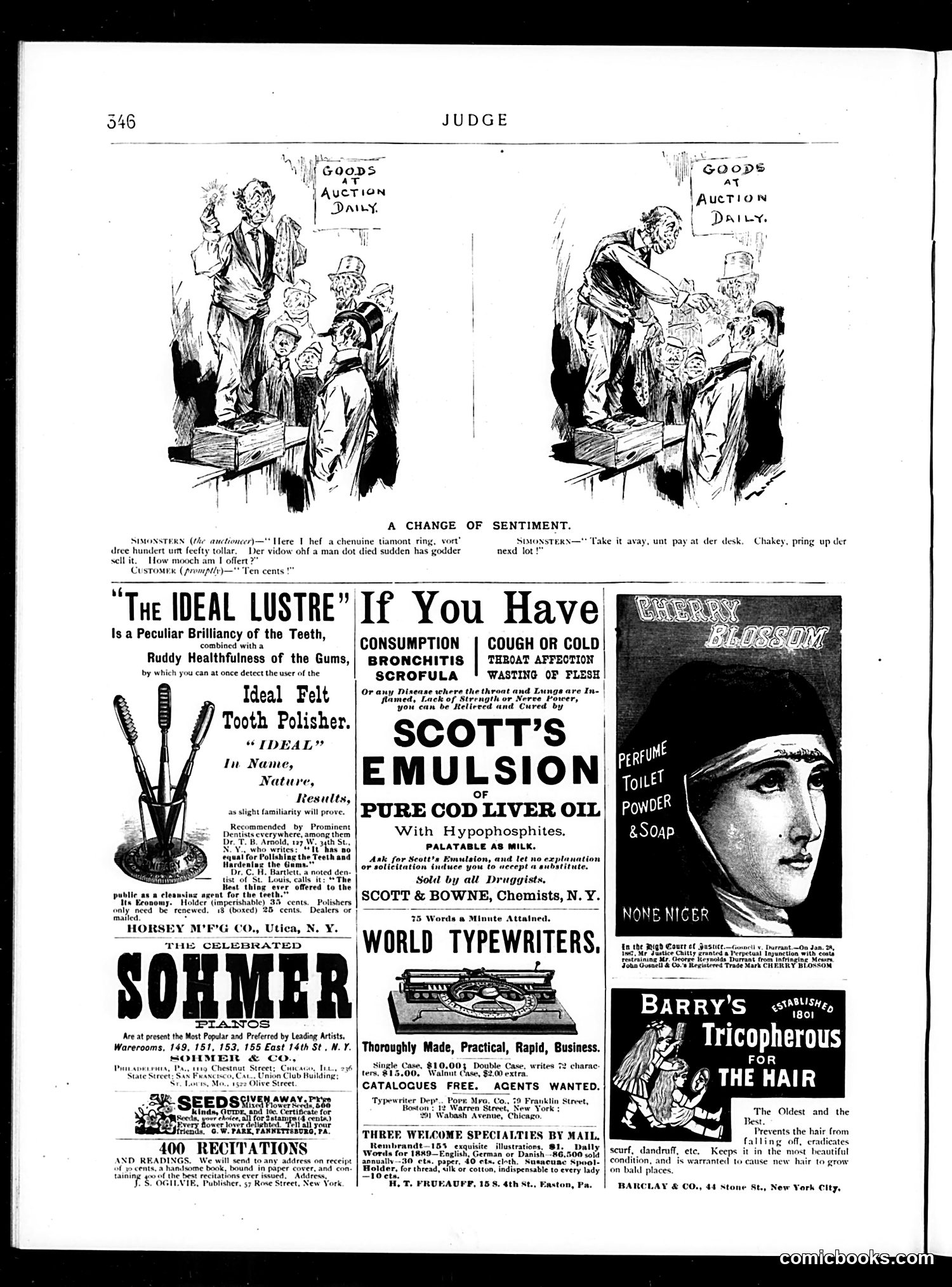
This cartoon satirizes auction house ethics or customer service. In the left panel, a well-dressed auctioneer eagerly sells goods to customers with apparent enthusiasm. In the right panel, identical scene but the auctioneer's demeanor has reversed—he now dismisses the customers curtly, telling them to "take it away" and "pay at the desk" rather than try to sell. The caption reveals the "change": a **Swindster** (con artist) initially courts the customer with flattery ("Here I had a chemise flaneur ring...") seeking a sale, while a **Customer** complains. Once the sale is complete, the auctioneer's civility evaporates. The joke critiques the transactional dishonesty of merchants—excessive courtesy before payment disappearing immediately after. It's a common complaint about vendor behavior that remains relevant today. The page is otherwise filled with period patent medicine and product advertisements (Scott's Emulsion, tooth polish, typewriters).
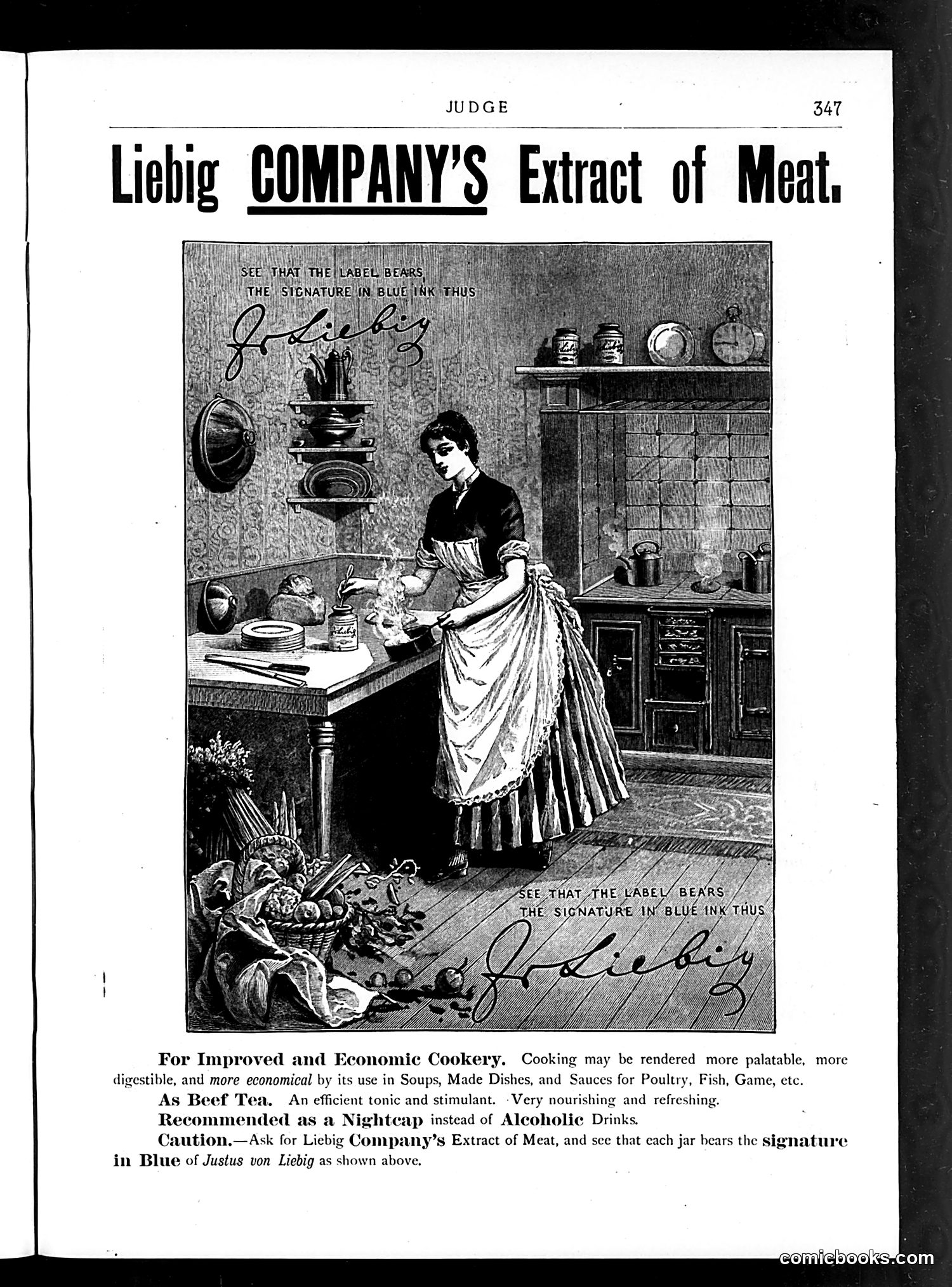
This is primarily a **product advertisement** rather than political satire. It promotes Liebig Company's meat extract, a concentrated beef product popular in the late 19th/early 20th century. The illustration shows a well-dressed woman in a kitchen using the product for cooking. The ad emphasizes practical benefits: economy, improved digestibility, and versatility in soups and sauces. A notable claim appears in the text: the extract is "**Recommended as a Nightcap instead of Alcoholic Drinks**"—reflecting Victorian-era health consciousness and perhaps temperance movement influence. The repeated emphasis on the **signature of Justus von Liebig in blue ink** served as an anti-counterfeiting measure, as the product was widely imitated. The tone is aspirational, positioning the product as enabling refined, economical cookery for middle-class households.
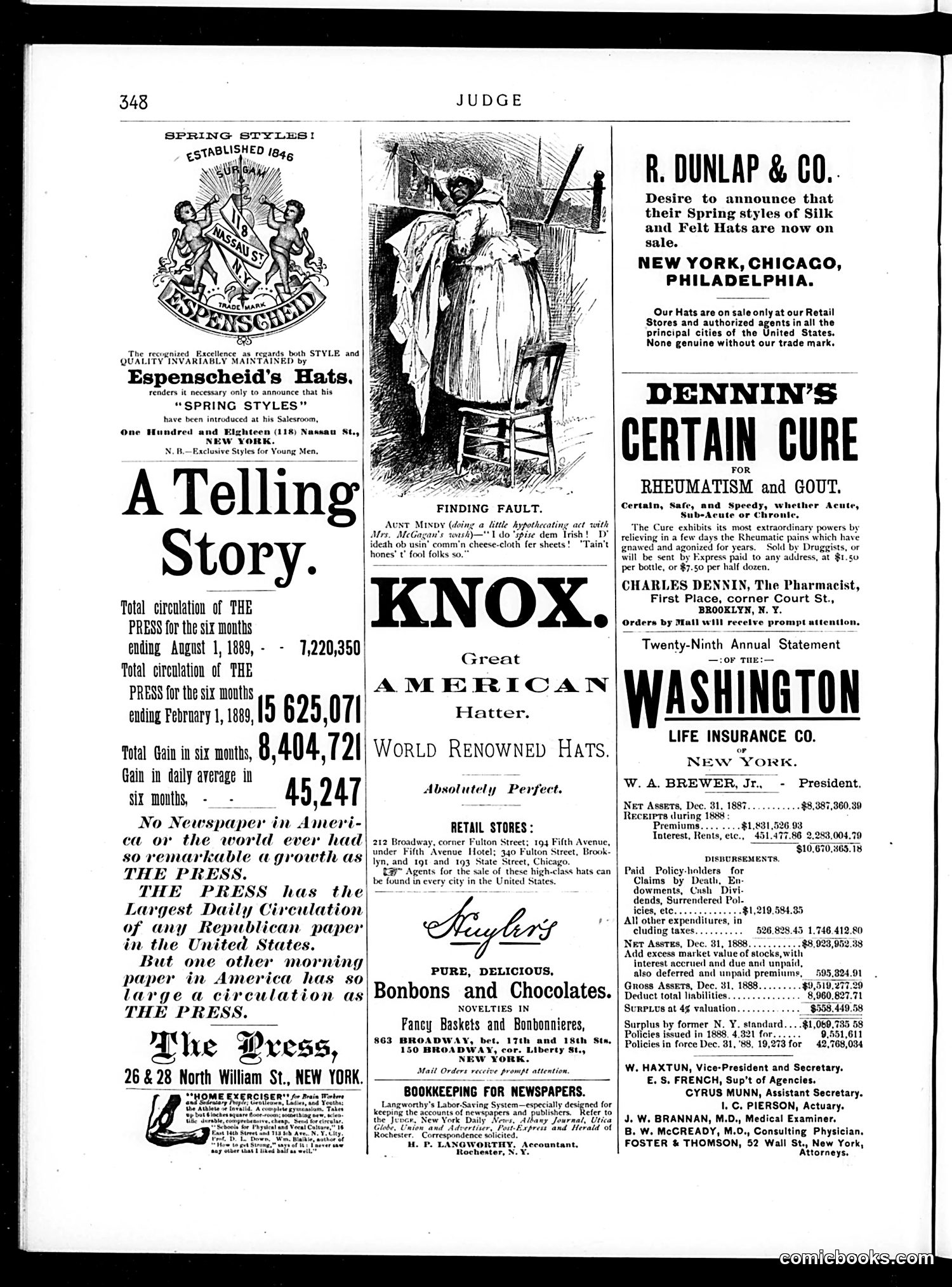
This page is primarily **advertising and corporate notices**, with one minor satirical element. ## The Cartoon: "Finding Fault" The small sketch shows an Irish woman (identified by dialect and stereotyping as "Aunt Minny") criticizing Mrs. McGagan's domestic practices—specifically her use of "cheese-cloth fer sheets" and attempting to "fool folks." The joke trades on period ethnic humor: Irish servants' gossip and class-conscious criticism of each other's housekeeping standards. This was standard Judge magazine fare: gentle mockery of immigrant working-class domestic life. ## The Advertisements The page is dominated by ads for hats (Espenscheid's, Knox, R. Dunlap & Co.), confections (Keylor's), patent medicines (Dennin's cure for rheumatism), and financial services—typical 1888-89 magazine content. ## "The Press" Self-Promotion Judge's circulation figures claim remarkable growth, boasting it has "the largest daily circulation of any Republican paper in the United States"—purely promotional content supporting the magazine itself.
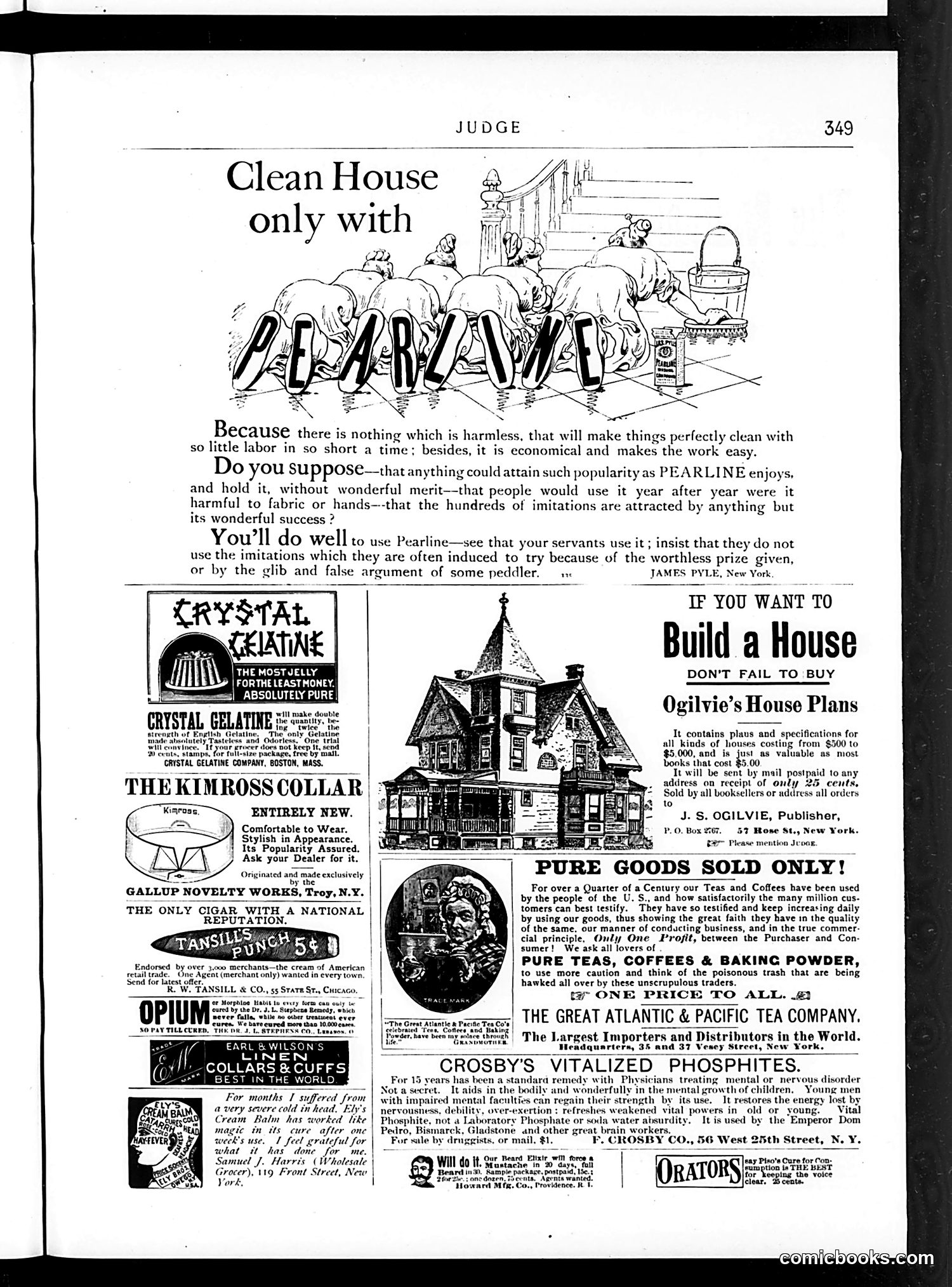
This is primarily an **advertising page** from Judge magazine, not a satirical cartoon. The main content features vintage product advertisements from the late 19th century. The dominant advertisement is for **Pearline cleaning product**, which uses a humorous illustration of women bent over scrubbing (forming the word "PEARLINE"). The text argues Pearline's popularity proves its safety and effectiveness, and warns consumers against imitations and cheap prizes used by competitors to lure buyers. The remaining space contains typical period advertisements: Crystal Gelatine, the Kimross collar, Tansill cigars, Opium patent medicine, Earl & Wilson collars, Ogilvie's House Plans, tea/coffee vendors, and Crosby's Phosphites (a nerve tonic). **For modern readers:** The page reflects turn-of-century consumer culture where patent medicines made wild health claims (Opium for "any disease"), cleaning products were labor-intensive, and magazines relied heavily on advertisements. The Pearline ad's concern about counterfeits shows early brand-management awareness. There is no political satire present on this page.
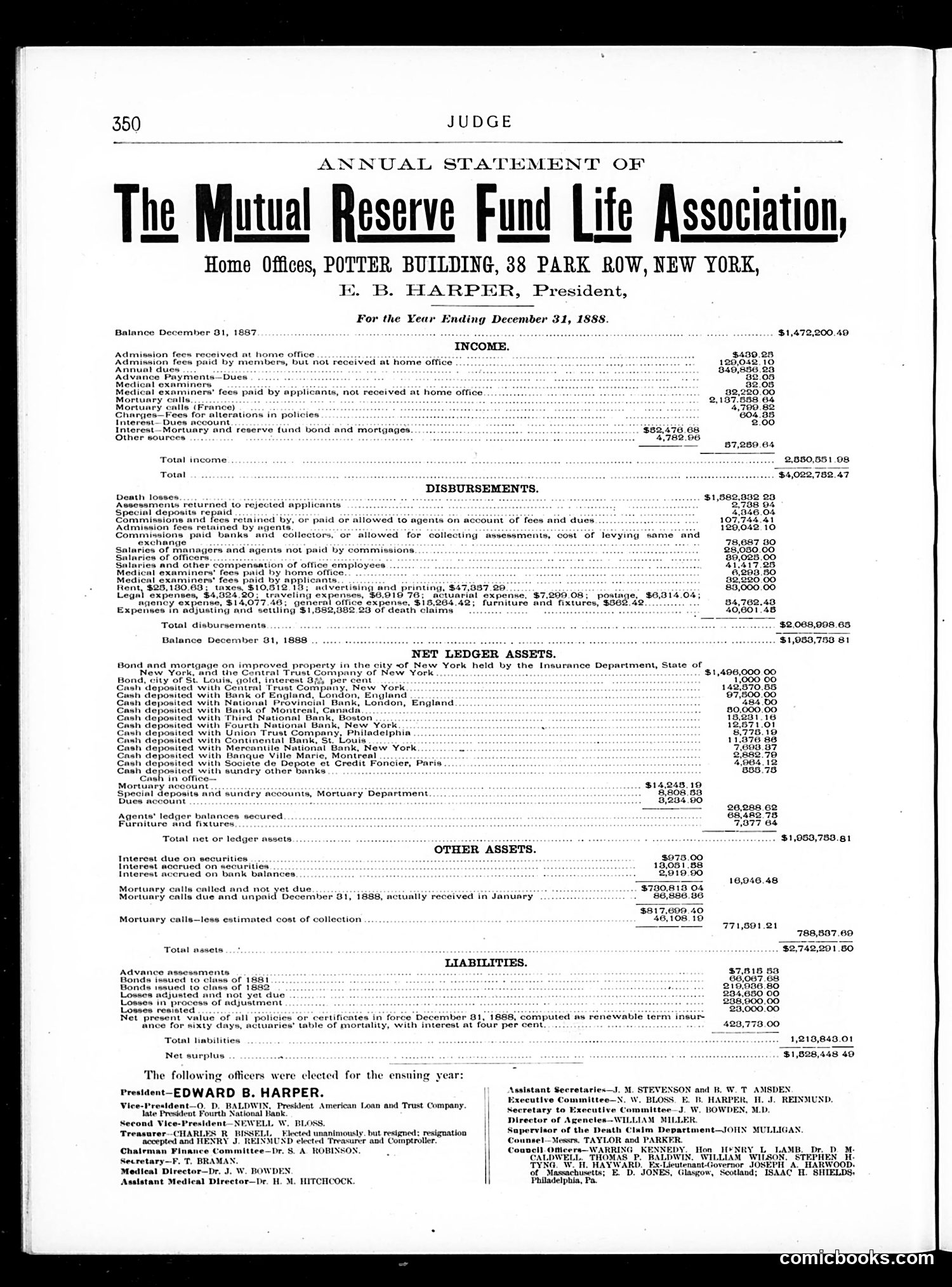
This page is **not a cartoon or satirical content**—it's a financial document. It's the annual statement of the Mutual Reserve Fund Life Association for 1888, showing income, disbursements, assets, and liabilities. However, its appearance in *Judge* magazine is itself noteworthy. Judge was a humor and satire publication, so printing this detailed insurance company financial statement in its pages is likely **satirical commentary on corporate bureaucracy and opacity**. The dense tables of numbers, arcane accounting categories, and fine print would have appeared comically impenetrable to ordinary readers—possibly mocking how financial institutions obscured their operations behind incomprehensible jargon. The statement shows the company's president was E.B. Harper and lists officers and board members. Without seeing accompanying illustrations or editorial text, the satire's exact target remains unclear, but the juxtaposition of tedious corporate accounting against a humor magazine's audience suggests mockery of institutional obfuscation.
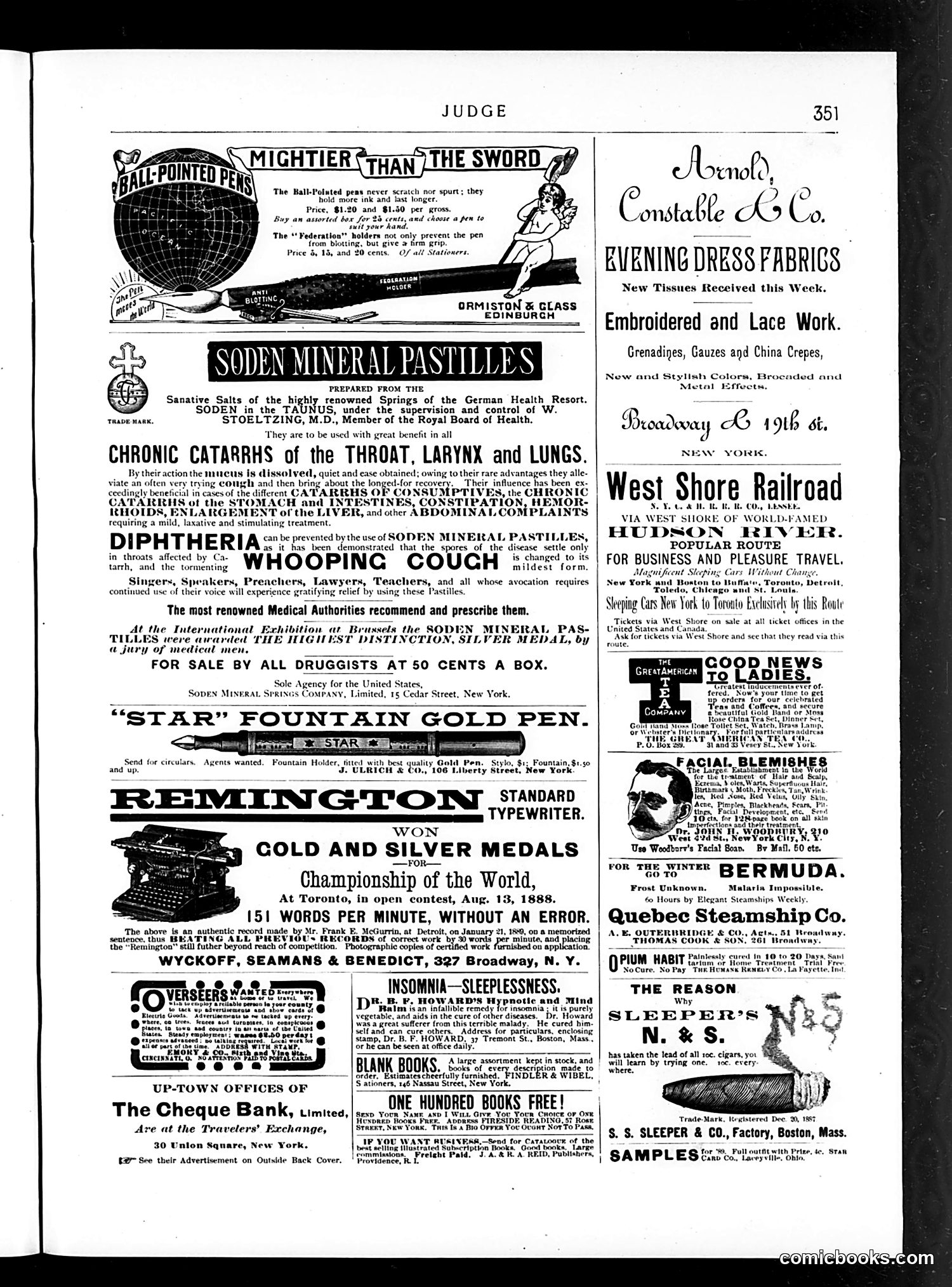
This is primarily **an advertising page** with no significant political cartoons or satirical content requiring historical context. The top features a small product advertisement for **Ball-Pointed Pens** and pen holders—mundane office supplies marketed for their durability and non-blotting properties. Below that is a lengthy medical advertisement for **Soden Mineral Pastilles**, German health-resort salts marketed as a cure-all for throat, lung, and digestive ailments. This reflects late-19th-century patent medicine culture when such products made unsubstantiated health claims. The remaining advertisements cover standard commercial products: a **Remington typewriter** (boasting a world speed record from 1888), a **fountain pen**, various books and stationery products, and medical remedies for insomnia and facial blemishes. The page captures the era's advertising landscape—before modern FDA regulation—when extravagant health claims were common and typewriter manufacturers actively promoted technological superiority.
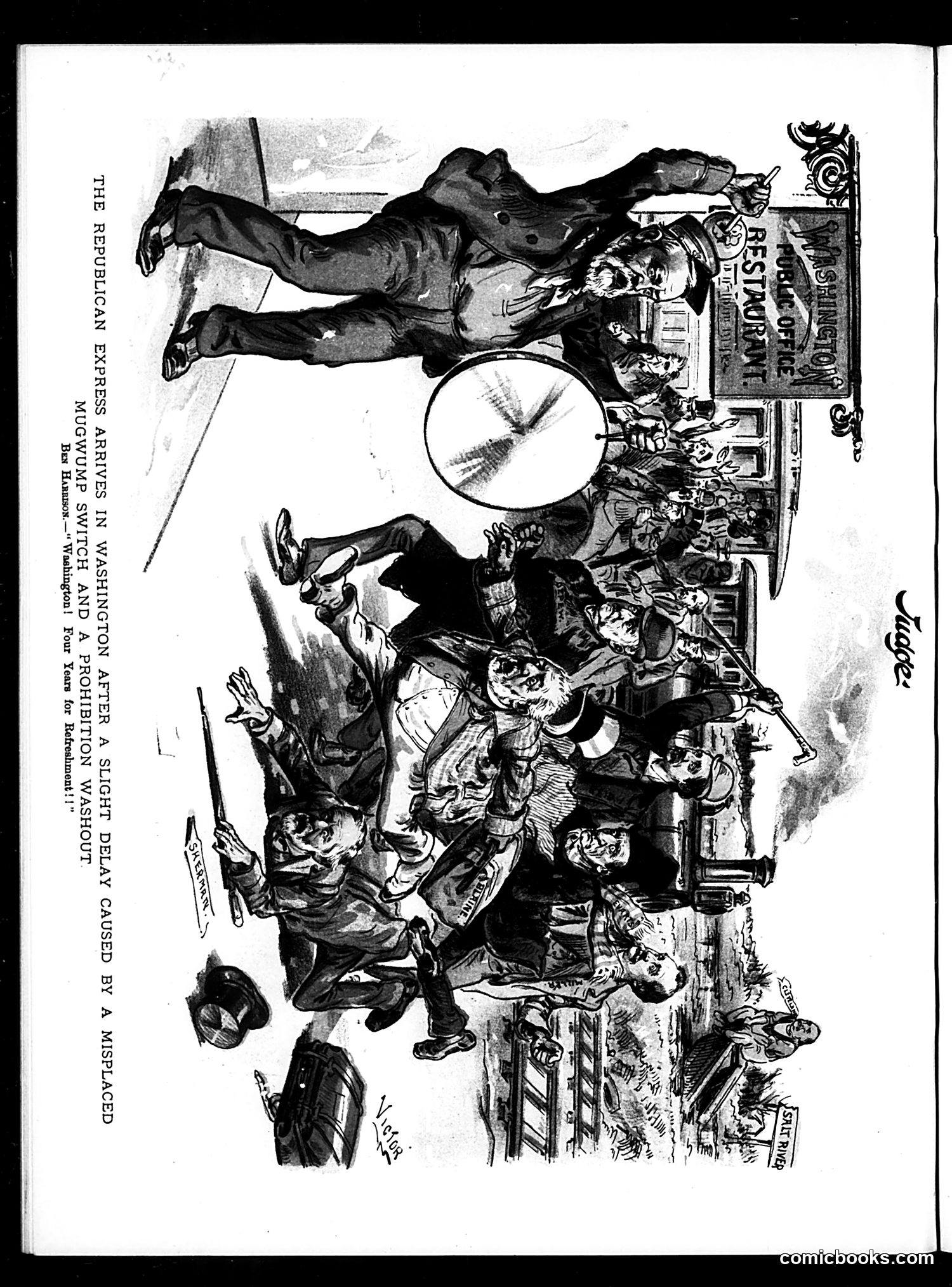
This Judge magazine cartoon satirizes the Republican Party's arrival in Washington, depicted as a derailed train. The "Republican Express" has crashed due to a "misplaced Mugwump switch" and "Prohibition washout"—referencing real political fractures of the era. "Mugwumps" were Republicans who defected to support Democrat Grover Cleveland, splitting the party. The cartoon depicts this schism literally wrecking the GOP's political machinery. The "Prohibition washout" references the contentious temperance debate dividing Republicans. The conductor's announcement of "Four Years for Refreshment" suggests Republicans need recovery time after internal chaos. The chaotic scene below the derailed train shows politicians scrambled by the crash, visually representing party disarray and dysfunction during a transitional political moment.
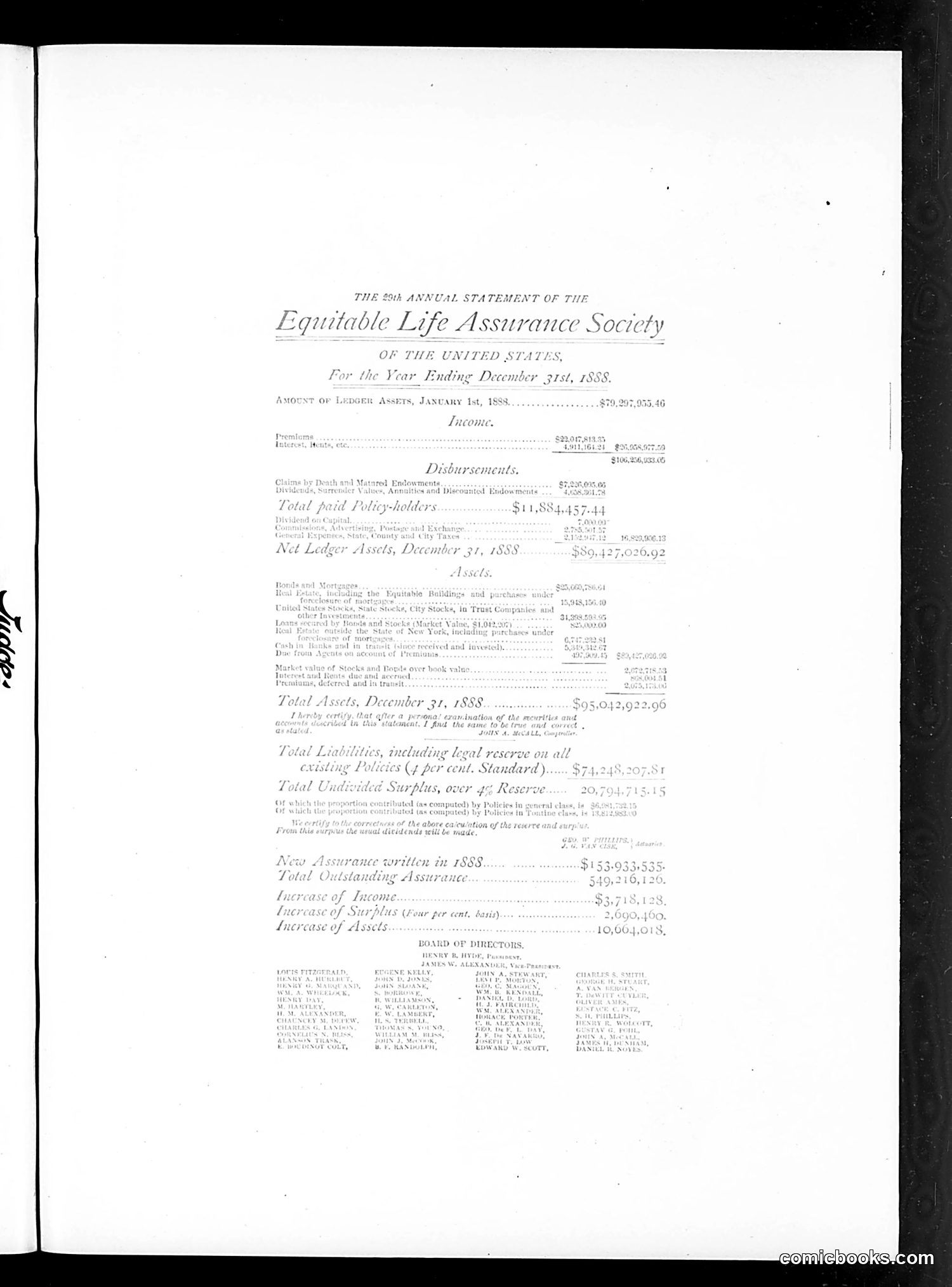
This page is **not a cartoon or satirical content** — it's a financial statement from the Equitable Life Assurance Society of the United States for the year ending December 31, 1888. The document presents: - Assets and liabilities data - Income and disbursement figures - A board of directors listing While this appears in *Judge* magazine, it functions as a straightforward corporate disclosure rather than satire. The inclusion of such financial statements in satirical publications was common practice for insurance companies and financial institutions seeking credibility and public trust during this era.
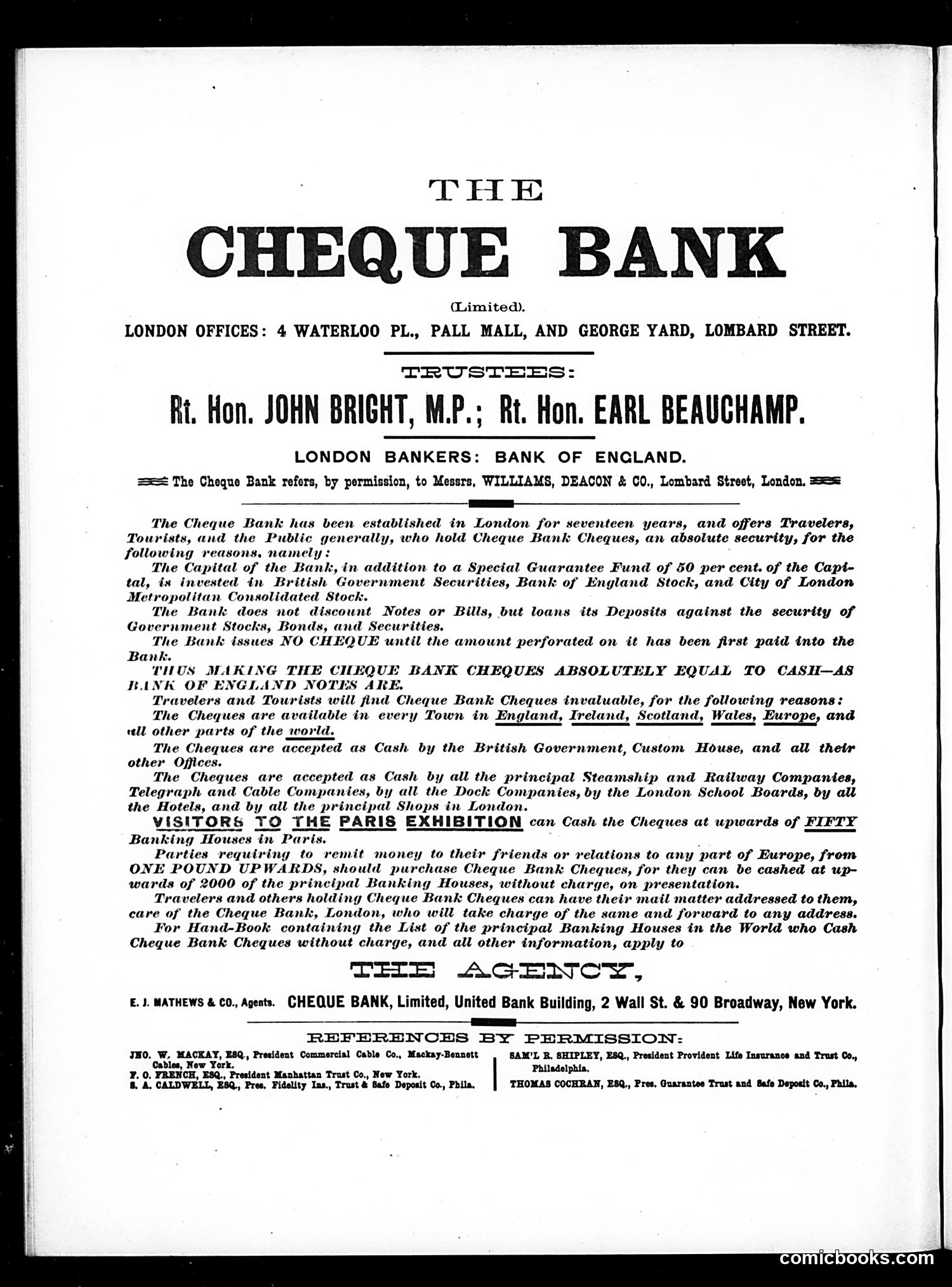
This page is **not a cartoon or satire**—it's a straightforward advertisement for The Cheque Bank, a London financial institution established seventeen years prior (the document itself is undated). The Cheque Bank offered traveler's cheques, a then-novel financial product guaranteeing security for tourists and business travelers across Europe and beyond. The ad emphasizes the bank's legitimacy through trustee names (John Bright and Earl Beauchamp were real British politicians), backing by the Bank of England, and capital invested in government securities. The advertisement highlights practical benefits: cheques accepted worldwide at 2,000+ banking houses, by governments, railroads, and hotels without charge. This represented a major innovation—travelers no longer needed to carry dangerous amounts of cash. The New York agency details and references from major American trust companies suggest Judge magazine's audience included affluent readers who traveled internationally, making this a logical advertisement placement.