
A complete issue · 51 pages · 1888
Judge — December 1888
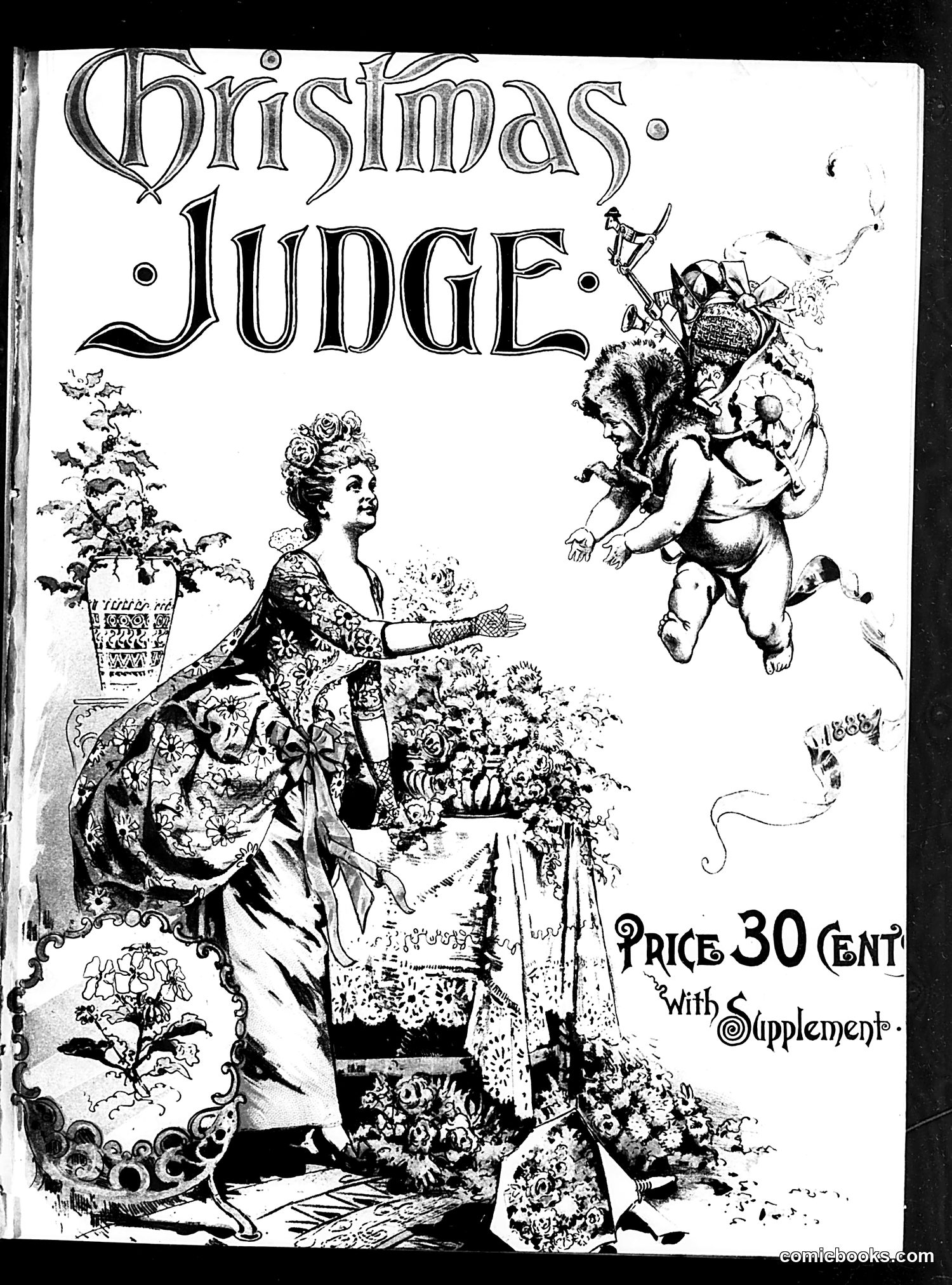
This is the cover of *Judge* magazine priced at 30 cents, labeled "Christmas Judge" with a supplement. The elaborate illustration depicts an elegant woman in ornate period dress surrounded by abundant flowers and decorative elements, embodying the magazine's holiday theme. Cherubs or putti float above, carrying garlands and adding festive whimsy. The artistic style is typical of late 19th/early 20th-century satirical magazine covers—ornamental, allegorical imagery celebrating the season rather than conveying political satire. The figure appears to represent an idealized feminine personification of Christmas or seasonal prosperity. Without additional context about the specific publication date or accompanying articles, the precise satirical intent remains unclear, though the lavish imagery suggests celebrating holiday consumption and aesthetic pleasures.
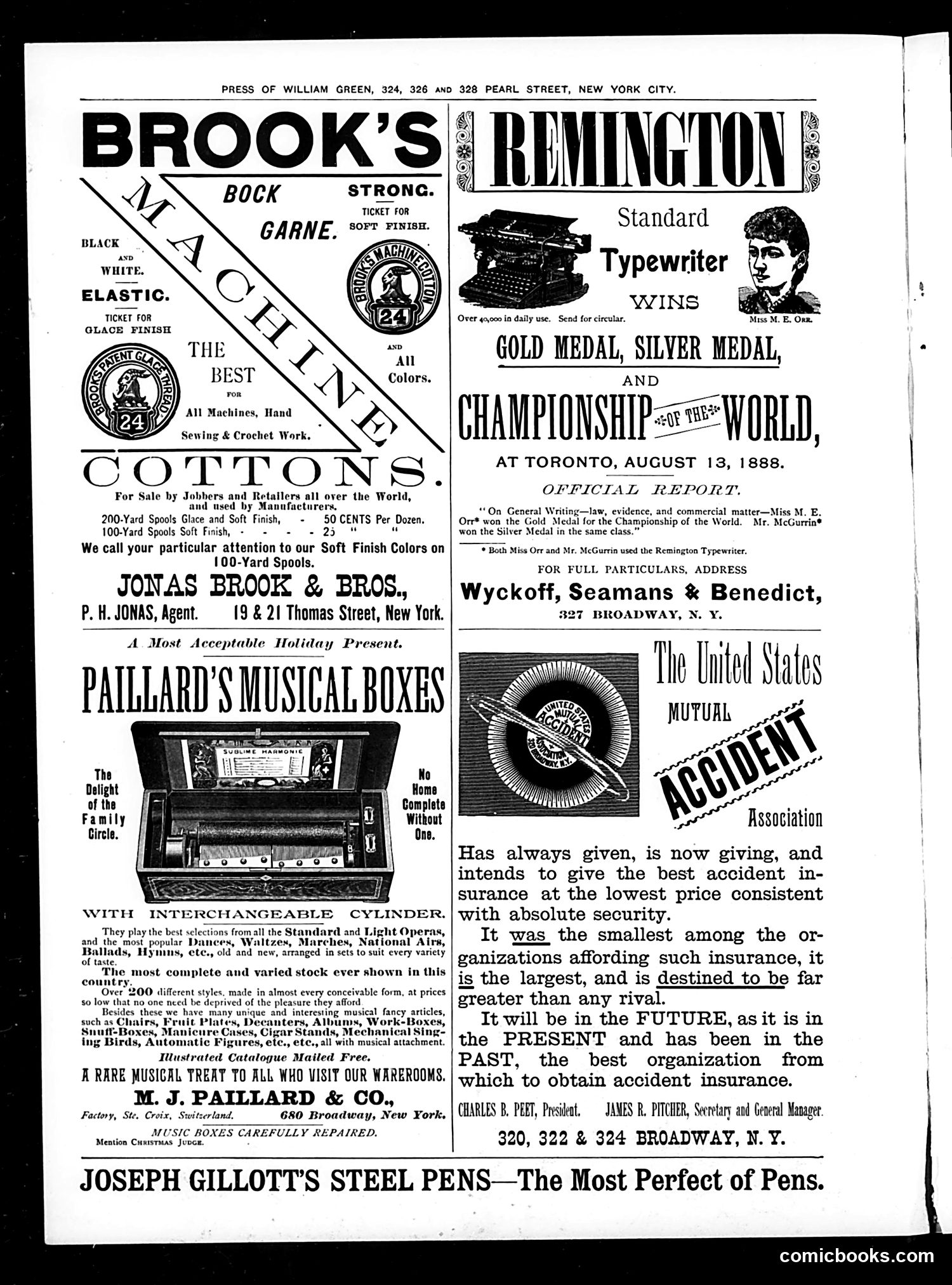
This page is **primarily advertising** with no political cartoons or satirical content. The advertisements include: - **Brook's products** (elastic, cotton thread, machine supplies) - **Remington Standard Typewriter** promoting its 1888 championship win at Toronto - **Paillard's Musical Boxes** (mechanical music devices) - **United States Mutual Accident Association** (insurance company) - **Joseph Gillott's Steel Pens** The only figure is a portrait of "Miss M. E. Ose" associated with the Remington typewriter ad, apparently highlighting a woman's success in a typing competition—notable for the era as women's increasing participation in office work. The page reflects late-19th-century consumer culture rather than political satire.
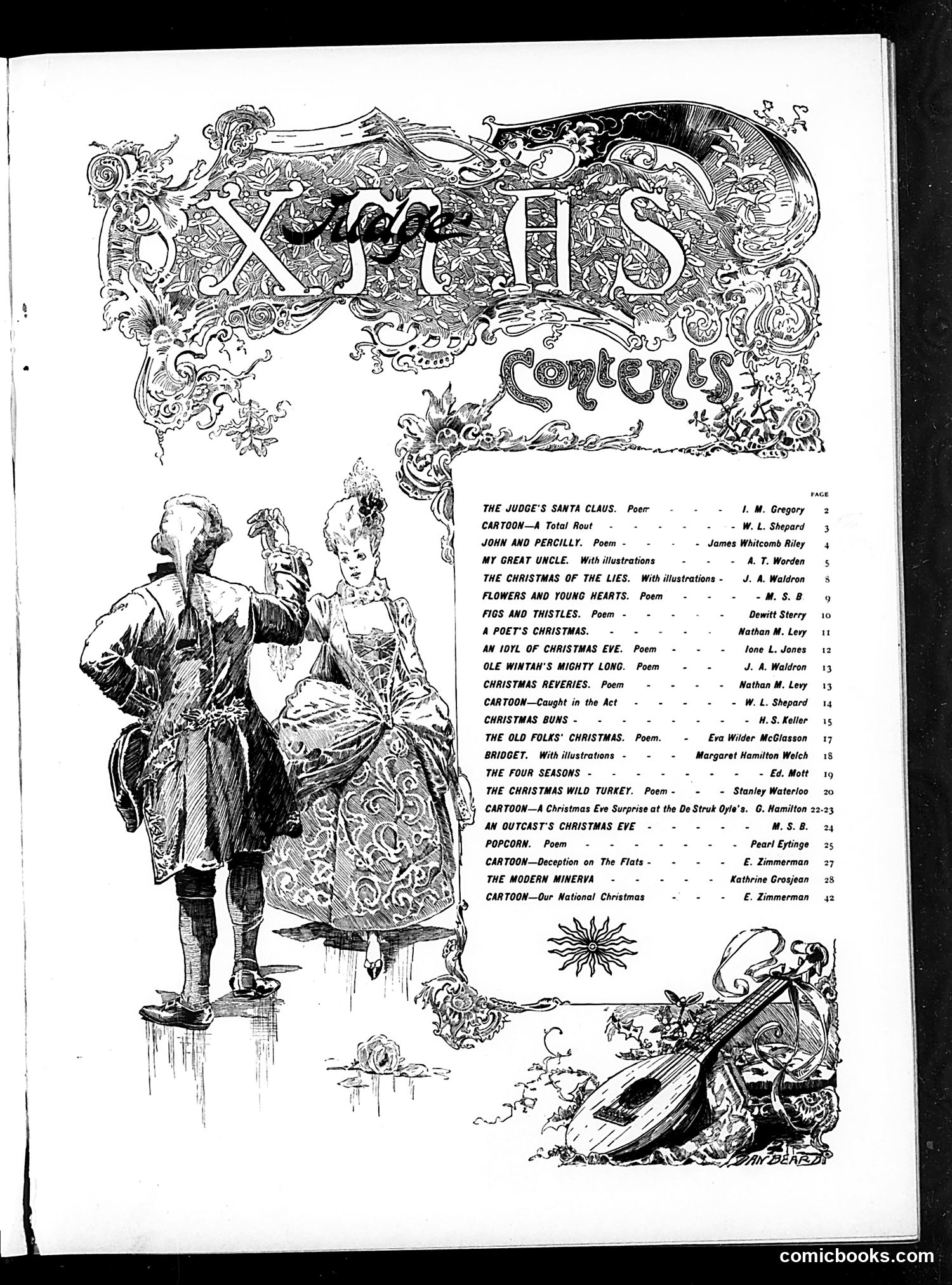
This is a table of contents for a Christmas-themed issue of *Judge* magazine, a prominent American satirical publication. The page features decorative Victorian-era illustrations surrounding the contents listing, typical of late 19th/early 20th-century magazine design. The issue contains a mix of seasonal content: poems about Christmas traditions (by popular period writers like James Whitcomb Riley), illustrated stories with domestic themes ("My Great Uncle," "Bridget"), and multiple cartoons by staff artists W.L. Shepard and E. Zimmerman addressing holiday scenarios—"A Total Rout," "Caught in the Act," and "Our National Christmas." The content emphasizes traditional American Christmas celebrations and sentimental family narratives. Without seeing the actual cartoons' content, specific satirical targets remain unclear, though "Our National Christmas" suggests commentary on American holiday customs or commercialism.
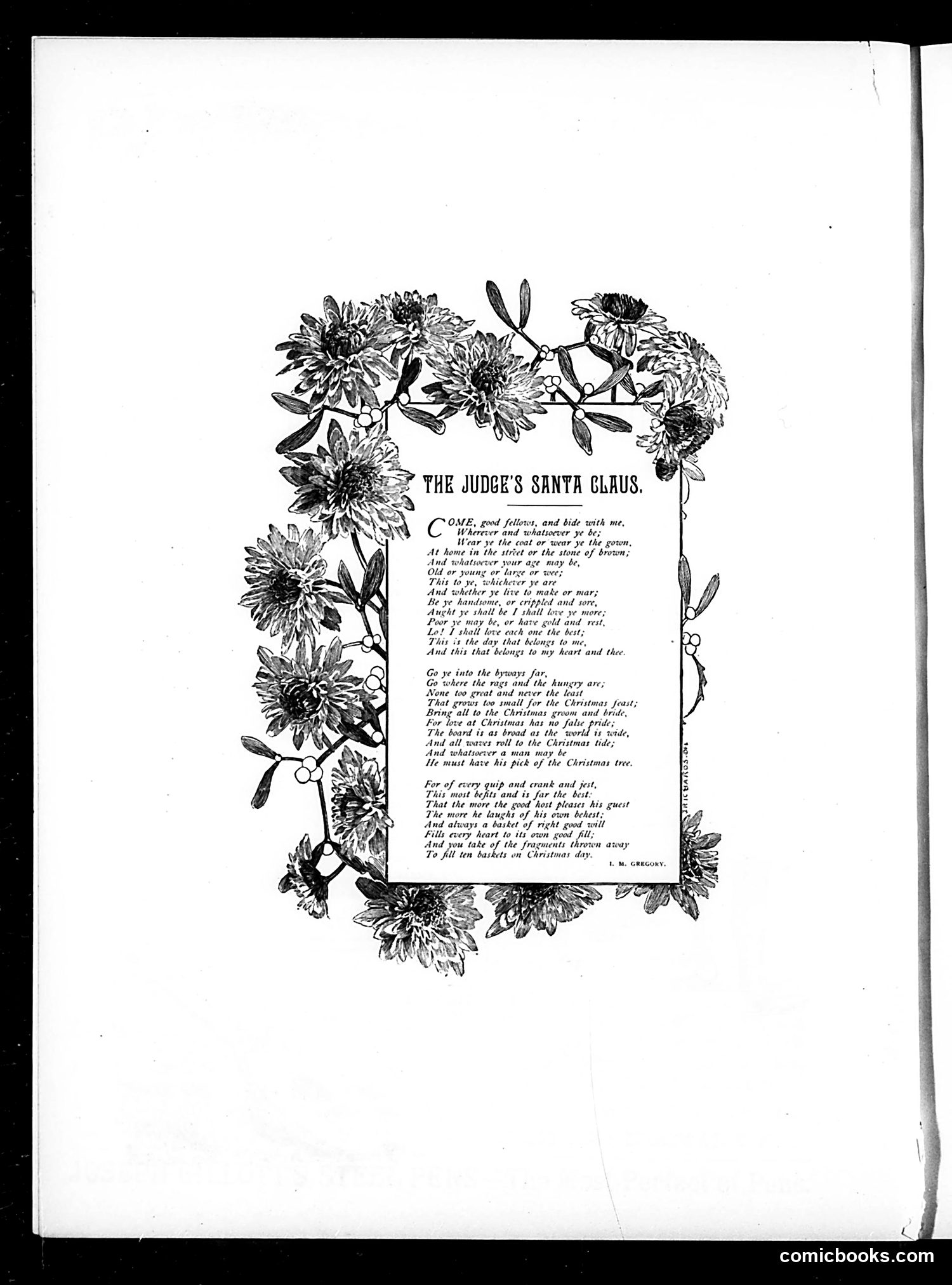
This is a sentimental Christmas poem, not political satire. The text presents an idealized vision of Santa Claus as a figure of universal charity and democratic equality. The poem emphasizes that Christmas transcends class boundaries—addressing rich and poor, healthy and infirm, young and old equally. Key themes include: charity toward the destitute ("Go where the rags and the hungry are"), abundance shared without pride, and the redemptive power of generosity. The florally-decorated border frames this as an aspirational moral message rather than mockery. The credited author "I.A. Gregory" appears to be offering Judge magazine readers an earnest holiday sentiment about radical inclusivity and Christian charity—a humanistic ideal rather than political commentary. This reflects late 19th/early 20th-century Progressive-era faith in benevolent social values.
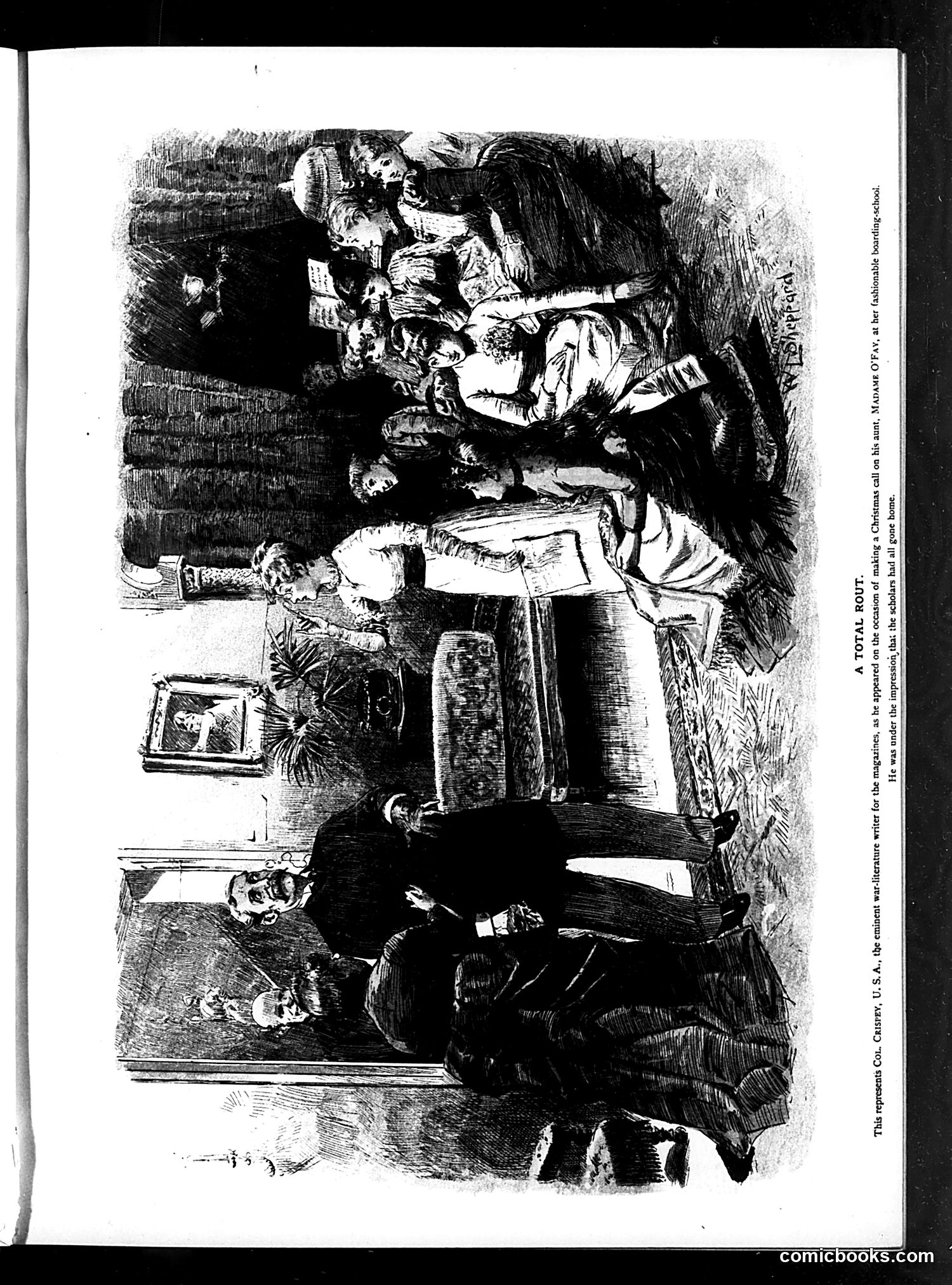
I cannot reliably read the OCR'd text (it appears corrupted or reversed), so I'm relying primarily on the image and title. The cartoon depicts a political defeat or rout. A well-dressed man in dark clothing (likely representing a political figure or party) appears to be retreating or fleeing in disarray, while figures above him—possibly representing opponents or the public—advance victoriously. The composition suggests a satirical commentary on electoral loss or political failure. Without clearer text or date information, I cannot identify the specific politician, election, or historical event being mocked. The style and printing suggest late 19th-century American politics, but the exact reference remains **unclear**.
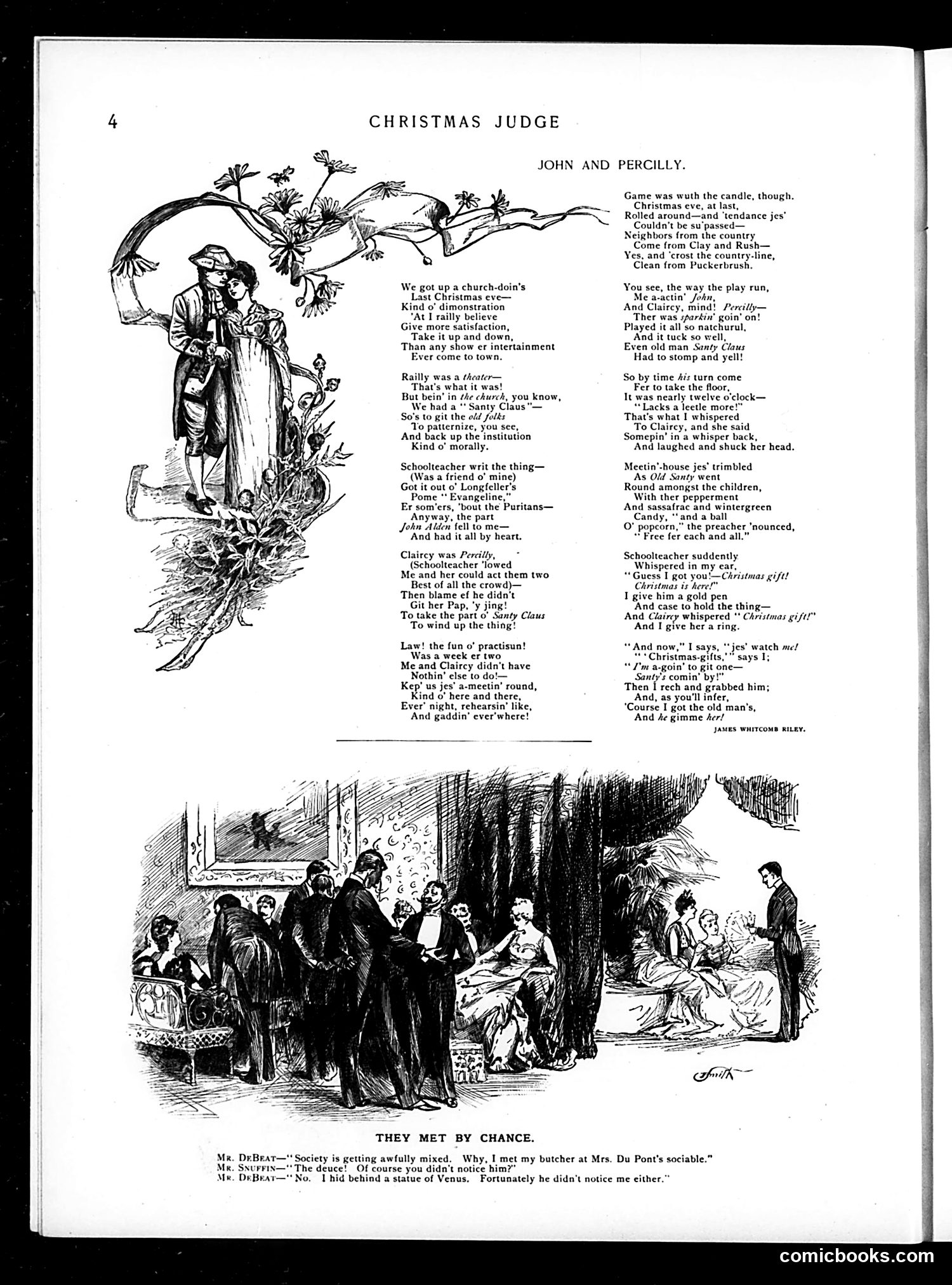
This page contains two distinct pieces: **"John and Percilly"** is a sentimental dialect poem by James Whitcomb Riley about a rural church Christmas pageant. Two young people (the narrator and Claircy) rehearse together playing characters from Longfellow's "Evangeline," and their on-stage "sparking" (flirtation) becomes genuine romance. The charm lies in the folksy language and innocent courtship within a wholesome community setting—typical of Riley's popular rural Americana verse of the era. **"They Met by Chance"** is a brief society satire below, mocking class anxiety. A wealthy woman boasts she encountered her butcher (working-class) at an upper-class gathering. The joke is mutual embarrassment: she hid behind a statue to avoid acknowledging him, while he similarly avoided noticing her—both desperate to maintain social pretense that their classes don't actually mix in "polite society." Both pieces reflect *Judge* magazine's mix of sentimental Americana and gentle social commentary on American class distinctions.
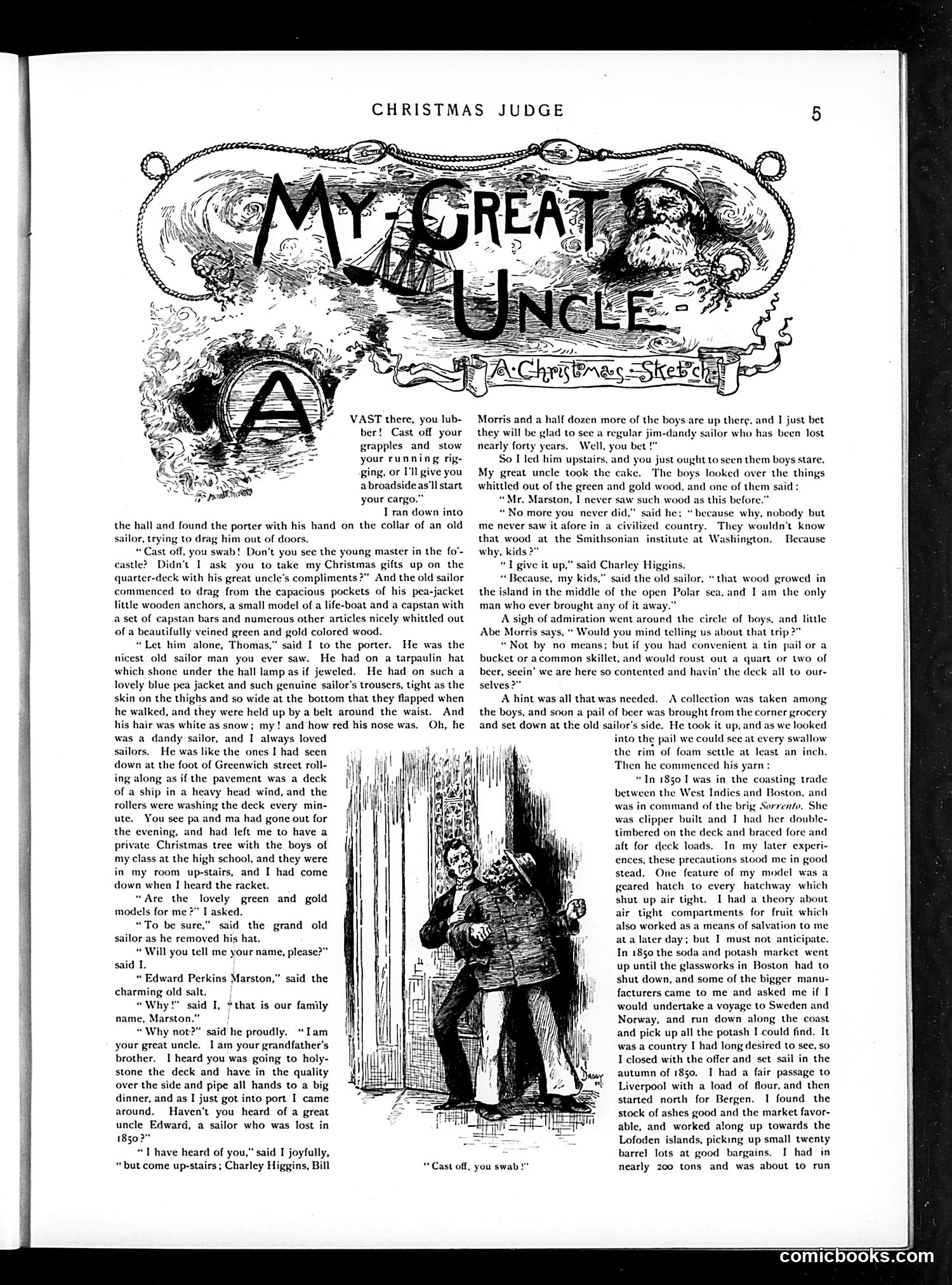
This is a humorous story rather than political satire, presenting a tall tale in the tradition of sailor yarn-spinning. The narrative follows a young boy who encounters an eccentric old sailor, Edward Perkins Marston, claimed to be his great uncle—supposedly lost at sea in 1850. The humor derives from the sailor's elaborate fabrications: he claims to have whittled wooden gifts from wood that grew on an island in the middle of the open Polar Sea, and boasts he's the only man who ever brought such material back to civilization. The exaggerated maritime dialect and character type—the romanticized, weathered old tar with colorful stories—were stock figures in 19th-century American humor magazines. The joke targets gullible audiences and the storytelling tradition itself, where improbable maritime adventures were told as fact.
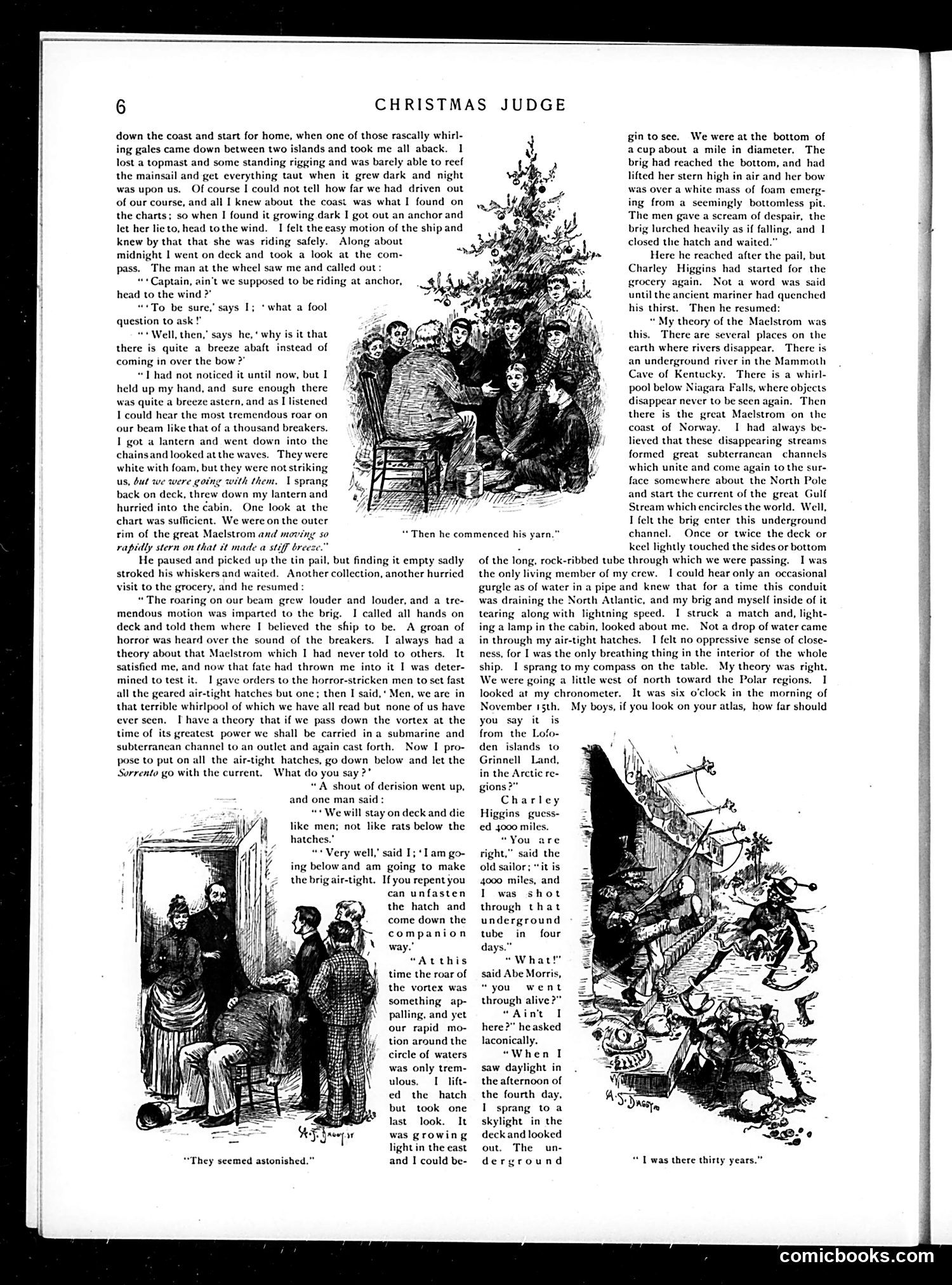
This page presents a serialized adventure tale rather than political satire. A narrator recounts a dramatic maritime encounter with the Maelstrom—the famous whirlpool off Norway's coast. The story describes a ship caught in the vortex's circular motion, sinking toward a bottomless pit. The captain devises an unconventional theory: if they seal the hatches and descend with the current, they'll be carried through an underground submarine channel to safety. His crew initially refuses, preferring to die "like men" on deck rather than "like rats below." The illustrations show the captain gathering an audience (likely at a bar, given the collection plate imagery), telling this tall tale. The dramatic engravings depict the ship in peril and the crew's reactions. This appears to be holiday entertainment fiction—a serialized adventure yarn meant to captivate readers during the Christmas season, rather than commentary on contemporary politics or social issues.
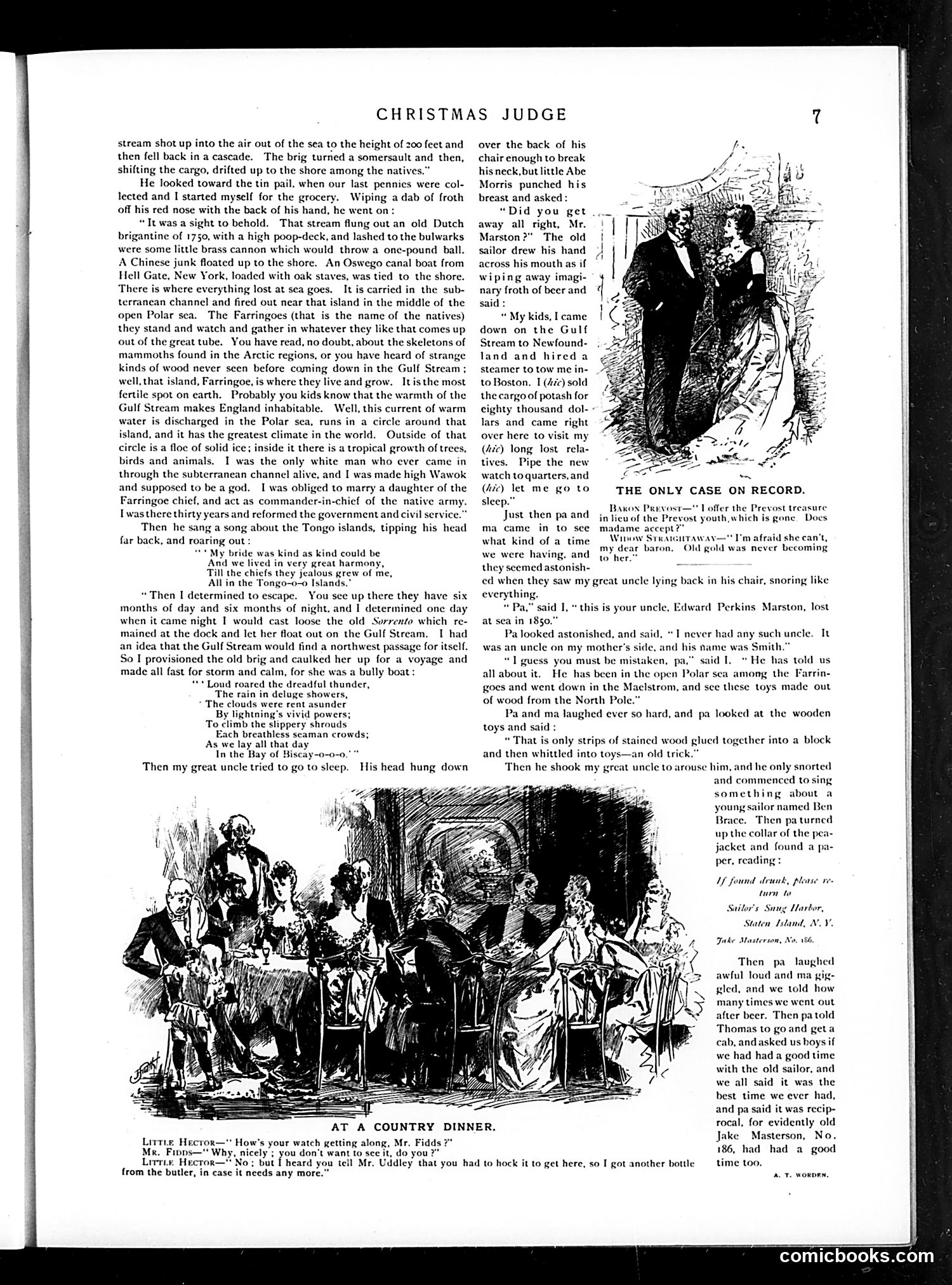
This page contains a tall tale told by an elderly sailor character to children. The main cartoon ("THE ONLY CASE OF RECORD") shows the narrator, an old seaman named Uncle Edward Perkins Marston, regaling young listeners with an elaborate fabricated story about discovering a magical tropical island in the Arctic called Farringoe, hidden within the Gulf Stream. The satire targets the tall-tale tradition itself—the drunk sailor's increasingly absurd narrative (with hiccups punctuating his speech) strains credulity: subterranean ocean channels, mammoth skeletons, tropical islands surrounded by ice, arranged marriages to native chiefs, and reformed governments. The lower cartoon ("AT A COUNTRY DINNER") shows the same character at a social gathering, suggesting this type of storyteller was a recognizable social type—the unreliable raconteur whose elaborate lies entertained but fooled no one.
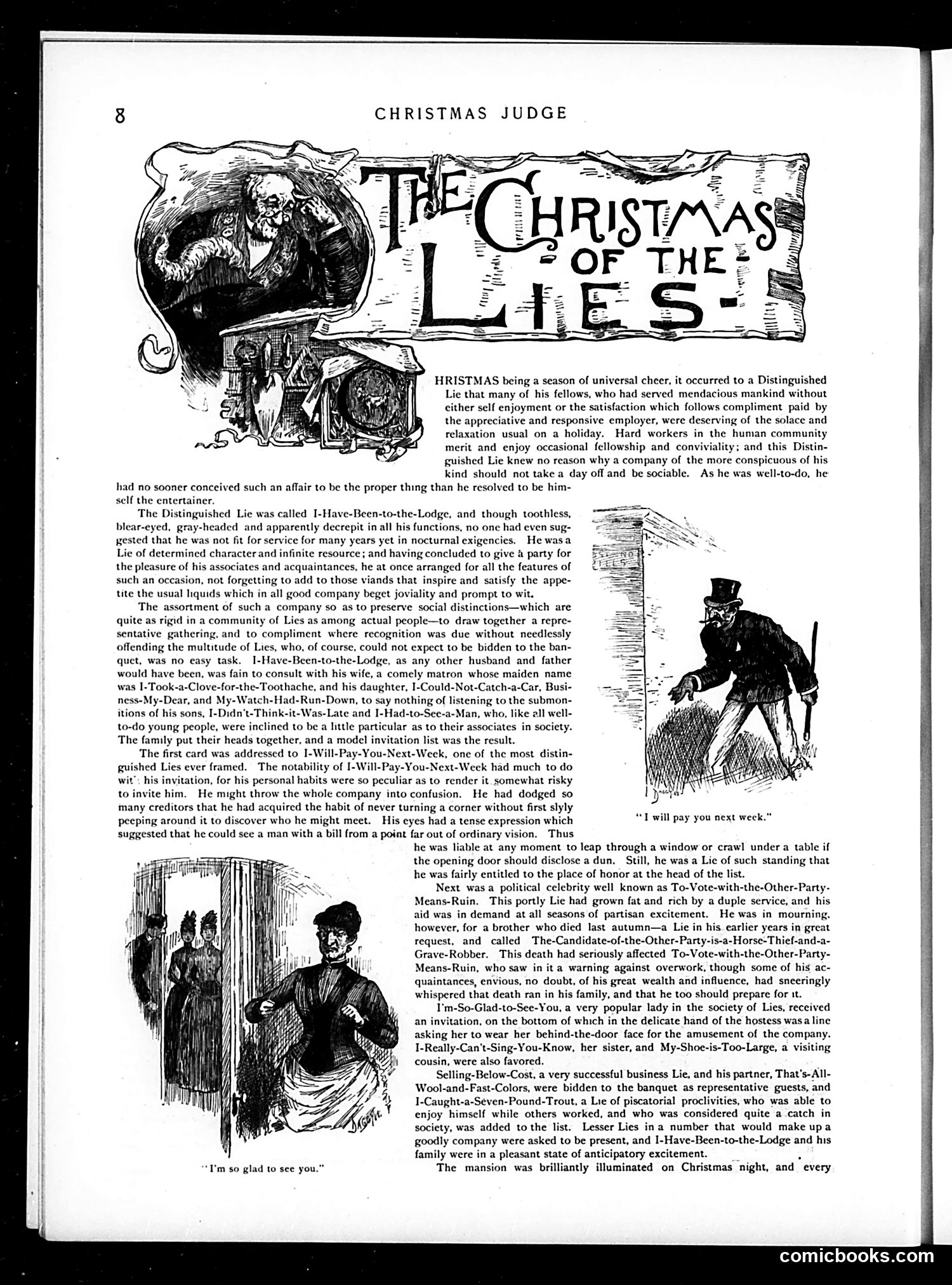
This is a satirical story personifying common human lies as social characters. The protagonist, "I-Have-Been-to-the-Lodge," is a successful, well-established lie throwing a Christmas party for fellow lies—similar to how actual social groups organize gatherings. The satire mocks Victorian social pretension by showing how lies maintain strict hierarchies and social distinctions identical to human society. Featured guests include "I-Will-Pay-You-Next-Week" (a lie about financial obligation), "To-Vote-with-the-Other-Party-Means-Ruin" (political deception), and others with humorous names referencing common social falsehoods. The joke targets both the prevalence of lies in daily life and the elaborate social rituals used to maintain respectability. By treating lies as an organized society with their own etiquette and status symbols, Judge critiques how widespread dishonesty was in Gilded Age American culture—particularly in politics, finance, and social climbing.
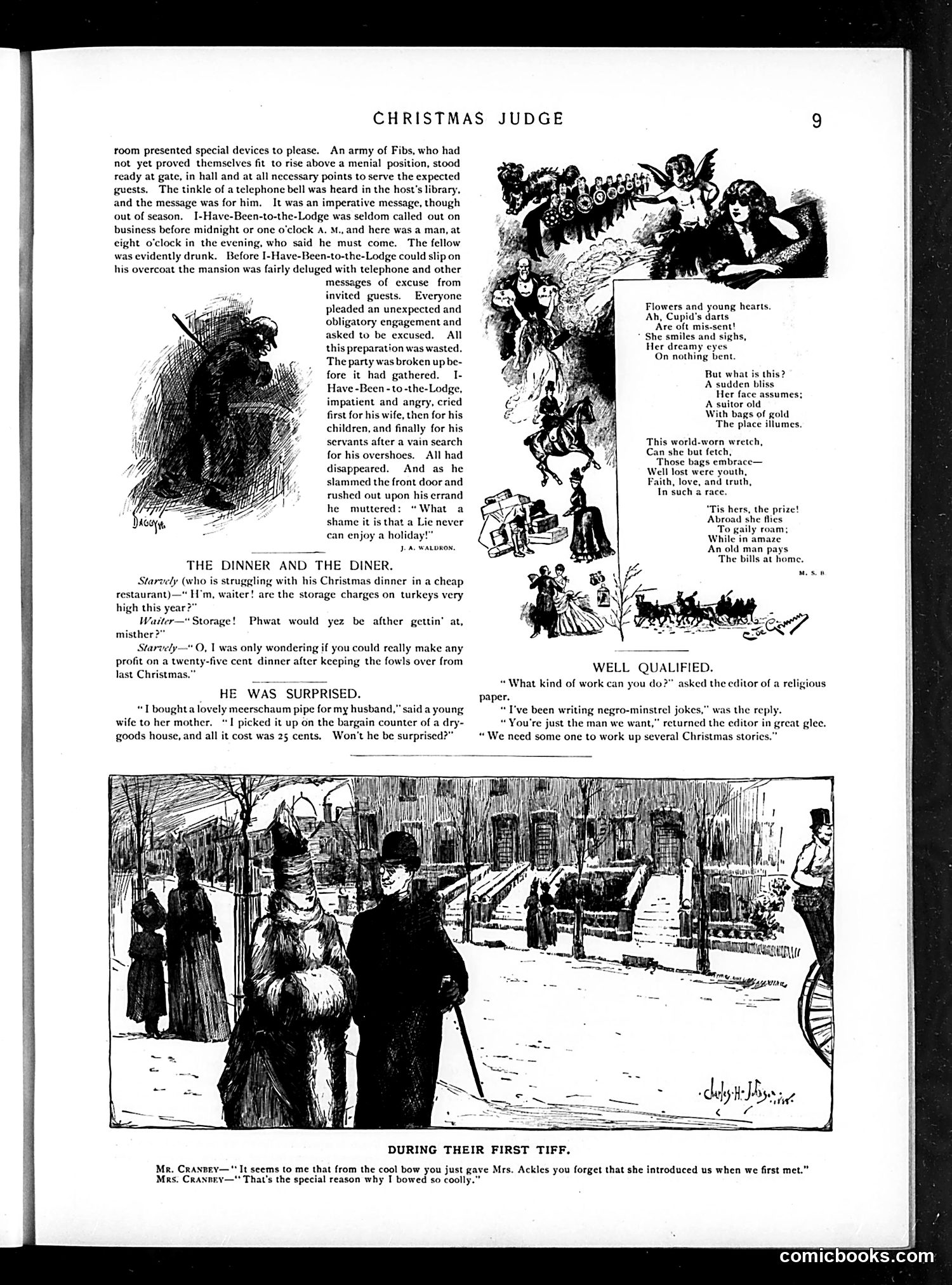
This page from *Judge* magazine contains multiple satirical vignettes mocking holiday social pretense and marital dynamics: **Main Story**: "I-Have-Been-to-the-Lodge" hosts an elaborate Christmas dinner. A drunk caller's phone message causes all invited guests to fabricate excuses and cancel, leaving the host furious—the joke being that people eagerly abandon social obligations despite elaborate preparation. **"The Dinner and the Diner"**: Working-class characters discuss whether restaurants profit from storing leftover turkeys year-round—satirizing cheap Christmas dining and commercial greed. **"He Was Surprised"**: A wife buys her husband a meerschaum pipe from a discount bin for 25 cents, naively expecting him to be delighted—mocking both cheap gift-giving and marital obliviousness. **"Well Qualified"**: A job applicant claims experience writing "negro-minstrel jokes"; the editor hires him to write Christmas stories—darkly satirizing racist entertainment's acceptability and its casual conflation with holiday content. **Bottom cartoon**: A couple's marital coldness stems from the wife introducing the husband to Mrs. Ackles—suggesting petty jealousy and social resentment. The overall theme: Christmas reveals hypocrisy, mercenary motives, and relationship dysfunction beneath polite society.
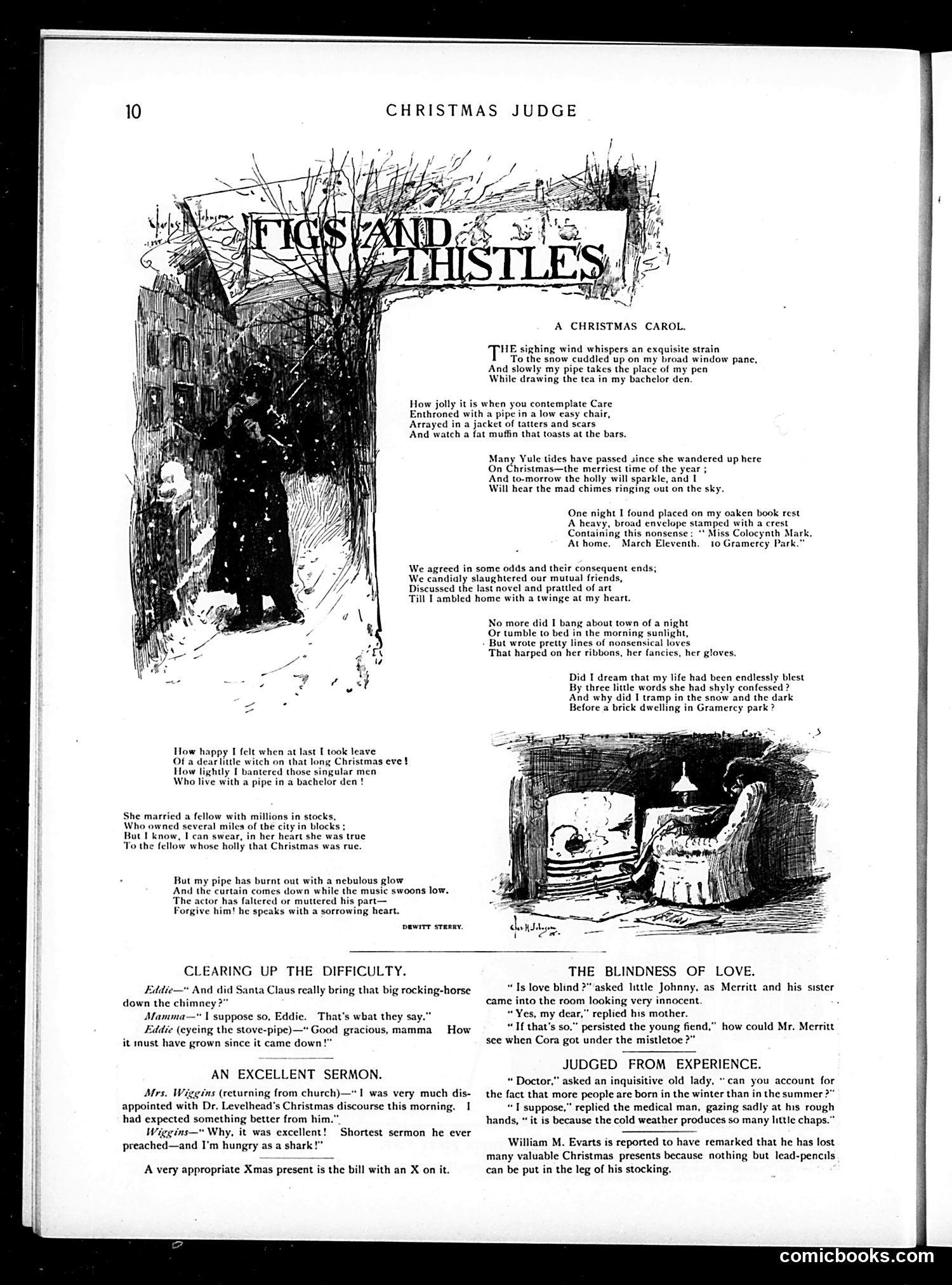
This is a **Christmas-themed humor page** from Judge magazine containing several unrelated jokes and a sentimental poem rather than political satire. The main content is "A Christmas Carol," a nostalgic poem by DeWitt Sterry about a bachelor reflecting on a lost love—a woman who married a wealthy man while he remained devoted to her memory, finding solace only in his pipe and writing verses. Below are brief humorous sketches: - **"Clearing Up the Difficulty"**: A child questions how Santa's rocking horse fit down the chimney, noting the chimney pipe is too small. - **"An Excellent Sermon"**: A minister's very short sermon pleases only because the listener was hungry. - **"The Blindness of Love"**: A child logically asks how someone under mistletoe could be seen if love is blind. - **"Judged from Experience"**: A doctor attributes winter births to cold weather producing "little chaps" (a mild sexual innuendo). The page concludes with a joke about William M. Evarts losing pencils in Christmas stockings because nothing larger fits in stocking legs.
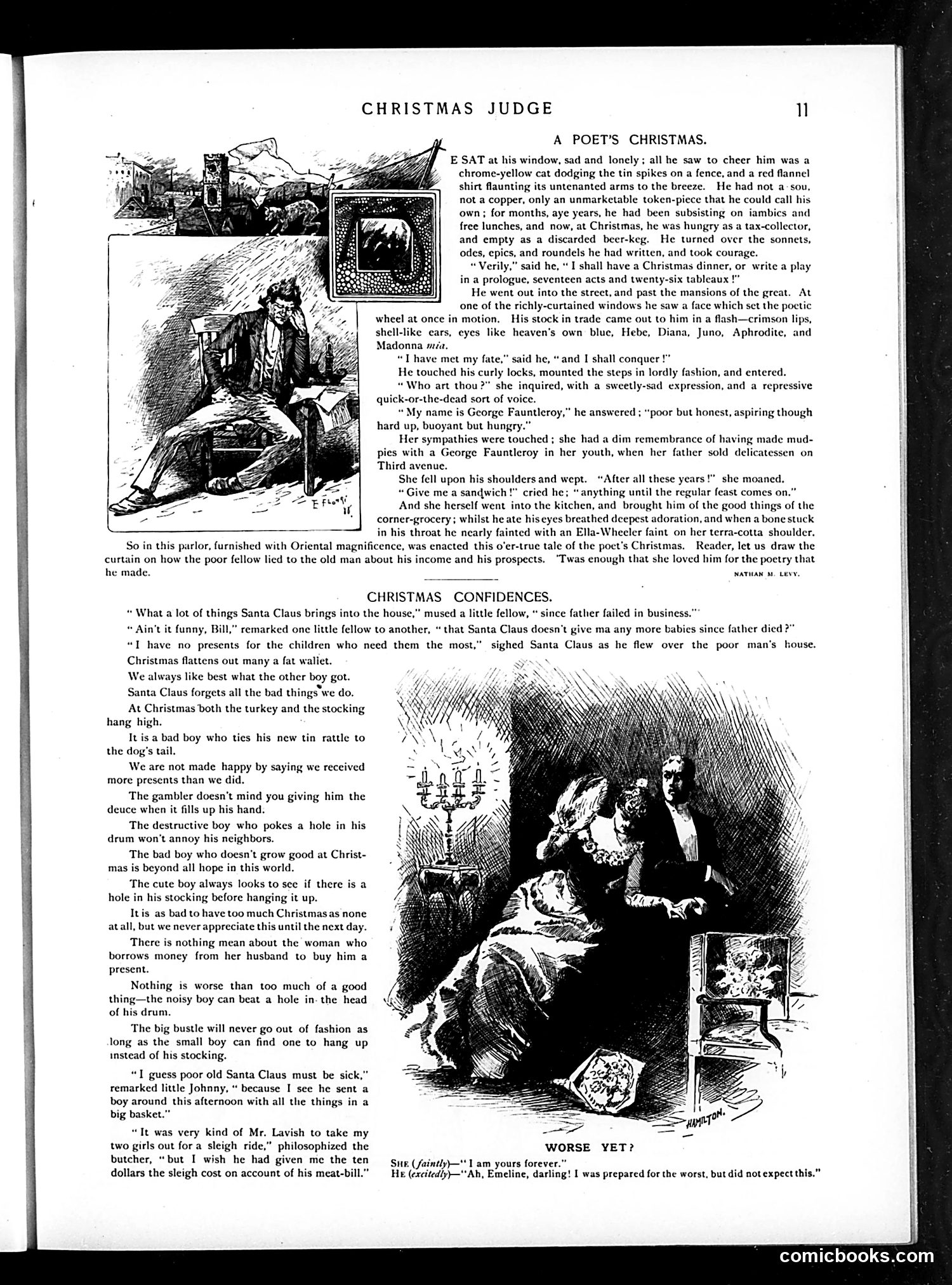
This page contains two satirical pieces about Christmas and poverty: **"A Poet's Christmas"** (top) mocks starving artists. A impoverished poet, subsisting on "iambics and free lunches," spots a wealthy woman and pursues her romantically, fabricating a respectable identity ("George Fauntleroy"). She recognizes him from childhood and feeds him—the joke being he wins her through deception and hunger rather than genuine feeling. The satire targets both the pretensions of struggling artists and the gullibility of sentimental wealthy women. **"Christmas Confidences"** (bottom) presents brief cynical observations about Christmas and class. Children note that Santa brings fewer gifts since their father's business failure or death; Santa pities the poor. The aphorisms satirize how Christmas reveals economic inequality and how material abundance doesn't guarantee happiness—commentary on Gilded Age wealth disparities. Both pieces use dark humor to critique social conditions: poverty among intellectuals, economic instability affecting families, and the disconnect between Christmas ideals and harsh reality.
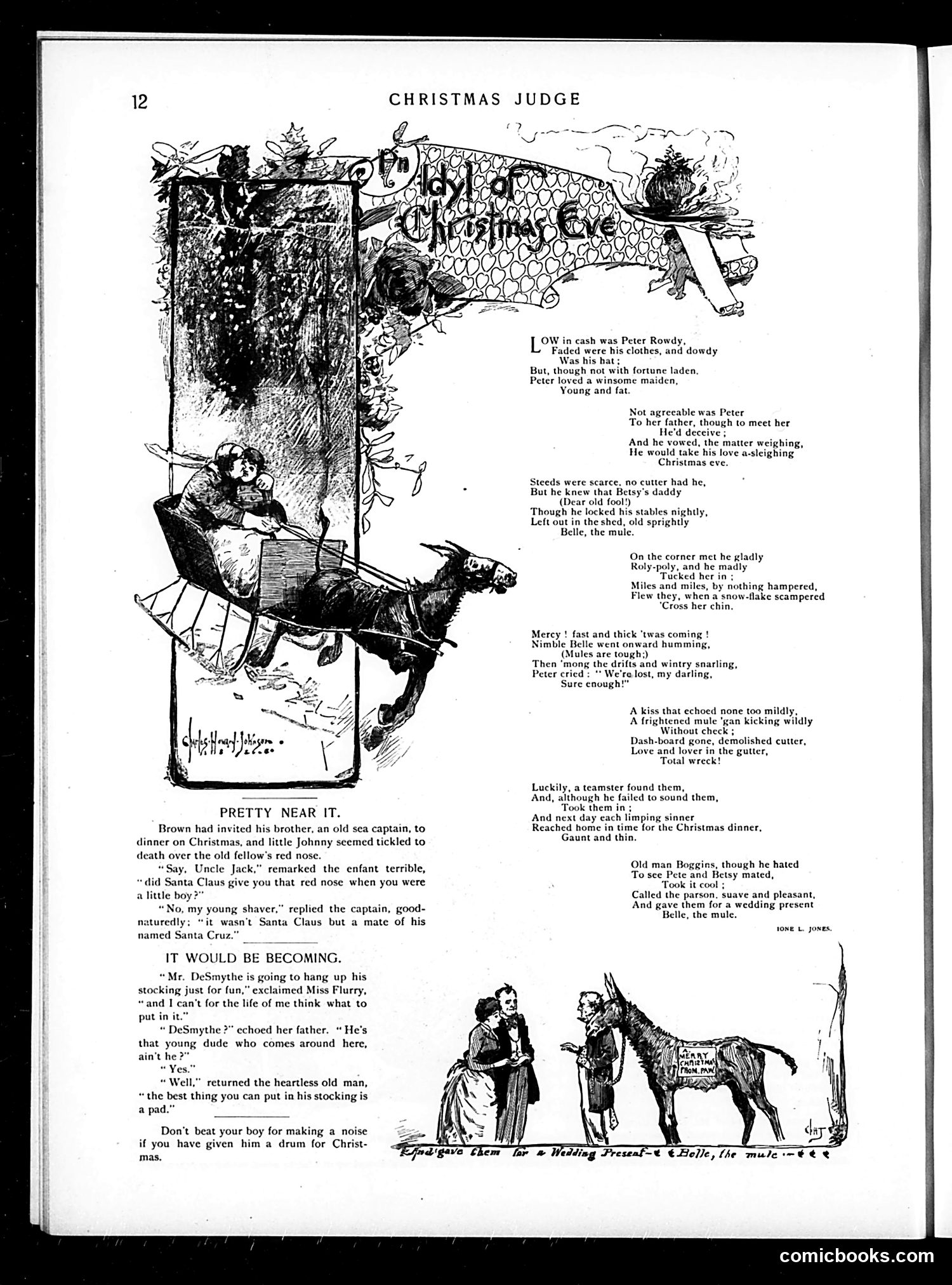
This page from *Judge* magazine contains three separate humorous pieces: 1. **"Pretty Near It"**: A joke about a child asking his uncle (a sea captain) if Santa Claus gave him his red nose as a boy. The captain replies it was from "Santa Cruz" (a pun—likely referring to a drunken brawl or fight). The humor relies on the implication that the uncle's red nose indicates heavy drinking. 2. **"It Would Be Becoming"**: A father's joke suggesting the best Christmas stocking-stuffer for a frivolous young man ("dude") who visits is a "pad"—implying he's foolish or needs cushioning. 3. **"Pretty Near It" (main story)**: A lengthy verse narrative about poor Peter Rowdy borrowing an old mule to take his girlfriend sleighing on Christmas Eve. A snowstorm causes them to crash; they're rescued by a teamster. The girl's father, initially opposed to their relationship, ultimately gives them the mule as a wedding present. The humor comes from the mishap and the ironic "gift." All reflect typical *Judge* magazine Victorian-era humor: drinking jokes, class commentary, and romantic mishaps.
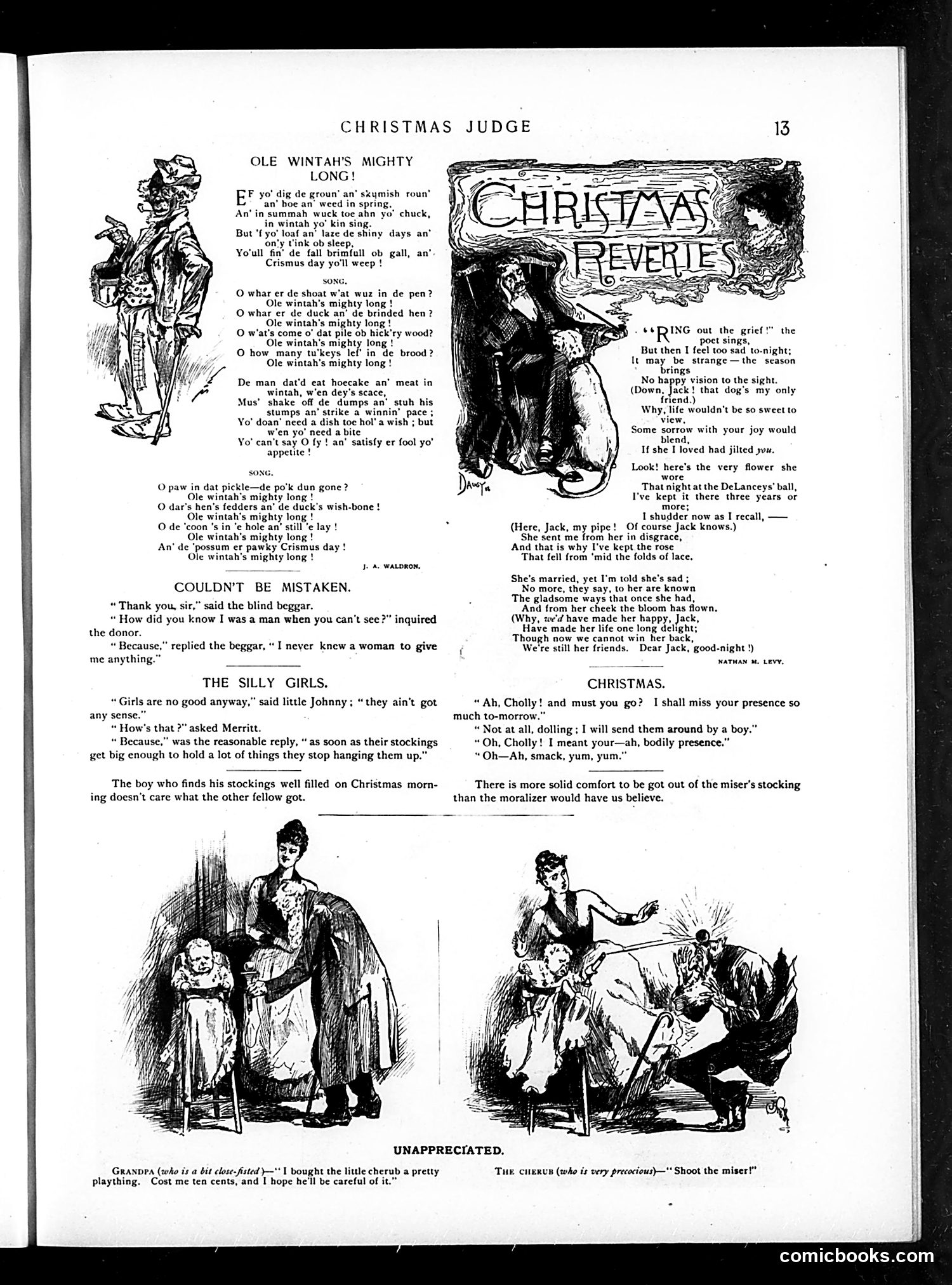
This page from Judge magazine contains several distinct pieces of holiday-themed humor: **"Ole Wintah's Mighty Long"** is a dialect poem in African American vernacular (typical of period magazines, reflecting contemporary entertainment conventions). It depicts a laborer reflecting on winter's hardships—warning that idleness brings regret when food becomes scarce. The point is moralizing: hard work in other seasons ensures survival through winter. **"Couldn't Be Mistaken"** is a brief joke playing on gender stereotypes: a blind beggar recognizes his donor must be male because women never give charity. **"The Silly Girls"** jokes that girls stop hanging stockings once they're large enough to hold items—a joke about female acquisitiveness and materialism. **"Christmas Reverie"** is a sentimental poem about lost love, with a man keeping a flower from an ex-lover who's now unhappily married. **The remaining items** are brief holiday jokes about romantic couples, miserly gifts, and Christmas stockings. The illustrations show period domestic scenes. Overall: lighthearted, sentimental holiday fare with period-typical gender stereotypes and class humor.
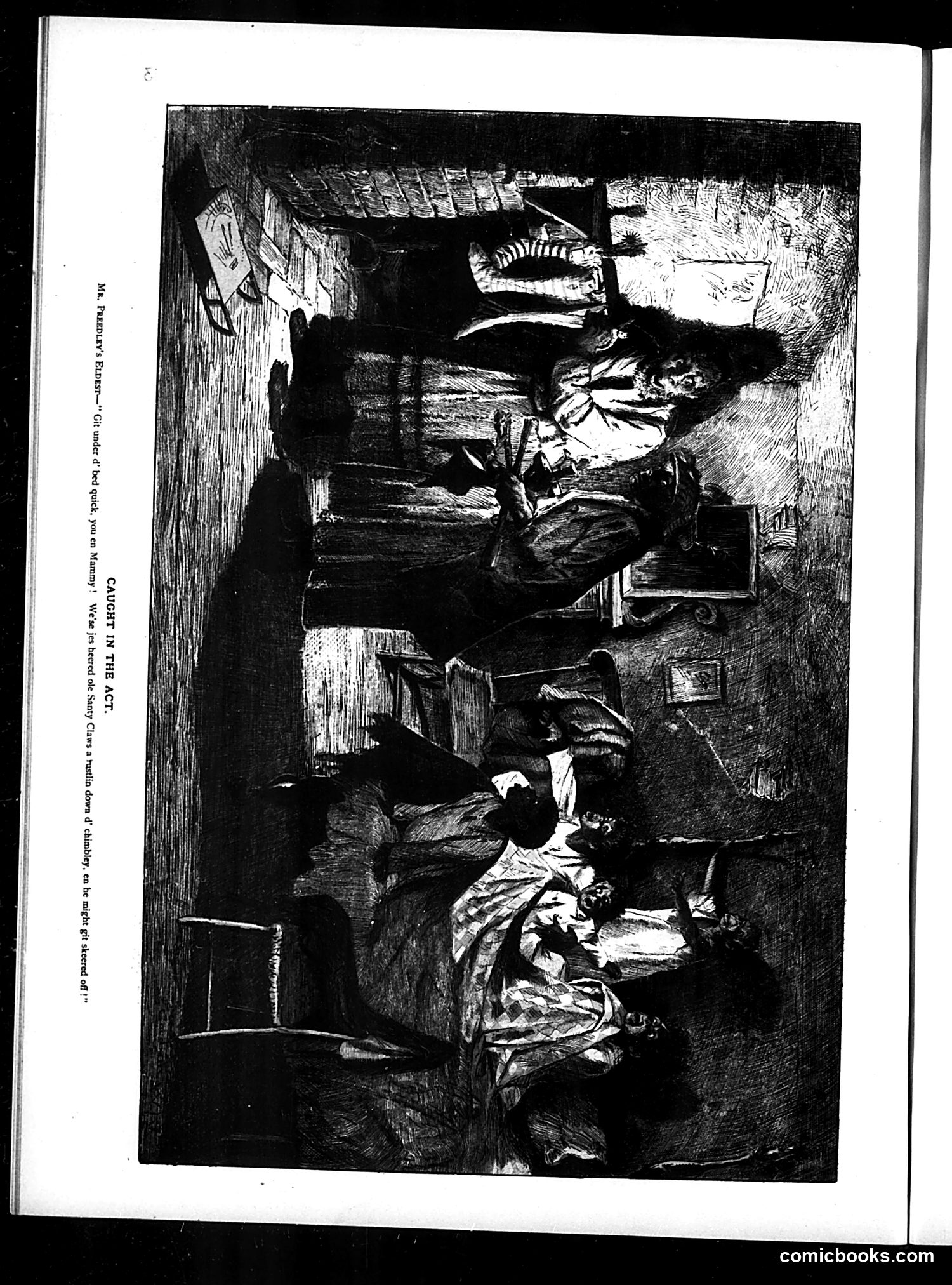
The OCR text is severely corrupted and unreadable, making it impossible to determine the specific title or caption with certainty. The image itself shows a dark etching or engraving depicting what appears to be an interior scene with multiple figures in period dress (likely 19th century based on the clothing and artistic style). The scene appears dramatic or chaotic, with figures positioned around what might be furniture or interior elements. Without legible text identifying the specific political figures, historical event, or satirical point being made, I cannot responsibly identify who these figures represent or what contemporary issue the cartoon addressed. The artistic technique and composition suggest serious social or political commentary typical of *Judge* magazine's work, but the specifics remain unclear from this reproduction. To properly explain this cartoon's meaning would require either: clearer OCR text, the original publication date, or additional context about the issue.
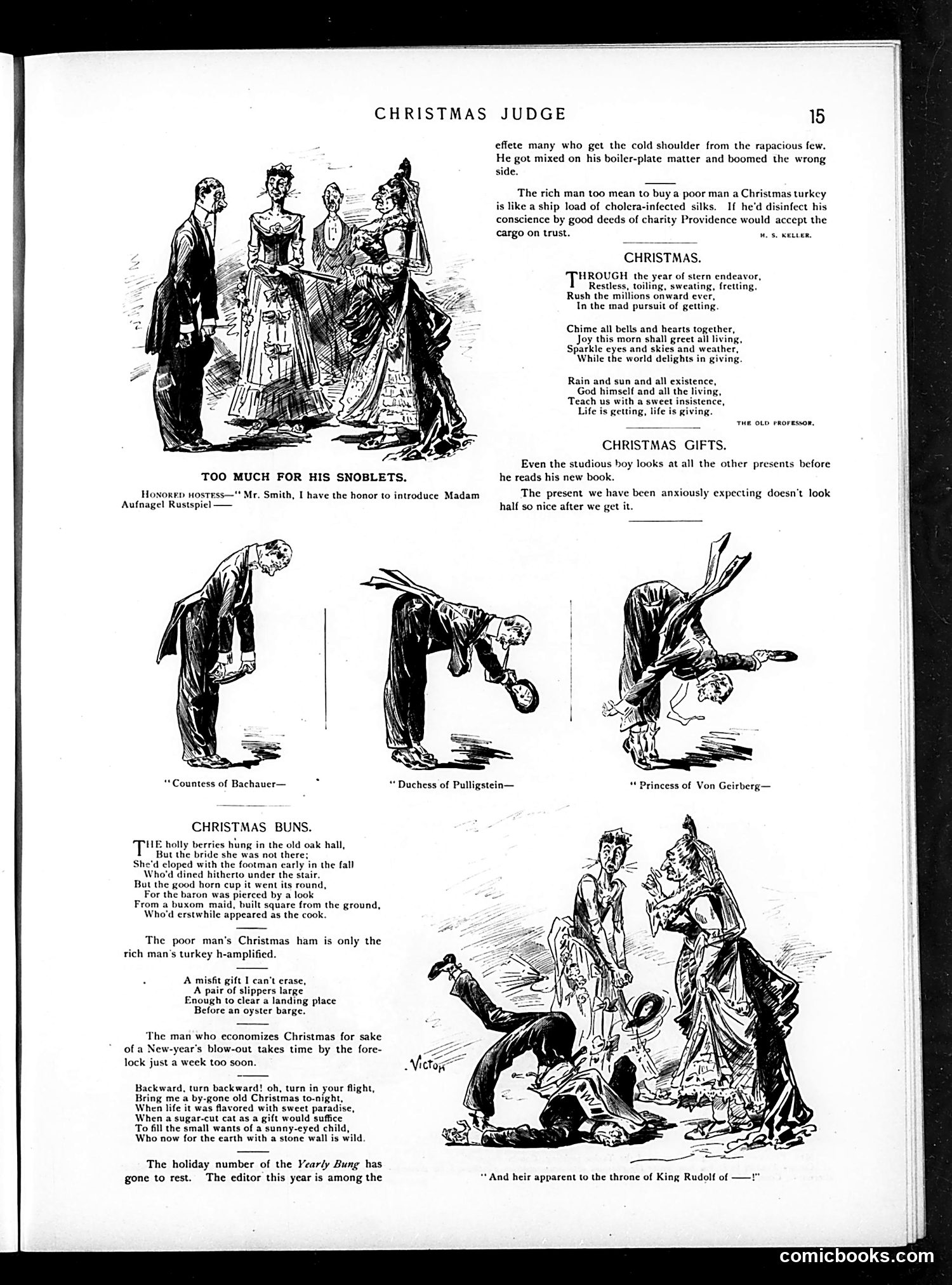
This is a Christmas-themed satirical page mixing social commentary with humor. The top cartoon mocks social snobbery: a hostess introduces "Mr. Smith" to aristocratic-sounding guests with deliberately absurd German names ("Madam Aufnagel Rustspiel"), satirizing wealthy Americans' pretension toward European nobility and their dismissal of ordinary people. The middle section includes Christmas verses and aphorisms critiquing materialism and class inequality—rich men's stinginess toward the poor, the disappointment of received gifts, and society's obsession with acquiring possessions. The "Christmas Buns" poem uses bawdy humor: a bride elopes with a footman, and a baron is seduced by the cook, mocking class pretense through sexual transgression. The lower illustration appears to show commoners or servants in a comedic scene, likely referencing a fictional story ("King Rudolf"). Overall, the page presents Judge's typical Gilded Age satire: critiquing wealth inequality, social pretension, and materialism while maintaining cynical humor about human nature.
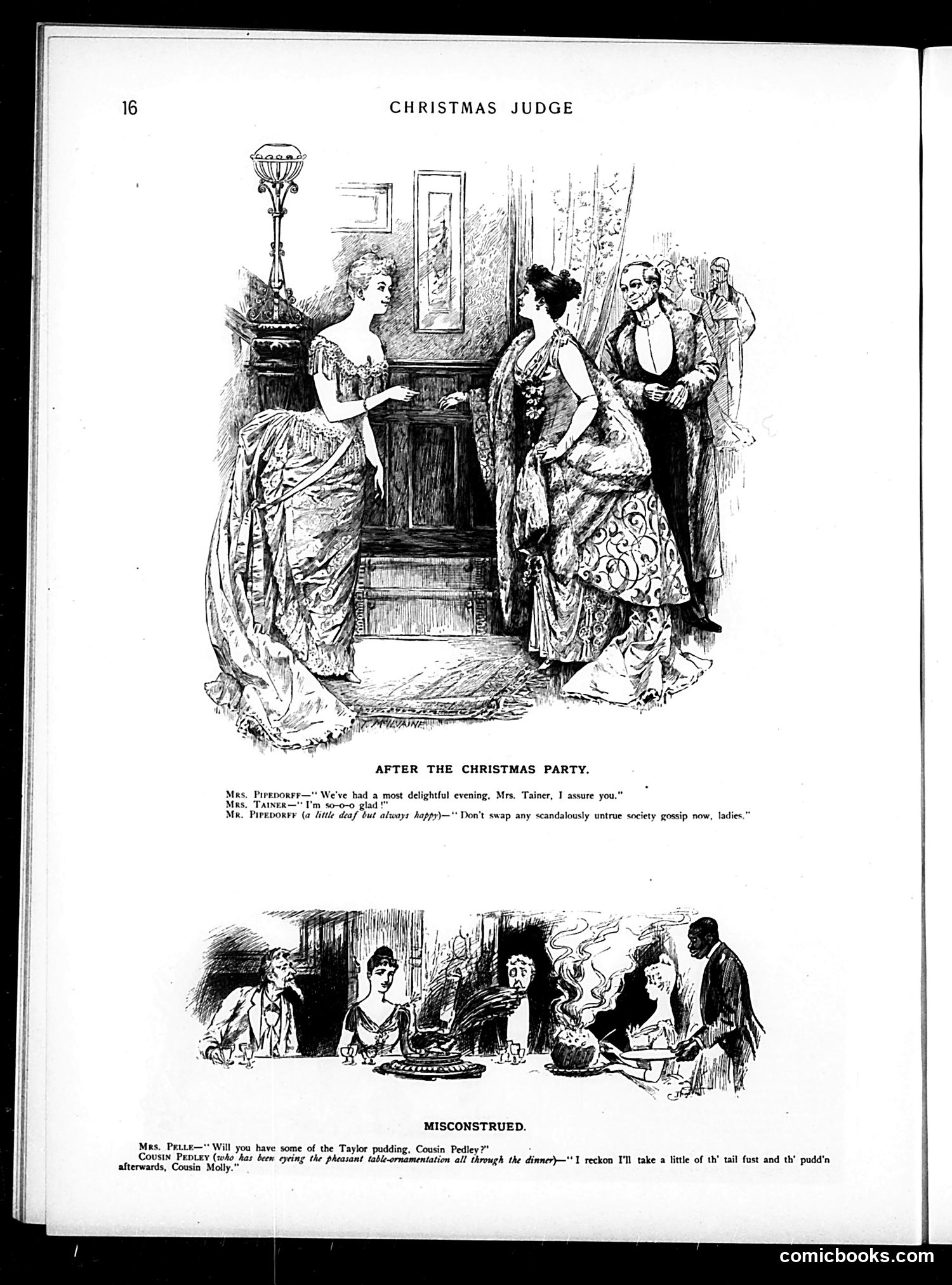
This page contains two separate satirical cartoons about social etiquette and miscommunication among the upper classes. **"After the Christmas Party"** depicts women in formal evening wear. Mrs. Pippendorf congratulates Mrs. Tainer on a delightful evening, while Mr. Pippendorf (noted as "a little deaf but always happy") warns the ladies not to spread "scandalously untrue society gossip." The humor lies in the irony that he's cautioning against exactly what they're about to do. **"Misconstrued"** shows a dinner scene where Cousin Pepley misunderstands a request for the "Taylor pudding," interpreting it as permission to gossip about cousin Molly throughout dinner. The joke satirizes how people selectively hear what they want to hear, using miscommunication as a vehicle for social criticism and comedic effect.
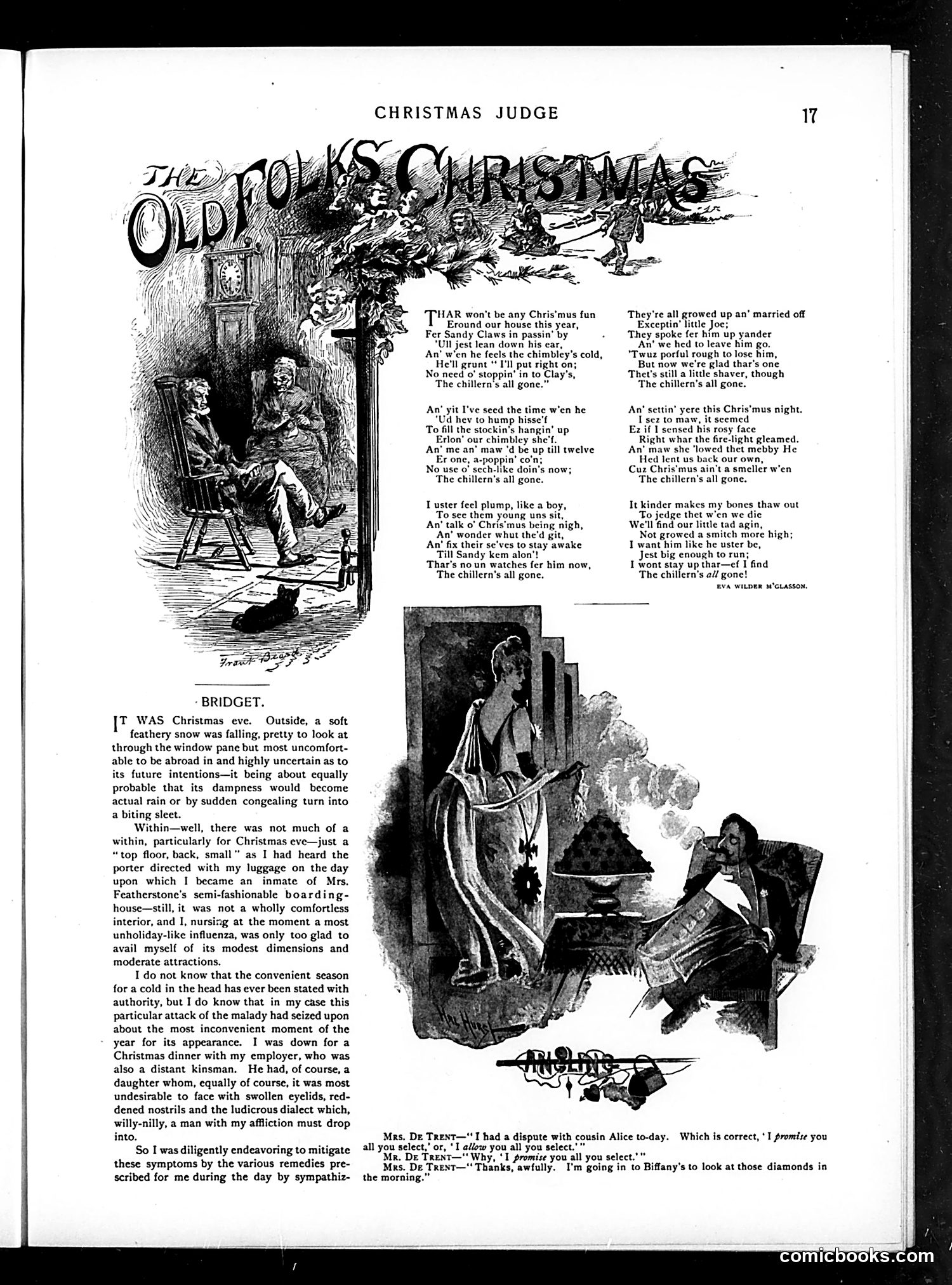
This page contains two distinct pieces: **"The Old Folks' Christmas"** (poem with illustration): A sentimental rural narrative in dialect about aging parents whose grown children have left home. The poem laments how Christmas has lost its joy—no stockings to fill, no children's excitement—though they find comfort imagining their deceased youngest son present. It's a nostalgic commentary on rural family dispersal and aging, addressing 19th-century concerns about young people leaving farms for cities. **"Bridget"** (prose story): A narrator ill with influenza on Christmas Eve, boarding at a modest rooming house. The setup introduces a gentleman facing an awkward social situation—attending Christmas dinner with his employer and the employer's daughter while visibly sick. **The dialogue snippet** below depicts upper-class women (Mrs. De Trent) discussing grammar and shopping, representing frivolous society concerns contrasted against the rural poverty and emotional depth above. The page juxtaposes working-class sentiment with upper-class superficiality, typical of *Judge*'s satirical approach.
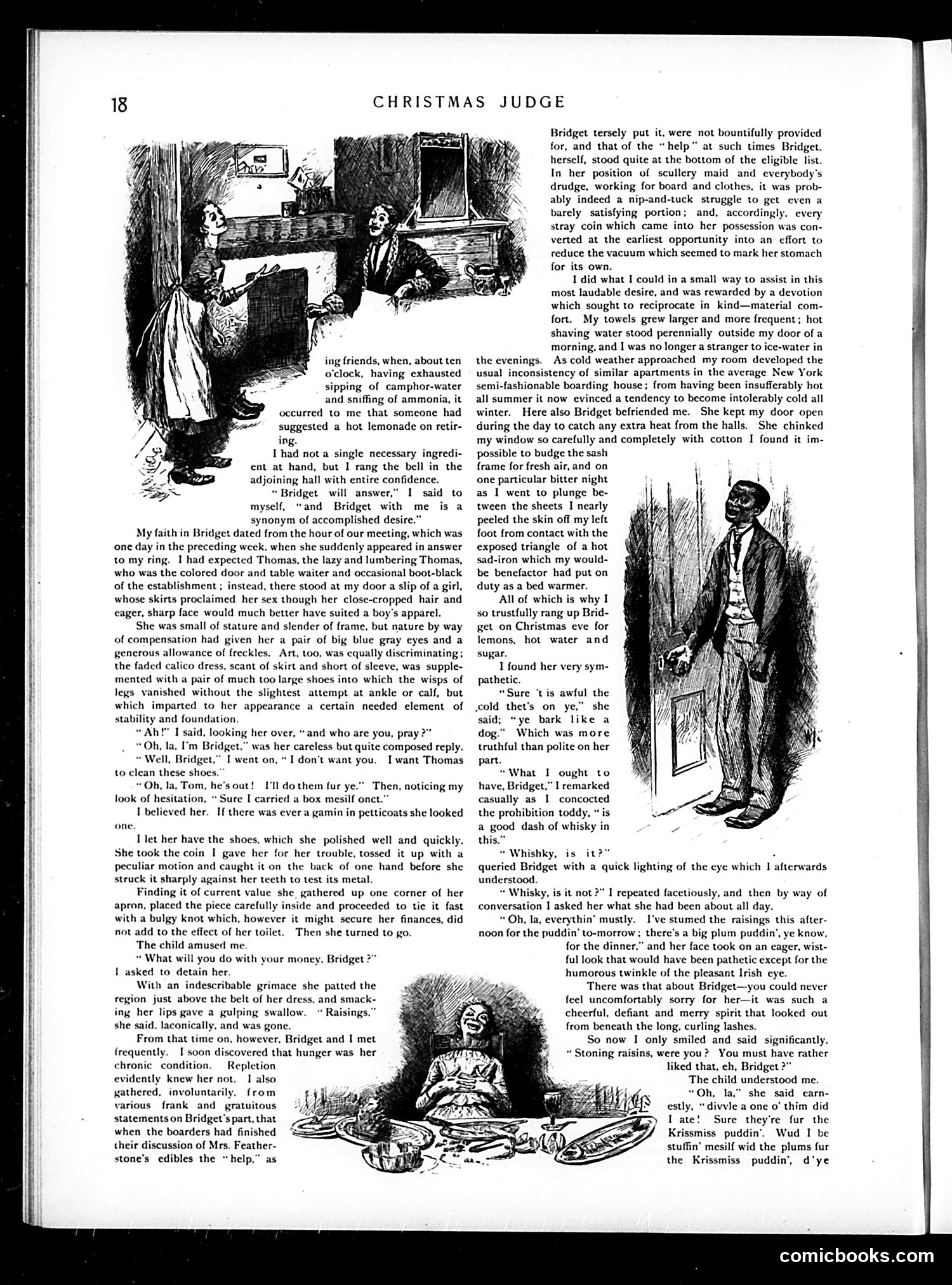
This page contains a fictional narrative about "Bridget," a working-class domestic servant struggling with poverty during winter. The illustrations show her interactions with her employer and her living conditions. The satire targets **economic inequality and working-class hardship**. Bridget's desperate circumstances—insufficient food, cold lodgings, worn shoes—contrast sharply with her employer's casual attitude. The narrative mocks the employer's assumption that Bridget can improvise solutions ("I don't you. I want Thomas") while denying her basic necessities. The piece critiques the **exploitation of domestic workers**, particularly Irish immigrants (suggested by the name "Bridget"), who were common domestic servants in America. The humor derives from the employer's obliviousness to Bridget's suffering and her resourceful, cheerful response despite mistreatment—a commentary on class blindness and servant resilience.
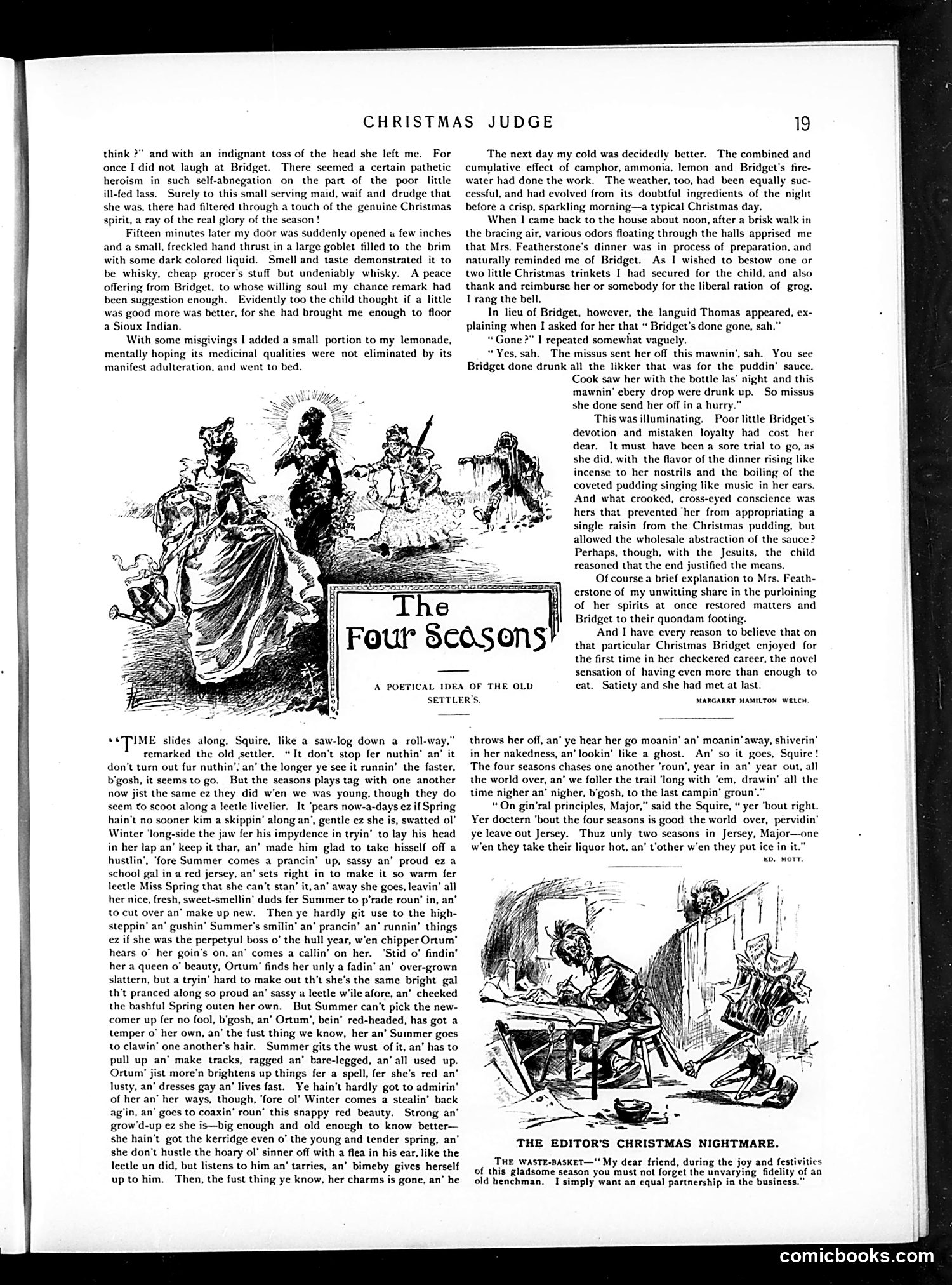
This page contains two distinct pieces: **Top Section**: A Christmas narrative about a servant named Bridget, whose misplaced loyalty costs her dearly. The narrator remarks on her devotion—she sacrifices her own Christmas dinner to help others, then offers him whisky as a peace offering after a minor disagreement. The satire targets sentimental Victorian attitudes toward the "deserving poor," mocking the narrator's self-satisfied pleasure at witnessing her self-abnegation. **Bottom Section**: "The Four Seasons"—a rural dialect poem personifying seasons as women in a relationship with an old settler ("Winter"). The verse uses colloquial language to allegorically describe seasonal cycles, with Spring as innocent and youthful, Summer as bold and vain, Autumn as fading, and Winter as predatory. The satire likely comments on aging, transience, and the inevitable decline of beauty and vitality. Both pieces employ period sentimentality ironically—celebrating humble self-sacrifice and accepting mortality while subtly critiquing the attitudes they appear to endorse.
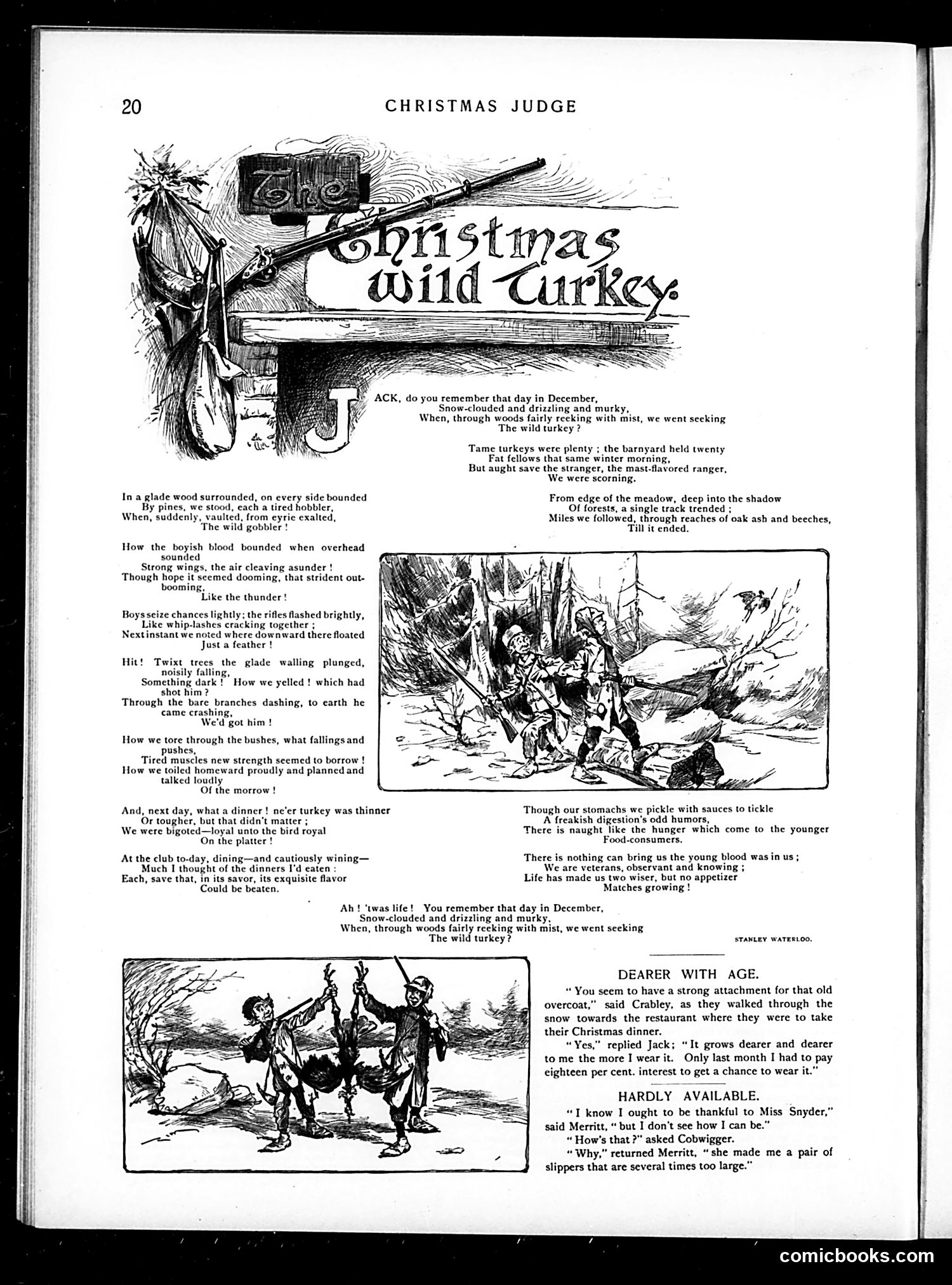
This page contains nostalgic and humorous Christmas content from Judge magazine. **"Christmas Wild Turkey"** (by Stanley Waterloo) is a sentimental poem about hunting wild turkeys as boys in December woods, contrasted with dining at an adult club. The narrative celebrates youthful vigor and adventure—the excitement of the hunt, physical exertion, and appetite—against the dulled pleasures of middle age, where even the finest meal cannot recapture that intensity. **"Dearer With Age"** is a brief joke playing on the double meaning of "dear": Jack's overcoat becomes emotionally precious *and* financially burdensome, as he's paying 18% interest just to wear it (suggesting a pawn shop or similar arrangement). The humor lies in poverty masked as sentiment. **"Hardly Available"** offers a gentle joke about an oversized gift—Miss Snyder's ill-fitting slippers create awkward social obligation: Merritt must pretend gratitude for something useless. All three items emphasize aging, nostalgia, and financial or physical diminishment during the holiday season—themes likely resonating with Judge's middle-class readership.
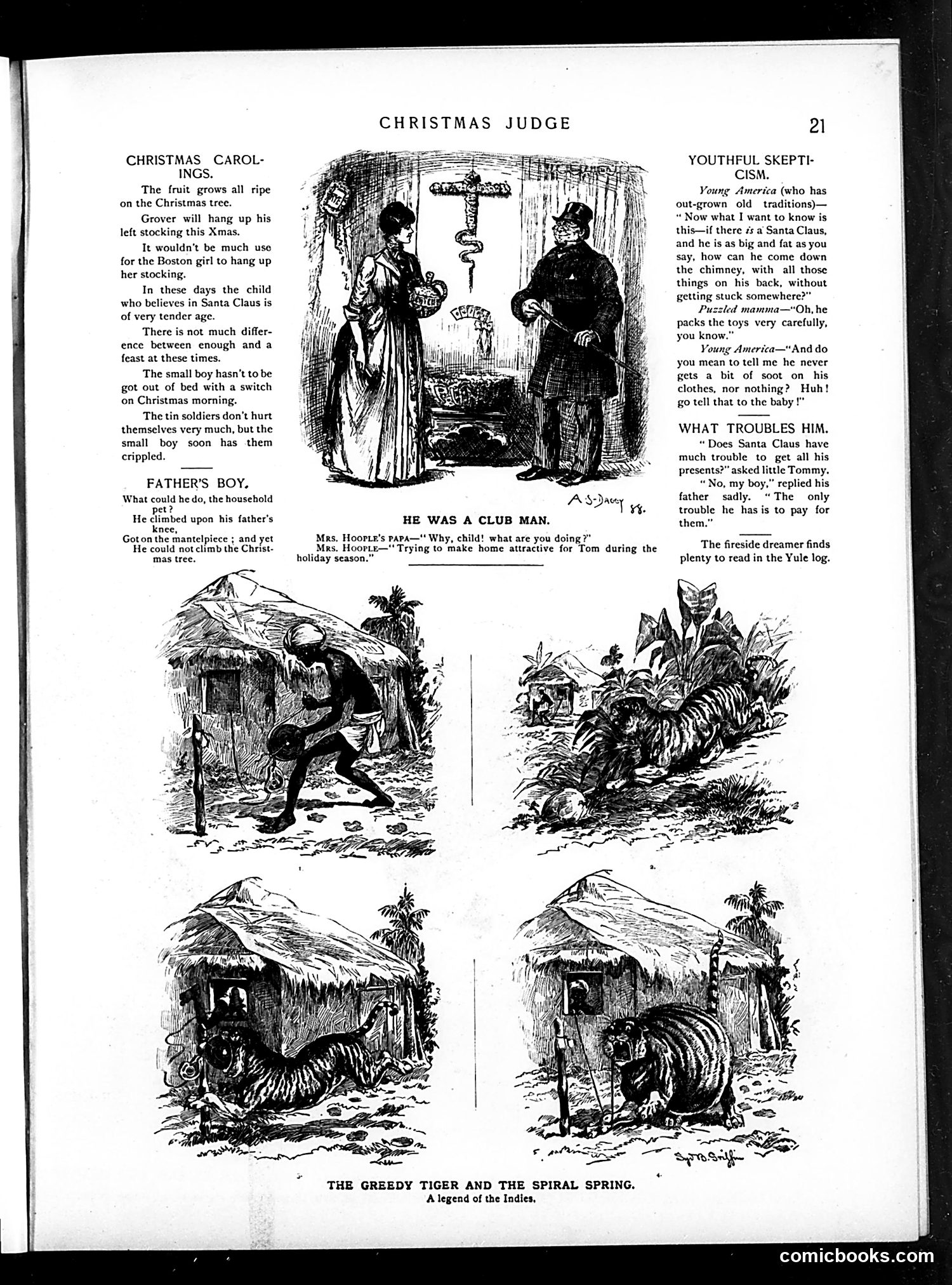
This page contains several satirical pieces about Christmas customs and American society. The main cartoons mock Victorian-era sentimentality and social pretense: **"Youthful Skepticism"** ridicules children's rational questioning of Santa Claus mythology—the modern child sees logical inconsistencies (soot on clothes, fitting down chimneys) that undermine the fantasy. **"What Troubles Him"** contains dark humor: a father admits Santa's real burden isn't delivering presents but *paying for them*—satirizing the financial strain of Christmas gift-giving on middle-class fathers. **"He Was a Club Man"** references "The Greedy Tiger and the Spiral Spring," a fable about the Indies, likely satirizing colonial exploitation or gullible wealthy men. **"Father's Boy"** mocks an incompetent household pet unable to climb a Christmas tree. The pieces collectively critique Christmas commercialism, expose children's growing skepticism toward traditional beliefs, and highlight the financial pressures the holiday places on families—themes that remain relevant today.
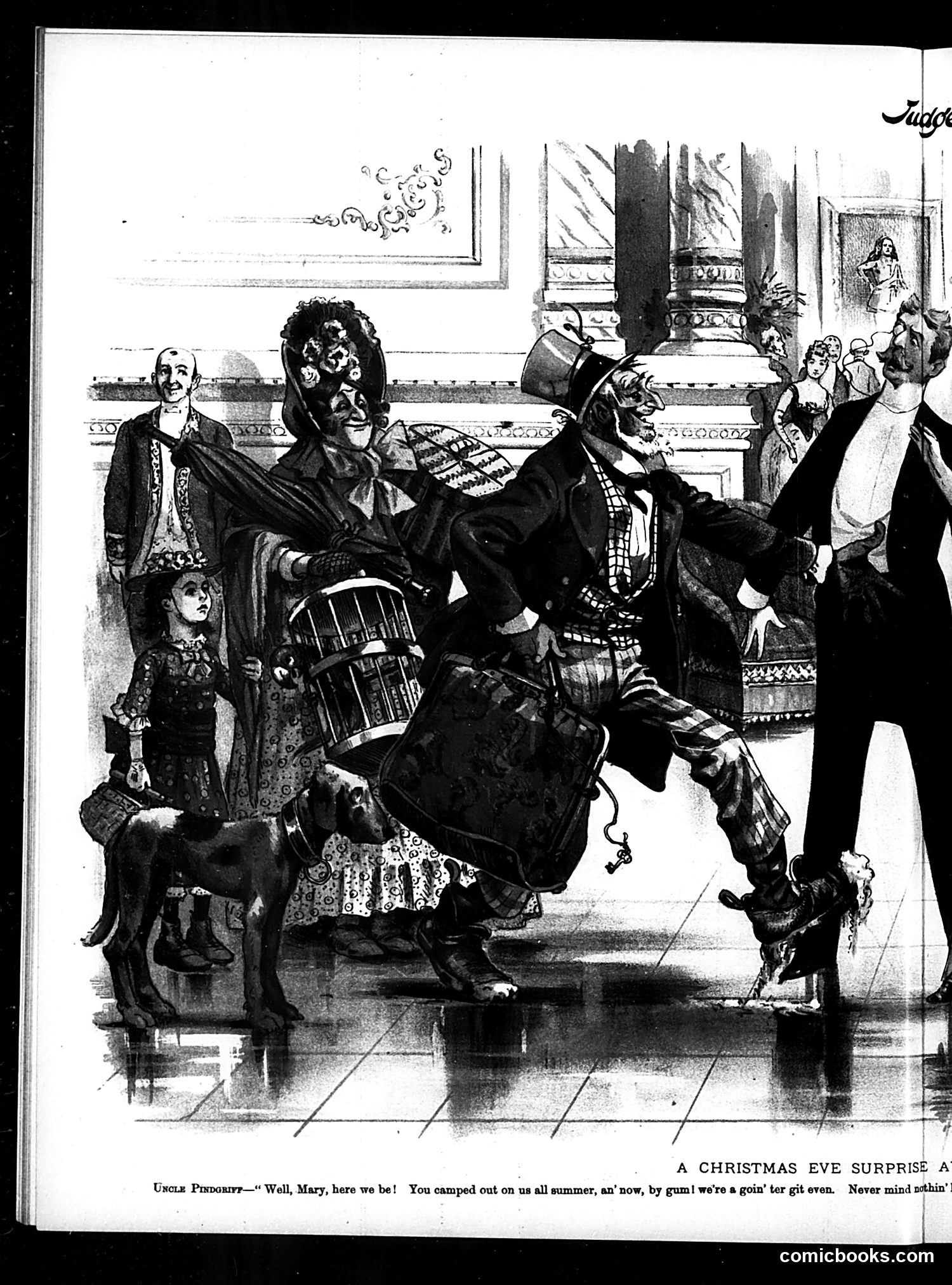
This cartoon satirizes the Irish immigrant experience in late 19th-century America. "Uncle Prideaux" (a caricatured figure with exaggerated features) arrives unannounced at a wealthy household on Christmas Eve with his extended family and belongings—reversing an earlier summer visit where he apparently imposed on their hospitality. The joke exploits anti-Irish stereotypes: the dialect ("goin' ter"), the large family, the casual intrusion, and the tit-for-tat revenge dynamic. The well-dressed hosts appear dismayed at this unexpected invasion during the holidays. The satire reflects period tensions between established Americans and Irish immigrants, portraying the latter as unwelcome freeloaders who overstay their welcome and lack social propriety. Judge magazine frequently deployed such ethnic humor for its educated, Anglo-Saxon readership.
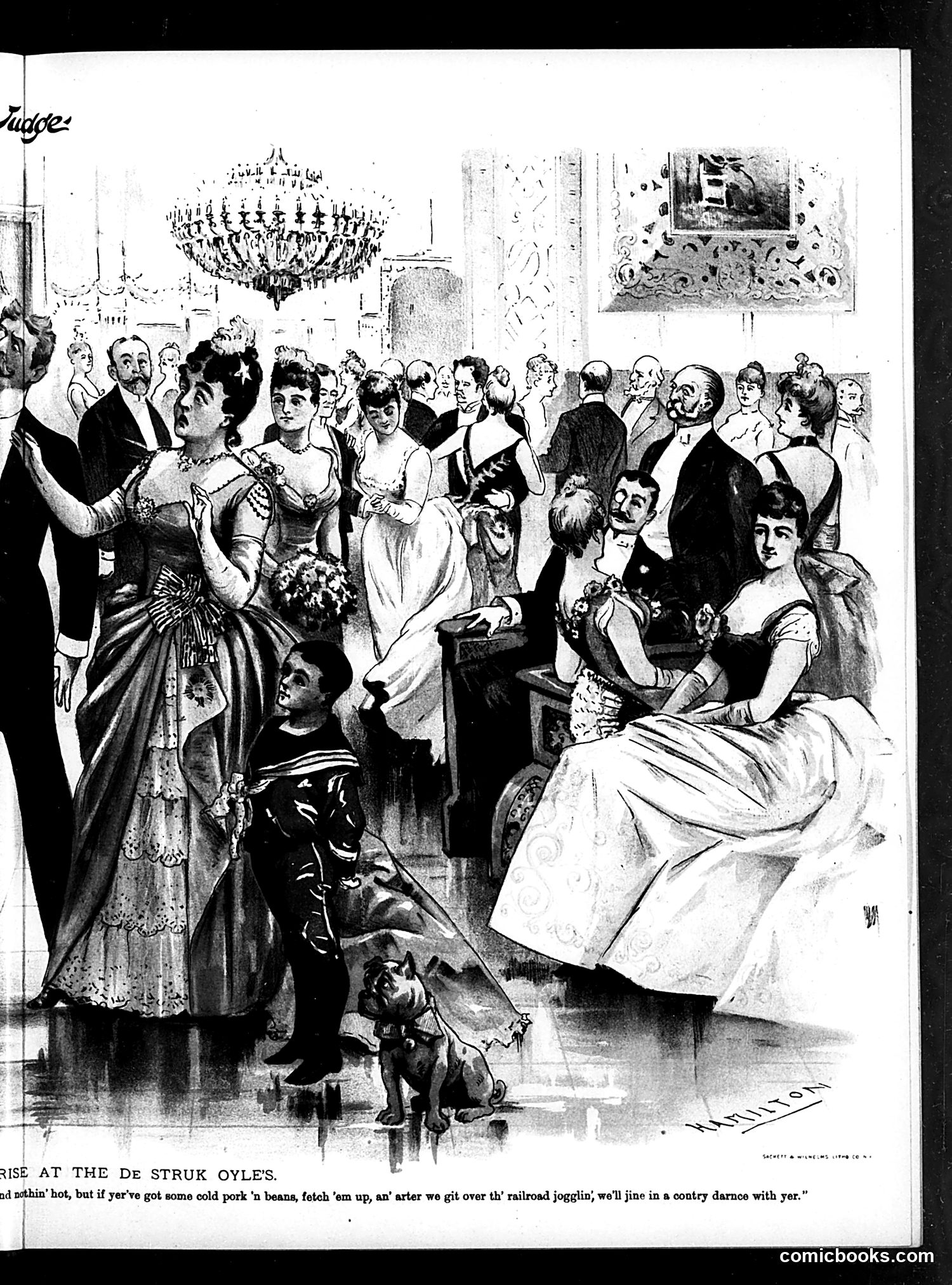
This appears to be a satirical scene set at an upscale social gathering (likely a wealthy household, given the chandelier and formal dress). The humor derives from a contrast: a working-class or rural figure—possibly a railroad worker or laborer, identifiable by his darker, simpler clothing and apparent lower social status—has intruded or been invited into this refined ballroom setting. The caption's dialect humor ("pork 'n beans," "jogglin'," "darnce") emphasizes the character's working-class background. The satire mocks either the pretensions of high society or the absurdity of class mixing. The figure appears to propose joining the formal gathering in a "country dance," suggesting comic culture clash between refined urban society and rough working-class recreations.
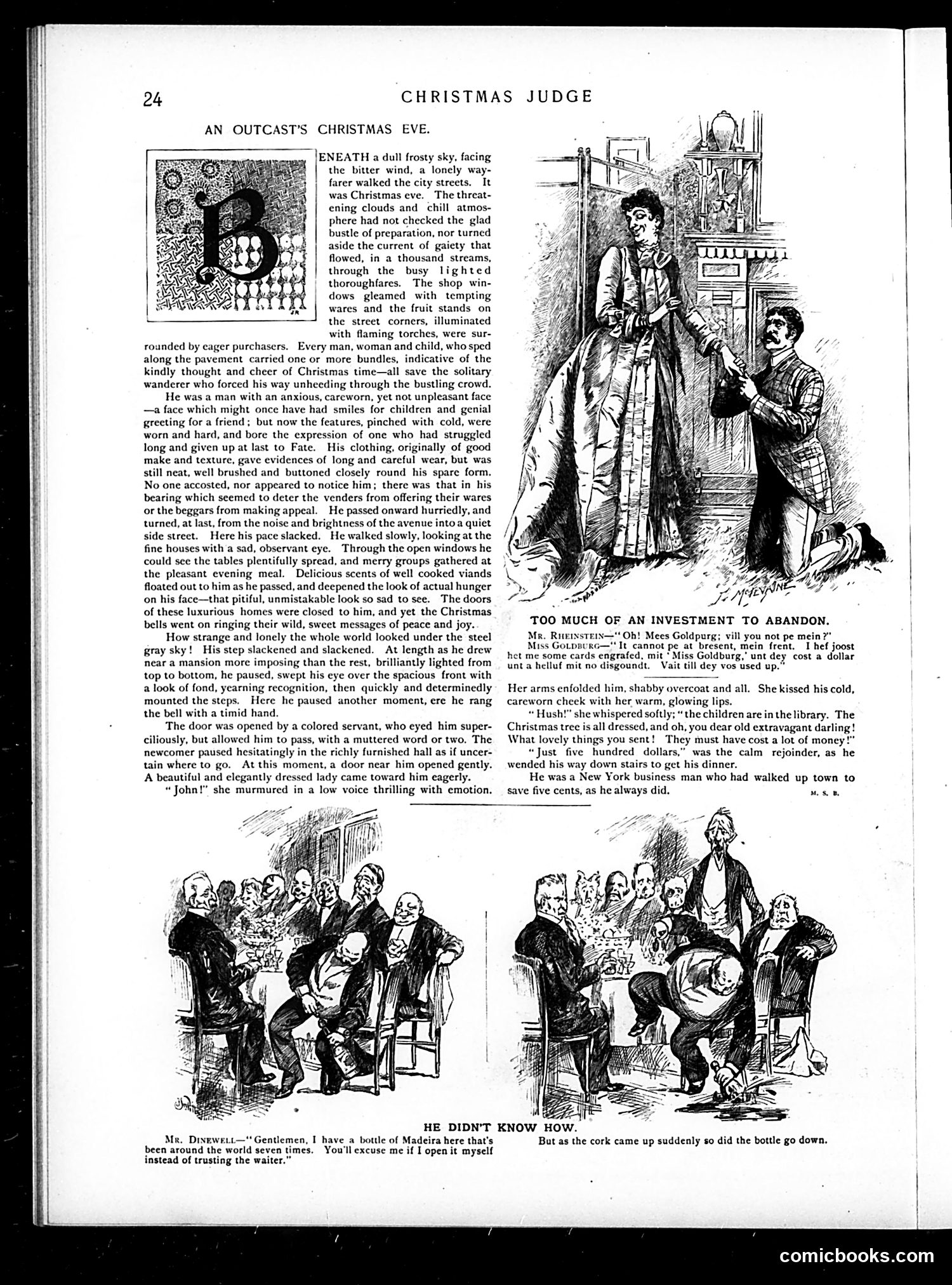
This is a Victorian-era sentimental story with social commentary, not primarily a political cartoon. The narrative follows a poor, homeless man on Christmas Eve walking through prosperous city streets lined with decorated shops and wealthy families celebrating inside. The story critiques class inequality: while the wealthy enjoy Christmas abundance, this outcast—described as having "struggled long and given up at last to Fate"—is excluded from society's festivities. The illustrations show him observing warm domestic scenes from outside, then being welcomed into a wealthy home where he encounters a woman and child. The accompanying vignettes satirize upper-class pretension (a man explaining an expensive bottle of Madeira) and social hypocrisy. The piece emphasizes how Christmas spirit should transcend class divisions.
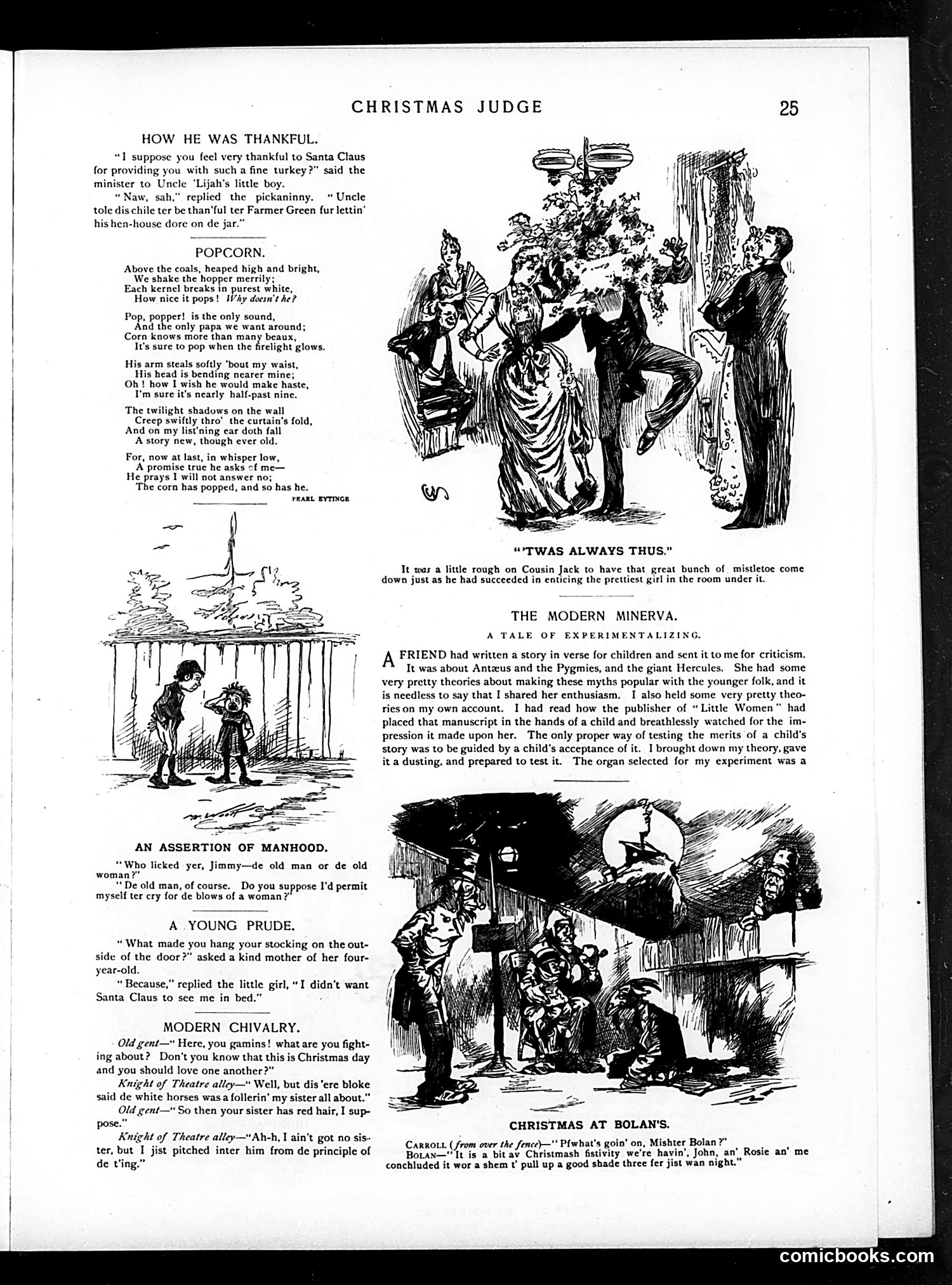
This Christmas-themed page contains several short satirical pieces reflecting late 19th/early 20th-century American humor: **"How He Was Thankful"** mocks racial stereotypes through dialect, depicting a Black child crediting the farmer rather than Santa for his turkey. **"Popcorn"** is a sentimental poem about courtship by firelight, where popcorn serves as a romantic metaphor—the girl "pops" (accepts) the boy's proposal as the corn pops. **"'Twas Always Thus"** illustrates a slapstick mishap where mistletoe falls, disrupting a young man's romantic moment with a girl. **"The Modern Minerva"** begins a longer story about testing a children's myth-based poem on an actual child, referencing how *Little Women*'s publisher tested that manuscript similarly. The remaining pieces ("An Assertion of Manhood," "A Young Prude," "Modern Chivalry," "Christmas at Bolan's") are brief jokes using working-class dialect and domestic scenarios for humor. Overall, the page emphasizes sentimental romance, class-based comedy, and period stereotypes typical of Judge's satirical approach.
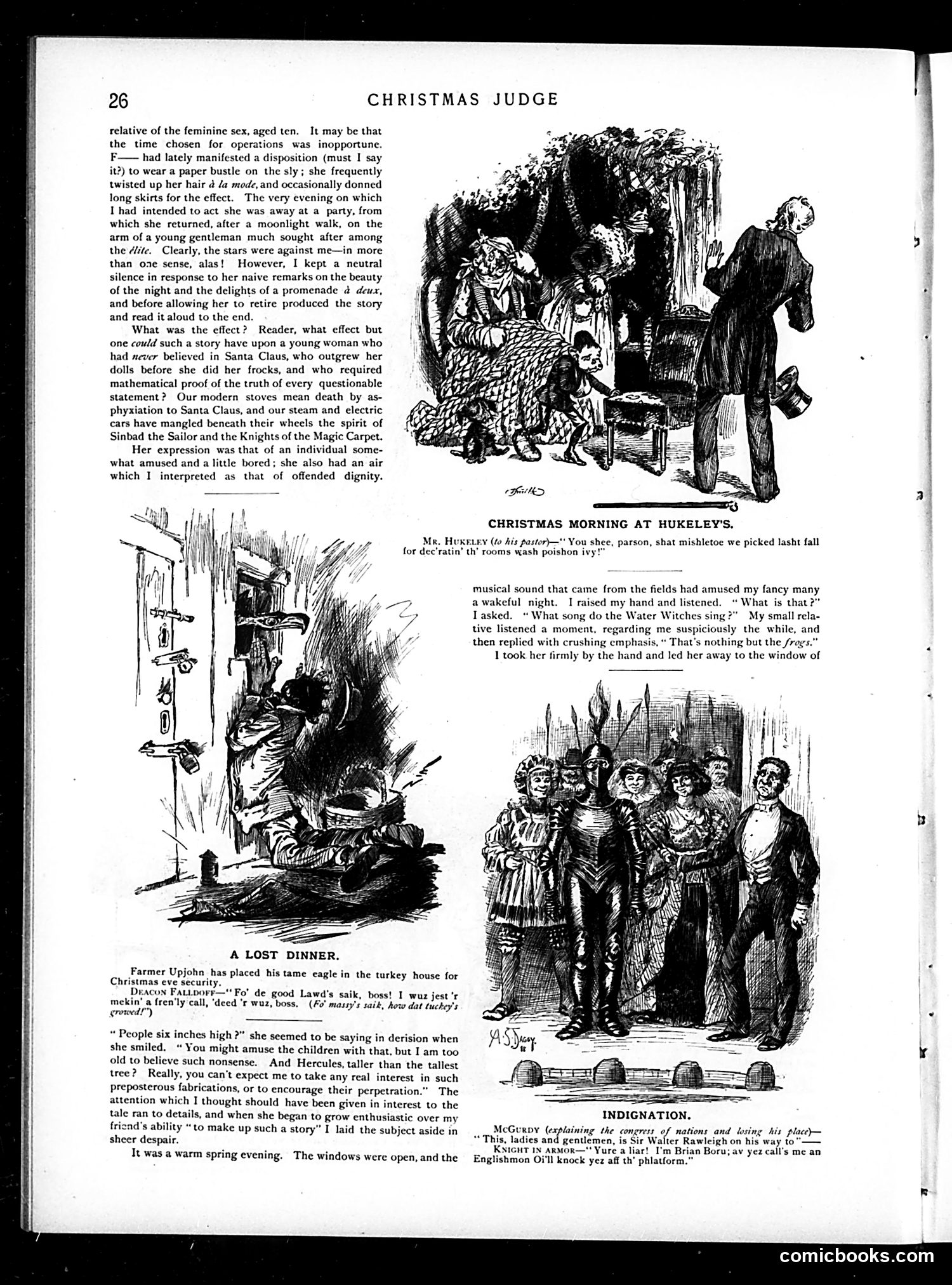
This page contains three illustrated stories with Christmas themes, not political cartoons. The main content includes: **"Christmas Morning at Hukleys"** — A domestic humor piece showing a woman (Mrs. Huckley) and parson discussing mistletoe and "poisoned ivy," with dialogue about "Water Witches" and "frogs." **"A Lost Dinner"** — Depicts Farmer Upjohn placing his game eagle in the turkey house for Christmas security, with a pun-based joke about the bird's disappearance. **"Indignation"** — Shows McCurdy explaining "congeries of nations" to Sir Walter Rawleigh, with a joke about an Englishman's response to profanity. These are gentle, domestic humor pieces typical of Judge's lighter content—focusing on wordplay and situational comedy rather than political satire. The illustrations use period-appropriate sketch work characteristic of early 20th-century magazine humor.
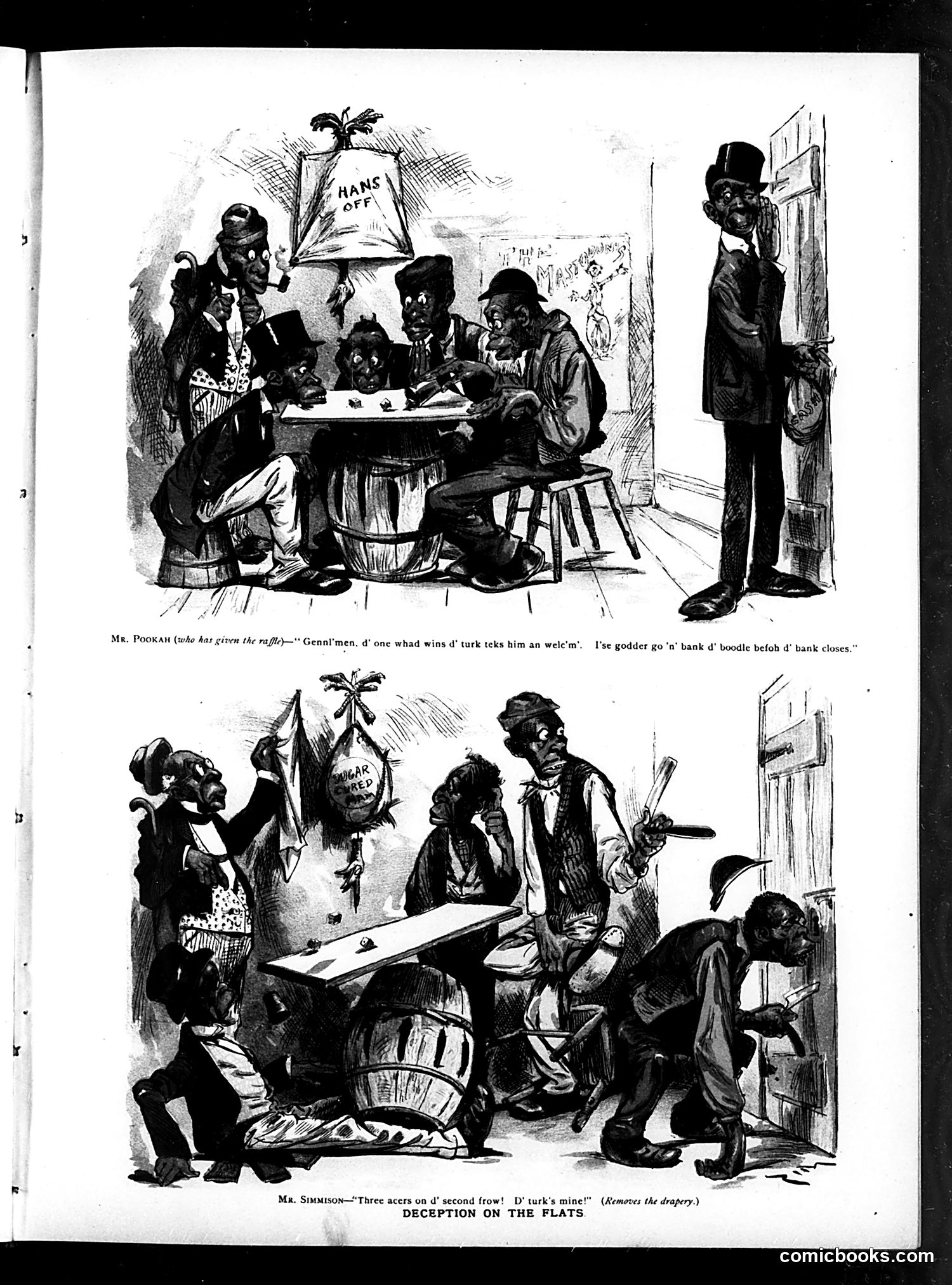
This two-panel satirical cartoon depicts a gambling scheme, likely referencing theatrical or street-level con games of the late 19th/early 20th century. The "flats" refers to con-artist operations. In the top panel, "Ma. Pookan" runs a rigged game (possibly dice or cards), telling participants the winner gets a "turkey" while she rushes to deposit the winnings at the bank before closing. The bottom panel shows "Ma. Simmonson" running a similar scheme with a bag labeled "SUGAR FIXED," revealing the deception when the curtain is removed—the game is fixed from the start. The heavy dialect and caricatured drawings suggest this satirizes immigrant con artists or working-class gambling fraud. The repeated joke is the absurdity of criminals openly admitting their scams to their victims.
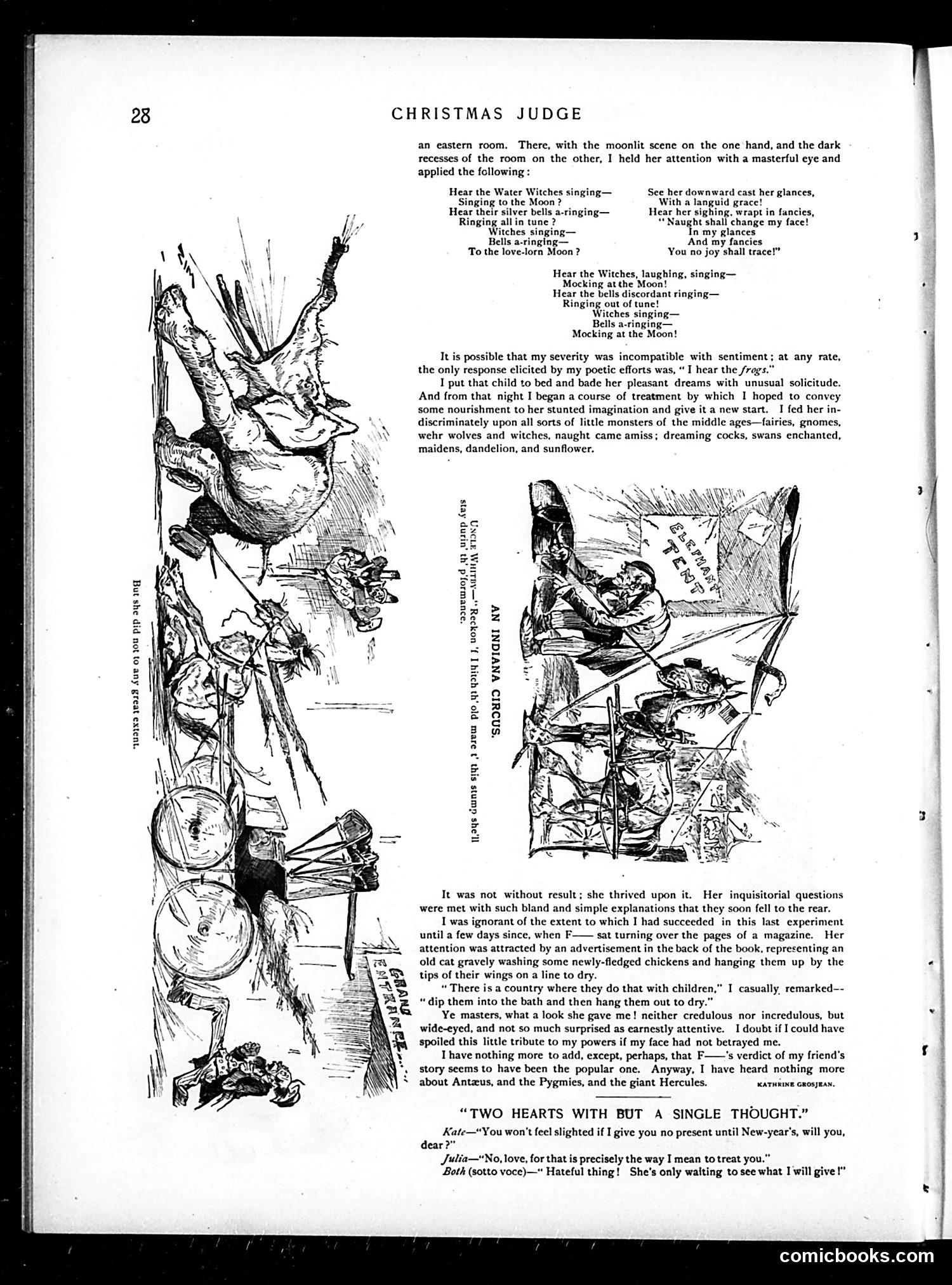
This is a *Christmas Judge* story about an adult attempting to cultivate a child's imagination through fairy tales and fantastical literature. The narrator recites romantic poetry to impress a young girl, but she dismissively responds "I hear the frogs"—deflating his pretensions. He then systematically feeds her folklore (fairies, werewolves, witches) to develop her imagination. The satire targets adult sentimentality and self-deception: the narrator believes he's succeeding until the girl nearly falls for his casual lie about children being dunked and hung to dry—revealing his storytelling actually works *too* well, dangerously blurring fact and fiction for her developing mind. The bottom cartoon titled "Two Hearts with But a Single Thought" satirizes couples' romantic dishonesty: both Kate and Julia pretend generously to delay gift-giving, while privately planning to give nothing unless the other gives first—mocking insincere courtship rituals during the gift-giving season.
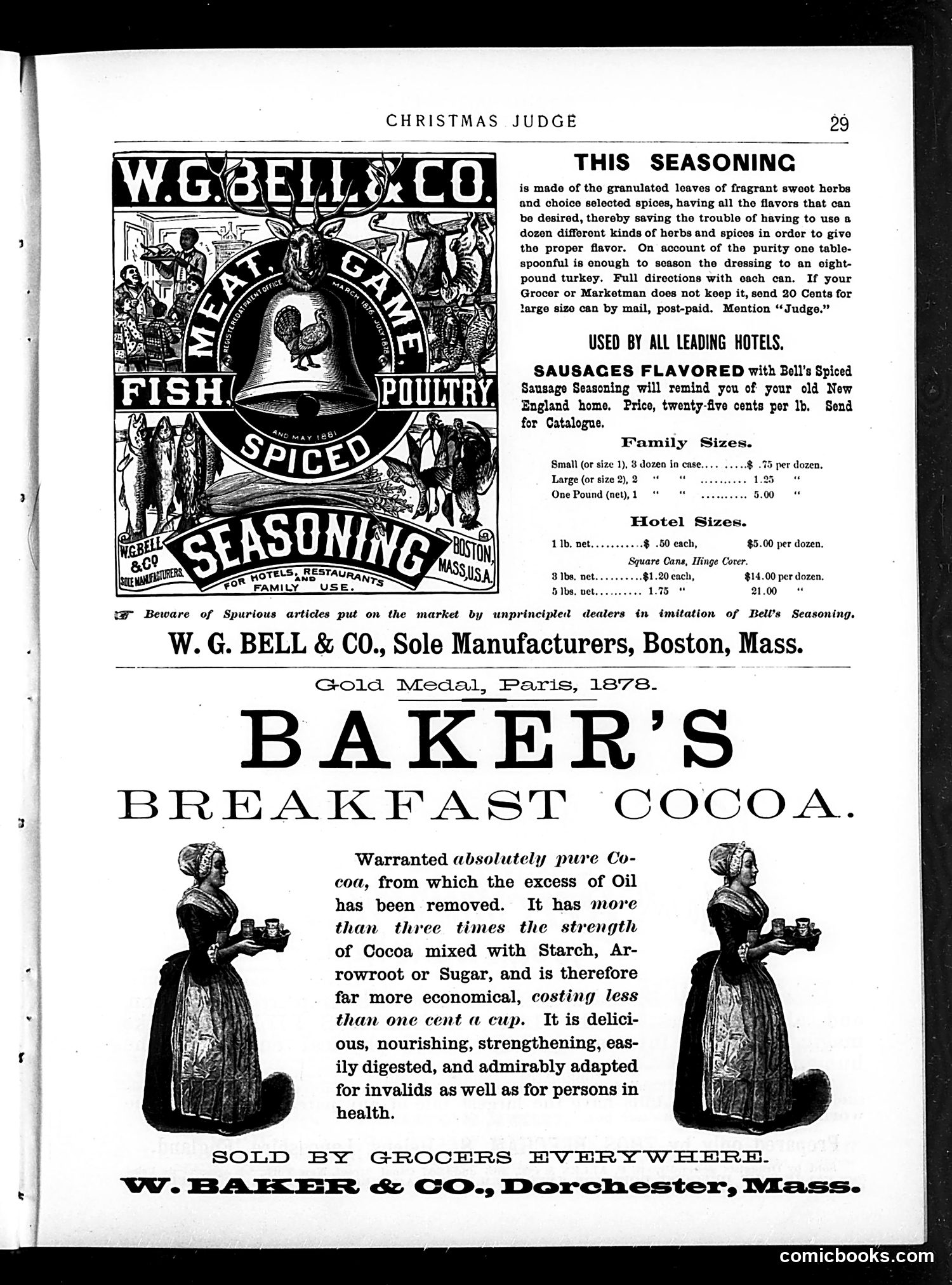
This page is primarily **advertising**, not satire or political commentary. It contains two product advertisements: 1. **W.G. Bell & Co. Seasoning** (top): An ornate label featuring game animals (fish, poultry, game birds) arranged around a bell. The ad emphasizes the product's use "by all leading hotels" and mentions it won a Gold Medal in Paris, 1878. Text warns against imitation products. 2. **Baker's Breakfast Cocoa** (bottom): Features an illustration of a Victorian-era woman serving cocoa. The ad claims the product is "absolutely pure cocoa" costing "less than one cent a cup" and is economical, nourishing, and suitable for invalids. Both are legitimate commercial advertisements typical of 19th-century magazine content, not satirical commentary.
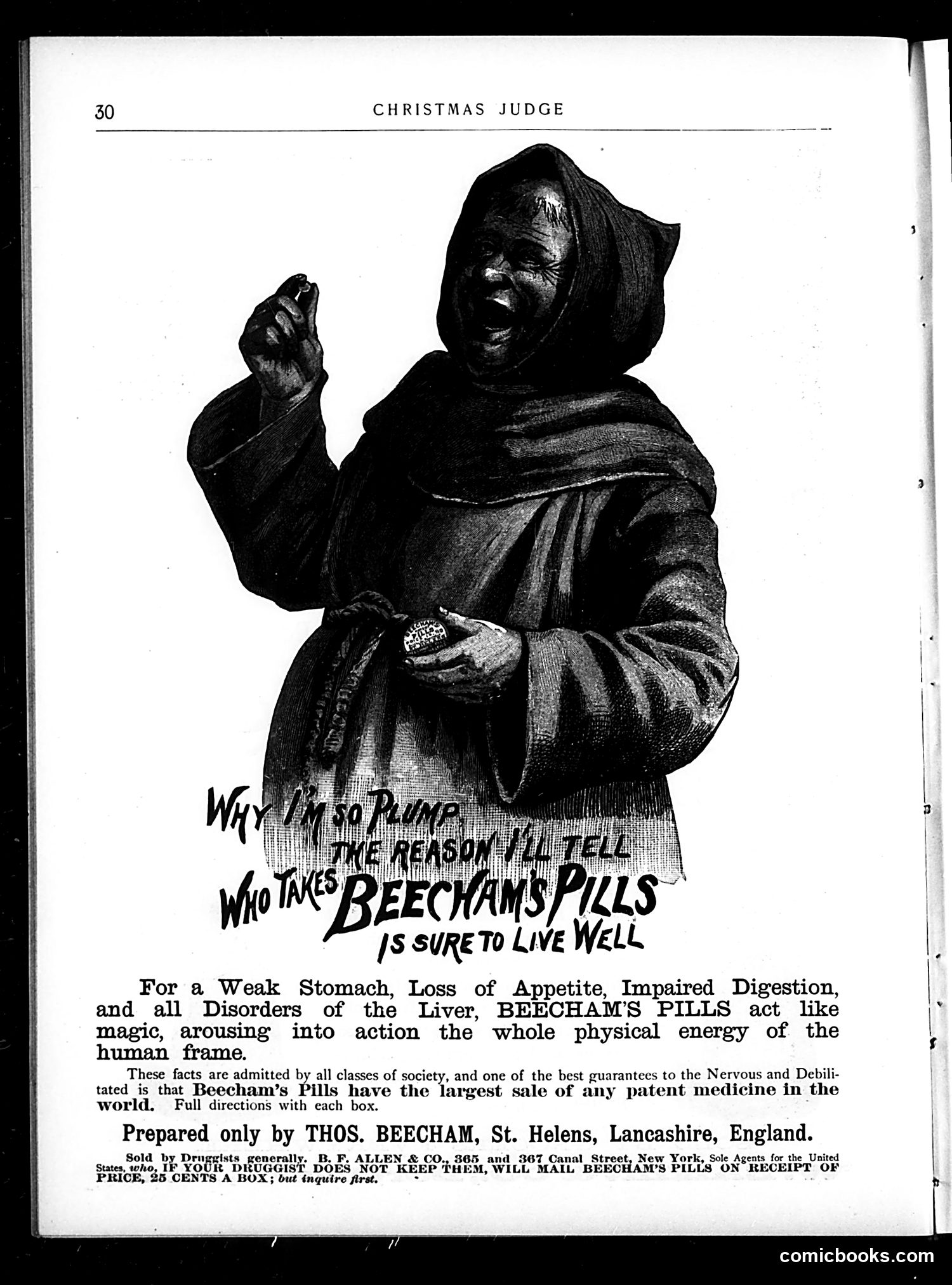
This page is a **patent medicine advertisement**, not political satire. It promotes Beecham's Pills, a British digestive remedy, using a caricatured figure (appears to be a stereotypical "plump" character) to humorously represent someone benefiting from the product. The ad claims the pills cure weak stomachs, appetite loss, and liver disorders, and boasts they have "the largest sale of any patent medicine in the world." The text promises results "like magic" and appeals to "all classes of society." This reflects the era's largely **unregulated patent medicine industry**, where exaggerated health claims were routine. Beecham's Pills were actually a real, successful product (British-made, sold in America through New York agents), but the extravagant medical promises would later become targets of regulatory reform and muckraking journalism. The "Christmas Judge" header indicates this ran in *Judge* magazine during the holiday season—advertising was common in such publications.
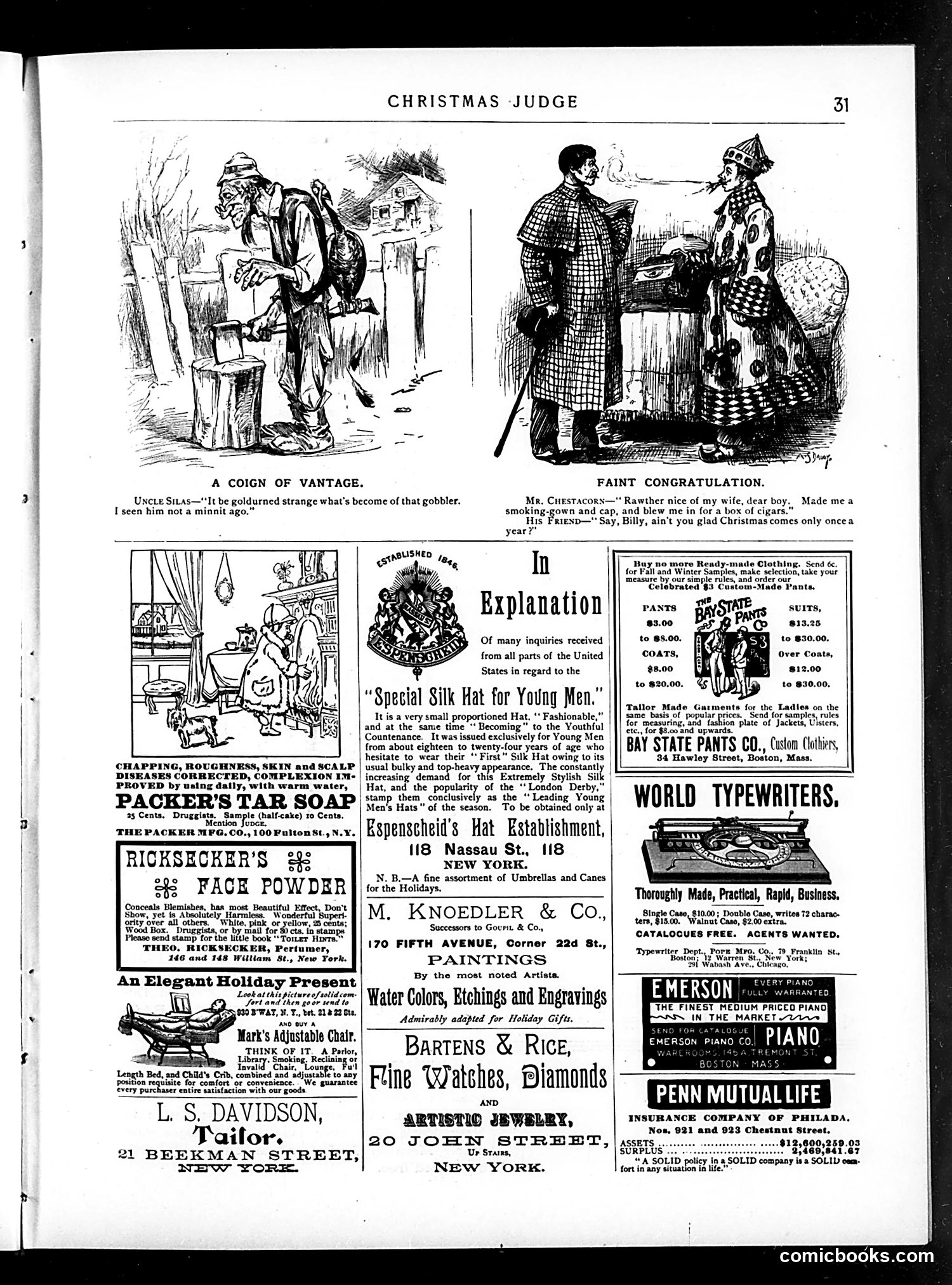
This page contains two cartoon jokes and extensive advertising typical of 1880s Judge magazine. **"A Coign of Vantage"** depicts Uncle Silas searching for a missing turkey, having seen it "not a minute ago." The joke plays on rural dialect and the common Christmas dinner mishap. **"Faint Congratulation"** shows a man receiving a smoking jacket and cigars from his wife as Christmas gifts, with a friend sarcastically remarking that Christmas comes "only once a year"—the humor suggesting these meager gifts hardly justify the holiday's arrival. It's social satire about disappointing domestic gift-giving. The remainder is advertising: face powder, tar soap, furniture, ready-made and custom clothing, typewriters, jewelry, paintings, pianos, and insurance. An "Explanation" section promotes a new "Special Silk Hat for Young Men"—a smaller, fashionable design specifically marketed to young men aged 18-24 hesitant about wearing traditional bulky silk hats. The page demonstrates Judge's typical blend of humor and commercial content aimed at middle-class American readers.
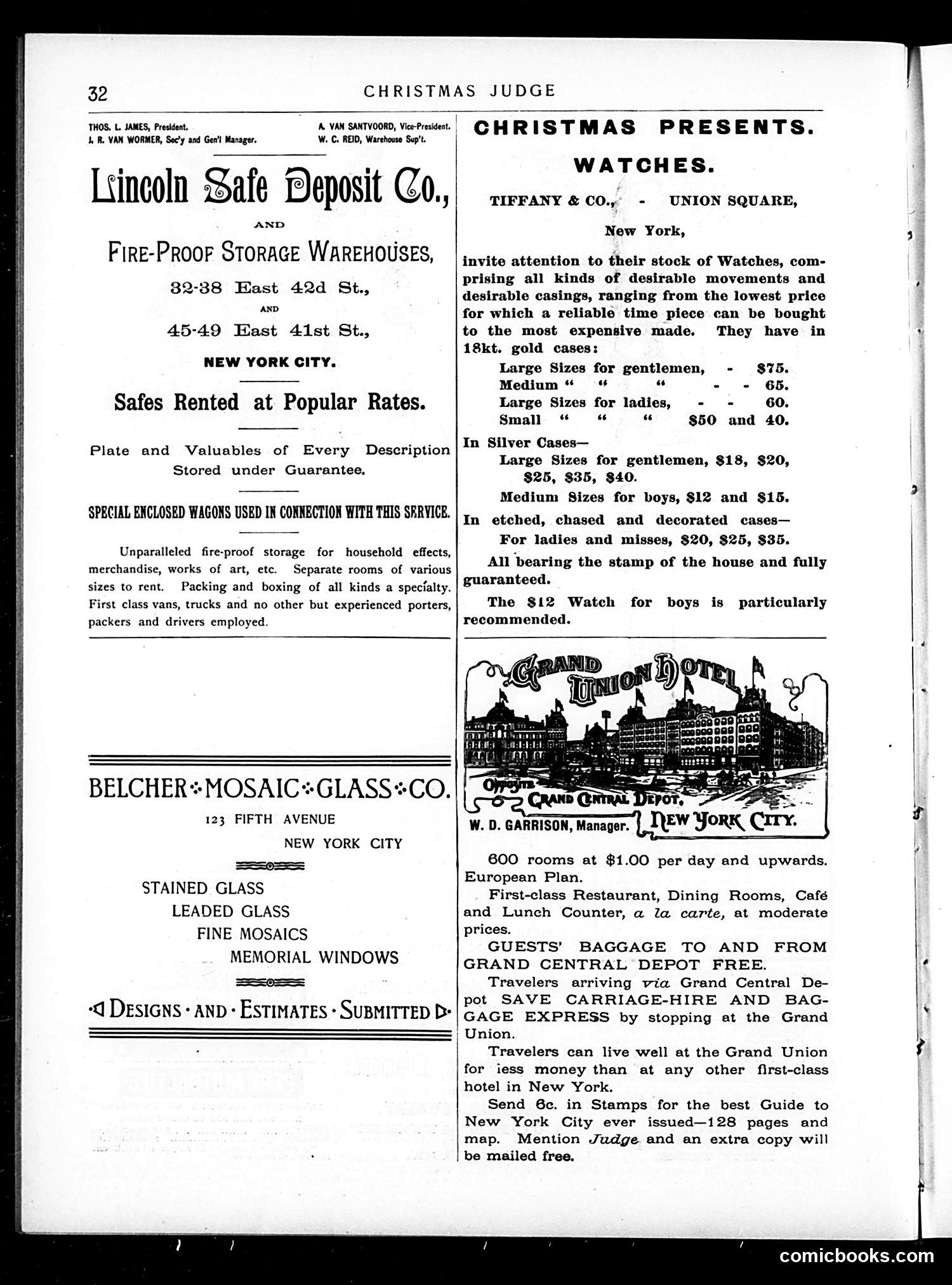
This is primarily an **advertisements page**, not a satirical cartoon. It's from a Christmas issue of *Judge* magazine and features luxury goods and services aimed at wealthy New York consumers. The advertisements include: - **Lincoln Safe Deposit Co.** - fireproof storage for valuables - **Tiffany & Co.** - watches ranging from $12 (for boys) to $75 (gold cases for gentlemen) - **Belcher Mosaic Glass Co.** - stained glass and decorative windows - **Grand Union Hotel** - budget-friendly lodging near Grand Central The page reflects **Gilded Age consumer culture**: premium gift-giving for the wealthy, emphasis on security and storage (suggesting significant personal wealth), and luxury timepieces as status symbols. The "Christmas Presents" section positions watches as desirable gifts across price points. There is no political satire visible—this is straightforward commercial content targeting *Judge*'s affluent readership during the holiday shopping season.
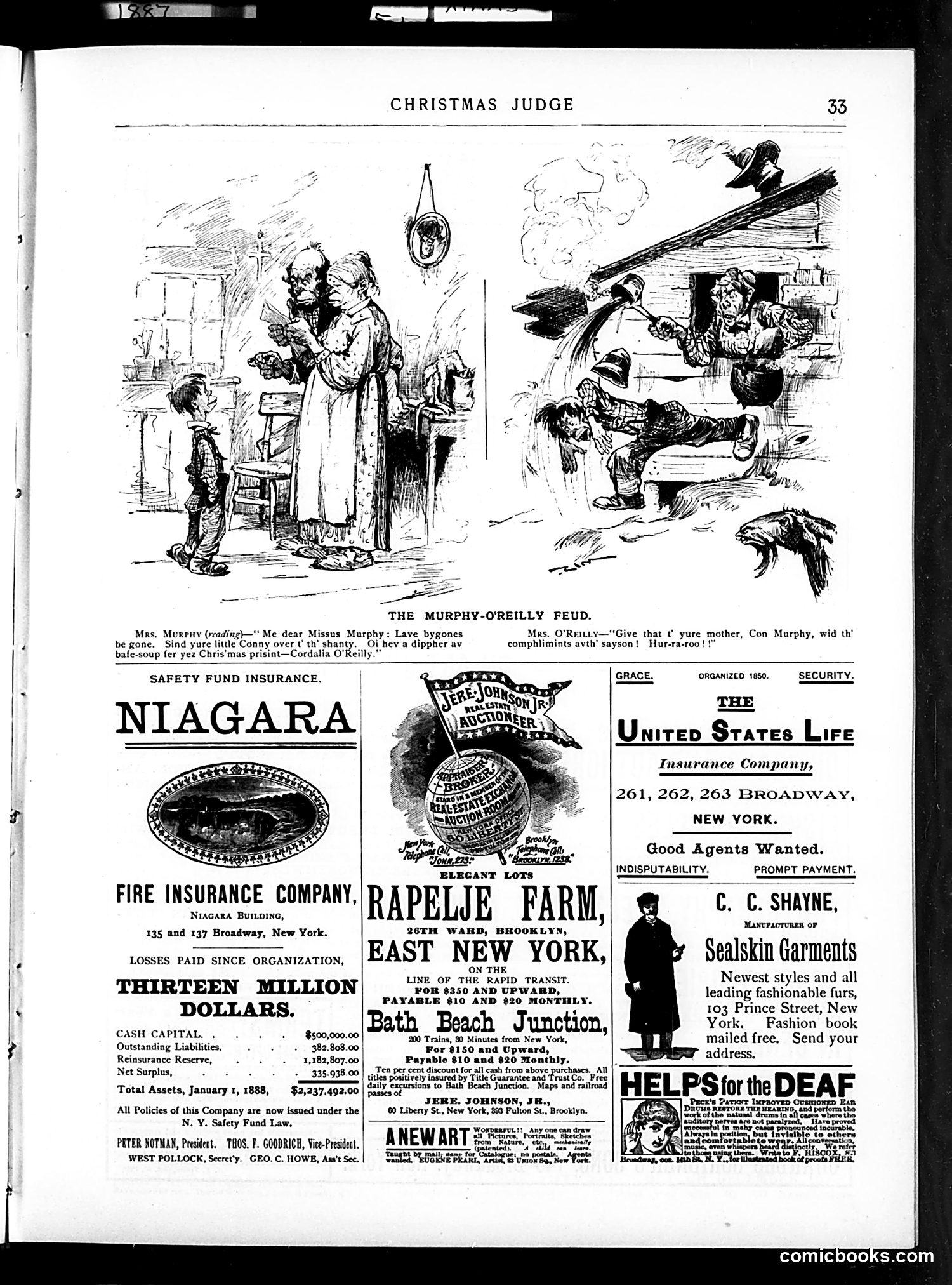
This cartoon satirizes Irish-American ethnic stereotypes and feuding cultures. Two Irish immigrant women—Mrs. Murphy and Mrs. O'Reilly—exchange hostile remarks while their children fight in the background. Despite their bitter "feud," they mockingly offer each other Christmas "gifts": Mrs. Murphy sends soup via her son "Conny," while Mrs. O'Reilly sends a "dippher" (dipper), both delivered with exaggerated Irish dialect and theatrical hostility. The joke targets 19th-century Irish-American communities, portraying them as perpetually quarrelsome yet ultimately bound by ethnic solidarity and holiday tradition. The contrast between vicious words and the actual exchange of food gifts—practical and neighborly—suggests the feud is more performative than genuine. The page is otherwise filled with period advertisements (fire insurance, real estate, life insurance) unrelated to the cartoon's content.
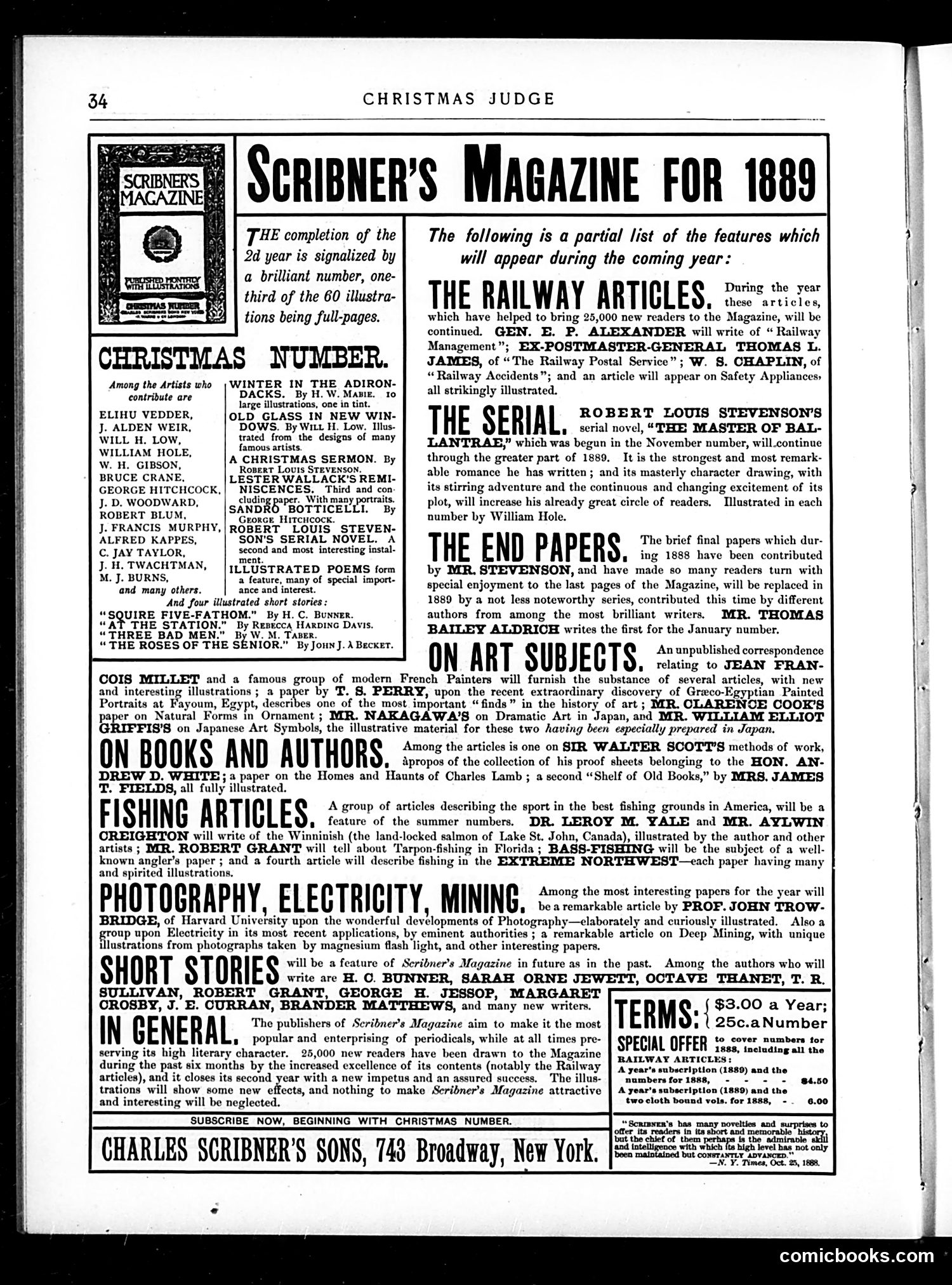
This is primarily a **promotional announcement** for Scribner's Magazine's 1889 publication schedule, not a political cartoon. It appears in *Judge*, a satirical magazine, but functions as paid advertising rather than satire. The page highlights the magazine's second-year success, announcing prestigious contributors (prominent artists like Elihu Vedder, J. Alden Weir) and major serialized content, notably Robert Louis Stevenson's "The Master of Ballantrae" and articles on railways, art history, and fishing. The implicit appeal targets educated, affluent readers interested in high-culture content—literature, fine art, and illustrated journalism. The listing of famous contributors and exotic subjects (Egyptian antiquities, Japanese art) signals intellectual prestige and cosmopolitan sophistication, typical advertising appeals for late-19th-century literary magazines. The subscription rates ($3/year or 25¢/number) indicate middle-to-upper-class readership.
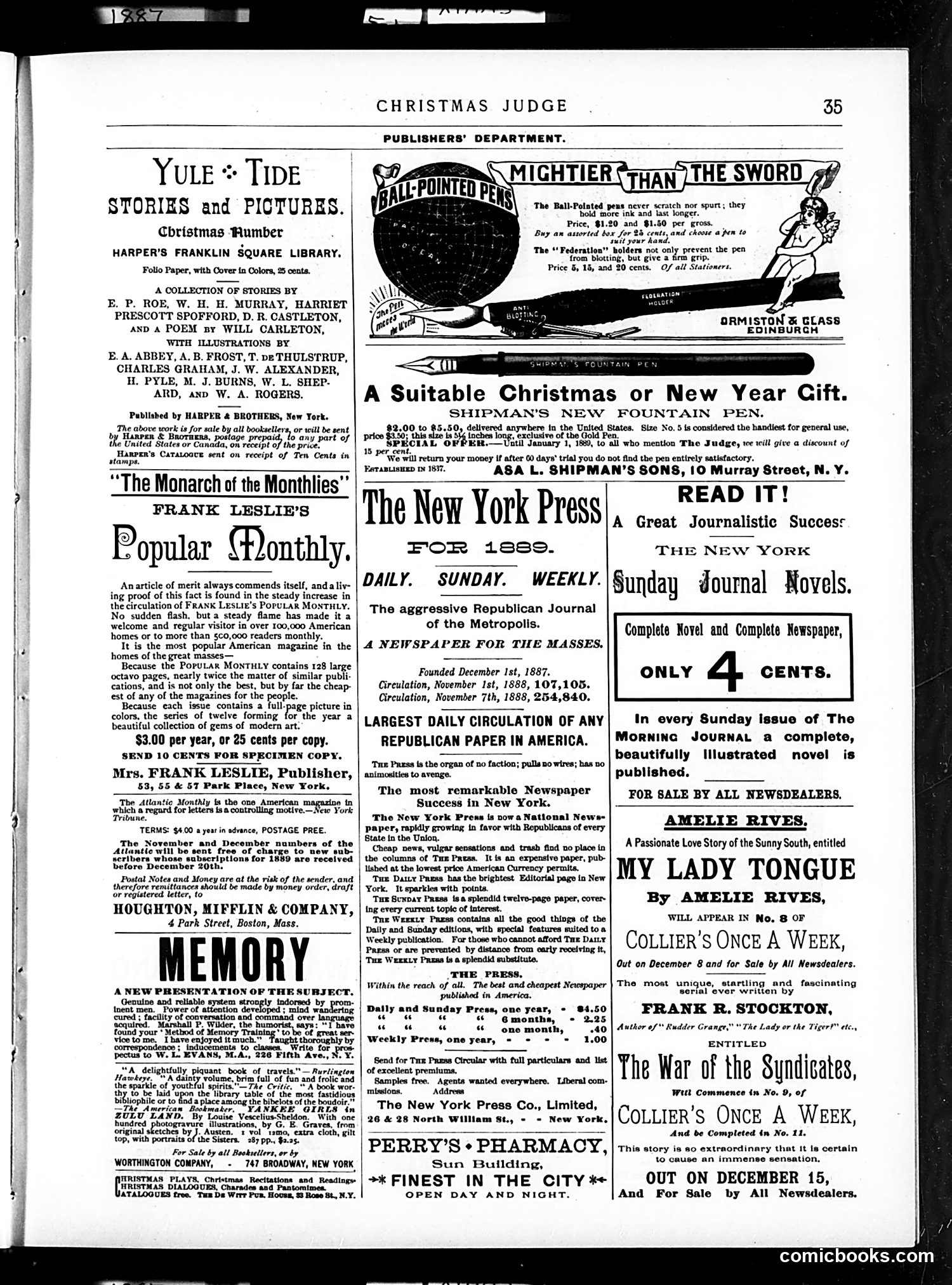
This page is primarily **advertising and promotional content**, not satire or political commentary. It comprises announcements from Judge's publishers promoting Christmas gift books and competing publications. The main cartoon visible shows a **ball-pointed pen advertisement** ("Mightier Than the Sword"), a visual pun comparing the pen's power to weapons—a common trope suggesting writing's influence over force. The figure appears to be a generic representation of writing/journalism rather than a specific political caricature. The bulk of the page advertises: - Harper's Christmas story collections - Frank Leslie's Popular Monthly (claiming to be "The Monarch of the Monthlies") - The New York Press (a Republican newspaper) - Memory improvement instruction books - Various other publications This reflects late 19th-century magazine culture where publishers aggressively competed for readers through cross-promotion and circulation claims. The page serves as a business/marketplace section rather than editorial content, showing Judge's commercial operations alongside competitor advertisements.
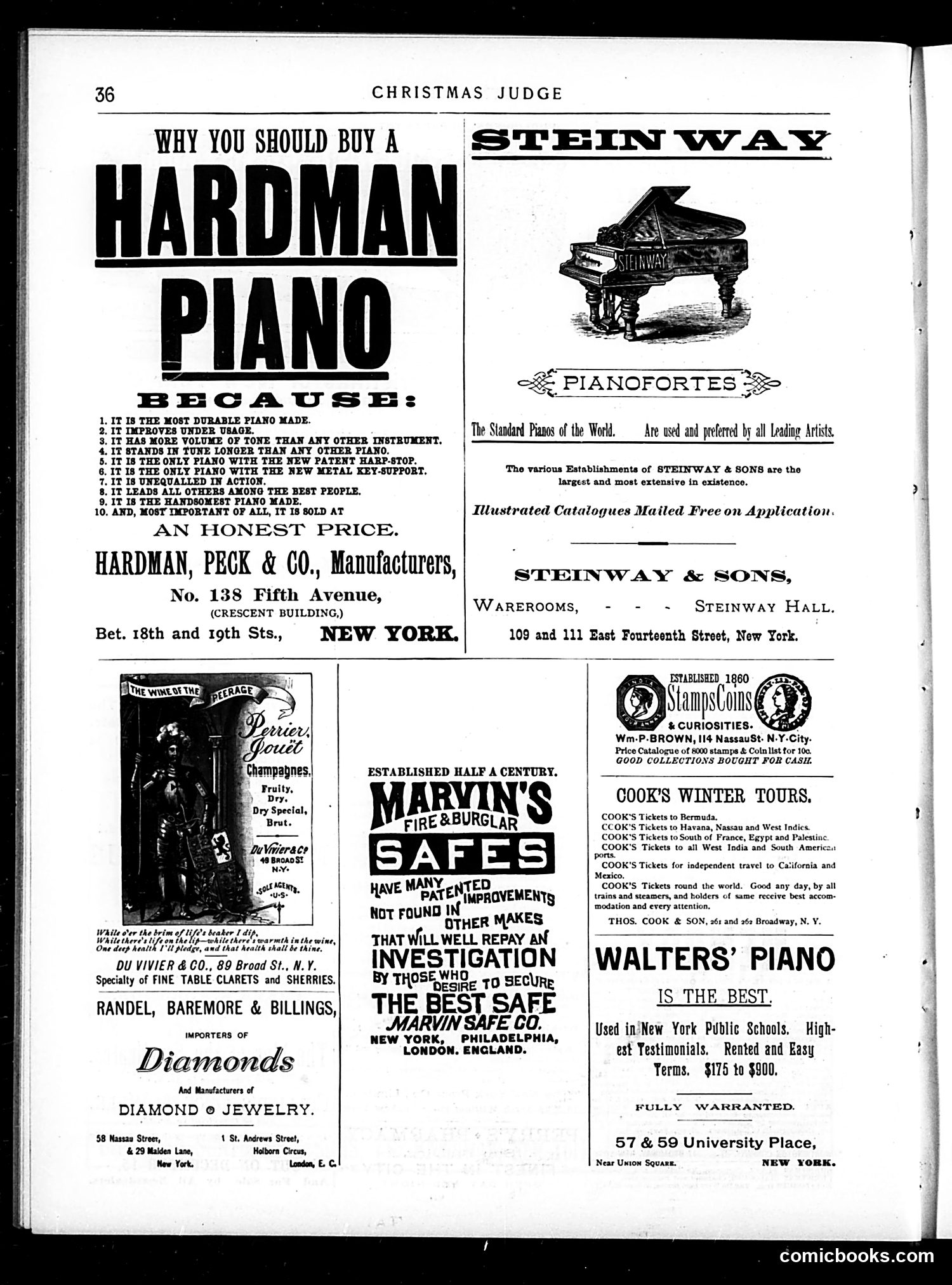
This is primarily a **Christmas advertising page** rather than a satirical cartoon. Judge magazine devoted this page to holiday gift recommendations, featuring competing piano manufacturers and luxury goods. The page contrasts two rival piano companies in a subtle competitive format: **Hardman, Peck & Co.** (left side) lists ten reasons to buy their pianos, emphasizing durability and "honest price," while **Steinway & Sons** (right side) claims to be "The Standard Pianos of the World" used by leading artists. The humor lies in the aggressive marketing claims typical of the era—each brand asserting superiority through increasingly hyperbolic statements. Additional advertisements promote luxury items befitting wealthy Christmas shoppers: diamonds, fine wines, safes, travel tours, and coin collecting. This reflects late-19th/early-20th-century consumer culture where Judge's affluent readership would expect premium product pitches during the holiday season.
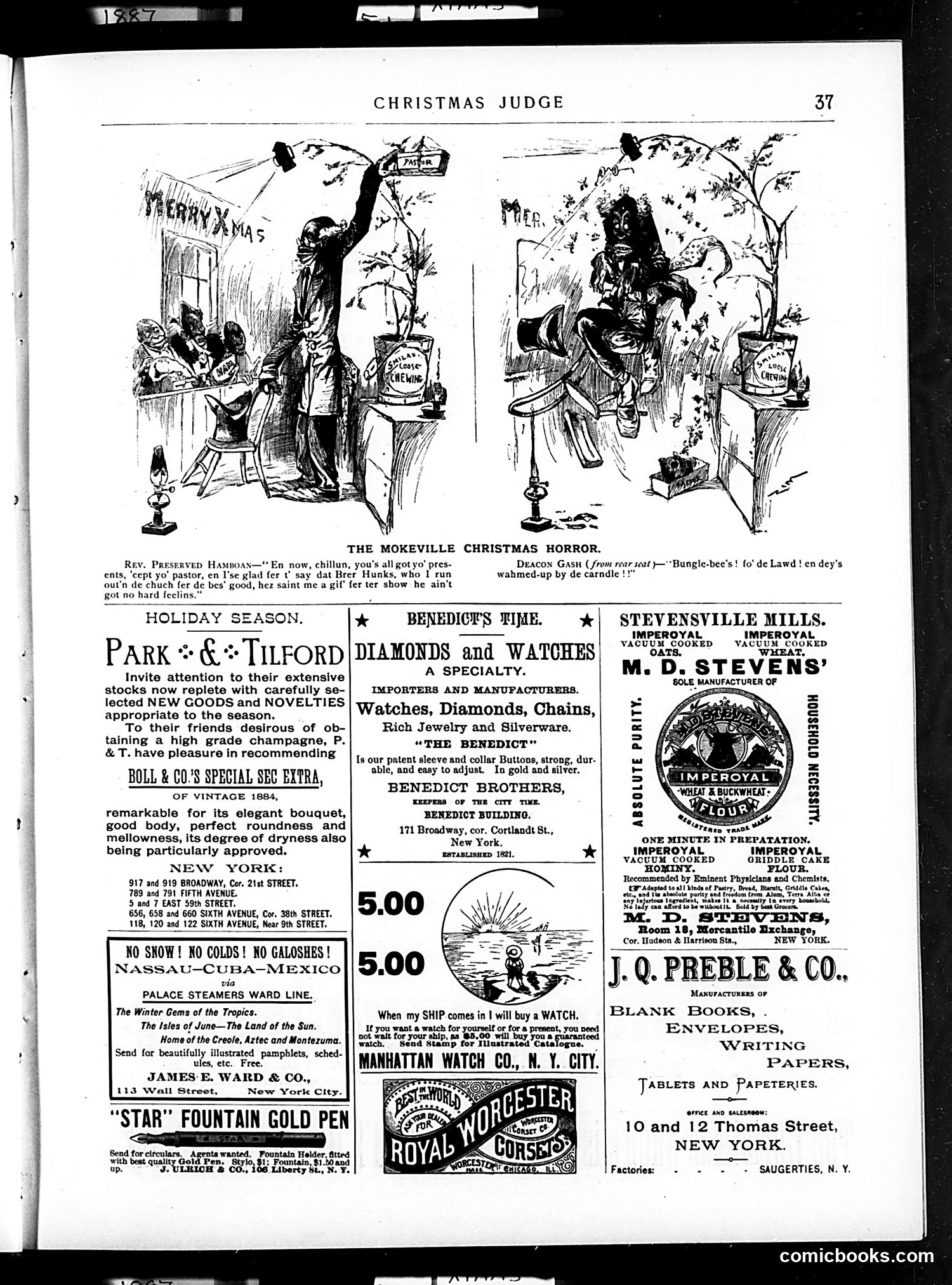
This page features two cartoons satirizing rural African American Christmas celebrations, using heavy dialect and racial caricature typical of late-19th-century American humor magazines. The left cartoon shows Reverend Preserved Handoak addressing his congregation about Christmas presents. The right panel shows Deacon Gash warning that the church's decorations (mistletoe) are being warmed by candles—a fire hazard played for comedy. The satire relies on minstrelsy-style stereotypes: exaggerated dialect, malapropisms ("Bungle-bee's" for mistletoe), and depicting rural Black church life as comedic and foolish. The "Mokeville" setting suggests a fictional backwoods community. The humor assumes readers would find the characters' speech patterns and concerns inherently funny—typical of Judge magazine's approach to racial comedy, which modern readers should recognize as offensive caricature rather than genuine satire of social issues.
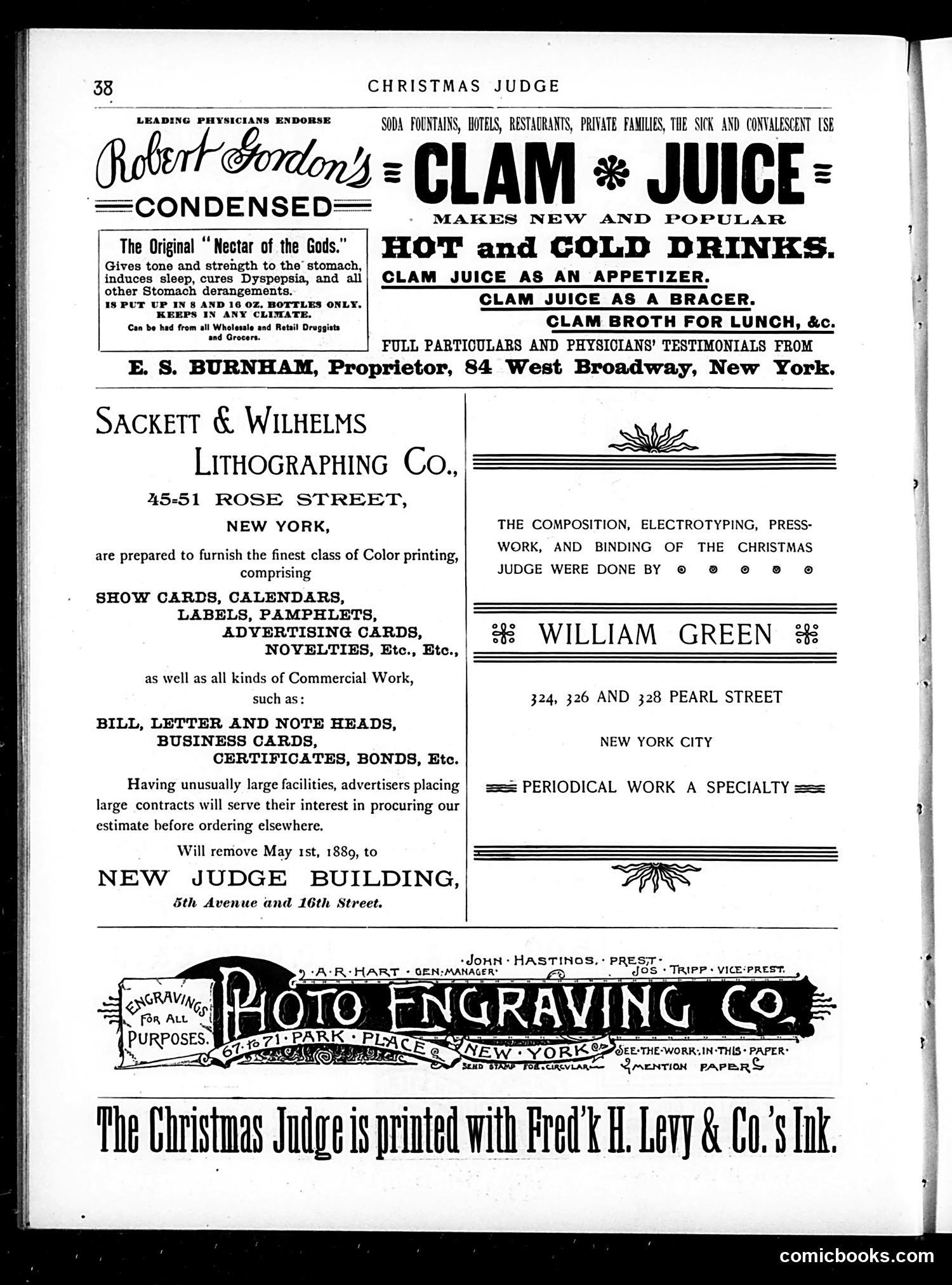
This page is primarily **advertisements and production credits** rather than editorial content or cartoons. The dominant ad promotes **Robert Gordon's Clam Juice**, a patent medicine marketed to physicians and sold at soda fountains, hotels, and druggists. It claims to cure stomach ailments, induce sleep, and treat dyspepsia—typical health claims of 1880s tonics (likely containing alcohol or other dubious ingredients). The remainder consists of **business credits**: Sackett & Wilhelms Lithographing Co. advertises their printing services; William Green lists composition/binding work; and Photo Engraving Co. credits their contribution. A final line notes the magazine was printed with **Fred'k H. Levy & Co.'s Ink**. There are **no political cartoons or satirical content visible** on this page—it's a production/advertising section of Judge magazine.
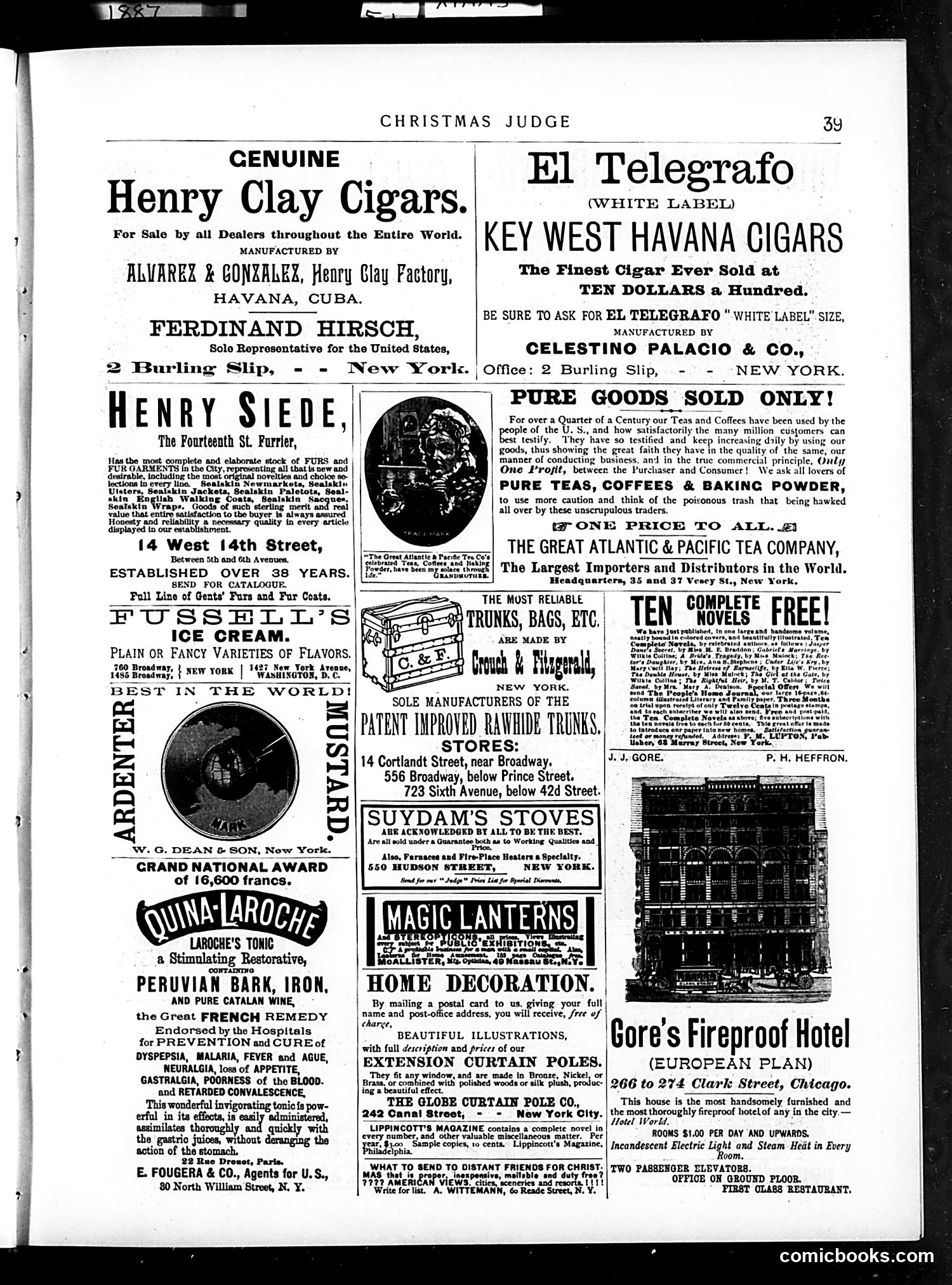
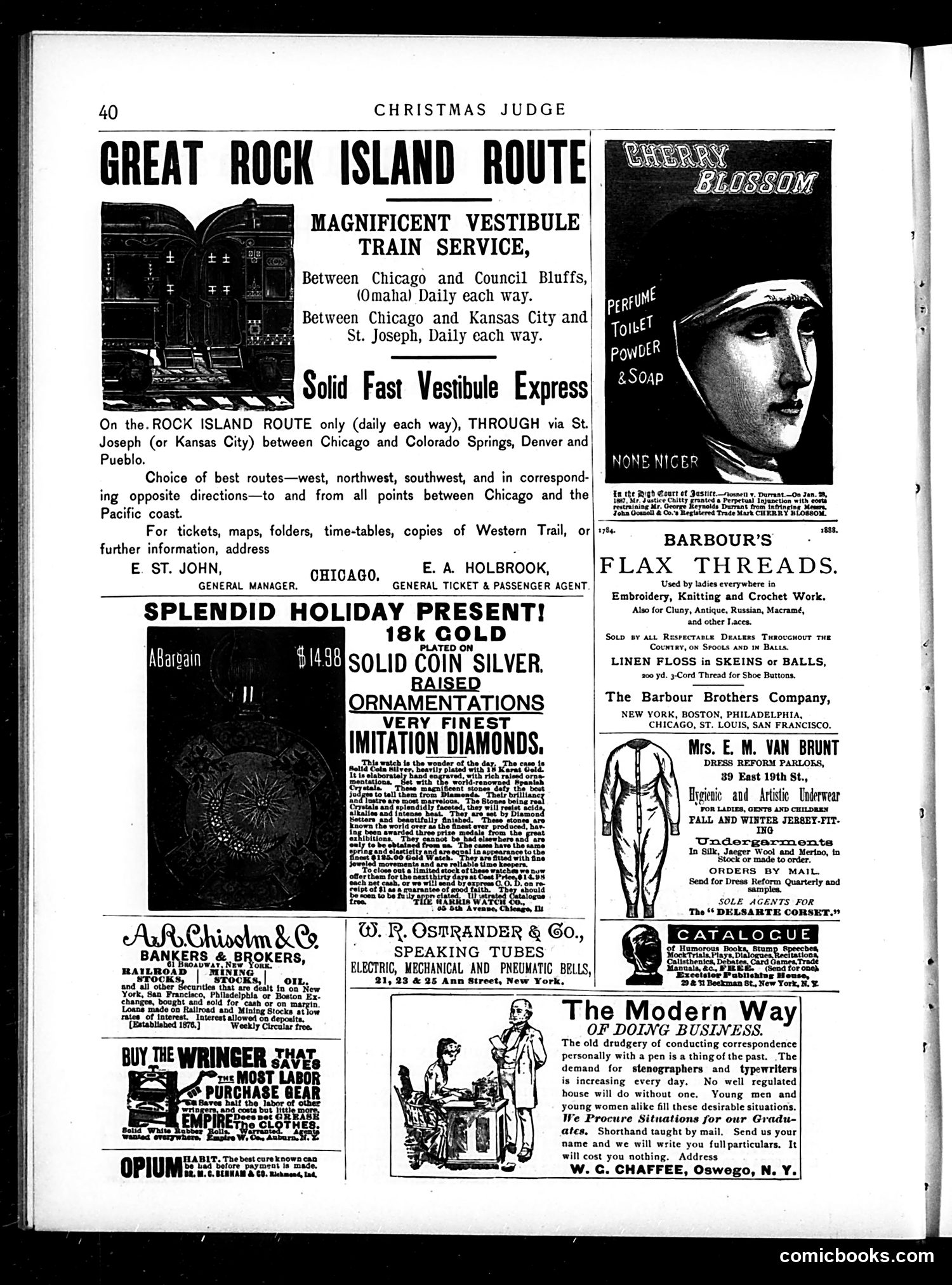
This page is **primarily advertising**, not political satire. It's from a Christmas issue of *Judge* magazine and consists almost entirely of commercial advertisements typical of the 1880s. Notable ads include: - **Great Rock Island Route**: Railroad service between Chicago and western cities - **Gold coin jewelry with imitation diamonds**: A holiday gift ad - **Mrs. E. M. Van Brunt's dress reform parlor**: Offering "hygienic" undergarments—referencing the late-Victorian "dress reform" movement advocating looser, healthier clothing for women - **W.C. Chaffee's stenography school**: Training for the newly in-demand skills of shorthand and typewriter operation The only potentially satirical element is the dress reform ad, which appeals to progressive attitudes about women's health and practicality, though it's presented straightforwardly as commercial opportunity rather than satire. The page reflects late-19th-century American consumer culture and emerging technologies.
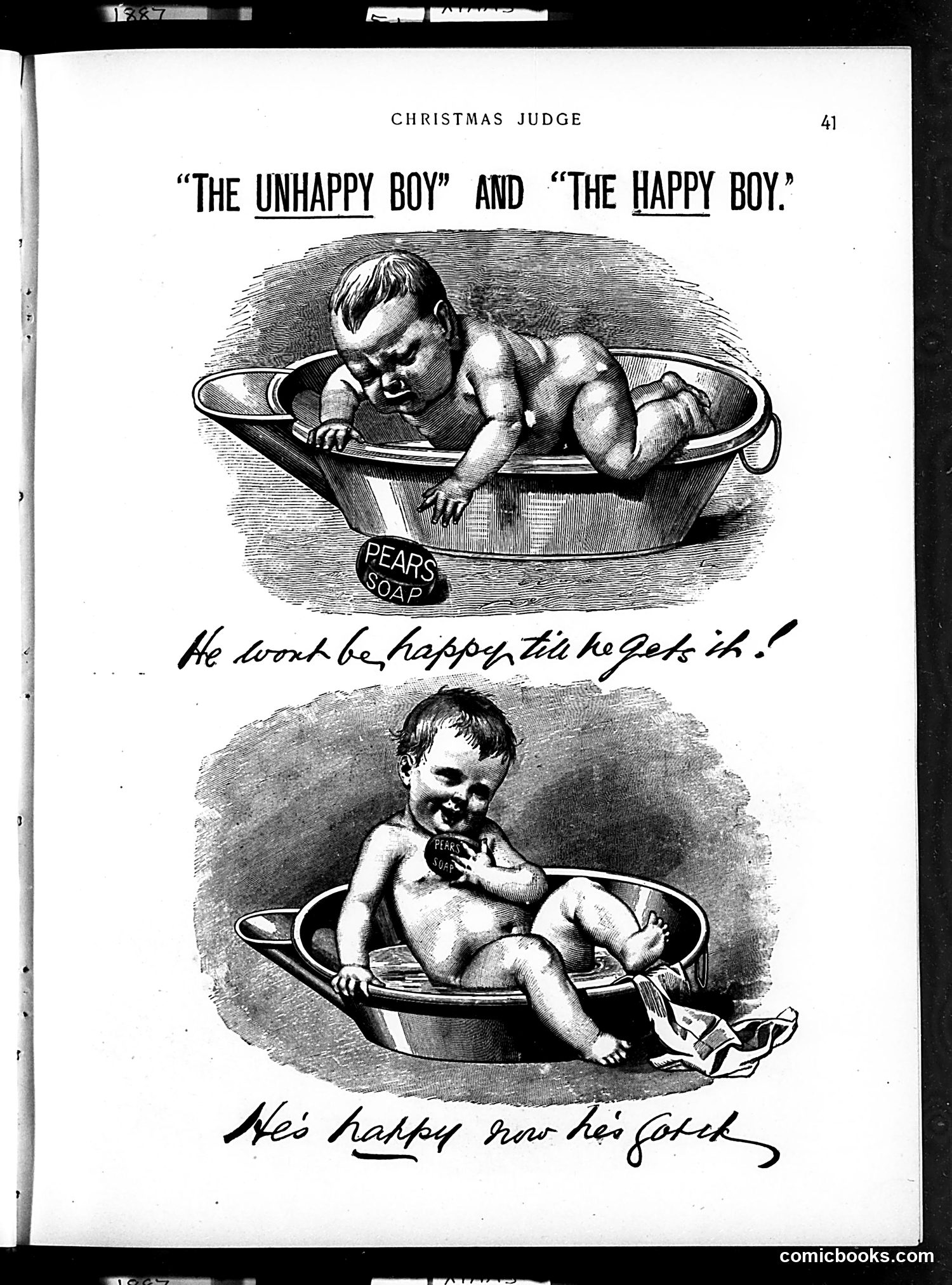
This is a Pears' Soap advertisement using contrasting images of infants. The top illustration shows a baby in a basin labeled "Pears Soap" looking unhappy or distressed, captioned "He won't be happy till he gets it!" The bottom shows a cheerful, well-bathed baby with clothing nearby, captioned "He's happy now he's got it." The advertisement uses a simple before-and-after structure to market soap as essential to infant happiness and presumably health. This reflects Victorian-era attitudes about cleanliness and childhood welfare. The product name and branding are clearly visible, making this primarily a commercial rather than satirical or political piece, though it appears in Judge magazine's pages.
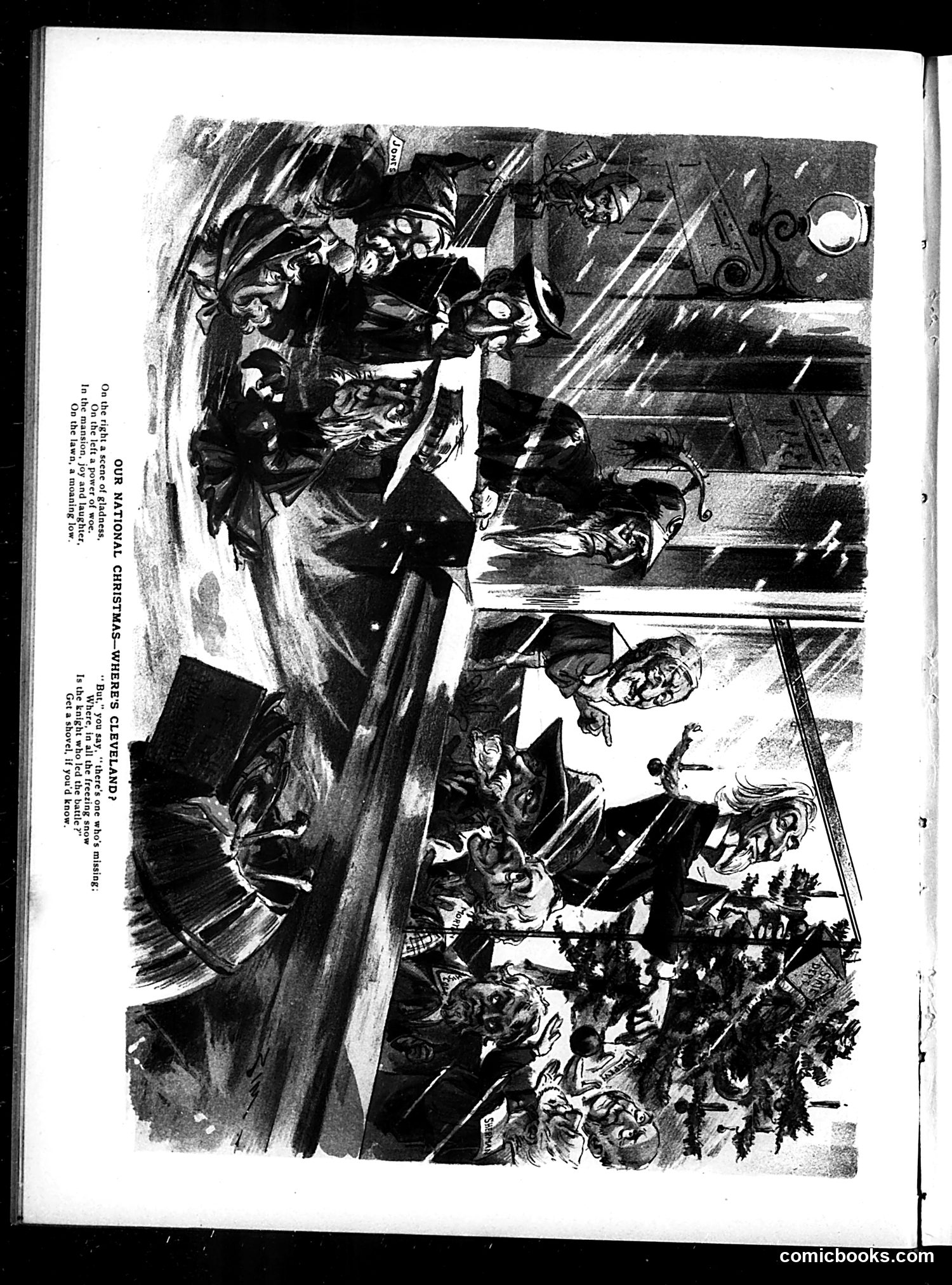
The OCR text is too corrupted to read reliably. However, the image shows a satirical illustration rotated 90 degrees, depicting what appears to be a chaotic Christmas scene with multiple figures in period dress (likely late 19th century based on Judge magazine's era). The drawing style is characteristic of Judge's political cartoons—crowded composition with exaggerated figures engaged in frantic activity. Without legible text identifying specific political figures, events, or the cartoon's title, I cannot confidently explain which contemporary political situation or social issue this satirizes or who the caricatured figures represent. To properly interpret this cartoon's meaning and context, a clearer image or readable caption/headline would be essential.
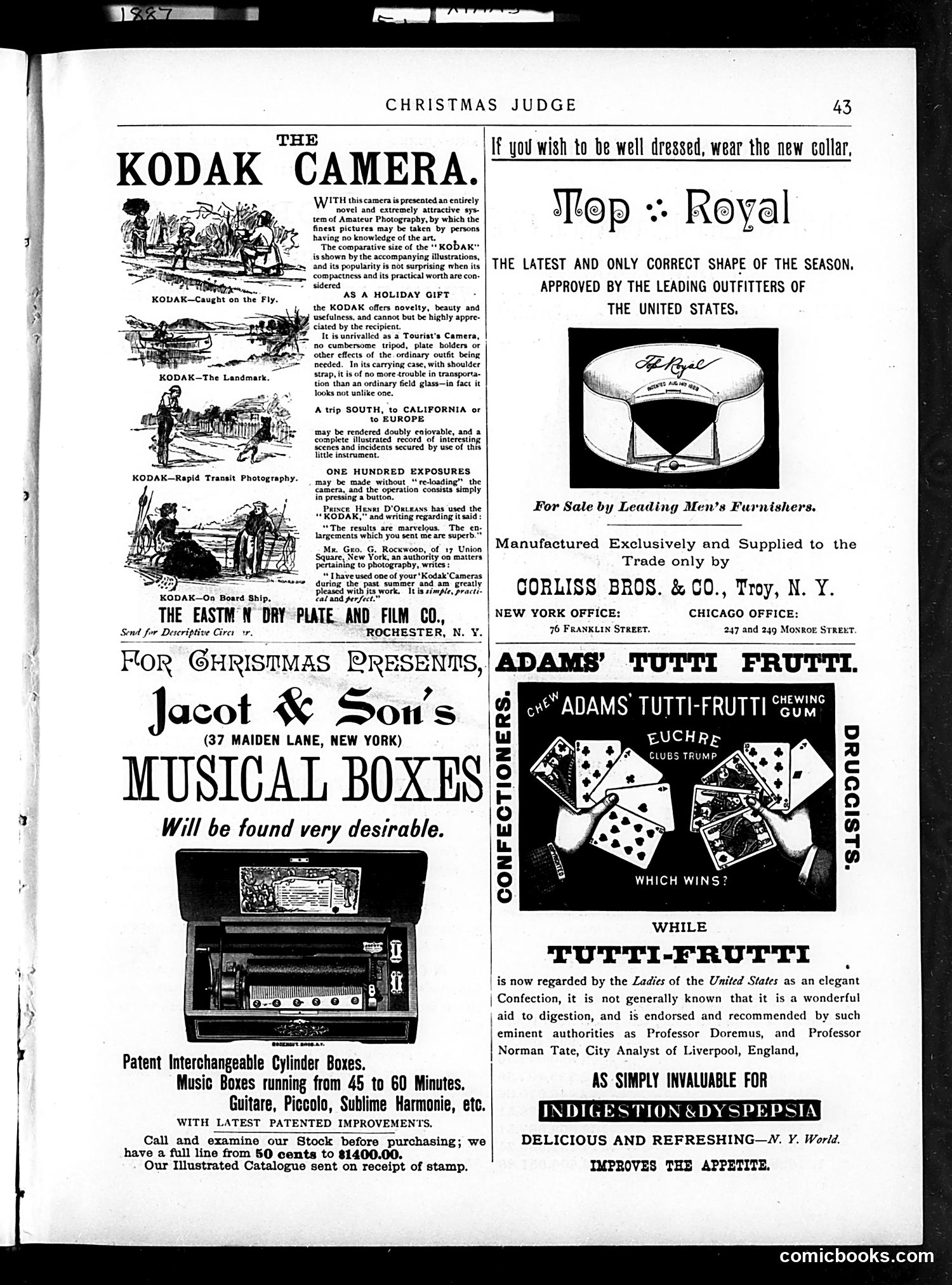
This is primarily an **advertising page** rather than satirical content. It showcases luxury gift items for wealthy Christmas shoppers circa the 1880s-90s. ## Key Advertisements: **Kodak Camera**: Presented as a revolutionary consumer product—an easy-to-use camera requiring no photography expertise. The marketing emphasizes its novelty, portability, and suitability as a holiday gift for travel. **Top Royal Collar**: A men's fashion item marketed as the season's only "correct" collar shape, approved by leading outfitters. **Jacot & Son's Musical Boxes**: Ornate mechanical music boxes ranging from 50 cents to $1,400—luxury items for the wealthy. **Adams' Tutti-Frutti Chewing Gum**: Marketed as both a confection and digestive aid, endorsed by professors as beneficial for indigestion and dyspepsia. The page reflects the era's consumer culture and advertising strategies: products presented with testimonials from authority figures and celebrities, emphasis on novelty and social status, and Christmas gift-giving as aspirational consumption.
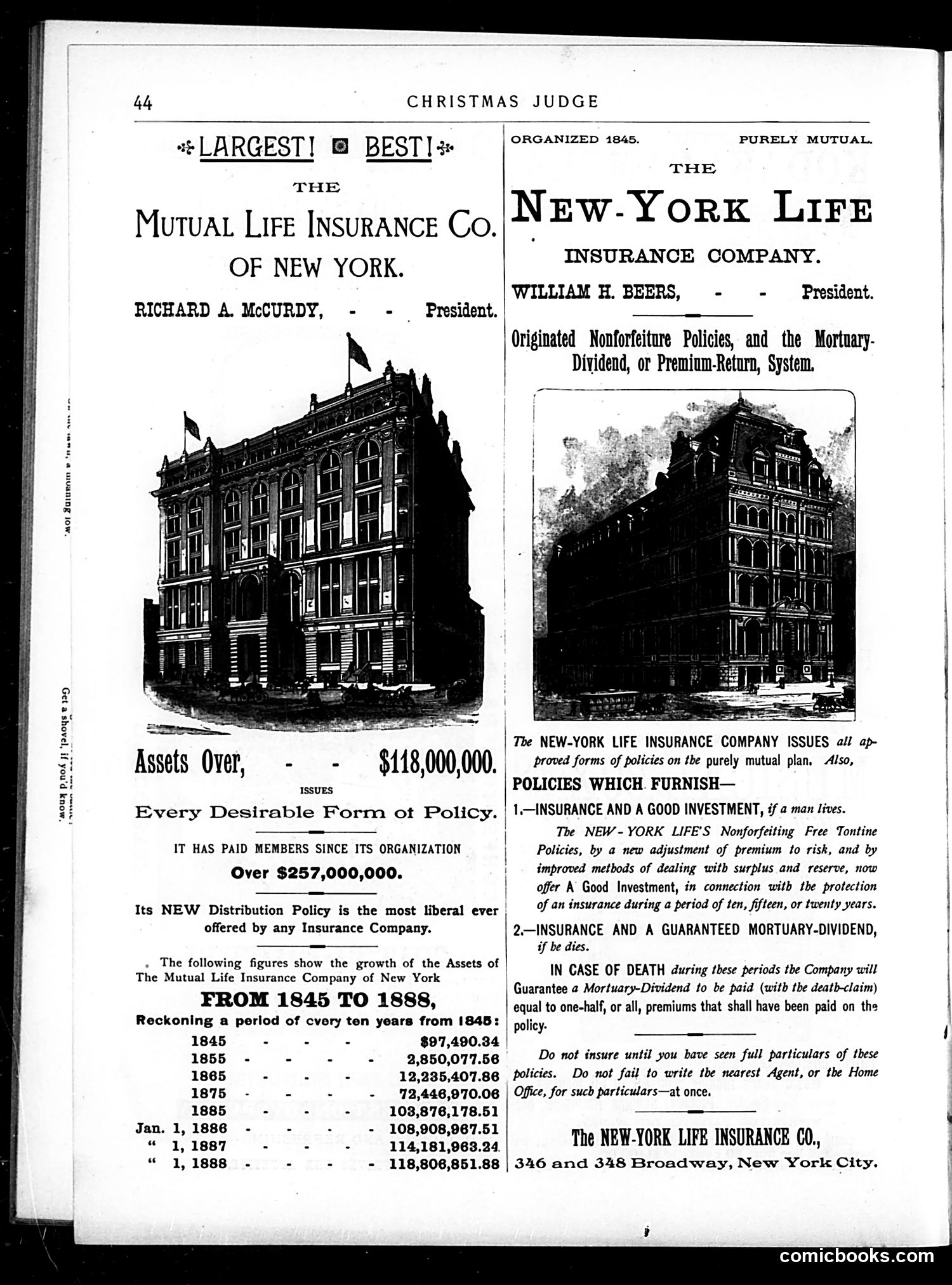
This is primarily **advertising copy**, not a satirical cartoon. The page features competing life insurance companies—Mutual Life Insurance Co. of New York (left, President Richard A. McCurdy) and New-York Life Insurance Company (right, President William H. Beers)—presenting their credentials to potential customers. Each company displays its headquarters building and boasts financial achievements: Mutual Life claims $118 million in assets and $257 million paid to members since 1845; New-York Life advertises innovative "Nonforfeiture" and "Mortuary-Dividend" policies offering both insurance protection and investment returns. The "LARGEST! BEST!" banner at top suggests competitive boasting typical of Gilded Age advertising. There is no apparent political satire or cartoon humor—this appears to be a **Christmas Judge issue** featuring holiday-season advertisements from major financial institutions seeking to reach affluent readers.
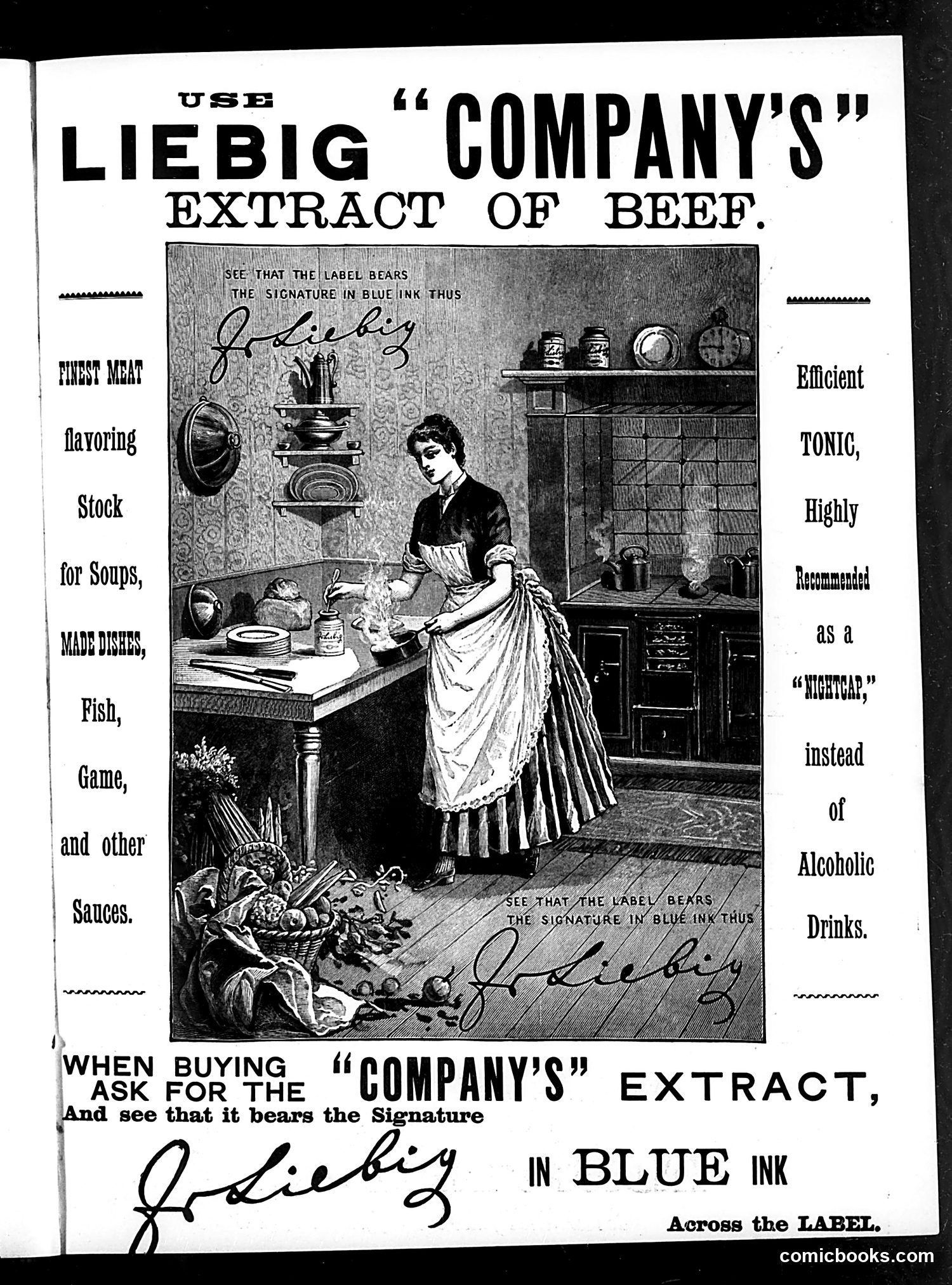
This is a **product advertisement**, not satire. It promotes Liebig Company's beef extract, a popular 19th-century food product and nutritional supplement. The ad emphasizes authenticity by repeatedly instructing buyers to verify the signature "J. Liebig" in blue ink on the label—combating counterfeit products, a common problem then. The imagery shows a Victorian-era woman in a kitchen using the extract for cooking. The right column makes a notable health claim: the extract is recommended as a "nightcap" *instead of alcoholic drinks*—reflecting contemporary attitudes about tonics and nutritional supplements as medicinal alternatives to alcohol, positioning the product within Victorian-era wellness culture. The left column lists culinary uses: soups, sauces, and gravies—the product's primary function as a flavor concentrate and cooking ingredient.
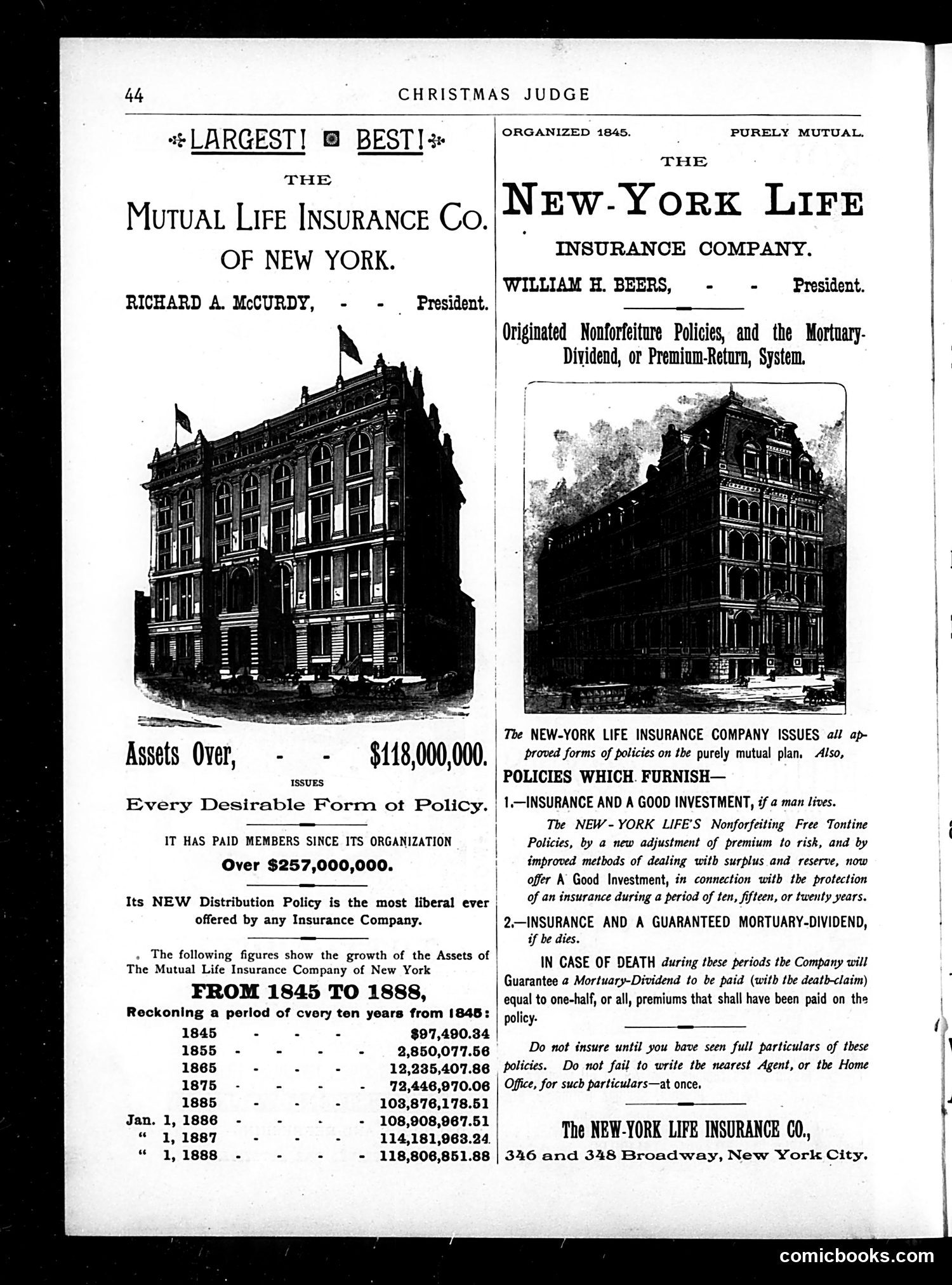
This page contains **no satire or cartoon**—it's a competitive advertising spread from Judge magazine's Christmas 1888 issue. Two major New York life insurance companies present side-by-side advertisements. The **Mutual Life Insurance Co.** (left), led by Richard A. McCurdy, showcases $118 million in assets and impressive growth figures from 1845–1888. The **New-York Life Insurance Company** (right), led by William H. Beers, emphasizes its innovation: "nonforfeiture policies" and "mortuary-dividend" systems—offering both investment returns during life and guaranteed death benefits. This reflects late-19th-century competition in the emerging life insurance industry. The "purely mutual" designation means policyholders shared profits, not external shareholders. The detailed asset growth and policy features suggest Judge's readers were educated, affluent men considering insurance options. The page demonstrates how satirical magazines monetized through premium advertisements targeting their upscale audience.
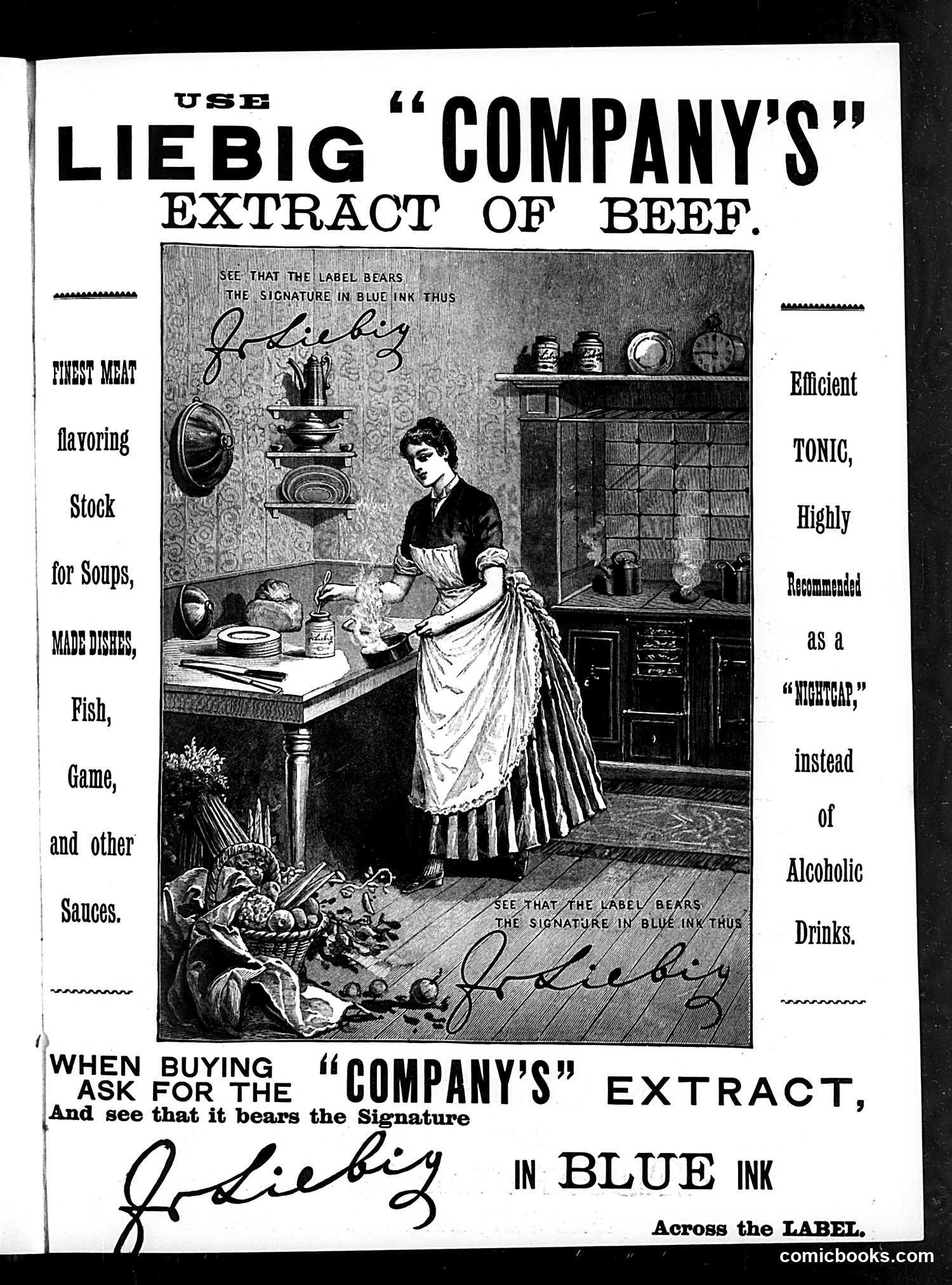
This is a **commercial advertisement**, not political satire. It promotes Liebig Company's beef extract as a cooking ingredient and health tonic. The ad features a Victorian-era kitchen scene with a woman preparing food. The central message emphasizes that authentic Liebig extract bears the company's signature in blue ink on the label—a anti-counterfeiting measure, as fake versions were apparently common enough to warrant this warning. The left sidebar lists the product's uses: soups, sauces, and dishes. The right side promotes it as a "nightcap" substitute for alcoholic drinks—a health claim typical of late-19th-century patent medicines and food extracts that marketed themselves as nutritious tonics.
This page contains two advertisements rather than satirical cartoons. The **Sohmer Pianos** ad (top) promotes the brand as popular among leading artists, listing New York showrooms and warerooms. The **Equitable Life Assurance Society** ad (bottom) emphasizes the company's size and reliability, claiming it "makes the most liberal contract" and issues "indisputable policies" while paying losses promptly. The appeal to "largest business" suggests competition among insurance companies of the era. Both ads reflect early 20th-century marketing strategies: associating products with prestige (artist endorsement for pianos) and emphasizing trustworthiness and financial stability (insurance company). The page demonstrates how Judge magazine generated revenue through paid advertisements alongside editorial content.

I can see this is a page from *Judge* magazine (as indicated by the watermark), but the image is almost entirely black or too dark to read clearly. The OCR text only provides the website "comicbooks.com," which appears to be a modern archive source rather than original magazine content. Without being able to discern the actual cartoon illustrations, text, or captions on the page itself, I cannot identify the specific figures, political references, or satirical points being made. To accurately explain this content to a modern reader, I would need a clearer, higher-contrast version of the image where the cartoons and their accompanying text are legible.