
Judge, 1888-12 · page 7 of 51
Judge — December 1888 — page 7: what you’re looking at
What you’re looking at
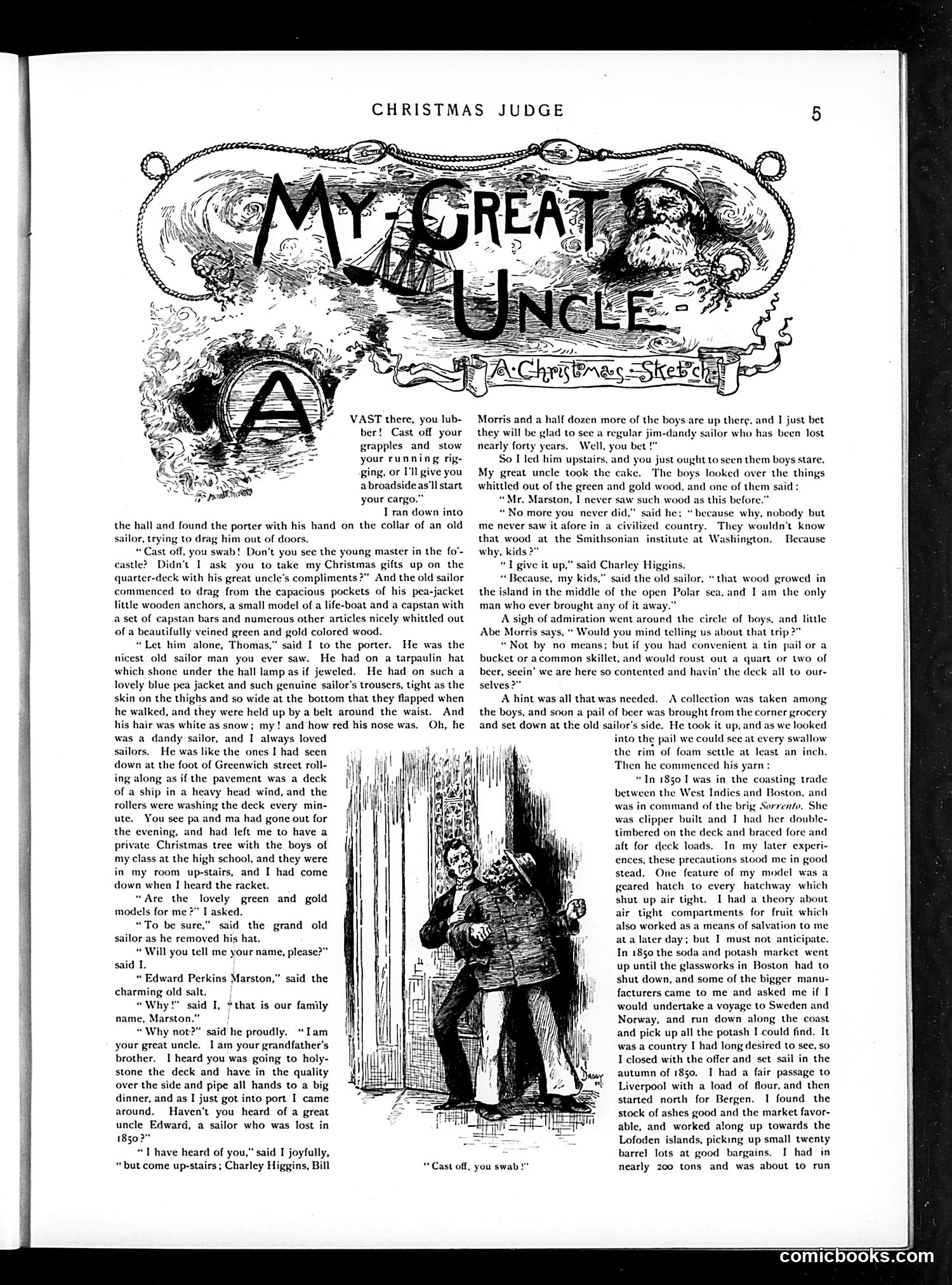
This is a humorous story rather than political satire, presenting a tall tale in the tradition of sailor yarn-spinning. The narrative follows a young boy who encounters an eccentric old sailor, Edward Perkins Marston, claimed to be his great uncle—supposedly lost at sea in 1850. The humor derives from the sailor's elaborate fabrications: he claims to have whittled wooden gifts from wood that grew on an island in the middle of the open Polar Sea, and boasts he's the only man who ever brought such material back to civilization. The exaggerated maritime dialect and character type—the romanticized, weathered old tar with colorful stories—were stock figures in 19th-century American humor magazines. The joke targets gullible audiences and the storytelling tradition itself, where improbable maritime adventures were told as fact.
📄 Transcribed text from this page (OCR, searchable)
Machine-transcribed from the original scan — historical spelling and the odd misread are preserved.
CHRISTMAS JUDGE VAST there, you lub- ber! Cast off your grapples and stow your running rig- ging, or I'll give you a broadside as'll start your cargo. T ran down into the hall and found the porter with his hand on the collar of an old sailor, trying to drag him out of doors. “Cast off, you swab! Don’t you see the young master in the fo'- Didn't I ask you to take my Christmas gifts up on the quarter-deck with his great uncle’s compliments 2” And the old sailor commenced to drag from the capacious pockets of his pea-jacket little wooden anchors, a small model of a life-boat and a capstan with a set of capstan bars and numerous other articles nicely whittled out of a beautifully veined green and gold colored wood. “Let him alone, Thomas,” said I to the porter. He was the nicest old sailor man you ever saw. He had on a tarpaulin hat which shone under the hall lamp as if jeweled. He had on such a lovely blue pea jacket and such genuine sailor’s trousers, tight as the skin on the thighs and so wide at the bottom that they flapped when he walked, and they were held up by a belt around the waist. And his hair was white as snow; my! and how red his nose was. Oh, he a dandy sailor, and I always loved sailors. He was like the ones I had seen down at the foot of Greenwich street roll- ing along as if the pavement a deck of a ship in a heavy head wind, and the rollers were washing the deck every min- ute. You see pa and ma had gone out for evening, and had left me to have a private Christmas tree with the boys of my class at the high school, and they were in my room up-stairs, and I had come down when I heard the racket. “Are the lovely green and gold models for me ?" I asked. “To be sure,” said the grand old sailor as he removed his hat. “ Will you tell me your name, please?” said I. “ Edward Perkins Marston,” said the charming old salt. “Why!” said I, that is our family name, Marston,” | “Why not?” said he proudly. “Tam your great uncle. I am your grandfather's brother. 1 heard you was going to holy- stone the deck and have in the quality over the side and pipe all hands to a big dinner, and as I just got into port I came around. Haven't you heard of a great uncle Edward, a sailor who was lost in 18502" “have heard of you,” said I joyfully, “but come up-stairs ; Charley Higgins, Bill “Cast off, you swab !" Morris and a half dozen more of the boys are up there, and I just bet they will be glad to see a regular jim-dandy sailor who has been lost nearly forty years. Well, you bet ! So I led him upstairs, and you just ought to seen them boys stare. My great uncle took the cake. The boys looked over the things whittled out of the green and gold wood, and one of them said : “Mr. Marston, I never saw such wood as this before.” “No more you never did,” said he; “because why, nobody but me never saw it afore in a civilized country. They wouldn't know that wood at the Smithsonian institute at Washington. Because why, kids ? “L give it up,” said Charley Higgin: “Because, my kids,” said the old sailor, “that wood growed in the island in the middle of the open Polar sea, and I am the only man who ever brought any of it away.” A sigh of admiration went around the circle of boys Abe Morris says, “ Would you mind telling us about that trip “Not by no means; but if you had convenient a tin pail or a bucket or acommon skillet, and would roust out a quart or two of beer, seein’ we are here so contented and havin’ the deck all to our- selves? A hint was all that was needed. A collection was taken among the boys, and soon a pail of beer was brought from the corner grocery and set down at tke old sailor's side. He took it up, and as v into the pail we could see at every s the rim of foam sett! Then he commenced his y id little “In 1850 I was in the coasting trade veen the West Indies and Boston, and command of the brig Sorre clipper built and I had her double- timbered on the deck and braced fore and aft for deck loads. In my later experi- ences, these precautions stood me in good stead. One feature of my model was a geared hatch to every ha which shut up air tight. I had a theory about air tight compartments for fruit which also worked as a means of salvation to me ata later day; but I must not anticipate. In 1850 the soda and potash market went up until the glassworks in Boston had to shut down, and some of the bigger manu- facturers came to me and asked me if I would undertake a voyage to Sweden and Norway, and run down along the coast and pick up all the potash I could find. It was a country I had long desired to see, so I closed with the offer and sct sail in the autumn of 1850. I had a fair passage to Liverpool with a load of flour, and then started north for Bergen. I found the stock of ashes good and the market favor- able, and worked along up towards the Lofoden islands, picking up small twenty barrel lots at good bargains. I had in nearly 200 tons and was about to run comicbooks.com